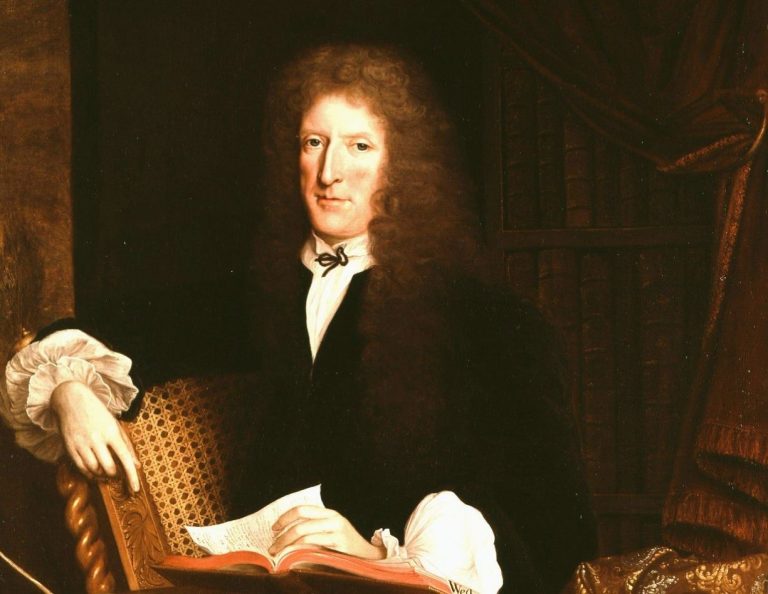

Rasse des Noeux was a considerable bibliophile and man of letters.

By Dr. Richard Aspin
Head of Research
Wellcome Library
Why do we often sign and date our books when we acquire them? It is not surely for fear that we will lose them and thus to ensure their safe return. Rather, it is to mark their place in our life’s trajectory: an individual volume takes on added meaning when we recall when and where we obtained it. In this sense, marks of ownership in books are a species of life writing. Maybe we also imagine a future reader perusing our personal book collection and gleaning some sense of who we were by the works we chose to acquire.
Many early printed books in the Wellcome Library bear such ownership inscriptions. Most are the inscriptions of individuals unknown to history. A very few are by people who are so well-known that the discovery of one of their books is unlikely to be of much research value. Perhaps more interesting is that sizeable category of owner who has left a number of traces, not least in ownership marks in books in various libraries, but whose life remains inchoate. In these circumstances, discovery and collation of a person’s books may go some way to retrieve a life from obscurity.
One such life is that of the Parisian surgeon François Rasse des Noeux (d. 1588), at least eight of whose books are now in the Wellcome Library. These books can be found on the Library catalogue through a keyword search for ‘rasse desneux’.
The volumes are by no means all medical, but include works of classical scholarship, philosophy and theology. One, a critical life of Cicero by the Italian classical scholar Sebastiano Corrado (d. 1556), has recently been digitised.
Rasse des Noeux was a considerable bibliophile and man of letters, whose ownership inscription can be found on volumes in libraries throughout Europe and North America.

Traces of his bibliographical interests can also be found in reports of auction sales, such as this report from 2005. Rasse des Noeux was a poet as well as a surgeon, and his verses were collected and published posthumously as ‘Recueil de poésies Calvinistes (1550–1566)’, ed. P. Tarbé (Reims, 1866). In addition to François, his brother Nicolas, also a surgeon, is represented on the Library’s shelves by his exquisite collection of coloured woodcuts of surgical instruments copied from Ambroise Paré’s ‘Dix livres de chirurgie’ (1564).

Both brothers eventually claimed the title of royal surgeon (as seen in Nicolas’s ownership inscription), because Nicolas attended the Valois court whilst François entered the service of Marguerite, queen of Navarre, wife of the future Henri IV.
A third, more senior member of the Rasse des Noeux dynasty of surgeons also makes an entrance in our collections, albeit at one remove. Two of the eight books owned by François that are now in the Library are early editions of works by Galen translated into Latin by Thomas Linacre. They are now bound together in a single volume (EPB 66183/D). The second work, ‘Galeni de sanitate tuenda’ (Paris, [1517]), was acquired by François in 1549. The first, ‘Galeni Methodus Medendi’ ([Paris], [1519]), originally belonged to his father.

François signed the book in 1562, presumably the date when he inherited it, but added a further note on the title-page concerning its earlier provenance: ‘dono dedit hoc volumen Rassio Noëo chirurgo Paris. Dom. Guill. Budens … 1519’ (‘Guillaume Budé gave this volume as a gift to Rasse des Noeux, surgeon of Paris, in 1519’). This book then was presented as a gift to François’s father, whose first name the inscription does not provide, by Guillaume Budé, dedicatee of the work, soon after its publication.
Pursuit of ownership marks in books can thus begin the work of reconstructing lives that were once at the centre of the intellectual world, but whose identities and scholarly activities have since been dissolved into a myriad of modern collections. After all, we still do not know the Christian name of François’s father, even though he was clearly a confidant or protégé of Budé. As library catalogues are enriched with more provenance information, and collections are increasingly put online, it is nice to think that more and more forgotten lives will be brought to light.
Originally published by Wellcome Library, 07.31.2015, under the terms of Creative Commons Attribution 4.0 International license.
About the Author