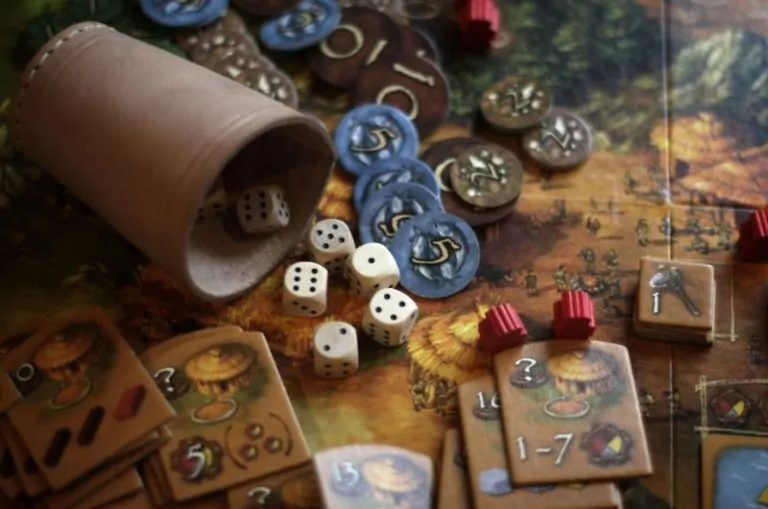
Games of chance emerged long before formal casinos. Archaeological evidence indicates that ancient societies used marked sticks, knucklebones, and dice for millennia before probability became a mathematical discipline.
The shift was conceptual: chance evolved from an expression of divine will into a measurable phenomenon that could be priced and, eventually, generated by software.
Ancient games mixed skill, chance and belief
Early game boards often blurred the lines between recreation, status, ritual, and divination. The Royal Game of Ur, dating to 2600 BCE, used tetrahedral dice to determine player movement along a race board.
In many ancient cultures, unpredictable results represented more than mere luck; they were seen as communication with forces beyond human control.
| Ancient object or game | Approximate period | Role of chance |
| Royal Game of Ur | c. 2600 BCE | Tetrahedral dice determined movement |
| Senet | Predynastic Egypt onward | Throw sticks controlled progression |
| Hounds and Jackals | c. 2000 BCE | Probable race mechanic |
| Liubo | Han dynasty | Dice, counters and board play |
| Roman dice | 1st–3rd century CE | Gaming, gambling and divination |
Egypt turned the game board into a journey
Senet, popular in Egypt for thousands of years, eventually became associated with the journey into the afterlife. The board featured 30 squares in three rows, with movement dictated by throw sticks or knucklebones.
Evidence of Senet grids scratched into floors suggests the game reached all social classes. Many boards were portable, often featuring a second game on the reverse side.
Dice travelled because their logic was portable
Dice require no shared language, making them highly portable across cultures. While Roman six-sided dice are familiar, antiquity also produced polyhedral forms, including twenty-sided dice marked with Greek or Latin numbers.
Roman dice also served divinatory purposes, sometimes paired with oracles that provided written advice based on numerical results. This history led to the development of dice towers to prevent manipulation during play.
Cards made chance easier to combine with strategy
Playing cards, reaching Europe in the late 14th century via Asia and the Islamic world, expanded gaming possibilities by supporting chance, memory, and strategy in a single deck.
Unlike dice, cards encouraged rule invention, allowing variations in hand hierarchy and betting. This flexibility established the categories of chance-dominant, mixed, and skill-dominant games.
Skill in these games becomes visible through repetition, as individual results cannot always reveal the quality of a player’s decision against short-term variance.
Gambling problems helped create probability theory
Probability emerged from the need to solve practical gambling disputes. In 1654, Blaise Pascal and Pierre de Fermat’s correspondence on the “problem of points” established the foundations of modern probability theory.
Their work addressed how to fairly divide stakes when a game ends early, requiring a shift toward accounting for all plausible future outcomes rather than just the current leader.
Expected value changed the language of games
Expected value describes the average mathematical direction over many repetitions. It does not predict a single round’s result but defines the long-term mathematical structure of a game.
Consider a simplified game:
| Outcome | Probability | Net result | Weighted value |
| Win | 40% | +₹100 | +₹40 |
| Lose | 60% | −₹100 | −₹60 |
| Expected value | −₹20 |
A player may still win the next round. The expected value describes the average mathematical direction across many repetitions.
Casinos industrialized game consistency
Purpose-built casinos standardized rules, dealing procedures, equipment and payment. That consistency allowed operators and players to understand the mathematical structure before play began.
The house edge is not the same as a guaranteed result for every session. It represents the operator’s expected mathematical advantage over repeated wagers under the stated rules.
A digital casino online applies the same principle without relying on physical cards, wheels or dice for every outcome. The player should be able to inspect the game rules, paytable and feature conditions before choosing a title. Volatility affects how unevenly results may arrive, while RTP describes a long-run theoretical percentage rather than a return promised to one account. These distinctions matter more than animation because they explain the actual mechanics beneath the presentation.
A visually calm game may still have high volatility. A rapid game can use the same RTP as a slower one while producing more decisions per hour.
Mechanical randomness gave way to software
Digital games replace mechanical randomness with Random Number Generators (RNGs). Regulated RNGs are tested to ensure results are correctly distributed, independent, and computationally unpredictable.
A regulated RNG is not accepted merely because the output looks irregular. Testing examines whether results are distributed correctly, statistically independent and computationally unpredictable.
The UK Gambling Commission requires RNG-driven remote casino products to submit game and RNG test results. Its technical rules state that outputs must be “acceptably random,” unpredictable and resistant to repeating or synchronized streams.
Nevada’s revised 2026 technical standards require newer gaming devices approved from 2027 onward to use cryptographically secure random-number generation and pass recognized tatistical test batteries.
The app changed access, not the mathematics
Mobile technology facilitates access but doesn’t alter the math. A user reviewing a MelBet app apk should prioritize source verification and available game data over visual effects.
Modern technology has made fairness more testable through large-scale evaluation by independent laboratories. Across four millennia, the central question remains unchanged: can the mechanism be trusted?
About the Author