Hesitancy is driven by misinformation and disinformation.

By Dr. Steven Woolf
Senior Fellow
The Center for American Progress

By Jill Rosenthal
Director, Public Health
The Center for American Progress
Introduction
The introduction of routine childhood immunization in the 20th century is heralded as one of the greatest success stories in public health. Few other measures have been as impactful and cost effective in controlling and preventing disease, improving health and quality of life, and extending lifespan.1 A 2024 study published in The Lancet estimated that vaccines have saved 154 million lives globally since 1974, comparable to a rate of six lives every minute. Of those saved lives, 95 percent were children younger than 5 years old.2
Perhaps partly owing to the success of this effort in slashing the rate of once common diseases, many parents today may take vaccines for granted. The percentage of parents who consider it “very” or “extremely important” for their children to get vaccinated fell from 94 percent in 2001 to 69 percent in 2024.3 They may not remember that the infectious diseases that modern vaccines prevent—which, thankfully, are now rare—once claimed the lives of millions of U.S. children or left them disabled.4
Despite the tremendous successes of these vaccines—which required years of rigorous testing, an intensive approval process before use, and are subject to ongoing safety monitoring—many Americans now express concerns about vaccine safety, fueled increasingly by misinformation circulating on social media5 and the false claims of public figures.6 This skepticism is fueling decreased vaccine uptake, setting the stage for more outbreaks of vaccine-preventable disease.
Without action, vaccine hesitancy and declining childhood vaccination coverage rates could make now rare diseases common again, threatening progress in protecting children from severe disease and death.
Vaccines Prevent Disease, Save Lives, and Yield Net Savings
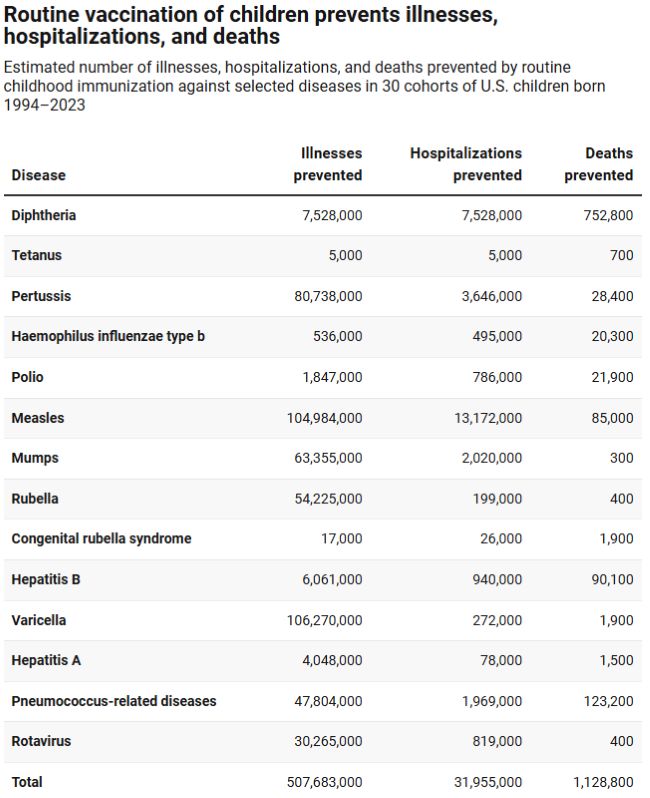
Routine childhood immunization is highly effective at preventing disease, not only during childhood but throughout a person’s lifetime. Approximately 117 million children were born in the United States between 1994 and 2023.7 Researchers estimate that, over the lifetimes of those children, receiving routine vaccinations will prevent more than 508 million cases of illness (averaging four illnesses per child), 32 million hospitalizations, and 1 million deaths.8 (see Table 1)
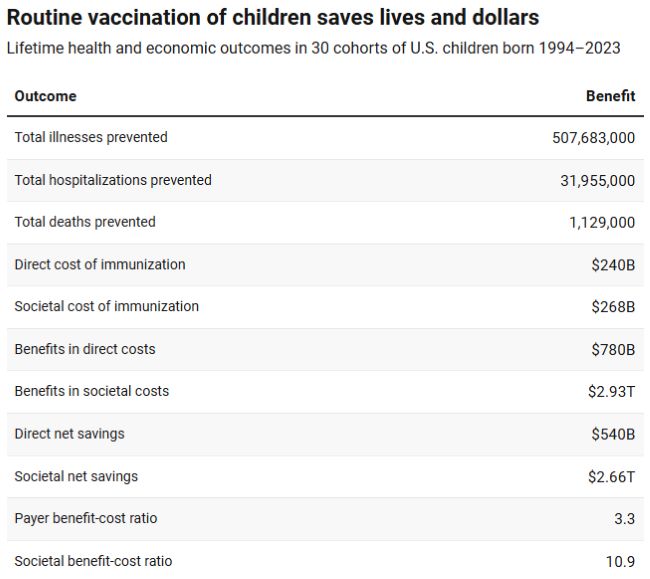
These outcomes will result in a net savings of $540 billion in direct costs and $2.7 trillion in societal costs.9 (see Table 2) In fact, researchers estimate that every dollar spent on childhood vaccination saves $3 in direct medical care and more than $10 in societal costs, such as special education programs for children who are harmed by vaccine-preventable disease, lost wages due to disability, and lost parent wages.10
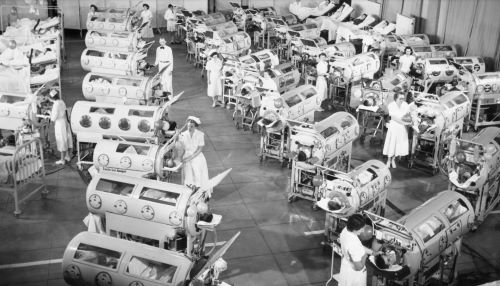
The polio vaccine is among the immunizations that today’s children routinely receive. Before that vaccine became available in the 1950s, thousands of U.S. children died from polio every year,11 including the largest polio epidemic in 1953, which resulted in 58,000 cases and 3,100 deaths.12 In 1952 and 1953, 44 percent and 37 percent of victims were left paralyzed, respectively.13
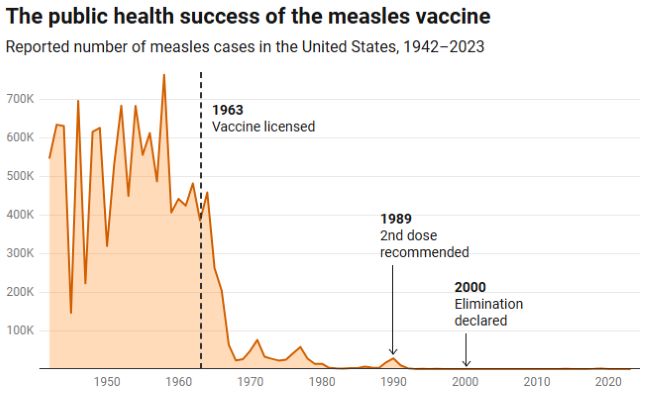
Today’s immunizations also include the measles vaccine. Before measles vaccination became widespread in the 1960s, 3 million to 4 million people in the United States were infected each year, 48,000 were hospitalized, and 400 to 500 died.14 (see Figure 1)
As recently as the 1980s, about 20,000 children younger than age 5 developed severe infections from Haemophilus influenzae type b (Hib), a bacteria that can cause potentially fatal meningitis, and about 1,000 died each year from Hib disease in the 1980s.15 Manufacturers introduced an effective Hib vaccine in the mid-1980s, and by 2006, routine vaccination of children had reduced the number of annual Hib cases to 29. Childhood vaccines also prevent and protect against mumps; rubella; human papillomavirus, which can cause cancers;16 hepatitis A and B; tetanus; diphtheria; pertussis (whooping cough); and other diseases.17
Requiring Vaccines for School Entry Is Critical to Increasing Vaccination Rates and Preventing Disease
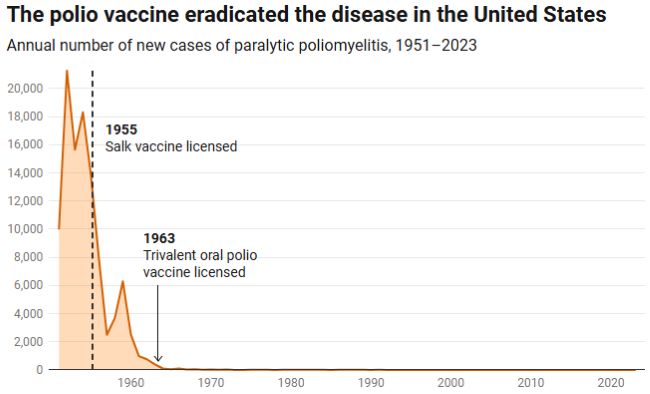
Schools are especially fertile settings for infectious diseases to spread among children and teachers. As early as the 1800s, schools began requiring children to be vaccinated to efficiently protect them from disease and to prevent diseases from spreading throughout communities.18 In 1905, the U.S. Supreme Court ruled in Zucht v. King that states have the authority to require vaccination for school entry to protect the common welfare.19 After Jonas Salk discovered the polio vaccine in the early 1950s, parents’ eagerness to get their children vaccinated resulted in mass vaccination campaigns in schools and a dramatic reduction in polio cases.20 As a result, by 1961, 53.6 percent of the U.S. population was fully vaccinated against polio, and the number of annual polio cases fell from 28,985 in 1955 to 1,312 in 1961.21 (see Figure 2) Since 1980, every state and the District of Columbia have required documentation of immunizations for children to attend public school.22
School Vaccine Exemption Rates Are Rising, and Vaccination Coverage Rates among Children Are Declining, Increasing the Risk of Preventable Disease Outbreaks
Although all 50 states have public school vaccine requirements, most states permit nonmedical exemptions based on religious or personal beliefs to accommodate individual parents’ requests.23 Vaccine exemptions elevate the risk of transmission and outbreaks, increasing infectious diseases among not only the children who forego vaccination but also other children and educators in their school and the entire community in which they live.
High vaccination rates, then, not only protect individual children from vaccine-preventable diseases but also maintain herd immunity. The herd immunity rate refers to the percentage of the population that must be immunized to prevent disease transmission and thus provide some protection even for those who lack immunity in spite of being vaccinated or otherwise having compromised immune systems, such as cancer patients.24 For example, 95 percent of the population must be vaccinated against measles to provide herd immunity and prevent community transmission of this highly contagious and life-threatening illness.25 Since the 2019-20 school year, kindergartener vaccine coverage rates for measles, mumps, and rubella (MMR) have fallen below the threshold of 95 percent, threatening herd immunity from measles.26 Thirty-nine states saw vaccination rates fall below that threshold in the 2023-24 school year, an increase from 28 states during the 2019-20 school year.27 The trend occurs for other childhood vaccines as well: During the 2023-24 school year, less than 93 percent of kindergarten children were up to date on their state-required vaccines compared with 95 percent in the 2019-20 school year.28
High exemption rates carry risks. A 1999 study of school-aged children (ages 5 to 19) found that those who were exempted from vaccinations were 35 times more likely than those who were vaccinated to contract measles during 1985–1992 and that residents of communities with high concentrations of exemptors were themselves at greater risk because of increased exposure.29 Researchers found that exemptors were 22.2 times more likely than vaccinated children to acquire measles and 5.9 times more likely to acquire pertussis.30
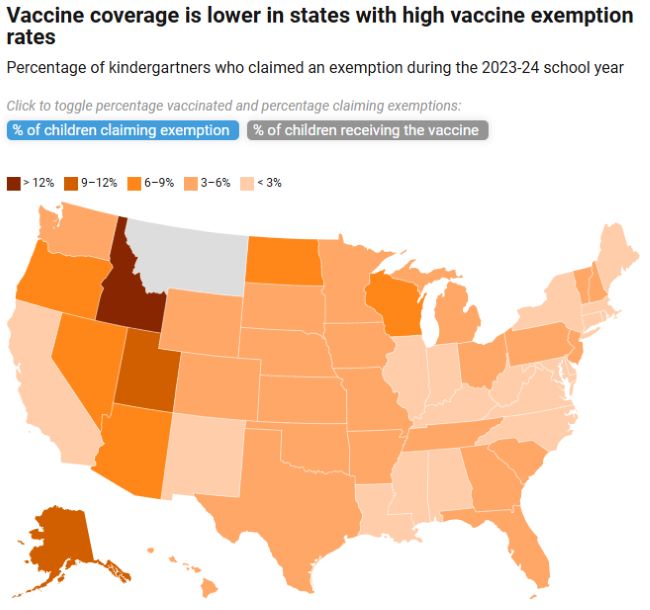
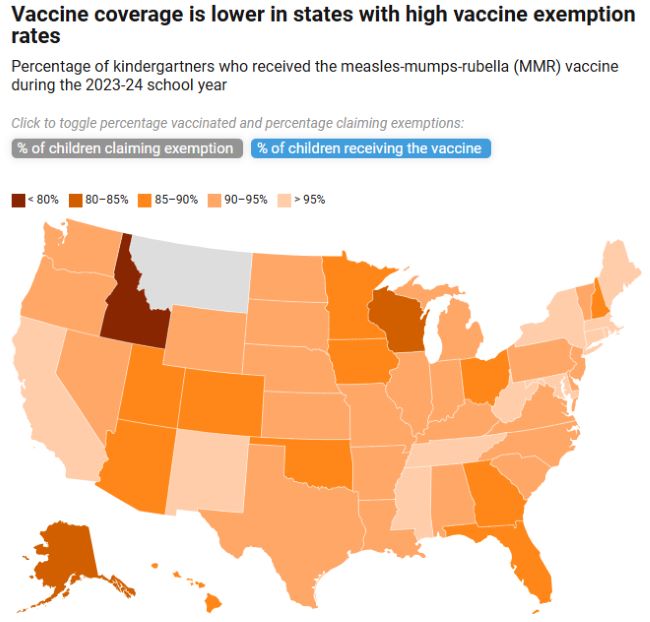
The share of kindergarten children with nonmedical exemptions from one or more required vaccinations has increased since 2019.31 In the case of measles, as exemptions increase and more unvaccinated children attend school, outbreaks are becoming more frequent.32 According to the U.S. Centers for Disease Control and Prevention, 16 measles outbreaks—defined as three or more related cases—occurred in 2024 as of December 20, compared with four outbreaks in 2023.33 As many as 40 percent of the cases in 2024 were severe enough to require hospitalization.34 To prevent these outbreaks and protect herd immunity, some states have responded by setting limits on—or tightened requirements for—the types of nonmedical exemptions. States with stricter restrictions on nonmedical exemptions are among those with the highest vaccination rates. (see Figure 3) Some examples include:
- Mississippi and West Virginia, the only states that have barred nonmedical school vaccine exemptions for more than 30 years (1979–2015), have maintained some of the highest childhood vaccination rates in the country for decades.35 Mississippi ended its policy in 2023,36 while West Virginia has maintained its policy and is among five states that only permit medical exemptions.37
- In 2016, following a measles outbreak in 2014–2015, California eliminated nonmedical exemptions, resulting in a 3.3 percentage-point increase in the MMR vaccination rate, raising the vaccination rate above the measles herd immunity level.38
- Maine eliminated personal and religious exemptions for school vaccines in 2019.39 The percentage of kindergarten students with any exemption—for diphtheria, tetanus, and pertussis; polio; MMR; and varicella-zoster virus—fell from 4.6 percent in the 2019-20 school year to 1.3 percent in the 2021-22 school year when the law was implemented.40 In April 2024, the Maine Center for Disease Control and Prevention announced that more than 95 percent of school-age children had received all required vaccines, reaching the herd immunity levels for the first time since reporting began in 2011.41
Vaccine Misinformation Campaigns and Influencers Are Fueling Vaccine Hesitancy, Threatening Gains in Vaccine Acceptance and Coverage
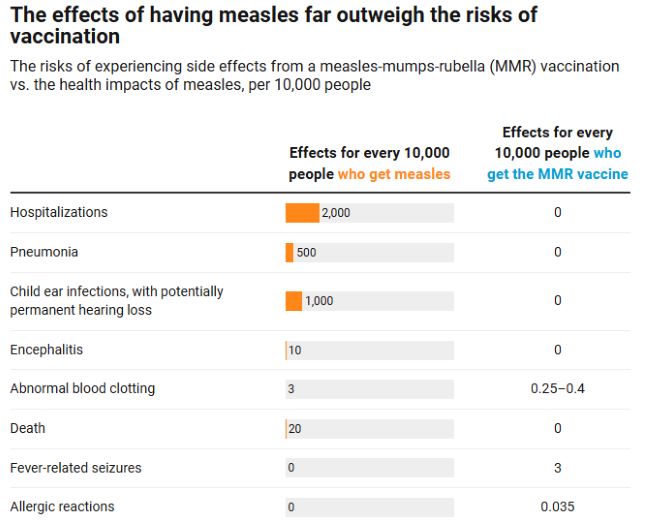
Vaccines cannot be licensed in the United States without rigorous testing to ensure that they are effective and that benefits far outweigh the risks. Federal programs such as the Vaccine Adverse Event Reporting System (VAERS), established in 1990, conduct nationwide surveillance procedures on every vaccine administered and monitor the rate of vaccine complications to ensure their safety.42 Decades of scientific research have shown that the lives that vaccines have saved and the major disabilities they prevent far outweigh the small risk of complications.43 Children are far more likely to die from an infectious disease if left unvaccinated than to experience side effects from vaccines. For example, for every 10,000 people who get measles, 10 to 30 children will die, 2,000 people will be hospitalized, and more than 1,500 children will experience serious illnesses, some causing long-term disability.44 In contrast, for every 10,000 people who get the MMR vaccine to protect against measles, less than four people will experience a fever-related seizure, abnormal blood clotting, or an allergic reaction.45 In the United States, the lifetime risk of being killed by lightning is approximately four times greater than experiencing an allergic reaction to the MMR vaccine.46
Yet survey results from the Annenberg Public Policy Center for 2021 through 2023 show a declining percentage of adults who think vaccines approved for use in the United States are safe, and a growing percentage of Americans have been convinced that vaccines contain toxins and can cause disease.47 This declining confidence in vaccine safety is driven by growing vaccine misinformation and disinformation, spread by people on social media who discredit vaccines, circulate disproved medical claims and conspiracies, and distort information.48 Despite claims to the contrary, vaccine data are transparent. For many years, the American public has been able to access extensive data and research on vaccine safety.49 VAERS de-identified data are available online through the CDC’s VAERS WONDER system.50 Step-by-step instructions and instructional videos are available to support users.
Vaccines have saved millions of lives, yet vaccine hesitancy threatens to roll back decades of progress. Federal, state, and local policymakers who embrace discredited vaccine beliefs could jeopardize long-standing childhood immunization programs by imposing barriers to access or acceptability of vaccines.51 For instance, threats to withhold federal funding to states that maintain strong and effective school vaccine requirements,52 or new proposed laws that loosen vaccine requirements,53 could entice parents to seek exemptions, threatening herd immunity. The rise in vaccine hesitancy could also threaten support for the federally funded Vaccines for Children program54 and Section 317 funding,55 which have helped ensure that children from low-income families are adequately immunized.
Policymakers and leaders must counter disinformation; restore trust; and bolster vaccine confidence to strengthen support for school vaccination requirements; increase vaccine coverage rates; safeguard herd immunity; and protect the health of individuals, families, communities and the economy. Trusted community leaders—including health care providers, school staff, and faith-based organizations—can counter misinformation and bolster vaccine confidence by engaging families and community leaders in conversations; listening respectfully to their concerns; and providing timely, accurate, culturally sensitive, and evidence-based information in accessible languages. According to a Pew Research Center survey conducted in March 2023, 88 percent of adults had “a lot” or “some” confidence in their health care provider to accurately present childhood vaccine benefits and risks, and those with the highest level of confidence were also the most confident about the benefits of the MMR vaccines.56 Trusted community and political leaders should direct public attention to reliable information on the safety profile of vaccines, which has been publicly available for decades, to help strengthen confidence in the benefit-risk ratio of vaccines and to refute unfounded claims that important data are being withheld from the public.
Policymakers must defend and robustly support programs and policies to promote routine childhood immunization, such as state laws that mandate immunization for K-12 students and new entrants to college and that set limits on nonmedical exemptions. Policymakers must also ensure sustainability and resources for federal programs that provide access to vaccination for children through the Vaccines for Children and Section 317 programs.
Conclusion
Vaccine-preventable disease once caused widespread death and permanent disabilities such as brain damage, paralysis, infertility, hearing loss, and other complications.57 With the rise in vaccine misinformation campaigns, influencers fueling hesitancy, and vaccine deniers who are likely to assume powerful political positions within the federal government, it is more critical than ever to remain focused on effective strategies to protect children from a resurgence of diseases that vaccines once eradicated and the emergence of new diseases that could threaten their health.
Endnotes
- C Lee Ventola, “Immunization in the United States: Recommendations, Barriers, and Measures to Improve Compliance: Part 1: Childhood Vaccinations,” P&T 41 (7) (2016): 426–236, available at https://www.ncbi.nlm.nih.gov/pmc/articles/PMC4927017/.
- Andrew Shattock and others, “Contribution of vaccination to improved survival and health: modelling 50 years of the Expanded Programme on Immunization,” The Lancet 403 (10441) (2024): 2307–2316, available at https://www.thelancet.com/action/showCitFormats?doi=10.1016%2FS0140-6736%2824%2900850-X&pii=S0140-6736%2824%2900850-X; Tara Haelle, “The Staggering Success of Vaccines,” Scientific American, October 15, 2024, available at https://www.scientificamerican.com/article/see-how-many-lives-vaccines-have-saved-around-the-world/.
- Jeffrey M. Jones, “Far Fewer in U.S. Regard Childhood Vaccinations as Important,” Gallup, August 7, 2024, available at https://news.gallup.com/poll/648308/far-fewer-regard-childhood-vaccinations-important.aspx.
- Fangjun Zhou and others, “Health and Economic Benefits of Routine Childhood Immunizations in the Era of the Vaccines for Children Program — United States, 1994–2023,” Morbidity and Mortality Weekly Report 73 (31) (2024): 682–685, available at https://www.cdc.gov/mmwr/volumes/73/wr/mm7331a2.htm#:~:text=Among%20approximately%20117%20million%20children,%242.7%20trillion%20in%20societal%20costs.
- Kai Ruggeri and others, “Behavioural Interventions To Reduce Vaccine Hesitancy Driven By Misinformation On Social Media,” BMJ 384 (2024), available at https://www.bmj.com/content/384/bmj-2023-076542.
- Lauren Weber, Lena H. Sun and David Ovalle, “10 RFK Jr. Conspiracy Theories And False Claims, In His Own Words,” The Washington Post, November 15, 2024, available at https://www.washingtonpost.com/health/2024/11/15/rfk-jr-views-conspiracies-false-claims/.
- Zhou and others, “Health and Economic Benefits of Routine Childhood Immunizations in the Era of the Vaccines for Children Program — United States, 1994–2023.”
- Ibid.
- Ibid.
- Fangjun Zhou and others, “Economic evaluation of the routine childhood immunization program in the United States, 2009,” Pediatrics 133 (4) (2014): 577–585, available at https://publications.aap.org/pediatrics/article-abstract/133/4/577/32731/Economic-Evaluation-of-the-Routine-Childhood?redirectedFrom=fulltext.
- World Health Organization, “History of the Polio Vaccine,” available at https://www.who.int/news-room/spotlight/history-of-vaccination/history-of-polio-vaccination#:~:text=In%20the%20late%2019th%20and,the%20disease%20faced%20lifelong%20consequences (last accessed December 2024).
- Davide Orsini and others, “The History Of Polio Vaccination With ‘Sabin’s OPV’ 60 Years After Its Introduction In Italy: An Unforgivable ‘Delay,’” Journal of Preventive Medicine and Hygiene 65 (1) (2024): E105–E112, available at https://pmc.ncbi.nlm.nih.gov/articles/PMC11066819/.
- C. C. Dauer, “Poliomyelitis in the United States, 1953,” Public Health Reports, 69 (12) (1954): 1185–1186, available at https://stacks.cdc.gov/view/cdc/72071.
- U.S. Centers for Disease Control and Prevention, “History of Measles,” May 9, 2024, available at https://www.cdc.gov/measles/about/history.html (last accessed December 2024).
- The College of Physicians of Philadelphia, “History of Vaccines, Hib (Haemophilus Influenzae Type B),” available at https://historyofvaccines.org/diseases/hib-haemophilus-influenzae-type-b (last accessed December 2024).
- U.S. Centers for Disease Control and Prevention, “About HPV,” available at https://www.cdc.gov/hpv/about/index.html (last accessed December 2024).
- U.S. Centers for Disease Control and Prevention, “Diseases That Vaccines Protect Against,” August 9, 2024, available at https://www.cdc.gov/vaccines-children/diseases/index.html.
- Philip J Smith, David Wood, and Paul M Darden, “Highlights Of Historical Events Leading To National Surveillance Of Vaccination Coverage In The United States,” Public Health Reports 126 (Supp 2) (2011): 3–12, available at https://pmc.ncbi.nlm.nih.gov/articles/PMC3113425/
- Ibid.
- Ibid.
- M G Sirken and B Brenner, “Population Characteristics And Participation In The Poliomyelitis Vaccination Program,” Public Health Monogram 61 (1960): 1–37; available at https://pubmed.ncbi.nlm.nih.gov/14447183/; U.S. Centers for Disease Control and Prevention, “Reported Incidence of Notifiable Diseases in the United States, 1961,” Morbidity and Mortality Weekly Report 10 (53) (1962): 7, available at https://stacks.cdc.gov/view/cdc/1427. The annual number of polio cases should not be confused with annual number of paralytic polio cases shown in Figure 2.
- Lois A. Weithorn and Dorit Rubinstein Reiss, “Legal Approaches To Promoting Parental Compliance With Childhood Immunization Recommendations,” Human Vaccines & Immunotherapies 14 (7) (2018): 1610–1617, available at https://pmc.ncbi.nlm.nih.gov/articles/PMC6067842/#:~:text=By%201980%2C%20all%20fifty%20states,an%20increasing%20number%20of%20diseases.
- Robert A Bednarczyk, Adrian R King, Ariana Lahijani, and Saad B Omer, “Current Landscape Of Nonmedical Vaccination Exemptions In The United States: Impact Of Policy Changes,” Expert Review of Vaccines 18 (2) (2019):175–190, available at https://pmc.ncbi.nlm.nih.gov/articles/PMC6386772/.
- Association for Professionals in Infection Control and Epidemiology, “Infection Prevention and You: Herd immunity,” available at https://www.apic.org/Resource_/TinyMceFileManager/for_consumers/IPandYou_Bulletin_Herd_immunity.pdf (last accessed January 2025).
- U.S. Centers for Disease Control and Prevention, “Assessing Measles Outbreak Risk in the United States,” April 4, 2024, available at https://www.cdc.gov/ncird/whats-new/measles-outbreak-risk-in-us.html.
- Elizabeth Williams and Jennifer Kates, “Childhood Vaccination Rates Continue to Decline as Trump Heads for a Second Term,” KFF, Nov 18, 2024, available at https://www.kff.org/policy-watch/childhood-vaccination-rates-continue-to-decline-as-trump-heads-for-a-second-term/.
- Ibid.
- Ranee Seither and others, “Coverage with Selected Vaccines and Exemption Rates Among Children in Kindergarten — United States, 2023–24 School Year,” Morbidity and Mortality Weekly Report 73 (41) (2024): 925–932, available at https://www.cdc.gov/mmwr/volumes/73/wr/mm7341a3.htm.
- Daniel A. Salmon and others, “Health Consequences of Religious and Philosophical Exemptions From Immunization Laws,” JAMA 282 (1) (1999): 47–53, available at https://jamanetwork.com/journals/jama/fullarticle/190649.
- DR Feikin and others, “Individual And Community Risks Of Measles And Pertussis Associated With Personal Exemptions To Immunization,” JAMA 284 (24) (2000): 3145–3150, available at https://pubmed.ncbi.nlm.nih.gov/11135778/.
- Ranee Seither and others, “Vaccination Coverage with Selected Vaccines and Exemption Rates Among Children in Kindergarten — United States, 2021–22 School Year,” Morbidity and Mortality Weekly Report 72 (2) (2023): 26–32, available at https://www.cdc.gov/mmwr/volumes/72/wr/pdfs/mm7202-H.pdf.
- U.S. Centers for Disease Control and Prevention, “Assessing Measles Outbreak Risk in the United States,” April 4, 2024, available at https://www.cdc.gov/ncird/whats-new/measles-outbreak-risk-in-us.html (last accessed December 2024).
- U.S. Centers for Disease Control and Prevention, “Measles Cases and Outbreaks,” available at https://www.cdc.gov/measles/data-research/index.html (last accessed December 2024).
- Ibid.
- James Colgrove and Abigail Lowin, “A Tale Of Two States: Mississippi, West Virginia, And Exemptions To Compulsory School Vaccination Laws,” Health Affairs 35 (2) (2016): 348–355, available at https://pubmed.ncbi.nlm.nih.gov/26858391/.
- Mississippi State Department of Health, “Religious Exemptions for Immunizations Available,” Press release, July 14, 2023, available at https://msdh.ms.gov/page/23,25673,341,802.html#:~:text=JACKSON%20%2D%20The%20Mississippi%20State%20Department,order%20entered%20in%20April%202023.
- Immunize.org, “Exemptions Permitted for State Childcare and School (K–12) Immunization Requirements,” available at https://www.immunize.org/wp-content/uploads/laws/exemptions-ccsch-rqt-map-2024.pdf (last accessed December 2024).
- Ezekiel J. Emanuel and Matthew Guido, “Covid Isn’t the Only Reason Children’s Vaccination Rates Are Falling,” The New York Times, December 28, 2023, available at https://www.nytimes.com/2022/12/28/opinion/vaccination-childhood-disease.html.
- State of Maine Legislature, “Summary of LD 798,” available at https://legislature.maine.gov/LawMakerWeb/summary.asp?LD=798&SessionID=13 (last accessed December 2024).
- Maine Department of Health and Human Services, “2019-2020 Maine School Immunization Assessment Report” (Augusta, ME: 2020), available at https://www.maine.gov/dhhs/mecdc/infectious-disease/immunization/publications/2019-2020-School-Age-Immunization-Assessment-Report.pdf; Maine Department of Health and Human Services, “2021-2022 Maine School Immunization Assessment Report” (Augusta, ME: 2021), available at https://www.maine.gov/dhhs/mecdc/infectious-disease/immunization/publications/2021/2021-2022%20Maine%20School%20Immunization%20Assessment%20Report.pdf.
- Maine Department of Health and Human Services, “Maine Achieves Record High Immunization Rates for School Children,” Press release, April 23, 2024, available at https://www.maine.gov/dhhs/news/maine-achieves-record-high-immunization-rates-school-children-tue-04232024-1200#:~:text=AUGUSTA%E2%80%93%20The%20Maine%20Center%20for,since%20reporting%20began%20in%202011.
- U.S. Department of Health and Human Services, “About VAERS,” available at https://vaers.hhs.gov/about.html (last accessed December 2024).
- Sandra E. Talbird and others, “Impact of Routine Childhood Immunization in Reducing Vaccine-Preventable Diseases in the United States,” Pediatrics 150 (3) (2022), available at https://publications.aap.org/pediatrics/article/150/3/e2021056013/188495/Impact-of-Routine-Childhood-Immunization-in.
- Peter J. Hotez, “You Are Unvaccinated and Got Sick. These Are Your Odds,” The New York Times, January 9, 2020, available at https://www.nytimes.com/2020/01/09/opinion/vaccine-hesitancy.html.
- Ibid.
- Ibid.
- Annenberg Public Policy Center, “Vaccine Confidence Falls as Belief in Health Misinformation Grows,” University of Pennsylvania, November 1, 2023, available at https://www.annenbergpublicpolicycenter.org/vaccine-confidence-falls-as-belief-in-health-misinformation-grows/.
- Shannon Bond, “Just 12 People Are Behind Most Vaccine Hoaxes On Social Media, Research Shows,” NPR, May 14, 2021, available at https://www.npr.org/2021/05/13/996570855/disinformation-dozen-test-facebooks-twitters-ability-to-curb-vaccine-hoaxes.
- American Academy of Pediatrics, “Vaccine Safety: Examine the Evidence,” November 21, 2024, available at https://www.healthychildren.org/English/safety-prevention/immunizations/Pages/Vaccine-Studies-Examine-the-Evidence.aspx, https://www.cdc.gov/vaccine-safety/vaccines/index.html.
- U.S. Centers for Disease Control and Prevention, “Submitting a Vaccine Adverse Event Reporting System (VAERS) Report and Using VAERS Data,” August 8, 2024, available at https://www.cdc.gov/vaccine-safety-systems/vaers/access-use.html?CDC_AAref_Val=https://www.cdc.gov/vaccinesafety/ensuringsafety/monitoring/vaers/publications.html.
- Isabella Cueto, “The Many Legal Fronts Of RFK Jr.’S Fight Against Vaccines,” STAT, Nov. 19, 2024, available at https://www.statnews.com/2024/11/19/rfk-jr-vaccine-lawsuit-history-children-health-defense/?utm_campaign=KHN%3A%20First%20Edition&utm_medium=email&_hsenc=p2ANqtz-_nlJNDD2ZzoDLEFHaePgWSC_310L8IVSG_0gdn3-5Agf-UyCBJ_GbWKfiOMmcxDiZBlJR2yxqBnz-uqcx-SS2mkb-1GdZHsQZBL7kojB_4TguD830&_hsmi=334606983&utm_content=334606983&utm_source=hs_email; Lauren Weber, “How The Anti-Vaccine Movement Is Gaining Power In Statehouses,” The Washington Post, December 22, 2023, available at https://www.washingtonpost.com/health/2023/12/22/anti-vaccine-covid/.
- Margaret Hartmann, “Did Trump Really Vow to Defund Schools With Vaccine Mandates?”, Intelligencer, March 5, 2024, available at https://nymag.com/intelligencer/article/trump-school-funding-vaccine-mandates.html.
- Shalina Chatlani, “As states loosen childhood vaccine requirements, health experts’ worries grow,” Idaho Capitol Sun, May 30, 2024, available at https://idahocapitalsun.com/2024/05/30/as-states-loosen-childhood-vaccine-requirements-health-experts-worries-grow/.
- U.S. Centers for Disease Control and Prevention, “About the Vaccines for Children (VFC) Program,” June 26, 2024, available at https://www.cdc.gov/vaccines-for-children/about/index.html.
- Paul Jarris and Virginia Dolen, “Section 317 Immunization Program: Protecting A National Asset,” Public Health Reporting, 128 (2) (2013): 96–8, available at https://pmc.ncbi.nlm.nih.gov/articles/PMC3560866/.
- Cary Funk and others, “Americans’ Largely Positive Views of Childhood Vaccines Hold Steady,” Pew Research Center, May 16, 2023, available at https://www.pewresearch.org/science/2023/05/16/americans-largely-positive-views-of-childhood-vaccines-hold-steady/.
- U.S. Centers for Disease Control and Prevention, “Recommended Immunizations for Birth Through 6 Years Old, United States, 2025,” November 22, 2024, available at https://www.cdc.gov/vaccines/imz-schedules/child-easyread.html.
Originally published by The Center for American Progress, 01.08.2025, republished with permission educational, for non-commercial purposes.
About the Author