During Rome’s siege of Syracuse, Archimedes’ mathematics became weaponry, revealing how states transform intellectual brilliance into instruments of survival.

By Matthew A. McIntosh
Public Historian
Brewminate
Introduction: Science under Siege
Archimedes of Syracuse has long stood as a symbol of pure mathematical genius, a thinker absorbed in geometry, proportion, and the abstract elegance of numerical relationships. Yet in 214 BCE, the Roman Republic transformed that abstraction into an urgent instrument of survival. When Roman forces under Marcus Claudius Marcellus besieged Syracuse during the Second Punic War, the city’s most celebrated intellectual became its most valuable strategic asset. The episode forces us to reconsider the cultural position of scientific knowledge in the Hellenistic world. It was not insulated from politics. It could be summoned, redirected, and weaponized when the security of the polis was at stake.
The ancient narrative tradition preserves this moment with striking clarity and with notable consistency across independent sources. Polybius, writing in the second century BCE and drawing upon eyewitness testimony and military inquiry, describes Roman astonishment at defensive engines capable of striking ships at varying distances, machines whose calibrated range allowed Syracusan defenders to adapt instantly as vessels approached the walls. He emphasizes the psychological impact as much as the mechanical effect: Roman soldiers reportedly hesitated at the mere sight of ropes or beams extending from the battlements, convinced that another device would suddenly emerge. Livy, composing his history centuries later but relying in part on earlier annalistic material, recounts Roman confusion in the face of concealed artillery and sudden mechanical force that disrupted both naval and land assaults. Plutarch, active in the first and early second centuries CE, amplifies the drama still further, portraying Archimedes as the unseen architect of resistance whose grappling machines seized ships, lifted them vertically, and smashed them back into the sea. While modern historians caution against accepting every detail of these later accounts, especially the more spectacular elements, the convergence of Polybius’ relatively sober military narrative with Livy’s and Plutarch’s elaborations strengthens the core claim. Archimedes’ mechanical ingenuity materially affected the Roman campaign. What emerges from these layered testimonies is not merely a story of technological cleverness but of intellectual authority pressed decisively into military service at a moment of existential threat.
This transformation was not accidental. Hellenistic courts cultivated scientific talent as a marker of prestige and power, yet patronage implied reciprocity. Scholars benefited from elite support, institutional resources, and political protection. In moments of crisis, that support carried expectations. Greek mathematics was never wholly detached from practical mechanics; the boundary between theoretical demonstration and applied engineering was porous. The siege of Syracuse exposed that permeability. Knowledge that had once circulated within elite scholarly networks was redirected toward state defense. Geometry became trajectory calculation. Mechanical theory became torsion artillery.
The Roman conquest of Syracuse in 212 BCE, and the reported death of Archimedes during its aftermath, crystallized this tension between contemplation and coercion. According to Plutarch, the mathematician was killed despite Marcellus’ order to spare him, an anecdote that underscores the uneasy coexistence of intellectual value and military conquest. Whether embroidered or not, the tradition reflects a broader historical truth. When knowledge becomes strategically indispensable, the line between scholar and engineer dissolves. Archimedes’ experience during the siege does not represent a betrayal of science by war. It reveals instead how fragile intellectual autonomy becomes when survival itself is at issue.
Archimedes before the Siege: Pure Mathematics in a Courtly World
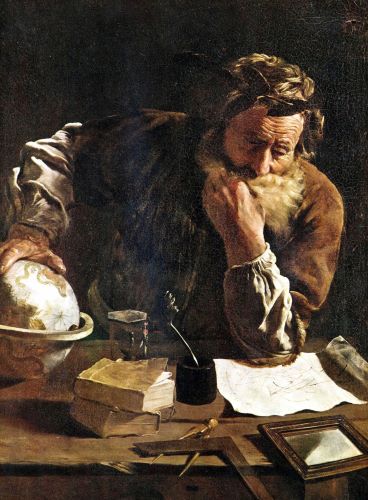
Before Roman siegecraft pressed upon Syracuse, Archimedes’ reputation rested not on engines of war but on demonstrations of extraordinary mathematical subtlety. His surviving treatises reveal a thinker deeply engaged with problems of area, volume, proportion, and equilibrium. In On the Sphere and Cylinder, he established relationships between curved surfaces and enclosing solids that he regarded as his greatest intellectual achievement. In On the Measurement of the Circle, he refined approximations of pi with remarkable precision. These works situate him firmly within the tradition of Greek theoretical mathematics, where proof, logical deduction, and geometric elegance were ends in themselves rather than instruments of immediate utility.
Archimedes’ intellectual formation unfolded within a Hellenistic environment that prized scientific accomplishment as a marker of elite cultivation. Syracuse, though politically distinct from Alexandria, participated in a broader Mediterranean network of scholarly exchange. Archimedes corresponded with figures such as Eratosthenes of Cyrene, whose own work in geography and measurement exemplified the synthesis of mathematics and empirical inquiry characteristic of the third century BCE. Archimedes’ style of argumentation reflects a highly sophisticated culture of diagrammatic reasoning, one in which geometric demonstration functioned as a shared intellectual language among a relatively small but interconnected community of experts. The mathematician operated within this courtly world not as an isolated genius but as part of an elite transregional conversation.
Royal patronage played a decisive role in sustaining this culture. Hellenistic rulers supported scholars for reasons that blended prestige, curiosity, and political symbolism. Scientific activity at court was neither fully detached from power nor reducible to crude propaganda. Patronage provided material support and social standing, but it also embedded intellectual labor within hierarchical structures of obligation. Archimedes benefited from this system. His association with King Hiero II of Syracuse suggests that his work was both admired and institutionally protected. The court offered the stability necessary for abstract inquiry, yet it also implied that knowledge existed within a framework of reciprocal expectation.
It is important to resist anachronism. Archimedes did not inhabit a modern category of insulated theoretical science detached from material application. Greek mathematical practice developed in conversation with crafts, astronomy, mechanics, and land measurement, and its practitioners were aware that geometric reasoning could illuminate physical phenomena. His treatise On Floating Bodies demonstrates a sustained attempt to analyze buoyancy and equilibrium through rigorous demonstration, applying deductive structure to observable reality. Likewise, his investigations into levers and centers of gravity reveal an intellectual curiosity about force and balance that straddled abstraction and physical law. Yet these inquiries were not conceived as battlefield manuals. They were structured as proofs, embedded in the formal conventions of Hellenistic mathematics, and addressed to fellow scholars capable of following intricate logical sequences. The goal was epistemic clarity, not tactical advantage. The cultural prestige attached to such work derived from its intellectual difficulty and conceptual refinement rather than its immediate usefulness. That distinction is crucial. Although the conceptual tools of mechanics were present, their primary arena was intellectual exchange within elite networks, not organized violence. The siege would not create new capacities in Archimedes’ mind. It would instead redirect existing analytical habits toward urgent and lethal ends.
This pre-siege profile matters because it clarifies the magnitude of the transformation that followed. Archimedes was not summoned from obscurity to construct engines. He was a celebrated mathematician whose theoretical accomplishments had already secured his standing within Hellenistic intellectual life. The courtly world that nurtured his abstractions would, under existential pressure, call upon the same analytical capacities for defense. Understanding his career before 214 BCE reveals that the militarization of his expertise was not the emergence of a different Archimedes. It was the redirection of an already formidable intellect into the service of survival.
The Siege of Syracuse: Engineering as Survival
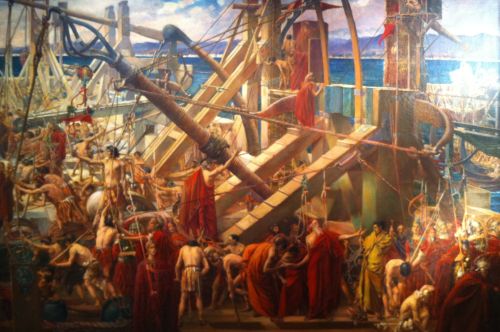
The Roman siege of Syracuse began in 214 BCE during the wider conflict of the Second Punic War, when shifting alliances in Sicily drew the city into confrontation with the expanding Roman Republic. After the death of King Hiero II, Syracuse’s political realignment unsettled the delicate balance of power in the central Mediterranean, prompting Rome to assert control over the strategically vital island. Marcus Claudius Marcellus commanded both land and naval forces, expecting that Roman persistence and material superiority would secure a relatively swift victory. Syracuse, however, was no minor stronghold. Its fortifications were formidable, and its harbor complex allowed for coordinated defensive maneuvering. Instead of collapsing under pressure, the city mounted a resistance that surprised even seasoned Roman commanders. Ancient accounts converge in attributing that resilience in substantial part to the mechanical ingenuity of Archimedes. What might otherwise have been a conventional siege became, in literary memory and likely in operational reality, a demonstration of applied scientific expertise under conditions of existential threat. The city’s survival, at least temporarily, depended not solely on manpower or fortification but on the calculated deployment of intellectual capital.
Polybius provides the earliest sustained description of these defensive measures. He reports that Archimedes designed artillery capable of striking targets at multiple ranges, adjusting the length and tension of torsion springs to match distance and angle. Roman ships approaching the walls found themselves struck by stones and projectiles launched with calibrated force. Polybius emphasizes that the defenders could rapidly shift between long-range bombardment and close-quarter assault, preventing Roman forces from finding a stable point of engagement. The adaptability of the machines proved as decisive as their destructive capacity. Roman soldiers, unprepared for such mechanical precision, reportedly hesitated at the sight of protruding beams or apertures in the walls, anticipating sudden and violent counteraction.
Livy’s narrative complements Polybius by stressing the psychological disruption inflicted on Roman morale and the tactical recalibration forced upon Roman command. He describes concealed engines emerging unexpectedly from fortified positions and notes the difficulty Roman troops faced in coordinating naval and infantry operations under constant bombardment. The siege became not merely a contest of manpower but a test of ingenuity, patience, and logistical endurance. Roman commanders, accustomed to relying on disciplined formation and relentless advance, encountered a defensive system that neutralized conventional advantage. The city’s walls were no longer passive barriers but dynamic platforms for calculated mechanical response. The Romans found themselves adapting to an adversary whose strength lay not in numerical superiority but in precision engineering. The siege exposed a vulnerability in Roman assumptions about warfare, demonstrating that disciplined force could be destabilized by technical innovation strategically applied.
Plutarch, writing centuries later, elaborates on the so-called grappling devices often referred to as the “claw” of Archimedes. According to his account, cranes equipped with hooks seized the prows of attacking ships, lifting them partially from the water before dropping them to destabilize or overturn the vessels. The imagery is vivid, almost theatrical, yet it is grounded in mechanical principles well understood in the Hellenistic world. Compound pulleys, cranes, and lever systems were integral to construction and harbor operations across the Mediterranean. Archimedes’ theoretical work on levers and centers of gravity provides a conceptual framework that could plausibly be translated into such devices. Modern scholars debate the scale and dramatic flair of Plutarch’s description, cautioning against uncritical acceptance of later embellishment. Even so, the essential scenario remains credible. A defender equipped with knowledge of torque, balance, and counterweight could design mechanisms capable of exploiting the structural vulnerabilities of wooden warships. What Plutarch dramatizes may reflect not fantasy but the retrospective magnification of real mechanical ingenuity deployed under extreme pressure.
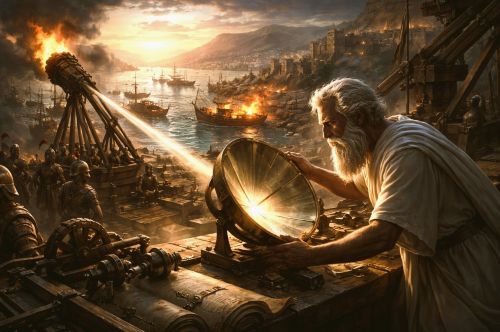
The more spectacular legend of incendiary mirrors igniting Roman ships at a distance has attracted sustained scrutiny. Later sources recount the use of polished surfaces to concentrate sunlight, setting vessels ablaze. While experimental archaeology has produced mixed results regarding the practicality of such a device under combat conditions, most historians regard the story as a subsequent embellishment. The absence of this detail in Polybius, who is otherwise attentive to mechanical innovation, cautions against accepting it uncritically. The persistence of the legend, however, reveals how readily later generations conflated mathematical brilliance with technological wonder, amplifying the aura surrounding Archimedes’ wartime role.
Syracuse fell in 212 BCE after prolonged resistance, not because its defenses failed to function, but because Roman persistence and internal vulnerabilities overcame mechanical advantage. Archimedes’ devices could delay conquest; they could not indefinitely forestall it. Yet the episode demonstrates a decisive historical shift in function. The mathematician’s knowledge was mobilized as a strategic resource. Geometry became trajectory. Principles of equilibrium became instruments of destabilization. The siege of Syracuse stands as a moment when scientific reasoning was not merely admired within elite circles but operationalized as a tool of collective survival. In that crucible, the distinction between intellectual inquiry and state engineering narrowed to the point of disappearance.
State Power and Intellectual Obligation in the Hellenistic World
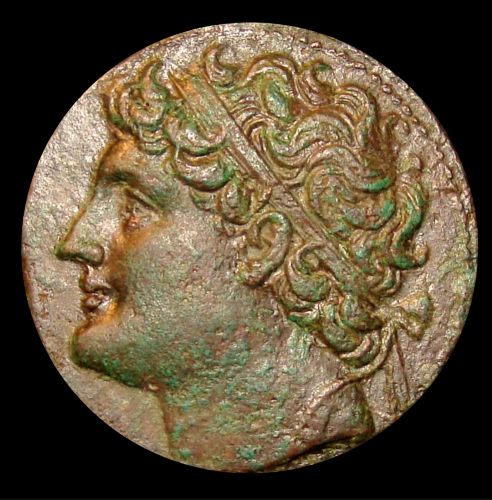
Archimedes’ mobilization during the siege of Syracuse was dramatic, but it was not structurally anomalous. The Hellenistic world was defined by monarchies that consciously fused cultural prestige with political authority. Kings sponsored poets, philosophers, engineers, and mathematicians not merely out of curiosity, but to project sophistication and legitimacy. Intellectual life flourished in courtly environments precisely because rulers recognized the symbolic and practical value of knowledge. Within such systems, scholars occupied privileged positions, yet their privilege existed within networks of dependence. Patronage was never ideologically neutral. It created reciprocal bonds that could, under crisis, become obligations.
The Ptolemaic court at Alexandria offers the clearest example of this dynamic. The Museum and Library functioned as centers of scholarly research, drawing mathematicians, astronomers, physicians, and grammarians into royal orbit. Yet the same court sponsored large-scale engineering projects, urban planning, hydraulic works, and military infrastructure. The separation between speculative science and practical mechanics was neither categorical nor rigid. Intellectual elites often possessed training that made them useful beyond textual commentary. Astronomy informed navigation and calendrical administration. Geometry shaped land measurement and fortification. Knowledge circulated between abstract reasoning and material implementation through institutional channels sustained by state power.
Syracuse under King Hiero II operated within this broader Hellenistic pattern, albeit on a smaller scale. Hiero’s long reign stabilized the city and fostered commercial and diplomatic ties across the Mediterranean. His patronage of Archimedes must be understood in that context. The mathematician’s association with the court provided security and resources, but it also placed his expertise within reach of royal directive. When Rome threatened the city, the intellectual capital cultivated during decades of relative peace became immediately relevant to defense. The expectation that knowledge serve the polis was not imposed from outside. It emerged from the structural integration of scholarship and sovereignty.
Ancient mechanics as a discipline already blurred the boundary between philosopher and artisan. Technical writers such as Philo of Byzantium and later Hero of Alexandria demonstrate that treatises on devices, automata, and artillery circulated alongside more theoretical works. Scholastic analysis of Greek and Roman artillery shows that siege engines were the product of systematic mathematical calculation, especially in the calibration of torsion springs and projectile weight. Such systems required conceptual precision as much as manual skill. The engineer was not a mere craftsman but a mathematically literate technician operating within frameworks of proportion and measurement. Archimedes’ participation in defensive design reflects not an aberration but the culmination of a broader Hellenistic synthesis of theory and application.
The siege of Syracuse reveals how intellectual obligation was embedded within political structure. Scholars did not abruptly become instruments of power. They already operated within patronage systems that linked prestige to service. In times of peace, that service manifested as cultural distinction and courtly acclaim. In times of war, it could assume lethal form. The Hellenistic monarchies cultivated knowledge as an asset of rule, and assets are mobilized when regimes face danger. Archimedes’ experience exemplifies a structural principle rather than a singular episode. Where state authority sustains intellectual life, it may also claim that life’s products in moments of crisis.
Legend, Memory, and the Heroization of Military Science

The fall of Syracuse did not diminish Archimedes’ reputation. It transformed it. In the generations following the siege, his identity as a mathematician fused with the image of a city-saving engineer, and the boundary between historical episode and moralized legend began to blur. The mechanics of defense became the scaffolding for narrative amplification. Archimedes’ intellectual authority, already formidable, acquired an aura of almost supernatural ingenuity. In this process, military necessity became inseparable from scientific greatness.
Plutarch’s Life of Marcellus plays a central role in shaping this memory. Writing in the early second century CE, Plutarch presents Archimedes not only as an ingenious defender but as a figure tragically absorbed in contemplation at the moment of his death. According to the account, a Roman soldier killed him despite orders to spare him, either because the mathematician ignored commands or because he refused to abandon a geometrical diagram traced in sand. Whether apocryphal or not, the scene dramatizes a tension between intellectual devotion and martial violence. It also sanctifies Archimedes as a martyr to knowledge, elevating his status beyond that of a technical adviser and into the realm of cultural hero.
Roman authors contributed to this heroization in complex ways. Livy emphasizes the ingenuity that delayed Roman victory, while later writers expressed admiration for the very machines that had frustrated their predecessors. This ambivalence is significant. Rome ultimately conquered Syracuse, yet it also absorbed and transmitted Greek intellectual traditions. The narrative celebration of Archimedes reflects not only Greek pride but Roman recognition that scientific mastery commanded respect even in defeat. Military innovation became part of the shared cultural inheritance of the Mediterranean world.
The most dramatic embellishment of this legacy is the legend of the burning mirrors. Although absent from Polybius and likely a later accretion, the story endured through Byzantine and Renaissance retellings. Its persistence illustrates how audiences came to expect that a figure of Archimedes’ stature would possess almost limitless technical power. The mirror episode, regardless of historical plausibility, symbolizes the fusion of geometry and fire, calculation and destruction. It elevates mathematical knowledge into a force capable of reshaping nature itself. In doing so, it reinforces the narrative pattern by which scientific brilliance becomes indistinguishable from technological marvel.
This myth-making process had intellectual consequences that extended far beyond anecdote. By casting Archimedes as the archetypal scientist-engineer, later generations retroactively defined Hellenistic science in terms of its most dramatic applications. Archimedes’ genuine achievement lies in the disciplined refinement of deductive reasoning and the rigorous use of diagrams as cognitive tools. Yet popular memory gravitates toward cranes lifting ships and beams of light igniting fleets. The heroization of military science shifts emphasis from epistemology to spectacle, privileging visible power over abstract method. In this reframing, mathematics becomes compelling not because it establishes demonstrable truths, but because it appears to command material forces. The legend reshapes cultural expectations about what science is for. It suggests that the highest validation of intellectual brilliance lies in its capacity to defend, dominate, or destroy. Such a narrative does not erase Archimedes’ theoretical legacy, but it overlays it with a martial lens that reorients interpretation. The mathematician becomes valuable not primarily because he proves theorems, but because he defends cities and humbles enemies.
In this transformation, one observes a broader cultural pattern. Societies remember intellectual figures most vividly when their knowledge intersects with survival or conquest. The memory of Archimedes demonstrates how wartime application can reshape posthumous identity. His theoretical achievements did not disappear, but they were reframed through the drama of siege and resistance. Legend becomes a vehicle for expressing a collective intuition: that knowledge, when mobilized under threat, acquires heroic stature. In the story of Archimedes, the scholar does not merely calculate. He saves, resists, and, in memory, transcends the limits of his era.
Knowledge as Strategic Capital: The Dissolution of Boundaries

The siege of Syracuse reveals a broader historical principle that extends beyond the biography of Archimedes. Knowledge, once recognized as strategically consequential, becomes a form of capital embedded within structures of power. In the Hellenistic world, intellectual achievement carried symbolic prestige, but under conditions of threat it also carried operational value. Geometry, mechanics, and calculation were not abstract luxuries. They could determine the trajectory of projectiles, the balance of machines, and the endurance of fortifications. When states perceive knowledge as materially decisive, they reorganize its function. The scholar’s work becomes inseparable from the state’s survival.
This shift does not require coercion in the narrow sense. It emerges from the logic of patronage, protection, and proximity to authority. Hellenistic courts sustained intellectual life through funding, institutionalization, and elite association, creating environments in which scholars operated within royal orbit. That support created a reciprocal relationship in which intellectuals benefited from stability, prestige, and material security, while rulers benefited from cultural distinction and technical expertise. During crisis, reciprocity sharpened into expectation. The very structures that protected inquiry also positioned it for mobilization. Archimedes did not need to be conscripted at sword point. His expertise already existed within a political framework capable of summoning it. The dissolution of boundaries between inquiry and engineering followed from structural integration rather than abrupt imposition. Intellectual life had long been interwoven with sovereignty. The siege simply revealed the depth of that interweaving.
The concept of knowledge as strategic capital also reframes how we interpret the relationship between theory and application in antiquity. Modern distinctions between “pure” and “applied” science risk obscuring the fluidity of ancient intellectual practice. Greek mathematics was rigorously deductive, yet it developed in dialogue with surveying, architecture, and mechanical experimentation. The same analytical habits that generated geometric proofs could inform practical design. The siege of Syracuse dramatized this continuity. It did not invent the linkage between abstraction and material force. It made the linkage visible under extreme pressure.
There is also a political dimension to strategic knowledge that transcends technical capacity. When intellectual labor becomes essential to defense, it acquires ideological weight and symbolic resonance. The state does not merely deploy knowledge. It claims it, frames it, and integrates it into narratives of civic identity. Archimedes’ machines were not presented as the isolated creations of a private individual. They were represented as instruments of the city, embodiments of Syracusan resilience. This framing matters because it converts personal expertise into collective possession. The intellectual becomes a guardian of communal survival, and his work becomes inseparable from the moral language of defense. In such moments, scholarly autonomy narrows, not necessarily through repression, but through redefinition. The scholar’s success becomes measured by service to the polity. Knowledge ceases to circulate only within elite networks of exchange and instead becomes embedded within the rhetoric of loyalty and preservation.
The dissolution of boundaries between scholar and engineer reflects a larger pattern in the history of political communities. States that cultivate intellectual life may do so initially for prestige or curiosity, yet they retain the capacity to redirect that cultivation toward strategic ends whenever circumstances demand. The episode at Syracuse offers an early and well-documented example of this dynamic, but it is not unique in principle. Archimedes’ intellectual authority was enhanced, not diminished, by his wartime role, yet enhancement carried implications. His identity became inseparable from the machinery of resistance. The mathematician’s diagrams and the engineer’s engines were understood as expressions of the same disciplined reasoning. In that synthesis, intellectual distinction reinforced political purpose. Knowledge became both ornament of power and instrument of force, illustrating how deeply intertwined cognitive achievement and state survival could become.
Archimedes’ career underscores a durable tension within the history of knowledge. Intellectual inquiry aspires to universality and abstraction. Political authority operates within urgency and constraint. When the two intersect under conditions of threat, boundaries dissolve. The scholar becomes indispensable to power, and power reshapes the meaning of scholarship. The siege of Syracuse did not corrupt mathematics. It revealed its capacity to be mobilized. Knowledge, once recognized as decisive, ceases to be merely contemplative. It becomes strategic capital, embedded within the survival calculus of the state.
Conclusion: Archimedes Between Geometry and War
Archimedes’ life and legacy resist simple categorization. He was neither merely a detached theorist nor primarily a military technologist, and any attempt to isolate one dimension of his identity risks distorting the whole. His career unfolded within a Hellenistic world in which intellectual prestige and political authority were mutually reinforcing, and where scholars operated in proximity to power rather than in isolation from it. The Roman siege of Syracuse did not transform a peaceful mathematician into something alien to his training. It revealed how readily abstract reasoning could be redirected when the survival of the polis demanded it. The same analytical discipline that measured spheres and cylinders could calibrate torsion engines, calculate projectile arcs, and design crane systems capable of destabilizing ships. The continuity lies not in the specific instruments produced, but in the habits of mind that generated them. Deductive rigor, spatial reasoning, and attention to proportional relationships formed the connective tissue between geometry and warfare. The siege did not create a second Archimedes. It exposed the latent versatility of the first.
The siege also clarifies the structural conditions under which knowledge becomes politically indispensable. Archimedes operated within a patronage system that both protected and positioned him. His expertise was cultivated in peacetime as a marker of cultural refinement, yet that cultivation carried latent strategic value. When Roman pressure mounted, his intellectual capital was not peripheral to defense. It became a point of focus. This shift was not a betrayal of inquiry but a reorientation of function. Knowledge that had circulated within elite scholarly networks entered the arena of organized violence. In doing so, it exposed the permeability of boundaries that modern categories too sharply divide.
The subsequent legend of Archimedes, shaped by Plutarch and amplified by later tradition, ensures that his wartime ingenuity remains inseparable from his mathematical brilliance. Memory fused the image of the contemplative geometer with that of the ingenious defender. This fusion reveals something fundamental about how societies remember intellectual achievement. Knowledge acquires heroic stature when it intersects with collective survival. The heroization of Archimedes does not erase his theoretical contributions, but it reframes them through the drama of siege and resistance. Geometry becomes memorable when it saves a city.
To situate Archimedes between geometry and war is not to divide his identity, but to recognize the historical forces that shaped it and the interpretive patterns that preserve it. His career illustrates a durable truth: intellectual life exists within political worlds that can summon it, redirect it, and memorialize it according to need. The siege of Syracuse stands as a moment when the scholar and the engineer converged under pressure, revealing how fragile the boundary between contemplation and coercion can be. In that convergence, the distinction between abstract reasoning and applied force narrowed to the point of disappearance. Archimedes remains a symbol not only of mathematical genius, but of the enduring tension between knowledge and power, between inquiry pursued for its own sake and inquiry mobilized for survival. His story compels us to confront a recurring historical reality. When states recognize knowledge as decisive, they do not leave it untouched. They integrate it into their strategies, and in doing so they reshape both its function and its memory.
Bibliography
- Archimedes. On the Sphere and Cylinder; On the Measurement of the Circle; On Floating Bodies. In The Works of Archimedes, translated by Sir Thomas Little Heath. London: C.J. Clay and Sons, 1897.
- Campbell, Duncan. Greek and Roman Siege Machinery 399 BC–AD 363. Oxford: Osprey Publishing, 2003.
- Cuomo, Serafina. Ancient Mathematics. London: Routledge, 2001.
- —-. Technology and Culture in Greek and Roman Antiquity. Cambridge: Cambridge University Press, 2007.
- Drachmann, A. G. The Mechanical Technology of Greek and Roman Antiquity. Madison: University of Wisconsin Press, 1963.
- Feldhay, Rivka. “Archimedes’ Legacy for Early Modern Science: Historical-Philosophical Reflections.” Interdisciplinary Science Reviews 47:3-4 (2022), 360-375.
- Kaplan, Philip G. “Early Greek Geography.” In The Oxford Handbook of Science and Medicine in the Classical World, edited by Paul T. Keyser and John Scarborough. Oxford: Oxford University Press (2018), 195-214.
- Lehoux, Daryn. What Did the Romans Know? An Inquiry into Science and Worldmaking. Chicago: University of Chicago Press, 2012.
- Livy. Ab Urbe Condita. Translated by B. O. Foster et al. Cambridge, MA: Harvard University Press, 1919–1959.
- Lloyd, G. E. R. Greek Science after Aristotle. New York: W. W. Norton, 1973.
- Marsden, E. W. Greek and Roman Artillery: Historical Development. Oxford: Clarendon Press, 1969.
- Netz, Reviel. The Shaping of Deduction in Greek Mathematics: A Study in Cognitive History. Cambridge: Cambridge University Press, 1999.
- Plutarch. Life of Marcellus. In Parallel Lives. Translated by Bernadotte Perrin. Cambridge, MA: Harvard University Press, 1917.
- Polybius. The Histories. Translated by Robin Waterfield. Oxford: Oxford University Press, 2010.
- Steele, Brett D. and Tamera Dorland. The Heirs of Archimedes: Science and the Art of War through the Age of Enlightenment. Cambridge: MIT Press, 2005.
Originally published by Brewminate, 03.03.2026, under the terms of a Creative Commons Attribution-NonCommercial-NoDerivatives 4.0 International license.
About the Author