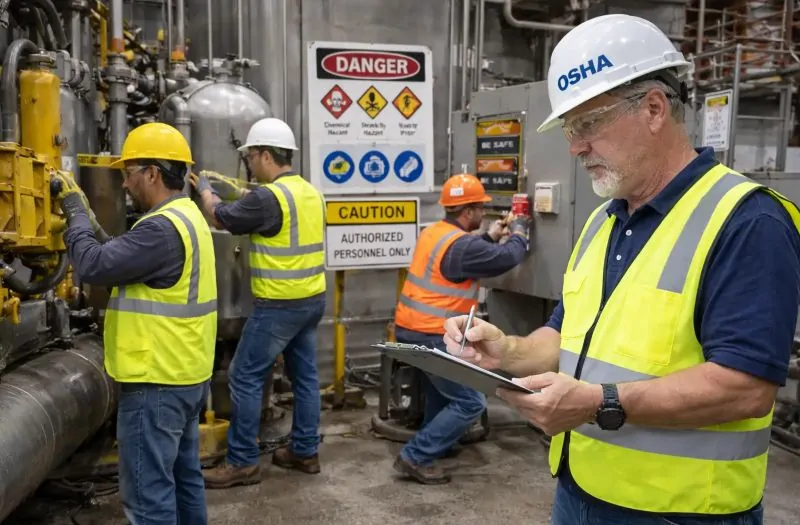
Being hurt on the job due to an obvious safety violation should be an easy case. Unfortunately, Illinois law is far more complex than many injured workers realize. When you speak with a personal injury attorney about injuries suffered at work, they will likely start by telling you that you typically cannot sue your employer. This is true even if your employer violated an OSHA regulation in a blatant and negligent manner.
The Basics of The Exclusive Remedy Rule
Under the exclusive remedy rule of the Workers’ Compensation Act, 820 ILCS 305, workers’ compensation benefits are normally the only method to obtain compensation from your employer after a workplace injury, no matter how reckless that employer was. Workers’ comp benefits do not require you to prove fault, but in exchange you normally cannot sue your employer for pain and suffering, emotional distress, or punitive damages. This holds true even when your employer violates multiple OSHA regulations in the most serious and blatant manner.
Why You Usually Can’t Sue After Receiving An OSHA Citation
Even when the violation involves serious and willful misconduct on the part of your employer, Illinois courts have repeatedly found the exclusive remedy rule to apply. An OSHA citation proving the existence of a dangerous condition that your employer knew about and failed to address does not automatically allow you to file a lawsuit against that employer.
Instead, there are two narrow exceptions that would allow such a lawsuit. You could sue your employer if they deliberately caused your injuries. You can also sue your employer if they failed to purchase workers’ compensation insurance in violation of 820 ILCS 305/4. Both of these exceptions require specific and substantial proof and come into play less frequently than injured workers hope.
OSHA Citations That Help Identify Liable Third Parties
However, OSHA violations can help with workplace injury cases. They can help you identify third parties who may have caused your accident. When you are hurt at work, there are often other parties at fault besides your employer. Equipment manufacturers, subcontractors, property owners, maintenance companies, and delivery drivers may all be legally distinct from your employer and play a role in causing your injuries. If an OSHA citation identifies unsafe equipment, a hazard created by a different contractor, or an unsafe property condition, that citation could be used as evidence in a third-party lawsuit against the party responsible for that particular hazard.
Damages Recoverable Through A Third-Party Claim
A third-party claim would be handled like any other personal injury lawsuit, not a workers’ compensation claim. That means you could recover damages like pain and suffering, full lost wages (rather than a percentage), and punitive damages in cases where they are warranted. In addition, you do not give up your right to workers’ compensation benefits by filing a third-party claim. The two avenues are completely separate, and you can collect workers’ comp while your attorney holds the negligent party responsible.
Take Note of Practical Issues and Deadlines
There are some practical considerations to keep in mind. First, immediately report the injury to your employer and file a workers’ compensation claim as soon as possible. You should consider filing your own complaint with OSHA if the hazardous condition still has not been remedied. In Illinois, you generally have 3 years to file a workers’ comp claim and 2 years to file a third-party lawsuit. Waiting too long can jeopardize your case.
Consult With a Personal Injury Attorney to Learn Your Rights
Do not settle for workers’ compensation if your employer broke an OSHA law and caused your accident. A knowledgeable Lake Charles personal injury attorney can analyze the citation and circumstances of your injury to see if you have a valid third-party claim against someone other than your employer.
About the Author