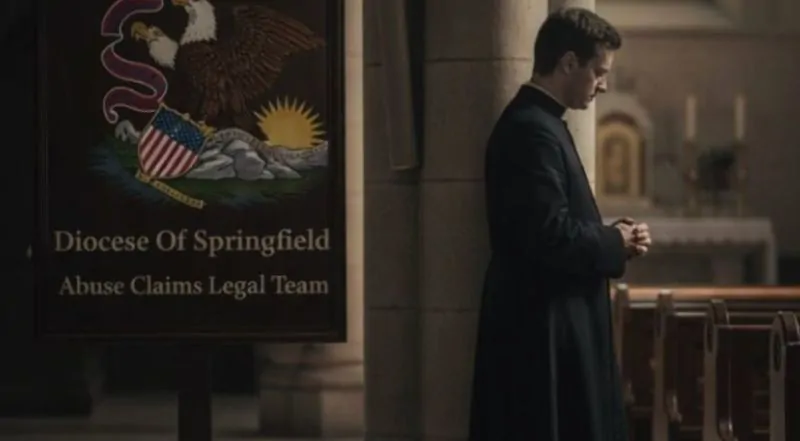
For much of the twentieth century, allegations of clergy sexual abuse in the United States were often treated as local matters. A complaint might involve a priest serving a particular parish, school, hospital, or community, while information about previous assignments remained scattered across diocesan files and personal recollections. That fragmentation made it difficult for people in one place to know whether similar reports had surfaced elsewhere.
Illinois shows how much that information landscape has changed. The state’s Catholic population is divided among six diocesan jurisdictions, including Chicago, Joliet, Rockford, Peoria, Springfield, and Belleville. Springfield is especially relevant because its diocese covers a broad section of central Illinois and includes communities far beyond the state capital. As survivor accounts, investigative findings, clergy histories, and institutional records became public, events once understood in isolation could be examined within a larger historical framework.
How Local Communities Once Encountered Clergy Abuse
A diocese is organized around a defined geographic territory, but clergy careers often cross many communities within it. Priests may serve at several parishes, schools, hospitals, and other institutions over decades. As a result, an allegation associated with one town may be connected to a much broader assignment history.
The Diocese of Springfield in Illinois demonstrates why geography matters. Its territory covers 28 counties in central Illinois, with Peoria to the north and Belleville to the south. The jurisdiction also predates its current name. It was established as the Diocese of Quincy in 1853, became the Diocese of Alton in 1857, and was renamed the Diocese of Springfield in Illinois in 1923.
For someone researching clergy abuse in this region, location can shape the entire inquiry. A priest associated with Springfield may have served in Decatur, Jacksonville, Quincy, Rochester, Taylorville, or several other communities during the course of a ministry. Publicly available Springfield diocese abuse resources can help bring together information about accused clergy, assignment histories, reported allegations, and records tied to the diocese.
Earlier generations rarely had access to this kind of consolidated material. Research often depended on separate parish records, newspaper archives, court documents, diocesan statements, and personal testimony.
Survivors Turned Local Experiences into a Broader Historical Record
Survivor testimony played a major role in changing how clergy abuse was understood. Individual accounts often appeared disconnected because survivors had limited ways to compare what happened in different parishes, dioceses, or states.
As more survivors spoke publicly and advocacy networks expanded, recurring institutional questions became harder to ignore. Reports from different communities raised similar concerns about transfers, recordkeeping, complaint procedures, internal investigations, and decisions about whether accused clergy remained in ministry.
Illinois provides a clear example of why those comparisons matter. Chicago is a major urban archdiocese with a dense network of parishes and Catholic institutions. Joliet and Rockford serve northern Illinois, while Peoria and Springfield cover large parts of the state’s center. Belleville serves communities farther south.
Those jurisdictions differ in size, structure, population, and history. A case arising in Springfield cannot be understood simply by applying what happened in Chicago or another diocese. Local leadership, assignment records, parish networks, and available documents all shape the historical record. Comparing dioceses is useful because it can reveal recurring institutional practices while preserving the distinct circumstances of each community.
Investigations Changed What the Public Could Know
Public investigations expanded the evidence available for examining clergy abuse. Survivor accounts could be evaluated alongside assignment histories, church records, correspondence, public statements, and other documents that helped establish timelines.
Illinois launched a major statewide inquiry in 2018 that examined Catholic clergy child sexual abuse across all six dioceses. The resulting statewide investigation into clergy sexual abuse placed Chicago, Belleville, Joliet, Peoria, Rockford, and Springfield within a common investigative record.
For Springfield, the investigation compiled information on substantiated abuse, clergy assignments, reported locations, survivor accounts, and institutional responses. The public report identified 34 abusive clerics and religious brothers associated with the Springfield diocese and documented allegations involving communities across central Illinois.
The statewide approach made it easier to establish chronology across diocesan boundaries. A clergy member might have served in several Illinois communities or held assignments outside the state. Reviewing multiple sources together can clarify where a person served, when allegations were reported, and how church authorities responded.
This type of documentation also reduces reliance on institutional memory. Testimony remains essential, but it can now be examined alongside records that help confirm dates, locations, assignments, and administrative decisions.
Why Geography Matters When Reconstructing Institutional History
The size and diversity of Illinois make geography especially important when examining clergy abuse.
Chicago’s archdiocese operates in one of the country’s largest metropolitan regions, with a substantial number of parishes, schools, clergy members, and Catholic institutions. Springfield covers a different landscape. Its territory extends across more than 15,000 square miles and includes urban, suburban, and rural communities throughout central Illinois.
That wider territory can complicate efforts to reconstruct a clergy member’s history. A priest might have served in Decatur, later moved to Jacksonville, and then received another assignment closer to Springfield. Each location can add information about ministry dates, reported conduct, institutional knowledge, or later disclosures.
The same need for local context applies when comparing Springfield with Peoria or Belleville. Their territories border one another, but each has separate leadership structures, archives, and administrative histories. Statewide records allow researchers to compare them without treating those dioceses as interchangeable.
National accounts explain how clergy abuse became a major public issue. State and diocesan records show how that history unfolded in specific communities.
Public Records Changed the Meaning of Accountability
As more records became available, survivors, families, journalists, historians, and local communities gained new ways to examine institutional conduct.
For survivors, assignment histories can help determine whether other reports were connected to the same clergy member. Families can trace where a priest served and when. Journalists can reconstruct timelines. Historians can compare institutional responses across different decades. Communities can revisit events that were once known mainly through private conversations.
Springfield’s history demonstrates the importance of organized records. Because the diocese has existed under several names and its clergy have served communities throughout central Illinois, reconstructing past events can require information from many periods and locations.
Chronology is particularly important. The date of an alleged incident may differ significantly from the date a complaint was first reported, the period when a clergy member remained in ministry, and the date when information became public. Keeping those stages separate helps clarify how institutions responded over time.
For that reason, public records are most useful when they provide more than names. They can reveal assignment patterns, reporting timelines, administrative decisions, and changes in disclosure practices.
Survivor Advocacy Connected Communities That Once Seemed Isolated
Years of survivor organizing helped create the conditions for broader public scrutiny. During the late twentieth century, survivors and their families formed networks that connected people who had previously struggled to find others with similar experiences.
Illinois was part of that development. Advocacy efforts in and around Chicago helped connect survivors across parish and diocesan boundaries. Over time, the growth of clergy-abuse survivor organizations gave people in separate cities and states a way to share information and place individual experiences within a wider pattern.
That shift affected how reports from Springfield and other Illinois communities were understood. A local allegation could be compared with cases elsewhere while still being evaluated according to its own diocesan records, leadership, and timeline.
Survivor advocacy also increased pressure for disclosure and preservation of records. As more documents became available, researchers could compare local histories with broader developments in Illinois and across the country.
Springfield’s record therefore belongs to several overlapping histories: the history of one diocese, the history of Catholic institutions in Illinois, and the national history of survivor efforts to make clergy abuse more visible.
From Local Memory to an Accessible Historical Record
America’s understanding of clergy abuse changed as information once confined to individual parishes and diocesan offices entered the public record. Survivor testimony, investigative reporting, government inquiries, institutional disclosures, and archival research made it possible to examine events across longer periods and wider geographic areas.
Illinois demonstrates why both statewide and local perspectives remain necessary. Chicago, Joliet, Rockford, Peoria, Springfield, and Belleville are part of the same state history, but each diocese has its own leadership, institutions, communities, and records. Understanding Springfield requires attention to the central Illinois parishes and towns connected through clergy assignments and diocesan administration. Greater access to those records has made it easier to reconstruct how allegations were reported, how institutions responded, and how events in individual communities became part of a broader historical record.
About the Author