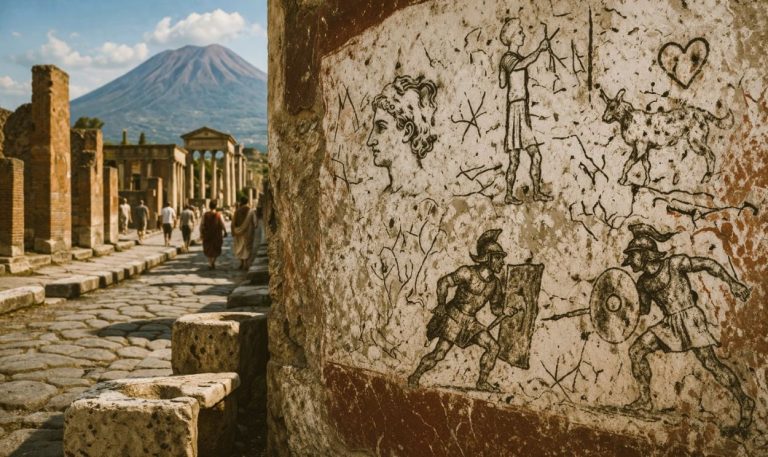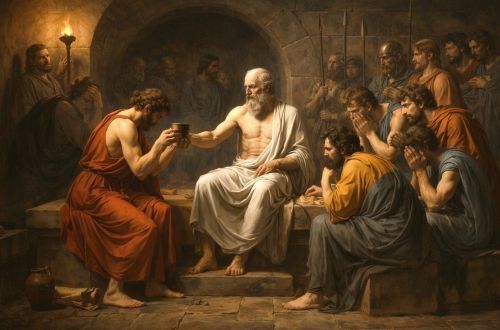
Socrates’ acceptance of execution in ancient Athens reframed death as philosophical commitment, revealing how conscience could outweigh survival in democratic politics.

By Matthew A. McIntosh
Public Historian
Brewminate
Introduction: Death as a Philosophical Problem, not a Medical Event
In 399 BCE, the city of Athens condemned Socrates to death on charges of impiety and corrupting the youth. The penalty was carried out through a method customary in Athenian practice: the ingestion of hemlock, administered under civic supervision and framed as the lawful conclusion of a jury’s decision. Yet what might otherwise have passed as a conventional execution within the machinery of the democratic polis became, through Socrates’ own reasoning and composure, a defining philosophical event. The significance of his death lies not in the physiological effects of the poison but in the choice that preceded it. Socrates had the opportunity to escape, arranged by friends and financed at personal risk. He declined. In doing so, he transformed death from a biological termination into a deliberate moral act situated within a political order he refused to undermine.
The surviving accounts of his final days, especially in Plato’s Apology, Crito, and Phaedo, present a man who neither denies the authority of the court nor seeks to evade its verdict through flight. Instead, he treats his impending death as a question to be examined. What does one owe to the laws of one’s city? Can injustice be answered with disobedience? Is death an evil, or merely a transition? These inquiries shift the focus from the body to the soul, from fear to reasoning. Death, in this framing, is not a medical crisis but a philosophical test.
This reframing matters. In modern discourse, death is often approached as a clinical threshold or a private event shaped by individual preference. In classical Athens, however, death in this case was a public and political matter, imposed by democratic procedure and witnessed by fellow citizens. Socrates’ refusal to escape complicates any simple opposition between state coercion and personal autonomy. He does not passively submit, nor does he rebel. Instead, he consents to lawful death on grounds that demand argument rather than sympathy.
The result is a tension that has endured for more than two millennia. Socrates’ choice forces a confrontation with the structure of civic belonging itself. If a citizen may reject a law only by persuading the city or by leaving it, as the Laws later argue in Crito, then obedience becomes intertwined with identity. To remain in Athens while benefiting from its institutions, courts, and protections is, on this view, to accept the reciprocal authority of its judgments, even when those judgments are fatal. Socrates’ serenity in the face of execution, as depicted in Phaedo, suggests that the meaning of death ultimately rests not in the state’s power but in the philosopher’s orientation toward the soul and its destiny. By accepting the hemlock, he did not merely comply with a sentence; he staged a final argument about whether moral integrity can coexist with political obedience. In 399 BCE, death became a philosophical problem because Socrates chose to make it one, binding the question of dying well to the prior question of living justly within a lawful order.
The Historical and Legal Context of 399 BCE
The execution of Socrates cannot be understood apart from the institutional framework of Athenian democracy at the end of the fifth century BCE. The city that condemned him was not ruled by a monarch or a narrow tribunal but by a participatory political system in which male citizens served directly as jurors and legislators. Large panels selected by lot rendered verdicts without professional judges to reinterpret the law, and there existed no standing class of legal experts to buffer the authority of the people. Authority rested with the citizen body itself, whose decisions carried immediate and binding force. The sentence imposed upon Socrates was not the decree of a tyrant nor the maneuver of a hidden faction operating outside public scrutiny. It emerged from an open civic process embedded in the ordinary functioning of democratic governance. To be condemned in Athens was to be judged by one’s peers acting collectively as the sovereign power of the polis.
The charges against him were framed in both religious and civic terms: impiety and corruption of the youth. According to the indictment preserved in Plato and echoed in Xenophon, Socrates was accused of failing to acknowledge the gods recognized by the city and of introducing new spiritual practices. In Athens, religion was not a private sphere detached from politics. Civic festivals, oaths, and public rituals bound religious practice to political stability. To appear to undermine shared religious norms could be interpreted as destabilizing the community itself.
This concern unfolded in a fragile political climate. Only a few years earlier, Athens had experienced the violent rule of the Thirty Tyrants following its defeat in the Peloponnesian War. The oligarchic regime of 404–403 BCE carried out executions and confiscations before being overthrown and replaced with a restored democracy. Although a general amnesty was declared in 403 BCE to prevent cycles of revenge, tensions remained. Socrates’ known associations with figures such as Critias, one of the Thirty, and Alcibiades, whose political career involved defection and controversy, did not constitute formal charges but contributed to a broader atmosphere of suspicion. His intellectual influence could be perceived, fairly or not, as intersecting with civic instability.
Athenian legal procedure also shaped the outcome in ways unfamiliar to modern legal systems. After conviction in a public trial, the prosecution proposed a penalty and the defendant offered a counterproposal. The jury then voted between the two options rather than deliberating freely among a range of possibilities. This structure sharpened the contrast between alternatives and required the defendant to position himself publicly within the civic order that had just condemned him. Socrates’ initial suggestion that he be rewarded with public maintenance, followed by a proposed monetary fine, framed the second vote in stark and symbolic terms. The jury selected death. The execution that followed was not automatic but the result of a second deliberative decision by the same civic body. The process underscores that his fate was shaped through formal mechanisms recognized as legitimate within Athenian political culture, even if the outcome remains philosophically and morally contested.
Imprisonment prior to execution was temporary and sometimes permeable. The delay in carrying out Socrates’ sentence due to the annual sacred mission to Delos created time during which his friends organized an escape plan. The possibility of flight was real, financed and arranged by those close to him. That escape was feasible indicates that the enforcement apparatus was not absolute. Socrates’ eventual acceptance of execution ccurred in a context where unlawful alternatives were materially available.
To modern readers accustomed to constitutional guarantees and codified rights, the proceedings may appear deficient. Yet within its own institutional logic, Athens regarded jury verdicts as legitimate expressions of collective authority. The restored democracy, having recently survived oligarchic collapse, had recommitted itself to law as a stabilizing principle. Socrates faced not arbitrary violence but a legally structured judgment of the polis to which he had long belonged. Any analysis of his refusal to flee must begin with the recognition that he confronted the authority of democratic law itself.
The Crito: Obedience to Law and the Social Contract

If the trial establishes the authority of the democratic polis, Crito confronts the question that follows conviction: whether obedience to law remains binding when the law appears to have acted unjustly. The dialogue takes place in Socrates’ prison cell, where his friend Crito urges him to escape. The practical arrangements have been made; the guards can be bribed; exile is possible. The urgency is not rhetorical but immediate. Socrates’ refusal to flee is not the result of fatalism or incapacity. It is the outcome of deliberate reasoning about justice and obligation.
Crito’s arguments are grounded in reputation, friendship, and paternal duty. He fears that the public will judge Socrates’ companions as cowardly for failing to save him, thereby staining their honor and exposing them to suspicion. He insists that Socrates has responsibilities to his children that outweigh abstract commitments to principle, arguing that leaving them fatherless when escape is possible would be a failure of care. He also raises the injustice of allowing one’s enemies to triumph through an avoidable death. Beneath these appeals lies an assumption that survival, when attainable, is preferable to self-sacrifice for an intangible norm. Socrates responds by methodically reframing the issue. The question is not what the majority will think, nor what reputation demands, but whether escaping would be just. The many, he argues, can inflict harm but cannot determine what is right; only reasoned judgment can do so. To commit injustice in response to injustice would damage the soul, and that injury, in Socratic reasoning, is more serious than any physical consequence. The dialogue shifts from social pressure to ethical consistency, from fear of public opinion to concern for the integrity of the self.
The dialogue’s most striking move is the personification of the Laws of Athens. Socrates imagines the Laws addressing him directly, asking whether he intends to destroy them by escaping their judgment. The Laws argue that he has lived in Athens his entire life, benefited from its institutions, married under its regulations, and raised children within its protections. By remaining in the city as an adult, he has implicitly consented to its authority. One may attempt to persuade the city that a law is wrong, but if persuasion fails, one must either obey or depart. To violate a lawful verdict while continuing to enjoy civic membership would, on this account, undermine the reciprocal structure that makes political community possible.
This argument has often been read as an early formulation of social contract theory, though it differs from later modern versions in crucial respects. Socrates does not describe a hypothetical agreement among autonomous individuals forming a state; rather, he emphasizes long-standing participation in a concrete civic order. His consent is not formal or written but enacted through residence and continued engagement. Te dialogue raises questions about the limits of such consent. If membership entails unconditional obedience, does the individual retain any space for principled resistance? Socrates appears to resolve this tension by asserting that one must never commit injustice, even in retaliation, thereby placing moral consistency above personal preservation.
The refusal to escape becomes an act of philosophical coherence rather than passive submission. Socrates does not claim that the verdict was correct. Instead, he maintains that escaping would constitute a separate injustice against the legal order that formed him as a citizen. His death is not embraced as an intrinsic good, nor is it sought as self-destruction. It is accepted as the consequence of remaining faithful to a conception of justice that binds the individual to the laws of the polis, even when those laws condemn him.
The Phaedo: The Soul and the Meaning of a Good Death
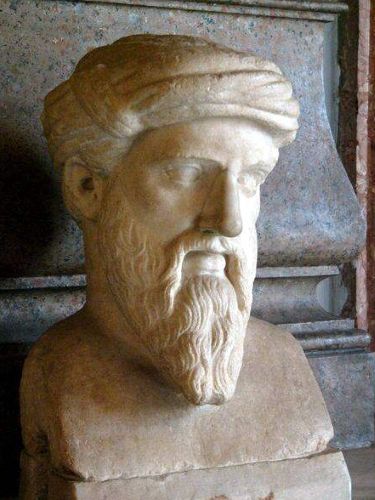
If Crito addresses the political logic of obedience, Phaedo turns inward to the metaphysical meaning of dying well. The dialogue unfolds on the final day of Socrates’ life, narrated after the fact, and framed not by anxiety but by philosophical discussion. Socrates’ companions gather in the prison, expecting grief; instead, they encounter a sustained inquiry into the nature of the soul. Death, in this setting, is not treated as catastrophe but as a transition whose significance depends upon what the soul is and how it has been cultivated. The conversation relocates the meaning of execution from the authority of the state to the condition of the self.
Socrates famously describes philosophy as a preparation for death. The philosopher, he argues, spends a lifetime separating the soul from the distractions and distortions of bodily desire, training himself to distrust the senses when they conflict with rational insight. If knowledge concerns what is stable, intelligible, and unchanging, then the senses, tied to flux and decay, cannot be its reliable guide. The pursuit of truth requires a gradual disentangling of the soul from bodily impulses, appetites, and fears. Death, understood as the separation of soul from body, becomes the completion of a discipline already practiced in life. This claim does not romanticize mortality; rather, it situates it within a larger metaphysical framework in which intellectual purification precedes physical dissolution. The good death is not defined by painlessness or speed but by the degree to which the soul has been oriented toward truth, freed from attachment, and disciplined through philosophical inquiry.
Socrates explicitly rejects the idea that one may simply take one’s own life at will. Human beings, he suggests, are in a kind of guardianship under divine authority. Just as a soldier should not abandon his post without command, a person should not depart life arbitrarily. This position complicates any attempt to interpret Socrates’ acceptance of hemlock as a form of suicide. He does not seek death; he refuses to evade it. The distinction matters. Voluntary self-killing is treated as presumptuous, while accepting a lawful sentence is framed as obedience within a cosmic and civic order.
The dialogue proceeds through a series of arguments for the immortality of the soul, including the cyclical argument from opposites, the theory of recollection, and the affinity argument distinguishing the visible from the invisible. Whether these arguments persuade modern readers is less important than the function they serve within the narrative. They establish that death is not annihilation but transition. Socrates’ calm demeanor is grounded in conviction about the soul’s persistence. His composure at the moment of drinking the hemlock is presented not as stoic indifference but as the natural consequence of philosophical confidence.
The closing scene reinforces this interpretation. Socrates drinks the poison without hesitation, speaks with his companions until his body begins to fail, and offers final instructions concerning a debt owed to Asclepius. The remark has been interpreted in various ways, yet within the structure of the dialogue it signals completion rather than despair. If Asclepius is the god of healing, the offering may suggest that death itself is a kind of cure, not from life as such but from the limitations imposed by embodiment. The metaphor of healing reframes the execution as therapeutic release rather than punitive destruction. Socrates’ serenity is neither theatrical bravado nor fatalistic resignation. It reflects a life ordered toward the care of the soul, culminating in an acceptance of death as philosophically intelligible. In Phaedo, the execution imposed by Athens becomes the occasion for articulating a vision of intellectual purification and existential coherence. Socrates’ final act integrates his political obedience with his metaphysical commitments, presenting death as the closing argument of a life devoted to inquiry.
Suicide in Greek Thought before and after Socrates
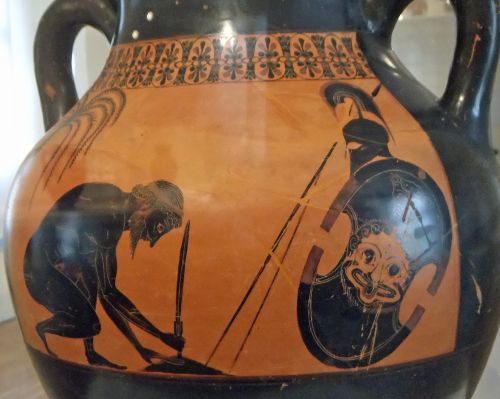
Greek attitudes toward self-killing were neither uniform nor static. In classical Athens, suicide was generally viewed with suspicion, particularly when it appeared to evade civic responsibility or disrupt communal order. While the surviving evidence is fragmentary, certain legal and ritual practices suggest that self-inflicted death could carry social stigma. Burial restrictions in some poleis, including the reported mutilation of the hand used in the act, indicate that voluntary death was not automatically regarded as honorable. The act was often interpreted not as an assertion of autonomy but as a violation of one’s obligations to family and city.
Yet the Greek world also preserved narratives in which self-chosen death carried a different moral valence. Tragic literature portrays figures who embrace death to avoid dishonor, enslavement, or moral compromise. Ajax, in Sophocles’ play, falls upon his sword after public humiliation, framing his act as the preservation of heroic integrity. Antigone accepts execution rather than abandon her religious duty to bury her brother. These representations do not offer philosophical defenses of suicide, but they reveal a cultural space in which death could be preferred to a life judged intolerable. The moral evaluation of such acts depended on context, honor, and perceived necessity.
Within philosophy prior to the Hellenistic period, a more cautious stance predominates. Plato’s own discussions, especially in Phaedo and later in Laws, treat self-killing as generally impermissible except under constrained circumstances. In Phaedo, Socrates’ argument that human beings are under divine guardianship implies that one must not depart life without warrant, since life is not wholly one’s possession but entrusted by a higher order. The analogy of military service suggests that individuals are stationed within a cosmic structure that they do not control. In Laws, Plato permits narrow exceptions in cases of extreme disgrace or unavoidable misfortune, yet even there suicide is framed as deviation from civic harmony and subject to legal and ritual regulation. The emphasis remains on restraint and on the impropriety of abandoning one’s assigned place in both the political and metaphysical hierarchy. Philosophical reflection in this period tends to subordinate personal choice to larger frameworks of duty and order.
Aristotle reinforces this civic framing in the Nicomachean Ethics, where he characterizes suicide as an injustice against the city rather than merely against oneself. The act, he argues, deprives the polis of a citizen and constitutes harm to the community. Even when motivated by anger or despair, the decision to end one’s life is interpreted as a failure of rational moderation and as a disruption of the civic balance that sustains collective flourishing. Aristotle’s ethical system links virtue to participation in the political community; excellence is realized within shared life, not in isolation. For that reason, voluntary death is treated less as an assertion of independence than as a rupture in the fabric of civic reciprocity. The individual’s life is embedded in the polis, and its termination carries political consequences beyond personal suffering.
A significant shift emerges with the Stoics in the Hellenistic period. Thinkers such as Zeno and later Roman Stoics including Seneca argue that under certain conditions, a rational departure from life can be consistent with virtue. If circumstances render it impossible to live in accordance with reason, or if external constraints destroy one’s capacity for moral agency, voluntary death may be permissible. The metaphor often invoked is that of leaving a smoky room when it becomes uninhabitable. This argument reframes self-chosen death not as rebellion against the cosmos but as an assertion of rational sovereignty over one’s own condition.
Socrates occupies a distinctive position on this trajectory. He neither endorses suicide as a general principle nor condemns all forms of voluntary death without qualification. Instead, he accepts execution while rejecting unlawful escape and self-inflicted departure. His stance integrates civic obedience with metaphysical restraint: he will not destroy himself because he is not his own ultimate master, yet he will not subvert the laws to preserve bodily life. In this sense, Socrates stands between earlier civic prohibitions and later Stoic autonomy. He embodies a model in which agency is exercised through principled acceptance rather than self-initiated termination, demonstrating that the question of death cannot be separated from the structure of obligation within which a life has been lived.
Individual Agency at Life’s End
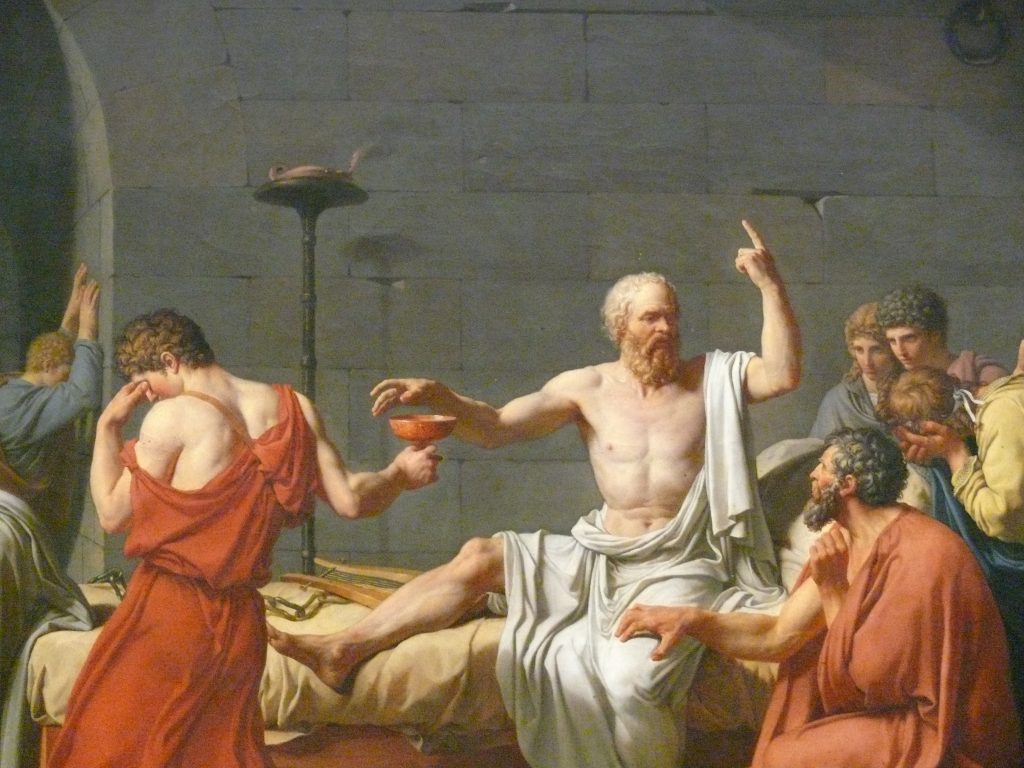
Socrates’ final decision complicates the concept of agency by locating it within constraint rather than outside it. He was not a passive victim swept toward execution without alternatives. The opportunity to flee was genuine, financed, and logistically feasible. Yet he declined it. Agency, in this instance, does not manifest as defiance of power but as deliberate refusal to evade it. The presence of an available escape sharpens the philosophical significance of his choice, because it reveals that death was not merely imposed but consciously accepted within a framework he judged binding.
This acceptance does not erase the coercive structure of the state. Athens possessed the authority to imprison and execute him, and that authority was backed by collective force. The jury’s verdict was not symbolic; it carried institutional weight, guarded walls, and an executioner’s hand. Yet the question of agency turns not on the existence of coercion but on the reasoning that confronts it. Socrates does not deny that he has been wronged, nor does he minimize the reality of impending death. Instead, he asks whether responding to perceived injustice with unlawful flight would introduce a second injustice of his own making. The freedom he exercises is internal rather than procedural. He cannot overturn the sentence, but he can determine whether his final act coheres with the principles he has articulated throughout his life. In this sense, agency consists not in escaping constraint but in choosing the terms on which one inhabits it.
This resists modern dichotomies between autonomy and obedience. In contemporary discourse, autonomy is often equated with resistance to external authority, especially when that authority is perceived as unjust. Socrates presents a different model. For him, autonomy consists in consistency with rationally examined commitments. If escaping would damage the moral coherence of his life, then survival achieved through evasion would represent a deeper loss than death. Agency becomes fidelity to a reasoned position rather than the assertion of preference against constraint.
The result is a reframing of what it means to choose death. Socrates does not initiate his own end, nor does he seek martyrdom for spectacle or symbolic protest. He remains within the legal order that condemns him and accepts its consequences because he judges that departure would fracture the structure of obligation he has defended in argument. His final act gathers together the strands of his life: commitment to inquiry, respect for law, and concern for the integrity of the soul. It is neither capitulation to force nor a theatrical embrace of demise. Rather, it represents an exercise of agency expressed through principled endurance. Autonomy, in this formulation, lies not in controlling the timing of death but in shaping the moral meaning of one’s response to it.
Moral Law versus Civic Law

The tension between moral law and civic law runs through the final chapters of Socrates’ life, yet it does not resolve in a simple hierarchy. In the Apology, Socrates appears willing to defy the jury by declaring that he will continue philosophizing even if ordered to cease. He claims obedience to a divine mission that transcends human authority. This stance suggests that moral obligation, grounded in reason and in what he describes as divine mandate, cannot be overridden by majority vote. The seeds of potential civil disobedience are present. Yet the same figure who proclaims this higher loyalty refuses to escape the legal penalty imposed upon him. The apparent contradiction demands closer examination.
In the Apology, Socrates distinguishes between unjust commands and lawful procedures. When the Thirty Tyrants previously ordered him to participate in an unlawful arrest, he refused, accepting personal risk rather than commit wrongdoing. There, obedience to moral principle required resistance to political power because the command itself violated justice. By contrast, his trial in 399 BCE, however flawed, unfolded through established civic mechanisms. The jury heard arguments, voted, and imposed a penalty according to recognized forms. Socrates may regard the verdict as mistaken, yet he does not treat it as lawless in the same way as the oligarchic order he once defied. The distinction between procedural legality and substantive correctness becomes crucial.
This differentiation clarifies why he does not equate escaping with moral resistance. To flee would not merely protest injustice; it would undermine the legal structure he has implicitly endorsed by lifelong participation in Athenian civic life. In Crito, the imagined voice of the Laws frames escape as a kind of civic injury, an act that would weaken the authority of judicial decisions and erode the mutual trust upon which democratic governance depends. If citizens disregard verdicts whenever they judge them mistaken, the stability of the legal order collapses into private discretion. Socrates recognizes that his personal case cannot be isolated from this broader principle. If moral law demands that one never commit injustice, and if violating lawful judgments constitutes harm to the political community, then evasion becomes ethically problematic even when the verdict itself is flawed. His refusal to flee expresses not deference to error but commitment to preserving a system within which justice can be pursued collectively rather than individually imposed.
The relationship between moral and civic law in Socratic thought is not one of simple subordination. Moral law retains primacy in determining whether an action is just. When commanded to act unjustly, as under the Thirty, Socrates resists. When subjected to a lawful penalty through democratic procedure, he complies, not because the majority is infallible but because he judges that breaking the law in response would constitute a new injustice. The standard remains moral evaluation, yet the outcome differs depending on whether compliance itself would violate justice.
This nuanced position resists both absolutist obedience and romanticized rebellion. Socrates neither sanctifies the state nor treats it as inherently corrupt, nor does he reduce justice to personal conviction untethered from communal structures. Instead, he situates civic authority within a broader ethical framework in which justice is defined by rational examination, consistency of action, and awareness of shared obligation. The conflict between moral and civic law becomes a test of integrity rather than a pretext for self-assertion or theatrical dissent. In accepting execution while refusing earlier unlawful commands, Socrates demonstrates that moral law governs his choices, but it does so in a manner sensitive to institutional context. Sometimes fidelity to justice requires resistance; at other times it requires endurance. The enduring force of his example lies in this disciplined balance, which refuses to collapse complex political realities into a simple binary of obedience or revolt.
The State and Lawful Death
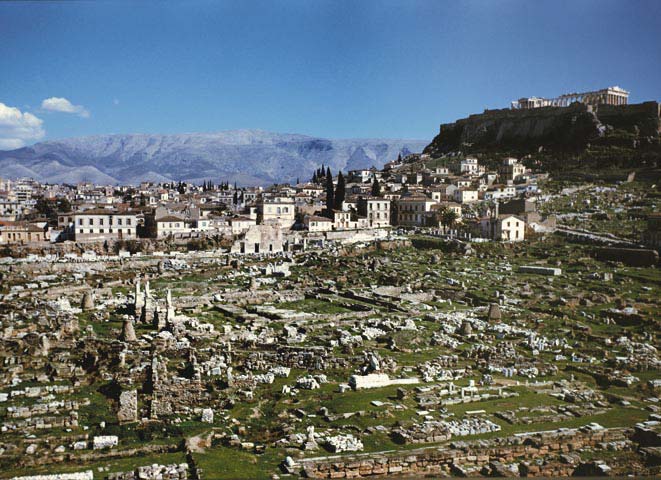
Socrates’ execution forces a confrontation with the authority of the state to impose death through lawful procedure. Athens did not conceal its power; it exercised capital punishment publicly, through jury vote, and within a framework regarded as legitimate by its citizens. The hemlock was administered not as an act of private vengeance or clandestine reprisal but as the formal conclusion of a civic judgment rendered in open court. The machinery of democracy, including indictment, defense speech, deliberation, and sentencing vote, functioned according to established norms. In this sense, Socrates’ death illustrates the capacity of a democratic polity to determine life and death without suspending its own legal identity. The event does not expose a breakdown of order but rather the stark implications of order itself. When the sovereign citizen body speaks through lawful channels, its decisions carry ultimate consequence. The philosophical unease arises precisely because the execution was legal. The problem it presents is not lawlessness but legality itself.
Lawful death carries a different moral weight than arbitrary killing. When a state executes through recognized processes, the act is framed as justice rather than violence. Yet Socrates’ case reveals the fragility of that distinction. A decision reached by majority vote may still be mistaken. Procedure does not guarantee moral correctness. The jury’s authority was real, and its verdict binding, but the philosophical question remains whether legitimacy derived from collective agreement suffices to justify irreversible punishment. Socrates’ composure in accepting the sentence does not dissolve this tension; it intensifies it by separating the morality of his response from the justice of the outcome.
His refusal to escape implicitly affirms the principle that legal order requires finality. If every condemned individual reserves the right to nullify verdicts personally, the state’s claim to adjudicative authority erodes. Socrates appears to recognize that the stability of the polis depends upon citizens accepting adverse judgments, even severe ones. His compliance underscores the structural necessity of lawful enforcement within political communities. The state’s ability to impose death, however troubling, is intertwined with its broader capacity to maintain order and mutual obligation.
Yet the episode also exposes the limits of political authority. The state can command the body, but it cannot compel assent of the soul. Socrates accepts execution without conceding that the jury’s moral reasoning was correct. His final hours are devoted not to retracting his philosophical commitments but to reaffirming them. In this way, the event divides external power from internal conviction. The state exercises its lawful right to punish; the individual retains sovereignty over meaning. Socrates’ death becomes a study in how political authority and moral autonomy intersect without fully subsuming one another, leaving unresolved the enduring question of whether legality alone can sanctify the taking of life.
Conclusion: Choosing Death without Choosing Suicide
Socrates’ death resists easy categorization. It was neither an act of self-destruction nor a simple capitulation to state power. He did not ingest hemlock because he despaired of life, nor did he do so because he lacked alternatives. He declined an available escape and remained within the legal framework that condemned him. In doing so, he separated the concept of choosing death from the act of initiating it. His decision was not to die, but to refuse injustice as he understood it, even when that refusal carried fatal consequence.
The distinction is philosophically decisive. Suicide, in much of Greek thought, involved an individual’s unilateral termination of life. Socrates does not assume such authority. In Phaedo, he argues that human beings are not their own ultimate masters and must not depart life without warrant. Yet in Crito, he refuses to undermine the legal order by escaping. His acceptance of execution emerges at the intersection of two commitments: restraint before divine order and fidelity to civic law. Death arrives not as a chosen objective but as the outcome of a sustained effort to live consistently within those boundaries.
This coherence explains the calm that characterizes the final scenes of Phaedo. Socrates’ composure is not fatalism and not theatrical martyrdom. It is the visible expression of a life aligned with examined principles. If philosophy is preparation for death, then his final act is the logical extension of that discipline. He neither seeks extinction nor clings to survival at any cost. Instead, he maintains the integrity of his reasoning to its conclusion. In this sense, the meaning of his death is inseparable from the manner of his living.
The enduring power of the episode lies in its refusal to collapse complex moral questions into simple binaries. Socrates neither sanctifies the state nor glorifies rebellion. He does not elevate personal autonomy above all structure, nor does he dissolve moral judgment into civic obedience. By accepting lawful execution without endorsing injustice, he demonstrates that agency, obligation, and mortality can intersect without erasing one another. Choosing death without choosing suicide becomes a way of naming this paradox. In 399 BCE, Socrates transformed an execution into a philosophical statement, leaving later generations to wrestle with the limits of autonomy, the authority of law, and the meaning of a good death.
Bibliography
- Aristotle. Nicomachean Ethics. Translated by Terence Irwin. Indianapolis: Hackett, 1999.
- Brickhouse, Thomas C., and Nicholas D. Smith. Socrates on Trial. Princeton: Princeton University Press, 1989.
- Citlak, Amadeusz. “Socrates’ Voluntary Death — An Essential Voice Against the Pathologisation of Suicide.” Europe’s Journal of Psychology 21:4 (2025), 331-345.
- Gallop, David. Plato’s Phaedo. Oxford: Clarendon Press, 1975.
- Griffin, Miriam. Seneca: A Philosopher in Politics. Oxford: Clarendon Press, 1976.
- Hansen, Mogens Herman. The Athenian Democracy in the Age of Demosthenes. Norman: University of Oklahoma Press, 1991.
- Kraut, Richard. Socrates and the State. Princeton: Princeton University Press, 1984.
- Morris, Ian. “Attitudes toward Death in Archaic Greece.” Classical Antiquity 8:2 (1989), 296-320.
- Mystakidou, Kyriaki, Eleni Tsilika, and Lambros Vlahos. “Death and Grief in the Greek Culture.” OMEGA: Journal of Death and Dying 50:1 (2005), 23-34.
- Ober, Josiah. Mass and Elite in Democratic Athens. Princeton: Princeton University Press, 1989.
- Plato. Apology. In Plato: Complete Works, edited by John M. Cooper. Indianapolis: Hackett Publishing, 1997.
- —-. Crito. In Plato: Complete Works, edited by John M. Cooper. Indianapolis: Hackett Publishing, 1997.
- —-. Laws. In Plato: Complete Works, edited by John M. Cooper. Indianapolis: Hackett Publishing, 1997.
- —-. Phaedo. In Plato: Complete Works, edited by John M. Cooper. Indianapolis: Hackett Publishing, 1997.
- Rist, John M. Stoic Philosophy. Cambridge: Cambridge University Press, 1969.
- Sedley, David. “The Dramatis Personae of Plato’s Phaedo.” In Oxford Studies in Ancient Philosophy, vol. 13. Oxford: Oxford University Press, 1995.
- Sophocles. Ajax. Translated by H. Lloyd-Jones. Cambridge, MA: Harvard University Press, Loeb Classical Library, 1994.
- Xenophon. Memorabilia and Apology. In Xenophon: Memorabilia and Oeconomicus, translated by E. C. Marchant. Cambridge, MA: Harvard University Press, Loeb Classical Library, 1923.
Originally published by Brewminate, 02.25.2026, under the terms of a Creative Commons Attribution-NonCommercial-NoDerivatives 4.0 International license.
About the Author