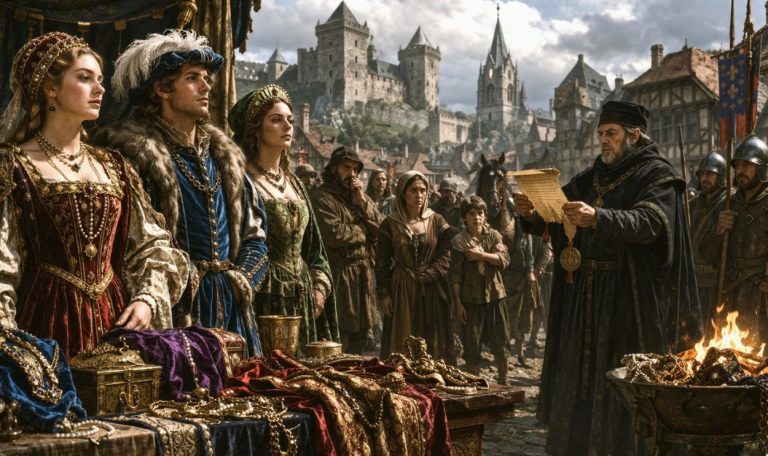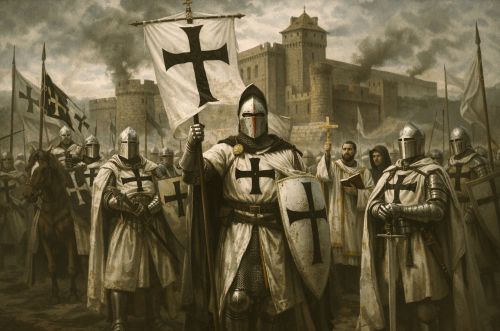
The Teutonic Order embodied militarized monasticism, revealing how crusading piety and territorial ambition merged in medieval Europe’s frontier politics.

By Matthew A. McIntosh
Public Historian
Brewminate
Introduction: When Vow and Sword Became One
In the high medieval world, the boundary between cloister and battlefield did not simply blur. In the case of the Teutonic Order, it was deliberately erased. Founded in the crucible of crusading warfare and formally recognized at the turn of the thirteenth century, the Order embodied a structural integration of monastic discipline and armed force. Its members took vows of poverty, chastity, and obedience, yet they also bore swords, commanded fortresses, and governed territories. Warfare was not an unfortunate necessity appended to spiritual life. It was articulated as vocation. In this institutional design, vow and violence became mutually reinforcing.
The emergence of military orders in the wake of the First and Third Crusades created a new category of religious life within Latin Christendom. The Templars and Hospitallers had already demonstrated that monastic rule could coexist with martial function. The Teutonic Knights, initially formed as a hospital brotherhood in Acre during the Third Crusade, adopted and adapted this model. Papal authorization provided canonical legitimacy, and a written rule structured communal discipline along monastic lines. Yet unlike secular crusading armies raised for specific campaigns, the Order constituted a permanent armed community whose identity was anchored in religious profession. Obedience to a superior was simultaneously a monastic and military act. The command structure did not merely mirror ecclesiastical hierarchy. It was ecclesiastical hierarchy translated into operational authority.
This fusion reshaped the moral grammar of warfare. In traditional feudal contexts, martial service derived from personal allegiance or territorial obligation. Within the Teutonic Order, armed conflict was framed as penitential service and sacred duty. Campaigns against non-Christian populations in the Baltic were presented not simply as territorial expansion but as participation in a providential struggle. The language of crusade conferred salvific meaning upon violence, and the liturgical rhythms of communal prayer accompanied military preparation. The Order’s black cross on white mantle symbolized not only affiliation but mission. To fight under that emblem was to act within a theological narrative that sacralized authority and justified coercion as a form of religious obedience.
The Teutonic Order represents more than a dramatic episode in the history of crusading. It illustrates how embedding religious hierarchy within an armed order transforms organizational culture, political governance, and concepts of legitimacy. When spiritual obedience and military command are unified in a single structure, dissent is recast as both insubordination and impiety, and authority acquires a dual character that is at once administrative and sacred. Territorial control becomes confessional, as governance is organized around the presumption of religious uniformity and mission. Structures of command are reinforced by vows that bind conscience as well as action. In such a framework, expansion can be narrated not as ambition but as obligation, and resistance can be framed as defiance of divine order rather than merely political opposition. By examining the Order’s institutional architecture, expansion in the Baltic, and administrative governance, we can observe how the blending of monastic vocation and military power reshaped not only external conquest but internal identity. The transformation was cultural as well as structural. Discipline, ritual, symbolism, and hierarchy were woven together into a single institutional ethos. In the Teutonic Order, faith did not merely inspire warfare. It constituted its organizing principle and defined the boundaries of belonging within the political communities it created.
Origins in the Crusading World: From Hospital Brotherhood to Military Order
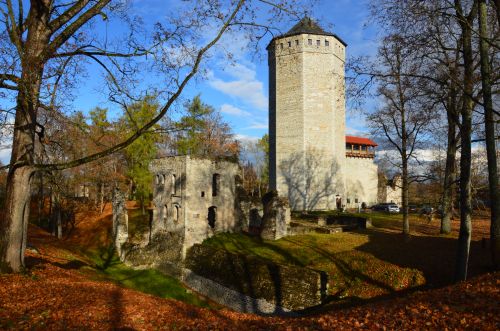
The origins of the Teutonic Order lay not in immediate conquest but in charitable service amid crusading instability. During the Third Crusade, German merchants from Lübeck and Bremen established a field hospital at Acre to care for wounded and sick pilgrims. What began as an improvised brotherhood dedicated to medical relief soon attracted ecclesiastical recognition. In 1190, the community received formal approval, and by 1198 it had been reorganized as a military order. This transformation was neither accidental nor purely local. It occurred within a crusading environment that had already normalized the blending of religious profession and armed defense.
Papal authorization proved decisive in shaping this institutional evolution. The Order adopted a rule modeled in part on the Knights Templar while retaining elements reminiscent of the Hospitallers’ charitable mission. Members professed the traditional monastic vows of poverty, chastity, and obedience, placing themselves under spiritual discipline even as they prepared for combat. These vows were not symbolic gestures. They structured daily life through communal prayer, regulated property ownership, and enforced obedience to superiors as a spiritual obligation. The papacy granted privileges that insulated the Order from local episcopal control, answering directly to Rome and thereby bypassing regional ecclesiastical authorities who might otherwise have constrained its autonomy. Such autonomy enabled it to function as a transregional institution capable of operating across political boundaries. It could recruit broadly, administer holdings independently, and coordinate military campaigns without becoming subordinate to local secular rulers. The combination of canonical legitimacy, internal discipline, and military purpose distinguished it sharply from ad hoc crusading contingents raised by secular lords for limited expeditions.
The conversion from hospital brotherhood to armed order reflected broader developments within Latin Christendom. The experience of crusade had generated a theological framework in which warfare, when conducted under ecclesiastical sanction, could be construed as penitential and meritorious. Participation in armed pilgrimage promised spiritual reward and remission of sins. The military orders institutionalized this logic in enduring form. Rather than assembling temporarily for campaigns, they embodied permanent readiness. Their members lived in community under a religious rule while remaining operationally prepared for battle. In this arrangement, the rhythms of prayer and the discipline of arms coexisted as aspects of a single vocation.
Geography also shaped the Order’s trajectory. After the loss of Acre and the contraction of crusader holdings in the Levant, the Teutonic Knights redirected their ambitions northward. Invitations from Polish rulers seeking assistance against pagan Prussian tribes provided opportunity and justification. The Baltic frontier offered both missionary rationale and territorial possibility. Unlike the eastern Mediterranean, where the Latin presence was precarious and contested by established Muslim polities, the Baltic region presented a different landscape of fragmented tribal structures and fluid political boundaries. The crusading ethos migrated from the eastern Mediterranean to northeastern Europe, reframed as a campaign against paganism rather than Islam. Papal bulls extended crusading privileges to those who fought in the Baltic, reinforcing the sacred framing of expansion. In this relocation, the Order’s identity evolved further from hospital fraternity to conquering authority, intertwining evangelization, colonization, and militarized governance.
Institutional consolidation followed expansion. The Order established fortified centers, developed administrative structures, and attracted recruits from across German-speaking lands. Castles such as Marienburg were not merely defensive structures but administrative hubs that anchored territorial control. Land grants, settlement policies, and economic management required bureaucratic coordination alongside military strength. Its members were not feudal retainers tied to hereditary estates but professed brothers bound by rule, forming a corporate body that transcended lineage. Leadership emerged through election within the Order’s hierarchical framework, reinforcing the fusion of monastic governance and military command. The Grand Master presided over both spiritual discipline and strategic direction, supported by regional commanders who exercised authority over provinces and commanderies. This dual authority eliminated the need to negotiate between clerical and martial spheres because those spheres were institutionally unified from the outset.
By the early thirteenth century, the Teutonic Order had become a permanent actor within the crusading world. Its transformation from hospital to military order reveals how crusading ideology enabled institutional fusion rather than mere collaboration between church and knight. The sword was not an external tool borrowed for emergency use. It became integral to the Order’s religious self-understanding. Charity, discipline, and conquest were woven into a single framework, setting the stage for the distinctive culture that would characterize its Baltic dominion.
Institutional Structure: Religious Hierarchy as Command System
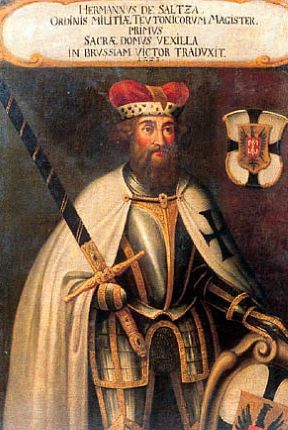
The Teutonic Order’s institutional architecture did not separate spiritual authority from military command. It fused them at every level. At the apex stood the Grand Master, elected by the brethren yet vested with authority that was simultaneously monastic and strategic. He governed the Order’s spiritual discipline, presided over its chapters, directed campaigns, negotiated treaties, and oversaw territorial administration. Beneath him operated a structured hierarchy of commanders, marshals, and provincial masters whose roles combined liturgical oversight with operational control. This was not a clerical order that happened to field troops. It was a religious community whose chain of command was inseparable from its vow of obedience.
Obedience itself functioned as the linchpin of this system. In monastic tradition, obedience represented submission of will to rule and superior as a path toward spiritual perfection. Within the Teutonic Order, that spiritual discipline translated directly into military cohesion and administrative reliability. Orders issued by superiors carried not merely administrative weight but moral gravity, rooted in a vow taken before God. Disobedience was not simply insubordination. It was violation of vow and breach of sacred commitment. The Rule structured daily life through communal prayer, regulated silence, dress, and diet, and imposed collective discipline that reinforced hierarchy at every level of the Order. Brothers ate together, worshiped together, and trained together, creating an environment in which shared ritual reinforced operational unity. The battlefield became an extension of the cloister’s order. Tactical coordination and spiritual conformity drew from the same well of institutional discipline. The internalization of obedience reduced reliance on external enforcement because conformity was framed as a matter of conscience as well as command.
Chapters, both general and provincial, further illustrate this integrated design. Major decisions were debated within formal assemblies of professed brethren, reflecting monastic governance traditions adapted to martial purpose. These gatherings did not dilute authority. They legitimized it through collective deliberation grounded in religious identity. Election of the Grand Master by chapter reinforced corporate unity and spiritual solidarity while maintaining strict hierarchical structure once decisions were finalized. The process combined communal participation with decisive leadership. Accountability was internal rather than feudal. Commanders were responsible to the Order’s rule and superiors, not to hereditary lineage or external lordship. This distinction separated the Order from secular knighthood, where personal bonds, dynastic interests, and land tenure frequently shaped allegiance. Within the Teutonic Order, authority derived from profession and vow, not bloodline. Governance operated through institutional continuity rather than familial succession, strengthening the Order’s coherence across generations and territories.
The result was a command system in which religious hierarchy did not merely bless military action but generated it. Authority flowed downward through vows rather than feudal contracts. Discipline was sustained by shared liturgy as much as by martial training. Governance of conquered territories followed the same pattern, with administrative offices embedded within the Order’s religious chain of command. In such a structure, institutional culture became self-reinforcing. Spiritual conformity strengthened military obedience, and military success validated the Order’s sacred mission. The integration of hierarchy and arms ensured that faith was not an ornament to power but its organizing framework.
Sacred War in the Baltic: Conquest as Evangelization
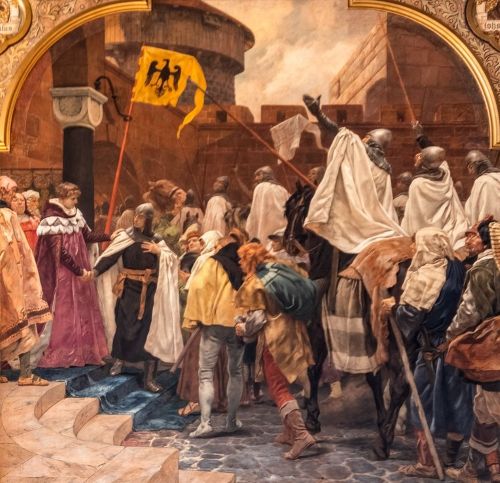
When the Teutonic Order redirected its energies from the Levant to the Baltic, it entered a region that Latin Christendom had long regarded as both frontier and mission field. The pagan Prussian and Lithuanian tribes were portrayed in crusading rhetoric as obstinate resistors of conversion, inhabiting lands that lay within the imagined orbit of Christian expansion. Papal bulls in the early thirteenth century extended crusading privileges to campaigns in the region, granting indulgences to those who participated and placing Baltic warfare within the same theological framework that had once animated expeditions to Jerusalem. The geographic shift did not dilute sacred meaning. It transferred it and adapted it to new circumstances. The frontier was recast as a spiritual boundary between Christendom and paganism. The battlefield in Prussia became an arena of spiritual struggle framed in explicitly evangelizing terms, where territorial conquest was interpreted as extension of Christian order into lands depicted as morally and cosmologically disordered.
The rhetoric of conversion played a central role in legitimizing conquest. Chronicles and papal bulls described campaigns as efforts to bring light to pagan darkness and to establish Christian order in territories depicted as spiritually wayward. Warfare was cast as preparatory to baptism, and submission to the Order was intertwined with acceptance of Christian authority. Yet the process of conversion was often inseparable from coercion. Military defeat preceded ecclesiastical incorporation. The sequence of subjugation, fortification, and settlement blurred the line between evangelization and colonization. Sacred language did not conceal this dynamic; it rendered it holy.
Fortified castles erected across Prussia and Livonia served both defensive and symbolic purposes. Structures such as Marienburg embodied the fusion of military and missionary ambition, rising as visible markers of both conquest and Christianization. From these centers, the Order projected authority into surrounding territories, organizing parishes, collecting tribute, and supervising local populations under an explicitly Christian administrative framework. Ecclesiastical organization followed military consolidation in deliberate sequence. Bishoprics were established in conquered regions, frequently staffed in coordination with the Order’s leadership and integrated into its political structure. The architecture of domination combined stone walls with sacramental administration. Castles functioned not merely as garrisons but as hubs of governance, taxation, and evangelizing oversight. Territorial control and religious integration advanced together, reinforcing one another in a system where spiritual and political authority were inseparable.
The Order’s campaigns against Lithuania illustrate the persistence of sacred framing even when geopolitical complexity deepened. Lithuania’s gradual engagement with Christian powers, including eventual baptism under Jogaila, complicated the narrative of simple pagan resistance. Yet for decades, the Teutonic Knights justified repeated incursions as necessary defense of Christendom against an unconverted adversary. Crusading indulgences attracted Western European nobles eager for both spiritual merit and martial reputation. The Baltic crusades became embedded within the broader culture of chivalric piety. Sacred justification sustained recruitment and reinforced the perception that expansion in the region fulfilled divine mandate.
This fusion of conquest and evangelization reshaped political authority in the Baltic. The Order did not merely defeat opponents. It reorganized territory according to a confessional template that privileged Latin Christian norms and marginalized alternative religious identities. German settlers were invited to colonize conquered lands, bringing with them urban charters, commercial networks, and legal systems aligned with the Order’s institutional priorities. Indigenous elites were integrated selectively, often contingent upon conversion and submission to Christian governance. Those who resisted faced not only military reprisal but exclusion from the political structures being constructed. Resistance could be interpreted as rebellion not merely against a ruling authority but against the divinely sanctioned order the Order claimed to represent. Religious identity became a primary criterion for belonging within the emerging polity, embedding confessional hierarchy into the foundations of territorial administration.
In framing warfare as religious mandate, the Teutonic Order transformed expansion into vocation. The sword was wielded not solely in pursuit of tribute or security but as instrument of perceived divine will. This framing endowed campaigns with moral urgency and institutional continuity. Even setbacks could be interpreted within a providential narrative. Sacred war in the Baltic was not episodic crusading enthusiasm. It became an enduring feature of the Order’s identity. Conquest and evangelization were interwoven threads in a single project, one that permanently altered the religious and political landscape of northeastern Europe.
Governance and Religious Exclusion: Building a Confessional State
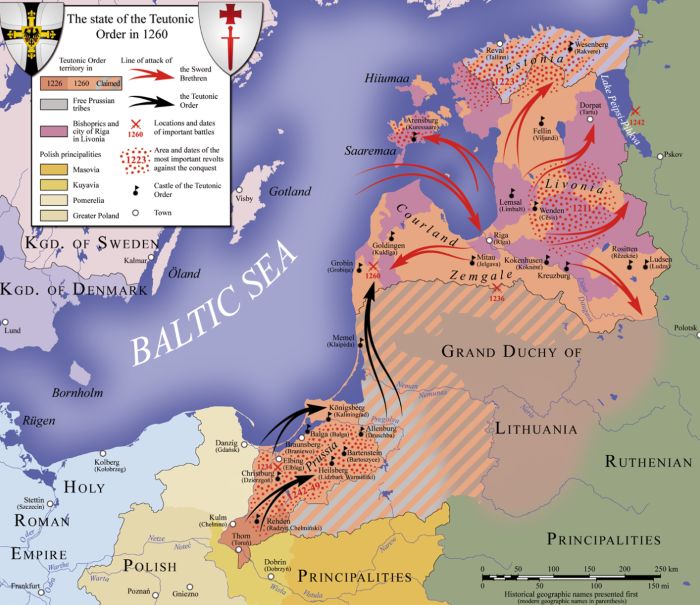
As the Teutonic Order consolidated control over Prussia and neighboring regions, conquest gave way to administration. The Order did not function merely as a military occupier. It established a territorial regime structured around its monastic hierarchy and infused with confessional assumptions. Governance flowed through commanderies that combined ecclesiastical supervision with fiscal and judicial authority. Land was surveyed, villages reorganized, and urban centers chartered under legal frameworks aligned with German models. Political authority was institutionalized through structures that reflected the Order’s religious character.
Confessional identity shaped inclusion within this emerging polity. Conversion to Christianity was not only a spiritual matter but a prerequisite for full participation in the Order’s political order. Indigenous populations who accepted baptism could be integrated into parochial life and local administration, though often within subordinate roles. Those who resisted faced marginalization, displacement, or continued military pressure. The linkage between religious conformity and civic standing embedded exclusion into governance. Political belonging became conditional upon alignment with the Order’s confessional framework.
Colonization reinforced this dynamic. The Order encouraged settlement by German-speaking Christians, importing legal customs such as Magdeburg Law to structure urban and rural life. These settlements altered demographic patterns and anchored administrative control in communities already aligned with Latin Christian norms. The granting of town charters established municipal councils that operated within frameworks compatible with the Order’s authority, creating islands of juridical order tied to broader Christian legal traditions. Churches, monasteries, and episcopal sees formed a dense network across conquered territories, reinforcing ecclesiastical oversight not only in worship but in education and record keeping. Parish organization often followed the lines of settlement, binding religious practice to emerging social hierarchies. Economic extraction, including tithes and rents, was coordinated through these intertwined spiritual and administrative channels. Governance operated through layered structures of spiritual and temporal authority. Territorial consolidation became systematic restructuring along confessional lines.
The Order’s judicial authority further illustrates this confessional dimension. Courts administered by the Order adjudicated disputes in accordance with legal traditions intertwined with Christian moral assumptions. Religious dissent or relapse into pre-Christian practice could be treated not merely as private deviation but as challenge to public order. The integration of ecclesiastical discipline and civil enforcement narrowed the space for alternative religious expression. Authority was justified not only through force but through invocation of divine mandate, rendering resistance morally suspect as well as politically rebellious.
In constructing what can be described as a confessional state, the Teutonic Order demonstrated how the fusion of monastic hierarchy and military command could extend beyond battlefield into daily governance. Religious exclusion was not incidental byproduct of conquest. It was embedded within institutional design and reinforced through administrative practice. The state that emerged in Prussia was structured around the presumption of Christian uniformity under the Order’s authority, shaping legal norms, settlement policy, and economic organization. Governance was framed as stewardship of a Christian polity rather than management of a plural society. This presumption narrowed the conceptual space for dissent and integrated religious conformity into the definition of political loyalty. Through this model, sacred vocation and political administration became inseparable, shaping a territorial regime defined as much by creed as by coercive capacity and establishing patterns that would influence regional governance for generations.
Institutional Culture and Identity: The Warrior Monk
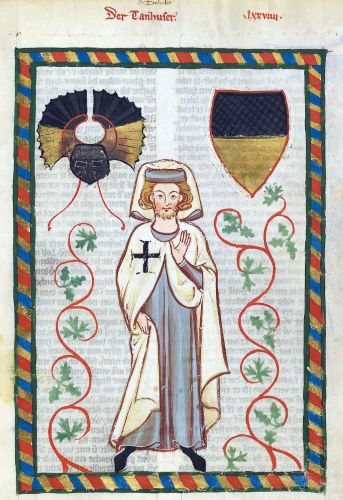
The identity of the Teutonic Knight was neither simply monastic nor merely martial. It was constructed at the intersection of cloistered discipline and battlefield obligation, shaped by vows that bound conscience even as they authorized violence. Brothers entered the Order through religious profession, surrendering personal property, renouncing marriage, and pledging obedience to superiors in a ceremony that resembled entry into a traditional monastery. Yet they did so in full knowledge that their vocation would require armed conflict and sustained engagement in frontier warfare. The renunciation of private life did not remove them from political struggle. It repositioned them within it under a theological mandate. The result was a distinct self-understanding. The knight of the Order was not a lay warrior temporarily taking up crusade or seeking personal advancement through arms. He was a professed religious whose spiritual formation unfolded within a militarized institution. His identity was shaped by the conviction that obedience to rule and readiness for combat were not competing loyalties but integrated expressions of sacred duty.
Daily life reinforced this synthesis. Communal prayer structured the hours, following patterns derived from monastic observance. Liturgical participation was not suspended during campaign seasons but integrated into them as circumstances allowed. The mantle bearing the black cross served as constant visual reminder of vocation. Dress codes, dietary regulations, and shared dormitories cultivated corporate identity. Even military preparation was framed within a spiritual ethos. Training and readiness were expressions of disciplined obedience rather than personal glory. In this way, the rhythms of the cloister infused the rhythms of war.
The warrior monk ideal also shaped the Order’s internal moral expectations. Courage in battle was interpreted not merely as chivalric virtue but as evidence of steadfast faith. Endurance under hardship acquired penitential meaning. Suffering and sacrifice were absorbed into a theology of service in which martial risk paralleled ascetic renunciation. Unlike secular knighthood, where honor might be tied to lineage or personal reputation, the Order emphasized collective identity over individual distinction. Glory belonged to the institution and, by extension, to the divine mission it claimed to serve. Personal ambition was to be subordinated to corporate purpose.
Ritual and symbolism further reinforced this culture. The black cross on white field functioned as emblem of purity and commitment, distinguishing the Order from both secular lords and other military fraternities. It appeared on mantles, standards, seals, and architectural decoration, embedding identity in both fabric and stone. Ceremonies of profession, reception of new brothers, and funerary rites embedded martial identity within a liturgical framework that reminded members of the eternal stakes associated with temporal conflict. Even architecture reflected this ethos. Castles incorporated chapels at their core, situating prayer physically and symbolically at the center of fortified space. Processions, feast days, and communal recitation of the Divine Office unfolded within walls designed for defense. The material environment itself communicated the inseparability of devotion and defense, reinforcing the perception that martial vigilance and spiritual vigilance were parallel obligations within a unified vocation.
Tensions nonetheless accompanied this synthesis. The accumulation of territorial wealth, administrative responsibilities, and diplomatic entanglements complicated the ascetic ideal. As the Order governed cities and oversaw economic networks, its leadership navigated pressures familiar to secular rulers. The vow of poverty applied corporately rather than individually, permitting institutional accumulation even as individual brothers remained dispossessed. This distinction preserved the formal integrity of monastic commitment while enabling expansive governance. Yet it also introduced ambiguities. The warrior monk operated within structures that increasingly resembled princely authority.
The Teutonic Order cultivated a culture that was neither purely contemplative nor simply militant. Its identity rested on the conviction that spiritual obedience and martial action were mutually sustaining. The cloister did not restrain the sword. It legitimized it. By embedding warfare within liturgical life and embedding liturgical life within fortified space, the Order fashioned a durable institutional persona. The warrior monk became emblem of a broader fusion in which faith defined the meaning of force and force defended the framework of faith.
Crisis and Transformation: Grunwald and the Limits of Sacred Authority
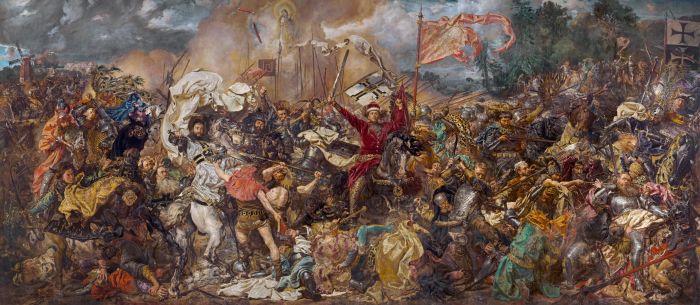
The Battle of Grunwald in 1410 marked a decisive rupture in the history of the Teutonic Order and exposed the vulnerability of sacralized military legitimacy. Facing a combined Polish-Lithuanian force under King Władysław II Jagiełło and Grand Duke Vytautas, the Order suffered a catastrophic defeat that resulted in the death of Grand Master Ulrich von Jungingen and the decimation of its elite command. For an institution that had long framed its campaigns as divinely sanctioned and providentially guided, the scale of the loss carried symbolic weight beyond military setback. Sacred rhetoric had sustained expansion and justified governance. Grunwald forced confrontation with the possibility that divine favor did not guarantee victory.
The defeat reverberated through the Order’s political and financial structures in ways that extended far beyond the battlefield. Although the fortress of Marienburg withstood siege in the immediate aftermath, preserving the institutional core of the Order, the broader strategic balance had shifted irreversibly. The First Peace of Thorn in 1411 imposed substantial indemnities that strained fiscal resources and undermined the Order’s economic stability. These reparations required intensified taxation within its territories, fueling dissatisfaction among urban merchants and landed elites. At the same time, the symbolic capital that had once attracted crusading volunteers from across Western Europe began to erode. The narrative of sacred invincibility had been punctured. Lithuania’s formal conversion to Christianity under Jogaila further complicated the ideological foundation of Baltic campaigns. The long-standing claim that warfare constituted defense of Christendom against pagan aggression lost clarity when former adversaries were integrated into the Christian fold. Sacred war, once rhetorically straightforward, now appeared entangled in dynastic politics and regional rivalry rather than unambiguous evangelizing mission.
Internally, Grunwald intensified structural strains that had accumulated over generations. The Order’s extensive territorial holdings required administrative sophistication and fiscal stability, both of which were shaken by military loss and economic burden. Urban elites within Prussian cities increasingly asserted political interests that did not always align with the Order’s priorities. Dissent emerged not in overt theological rebellion but in political negotiation and resistance to fiscal demands. The fusion of religious hierarchy and military command that had once ensured cohesion now confronted limits imposed by geopolitical reality and internal complexity.
Grunwald did not immediately dissolve the Teutonic Order, but it transformed its trajectory. Sacred authority, while still invoked, no longer sufficed to secure regional supremacy. The Order entered a period of contraction, adaptation, and eventual secularization of its Prussian territories in the sixteenth century. The crisis revealed a fundamental tension within militarized monasticism. When institutional legitimacy rests upon the presumption of divine endorsement in battle, defeat acquires theological as well as strategic implications. The events of 1410 illuminate the boundaries of sacralized force. They demonstrate that institutional fusion of faith and arms can generate formidable cohesion, yet it cannot insulate authority from the contingencies of power and the recalibrations of history.
Conclusion: Institutional Design and the Culture of Sacred Force
The history of the Teutonic Order demonstrates that the integration of religion and military authority was not merely rhetorical but architectural. From its formal recognition at the end of the twelfth century to its territorial governance in Prussia, the Order embodied a governing design in which monastic discipline and martial command were inseparable. Its founding rule did not treat warfare as an auxiliary function appended to spiritual life. It codified armed service as intrinsic to religious vocation. Vows of obedience underwrote battlefield cohesion, binding conscience to command in ways that exceeded feudal obligation. Liturgical rhythm structured administrative life, ensuring that governance unfolded within a sacralized temporal framework. Sacred language did not merely accompany conquest. It framed and justified it, rendering expansion an expression of providential mandate. Castles, parishes, and commanderies formed a network in which ecclesiastical hierarchy and military authority operated as a single system. In this synthesis, faith became the organizing principle of force rather than its ornamental justification, reshaping not only the external projection of power but the internal culture through which that power was exercised.
Unlike secular rulers who invoked divine favor while operating within plural political systems, the Teutonic Order embedded religious identity into the core of governance. Political authority was mediated through religious hierarchy. Territorial expansion was articulated as missionary obligation. Inclusion within the polity required alignment with Christian norms defined and enforced by the Order itself. This integration reshaped institutional culture. The warrior monk did not oscillate between cloister and campaign. He inhabited a single vocation in which spiritual obedience and martial action were mutually reinforcing expressions of sacred duty.
The durability of this structure rested on coherence between mission and authority. For centuries, the Order sustained a culture in which conquest, colonization, and governance were interpreted within a unified theological framework. Yet the crisis at Grunwald revealed the fragility inherent in sacralized force. When military defeat disrupted the narrative of divine endorsement, institutional legitimacy confronted strain. Religious authority could intensify cohesion and justify expansion, but it could not eliminate geopolitical contingency or internal dissent. This structural union magnified both strength and vulnerability.
The Teutonic Order offers a revealing case study in the transformation of institutional culture when faith and armed power are structurally entwined. It shows how religious hierarchy can generate disciplined command, how sacred rhetoric can legitimate territorial control, and how exclusionary governance can follow from confessional design. At the same time, it underscores the limits of sacralized authority in the face of historical change. The culture of sanctified force forged in the Baltic frontier reshaped regional politics for centuries. Yet its trajectory confirms that no governing structure, however theologically grounded, stands immune from the pressures of power, defeat, and adaptation.
Bibliography
- Barber, Malcolm. The Military Orders Volume I: Fighting for the Faith and Caring for the Sick. Aldershot: Ashgate, 1994.
- Brzechczyn, Krzysztof. “The State of the Teutonic Order as a Socialist Society.” Poznan Studies in the Philosophy of the Sciences and the Humanities 33 (1993), 397-414.
- Christiansen, Eric. The Northern Crusades. London: Penguin Books, 1980.
- Housley, Norman. Documents on the Later Crusades, 1274-1580. London: Bloomsbury Academic, 1996.
- —-. Religious Warfare in Europe, 1400–1536. Oxford: Oxford University Press, 2002.
- Kļaviņš, Kaspars. “The Ideology of Christianity and Pagan Practice among the Teutonic Knights: The Case of the Baltic Region.” Journal of Baltic Studies 37:3 (2006), 260-276.
- Morton, Nicholas. The Teutonic Knights in the Holy Land, 1190–1291. Woodbridge: Boydell Press, 2009.
- Nicholson, Helen. The Knights Templar: A New History. Stroud: Sutton Publishing, 2001.
- North, Michael. The Baltic: A History. Cambridge, MA: Harvard University Press, 2015.
- Urban, William. The Last Years of the Teutonic Knights: Lithuania, Poland and the Teutonic Order. London: Greenhill Books, 2018.
- —-. The Teutonic Knights: A Military History. London: Greenhill Books, 2003.
- Xiao, Hongde and My An Trieu Thi. “Study on the Secularization of the Teutonic Knights’ State.” Journal of Science and Technology Development 26:4 (2023), 3244-3250.
Originally published by Brewminate, 02.27.2026, under the terms of a Creative Commons Attribution-NonCommercial-NoDerivatives 4.0 International license.
About the Author