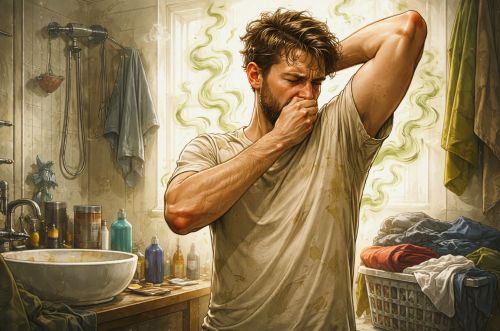
For most people, the practical takeaway from this debate is not a radical change in behavior, but a loosening of rigid expectations.

By Matthew A. McIntosh
Public Historian
Brewminate
Introduction
For most of the twentieth century, daily showering was treated as a basic marker of hygiene, normalcy, and even moral responsibility. To bathe regularly was to be clean, civilized, and socially acceptable. Yet in recent years, that assumption has begun to crack. A growing number of voices, ranging from dermatologists to public-health researchers, have questioned whether daily showering is actually necessary for most people. Frequent bathing is often more cultural habit than medical requirement, and in some cases may even irritate the skin.
This rethinking has moved beyond academic discussion into everyday behavior. Even professional articles have helped popularize the idea that modern hygiene norms may be out of step with how human skin actually functions. At the same time, lifestyle media has amplified the trend, sometimes unhelpfully, by spotlighting celebrities who openly reject frequent bathing. Some frame the phenomenon as a provocative cultural question: are daily showers a necessity, or an overcorrection born of advertising, habit, and social pressure?
The conversation has even been reinforced by surveys suggesting large numbers of adults no longer bathe at all. Research has found that millions of people say they never take baths, reflecting a broader shift in how cleanliness is defined and practiced. None of this amounts to a medical endorsement of abandoning hygiene altogether, and for many people the idea is frankly off-putting. Still, the debate itself reveals something deeper: bathing habits are not fixed truths, but cultural practices shaped by science, environment, and changing ideas about what it means to be clean.
What the Trend Looks Like Today
The contemporary rethinking of bathing does not usually take the form of outright rejection of hygiene, despite how some headlines frame it. More commonly, it appears as a gradual loosening of routines that once felt nonnegotiable. People describe showering every other day instead of daily, avoiding soap on most of the body, or limiting full showers to periods of physical exertion. In online discussions and lifestyle reporting, these changes are often presented as pragmatic adjustments rather than ideological stances.
Public health and academic institutions have contributed to the visibility of this shift by translating technical research into accessible language. When the Yale School of Public Health asks whether showering is “overrated,” it does so cautiously, emphasizing skin biology and the role of beneficial microbes rather than promoting neglect. These pieces tend to stress that modern bathing habits are shaped more by custom than by clear medical necessity, a message that resonates with readers already questioning rigid norms.
Media coverage, however, has sometimes pushed the trend toward spectacle. Profiles of celebrities who claim to avoid bathing altogether have generated disproportionate attention, often stripping away nuance in favor of provocation. A Vice article captures this tension, oscillating between curiosity and disbelief. The result is a public conversation that blends genuine scientific questions with cultural fascination and, at times, revulsion.
Survey data suggests that behavior is changing, even if motivations vary. A 2025 report from Direct Line Group found that millions of adults say they never take baths, reflecting a broader decline in traditional bathing practices. This does not mean that people have abandoned cleanliness altogether, but it does indicate a shift in how hygiene is defined. What once centered on routine immersion in water is increasingly framed around comfort, skin health, and personal judgment, rather than strict adherence to inherited norms.
Why People Say They’re Skipping Showers
One of the most frequently cited reasons for showering less is concern for skin health. Dermatologists and public-health writers have increasingly emphasized the role of the skin microbiome, the complex ecosystem of bacteria that helps protect against irritation and infection. Excessive washing, especially with hot water and harsh soaps, can strip away natural oils and disrupt this balance. As Harvard Health has noted, daily showering is rarely medically necessary and can aggravate dryness, eczema, and sensitivity in some people.
Environmental considerations also play a role in the conversation. Showers consume large amounts of water and energy, and some people frame reduced bathing as a small but meaningful sustainability choice. This argument tends to resonate with younger audiences already attuned to climate concerns. While individual shower habits make only a modest environmental difference, they have become part of a broader ethic of minimizing waste and questioning routines once taken for granted.
Convenience and lifestyle changes have further normalized less frequent bathing. Remote work, flexible schedules, and reduced daily commuting mean fewer people feel pressured to present themselves according to strict workplace norms. Without the daily rhythm of office life, the expectation of showering every morning has softened. For many, skipping a shower is less about ideology than about practicality and comfort.
Celebrity influence has amplified these trends, sometimes distorting them. When public figures announce that they avoid bathing regularly, the message often travels without context or qualification. A widely shared Vice article captures how such claims fuel curiosity and backlash in equal measure. What begins as a discussion of moderation can quickly morph into a cultural spectacle, detached from medical nuance.
Finally, survey data suggests that traditional bathing habits are declining more broadly. A 2025 report from Direct Line Group found that millions of adults say they never take baths at all. This does not necessarily signal widespread rejection of hygiene, but it does reflect changing definitions of cleanliness. For many people, the decision to shower less is framed as a personal calibration rather than a rejection of social responsibility, even if the trend unsettles those who still view daily bathing as nonnegotiable.
What Medical Experts Actually Say
Medical experts have generally responded to the anti-bathing conversation with caution rather than alarm. Dermatologists and public-health specialists tend to agree on one central point: daily showering is not medically required for most people, but neither is abandoning hygiene altogether advisable. As explained by Harvard Health, the human body is remarkably resilient, and skin health depends more on how people bathe than how often. Shorter showers, gentler cleansers, and avoiding excessively hot water matter more than rigid schedules.
Experts also emphasize that hygiene is not a single behavior but a collection of targeted practices. Washing hands regularly, cleaning areas prone to odor or bacterial buildup, and maintaining basic grooming remain essential for health and social interaction. The Yale School of Public Health has stressed that moderation, not neglect, is the takeaway from microbiome research. Skin hosts beneficial bacteria, but that does not mean dirt, sweat, or environmental contaminants should be ignored.
Where physicians tend to push back is against absolutist interpretations of the trend. Claims that bathing is inherently unhealthy or unnecessary for everyone are not supported by medical consensus. Dermatologists routinely note that individual needs vary widely based on activity level, climate, age, and underlying skin conditions. What works for one person may cause irritation or infection for another. The science supports flexibility, not blanket rules.
Experts frame the debate as a matter of personalization rather than rebellion. Showering less frequently can be reasonable for some people, particularly those with dry or sensitive skin, but hygiene remains an important part of physical and social well-being. Medical guidance does not endorse abandoning bathing, but it does challenge the assumption that daily, full-body washing is a universal requirement. The message from clinicians is measured: cleanliness matters, but so does understanding how and why we practice it.
Where Culture Meets Biology
The renewed debate over bathing highlights the uneasy intersection between biological science and cultural expectation. For much of modern history, cleanliness has been treated as a moral and social obligation, reinforced through advertising, workplace norms, and public health messaging. Daily showering came to symbolize responsibility and self-discipline, regardless of whether it was medically necessary. As scientific research complicates those assumptions, cultural habits have proven slower to adapt.
Biology alone does not dictate hygiene practices. Human skin evolved long before modern soaps, hot water on demand, or enclosed bathrooms. Research into the skin microbiome has shown that the body maintains its own protective systems, prompting questions about whether constant intervention is always beneficial. Yet biology does not operate in a vacuum. People live in social environments where odor, appearance, and proximity matter, and those pressures shape behavior as much as scientific evidence does.
Cultural discomfort plays a significant role in how the anti-bathing conversation is received. Even modest reductions in showering can provoke strong reactions, suggesting that bathing has become a proxy for broader anxieties about self-control, civility, and social boundaries. The visceral responses many people express are not rooted in dermatology but in learned expectations about what clean bodies should look and smell like. Hygiene, in this sense, functions as a shared language of trust and normalcy.
Public health institutions have tried to navigate this terrain carefully. When organizations like the Yale School of Public Health discuss bathing habits, they do so with attention to both biological evidence and social consequences. The goal is not to dismantle hygiene norms but to contextualize them, emphasizing that cleanliness is not a one-size-fits-all mandate. Scientific nuance, however, often gets lost once these discussions enter popular media.
The result is a conversation shaped as much by identity and values as by research. For some, showering less represents autonomy and skepticism toward inherited norms. For others, it feels like a rejection of shared standards that make communal life possible. Biology may explain what the skin can tolerate, but culture determines what society expects. The current debate reflects that tension, revealing how deeply ideas about cleanliness are embedded in social life, even as scientific understanding continues to evolve.
Practical Takeaways
For most people, the practical takeaway from this debate is not a radical change in behavior, but a loosening of rigid expectations. Medical experts are clear that there is no single “correct” bathing schedule that applies to everyone. If daily showers make you feel comfortable, refreshed, and socially confident, there is no health-based reason to stop. Hygiene is not a moral test, and comfort still matters.
At the same time, science does suggest that moderation can be beneficial. Shorter showers, gentler soaps, and focusing on areas most prone to odor or bacterial buildup can protect skin health without sacrificing cleanliness. As Harvard Health notes, excessive washing can worsen dryness and irritation, especially in colder climates or for people with sensitive skin. Washing smarter, rather than simply washing more, is often the better approach.
Context also matters. Physical activity, climate, occupation, and social environment all shape what hygiene looks like in practice. Someone working outdoors in summer will have different needs than someone working from home in a cool apartment. Public-health guidance, including perspectives shared by the Yale School of Public Health, consistently emphasizes adaptability rather than strict rules. Cleanliness should respond to lived conditions, not ignore them.
The bathing debate is less about soap and water than about agency. People do not need to embrace anti-bathing rhetoric to take something useful from the discussion. The value lies in recognizing that hygiene practices are habits, not commandments. Thoughtful adjustments, informed by science and personal experience, are enough. There is no need to abandon showers altogether, and no obligation to treat daily bathing as a universal standard.
Conclusion: The Bigger Picture
The current debate over bathing is not really about whether people should shower less or more. It reflects a broader cultural moment in which long-standing routines are being reexamined through the lenses of science, sustainability, and personal autonomy. What once seemed unquestionable now invites scrutiny, not because hygiene has lost its importance, but because knowledge about the body has grown more precise. The friction comes from the gap between evolving science and deeply ingrained social norms.
Importantly, this conversation should not be mistaken for a rejection of cleanliness. Medical experts are not urging people to abandon hygiene, nor is there evidence that widespread non-bathing is beneficial or desirable. What has changed is the understanding that cleanliness does not require rigid uniformity. Skin biology, environmental context, and individual health vary, and hygiene practices can reflect that variation without sliding into neglect.
The renewed attention to bathing habits says more about how societies negotiate change than about soap and water themselves. Hygiene has always been shaped by culture as much as by science, and it continues to be renegotiated as new evidence emerges. The challenge is not choosing between daily showers and none at all but learning to hold nuance in a world that prefers absolutes.
Originally published by Brewminate, 01.12.2026, under the terms of a Creative Commons Attribution-NonCommercial-NoDerivatives 4.0 International license.
About the Author