A merchant in 1890 could not get paid after dark. Not because the buyer was broke, but because there was no system for moving money outside banking hours. That single inconvenience shaped the next century of retail more than any product launch ever did.
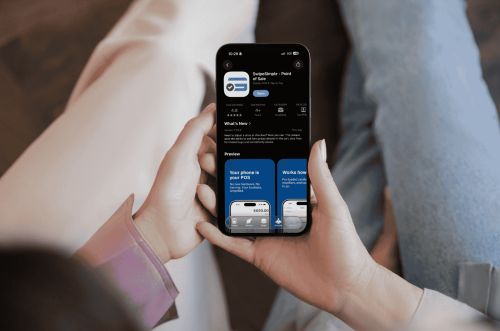
Every shift in how people pay at the counter follows the same script. Someone removes a step, merchants adopt it because the step was costing them money, and a wave of sellers gets left behind because they waited. You can see the whole arc play out today in phone-based checkout, where the newest sellers now accept payments on iphone without ever owning a terminal.
Why payment formats keep dying
Think about what a seller actually needs at the moment of sale. Money has to move from the buyer’s account to yours, the proof has to survive a dispute, and the whole thing has to take less time than the customer’s patience. Everything else is decoration.
Cash failed the first test once transactions got large. Carrying a week’s revenue in a lockbox meant hiring guards or losing sleep. Checks failed the speed test, because a piece of paper is a promise, not a payment. Cards fixed both problems and then created a new one: the merchant had to rent a machine, wire it to a phone line, and wait for approval codes.
The card reader held on for decades because nobody could beat it on trust. It was ugly, and it worked. Here’s my read on it: the terminal never really earned its long run. It survived on inertia and on the fact that no one wanted to explain a new system to a customer mid-checkout.
A century of getting paid, in four moves
The pattern is genuinely old. Follow it and the present stops looking random.
| Era | What sellers used | What it solved | What it broke |
| Late 1800s | Cash and informal credit ledgers | Immediate trust between neighbors | Nothing after hours, nothing at distance |
| Mid 1900s | Paper checks and charge accounts | Buying without carrying cash | Slow clearing, easy fraud |
| 1970s onward | Magnetic stripe card readers | Faster checkout, bank-backed proof | Hardware cost, fixed locations only |
| 2010s onward | Phones and contactless chips | Checkout anywhere, no machine | Learner curve for both sides of the counter |
The magnetic stripe is a good example of how stubborn a standard can be. According to the Library of Congress, the stripe format grew out of an engineering constraint rather than a good idea, and merchants lived with its limitations for generations because replacing it meant replacing every reader in the country.
That’s the part most owners miss. Payment formats don’t lose because a better one shows up. They lose when the cost of staying finally exceeds the cost of switching. For a hardware store with twelve lanes, that day arrives late. For a mobile dog groomer, it arrived years ago.
What the phone actually changed
A phone didn’t make payments faster in some abstract sense. It did one specific thing: it moved the terminal from the counter to the seller’s pocket. That sounds small. It isn’t, if your counter is a van.
Consider a caterer at a wedding venue. She has no fixed address, no phone line, and a client who wants to settle the balance on the spot. Under the old model she either carries a card reader and a hope that the venue’s wifi cooperates, or she asks for a check and waits four days. Under the new model the customer taps the back of her phone and it’s done.
The security side matters more than sellers give it credit for. Contactless payments use a one-time code per transaction rather than your card number, a technique with roots in the same tamper-resistant chip work documented by the Smithsonian Magazine archives on transaction security. Your customer’s actual number never crosses the air gap. That’s a real improvement over the old carbon copy slips, which sat in filing cabinets for anyone to photograph.
The seller who got burned by waiting
I’ve watched this play out in a specific way. A two-person landscaping crew quotes a job, finishes the job, and then has to collect. For three seasons they accepted checks only, drove to the client’s house to pick one up, and lost a weekend doing it. They didn’t calculate the cost of that drive, or the cost of a check that bounced twice.
When they finally switched to phone-based checkout, the change wasn’t really about technology. It compressed a five-step collection ritual into one moment, before the crew packs up the trailer. The customer is standing there, the work is visibly complete, and there’s no awkward follow-up call two weeks later.
That’s the actual argument for on-the-spot collection. It’s not convenience for its own sake. It’s that you collect when the customer’s satisfaction is at its highest point, which is the ten minutes after you finish.
A checklist before you switch
Don’t buy a new setup because a vendor made it sound inevitable. Run these five checks against your actual week.
- Count how many of your transactions happen away from a counter. If it’s more than a handful, portability is worth paying for.
- Ask your processor what rate applies when the card is present versus keyed in manually. The gap is usually the whole argument.
- Confirm your phone model and operating system are supported. Older devices get left out.
- Test one transaction with your own card before your first customer watches you fumble.
- Check whether your receipts can still carry the details your business clients need for their own books.
One more thing worth flagging. A phone-based setup is not a full replacement for every business. If you process a few hundred transactions a day behind a fixed counter, you still want dedicated hardware, because speed at the register beats portability you’ll never use. I’d pick the phone for anything mobile, and the terminal for anything that stays put.
The European Central Bank has documented across its official site how payment habits shift when the friction of a method drops, and the pattern holds in every market they track. People don’t adopt new payment types out of curiosity. They adopt them when the old one starts costing them patience.
What comes after the phone
The phone will eventually become the thing people are nostalgic about, the same way a carbon copy slip now feels like a museum piece. Someone is already building the next step, probably something that requires even less action from the buyer than a tap.
Here’s the practical takeaway from a century of this pattern. Choose the payment method that matches where your customers actually are, not the one that matches where your business was five years ago. If that place is a doorstep, a job site, or the back of a van, the phone in your hand is already the answer, and the cash drawer was never coming back.
What’s the last time you watched a customer reach for a card and you weren’t ready for it? Fix that moment before next week.
About the Author