
Italian nationalists carried out a string of attentats as assassination entered the anarchists’ toolkit.

By Eric Laursen
After an anarchist and former steel worker named Leon Czolgosz assassinated President William McKinley in September 1901, McKinley’s successor, Theodore Roosevelt, in his first message to Congress, offered his own characterization of “the anarchist.” It ought to sound familiar to us today.
“For the anarchist himself, whether he preaches or practices his doctrines, we need not have one particle more concern than for any ordinary murderer. He is not the victim of social or political injustice. There are no wrongs to remedy in his case.”
Roosevelt’s message echoes in the denunciations of Islamic terrorism that have filled the last several decades; it amounts to a denial that any larger context is needed to explain an act of political violence. “No man or body of men preaching anarchistic doctrines,” Roosevelt declared, “should be allowed at large any more than if preaching the murder of some specified private individual. Anarchistic speeches, writings, and meetings are essentially seditious and treasonable.”
Any speech that could be labeled anarchist, even if its content was peaceful, was therefore an incitement to violence and a crime. Further, it could be used to justify giving government greater powers and resources to surveille, interdict, and punish any political competitor. As “enemies of the State” have continued to appear over the last century-plus, the State has continued to accumulate new powers and capabilities: to emerge stronger from every attempt to challenge its authority.
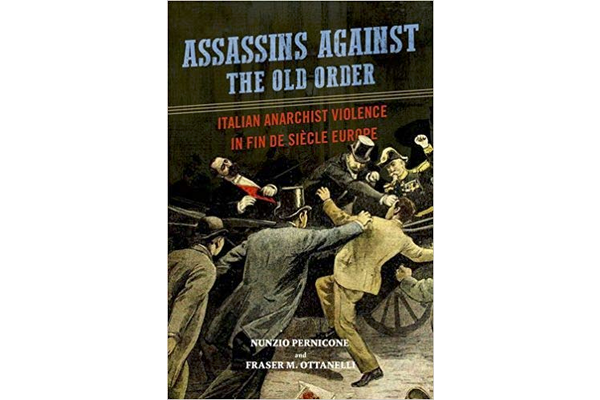
The assassination of McKinley, and Roosevelt’s thunderous response, came at the tail end of the spasm of politically motivated killings, or attentats, that’s covered in Assassins against the Old Order (University of Illinois Press), an excellent new study by Nunzio Pernicone and Fraser M. Ottanelli. Pernicone, the great historian of Italian and Italian-American anarchism, died in 2013; Ottanelli, the author of several works on Italian migration and the U.S. Left, completed his work. Their book attempts to restore the larger political context to late-19th century anarchist violence, much of it perpetrated by Italians, by surveying the history and then focusing on six sensational cases. Along the way, they tell an engrossing if tragic story of human suffering, oppression, rage, and revenge.
Their conclusion turns the table on Roosevelt’s: “Anarchist violence was essentially retaliatory violence precipitated by government repression.” In fact, they show, the origins of anarchist violence weren’t even in anarchism itself, but in the tactical doctrines of the Risorgimento, the nationalist struggle for Italian unification that, ironically, had earlier captured the imagination of liberals in the United States, Britain, and elsewhere.
“Propaganda of the deed,” the notion that individual acts of violence, including the assassination of tyrants and reactionary politicians was necessary to spark a revolutionary outbreak, was articulated by Carlo Pisacane, a companion of Mazzini, the father of the Risorgimento; Pisacane died trying to launch an insurrection in the Kingdom of Naples in 1857. His landing in the kingdom was celebrated in a poem by Luigi Mercantini that was translated into English by Longfellow; the date of his abortive rising is marked every year by a three-day festival in the Campanian town of Sapri.
Pisacane’s death was the end point of a period when Italian nationalists carried out a string of attentats, including the stabbing of one of Pope Pius IX’s ministers (1848), the fatal stabbing of Duke Carlo III of Parma (1854), and an attempt on the life of King Fernandino II of Naples (1856).
How did assassination then enter the toolkit of Italian anarchists? In the decades following Italian unification in 1870, “anarchism appealed to Mazzinian democrats disillusioned with the outcome of the Risorgimento, who increasingly conceived of their struggle in terms of social revolution,” Pernicone and Ottanelli write. If the attentat could serve the cause of national liberation, it could serve the new social struggle as well. Italian anarchists “established a direct linkage that was never broken between anarchism and the legacy of violence embedded in the revolutionary traditions of the Risorgimento.”
The early decades of Italian unification are often portrayed as a period of gradual political liberalization and economic expansion, but Pernicone and Ottanelli set the record straight. These years were punctuated by severe depressions, with relief for big landowners but no social safety net to alleviate the suffering in the countryside or the cities; worker unrest and uprisings; and government by a tightly restricted political class desperate to dampen the popularity of the socialist and anarchist movements.
Italy, in other words, was a highly combustible place that gave leftists plenty of reason to lash out and very little opportunity to express themselves in a mainstream-permissible manner. Assassinations were far from the only way that impoverished people, rural and urban, expressed their unhappiness. From their point of view, the most important events of the period were an attempted general strike in Rome in 1891 (“as a precautionary measure, the police deported 8,000 unemployed workers back to their hometowns”) and a series of rebellions that extended from Tuscany into Sicily; the unrest in the latter ended only when the government declared a state of siege and sent 40,000 troops to occupy the island.
But as in Mazzini’s time, political killings appealed to people, many of whom were marginal to the anarchist movement itself, as a way to focus the outrage of the masses on the figures at the top of the social, economic, and political order and thereby encourage wider uprisings.
Six of these sensational acts form the core of Pernicone and Ottanelli’s story:
- The attempted assassination of Italian Prime Minister Francesco Crispi by a 25-year-old unemployed carpenter, Paolo Lega (1894);
- The fatal stabbing of French President Sadi Carnot eight days later by Sante Geronimo Caserio, a baker and anarchist propagandist;
- The attempted killing of Italy’s King Umberto I by Pietro Acciarito, an unemployed blacksmith, in 1897;
- The assassination of Spanish Prime Minister Antonio Cánovas the same year by Michele Angiolillo, an ex-officer cadet and the only one of the group who wasn’t working-class in origin;
- The assassination of Empress Elizabeth of Austria in 1898 by Luigi Lucheni, a desperately poor laborer, ex-soldier, and ex-manservant; and finally,
- The murder of King Umberto in 1900 by Gaetano Bresci, a weaver who had become an anarchist while living in Paterson, New Jersey before returning to Italy.
“Anarchists were but an expression of a long-established tradition of tyrannicide in Italian history,” Pernicone and Ottanelli conclude, tapping into a popular image of the giustiziere: one who kills a despot for the common good. Almost by definition, a giustiziere is a lone actor who performs the deed out of a sense of duty. The authors stress that none of the six cases “conform to the contemporary definitions of terrorism, with its emphasis on the slaughter of innocents.”
But that didn’t stop the authorities from attempting over and over, in the trials of the assassins, to prove that each one was part of a larger plot. In particular, they were determined to implicate Errico Malatesta, Italy’s most famous anarchist, who in fact had always stressed insurrection over assassination as the path to a new society. The vendetta against Malatesta reached a bizarre height in 1901, when the Interior Ministry suspected that he had formed a plot with ex-Queen Maria Sofia of Naples, known for her implacable hatred of the House of Savoy, to liberate Bresci and possibly assassinate the new king, Vittorio Emanuele III.
The authorities were utterly ruthless in their efforts to indict the entire anarchist movement of these crimes, despite the fact that Italian anarchism was beginning a long decline and the mainstream Socialists were gathering strength; Pernicone and Ottanelli suggest that the government knew this and that its real objective was to discredit the Socialists and justify a crackdown on opposition politicians and press. The preferred instrument was domicilio coatto: imprisonment or exile to one of a string of squalid islands off the coast; anarchists got so used to the latter treatment that they came to refer to these penal colonies, mordantly, as the “health islands.”
To get them there, or to the scaffold, the government wouldgo to any length. In Caserio’s trial, the French judge tried again and again to get him to admit he was “the agent of an anarchist plot.” Each time, the defendant replied, “No, I am alone.”
Prosecutors hatched a ruse to convince Acciarito that he had a son living with the prisoner’s mother and that his refusal to cooperate, implicating other anarchists in the attempted murder of Umberto, was condemning them to poverty. When the truth came out, Acciarito dramatically denounced the prosecutors in court, provoking outrage in the press. He was nevertheless sentenced to solitary confinement, after which he was consigned to an asylum for the criminally insane until his death almost 40 years later.
Bresci’s assassination of Umberto was of course the greatest of the attentats; in its effort to prove a plot originating in the U.S., the Italian government pressured Washington, now presided over by that avowed enemy of anarchism, Theodore Roosevelt, to launch a massive investigation that eventually involved the Secret Service, the Justice Department, the Post Office, and the U.S. Marshals Service. “Not a trace of a plot [was] discovered by federal agents,” Pernicone and Ottanelli note. Bresci was confined to a fortress prison on the island of Elba, where he was found hanged in his cell, likely in a staged suicide.
From the beginning, there were two facets to governments’ response to anarchist violence. On one hand, as embodied in Roosevelt’s speech, they wanted the public to regard political assassinations as not political at all, but the acts of depraved, bestial individuals; on the other, they asked the courts to tie the murderers together in a vast political conspiracy. These two approaches were not really consistent with one another, but they served the purpose of demonizing anarchists both as individuals and as a movement.
One prominent figure, the historian Guglielmo Ferrero, argued for something different. Why not establish “an effective police force to keep tabs on extremists and [extend] greater political liberty to the anarchists, which would encourage them to channel their ideas and frustrations into nonviolent avenues of expression”? But there was as much chance of the government adopting such policies “as of Mt. Etna ceasing its eruptions,” the authors conclude.
The end of the comparatively short period of anarchist attentats coincided with the rise of the parliamentary Socialists and an organized labor movement in Italy, and probably had more to do with these developments than with the government’s brutal crackdown. But it forms part of the dynamic noted at the beginning of this review, and that continues to this day: the exploitation of acts of political violence to strengthen the hand of the State. The brutal San Stefano prison, where Bresci may have been murdered, has its analogy in Guantanamo; Italy’s string of island penal colonies in the CIA’s global chain of hidden prison and torture facilities; and the repressive “exceptional laws” that the Crispi government passed in the wake of the attempt on the prime minister’s life in the passage of the Homeland Security Act following the 9/11 attacks in the U.S.
As in that earlier period, proving that the perpetrators are part of a larger conspiracy beyond sharing a common ideology, has mostly proven difficult. Once again, the State has the option of addressing the root causes of political violence, or lashing back with new methods of repression. Again, it has chosen the latter.
Originally published by History News Network, 10.13.2019, reprinted with permission for educational, non-commercial purposes.
About the Author