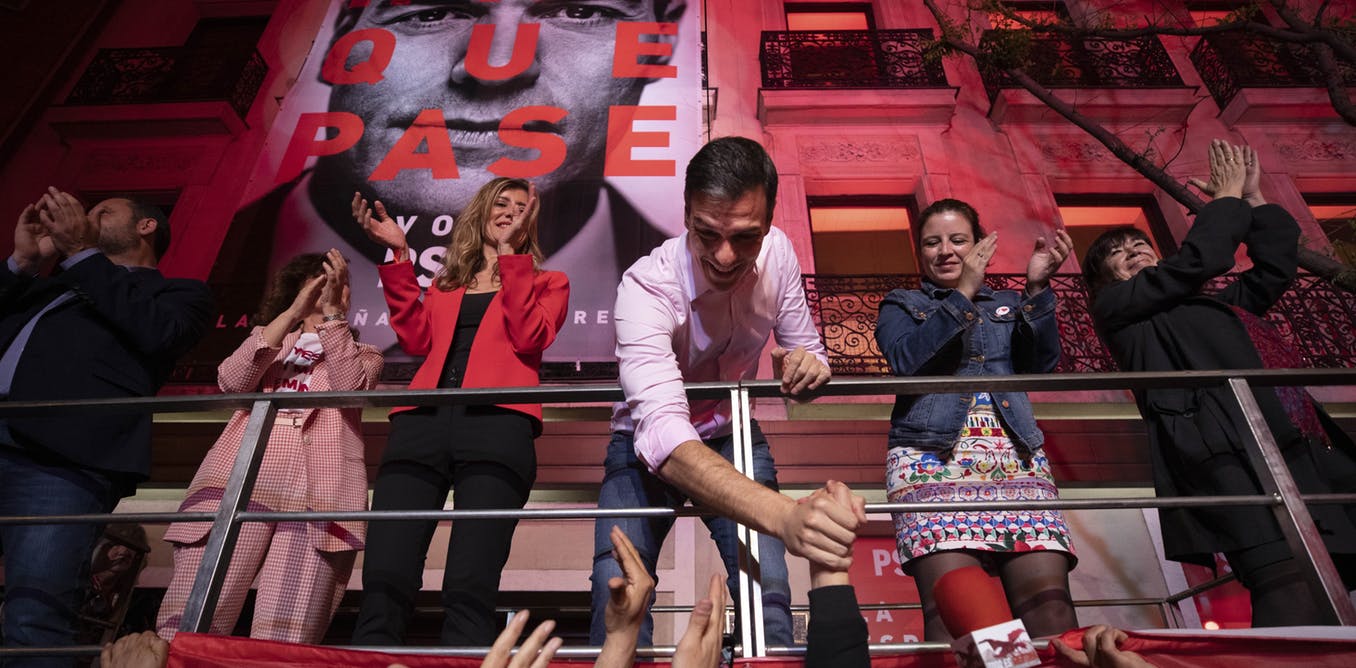

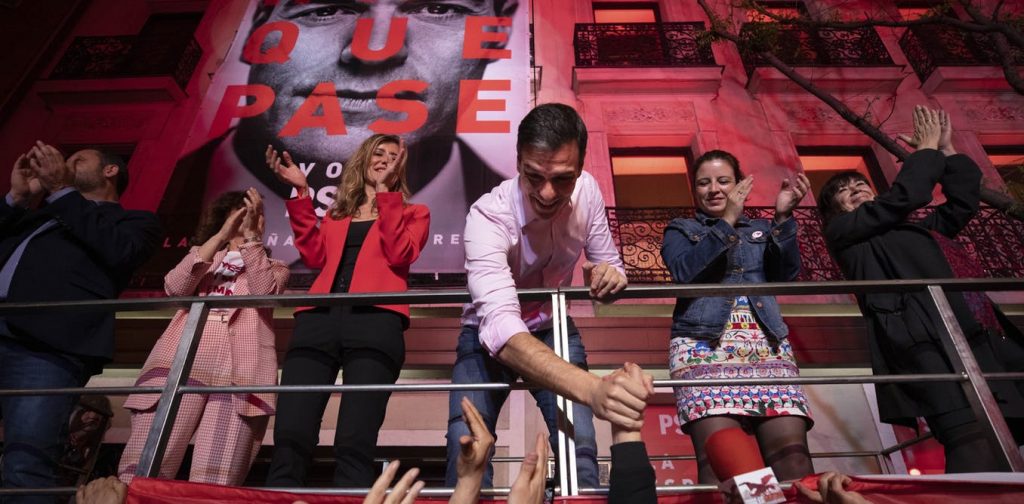
There was a very high turnout among leftists who feared a return to ultra-right government. Spain had a rightist military regime until 1975.

By Dr. Monica Clua Losada
Assistant Professor in Global Political Economy
University of Texas Rio Grande Valley
Thanks to massive voter turnout in Spain’s April 28 general election, especially on the left, far-right parties did not win enough votes to form a coalition government. The ruling Socialist Party will remain in power for now.
Turnout in Spanish general elections, which generally hovers around 66%, was nearly 76% – the third-highest in its modern democratic history. Historically, Spaniards only vote in such huge numbers during times of trouble. After an attempted military coup in 1981, nearly 80% of Spaniards turned out to vote in the 1982 general election. In 2004, after al-Qaida bombed Madrid’s Atocha train station, over 77% came out to vote.
This year’s unusually high election participation is likely a response to political and economic crisis in Spain. Consecutive governments have failed to manage the economic crisis resulting from the 2008 global financial meltdown and struggled to find nonviolent political solutions to dissent in the independence-minded Catalunya region.
Since 2010, my research shows, Spain has been volatile. Its politics have been dominated by mass protests, separatist movements and mistrust in state institutions, particularly the judiciary – with its increasingly political decision-making.
Conservative Prime Minister Mariano Rajoy was ousted with a vote of no-confidence in June 2018 following his party’s involvement in Spain’s largest corruption scandal. Prime Minister Pedro Sánchez of the center-left Socialist Party replaced him.
On April 28, Spain’s energized left wing came out en masse to give Sánchez and the Socialists a vote of confidence: four years in power.
Spain’s authoritarian past
That wasn’t the expected outcome.
Many political analysts predicted that Vox, an extreme-right party aligned with anti-immigrant forces across Europe, would see a significant share of votes, paving the way for a ruling coalition to form between it, the center-right Popular Party and another young right-wing party called Ciudadanos.
That’s the triple alliance now governing the southern province of Andalusia.
The threat of radical right-wing leadership appears to have mobilized voters in Spain, a young democracy with a chilling history of rightist authoritarianism. Spaniards endured brutality under the right-wing military dictatorship of General Francisco Franco, who ruled the country from 1939 to 1975.
Many of his regime’s atrocities – which included kidnappings, forced abortions and mass killings of political opponents – have been left painfully unresolved in Spain.
For decades since, Spain was considered a place where the far right could get no foothold. Even as extreme right-wing parties grew across Europe, Spain’s political system after Franco was basically centrist.
The Francoist right voted for the mainstream Popular Party. In recent years it has grown ever more socially conservative, effectively capturing and mainstreaming Spain’s far right.
Then, in 2006, came Ciudadanos, a right-wing nationalist party. Vox was founded in 2013 by Popular Party defectors with an anti-feminist, anti-gay and anti-immigrant political agenda.
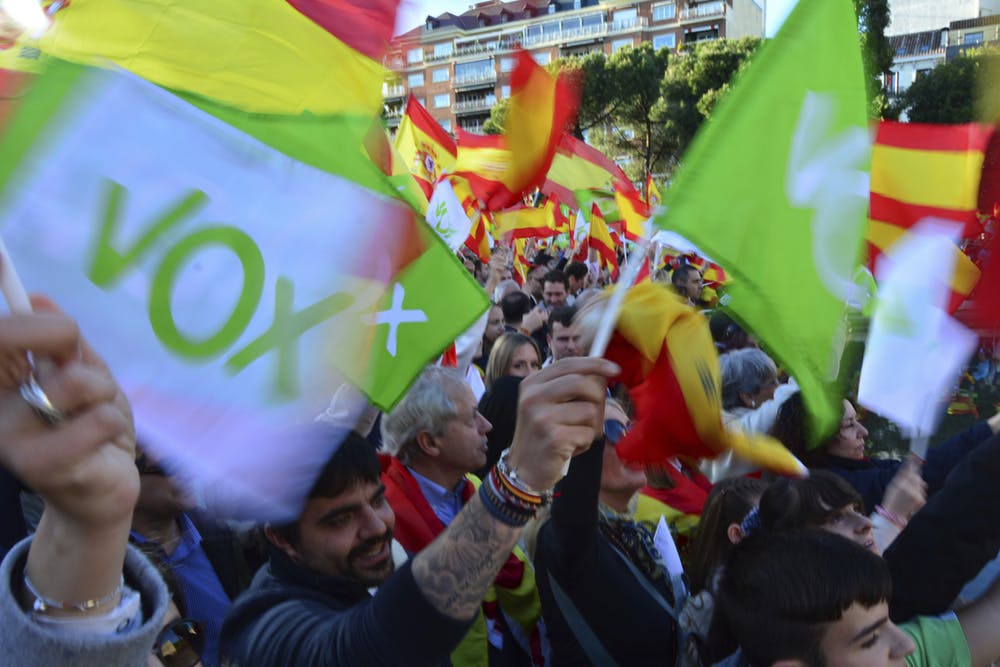
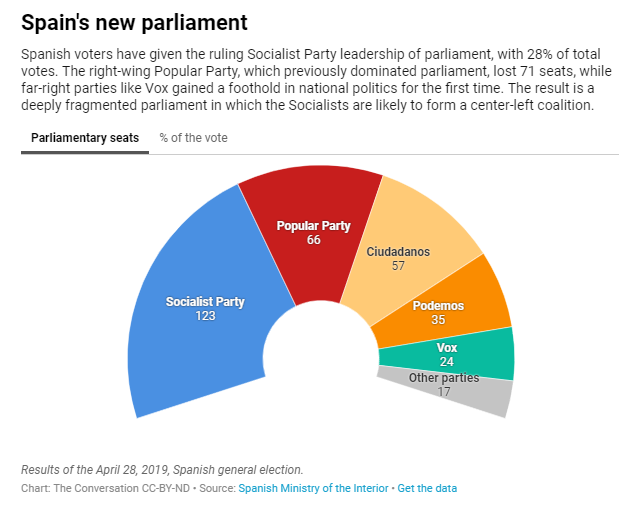
With the rise of new ultra-right parties, Spain’s once unified right was split in three. As a result, the Popular Party suffered the biggest defeat in its 30-year history, winning just 16.7% of the vote.
That helped the Socialists stay in power nationwide. A progressive ruling alliance between the Socialist Party and the Podemos party, its leftist ally, now seems the likely outcome of the election.
Given the deep fragmentation of parliament, however, an unexpected right-left coalition government like that seen in Germany and France is also a possibility.
Spain’s fragile democracy
In his election night victory speech, Prime Minister Sánchez said the election results show the strength and quality of Spain’s political system.
Voters proved that “this is a great democracy,” he said on April 28 to the crowds celebrating outside the Socialist Party’s headquarters in Madrid.
My political research in Spain suggests the contrary. Spanish democracy is increasingly fragile, with its growing polarization, its jailing of Catalan independence leaders and its rising right wing.
Vox won 10% of the vote on Sunday, giving it real power on the national level for the first time. Together, right-wing parties now control 147 of the 350 seats in Spain’s parliament.
Progressive forces won election day, but Spain’s political future remains divided.
Originally published by The Conversation, 04.30.2019, under the terms of a Creative Commons Attribution/No derivatives license.