From Tecumseh and Tenskwatawa to Brock, Perry, and Jackson, the War of 1812 unfolded through sacred histories, heroic ideals, frontier terror, and competing myths that shaped memory.

By Matthew A. McIntosh
Public Historian
Brewminate
Introduction: A War Fought in Several Mythic Worlds
On August 15, 1812, Major General Isaac Brock demanded the immediate surrender of Detroit and warned Brigadier General William Hull that the Indigenous warriors allied with Britain might become impossible to restrain once battle began. Brock’s message transformed the coming assault into something larger than a calculation of artillery, fortifications, and troop strength. Hull had already been shaken by failed operations in Upper Canada, disrupted supply lines, militia unreliability, the fall of Fort Mackinac, and reports of Indigenous attacks along the approaches to Detroit. He also knew that soldiers’ families and other civilians remained within the settlement. Although the American force exceeded the number of British regulars and militia immediately available to Brock, Hull imagined resistance ending not in an orderly defeat but in an uncontrollable massacre. Brock and Tecumseh turned that fear into a weapon, using concealment, movement, rumor, and the reputation of Indigenous warfare to make their army appear more numerous and more terrifying than it was. Hull surrendered on August 16, relinquishing Detroit, the Michigan Territory, and an army to an opponent who had won as much through command of perception as through command of the battlefield.
Detroit provides a revealing entrance into the mythic worlds of the War of 1812 because the word mythology must mean more here than a collection of fanciful tales or demonstrably false beliefs. Myth could take the form of sacred history, prophetic revelation, ancestral memory, providential interpretation, classical analogy, martial legend, or a culturally inherited story about the nature of another people. Such narratives did not exist outside political and military reality. They taught communities how land had been created, why authority was legitimate, what obligations the living owed to their ancestors, which forms of violence were honorable, and whether victory or defeat revealed a larger moral order. This broader definition also prevents a misleading distinction in which Indigenous teachings are classified as mythology while American republicanism, British imperial loyalty, and Christian providentialism are treated as rational ideologies. All of these traditions joined historical experience to symbolic narratives that made collective action intelligible.
The peoples drawn into the conflict nevertheless inhabited distinct and sometimes incompatible moral universes. Tenskwatawa’s prophetic movement called upon Indigenous communities to reject alcohol, commercial dependency, and selected American customs while renewing ceremonies and relationships believed essential to collective survival. Tecumseh translated that religious renewal into a political argument: the continent’s Indigenous peoples possessed a common interest in land that individual leaders could not permanently surrender to the United States. Their confederacy was not simply a British military auxiliary but an effort to preserve an autonomous Indigenous future. American expansionists answered with their own sacred and heroic language, presenting settlement as the advance of civilization, republican liberty, or providential destiny. British officers invoked constitutional loyalty, imperial duty, military honor, and the traditions of gentlemanly command, even as they depended upon Indigenous allies whose objectives differed sharply from those of the empire. Classical antiquity supplied Americans and Britons with familiar models of civic virtue, sacrifice, magnanimity, treason, and heroic death, but frontier stories about captivity and massacre could prove more immediately powerful. Brock’s warning at Detroit worked because generations of colonial warfare had transformed the Indigenous warrior in white imagination into a nearly elemental figure of terror.
The War of 1812 was fought in several mythic worlds at once. Material causes remained decisive: maritime coercion, territorial ambition, trade, arms, food, transportation, manpower, and the relentless American demand for Indigenous land. Mythology did not displace those realities; it organized them into stories about creation, sovereignty, honor, savagery, sacrifice, and national destiny. It helped leaders unite followers, identify enemies, interpret uncertainty, and justify violence. After the fighting ended, it also transformed Tecumseh, Brock, Oliver Hazard Perry, Andrew Jackson, Tenskwatawa, and the disgraced Hull into symbolic figures whose remembered lives served American, British, Canadian, and Indigenous histories. To examine mythology in this conflict is not to claim that commanders mechanically reenacted ancient legends or that prophecy alone determined military decisions. It is to investigate how inherited narratives shaped what people feared, what they defended, what they believed victory meant, and how an indecisive imperial war became a collection of powerful and competing national memories.
Political Power in the Early Nineteenth Century

The early nineteenth century did not recognize the firm boundary between religion and politics that modern observers often impose upon the past. Governments invoked Providence, military officers interpreted victory and defeat through moral language, and communities understood territory through inherited stories about creation, ancestry, obligation, and divine favor. Public ceremonies, political speeches, treaty councils, sermons, military proclamations, and newspaper accounts all moved easily between the sacred and the practical. A declaration of war could discuss maritime rights and national honor in the same breath, just as an Indigenous diplomatic speech could connect disputed land to the Creator’s intentions for the people who inhabited it. Religion did not merely decorate political arguments after decisions had been made. It helped determine which decisions appeared legitimate, necessary, or even imaginable.
Mythology must be understood more carefully than a simple collection of false stories. Myth was a narrative that connected present circumstances to a larger account of how the world had been ordered and how human beings ought to live within it. A creation story could establish the relationship between a people and their homeland. An account of ancestral migration might explain political identity. A prophetic revelation could identify the source of collective suffering and prescribe a path toward renewal. Classical history could provide models of civic virtue and political decline, while Christian providentialism could transform military success into evidence of divine approval. Whether such narratives described gods, ancestors, republics, empires, or chosen nations, they gave historical events a moral structure.
This definition is important because older scholarship often treated Indigenous religion and Euro-American political thought according to unequal standards. Indigenous leaders who invoked visions, sacred power, or ancestral law were described as superstitious, irrational, or fanatical. American and British leaders who appealed to Providence, classical antiquity, national destiny, or the civilizing mission of empire were more often presented as employing respectable ideology. Yet both kinds of discourse connected political claims to realities that could not be reduced to immediate material calculation. Americans imagined their republic as the heir to ancient struggles against tyranny. Britons understood imperial service through traditions of monarchy, Protestantism, constitutional loyalty, and aristocratic honor. Indigenous peoples drew upon diverse sacred histories that defined obligations among communities, ancestors, animals, spiritual beings, and the land itself. These traditions were not identical, but they all shaped political perception.
Mythic and religious traditions nevertheless did not operate as fixed scripts. Leaders selected, adapted, and sometimes transformed inherited beliefs in response to new dangers. Tenskwatawa’s religious movement, for example, drew upon Shawnee and broader Indigenous traditions, but it also responded to conditions created by settler expansion, epidemic disease, alcohol, commercial dependency, missionary pressure, and repeated land cessions. His teachings did more than preserve an unchanged ancestral religion. They reorganized older practices into a program of moral purification and political resistance. Tecumseh likewise translated ideas of sacred land and common Indigenous origins into an ambitious confederate argument that peoples with distinct histories should resist the United States together. Such innovations acquired authority because they were presented not as arbitrary inventions but as recoveries of an order that conquest had violated. Religious revitalization could become a form of political organization. Prophets diagnosed collective crisis, condemned practices associated with dependency and promised that disciplined communities might restore a damaged relationship with the spiritual world. Rejecting alcohol or American manufactures was not merely an individual moral choice. It could become a public declaration that a village or nation refused the social order accompanying American commerce. Ceremonies, dances, sacred fires, medicines, fasting, and communal purification helped create solidarity among people whose political institutions had been strained by migration and war. Prophetic authority could generate internal conflict. Those who accepted a prophet’s teachings might accuse opponents of collaboration, spiritual corruption, or witchcraft, while leaders committed to accommodation feared that resistance would bring destruction upon their communities. Religion united some people precisely because it divided them from others.
Euro-American political culture employed different symbols but relied upon comparable processes of moral classification. The classical republics of Greece and Rome supplied Americans with examples of courage, public virtue, corruption, tyranny, and decline. Political leaders warned that luxury could destroy republican liberty just as it had supposedly ruined ancient states, while military sacrifice invited comparison with celebrated defenders of the classical world. Christian language added another layer by portraying the nation as subject to divine judgment or protection. British officers and colonial administrators similarly combined Protestant providentialism, loyalty to the Crown, imperial duty, and gentlemanly honor. These ideals influenced how commanders evaluated surrender, discipline, courage, and reputation. A military action was rarely judged only by whether it succeeded. It was also measured against inherited expectations of what an honorable officer, loyal subject, republican citizen, or courageous warrior ought to do.
Mythology exercised political power most visibly by shaping perception. It identified some lands as sacred inheritance and others as territory open to settlement. It transformed one community’s resistance into another community’s rebellion or savagery. It made certain deaths appear as martyrdom, certain victories as providential deliverance, and certain defeats as evidence of betrayal or moral failure. Yet mythology did not act independently of weapons, food, trade, diplomacy, population, and geography. Its force lay in organizing those material realities into meaningful patterns. The War of 1812 emerged from concrete disputes over sovereignty, commerce, territorial expansion, and imperial competition, but the people who entered the conflict understood those disputes through narratives of creation, civilization, republican survival, Indigenous renewal, imperial loyalty, and divine purpose. To study those narratives is not to replace military or political history with symbolism. It is to explain why particular interests commanded loyalty, why particular dangers inspired fear, and why the same war could carry radically different meanings for the peoples who fought it.
Sacred Land and the Indigenous Crisis of American Expansion
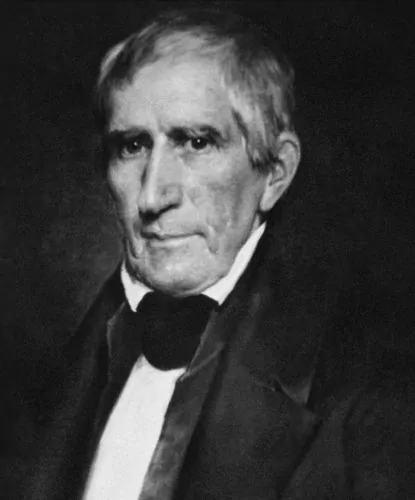
For Indigenous peoples of the Ohio Valley and Great Lakes, land was not simply a commodity that could be detached from the communities inhabiting it and permanently transferred through a single written agreement. Territory was embedded in overlapping relationships among villages, hunting grounds, agricultural fields, burial places, waterways, animal populations, ancestral histories, and spiritual powers. Different peoples could possess distinct rights to use the same region without understanding those rights as identical to exclusive Euro-American ownership. A river valley might sustain seasonal hunting, diplomacy, travel, ceremony, and settlement by several communities whose claims were neither limitless nor easily reducible to surveyed boundaries. When American officials treated land as measurable acreage available for purchase, they imposed a legal framework that often failed to recognize the layered obligations through which Indigenous societies understood belonging.
The crisis intensified after the American Revolution, when the United States claimed sovereignty over the trans-Appalachian West by virtue of Britain’s territorial concessions in the Treaty of Paris. Indigenous nations had not collectively surrendered those lands, and many rejected the proposition that Britain could transfer territories it had never fully possessed. The resulting Northwest Indian War was more than a struggle over a disputed frontier. It was a conflict between incompatible understandings of political authority. The intertribal force that defeated the American armies of Josiah Harmar and Arthur St. Clair defended a region in which Native communities exercised military, diplomatic, and spiritual power. Even after Anthony Wayne’s victory at Fallen Timbers and the Treaty of Greenville in 1795, the question of sovereignty remained unsettled. The treaty established boundaries and opened vast areas to American settlement, but it did not erase Indigenous expectations that surviving homelands would remain protected from further encroachment. American expansion proceeded by combining military pressure, commercial dependency, diplomatic coercion, and the strategic recognition of selected leaders as legitimate sellers of land. Federal officials commonly insisted that treaties represented voluntary agreements between sovereign peoples, yet negotiations occurred within an increasingly unequal balance of power. Debt to traders, dwindling game, alcohol, settler violence, and the threat of renewed war narrowed the choices available to Indigenous negotiators. Payments were often distributed through annuities that made communities more dependent upon the government seeking additional cessions. American officials also exploited political divisions by negotiating with leaders willing to sell, then treating their signatures as binding upon peoples who had not attended the councils or who denied that the signatories possessed authority over the lands in question.
The Treaty of Fort Wayne in 1809 became one of the clearest expressions of this expanding system. William Henry Harrison negotiated the acquisition of millions of acres from selected representatives of the Delaware, Miami, Potawatomi, and Eel River Miami, although the territory involved was used or claimed by a wider range of Indigenous communities. Tecumseh denounced the cession not merely because he disliked its terms but because he rejected the principle that separate leaders could alienate land upon which the survival of many Native peoples depended. He argued that the land had been given for the common use of Indigenous peoples and could not legitimately be sold without broad consent. This position drew strength from older traditions of intertribal diplomacy, shared use, and collective defense, but it also represented an innovative response to the scale of American expansion. Tecumseh sought to transform scattered grievances into a continental doctrine: no nation could preserve its own homeland by permitting the piecemeal dispossession of its neighbors.
Sacred history gave this political argument moral force. Indigenous peoples had been placed upon the land by the Creator, and their continued relationship with it formed part of the proper order of the world. American settlement appeared not as an ordinary movement of population but as a violation of divinely grounded relationships. Forest clearing, surveying, road construction, fenced farms, and livestock agriculture altered more than the physical landscape. They disrupted hunting patterns, village mobility, ceremonial places, food systems, and the ability of communities to maintain political independence. To surrender territory under such conditions could be understood as endangering future generations and betraying obligations inherited from ancestors.
The Indigenous crisis was nevertheless not experienced uniformly. Some leaders favored accommodation, hoping that selective land sales, annuities, agricultural adaptation, or alliance with the United States might preserve what remained. Others doubted that intertribal unity could overcome long-standing rivalries or withstand American military power. Communities were divided by local interests, kinship ties, commercial relationships, and differing assessments of British reliability. Tecumseh’s program gained urgency from these fractures but could not easily overcome them. Its importance lay in recognizing that the treaty system converted division into a weapon of conquest. By insisting that the defense of one people’s land required the defense of all, Tecumseh and the prophetic movement around Prophetstown recast dispossession as a collective spiritual and political emergency. American expansion had made local survival dependent upon a unity that had never before been required on such a scale.
Tenskwatawa’s Revelation and the Rebirth of a People
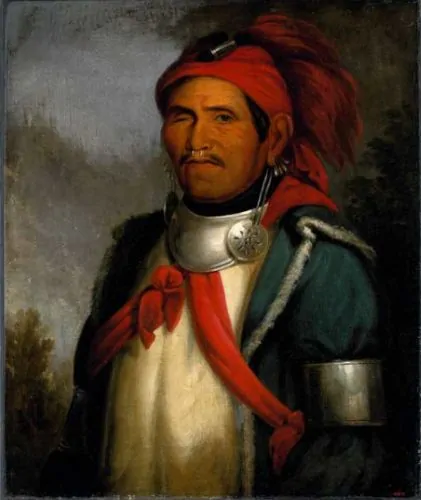
Before he became Tenskwatawa, the Shawnee religious leader was known as Lalawethika, a man remembered in later accounts as socially marginal, physically impaired, dependent upon alcohol, and overshadowed by more accomplished relatives. That remembered degradation became essential to the authority he later claimed. Around 1805, Lalawethika reportedly fell into a deathlike trance and was believed by those around him to have died. Upon recovering, he declared that his spirit had traveled beyond the ordinary world and witnessed the destinies awaiting the righteous and the corrupt. He described punishments for drunkenness, violence, selfishness, and abandonment of ancestral ways, presenting his own survival as evidence that the Creator had returned him to guide Indigenous peoples away from destruction. Taking the name Tenskwatawa, commonly translated as “The Open Door,” he made his personal transformation into a model for collective rebirth.
Tenskwatawa’s message spread rapidly because it addressed a crisis that was at once spiritual, political, economic, and social. Indigenous communities throughout the Great Lakes and Ohio Valley had endured generations of warfare, epidemic disease, displacement, commercial dependency, missionary pressure, and repeated land cessions. Alcohol introduced through the colonial trade had damaged families and weakened political authority, while imported goods increasingly tied villages to American and British merchants. Tenskwatawa taught that these conditions were not merely unfortunate consequences of changing times. They revealed a dangerous departure from the order intended by the Creator. Native peoples had been given their own lands, customs, foods, ceremonies, and forms of community; suffering had followed because they had allowed outsiders to persuade them that these ways were inferior. Renewal required more than resistance to a particular treaty or settlement. It demanded a purification of everyday life.
His teachings condemned alcohol, interpersonal violence, destructive forms of individualism, and excessive reliance upon Euro-American manufactures. Followers were encouraged to restore Indigenous clothing, subsistence practices, ceremonies, and communal discipline. Tenskwatawa also urged Native peoples to cease fighting one another, arguing that old rivalries only strengthened those taking their lands. This moral program gave political meaning to apparently private choices. Refusing whiskey, imported clothing, or dependence upon traders became a rejection of the social system accompanying American expansion. Communities that gathered around the Prophet were not simply preparing for war; they were attempting to create an alternative society capable of surviving outside the expanding economic and cultural power of the United States. Prophetstown, established near the confluence of the Tippecanoe and Wabash Rivers, became the physical center of that experiment and attracted followers from several nations.
The more sensational elements attributed to Tenskwatawa require particular caution. American officials, missionaries, interpreters, traders, and later historians reported that he described white Americans as the offspring of an evil spirit or Great Serpent, promised supernatural protection to obedient followers, and claimed the power to expose witches or punish unbelievers. Some of these reports may preserve genuine features of his teaching, including a sharp cosmological distinction between Indigenous peoples who followed the Creator’s order and settlers whose insatiable hunger for land embodied corruption. Yet the surviving evidence passed through translation, political hostility, and cultural misunderstanding. American observers had strong reasons to portray the Prophet as a dangerous impostor manipulating irrational followers. Claims that his warriors believed themselves literally invulnerable to bullets may exaggerate or flatten more complex ideas about sacred power, medicine, courage, and spiritual preparation. Tenskwatawa’s authority did not depend upon a single doctrine uniformly accepted by every follower; it rested upon his ability to interpret suffering and persuade communities that renewal remained possible.
Tecumseh and the Political Translation of Prophecy
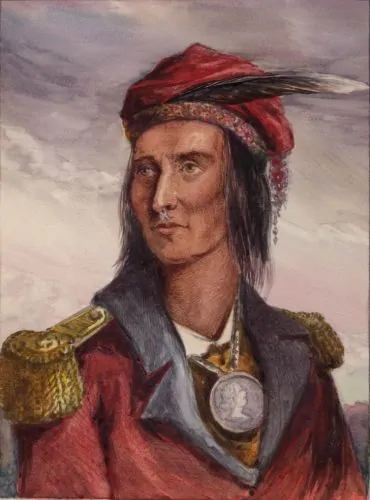
Tenskwatawa’s religious movement created a community of purification and renewal, but Tecumseh transformed its spiritual energy into an expansive political program. The distinction between the brothers should not be made too sharply: Tenskwatawa’s teachings contained political implications, while Tecumseh’s diplomacy repeatedly invoked sacred relationships among land, ancestry, and the Creator. Their authority was complementary. The Prophet offered an explanation for Indigenous suffering and a path toward moral restoration; Tecumseh argued that restoration could not succeed unless Native peoples resisted American expansion collectively. Through travel, council speeches, personal alliances, and military organization, he carried the movement’s message beyond Prophetstown and attempted to construct a confederacy capable of confronting the United States on a continental scale.
Tecumseh’s central political claim was that no single nation, village, or group of chiefs possessed the authority to sell lands required by the wider Indigenous world. American officials preferred to negotiate separately with particular communities, recognizing those leaders willing to sign treaties and then treating their consent as sufficient to extinguish competing claims. Tecumseh attacked the legitimacy of that process. In his confrontations with William Henry Harrison, especially after the Treaty of Fort Wayne, he maintained that the land had been given to Indigenous peoples collectively and could not be divided and sold as though it belonged to isolated individuals. Accounts of his speeches survive through interpreters, hostile officials, later recollection, and partisan publication, making their exact wording uncertain. Their underlying argument is clear: piecemeal treaties allowed the United States to convert Indigenous political diversity into an instrument of dispossession. That argument required Tecumseh to imagine unity among peoples who did not understand themselves as members of a single political nation. Shawnee, Wyandot, Delaware, Miami, Potawatomi, Kickapoo, Ojibwe, Ottawa, and other communities possessed distinct languages, histories, diplomatic traditions, and territorial interests. Some had fought one another within living memory. Others had already entered treaties with the United States, depended upon federal annuities, or believed accommodation offered a better chance of survival than renewed war. Tecumseh could not erase these differences, nor did every community accept the authority he claimed for a broader Indigenous confederacy. His diplomacy instead asked leaders to reinterpret local danger as part of a shared crisis. A cession in Indiana or Illinois was not merely the loss of another people’s hunting ground. It established a precedent by which American officials would eventually reach every remaining homeland.
Sacred history gave this political innovation the appearance of restoration rather than invention. Tecumseh spoke of Indigenous peoples as children of a common Creator and inhabitants of a land intended for their collective use. Such language did not imply that all Native nations possessed identical cultures or territorial rights. It supplied a higher moral principle through which their differences might be subordinated to mutual defense. The United States appeared as a society that violated the proper relationship between human beings and the earth by surveying, fencing, purchasing, and reselling land without limit. Tecumseh’s message joined political sovereignty to cosmological order. Resistance was not simply a strategy for obtaining better treaty terms. It was an obligation to ancestors, descendants, and the Creator who had placed Indigenous peoples upon the continent.
Tecumseh’s achievement was consequently both traditional and radically new. He drew upon long histories of intertribal diplomacy, shared resistance, refugee migration, and prophetic renewal, yet he attempted to organize them at a scale demanded by the unprecedented growth of the American republic. His travels southward among the Muscogee, Choctaw, Chickasaw, and other peoples demonstrated the ambition of that vision, but also its limitations. Local rivalries, competing prophets, factional struggles, and uncertainty about British support prevented a unified Indigenous front from emerging. Even within the northwestern confederacy, allegiance remained fluid and depended upon particular villages and leaders rather than a centralized government. Tecumseh nevertheless translated prophecy into a durable political diagnosis: no Indigenous nation could protect itself indefinitely while the United States was permitted to dispossess its neighbors one treaty at a time. Tenskwatawa had declared that Native peoples could be reborn; Tecumseh argued that such rebirth required them to act as participants in a common struggle.
Tippecanoe: Prophecy Tested by Battle

By the autumn of 1811, Prophetstown had become both a religious center and a political challenge to American authority in the Old Northwest. Its growing population included followers from several Indigenous nations, some drawn by Tenskwatawa’s teachings and others by the wider resistance associated with Tecumseh. William Henry Harrison, governor of Indiana Territory, viewed the settlement as a threat to the treaty system through which he had secured extensive land cessions. Tecumseh’s opposition to the Treaty of Fort Wayne had already produced tense confrontations with Harrison, and reports that Prophetstown was receiving British encouragement intensified American suspicion. While Tecumseh traveled southward seeking broader support, Harrison assembled regular soldiers and militia and advanced up the Wabash. He described the expedition as a defensive response to intimidation and violence, but its strategic purpose was unmistakable: to weaken the confederacy before it could become stronger.
When Harrison’s force reached the vicinity of Prophetstown on November 6, the two sides entered negotiations marked by mutual distrust. Indigenous emissaries asked for talks to continue the following day, while Harrison established a camp on high ground near Burnett’s Creek. Before dawn on November 7, warriors attacked the American position. The fighting was confused, close, and violent, with repeated assaults against different parts of Harrison’s line. American troops eventually held their ground and forced the attackers to withdraw. The battle was not a sweeping tactical triumph in the conventional sense. Harrison suffered substantial casualties, failed to destroy the attacking force in combat, and remained uncertain about its movements. Yet because his army retained the field, the encounter could be presented as a decisive victory over the prophetic movement.
Tenskwatawa’s responsibility for the attack has remained one of the most contested questions surrounding Tippecanoe. Later accounts often portrayed him as a reckless religious fanatic who ordered battle against Tecumseh’s instructions and promised that sacred power would make warriors immune to American bullets. Some witnesses did report that the Prophet performed ceremonies, sang from a nearby elevation, or assured followers that divine protection would accompany them. Yet the surviving testimony is fragmentary, contradictory, and heavily mediated through American observers, later recollections, and political storytelling. Indigenous warriors may have understood spiritual preparation as a source of courage, discipline, or favor rather than as a literal guarantee of physical invulnerability. It is also unclear whether Tenskwatawa directed the attack, approved a decision made by war leaders, or failed to restrain warriors who believed Harrison intended to destroy Prophetstown regardless of negotiation. The familiar story of a fraudulent prophet exposed by bullets simplified a far more complicated struggle over authority, strategy, and sacred power.
After the battle, Harrison’s men entered Prophetstown and found that most of its inhabitants had withdrawn. They destroyed houses, food stores, crops, and other supplies before beginning their return march. This destruction mattered as much as the battlefield encounter itself. Prophetstown was not merely a military encampment; it was the social and ceremonial center of a movement that sought to create an autonomous Indigenous future. Burning the settlement attacked the material foundation of prophecy by scattering families, eliminating stored provisions, and demonstrating that the United States could reach the heart of the confederacy. Tenskwatawa’s prestige suffered, particularly among those who blamed him for the losses or believed that his assurances had failed. His authority did not disappear overnight. Prophetstown was reoccupied, followers continued to gather, and both brothers remained important participants in the Indigenous-British alliance that formed during the War of 1812.
Americans quickly transformed Tippecanoe into a legend of civilization defeating fanaticism. Harrison’s supporters presented the battle as proof of courage, vigilance, and providential success, obscuring the expedition’s role in enforcing disputed land cessions. The slogan “Tippecanoe and Tyler Too” would later carry the memory of the battle into the presidential campaign of 1840, turning a contested frontier encounter into the foundation of Harrison’s national political identity. For Indigenous communities, the consequences pointed in the opposite direction. The destruction of Prophetstown confirmed that American officials would use military force to impose a territorial order rejected by many Native peoples. Prophecy had been tested by battle, but the result did not demonstrate that religion had been irrelevant or simply disproven. Instead, Tippecanoe revealed the vulnerability of a sacred movement that depended upon villages, food, diplomacy, and military judgment as well as spiritual conviction. The battle weakened Tenskwatawa’s standing while strengthening the argument that only a wider alliance, and perhaps British assistance, could prevent the United States from destroying Indigenous resistance one community at a time.
The Anglo-American Classical Imagination

Classical antiquity formed one of the most familiar intellectual languages available to educated Americans and Britons in the early nineteenth century. Schooling in Latin and, for a smaller number, Greek introduced young men to Homer, Virgil, Livy, Plutarch, Cicero, Sallust, and other ancient authors whose works were treated as guides to rhetoric, morality, political conduct, and military leadership. Even people without formal classical training encountered antiquity through sermons, newspapers, public monuments, theatrical performances, political pseudonyms, and popular biographies. Greece and Rome existed not only as distant civilizations but as collections of examples through which contemporaries judged ambition, courage, corruption, sacrifice, and national decline. Classical references could elevate an ordinary political dispute into a struggle between liberty and tyranny or convert a commander’s death into an act of exemplary self-sacrifice.
The United States drew heavily upon the Roman republican tradition. Revolutionary leaders had compared resistance to Britain with ancient struggles against kings and tyrants, while the founders debated whether the new republic possessed enough civic virtue to avoid the corruption that had supposedly destroyed Greece and Rome. Americans adopted classical names for towns, public buildings, political societies, and civic offices; artists personified the nation through figures resembling Liberty, Minerva, and Columbia; and political writers signed themselves “Cato,” “Brutus,” “Publius,” or other names borrowed from antiquity. George Washington’s retirement from military command encouraged comparison with Cincinnatus, the Roman citizen-soldier who relinquished extraordinary power and returned to his farm. By 1812, such analogies had become part of the republic’s inherited political vocabulary. Americans could portray war as a test of whether their young nation retained the courage, discipline, and public spirit associated with the idealized ancient republics.
Classical language also carried warnings. Rome represented civic greatness, but it also demonstrated how luxury, faction, military ambition, and concentrated power might destroy liberty. Sparta offered an image of martial discipline, yet its harshness could also suggest the dangers of subordinating society entirely to war. Athens symbolized eloquence, democracy, and cultural brilliance, but critics associated it with instability and demagoguery. These examples allowed opposing political factions to draw contradictory lessons from the same past. Supporters of the War of 1812 could describe resistance to British coercion as a defense of republican honor, while opponents could argue that reckless conquest and militarization threatened the republic more seriously than maritime humiliation did. Antiquity did not dictate a single position; it provided a prestigious language through which competing positions could be made morally compelling. British classical culture emerged from many of the same texts but developed within a different political setting. Educated officers and statesmen encountered Greece and Rome through grammar schools, universities, private tutoring, literary culture, and the traditions of gentlemanly improvement. Yet British writers were less likely to imagine monarchy itself as incompatible with classical virtue. They commonly presented Britain’s mixed constitution as having reconciled monarchy, aristocracy, and popular representation while avoiding the extremes that had destroyed ancient states. Roman examples could validate imperial authority, disciplined service, and the responsibilities of command just as readily as they could support republican resistance. British officers serving in North America operated within a culture that joined classical honor to Protestant identity, loyalty to the Crown, and confidence in Britain’s constitutional and imperial mission.
The classical imagination mattered most in the standards by which conduct was interpreted. Officers were expected to demonstrate courage without recklessness, firmness without cruelty, ambition without selfishness, and concern for reputation without sacrificing duty. A successful commander might be praised as Roman in discipline, Spartan in endurance, or magnanimous in victory. A defeated officer could retain honor if he had resisted bravely, while surrender without sufficient struggle invited accusations of cowardice and disgrace. Death in battle could erase earlier controversy by fixing a commander’s character in the heroic posture of sacrifice. These expectations shaped public judgment of figures such as Isaac Brock, Oliver Hazard Perry, William Hull, and later Andrew Jackson, even when no evidence shows that they consciously modeled a particular decision upon a specific ancient hero. Classical culture supplied the categories through which newspapers, biographers, political allies, and enemies turned military behavior into moral character.
It would be misleading to claim that Hull surrendered Detroit because classical precedent taught him to preserve innocent lives, or that Brock’s audacity resulted from direct imitation of Alexander, Caesar, or another ancient conqueror. Their choices arose from immediate military conditions, personal temperament, professional training, political pressure, and imperfect information. The deeper influence of antiquity lay in the stories attached to those choices afterward. Brock’s death could be presented as heroic sacrifice; Hull’s surrender could be made the opposite of republican valor; Perry’s transfer from the shattered Lawrence could become a scene of almost epic perseverance. Classical mythology and history did not function as secret instructions controlling commanders’ actions. They provided a shared repertoire of heroic types, moral contrasts, and historical analogies through which the War of 1812 could be transformed from a confused series of campaigns into a drama of courage, betrayal, sacrifice, and national destiny.
Detroit and the Mythology of Frontier Terror
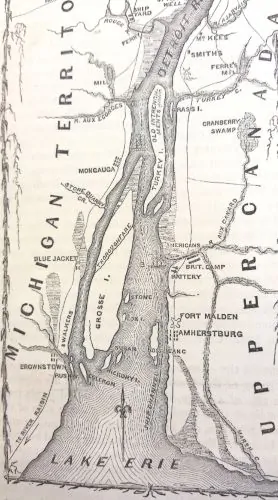
By August 1812, William Hull’s campaign against Upper Canada had deteriorated into a crisis of confidence, supply, and command. His army had crossed the Detroit River expecting that many Canadians would welcome an American invasion, but the anticipated collapse of British authority never occurred. Hull hesitated to attack Fort Amherstburg, withdrew to Detroit, and watched his communications become increasingly vulnerable to British-allied Indigenous forces. The capture of Fort Mackinac had strengthened the British position in the upper Great Lakes, while attacks near Brownstown and Monguagon demonstrated that Hull could not safely move supplies along the road connecting Detroit with Ohio. His regulars and militia remained a formidable force on paper, but their numerical strength concealed disobedience, exhaustion, divided leadership, and deepening fear. When Isaac Brock arrived to take command of the British defense, he encountered an American general whose strategic position was serious but not yet hopeless.
The fear surrounding Hull’s army had been cultivated long before the campaign began. Anglo-American frontier culture contained an extensive literature of captivity, massacre, mutilation, and threatened settlement stretching back through the colonial wars and the American Revolution. Newspapers and popular histories repeatedly described Indigenous warfare as uniquely cruel, emphasizing scalping, attacks upon civilians, and the supposed inability of Native warriors to distinguish between combatants and noncombatants. These narratives converted a wide range of Indigenous military practices into a single racial image of uncontrolled savagery. Violence committed by settlers, militia, and regular armies was more often classified as retaliation, conquest, or military necessity, while Indigenous violence was interpreted as the expression of an innate and almost supernatural ferocity. Hull had personal reasons to take such stories seriously. His command included men whose families lived within Detroit, and the settlement contained women, children, and other civilians who would be exposed if the British stormed the fort. Reports of Indigenous movements carried emotional force far beyond what their numbers alone could explain. Brock recognized this vulnerability and deliberately incorporated it into his strategy. On August 15, he demanded Hull’s surrender and warned that the large body of Indigenous warriors attached to the British force would be beyond his control once combat began. The threat was carefully constructed. Brock did not explicitly promise a massacre, but he invited Hull to imagine one and placed responsibility for preventing it upon the American commander. British forces reinforced the deception by making their army appear larger than it was. Troops were concealed, moved through visible positions, and presented in ways intended to exaggerate their numbers, while Indigenous warriors repeatedly passed through openings where American observers could see them. Tecumseh and the other Native leaders were not theatrical props; their warriors had already demonstrated their ability to disrupt Hull’s communications and inflict casualties. Yet Brock multiplied their military value by exploiting the terrifying reputation that American frontier mythology had attached to them.
Hull’s surrender on August 16 has often been reduced to personal cowardice, senility, or treason, interpretations encouraged by political enemies and reinforced by his later court-martial conviction. His conduct unquestionably revealed severe failures of leadership. He surrendered Detroit without exhausting its defensive possibilities, ignored the anger of officers who wished to resist, and included forces outside the fort in capitulation without adequately informing them. Nevertheless, the decision cannot be understood solely as an inexplicable collapse. Hull faced uncertain supplies, strained communications, British artillery fire, unreliable militia, and the possibility that an assault would reach civilians sheltering within the settlement. His error lay partly in allowing the worst possible outcome to become the most probable one in his mind. He interpreted Brock’s warning through inherited stories in which the defeat of a frontier garrison ended not with orderly surrender but with indiscriminate slaughter. Strategic weakness and mythic terror reinforced each other until capitulation appeared to him as the only humane choice.
The fall of Detroit immediately entered the mythologies of all three principal forces involved. British and Upper Canadian memory celebrated Brock as the audacious commander who had conquered a superior army through courage and intelligence. Tecumseh emerged as the indispensable Indigenous ally whose presence made victory possible, although later commemorations often detached him from his struggle for an autonomous Native homeland. American memory required a different figure and found one in Hull, who became the disgraced opposite of the republican hero: hesitant where he should have been bold, fearful where he should have displayed fortitude, and willing to surrender what honor demanded he defend. These narratives simplified the event but preserved its central psychological truth. Detroit was captured through artillery, disrupted supply lines, Indigenous military action, and British deception, but also through stories already lodged in the minds of the combatants. Brock defeated Hull partly by commanding an alliance and partly by commanding the American imagination of what that alliance might do.
Brock and Tecumseh: Alliance and the Creation of Heroes
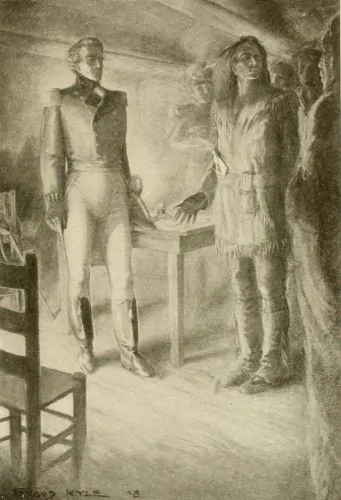
The partnership between Isaac Brock and Tecumseh became one of the most celebrated relationships of the War of 1812, but its historical importance did not rest upon sentimental friendship. The two men represented political worlds with different aims, unequal resources, and sharply divergent expectations of the future. Brock sought to defend Upper Canada with too few regular troops, uncertain militia support, and a long frontier vulnerable to American invasion. Tecumseh sought to preserve an Indigenous confederacy against a republic whose expansion threatened to make Native political independence impossible. Britain could offer weapons, supplies, military coordination, and a powerful enemy of the United States. Tecumseh’s forces could provide Brock with experienced warriors, intelligence, mobility, and influence across a contested borderland. Their alliance worked because immediate necessity brought their interests together, not because those interests were identical.
When Brock reached Amherstburg in August 1812, he found Tecumseh already established as the most prominent military and political figure among the Indigenous forces resisting Hull’s invasion. Their first meeting was soon enveloped in heroic memory. Later accounts attributed to Tecumseh an admiring judgment that Brock was truly a man or warrior, while Brock reportedly praised Tecumseh’s intelligence, eloquence, and commanding presence. The precise language of these exchanges cannot be recovered with certainty. Much of it survives through recollection, translation, patriotic biography, and later commemoration. Yet the admiration itself was plausible. Brock recognized that Tecumseh was not merely the leader of auxiliaries but a strategist whose cooperation was essential. Tecumseh, in turn, encountered a British commander willing to act aggressively rather than retreat before the American advance.
Their cooperation at Detroit depended upon a calculated performance of power. Brock’s available force was smaller and less secure than the image he projected toward Hull. British regulars, Canadian militia, and Indigenous warriors were arranged and moved to exaggerate their numbers, while communications were crafted to suggest that reinforcements were more abundant than they actually were. Tecumseh’s warriors repeatedly passed through areas where American observers could see them, creating the impression of a vast Indigenous host gathering outside the fort. Noise, movement, concealment, intercepted information, and Brock’s warning that he might be unable to restrain his Native allies all contributed to the deception. Tecumseh and Brock did not create American fear of Indigenous warfare; they used an existing frontier mythology in which Native warriors appeared almost limitless in number and uncontrollable in violence. Performance amplified military reality until Hull confronted not only the force outside Detroit but the catastrophe he imagined would follow an assault.
The victory demonstrated the strength of their partnership while also exposing the racial assumptions surrounding it. British officers praised Indigenous courage and acknowledged that the presence of Tecumseh’s warriors had made Hull’s surrender possible. British strategy depended upon representing those same allies as a threat beyond civilized control. Brock could employ Indigenous warriors as disciplined partners while warning Hull that their conduct might become indiscriminate once battle began. This contradiction was not accidental. British officials frequently shifted between admiration and disavowal, claiming Native military power when it served imperial objectives and distancing themselves from it when challenged over frontier violence. Tecumseh understood the value of the fear attached to his forces, but his political project was more substantial than the terrifying image Brock projected. His warriors fought to prevent dispossession, not merely to frighten an American garrison into surrender. Later memory transformed the alliance into a meeting of two heroic personalities. Brock became the bold imperial commander who saved Upper Canada through decisive action. Tecumseh became the noble Indigenous warrior whose approval confirmed Brock’s greatness. The story was attractive because it appeared to unite courage across racial and cultural boundaries. It also allowed British and Canadian commemorators to present the defense of Upper Canada as a cooperative struggle among regular soldiers, militia, and Indigenous allies. Yet the emphasis on personal admiration could obscure the political terms of the alliance. Tecumseh did not fight primarily to create or defend a future Canadian nation. He expected Britain to support an Indigenous territorial barrier capable of limiting American expansion. Brock’s military respect offered no guarantee that imperial diplomacy would honor that objective.
Brock’s death at Queenston Heights in October 1812 accelerated his transformation from commander into martyr. Leading troops against an American foothold, he was shot and killed before the position was retaken later that day. His death fixed his reputation at the moment of courageous action and protected it from the compromises, setbacks, and political disputes that might have complicated a longer career. Monuments, biographies, sermons, military histories, and public commemorations presented him as the savior of Upper Canada, a leader who had sacrificed himself for king, colony, and empire. Detroit became the proof of his genius, while Queenston Heights supplied the redemptive death expected of a national hero. The contributions of Tecumseh, John Norton, Indigenous warriors, Black troops, militia, and ordinary British soldiers could be acknowledged, but they were frequently arranged around Brock as the central figure of the story.
Tecumseh underwent a related but more politically troubling heroization. British and Canadian writers celebrated his courage, dignity, loyalty, and eloquence, often portraying him as the idealized “noble warrior” who recognized Brock’s greatness and remained faithful to Britain. That admiration intensified after Tecumseh’s death because it no longer required imperial authorities to fulfill his demands. Praise could replace policy. The heroic partnership of Brock and Tecumseh consequently preserved a real moment of effective cooperation while concealing the unequal futures produced by the war. Upper Canada survived the American invasion and gained a foundational martyr. Tecumseh’s confederacy lost its principal strategist, its military cohesion, and its hope of securing an autonomous Indigenous homeland. Their alliance became mythic not because it was invented, but because later memory separated mutual courage from the political bargain that had made cooperation necessary.
Hillis Hadjo and the Sacred Geography of Red Stick Resistance
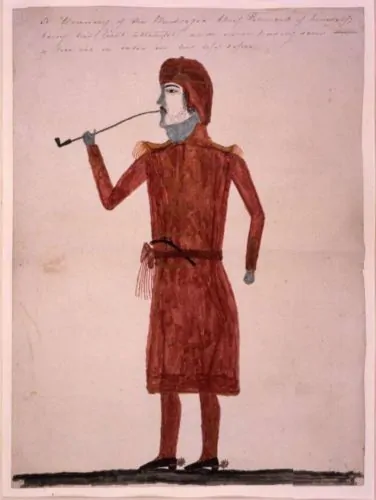
The prophetic resistance that emerged among the Muscogee peoples during the War of 1812 belonged to the same continental crisis that had produced Prophetstown, but it developed from a distinct southern history. By the early nineteenth century, Muscogee communities were confronting mounting pressure from American traders, federal agents, missionaries, land speculators, and settlers moving toward the Gulf Coast. Benjamin Hawkins, the federal agent among the Creeks, promoted livestock raising, plantation agriculture, private property, spinning, and other practices that American officials associated with “civilization.” Some Muscogee leaders adopted parts of this program, accumulated property, participated extensively in the deerskin and cattle trades, and developed closer relationships with the United States. Others saw the same changes as sources of debt, political dependency, social inequality, and cultural dissolution. The resulting conflict divided towns, clans, families, and generations before it divided armies.
Josiah Francis, better known by the Muscogee title Hillis Hadjo, emerged as one of the most influential prophets within the movement Americans called the Red Sticks. The name hadjo conveyed associations with sacred power, inspired intensity, or ceremonial authority rather than simple madness, despite the dismissive translations sometimes favored by white observers. Francis reportedly experienced a religious transformation during the years of mounting crisis and acquired a reputation for receiving spiritual knowledge, preparing medicine, directing ceremonies, and interpreting the dangers confronting his people. Like Tenskwatawa, he taught that Indigenous suffering resulted partly from departure from a proper moral and sacred order. His authority did not arise from military rank alone. It rested upon the belief that he could identify the spiritual causes of political weakness and guide communities toward purification.
Red Stick religion drew upon Muscogee ceremonial traditions in which towns, sacred fires, medicine bundles, dance grounds, and cycles of purification structured collective life. The annual Busk, commonly called the Green Corn Ceremony, renewed relationships within the community through fasting, cleansing, reconciliation, the extinguishing and rekindling of fires, and the consumption of the new harvest. Such practices joined political order to sacred geography. A town was not merely a collection of dwellings; it was a place organized around fire, kinship, memory, and ritual obligation. Prophets adapted these traditions to the emergency of American expansion. Ceremonial discipline prepared warriors, while dances and medicines strengthened solidarity and courage. Rejecting American goods, livestock practices, clothing, and commercial habits could signify a determination to remove corrupting influences from both the individual body and the collective homeland. Tecumseh’s visit to the Muscogee country in 1811 contributed to this atmosphere of resistance, but the Red Stick movement should not be treated as a southern branch created by the Shawnee brothers. Tecumseh appealed for a broad Indigenous alliance against American expansion and found receptive audiences among people already divided over accommodation, trade, land, and cultural change. Muscogee prophets possessed their own sources of authority and interpreted events through local ceremonial traditions. The New Madrid earthquakes of 1811 and 1812, which shook a vast area of eastern North America, could be understood by some as signs that extraordinary spiritual forces were at work, although later accounts may have exaggerated Tecumseh’s supposed prediction of the tremors. What mattered was not whether the movement followed a single imported prophecy. Red Stick leaders understood the disruption of the natural and political worlds as connected evidence that an established order had been violated.
Hillis Hadjo became closely associated with a settlement known as Holy Ground, or Econochaca, established on elevated land above the Alabama River. The place served as a refuge, ceremonial center, and defensive position for Red Stick followers. Its sanctity was expressed in claims that spiritual power would protect it from invasion or prevent enemies from successfully occupying it. American forces under Ferdinand Claiborne attacked Holy Ground in December 1813, compelling its defenders to retreat and destroying the town and its provisions. The assault illustrates how sacred geography became a military objective. American campaigns targeted houses, corn, livestock, stored food, ceremonial centers, and transportation routes because Red Stick resistance depended upon communities as much as upon warriors. Burning a sacred settlement was both logistical warfare and a demonstration that the spiritual claims sustaining resistance could be violated by American arms.
The defeat of the Red Sticks did not prove that their religion had been politically irrelevant. Prophecy helped transform resistance to debt, cultural change, and territorial intrusion into a struggle over the survival of a sacred social world. It also sharpened internal divisions, as Muscogee opponents of the Red Sticks allied with American armies and understood the prophets as threats to their own towns and political strategies. Hillis Hadjo survived the main fighting, traveled to Britain seeking continued support, and later returned to the Gulf borderlands, where Andrew Jackson’s forces captured and executed him without a conventional trial in 1818. His death revealed how persistently the United States regarded Indigenous prophetic leadership as a political danger. Hillis Hadjo had attempted to defend more than territory in the narrow sense. He fought for a landscape in which sacred fires, towns, ceremonies, kinship, and political autonomy remained inseparable and against an expanding republic determined to reorganize that landscape according to its own laws and myths.
The American Myth of Savage War

The attack on Fort Mims on August 30, 1813 became the defining atrocity story of the Creek War and one of the most powerful episodes in the American mythology of frontier violence. The fortified settlement north of Mobile contained a socially complex population that included white settlers, enslaved people, mixed-ancestry Muscogees, militia, traders, women, and children. Many had sought protection there because conflict between Red Stick and accommodationist Muscogee factions had made the region increasingly dangerous. The fort’s defenders had received warnings that Red Stick warriors were nearby, but poor discipline, overconfidence, and failures of preparation left the entrance inadequately secured. When Red Stick forces led by Peter McQueen and William Weatherford attacked, they broke into the enclosure and fought for hours before overwhelming resistance. Hundreds of people died, though exact totals remain uncertain and later accounts often magnified the numbers or simplified the identities of the dead. What Americans remembered as the “Fort Mims Massacre” was both a genuine catastrophe and an event rapidly stripped of its political and social complexity. American reports portrayed the attack as proof that Red Stick resistance had passed beyond legitimate warfare into racial savagery. Newspaper accounts emphasized women and children killed, bodies mutilated, buildings burned, and defenders slaughtered after organized resistance had collapsed. The label “massacre” was not inaccurate as a description of the scale and character of the killing, but it carried an additional ideological force. It detached the attack from the Muscogee civil war, the expansion of American settlement, and the military tensions already reshaping the Gulf borderlands. Red Stick warriors appeared not as political actors pursuing a violent and contested program but as embodiments of an ancient frontier nightmare.
The memory of Fort Mims helped mobilize armies from Tennessee, Georgia, and the Mississippi Territory by transforming retaliation into moral duty. Governors called out militia, volunteers entered service, and political leaders warned that every settlement might face the same destruction unless the Red Sticks were crushed. Andrew Jackson’s rise as the most prominent American commander in the conflict depended partly upon this atmosphere of vengeance. He presented the campaign as a defense of innocent families and a restoration of security, but his army also advanced into Muscogee territory, destroyed towns, seized food, killed noncombatants, and helped break the political autonomy of peoples far removed from the original assault. Fort Mims supplied a moral shorthand through which nearly any subsequent American violence could be represented as punishment for savagery. The massacre narrative did not invent the danger posed by Red Stick forces, but it transformed a civil and territorial conflict into a war between civilization and barbarism.
American campaigns deliberately attacked the material and ceremonial foundations of Red Stick resistance. Soldiers burned houses, destroyed corn, confiscated livestock, and occupied or ruined towns associated with prophetic leadership. Such actions were militarily effective because Red Stick warriors depended upon food, shelter, families, and local networks of support. They were also culturally devastating. A Muscogee town was a political community organized through clan relationships, ceremonial grounds, sacred fires, and collective memory. Its destruction damaged far more than military logistics. Yet American accounts commonly described these operations as the clearing of hostile settlements, while Indigenous attacks upon fortified communities were classified as atrocities arising from racial cruelty. The campaign culminated at Horseshoe Bend on March 27, 1814, where Red Stick defenders occupied a fortified bend of the Tallapoosa River called Tohopeka. Jackson commanded a much larger force composed of United States regulars, Tennessee militia, volunteers, Cherokee warriors, and Lower Creek allies. While American artillery struck the Red Stick barricade, Cherokee and allied Muscogee forces crossed the river, captured canoes, burned the village, and attacked from the rear. Jackson’s troops eventually stormed the breastwork, and the battle became a devastating slaughter in which hundreds of Red Stick warriors were killed. Many refused or were unable to surrender, while American troops continued firing into the enclosed position. The victory destroyed the principal military concentration of the Red Stick movement, but it was not a simple triumph of Americans over Indians. Indigenous allies were indispensable to Jackson’s success, contributing reconnaissance, mobility, combat power, and knowledge of the terrain. Their role complicated the emerging national story, which increasingly placed Jackson alone at the center of victory.
Horseshoe Bend nevertheless became a foundational episode in Jackson’s heroic mythology. He appeared as the relentless frontier commander who had answered Fort Mims, defeated prophetic fanaticism, and saved the Southwest from annihilation. The suffering, hunger, mutiny, and logistical failures that had repeatedly threatened his campaign were reorganized into evidence of endurance and iron determination. Cherokee and Lower Creek participation receded from popular memory, while the Red Stick defenders became a defeated mass against which Jackson’s character could be measured. His victory prepared the way for New Orleans and, eventually, the presidency.
The mythology of savage war also concealed the unequal settlement imposed afterward. The Treaty of Fort Jackson compelled the Muscogee Confederacy to surrender more than twenty million acres, including lands belonging to communities that had fought alongside the United States. Jackson treated the war not merely as a campaign against the Red Sticks but as an opportunity to secure a vast territorial transformation. American memory separated that land seizure from the moral narrative of Fort Mims, presenting conquest as the natural consequence of victory rather than as one of the war’s central purposes. The result was a powerful asymmetry in historical language: Red Stick violence became massacre, fanaticism, and savagery, while American destruction became pacification, retribution, and national defense. Fort Mims was a real atrocity, and Horseshoe Bend was a decisive battle, but the mythology linking them converted a complex Indigenous civil war into a heroic story of American civilization overcoming barbarism.
Oliver Hazard Perry and the Manufacture of Naval Heroism
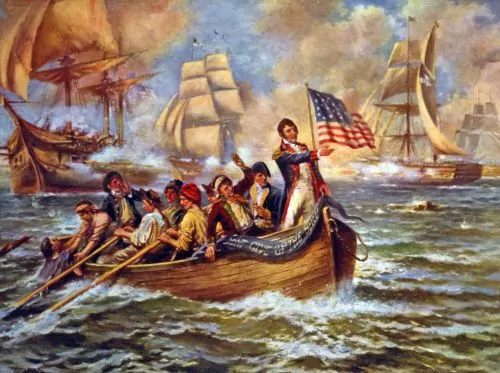
The naval war offered the United States a stage upon which defeat could be transformed into sacrifice and victory condensed into memorable words. Oliver Hazard Perry entered the Lake Erie campaign as a young officer entrusted with creating a fleet almost from nothing at Presque Isle. Ships had to be constructed, armed, supplied, and crewed in a frontier environment where sailors, craftsmen, guns, and provisions were all scarce. By September 1813, Perry’s squadron was prepared to challenge the British force commanded by Robert Heriot Barclay. The resulting battle would be remembered as a nearly inevitable expression of American courage, but its outcome depended upon shipbuilding, logistics, favorable weather, uneven gunnery, command decisions, and the physical exhaustion of both fleets. Heroic memory later simplified this difficult preparation into the image of Perry standing beneath a blue flag bearing the command, “Don’t Give Up the Ship.”
The phrase did not come from ancient mythology, nor was it originally Perry’s. It was attributed to Captain James Lawrence, who had been mortally wounded when HMS Shannon captured the USS Chesapeake in June 1813. Lawrence’s death converted a humiliating defeat into a story of personal courage: although his ship had been lost, his final words could be detached from the surrender and preserved as an uncompromised command to resist. Perry named his flagship Lawrence in the dead captain’s honor, and his purser, Samuel Hambleton, helped prepare the battle flag carrying the famous words. This act joined remembrance to anticipation. Lawrence’s failed resistance became a moral inheritance that Perry’s squadron was expected to redeem. The flag transformed an officer killed in defeat into an invisible participant in a future victory.
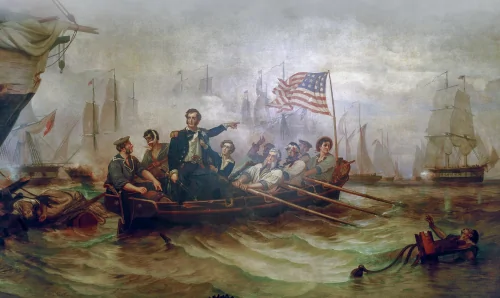
During the Battle of Lake Erie on September 10, the Lawrence absorbed devastating British fire while much of Perry’s squadron remained at a distance or struggled to enter effective action. Casualties mounted, guns were disabled, rigging was destroyed, and the flagship became nearly unmanageable. Perry then transferred by boat to the Niagara, carrying the battle flag with him. His passage across the exposed water later became the central visual scene of the engagement: a commander abandoning a shattered ship without abandoning the battle. From the Niagara, Perry broke through the disordered British line and brought fresh fire against vessels already battered by hours of combat. Barclay’s squadron surrendered soon afterward. The transfer was tactically important, but its commemorative power came from the ease with which it resembled an epic ordeal. Perry seemed to move through destruction, preserve the spirit of the fallen, and return to the contest with renewed force. Perry’s brief report to William Henry Harrison further shaped the battle’s mythology: “We have met the enemy and they are ours.” The sentence reduced a confused and exceptionally bloody engagement to possession, certainty, and triumph. It omitted the severe damage to the American squadron, the disputed conduct of Jesse Elliott aboard the Niagara, and the narrow margin separating victory from disaster. Like the battle flag, the dispatch functioned because it was concise enough to be repeated, printed, displayed, and remembered. Newspapers and patriotic publications quickly circulated Perry’s words, while paintings represented his transfer between ships as the decisive action of a solitary hero. The crews who built, sailed, fought, bled, and died aboard the squadron did not disappear entirely, but public memory arranged their collective achievement around Perry’s visible courage.
The manufacture of Perry’s heroism did not require the invention of bravery that had never existed. He had accepted grave personal risk, maintained command after the destruction of his flagship, and contributed decisively to a victory that secured American control of Lake Erie and forced the British withdrawal from Detroit. Mythmaking instead worked by selecting certain truths and making them stand for the whole. Lawrence’s dying words became a national commandment; the battle flag turned memory into sacred obligation; Perry’s boat passage became an ordeal of heroic perseverance; and his dispatch transformed a complicated engagement into immediate legend. In a war marked by failed invasions, surrendered armies, and political division, Lake Erie supplied Americans with a hero who appeared to embody youthful confidence and republican valor. Perry’s achievement was military, but the form in which the nation remembered it was already mythic.
Defeat and the Apotheosis of Tecumseh
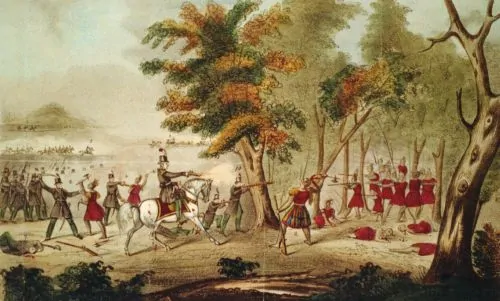
The Battle of the Thames on October 5, 1813 destroyed the military position that Tecumseh had spent years constructing. Oliver Hazard Perry’s victory on Lake Erie had severed British communications and compelled Major General Henry Procter to abandon Detroit and retreat eastward through Upper Canada. Tecumseh opposed the withdrawal, recognizing that the loss of the Detroit frontier would expose Indigenous communities to American retaliation and leave the confederacy without a defensible territorial base. He had repeatedly warned that Britain might sacrifice Native interests when imperial necessity demanded it. As Procter’s exhausted column moved along the Thames River, that fear became reality. Supplies dwindled, discipline weakened, and British soldiers and Indigenous warriors prepared to fight under conditions chosen more by collapse than by strategy.
When William Henry Harrison’s pursuing army reached the British position near Moraviantown, Procter arranged his regulars in a thin line that proved unable to withstand the American mounted charge. The British formation broke quickly, and many soldiers surrendered or fled. Indigenous warriors positioned themselves in swampy woodland, where the terrain offered concealment and limited the effectiveness of cavalry. Tecumseh remained with them, reportedly wearing traditional clothing rather than the uniform or insignia of a European commander. The fighting there was close and confused. American troops encountered a resistance far more determined than that offered by Procter’s regulars, but the death of Tecumseh deprived the warriors of their most influential leader. Once word of his fall spread, the Indigenous line gradually dissolved. The battle ended not only a campaign but the possibility that the northwestern confederacy might continue operating as a coherent military alliance.
The circumstances of Tecumseh’s death remain uncertain. No uncontested eyewitness identified the person who killed him, and his body was never conclusively recognized afterward. American soldiers later produced competing claims, while British and Indigenous accounts preserved different memories of the battle. The uncertainty created ideal conditions for legend. Richard Mentor Johnson emerged as the most famous claimant. Johnson, a Kentucky politician and commander of mounted troops, had been wounded during the fighting, and his supporters later asserted that he had personally killed Tecumseh. The story gained political usefulness precisely because it converted a chaotic encounter into a duel between representative champions: the republican citizen-soldier and the greatest Indigenous enemy of American expansion. During Johnson’s campaign for the vice presidency in the 1830s, admirers promoted the claim through speeches, songs, prints, and the memorable refrain that “Colonel Johnson killed Tecumseh.” The evidence remained inconclusive, but political mythology did not require courtroom certainty. By attaching Tecumseh’s death to Johnson, supporters transformed conquest into personal heroism and offered voters a dramatic battlefield credential that could overshadow the more complicated realities of the campaign.
The treatment of Tecumseh’s body further exposed the violence concealed beneath later romantic admiration. Some accounts reported that American soldiers mutilated or removed pieces of skin from an Indigenous corpse believed to be his, turning the dead warrior into a source of trophies. Whether every detail can be verified, the stories are consistent with documented practices of battlefield mutilation and souvenir-taking along the frontier. They also reveal the contradiction within American memory. Tecumseh could be praised as brave, eloquent, and noble while the political cause for which he fought was dismissed as doomed resistance. Admiration became easier after his death because it no longer threatened American control of the West.
Tecumseh’s apotheosis proceeded differently in American, British, Canadian, and Indigenous memory. Americans often made him the greatest defeated adversary of western settlement, a formidable enemy whose fall confirmed the advance of the republic. British writers emphasized his loyalty and courage, sometimes using his steadfastness to condemn Procter’s retreat and the empire’s failure to protect its allies. Later Canadian memory incorporated him into the defense of Upper Canada, even though his objective had not been the creation of a Canadian nation but the preservation of an autonomous Indigenous homeland. Indigenous remembrance retained the larger political meaning of his struggle: he had attempted to unite distinct peoples against a treaty system designed to isolate and dispossess them. In every tradition, his death became more than a battlefield event. It transformed a living statesman, whose alliances and strategies had been contested, into a heroic figure who could be admired without allowing his program to survive. Tecumseh lost the battle and, with it, the confederacy’s best hope of military success, but defeat enabled his passage into legend.
The War’s American Reinvention
The War of 1812 gave Americans few unambiguous victories from which to construct a triumphant national story. The invasions of Canada failed, Detroit surrendered, Washington burned, commerce suffered, and political opposition deepened across New England. The Treaty of Ghent restored the territorial status quo without resolving impressment or establishing American control over Canada. Yet wars are remembered through selection rather than through an exact accounting of objectives gained and lost. By emphasizing endurance, naval victories, frontier conquest, and the defense of New Orleans, Americans gradually recast a strategically inconclusive conflict as a successful defense of republican independence. Providence, national honor, and heroic memory joined together to create the image of a young republic tested by empire and vindicated through sacrifice.
Providential language made military events morally intelligible. Presidents, ministers, editors, and ordinary citizens interpreted disaster as punishment, victory as divine favor, and perseverance as evidence that the nation retained a special place within history. Public fasts and days of thanksgiving linked the fate of the republic to collective virtue. Defeat could be explained without abandoning belief in national destiny: it might expose corruption, chastise pride, or call the people back to moral discipline. Victory, by contrast, suggested that Providence had accepted the nation’s repentance or rewarded its courage.
The burning of Washington in August 1814 demonstrated how rapidly humiliation could be absorbed into a providential narrative. British troops defeated the American force at Bladensburg, entered the capital, and burned the Capitol, the President’s House, and other public buildings. The destruction exposed failures of preparation and contradicted claims that republican enthusiasm alone could overcome professional military power. Yet the severe storm that struck the city soon afterward invited a different interpretation. High winds, torrential rain, and a possible tornado damaged buildings, disrupted British movements, and helped extinguish fires. In popular memory, the storm became an intervention by nature or Providence against the invader. The image did not erase the British achievement, but it shifted attention from American military failure toward the idea that a higher power had refused to permit the republic’s complete humiliation. Naval victories provided firmer material for patriotic reinvention. The successes of the Constitution, the United States, the Wasp, and Perry’s Lake Erie squadron contradicted assumptions that the Royal Navy would dominate every encounter. Although these engagements could not break the British blockade or determine the war’s final settlement, they possessed enormous symbolic value. Each victory seemed to prove that republican sailors could equal or surpass the disciplined servants of an ancient empire. Captains became representatives of national character, while ships acquired personalities and legendary reputations of their own.
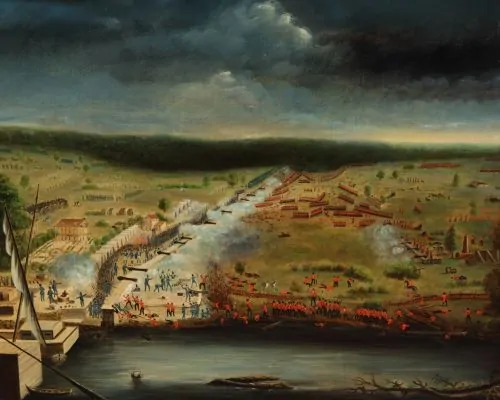
The Battle of New Orleans supplied the culminating scene American memory required. Andrew Jackson’s diverse army defeated Major General Edward Pakenham’s experienced British force on January 8, 1815, after the Treaty of Ghent had been signed but before news of peace had reached the Gulf Coast. The timing did not diminish the battle’s symbolic force. Americans learned of peace and victory in close succession, allowing the two events to merge into a single emotional conclusion. The overwhelming British casualties, Jackson’s defensive preparations, and the participation of regulars, militia, free men of color, Choctaws, sailors, privateers, and local civilians produced a victory that seemed both miraculous and distinctly national. Difficult questions about the war’s original objectives receded before the spectacle of imperial veterans broken by defenders assembled from the population of the republic.
Jackson’s elevation after New Orleans combined classical republican imagery with the developing mythology of the frontier. He could be presented as a modern Cincinnatus who accepted extraordinary command in a moment of danger, saved the community, and remained the servant of the people. He represented a newer heroic type: the forceful western leader whose iron will supposedly overcame aristocratic pretension, bureaucratic hesitation, and civilized weakness. His earlier victory over the Red Sticks at Horseshoe Bend became part of the same narrative of national salvation. The violence of conquest was reorganized as evidence of resolve, and the dispossession of Indigenous peoples became inseparable from the expansion of American political power.
The retrospective claim that the War of 1812 constituted a “second war of independence” completed this transformation. Britain had not attempted to restore colonial rule, and the treaty did not recognize a new independence that the United States had somehow lost. The phrase nevertheless expressed the emotional meaning Americans attached to survival. The republic had challenged the world’s greatest empire, endured invasion, and emerged territorially intact. This national reinvention concealed profound asymmetries. The United States gained confidence and a usable pantheon of heroes, while Indigenous confederacies lost British support, military leverage, and extensive homelands. Providence and destiny converted that outcome into a story of national maturation. The war became victorious not because every stated objective had been achieved, but because Americans learned to remember survival, expansion, and Indigenous defeat as parts of the same inevitable rise.
British and Canadian Memory
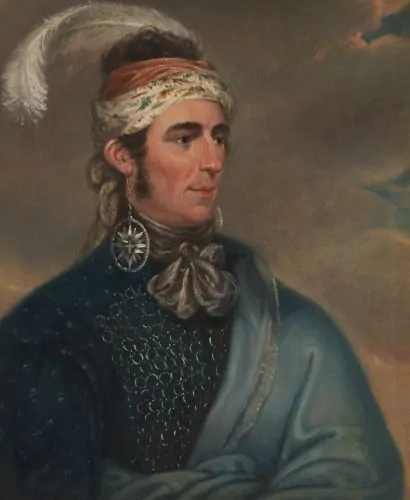
In Upper Canadian memory, the War of 1812 became a foundational struggle in which a small and vulnerable colony resisted conquest by the far more populous United States. The survival of the province appeared to confirm the strength of loyalty, British institutions, local courage, and attachment to the Crown. This interpretation was not entirely invented. American armies repeatedly crossed the border, occupied settlements, destroyed property, and threatened the continued existence of British government in the region. Yet the later national story imposed unity upon a population whose loyalties had been uncertain and whose wartime experiences differed greatly. Upper Canada did not enter the conflict as an embryonic nation consciously defending a future Canada. It was a recently created colony inhabited by Loyalist families, Indigenous communities, British officials, recent immigrants from the United States, farmers concerned primarily with their property, and people whose allegiance changed according to danger and circumstance.
Isaac Brock became the ideal figure through whom this uncertain society could be remembered as purposeful and united. His capture of Detroit in August 1812 supplied the image of bold leadership required by a colony that feared invasion and doubted the reliability of its militia. His death at Queenston Heights two months later completed the heroic pattern. Brock was killed while attempting to rally troops against an American force that had crossed the Niagara River and seized the heights above Queenston. Although the position was recovered only later, after Major General Roger Hale Sheaffe arrived with reinforcements and Indigenous warriors helped block American movement, public memory concentrated upon Brock’s fatal charge. His death transformed a complicated battle into an act of personal sacrifice. He became the commander who had understood the danger before others, acted when caution might have surrendered the province, and given his life at the moment of invasion. The monument eventually raised above Queenston Heights turned the landscape itself into a place of pilgrimage, allowing visitors to connect the survival of Upper Canada with the body of its most celebrated defender. Brock’s mythology also reinforced a wider story of loyalism. Descendants of Loyalists who had left the United States after the American Revolution could interpret the war as the final proof of their families’ political wisdom. Their parents had rejected republican rebellion; their generation had resisted republican invasion. Loyalty became not merely an allegiance to the Crown but a hereditary moral quality distinguishing Upper Canadians from Americans. This interpretation elevated steadfastness, hierarchy, and constitutional order while obscuring desertion, evasion of militia service, commercial exchange across the border, and the widespread desire simply to avoid destruction.
The related “militia myth” claimed that ordinary Canadian farmers had risen spontaneously to repel the invader, demonstrating that the colony’s people rather than British power had saved the country. Militia service was unquestionably important. Local men guarded roads, carried supplies, reinforced garrisons, fought in several battles, and endured disruption to farms and families. Their knowledge of the region could be indispensable, and their participation made defense possible across a long frontier. Nevertheless, later commemorative narratives exaggerated both the enthusiasm and the independent effectiveness of the militia. British regulars provided the central professional military structure, artillery, discipline, and much of the battlefield power required to withstand American offensives. Many militiamen served reluctantly, disappeared when harvests or family obligations called them home, or judged the war through local rather than imperial priorities. The mythology of a population united in arms converted an uneven record of service into a national character defined by quiet courage and natural military ability.
The greatest distortion concerned the place of Indigenous allies. Tecumseh, John Norton, and warriors from numerous nations had been essential at Detroit, Queenston Heights, Beaver Dams, and other engagements. They gathered intelligence, disrupted communications, screened British movements, defended difficult terrain, and magnified American fears. Canadian memory increasingly acknowledged their bravery, but often by incorporating them into a national story that was not their own. Tecumseh could be celebrated as a defender of Canada only by minimizing his actual objective: the creation of an autonomous Indigenous territory protected from American settlement. Britain and the Indigenous confederacy shared an enemy, but they did not share an identical vision of victory. When British diplomacy at Ghent failed to secure the territorial barrier desired by Indigenous allies, the empire preserved Upper Canada while abandoning the larger political project for which Tecumseh had fought.
Black participation was similarly marginalized within the traditional narrative of white loyalism. Free and formerly enslaved Black men served in formations such as the Coloured Corps, performed labor essential to fortification and transportation, and defended a British colony that represented both opportunity and persistent racial inequality. Enslaved people from the United States also understood British military power through their own pursuit of freedom, particularly in the Chesapeake and southern theaters. Their experiences complicated any simple opposition between British liberty and American republicanism. The empire could offer freedom selectively while maintaining slavery elsewhere, just as Upper Canadian society could praise Black loyalty without granting full equality. Remembering these soldiers alongside Indigenous warriors and reluctant militiamen reveals that the defense of British North America depended upon a coalition held together by distinct and sometimes incompatible hopes.
The Canadian mythology of 1812 drew its power from a genuine historical outcome: Upper Canada remained outside the United States. Yet survival did not automatically create the unified national consciousness later commemorators found in the conflict. Monuments, schoolbooks, public ceremonies, biographies, and anniversaries gradually organized the war around a small number of heroic scenes: Brock confronting Hull, Brock falling at Queenston Heights, Laura Secord warning the British, militia resisting invasion, and Indigenous warriors joining the defense. These stories helped nineteenth- and twentieth-century Canadians distinguish their political tradition from that of the United States. They also converted contingency into destiny. British North America had survived because of imperial resources, Indigenous alliances, American military failures, difficult geography, local service, and shifting strategic priorities. National mythology compressed those forces into a moral drama of loyalty rewarded. Brock stood at its center because his early death allowed him to embody courage without compromise, while the more difficult questions of Indigenous abandonment, colonial division, and unequal citizenship remained at the edges of the heroic landscape.
The People Left Outside the Heroic Story
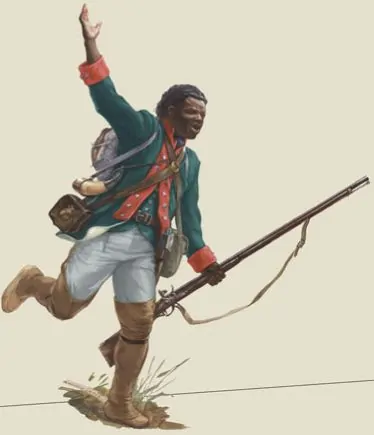
Heroic memory favors individuals who can be made to represent entire wars. Brock stands at Queenston Heights, Perry crosses from the ruined Lawrence to the Niagara, Jackson surveys the defenses of New Orleans, and Tecumseh falls at the Thames. Such scenes make the War of 1812 intelligible by reducing it to moments of command, courage, and sacrifice. They also remove much of the population from view. Armies depended upon people who cooked, carried, harvested, repaired, nursed, interpreted, scouted, built roads, moved artillery, buried the dead, and attempted to keep families alive amid invasion. Their work rarely produced the dramatic statements or battlefield tableaux from which national legends were made, but without it neither military resistance nor civilian survival would have been possible.
Indigenous women were among those most obscured by the concentration on male prophets, diplomats, and warriors. Women cultivated crops, prepared and preserved food, maintained households, cared for children and elders, and sustained the kinship networks through which towns reproduced themselves politically and socially. Their labor became particularly important when warfare drew men away for extended campaigns or forced entire communities to move. The destruction of Indigenous towns struck directly at women’s work and authority. When American soldiers burned houses, cornfields, stored provisions, and ceremonial centers, they attacked the foundations upon which resistance depended through the coming winter. Refugee movement placed additional burdens on women required to preserve families while carrying food, tools, clothing, and sacred or household objects into unfamiliar territory. Yet campaign narratives commonly reduced these losses to the destruction of “enemy villages,” as though settlements were empty military installations rather than living communities. Women also shaped wartime decisions without necessarily appearing in formal councils. Kinship ties connected villages across political and military divisions, while marriage linked Indigenous, European, African, and mixed-ancestry families throughout the borderlands. A man deciding whether to join Tecumseh, cooperate with American officials, follow a British retreat, or remain near his fields did not act as an isolated warrior. His choice affected mothers, wives, sisters, children, and clan relations, all of whom might face hunger or retaliation as a consequence. The heroic story’s emphasis upon individual resolve obscures the collective negotiations through which communities determined whether resistance was sustainable.
Black participation complicates the familiar claim that the war was fought simply between American republicanism and British liberty. In Upper Canada, free and formerly enslaved Black men served in the Coloured Corps and in other military capacities, helping defend a colony that had restricted slavery but had not eliminated racial discrimination. Black laborers constructed fortifications, transported supplies, and performed the exhausting work through which military positions became defensible. In the Chesapeake and along the southern coast, enslaved people confronted a different set of possibilities. British proclamations and military operations created opportunities to escape American slavery, and thousands sought protection with British forces. Some served as guides, sailors, laborers, or members of the Corps of Colonial Marines. Their actions were not merely reactions to promises made by imperial officers. They represented independent judgments that British military power might offer a path toward freedom unavailable within the United States. American slaveholders consequently experienced British invasion not only as a threat to territory but as an assault upon the labor system and racial authority on which their wealth depended.
The American military itself rested upon unequal forms of service. Regular soldiers enlisted under harsh conditions and endured disease, inadequate clothing, poor food, delayed pay, and commanders whose ambitions could be remote from the concerns of the ranks. Militiamen were celebrated afterward as citizen-soldiers defending home and liberty, but many served reluctantly, disputed whether they could legally be compelled to cross national or state boundaries, or left when enlistments expired and farms required attention. Sailors faced wounds, captivity, and disease in environments where splintered wood could be as deadly as shot. Teamsters, boatmen, artificers, laundresses, nurses, and camp followers performed indispensable tasks without acquiring the status attached to combat. The war depended upon their labor while its mythology placed weapons almost exclusively in heroic hands. Borderland civilians also resisted the clear national identities later histories imposed upon them. Families around the Great Lakes and along the Niagara frontier traded across the international boundary, possessed relatives on both sides, and often cared more about protecting farms and property than about proving ideological loyalty. Some inhabitants supplied whichever army occupied the district. Others fled, hid livestock, resisted requisitions, or attempted to remain neutral. American-born settlers in Upper Canada might distrust the colonial government without wishing to be annexed by the United States, while residents of northern New York could oppose the war yet suffer from British raids. War turned these ambiguous communities into objects of suspicion. Authorities classified mobility as desertion, trade as treason, and negotiation with an enemy as disloyalty even when civilians were attempting to survive between competing armies.
Enslaved people, refugees, mixed-ancestry families, and Indigenous allies also reveal how misleading it is to treat the conflict as a contest among three unified blocs called the United States, Britain, and the Indians. Muscogee warriors fought on both sides of the Creek War. Cherokee forces helped Jackson destroy the Red Stick position at Horseshoe Bend, even though the territorial order created by American victory would soon threaten Cherokee lands as well. Indigenous warriors allied with Britain pursued objectives that imperial negotiators eventually abandoned. Black Americans served the United States while others escaped to British lines, and British authorities offered freedom selectively while sustaining slavery elsewhere in the empire. These choices were not contradictory when viewed from the ground. People acted within immediate structures of kinship, coercion, opportunity, danger, and survival rather than according to the neat national loyalties later commemorations assigned them.
Restoring these people to the narrative does not require replacing one group of heroes with another. Women who maintained refugee communities, enslaved people who seized opportunities for freedom, soldiers who endured campaigns, and families who navigated divided borderlands were not all engaged in the same moral or political project. Some supported conquest, some resisted it, and many tried simply to survive forces beyond their control. Their presence changes the meaning of the war because it reveals how national victory depended upon labor and suffering excluded from the final story. The United States remembered republican valor, Canada remembered loyal defense, and Britain remembered imperial service, but each narrative drew sharp borders around a conflict lived by people whose identities crossed those lines. The heroic story preserved memorable acts of courage. It also concealed the households, forced migrations, coerced labor, fractured kinships, and unequal freedoms that made such heroism possible.
From Sacred History to National Folklore
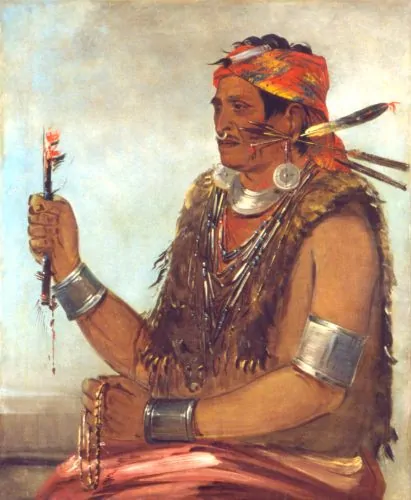
During the years leading to war, sacred narratives and prophetic teachings helped communities interpret crisis and decide what obligations followed from it. Tenskwatawa explained Indigenous suffering as the consequence of cultural corruption and departure from the Creator’s order. Tecumseh translated that diagnosis into a confederate argument about common land and collective survival. Muscogee prophets placed political resistance within a ceremonial geography of sacred fires, purified towns, medicines, and ancestral responsibility. These traditions were not retrospective decorations added after the fighting. They operated within the conflict itself, defining enemies, sustaining discipline, and transforming territorial loss into a violation of cosmic and moral relationships.
National folklore worked differently. It took the confusion of battle and compressed it into scenes that could be repeated without explanation: Brock confronting Hull, Perry carrying his flag between ships, Tecumseh falling in the woods, Jackson standing behind the defenses of New Orleans. Complexity became character. This transformation began almost immediately. Military reports, newspapers, sermons, campaign biographies, prints, songs, commemorative speeches, and political propaganda selected phrases and images capable of surviving beyond their original circumstances. Perry’s “We have met the enemy and they are ours” replaced hours of smoke, casualties, tactical confusion, and dispute with a sentence of absolute possession. Brock’s death at Queenston Heights overshadowed the later stages of the battle and made martyrdom the emotional meaning of the engagement. Claims that Richard Mentor Johnson killed Tecumseh converted an uncertain battlefield death into a personal duel useful in electoral politics. The phrase “Tippecanoe and Tyler Too” removed the destruction of an Indigenous religious center from its history of contested land cessions and transformed it into a cheerful slogan celebrating William Henry Harrison. Folklore preserved what could be sung, pictured, monumented, and attached to an individual name.
The process also assigned recurring roles. Tecumseh became the noble but doomed adversary whose courage magnified the greatness of those who defeated him. Tenskwatawa became either the inspired prophet who recognized the spiritual violence of expansion or the fraudulent fanatic exposed by battle. Brock embodied loyal self-sacrifice, Perry youthful audacity, Jackson frontier determination, and Hull cowardice. Once fixed in these roles, historical figures became less like people making uncertain decisions and more like moral types drawn from epic, classical history, religious narrative, and popular drama. Their stories instructed later generations in what courage, loyalty, treachery, sacrifice, or national character were supposed to look like.
Folklore did not simply falsify the War of 1812. It preserved real actions while rearranging their proportions and meanings. Brock was courageous, Perry did cross from a shattered flagship, Tecumseh did die while resisting American expansion, and Jackson did win a remarkable victory at New Orleans. Yet the familiar stories surrounding them separated those moments from the labor, alliances, coercion, chance, and political objectives that made them possible. They also distributed memory unequally. The United States gained heroes of independence and expansion; Canada gained defenders of loyal survival; Britain retained a smaller imperial memory; Indigenous peoples were often reduced to allies, obstacles, or tragic figures within someone else’s national development. The movement from sacred history to national folklore marked a transfer of power over meaning. Prophets and warriors had used narrative to defend living communities and homelands. Later nations used narrative to claim the war itself.
Did Mythology Actually Cause Anything?
The following video from “Kings and Generals” briefly discusses the Battle of New Orleans:
The strongest challenge to interpreting the War of 1812 through mythology is that the conflict was driven by material forces that do not require symbolic explanation. The United States went to war over maritime coercion, national honor, commercial restrictions, imperial rivalry, territorial ambition, and the vulnerability of its western frontier. Indigenous resistance arose from land loss, treaty manipulation, commercial dependency, settler violence, and the threat of political extinction. Brock succeeded at Detroit because Hull’s supply lines were compromised and his command was unstable. Perry prevailed on Lake Erie because ships had been constructed, armed, crewed, and maneuvered effectively. Jackson destroyed the Red Stick position at Horseshoe Bend through superior numbers, logistical endurance, artillery, and indispensable Indigenous allies. From this perspective, mythology risks becoming an ornamental layer placed over decisions better explained by power, resources, and strategic necessity.
There is also a danger of making the term so broad that it loses analytical precision. If prophecy, providentialism, classical education, patriotic slogans, racial stereotypes, commemorative monuments, and national memory are all classified as mythology, then nearly every belief influencing political behavior may fall within the category. A concept that explains everything can cease to distinguish among different kinds of causes. Tenskwatawa’s revelation, Brock’s appeal to military honor, American fear of Indigenous violence, and Perry’s battle flag did not operate in identical ways and should not be treated as interchangeable expressions of a universal mythic mentality.
The evidentiary problem is serious when reconstructing Indigenous prophetic traditions. Much of what survives about Tenskwatawa, Tecumseh, Hillis Hadjo, and other Native religious leaders was recorded by American officials, missionaries, traders, interpreters, military officers, or later writers with political and cultural reasons to misunderstand them. Statements about evil spirits, magical invulnerability, miraculous signs, or promised immunity from bullets may preserve genuine religious ideas, but they may also reflect mistranslation, hostile caricature, retrospective exaggeration, or attempts to portray resistance as irrational fanaticism. Indigenous teachings were often orally delivered, adapted to particular audiences, and understood through ceremonial contexts that written English accounts could not fully convey. A historian who confidently reconstructs a fixed doctrine from such evidence may reproduce the distortions of the very colonial sources being examined.
A related asymmetry appears when Indigenous beliefs are called mythology while American and British beliefs are labeled politics, religion, or ideology. Such language can imply that Native peoples acted through superstition whereas Euro-American leaders responded rationally to objective conditions. Yet American claims that expansion represented civilization, British confidence in imperial mission, and national interpretations of victory as providential favor were no less culturally constructed. The solution is not to collapse all beliefs into a single undifferentiated category. It is to compare them carefully. Indigenous sacred histories, Christian providentialism, classical republican models, frontier racial legends, and later national folklore possessed different institutions, sources of authority, and relationships to political power. Their common feature was not irrationality but their capacity to connect immediate events with larger accounts of moral order.
Mythology did not cause the War of 1812 independently of land, trade, weapons, population, diplomacy, and military opportunity. It shaped how people understood those forces and what actions they believed those forces required. Land became ancestral responsibility rather than acreage; expansion became civilizational progress rather than conquest; an alliance became sacred obligation or imperial necessity; surrender became either humane restraint or unforgivable cowardice; battlefield death became martyrdom; and an inconclusive peace became national victory. Brock’s threat at Detroit mattered because Hull interpreted it through inherited frontier stories. Tenskwatawa’s teachings mattered because they made cultural renewal inseparable from political resistance. Perry’s flag mattered because it transformed defeat into a command for future sacrifice. Mythology was neither an alternative to material explanation nor an invisible hand directing events. It was the language through which material interests became fears, duties, identities, and memories powerful enough to move people toward war and to determine what the war would later mean.
Conclusion: The War That Became a Myth
The surrender of Detroit remains the clearest expression of how mythology operated within the War of 1812. Isaac Brock and Tecumseh did not defeat William Hull through illusion alone. British artillery, Indigenous control of the approaches, disrupted American supply lines, militia instability, and Hull’s deteriorating command created a genuine military crisis. Yet those conditions became decisive because Hull interpreted them through an inherited mythology of frontier catastrophe. Brock’s warning that he might be unable to restrain his Indigenous allies summoned decades of captivity narratives, massacre reports, racial fear, and settler memory. Tecumseh’s warriors became more powerful in Hull’s imagination than their numbers alone could make them. Detroit was won within several realities at once: the physical geography of the frontier, the strategic balance between opposing forces, and the symbolic world through which the American commander understood what defeat might mean.
The same interaction between material conditions and mythic meaning shaped the conflict elsewhere. Tenskwatawa interpreted dispossession, alcohol, commercial dependency, and social fracture as signs that Indigenous peoples had departed from the Creator’s intended order. Tecumseh converted that diagnosis into an argument for collective landholding and intertribal resistance. Hillis Hadjo and other Muscogee prophets grounded opposition to American expansion in sacred fires, ceremonial renewal, medicine, dance, and the spiritual geography of towns. Their movements did not reject politics in favor of religion. They made political survival inseparable from the restoration of sacred relationships among people, land, ancestors, and future generations. American and British leaders inhabited different traditions, but they too understood events through inherited narratives. Classical models defined courage and disgrace, Christian providentialism transformed survival into divine favor, and frontier legends turned conquest into a struggle between civilization and savagery.
After the fighting ended, mythology shifted from mobilizing communities to organizing national memory. Brock became the martyr who saved Upper Canada; Perry became the young naval hero who carried a dead captain’s command through destruction to victory; Jackson became the frontier savior who redeemed the republic at New Orleans; and Hull became the coward against whom courage could be measured. Tecumseh entered American, British, Canadian, and Indigenous memory in sharply different forms, as defeated enemy, loyal ally, defender of Canada, and visionary of Native political unity. These heroic identities preserved genuine acts of courage, but they detached individuals from the coalitions, labor, coercion, and political objectives that had made their actions possible. Women who sustained refugee communities, Black people who used the war to pursue freedom, Indigenous allies whose goals were later abandoned, militiamen who served reluctantly, and civilians who crossed or ignored national boundaries found little place within the polished narratives of national birth.
The War of 1812 consequently produced no single mythology. Americans remembered a second struggle for independence, Canadians a successful defense against annexation, Britons a secondary theater within a global imperial war, and Indigenous peoples a catastrophic contest over homelands and sovereignty. The Treaty of Ghent restored borders between the United States and British North America, but it did not restore the political position of Tecumseh’s confederacy or protect the Muscogee lands taken after American victory. The nations that survived the conflict acquired monuments, slogans, martyrs, and reassuring stories of destiny; the Indigenous movements that lost were often absorbed into those stories as noble allies or doomed obstacles. Mythology did not erase history, but it determined which parts of history became memorable and which could be forgotten. The war became a myth because later generations needed it to explain who they were and because the competing peoples who fought it had never agreed upon what world they were defending.
Bibliography
Affiliate disclosure: Amazon links on this site are paid links. As an Amazon Associate I earn from qualifying purchases.
- Adams, John. A Defence of the Constitutions of Government of the United States of America. 3 vols. London: C. Dilly, 1787–1788.
- Addison, Joseph. Cato: A Tragedy. Edinburgh: John Wood, 1700.
- American State Papers. Indian Affairs. 2 vols. Washington, DC: Gales and Seaton, 1832–1834.
- American State Papers. Military Affairs. 7 vols. Washington, DC: Gales and Seaton, 1832–1861.
- Ayres, Philip. Classical Culture and the Idea of Rome in Eighteenth-Century England. Cambridge: Cambridge University Press, 1997.
- Benn, Carl. The War of 1812. Oxford: Osprey Publishing, 2002.
- Bickham, Troy. The Weight of Vengeance: The United States, the British Empire, and the War of 1812. New York: Oxford University Press, 2012.
- Brannan, John, ed. Official Letters of the Military and Naval Officers of the United States, during the War with Great Britain in the Years 1812, 13, 14, and 15. Washington, DC: Way and Gideon, 1823.
- Braund, Kathryn E. Holland. Deerskins and Duffels: The Creek Indian Trade with Anglo-America, 1685–1815. Lincoln: University of Nebraska Press, 1993.
- Brock, Isaac. The Life and Correspondence of Major-General Sir Isaac Brock, K.B. Edited by Ferdinand Brock Tupper. London: Simpkin, Marshall, 1847.
- Brown, Roger H. “The War Hawks of 1812: An Historical Myth.” Indiana Magazine of History 60:2 (1964), 137-151.
- Brown, Samuel R. Views of the Campaigns of the Northwestern Army. Burlington, VT: Samuel Mills, 1814.
- Calloway, Colin G. The Shawnees and the War for America. New York: Viking, 2007.
- Cave, Alfred A. Prophets of the Great Spirit: Native American Revitalization Movements in Eastern North America. Lincoln: University of Nebraska Press, 2006.
- Colley, Linda. Britons: Forging the Nation 1707–1837. New Haven: Yale University Press, 1992.
- Cozzens, Peter. Tecumseh and the Prophet: The Shawnee Brothers Who Defied a Nation. New York: Alfred A. Knopf, 2020.
- Cruikshank, E. A., ed. Documents Relating to the Invasion of Canada and the Surrender of Detroit, 1812. Ottawa: Government Printing Bureau, 1912.
- Dawson, Moses. A Historical Narrative of the Civil and Military Services of Major-General William H. Harrison, and a Vindication of His Character and Conduct as a Statesman, a Citizen, and a Soldier. Cincinnati: M. Dawson, 1824.
- Dennis, Matthew. “Reflections on a Bicentennial: The War of 1812 in American Public Memory.” Early American Studies 12:2 (2014), 269-300.
- Dowd, Gregory Evans. A Spirited Resistance: The North American Indian Struggle for Unity, 1745–1815. Baltimore: Johns Hopkins University Press, 1992.
- Dudley, William S., ed. The Naval War of 1812: A Documentary History. 3 vols. Washington, DC: Naval Historical Center, 1985–2002.
- Edmunds, R. David. The Shawnee Prophet. Lincoln: University of Nebraska Press, 1983.
- —-. Tecumseh and the Quest for Indian Leadership. Boston: Little, Brown, 1984.
- Esarey, Logan, ed. Messages and Letters of William Henry Harrison. 2 vols. Indianapolis: Indiana Historical Commission, 1922.
- Eustace, Nicole. 1812: War and the Passions of Patriotism. Philadelphia: University of Pennsylvania Press, 2012.
- Gilpin, Alec R. The War of 1812 in the Old Northwest. East Lansing: Michigan State University Press, 1958.
- Graves, Dianne. In the Midst of Alarms: The Untold Story of Women and the War of 1812. Montreal: Robin Brass Studio, 2007.
- Hamilton, Alexander. The Federalist No. 59. In The Federalist Papers. New York: Signet Classics, 2003.
- Hawkins, Benjamin. “A Sketch of the Creek Country, in the Years 1798 and 1799.” In Collections of the Georgia Historical Society. Vol. 3, part 1. Savannah: Georgia Historical Society, 1848.
- Herrera, Ricardo A. “Toward an American Army: U.S. Soldiers, the War of 1812, and National Identity.” Army History 88 (2013), 42-57.
- Hickey, Donald R. Don’t Give Up the Ship! Myths of the War of 1812. Urbana: University of Illinois Press, 2006.
- —-. The War of 1812: A Forgotten Conflict. Bicentennial ed. Urbana: University of Illinois Press, 2012.
- —-. “The War of 1812: Still a Forgotten Conflict?” The Journal of Military History 65:3 (2001), 741-769.
- Hitsman, J. Mackay. The Incredible War of 1812: A Military History. Updated by Donald E. Graves. Toronto: Robin Brass Studio, 1999.
- Hull, William. Memoirs of the Campaign of the North Western Army of the United States, A.D. 1812: In a Series of Letters Addressed to the Citizens of the United States. Boston: True and Greene, 1824.
- Jackson, Andrew. The Papers of Andrew Jackson. Edited by Harold D. Moser et al. 11 vols. Knoxville: University of Tennessee Press, 1980–2019.
- Jortner, Adam. The Gods of Prophetstown: The Battle of Tippecanoe and the Holy War for the American Frontier. New York: Oxford University Press, 2011.
- Kappler, Charles J., ed. Indian Affairs: Laws and Treaties. Vol. 2, Treaties. Washington, DC: Government Printing Office, 1903.
- Lincoln, Bruce. Theorizing Myth: Narrative, Ideology, and Scholarship. Chicago: University of Chicago Press, 1999.
- Madison, James. “Message to Congress, June 1, 1812.” In Annals of the Congress of the United States, 12th Cong., 1st sess. Washington, DC: Gales and Seaton, 1853.
- Malcomson, Robert. A Very Brilliant Affair: The Battle of Queenston Heights, 1812. Toronto: Robin Brass Studio, 2003.
- Martin, Joel W. Sacred Revolt: The Muskogees’ Struggle for a New World. Boston: Beacon Press, 1991.
- Morgan, Cecilia. Commemorating Canada: History, Heritage, and Memory, 1850s–1990s. Toronto: University of Toronto Press, 2016.
- Niles, Hezekiah. Niles’ Weekly Register. Baltimore, 1814.
- Norton, John. The Journal of Major John Norton, 1816. Edited by Carl F. Klinck and James J. Talman. Toronto: Champlain Society, 1970.
- Owens, Robert M. Mr. Jefferson’s Hammer: William Henry Harrison and the Origins of American Indian Policy. Norman: University of Oklahoma Press, 2007.
- Owsley, Frank Lawrence Jr. “Prophet of War: Josiah Francis and the Creek War.” American Indian Quarterly 9:3 (1985), 273–293.
- Perry, Oliver Hazard. “Report to William Henry Harrison, September 10, 1813.” In The Naval War of 1812: A Documentary History, edited by William S. Dudley. Vol. 2. Washington, DC: Naval Historical Center, 1992.
- Pickett, Albert James. History of Alabama, and Incidentally of Georgia and Mississippi, from the Earliest Period. 2 vols. Sheffield: Robert C. Randolph, 1896.
- Reinhold, Meyer. Classica Americana: The Greek and Roman Heritage in the United States. Detroit: Wayne State University Press, 1984.
- Remini, Robert V. The Battle of New Orleans. New York: Viking, 1999.
- Richard, Carl J. The Founders and the Classics: Greece, Rome, and the American Enlightenment. Cambridge, MA: Harvard University Press, 1994.
- Richardson, John. War of 1812: First Series, Containing a Full and Detailed Narrative of the Operations of the Right Division of the Canadian Army. London: The Musson Book Co. Limited, 1902.
- Saunt, Claudio. A New Order of Things: Property, Power, and the Transformation of the Creek Indians, 1733–1816. Cambridge: Cambridge University Press, 1999.
- Shalev, Eran. Rome Reborn on Western Shores: Historical Imagination and the Creation of the American Republic. Charlottesville: University of Virginia Press, 2009.
- Sheppard, George. Plunder, Profit, and Paroles: A Social History of the War of 1812 in Upper Canada. Montreal and Kingston: McGill-Queen’s University Press, 1994.
- Skaggs, David Curtis. Oliver Hazard Perry: Honor, Courage, and Patriotism in the Early U.S. Navy. Annapolis, MD: Naval Institute Press, 2006.
- —-. William Henry Harrison and the Conquest of the Ohio Country. Baltimore: Johns Hopkins University Press, 2014.
- Skaggs, David Curtis, and Gerard T. Alto. A Signal Victory: The Lake Erie Campaign, 1812–1813. Annapolis, MD: Naval Institute Press, 1997.
- Sleeper-Smith, Susan. Indigenous Prosperity and American Conquest: Indian Women of the Ohio River Valley, 1690–1792. Chapel Hill: University of North Carolina Press, 2018.
- Sugden, John. Tecumseh: A Life. New York: Henry Holt, 1998.
- Symonds, Craig L. Navalists and Antinavalists: The Naval Policy Debate in the United States, 1785–1827. Newark: University of Delaware Press, 1980.
- Tanner, John. A Narrative of the Captivity and Adventures of John Tanner (U.S. Interpreter at the Saut de Ste. Marie) during Thirty Years Residence among the Indians in the Interior of North America. Edited by Edwin James. New York: G. and C. and H. Carvill, 1830.
- Taylor, Alan. The Civil War of 1812: American Citizens, British Subjects, Irish Rebels, and Indian Allies. New York: Alfred A. Knopf, 2010.
- —-. The Internal Enemy: Slavery and War in Virginia, 1772–1832. New York: W. W. Norton, 2013.
- Tipton, John. “Journal of an Expedition against the Indian Towns on the Wabash.” In The John Tipton Papers, edited by Nellie Armstrong Robertson and Dorothy Riker. Vol. 1. Indianapolis: Indiana Historical Bureau, 1942.
- Tupper, Ferdinand Brock, ed. The Life and Correspondence of Major-General Sir Isaac Brock, K.B. London: Simpkin, Marshall, 1847.
- Turner, Wesley B. The War of 1812: The War That Both Sides Won. 2nd ed. Toronto: Dundurn Press, 2000.
- United States. “Treaty with the Delawares, Etc., 1809.” In Indian Affairs: Laws and Treaties, edited by Charles J. Kappler, 2:101–5. Washington, DC: Government Printing Office, 1904.
- United States War Department. Letters Received by the Secretary of War, Registered Series, 1801–1870. Record Group 107. National Archives, Washington, DC.
- Warren, Stephen. The Shawnees and Their Neighbors, 1795–1870. Urbana: University of Illinois Press, 2005.
- Waselkov, Gregory A. A Conquering Spirit: Fort Mims and the Redstick War of 1813–1814. Tuscaloosa: University of Alabama Press, 2006.
- —-, ed. Tohopeka: Rethinking the Creek War and the War of 1812. Tuscaloosa: University of Alabama Press, 2015.
- Watts, Steven. The Republic Reborn: War and the Making of Liberal America, 1790–1820. Baltimore: Johns Hopkins University Press, 1987.
- White, Richard. The Middle Ground: Indians, Empires, and Republics in the Great Lakes Region, 1650–1815. 20th anniversary ed. Cambridge: Cambridge University Press, 2011.
- Whitehorne, Joseph A. The Battle for Baltimore, 1814. Baltimore: Nautical and Aviation Publishing Company of America, 1997.
- Whitfield, Harvey Amani. Blacks on the Border: The Black Refugees in British North America, 1815–1860. Burlington: University of Vermont Press, 2006.
- Winterer, Caroline. The Culture of Classicism: Ancient Greece and Rome in American Intellectual Life, 1780–1910. Baltimore: Johns Hopkins University Press, 2002.
- Woodward, Thomas S. Woodward’s Reminiscences of the Creek, or Muscogee Indians. Montgomery, AL: Barrett and Wimbish, 1859.
Originally published by Brewminate, 07.22.2026, under the terms of a Creative Commons Attribution-NonCommercial-NoDerivatives 4.0 International license.
About the Author