Jefferson drew on classical antiquity to imagine an agrarian republic, heroic western exploration, and an empire of liberty divided by slavery, conquest, and Indigenous dispossession.

By Matthew A. McIntosh
Public Historian
Brewminate
Introduction: Searching for Argos in Jefferson’s America
Across the ancient Argolid stretched a landscape in which agriculture, political community, and heroic memory seemed inseparable. Argos stood beside a fertile plain long associated with grain, horses, dynastic power, and some of the oldest stories through which Greeks explained their collective past. The wider region supplied settings and genealogies for Perseus, Heracles, Agamemnon, and the houses whose conflicts filled epic and tragedy. Its name also echoed in the Argo, the ship that carried Jason and his gathered heroes beyond the familiar Greek world in pursuit of the Golden Fleece. More than two millennia later, Thomas Jefferson imagined another republic grounded in cultivated land yet driven toward distant horizons. He praised agricultural labor as a source of independence and civic virtue, acquired an immense western territory during his presidency, and dispatched Meriwether Lewis and William Clark across a continent that remained imperfectly known to Euro-Americans. The parallel is immediately attractive: Jefferson’s independent cultivators appear to resemble the citizens of an ancient agricultural landscape, while the Corps of Discovery can be imagined as a company of American Argonauts searching for the geographic knowledge and natural wealth that would secure the republic’s future. Yet the very elegance of this comparison creates a historical danger. Resemblance is not proof of influence, and no convincing body of documentary evidence demonstrates that Jefferson consciously selected Argos as the model for his agrarian republic or designed the Lewis and Clark expedition as a reenactment of Jason’s voyage. Searching for Argos in Jefferson’s America must begin not with the assertion of a hidden classical blueprint but with a more careful inquiry into how ancient history and mythology entered the intellectual world of the American founding.
That ancient world was undeniably present in Jefferson’s life. He received extensive instruction in Latin and Greek, read classical authors in their original languages, assembled editions of ancient historians, poets, philosophers, and political writers, and continued to defend classical learning long after the revolutionary generation had begun to pass away. In advising his nephew Peter Carr in 1785, Jefferson prescribed a demanding course of ancient history that moved from introductory surveys to Herodotus, Thucydides, Xenophon, Arrian, Diodorus Siculus, and other Greek and Roman writers. Decades later, he still described access to Greek and Latin authors in their original languages as one of the great intellectual luxuries of an educated life. His engagement with antiquity extended beyond books. Classical forms shaped his architectural designs, his educational plans, his correspondence, his vocabulary of public virtue, and his understanding of the historical forces by which free governments rose, prospered, became corrupted, and declined. Jefferson nevertheless approached the ancients selectively rather than submissively. He admired their literary achievement and mined their experiences for political and moral instruction, but he did not believe that Greece or Rome possessed an infallible political science suitable for direct transplantation into the modern world. Ancient societies had tolerated slavery, hereditary privilege, civic exclusion, imperial conquest, factional violence, and unstable constitutional arrangements. Jefferson could celebrate particular ancient achievements while regarding modern philosophy, representative government, natural science, and the doctrine of universal rights as advances beyond them. Classical antiquity was consequently neither an ornamental collection of dead stories nor an authoritative code that dictated his decisions. It was a contested intellectual inheritance: a storehouse of examples, warnings, symbols, and narrative patterns through which Jefferson could imagine what a republic might become.
The meaning of “influence” must be defined with unusual care. At its strongest, influence can be demonstrated when Jefferson quoted an ancient author, recommended a particular text, adopted a recognizable classical form, or explicitly compared modern events with a Greek or Roman precedent. A second and less direct form of influence operated through the classical culture shared by educated people in Britain and revolutionary America. Within that culture, discussions of citizenship, luxury, corruption, public virtue, tyranny, agrarian independence, and republican decline repeatedly drew upon ancient examples even when no single text was named. A third category is retrospective analogy: a comparison introduced by the historian because it illuminates an important structure in Jefferson’s thought, though Jefferson himself left no record of having formulated it. Argos and the Argonauts belong primarily to this third category, while also drawing plausibility from the second. Historical Argos was not the uncomplicated community of virtuous, self-sufficient farmers that a romantic Jeffersonian reading might require. It experienced monarchy, aristocratic rivalry, democratic experimentation, territorial competition, warfare, and internal upheaval. Likewise, Lewis and Clark were not mythical adventurers searching for an enchanted object. They led a military, scientific, diplomatic, and commercial mission ordered to map waterways, record natural resources, cultivate relations with Indigenous nations, and extend the strategic reach of the United States. Calling them American Argonauts is not the recovery of Jefferson’s secret name for the expedition. It is an interpretive comparison that draws attention to the cultural process by which organized exploration becomes heroic voyage, geographic information becomes national treasure, and distant, inhabited territory is recast as a field of discovery.
Ancient mythology influenced Jefferson most powerfully not by furnishing literal instructions for policy but by participating in a broader classical imagination that helped him connect land, civic character, exploration, and national destiny. Argos and the Argo provide two complementary images through which that imagination can be examined. The first represents rootedness: the belief that political independence arose from productive soil, autonomous households, and citizens whose material security protected them from corruption and domination. The second represents movement: the journey beyond familiar borders to acquire the knowledge, resources, routes, and strategic advantages required for collective greatness. Jefferson’s political vision joined these apparently opposing impulses. He sought a stable republic of cultivators but preserving that republic appeared to require continual territorial enlargement. He praised limited government while using national power to purchase Louisiana, sponsor exploration, negotiate with Indigenous peoples, and prepare western lands for incorporation. He described agriculture as the foundation of liberty while living within a plantation order sustained by enslaved labor. The classical language of virtue and heroic discovery could dignify these projects, but it could also conceal the coercion on which they depended. Jeffersonian America emerged between an imagined Argos and an American Argo: between the cultivated republic already planted and the expedition forever moving westward to secure new soil for its expansion. Recovering that relationship does not prove that Jefferson consciously copied a particular Greek city or myth. It reveals instead how classical forms could be absorbed, revised, and made to serve a modern national mythology whose promises of knowledge, independence, and republican opportunity were inseparable from slavery, dispossession, and continental empire.
Jefferson’s Classical Education: Antiquity as a Language of Thought

Thomas Jefferson’s familiarity with antiquity began not as the recreational interest of an adult statesman but as the foundation of his formal education. In his Autobiography, he recalled that his father placed him in an English school at five and a Latin school at nine. His first instructor, the Reverend William Douglas, gave him the rudiments of Latin, Greek, and French, although Jefferson later judged Douglas to have been only a superficial Latinist and still less accomplished in Greek. After his father’s death, Jefferson continued his studies under the Reverend James Maury, whom he remembered more favorably as a “correct classical scholar.” Under Maury, classical languages were not separated sharply from history, literature, rhetoric, moral instruction, or the habits expected of a provincial gentleman. Grammar and translation provided the technical foundation, but the larger purpose was intellectual formation. Greek and Roman texts offered models of eloquence, courage, prudence, ambition, patriotism, and political failure. Mythology entered this curriculum not as an isolated catalogue of supernatural tales but through Homeric epic, Latin poetry, ancient history, moral philosophy, and the stories attached to famous peoples and places. By the time Jefferson entered the College of William and Mary in 1760, antiquity had already become one of the principal languages through which he encountered questions of character, public duty, and historical change.
Jefferson’s years in Williamsburg enlarged that classical foundation by placing it beside the intellectual innovations of the Enlightenment. At William and Mary, he studied closely with the Scottish professor William Small, whose influence Jefferson later described as having “fixed the destinies” of his life. Small introduced him to mathematics, natural philosophy, metaphysics, and the systematic investigation of the physical world, while also drawing him into the cultivated circle surrounding Governor Francis Fauquier and the lawyer George Wythe. Under Wythe’s subsequent legal mentorship, Jefferson encountered Roman law, English constitutional history, legal reasoning, and the rhetorical traditions through which educated lawyers constructed arguments. The importance of this education lies in its combination rather than in any exclusive allegiance to either ancient or modern authority. Jefferson learned to place Homer, Cicero, Tacitus, and Plutarch within the same intellectual universe as Francis Bacon, Isaac Newton, John Locke, and the modern natural sciences. Antiquity supplied historical depth, rhetorical form, and moral example; Enlightenment thought supplied confidence in observation, improvement, classification, and the progressive enlargement of knowledge. Jefferson’s later political imagination grew from this synthesis. He did not simply ask how Americans might imitate Greece or Rome. He asked how the moral and political experience preserved in ancient literature might be joined to modern science, representative institutions, religious freedom, and an expanding understanding of natural rights.
Jefferson’s continuing devotion to the classical languages demonstrates that the ancient world remained a living intellectual presence long after his schooling ended. He read Latin with considerable fluency and retained enough Greek to consult ancient authors in the original, compare translations, and engage in debates about pronunciation. During his diplomatic residence in Paris, he sought instruction from modern Greek speakers because he believed that inherited patterns of speech might preserve traces of ancient pronunciation. In retirement, when political office no longer consumed his time, he returned repeatedly to Greek and Roman authors for consolation, pleasure, and intellectual companionship. Writing to John Brazer in 1819, Jefferson identified several distinct uses of classical learning. Ancient authors provided models of disciplined composition; their languages preserved important bodies of history, ethics, mathematics, medicine, and natural knowledge; and reading them without the mediation of translation offered what he called the “luxury” of encountering their full beauty. This was not merely a claim about scholarly accuracy. Jefferson believed that language carried habits of thought. The structure, restraint, and precision he admired in classical prose could train judgment and taste, while direct access to ancient texts allowed readers to test inherited interpretations rather than accept them passively. His classicism was textual and active: it depended upon comparison, criticism, selection, and the expectation that old works should continue to exercise the modern mind. Translation, in Jefferson’s view, could convey information and argument, but it frequently flattened the rhythm, ambiguity, wit, and emotional force through which an ancient author achieved lasting power. To read Homer, Demosthenes, Cicero, or Horace only in translation was to possess the substance of the work without fully experiencing its intellectual and aesthetic form. The labor required to retain Greek and Latin was justified because it preserved direct contact with minds whose modes of expression had helped establish standards of eloquence for centuries. Classical study also trained patience. Parsing difficult syntax, weighing alternate meanings, and comparing passages demanded the same habits of close attention that Jefferson valued in law, science, architecture, and political reasoning. His attachment to ancient languages was consequently bound to a larger belief that disciplined reading could form a disciplined citizen, capable of distinguishing persuasive appearance from sound judgment and inherited authority from demonstrable truth.
The educational program Jefferson recommended to his nephew Peter Carr in 1785 reveals more precisely how he expected classical reading to shape an individual. Carr was to begin with a general history of Greece and then proceed through Herodotus, Thucydides, Xenophon, Quintus Curtius, and Justin before turning to Roman and modern history. In poetry, Jefferson listed Homer, Anacreon, Theocritus, Virgil, Terence, and Horace alongside Milton, Pope, Swift, and other English-language writers. For moral philosophy, he recommended Epictetus, Xenophon’s Memorabilia, Plato’s Socratic dialogues, and Cicero’s philosophical works. The arrangement joined chronology with comparison: the student was to acquire an ordered knowledge of historical events while learning style, ethics, and judgment from authors representing different genres and political worlds. Jefferson did not present mythological literature as escapist fantasy. Homeric heroes, divine interventions, legendary voyages, tragic dynasties, and foundation stories belonged to a literary inheritance that trained the imagination while history trained the memory and philosophy disciplined reason. Yet the prescribed course was also practical. Jefferson expected Carr eventually to enter public life, and classical study was intended to prepare him for that “public stage.” Ancient texts supplied examples of ambition, faction, military leadership, civic loyalty, eloquence, and constitutional collapse that could inform the conduct of a modern citizen even when no ancient event provided a directly reproducible solution.
Jefferson’s libraries offer additional evidence that antiquity functioned as an organizing presence in his thought rather than as a narrow specialty. Adapting Francis Bacon’s division of the faculties of the mind, he classified knowledge under Memory, Reason, and Imagination, translated in his catalogues into History, Philosophy, and Fine Arts. Ancient works appeared throughout these divisions. Greek and Roman historians belonged to Memory, but the ancient world also occupied philosophy, ethics, law, politics, rhetoric, poetry, architecture, and the arts. Homer could be approached simultaneously as a poet, a transmitter of myth, an authority on archaic society, and a model of literary power. Cicero could be read as an orator, moral philosopher, statesman, and witness to republican collapse. Vitruvius carried antiquity into architectural theory, while Greek and Roman agriculture, medicine, geography, and natural history preserved observations that could be compared with modern knowledge. Jefferson’s arrangement resisted the modern tendency to place “the classics” within a single disciplinary enclosure. Antiquity crossed the boundaries of his library because it crossed the boundaries of his thinking. Ancient history could illuminate politics; ancient poetry could shape taste; ancient philosophy could sharpen moral inquiry; and ancient architecture could provide visible forms for republican aspirations. The resulting classical world was not a single doctrine but a network of texts, images, practices, and historical memories. Mythology participated in that network through editions and translations of Homer, Virgil, Ovid, Apollonius, and other authors whose works preserved the genealogies, voyages, divine conflicts, and heroic trials of the ancient Mediterranean. These texts could be read for pleasure, linguistic instruction, comparative religion, historical evidence, or moral reflection, depending upon the reader’s purpose. Jefferson’s cataloguing system encouraged precisely this movement between uses. A mythological episode might belong formally to poetry, yet it could also prompt questions about government, customs, geography, or the social values of the people who transmitted it. His library made no absolute division between imaginative literature and useful knowledge. Instead, it embodied his conviction that the imagination, properly educated, contributed to judgment by giving human motives and political dangers memorable narrative form. The breadth of his collection also permitted ancient authorities to be tested against one another and against modern scholarship, preventing any single author or civilization from becoming sovereign over his thought.
Jefferson’s respect for classical learning nevertheless coexisted with a pronounced conviction that the modern world had surpassed the ancients in crucial respects. He admired Greek and Roman style, historical writing, philosophical inquiry, and civic devotion, but he did not accept ancient authority as final. In his letter to Brazer, he praised ancient ethical writings while judging modern moral science to have advanced beyond them. Similar reservations shaped his political thought. The governments of Greece and Rome had been limited by small scale, restricted citizenship, slavery, constant warfare, and the absence of fully developed representative institutions. Their histories could reveal the operations of faction, corruption, ambition, and imperial expansion, but they could not furnish a complete constitution for a vast modern republic. Jefferson also distrusted the use of classical quotation as a substitute for independent reasoning. The prestige of an ancient name did not prove an argument, and the admiration of antiquity could become intellectually sterile when it hardened into antiquarian reverence. This ambivalence is essential for understanding the place of mythology in his political imagination. Jefferson could absorb heroic patterns, moral archetypes, and classical symbols without treating myths as literal history or allowing them to dictate policy. He occupied a classical world while also judging it from the perspective of modern progress, a tension that made antiquity useful precisely because it remained open to criticism and revision. Representative government was particularly important to this judgment. Jefferson believed that the modern principle of political representation made republican government possible across territories far larger than the compact city-states of antiquity, thereby overcoming one of the central limits that ancient experience seemed to impose upon popular rule. The printing press, modern science, expanded education, and the wider circulation of political information likewise appeared to offer possibilities unavailable to Greek and Roman citizens. Yet Jefferson’s confidence in improvement did not eliminate the older republican fear that luxury, dependence, militarism, and concentrated power might corrupt free institutions. Modernity had created new safeguards, but it had also created new forms of finance, administration, commerce, and imperial competition that could reproduce ancient patterns of decline on a greater scale. Antiquity remained relevant not because its constitutions should be copied but because its failures exposed recurrent tendencies in political behavior. The contradiction was sharp in relation to slavery. Jefferson could recognize slavery as a moral and political evil while admiring civilizations whose celebrated achievements had depended upon enslaved labor, just as his own republican life rested upon the labor of enslaved people. His selective classicism allowed him to condemn ancient deficiencies and proclaim modern advances, but it did not free him from reproducing some of the exclusions he associated with the past.
Jefferson’s late educational projects carried this selective classicism into his vision of republican posterity. In planning the University of Virginia, he assigned Latin, Greek, ancient history, and ancient geography an important place within the curriculum, but he embedded them within a larger program encompassing modern languages, mathematics, law, political economy, natural philosophy, chemistry, medicine, and the sciences. Classical learning was to provide linguistic discipline, historical perspective, literary taste, and access to the intellectual sources of Western law and political thought; it was not to monopolize education or prevent the study of modern discoveries. Jefferson’s ideal statesman required history, ethics, eloquence, mathematics, politics, and scientific knowledge together. Antiquity consequently became a language of thought rather than a repository of binding commands. It furnished Jefferson with names for virtue and corruption, narrative forms for rise and decline, images of founders and voyagers, and examples through which the dangers facing republics could be made intelligible. When he imagined agricultural citizenship, territorial growth, scientific exploration, or the education of future leaders, he did so with a mind formed partly by Greek and Roman literature but equally committed to transforming inherited knowledge for American circumstances. The influence of antiquity was pervasive without being mechanically prescriptive: it shaped the questions Jefferson asked, the comparisons he found meaningful, and the historical scale on which he understood the American experiment.
From Ancient Republics to a New American Political Order

For Jefferson and his revolutionary contemporaries, the word “republic” carried the accumulated weight of ancient history. Greece and Rome supplied the most familiar examples of peoples who had attempted to govern themselves without hereditary kings, but those examples reached eighteenth-century Americans through many intervening traditions: Renaissance humanism, English commonwealth thought, natural-law philosophy, opposition Whiggism, histories of Greece and Rome, and modern arguments about commerce and political economy. Aristotle, Cicero, Sallust, Tacitus, Plutarch, Polybius, and Livy did not speak with one voice, nor did the founders read them in isolation from Locke, Sidney, Montesquieu, Hume, or the experience of British constitutional government. Antiquity nevertheless gave republican language much of its emotional and historical force. To call a political order republican was to evoke civic participation, public virtue, resistance to tyranny, government by law, and the sacrifice of private interest for the common good. It was also to summon memories of faction, demagoguery, civil war, dictatorship, and imperial decline. The ancient republics offered Americans neither a single constitution nor an uncontested political doctrine. They provided a field of historical experience within which the possibilities and dangers of self-government could be imagined. Jefferson’s achievement was not to choose one ancient state for literal reproduction but to help transform this inherited language into the ideology of a nation claiming that legitimate political authority arose from the rights and consent of the people.
The classical republican tradition placed unusual emphasis upon the character of citizens because free government appeared incapable of surviving through institutional machinery alone. Monarchies might be sustained by fear, hierarchy, patronage, or obedience to a dynasty, but republics required citizens able to govern themselves before they could govern collectively. Virtue in this tradition did not mean private goodness in a purely religious or sentimental sense. It signified the capacity to resist corruption, subordinate immediate advantage to public welfare, defend political independence, and recognize that liberty entailed obligations as well as rights. Jefferson absorbed much of this vocabulary, yet he recast it through the natural-rights philosophy of the Enlightenment. The Declaration of Independence did not argue that Americans deserved freedom because they had reproduced the virtue of Sparta or republican Rome. It grounded political legitimacy in equality, unalienable rights, popular consent, and the people’s authority to alter or abolish destructive government. Even so, the Declaration’s theory of rights did not eliminate the older republican concern with civic character. Rights could be proclaimed universally, but their preservation still depended upon an informed and independent citizenry capable of identifying usurpation. Jefferson’s repeated commitments to public education, local participation, religious liberty, freedom of the press, and broadly distributed property reflected this concern. The republic required constitutional protections, but it also required citizens whose judgment was not controlled by priests, patrons, employers, creditors, military commanders, or political courtiers. Jefferson joined two intellectual traditions that were compatible without being identical: a modern language of individual natural rights and an older republican language of public virtue and resistance to domination.
Ancient history sharpened this concern because the same civilizations that displayed republican greatness also demonstrated how liberty might be destroyed. Athens represented cultural brilliance and citizen participation, but also volatility, imperial aggression, demagoguery, and catastrophic war. Sparta seemed to embody discipline and devotion to the commonwealth, yet its militarized order rested upon coercion and the subjection of the helots. Rome offered perhaps the most powerful example of republican courage, law, and expansion, but its victories produced provincial wealth, military commands, aristocratic rivalry, civil violence, and eventually autocracy. For Jefferson, antiquity was most valuable when read comparatively. No ancient constitution had solved the problem of power permanently, and no celebrated people had remained virtuous simply because its founders had established republican institutions. The classical past warned Americans that republics could conquer themselves into despotism, enrich themselves into dependence, or surrender liberty to leaders who claimed that emergency required exceptional authority.
The Constitution created a political order that drew upon this historical inheritance while rejecting the scale and structure of the ancient city-state. Classical republics had generally been small, direct, socially exclusive, and territorially compact. The United States was already extensive, geographically dispersed, religiously diverse, economically varied, and divided among states protective of their own sovereignty. The problem was not how to reconstruct an Athenian assembly or Roman senate, but how to preserve popular government across distances the ancients had usually associated with monarchy or empire. Representation supplied the crucial modern answer. Citizens would not gather personally to decide every national question; they would choose representatives whose authority remained dependent upon recurring elections. Federalism divided public power between the states and the national government, while separated branches, bicameralism, and checks and balances attempted to prevent any institution from converting temporary authority into permanent supremacy. Madison articulated the theoretical advantages of the extended republic more systematically than Jefferson, arguing that size and diversity could inhibit the formation of an oppressive majority rather than make republican government impossible. Jefferson did not accept every element of the constitutional settlement without reservation, but he shared the larger conviction that representation allowed modern republics to exceed the geographic limitations of antiquity. This was a decisive transformation. The founders did not simply imitate classical republicanism; they sought to correct what they regarded as its structural weaknesses by dispersing authority, enlarging the sphere of government, and embedding popular sovereignty within written constitutional forms. Yet their system retained an ancient assumption: no arrangement of offices could dispense entirely with civic virtue. Madison himself invoked the character of the American people when defending representative institutions, demonstrating that even the most sophisticated constitutional mechanisms ultimately depended upon expectations about those who operated them
Jefferson’s response to the proposed Constitution revealed both his acceptance of modern institutional innovation and his continuing fear of concentrated authority. Serving as American minister in France during the Philadelphia Convention, he welcomed the effort to create a government capable of functioning without continual intervention by the states. He approved of many features of the new framework but objected to the absence of an explicit declaration of rights and worried that the presidency might become effectively perpetual through repeated reelection. His correspondence with Madison shows that he did not regard popular government as automatically safe merely because its officers were elected. Majorities could oppress, executives could accumulate power, and institutions could drift beyond the purposes for which they had been created. A bill of rights would establish a public standard by which governmental acts could be judged and around which citizens could rally when authority exceeded its limits. Jefferson’s controversial comments about periodic rebellion arose from the same suspicion of political complacency. He did not offer disorder as a complete system of government, but he feared that unquestioning obedience would permit officials to mistake delegated authority for possession. The new republic had to balance stability with continued popular vigilance. Unlike an ancient state founded upon reverence for ancestral law, Jefferson’s republic remained accountable to living citizens who retained the ultimate authority to revise its institutions.
The danger of corruption also possessed a material foundation. Jefferson believed that citizens who depended upon powerful employers, government patronage, speculative finance, or distant markets would find it more difficult to exercise independent political judgment. His preference for an agricultural society emerged partly from this republican fear of dependence, although it should not be reduced to hostility toward every form of commerce or manufacture. In Notes on the State of Virginia, he contrasted the relative independence of cultivators with the poverty and dependence he associated with the great manufacturing cities of Europe. The passage drew upon an old republican opposition between landed stability and metropolitan corruption, but it also reflected the unusual abundance of land available to white settlers in North America. Jefferson imagined that access to soil would allow workers to escape the conditions that made European laborers vulnerable to employers and political manipulation. He similarly feared standing armies because professional soldiers might become instruments of executive ambition, and he regarded permanent public debt as a mechanism through which one generation could bind another while financiers acquired influence over government. Yet his political economy changed with circumstances. Embargo, war, and foreign interruption persuaded him that domestic manufacturing was necessary for national independence, leading him to envision agriculture, manufacture, and commerce as mutually supporting activities within carefully defined limits. This evolution is important. Jefferson’s republicanism was not an inflexible survival from antiquity; it was an adaptive framework through which he evaluated changing relationships among labor, property, power, and national security. His suspicion remained directed less at tools, workshops, or trade themselves than at forms of dependence capable of producing extreme inequality and transferring political power from citizens to concentrated private or governmental interests. The contradiction was profound. Jefferson celebrated independence while presiding over enslaved laborers whose lives embodied the most absolute form of coerced dependence, and he imagined widely distributed landed citizenship through territorial expansion that would dispossess Indigenous nations. The material foundations of his republic violated its professed moral logic even as he presented those foundations as safeguards against corruption.
The American political order that emerged from the founding was consequently neither an ancient republic restored nor a complete departure from classical thought. It translated the old concerns of virtue, corruption, faction, military power, civic independence, and constitutional decline into a modern structure of natural rights, representation, federalism, written law, and continental scale. Jefferson could invoke the moral seriousness of antiquity while insisting that modern political knowledge had improved upon ancient practice. He could celebrate local self-government while participating in the construction of a national state, oppose concentrated power while exercising it, and imagine territorial abundance as a protection against corruption while relying upon expansion to maintain that abundance. Classical republicanism gave him a language for diagnosing political danger, but American conditions altered the meaning of its terms. Virtue became associated with independent householders; empire could be presented as an extension of liberty; and representation promised to reconcile republican government with geographic vastness. The result was a political ideology at once ancient in vocabulary and modern in ambition, a republic that looked backward for warnings even as it claimed to inaugurate a new stage in the history of self-government.
The Cultivator as Citizen: Jefferson’s Agrarian Republic
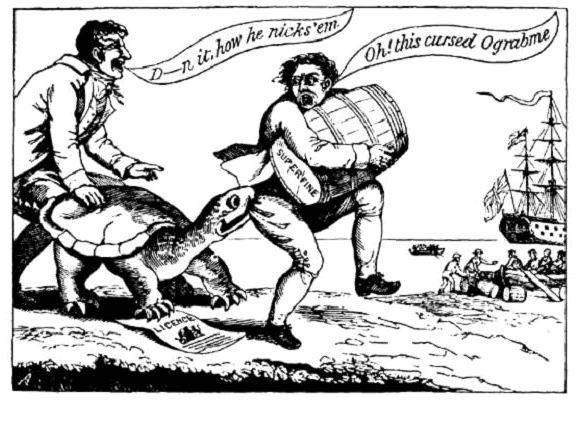
Jefferson’s agrarianism rested upon a political claim disguised as a description of occupational character: those who cultivated their own land possessed the material independence necessary for republican citizenship. In Query XIX of Notes on the State of Virginia, he called cultivators of the earth the “chosen people of God” and contrasted their supposedly enduring virtue with the dependence he associated with urban manufacturing. The force of the passage did not arise from an uncomplicated belief that farmers were naturally kinder or more intelligent than other people. Jefferson imagined agriculture as a relationship among labor, property, household government, and political judgment. A cultivator who controlled the soil from which his family drew its subsistence appeared less vulnerable to an employer, creditor, patron, or government official who might use economic dependence to command political obedience. Working the land also seemed to reward patience, foresight, regular effort, and attention to natural processes, qualities that Jefferson readily translated into civic virtues. The farm became, in this idealized formulation, both an economic unit and a school of self-government. Citizens accustomed to directing their own labor and managing their own households would supposedly resist arbitrary authority because they possessed something tangible that authority could threaten but did not ordinarily control. Jefferson’s agrarian republic was not merely a nation that produced crops. It was a nation in which ownership and cultivation would preserve the independence upon which meaningful consent depended.
The cultivator’s value also arose from Jefferson’s broader fear of dependence. Eighteenth-century republican thought rarely defined liberty as the simple absence of immediate restraint. A person might enjoy considerable freedom of movement and still lack political independence if another individual possessed the power to withdraw employment, credit, protection, or subsistence. Jefferson believed that widespread access to land could prevent the emergence of a permanently dependent laboring population resembling the urban poor he observed in Europe. The abundance of North American territory appeared to give the United States a historical opportunity unavailable to crowded European states: workers who might otherwise become wage laborers could establish households upon land of their own. Agricultural independence would consequently diffuse property, reduce social hierarchy, and deny political elites the mass of clients and dependents upon whom corrupt systems of patronage flourished. This ideal did not require every household to become economically isolated. Jefferson expected farmers to exchange surpluses, purchase manufactured goods, participate in markets, and benefit from international commerce. His objection centered less upon exchange itself than upon social arrangements in which citizens lost practical control over the conditions of their lives. The independent cultivator remained republican not because he withdrew from society but because he entered economic and political relationships from a position Jefferson imagined as sufficiently secure to permit free judgment.
The social world of Jefferson’s Virginia bore only a partial resemblance to this republic of autonomous cultivators. The Chesapeake economy was deeply connected to Atlantic markets, especially through tobacco, and even substantial landowners could become dependent upon merchants, fluctuating prices, imported goods, and accumulated debt. Small farmers differed widely in wealth, access to transportation, soil quality, labor supply, and market participation, while tenants, hired workers, landless whites, free Black people, women, and enslaved laborers fell outside the independent household citizenship celebrated by agrarian rhetoric. Jefferson himself was not a self-sufficient yeoman who produced chiefly for his family’s needs. He was a planter, land speculator, debtor, experimental agriculturalist, and member of Virginia’s governing elite. Monticello depended upon the coerced labor of enslaved people who cultivated crops, raised livestock, performed skilled trades, produced household goods, and maintained the estate that allowed Jefferson to write about agricultural independence. The contradiction was not incidental. The apparent autonomy of the planter household was created by denying autonomy to the people held within it. Enslaved laborers possessed agricultural knowledge, family relationships, productive skills, and their own understandings of the land, yet Jefferson’s political vocabulary treated the proprietor rather than the actual cultivator as the bearer of civic virtue. His agrarian ideal attached moral value not to agricultural labor alone but to the combination of labor, mastery, property, race, sex, and recognized household authority. A white male landowner could be imagined as independent even when his livelihood relied upon enslaved workers, distant markets, merchant credit, and the legal protection of the state. The category of “cultivator” concealed these relationships by presenting the farm as a unified moral household under the direction of its proprietor. Jefferson’s language universalized the virtues of cultivation while restricting citizenship to those whom the social and legal order permitted to command land, labor, and dependents.
Jefferson nevertheless supported institutional changes intended to weaken the inherited landed hierarchy of colonial Virginia. The abolition of entail and primogeniture reduced the ability of elite families to preserve great estates intact across generations, while his proposals for public education sought to identify talent beyond the narrow circle of established wealth. These measures reflected his belief that republican society required circulation rather than permanent caste: property should be more widely distributed, political ability should be cultivated, and one generation should not be permitted to bind its successors indefinitely. Yet Jefferson did not advocate economic equality in a modern redistributive sense. He accepted substantial differences of wealth so long as they did not harden into hereditary privilege or create forms of dependence destructive of citizenship. His desired republic was socially unequal but politically mobile, governed by what he hoped would be a “natural aristocracy” of virtue and talent rather than an artificial aristocracy of birth.
Western land gave this vision its geographic foundation. As population increased in the older states, Jefferson feared that scarcity would reproduce the crowding, poverty, hierarchy, and dependence he associated with Europe. Expansion offered an apparent escape. New territories could absorb future generations, sustain family farms, and extend republican society without forcing large numbers of Americans into urban wage labor. The West became more than a reservoir of natural resources or a field for commercial development; it was a political safety valve meant to preserve the social conditions of independence. This reasoning linked Jefferson’s agrarianism directly to territorial policy. Surveying, acquiring, organizing, and settling western lands promised to reproduce the cultivator-citizen across space. Yet the land upon which this republican future depended was neither vacant nor simply awaiting productive use. Indigenous nations possessed, governed, cultivated, hunted, traded across, and attached sacred and historical meaning to these territories. Transforming Native homelands into farms for American settlers required treaties made under unequal pressure, commercial dependency, land cessions, and eventually removal and warfare. The agrarian republic’s promise of widely distributed independence for white households depended upon the contraction of Indigenous independence. Expansion did not merely enlarge Jefferson’s political ideal; it exposed the coercive process required to sustain it.
Nor did Jefferson retain an entirely static opposition between agriculture and manufacturing. His celebrated statements of the 1780s reflected a period in which he expected American agricultural exports to be exchanged for European manufactured goods under peaceful commercial conditions. International conflict, maritime restriction, embargo, and war later demonstrated the vulnerability of that arrangement. By 1809, Jefferson described an equilibrium among agriculture, manufacturing, and commerce as essential to national independence, and in 1816 he explained that altered international circumstances had changed the economic assumptions under which he had written Notes on the State of Virginia. Domestic manufacturing could protect the republic when foreign powers withheld essential goods or used trade as an instrument of coercion. Agriculture nonetheless retained a privileged place within his political imagination because it joined productive labor to landownership, household authority, demographic growth, and territorial settlement. Jefferson’s agrarianism is best understood not as a literal plan to exclude cities, workshops, merchants, or technological development, but as a theory about the social location of republican independence. Its cultivator was an ideal citizen constructed from the perceived moral qualities of landed labor. That construction could inspire opposition to hereditary privilege and economic domination, but it could also disguise slavery, patriarchy, class inequality, and Indigenous dispossession beneath the pastoral image of the virtuous farm. The Jeffersonian cultivator stood at the center of a republic that promised independence by distributing land while continually requiring new land, and new forms of domination, to preserve that promise.
Argos: Heroic Landscape and Republican Analogy
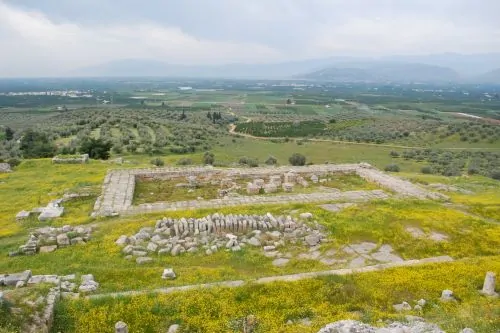
Ancient Argos occupied the western edge of the Argive plain in the northeastern Peloponnese, beneath the heights later known as Larisa and Aspis. The surrounding territory offered one of the broadest expanses of cultivable ground in southern Greece, bordered by mountains and connected to the sea through the Argolic Gulf. Grain, olives, vines, livestock, and horses tied the city’s economy to the rhythms of the plain, while routes through the region connected Argos with Mycenae, Tiryns, Epidaurus, Corinth, and the southern Peloponnese. Yet the landscape was not an effortless garden. Rivers could be seasonal, water management remained essential, and productive land was distributed unevenly among communities and households. The great sanctuary of Hera, situated beyond the urban center, helped give religious and political meaning to this wider territory by linking settlements across the plain to a shared sacred landscape. Argos emerged from a relationship among city, countryside, sanctuary, and neighboring communities rather than from the city walls alone. Its fertility mattered because the plain could sustain population, warfare, worship, and political ambition, not because agricultural abundance automatically produced a peaceful or egalitarian society.
The mythological Argolid was even larger than its political geography. Greek tradition traced the region’s beginnings to the river god Inachus and to Phoroneus, sometimes remembered as a primordial ruler who gathered scattered human beings into an ordered community. Io, an Argive woman pursued by Zeus and tormented by Hera, carried the genealogy of Argos outward through her wanderings; her descendants eventually returned through Danaus and his fifty daughters. The Danaids’ flight, forced marriages, and killing of their husbands made Argos the setting for a story about asylum, kinship, political succession, gendered violence, and the admission of foreigners into a civic community. From the same intertwined genealogies came Acrisius, Danaë, and Perseus, whose victory over Medusa and rescue of Andromeda became among the most widely transmitted heroic stories of antiquity. Heracles was attached to the Argive world through descent from Perseus, while traditions surrounding Adrastus and the Seven against Thebes turned Argos into the organizing center of another disastrous heroic expedition. Agamemnon, Menelaus, and the house of Atreus were also repeatedly associated with the broader Argolid, although epic poetry could use “Argos” flexibly to indicate the city, the region, or even a much larger portion of the Greek homeland. The result was not one coherent founding legend but a dense accumulation of competing memories. Argos could represent ancestry, kingship, refuge, conquest, homecoming, divine favor, inherited guilt, and the catastrophic consequences of dynastic ambition. Its agricultural landscape was inseparable from a heroic landscape in which nearly every field, spring, road, tomb, and sanctuary could be attached to a story about the remote origins of Greek civilization.
Historical Argos was no less complex. Later traditions remembered an age of kings and associated the ruler Pheidon with military power, territorial expansion, weights and measures, and intervention at Olympia, although the chronology and extent of his achievements remain disputed. Archaeological and literary evidence suggests that Argos gradually consolidated influence over parts of the plain rather than beginning as the undisputed master of the entire Argolid. Its ambitions brought it into conflict with neighboring communities and, most famously, with Sparta. The disastrous Argive defeat at Sepeia around 494 BCE weakened the citizen body and disrupted the regional balance of power, but the political consequences were neither simple nor fully recoverable from the conflicting ancient accounts. During the fifth century, Argos developed institutions generally described as democratic, pursued alliances against Sparta, and attempted to reassert control over communities of the plain. Its political history moved through kingship, elite competition, popular participation, interstate rivalry, defeat, recovery, and renewed expansion. It was never merely a settled association of self-sufficient farmers attending peacefully to their fields.
Agriculture nevertheless formed part of the material basis upon which Argive citizenship, warfare, and collective identity rested. Land supported households, supplied armies, financed ritual, and gave political communities claims over territory whose boundaries were repeatedly contested. Cultivation could encourage attachment to place, but attachment to place also produced conflict over pastures, water, roads, sanctuaries, and fertile ground. The citizen-farmer familiar from idealized accounts of the Greek polis was simultaneously a producer, landholder, soldier, worshiper, and participant in institutions that excluded much of the population. Women contributed to household production and occupied important places in Argive religious and mythological traditions, yet they did not enjoy political citizenship on equal terms with men. Enslaved people and other dependent laborers performed work essential to agricultural and domestic life without receiving the civic independence that later republican admirers associated with cultivation. Land itself was not equally distributed, and possession of sufficient property could reinforce hierarchy as readily as autonomy. Even the sanctuary of Hera should not be imagined simply as the spiritual center of a unified Argive state from the beginning; scholarship has shown that its relationship to Argos, Mycenae, and other communities of the plain changed over time. The landscape acquired political coherence through competition, ritual appropriation, military pressure, and the continual reinterpretation of local traditions. Argos demonstrates that agriculture could sustain republican participation without ensuring republican equality.
It is precisely this combination of fertile land, household production, civic identity, and historic independence that makes Argos tempting as a comparison with Jefferson’s agrarian republic. Jefferson knew authors such as Diodorus Siculus and Pausanias who preserved Argive myths and monuments, and he inhabited an educated culture in which places like Argos belonged to the shared geography of antiquity. The surviving documentary record does not establish that he selected the Argive constitution or agricultural plain as a particular model for the United States. His praise of cultivators can be traced much more directly to classical republican concerns about dependence, English country ideology, Enlightenment political economy, colonial experience, and his interpretation of North American land. Argos is better understood as a revealing analogy than as an undocumented source.
Used carefully, that analogy clarifies rather than distorts Jeffersonian agrarianism. Argos shows how a cultivated landscape could become the foundation of a political identity and how stories attached to the land could convert agricultural subsistence into a larger account of ancestry, duty, courage, and collective destiny. It also demonstrates why no straightforward line can be drawn from fertile soil to republican virtue. The same plain that supported households sustained armies; the same attachment to place that encouraged civic participation generated territorial rivalry; and the same heroic traditions that gave a community dignity preserved memories of murder, exile, conquest, and dynastic catastrophe. Jefferson similarly imagined the agricultural republic as a realm of stable households and independent citizens, yet its preservation required territorial enlargement, state power, racial exclusion, and the appropriation of land already inhabited by others. Argos consequently matters not because Jefferson attempted to reproduce it but because its history exposes the ambiguities hidden inside the pastoral image of the virtuous cultivator. It represents rooted citizenship without confirming that rootedness was peaceful, equal, or morally self-sufficient. Nor should the resemblance between the names Argos and Argo be mistaken for evidence that the city and the Argonautic ship formed a single ancient political symbol; the ship was traditionally associated with its builder Argus and belonged to a distinct narrative cycle. Yet the two images can still be joined interpretively. Argos offers the settled plain upon which civic identity is planted, while the Argo supplies the movement outward through which wealth, knowledge, and power are pursued. Before making that transition, it is necessary to recognize what the Argive case already reveals: political communities do not merely inhabit landscapes; they transform those landscapes into histories about who belongs, who rules, and what sacrifices collective greatness is believed to require.
Myth and the Manufacture of Civic Character
For Jefferson and his contemporaries, antiquity was politically useful because it converted abstract virtues into memorable human actions. Ancient readers distinguished epic, legend, biography, and history, but these genres often worked together in civic education. Achilles, Odysseus, Aeneas, Solon, Cato, and Brutus were not the same kinds of figures, yet each could embody courage, prudence, endurance, patriotism, ambition, or destructive pride. The value of such figures did not depend upon accepting every story as literal fact. Their importance lay in the judgments attached to them and in their ability to show how private character could produce public consequences.
Republican government appeared dependent upon this kind of moral instruction because constitutional arrangements alone could not preserve liberty. Laws might define offices and limit authority, but they could not ensure that citizens would recognize corruption, resist intimidation, or place the common welfare above immediate advantage. Ancient history functioned as a school of political perception. Athens demonstrated the creative power of citizen participation, but also the dangers of demagoguery, imperial overreach, and factional volatility. Sparta offered images of discipline and sacrifice while revealing the violence required to sustain a militarized order. Rome provided the most extensive sequence of republican virtue, territorial expansion, social conflict, civil war, and autocratic consolidation. Jefferson and other founders read these histories not because they expected events to repeat mechanically, but because they believed recurring passions (ambition, fear, resentment, greed, and the desire for glory) could threaten any political system. Historical study trained the citizen to identify those tendencies before they became irreversible.
Myth performed a related but distinct function. It gathered complicated experiences into narratives of origins, trials, migrations, heroic voyages, and collective destiny. A political community could understand itself through the memory of a founder, a war of liberation, a covenant, or a journey from oppression into independence. Greek cities attached themselves to heroic ancestors and sacred landscapes; Rome traced its beginnings through Aeneas, exile, conflict, and settlement. Such stories did more than explain where a people supposedly came from. They taught members what kinds of courage, sacrifice, loyalty, and obedience the community expected from them. Early Americans engaged in a comparable process as they tried to explain how thirteen colonies had become a nation. The Revolution could be remembered as more than a dispute over taxation and imperial administration. It became a struggle between liberty and tyranny, while its leaders could be cast as founders, lawgivers, patriots, and guardians of republican virtue. Classical comparison helped elevate recent events into a historical drama whose significance seemed equal to that of Greece and Rome. Yet the process was selective from the beginning. National memory emphasized episodes that encouraged unity and sacrifice while suppressing contradictions that complicated the heroic story.
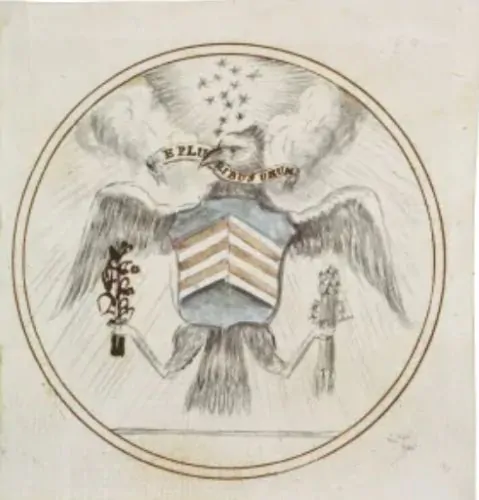
Jefferson’s rationalism did not remove him from this symbolic world. His proposed design for the Great Seal of the United States in 1776 drew upon the biblical Exodus, depicting the Israelites crossing the Red Sea as Pharaoh’s forces were overwhelmed. For the reverse, he proposed Hengist and Horsa, the legendary leaders associated with the Anglo-Saxon settlement of Britain. The combination joined sacred narrative, legendary ancestry, migration, and political liberation in a single national emblem. Neither image offered a literal plan of government. Both compressed broad claims about American identity into scenes that citizens could recognize and remember: the new nation had escaped oppression and inherited an ancient tradition of resistance to arbitrary rule.
Civic character was manufactured not only through reading but through architecture, ceremony, commemoration, biography, and public imitation. Revolutionary anniversaries, funeral orations, monuments, seals, coins, political prints, and schoolbooks taught Americans how to remember the founding generation. George Washington’s resignation of military command encouraged comparison with Cincinnatus, the Roman citizen-soldier who relinquished extraordinary power and returned to private life. The analogy mattered because it defined republican greatness as self-restraint rather than conquest. A victorious general became most admirable when he refused to become a ruler. Jefferson’s own public image underwent a similar transformation. He could be represented as the philosopher-statesman, the author of independence, the apostle of religious liberty, the patriarch of Monticello, and the retired sage corresponding with John Adams. These identities contained elements of truth, but they also simplified a divided and contradictory life. That simplification was part of their civic function. Republics needed recognizable models through which later generations could imagine virtue, and biography often became mythic when complex individuals were converted into symbols of national principle. The process could preserve genuine achievements while detaching them from the material conditions that made those achievements possible.
Jefferson also understood, at least in principle, that inherited stories could mislead. Classical examples carried moral authority, but admiration could conceal coercion. Sparta’s discipline rested upon the subjection of the helots. Roman devotion to the commonwealth could be invoked to glorify militarism and conquest. Heroic traditions centered exceptional men while subordinating women, enslaved people, laborers, and conquered populations to the margins of the narrative. American civic mythology developed the same exclusions. The figure of the independent farmer could obscure slavery, tenancy, debt, and unequal access to land. The heroic explorer could transform Indigenous homelands into supposedly empty wilderness and recast diplomacy, trade, and coercion as discovery. Myth did not need to fabricate every event in order to distort the past. It could arrange real events so that some experiences appeared central and others became invisible. Jefferson’s skepticism toward monarchy, priestcraft, and inherited dogma did not prevent him from participating in narratives that converted racial domination and territorial expansion into background conditions of republican progress.
The manufacture of civic character was neither pure deception nor innocent commemoration. It was the process by which selected memories became political expectations. Jefferson drew upon antiquity because it offered an established vocabulary of founders, legislators, citizens, tyrants, patriots, exiles, and voyagers. He transformed that vocabulary by joining it to natural rights, Enlightenment improvement, biblical imagery, colonial experience, and American territorial ambition. Classical mythology supplied narrative forms rather than hidden instructions: the dangerous voyage, the virtuous homeland, the heroic trial, the liberation from tyranny, and the founding of a new political order. These forms helped Americans imagine what their republic demanded from them. They also made domination easier to overlook when conquest, displacement, and coerced labor appeared merely as stages in a heroic national journey.
Empire of Liberty: Expansion and the Geographic Republic
Jefferson’s agrarian republic required geography on an enormous scale. If political independence rested upon the availability of land for successive generations of cultivators, then republican stability could not be separated from territorial growth. A confined nation would eventually reproduce the conditions Jefferson associated with Europe: concentrated property, crowded cities, dependent labor, inherited poverty, and political patronage. Expansion appeared to offer an escape from that historical cycle. New territory would permit population to spread outward, allow families to establish farms, and postpone the emergence of a permanent landless class. Jefferson’s republic was geographic as well as constitutional. Its political future depended not only upon elections, laws, and civic education but upon the continuing conversion of territory into privately occupied agricultural households.
This connection between liberty and expansion appeared early in Jefferson’s public thought. During the Revolution and Confederation periods, he imagined western settlement as essential to the security and development of the United States. The trans-Appalachian country was not merely a distant borderland; it was the prospective home of future states whose inhabitants would participate in the same republican union as the original thirteen. Jefferson’s draft plan for governing the western territories in 1784 anticipated the creation of new states admitted on terms of formal equality rather than held permanently as subordinate colonies. This principle distinguished his projected continental republic from European empires that governed distant populations as dependencies. Expansion, in Jefferson’s preferred account, would not produce provinces ruled for the benefit of a metropolitan center. It would reproduce republican citizens and states across space. The language was powerful because it turned territorial enlargement into an extension of political equality. Yet equality operated primarily among the white settler communities recognized as future members of the Union. Indigenous nations already inhabiting those territories did not enter the scheme as coequal republics whose territorial sovereignty carried the same weight. Their lands appeared within American political planning as spaces that could eventually be acquired, surveyed, settled, and incorporated.
Jefferson’s phrase “empire of liberty” captured the resulting tension. Empire ordinarily suggested hierarchy, conquest, and rule over subject peoples, while liberty implied consent and self-government. Jefferson joined them by imagining a continental union that expanded not through permanent colonial subordination but through the multiplication of republican states. The contradiction did not disappear. A nation could remain internally republican for its recognized citizens while behaving imperially toward those excluded from citizenship and exposed to its territorial power.
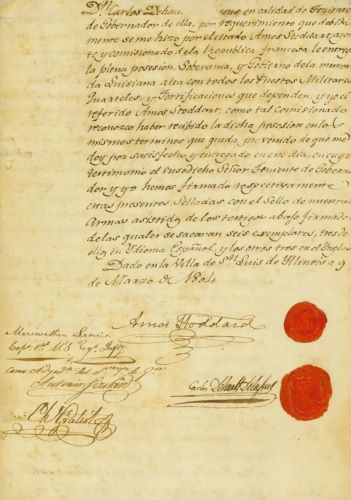
The Louisiana Purchase of 1803 gave this geographic vision its greatest practical opportunity. Spanish control of Louisiana had long troubled American leaders because the Mississippi River and the port of New Orleans were vital to western farmers seeking access to Atlantic markets. When France reacquired Louisiana, Jefferson feared that a powerful European state positioned at the river’s mouth could threaten American commerce, encourage western separatism, and draw the United States into military conflict. His administration initially sought to purchase New Orleans and adjoining territory, but Napoleon’s decision to offer the whole province transformed a limited diplomatic mission into the acquisition of an immense domain. The purchase nearly doubled the claimed area of the United States, strengthened American control over the Mississippi watershed, weakened European influence in the continental interior, and opened a vast field for exploration, trade, diplomacy, settlement, and speculation. Jefferson understood the acquisition as a generational safeguard. The new territory promised enough land to sustain an expanding agricultural population for decades, perhaps centuries, while reducing the immediate pressure that population growth might place upon older states. Louisiana appeared to protect the republic by enlarging the physical space within which its preferred social order could reproduce itself.
The purchase also exposed the constitutional fragility of Jefferson’s political principles. He had long argued for a limited federal government confined to powers delegated by the Constitution, yet the Constitution contained no explicit provision authorizing the acquisition and incorporation of foreign territory. Jefferson initially considered proposing a constitutional amendment that would validate the purchase and regulate the territory’s future admission. The urgency of the transaction, the possibility that Napoleon might withdraw the offer, and the willingness of his advisers to rely upon the treaty-making power eventually led him to accept a broader interpretation than his usual constitutional language seemed to permit. Writing to John C. Breckinridge, Jefferson acknowledged that public officials sometimes confronted opportunities of such importance that they acted for the public good without an entirely secure constitutional warrant and then depended upon the people to ratify what had been done. This reasoning presented the purchase as a necessary irregularity rather than an abandonment of constitutional principle, but it also enlarged the practical authority of the presidency. Jefferson preserved the imagined future of limited government through an exercise of executive power that demonstrated how readily continental opportunity could loosen constitutional restraint.
The territorial achievement was equally inseparable from slavery. Jefferson imagined Louisiana as the future domain of agricultural households, but he never resolved whether the westward spread of those households would expand free labor, plantation slavery, or both. The purchase intensified disputes over the political balance between free and slave states, the movement of enslaved people across the continent, and the federal government’s authority over slavery in the territories. Land could function as the material basis of white republican independence while enslaved laborers remained property within the households celebrated as independent.
Indigenous sovereignty posed an even more immediate obstacle to the geographic republic. The Louisiana Purchase transferred France’s imperial claim to the United States, but it did not erase the presence or political authority of the many Native nations occupying the territory. Jefferson’s administration nevertheless treated the acquisition as establishing a superior American claim that could gradually be converted into effective possession. His Indian policy combined professions of friendship and cultural respect with a deliberate program of territorial pressure. He encouraged Native communities to adopt commercial agriculture, animal husbandry, private property, and household production as Americans defined them. He also promoted trade on credit, anticipating that indebted nations might be induced to cede land in payment. Native peoples who adopted Jefferson’s preferred economic practices were expected to require less hunting territory, making additional lands available for American settlement. Those who resisted incorporation or aligned with foreign powers could be threatened with removal beyond the expanding frontier. The supposed generosity of agricultural “civilization” became an instrument of dispossession. Jefferson’s empire of liberty depended upon a sequence that appeared peaceful when described administratively but remained coercive in operation: exploration produced knowledge, diplomacy opened commercial relationships, debt and treaty secured cessions, surveys converted land into property, and settlers transformed Indigenous homelands into American farms. The geographic republic offered equality to newly created settler states while denying that its own expansion rested upon unequal power. Its central paradox was not that liberty and empire accidentally collided. Jeffersonian liberty was made continental through imperial practices, and the abundance that protected one population from dependence was created by imposing displacement, enslavement, and political subordination upon others.
The Argo Reimagined
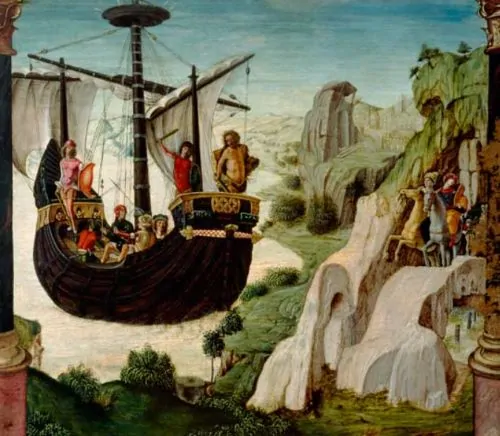
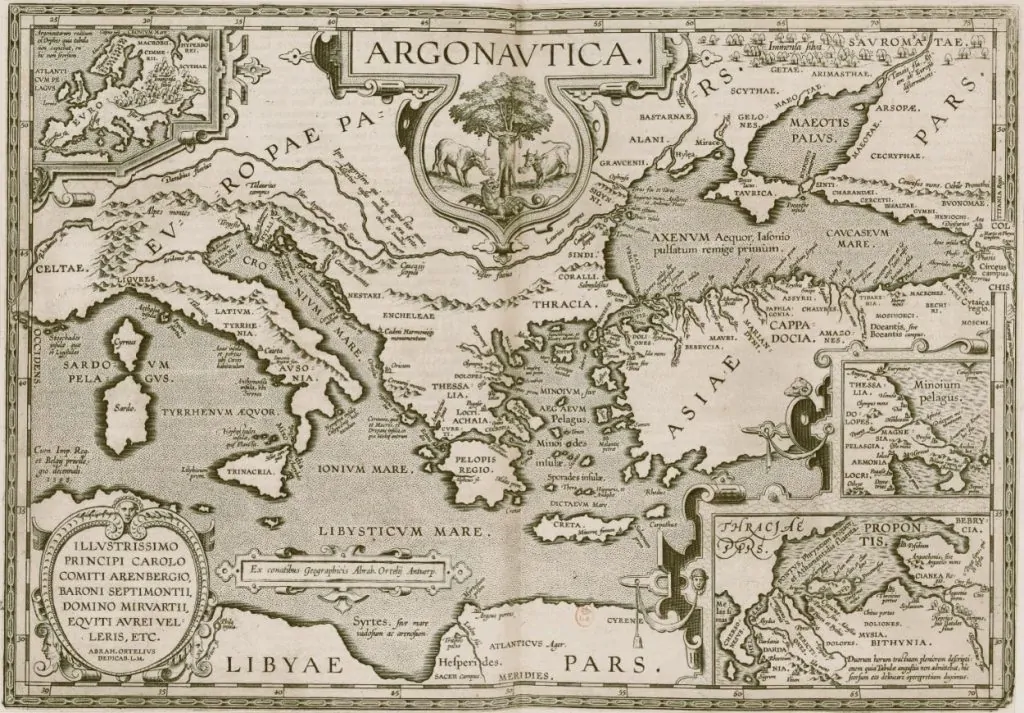
The voyage of the Argo offered the ancient Mediterranean one of its most adaptable stories of organized exploration. Jason, deprived of his expected inheritance, was sent to Colchis to recover the Golden Fleece, an object whose possession promised legitimacy, prestige, and political restoration. To accomplish the task, he did not travel alone. He gathered a company of exceptional figures whose collective abilities transformed the expedition into something larger than an individual adventure. The Argonautic story joined travel, danger, diplomacy, violence, technological ingenuity, divine assistance, and the acquisition of distant treasure within a single narrative of departure and return. Its enduring power arose partly from this combination. The voyage could be remembered as a heroic quest, a foundation story, an encounter with foreign peoples, or a warning about the destructive ambitions concealed within the pursuit of glory.
The ship itself gave the expedition a distinctive political and symbolic form. Ancient traditions associated its construction with Argus, while Athena was said to have assisted in its making or contributed a prophetic timber to the vessel. The Argo was not merely transportation but the material embodiment of coordinated purpose. It gathered heroes who possessed different strengths, subordinated them to a common mission, and carried them across boundaries separating the familiar Greek world from regions imagined as remote and dangerous. The crew included warriors, seers, musicians, navigators, and figures connected to the ruling houses of numerous Greek communities. Later writers could consequently treat the expedition as an early collective enterprise of the Greeks, undertaken before the Trojan War had supplied an even larger story of common action. Yet the company was never perfectly unified. Rivalries, doubts, disputes over leadership, and disagreements about how to proceed accompanied the voyage. Jason himself was not invariably the strongest or most commanding member of the crew. His success depended upon cooperation, persuasion, favorable circumstances, and the assistance of Medea. The myth located heroic achievement within a network of specialized knowledge and unequal relationships rather than presenting it as the simple triumph of one self-sufficient conqueror.
The Golden Fleece intensified this political meaning because it was valuable not solely as wealth. It represented the object whose acquisition could alter authority at home. Possessing it promised Jason the recovery of status, but reaching it required entry into another ruler’s domain and submission to tasks designed to make success impossible. The fleece joined knowledge, mobility, legitimacy, and possession. Its significance lay partly in the transformation produced by the voyage: something distant, guarded, and embedded within a foreign political order was removed and carried back to serve a new claim to power. That pattern makes the myth particularly suggestive for later cultures of exploration. Distant lands became meaningful not merely because travelers reached them, but because travelers returned with objects, maps, reports, specimens, routes, and stories that changed how their own societies understood the world.
The analogy with Jeffersonian exploration must nevertheless remain controlled. Lewis and Clark were not dispatched to seize a magical object, and Jefferson did not describe their mission as a conscious reenactment of Jason’s quest. The Corps of Discovery belonged to the worlds of Enlightenment science, imperial rivalry, military reconnaissance, diplomacy, and commercial geography. Any comparison with the Argonauts is interpretive rather than documentary. That distinction does not make the comparison empty. Classical voyage narratives remained part of the educational and literary environment in which Jefferson and other members of the founding generation were formed. Apollonius of Rhodes, Pindar, Apollodorus, Diodorus Siculus, and later compilers preserved differing versions of the Argonautic expedition, while the broader classical tradition repeatedly connected travel with the testing of character and the enlargement of political knowledge. Jefferson’s own reading habits encouraged him to treat ancient literature as a repository of human patterns rather than as a collection of literal instructions. The voyage beyond familiar boundaries was one such pattern. It dramatized the movement from uncertainty to knowledge, from dependence upon rumor to the authority of direct observation, and from limited local horizons to a wider understanding of geography and power. In a modern republic committed to science, commerce, and territorial development, the treasure sought by an expedition no longer needed to be a miraculous fleece. Accurate information could become the more consequential prize. A navigable river, an overland passage, a reliable map, a new plant, a record of mineral deposits, or knowledge of Indigenous trade networks could carry strategic value far beyond its immediate appearance.
The Corps of Discovery be understood as an American reworking of the heroic voyage only when its institutional character remains visible. Jefferson chose Meriwether Lewis partly because he possessed a combination of frontier experience, military discipline, practical judgment, and familiarity with natural inquiry. William Clark contributed complementary abilities in command, surveying, mapping, and the management of men. The expedition included soldiers, boatmen, interpreters, hunters, craftsmen, and others whose skills were essential to movement and survival. Its success also depended upon knowledge supplied by Indigenous peoples, French and Indigenous traders, Sacagawea, Toussaint Charbonneau, and numerous local guides and diplomatic intermediaries. Like the Argonautic company, it was a collective enterprise whose later commemoration often concentrated glory upon a few named leaders. Yet its records reveal dependence at nearly every stage. Rivers had to be interpreted, routes identified, food obtained, horses acquired, languages mediated, and political intentions explained. The expedition crossed not an empty mythic wilderness but a continent of established nations, contested territories, commercial networks, and existing geographic knowledge. What American officials later celebrated as discovery frequently involved the collection, translation, and appropriation of information already possessed by the people who lived there.
The Argo analogy is most revealing when the Golden Fleece becomes a metaphor for knowledge capable of being converted into national power. The expedition’s journals, maps, specimens, diplomatic observations, and descriptions of resources returned to the United States as instruments through which distant territory could be imagined, governed, traded across, and eventually settled. Heroic narrative transformed this acquisition of information into a story of courage and national destiny. Yet the mythic frame also risks concealing the unequal consequences of the voyage. The returning Argonauts brought home a prize detached from the political world that had guarded it; the Corps of Discovery brought back knowledge that would assist a growing republic in extending authority over lands occupied by others. Reimagining the Argo in Jefferson’s America reveals both the romance and the machinery of exploration: a carefully assembled company moved beyond the nation’s familiar horizon, but the true object of the quest was the knowledge required to make continental ambition practicable.
Jefferson’s Instructions to Lewis: Exploration as an Enlightenment Project
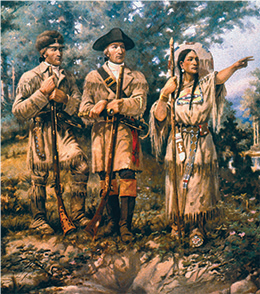
Jefferson’s instructions to Meriwether Lewis, dated June 20, 1803, transformed a hazardous journey into a disciplined program of national inquiry. The expedition was to search for the most direct and practical water communication across the continent, especially a route connecting the Missouri River system with rivers flowing toward the Pacific. Yet Jefferson did not limit the mission to transportation. Lewis was ordered to determine latitude and longitude, describe the courses and dimensions of rivers, record portages, identify tributaries, and note the character of the surrounding terrain. These requirements reflected an Enlightenment confidence that careful observation could convert unfamiliar space into organized knowledge. The West would cease to be a region known chiefly through rumor, Indigenous reports, traders’ recollections, and speculative maps. It would become a measured geography whose rivers, mountains, soils, and distances could be compared, classified, and incorporated into the administrative imagination of the United States.
The natural world occupied an equally prominent place in the instructions. Lewis was to observe soils, plants, animals, minerals, climate, seasonal patterns, and any features that might possess scientific or commercial significance. Jefferson expected him to distinguish familiar species from those believed to be unknown, preserve specimens when possible, and describe discoveries with sufficient precision to permit later evaluation. This assignment emerged from Jefferson’s longstanding engagement with natural history. In Notes on the State of Virginia, he had answered European claims that the American environment produced weaker animals and degenerate human beings by cataloguing the continent’s size, abundance, and biological variety. Western exploration offered an opportunity to extend that argument through new evidence. Before Lewis’s departure, Jefferson arranged for him to receive additional training in Philadelphia from leading scientific authorities. He studied botanical classification with Benjamin Smith Barton, medical and anatomical subjects with Benjamin Rush and Caspar Wistar, and astronomical observation with Robert Patterson and Andrew Ellicott. Scientific preparation was not an ornamental addition to a primarily military venture. It was essential to Jefferson’s conception of the expedition. The explorer was expected to see more than an ordinary traveler because he had been trained to recognize, measure, name, and preserve what he encountered. Observation became most useful when it could be standardized, recorded, and transmitted to other investigators. The mission was designed to replace wonder with description without entirely eliminating wonder. Reports of unfamiliar animals, extraordinary landscapes, mineral wealth, or surviving large quadrupeds might inspire speculation, but Lewis was expected to test such claims against direct evidence. The unknown remained exciting precisely because disciplined inquiry promised to make it intelligible.
Jefferson’s ethnographic and diplomatic instructions were even more extensive, though they were framed by assumptions characteristic of American expansion. Lewis was to gather information about Indigenous nations along the route, including their names, numbers, territories, languages, political relationships, trade networks, customary laws, subsistence practices, technologies, diseases, and attitudes toward neighboring peoples. He was also to communicate the peaceful intentions of the United States, announce the change of sovereignty represented by the Louisiana Purchase, encourage commercial relations, and identify influential leaders through whom future diplomacy might be conducted. In this respect, the expedition joined inquiry to governance. Information about Native societies was valuable not merely because it expanded human knowledge but because it could assist negotiation, trade, territorial administration, and the projection of American authority. Jefferson’s categories translated diverse and politically autonomous peoples into entries within a national inventory. Population estimates could suggest military strength; descriptions of trade could reveal economic dependencies; linguistic comparisons could support theories of migration and ancestry; and accounts of political alliances could guide American diplomacy. The effort to record Indigenous knowledge also contained a profound imbalance. Lewis and Clark depended upon Native guides, interpreters, geographic intelligence, food supplies, horses, trade routes, and diplomatic permission, yet their reports reorganized much of that knowledge for American purposes. Information that had developed within Indigenous communities over generations entered federal records as the result of American exploration. The expedition’s ethnography was inseparable from the power to select, classify, and circulate knowledge about peoples who had not consented to become objects of study or victims of American territorial ambition.
Commercial objectives tied these scientific and diplomatic inquiries together. Jefferson wanted to know whether the Missouri and Columbia river systems could support a practicable route between the continental interior and the Pacific. Such a route might redirect the fur trade, connect western communities to American markets, reduce British commercial influence, and strengthen the United States against competing imperial claims. The expedition was to record navigational obstacles, seasonal changes, portages, available timber, productive soils, and the locations of peoples with whom trade might be established. A river was simultaneously a natural feature, a line on a map, a transportation corridor, a commercial opportunity, and a strategic instrument. Jefferson’s Enlightenment project did not separate pure science neatly from economic usefulness. Knowledge demonstrated its public value when it improved navigation, agriculture, medicine, commerce, or national security.
The instructions also reveal how readily Enlightenment inquiry could become a technology of empire. Mapping a river did not by itself conquer the territory through which it flowed, and collecting a plant did not immediately transfer ownership of the soil in which it grew. Yet systematic description made distant regions more available to political action. Maps could guide soldiers, traders, surveyors, diplomats, and settlers. Reports of fertile land or commercial resources could attract investment and migration. Lists of Native nations could help officials decide where to establish trading posts, distribute gifts, seek treaties, or apply pressure. Jefferson presented the expedition as peaceful, and Lewis was repeatedly directed to avoid unnecessary conflict, respect local communities, and preserve the lives of his party. Nevertheless, the mission’s peaceful methods served an expanding state whose long-term goals included territorial consolidation and settlement. The journals and maps returned by the Corps of Discovery did not simply enlarge the stock of human knowledge; they helped convert an immense and politically complex region into a space that Americans could imagine as part of their national future. Jefferson’s instructions united the highest aspirations and deepest contradictions of Enlightenment exploration. They valued careful observation, empirical testing, scientific cooperation, and the preservation of knowledge, but they also placed those practices at the service of commerce, diplomacy, strategic competition, and continental power. The expedition was an Enlightenment project because it sought to make the unknown legible. It was an imperial project because the authority to describe the West was expected to assist the authority to possess it.
Lewis and Clark as American Argonauts
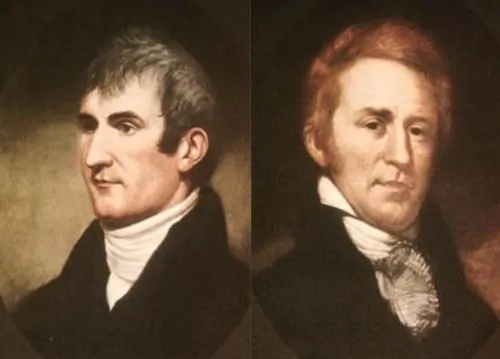
To describe Lewis and Clark as American Argonauts is to interpret the expedition through the structure of heroic voyage rather than to recover a name Jefferson demonstrably used. Like Jason’s company, the Corps of Discovery was deliberately assembled for a mission whose success depended upon varied abilities joined under common leadership. Jefferson selected Meriwether Lewis because he combined military experience, practical intelligence, frontier familiarity, physical endurance, and an aptitude for scientific observation. Lewis then invited William Clark, whose experience as an officer, surveyor, mapmaker, woodsman, and manager of men complemented his own. Their partnership gave the expedition a dual command, even though Lewis formally held the superior rank. The resulting enterprise was neither the solitary adventure of an exceptional hero nor the spontaneous movement of settlers into an unknown country. It was an organized national mission designed to carry American authority, inquiry, and ambition beyond the republic’s established geographic horizon.
The larger company makes the Argonautic analogy more revealing. Ancient versions of the voyage assembled heroes from different regions and endowed them with specialized strengths; the Corps of Discovery likewise depended upon a varied body of soldiers, hunters, boatmen, interpreters, craftsmen, navigators, and laborers. York, William Clark’s enslaved servant, performed the same arduous physical labor as other members, hunted, helped care for the sick, and participated in encounters in which his appearance attracted intense interest among people who had not previously met a man of African descent. George Drouillard’s command of sign language, hunting ability, and frontier experience made him indispensable, while Pierre Cruzatte, François Labiche, and other French-speaking or multilingual members helped bridge cultural and linguistic divisions. The expedition’s boats, firearms, medicines, scientific instruments, trade goods, repair tools, and written instructions represented accumulated forms of technical knowledge, but equipment alone could not ensure survival. The company had to adapt constantly to unfamiliar currents, weather, terrain, animals, food supplies, and political circumstances. Like the crew of the Argo, its members were joined by a common purpose without becoming a perfectly harmonious brotherhood. Discipline broke down at times, punishments were imposed, illness and exhaustion tested morale, and disagreement accompanied major decisions. Later memory elevated Lewis and Clark above the rest, but the journals show achievement distributed across a company whose success depended upon cooperation more than individual heroism. The parallel should not obscure a fundamental difference. The Argonauts traveled through a mythic geography organized around trials placed before them; Lewis and Clark moved through homelands already known, named, governed, traveled, and contested by Indigenous peoples. What seemed unknown from Washington or Philadelphia was not unknown to those who lived there.
Indigenous assistance was not peripheral to the expedition but essential to its progress. The Corps entered diplomatic worlds shaped by longstanding alliances, rivalries, migrations, trade routes, hunting territories, and memories of earlier encounters with French, British, Spanish, and Canadian traders. Mandan and Hidatsa communities made the winter of 1804–5 possible by providing trade, food, geographic information, and relative security. Shoshone horses allowed the expedition to cross the Rocky Mountains, while guides and advisers helped identify routes through difficult terrain. Nez Perce assistance proved crucial when the exhausted company emerged from the mountains and again when it prepared to return east. Sacagawea’s importance arose from several overlapping roles. As a Shoshone woman traveling with an infant, she helped signal that the company was not simply a war party; she interpreted in diplomatic exchanges conducted through chains of translation; she identified edible plants and geographic features; and her recognition of the Shoshone leader Cameahwait as her brother assisted the negotiations through which the expedition obtained horses. Her presence did not make her the sole guide of the expedition, as later legend often implied, but neither was she an incidental passenger. She formed part of a complex network of mediation without which American equipment, military discipline, and scientific training would have been insufficient. The heroic language of discovery tends to reverse this dependence. It portrays the expedition as bringing knowledge into an empty space, when in fact the travelers repeatedly acquired knowledge from people whose familiarity with the country exceeded their own. The “discovery” recorded in the journals was often an act of translation: Indigenous geographic, ecological, and diplomatic knowledge was converted into forms legible to American officials, mapmakers, scientists, merchants, and future settlers.
Lewis and Clark also differed from Jason’s company in the nature of what they were expected to bring home. There was no single Golden Fleece whose possession could dramatize the expedition’s success. The national prize consisted of accumulated observations: maps of river systems, estimates of distances, descriptions of mountain ranges, records of plants and animals, mineral specimens, vocabularies, population figures, diplomatic impressions, and assessments of possible trade routes. Knowledge became valuable because it could travel independently of the explorers who gathered it. Once copied, published, mapped, classified, or transmitted to government departments, it could guide people who had never seen the Missouri, crossed the Continental Divide, or visited the Pacific coast. The expedition converted experience into a portable national resource. Its journals and maps made the continent more imaginable to Americans living far from its western interior, while its reports supported Jefferson’s belief that the republic possessed both the capacity and the right to extend its commerce and political influence across that space.
The transformation of the Corps of Discovery into a national heroic story occurred gradually rather than immediately. Lewis’s delay in preparing the journals for publication, his death in 1809, and the appearance of Nicholas Biddle’s edited narrative in 1814 shaped the expedition’s early public reception. The difficult and contingent journey eventually became a foundational episode in the history of westward expansion. Lewis and Clark were cast as visionary pathfinders, Sacagawea became an emblem of peaceful Indigenous assistance, and the expedition’s dependence upon Native nations was often reduced to a reassuring story in which continental expansion appeared welcomed or inevitable. This retrospective mythology made the Argonautic comparison culturally powerful even where it remained historically indirect. Both stories convert collective, uncertain, and morally complicated enterprises into voyages led by memorable heroes toward a prize of civilizational significance. Yet the comparison also exposes what heroic memory suppresses. Jason’s success depended upon Medea, whose knowledge and actions made the fleece attainable before the story subordinated her to the hero’s return. Lewis and Clark depended upon Indigenous people, multilingual intermediaries, enlisted men, an enslaved laborer, and a young Native woman whose contributions were later rearranged to serve an American national narrative. Calling the expedition an American Argo is most useful when it enlarges rather than narrows the cast. The voyage becomes not the effortless advance of two great men across vacant wilderness but a precarious collective undertaking through inhabited political worlds. Its ultimate treasure was knowledge, but that knowledge was inseparable from the unequal power that determined who could collect it, who would receive credit for it, and how it would later be used to claim a continent.
Mastodons and the Boundaries of the Known World
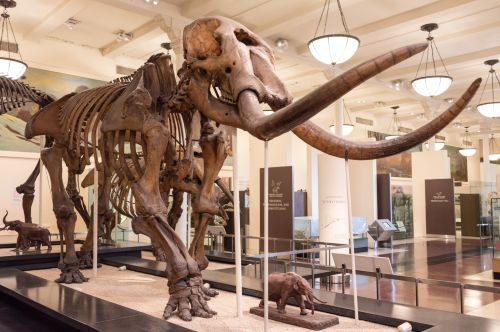
The popular claim that Jefferson sent Lewis and Clark westward primarily to find living mammoths turns a complicated scientific question into a picturesque legend. Jefferson did believe that enormous animals represented by fossil bones might still survive somewhere in the continent’s unexplored interior, and his instructions directed Lewis to investigate animals considered rare or extinct. The expedition was not a prehistoric monster hunt. Mammoths and mastodons formed one part of a much larger inquiry into American geography, natural history, commerce, and human societies. Nor were these animals “mythical” in the ordinary sense. Their bones were real and increasingly well documented. What remained uncertain was how those bones should be classified, whether they belonged to animals still living elsewhere, and whether nature permitted an entire species to disappear.
Jefferson’s fascination with large fossil animals developed within an international argument over the natural character of the Americas. The French naturalist Georges-Louis Leclerc, Comte de Buffon, had maintained that the animals of the New World were generally smaller and weaker than those of the Old, a supposed degeneracy he associated with climate, moisture, and environmental conditions. Jefferson challenged that theory at length in Notes on the State of Virginia, assembling comparative measurements and emphasizing the size of American bison, bears, elk, and other animals. The immense fossil creature then widely called the American incognitum or “mammoth” offered a forceful answer. Its tusks, jaws, and enormous molars suggested an animal capable of rivaling or exceeding the elephant. Jefferson and some contemporaries initially imagined it as a formidable carnivore, partly because the cusped structure of its teeth seemed unlike the flatter grinding surfaces associated with elephants. What modern science recognizes as the American mastodon consequently became not only a zoological puzzle but a patriotic symbol. Its magnitude appeared to refute the claim that American nature was feeble, while its possible survival implied that the unexplored continent still contained forms of life unknown to European science. Jefferson’s reasoning mixed empirical evidence with assumptions that later naturalists would abandon, but it was not a retreat into fantasy. He compared specimens, solicited measurements, examined testimony, corresponded with anatomists, and revised parts of his interpretation as better evidence became available.
His resistance to extinction reflected the unsettled boundaries of late eighteenth-century natural history. In 1796, while discussing the fossil animal he named Megalonyx, Jefferson wrote that he could not help believing both it and the mammoth still existed. The complete annihilation of a species seemed so unlike the visible economy of nature that survival in an unexamined region appeared more probable than disappearance from creation altogether.
Jefferson’s instructions to Lewis gave this uncertainty an empirical outlet. The expedition was to record the animals of the country, particularly unfamiliar species, and to seek remains or reports of creatures believed rare or extinct. That directive made surviving mammoths scientifically possible without making them a central objective of the mission. Jefferson expected the West to test eastern assumptions because its vast geography placed much of the continent beyond sustained Euro-American observation. Indigenous testimony, traders’ reports, fossil discoveries, and stories of unusually large animals could not simply be dismissed, but neither were they to be accepted without investigation. Lewis and Clark were supposed to compare accounts with physical evidence, describe unfamiliar species carefully, and preserve specimens when practicable. Their journals eventually documented grizzly bears, pronghorns, prairie dogs, bighorn sheep, jackrabbits, and numerous other animals that appeared novel to American science, but they found no living mammoths or mastodons. The absence of such creatures did not by itself settle the question of extinction, since the expedition examined only one broad route across a continent, yet its observations narrowed the imaginative space in which surviving populations might be placed. The voyage marked a transition from the speculative geography of monstrous possibility toward a more measured understanding of the continent’s fauna.
Jefferson’s interest in fossil giants continued after the Corps of Discovery returned. In 1807, he financed William Clark’s excavation at Big Bone Lick in Kentucky, where laborers recovered hundreds of bones from mastodons and other large prehistoric animals. Specimens were studied by Caspar Wistar, shared with the American Philosophical Society, displayed at Monticello, and sent to French scholars whose comparative anatomy was transforming the study of fossils. Jefferson gradually accepted Georges Cuvier’s conclusion that the American animal was distinct from the Siberian mammoth and living elephants, adopting the name mastodon and abandoning the idea that it had been carnivorous. His position on extinction also changed. By 1823, he could acknowledge that certain races of animals had disappeared, even as he incorporated extinction into a larger belief in a universe governed by continuing creation and regeneration. The intellectual journey is more revealing than the familiar image of a president hoping explorers would encounter prehistoric beasts. Mammoths and mastodons occupied the boundary between evidence and conjecture, between inherited assumptions about nature’s permanence and the emerging recognition of deep natural change. For Jefferson, the western continent was compelling because it might resolve such questions. The unknown was not an enchanted realm outside science; it was the place where science had not yet completed its work.
The President as Classical Statesman

Jefferson entered the presidency in 1801 determined to present political change as republican restoration rather than revolutionary rupture. The election of 1800 had been bitter, and the prolonged contest in the House of Representatives raised fears that partisan conflict might destabilize the constitutional order. In his First Inaugural Address, Jefferson responded by minimizing the legitimacy of permanent faction and declaring that political disagreement need not make Americans enemies. His assurance that “we are all republicans, we are all federalists” was more than conciliatory rhetoric. It cast the transfer of power as evidence that a free people could correct governmental direction without civil war, military intervention, or dynastic overthrow. Ancient republics had often been destroyed when factional competition became a struggle for physical control of the state. Jefferson instead portrayed electoral judgment as the modern republican alternative to proscription and violence. The administration would restore what he regarded as the principles of 1776: limited government, economical administration, freedom of opinion, civilian supremacy, and confidence in the political reason of ordinary citizens.
His presidential style reinforced this image of the restrained magistrate. Jefferson rejected some of the ceremonial practices associated with George Washington and John Adams because he feared that courtly forms could encourage monarchical habits. He abandoned the presidential levee, received visitors with calculated informality, and sent annual written messages to Congress rather than appearing personally to deliver speeches resembling the British monarch’s address from the throne. His administration reduced internal taxes, lowered portions of military expenditure, paid down part of the national debt, and sought to simplify federal administration. These policies reflected both Jeffersonian political economy and a classical suspicion that republics were corrupted by standing armies, public creditors, ceremonial hierarchy, and executive patronage. Yet Jefferson’s informality should not be mistaken for political passivity. He worked closely with cabinet officers, corresponded extensively with congressional allies, guided legislative priorities, and used party organization to sustain his administration. His presidency combined an outward performance of republican modesty with a highly developed practice of political management. Like the classical statesman who claimed to serve rather than rule, Jefferson cultivated the appearance that authority flowed naturally from public confidence even while he exercised considerable influence over the direction of government.
The Louisiana Purchase exposed the limits of that restrained model. By acquiring an immense territory without an explicit constitutional provision authorizing such an act, Jefferson behaved less like a cautious magistrate preserving inherited boundaries than like a founder enlarging the republic’s historical possibilities. He justified the decision through necessity, opportunity, and confidence that the people would approve what constitutional language had not clearly anticipated. Foreign affairs produced an equally revealing transformation. Jefferson had long feared standing armies and concentrated executive authority, but the presidency confronted him with conflicts that demanded sustained national action. In the Mediterranean, his administration used naval force against Tripoli after years of American payments to the Barbary states had failed to secure stable protection for commerce. The campaign was limited in scale, yet it demonstrated Jefferson’s willingness to employ military power abroad while maintaining a republican language of defensive necessity. A more serious crisis emerged from the wars between Britain and Napoleonic France. Both powers interfered with neutral American commerce, and British impressment of sailors became inflammatory after the Chesapeake–Leopard affair in 1807. Jefferson rejected immediate war, which he believed would expand debt, armies, taxation, and executive power. He instead supported the Embargo Act, prohibiting American exports in an effort to compel Britain and France to respect American neutrality through economic pressure. The policy attempted to turn commercial withdrawal into a republican weapon, preserving peace while avoiding the institutional dangers of war. But practically enforcing the embargo required an extensive federal apparatus, intrusive regulations, seizures, surveillance, and expanded discretionary authority. Smuggling spread, merchants resisted, coastal communities suffered, and the policy inflicted severe damage upon the American economy without forcing the European belligerents to retreat. The episode revealed a central contradiction in Jefferson’s statesmanship: his effort to defend republican simplicity produced one of the most coercive exercises of federal power undertaken during his presidency. The classical fear that emergencies could enlarge executive authority did not disappear merely because the president invoking necessity professed republican intentions.
Jefferson’s presidency cannot be reduced to a single classical role. At times he resembled the restrained civic magistrate who rejected pomp, reduced governmental burdens, deferred to popular judgment, and prepared to surrender office after a limited term. At others he appeared as an energetic founder whose vision of national destiny justified territorial acquisition, military action, administrative innovation, and exceptional measures. Both roles belonged to the classical political imagination. Antiquity celebrated law-bound citizens who refused royal honors, but it also honored founders, legislators, commanders, and preservers who acted decisively during moments of danger. Jefferson drew upon this tension rather than resolving it. His presidency showed that republican leadership required power even while republican ideology taught citizens to fear its accumulation. He left office voluntarily in 1809 and returned to private life, strengthening his image as a statesman who did not cling to authority. Yet the territorial, diplomatic, and constitutional precedents of his administration had permanently enlarged the nation and the practical reach of its executive. Jefferson’s classical statesmanship was consequently neither a disguise for simple ambition nor a consistent enactment of limited government. It was an unstable effort to reconcile republican restraint with the demands of governing an expanding continental power.
The Material Presence of Antiquity
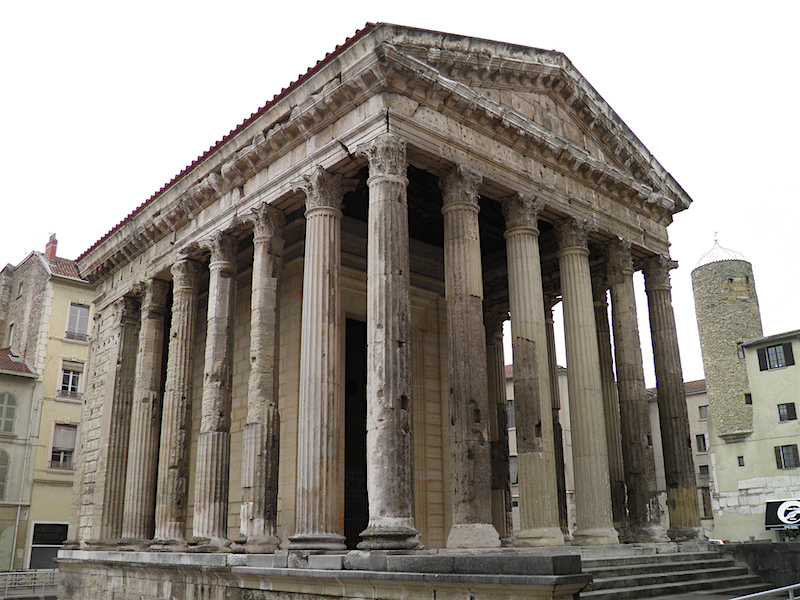
Jefferson’s engagement with the classical world was not confined to books, political metaphors, or private reflections. He attempted to make antiquity physically present within the American landscape. Architecture could train perception, establish standards of taste, and give public institutions a visible language of order, proportion, durability, and civic dignity. Because the new republic possessed few monumental buildings that were not inherited from colonial practice, Jefferson regarded construction as an opportunity to shape national character. A courthouse, capitol, house, or university could do more than serve an immediate function. It could teach citizens what kinds of authority deserved respect and what historical traditions the republic claimed as its own. Classical design was particularly useful because it separated public power from the Gothic churches, baroque palaces, and aristocratic residences associated in Jefferson’s mind with European monarchy and ecclesiastical domination. Ancient forms could be presented instead as the architecture of civic life, disciplined reason, and republican permanence, even though the buildings from which those forms were borrowed had originally served monarchies, empires, temples, and socially exclusive political orders.
The Virginia State Capitol provided Jefferson with his first great opportunity to convert that architectural theory into public practice. While serving as American minister in France, he recommended the Maison Carrée at Nîmes, a surviving Roman temple, as the principal model for the new building in Richmond. Assisted by the French architect Charles-Louis Clérisseau, Jefferson obtained drawings and commissioned a model through which the design could be communicated across the Atlantic. He praised the Maison Carrée for its simplicity, nobility, and survival as one of antiquity’s finest monuments. The decision was pedagogical as much as aesthetic. Jefferson hoped the Capitol would introduce Virginians to a superior architectural standard and provide young builders with a model capable of improving public taste. A Roman temple was adapted to house a representative legislature. The transformation carried an implicit claim: Virginia’s republican institutions deserved the dignity and permanence associated with the most admired remains of antiquity, but they would redirect that inherited grandeur from imperial worship toward government by elected representatives.
Monticello translated classical architecture into a more personal and experimental register. Jefferson repeatedly redesigned the house over several decades, drawing upon Palladian theory, ancient examples, French neoclassicism, and practical inventions suited to his own habits. Its porticoes, columns, pediments, symmetry, and dome placed a Virginia plantation within a transatlantic architectural tradition, while its internal arrangements reflected Jefferson’s fascination with efficiency, privacy, display, measurement, and technological control. Monticello was at once residence, plantation headquarters, laboratory, museum, library, workshop, and political stage. Visitors encountered Native objects, maps, fossils, portraits, books, scientific instruments, and architectural forms that presented the owner as a philosopher and citizen of the republic of letters. Yet the building’s apparent harmony depended upon the concealment of labor. Service passages, workspaces, dependencies, and plantation routines allowed enslaved workers to sustain the ordered domestic world displayed to guests. Classical beauty did not stand apart from coercion; it helped organize the visual distinction between the cultivated life of the master and the labor upon which that life depended.
Jefferson’s most complete union of architecture and political education emerged at the University of Virginia. Rather than concentrating students and instructors within a single monumental structure, he arranged the institution as an “Academical Village.” Professors occupied pavilions facing a long central Lawn, students lived in adjoining rooms, and hotels provided dining and domestic services. The ten pavilions employed different classical orders and architectural compositions, turning the campus itself into a collection of models through which students could learn proportion, ornament, construction, and taste. At the northern end stood the Rotunda, adapted from the Roman Pantheon and reduced in scale for use as the university library and intellectual center. The placement was symbolically decisive. A building modeled upon an ancient temple would house books, scientific collections, lectures, examinations, and scholarly inquiry rather than religious worship. Jefferson did not prohibit religion from the intellectual life of the university, but he refused to place a chapel at the physical center of the institution. The library occupied that privileged position because accumulated knowledge, open inquiry, and disciplined education were to provide the unifying authority of the academic community. The arrangement also joined hierarchy with intimacy. Professors and students lived near one another, education occurred across domestic and formal spaces, and the open Lawn created a shared civic setting resembling an idealized republic of teachers and learners. The Academical Village was both campus and argument: knowledge should be distributed among specialized disciplines, but those disciplines should remain parts of a coherent intellectual community.
The university’s curriculum gave political purpose to this architectural setting. Jefferson wanted students to study ancient and modern languages, history, law, political economy, mathematics, medicine, natural philosophy, and the sciences without submitting the institution to a single religious denomination. Education would prepare legislators, judges, physicians, teachers, scientists, and informed citizens capable of maintaining republican government. Classical learning retained an important place because Greek and Roman texts preserved models of eloquence, philosophy, law, political conduct, and historical decline. Yet the arrangement refused to treat antiquity as complete or authoritative. Classical knowledge stood beside modern science and political economy, just as the ancient forms of the pavilions housed instruction directed toward a modern republic. Architecture made that synthesis visible. Students moved daily among Roman orders, Palladian adaptations, experimental construction, books, laboratories, gardens, and cultivated landscapes. The campus was intended to educate the eye as well as the mind, encouraging citizens to recognize order and proportion in physical form while learning to apply reasoned judgment to public life.
The material presence of antiquity at the university also reveals the exclusions contained within Jefferson’s educational republic. Enslaved Black laborers quarried materials, made bricks, transported supplies, constructed buildings, maintained grounds, prepared food, washed clothing, and performed domestic work for professors and students. Their labor helped create an environment dedicated to liberty and intellectual improvement while they remained legally excluded from both. Women likewise did not enter the original university as equal students, and the institution was designed principally to educate white men for leadership. These contradictions do not make Jefferson’s architectural classicism meaningless, but they change how it must be interpreted. The Capitol, Monticello, and the Academical Village demonstrate that he regarded antiquity as a usable inheritance capable of shaping republican institutions and civic character. They also reproduce a deeper parallel with the ancient societies he admired: monumental culture, intellectual achievement, and political citizenship could coexist with slavery, patriarchy, and restricted access to public life. Jefferson made the classical past visible in America, but the buildings reveal more than the ideals he intended them to proclaim. They preserve in stone and brick the unresolved relationship between republican beauty and coerced labor, universal enlightenment and social exclusion, ancient example and American power.
The People Missing from Jefferson’s Classical Republic
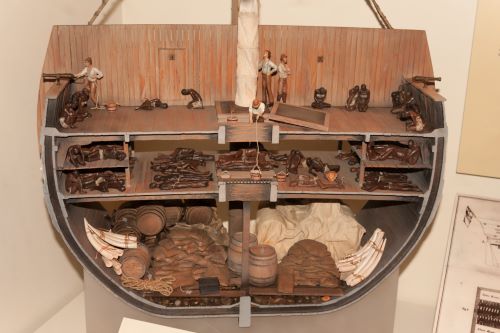
Jefferson’s classical republic was built around a sharply bounded image of the citizen: independent, property-holding, male, white, educated, and capable of exercising judgment free from coercion. The apparent universality of his language often obscured how narrow that political subject actually was. When Jefferson praised cultivators, defended natural rights, or imagined future generations spreading across the continent, he usually treated the household proprietor as the representative human figure. Women, enslaved people, Indigenous nations, landless laborers, and many free Black Americans appeared not as equal participants in the republic but as dependents, laborers, obstacles, wards, or populations to be governed. Their exclusion was not simply a failure to apply an otherwise complete political theory. It helped constitute the theory itself. The independent citizen could be imagined as autonomous because other people performed the labor, absorbed the vulnerability, or surrendered the land that made his independence possible.
Slavery exposed the deepest contradiction. Jefferson’s political language condemned arbitrary power and treated dependence upon another person’s will as incompatible with republican freedom, yet Monticello and his wider plantation interests rested upon precisely that form of domination. Enslaved men and women cultivated fields, cared for livestock, constructed buildings, manufactured goods, maintained households, and produced the wealth that supported Jefferson’s intellectual and political life. They possessed agricultural expertise and sustained the material world surrounding the celebrated “cultivator,” but Jefferson’s agrarian ideal transferred the moral value of their labor to the white proprietor who controlled it. The planter could be praised as independent even though his independence depended upon denying legal personhood, mobility, family security, and economic choice to others. Jefferson recognized slavery’s moral danger in private and public writings, but he repeatedly deferred any decisive confrontation with it. His language of gradual emancipation, expatriation, demographic anxiety, and racial difference placed the burden of slavery’s resolution upon an indefinite future while preserving the immediate authority of enslavers.
Classical antiquity gave this contradiction both precedent and warning. The Greek poleis and the Roman Republic had celebrated citizenship, law, public virtue, and political participation while excluding enslaved people from the civic community. Jefferson knew that ancient liberty had not been universal. Yet classical admiration could normalize a political world in which the freedom of citizens coexisted with the bondage of others. The parallel does not establish that antiquity caused Jefferson’s slaveholding, but it reveals how republicanism could define liberty relationally: the citizen was free because he was not a slave, and because he exercised authority over dependents within the household. Jefferson’s America modernized the language of natural rights without fully breaking this inherited structure.
Women were likewise essential to Jefferson’s republic while remaining politically subordinate within it. His agrarian household depended upon women’s domestic management, reproduction, education of children, preservation of family networks, and participation in agricultural and household production. Yet Jefferson did not envision women as independent citizens in the same sense as men. Their civic influence was expected to operate indirectly through family, morality, and education rather than through voting, officeholding, or formal public authority. He could value women’s intelligence and correspondence while continuing to treat politics as a male domain. The ideal household became a miniature republic governed by a male head whose supposed independence rested partly upon the unpaid or legally constrained labor of women. As with slavery, the public language of liberty depended upon a private structure of unequal authority.
Indigenous peoples occupied an even more unstable position within Jefferson’s political imagination. He could praise Native eloquence, courage, intelligence, and capacity for improvement, rejecting some European claims that they were naturally inferior. Yet he also treated their territories as the future geographic base of the American republic. His proposed policy of “civilization” encouraged Native communities to adopt agriculture, private property, market exchange, and patriarchal household forms modeled upon white American society. These policies were presented as benevolent, but they carried a territorial logic. Agricultural peoples, Jefferson believed, would require less land than hunting communities, making additional territory available for purchase or cession. Trade on credit could deepen indebtedness, while federal officials could use that debt to press for land. Communities that resisted American incorporation might be pushed beyond the advancing frontier. Indigenous sovereignty disappeared behind a developmental hierarchy in which the United States claimed authority to decide what counted as civilization, productive land use, and political maturity. Jefferson’s republic could expand only by treating Native possession as provisional and American settlement as historically legitimate.
The people missing from Jefferson’s classical republic were not absent from its economy, geography, or political development. They were everywhere present but denied equal standing within the story the republic told about itself. Enslaved laborers sustained the plantation economy; women reproduced and managed households; Indigenous nations controlled routes, supplied knowledge, conducted diplomacy, and defended homelands; landless workers and tenants performed labor without possessing the independence attributed to property owners. Jefferson’s political imagination converted these relationships into the background of republican citizenship. The contradiction resembled, but also exceeded, that of the ancient societies he admired. Greece and Rome had restricted citizenship openly, whereas Jefferson grounded legitimate government in universal natural rights while participating in a political order that withheld those rights systematically. His classical republic was most revealing at its margins. The exclusions were not accidental imperfections surrounding an otherwise coherent ideal. They were the conditions through which the idealized citizen (independent, landed, rational, and free) could appear to exist at all.
From Classical Analogy to American Mythology
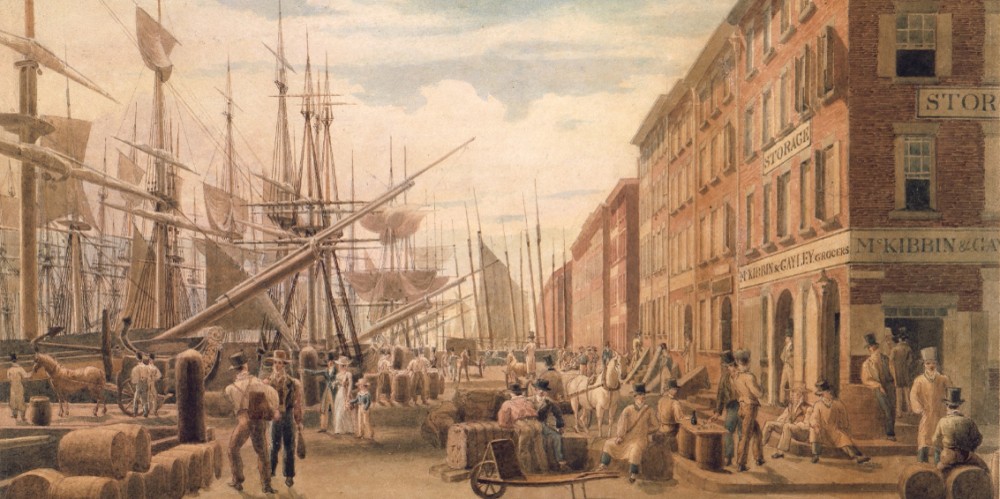
Jefferson’s America did not merely borrow names, architectural forms, and political examples from Greece and Rome. It transformed classical materials into a national mythology suited to a republic that understood itself as both ancient in principle and unprecedented in scale. The founders claimed that liberty rested upon truths older than monarchy, yet they also presented the United States as a new political beginning. Classical analogy helped reconcile those positions. Greece and Rome supplied recognizable figures of founders, legislators, citizen-soldiers, tyrants, patriots, and voyagers, while American experience supplied revolution, continental geography, natural abundance, and the promise of representative government. The result was not imitation but translation. Ancient stories acquired American settings, and American events gained authority by appearing within narrative patterns already associated with civilizational origins and republican greatness.
This translation was visible in the emerging image of the farmer-citizen. Jefferson’s cultivator was not simply a person who produced food; he became the moral guardian of the republic. Agricultural labor supposedly joined independence, household responsibility, attachment to place, and resistance to corruption. These qualities had precedents in classical republican thought, but Jeffersonian America expanded them into a national account of social destiny. The farm represented more than a productive unit. It became the setting in which liberty was renewed from generation to generation. Political independence seemed to grow from the soil because landownership protected citizens from dependence upon patrons, employers, financiers, and centralized authority. This pastoral image converted a historically specific arrangement, white male access to land in an expanding settler society, into an apparently universal moral law. The American republic would remain free because its citizens remained cultivators, and it would remain a nation of cultivators because new land continued to be available. Agrarian mythology concealed its own geographic requirement. The stable household at the center of Jeffersonian virtue depended upon movement beyond the nation’s existing boundaries.
Exploration supplied the second major figure within this mythology. The farmer represented rootedness; the explorer represented purposeful movement. Together they formed a sequence through which the republic imagined its continental future. Lewis and Clark entered national memory as the heroic agents of that movement. Their expedition could be narrated as a disciplined scientific undertaking, a diplomatic mission, a military reconnaissance, a commercial investigation, or a dangerous passage through Indigenous homelands. American commemoration increasingly combined these dimensions into a simpler founding story. Selected representatives of the republic entered an immense western space, endured physical trials, reached the Pacific, and returned with knowledge that enlarged the nation’s understanding of itself. Like the Argonauts, they became memorable not simply because they traveled far but because their voyage appeared to secure a collective future. The journals, maps, specimens, and geographic reports functioned as a modern treasure whose value lay in what the nation could do with it. Knowledge made possible commerce, settlement, diplomacy, state formation, and the projection of authority. Yet the heroic form reordered the expedition’s actual relationships. Indigenous assistance became evidence of providential cooperation; existing Native routes became paths discovered by Americans; and political landscapes occupied by sovereign nations became wilderness awaiting entry into national history. The voyage did not need to be consciously modeled upon the Argo to become Argonautic in retrospect. It acquired the same narrative movement from uncertainty through trial toward transformative acquisition.
National mythology also converted contingency into destiny. The Louisiana Purchase resulted from war in Europe, Napoleon’s imperial calculations, the Haitian Revolution, fragile negotiations, and unexpected diplomatic opportunity. Nothing about the acquisition had been inevitable. Once incorporated into the story of the United States, Louisiana could appear as the natural geographic extension of a republic always destined to cross the continent. Jefferson’s language of an “empire of liberty” helped make territorial growth compatible with anti-imperial identity. Unlike European empires, the United States supposedly expanded by multiplying equal states and independent households rather than by maintaining permanent colonies. That distinction carried real constitutional significance, but it also permitted Americans to describe conquest, coerced treaties, land speculation, and settler occupation as the spread of self-government. Empire became difficult to recognize when it appeared in the form of farms, surveys, roads, and future state boundaries. Myth did not operate chiefly by inventing events that had never occurred. It worked by selecting, arranging, and moralizing events that had occurred. It determined which participants appeared as founders, which actions counted as discovery, and which forms of violence remained outside the central narrative.
The Jeffersonian sequence can be stated plainly: exploration produced knowledge; knowledge strengthened territorial claims; territorial control enabled surveying and settlement; settlement created agricultural households; and those households supposedly preserved republican virtue. Each stage reinforced the next, converting continental expansion into a moral and political necessity. The sequence also explains why the images of Argos and the Argo can be joined interpretively without being mistaken for direct Jeffersonian sources. Argos represents the cultivated landscape transformed into civic identity, while the Argo represents the organized voyage through which a community seeks the resources or knowledge required for renewal. Jefferson’s America joined the two by imagining that heroic movement would create new fields of republican stability. Yet the mythology remained deeply exclusionary. Enslaved labor sustained the agricultural order, Indigenous dispossession supplied its land, women’s labor reproduced its households, and federal authority organized the expansion celebrated as individual independence. Classical analogy did not merely decorate these processes. It helped elevate them into a civilizational story in which American growth appeared heroic, historically meaningful, and morally redemptive. The nation’s mythology was neither wholly inherited nor wholly invented. It was antiquity refashioned for a continental republic, an American past constructed from classical forms, Enlightenment confidence, settler ambition, and the persistent desire to make power appear as destiny.
Are Argos and the Argonauts Being Imposed on Jefferson?
The following video from Jacob Becker examines Jefferson and the roots of American agrarianism:
The strongest challenge to my propositions is straightforward: the comparison may say more about the historian’s imagination than Jefferson’s own. No surviving body of correspondence, presidential papers, commonplace books, architectural notes, or educational plans demonstrates that Jefferson consciously selected Argos as the model for his agrarian republic. Likewise, he did not describe Meriwether Lewis and William Clark as modern Argonauts or frame their expedition as an American search for the Golden Fleece. Jefferson knew the classical world well, but classical literacy alone cannot establish that every resemblance between an ancient story and a modern policy reflects direct influence. A cultivated plain does not become Jeffersonian merely because Jefferson praised agriculture, and a difficult expedition does not become Argonautic merely because it carried selected men beyond familiar boundaries. Without explicit evidence, claims of deliberate imitation risk turning thematic similarity into historical causation.
Jefferson’s agrarianism can be explained more securely through sources closer to his political and material circumstances. English country ideology associated landed independence with resistance to court corruption, patronage, public debt, standing armies, and speculative finance. Enlightenment political economy encouraged debate over agriculture, manufacturing, commerce, population, and the distribution of property. Virginia’s plantation society gave Jefferson direct experience of land, debt, agricultural experimentation, Atlantic markets, and the authority exercised by household proprietors. North America’s apparent abundance of land allowed him to imagine a social future different from that of crowded European states. These influences offer a clearer documentary path to his praise of cultivators than any specific attachment to Argos. The same objection applies to the Lewis and Clark expedition. Its origins lie in Jefferson’s longstanding interest in western geography, transcontinental waterways, natural history, trade, imperial rivalry, and the strategic position of the Mississippi Valley. His instructions to Lewis are practical, scientific, diplomatic, and commercial. They contain no evident appeal to Jason, Colchis, or the Argo. The expedition can be understood fully within Enlightenment science and American statecraft without invoking mythology at all.
The danger is a form of parallelism in which correspondences accumulate until resemblance itself appears to prove influence. Argos is fertile; Jefferson admired farmers. The Argo carried heroes into distant lands; Lewis and Clark crossed the West. Both expeditions returned with something valuable. None of these parallels, by themselves, establishes a historical connection.
A second challenge concerns the category of mythology itself. Jefferson cited ancient historians, philosophers, moralists, lawyers, architects, and political examples more directly than he invoked mythological narratives. Cicero, Tacitus, Plutarch, Livy, and classical republican history often mattered more to his political reasoning than Jason, Perseus, or the heroic dynasties of Argos. His own intellectual style was analytical, comparative, and deeply shaped by Enlightenment confidence in reason and evidence. To emphasize mythology too heavily may blur important distinctions between Jefferson’s admiration for ancient literature, his use of republican history, and his actual formulation of policy. It may also romanticize the Lewis and Clark expedition by placing it within a heroic literary structure that obscures its bureaucratic, military, commercial, and imperial purposes. The Argonautic analogy can unintentionally reproduce the very mythology analyzed here, elevating American explorers into epic figures while minimizing Indigenous knowledge, negotiated passage, coercive diplomacy, and the state’s intention to convert information into territorial power. A comparison designed to expose national mythmaking can become another act of mythmaking if its limits are not stated repeatedly and clearly.
These objections do not require abandoning Argos and the Argonauts, but they do require narrowing the claim. The evidence does not support the argument that Jefferson copied an Argive political model or consciously sent American Argonauts westward. Argos and the Argo should instead be treated as comparative figures drawn from the classical world that Jefferson inhabited and from the broader culture of classical reception surrounding the founding generation. They illuminate recurring relationships among cultivated land, civic identity, heroic movement, acquisition, and political legitimacy without serving as demonstrable sources of particular decisions. This distinction separates documentary influence from historical interpretation. Jefferson’s agrarianism and western policy arose from identifiable economic, political, and geopolitical pressures, but they were expressed within a culture that continued to organize public meaning through classical forms. The final interpretation must remain double: Jefferson did not secretly govern from a mythological blueprint, yet his republic became intelligible, and was later remembered, through patterns remarkably similar to ancient narratives of fertile homelands, organized voyages, heroic acquisition, and national founding. Argos and the Argonauts are most valuable not as hidden causes but as instruments for seeing how American power was converted into American mythology.
Conclusion: The Republic Between Argos and the Argo
Jefferson’s political imagination was shaped by a classical inheritance, but not by a secret program of mythological imitation. No persuasive evidence demonstrates that he consciously modeled his agrarian republic upon Argos or dispatched Lewis and Clark as modern Argonauts. The deeper relationship lies in the narrative structures through which Jefferson and later Americans understood land, citizenship, exploration, and national purpose. Argos represents the cultivated homeland: a landscape in which soil, household, ancestry, and civic identity become inseparable. The Argo represents organized movement beyond familiar boundaries in search of something capable of transforming the political community that sends the voyagers forth. Jefferson’s America joined these images by treating exploration as the means through which new agricultural republics could be planted. The settled farm and the heroic expedition were not opposing ideals. The voyage existed to create the conditions for settlement, while settlement supplied the moral justification for further movement.
That relationship contained a fundamental paradox. Jefferson believed widely available land could preserve political independence by allowing citizens to avoid the concentrated wealth, dependent labor, and urban poverty he associated with Europe. Yet maintaining that abundance required continual territorial expansion. Republican stability depended upon geographic restlessness. The cultivator could remain rooted only because explorers, diplomats, surveyors, traders, soldiers, and settlers pushed the boundaries of the republic outward. The Louisiana Purchase and the Lewis and Clark expedition converted this logic into national policy. Scientific observation, mapping, natural history, and commercial inquiry widened human knowledge, but they also made distant regions more available to federal administration and settler occupation. The American Argo did not return with a magical fleece. It returned with information that could be transformed into routes, claims, markets, treaties, farms, and states.
The costs of that transformation expose the limits of Jefferson’s republican ideal. The independence of white property-owning citizens rested upon the labor and exclusion of people denied equal membership in the political community. Enslaved men and women sustained the plantation economy celebrated as the foundation of agricultural virtue. Women’s labor maintained households while formal citizenship remained overwhelmingly male. Indigenous nations supplied geographic knowledge, diplomatic assistance, food, horses, and passage to American explorers, yet their homelands were increasingly treated as territory awaiting acquisition. Jefferson’s classical education gave him a powerful language of liberty, corruption, virtue, and republican decline, but the ancient societies he admired had also reconciled civic achievement with slavery, patriarchy, conquest, and restricted citizenship. The American republic surpassed antiquity in its universal language of natural rights while reproducing many of antiquity’s exclusions in new racial and continental forms.
Jefferson’s republic consequently remained suspended between Argos and the Argo: between the desire for a stable society of independent cultivators and the demand for perpetual movement necessary to sustain it. Classical antiquity did not dictate this vision, but it helped provide the intellectual and imaginative forms through which the vision could be expressed, defended, and remembered. Jefferson turned ancient examples toward a modern experiment grounded in representative government, Enlightenment science, territorial abundance, and national expansion. The resulting mythology endowed the farmer with civic virtue, the explorer with heroic purpose, and the continent with the appearance of destiny. Yet beneath that mythology lay a harder history of executive power, coerced labor, Indigenous dispossession, and unequal access to the freedoms the republic proclaimed. Jefferson’s America was neither a reborn Greek polis nor an entirely unprecedented political creation. It was a continental republic that drew upon classical forms while transforming them into instruments of American self-understanding: Argos made expansive, the Argo made national, and liberty made inseparable from empire.
Bibliography
Affiliate disclosure: Amazon links on this site are paid links. As an Amazon Associate I earn from qualifying purchases.
- Aeschylus. Suppliants. In Aeschylus II: The Oresteia, Suppliants, Persians, and Seven against Thebes, edited and translated by David Grene and Richmond Lattimore. 2nd ed. Chicago: University of Chicago Press, 1991.
- Allen, John Logan. Passage through the Garden: Lewis and Clark and the Image of the American Northwest. Urbana: University of Illinois Press, 1975.
- Apollodorus. The Library of Greek Mythology. Translated by Robin Hard. Oxford: Oxford University Press, 1997.
- Apollonius Rhodius. Argonautica. Translated by William H. Race. Cambridge, MA: Harvard University Press, 2008.
- Appleby, Joyce. Capitalism and a New Social Order: The Republican Vision of the 1790s. New York: New York University Press, 1984.
- —-. Liberalism and Republicanism in the Historical Imagination. Cambridge, MA: Harvard University Press, 1992.
- Bailyn, Bernard. The Ideological Origins of the American Revolution. Cambridge, MA: Belknap Press of Harvard University Press, 1967.
- Banning, Lance. The Jeffersonian Persuasion: Evolution of a Party Ideology. Ithaca, NY: Cornell University Press, 1978.
- Barrow, Mark V., Jr. Nature’s Ghosts: Confronting Extinction from the Age of Jefferson to the Age of Ecology. Chicago: University of Chicago Press, 2009.
- Bedini, Silvio A. Thomas Jefferson: Statesman of Science. New York: Macmillan, 1990.
- Bellah, Robert N. “Civil Religion in America.” Daedalus 117:3 (1988), 97-118.
- Biddle, Nicholas, and Paul Allen. History of the Expedition under the Commands of Captains Lewis and Clark, to the Sources of the Missouri, Thence across the Rocky Mountains and down the River Columbia to the Pacific Ocean. 2 vols. Philadelphia: Bradford and Inskeep, 1814.
- Bowman, Rex, and Carlos Santos. Rot, Riot, and Rebellion: Mr. Jefferson’s Struggle to Save the University That Changed America. Charlottesville: University of Virginia Press, 2013.
- Brown, Stuart Gerry. “The Mind of Thomas Jefferson.” Ethics 73:2 (1963), 79-99.
- Clark, William. “To Thomas Jefferson, September 20, 1807.” Founders Online. National Archives.
- Clauss, James J. The Best of the Argonauts: The Redefinition of the Epic Hero in Book One of Apollonius’s Argonautica. Berkeley: University of California Press, 1993.
- Clauss, James J., and Martine Cuypers, eds. A Companion to Hellenistic Literature. Chichester: Wiley-Blackwell, 2010.
- Cole, Nicholas P., and Peter S. Onuf, eds. Thomas Jefferson, the Classical World, and Early America. Charlottesville: University of Virginia Press, 2013.
- Cutright, Paul Russell. Lewis and Clark: Pioneering Naturalists. Lincoln: University of Nebraska Press, 1969.
- Diodorus Siculus. Library of History. Vol. 2, Books 2.35–4.58. Translated by C. H. Oldfather. Cambridge, MA: Harvard University Press, 1935.
- Ellis, Joseph J. American Sphinx: The Character of Thomas Jefferson. New York: Alfred A. Knopf, 1996.
- Finkelman, Paul. Slavery and the Founders: Race and Liberty in the Age of Jefferson. 2nd ed. New York: Routledge, 2001.
- Frullini, Stefano. “Politics and Landscape in the Argive Plain after the Battle of Sepeia.” Journal of Hellenic Studies 141 (2021), 110–135.
- Furtwangler, Albert. Acts of Discovery: Visions of America in the Lewis and Clark Journals. Urbana: University of Illinois Press, 1993.
- Gordon-Reed, Annette. The Hemingses of Monticello: An American Family. New York: W. W. Norton, 2008.
- Hall, Jonathan M. Ethnic Identity in Greek Antiquity. Cambridge: Cambridge University Press, 1997.
- —-. “How Argive Was the ‘Argive’ Heraion? The Political and Cultic Geography of the Argive Plain, 900–400 B.C.” American Journal of Archaeology 99:4 (1995), 577–613.
- Hamilton, Alexander, James Madison, and John Jay. The Federalist Papers. Edited by Jacob E. Cooke. Middletown, CT: Wesleyan University Press, 1961.
- Harder, Annette. The Argonautica of Apollonius Rhodius: A Commentary. 2 vols. Oxford: Oxford University Press, 2012.
- Hayes, Kevin J. The Road to Monticello: The Life and Mind of Thomas Jefferson. New York: Oxford University Press, 2008.
- Hedeen, Stanley. Big Bone Lick: The Cradle of American Paleontology. Lexington: University Press of Kentucky, 2008.
- Hendrickson, David C., and Robert W. Tucker. Empire of Liberty: The Statecraft of Thomas Jefferson. New York: Oxford University Press, 1990.
- Herodotus. Histories. Translated by Robin Waterfield. Oxford: Oxford University Press, 1998.
- Homer. The Iliad. Translated by Richmond Lattimore. Chicago: University of Chicago Press, 1951.
- Hunter, Richard L. The Argonautica of Apollonius: Literary Studies. Cambridge: Cambridge University Press, 1993.
- Jackson, Donald, ed. Letters of the Lewis and Clark Expedition, with Related Documents, 1783–1854. 2nd ed. 2 vols. Urbana: University of Illinois Press, 1979.
- Jefferson, Thomas. Autobiography of Thomas Jefferson, 1743-1790. Introduction and Notes by Paul Leicester Ford. New York: G. P. Putnam’s Sons, 1914.
- —-. “A Bill Declaring Who Shall Be Deemed Citizens of This Commonwealth.” In The Papers of Thomas Jefferson. Vol. 2, 1777 to 18 June 1779, edited by Julian P. Boyd, 476–78. Princeton, NJ: Princeton University Press, 1950.
- —-. “A Bill to Abolish Entails.” In The Papers of Thomas Jefferson. Vol. 2, 1777 to 18 June 1779, edited by Julian P. Boyd, 507–8. Princeton, NJ: Princeton University Press, 1950.
- —-. “A Bill for the More General Diffusion of Knowledge.” In The Papers of Thomas Jefferson. Vol. 2, 1777 to 18 June 1779, edited by Julian P. Boyd, 526–35. Princeton, NJ: Princeton University Press, 1950.
- —-. “Confidential Message to Congress, January 18, 1803.” In The Papers of Thomas Jefferson. Vol. 39, 13 November 1802 to 3 March 1803, edited by Barbara B. Oberg. Princeton, NJ: Princeton University Press, 2012.
- —-. “Declaration of Independence.” In The Papers of Thomas Jefferson. Vol. 1, 1760–1776, edited by Julian P. Boyd, 423–33. Princeton, NJ: Princeton University Press, 1950.
- —-. “A Device for a Seal of the United States, August 1776.” In The Papers of Thomas Jefferson. Vol. 1, 1760–1776, edited by Julian P. Boyd, 494–97. Princeton, NJ: Princeton University Press, 1950.
- —-. “Explanations of the Ground Plan of the University of Virginia, [by July 1, 1823].” In The Papers of Thomas Jefferson, Retirement Series. Vol. 20, 1 January to 31 March 1823, edited by J. Jefferson Looney. Princeton, NJ: Princeton University Press, 2023.
- —-. “First Annual Message, December 8, 1801.” In The Papers of Thomas Jefferson. Vol. 36, 1 December 1801 to 3 March 1802, edited by Barbara B. Oberg. Princeton, NJ: Princeton University Press, 2009.
- —-. “First Inaugural Address, March 4, 1801.” In Writings, edited by Merrill D. Peterson, 492–96. New York: Library of America, 1984.
- —-. “Instructions to Meriwether Lewis, June 20, 1803.” In The Papers of Thomas Jefferson. Vol. 40, 4 March to 10 July 1803, edited by Barbara B. Oberg, 626–31. Princeton, NJ: Princeton University Press, 2013.
- —-. “A Memoir on the Discovery of Certain Bones of a Quadruped of the Clawed Kind in the Western Parts of Virginia.” Transactions of the American Philosophical Society 4 (1799), 246–60.
- —-. Notes on the State of Virginia. Edited by Frank Shuffelton. New York: Penguin Books, 1999.
- —-. The Papers of Thomas Jefferson. Vol. 8, 25 February to 31 October 1785. Edited by Julian P. Boyd. Princeton, NJ: Princeton University Press, 1953.
- —-. The Papers of Thomas Jefferson, Retirement Series. Vol. 14, 1 February 1818 to 31 August 1819. Edited by J. Jefferson Looney. Princeton, NJ: Princeton University Press, 2017.
- —-. “Report of the Commissioners Appointed to Fix the Site of the University of Virginia, August 4, 1818.” In The Papers of Thomas Jefferson, Retirement Series. Vol. 13, 4 March 1818 to 31 January 1819, edited by J. Jefferson Looney. Princeton, NJ: Princeton University Press, 2016.
- —-. “Report of a Plan of Government for the Western Territory, March 1, 1784.” In The Papers of Thomas Jefferson. Vol. 6, 21 May 1781 to 1 March 1784, edited by Julian P. Boyd, 603–15. Princeton, NJ: Princeton University Press, 1952.
- —-. “Second Inaugural Address, March 4, 1805.” In Writings, edited by Merrill D. Peterson, 518–23. New York: Library of America, 1984.
- —-. Thomas Jefferson’s Library: A Catalog with the Entries in His Own Order. Edited by James Gilreath and Douglas L. Wilson. Washington, DC: Library of Congress, 1989.
- —-. “To Benjamin Austin, January 9, 1816.” In The Papers of Thomas Jefferson, Retirement Series. Vol. 9, September 1815 to April 1816, edited by J. Jefferson Looney. Princeton, NJ: Princeton University Press, 2012.
- —-. “To Benjamin Banneker, August 30, 1791.” In The Papers of Thomas Jefferson. Vol. 22, 6 August 1791 to 31 December 1791, edited by Charles T. Cullen, 49–54. Princeton, NJ: Princeton University Press, 1986.
- —-. “To Caspar Wistar, February 25, 1807.” Founders Online. National Archives.
- —-. “To George Rogers Clark, December 25, 1780.” In The Papers of Thomas Jefferson. Vol. 4, 1 October 1780 to 24 February 1781, edited by Julian P. Boyd, 237–41. Princeton, NJ: Princeton University Press, 1951.
- —-. “To Henry Dearborn, December 28, 1802.” In The Papers of Thomas Jefferson. Vol. 39, 13 November 1802 to 3 March 1803, edited by Barbara B. Oberg. Princeton, NJ: Princeton University Press, 2012.
- —-. “To James Jay, April 7, 1809.” In The Papers of Thomas Jefferson, Retirement Series. Vol. 1, 4 March 1809 to 15 November 1809, edited by J. Jefferson Looney. Princeton, NJ: Princeton University Press, 2004.
- —-. “To James Madison, September 20, 1785.” In The Papers of Thomas Jefferson. Vol. 8, 25 February to 31 October 1785, edited by Julian P. Boyd, 534–38. Princeton, NJ: Princeton University Press, 1953.
- —-. “To James Madison, December 20, 1787.” In The Papers of Thomas Jefferson. Vol. 12, 7 August 1787 to 31 March 1788, edited by Julian P. Boyd, 438–43. Princeton, NJ: Princeton University Press, 1955.
- —-. “To James Madison, April 27, 1809.” In The Papers of Thomas Jefferson, Retirement Series. Vol. 1, 4 March to 15 November 1809, edited by J. Jefferson Looney, 168–71. Princeton, NJ: Princeton University Press, 2004.
- —-. “To John Adams, March 21, 1819.” In The Papers of Thomas Jefferson, Retirement Series. Vol. 14, 1 February to 31 August 1819, edited by J. Jefferson Looney. Princeton, NJ: Princeton University Press, 2017.
- —-. “To John Adams, April 11, 1823.” Founders Online. National Archives.
- —-. “To John Brazer, August 24, 1819.” In The Papers of Thomas Jefferson, Retirement Series. Vol. 14, 1 February to 31 August 1819, edited by J. Jefferson Looney, 629–31. Princeton, NJ: Princeton University Press, 2017.
- —-. “To John C. Breckinridge, August 12, 1803.” In The Papers of Thomas Jefferson. Vol. 41, 11 July to 15 November 1803, edited by Barbara B. Oberg, 174–80. Princeton, NJ: Princeton University Press, 2014.
- —-. “To John Jay, August 23, 1785.” In The Papers of Thomas Jefferson. Vol. 8, 25 February to 31 October 1785, edited by Julian P. Boyd, 426–29. Princeton, NJ: Princeton University Press, 1953.
- —-. “To John Stuart, November 10, 1796.” In The Papers of Thomas Jefferson. Vol. 29, 1 March 1796 to 31 December 1797, edited by Barbara B. Oberg, 205–6. Princeton, NJ: Princeton University Press, 2002.
- —-. “To Meriwether Lewis, April 27, 1803.” In The Papers of Thomas Jefferson. Vol. 40, 4 March to 10 July 1803, edited by Barbara B. Oberg, 355–57. Princeton, NJ: Princeton University Press, 2013.
- —-. “To Peter Carr, August 19, 1785.” In The Papers of Thomas Jefferson. Vol. 8, 25 February to 31 October 1785, edited by Julian P. Boyd, 405–8. Princeton, NJ: Princeton University Press, 1953.
- —-. “To William Branch Giles, December 26, 1825.” In The Papers of Thomas Jefferson, Retirement Series. Vol. 19, 16 September 1825 to 30 June 1826, edited by J. Jefferson Looney. Princeton, NJ: Princeton University Press, 2022.
- —-. “To William Henry Harrison, February 27, 1803.” In The Papers of Thomas Jefferson. Vol. 39, 13 November 1802 to 3 March 1803, edited by Barbara B. Oberg. Princeton, NJ: Princeton University Press, 2012.
- —-. Writings. Edited by Merrill D. Peterson. New York: Library of America, 1984.
- Kammen, Michael. Mystic Chords of Memory: The Transformation of Tradition in American Culture. New York: Alfred A. Knopf, 1991.
- Kaplan, Lawrence S. Thomas Jefferson: Westward the Course of Empire. 3rd ed. Wilmington, DE: Scholarly Resources, 1998.
- Kelly, Thomas. A History of Argos to 500 B.C. Minneapolis: University of Minnesota Press, 1976.
- Kerber, Linda K. Women of the Republic: Intellect and Ideology in Revolutionary America. Chapel Hill: University of North Carolina Press, 1980.
- Kessler, Donna J. The Making of Sacagawea: A Euro-American Legend. Tuscaloosa: University of Alabama Press, 1996.
- Kukla, Jon. A Wilderness So Immense: The Louisiana Purchase and the Destiny of America. New York: Alfred A. Knopf, 2003.
- Lewis, Meriwether, William Clark, and Members of the Corps of Discovery. The Definitive Journals of Lewis and Clark. Edited by Gary E. Moulton. 13 vols. Lincoln: University of Nebraska Press, 1986–2001.
- —-. Original Journals of the Lewis and Clark Expedition, 1804–1806. Edited by Reuben Gold Thwaites. 8 vols. New York: Dodd, Mead, 1904–5.
- Livy. Ab Urbe Condita. Translated by B. O. Foster et al. Cambridge, MA: Harvard University Press, 1919–1959.
- Malone, Dumas. Jefferson the President: First Term, 1801–1805. Boston: Little, Brown, 1970.
- —-. Jefferson the President: Second Term, 1805–1809. Boston: Little, Brown, 1974.
- McCoy, Drew R. The Elusive Republic: Political Economy in Jeffersonian America. Chapel Hill: University of North Carolina Press, 1980.
- McInnis, Maurie D., and Louis P. Nelson, eds. Educated in Tyranny: Slavery at Thomas Jefferson’s University. Charlottesville: University of Virginia Press, 2019.
- Montesquieu, Charles de Secondat, Baron de. The Spirit of the Laws. Translated and edited by Anne M. Cohler, Basia C. Miller, and Harold S. Stone. Cambridge: Cambridge University Press, 1989.
- Morgan, Edmund S. American Slavery, American Freedom: The Ordeal of Colonial Virginia. New York: W. W. Norton, 1975.
- Nelson, Louis P. Architecture and Empire in Jamaica. New Haven, CT: Yale University Press, 2016.
- Onuf, Peter S. Jefferson’s Empire: The Language of American Nationhood. Charlottesville: University Press of Virginia, 2000.
- Onuf, Peter S., and Nicholas P. Cole, eds. Thomas Jefferson, the Classical World, and Early America. Charlottesville: University of Virginia Press, 2011.
- Palladio, Andrea. The Four Books of Architecture. Translated by Issac Ware. London: R. Ware, 1738.
- Pausanias. Description of Greece. Translated by W. H. S. Jones. Cambridge, MA: Harvard University Press (Loeb Classical Library), 1918.
- Peterson, Merrill D. The Jefferson Image in the American Mind. New York: Oxford University Press, 1960.
- —-. Thomas Jefferson and the New Nation: A Biography. New York: Oxford University Press, 1970.
- Piérart, Marcel, and Gilles Touchais. Argos: Une ville grecque de 6000 ans. Paris: CNRS Éditions, 1996.
- Pindar. Olympian Odes, Pythian Odes. Edited and translated by William H. Race. Loeb Classical Library. Cambridge, MA: Harvard University Press, 1997.
- Plutarch. Greek Lives. Translated by C. E. Byles. London: Edward Arnold, 1907.
- —-. Roman Lives. Translated by Robin Waterfield. Oxford: Oxford University Press, 1999.
- Pocock, J. G. A. The Machiavellian Moment: Florentine Political Thought and the Atlantic Republican Tradition. Princeton, NJ: Princeton University Press, 1975.
- Reinhold, Meyer. Classica Americana: The Greek and Roman Heritage in the United States. Detroit: Wayne State University Press, 1984.
- Richard, Carl J. The Founders and the Classics: Greece, Rome, and the American Enlightenment. Cambridge, MA: Harvard University Press, 1994.
- —-. “A Dialogue with the Ancients: Thomas Jefferson and Classical Philosophy and History.” Journal of the Early Republic 9:4 (1989), 431-455.
- Rodgers, Daniel T. “Republicanism: The Career of a Concept.” Journal of American History 79:1 (1992), 11–38.
- Ronda, James P. Finding the West: Explorations with Lewis and Clark. Albuquerque: University of New Mexico Press, 2001.
- —-. Lewis and Clark among the Indians. Lincoln: University of Nebraska Press, 1984.
- Scherr, Arthur. “Thomas Jefferson’s Nationalist Vision of New England and the War of 1812.” The Historian 69:1 (2007), 1-35.
- Seefeldt, Douglas, Jeffrey L. Hantman, and Peter S. Onuf, eds. Across the Continent: Jefferson, Lewis and Clark, and the Making of America. Charlottesville: University of Virginia Press, 2005.
- Semonin, Paul. American Monster: How the Nation’s First Prehistoric Creature Became a Symbol of National Identity. New York: New York University Press, 2000.
- Shackelford, George Green. Thomas Jefferson’s Travels in Europe, 1784–1789. Baltimore: Johns Hopkins University Press, 1995.
- Shalev, Eran. American Zion: The Old Testament as a Political Text from the Revolution to the Civil War. New Haven, CT: Yale University Press, 2013.
- —-. Rome Reborn on Western Shores: Historical Imagination and the Creation of the American Republic. Charlottesville: University of Virginia Press, 2009.
- —-. “Thomas Jefferson’s Classical Silence, 1774–1776: Historical Consciousness and Roman History in the Revolutionary South.” In Thomas Jefferson, the Classical World, and Early America, edited by Peter S. Onuf and Nicholas P. Cole, 219–47. Charlottesville: University of Virginia Press, 2011.
- Shalhope, Robert E. “Thomas Jefferson’s Republicanism and Antebellum Southern Thought.” The Journal of Southern History 42:4 (1976), 529-556.
- Sheehan, Bernard W. Seeds of Extinction: Jeffersonian Philanthropy and the American Indian. Chapel Hill: University of North Carolina Press, 1973.
- Slaughter, Thomas P. Exploring Lewis and Clark: Reflections on Men and Wilderness. New York: Alfred A. Knopf, 2003.
- Slotkin, Richard. Regeneration through Violence: The Mythology of the American Frontier, 1600–1860. Middletown, CT: Wesleyan University Press, 1973.
- Sowerby, E. Millicent, comp. Catalogue of the Library of Thomas Jefferson. 5 vols. Washington, DC: Library of Congress, 1952–59.
- Stoll, Steven. Larding the Lean Earth: Soil and Society in Nineteenth-Century America. New York: Hill and Wang, 2002.
- Sturtz, Linda L. Within Her Power: Propertied Women in Colonial Virginia. New York: Routledge, 2002.
- Thomson, Keith. “The ‘Great-Claw’ and the Science of Thomas Jefferson.” Proceedings of the American Philosophical Society 155:4 (2011), 394-403.
- —-. A Passion for Nature: Thomas Jefferson and Natural History. Chapel Hill: University of North Carolina Press, 2008.
- Thucydides. History of the Peloponnesian War. Translated by Rex Warner. Revised by M.I. Finley. London: Penguin Classics, 1972.
- Tomlinson, R. A. Argos and the Argolid: From the End of the Bronze Age to the Roman Occupation. Ithaca, NY: Cornell University Press, 1972.
- “Treaty between the United States of America and the French Republic, April 30, 1803.” In Treaties and Other International Acts of the United States of America. Vol. 2, edited by Hunter Miller, 498–511. Washington, DC: Government Printing Office, 1931.
- Tucker, Robert W., and David C. Hendrickson. Empire of Liberty: The Statecraft of Thomas Jefferson. New York: Oxford University Press, 1990.
- United States Congress. An Act Laying an Embargo on All Ships and Vessels in the Ports and Harbors of the United States. December 22, 1807. 2 Stat. 451.
- —-. Message from the President of the United States, Communicating Discoveries Made in Exploring the Missouri, Red River and Washita. New York: Hopkins and Seymour, 1806.
- Upton, Dell. Architecture in the United States. Oxford: Oxford University Press, 1998.
- Viola, Herman J. Exploring the West. Washington, DC: Smithsonian Books, 1987.
- Virgil. The Aeneid. Translated by Robert Fagles. New York: Viking, 2006.
- Waldstreicher, David. In the Midst of Perpetual Fetes: The Making of American Nationalism, 1776–1820. Chapel Hill: University of North Carolina Press, 1997.
- Wallace, Anthony F. C. Jefferson and the Indians: The Tragic Fate of the First Americans. Cambridge, MA: Belknap Press of Harvard University Press, 1999.
- Walsh, Lorena S. Motives of Honor, Pleasure, and Profit: Plantation Management in the Colonial Chesapeake, 1607–1763. Chapel Hill: University of North Carolina Press, 2010.
- Wiencek, Henry. Master of the Mountain: Thomas Jefferson and His Slaves. New York: Farrar, Straus and Giroux, 2012.
- Wilson, Richard Guy, ed. Thomas Jefferson’s Academical Village: The Creation of an Architectural Masterpiece. Charlottesville: Bayly Art Museum of the University of Virginia, 1993.
- Winterer, Caroline. The Culture of Classicism: Ancient Greece and Rome in American Intellectual Life, 1780–1910. Baltimore: Johns Hopkins University Press, 2002.
- Wood, Gordon S. The Creation of the American Republic, 1776–1787. Chapel Hill: University of North Carolina Press, 1969.
- —-. Empire of Liberty: A History of the Early Republic, 1789–1815. New York: Oxford University Press, 2009.
- —-. The Radicalism of the American Revolution. New York: Alfred A. Knopf, 1992.
- Wright, Louis B. “Thomas Jefferson and the Classics.” Journal of the History of Ideas 87:3 (1943), 223-233.
- Zangger, Eberhard. The Geoarchaeology of the Argolid. Berlin: Gebrüder Borntraeger, 1993.
Originally published by Brewminate, 07.21.2026, under the terms of a Creative Commons Attribution-NonCommercial-NoDerivatives 4.0 International license.
About the Author