
Finding a psychiatrist is hard enough. Finding one who treats patients in their first language – and does it well – narrows the field considerably. Culver City and the surrounding Westside Los Angeles area have options, but quality varies, and not every clinic that lists Spanish or another language actually staffs bilingual providers at every level of care. This list covers five clinics and practices that serve the greater Culver City region, with attention to telehealth reach, clinical approach, and whether bilingual care is genuinely integrated.
Finding Bilingual Psychiatric Care in Culver City
Westside Los Angeles has a large Spanish-speaking population, and demand for bilingual psychiatric care – meaning care delivered in the patient’s own language, not just routed through an interpreter – has grown steadily. Top bilingual psychiatry clinics near Culver City range from telehealth-first practices to in-person specialty centers with decades of history; the right fit depends heavily on diagnosis, insurance, and whether showing up in person matters to you. Clinics here were chosen based on geographic proximity to Culver City, published language access, and documented clinical approach.
1. Reimagine Psychiatry
Best for: Adults across California needing medication management, including bilingual telehealth access
Specialty: Medication management, ADHD, anxiety, depression, PTSD, OCD, bipolar disorder, insomnia
Format: Telehealth only (secure platform, California-wide)
Standout: Integrates genetic testing for medication selection with lifestyle and nutrition guidance
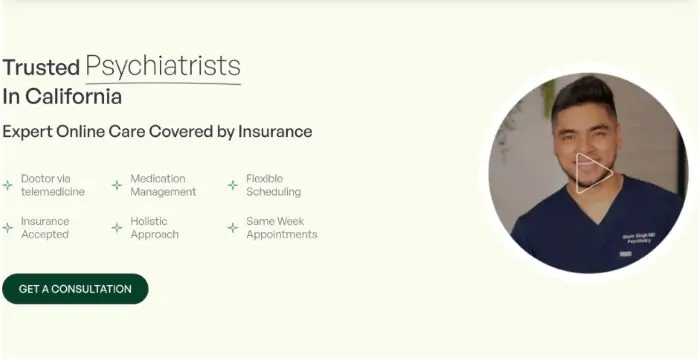
Founded in 2024, Reimagine Psychiatry operates as a fully telehealth psychiatric practice based in Los Angeles. The team is led by Dr. Sham Singh, a UCLA-trained board-certified psychiatrist, and includes psychiatric nurse practitioners and physician associates. Reimagine Psychiatry, Los Angeles accepts most major commercial insurance plans (Aetna, Anthem Blue Cross, Blue Shield of California, Meritain Health, and ComPsych) and verifies benefits before the first appointment so patients aren’t left guessing about out-of-pocket costs.
What sets this practice apart is an explicit commitment to reducing medication dependence over time. Providers don’t manage prescriptions in isolation, they pair pharmacotherapy with psychotherapy referrals, sleep hygiene guidance, mindfulness, and exercise recommendations. Same-week appointments and no commute make access genuinely easier for working adults and families running tight schedules. Patients typically notice initial symptom changes within four to six weeks of starting treatment.
2. Westwood Institute for Anxiety Disorders
Best for: Adults with severe or treatment-resistant OCD, BDD, and anxiety spectrum conditions
Specialty: OCD, Body Dysmorphic Disorder, anxiety spectrum disorders
Format: In-person (Los Angeles and Beverly Hills); phone and online therapy available
Standout: Intensive “last resort” center for cases that haven’t responded elsewhere
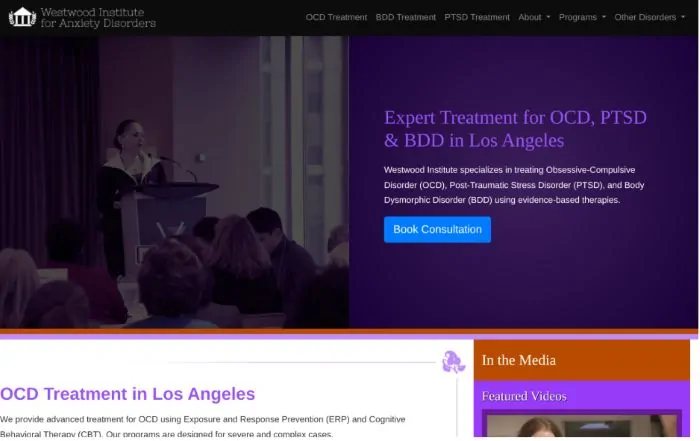
Founded in 1997 by Dr. Gorbis, the Westwood Institute for Anxiety Disorders is one of the few practices in Southern California built specifically around Dr. Edna Foa’s Exposure and Response Prevention (ERP) protocol. The approach combines behavioral ERP with cognitive components, writing exercises, and medication when clinically appropriate. For cases that go beyond outpatient intensity, the Institute coordinates hospitalization through UCLA.
Dr. Gorbis’s work has been featured on 60 Minutes, 20/20, and MTV’s True Life. The Institute also extends phone and online services to clients worldwide, a practical option for patients in Culver City who can’t travel to Westwood or Beverly Hills. If a patient has already worked through standard therapy without improvement, this is a reasonable next step. Specific team size isn’t publicly listed.
3. Rogers Behavioral Health
Best for: Patients needing a structured continuum of care, including intensive outpatient or residential levels
Specialty: OCD, anxiety, addiction, depression, eating disorders, trauma, PTSD
Format: In-person (multiple states) and virtual intensive outpatient
Standout: Over a century of operation; 25-plus years of published clinical outcome data
Rogers Behavioral Health was founded in 1907 and has grown into one of the largest nonprofit specialty behavioral health systems in the United States, with locations across ten states. For Culver City residents, the virtual intensive outpatient program is the most practical access point, since the main campus sits in Oconomowoc, Wisconsin.
The clinical approach spans CBT, DBT, Dialectical Behavior Therapy, Exposure Therapy, Prolonged Exposure, and Written Exposure Therapy. Rogers employs close to 2,000 staff and runs its own internal research center – the Rogers Research Center – focused on measurement-based care. In November 2023, the American Society of Addiction Medicine recognized the organization’s accreditation standards. For patients who need a higher level of care than weekly outpatient sessions, Rogers’s program structure is worth comparing against local options.
4. Century City Psychiatry
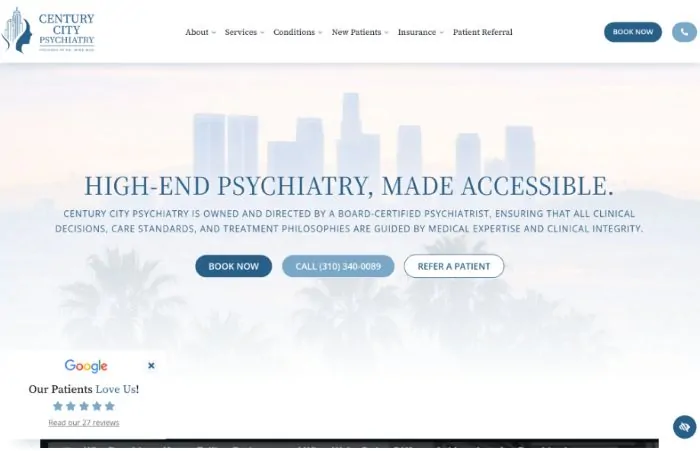
Best for: Patients seeking insurance-based psychiatric care with boutique-level provider supervision
Specialty: Depression, anxiety, PTSD, ADHD, bipolar disorder, eating disorders, sleep disorders, chronic pain
Format: In-person (West Los Angeles) and telepsychiatry across California
Standout: All clinicians personally selected, trained, and directly supervised within the group practice
Century City Psychiatry is located at 10323 Santa Monica Blvd in Los Angeles, about four miles from central Culver City. Dr. Mah has been practicing since 2021, and the group recently expanded its clinical team with an additional psychiatric nurse practitioner and plans for further hires. The practice is designed to thread the needle between boutique mental health care and insurance accessibility. Every provider accepts major plans, which sets it apart from many private pay-only practices in the area.
Services cover both in-person evaluations and secure telepsychiatry throughout California. The conditions treated are broad, including eating disorders, chronic pain, and sleep disorders alongside the more standard psychiatric presentations. No specific founding date is publicly listed.
5. Cognitive Behavioral Therapy Los Angeles
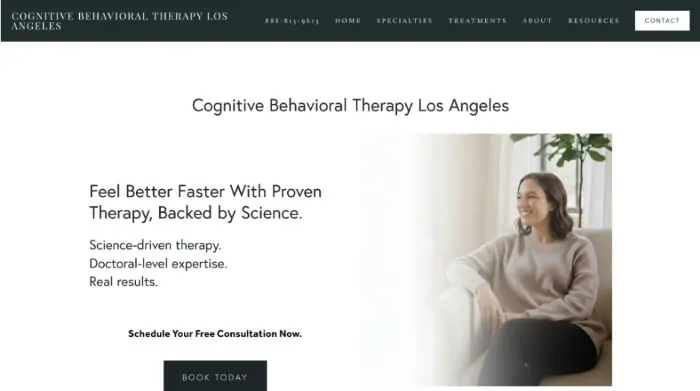
Best for: Adults and children seeking doctoral-level CBT for anxiety, OCD, depression, or insomnia
Specialty: CBT, ERP for OCD, CBT-I for insomnia, PTSD, ADHD assessment, couples therapy
Format: In-person (Westwood/Brentwood, Pasadena, Glendale) and online across California
Standout: All therapists are clinical psychologists, many of whom hold faculty roles at top psychology programs
Cognitive Behavioral Therapy Los Angeles runs three office locations: Westwood/Brentwood (11645 Wilshire Blvd), Pasadena, and Glendale, putting the Westwood site within easy reach of Culver City. The practice has operated for more than a decade. Director Dr. Albert Bonfil specializes in anxiety and OCD, supervises postdoctoral CBT fellows, and teaches at the university level.
This is a therapy-only practice. It doesn’t prescribe medication, so patients who need combined pharmacotherapy and psychotherapy would need a separate psychiatric provider. That said, the depth of CBT specialization here (ERP for OCD, CBT-I for insomnia, Behavioral Activation for depression, CPT and Prolonged Exposure for PTSD, and adult ADHD assessment with executive coaching) makes it a strong referral complement for any prescribing clinician.
What Matters When Choosing a Bilingual Psychiatrist
Language access in psychiatry means far more than having a provider who can translate. Diagnostic interviews, trauma histories, and medication conversations all depend on precise language, and a patient’s fluency in English often drops sharply under emotional stress. The best bilingual clinics staff bilingual providers at every clinical level – not just at the front desk – so a language gap doesn’t fracture the therapeutic relationship mid-session.
Insurance coverage is the other practical filter. Several practices on this list accept major commercial plans, but it’s worth calling ahead to confirm which specific providers within a group are in-network. Group practices sometimes have credentialing gaps where individual clinicians differ from the group’s listed plans.
Format matters too. Telehealth has expanded access dramatically across California, and for patients in Culver City who work during clinic hours or have transportation barriers, a high-quality virtual provider can be a better fit than a nearby in-person clinic with limited availability.
Bottom Line
The top bilingual psychiatry clinics near Culver City span a real range, from intensive specialty centers for treatment-resistant OCD to telehealth practices serving all of California with same-week availability. Patients with complex or severe presentations may benefit from the structured programs at Rogers or the ERP depth at the Westwood Institute. Those needing accessible, insurance-friendly medication management with shorter wait times will find telehealth-first practices a more practical starting point. Match the clinic to the diagnosis, the insurance situation, and realistic access constraints. That combination narrows the field faster than any single ranking can.
About the Author