
After Cannae, Hannibal needed more than another victory. Stronger support from Carthage might have helped him unravel Rome’s alliances, but could it have forced Rome to negotiate?

By Matthew A. McIntosh
Public Historian
Brewminate
After Cannae in 216 BCE, Rome had lost an army, but it had not lost the war. Hannibal’s victory persuaded Capua and several other southern Italian communities to abandon their Roman allegiance. Yet Rome refused to negotiate, recruited new forces, and continued fighting elsewhere. Hannibal remained in Italy for years without breaking the alliance network that sustained Roman resistance. What if Carthage had given him stronger support at this moment? The most useful scenario is a concentrated effort after Cannae to reinforce his Italian campaign, accepting greater risks elsewhere. That could have improved his prospects considerably, although making Rome accept defeat required more than another battlefield victory.
The familiar picture of Hannibal winning battles while an indifferent Carthaginian government simply abandoned him is misleading. Carthage supported several theaters of war and eventually sent reinforcements to southern Italy. Its forces also fought to preserve the valuable territories in Spain that supplied money and manpower. Roman pressure there was a serious threat, while opportunities in Sardinia and Sicily demanded further resources. Ancient accounts, largely preserved through writers on the Roman side, do not give us an uncomplicated view of Carthaginian deliberations. The counterfactual begins with a different strategic priority rather than a sudden discovery that Hannibal needed help. During the winter after Cannae, Carthage commits to sending a substantial expedition to southern Italy for the following campaigning season, with military supplies and money to maintain it. This would require redirecting resources from other operations, not imagining reserves without limit. The expedition would also need a usable landing place and reliable coordination with Hannibal. Roman naval power made the crossing dangerous, but Carthaginian ships could still move troops across the Mediterranean; the sea was an obstacle, not an impenetrable wall.
Additional soldiers would matter most by allowing Hannibal to operate in more than one place at once. His Italian allies needed protection against Roman retaliation, and each new commitment reduced his freedom to concentrate his army. A second substantial force could guard friendly territory or threaten a Roman army while Hannibal campaigned elsewhere. Money and equipment would help sustain these operations, although imported supplies could only supplement local resources. The objective would not necessarily be an immediate march on Rome. Reinforcements did not automatically provide the means to capture a large fortified city, and an unsuccessful siege could squander Hannibal’s advantage. A more plausible strategy would make Rome’s promises of protection increasingly difficult to fulfill, encouraging additional communities to reconsider their allegiance.
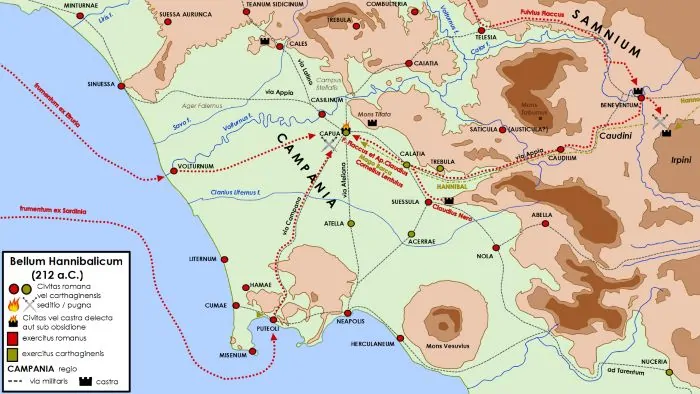
That process would face limits that Cannae had already exposed. Rome’s allies did not all interpret a Roman disaster as their opportunity to leave. Many had political connections or local interests tied to the existing relationship. Others had reason to fear what neighboring communities might gain from a Carthaginian victory. Much of central Italy remained loyal, and the Latin colonies provided important support. Hannibal would need to turn military presence into a credible expectation that defection could survive Roman revenge. Here a reinforced campaign might make a decisive difference in certain places. Historically, Rome recovered Capua in 211 BCE, demonstrating the impacts of abandoning its alliance. In this scenario, another Carthaginian army might prevent its isolation or force Rome to postpone the siege. Keeping Capua would preserve a valuable ally and weaken the deterrent effect of its punishment. Success might also improve Hannibal’s ability to exploit later opportunities around Tarentum, where his historical capture of the city left its citadel in Roman hands. None of these gains guarantees a general Italian revolt. Their significance would be cumulative. Fewer allies recovered by Rome, more Roman troops committed to containment, and greater uncertainty among communities still deciding which side could protect them.
Rome would respond to that pressure rather than passively await another Cannae. Its commanders could continue avoiding battle on Hannibal’s preferred terms while attacking vulnerable allies and supply routes. More significantly, concentrating Carthaginian strength in Italy would probably weaken its position elsewhere. Roman armies in Spain might advance more quickly against reduced opposition, threatening the revenues that sustained the wider war. Efforts to contest Sicily could also suffer, potentially improving Rome’s access to the island’s resources. Hannibal’s stronger army would purchase an opportunity with a deadline; it needed to produce political results before losses elsewhere undermined the effort. The most plausible favorable outcome would be negotiations after several further seasons of successful campaigning, with Rome facing the prospect of prolonged war and additional defections. Carthage could seek security for its own possessions and a diminished Roman position in southern Italy. Whether Roman leaders would accept such terms remains deeply uncertain. Their actual refusal to concede after catastrophic defeats suggests that even a worsening military position might not suffice.
Stronger support could have made a Carthaginian victory more plausible without making it inevitable. Hannibal’s greatest opportunity lay in converting Cannae into a lasting change in Italian loyalties, and reinforcements could have helped him protect the communities that took his side. They could not erase Rome’s remaining advantages or compel its leaders to regard negotiation as preferable to continued war. The scenario reveals why the historical struggle lasted so long. Tactical brilliance could destroy a Roman army, but defeating Rome required unraveling the political relationships that allowed it to raise another. Carthage might have given Hannibal a better chance to accomplish that larger task. It could not simply have sent him victory.
Originally published by Brewminate, 10.26.2026, under the terms of a Creative Commons Attribution-NonCommercial-NoDerivatives 4.0 International license.
About the Author