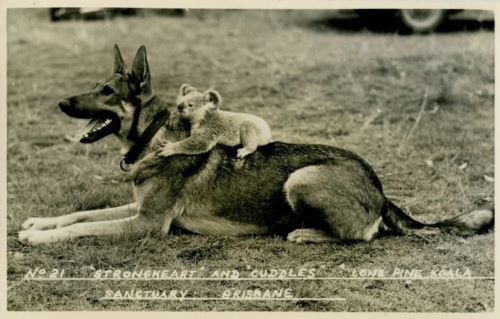
Historical studies of filmic dogs can help us to understand the changing perception of dogs in Western culture.

By Dr. Kathryn Fuller-Seeley
William P. Hobby Centennial Professor of Communication
The University of Texas at Austin

By Dr. Jeremy Groskopf
Lecturer in English
Averett University
Introduction
The Greatest Animal Actor the World Has Ever Known! Strongheart [in] White Fang, Jack London’s Mighty Epic of Alaska. A Man! A Girl! A Dog!
Niagara Falls Gazette, July 14, 1925, 11
Rin Tin Tin, that Fairbanks, Mix and Barrymore of the canine world, has made his best picture.
Variety, April 7, 1926, 40
“Dog heroes” were top American action-film stars in the 1920s. Strongheart and Rin Tin Tin, among the early wave of German Shepherds introduced to the United States at the conclusion of World War I, were beloved by millions of movie fans as superbly talented canine performers whose abilities, like other dog stars before them, were uniquely highlighted by silent film. Strongheart was known as an original “Wonder Dog” and as the most outstandingly skilled actor of the dozen or more canine cinematic performers of the era (see Rapf in this volume). Rin Tin Tin was sometimes called “The Dog Who Saved Hollywood,” as his films supposedly rescued the struggling Warner Bros. studio from bankruptcy. His story is especially steeped in Hollywood mythology, and his trainer, Lee Duncan, constructed fantastical stories about his origins and achievements.“Rinty” (as the dog was nicknamed) was rumored to receive twelve thousand fan letters a week, to earn $6,000 a month, to own solid-gold dog tags and a diamond-studded collar, and to live in luxurious style in his own Hollywood mansion. Susan Orlean, in her hagiographic book about Rin Tin Tin, claims that the dog won the vote for Best Actor for the first Academy Award in 1929 and that this embarrassed officials so much that they gave it to Emil Jannings instead and changed the voting rules so that animals could not be nominated for acting awards (Orlean 2011, 88–89). Even Rinty’s death was tied to celebrity, as gossip claimed it was in the arms of screen siren Jean Harlow (Basinger 2000, 451). None of this is true, of course, especially Orlean’s claim about Rinty and the Oscars (see the introduction to this volume). But that the legends have such resonance is due to the incredible significance of Strongheart and Rinty during the 1920s; the pair romped through many areas of 1920s popular culture—on movie screens across the nation, in film reviews and articles in local newspapers, at personal appearances in scores of theaters, and pictured on commercial products from dog food cans, cereal boxes, and shoe polish tins to Cracker Jack prizes, statuettes, and children’s books. Strongheart and Rin Tin Tin were depicted as full-fledged movie stars in the decade’s fan magazines, which breathlessly documented their strenuous adventures on set, their publicity appearances, and their everyday life offscreen surrounded by their families of pups sired with their canine spouses.
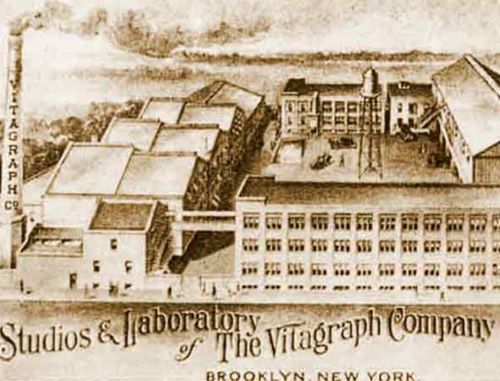
The enormous success of Rinty and Strongheart as cinematic canines in the1920s was due to a fortuitous combination of factors—the precedent of earlier nickelodeon-era dog actors, for example the border collies Jean at the Vitagraph studio and Shep at Thanhouser, the Great Dane mix Teddy at Keystone, and Luke, Roscoe “Fatty” Arbuckle’s dog, at Biograph; the vogue for the outdoor action film genre in the 1920s; the extraordinary talents of Strongheart and Rin Tin Tin, who moved beyond merely performing tricks to be noted for their athleticism, for their sharp teeth, and dark, fierce visages, and also for their expressive eyes, in which audiences read sorrow and love; and, as a complex cause and result of all of these, the rising status of the dog as pet and companion in U.S. culture. But the celebrity of dog as hero—rather than comic foil or surrogate child, for example—was ultimately engineered by their owners and film publicity agents. Quirky characters Laurence Trimble (who guided Jean and Strongheart) and Lee Duncan (who trained Rinty) devoted their careers to directing, publicizing, and profiting from these gifted animals.
The early years of the twenty-first century have seen a massive growth of interest, in scholarly circles, in the study of human-animal relationships. This scholarly work is particularly interested in our representations of animals. As Nigel Rothfels writes, “the way we talk or write about animals, photograph animals, think about animals, imagine animals—represent animals—is. . . deeply connected to our cultural environment” and our history (Rothfels 2002, xi).Scholarly studies of animal representation have often engaged both with the movies as a form and with dogs as a film subject: the former a result of film’s status as one of the foremost narrative mediums of modern life, the latter a result of the ubiquity of dogs as a companion animal in Western culture. It is the rare individual indeed who, in American culture at least, has no “dog-lovers” as friends or who has not watched the heroic adventures of Benji or some other dog on film either as or in the company of a child.
But the importance of the dog in film does more than simply draw attention to a convention in American culture. The various narrative positions we grant to dogs is indicative of the often conflicted ways in which we think about dogs in particular and animality in general. Susan McHugh (2004) cuts to the heart of the complexity of filmic dogs when she poses a question about the remarkable number of animated canines populating the films of Walt Disney over many decades: “If Pluto is Mickey Mouse’s dog, then what on earth is Goofy?” (10). Disney weaves together the notion of dog as “companion” and the notion of dog as “protohuman” into cartoon form, side by side, and the general reluctance of any given spectator to give thought to the animality of the characters allows this conflicted representation to slide past unscrutinized.
As such, historical studies of filmic dogs can help us to understand the changing perception of dogs in Western culture, as they move back and forth from a representation of wildness to a representation (much like children) of the embodiment of innocence. Silent-era dog heroes, like Strongheart, Rin Tin Tin, and those who came before, show film’s first steps toward humanizing dogs, for better or worse, through stories of heroism, gracing them with both complex intellectual faculties and courage. As many essays in this book explore, dog stars, no less than many of the nineteenth- and twentieth-century literary icons on which their roles are often based, continue to occupy the ground between anthropomorphized and wild, reproducing the visual and narrative templates established from the early years of cinema through the present.
Early Dog Heroes: Jean and Shep
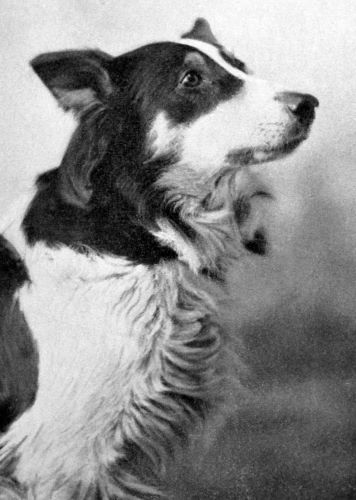
One precedent for filmic depictions of heroic star dogs was set by the career of Jean the Vitagraph Dog. This female black-and-white border collie, appearing in one-reel films from 1910 to 1913, was one of the first American film performers promoted by her real name, while Florence Lawrence was still the anonymous Vitagraph Girl (Slide 1987, 55). Jean came to Vitagraph when her owner, Laurence Trimble, a twenty-five-year-old author of short story fiction from Maine, visited the Brooklyn studio while researching a magazine article on motion picture production. Trimble encountered a film crew having difficulty with a recalcitrant dog performer. Trimble had a natural talent for working with canines, showed the moviemakers how to do it, and then returned to the lot with his own trained and talented dog. Vitagraph hired Jean for $25 per week, and Trimble became a director (Gallo 2000); Jean was subsequently featured in at least twenty films directed by Trimble. She was especially adept in dramatic roles, at various times bringing adult lovers together (in one film, two lovers’ rivalry over Jean’s ownership drives them apart), being a playful companion to lonely children, or rescuing endangered human infants from fire or kidnapping. She was a full member of the Vitagraph stock company and appeared in numerous films with Florence Turner, John Bunny the comedian, romantic hero Maurice Costello, and Ken Casey the Vitagraph Boy. In the one-reel melodrama Where the Winds Blow (1910), shot on location on the Maine coast, Jean helps her poverty-stricken human family stave off starvation by digging for clams along the rocky shoreline to help them earn a living.
“Jean is an inspiration; no one could help making a fine story about her, and no actor could act badly in her support,” a 1910 Vitagraph publicity release noted (Slide 1987, 55). While film reviewers found some of her movies to be just minor “program fillers,” they praised her performances in sentimental melodramas like Playmates (1912), in which a loving stray dog cheers a sick and lonely wealthy child back to health, earning the parents’ gratitude. Moving Picture World singled out that film, judging it to be “best film of the week” released by an American or European film studio (February 19, 1912, 367; see also the New York Daily Mirror, February 21, 1912, 12). Jean’s fame with movie audiences spread as Vitagraph featured illustrations of the dog in its advertisements and offered theater managers souvenir postcard portraits of her to give away at its nickelodeons. When she had a litter of puppies, the Vitagraph Company capitalized on it in a half-reel film, Jean and Her Family (1913) (Moving Picture World, March 28, 1913, 1242). Jean and Trimble departed Vitagraph for a more lucrative opportunity in 1913, joining an independent film production studio in England headed by actress Florence Turner, where the dog appeared in several more films before passing away in 1916.
Meanwhile, in New York, Vitagraph director John Harvey located a replacement collie, Shep, for the studio. However, dog and trainer soon decamped to the Thanhouser film studio, where Harvey directed Shep in a half-dozen one-reel films, most notably the melodrama A Dog’s Love (1914), whose plot inventively develops Shep’s emotions and his active agency. Calling the film “a miniature masterpiece,” a Moving Picture World reviewer noted that “when Baby Helen [the dog’s only companion], stricken down by an automobile, is taken from the tangible world, not only her parents are broken hearted. Shep’s grief is consistent and prolonged. He visits the cemetery and mourns over the little flower-strewn mound; from a florist he himself brings flowers; he entices a young woman with a watering pot to come and sprinkle the wilting blossoms, and, like them, he droops at home, refusing to eat anything—even chicken bones.” In a remarkable double-exposure shot Shep is shown dreaming of a ghostly Helen, who hugs and beckons him to join her in the afterlife. Despondent upon awakening, he lies down on her grave and dies. “By this time the audience is in the state of rapid-fire winking, and in some quarters there is that furtive movement connected invariably with a covert kerchief search,” the review continued.“ Then suddenly the situation is saved and the picture ends in a flash of glorious relief with the insert, ‘Don’t cry, it was only make believe,’ preceding a picture of the livest [sic], healthiest Baby Helen playing with an equally live and cheerful collie. . . . In its pathos it is quite exquisite, and then it finishes with that little masterpiece of an emotional poultice and sends everyone away with the delightfully mixed up feeling of a streak of sadness sweetly frosted over with relieved happiness” (Moving Picture World, October 17, 1914, quoted in Bowers 1997).
A New Generation of Dog Heroes
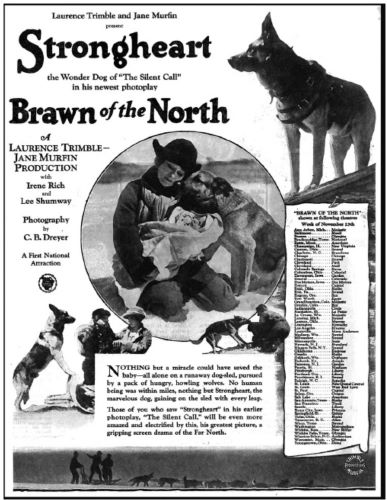
Despite the momentum these successes gave to produce more dog-themed films, when Shep died unexpectedly early in 1915, and Jean was gone, no other canine actors immediately took similar roles. The economic devastation that World War I dealt to the European film industry sent Trimble back to the United States to look for film work and a new dog to train. In 1920 a New York dog breeder alerted Trimble to the availability of a German Shepherd (at the time also known as Belgian Shepherds, Alsatians, or Red Cross police dogs) named Etzel von Oeringen that had recently been brought to the United States from Germany. Trimble and his screenwriter wife, Jane Murfin, were impressed with Etzel’s athletic build, commanding size, and fierce visage, as well as the skills he had acquired through training. German Shepherds, previously little known to Americans, had gained a lot of publicity in newspapers and newsreels during the war, serving both the Allied and Axis armies as canine guards, scouts, messengers, and attackers and helping the Red Cross as rescuers. Shepherds were not cute, cuddly pets but strong, sharply sensed working dogs and snarling, lethal weapons. Etzel had been thoroughly trained as a military dog to jump, chase, and attack; but to become a film performer who could patiently interact with adults and children and perform the kinds of stunts that film plots might call for would require a great deal of retraining. This fierce attack dog did not know how to “play,” and (of course) at first only obeyed commands spoken in German. Trimble trained the animal, which they rechristened Strongheart, to take his commands from an arrangement of mirrors “to break him of the habit of looking at his master” (Los Angeles Times, May 24, 1931, L12). Strongheart took to his lessons with alacrity and was soon able to perform an astonishing array of athletic stunts and subtle movements, all at his master’s cue. Trimble and Murfin formed an independent film production company to create feature-length films starring their dog, whose films they subsequently released through the First National studio.
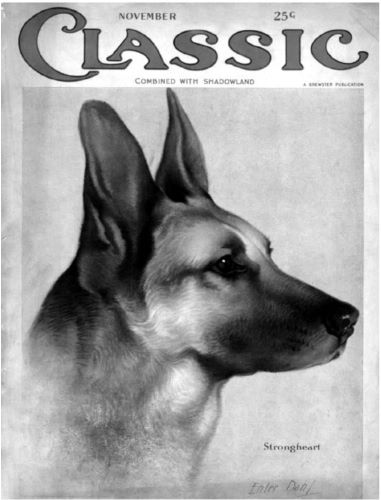
Strongheart’s first film, The Silent Call (released in November 1921), was enormously popular in both urban and small-town theaters across the United States. Rumored to have cost $100,000 to produce, it supposedly earned $1 million at the box office, playing nearly eight hundred shows at Miller’s Theater, a prominent cinema in Los Angeles (Los Angeles Times, March 26, 1922, III35;Elwood 2010, 63, 80). Film critics commented excitedly on the novelty of a dog’s playing the leading role in a feature film with the aplomb of a Hollywood actor. The Chicago Tribune reviewer noted “the remarkable, in fact almost uncanny intelligence and dramatic performance contributed by him. Never for a moment does the beholder feel the director telling this wonderful dog what to do or how to do it, never for a moment do we feel that it is a trick” (“Introducing a Canine Hero Who Can Act,” Chicago Tribune, April 12, 1922, 24). Others claimed Strongheart’s performance ranked him with Hollywood’s current greatest romantic leading men and action stars. “He does all the things that human heroes of melodramas are supposed to do,” a review in the Atlanta Constitution stated; “He looks handsome—a good deal handsomer than Wallace Reid. He fights bravely—and a good deal more realistically than William S.Hart. He loves family—and decidedly more naturally than Eugene O’Brien. And he hates bitterly—and to a good deal more purpose than any movie actor we’ve ever seen, because in the end he drowns the object of his hatred after practically chewing him into ribbons.” The review concluded, “The greatest actor that the screen has produced is a dog, and he is the greatest actor because he acts just exactly as a dog would act under given circumstances” (Atlanta Constitution, February 14, 1922, 7). Strongheart’s portrait was even featured on the cover of Motion Picture Classic, the most elegant American movie fan magazine, with a profile article, penned by Trimble, detailing the Wonder Dog’s daily training and keen emotional and psychological connections with his human handlers (November 1923).
Despite the huge success of Strongheart’s first film, his fame was not immediately exploited by featuring him in a constant round of follow-ups, the way that major Hollywood studios were doing with human stars. Trimble and Murfin produced Strongheart’s films independently with their own money, rather than with the larger resources or factorylike pressures of a large film studio, so Strongheart appeared in only one full-length film per year. With only five features to his credit, Strongheart’s career would be further impeded when Trimble and Murfin divorced in 1926, breaking up their partnership (Elwood 2010, 87).Strongheart’s outstanding performances created a new fascination among the public with dog heroes, however, and other Hollywood studios rushed to cash in on the trend and to capitalize on public interest in cinematic canines; they hastily produced their own outdoor adventure films set in the snowy Northwest or on the rugged frontier featuring not cute, huggable pets but big, fierce, wild wolves and athletic, loyal sled dogs.
Such an opportunity was how Rin Tin Tin, another German Shepherd brought over from France by Lee Duncan, a World War I veteran, entered motion pictures in 1922. Every single “fact” about Rin Tin Tin’s life is encased in layers of fanciful invention spun by Lee Duncan or the Warner Bros. publicity department, and it has been tempting for authors to fall prey to them. Rin Tin Tin biographer Ann Elwood (2010) cannily describes Duncan as “like the Wizard of Oz . . . a man who hid behind a projection of himself ” (3–4). Even the heroic story Duncan spun about rescuing a litter of pups from a bombed out French kennel (Orlean 2011, 11, 29) and discovering the remarkable dog’s potential was a significantly embellished tale of actual events. A Los Angeles Times article of October 1919 on an upcoming kennel show already falsely elevates the young Rinty’s status to “famous war dog” but quotes Lt. Lee Duncan as saying that he and six soldiers had captured a German Shepherd they named Fritz from a German trench at Thiancourt, France, and mated him with another dog captured in Belgium. In this article Duncan said it was Fritz who was found, sorely wounded, abandoned by fleeing German troops and lying beside the bodies of eleven other dogs that had been killed by an exploding shell; in later stories Duncan claimed it was Rinty whom he found in the bombed-out kennel. Here Duncan states that Fritz was made mascot of a company of U.S. soldiers at Toule, and with the female Shepherd produced a litter of pups. Duncan named the pup Rin Tin Tin after the little good luck dolls made by French women and sold for charity. Duncan then said that he secured a special permit from the French government at Bordeaux to bring the young Rin Tin Tin and a sister back to the United States and that now Duncan was exhibiting Rinty at dog shows (October 13, 1919, II2).
No matter what stories Duncan dreamed up, there was no denying that Rinty was intelligent, handsome, and a quick learner, with remarkable athletic abilities to run and to jump to second-story heights. After training Rinty and taking him to perform at dog shows, the Southern Californian Duncan soon connected with filmmakers looking for stunt dogs. Three-year-old Rinty’s first major film role apparently came when Duncan convinced a Warner Bros. studio crew that this Shepherd could perform better than the underperforming faux “wolf ” they were struggling to use in a low-budget film, The Man from Hell’s River (1922). Rinty was subsequently featured in the studio’s snow country adventure Where the North Begins (1923) (with a script written by Duncan), which was a big box-office hit (Elwood 2010, 64). The struggling studio benefited substantially from its new canine star and soon gave him top billing in its trade journal advertisements; Hollywood mythmakers anointed Rin Tin Tin “The Dog Who Saved Warner Bros.” Rinty had a longer and fuller career than Strongheart, as he appeared in twenty-four feature films at Warner Bros. in the 1920s compared to a half-dozen Strongheart vehicles. Rinty’s fame was also bolstered by Duncan’s penchant for embellishing every story about himself and his dog with layers of myth and bravado.
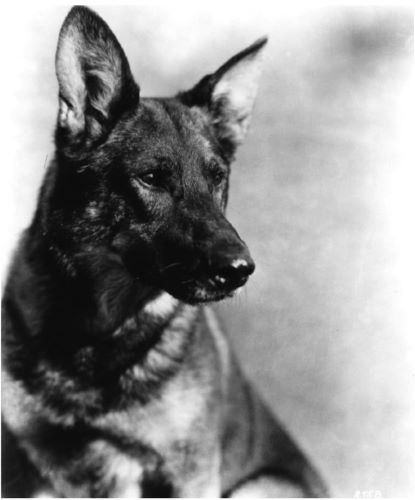
Strongheart’s and Rinty’s successes led every studio to have its own performing dog or two on the roster; there were more than two dozen dog star wannabes, mostly German Shepherds, that appeared in Hollywood films of the1920s. But none had the lasting reputation of Strongheart or Rinty—some, like Peter the Great, were talented animals whose careers were prematurely cut short by death, while other canines gave very mixed performances. A reviewer noted of an FBO-released film The Outlaw Dog (1927) that FBO’s dog hero, Ranger, could actually read signs and knew how to flag down a passing train (Variety, June 8, 1927, 19), but in Breed of Courage, appearing five months later,the reviewer decided that “Ranger is not a good actor. . . . The heavy practically drags the dog toward him instead of the animal attacking, in several cases the menace falls to the floor, pulling the dog down on top in semblage [sic] of a fight” (Variety, November 2, 1927, 25).
Movieland’s Perfect Stars
Critics reviewing dog hero films regularly singled out the canine stars’ intelligence and acting skills for comment. Reviews made the distinction that Strongheart was not merely a “trick dog” that could perform several discrete stunts but an “actor” who could perform a variety of scenes, moods, and actions. They noticed that Strongheart (and subsequently Rinty) seemed to express emotion through his eyes, facial expressions, and body movements. As the Chicago Tribune’s review of Strongheart in The Silent Call (1922) noted, “The dog is not a trick animal. He doesn’t walk on his forefeet or fry pancakes for breakfast. He’s just an extraordinarily intelligent creature with a pair of eyes that go to your heart and fangs long and sharp enough to reach it. Who is a picturesque figure against a background of magnificent scenery” (April 12, 1922, 24).
Of Rin Tin Tin’s early film Where the North Begins, the Boston Globe reviewer claimed that although his acting skills were not quite to the level of his canine movie rival,
He [Rinty] is a remarkable animal, with splendid eyes and ears, and he seems to be wondering what all this acting is about. One minute he is encouraged to tear up the child’s clothes, and the next he is made to slink out before the camera. If such a dog is angry, he is really angry, and there’s no acting about it. If he wants something, he wants it. When Gabriel Dupre, played by Walter McGrail, is supposed to lash the dog with a whip, it is accomplished without one seeing the dog. It would have been more effective to have him show that he was going to whip the dog and leave the set with the whip, instead of apparently lashing the floor.
December 24, 1928, 2
The reviewer also claimed that Rinty “enacts so many different moods that itis difficult to believe that one dog could play throughout the film. He can look like a savage wolf one minute. The next he plays with a little Indian child and wears an almost silly smile when he does his antics.”
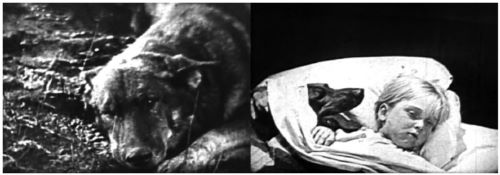
The Los Angeles Times noted that “Rin Tin Tin [in Tracked in the Snow Country (1925)] is an expressive young actor, and the scene in which he lies at the feet of the man who intends to shoot him is quite without parallel in dog pictures. In fact in the moments when he is standing, or lying still and just looking, the famous dog is far better than in the more active scenes. Perhaps, Rin Tin Tin belongs to that modern school of acting, which expresses everything in the face” (May 4, 1925, 13). But emphasizing that face apparently required a little dash of Hollywood makeup. Lee Duncan claimed that Rinty’s dark-colored coat posed a challenge for filming and that the studio prevailed upon Duncan to dust Rinty with talcum powder in order to make him photograph more distinctly and to enable his expressive face and body to contribute further to his performances (ABC publicity sheet for “Adventures of Rin Tin Tin,” 1954). An Atlanta reviewer praised Rinty as the consummate silent actor in Hills of Kentucky (1927), remarking that “In the action Rin-Tin-Tin does everything but speak and still the eyes and the movements of this dog do speak and speak louder than words” (Atlanta Constitution, July 4, 1927, 3).
Praise for the perceived acting talents of Strongheart and Rin Tin Tin illustrates the central importance of facial expression in silent film acting. Screen close-ups of actors’ emotion-laden eyes and faces that seemed to communicate their innermost feelings made screen performers such as Lillian Gish, Charlie Chaplin, Rudolph Valentino, and Greta Garbo internationally famous stars of the 1910s and 1920s. “Everything in film depends upon eyes,” Gish once noted.“ They tell the story better than words” (Leider 2004, 8). Screenwriter June Mathis claimed that eyes were the first thing she noticed about an actor, because they didn’t lie: “The soul that looks out of the eyes is the real you” (Leider 2004,166). As early filmmakers moved away from simply photographing a stage play from the point of view of someone sitting well to the back of a theater, and began to move their cameras in closer to capture close-ups of individual actors’ movements and facial expressions, actors, too, had to alter their methods. No longer would broad, sweeping gestures and exaggerated facial reactions of the nineteenth-century stage seem appropriate on film; instead, actors and directors developed more naturalistic and subtle ways to perform before the camera (see Pearson 1992; Staiger 1985). James Naremore (1988) documents the increasing significance to acting across the silent film period of “tiny expressive movements of eyes, face, and hands. The circumstances were just the reverse of conventional theater and everyday discourse, where movement is promoted by utterance, and where gestures either support speech or reveal latent meanings behind it. In silent movies, actors needed to make their few words rise out of their gestures, never forgetting that meaning lay in their eyes and at their fingertips”(48). With silent-film actors developing restrained, understated performances; close-ups magnifying their smallest eye movements, frowns, and gestures into expressive emotional portrayals; and film audiences now sensitized to absorb and interpret this acting style—enlarged on the big screen and surrounded by silent films’ accompanying orchestral and organ music scores—it is no wonder that film viewers would impute similar, sensitive acting skills to dog heroes and their large, expressive eyes and handsome faces.
Cultural studies scholars note that the cinematic canines in films like these are characters that possess fully formed personalities, like proper human heroes. As Pete Porter (2006) asserts, there is nothing in the filmic treatment of animals that renders it less likely that we will attribute to them the same “personhood” that we attribute to human characters. Animals, like humans, have discrete and recognizable bodies, self-motivated actions, and imagery that forces us to assume that they are thinking—for example, a close-up on the dog hero’s watching eyes. As Jonathan Burt (2002) points out, animal characters often interact with humans in film via a “shared look,” which, though it does not necessarily imply similarity of thought (or even understanding), at least links the two species as living and thinking beings (38–40,69). Burt stresses the possibility of a lack of comprehension between the species and argues that dogs demonstrate to humans “respect without understanding.” In dog hero films, however, this fact is always belied by narrative structure and context. The dog-as-hero always displays his comprehension by saving the day. The human then reciprocates with praise—“Good dog.”
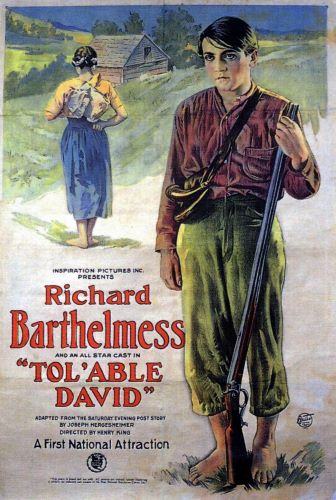
Film reviewers of the 1920s often noted that Strongheart’s and Rinty’s films put them into roles analogous to those of the decade’s leading male Hollywood stars, especially the strong, athletic, loner heroes of action films, such as swashbuckler Douglas Fairbanks and western star William S. Hart. Hart’s steely expressions, honed during his years on Broadway playing Messala the Roman warrior in Ben Hur and the title role of the famous western drama The Virginian, brought a serious resolve to his many film roles of the 1910s when he played the lone gunfighter of high morals cleaning up evildoing in the Wild West. In films like Hell’s Hinges (1916) and Tumbleweeds (1925) Hart rode alone, was never romantic or emotional, was taciturn and silent in his resolve. “Rin Tin Tin’s suffering and adventures are almost analogous to those undergone in countless films by Bill Hart and others of the school of martyred, silent, western heroes,” wrote the Atlanta Constitution reviewer (February 14, 1922, 7). And as another put it, “Rin Tin Tin shows himself to be as effective a canine actor as ever, shedding real tears when his master dies and portraying most effectively the mental torture of a poor animal pursued and hounded by those who had formerly loved him” (Variety, July 22, 1925, 32). Comparing the dog heroes to the swashbuckling Douglas Fairbanks was also high praise from critics, for Fairbanks was the 1920s’ greatest embodiment of joyful athleticism, all-American self-confidence, and go-getting personality. Like Strongheart and Rinty, Fairbanks was not primarily a romantic hero, chasing women and pursuing love (actors John Gilbert and Rudolph Valentino had a lock on those roles). The Fairbanks hero saved the damsel in distress as a mere part of saving the day—his greatest joy was to enact Zorro, Robin Hood, or D’Artagnan with energetic jousting against the bad guys and breathtaking physical stunts. Rinty was tagged “The Douglas Fairbanks of Dogdom,” with “his most notable stunts being a twelve foot jump, a broad jump clearing ten men crouched in leap frog style, and a twenty foot dive into the water to rescue a human being” (“Silver Sheet Animal Stars in High Life,” Los Angeles Times, January 1, 1924, E9). Praising Rinty’s performance in Below the Line (1925), set in southern swamplands, the Los Angeles Times reviewer expounded on Rinty’s ability to portray suffering, loyalty, and fierceness: “In the earlier sequence where Pat Hartigan, in the role of a villainous deputy sheriff, utterly breaks the brave dog’s spirit through brutality, Rin-Tin-Tin gives a remarkable interpretation of a cowardly, fear-stricken animal. He cringes at the approach of a mongrel and runs to shelter when a poodle bites at him. Later on when he senses his kind master, John Harron, and his mother, Edith Yorke, are in trouble, his old fighting spirit is aroused and he brings into action some of his scientifically-trained attributes” (December 7, 1925, A9). The reviewer concluded that the film’s climax, in which Rinty singlehandedly fights off a pack of bloodhounds to save his humans, “is probably the most vivid thing of its kind ever seen on the screen—truly a superb piece of acting, it has its human parallel in Richard Barthelmess’s fight with the hillbillies in Tol’able David,” a film famous for the physical and emotional intensity of its violent climax.
Perhaps to offset the tendency to give the dogs too much acting credit, some critics exposed the manufactured/constructed nature of the dog hero’s acting skills, such as when an Atlanta reviewer in 1923 wrote, “Acting was harder to learn and harder to teach than other stunts. Rin Tin Tin’s greatest difficulty was to learn to take orders without turning his head. His master overcame this by placing him in a room with mirrors for walls so that he could see signals in any position. Gradually he learned to understand the words without the signals. After that it was as easy to direct him as any film actor and often easier” (Atlanta Constitution, October 28, 1923, D1). In the article “Dogs of Screenland Save ‘Bad’ Pictures,” the author noted that “one of the remarkable features of these dogs is that they are often required to show every sign of devotion and love for a character in the picture, who, off stage, they have absolutely no use for, and will not even allow to pet or come near them” (Los Angeles Times, September 5, 1923, WF7). Reporters and writers began to talk to trainers about how they manipulated dogs to get the desired expressions and actions, effectively changing a discourse of acting to one of tricks. The “Dogs of Screenland” author goes on to praise and then mock Rinty’s athletic abilities as they were sometimes ludicrously employed by far-fetched melodramatic plots: “Besides being a very clever dog actor, Rin Tin Tin is a wonderful all around athlete. He will do a clear high jump over a sixteen hand horse, or a clear broad jump over ten men standing in leap frog position, chew a two inch hemp rope in half in a few seconds. Do a twenty foot dive off a bank or bridge into water and rescue a human body. He will trail a man 700 yards on a trail two hours old and retrieve a postage stamp or other small objects placed at the end of the trail” (Los Angeles Times, September 5, 1923, 11).
Nevertheless, the dog hero in the 1920s was often described in the press as “movieland’s perfect star” (Atlanta Constitution, October 28, 1923, D1). Strongheart was written about as “one motion picture star in Hollywood who has never been divorced, arrested for speeding, mentioned as a co-respondent, hailed as the screen’s most perfect lover, or been the object of a prohibition officer’s attentions”(“This Screen Actor Leads Quiet Life,” Los Angeles Times, August 2, 1925,H12). A review of Clash of the Wolves (1925) described Rin Tin Tin as “a big handsome actor, with lots of genius, and no conceit. An idol of the ladies who has no idea he’s any such thing. A star who’s popular with producers, but takes no advantage of the fact and puts his whole soul and all his intelligence into every role he plays, working hard and sincerely every minute, never cheating for the flicker of a Kleig, and who is in addition a family man who loves his wife and is good to his children” (Chicago Tribune, December 14, 1925, 23). An Atlanta reviewer noted of Rinty, “It has just occurred to me that Rin Tin Tin is one of the few movie stars about whom I have never heard any scandal. Why is it no one has thought of assuming a knowing look, and say, ‘I hear that Mrs. Joe Martin [a movie chimpanzee] and Rin Tin Tin are being seen everywhere together.’ Maybe everybody is afraid the know-it-all of the group would promptly come forth with, ‘But you’re entirely wrong. It’s Strongheart she’s intrigued with’”(Atlanta Constitution, May 9, 1926, F9). Newspaper reporters also found amusement in conducting tongue-in-cheek “interviews” with the canine stars in which the dogs spoke English. Strongheart gave an extended interview to the Los Angeles Times expressing sorrow over the unreality of Hollywood moral values. For the same paper, Rinty dished on his human female film co-stars, proclaimed that the movie business is really tough and that actors live “a dog’s life”(Los Angeles Times, January 20, 1924, F11; March 21, 1926, B14).
The downside of the stardom of dog heroes was experienced not only by the often grueling work and lack of normal activities, especially rest and play, that the canine stars endured (see Elwood 2010). For human actors, writers, and directors there was the mortification of having to play sidekick to a dog. Darryl Zanuck, who got his start in Hollywood writing scenarios for Rinty films, for years expressed how much he had hated doing it (Mosley 1984, 67–71). While Rinty’s endeavors brought in needed box-office dollars, they were formulaic adventure films to script. After appearing in three films with Rinty, actor Jason Robards (the dramatic-school-trained father of the later Hollywood star) complained, the tone only partly tongue-in-cheek, to the Los Angeles Times:
It was disheartening. I went to the powers that be. “Mr. Warner and Mr. Warner,” I said, “Is that nice? What have I done that I should deserve such treatment? Rinty is as nice a dog as ever barked up a tree; Rinty is a man’s pal; Rinty is a great deal more than that. But gentlemen, enough is enough. I have a wife and kiddies to support. I want their faces to light up when I come home o’nights, and when they say to me, Daddy, what are you doing these livelong days? I want to be able to answer, I am not, praise be, acting with Rin Tin Tin.”
Los Angeles Times, July 31, 1927, C13
Warner Bros. mercifully tore up Robards’s film contract and let him go back to the stage.
Dog Op’ries
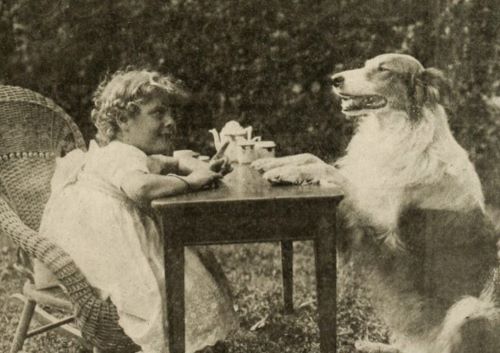
Dog hero films of the 1920s (dubbed “dog op’ries” by humorist Will Rogers and other wits) did have pretty standardized plots, primarily following the genres of the western or the north-woods outdoor adventure film (Los Angeles Times, February 18, 1924, A7). The dog hero was often introduced in the story as a mixed breed or mixed species—part wolf and part domesticated dog—to frame a story of the dog hero’s struggle to decide his path in life, whether to be wild beast or friend and helper of humans. Sometimes he was an orphaned puppy adopted into a wolf pack, or a wolf or wild dog that is transformed through an encounter (or a mythic experience) to gain a close connection to humans. He has to overcome his wild animal urges, but sometimes they emerge to help him be an even fiercer fighter than any regular dog might be. Cultural studies scholars think of animals like these cinematic dog heroes as “threshold creatures.” In her study of dogs in human cultural history, Susan McHugh (2004) asserts that dogs are often narratively used as markers of liminal spaces, being positioned “between nature and culture,” between childhood and adulthood, or—as in the classic tale of Cerberus, the multiheaded mythological dog who guards the entrance to the underworld—between life and death (41, 145). Recall, of course, the Thanhouser story A Dog’s Love for a filmic example of the latter concept, as Shep was placed between the worlds of the living and the dead as he literally lies on a grave. Jonathan Burt (2002) similarly argues that, in modernity, animals in general are often used as the narrative link between “the archaic and the modern” (192). This narrational theory can also be extended into the visual structuring of scenes. For example, dogs often act almost as mirrors—placed directly between linked characters and encouraging the viewer to see the parallels and divergences between the characters on either side. Examples can be found in both the 1914 Thanhouser film Shep’s Race with Death (in which Shep is constantly positioned between twin girls, one beloved and the other not), and the 1925 proto werewolf film Wolfblood (in which a hero and a villain—both suspected of impure blood—are linked). As such a device the dog marks and crosses boundaries—most commonly the boundary between the wild and the domestic.
McHugh’s theories also allow us to discuss dogs in their particularity, as she additionally asserts that various breeds go through “cycles of social favor.” The breeding of dogs, a practice that is only about three hundred years old, has created a culture in which “breed secures certain meanings for dogs.” McHugh’s example is the collie (the breed of the later star Lassie), which she says has a recent breed meaning of “loyalty despite class.” Lassie chooses the love of her original human family over the wealthy man to whom she has been sold. Additionally, the notion of breed “purity” results in visual stability, as a particular breed evolves an iconic representation that then holds these assumed meanings (McHugh 2004, 58, 66, 90–94,104–106,114–115,128).
The wild dog / wolf scenes in dog hero films of the 1920s allow Strongheart and Rinty to be filmed running across rugged landscapes, jumping over rocks and downed trees, leaping across chasms, majestically posing on the top of rock outcroppings to survey their territory, and leading their packs. Whether he starts as wild or is introduced as a sheepherder or ranch dog, the dog hero is almost always a working dog. No lounging by the fireplace eating dog biscuits and being pampered, or even simply petted, for him. The dog hero has a useful and important place in the ranch or northwestern society, protecting sheep from predators, guiding northwest hunters or tradesmen, serving as companion to a rugged rancher or outdoorsman. The star imagery of both Strongheart and Rin Tin Tin, and several of their film plots, also sometimes involved narratives of wartime trauma during World War I and the strong, fierce characteristics of the breed used in wartime.
The dog hero must also engage in several fierce battles, struggling to defeat villainous men, bad dogs, or even, in one film, an evil condor that has been slaughtering lambs. The dog hero is a lone fighter; no wonder film reviewers compared him to taciturn western star William S. Hart and the athletic loner Douglas Fairbanks. To further milk audiences’ anxiety and concern for their dog hero, Rinty’s films often featured him having to struggle and make several attempts to achieve his most spectacular physical stunts. In Find Your Man (1924) Rinty plays a dog (Buddy) who a reviewer notes is “the only witness to a cowardly shooting of his master.” The villain is afraid the dog will rat him out and orders someone to kill him; instead, the henchman binds and gags Buddy, planning to take him off and sell him, but the dog escapes and rescues his master at the courthouse trial. “Outside one sees the indomitable and faithful Buddy endeavoring to leap over the door and through the transom to the court scene. He tries once and fails. Then a second time without success. After a long run and a terrific leap he gets up and bounds into the crowded room. Horror strikes the real murderer as he sees the four footed hero springing at him with a nasty snarl and bared teeth” (New York Times, September 23, 1924, 26).
Sometimes the dog star’s heroics surely stretched the viewer’s credulity, especially as the “dog op’ry” genre wore on. The reviewer for the New York Times termed Rinty’s 1924 melodrama The Lighthouse by the Sea “lurid” but continues in admiration for the dog if not the plot:
But the dog’s big moment is toward the final chapter when somebody has to light the lighthouse lamp. Dorn is gagged and bound, the heroine has been kidnapped, and the old blind father has been injured by ruffianly bootleggers. Even Rin Tin Tin has been tied up in a strong bag. He gnaws his way free, carries a box of matches over to Dorn who is hung up struggling. The matches can just be touched by the hero’s feet and so he manages to ignite some of them, Rin Tin Tin helps his master still further, and then, after Dorn has caused oil-saturated waste to catch fire, the dog scampers up the lighthouse steps with the blazing waste and eventually puts it down the great cylinder, and the streak of light is seen by the revenue cutter. This film is worthwhile seeing for the amazing actions of Rin Tin Tin.
December 29, 1924, 11
The two dog heroes did have softer sides to display, and here their reported acting skills came to the fore. They nuzzle a human baby or a lamb, they are instantly docile and friendly around sweet frontier heroines, and they show tender love by licking the face of a wounded hero. The dog hero shows love and compassion, worry, and also fear, longing, and guilt, and confusion when they are unjustly accused of doing evil, such as being accused of killing a baby or a lamb. When the northwestern trapper goes to whip Rinty for supposedly killing a baby in Where the North Begins, the animal’s large dark eyes and face show such sadness, mutely appearing to ask, “Why am I being falsely accused?” (Audiences never seemed to wonder about how such “expressions” were elicited; for more on [often punitive] dog-training methods in this era see Elwood 2010.)
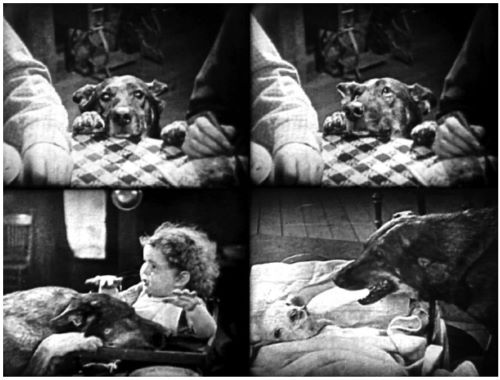
The dog hero film genre, with its thrills and strong emotions, appealed to a wide range of audiences that urban critics sniffed at as “unsophisticated”—children and the small-town audiences who appreciated westerns and action films, but also female audiences who enjoyed feeling sentimental about faithful dogs. Exhibitor trade journals like Variety warned theater owners that dog hero films did not draw well at big city picture palaces (April 14, 1926, 27). New York Times reviewer Mordaunt Hall made especial note of the large numbers of children and mothers in the audience of the Warner Theater for Rinty’s The Night Cry (1926) and their absorption in the action:
One little fellow with curly, golden hair clutched the rail, fearing to let go his hold even to clap his little hands. At the same time he wished to let Rin-Tin-Tin know that he appreciated the dog’s heroism. So he gleefully yelled his shrill appreciation. There were groans when an eagle swooped down on a child and supposedly carried it away to the rocky heights, and the youngsters thought that neither Rin-Tin-Tin nor the woman would ever get free in time to rescue the little girl. The mother was bolted in a shack, the dog was tethered to a beam, and struggle as he would the rope would not break. It was an awful period to the children, and their delight was boundless when simultaneously the mother managed to slip the bolt on the door and Rin-Tin-Tin broke away from his harness.
April 7, 1926, 26
Exhibitor trade journal reviewers were also often dismissive of dog hero films and their audiences, except when noting the positive box office returns. Of one Rinty vehicle, A Race for Life (1928), the Variety reviewer noted that “enjoyment of a picture such as this requires a naive and sentimental disposition plus a regard for dogs.” The reviewer suggested that this film might be suitable for a double bill in an urban theater, but in small towns “the dog opera can and does stand alone, unaided and unapologetic. . . . There is enough heart tug of a sort to have the kids whistling at Saturday matinees” (February 1, 1928, 28).The Atlanta Constitution reviewer intimated that Rinty in a romantic setting could inspire women in the audience to swoon as if he were Valentino or John Gilbert: “Paired with a female dog of exceeding beauty, Rinty brings the sighs from the feminine portions of his audiences, and later in the picture, when three puppies are suddenly brought on the scene, the exclamations are decidedly audible”(October 5, 1926, 20). As the Chicago Tribune reviewer baldly stated in the headline for its review of Rinty’s The Night Cry, “Rin Tin Tin will make you weep, but you’ll enjoy each sob” (Chicago Tribune, May 12, 1926, 39).
Moreover, film reviewers argued over which was the best use of the dog hero: to be the main focus of the film or to have his doings interwoven with a plot about humans. On one hand, some reviewers, like one at the Los Angeles Times, criticized the film White Fang (1925) for having Strongheart play too minor a role ( June 22, 1925, A7). Variety’s critic, on the other hand, noted that “the most successful pictures featuring Rin Tin Tin, Strongheart and other dog actors have not played up the canine side too strongly, but have introduced it merely as interwoven with a plot of human beings that holds a good deal of interest in itself. Tracked in the Snow Country makes the mistake of focusing the spotlight on its animal actors, and its star in particular, to the almost total exclusion of the men and women in the cast. The result seems to be a certain amount of monotony”( July 22, 1925, 32).
Although apparently none of Strongheart’s films from his prime years has survived to be restored for viewing today, a half-dozen of Rinty’s silent films still exist. For contemporary audiences who can look past the cheaply made sets, sometimes wooden acting of the humans, and often formulaic plots, Rinty is still a vibrant performer. He is portrayed as intelligent—opening doors, cleverly hiding in hollowed logs and under piles of clothes and in children’s beds, pointing out a well-stocked fishing hole. He is athletic—climbing trees, boulders, and mountains; racing across fields; swimming in swift rivers. He battles his foes fiercely, tumbling through the air locked in mortal combat with a condor, even when one can see that the pack of wild dogs attacking him might be hand puppets pushed into his face. The viewer is drawn to Rinty’s point of view to sympathize with and root for him, such as when he expresses worry and sorrow—he pleads for understanding with his huge sad eyes or looks scared and sad as he grovels on the ground before the master who is about to shoot him. He does cute things to demonstrate his gentleness and sentimentality, nuzzling a human baby in its crib, feeding a lamb from a baby bottle and licking its face, and providing friendship to a lonely crippled child. The dog hero holds up well as a silent film actor.
From Career to Legend
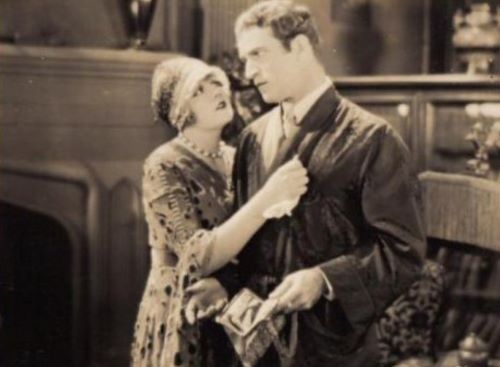
In 1927 critics began to notice that Rinty was getting on in years, and that his stunts weren’t quite as astounding as in his earlier days:
Considering his age, Rin Tin Tin displays wonderful activity in his new film. . . . If this animal was born in the French trenches during the war he is about 9 years old, roughly the equivalent of a man of 63. There are not many men of that age who could go through what Rin-Tin-Tin does in this screen adventure. He is like a d’Artagnan of dogs, and he seems to have many a day in this production. He is cunning enough to keep quiet when the villain is searching for him, and he not only evens up scores with this rogue but saves the heroine from going to her death over a cataract. . . . It is evident that Rin-Tin-Tin is extraordinarily sagacious. He seems to enjoy the work, whether it is diving into the river, hiding in a hollow tree trunk or getting into a barrel of water and ducking every time Ben Harley turns his head in Rin-Tin-Tin’s direction.
New York Times, March 2, 1927, 29
For a confluence of reasons, in the late 1920s the dog hero’s stardom dimmed. Both Strongheart and Rinty were elder statesmen now, each over seventy in human years, and they could no longer carry out the strenuous action sequences of their prime days. Stunt doubles handled more of the action. Strongheart had been semiretired since Trimble’s divorce left the dog in Murfin’s hands; he appeared in a relatively small role in one more film, The Return of Boston Blackie (1927), and unfortunately this, the sole film available for viewing today, does not show the tired old warrior to advantage. In contrast, Rinty was still a prominent Warner Bros. star, and he made a cameo appearance in the studio’s first all-talkie extravaganza The Show of Shows (1929), appearing briefly as a master of ceremonies in a color sequence, introducing with his barks a Chinese fantasy musical sequence in which Myrna Loy impersonated an oriental dancer.
The new technology of sound reproduction, added to silent film in 1927, brought waves of upheaval to Hollywood filmmaking. “Talkies” necessitated that actors speak and sing as well as bark; they had to have voices that pleased the microphone and seemed to match their star personalities (Rinty had no reported problems with his voice tests). But they also had to memorize dialogue and emote through long scenes without the constant coaching and intervention of their directors, which was a significant problem for dog actors who needed to take commands from their trainers. Duncan claimed to be able to overcome that difficulty for Rinty by means of silent commands and other tricks. But harder to get around was the public’s perceived weariness of westerns, northwestern snow pictures, and lone, silent athletic heroes. William S. Hart had retired, and Douglas Fairbanks was not far behind him. As the Depression deepened in the 1930s,the public seemed to want musicals and fast-paced urban stories of gangsters and cops. The day of the dog hero seemed to be over. In December 1929 Warner Bros. even released the aging Rinty—and therefore Lee Duncan—from his contract (Variety, January 8, 1930, 80). The formerly popular western and snow-countryaction genres were reduced to Saturday afternoon children’s showf odder, and Strongheart and Rinty moved over to the Poverty Row studios to make low-budget serials. Strongheart’s career ended in 1929 when he reportedly fell against a hot studio light while filming and developed a tumor and died at age thirteen (Los Angeles Times, June 25, 1929, A3). Rin Tin Tin’s career continued with several more low-budget sound films at the Mascot Studios and a twelve-part serial, The Lightning Warrior (1931). Duncan still performed with Rinty in personal appearances at theaters around the country, and explored new media forms; Rinty was featured in a series of popular radio programs geared to children in the early 1930s, a fifteen-minute weekly drama on the NBC Blue Network for which Rinty purportedly barked his own lines in the drama and the commercials (his part was really performed by a sound effects crewman)(Chicago Tribune, March 8, 1931, K9). But his career could not last forever, and Rinty died in 1932, at the ostensible age of fourteen (but not in the arms of Jean Harlow). Both dog hero deaths made the front pages of newspapers across the United States.
Fame, however, was not finished with these two talented movie stars. Strongheart and his mate Lady Jule produced a number of puppies whose line continues, although they are not actors. Strongheart has continued to be the face and namesake of Strongheart canned dog food, his face gracing product cans down to the present day. Larry Trimble left film directing in 1926 to spend the rest of his career training seeing-eye dogs; he died in 1954 (Variety, February10, 1954; Gallo 2002). In 1939 J. Allen Boone published a book called Letters to Strongheart chronicling his deep emotional connection and communication with the dog during life (he had been a friend of Trimble and Murfin’s). After Strongheart’s death Boone began writing the dog letters, and these he published as contemplations of the survival of the dog’s soul after death and the unconditional love of animals for the humans who are willing to share their lives with them and learn from them. Boone wrote of the enduring qualities of Strongheart’s soul that transcended the mere physical body: “goodness, loyalty, understanding, enthusiasm, fidelity, devotion, sincerity, nobility, affection, intelligence, honesty, confidence, strength, gentleness, happiness, gratitude, appreciation, trustworthiness, endurance, integrity, humility, purity, unselfishness, fearlessness,[and] love” (Boone 1939/2007, 4–6).The book and its sequel, Kinship with All Life (1954/1976), have been reprinted many times and remain classics of the Spiritualist faith.
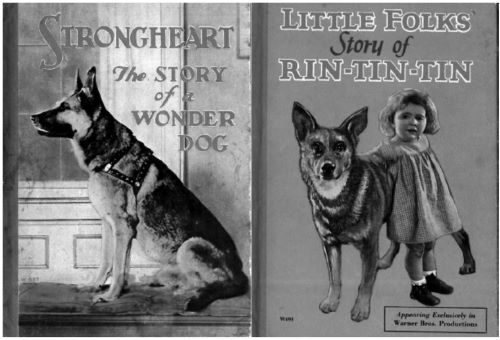
Lee Duncan, ever the promoter, continued Rin Tin Tin’s exploits, first through the dog hero’s son Rin Tin Tin Jr., who continued to “appear” on the radio, in person, and in movie serials throughout the 1930s. Rinty IV (whose coat was a much lighter color than his great grandfather’s and so whose direct relation to the original might be suspect) found television fame in a popular ABC series The Adventures of Rin Tin Tin (1954–1959),which featured standard western plots enlivened by the addition of Rin Tin Tin’s daring deeds on the frontier with the 101st Cavalry at the side of his boy companion, Rusty (LeeAaker). Rinty’s career was lovingly parodied in Paramount’s 1976 comedy Won Ton Ton: The Dog Who Saved Hollywood, which features cameo appearances by dozens of old movie stars from the 1920s, 1930s, and 1940s. Seventy years after his death, Rinty remains a subject of fascination; he has been the subject of two recent biographies. Ann Elwood’s Rin-Tin-Tin: The Movie Star (2010) focuses on meticulous research into the facts rather than the legends about Rinty’s film career and examines the details of his training, adding fascinating insights that reconstruct how an intelligent dog could be made to seem to express such a range of emotions and physical abilities in the magical medium of silent film. Susan Orlean’s Rin Tin Tin: The Life and the Legend (2011) is concerned primarily with Duncan’s penchants for storytelling and heroic mythmaking, and her book dwells more on ruminations about the evolution of the place of dogs in human society over the past century and on her own tangential journeys to connect with the quirky characters revolving around Rinty’s legacy rather than on unpacking the veracity of the myths and stories themselves.
Strongheart and Rin Tin Tin, the best known of the dog heroes of Hollywood films in the 1920s, left significant legacies in American film and popular culture. They were bona fide movie stars, representing admirable celebrity behavior in press coverage and earning large sums for both their trainers and the production companies for whom they toiled. They won the great loyalty and affection of film audiences in the United States and around the world. They were successful “spokes dogs” and brand symbols for consumer products, pitching shoe polish, children’s books, and fresh fruit, as well as dog food. Their highly praised acting and charismatic film personas taught the film industry that nonhuman actors could successfully carry a film narrative, paving the way for future generations of featured performers such as Asta and Lassie, along with Rin Tin Tin IV on television in the 1950s. We can never know how they felt about their work in the movies, no matter how many “letters” we might write to them; but for better or for worse, Strongheart and Rin Tin Tin live on in the dreams of anyone who wants to believe that someday, somewhere, a dog would jump off a cliff to save them or would willingly give its life for a human “master.”
Appendix
Bibliography
Affiliate disclosure: Amazon links on this site are paid links. As an Amazon Associate I earn from qualifying purchases.
- Basinger, Jeanine. 2000. Silent Stars. New York: Knopf
- Boone, J. Allen. (1939) 2007. Letters to Strongheart. Whitefish, Mont.: Kessinger.
- ———. (1954) 1976. Kinship with All Life. New York: Harper and Row
- Bowers, Q. David. 1997. Thanhouser Films: An Encyclopedia and History. Portland, Ore.: Thanhouser Film Associates. CD-ROM.
- Burt, Jonathan. 2002. Animals in Film. London: Reaktion.
- Elwood, Ann. 2010. Rin-Tin-Tin: The Movie Star. Lexington, Ky.: CreateSpace
- Leider, Emily W. 2004. Dark Lover: The Life and Death of Rudolph Valentino. New York: Faber and Faber.
- ———. 2012. Myrna Loy: The Only Good Girl in Hollywood. Berkeley: University of California Press
- McHugh, Susan. 2002. “Bringing Up Babe.” Camera Obscura 17 (1.49): 149–187.
- ———. 2004. Dog. London: Reaktion.
- ———. 2011. Animal Stories: Narrating Across Species Lines. Minneapolis: University of Minnesota Press.
- Mosley, Leonard. 1984. Zanuck: The Rise and Fall of Hollywood’s Last Tycoon. Boston: Little, Brown
- Orlean, Susan. 2011. Rin Tin Tin: The Life and the Legend. New York: Simon and Schuster
- Naremore, James. 1988. Acting in the Cinema. Berkeley: University of California Press.
- Porter, Pete. 2006. “Engaging the Animal in the Moving Image.” Society & Animals 14 (4): 399–416.
- ———. 2010. “Teaching Animal Movies.” In Teaching the Animal: Human-Animal Studies Across the Disciplines, edited by Margo DeMello, 18–34. New York: Lantern
- Pearson, Roberta. 1992. Eloquent Gestures: The Transformation of Performance Style in the Griffith Biograph Films. Berkeley: University of California Press.
- Rothfels, Nigel, ed. 2002. Representing Animals. Bloomington: Indiana University Press.
- Slide, Anthony. 1987. The Big V: A History of the Vitagraph Company. Rev. ed. Metuchen, N.J.: Scarecrow
- Staiger, Janet. 1985. “The Eyes Are Really the Focus: Photoplay Acting and Film Form and Style.” Wide Angle 6 (4): 14–23.
Chronological Filmography
- Where the Winds Blow (Laurence Trimble, December 1910). Jean the Dog.
- Playmates (director unknown, February 1912). Julia Swayne Gordon, Hazel Neason, Florence Foley, Alec B. Francis, Edith Halleran, Jean the Dog.
- A Dog’s Love ( Jack Harvey, October 1914). Shep the Dog, Helen Badgley, Arthur Bauer, Ethyle Cooke.
- Shep’s Race with Death ( Jack Harvey, November 1914). Shep the Dog, Mrs. Whitcove, J. S. Murray.
- The Silent Call (Laurence Trimble, November 1921). Strongheart the Dog, John Bowers, Kathryn McGuire.
- The Man from Hell’s River (Irving Cummings, May 1922). Irving Cummings, Eva Novak, Wallace Beery, Frank Whitson, Rin Tin Tin.
- Where the North Begins (Chester M. Franklin, July 1923). Clair Adams, Fred Huntley, Walter McGrail, Pat Hartigan, Myrtle Owen, Rin Tin Tin [as Rin-tin-tin].
- Find Your Man (September 1924, Malcolm St. Clair). June Marlowe, Rin Tin Tin, Eric St. Clair.
- The Lighthouse by the Sea (Malcolm St. Clair, December 1924). William Collier Jr., Rin Tin Tin, Louise Fazenda, Charles Hill Mailes.
- White Fang (Laurence Trimble, May 1925). Theodore von Eltz, Ruth Dwyer, Matthew Betz, Walter Perry, Strongheart the Dog.
- Tracked in the Snow Country (Herman C. Raymaker, July 1925). Rin Tin Tin, June Marlowe, David Butler, Mitchell Lewis.
- Below the Line (Herman C. Raymaker, September 1925). John Harron, Rin Tin Tin, June Marlowe, Pat Hartigan.
- Clash of the Wolves (Noel M. Smith, November 1925). Rin Tin Tin, Nanette [dog], Charles Farrell, June Marlowe.
- The Night Cry (Herman C. Raymaker, February 1926). Rin Tin Tin, John Harron, June Marlowe, Gayne Whitman.
- Hills of Kentucky (Howard Bretherton, February 1927). Rin Tin Tin, Jason Robards Sr., Dorothy Dwan.
- The Outlaw Dog ( J. P. McGowan, May 1927). Ranger the Dog, Helen Foster, Rex Lease.
- Breed of Courage (Howard M. Mitchell, August 1927). Sam Nelson, Jean Fenwick, Stanton Heck, Ogoma [dog].
- The Return of Boston Blackie (Harry O. Hoyt, August 1927). Strongheart the Dog, Bob Custer, Corliss Palmer.
- A Race for Life (D. Ross Lederman, January 1928). Rin Tin Tin, Virginia Brown Faire, Carroll Nye.
- The Show of Shows (John G. Adolfi, December 1929). Frank Fay, William Courtenay, H. B. Warner, Hobart Bosworth, John Barrymore, Mary Astor, Richard Barthelmess, Noah Beery, Sally Blane, Monte Blue, Jack Buchanan [et al.], Rin Tin Tin.
- The Lightning Warrior (Benjamin H. Kline / Armand Schaefer, 1931). Rin Tin Tin, Frankie Darro, Georgia Hale, George Brent.
- Won Ton Ton: The Dog Who Saved Hollywood (Michael Winner, 1976). Dennis Morgan, Shecky Greene, Phil Leeds, Madeline Kahn, Teri Garr, Bruce Dern [et al.], Augustus von Schumacher [dog].
Originally published by Arcade: Literature, the Humanities, and the World, 03.27.2014, under the terms of a Creative Commons Attribution-NonCommercial-ShareAlike 3.0 United States license.
About the Author