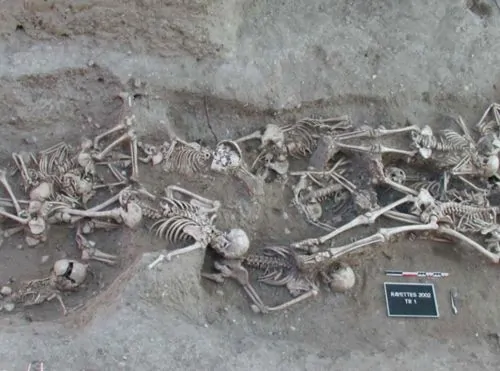
If the Black Death had killed nine Europeans in ten, abundant land might have offered little security. Europe’s future would depend on whether surviving communities could rebuild.

By Matthew A. McIntosh
Public Historian
Brewminate
What would plentiful land be worth if there were too few people left to harvest it? The Black Death, which reached Europe in 1347, killed an estimated 30–60 percent of its population over the following several years. The losses varied considerably between regions, and further outbreaks followed. Enough people nevertheless survived to keep many major institutions operating and eventually rebuild commerce. For this scenario, the divergence begins in 1348: unusually destructive outbreaks continue in close succession, striking even districts that historically escaped the worst losses, until plague has killed roughly nine Europeans in ten by 1355. Recurring epidemics are historical; that cumulative mortality is an extreme counterfactual assumption. Sustaining transmission as settlements emptied would itself be a difficulty. The question is whether enough organized communities would remain to turn survival into recovery.
The first problem would be getting through the next harvest. A population reduced to one-tenth would need much less food, but deaths would not leave every surviving household with a conveniently balanced share of resources. Some villages might retain enough families to cultivate their best fields; others might lose the people who knew how to operate a mill or maintain local waterworks. During the epidemic, frightened flight and interrupted transport could separate survivors from existing stores. Livestock would provide food in places where animals remained accessible, and shifting from grain cultivation to pasture could eventually reduce labor requirements. Those adjustments would take time. In badly damaged districts, hunger might follow plague despite an abundance of vacant farmland. The most promising response would probably be concentration: scattered survivors moving into viable settlements, bringing usable equipment and abandoning land they could no longer work. Recovery would depend heavily on whether neighbors could cooperate before essential supplies ran out. The dead would leave possessions behind, but ownership could not substitute for the labor and relationships that made those possessions useful. A functioning village could offer greater security than possession of an entire deserted estate.
Scarce labor would still give some survivors bargaining power, but the familiar account of higher wages after the Black Death would become harder to apply. A worker could demand better terms where competing employers remained capable of paying. In a district with almost no functioning market, an impressive nominal wage might buy little. Landlords would also face a choice between concessions and coercion. In actual England, the Statute of Labourers of 1351 attempted to restrict wages and compel labor, showing that elites did not simply accept the new balance of supply and demand. Under our scenario, similar measures might become more desperate, although enforcing them would require surviving officials and armed followers. Some communities could gain considerable independence because their lords lacked that capacity. Elsewhere, access to protection or a working mill might allow a powerful survivor to impose harsh obligations. Greater mortality would produce no uniform march toward freedom.

Kings would inherit a comparable problem on a larger scale. Claims to territory could survive on parchment while the tax base supporting them disappeared. Maintaining castles and supplying armies would become difficult, especially where deaths had scattered the officials who collected revenue. Some rulers might lose effective control over distant provinces; others could consolidate authority around relatively intact towns. A strong regional government might even grow more intrusive, organizing resettlement and claiming abandoned holdings that weaker neighbors could not administer. Warfare might diminish in devastated areas because nobody could sustain it, yet struggles over productive settlements could remain fierce. The location of survivors would matter more than a continental average. Ten percent clustered around functioning ports would preserve far more commercial capacity than the same number dispersed across disconnected hamlets. Mediterranean shipping might continue between surviving centers while inland routes contracted sharply. Merchants could redirect trade toward places where buyers and enforceable agreements still existed. Europe would probably emerge as a patchwork of recovering enclaves and extensive abandonment, with political boundaries increasingly reflecting the geography of survival. Its institutions would shrink or change at different speeds.
Knowledge would face a quieter emergency. A manuscript could outlast an epidemic, but a book could not replace every experienced craftworker or train its own readers. Where a specialist and all potential apprentices died, practical expertise might disappear locally. Surviving monasteries and schools would therefore become unusually important, provided they retained people able to sustain their work. Religious responses would remain unpredictable: catastrophic mortality could strengthen devotion in one community and discredit local authorities in another. There is little reason to expect a recognizable Renaissance simply to arrive earlier, or to vanish forever. Cultural recovery would depend on which centers survived and how successfully they reconnected.
Beyond Europe, the consequences would depend on an additional boundary to our scenario: neighboring regions also experience plague, as they historically did, but escape comparable depopulation. Even then, expansion into emptied European territory would require resources and people that neighboring powers might lack. Immigration could rebuild some ports or borderlands, often on terms favorable to newcomers. European rulers might welcome settlers because inhabited land generated revenue; surviving communities might resist them or bargain over their entry. Over generations, these movements could change the continent’s cultural geography. No firm prediction about eventual European overseas expansion follows from this disaster. Any such ventures would depend on commercial networks and political ambitions rebuilt under dramatically altered conditions. The more defensible claim is that Europe’s recovery would become slower and much more uneven, with fewer surviving networks available to support it. The actual Black Death’s economic consequences depended on people being able to bargain within societies that still functioned. At ninety percent mortality, keeping such societies alive would become the decisive struggle.
Originally published by Brewminate, 10.05.2026, under the terms of a Creative Commons Attribution-NonCommercial-NoDerivatives 4.0 International license.
About the Author