In 1924, leading light bulb companies formed the Phoebus cartel. Its rules and fines helped shorten bulb lifespans, making repeat purchases part of an organized business strategy.

By Matthew A. McIntosh
Public Historian
Brewminate
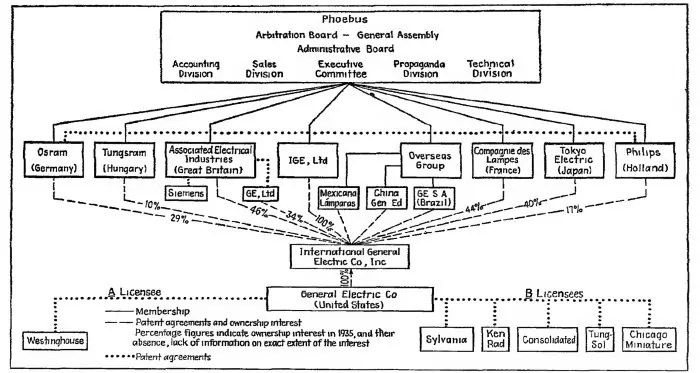
In the late 1920s, a light bulb manufacturer could face a fine for making bulbs that lasted too long. The penalty came from Phoebus, an international cartel established by leading lighting companies in Switzerland in December 1924. Its members included Germany’s Osram and the Netherlands’ Philips, with General Electric participating through overseas companies. They agreed on a target life of 1,000 hours for ordinary household bulbs. A product’s endurance, usually something a customer might welcome, had become a problem that manufacturers organized themselves to control.
Electric lighting was spreading, and the industry had already made substantial improvements over the early bulbs associated with Thomas Edison. Tungsten filaments helped lamps produce useful illumination more efficiently than their carbon-filament predecessors. Yet expanding demand did not guarantee steady business for every manufacturer. Companies competed across national borders, while patents and licensing agreements shaped who could manufacture particular designs. Phoebus offered its members a way to reduce that uncertainty. They divided markets and assigned sales quotas, limiting competition among themselves. Cooperation also included exchanging technical knowledge. Within this system, shortening bulb life had an obvious commercial attraction: a customer whose lamp burned out sooner would need a replacement sooner. Greater durability could reduce repeat purchases even while making the product more valuable to its owner.
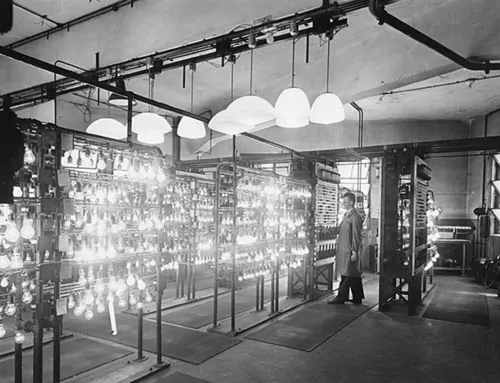
The 1,000-hour rule required more than a handshake. Participating factories sent bulb samples to a central laboratory in Switzerland, where testing checked whether their products met the cartel’s specifications. Financial penalties enforced the prescribed lifespan; bulbs that departed from it in either direction could trigger fines. Engineers studied filament design and operating conditions to bring lifespans toward the agreed target. Individual bulbs did not all expire at exactly the thousandth hour, and the change took years. For a standard reference bulb, the average recorded life fell from about 1,800 hours in 1926 to 1,205 hours in the 1933–1934 financial year.
There was a genuine engineering complication behind the manufacturers’ defense. An incandescent bulb produces light by heating its filament, and operating that filament hotter can improve light output per unit of electricity while shortening its life. A bulb that survives longer is therefore not automatically cheaper to use: electricity costs matter alongside replacement costs. That tradeoff makes the familiar story of companies suppressing a perfect, everlasting bulb misleading. Nevertheless, it does not explain away coordinated restrictions on durability. Surviving company correspondence shows that longer-lasting lamps worried cartel executives because they threatened sales turnover. Anton Philips, for example, objected when members supplied bulbs designed for higher voltages than those at which customers would actually operate them, a practice that prolonged their lives. His objection connected durability directly with the cartel’s commercial interests. Consumers were encountering a design choice shaped by an agreement among sellers whose earnings depended partly on how often lamps needed replacing.
The enforcement system also addressed a weakness in the arrangement: an individual member could gain customers by offering a longer-lasting bulb while its partners followed the agreed standard. Testing and fines made that departure costly. Phoebus consequently became a prominent early example of planned obsolescence, the deliberate management of a product’s useful life to encourage continuing purchases. The revealing feature was the organization behind the decision. Competing companies had established machinery for discouraging durability beyond their chosen limit. Whatever technical benefits standardization offered, customers had fewer opportunities to choose among genuinely competing judgments about how long their lamps should last.
Phoebus did not maintain its grip indefinitely. Competition weakened the arrangement during the 1930s, and World War II disrupted cooperation among firms based in opposing countries. Its significance survives in the paperwork documenting what customers could scarcely see when they bought a bulb. A familiar brand and a functioning filament revealed little about the negotiations that had shaped the product’s expected life. The unsettling historical detail remains the fine for excessive endurance: a manufacturer could be penalized for supplying more hours of light than its partners wanted customers to receive.
Originally published by Brewminate, 10.05.2026, under the terms of a Creative Commons Attribution-NonCommercial-NoDerivatives 4.0 International license.
About the Author