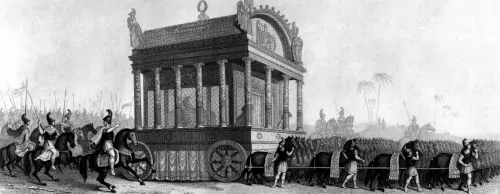
Alexander’s death left an empire without a secure succession. Another three decades might have given him time to raise an heir and turn personal command into an enduring monarchy.

By Matthew A. McIntosh
Public Historian
Brewminate
The empire Alexander the Great left behind was enormous; the heir who might hold it together had not yet been born. In June 323 BCE, Alexander died in Babylon at thirty-two, after an illness whose precise cause remains disputed. He had overthrown the Persian Empire and extended Macedonian power into northwestern India, but he had not established a secure succession. His wife Roxana was pregnant. Their son, known to history as Alexander IV, would grow up amid struggles among commanders who initially governed in the royal family’s name. Those struggles eventually produced separate kingdoms, and the boy himself was murdered before reaching adulthood. Alexander’s death did more than interrupt another campaign: it transferred an immense concentration of authority to people who disagreed about who should exercise it.
A workable alternative begins in that Babylonian sickroom. Suppose Alexander’s fever subsides and he survives later dangers to live into his sixties, around 290 BCE. This gives him approximately three additional decades without assuming that recovery makes him wiser or less ambitious. His next undertaking would probably be the Arabian expedition for which preparations were already underway. Ships and coastal bases might extend his influence around the Persian Gulf, although shortages of water and the difficulty of supplying troops would limit any advance inland. The grand western conquests attributed to him in ancient accounts are less secure foundations for prediction. Living longer would give him opportunities to fight Carthage; it would not make victory inevitable. The more consequential question is whether continued campaigning could coexist with the work of making his existing dominions governable.
For a time, the strongest obstacle to fragmentation would simply be the presence of the king. Officers who became independent rulers after his death would face a different calculation while the conqueror remained alive, commanding armies and distributing appointments. Rebellion would still be possible, but it would require openly challenging an authority they had previously acknowledged. Continued unity was also administratively conceivable. Alexander had inherited Persian provincial structures and relied on local expertise; the Achaemenid kings had governed much of this territory for generations. His empire did not need to invent government from nothing. A longer reign could allow him to regularize relations with governors and establish more dependable arrangements for collecting revenue. Yet distance would still make supervision difficult, especially during campaigns far from the imperial center. A governor who controlled troops and money could accumulate considerable independence. Holding the empire together would depend on bargains renewed over years, supported by the credible possibility of royal intervention.
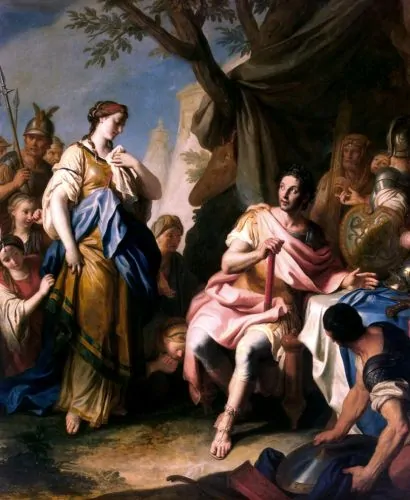
Within the army, longevity might deepen a conflict already visible before Alexander died. In 324 BCE he arranged marriages between Macedonian officers and Iranian noblewomen at Susa, while his recruitment of Iranian soldiers challenged Macedonian privileges. At Opis that year, plans to discharge veterans helped provoke a mutiny amid resentment over their apparent replacement. Another generation of shared service and family connections might ease those tensions. Alexander could also harden opposition by demanding obedience. His earlier executions and violent confrontations offer little reason to assume that age would automatically produce patient compromise.
The greatest opportunity would concern Roxana’s son. Instead of becoming a child king dependent on competing guardians, he could grow up under his father’s protection and enter adulthood while Alexander still ruled. The king would have time to give him military responsibilities and seek acceptance of his eventual succession. A command of his own could let the prince earn soldiers’ loyalty while his father remained available to support him, a practical advantage that a proclamation alone could not supply. By the time Alexander reached his sixties, this son could be an experienced man in his early thirties. That would remove the helplessness that made the actual royal family so vulnerable. It would not establish an uncontested right to rule. Macedonian succession depended heavily on political and military support, and Roxana’s Bactrian origins could remain a source of opposition. Alexander’s other royal marriages might produce sons with competing claims. Even a designated heir could discover that the commanders who obeyed his father regarded obedience to him as negotiable. Nevertheless, an adult successor with his own relationships among officers would have a substantially better chance than an infant whose authority others exercised. A successful transfer becomes plausible here, without requiring the empire to retain every province or suppress every rival.
By around 290 BCE, then, one credible outcome would be a surviving monarchy that still linked Macedonia to major territories of the former Persian Empire, perhaps with looser control at its edges. Its existence could prevent or postpone some of the wars that formed the familiar Hellenistic kingdoms. Cultural exchange would not depend on keeping that political map intact: Greek settlement and interaction with local traditions had already begun, and in actual history they continued across rival states. A longer-lived Alexander might change where royal patronage concentrated and which cities gained importance, but neither universal harmony nor a single uniform culture follows from his survival. What changes most convincingly is the opportunity to turn personal command into an inherited monarchy. His early death closed that opportunity before it could be tested. Imagining him old reveals how much of his historical achievement remained unfinished: winning an empire had been possible within a decade, while making its powerful men accept a future beyond its founder could require a generation.
Originally published by Brewminate, 10.05.2026, under the terms of a Creative Commons Attribution-NonCommercial-NoDerivatives 4.0 International license.
About the Author