The identity of the first copyrighted motion picture in 1893 reveals how early filmmakers shaped cinema, authorship, and the legal foundations of visual storytelling.

By Wendi A. Maloney
Writer/Editor
Office of Communications
Library of Congress
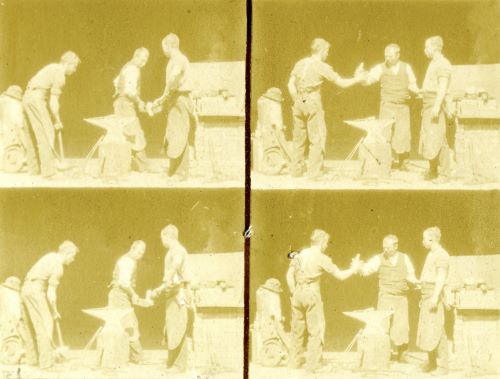
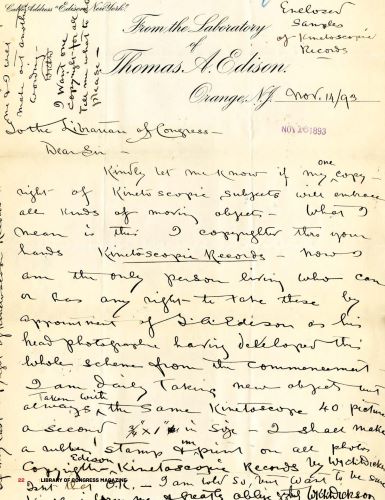
The perfectly folded letter opened, and out dropped pictures — 18 small images imprinted in two strips on a single sheet. Three men stand around an anvil, enacting a scene from a blacksmith’s shop.
“I froze,” says Claudy Op den Kamp, the film scholar who extracted the letter from a Library of Congress archival box last summer. “I couldn’t grasp what I was holding.”
The letter, dated Nov. 14, 1893, was signed “W.K.L. Dickson.” Op den Kamp knew him as the head photographer at Thomas Edison’s New Jersey laboratory at a time when Edison was racing against competitors to establish himself as the father of motion pictures.
Dickson wanted to know the status of a copyright application he’d submitted to Ainsworth Rand Spofford, the Librarian of Congress, several weeks earlier — at the time, Spofford also directed copyright operations.
The application was for a motion picture Dickson described only as “Kinetoscopic Records.” The pictures contained in the letter, Dickson wrote, were samples from the film. He had recorded them on a new machine, perfected in Edison’s lab, that could take 40 pictures a second. Imprinted on film stock and viewed through a kinetoscope — another Edison breakthrough — the images appeared to move.
Dickson was making new films daily, he wrote, and wanted to protect the lab’s work from the competition.
Op den Kamp caught her breath, then cried out. In her hands, she held evidence from the birth of American cinema, a piece of paper that solved a longstanding mystery: What was the first U.S. motion picture ever copyrighted?
For years, scholars had known that an unidentified film was registered in 1893. But none had been able to tie that registration to an actual title with certainty — until now.
Mike Mashon, head of the Library’s Moving Image Section, came running from a nearby office. “It was a wonderful moment,” he says. “It really was.”
To the uninitiated, motion picture copyright might seem an arcane subject. But not to film scholars. For decades, they’ve mined copyright records at the Library — home to the U.S. Copyright Office — to piece together the story of early cinema. Under copyright law, registrants must submit copies of their works when they apply. When Dickson and other early filmmakers registered, they couldn’t have known they were documenting the start of a world-changing industry.
“It only becomes clear in retrospect,” Mashon says. “But it’s from those early efforts that global cinema eventually emerges. Copyright has played an incredibly important role in preserving the record.”
Edison patented an extraordinary 1,000-plus inventions in his lifetime and zealously used legal means to protect his achievements. Dickson had been registering photographs with Spofford for years, so it’s not surprising that Edison’s lab turned to copyright for its films.
Now, nearly 130 years after Dickson dispatched his letter to Spofford, we know that the first copyrighted motion picture was Edison’s “The Blacksmith Shop,” also known as “The Blacksmith Scene” or “The Blacksmithing Scene.”
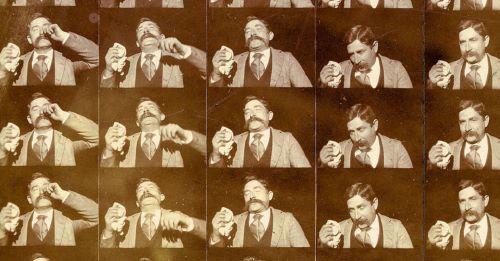
The second film copyrighted, also from Edison’s lab, has long been known. Registered on Jan. 9, 1894, and inscribed in the official copyright record book as “Edison Kinetoscopic Record of a Sneeze,” it’s often called “Fred Ott’s Sneeze.” Ott was an employee in Edison’s lab, and he’s filmed sneezing as part of the lab’s motion picture experiments.
A lecturer in film and intellectual property at Bournemouth University in England, Op den Kamp was in residence at the Library’s John W. Kluge Center for six months last year to study Spofford’s role in the formation of the Library’s collection of paper prints — rolls of photographic contact paper the earliest producers submitted to register motion pictures.
No category for motion pictures existed in copyright law until 1912. So, pioneering producers, starting with Edison, exposed their nitrate film negatives on rolls of photographic contact paper to register them, mostly as photographs, a category established in 1865.
Most films made on nitrate — highly flammable and deterioration-prone — no longer exist. “The Blacksmith Shop” survives because business magnate Henry Ford, a close friend of Edison, had a copy, and the Museum of Modern Art later preserved it.
In 1995, the film was inducted into the Library’s National Film Registry. According to the registry, the “The Blacksmith Shop” features the first screen actors in history and is considered the first film of more than a few feet to be exhibited publicly — it was screened for audiences in Brooklyn on May 9, 1893.
“It shows living subjects portrayed in a manner to excite wonderment,” a Brooklyn newspaper reported the following day.
On her quest to solve this cinema mystery, Op den Kamp consulted with some 30 current and retired staff experts at the Library; worked in five reading rooms; and, finally, pored over five pallets pulled from storage — each containing 50 boxes, each box associated with 2,000 registrations. Inside one box, she found the letter.
Film scholars, she says, long had assumed that the “Kinetoscopic Records” listed in the copyright record books implied multiple motion pictures, and “The Blacksmith Shop” was strongly suspected to be among them. Now, we know that “records” meant multiple images in strips — the photographs that dropped out of a letter that day and made film history.
“In some ways,” Mashon says, “the letter Claudy found is the Big Bang. Everything sort of flows from that.”
Originally published by Library of Congress Magazine 12:1 (January-February 2023, 6-7) to the public domain.
About the Author