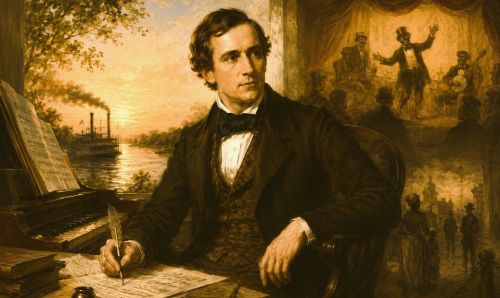
Stephen Foster helped create American popular song, but his melodies carried beauty, commerce, racial caricature, and national memory together.

By Matthew A. McIntosh
Public Historian
Brewminate
Introduction: The Songwriter America Remembers without Always Naming
Americans often know Stephen Collins Foster before they know his name. They know him in fragments: a banjo on the knee, a dreamer called from the window, hard times asked not to come again, a Kentucky home transformed into public ritual, a river made into memory even for those who have never seen it. His songs have passed through schoolrooms, state ceremonies, parlor pianos, minstrel stages, folk revivals, recording studios, films, civic pageants, and family singalongs with a familiarity so deep that authorship often disappears. That disappearance is one measure of Foster’s cultural power. “Oh! Susanna,” “Camptown Races,” “Old Folks at Home,” “My Old Kentucky Home,” “Jeanie with the Light Brown Hair,” “Hard Times Come Again No More,” and “Beautiful Dreamer” did not merely circulate as popular songs. They settled into the sediment of American memory, where composed music can begin to feel like anonymous inheritance.
That familiarity is also the beginning of the problem. Foster has often been called the “Father of American Music,” but the phrase is both revealing and misleading. It is revealing because Foster did help create a recognizable American popular song culture before recording, radio, Tin Pan Alley, or the modern music industry gave songwriters clearer commercial structures. He wrote words and music for a mass public, pursued composition as a profession, and helped make the printed song into a vehicle of national feeling. Yet the title is misleading if it implies origin, purity, or solitary creation. American music did not begin with Foster. It was already being made in churches, work sites, streets, theaters, fields, military camps, Indigenous communities, African American religious and secular traditions, immigrant households, and domestic parlors. Foster’s importance lies not in inventing American music from nothing, but in joining existing currents into songs that white commercial culture could print, perform, sell, remember, and sentimentalize.
The joining of those currents made Foster foundational, but it also made him morally complicated. His music drew from European balladry, parlor sentiment, comic theater, African American musical influence, and the commercial machinery of blackface minstrelsy. Some of his most famous early songs were written for or absorbed by white minstrel performers who blackened their faces and turned distorted images of Black life into popular entertainment. These were not accidental associations or unfortunate background conditions. They were part of the commercial world through which Foster’s songs traveled, gained audiences, and became profitable. Blackface minstrelsy allowed white performers and publishers to borrow from Black expressive culture while denying Black people control over their own representation. It turned plantation life, racialized speech, enslaved suffering, and comic distortion into commodities that could be sold as amusement to northern and southern audiences alike. Foster’s place within that world is central to any honest account of his achievement. Later plantation songs sometimes softened caricature into pathos, and in works such as “Nelly Was a Lady,” Foster gave Black characters a degree of domestic dignity unusual in white-authored popular song of the period. But even that partial humanization remained bound to a market that profited from racial fantasy. His melodies could be beautiful, his emotional instincts powerful, and his craft unusually durable, while the world that carried those songs into American homes was often cruel, exploitative, and evasive. The difficulty is not that Foster’s music had one noble side and one corrupted side, easily separated for modern comfort. The difficulty is that the beauty and the compromise often occupied the same musical space.
I treat Foster neither as an innocent national bard nor as a figure to be dismissed with simple condemnation. He belongs instead to the difficult history of American popular culture, where beauty and harm often traveled together. Chronologically, his life traces a larger transformation: from parlor song and minstrel theater to commercial songwriting, from antebellum expansion to Civil War fracture, from authored sheet music to folk-like national memory. To understand Foster is to understand how the United States learned to sing longing, humor, home, poverty, race, nostalgia, and loss in forms that millions could carry in their mouths. The question is not whether Foster mattered. He did. The harder question is what it means that so much American musical memory came to know itself through songs that were at once tender, marketable, unforgettable, and haunted.
Before Foster: Parlor Song, Minstrelsy, Print Culture, and the Search for an American Sound
Before Foster became attached to the idea of an American musical inheritance, the United States already possessed a dense and restless musical life. It was not yet organized around recording stars, radio broadcasts, copyright royalties, national charts, or the machinery that later made popular music a modern industry. Song moved instead through bodies, paper, memory, instruments, churches, theaters, streets, drawing rooms, military camps, taverns, river towns, and family parlors. Americans sang hymns, ballads, comic songs, sentimental airs, political songs, children’s songs, work songs, and dance tunes. Some of these came from Britain, Ireland, Scotland, Germany, France, Italy, and elsewhere in Europe. Others came through African American religious, laboring, and vernacular traditions, many of them shaped under slavery and then distorted when white commercial culture claimed them for entertainment. Foster entered a musical world already full of sound. His importance would lie not in creating that world, but in giving parts of it a form that could travel nationally under a single composer’s name.
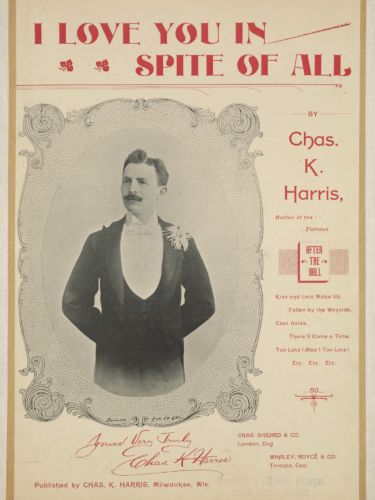
The parlor was one of the crucial spaces in that early nineteenth-century culture, a place of entertainment with songs written by the likes of Charles K. Harris. In middle-class homes, music was both recreation and social performance, especially for women whose musical skill was often treated as a sign of refinement. A piano, a small stack of sheet music, and a voice capable of pleasing guests could turn domestic space into a small theater of feeling. The songs favored often drew on European models: lyrical melodies, clear harmonic movement, themes of love, parting, death, memory, motherhood, and home. These songs did not demand professional virtuosity. Their power depended on emotional accessibility. They were meant to be purchased, played, sung, and remembered by amateurs. This was the culture that helped make Foster possible, because he learned to write melodies that ordinary people could carry, not merely admire.
Yet the parlor alone cannot explain the emergence of American popular song. The theater, especially the blackface minstrel stage, was just as important and far more troubling. By the 1830s and 1840s, minstrelsy had become one of the most visible forms of popular entertainment in the United States. White performers blackened their faces, adopted grotesque dialects, and presented caricatured versions of Black life for laughing white audiences. These performances drew from African American music and dance while violently misrepresenting the people whose culture they exploited. The form’s popularity grew in the same decades that slavery became the central political and moral crisis of the republic, which meant that minstrelsy did more than entertain. It helped white audiences manage, evade, and distort the presence of Black people in American life. It offered a theatrical fantasy in which Blackness could be mocked, borrowed, sentimentalized, feared, desired, and controlled, all within a structure that protected white spectators from the reality of Black autonomy and suffering. Minstrelsy was not simply a racist sideshow at the margins of American entertainment. It was central to the growth of mass popular culture, and it created one of the first broadly national markets for comic songs, plantation songs, dance tunes, and theatrical music. Any account of Foster’s rise must begin there, because the stage that helped carry his earliest hits was already built on racial theft and commercial distortion.
The minstrel show also revealed how American music was forming through contradiction. It was vulgar and commercially energetic, racist and musically adaptive, theatrical and portable, local in performance but national in reach. Audiences heard banjos, bones, fiddles, comic choruses, sentimental laments, and exaggerated dialect songs in forms that pretended to represent Black culture while actually serving white desire, anxiety, and amusement. This does not mean that minstrelsy can be treated as a legitimate vessel of African American expression. It was a white-controlled performance system. But it does mean that the United States’ search for a distinct musical sound was already entangled with unequal borrowing. White performers and composers sought something that felt less European, more local, more “American,” and they often found it by transforming Black influence into caricature. Foster would inherit that contradiction almost perfectly. His songs could soften, refine, and sentimentalize the minstrel idiom, but they did not escape the racial order that made the idiom profitable.
Print culture gave these musical worlds their reach. Before sound recording, sheet music was the technology that allowed a song to travel beyond the body of a single performer. Publishers, engravers, music shops, theaters, and amateur musicians formed a network through which songs could move from city stages to domestic parlors and from local popularity to national recognition. A song could be performed by a minstrel troupe in one city, printed by a music publisher, purchased by a family, played by a daughter at the piano, sung by a crowd, copied into memory, and carried westward by migrants or soldiers. This system was uneven and often financially exploitative, especially for composers, but it created a public for popular song before the modern music business existed. Foster’s career would expose both the promise and the weakness of that system. He could become famous through print, but fame did not guarantee security.
The search for an “American sound” in this period was never innocent. It took place in a nation expanding across Indigenous lands, deepening sectional conflict, defending and contesting slavery, absorbing immigrants, building cities, and imagining itself through both republican ideals and racial hierarchy. Popular song became one way Americans narrated that unsettled identity. Songs about home mattered in a country defined by movement, because homes were being left, invented, remembered, destroyed, and mythologized across expanding frontiers and growing cities. Songs about rivers mattered in a country bound by commerce and migration, where waterways carried goods, people, news, enslaved labor, and dreams of escape as well as dreams of profit. Songs about longing mattered in a society full of separation, whether by labor, death, westward expansion, sale, or war. Songs about the plantation mattered because slavery stood at the center of national life even when white audiences tried to turn it into nostalgia, comedy, or sentimental distance. In that setting, the language of feeling could become a kind of refuge from the language of politics. A melody might invite sympathy while avoiding justice. A sentimental chorus might acknowledge grief while leaving its causes untouched. Foster’s later genius would be his ability to compress these large emotional patterns into melodies simple enough to seem inevitable.
This was the world into which Foster was born in 1826: a world of parlor refinement and theatrical vulgarity, European inheritance and African American influence, expanding print commerce and unstable authorship, ordinary domestic music and public racial spectacle. The United States did not yet have a fully consolidated popular music industry, but it had the ingredients from which one would be made. It had publishers who needed songs, performers who needed material, homes that wanted singable music, audiences eager for novelty, and a culture increasingly hungry for forms that sounded national rather than imported. Foster’s later reputation as the “Father of American Music” depended on his ability to stand at the crossing point of these forces. He wrote songs polished enough for the parlor, catchy enough for the stage, simple enough for amateurs, and memorable enough to detach from their origins.
That detachment is precisely what makes the history difficult. By the time many of Foster’s songs became familiar as American standards, the conditions that produced them were often forgotten or softened. The parlor could make minstrel material seem respectable. Print could make theatrical caricature seem like domestic song. Repetition could make authored composition seem like folk tradition. Sentiment could make racial fantasy feel like universal feeling. Foster did not invent these transformations, but he became one of their most consequential beneficiaries and artisans. Before Foster, American song already existed in abundance. With Foster, parts of that abundance were condensed into a commercial, singable, emotionally durable form that the nation could remember while forgetting much of what it had required.
Pittsburgh, Family, and Apprenticeship: Foster before Fame, 1826–1846
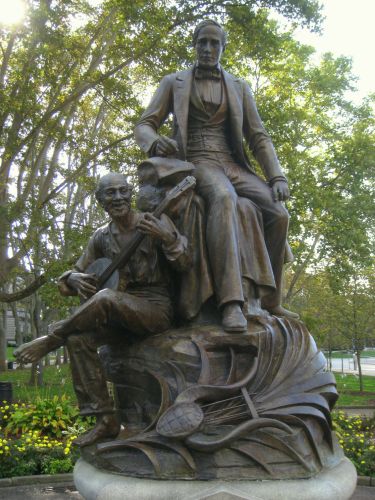
Foster was born on July 4, 1826, in Lawrenceville, Pennsylvania, then a village near Pittsburgh and later absorbed into the city’s expanding urban fabric. The date itself invited later mythmaking, as if the future composer of national songs had arrived already stamped by Independence Day. But Foster’s early life was less a patriotic fable than a study in unstable gentility, where family pride, social ambition, and economic uncertainty pressed against one another. His family had social standing, political connections, and middle-class aspirations, but also financial uncertainty and repeated reversals. His father, William Barclay Foster, had been a businessman, local figure, and sometime officeholder, while his mother, Eliza Clayland Tomlinson Foster, belonged to a household culture in which refinement, sociability, and music mattered. Stephen was the youngest child in a large family, growing up in a domestic world where music was not an abstract art but part of family life, courtship, memory, manners, and the performance of respectability. That setting mattered because Foster’s later songs would repeatedly return to the emotional vocabulary of home even when home itself was imagined, lost, commercialized, or unreachable. His childhood did not unfold in poverty, but neither did it rest on lasting security. He came from a family close enough to gentility to value polish, but not secure enough to ignore the market.
Pittsburgh shaped Foster as much as family did. In the 1820s, 1830s, and 1840s, it was not yet the industrial giant of later memory, but it was already a place of manufacture, river traffic, migration, commerce, and cultural exchange. The city sat at a junction of movement, with the Allegheny and Monongahela forming the Ohio and connecting local life to western expansion, southern trade, and the world of river travel. This geography mattered musically. Songs, performers, printed material, instruments, dialects, and theatrical styles moved through such places. Pittsburgh was neither an isolated provincial town nor a polished eastern cultural capital. It was a threshold city, close enough to Atlantic print culture to receive imported musical forms and western enough to feel the pull of expansion. Foster’s later songs would often imagine home from the standpoint of movement and separation, and Pittsburgh gave him an early education in a country already on the move.
Foster’s musical education was irregular rather than conservatory-based, which is one reason his later achievement belongs to popular music rather than the formal European art tradition. He received some instruction, absorbed genteel parlor styles, and demonstrated early facility with melody, but he did not become a composer through the disciplined institutions that produced symphonists or church musicians. His apprenticeship took place in domestic rooms, school settings, local performances, printed songbooks, amateur music-making, and the soundscape of a growing city. This mattered because Foster learned music as social use. A successful song was not simply an exercise in composition. It had to be singable, memorable, emotionally direct, and adaptable to ordinary performers. His later genius for melodic simplicity was not evidence of artistic naivete. It was a practical understanding of how songs lived when they depended on voices, parlors, stages, and paper rather than recordings.
Family networks also gave Foster early access to circulation, encouragement, and aspiration. He was surrounded by siblings and relatives who moved through commercial and professional worlds, and his brother Morrison later became an important source for preserving and narrating his life. Yet these family accounts must be read carefully, because nineteenth-century biographical memory often softened difficulty into sentiment and rearranged failure into moral lesson. Foster’s early years included promise, charm, and musical precocity, but they did not point inevitably toward fame. He was not yet the tragic national songwriter of later commemoration. He was a young man in a family trying to maintain status, in a city growing faster than its cultural institutions, learning to make songs in a republic that had not yet decided what its popular music should sound like.
By 1846, when Foster left Pennsylvania for Cincinnati to work as a bookkeeper for his brother Dunning, his apprenticeship was nearly complete even if his fame had not begun. He had learned the emotional language of the parlor, the appeal of simple melody, the possibilities of print, and the commercial energy of popular entertainment. He had also grown up close to the cultural crossroads that would define his career: respectability and amusement, home and movement, authorship and anonymity, European inheritance and American improvisation. His early life did not produce a fully formed “Father of American Music.” It produced something more historically plausible and more interesting: a young composer with enough genteel training to write polished songs, enough popular instinct to reach ordinary singers, and enough exposure to a restless musical marketplace to understand that the future of American song would belong not only to the concert hall, but to the printed page, the stage, and the remembered chorus.
Cincinnati and the Making of a Professional Songwriter, 1846–1848
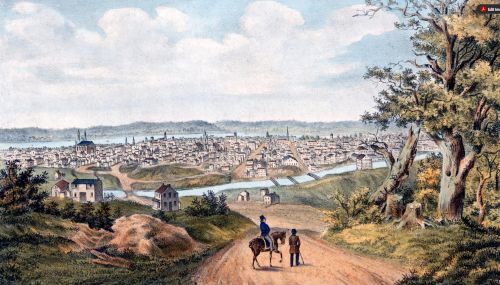
When Foster moved to Cincinnati in 1846, he did not go as a professional composer entering the music business with a clear plan for fame. He went as a young man taking respectable employment in his brother Dunning’s commercial world, working as a bookkeeper in a city tied to river traffic, trade, migration, and the economy of slavery. Cincinnati was a borderland metropolis, culturally northern but commercially bound to the Ohio and Mississippi river systems. Goods, performers, laborers, travelers, printed materials, and musical styles moved through its wharves and streets. That setting gave Foster something Pittsburgh had only begun to offer him: a daily view of American mobility as commerce. He entered Cincinnati as a clerk, but he listened like a songwriter.
The work itself mattered because bookkeeping taught Foster the practical side of cultural life. It placed him in a world of accounts, contracts, shipments, profit, paper, and circulation. This was not unrelated to music. The nineteenth-century song trade also depended on paper, distribution, calculation, and networks of exchange. A song had to be written, copied, engraved, printed, advertised, sold, performed, and purchased. Foster’s later career would unfold inside this same logic, though with far less financial security than the merchants around him enjoyed. His Cincinnati years sharpened a tension that would define his life: he was drawn toward art, but the art he chose could survive only by becoming a commodity.
Cincinnati also forced Foster closer to the South than he had been in Pittsburgh, even though he remained geographically north of the slave states. The city’s river economy connected it to cotton, steamboats, warehouses, southern markets, and the movement of people across the boundary between free and slave territory. The University of Pittsburgh’s biographical account notes that Dunning’s shipping business profited from goods tied to cotton picked by enslaved Black laborers, an uncomfortable fact that complicates any sentimental portrait of Foster’s early career. This does not mean Foster personally experienced plantation life in the way his later songs imagined it. Quite the opposite: his South was largely mediated through commerce, theater, print, rumor, racial convention, and northern fantasy. But Cincinnati placed him near enough to the river world to absorb its imagery and rhythms, while still leaving enough distance for imagination to turn social reality into song.
During these years, Foster began selling songs and piano pieces to local publishers, moving from amateur promise toward commercial authorship. That shift was not yet the same thing as a stable profession. The American music industry had not developed reliable royalty structures, copyright protection was uneven, and composers often sold songs outright for modest sums while publishers reaped larger rewards from successful pieces. Foster’s ambition emerged inside an immature market. He could imagine earning money from composition, but the mechanisms for doing so remained unreliable. This made his career historically important for precisely the reason it was personally precarious. Foster was helping to define a profession before the profession had learned how to protect its practitioners.
The decisive breakthrough came with “Oh! Susanna,” first published in 1848 by W. C. Peters. The song was not only a success; it became a national event of popular circulation. Its melody was immediate, its rhythm propulsive, and its comic energy perfectly suited to minstrel performers and mass repetition. The song spread through theaters, printed editions, amateur performance, and migration, especially as the California Gold Rush gave it new life among people moving west. It could be sung by trained performers, shouted by crowds, played in informal settings, and remembered after a single hearing, which gave it exactly the kind of mobility that nineteenth-century popular music required. Yet its success also exposed the weakness of authorship in Foster’s world. “Oh! Susanna” was reprinted repeatedly, sometimes without meaningful benefit to him, and its fame far exceeded his compensation. The song helped make Foster famous, but it also demonstrated how easily a song could escape the control of the person who wrote it. In that sense, Foster’s first great triumph contained the pattern of his later career: national recognition without dependable reward, cultural permanence without economic security, and a melody so widely embraced that the public almost swallowed the author.
By 1848, then, Foster stood at the edge of a new kind of American musical life. He was no longer merely a young man from a musical family or a clerk who wrote songs on the side. He had discovered that a short, singable composition could move through the nation with astonishing speed, attaching itself to performers, publishers, migrants, and memory. Cincinnati had shown him the commercial world behind circulation; “Oh! Susanna” showed him what circulation could do to a song. The making of Foster as a professional songwriter was not a single decision but a historical process. Between 1846 and 1848, he learned that American music could become a business, that a songwriter could become known beyond his own region, and that fame, once released into print and performance, might belong less to the composer than to the public that seized the tune.
“Oh! Susanna” and the Birth of a National Hit, 1848–1849
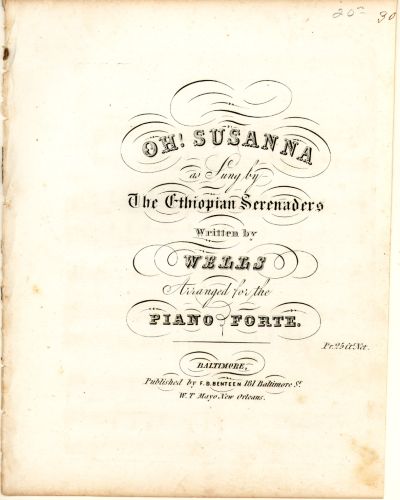
“Oh! Susanna” marked the moment when Stephen Collins Foster’s private apprenticeship became public force. The song possessed the qualities that nineteenth-century popular music needed in order to travel: a compact structure, a memorable refrain, a driving rhythm, comic exaggeration, and a tune that could be seized quickly by professionals and amateurs alike. It did not require deep musical training or a formal concert setting. It could be sung from a stage, around a piano, in a crowd, on the road, or in the informal spaces where American popular culture often reproduced itself. In that sense, “Oh! Susanna” was not merely one of Foster’s early successes. It was the song that revealed how a printed composition could become a national possession almost as soon as it left the publisher’s hands.
The timing mattered. The song appeared just as the United States was expanding westward with new intensity, and its circulation soon became entangled with the California Gold Rush. As men moved toward the goldfields, “Oh! Susanna” moved with them, becoming one of the informal anthems of migration and restless hope. Its famous opening image of a singer coming from Alabama with a banjo on his knee compressed movement, performance, region, and comic self-invention into a form that listeners could remember instantly. The song’s geography was not realistic so much as theatrical. It turned the nation into a stage of motion, where place names, absurd images, and rhythmic energy mattered more than coherent narrative. That made it ideal for an America imagining itself through mobility. People going somewhere could sing it as if the tune itself were traveling beside them. The song also fit a moment when westward movement was being romanticized even as it rested on violence, displacement, speculation, and economic desperation. Gold Rush migrants carried dreams of sudden wealth, but they also carried the cultural habits of the places they left behind, including songs that turned anxiety into bravado. “Oh! Susanna” could make departure feel comic rather than frightening, restless rather than rootless, communal rather than lonely. Its absurdity was part of its usefulness. In a nation rushing toward uncertain futures, the song gave motion a chorus.
But the song’s popularity cannot be separated from blackface minstrelsy. “Oh! Susanna” drew on minstrel conventions, including racialized dialect, comic distortion, and a stage world in which white performers transformed Blackness into entertainment for white audiences. Its success depended partly on this theatrical ecosystem. Minstrel troupes, music publishers, and amateur performers gave the song its reach, and the same culture that made it catchy also made it morally compromised. To call it a national hit, then, is not merely to celebrate its breadth of circulation. It is to recognize how early American mass culture often became national by passing through racial caricature. The song helped Americans sing together, but the terms of that togetherness were unequal from the beginning.
The authorship of “Oh! Susanna” also revealed the fragile condition of the early professional songwriter. The song became famous far beyond the income it produced for Foster. It was reprinted widely, sometimes without his authorization or substantial compensation, and its popularity quickly exceeded the contractual and copyright systems available to him. This was a crucial lesson. In the world before recordings and modern performance royalties, the sheet-music market could spread a song faster than it could protect a composer. Foster’s reputation grew because the tune escaped him. His financial disappointment was not incidental to his historical importance. It shows that American popular song became a national commodity before the law and the marketplace had created stable protections for those who made it.
By 1849, “Oh! Susanna” had done more than announce Foster as a promising songwriter. It had demonstrated a new model of American musical fame. A song could begin as a published piece, enter the minstrel stage, attach itself to migration, pass through informal performance, multiply through unauthorized editions, and become so familiar that it seemed less composed than discovered. This was the paradox that would follow Foster throughout his career. His songs were authored, crafted, and commercial, yet their greatest power came when they began to feel anonymous, communal, and inevitable. “Oh! Susanna” made Foster visible by showing how easily the public could make a songwriter disappear inside his own melody. It also established the conditions under which his later reputation would be built: national reach, emotional portability, racial compromise, and the strange alchemy by which a marketplace product becomes cultural memory. The song’s triumph was not just a biographical turning point. It was an early demonstration of how American popular music would work: through repetition, performance, borrowing, forgetting, and the uneasy transformation of private authorship into public possession.
Blackface Minstrelsy, Racial Caricature, and the Commercial Stage
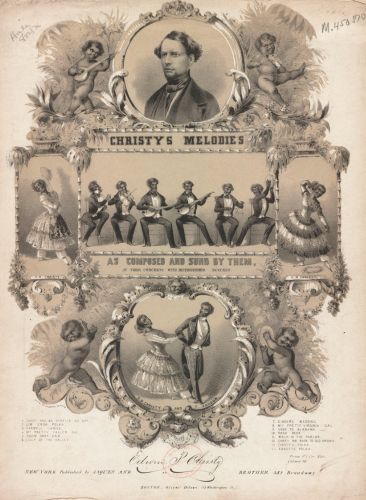
Foster’s early fame cannot be understood apart from blackface minstrelsy, the most powerful popular theatrical form in the United States during the decades before the Civil War. Minstrelsy was not a peripheral entertainment that happened to receive some of Foster’s songs. It was one of the central commercial engines through which popular music became national. By the 1840s, organized minstrel troupes had turned caricatured representations of Black life into a repeatable theatrical formula, combining songs, jokes, dialect routines, dances, comic skits, sentimental numbers, and instrumental performance. White men blackened their faces with burnt cork and claimed authority to perform Blackness for white audiences. That act was not simply disguise. It was a ritual of racial control, allowing white performers to borrow, distort, ridicule, desire, and contain the cultural presence of African Americans in a society built on slavery and racial hierarchy.
The minstrel stage mattered commercially because it gave songs bodies, voices, gestures, and markets. A printed song could sit silently in a music shop, but a minstrel performer could make it memorable in public, attach it to a comic persona, and send an audience home with a refrain still sounding in the ear. The relationship between performance and print was circular. Minstrel troupes needed new material, publishers needed songs that could sell, and audiences wanted pieces they could recognize, repeat, and sing outside the theater. The stage created demand, the publisher supplied paper, and the public carried the song into spaces where formal performance ended. Foster entered this system as a songwriter whose melodies were unusually adaptable. His work could move from the public stage to the domestic parlor, from a professional troupe to an amateur pianist, from theatrical entertainment to family music-making. That mobility helped make him famous, but it also meant that minstrel conventions traveled with the songs into places that could mistake themselves for innocent. A family singing at home might not imagine itself participating in the same racial theater as a burnt-cork performer, yet the song’s language, humor, and imagined voices often carried that theater into the household. This was one of minstrelsy’s most consequential achievements: it made racial caricature portable, respectable, and repeatable under the cover of music.
The racial caricature at the heart of minstrelsy was both obvious and unstable. It mocked Black speech, movement, intelligence, family life, religion, labor, and aspiration, reducing human beings to comic types for white amusement. The form depended on fascination with Black expressive culture. Its rhythms, dances, instruments, and vocal effects drew from a world that white performers could imitate only by deforming it. Eric Lott’s influential phrase “love and theft” captures this doubleness: minstrelsy was not only contempt, but also appropriation, envy, anxiety, pleasure, and control. White performers wanted the energy they associated with Black culture while maintaining the social order that denied Black people equal humanity. Foster’s songs entered precisely this contradiction. Their musical effectiveness often depended on forms of performance that had already converted racial domination into popular amusement.
Foster’s early minstrel songs did not stand outside that system, even when they displayed more melodic grace than much of the surrounding repertoire. “Oh! Susanna” and “Camptown Races,” for example, belong to a world of comic exaggeration, racialized voice, and theatrical motion. Their speed, absurdity, and memorability made them ideal for public performance, but the conventions that helped them travel were not neutral. Dialect itself functioned as a racial marker, telling audiences not only how to hear the singer, but how to locate the imagined speaker within a hierarchy of intelligence, class, and race. The comic speaker could be made foolish, childlike, evasive, hyperactive, or sentimental, depending on the needs of the performance, but in nearly every case the voice was controlled by white authorship and white expectation. That control mattered because song is intimate. When audiences repeated a chorus, they also repeated the imagined racial position embedded in it, often without stopping to name what they were doing. The comic energy of these songs should be read historically rather than excused aesthetically. Their brilliance as popular music does not cancel the damage of the performance world that shaped them. It makes that damage more important, because the songs succeeded so well. The more memorable the tune, the farther the caricature could travel.
Yet Foster’s relationship to minstrelsy also shows why cultural judgment must be precise rather than lazy. He was not merely a crude supplier of racist stage jokes, nor was he an innocent melodist accidentally caught in a bad genre. He wrote within a racist commercial form while also modifying parts of it. Compared with many minstrel songs of the period, some of Foster’s work moved away from sheer buffoonery and toward sentiment, pathos, and domestic feeling. This change mattered because it helped make plantation song emotionally acceptable to white middle-class audiences who might have recoiled from vulgarity but welcomed sorrow. The result was not liberation from minstrelsy, but refinement within it. Foster helped convert the minstrel stage’s caricatured Black figures into sentimental figures capable of longing, grief, and memory, but always within limits imposed by white authorship and commercial expectation.
That refinement may be one of Foster’s most consequential cultural acts. By softening minstrelsy, he made it more portable. Brutal ridicule could remain in the theater, but sentimental plantation song could enter the parlor, the schoolroom, the civic ceremony, and eventually the national songbook. This was a powerful transformation. It allowed white Americans to feel tenderness toward imagined Black speakers while avoiding the political claims of real Black people. It could make slavery’s world sound mournful without making white listeners responsible for slavery’s violence. Foster’s music helped create a mode of racial sentiment that was morally evasive precisely because it was emotionally sincere. The songs could move listeners, and that movement could still leave the social order untouched.
The commercial stage did more than launch Foster’s career. It defined the central contradiction of his legacy. He became one of the first great American popular songwriters through a system that joined print capitalism, theatrical performance, racial exploitation, and mass memory. His melodies helped build a shared musical culture, but the sharing was unequal from the start. Black expressive traditions influenced the sound and energy of American popular music, while white performers, publishers, and composers often received the public credit and financial reward. Foster’s place in this history is neither incidental nor simple. He was a gifted composer working inside a damaged marketplace, and the marketplace helped make his gift national. To understand him honestly is to see that the “Father of American Music” was also a son of blackface minstrelsy, born into a culture where American song learned to sound national by disguising, exploiting, and sentimentalizing Black life.
Sentiment, Reform, and “Nelly Was a Lady”: Foster’s Partial Humanization of Black Characters
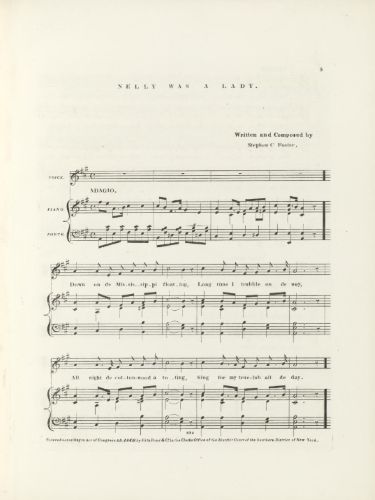
As Foster moved beyond the explosive comic success of “Oh! Susanna,” his work began to show a more complicated engagement with the emotional possibilities of minstrel song. The shift did not free him from blackface conventions, nor did it remove his music from the racial marketplace that had helped make him famous. But it did mark a change in tone. Foster increasingly turned toward feeling, domesticity, grief, memory, and moral sympathy, softening the grotesque comic figure of the minstrel stage into characters who could suffer, love, mourn, and remember. This development matters because it reveals both the reach and the limits of antebellum sentiment. Foster did not overthrow the racial assumptions of his culture, but he sometimes bent them toward a more serious recognition of Black humanity than much popular white entertainment allowed.
“Nelly Was a Lady,” published in 1849, stands near the center of this transition. The song is often identified as one of Foster’s most important attempts to portray African American domestic life with dignity rather than ridicule. Its significance begins with the title itself. To call Nelly a “lady” was no small gesture in a culture that routinely denied Black women the language of gentility, virtue, and respectable domestic feeling. The song presents a grieving husband mourning his dead wife, not a comic fool, grotesque caricature, or disposable theatrical type. The emotional frame is familiar from sentimental parlor music: love, death, memory, and conjugal devotion. But Foster placed those feelings in the voice of a Black male speaker, granting to him an interior life that many white-authored minstrel songs denied.
The song’s importance should not be exaggerated into innocence. “Nelly Was a Lady” still uses dialect, still emerged from a minstrelized musical culture, and still depended on white authorship imagining Black feeling for a largely white audience. Its sympathy was mediated, limited, and commercially framed. Yet its deviation from crude mockery was real. In much early minstrelsy, Black characters were rendered as comic bodies, not grieving spouses; as musical energy, not moral subjects; as stage devices, not persons embedded in intimate relationships. Foster’s song did something different by making Black marriage legible through the sentimental language that white middle-class culture recognized as honorable. That recognition mattered because domestic feeling was one of the central moral languages of the nineteenth century. To possess grief, fidelity, marital tenderness, and reverent memory was to belong, at least partially, to the world of moral personhood. Foster did not grant political equality, and he did not free the song from racial performance. But he did move the imagined Black subject from the comic edge of the stage toward the emotional center of the song. The result was not equality, but a partial admission. The song asked white listeners to hear Black domestic grief as grief.
That gesture belongs to the broader antebellum world of sentimental reform. The same decades that produced Foster’s plantation songs also produced a flood of reform literature, domestic fiction, abolitionist argument, religious appeals, and moral suasion campaigns that tried to move readers and listeners through feeling. Sentiment could become a political language, especially when direct confrontation seemed too dangerous or divisive. By inviting audiences to pity the suffering enslaved person, the bereaved mother, the separated family, or the dying beloved, sentimental culture tried to make moral recognition pass through the heart. Foster’s “Nelly Was a Lady” fits this pattern, even though it was not an abolitionist tract. It did not denounce slavery directly or call listeners into political action. Instead, it made the emotional life of a Black couple available within a genre white audiences already understood. That made the song reformist in feeling, if not radical in program.
The limitation of such sentiment is just as important as its achievement. Sympathy can humanize, but it can also contain. A white audience might weep for Nelly without challenging the structures that made Black life vulnerable to sale, separation, labor exploitation, and premature death. Sentimental recognition often depended on making Black characters resemble white domestic ideals, which meant that dignity became legible only when filtered through familiar middle-class forms. The Black husband in “Nelly Was a Lady” is granted seriousness because he mourns like a sentimental hero. That matters, but it also reveals the narrow passage through which white culture permitted Black humanity to appear. Foster’s partial humanization did not create a new racial order. It created a more tender version of the old one.
Still, the tenderness should not be dismissed as meaningless. In the history of popular song, emotional conventions matter because they teach audiences what kinds of people can be imagined as feeling subjects. If a popular song gives a Black woman the title “lady,” gives a Black husband grief, and gives a Black marriage tragic dignity, it changes something within the language of the stage, even if it changes far less than justice required. Popular culture rarely transforms moral perception all at once. More often, it shifts the boundaries of the imaginable, allowing a figure previously confined to ridicule to appear under the sign of sorrow, love, or memory. That is what makes Foster’s sentimental turn so historically important and so ethically frustrating. It opened a door without leaving the room. It gave white audiences a Black subject worthy of pity and respect, but it did not require them to hear Black people as authors of their own songs, interpreters of their own lives, or claimants upon the nation’s conscience. Foster’s importance lies partly in that uneven movement. He made songs that could soften the minstrel form from within, replacing some of its harshest ridicule with pathos. But because that pathos still moved through blackface entertainment, it remained compromised at the root. Foster widened the emotional vocabulary of minstrel song without breaking the racial frame that enclosed it.
“Nelly Was a Lady” reveals the central pattern of Foster’s maturing career: his best songs often moved toward human feeling while remaining trapped inside structures of racial fantasy. This is why the song belongs not in a simple story of progress, but in a history of contradiction. It shows Foster at his most morally suggestive and still historically limited. He could recognize grief where other songwriters saw only comic opportunity. He could imagine tenderness across the color line while leaving intact the conventions that made such imagination profitable for white performers and publishers. The song’s power comes from that tension. It is a small act of humanization inside a large system of dehumanization, and that makes it neither redemptive nor negligible, but deeply revealing.
“Old Folks at Home” and “My Old Kentucky Home”: Plantation Nostalgia and the National Imagination, 1851–1853
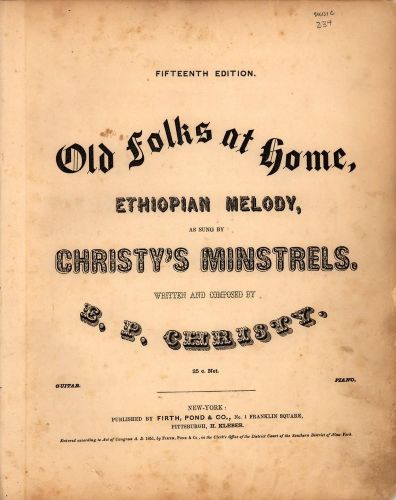
By the early 1850s, Foster had moved from comic minstrel energy toward a more enduring and more troubling form of musical sentiment: the plantation song of longing. “Old Folks at Home,” published in 1851, and “My Old Kentucky Home, Good-Night!,” published in 1853, became two of his most famous works because they transformed the imagined plantation South into a landscape of memory, exile, and emotional return. These songs did not abandon the minstrel world that had helped make Foster famous. They refined it. The clownish figure of early blackface performance gave way to speakers who remembered home, family, and loss with aching sincerity. That shift gave Foster’s music a broader emotional reach, but it also made plantation nostalgia more powerful because it taught white audiences to feel deeply within a racial fantasy.
“Old Folks at Home” is especially revealing because its longing appears universal while its original frame remains historically specific. The song’s speaker yearns for the Swanee River and the loved ones left behind, turning geographical distance into emotional ache. Foster reportedly chose the Suwannee River not because he knew it intimately, but because the name fit the sound he wanted, which is itself a clue to the song’s constructed nature. The river became less a real place than a musical symbol. It carried homesickness, aging, separation, and memory in a form that listeners far from Florida could claim as their own. That portability helped the song survive, but it also blurred the racial and theatrical conventions from which it emerged. A minstrelized plantation voice became a general American voice of homesick longing.
“My Old Kentucky Home” worked in a related but distinct register. Its emotional world was not comic movement, as in “Oh! Susanna,” but threatened departure, forced separation, and the fragility of domestic belonging. The song’s title alone gave Kentucky a mythic domestic aura, turning a specific slave state into a national emblem of home. Its association with antebellum sentimental culture, and with the broader world made famous by Harriet Beecher Stowe’s Uncle Tom’s Cabin, placed it within a moral climate increasingly attentive to the suffering of enslaved families. Foster’s song appeared in a culture where readers and listeners were being asked, sometimes timidly and sometimes forcefully, to imagine enslaved people not as abstractions but as mothers, fathers, children, spouses, and mourners. Yet Foster’s song did not operate as a direct political indictment. It softened the violence of slavery into pathos, inviting listeners to mourn separation without necessarily confronting the legal and economic system that produced it. The home in the song is tender, but it is not innocent. Its emotional force depends on the listener feeling the pain of departure while leaving unresolved the deeper fact that enslaved people did not possess secure homes under law. In that contradiction, Foster created one of the most durable musical myths of the antebellum United States: the plantation as a place of feeling rather than domination.
The power of both songs lies in their ability to convert historical violence into emotional atmosphere. Plantation life appears not as a regime of labor extraction, surveillance, punishment, sale, and family rupture, but as a place remembered through melody. This does not mean that Foster was indifferent to sorrow. On the contrary, sorrow is the very substance of these songs. But the sorrow is displaced. It becomes beautiful, generalized, and singable, detached from the full brutality of the institution that made such longing necessary. White audiences could enter the emotional world of separation while remaining protected from its political meaning. They could grieve with an imagined Black speaker, or through one, while still holding the plantation at a sentimental distance. Foster’s genius was to make this emotional transfer musically convincing. The ethical problem is that conviction could become consolation.
The songs also show how national imagination works through selective memory. In the United States of the 1850s, the plantation was not simply a regional reality. It was a national problem, tied to cotton capitalism, party politics, westward expansion, constitutional conflict, and the coming crisis over slavery’s future. Northern merchants, southern planters, western expansionists, textile manufacturers, shipping interests, publishers, performers, and consumers all lived inside an economy and culture shaped by slavery, even when they imagined themselves distant from it. Yet popular culture often transformed that problem into scenes of song, loyalty, memory, and home. Foster’s plantation songs participated in that transformation by giving white listeners a South they could feel before they judged. “Old Folks at Home” and “My Old Kentucky Home” did not defend slavery in explicit argumentative terms, but they helped create an emotional vocabulary in which the plantation could be remembered as a lost domestic world rather than confronted as a violent labor system. That is why their beauty cannot be separated from their evasiveness. They offered a nation on the edge of fracture an image of shared feeling, but that feeling was built by narrowing the field of vision. The songs remembered longing while muting coercion, home while obscuring ownership, grief while softening the structures that produced grief.
Their afterlives confirm their power. “Old Folks at Home” eventually became Florida’s state song, while “My Old Kentucky Home” became inseparable from Kentucky identity, public ceremony, and the ritual culture surrounding the Kentucky Derby. Both songs have undergone lyric revisions and public reassessment because the language and racial imagination embedded in their original forms became impossible to treat as neutral inheritance. These later changes do not erase the songs’ nineteenth-century meanings. They reveal them. A culture revises songs when it wants to keep the melody but can no longer bear the full moral weight of the words. That process is itself historically revealing, because it shows how Foster’s music survived by being repeatedly detached from its original racial scripts. The tune could be preserved, the offensive terms altered, the ceremonial function maintained, and the public memory softened. Yet alteration does not make the original disappear. It asks listeners to recognize that what sounds familiar and beloved may have carried meanings earlier generations normalized and later generations had to confront. Foster’s music survived partly because its emotional architecture remained compelling even after its racial language became publicly unacceptable.
Between 1851 and 1853, Foster created songs that helped define the sentimental South in American memory. They were not documentary records of plantation life, nor were they simple proslavery propaganda. They were something subtler and more durable: musical acts of translation that turned slavery’s world into longing, memory, and domestic feeling for a broad public. That is why they occupy such an important place in Foster’s legacy. They show him at the height of his melodic and emotional power, but also at the center of the national evasion his music helped sustain. “Old Folks at Home” and “My Old Kentucky Home” made Americans feel the ache of separation. They also helped many avoid asking why so many separations happened, who profited from them, and what kind of nation made them singable.
Parlor Songs, Domestic Feeling, and Foster beyond Minstrelsy
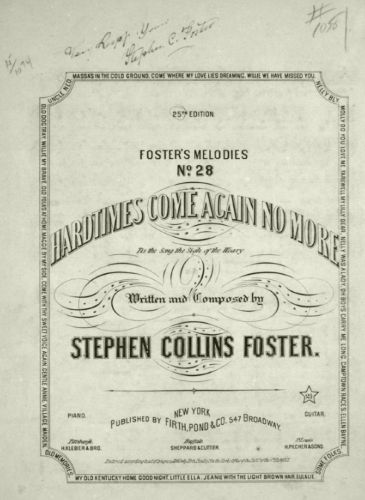
To understand Foster only through blackface minstrelsy is to miss a second body of work that was equally central to his reputation: the parlor songs and sentimental ballads that brought his music into domestic life with unusual force. These songs did not escape the broader commercial world that made Foster famous, and some still touched the same melodic and emotional vocabulary as his minstrel pieces. Yet they operated in a different register. Instead of comic dialect, plantation nostalgia, or theatrical caricature, they often centered longing, courtship, separation, memory, poverty, and grief. They were songs for ordinary singers, especially in homes where sheet music, piano, and voice formed part of middle-class sociability. Foster’s parlor music reveals a composer whose importance extended beyond the minstrel stage into the intimate emotional habits of nineteenth-century Americans.
The parlor song depended on accessibility. It had to sound refined without becoming difficult, expressive without demanding professional technique, and memorable without seeming vulgar. Foster understood this balance remarkably well. His best domestic songs often move with clean melodic lines, clear harmonic support, and lyrics that invite immediate emotional recognition. “Jeanie with the Light Brown Hair,” published in 1854, is one of the clearest examples. Its dreamlike language, soft natural imagery, and aching sense of absence belong to the world of romantic memory rather than public comedy. The song’s emotional restraint is part of its power. It does not overwhelm the singer with dramatic excess. It allows longing to unfold gently, making private feeling available to public performance within the safe space of the home.
This domestic setting mattered because nineteenth-century Americans often encountered music by making it themselves. Before recordings, a song did not live primarily as a fixed performance by a famous artist. It lived when someone bought the sheet music, placed it on a piano, practiced it, sang it for family or guests, copied it into memory, or carried it into another household. Foster’s songs were well suited to this world because they were crafted for circulation through ordinary ability. Their apparent simplicity made them socially powerful. They could be sung by amateurs without embarrassment and remembered by listeners without effort. In a culture where domestic performance was often tied to courtship, refinement, family feeling, mourning, and sociability, a song could become part of how people staged their own emotional lives. To sing in the parlor was not only to reproduce a composer’s work, but to inhabit a feeling in front of others. Foster understood that such songs had to leave room for the singer. They could not be so idiosyncratic that ordinary performers felt excluded, nor so empty that the performance carried no emotional charge. Foster’s parlor songs helped create not only a repertoire but a practice: the shared domestic performance of feeling. His music entered American life not merely as entertainment, but as a script for how sorrow, tenderness, and remembrance might be voiced.
“Hard Times Come Again No More,” also published in 1854, widened that domestic emotional world into social sympathy. The song does not depend on plantation nostalgia or romantic longing, though it draws on the same gift for plain melody and direct appeal. Instead, it asks listeners to attend to suffering beyond themselves, to the poor and weary who stand near the edges of comfort. Its refrain is simple enough to sound almost like a prayer, and that simplicity gives the song moral force. Foster does not offer a political program, but he does create an ethics of attention. In a decade marked by economic insecurity, sectional conflict, and widening social inequality, “Hard Times” gave private singers a way to voice public compassion from within the domestic parlor.
The emotional world of these songs also complicates the division between Foster’s “respectable” parlor music and his minstrel work. The categories overlap more than later memory sometimes admits. “Hard Times Come Again No More,” for example, has often been understood as blending elements of Foster’s compositional styles, linking the accessible chorus structure of popular entertainment with the moral seriousness of sentimental song. This overlap is important because Foster’s genius did not lie in keeping musical worlds separate. It lay in moving between them, adapting theatrical immediacy to domestic respectability and bringing parlor sentiment into forms that could circulate widely. His music often crossed boundaries that critics later tried to police: public and private, comic and mournful, popular and respectable, commercial and intimate. The same composer who wrote for minstrel circulation could also write music that families used to express grief, affection, and moral concern. That does not erase the racial harm of the minstrel tradition, but it does prevent Foster from being understood through a single genre. The same musical economy that made “Oh! Susanna” portable also helped make “Jeanie” and “Hard Times” enduring. What changed was not Foster’s commitment to singability, but the emotional work he asked that singability to perform. In the parlor songs, melody became less a vehicle for comic theatrical motion and more a vessel for inwardness, memory, and shared vulnerability.
“Beautiful Dreamer,” published posthumously in 1864, later became the emblem of Foster at his most ethereal and least burdened by the racial and theatrical associations of his earlier fame. Its dream imagery, gentle address, and suspended atmosphere seem to lift Foster into a world of pure lyric longing. Yet even here, the song’s later reception matters. Because it appeared after his death, “Beautiful Dreamer” helped shape the sentimental memory of Foster himself: the doomed composer, the vanished dream, the fragile artist whose music outlived his poverty and decline. That posthumous aura can obscure the harder history of his career, but it also testifies to the durability of his parlor style. Foster could write songs that seemed to hover between private grief and shared memory, songs intimate enough for a single voice yet broad enough to become national inheritance.
Foster beyond minstrelsy, then, was not a different man but a fuller one. His parlor songs show the same instincts that made his comic and plantation songs travel: direct melody, emotional clarity, verbal simplicity, and an extraordinary ability to make composed music feel already familiar. In domestic song, those gifts turned toward courtship, poverty, longing, remembrance, and the fragile consolations of song itself. This is why Foster’s legacy cannot be reduced to either condemnation or celebration. The parlor repertory reveals a composer who gave nineteenth-century Americans some of their most durable ways of singing private feeling. But those songs also belonged to the same marketplace, the same culture of sentiment, and the same nation that made his more troubling work possible. Foster’s music entered the home because it knew how to sound like the heart. The difficulty is that the heart it voiced was always historical.
Commerce without Security: Copyright, Publishing, Poverty, and the Limits of Early Professional Songwriting
Foster is often described as America’s first professional songwriter, and the claim is useful if handled with care. It does not mean that no American had ever written songs for money before him, nor that Foster entered a fully formed profession with stable rules, reliable income, and recognized protections. It means that Foster was among the first American composers to attempt something new with unusual seriousness: to make songwriting itself the basis of a livelihood. The University of Pittsburgh describes him as one of the first American songwriters to earn a living through composition alone, a phrasing that captures both the novelty and the fragility of his position. Foster stood at the beginning of a professional identity that the marketplace had not yet learned how to sustain.
The conditions of that marketplace were sharply different from those of later popular music. There were no recordings, broadcasts, streaming platforms, mechanical royalties, radio royalties, or national performance-rights organizations. A song became valuable primarily through sheet music sales, public performance, theatrical use, and repeated amateur circulation. The composer’s income depended on arrangements with publishers, and those arrangements varied widely. Some songs were sold outright. Others might bring royalties per copy. But even when a royalty agreement existed, enforcement depended on contracts, honest accounting, and a copyright system still poorly suited to the speed and looseness of popular circulation. The law could recognize a printed composition, but it could not easily control the many ways a tune moved once audiences, performers, and rival publishers took hold of it. Minstrel troupes could popularize a song before proper compensation followed. Local printers could issue competing editions. Amateur singers could carry a chorus into memory, making the song culturally valuable without creating any new payment for its author. A song that traveled widely could become famous in hundreds of mouths while returning very little money to the person who wrote it.
Foster learned this lesson early and painfully. “Oh! Susanna” became a national phenomenon, but its financial reward to Foster was modest compared with the profits and publicity it generated for others. The song was repeatedly reprinted, adapted, and claimed in a marketplace where piracy and unauthorized editions were common. Its very success made it difficult to control. Once a tune entered minstrel performance, popular memory, and westward migration, it no longer belonged neatly to publisher, performer, or author. This is one of the central ironies of Foster’s career. The songs that made him important as a professional writer often achieved that importance by escaping the boundaries within which professional authorship could be compensated.
The 1849 relationship with the New York firm Firth, Pond & Co. mattered deeply. Foster’s move toward royalty publication signaled that songwriting could be treated as an ongoing profession rather than as a series of isolated sales. It placed him in closer relation to the emerging commercial infrastructure of American music publishing, with a major firm distributing his work to a wider public. Yet this arrangement did not solve the underlying problem. Royalty systems could help, but they could not fully protect a composer from unauthorized printing, weak copyright enforcement, uneven sales, or the unpredictable nature of public taste. Foster’s career moved forward because the sheet-music trade needed him, but his life remained unstable because the trade did not need him enough to guarantee his security.
That instability shaped the moral and artistic economy of his work. Foster wrote within a market that rewarded immediate appeal, emotional clarity, and broad singability. This does not diminish his artistry. It explains some of its discipline. He could not write only for elite admiration or private satisfaction. His songs had to sell, and to sell they had to move across class, region, and performance setting. They had to be simple enough for amateurs, vivid enough for stages, respectable enough for parlors, and memorable enough for the public to carry. Every successful Foster song was also a calculation in accessibility, even when the calculation felt effortless. Commercial pressure helped produce the very qualities later generations praised as natural genius: direct melody, emotional compression, and language that seemed already familiar. The market did not merely exploit Foster. It shaped the form of his achievement. His craft emerged from the need to reach people quickly and remain with them afterward, to make a printed object become a social act, a household performance, a theatrical refrain, or a remembered fragment. In that sense, the commercial marketplace was not outside the music. It was inside the music’s structure, pacing, and emotional design.
But commerce also narrowed the range of what could safely be imagined. Publishers and performers favored songs that audiences already knew how to hear, and in Foster’s case that often meant minstrel numbers, plantation sentiment, romantic longing, domestic grief, and generalized social sympathy rather than more direct political challenge. The marketplace rewarded feeling, but not necessarily truth. It welcomed sorrow if sorrow could be printed, performed, and sold without requiring listeners to change their world. This helps explain why Foster’s work so often moves between genuine tenderness and moral evasion. He wrote for a public that wanted to feel deeply, but not always to think dangerously. Professional songwriting in this early form was both liberating and constraining. It allowed Foster to reach a national audience, but it also bound his music to the emotional expectations and racial habits of that audience.
The personal consequences were severe. Foster’s fame did not protect him from financial strain, family difficulty, professional uncertainty, or later poverty. The familiar story of the great songwriter dying poor can become sentimental if repeated too easily, but it points to a real structural failure. American popular culture could consume songs faster than it could honor the labor behind them. Foster helped create a national repertoire, yet he never enjoyed the kind of economic stability that such cultural power might seem to promise. His life exposes the gap between fame and security at the birth of American commercial music. He was known, sung, and remembered, but knowledge, song, and memory did not pay reliably.
The limits of Foster’s profession also shaped his posthumous legend. Later generations could look back and see in him a tragic pioneer: the first great American songwriter, beloved but underpaid, famous but fragile, foundational but unprotected. That image contains truth, but it can also soften the harder historical lesson. Foster’s poverty was not only personal misfortune. It was part of a developing cultural economy in which music became mass property before composers had dependable claims upon its value. The modern American music industry would eventually build more elaborate systems of copyright, royalty collection, publishing control, and performance revenue. Foster stood before that machinery. He helped prove that songs could become national commodities, but he lived before the commodity could reliably sustain the person who made it.
The phrase “professional songwriter” carries a paradox at the center of Foster’s legacy. He professionalized songwriting by treating it as work, craft, and vocation. Yet the profession he entered remained unfinished. It could reward him with celebrity, but not stability; circulation but not control; cultural permanence, but not material safety. This paradox makes Foster more than a romantic casualty of genius. It makes him a historical figure in the making of American cultural labor. His songs helped teach the United States how to consume popular music nationally. His life revealed how slowly the country learned to compensate the people whose music it could not stop singing.
Civil War, Decline, and “Beautiful Dreamer”: The Last Songs, 1861–1864
The Civil War changed the world in which Foster’s songs were heard. The sentimental plantation South that had helped make “Old Folks at Home” and “My Old Kentucky Home” so powerful could no longer remain safely suspended in nostalgia once the nation was openly at war over slavery, sovereignty, and the future of the republic. Foster had written many of his most famous songs before Fort Sumter, but their meanings did not stay fixed. As Union and Confederate armies mobilized, as enslaved people fled to federal lines, as families were separated by death and battle, and as the war gradually became a struggle over emancipation as well as Union, the older language of home, longing, and plantation memory entered a harsher historical light. The songs had always carried sorrow. The war made it harder to pretend that sorrow had no political cause. A melody that once seemed to offer generalized homesickness now sounded against the realities of military camps, refugee movement, contraband camps, battlefield death, and enslaved people taking history into their own hands by leaving plantations whenever Union lines made escape possible. Foster’s older songs did not suddenly become different compositions, but the world around them had changed so dramatically that their emotional meanings became harder to contain. The imagined plantation home could no longer be heard only as a place of memory. It now stood inside a national crisis that exposed the violence beneath the nostalgia.
Foster’s own position during the war years was neither that of a major patriotic composer nor that of a public political poet. He continued writing, but his great period of national invention had already passed. The marketplace around him was changing, and the public appetite for song was increasingly shaped by war: martial music, recruitment songs, camp songs, mourning songs, patriotic choruses, and partisan pieces. Foster’s gift had been for emotional portability, not ideological declaration. He could write about home, poverty, dream, memory, and separation with unusual directness, but he did not become the Civil War’s defining songwriter. This absence is significant. The crisis that revealed the historical violence behind plantation nostalgia also found Foster personally diminished, artistically uneven, and increasingly distant from the center of popular musical energy.
The final years of Foster’s life in New York were marked by instability, illness, strained relationships, and poverty. The older image of Foster as a doomed, destitute genius has often been sentimentalized, but there is a hard truth beneath the legend. He had given the country some of its most enduring songs, yet he lacked financial security. He continued selling compositions, sometimes for small sums, in a market that consumed his work without reliably sustaining him. His separation from his wife, Jane McDowell Foster, and daughter, Marion, deepened the loneliness attached to his last years, while his physical health declined. The songwriter who had made home into one of American music’s most powerful emotional symbols increasingly lived without a secure home of his own. That irony has shaped Foster’s memory ever since, but it should be understood historically rather than melodramatically. His decline was not only personal tragedy. It was also the consequence of a cultural economy that could turn melody into public property while leaving the maker exposed.
The songs of these last years vary in quality, but they reveal a composer still drawn to the emotional subjects that had defined his career: dreams, love, fatigue, memory, separation, and the ache of unreachable consolation. Some were written hurriedly and sold cheaply. Others retain flashes of the old lyric clarity. Foster’s late work lacks the confident cultural force of “Oh! Susanna,” “Old Folks at Home,” or “My Old Kentucky Home,” but that very weakening has its own historical meaning. The nation had moved into catastrophe, and Foster’s own life had narrowed into survival. The commercial songwriter who once gave American expansion a comic chorus and plantation nostalgia a sentimental voice now wrote in the shadow of war, debt, and illness. His late songs often seem less like songs of public formation than fragments of private endurance.
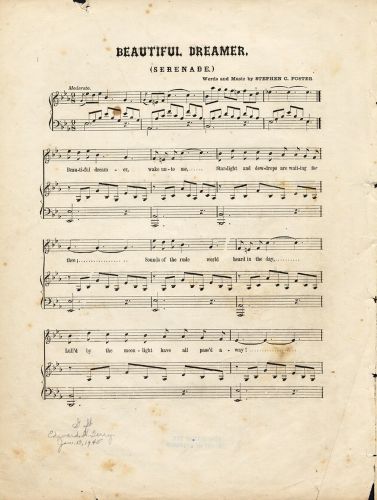
“Beautiful Dreamer,” submitted for copyright deposit in March 1864 and published after Foster’s death, became the great posthumous exception. The title page tradition presented it as one of his final songs, and later memory often treated it as the last flowering of his genius. Its power comes from its suspension. The song does not move through the comic rush of migration, the racial theater of minstrelsy, or the plantation landscape of longing. It addresses a dreamer in a world of starlight, dewdrops, soft sound, and imagined awakening. Its famous serenity is not empty. It feels like an appeal from the threshold between waking and sleep, presence and absence, life and death. The melody seems to hover rather than march, and that hovering quality helps distinguish it from the public energies of Foster’s earlier hits. It belongs to the parlor tradition, but it also feels strangely detached from ordinary domestic performance, as if the song were already listening to itself from a distance. Because it appeared after Foster’s death, listeners could easily hear it as a farewell, even if that interpretation owes as much to reception as to composition. The timing gave the song a biographical meaning Foster himself did not live to manage. It allowed the public to imagine his final voice as gentle, luminous, and untroubled by the harsher circumstances of his last years. The song gave Foster’s life a final image more graceful than his circumstances.
That grace has been both consoling and misleading. “Beautiful Dreamer” helped rescue Foster from the harder contradictions of his career by allowing later generations to remember him as a tragic lyric dreamer rather than as a composer deeply implicated in minstrelsy, racial sentiment, and the unstable marketplace of antebellum song. The song’s beauty is real, and its place in American musical memory is deserved. But the posthumous aura surrounding it can turn Foster into a harmless figure of melancholy genius, floating above the world that made him. A historically honest reading must resist that escape. “Beautiful Dreamer” is moving not because it cancels the earlier Foster, but because it stands beside him. The same composer who wrote songs carried by blackface performance and plantation nostalgia also wrote this delicate parlor serenade. The contradiction does not disappear at the end. It becomes more poignant.
Foster died in New York on January 13, 1864, after collapsing while ill and being taken to Bellevue Hospital. He was thirty-seven years old. The Civil War was still raging, emancipation was not yet constitutionally secured, and the modern music industry that would later give songwriters more elaborate systems of royalties and rights had not yet emerged. His death came at a symbolic crossing point. He belonged to the antebellum world, but his songs survived into a nation that would have to reinterpret them after slavery’s destruction. “Beautiful Dreamer” gave that survival a tender surface. Beneath it lay the larger truth of Foster’s career: he had helped create the emotional vocabulary of American popular song, but he did so in a republic whose dreams were inseparable from exploitation, longing, commerce, and loss.
Afterlives: State Songs, Folk Memory, Popular Covers, and the Making of a National Composer

Foster’s career did not end with his death in 1864. In many ways, his public life expanded afterward. The songs that had circulated through minstrel stages, parlors, sheet music shops, schools, and amateur performance became increasingly detached from the circumstances of their creation. They entered American memory as if they had always been there, carried by repetition rather than by biography. This is one of the defining features of Foster’s afterlife: he became more securely “national” as the public forgot more of the specific theatrical, racial, commercial, and personal conditions under which his music had first circulated. The author receded, the songs remained, and the remaining songs began to sound like inheritance.
State identity became one of the most visible forms of that inheritance. “Old Folks at Home” became Florida’s state song, while “My Old Kentucky Home” became the state song of Kentucky and a ceremonial fixture associated with the Kentucky Derby. These adoptions matter because they transformed Foster’s compositions from popular songs into civic symbols. A piece written within the racialized world of nineteenth-century plantation sentiment could be reinterpreted as an emblem of place, belonging, and public tradition. The transformation did not remove the songs’ original meanings. It layered new meanings over them. Florida could claim the Suwannee River as regional memory, and Kentucky could claim the old home as state feeling, even though both songs had emerged from a national commercial culture shaped by minstrel convention and sentimental fantasy.
The process by which Foster’s songs became folk memory was subtler than official adoption. Many of his compositions became so familiar that they were mistaken for traditional songs, which is one of the clearest signs of their cultural success. “Oh! Susanna,” “Camptown Races,” “Old Folks at Home,” and “My Old Kentucky Home” moved through schools, songbooks, family performance, summer camps, civic events, and informal singing until authorship seemed almost secondary. That folk-like status was not the same thing as true anonymity. Foster wrote these songs, publishers sold them, and performers popularized them. But repeated use changed their social meaning. A composed song, if sung long enough by enough people, can begin to behave like folklore. It becomes a cultural object people inherit rather than a commodity they remember someone making. This process also reveals how memory can flatten history. A song that began in print capitalism and theatrical performance can later seem to belong to everyone, as if it rose naturally from the soil of the nation. That illusion of natural origin is powerful. It makes Foster’s work feel older, purer, and less implicated than it really was. Folk memory did not erase authorship entirely, but it softened the commercial and racial pathways by which the songs had first become familiar.
This folk-like afterlife was strengthened by educational and commemorative culture. Foster’s songs appeared in school music collections, popular songbooks, patriotic anthologies, and nostalgic programs that presented them as part of a shared American past. Their melodies often became more important than their original lyrics or performance contexts. Children might learn a chorus without learning about blackface minstrelsy. Civic audiences might sing a state song without confronting the plantation fantasy embedded in the text. This was not necessarily deliberate deception in every case. It was often the ordinary work of cultural memory, which simplifies what it repeats. Yet the simplification had consequences. It allowed Foster to become a safe national composer by separating his music from the racial structures that helped make it national in the first place.
Recording technology gave Foster another afterlife. Once sound recording emerged, his songs entered the repertory of singers, instrumentalists, popular entertainers, classical performers, folk musicians, country musicians, and later revivalists. The Library of Congress’s National Jukebox and related collections preserve many early recordings of Foster’s music, showing how readily his songs adapted to new media. Their melodic clarity made them unusually flexible. A song first sold as sheet music could survive as a parlor performance, a schoolroom standard, a concert arrangement, a folk rendition, a country tune, or a nostalgic popular recording. Each new medium altered the song’s meaning. Recording fixed performances that had once depended on amateur variation, but it also gave Foster’s music wider circulation across time, preserving versions that could be heard long after the singers themselves were gone.
Popular covers and adaptations further expanded Foster’s reach. His songs have been performed by a wide range of artists across genres, sometimes reverently, sometimes nostalgically, sometimes critically, and sometimes with little awareness of the racial history behind them. This adaptability is part of the reason Foster endured. His melodies could survive changes in instrumentation, tempo, audience, and ideology. “Beautiful Dreamer” could become a sentimental standard. “Hard Times Come Again No More” could be heard as a social lament in later periods of economic distress. “Oh! Susanna” could persist as a children’s song even after its minstrel origins became less publicly acceptable. The very flexibility that kept Foster alive also allowed discomfort to be managed through rearrangement. A new performance could preserve the tune while softening, revising, or ignoring the original burden of the words. This is one reason Foster’s afterlife reaches so far beyond the nineteenth century. Musicians could take from him melody, mood, or cultural familiarity without necessarily taking on the full historical frame. At times, that made the songs newly expressive. At other times, it allowed the past to become decorative, a pleasant old tune with its wounds politely covered. The afterlife of a song is never neutral. Each revival decides, whether openly or silently, how much history the melody will be allowed to carry.
The making of Foster as a national composer was a historical construction, not simply a natural result of genius. Memorials, biographies, song editions, institutional collections, state rituals, school curricula, and popular recordings all helped create the Foster Americans came to know: the tragic songwriter, the melodist of home, the first professional composer of national feeling, the “Father of American Music.” This image contains truth, but it is curated truth. It emphasizes melodic beauty, emotional accessibility, poverty, and pathos while often minimizing blackface performance, racial caricature, copyright instability, and the commercial exploitation of plantation nostalgia. The national Foster was made by selection. Some songs were elevated, some lyrics revised, some contexts softened, and some contradictions left outside the frame.
That selective memory is now impossible to sustain without challenge. The later revision of lyrics, the reassessment of state songs, and the growing scholarship on minstrelsy have made Foster’s afterlife as contested as his career. But contestation does not mean disappearance. It means historical adulthood. Foster remains important because his songs reveal how American popular music became national through beauty, commerce, repetition, and racial distortion all at once. His afterlife shows that a song can outlive its maker, outgrow its original setting, and still carry the marks of that setting inside it. To call Foster a national composer, then, is not to cleanse him. It is to recognize that American national memory itself was made through acts of preservation, forgetting, revision, and return. Foster’s songs endure because they are beautiful. They trouble because they remember more than later tradition wanted to admit.
Modern Reassessment: Retired Lyrics, Revised Performances, and the Burden of Inheritance
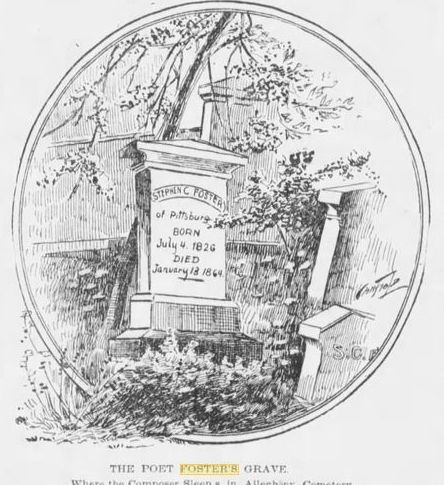
Modern reassessment of Foster has not erased his importance, but it has made innocence impossible. The songs that once moved through schools, civic rituals, popular recordings, and family memory as familiar American standards now face a more searching historical question: what exactly has been inherited? Foster’s melodies remain powerful because they are singable, emotionally direct, and woven into public memory. Yet many of the words, settings, and performance traditions attached to them came from a nineteenth-century world shaped by blackface minstrelsy, plantation nostalgia, and white commercial control over representations of Black life. Reassessment begins when familiarity no longer excuses forgetfulness. A song remembered lovingly may still carry the assumptions of the world that made it.
The most visible form of this reassessment has been lyric revision. “Old Folks at Home” and “My Old Kentucky Home” both became official or ceremonial songs while retaining traces of racial language and plantation imagination that later audiences could no longer treat as harmless. Altering such lyrics is often presented as a compromise: the melody is preserved, the most offensive words removed, and the public ritual continues. But revision does more than clean up embarrassment. It exposes the problem that made revision necessary. When a state song must be rewritten to remain singable in public, the alteration becomes an act of historical evidence. It reveals that the song’s public usefulness depended for generations on a willingness to overlook or normalize racial meanings embedded in the text. It also reveals the tension between attachment and accountability. Communities often do not revise beloved songs because they have ceased to care about them. They revise them because they still care, and because continued use now requires a reckoning earlier ceremonies avoided. The changed lyric becomes a kind of public scar: a sign that the melody survived, but not untouched. In Foster’s case, revision shows how deeply his music entered civic identity and how difficult it is for institutions to let go of songs that have become ceremonial habits, even when those songs carry histories the present can no longer comfortably sing.
Retirement is another, stronger response. Some Foster songs, or some versions of them, have receded from public performance because their original language and associations are too entangled with minstrelsy to be comfortably adapted. This does not mean that the songs vanish from history. It means they move from uncritical performance into archival, scholarly, or contextual spaces. That shift is important. A song may be historically indispensable and still inappropriate for casual ceremonial use. Historians, musicians, teachers, and cultural institutions must distinguish between preservation and repetition. Preservation asks what a song reveals about the past. Repetition can sometimes reproduce the past’s injuries under the cover of tradition. Foster’s work now forces that distinction with unusual clarity.
Revised performances have attempted another path: contextualization rather than disappearance. In this approach, musicians may retain Foster’s melodies while changing lyrics, adding historical framing, altering arrangements, pairing songs with African American musical traditions, or presenting them within programs that explicitly address minstrelsy and slavery. Such performances can be valuable when they refuse nostalgia’s old bargain. They ask listeners to hear beauty and harm together, not as canceling forces but as historically joined ones. The danger is that context can become decorative if it merely excuses continued comfort. A short program note cannot undo a song’s racial history if the performance itself still invites the audience to feel untroubled nostalgia. Context must change the act of listening, or it becomes another way of keeping the melody while muting the burden.
The burden of inheritance is especially heavy because Foster’s songs are not obscure artifacts. They are familiar. That familiarity can make critique feel like intrusion, as if historians have arrived late to spoil something beloved. But historical criticism does not impose difficulty on Foster’s music from the outside. The difficulty was there from the beginning. “Oh! Susanna” was born in the world of blackface performance. “Old Folks at Home” transformed a minstrelized plantation voice into universal homesickness. “My Old Kentucky Home” made an enslaved world available as sentimental memory. “Beautiful Dreamer” may seem far removed from those racial frames, but its reception helped soften the image of Foster himself. The modern listener’s task is not to choose between affection and knowledge, but to refuse affection without knowledge. That refusal is demanding because beloved music often enters memory before critical judgment does. People learn songs as children, at public ceremonies, in family settings, or through inherited cultural routines long before they know the histories attached to them. Later reassessment can feel personal, not merely intellectual. But that is exactly why it matters. A mature historical culture must be able to revisit what it once received innocently and ask what innocence concealed. Foster’s music is difficult because it sits precisely at that crossing point between emotional memory and historical knowledge.
This reassessment also changes the meaning of the phrase “Father of American Music.” If Foster is treated as a pure origin point, the title becomes evasive and exclusionary. It risks placing a white composer at the head of a musical tradition shaped profoundly by African American creativity, coercion, appropriation, and survival. But if the title is treated critically, it can reveal something truer and darker about American popular music’s formation. Foster was not the father of American music in any total sense. He was one of the fathers of American commercial song: a composer who helped transform print, performance, sentiment, and racialized entertainment into a national repertoire. That is a serious achievement, but it is not an innocent one. Modern reassessment does not shrink Foster. It places him where he belongs, inside the structures that made him possible.
The question, then, is not whether Foster should be remembered, but how. To remember him responsibly is to hold the melodies and the marketplace together, the parlor and the minstrel stage together, the beauty and the racial fantasy together. It means teaching “Hard Times Come Again No More” as a genuine song of social sympathy while also teaching “Oh! Susanna” as a product of blackface culture. It means hearing “My Old Kentucky Home” not only as state memory, but as a sentimental transformation of slavery’s violence. It means allowing “Beautiful Dreamer” to remain beautiful without letting that beauty wash the rest of the history clean. Responsible memory also means resisting the false comfort of simple verdicts. Foster was neither merely a villain to be discarded nor a national innocent to be protected from critique. He was a gifted composer whose work reveals how American culture often made beauty out of unequal power, how it converted exploitation into sentiment, and how it preserved melodies even when it revised or forgot the conditions that gave them meaning. Foster’s inheritance is burdensome because it is national. The songs endure because America kept singing them. The responsibility now is to know what was being sung, and to decide, with honesty rather than habit, what kind of singing the present can still justify.
Was Foster the “Father of American Music,” or Only the Father of White Commercial Nostalgia?
The following video from Gettysburg History is a biography of the life of Stephen Collins Foster:
The title “Father of American Music” has always carried more weight than it can safely bear. It recognizes something real in Stephen Collins Foster’s career: his extraordinary role in shaping American popular song as a commercial, emotional, and national form. Yet the phrase also risks turning a complicated historical process into a comforting family romance. Fathers imply origins, inheritance, legitimacy, and descent. To call Foster the father of American music can make him seem like the source from which the national tradition flowed, when in fact he stood inside a crowded musical world already rich with African American creativity, Indigenous sound worlds, European immigrant traditions, hymnody, dance music, theater, oral performance, and regional song. The title also carries the danger of retrospective order, making nineteenth-century American music seem more unified than it was. Foster’s world was noisy, plural, uneven, and contested, filled with competing musical practices rather than a single national style waiting to be named. His achievement was not that he brought music to a silent nation, but that he gave certain kinds of popular song a form that could be printed, sold, performed, remembered, and claimed as national. Foster did not create American music. He helped commercialize and consolidate one powerful version of it.
The strongest challenge to Foster’s title is that it centers a white composer within a musical culture profoundly indebted to Black expressive life. Minstrelsy drew energy from African American music, dance, rhythm, gesture, and speech while denying Black people control over their representation and often excluding them from the profits and prestige generated by imitation. Foster’s songs did not simply float above that system. Many moved through it, benefited from it, and carried its assumptions into national circulation. If Foster is made the father of American music without qualification, the title repeats the older act of appropriation: Black cultural presence becomes raw material, while white authorship becomes legacy. The danger is not merely that Foster receives too much credit. It is that the communities whose creativity shaped American music before, during, and after Foster are once again made background.
There is another danger in the title as well. Foster’s most famous plantation songs helped teach white Americans to remember slavery through longing rather than domination. “Old Folks at Home” and “My Old Kentucky Home” did not present slavery as a political argument to be defended, but as an emotional landscape to be mourned, inhabited, and sung. That made them more durable than explicit propaganda. They offered a version of the South in which home, river, family, memory, and sorrow overshadowed sale, coercion, punishment, labor extraction, and sexual violence. The plantation became less an institution of forced labor than a stage of feeling, a place where white listeners could encounter grief without having to name the full system that produced it. This was not merely a lyrical problem. It was a national habit of memory. By converting slavery’s world into music of homesickness and loss, Foster’s songs participated in a broader cultural pattern that allowed Americans to sentimentalize what they should have been forced to judge. Foster may appear less as the father of American music than as a father of white commercial nostalgia: a composer who helped turn the plantation into a marketable feeling, one that white audiences could consume without fully confronting the system that produced the grief being sung.
Yet that counterpoint, powerful as it is, can become too simple if it treats Foster only as an agent of evasion. His music did more than flatter white nostalgia. It also created durable forms of popular feeling that exceeded their original frames. “Hard Times Come Again No More” gave social suffering a plain and memorable voice. “Jeanie with the Light Brown Hair” and “Beautiful Dreamer” shaped parlor longing with remarkable delicacy. Even within the plantation songs, Foster sometimes moved beyond crude ridicule toward grief, memory, and domestic tenderness. “Nelly Was a Lady” remains historically significant precisely because it granted a Black woman a title and a place within sentimental dignity that much white popular culture denied. These gestures did not redeem the racial marketplace in which they appeared, but they do show why Foster cannot be reduced to nostalgia alone. He widened the emotional range of American popular song, even when he did so within compromised forms.
The better answer, then, is not to keep or discard the title without revision, but to narrow and trouble it. Foster was not the father of American music in any total sense. He was not the origin of American musical creativity, not the inventor of national sound, and not the sole source of popular song. But he can be understood as one of the fathers of American commercial popular song: a figure who joined print capitalism, domestic performance, theatrical entertainment, sentiment, and memorable melody into a repertoire that moved nationally before recording technology existed. His importance lies in mediation. He took existing musical and emotional languages, gave them compact popular form, and helped make them reproducible through publishers, performers, parlors, and memory. That is a real historical achievement, but it is an achievement inseparable from the unequal cultural economy that made it possible.
So the question becomes less “Was Foster the Father of American Music?” than “What kind of American music did Foster help father?” The answer is uncomfortable because it is double. He helped father a song culture of astonishing melodic accessibility, emotional directness, and national reach. He also helped father a commercial memory that could make racial caricature singable, make plantation loss sentimental, and make authored songs feel like innocent folk inheritance. Foster’s greatness and his limitation are intertwined. He gave America music it could remember, but he also gave it music through which it could forget. To study him honestly is to refuse both the shrine and the dismissal. He was foundational, but not pure; national, but not universal; beautiful, but not innocent. The title can survive only if it is made uneasy.
Conclusion: Beautiful Dreamer, Troubled Dream
“Beautiful Dreamer” offers a fitting final image for Stephen Collins Foster because it captures both the grace and the danger of his memory. The song seems to float above the harder world that produced him, calling from a realm of starlight, softness, longing, and suspended time. It is easy to hear in it the tragic figure later generations preferred: the delicate songwriter, poor and fading, whose music outlived his life. But Foster’s career cannot be allowed to dissolve into that dream. The same composer who wrote one of America’s gentlest parlor songs also wrote within the commercial world of blackface minstrelsy, plantation sentiment, unstable copyright, and racialized popular entertainment. His beauty was real. So was the damage around it.
Foster’s claim to the title “Father of American Music” depends on what the phrase is allowed to mean. If it means that he originated American music, the title is false. The nation’s musical life long predated him and was shaped by Indigenous traditions, African American creativity, European immigrant forms, hymnody, dance, labor, theater, oral performance, and countless unnamed singers. If it means that he helped father American commercial popular song, the title becomes more defensible and more troubling. Foster joined melody, print, theatrical circulation, domestic performance, and sentiment into songs that could move across region, class, and generation. He made authored songs feel communal. He helped turn sheet music into shared memory. He gave Americans melodies they could carry even when they forgot who had written them.
Yet the forgetting is precisely the problem. Foster’s songs helped Americans remember home, longing, grief, poverty, and dream, but they also helped many forget the structures that made such feelings historically charged. Plantation songs made slavery’s world singable as nostalgia. Minstrel songs carried racial caricature into national circulation. Parlor songs made private feeling public without always acknowledging the marketplace that shaped their intimacy. Later civic use turned troubling compositions into state symbols, school songs, and ceremonial traditions. Foster’s afterlife shows how national memory often works: it preserves what is beautiful, revises what is embarrassing, softens what is painful, and only later returns to ask what the melody had been carrying all along.
The honest conclusion, then, is neither shrine nor erasure. Foster was foundational, gifted, and compromised. He helped create a durable language of American popular song, one built from simplicity, sorrow, humor, sentiment, repetition, and extraordinary melodic instinct. He also worked inside a culture that made racial fantasy profitable and then made that profit sound like inheritance. To study him seriously is to accept the unease. America still hears Foster because his songs taught the nation how to sing itself: its dreams, its homesickness, its theatricality, its tenderness, its evasions. “Beautiful Dreamer” remains beautiful, but the dream was never innocent. It was always American, and always troubled.
Bibliography
Affiliate disclosure: Amazon links on this site are paid links. As an Amazon Associate I earn from qualifying purchases.
- Austin, William W. “Susanna,” “Jeanie,” and “The Old Folks at Home”: The Songs of Stephen C. Foster from His Time to Ours. Urbana: University of Illinois Press, 1975.
- Bingham, Emily. My Old Kentucky Home: The Astonishing Life and Reckoning of an Iconic American Song. New York: Knopf, 2022.
- Cockrell, Dale. Demons of Disorder: Early Blackface Minstrels and Their World. Cambridge: Cambridge University Press, 1997.
- Crawford, Richard. America’s Musical Life: A History. New York: W. W. Norton, 2001.
- Emerson, Ken. Doo-Dah! Stephen Foster and the Rise of American Popular Culture. New York: Simon & Schuster, 1997.
- —-. “Stephen Foster and American Popular Culture.” American Music 30:3 (2012), 397-404.
- Florida Department of State. “State Song: Old Folks at Home.” Tallahassee: Florida Department of State.
- Foster, Morrison. My Brother Stephen: The Story of Stephen Collins Foster. Indianapolis: Privately printed, 1932.
- Foster, Stephen Collins. “Beautiful Dreamer.” New York: Wm. A. Pond & Co., 1864.
- —-. “Camptown Races.” Baltimore: F. D. Benteen, 1850.
- —-. “Hard Times Come Again No More.” New York: Firth, Pond & Co., 1854.
- —-. “Jeanie with the Light Brown Hair.” New York: Firth, Pond & Co., 1854.
- —-. “My Old Kentucky Home, Good-Night!” New York: Firth, Pond & Co., 1853.
- —-. “Nelly Was a Lady.” New York: Firth, Pond & Co., 1849.
- —-. “Oh! Susanna.” Cincinnati: W. C. Peters & Co., 1848.
- —-. “Old Folks at Home.” New York: Firth, Pond & Co., 1851.
- Hall, Dale E. “The Unknown Stephen Foster.” American Music Teacher 26:4 (1977), 25-27.
- Hamm, Charles. Yesterdays: Popular Song in America. New York: W. W. Norton, 1979.
- Howard, John Tasker. Stephen Foster: America’s Troubadour. New York: Thomas Y. Crowell Company, 1934.
- Jackson, George Pullen. “Stephen Foster’s Debt to American Folk-Song.” The Musical Quarterly 22:2 (1936), 154-169.
- Key, Susan. “’Forever in Our Ears’: Nature, Voice, and Sentiment in Stephen Foster’s Parlor Style.” American Music 30:3 (2012), 290-307.
- —-. “Sound and Sentimentality: Nostalgia in the Songs of Stephen Foster.” American Music 13:2 (1995), 145–166.
- Lhamon, W. T., Jr. Raising Cain: Blackface Performance from Jim Crow to Hip Hop. Cambridge, MA: Harvard University Press, 1998.
- Library of Congress. Stephen Collins Foster: A Guide to Resources. Washington, DC: Library of Congress.
- Lott, Eric. Love and Theft: Blackface Minstrelsy and the American Working Class. New York: Oxford University Press, 1993.
- Mahar, William J. Behind the Burnt Cork Mask: Early Blackface Minstrelsy and Antebellum American Popular Culture. Urbana: University of Illinois Press, 1999.
- Root, Deane L., ed. The Music of Stephen C. Foster: A Critical Edition. Washington, DC: Smithsonian Institution Press, 1990.
- —-. “The ‘Mythtory’ of Stephen C. Foster.” American Music Research Center Journal 1 (1991), 1–20.
- Stowe, Harriet Beecher. Uncle Tom’s Cabin; or, Life Among the Lowly. Boston: John P. Jewett & Company, 1852.
- Toll, Robert C. Blacking Up: The Minstrel Show in Nineteenth-Century America. New York: Oxford University Press, 1974.
- University of Pittsburgh Library System. “Frequently Asked Questions About Stephen Foster.” Center for American Music, University of Pittsburgh.
- —-. “The Life and Music of Stephen Collins Foster.” Center for American Music, University of Pittsburgh.
Originally published by Brewminate, 06.02.2026, under the terms of a Creative Commons Attribution-NonCommercial-NoDerivatives 4.0 International license.
About the Author