After Xerxes’ defeat, the Ionian cities entered a transformed Aegean where Persian power endured even as Athens built a new hegemony through local participation and conflict among the poleis.

By Dr. Joshua P. Nudell
Assistant Professor of History
Truman State University
Introduction
Ionia was firmly ensconced in the Persian Empire at the start of Xerxes’ ill-fated campaign in 480. When Xerxes mustered his forces, therefore, the Ionians came. A contemporary observer would be hard-pressed to imagine that the next two years would see Persian power rolled back or that this development created the playing field that would shape the region for the next two centuries. And yet that is exactly what happened.
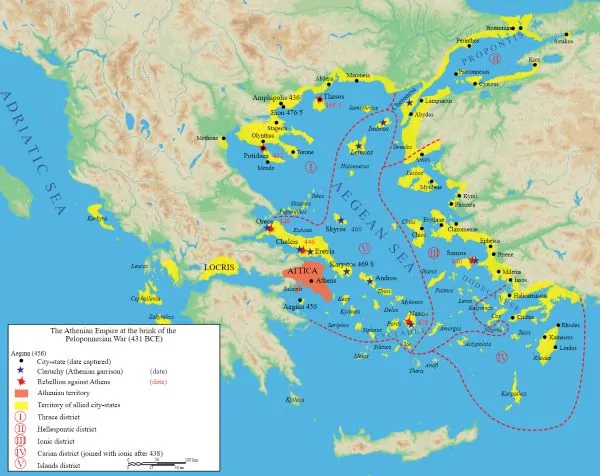
Ionia had long been constrained by its relationships with its imperial neighbors, so the development of Athenian hegemony was novel primarily in that the new power in the region was a Greek polis rather than a king. The year 480/79 also marked a subtle change in that Athens held Persian authority at bay without sweeping Persia entirely away, thereby leaving the Ionian poleis to chart a course that accounted for a multipolar imperial arena. Analyzing Ionia within this new environment reveals two recurring themes. First, Ionians were complicit in the practice of empire in the Aegean, both in the Persian system and in the developing Athenian one. This is not a shocking conclusion, but the ebbs and flows of imperial competition offered new avenues to exploit power dynamics, including at the expense of other Greek poleis. Second, imperial competition threatened to exacerbate the long-standing factional conflicts in Ionia, the consequences of which began to appear already in the first half of the fifth century.
Fighting Badly? Ionia and Xerxes’ Invasion of Greece
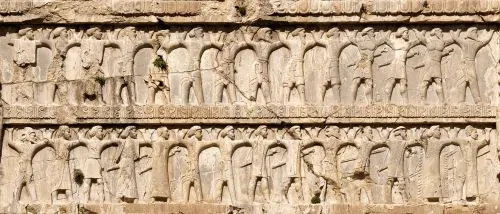
Despite the prominence of the Ionian revolt in Herodotus’ history (5.28–55, 97–126, 6.1–42), the Ionians are largely subsumed into the mass of the Persian forces in his account of the campaign in 480. He refers to them as Ionians, as distinct from Greeks, at once highlighting concerns over their loyalty and demonstrating them to be among the most efficient units in the Persian fleet. The result is a tension that closer evaluation reveals to be the result of two competing forces: faction within Ionia at the time of the invasion and a web of pressures around how the Ionian contribution to the Persian invasion ought to be remembered.
According to Herodotus’ catalog of the Persian force, the Ionians furnished a hundred ships (7.94; cf. Diod. 11.2.8). The description of this contingent is frustratingly vague and, despite already having described events in Ionia at length, Herodotus hews to the formula in the rest of this section in providing only an ethnographic snapshot about the contingent, saying that they were “equipped like Greeks” (ἐσκευασμένοι ὡς Ἕλληνες, 7.94).1 Numbers reported by Herodotus are notoriously problematic, but, while the one hundred ships may be inexact, only the Phoenicians supplied more.2
In describing the Persian naval forces, Herodotus says Ariabignes, a son of Darius, commanded the Ionian and Carian ships, all of which carried Persian, Median, and Sacae marines (7.96–97).3 However, it would be a mistake to assume that the Ionians at this moment fought for Persia only under the threat of death and were merely awaiting an opportunity to break free. In fact, Herodotus offers a rare moment of insight into their motivations at the start of the battle of Artemisium, when the Persian fleet had the Hellenic League ships surrounded (8.10.2–3):
Now, all those among the Ionians sympathetic to the Greeks were sailing involuntarily. They became greatly distressed seeing [the Greeks] surrounded and believed that none would ever return home again, so weak did the Greek position seem to be. But others relished the situation, competing with each other to see who could seize an Attic ship first in order to receive gifts from the king since there was the most talk in camp about the Athenians.
ὅσοι μέν νυν τῶν Ἰώνων ἦσαν εὔνοοι τοῖσι Ἕλλησι, ἀέκοντές τε ἐστρατεύοντο συμφορήν τε ἐποιεῦντο μεγάλην ὁρῶντες περιεχομένους αὐτοὺς καὶ ἐπιστάμενοι ὡς οὐδεὶς αὐτῶν ἀπονοστήσει: οὕτω ἀσθενέα σφι ἐφαίνετο εἶναι τὰ τῶν Ἑλλήνων πρήγματα. ὅσοισι δὲ καὶ ἡδομένοισι ἦν τὸ γινόμενον, ἅμιλλαν ἐποιεῦντο ὅκως αὐτὸς ἕκαστος πρῶτος νέα Ἀττικὴν ἑλὼν παρὰ βασιλέος δῶρα λάμψεται: Ἀθηναίων γὰρ αὐτοῖσι λόγος ἦν πλεῖστος ἀνὰ τὰ στρατόπεδα.
Herodotus only specifies that some of the Ionians felt sympathy the Greeks, thereby leaving open to interpretation the identity of the ship commanders who were eager to attack the Athenians because they saw potential reward, but the parallel construction of his language also suggests that all of the viewpoints described here belonged to Ionians.4 Indeed, Graham Shipley has argued that the Samians enthusiastically participated in the campaign because they had come to see the Ionian revolt as a mistake, while a strand of historiography suggests that serving in the Persian fleet empowered traditionally disenfranchised classes of people in Ionia in much the same way that ascendancy of the navy in fifth-century Athens endowed the thētes with increased political power.5 Equally important, though, is Herodotus’ explanation for the Ionian sympathy: not out of kinship, but at the seemingly hopeless situation of the Greek fleet.
A similar slippage occurs in the description of Themistocles’ bid to separate the Ionians from Persia before the battle. Themistocles reportedly believed that the Ionians and Carians were the key to defeating the Persians (Hdt. 8.19.1) and so discretely sailed to locations where the Persian ships would put in for water and there left a message for the Ionians (Hdt. 8.22; Plut. Them. 9.1–2). In the Herodotean version, Themistocles wrote:6
Ionians! You are not acting justly taking up arms against your fatherland and bringing slavery to Hellas. It would be best if joined with us, but if that is not within your power you could still withdraw from this conflict yourselves and beg the Carians to go with you. But if you can do neither of these but are so powerfully compelled such that you cannot resist, then deliberately feign cowardice when battle is joined, remembering that you are our offspring and that these hostilities with the barbarians were your fault from the beginning.
ἄνδρες Ἴωνες, οὐ ποιέετε δίκαια ἐπὶ τοὺς πατέρας στρατευόμενοι καὶ τὴν Ἑλλάδα καταδουλούμενοι. ἀλλὰ μάλιστα μὲν πρὸς ἡμέων γίνεσθε: εἰ δὲ ὑμῖν ἐστι τοῦτο μὴ δυνατὸν ποιῆσαι, ὑμεῖς δὲ ἔτι καὶ νῦν ἐκ τοῦ μέσου ἡμῖν ἕζεσθε καὶ αὐτοὶ καὶ τῶν Καρῶν δέεσθε τὰ αὐτὰ ὑμῖν ποιέειν. εἰ δὲ μηδέτερον τούτων οἷόν τε γίνεσθαι, ἀλλ ̓ ὑπ ̓ ἀναγκαίης μέζονος κατέζευχθε ἢ ὥστε ἀπίστασθαι, ὑμεῖς δὲ ἐν τῷ ἔργῳ, ἐπεὰν συμμίσγωμεν, ἐθελοκακέετε μεμνημένοι ὅτι ἀπ ̓ ἡμέων γεγόνατε καὶ ὅτι ἀρχῆθεν ἡ ἔχθρη πρὸς τὸν βάρβαρον ἀπ ̓ ὑμέων ἡμῖν γέγονε.
Commentators from Herodotus onward have explained this gambit by saying that Themistocles had hoped either to lure the Ionians away from Xerxes’ fleet or to sow the seeds of mistrust so that the king would hold them back from battle (Hdt. 8.22; cf. Plut. Them. 9.2). Themistocles’ actions make for a good story—bravery, risk, and a dramatic flourish appealing to a common heritage—but there is no indication that they made a significant contribution to the Greek cause. Much like Leonidas’ “sacrifice” at Thermopylae, Themistocles’ attempts to incite a mass defection from Persia held more weight as propaganda and in memory than they did in practice.
After three days of indecisive fighting and a destructive storm (Hdt. 8.9–18; Diod. 11.12–13), the defending ships withdrew south and Xerxes’ fleet advanced toward the climactic battle at Salamis.
On the day of battle, the Ionian contingent held the Persian left wing, nearest to Piraeus and facing the Spartan ships, while the Phoenicians faced the Athenians across the strait. Herodotus describes the hours that followed as a tangled and desperate struggle in which the Persian fleet fell to ruin under the eyes of the king himself.7 However, Herodotus also points out that parts of the Persian fleet demonstrated conspicuous bravery amid the carnage. At the height of the battle, the Phoenicians approached Xerxes to accuse the Ionians of treason (προδόντων), only for the king to witness a Samothracian vessel sink an Athenian ship and capture an Aeginetan one in quick succession and therefore dismiss the accusation (8.90).8 Herodotus also identifies two Samians, Theomestor, the son of Androdamas, and Phylacus, the son of Histiaeus, who received honors from Xerxes on account of their bravery (8.85). Finally, in describing the Ionian conduct, he once again invokes Themistocles’ appeal, only to say that most simply ignored it (ἐθελοκάκεον μέντοι αὐτῶν κατὰ τὰς Θεμιστοκλέος ἐντολὰς ὀλίγοι, οἱ δὲ πλεῦνες οὔ, 8.85).
There is reason to be suspicious of Herodotus’ account of the Ionian role in the fighting. He singles out Greeks whose conduct in the battle was less than ideal and includes praise for the duplicitous skill of Artemisia of Caria, but the general shape of his narrative extols the naval prowess of the Greeks and the failures of the non-Greek ships. For the Ionians he thus suggests that they exceeded the barbarian contingents and those few who fell short did so only because they heeded Themistocles. While allowing that some of the Ionian ships may well have performed better than the Phoenicians at Salamis, Herodotus’ explanation also suits a politically correct memory about the battle from a time when the Ionians were integral members of the Delian League.9 Herodotus thus redeems those Ionians for the defeat at the battle of Lade even as they fought on the wrong side of the conflict. Diodorus confuses the issue further by preserving the tradition that the east side of the Persian fleet, composed of the Greek contingents, put up the stiffest resistance, but adds that before the battle the Ionians dispatched a Samian man to relate Xerxes’ battle plans to the Greek commanders, promising to desert during the battle—which they proceeded to not do (11.17.3–4).10
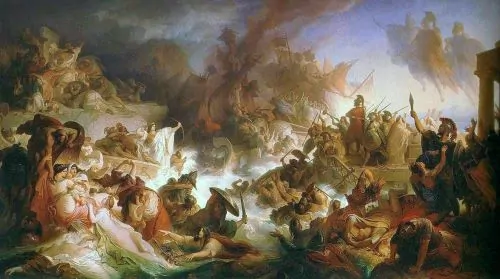
In fact, if we trust Herodotus, Xerxes only began to suspect the loyalty of the Ionians after suffering defeat at Salamis. Recalling a parallel episode where Ionians were tasked with guarding Darius’ bridge over the Danube (Hdt. 4.133–41, 5.23), Herodotus says Xerxes feared that the Ionians would put it into the minds of his enemies to destroy the bridge over the Hellespont and so decided to withdraw his royal person from Europe (8.97).11 And yet, not only is there no record of Xerxes punishing any Ionian for disloyalty, but he also appointed two Samians orosangai. A careful reading of Herodotus’ account of Xerxes’ campaign thus underscores the continued factionalism in Ionia writ large. The evidence that Ionians fought against people they considered their kin only under compulsion is far slimmer and likely emerged from a need to rehabilitate them for having been on the wrong side of a war branded as a defense of Greek liberty.
Local and regional conflicts in Ionia meant that the potential for rebellion and revolution bubbled just beneath the surface throughout the Classical period. When the Greek ships mustered at Aegina after Salamis, they were approached by six Chians who had participated in a conspiracy to murder the tyrant Strat-tis, asking that the Greek fleet sail immediately to Ionia (Hdt. 8.132).12 Nevertheless, the region was still firmly Persian in the winter of 480/79. Xerxes dispatched Artemisia to convey his family to Ephesus (Hdt. 8.106) and followed through on his promise to appoint Theomestor tyrant on Samos, where part of the Persian fleet spent the winter (Hdt. 8.130; Diod. 11.27.1). When spring arrived, the Persian fleet, including the Ionian ships, mustered at Samos in order to guard against a potential rebellion, Herodotus says, while adding that “they did not expect the Greeks to come to Ionia” (οὐ μὲν οὐδὲ προσεδέκοντο τοὺς Ἕλληνας ἐλεύσεσθαι ἐς τὴν Ἰωνίην, 8.130.3).13 They could not have known that 479 would be a year that displayed all of the features that defined Ionia for the subsequent two centuries.
Buried near the end of Herodotus’ history is his account of the battle of Mycale (9.90–107; cf. Diod. 11.34–36), an engagement that ancient tradition implausibly sets on the same day as Plataea (Hdt. 9.90; Diod. 11.24.1).14 Despite acknowledging the battle’s significance in securing the victory over the Persians, Herodotus sets it in the denouement of the war. However, for Ionia, Mycale, not Salamis, led to the “liberation” that framed the rest of the fifth century. Before turning to the battle and its aftermath, it is worth considering what can be gleaned about the regional political currents in Ionia from these pas-sages. Both Herodotus and Diodorus frame Mycale as a moment of liberation for Ionia and put those words in the mouths of the ambassadors from Samos. Persian-appointed officials ruled at least at Samos, Chios, and Miletus, but their positions became increasingly tenuous as the year wore on.15
Herodotus records both subversive actions and Persian suspicion. Immediately before the battle, he says that “the Samians” sent Lampon, son of Thrasy-cles, Athenagoras, son of Archistratides, and Hegesistratus, son of Aristagoras, to make an appeal to the Spartan commander Leutychides on Delos, where Hegisistratus declared (9.90):16
Should the Ionians only see you, they will desert from the Persians and the barbarians will not remain, but if they do, you will never again have such a hunt.
ὡς ἢν μοῦνον ἴδωνται αὐτοὺς οἱ Ἴωνες ἀποστήσονται ἀπὸ Περσέων, καὶ ὡς οἱ βάρβαροι οὐκ ὑπομενέουσι: ἢν δὲ καὶ ἂρα ὑπομείνωσι, οὐκ ἑτέρην ἄγρην τοιαὺτην εὑρεῖν ἄν αὐτούς.
Hegisistratus continued that the Persian ships were unseaworthy and implored the Greeks to liberate them from slavery by defeating the barbarians. Of course, Leutychides rejected both the impassioned plea and all arguments in favor of viewing the name “Hegisistratus” as an auspicious omen, whereupon the two sides bound themselves with an oath of alliance (Hdt. 9.91–92). The Samians had also liberated five hundred Athenian prisoners, whom they supplied with provisions and sent back to Athens, which in turn led to suspicion from the Persians (Hdt. 9.99.2). Herodotus thus establishes Samos as the leading polis in the fight for Greek liberty, a status that is paid off both by having the Samians turn on the Persians at the height of the fighting and with Samos’ prominent position within the Delian League. Diodorus’ account strengthens this pic-ture not only by saying not only that the Samians dispatched the ambassadors (11.34.2) and had unanimously decided to turn on the Persians, but also that their attack turned the tide of the battle (11.36.2, 4).17
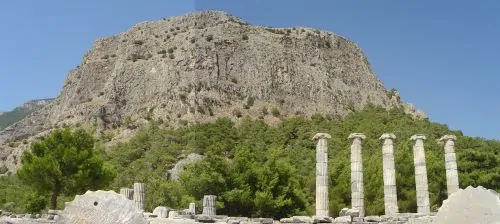
Persian suspicions peaked immediately before the battle of Mycale when Leutychides had a ship sail close to shore and repeat Themistocles’ ploy from the leadup to Artemisium, with a herald tell the Ionians to turn against the Persians (Hdt. 9.98). The Persian commander Tigranes ordered the Samians stripped of their arms and armor (ὅπλα) and stationed the Milesians on the heights of Mycale away from the battlefield (9.99).18 Nevertheless, Herodotus says, at the climax of the battle the Ionians effected a second revolt. The Samians led the way by turning on the Persians, causing them to retreat, and then the Milesians, who were ostensibly guarding the passes and guiding the Persians to safety, directed them right back to their enemies (Hdt. 9.103–4).19 The Ionian role in leading the Greeks of Asia against the Persians and turning the tide of the battle is undoubtedly exaggerated, once again redeeming Greeks who had fought on the “wrong side,” but there is no reason to reject more modest contributions.20
Whether a spontaneous uprising against the Persians as in Herodotus or a premeditated plot as in Diodorus, the Greek sources present the events as the result of a revolutionary sentiment against Persian rule, but there is little evidence from the Ionians specifically that supports this picture. It was this rationale that prompted Jack Balcer to argue that the primary issue was not revolution, but “to find successful means by which to revitalize the particular poleis in order to prevent further disintegration, and to preserve and reorganize the social and political order.”21
In the immediate aftermath of Mycale, the leaders of the Hellenic League convened a council on Samos to determine what to do with the Ionians since they believed it would only be a matter of time before they faced another threat from the barbarians (9.106.2). The topic at hand was who would give them land. The possibility of relocating the Ionians was not new; Bias of Priene had allegedly made the same proposal in 546, and some of the Phocaeans and Teians had actually followed through (Hdt. 1.164–70). However, the scale of the proposed operation would have dwarfed the earlier proposals and the paucity of the surviving details invites questions about its veracity, in either Herodotus’ account or the more exaggerated version in Diodorus, where the Athenians scuttled the plan only after the Ionians and Aeolians had prepared because they would then cease to be the Ionian mother city (11.37).22 Herodotus does not mention the Aeolians or other Greeks of Asia, for instance, or whether the proposal included islands like Samos and Chios that had been no more successful than their neighbors on the mainland at warding off Persian power. Thus, Herodotus’ discussion foreshadows the coming rivalry between Athens and Sparta more than it records a serious proposal. Thucydides blames the violence of Pausanias for the demise of the Hellenic League, but the failure to resolve the underlying tension between its aims of liberating the Greeks and its unwillingness to commit to protecting them spelled its doom.23
Herodotus does not record the fate of Theomestor but concludes by say-ing that the Greeks enrolled the Samians, Chians, and Lesbians in the Hellenic League before sailing to the Hellespont to dismantle Xerxes’ bridge (9.106.4).24 Through the campaign season of 478, ships from Samos and Chios, at least, sailed with Pausanias first to Cyprus and then to Byzantium, where Spartan leadership collapsed (Thuc. 1.94–95).25 Persian power remained at Sardis just over the horizon, but, for the moment, Ionia was free.
Founding the Delian League
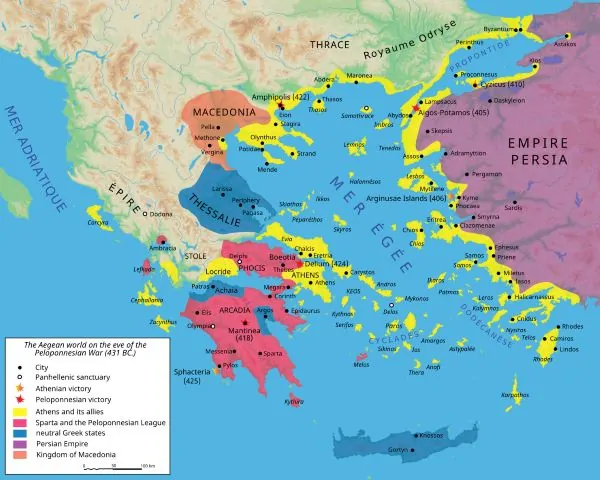
Sparta might have led the Hellenic League against Persia, but Athens dominated the fifth-century Aegean. From the outset, the Ionians received an out-sized amount of blame for undermining the Spartan alliance. Thucydides says that it was the Ionians as a group (οὐχ ἥκιστα οἱ Ἴωνες, 1.95.1) who came to resent the violent (βίαιος) leadership of Pausanias and therefore requested that Athenians lead a new alliance that would better serve their interests, while [Aristotle] says that Aristides stoked the flames of frustration on the part of the Ionians after Pausanias’ fall (Ath. Pol. 23.4).26 However, from this early date it is unclear how many of the Ionian poleis had joined the Hellenic League (see above, “The Year of Liberation”).27 Ancient sources present conflicting evidence, oscillating between naming Samos and Chios as specific poleis brought into the league and making general pronouncements about the Ionians being involved in league activities. This contradiction is most pronounced with regard to the Milesians, whose actions at Mycale Herodotus characterized as a second Ionian revolt, but who no ancient source included on the list of poleis enrolled in the Hellenic League.28
Presenting Ionian antagonism to Sparta as the driving force behind the creation of the Delian League also leads to the false conclusion that this was an Ionian alliance built on kinship.29 Ancient sources almost universally point to Athenian activities spearheaded by Themistocles and Aristides that caused poleis throughout the Aegean to reject Sparta, leaving Athens as a natural alternative (e.g., Diod. 11.41–46; [Arist.] Ath. Pol. 23.4–5).30 Plutarch identifies commanders from Samos, Chios, and Lesbos generally and Uliades of Samos and Antagoras of Chios specifically as instigating the conspiracy (Arist. 23.4–5). He is almost certainly wrong to exonerate his upright subject Aristides on the charge of conspiring against the Spartans, but his suggestion that the non-Athenian actors included only men from the large islands that had joined the Hellenic League after the battle of Mycale is more likely true than is the implication that the Delian League was the result of a general Ionian uprising.
Similarly, no ancient source preserves a list of poleis that inscribed their oath to have the same enemies and friends on lumps of iron before casting them into the sea to render it unbreakable ([Arist.] Ath. Pol. 23.5).31 Subsequently, ancient tradition held, Aristides assessed the allies for tribute, likely preserving the rates that the Persians had set ([Arist.] Ath. Pol. 23.5; Plut. Arist. 24). Recreating the original roster of the Delian League is complicated further still by the processes of historical memory that surround the purpose of the league and the relationship between the league members and Athens. In Ionia, Chios and Samos were charter members and Miletus likely was as well, but Myus was supposed to have been given to the exiled Themistocles by the Persian king as late as 465 (Plut. Them. 29.7).32 Evidence in either direction for the rest of the region is limited. Ephesus remained a crucial transit point for people moving between the Persian Empire and the Aegean world, but it, along with the rest of Ionia, was firmly in the Athenian orbit by 454, and there is no evidence for a military expedition coercing the Ionians to join, as there was elsewhere (Plut. Cim. 12.4; see below, “The Tides of War”). Placing the Ionians collectively at the inauguration of the Delian League elides a more complicated reality. In these early years the entire region was likely assessed for contributions even when they were only tenuously within the league’s orbit before gradually and spasmodically they joined in earnest.
The process by which Ionia became fully integrated into the Delian League is bound up with its original purpose. Athenian propaganda asserted a league mandate to liberate and protect the Greeks of Asia Minor from Persia (e.g., Thuc. 3.10.1; Diod. 11.41.4), but these were mere words. Closer to the mark is the formulation of Raphael Sealey: “The original purpose of the League was piratical.”33 Indeed, liberation by the Delian League was conquest by another name—its recipients had no choice but to sign on.34 Athenian willingness to compel obedience tempered any protection it offered and is therefore an inadequate explanation on its own for how Ionia became integrated into this Athenian-Aegean system, regardless of the potential of kinship diplomacy.
In a discussion of Ionian motivations, lodged between the usual explanations I just characterized as inadequate on their own, Jack Balcer offered a third possibility.35 At least by the reorganization of the Persian Empire under Darius I, and arguably earlier, Ionian commercial prosperity had stemmed from its extensive trading networks throughout Anatolia and the eastern Mediterranean. These markets were closed to Ionian merchants following their “liberation,” meaning that this region where the poleis were still recovering from the revolts of the 490s had to reorient its commerce.36 The positive incentives of promised plunder from military campaigns against Persia and economic opportunity in the Aegean bound the Ionians into this new system more tightly than did kinship or promises of protection. In fact, Ionian interaction with the Delian League in these early years appears most clearly in the campaigns against Persia.
The Tides of War: 478–454
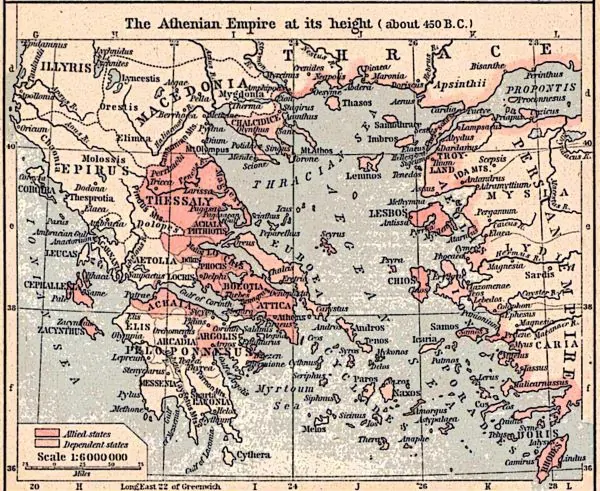
The details of the early history of the Delian League are scarce, which complicates our understanding of how the Ionians interacted with it.37 Thucydides, for instance, uses his account to examine the growth of Athenian power to support his thesis about the origins of the Peloponnesian War.38 He covers the early Delian League campaigns to Eion, Scyros, Carystus, and Naxos in a few short sentences that demonstrate the growth of Athenian power, before recounting Cimon’s campaigns in southern Anatolia and Cyprus that captured Phaselis and won a victory at the Eurymedon River (Thuc. 1.100; Diod. 11.60–61; Plut. Cim. 12.4). By the end of this period, Thucydides concludes, the allies were the cause of their own subjection because they met their obligations with money and shirked military service. When the time came to fight back, he explains, they were both “unprepared and inexperienced” (ἀπαράσκευοι καὶ ἄπειροι, 1.98–99). Athens had expanded the league by force, and the subjugation of Naxos both demonstrated a willingness to compel allies to remain in the league and temporarily ended any debate about how long it would exist.39 But Athens did not operate alone, so we need to ask what role the Ionians played in the growth of the league power.
At some time in the first half of the 460s, the Athenians elected Cimon, son of Miltiades, strategos and empowered him to wage war against Persia in order to liberate the Greeks of Asia, as Diodorus characterizes it (11.contents).40 The highwater mark of Cimon’s success and, indeed, of Athenian expansion was a decisive victory over the Persian fleet off Cyprus that he followed up with a second victory over the Persian army at the Eurymedon River (Diod. 11.60–62; cf. Thuc. 1.100.1). Diodorus reports that Cimon captured 340 ships, twenty thousand prisoners, and a sizable amount Persian gold and credits Cimon (11.62.1) and the Athenians (11.60.6) for the victories. Indeed, the two hundred Athenian triremes Cimon had upon leaving the Piraeus formed the core of the fleet, but league forces swelled its size by half again, bringing his total force up to three hundred ships (Diod. 11.60.3; cf. Thuc. 1.100.1). Neither Thucydides nor Diodorus lists the allied contingents individually, but Diodorus specifically says that ships from Ionia joined Cimon’s expedition. Determining what he meant by “Ionia” is another matter.
There is always a risk that casual invocations of Ionia in ancient historians merely to refer to the Greeks of Asia Minor. Diodorus distinguishes between Ionians and Aeolians elsewhere, but, writing in the first century BCE, he was beholden to sources that, on top of choosing not to elaborate on the non-Athenian contingents, could have applied their own definition of “Ionian.” Despite these limitations, there is good reason to believe that a significant portion of the allied ships came from the cities of the Ionian dodecapolis and that most of those came from Chios and Samos, two large island poleis that still maintained substantial fleets at this time. Identifying these poleis as integral to Cimon’s expedition is not purely speculative. In his biography of Cimon, Plutarch includes an anecdote about Cimon’s ferocity in attacking Phaselis because the city refused Athenian liberation (Cim. 12.4). The Chians, he says, were traditionally on good terms with the Phaselites and therefore appealed to Cimon while passing notes to the besieged by shooting arrows over the wall. The details of this episode strain credibility, but an Athenian decree that established a judicial relationship with Phaselis likely uses the relationship between Athens and Chios as a model (RO 120 = IG I3 10, ll. 10–11), and the broad outlines of an Athenian expedition bolstered by Ionian forces fit neatly within the consensus picture of the Delian League in this period.
Much the same picture emerges in the Athenian expeditions to Egypt. In c.464, shortly after the accession of Artaxerxes, the Egyptian Inarus, the son of Psamettichus, solicited Athens for support for his rebellion against Persia (Thuc. 1.104; Diod. 11.71).41 The Athenians responded enthusiastically (Diod: μετὰ πολλῆς προθυμίας) and dispatched hundreds of ships to Egypt. Thucydides’ narrative foreshadows the catastrophe in Sicily a half century later, right down to the loss of a second fleet sent to relieve the first (Thuc. 1.110.4), so recent scholarship has cast doubt the enormous size of the expedition.42 Thucydides’ reliability is beyond the scope of this inquiry, but this expedition in particular is often seen as a wheel on which he could sharpen his political axe about the foolishness of democracy.43 Nevertheless, the Athenian enthusiasm for the campaign found in all of the available sources is generally explained by the combination of a fervor to strike a blow against Persia combined with the economic opportunity that might be found in Egypt and it is worth considering how far beyond Athens these motivations spread.44 The Ionian poleis had long had close commercial relationships with Egypt. Chios, Teos, Phocaea, and Clazomenae were among the nine that contributed to a Hellenion at the emporium Naucratis, while two others, Samos and Miletus, established their own precincts for Hera and Apollo, respectively (Hdt. 2.178.2–3).45 Ionia also lay on the eastern edge of the confederacy, making ulterior motivations likely. For some, a blow against Persia kept a threat on its heels; for others, a campaign legitimized their regime by unifying the community against a common enemy.
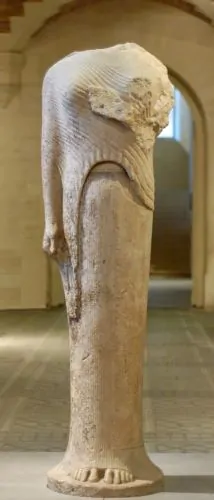
Both ancient and modern authors overwhelmingly focus on the Athenians.46 Inarus invited their participation, after all, and Athenian ships com-prised the largest part of the expedition, but Thucydides makes it clear that the fleet included both the Athenians and their allies (1.104.1). An honorific epigram for Hegesagoras, son of Zoilos, found on a statue base at the Heraion on Samos commemorates the Samian capture of fifteen Phoenician ships on the Nile near Memphis (IG XII 6, 279).47 Despite Westlake’s cavalier assertion that this inscription does not substantially revise what we know about the campaign, it is an important reminder that the selective survival of evidence from this period belies the extent to which Athens relied on its allies to fight its wars.48 The capture of fifteen vessels, a number more reliable than those given for the total size of the Greek fleet, suggests a substantial number of Samians in Egypt!
Unfortunately, this murky picture already strains the limits of our evidence since the sources frequently omit even the mention of Ionian allies. Jack Balcer reasonably “suspected” wider participation in the Athenian campaigns from Chios, which continued to field a fleet until the last decade of the fifth century, and perhaps Erythrae and Miletus, which were among the wealthiest in the region as judged by the assessment on the Athenian tribute lists,49 but there is little concrete evidence outside of the inscription on Samos and the anecdotal tradition about the capture of Phaselis.
I opened this section with Thucydides’ claim that the Athenian allies grew complacent and thereby fell increasingly under the Athenian yoke. Thus, in the terminology of modern scholars, the Delian League metastasized into an Athenian empire. However, we might tentatively challenge Thucydides’ authoritative declaration even beyond the usual caveat that Samos, Chios, and Lesbos were exceptions to the rule. Unlike Herodotus’ account of the battle of Lade, where he enumerates contingents from the individual poleis, down to the three triremes each outfitted by Phocaea and Myus (6.8), none of the surviving sources for these Athenian operations offers a roll call. Any evidence for their participation emerges instead from ancillary evidence. This alone is hardly proof that Myus, for instance, contributed even a solitary ship, but underscores that, if Myus did, we would likely not know.
Throughout the early years of the Delian League, most of the Ionians were not idle witnesses to the growth of Athenian power, but actively complicit in it. Much as the Chians sought to profit from the Athenian war against Samos in 440/39, both Chios and Samos likely aided in the campaign against Naxos. Similarly, Pausanias records that the inscribed shield the Spartans dedicated at Olympia after the battle of Tanagra in 457 read that it was a “gift from the Argives, Athenians, and Ionians” (δῶρον ἀπ ̓ Ἀργείων καὶ Ἀθαναίων καὶ Ἰώνων, 5.10.4).50 Once more the question whether “Ionian” was merely a shorthand for the Athenian allies rears its head, but we should not be quick to dismiss the presence of the men of Ionia: they certainly fought in the Peloponnese during the Peloponnesian War. The development of the Athenian tribute lists supports Thucydides’ argument, but the fixation on naval warfare erases other military contributions, and the earnest declaration about complacency obscures that this was a period during which the Ionians were continually at war.
Ionia within the Early Athenian Arche: Desolation and Renaissance
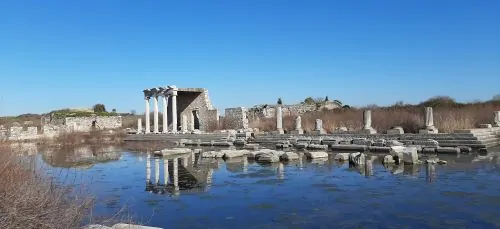
In the two decades between the start of the Persian wars and the Athenian expedition to Egypt, Ionia had gone from being embedded in the Persian Empire to being embedded in an Athenian one. The surest sign of this entanglement is the evidence for participation in Athenian expeditions, but there is also copious evidence from this period for the migration of both people and intellectual traditions to Athens. This movement helped construct that city’s reputation as a center of learning, even as the influx of immigrants to Athens likely contributed to legislative changes like the Periclean Citizenship Law of 451/0 ([Arist.] Ath.Pol. 26.3).51 Thus far I have focused on how Ionians navigated the changing currents of imperial competition, but, just as imperial actions responded to and reflected regional and domestic developments, imperial actions had an impact on what happened in the region.
Already in the Archaic period Ionia was filled with traditions about internal conflict, some the residual legacy of interactions with the indigenous Carian and Lydian inhabitants, others stemming from economic inequality. Nowhere are these traditions more evident than at Miletus, where the women allegedly swore an oath to never sit at a table with their husbands or call them by their names because the Milesian men married them after killing their fathers, husbands, and sons (Hdt. 1.146.3; see Appendix 2). However, two other accounts of factional conflict at Miletus describe it along economic lines. In one, [Plutarch] says that Miletus was divided between the aeinautai (“forever sailors”) and the cheiromachei (“manual workers,” here perhaps farmers), which might indicate a growing conflict in the sixth century between the burgeoning commercial interests and the traditional landed stratum of society (Mor. 298c–d; cf. Hdt. 5.28–30).52 In the other, Athenaeus preserves a fragment from Heraclides of Pontus about a conflict between the wealthy and the Gergithae, whom he refers to as the δημότης (common people), during which the Gergithae expelled the citizens and had their young children trampled by oxen on the threshing floor (Athen. 12.26 [524a]).53 When the wealthy regained the upper hand, he says, they smeared the Gergithae with pitch and set them on fire, which caused a sacred olive tree to burn and thus the oracular powers to be withdrawn from the Milesians.
Noel Robertson juxtaposes the evidence of Heraclides with a reference in the Suda that “Gergethes” was a derogatory term the wealthy used to refer to manual laborers (Γέργηθες gamma, 189; cf. tau, 1192). “It is clear that the Gergithes are country-folk,” he declares, noting the particularly agrarian methods used in the reprisals and comparing them to another group of village-dwelling noncitizens in Ionia, the Pedieis at Priene.54 His proposal, therefore, is that the Gergithae “occupied some of the best land near Miletus,” which prompted violent conflict between them and Milesian landowners.55 Robertson’s evidence for the connection between the Gergithes and the countryside is the Suda definition of καὶ οἱ χειρώνακτες οὕτως καλοῦνται παρὰ τοῖς Μιλησίοις τοῖς ἐν περιβολῇ (“the handworkers, as they are called among the Milesians”), where he interprets τοῖς ἐν περιβολῇ as “used by the Milesians living ‘in the periphery.’” However, taking τοῖς ἐν περιβολῇ literally mistakes the meaning of the passage, in that it may better refer to refer to those in rarefied circles, as the entry continues τουτέστι τοῖς πλουσίοις (“that is to say, the rich”) who dismissively call the craftsmen Gergithae. In other words, the Suda does not invalidate an economic interpretation of this conflict.56
These traditions reflect generations of conflict rather than individual moments. Herodotus explains that arbiters from Paros surveyed Miletus after two generations of strife and ushered in a period of prosperity by giving rule to those citizens with the best-managed farms (5.28–30.1). This arbitration is often tentatively dated to 525 because that year inaugurates the list of names on an early Hellenistic inscription that purports to record the polis’ eponymous officials (aesymnetes; Milet I.3, no. 122).57 However, as with almost all evidence for this period in the history of Miletus, the dates are a problem. For the purposes of this discussion, the list includes no hint of a period between 494 and 479, when some scholars have suggested that Miletus was left desolate after the Persians ended the Ionian revolt with fire and blood.58 This inscription instead offers an unbroken list of names that represents an artificial memory about Milesian history more than its historical reality.59 Inasmuch as the ruined Didyma came to represent Ionian opposition to Persia, the desolation of Miletus bloomed in Greek propaganda. In fact, Milesians likely began to rebuild Miletus probably as early as 492, establishing what Alexander Herda terms a “copy” on the same footprint of the late-Archaic city.60
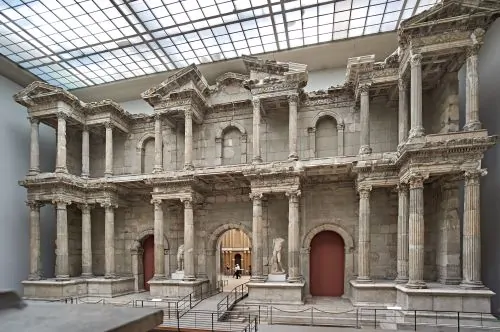
These stasis narratives are filtered through the lens of the Classical period, as Dina Guth has recently demonstrated, but I believe that is even more reason to take seriously their importance to Classical Miletus.61 The public ritual calendar at Miletus may also reflect statutes designed to preserve the unity of the community, with the Molpoi Decree establishing protocols for the procession from the intramural Delphinion to the sanctuary of Didyma that began the year.62 Although it resided in the Milesia, Didyma had only come under control of Miletus in the late seventh or early sixth century, and the sanctuary maintained its autonomy under the control of the Branchidae, a non-Greek priestly family (Hdt. 1.157.3; Paus. 7.2.6).63 According to tradition, the Branchidae betrayed the city to Persia at the conclusion of the Ionian revolt, leading to the sack of the temple and their own deportation (Hdt. 6.19).64 And yet, even in ruin, the nominal independence of the sanctuary and its ambivalently Greek identity turned it into an important site of reconciliation for a fragmented community.
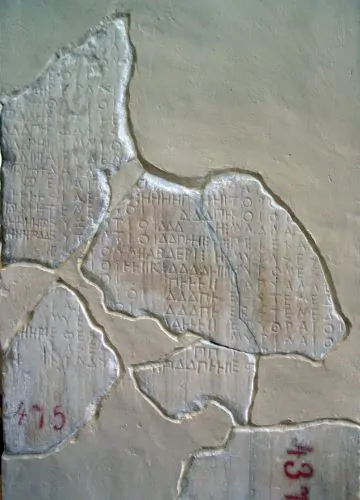
These provisions did not ensure internal stability. A fragmentary decree from the middle of the fifth century records a partial list of individuals banished in perpetuity, along with declarations that they had forfeited their property and establishing provisions to reward any citizen who would kill them should they ever return (RO 123 = Milet VI.1, no. 187).65 The context of this inscription defies capture. Scholars traditionally interpreted it as evidence for an oligarchic challenge to the nascent Milesian democracy in the 450s led by the powerful Neleid clan that traced its lineage back to the mythical founder of the city. Indeed, among the exiles were the sons of Nympharetus, a Milesian whose name appeared on the aesymnetes list, possibly for the year 503/2 (Milet I.3 no. 122, l. 24), which creates a tidy picture of the domestic instability in the 450s that would have explained this date for the Athenian regulatory decrees at Miletus that most likely date to several decades later.66 The circumstantial evidence for dating this inscription has led Noel Robertson to push its date to just after 479 and plausibly identify the Nympharetus of this inscription with man named on the aesymnetes list.67 Although most of the critical information about this decree, including the authorities who passed it, the identities of the perpetrators, and the nature of their threat to Miletus, remain unknown, it is a powerful reminder that the deep domestic divisions that existed in Miletus throughout the Archaic period remained unresolved into the Classical.
We should be cautious about regarding the domestic turmoil at Miletus as typical given the relative surfeit of evidence elsewhere in Ionia, but neither should we dismiss it as entirely unusual. An imprecation inscribed at Teos offers a counterpoint the Milesian example. According to both Strabo and Herodotus, the Teians opted to leave Ionia rather than submit to Persian rule in 545, and instead sailed to Abdera where they founded a new city, only to return to their original settlement sometime later (Hdt. 1.168.1; Strabo 14.1.30).68 Much like the dating of the Milesian stasis, the return date relies on inference and supposition. The Teians equipped seventeen ships at Lade in 494 (Hdt. 6.8), leading to the suggestion that refoundation took place shortly after Darius conquered Thrace between 512 and 510 on the grounds that, if they had no choice but to accept Persian rule, they preferred their home to constant struggle against Thracian and Paeonian tribes attested by Pindar’s Second Paean.69 This set of motivations and chronology is improbable, though, given that Teos began minting coins at least by 520–515—that is, before Darius’ invasion of Thrace.70
The Teians likely suffered at the end of the Ionian revolt. Herodotus says that the Persians deported young men and women and set fire to the Ionian poleis along with their holy places (τὰς πόλιας ἐνεπίμπρασαν αὐτοῖσι τοῖσι ἱροῖσι, 6.32). But there is nothing like Herodotus’ description of Miletus (6.25.1) to suggest that Teos was left depopulated in 494. Nevertheless, the close relationship between Teos and Abdera likely resulted in a reciprocal relationship by which some Abderans returned.71 Any Persian-imposed tyranny in this period was likely short-lived since Mardonius installed democracies in 492 (Hdt. 6.43.3). This official decision to support democracies may strain belief until one recalls that it was in fact Ionian tyrants who had stirred up the Ionian revolt. However, we might question how democratic these democracies were given that the overhaul seems designed to offer the appearance of local control while undermining the position of potential troublemakers. Most likely these constitutions included limited suffrage, and the prominent leaders could count on the backing of Persia. In Teos, the eponymous official in this period was probably the aesymnetes, paralleling the office at Miletus. Association with factions that rose to prominence because of Persian power set the stage for the charge that they abused their position, and, in the wake of the battle of Mycale in 479, the Teians established a set of imprecations against those who would abuse the position of aesymnetes to set themselves up as tyrants (RO 102 = SIG3 37, 38).72
It is thus tempting to interpret domestic conflicts in Ionia as responses to the changes in the imperial landscape. Jack Balcer, for instance, regarded Ionian history as the result of its location at the intersection of competing imperial systems such that whenever one imperial power became too onerous there was another power waiting in the wings to offer an attractive combination of protection and autonomy.73 This might have been true on a larger scale, but it does not adequately explain either the complicity of the Ionians in the development of the Athenian empire or the domestic turmoil of the sort on display at Miletus and Teos. Rather, the imprecation at Teos speaks more to the general instability in the form of piracy and threats to the grain supply than to imperial competition, while the domestic conflicts at Miletus ran deep and predated the appearance of these imperial systems. To be clear: imperial competition did not improve local stability in Ionia and often constrained local decision-making, but neither should every local action be interpreted in light of imperial competition. Just as Persian imperial policy required working with local notables, so too did Athenian hegemony respond to the preexisting conditions on the ground in Ionia. This period saw Ionia excised from Persian hegemony only to become entangled in an Athenian one and, as Athenian control tightened, the consequences of the local conditions, rivalries, and demands only became more apparent.
Endnotes
- Most of the ships were probably triremes, but this number may have also included biremes and pentekonters. On the composition of Archaic fleets, see Thomas J. Figueira, “Archaic Naval Warfare,” Historika 5 (2015): 499–515. Herodotus later notes that he omits the names of the leaders of individual contingents on the grounds that they are not soldiers so much as slaves (ὥσπερ οἱ ἄλλοι στρατευόμενοι δοῦλοι, 7.96). Herodotus also describes the Samothracians as Ionians at 8.90, but see below, n. 8.
- Herodotus’ catalog includes no Greeks among the infantry, and O. Kimball Armayor, “Herodotus’ Catalogues of the Persian Empire in the Light of the Monuments and the Greek Literary Tradition,” TAPhA 108 (1978): 7, argues that it has a sense of “predetermination” that reflects the people of the Persian Empire. The presence of Ionian individuals at Plataea, such as the Ephesian Dionysophanes who buried Mardonius after the battle (Hdt. 9.84; Paus. 9.2.2), serves as a reminder that there were people with the campaign other than soldiers.
- H. T. Wallinga, Xerxes’ Greek Adventure: The Naval Perspective (Leiden: Brill, 2005), 40–42, suggests thirty Persian marines on each ship.
- Barry S. Strauss, The Battle of Salamis: The Naval Encounter That Saved Greece—and Western Civilization (New York: Simon and Schuster Paperbacks, 2005), 21, takes Herodotus as putting the Ionians in one group and the rest of the Persian fleet in the other.
- Graham Shipley, A History of Samos, 800–188 BC (Oxford: Oxford University Press, 1987), 108, following B. M. Mitchell, “Herodotus and Samos,” JHS 95 (1975): 88–89. Cf. Hdt. 6.14, where most of the Samian fleet refused to fight at the battle of Lade. For the thesis of political opportunity in service to Persia, see H. T. Wallinga, “The Ancient Persian Navy and Its Predecessors,” in Sources, Structures, and Synthesis: Proceedings of the Groningen 1983 Achaemenid History Workshop, ed. Heleen Sancisi-Weerdenburg (Leiden: Nederlands Instituut voor het Nabije Oosten, 1987), 47–77; Tristan A. Goldman, “Imperializing Hegemony: The Polis and Achaemenid Persia” (PhD diss., University of Washington, 2011), 117–32.
- Plutarch adds that Themistocles asked the Ionians to foul the Persian forces in battle, but that seems like later embellishment. Polyaenus 1.30.
- contains an abbreviated account of the message and simply says that it caused the king to mistrust the Ionians, though see below, “Fighting Badly,” on Xerxes’ mistrust. Defense of Greece, 490–479 B.C. (Warminster: Aris & Phillips, 1993), 151–97; Strauss, The Battle of Salamis, 157–208; Wallinga, Xerxes’ Greek Adventure, 114–48.
- Although Paus. 7.4.3 suggests that Samothrace was a colony of Samos and thus “Ionian,” Herodotus more likely picked up the language of his sources for this story since the common Persian word for all Greeks was “Yauna” (Ionian).
- Contra Wallinga, Xerxes’ Persian Adventure, 41–42, who argues that the tradition was Athenian slander because Herodotus records only two Samians as orosangai (8.85) and the actual fighting would have been done by the Persian marines stationed aboard that prevented sabotage. Herodotus likely published his history in installments throughout the 420s, though the exact chronology is debated; see Justus Cobet, “Wann wurde Herodots Darstellung der Perserkriege publiziert?,” Hermes 105, no. 1 (1977): 2–27; J. A. S. Evans, “Herodotus’ Publication Date,” Athenaeum 57 (1979): 145–49; J. A. S. Evans, “Herodotus 9.73.3 and the Publication Date of the Histories,” CPh 82, no. 3 (1987): 226–28; Charles W. Fornara, “Evidence for the Date of Herodotus’ Publication,” JHS 91 (1971): 25–34; Charles W. Fornara, “Herodotus’ Knowledge of the Archidamian War,” Hermes 109, no. 2 (1981): 149–56; David Sansone, “The Date of Herodotus’ Publication,” Illinois Classical Studies 10, no. 1 (1985): 1–9; Rosalind Thomas, “The Intellectual Milieu of Herodotus,” in The Cambridge Companion to Herodotus, ed. Carolyn Dewald and John Marincola (Cambridge: Cambridge University Press, 2016), 60–75. James Romm, Herodotus (New Haven, CT: Yale University Press, 1998), 48–58, lays out the challenges to understanding Herodotus’ biography.
- This seems to be an inversion of Themistocles’ activities as described by Herodotus (8.22). Lazenby, Defense of Greece, 185 calls the story “faintly ridiculous.” On the contested traditions about the order of battle, see Lazenby, 183–87.
- In the earlier incident the Ionians remained loyal to Darius, albeit because he ensured their political power. In the latter, Herodotus credits Themistocles with the plan to attack the bridge without mentioning the Ionians (8.108.2).
- Herodotus conspicuously does not use the language of liberty to describe this episode. The Greek commanders were only willing to go as far as Delos.
- Diodorus also comments on the specter of agitation in Ionia (ὡς ἀλλότρια φρονούντων τῶν Ἰώνων, 11.27.1).
- Pierre Briant, From Cyrus to Alexander: A History of the Persian Empire, trans. Peter T. Daniels (Winona Lake, IN: Eisenbrauns, 2002), 533, offers a more likely chronology whereby the Greek fleet sailed to Delos before Plataea (Hdt. 9.90) and only went on the offensive afterward.
- Mardonius was supposed to have deposed all Ionian tyrants in 492, replacing them with democracies (Hdt. 6.43). While allowing that Xerxes may have simply made a new decision to appoint Theomestor, it may well be that labeling him and the Chian Strattis (Hdt. 8.132) “tyrants” is slander on account of their collaboration with the Persian authorities.
- Diodorus 11.34.2 says that the “worthy ambassadors” (πρέσβεις ἀξιοῦντες) came from Samos. Shipley, History of Samos, 109, identifies these names as belonging to the other families who had been suppressed and exiled during and after the reign of Polycrates; cf. Sara Forsdyke, Exile, Ostracism, and Democracy: The Politics of Expulsion in Ancient Greece (Princeton, NJ: Princeton University Press, 2005), 59–69.
- Diodorus’ use of Ephorus as his source for Mycale and its aftermath likely accounts for the differences from Herodotus.
- Shipley, History of Samos, 109, doubts that the disarmed soldiers were hoplites on account of his contention that Samos had fewer hoplites in proportion to the size of its population than other poleis, but recent scholarship has begun to challenge the primacy of the hoplite at the time of the Persian wars altogether; see, in particular, Roel Konijnendijk, “‘Neither the Less Valorous nor the Weaker’: Persian Military Might and the Battle of Plataia,” Historia 61, no. 1 (2012): 1–17.
- Herodotus’ mention of the Milesians here is notable because he had implied that the entire population of Miletus was killed or deported following the Ionian revolt (6.19). As Alan M. Greaves, Miletos: A History (New York: Routledge, 2002), 132, suggests, the destruction of Miletus was likely exaggerated, while Vanessa B. Gorman, Miletos, the Ornament of Ionia (Ann Arbor: University of Michigan Press, 2001), 146–51, plausibly connects a series of isopoliteia treaties between Miletus and its colonies during this period and thus suggests that the new citizens returned from the colonies; see below, “Ionia within the Early Athenian Arche.”
- T. J. Quinn, Athens and Samos, Lesbos and Chios, 478–404 B.C. (Manchester: Manchester University Press, 1981), 7. Cf. Mitchell, “Herodotus and Samos,” 87–91, who sees a Samian apologia behind Herodotus’ account of both the Ionian revolt and the battle of Mycale. Elizabeth Irwin, “Herodotus and Samos: Personal or Political,” CW 102, no. 4 (2009): 395–416, argues, persuasively, that Herodotus’ interest in Samos comes from its parallel with fifth-century Athens. She rejects earlier arguments that it was personal, but only brushes on how memory and politics shaped his presentation of Samos (416 n. 65), which necessarily would have included not just Athenian memories, but Samian ones.
- Jack Martin Balcer, Sparda by the Bitter Sea: Imperial Interaction in Western Anatolia (Providence, RI: Brown University Press, 1984), 324. Balcer, in “Fifth Century B.C. Ionia: A Frontier Redefined,” REA 87, nos. 1–2 (1985): 31–42, and “The Liberation of Ionia: 478 B.C.,” Historia 46, no. 3 (1997): 374–77, also argues that Persia retained control of the river deltas in Ionia. While he is correct to doubt that liberation of Ionia was clean and complete, I am skeptical of his interpretation that Persian control lay behind local unrest in the region; see Chapter 3, “Domestic Factionalism and the Specter of Persia.”
- Shipley, History of Samos, 109. On these myths see Chapter 1.
- As Donald Kagan, The Outbreak of the Peloponnesian War (Ithaca, NY: Cornell University Press, 1969), 34.
- Herodotus expands the list of enrollees to “all other islanders who had served with the Greeks,” τοὺς ἄλλους νησιώτας, οἵ ἔτυχον συστρατευόμενοι. Distinguishing between the islanders and the mainland poleis is a repeated issue throughout the Classical period.
- Balcer, Sparda, 327–30, frames the campaign to Sparta as a bid to maintain hegemony over the Hellenic League in the face of a challenge from Athens.
- Plutarch elaborates on Pausanias’ violence, describing the punishments he meted out to non-Spartans in contrast to the moderation of the Athenians Cimon and Aristides (Arist. 23.2–3).
- In part this determination is dependent on the strength and longevity of the league. I follow David Yates, “The Tradition of the Hellenic League against Xerxes,” Historia 64, no. 1 (2015): 1–25, in seeing the Hellenic League as a “tenuous and temporary” association that quickly faded out of existence after 478; cf. Adrian Tronson, “The Hellenic League of 480 B.C.—Fact or Ideological Fiction,” Acta Classica 34 (1991): 93–110, who regards the Hellenic nature of the league as an “ideological fiction.” The interpretation of a strong Hellenic League emerges mostly from the evidence of Diodorus Siculus, following Ephorus, that builds on the model of the fourth-century League of Corinth.
- This question of original enrollment in the Delian League and, by extension, the Hellenic League, was a debate in the early twentieth century, for discussion see particularly Raphael Sealey, “The Origin of the Delian League,” in Ancient Societies and Institutions, ed. Ernst Badian (New York: Barnes and Noble, 1966), 242–48. However, Gorman, Miletos, 215, declares that the Milesian contribution at Mycale must have meant its inclusion.
- Gorman, Miletos, 215, highlights the parallel with 499 in the appeals to Athenian kinship even though Aristagoras had also appealed to Sparta before traveling to Athens. Gordon Shrimpton, “Horton Hears an Ionian,” in Epigraphy and the Greek Historian, ed. Craig Cooper (Toronto: University of Toronto Press, 2008), 129–49, takes a wider view of Ionian identity suggests that Athens chose Delos as the focal point of its new confederacy because of its religious importance to Ionia, citing it as the birthplace of Artemis and Apollo. However, this is misleading since other traditions located the birth of both deities in the vicinity of the Ionian dodecapolis or Lycia.
- On the interpretations of the Delian League constitution, see P. J. Rhodes, Commentary on the Aristotelian Athenaion Politeia, rev. ed. (Oxford: Oxford University Press, 1993), 294–95.
- The original roster of the Delian League is a debate begun in the nineteenth century and still unresolved. A. Kirchhoff, “Der Delische Bund im Ersten Decennium Seines Bestehens,” Hermes 11, no. 1 (1876): 1–48, maintained that the alliance excluded the Ionian and Aeolian poleis other than perhaps those on the islands until after Eurymedon in 465, which Evelyn Abbott, “The Early History of the Delian League,” CR 3 (1889): 387–90, roundly rejected.
- Complications with this donation abound. First, the gifts may not be real, given that they fit into a metaphorical schema for a complete diet. Second, by the 460s Myus, located on the Bay of Mycale, may not have been in the power of the king to give except as a symbolic gesture, though see Balcer, “Liberation of Ionia.” On the date of Themistocles’ arrival in Persia, see Pietro Maria Liuzzo, “L’arrivo di Temistocle in Persia e la successione a Serse: Il breve regno di Artabano,” Rivista storica dell’antichità 40 (2010): 33–50.
- Sealey, “Origins of the Delian League,” 238, following Thucydides 1.96.1, cf. Noel Robertson, “The True Nature of the ‘Delian League,’” AJAH 5, no. 1 (1980): 64–96 and Noel Robertson, “The True Nature of the ‘Delian League’ II,” AJAH 5, no. 2 (1980): 110–33, who characterizes the league as containing a small group of predatory members. This position is not universally accepted. Some scholars, such as A. H. Jackson, “The Original Purpose of the Delian League,” Historia 18, no. 1 (1969): 12–16, see the league activity as aiming for strategic advantage rather than conquest. Vincent Azoulay, Pericles of Athens, trans. Janet Lloyd (Princeton, NJ: Princeton University Press, 2014), 51–52, notes the new members still had a say in the league synedrion, at least at first.
- As Sealey, “Origins of the Delian League,” 241–42, points out. Hunter Rawlings III, “Thucydides on the Purpose of the Delian League,” Phoenix 31, no. 1 (1977): 1–8, argues that Thucydides meant to imply an ulterior motive behind the Athenian actions in 478/7 and that they only accepted leadership to assert control. While there was more Athenian activity in the coup to topple Pausanias than is sometimes acknowledged, the position that Athens was aiming for an empire from the jump is too aggressive and not supported by Thucydides; see A. French, “Athenian Ambitions and the Delian Alliance,” Phoenix 33, no. 2 (1979): 134–41. Balcer, Sparda, 330–31, holds that the eastern Greeks sought an alliance, which was frequently true but too strong as a blanket statement.
- Balcer, Sparda, 331.
- E.g., Miletus, which Herodotus says was left desolate of Milesians (Μίλητος μέν νυν Μιλησίων ἠρήμωτο, 6.22.1), though other poleis likely recovered more quickly. The time between the end of the revolts and 478 is the same as the time between the plague at Athens and the launch of the Sicilian expedition, when Thucydides suggests that the Athenians had finally recovered from the first catastrophe.
- The most thorough account of this period is still Russell Meiggs, The Athenian Empire (Oxford: Oxford University Press, 1972), 68–91.
- As A. French, The Athenian Half-Century, 478–431 BC (Sydney: Sydney University Press, 1971), 2, notes, “Outside the strict confines of his subject he leaves the ground virtually untouched.”
- Thucydides’ abbreviated chronology is compressed. These campaigns ranged from the 477 into the 460s. Ron K. Unz, “The Chronology of the Pentekontaetia,” CQ 2 36, no. 1 (1986): 69–73, provocatively rejects Thucydides’ relative chronology, accepted by most scholars, on the grounds that it fails to explain why the Naxians would have believed the league no longer necessary and therefore places the revolt after the battle of Eurymedon. For a traditional order of events, see Meiggs, Athenian Empire, 68–91, and Brian Rutishauser, Athens and the Cyclades: Economic Strategies 510–314 BC (Oxford: Oxford University Press, 2012), 89–90. The lack of evidence has led to numerous proposals; see Rutishauser, 89 n. 52.
- ὡς Ἀθηναῖοι τὰς κατὰ τὴν Ἀσίαν Ἑλληνίδας πόλεις ἠλευθέρωσαν. Despite a continued tendency in some corners to frame Greek history in terms of freedom from oriental oppression, there is a lack of freedom in these Athenian liberations; see Sealey and Robertson above, n. 33. Azoulay, Pericles, 51–60, stresses the violence of the Delian League.
- These dates are contested. I follow Dan’el Kahn, “Inaros’ Rebellion against Artaxerxes I and the Athenian Disaster in Egypt,” CQ 2 58, no. 2 (2008): 424–40, in seeing a short rebellion that started after the accession of Artaxerxes I in 465 and concluded in 457 following the Persian victory at Prosopitis, with a second Athenian expedition to Cyprus c.450.
- Eric W. Robinson, “Thucydidean Sieges, Prosopitis, and the Hellenic Disaster in Egypt,” CW 18, no. 1 (1999): 132, notes the recent consensus of c.100 ships lost, which, he says, would not have caused the collapse of Athenian power though he ultimately agrees with Thucydides’ emphasis on the failure of the expedition; cf. A. J. Holladay, “The Hellenic Disaster in Egypt,” JHS 109 (1989): 178–79. Kahn, “Inaros’ Rebellion,” 435, points out that Ctesias (F14) and Diodorus (11.77) offer a different ending to the campaign found in Thucydides 1.110.1, where “most of them were killed” (οἱ δὲ πλεῖστοι ἀπώλοντο); cf. Eyal Meyer, “The Athenian Expedition to Egypt and the Value of Ctesias,” Phoenix 72, nos. 1–2 (2018): 43–61. For many historians, though, Thucydides reigns. E.g., Carmela Raccuia, “La tradizione sull’intervento Ateniese in Egitto,” Helikon 18–19 (1978–79): 210–27, who dismisses Ctesias and Diodorus as inadequate even while applauding them for fleshing out Thucydides’ brevity. For the parallel with Sicily, see S. Hornblower, A Commentary on Thucydides, vol. 1 (Oxford: Oxford University Press, 1997), 176–77, though this position is not universally accepted; see Holladay, “Hellenic Disaster,” 181–82.
- H. D. Westlake, “Thucydides and the Athenian Disaster in Egypt,” CPh 45, no. 4 (1950): 209–16, for instance; cf. Kahn, “Inaros’ Rebellion,” 436.
- Meiggs, Athenian Empire, 95 and n. 3, points to evidence for a grain shortage in Athens that made Egypt particularly attractive, though his principal grounds for an early date for the inscription IG I2 31.6, the three-barred sigma, is obsolete.
- The origins of Naucratis are unclear, but Strabo’s story about a Milesian foundation (13.1.18) likely developed from a later tradition that built Miletus up as a colonizing power; see Jan Willem Drijvers, “Strabo 17.1.18 (801C): Inaros, the Milesians and Naucratis,” Mnemosyne 452, no. 1 (1999): 16–22. On the organization of Naucratis, see Carl Roebuck, “The Organization of Naukratis,” CPh 46, no. 4 (1951): 212–20. Locating the Hellenion has been a goal of excavators; see Albert Leonard Jr., “Ancient Naukratis: Excavations at a Greek Emporium in Egypt, Part I: The Excavations at Kom Ge’if,” AASOR 54 (1997): 1–35.
- The most common acknowledgment of non-Athenian forces comes in the calculations for how many Athenians might have died in Egypt; see Holladay, “Hellenic Disaster,” 179; Robinson, “Thucydidean Sieges,” 149–50.
- This inscription was first published by Werner Peek, “Ein Seegefecht aus den Perserkriegen,” Klio 32 (1939): 289–306. His reconstruction has largely been accepted, with subsequent scholars debating how much this changes the picture of the campaign found in the textual tradition.
- Westlake, “Thucydides.”
- Balcer, Sparda, 377. For a discussion of these lists, see Chapter 3.
- Fragments survive from an inscription at Olympia that likely was part of the same monument; see P. J. Rhodes and Robin Osborne, Greek Historical Inscriptions, 478–404 BC (Oxford: Oxford University Press, 2017), 70–73.
- The so-called Periclean Citizenship Law has open questions both as to its origin and its practical effects. For an overview of the debate, see Josine H. Blok, “Perikles’ Citizenship Law: A New Perspective,” Historia 58, no. 2 (2009): 142–58. On the connection between the law and immigration, see Cynthia B. Patterson, Pericles’ Citizenship Law of 451–50 BC (New York: Arno Press, 1981), 40–81, and Rebecca Futo Kennedy, Immigrant Women in Athens: Gender, Ethnicity, and Citizenship in the Classical City (New York: Routledge, 2014), 14–22. Kennedy, 16, notes that the law did “more to justify social prejudice than to change marriage patterns.”
- On this conflict, see Greaves, Miletos, 95; Noel Robertson, “Government and Society at Miletus, 525–442 B.C.,” Phoenix 41, no. 4 (1987): 381–82. The aeinautai might have been a merchant association throughout the Aegean; see Basile Chr. Petrakos, “Dédicae des AEINAYTAI d’Érétrie,” BCH 87, no. 2 (1963): 545–47, with discussion in Robert K. Sherk, “The Eponymous Officials of Greek Cities: Mainland Greece and the Adjacent Islands,” ZPE 84 (1990): 238. Carl Roebuck, “Tribal Organization in Ionia,” TAPhA 92 (1961): 506–7, characterizes cheiromachei as “hand-fighters.”
- The story of the Gergithae plausibly suggests that the poorest people in Ionia were the indigenous Carians, since the name resembles Gergithos in the Troad of Herodotus 7.43.2 and Gerga is attested as a town name in Caria; see G. E. Bean, “Gerga in Caria,” Anatolian Studies 19 (1969): 179–82, though the Roman-era graves and foundation houses at the site could mean that it received its name from these stories rather than vice versa. The Carians around Miletus were more usually called Leleges (Hdt. 1.171; Strabo 14.1). Gorman, Miletos, 103–8, rejects the story and evidence for a Carian population altogether, while Greaves, Miletos, 25, only mentions it in conjunction with the threshing of grain. Cf. Eckart Schütrumpf, Heraclides of Pontus: Texts and Translations (New Brunswick, NJ: Rutgers University Press, 2008), 80–83.
- Robertson, “Government and Society at Miletus,” 374. On the Pedieis, see Appendix 2.
- Robertson, “Government and Society at Miletus,” 375.
- This is not meant to deny that the Milesians clashed with their neighbors over farmland since, as Robertson, “Government and Society at Miletus,” 376, rightly points out, there is evidence for a conflict with Lydia that resulted in the desecration of sacred property and subsequent withdrawal of oracular privileges in the first half of the sixth century (Hdt. 1.19.1), an episode that appears to remember the mirror image of the one preserved by Heraclitus.
- E.g., Robertson, “Government and Society at Miletus,” 376, though Greaves, Miletos, 113–15, who decouples the arbitration from the list, challenges the assumption that its start can be calculated by counting entries back from when it was inscribed. Cf. A. J. Graham, “Teos and Abdera,” JHS 112 (1992): 71–72. Robert K. Sherk, “The Eponymous Officials of Greek Cities IV: The Register: Part III: Thrace, Black Sea Area, Asia Minor (Continued),” ZPE 93 (1992): 230, notes that the eponymous official was also sometimes called a stephanephoros.
- E.g., Graham, “Abdera and Teos,” 71; Gorman, Miletos, 145–51, but see Alexander Herda, “Copy and Paste? Miletos before and after the Persian Wars,” in Reconstruire les villes: Modes, motifs et récits, ed. Emmanuelle Capet, C. Dogniez, M. Gorea, R. Koch Piettre, F. Mass, and H. Rouillard-Bonraisin (Turnhout: Brepols, 2019), 93–96. This interpretation is built both on Herodotus and limited archaeological evidence for occupation in these years.
- There are multiple difficulties. The list masks known periods of conflict and equally may skip years or include multiple names for a single year. Likewise, the annual reckoning is based on a count back from Alexander that could belong in either 334 or 332. Cf. Chapter 7.
- Herda, “Copy and Paste.” In a recent chapter, Hans Lohmann, “Miletus after the Disaster of 494 B.C.,” in The Destruction of Cities in the Ancient Greek World, ed. Sylvian Fachard and Edward M. Harris (Cambridge: Cambridge University Press, 2021), 50–69, argues that Miletus shrank as a result of the sack and that the diminished urban center took on characteristics like the orthogonal grid only after 479, but also that the continuity of cult institutions argues against an actual “refoundation.”
- Dina Guth, “The ‘Rise and Fall’ of Archaic Miletus,” Historia 66, no. 1 (2017): 2–20.
- As with many pieces of evidence for early Ionia, the date of the Molpoi decree is unknown. The extant inscription is a Hellenistic copy of a decree dated to 450/49 based on juxtaposing the named aesymnetes with the evidence from the aesymnetes list (Milet I.3 no. 122), but the core text of the decree likely belongs to an earlier period, perhaps even before the inauguration of the list; see Alexander Herda, Der Apollon-Delphinios-Kult in Milet und die Neujahrsprozession nach Didyma (Darmstadt: Verlag Philipp von Zabern, 2006), 15–20, with bibliography.
- See Chapter 9.
- N. G. L. Hammond, “The Branchidae at Didyma and in Sogdiana,” CQ 2 48, no. 2 (1998): 339–44, argues that the betrayal belonged in 479, when the retreating Persians destroyed the temple, largely because some early Hellenistic sources name Xerxes as the king responsible. However, this date is unlikely for several reasons. Retributive destruction of sacred precincts was part of the motivation for the Persian campaigns, and Herodotus mentions the oracle at the close of the Ionian revolt, but not again after Mycale, making it more likely that any betrayal and subsequent destruction took place during the reign of Darius.
- On the οἱ ἐπιμήνιοι, the board of officials tasked with carrying out the punishments, see Robertson, “Government and Society at Miletus,” 378–84.
- See, e.g., John P. Barron, “Milesian Politics and Athenian Propaganda, c.460–440 B.C.,” JHS 82 (1962): 3–6.
- Robertson, “Government and Society at Miletus,” 378–84.
- Herodotus uses the verb κτίζω, Strabo ἀποικέω, but both convey the same action. Herodotus records an earlier phase of colonization by Clazomenae but says that that settlement was driven out by the Thracians. Based on the Phoenician character of the name, Abdera may have originally been a Phoenician emporium, as argued by Benjamin H. Isaac, The Greek Settlements in Thrace until the Macedonian Conquest (Leiden: Brill, 1986), 76–77, but there is no archaeological evidence to support this connection; see Katerina Chryssanthaki, “Les trois fondations d’Abdère,” REG 114 (2001): 386; Graham, “Abdera and Teos.”
- Graham, “Abdera and Teos,” 49–51; Jonathan R. Strang, “The City of Dionysos: A Social and Historical Study of the Ionian City of Teos” (PhD diss., SUNY Buffalo, 2007), 60.
- Chryssanthaki, “Les trois fondations d’Abdère,” 394–97.
- Pindar’s Second Paean alludes to the refoundation of Teos following a fire, but A. J. Graham, “‘Adopted Teians’: A Passage in the New Inscription of Public Imprecations from Teos,” JHS 111 (1991): 177, notes that it is impossible to know whether the fire describes the destruction in 545 or 494. Strang, “City of Dionysos,” 59–60, not altogether convincingly, makes a positive identification of the fire with the end of the Ionian revolt, while offering a synthesis position that there were two waves of Abderan resettlement; cf. Giovan Battista D’Alessio, “Immigrati a Teo e ad Abdera (SEG XXXI 985; Pind. Fr. 52b Sn.–M.),” ZPE 92 (1992): 77–78, who finds Pindar’s tone and terminology for Teians and Abderans incompatible with a refoundation early in the history of Abdera. Pindar celebrates Abdera as both the mother and daughter of Teos, as Carol Dougherty, “Pindar’s Second Paean: Civic Identity on Parade,” CPh 89, no. 3 (1994): 212, points out, and the two cities had a close relationship, but the loose allusion to a fire that preceded the refoundation of Teos is too little evidence to indicate a large-scale refoundation after 494.
- Paul J. Kosmin, “A Phenomenology of Democracy: Ostracism as Political Ritual,” CA 34, no. 1 (2015): 133, compares this inscription to the imprecations read out at every assembly meeting in Athens condemning medism, tyranny, and subversion of laws, making them a protective function that looks forward rather than backward. Aesymnete and tyrant were firmly connected at least by the time of Aristotle, who described the position as an “elected tyranny” (αἱρετὴ τυραννίς, Politics 3.1285a 30). On this inscription, cf. Henri van Effenterre and Françoise Ruzé, Nomima: Recueil d’inscriptions politiques et juridiques de l’archaisme grec, vol. 1 (Paris: De Boccard, 1994), 366–70, no. 104, whose text diverges from Rhodes and Osborne at several points, albeit in ways that do not change my argument.
- Balcer, Sparda, 19–25. Balcer’s model is flawed when it comes to Ionia, and overly reliant on a clash of civilizations given that his stage 1 “defensive” phase was allegedly driven by “a fear of foreign military intervention and fear of foreign domination of the institutions of art” (19–20). More recently, scholars such as Kostas Vlassopoulos, Greeks and Barbarians (Cambridge: Cambridge University Press, 2013), have challenged some of the assumptions about these interactions.
Chapter 2 (18-40) from Accustomed to Obedience?: Classical Ionia and the Aegean World, 480-294 BCE, by Joshua P. Nudell (University of Michigan Press, 03.06.2023), published by OAPEN under the terms of a Creative Commons Attribution-NonCommercial-NoDerivatives 4.0 International license.
About the Author