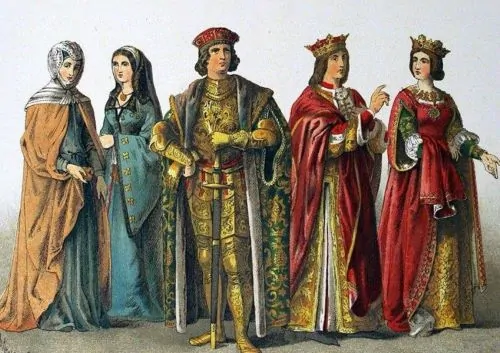
In medieval Catalonia, drapers, tailors, artisans, and consumers reshaped fashion through expanding textile markets, easy credit, skilled labor, and courtly displays of status.

By Dr. Lluís To-Figueras
Agnes Gund and Daniel Shapiro Member, Medieval History
Institute for Advanced Study
Introduction
During the first half of the fourteenth century,1 there was a wave of sartorial innovation across Europe that has induced some historians to consider it as the birth of fashion.2 Research has focused on the aristocratic courts and urban elites, which are usually identified as the social groups that led changes in clothing (Bartholeyns 2008; Blondé and Ryckbosch 2015). Another historiographical scholarship has proved that rural society became increasingly commercialised by the Later Middle Ages. Thus, even peasant households were able to sell and purchase, at least occasionally, a variety of goods that included clothes (Britnell 1993; Kowaleski 2006; Dyer 2012). It is remarkable that an awareness for new fabrics and new apparel seems to have been socially widespread among medieval populations and not restricted to urban elites. Emulation and a desire to differentiate oneself – two key features of societies driven by consumerism – already existed in late medieval times, and had far-reaching economic implications (Dyer 2005, 126-72). Fashion thrived in a context in which households were ready to spend on garments not only for utilitarian purposes, but because it conveyed symbolic capital. Furthermore, a more commercialised economy enabled specialization and more specifically the proliferation of cloth retailers and tailors. Both trades were crucial in disseminating new textiles and new ways to transform them into personal outfits.
An increase in purchases of carefully chosen cloth was clearly linked to expanding textile manufacturing and the development of specialized production in some specific areas of north-western Europe (chiefly Flanders and Northern France). Burgeoning cities such as Ghent, Arras, Ypres, Paris and Châlons-en-Champagne sustained a growing textile production because their products were distributed over a large geographical area (Munro 2003). More and more, they were able to produce several types of fabrics and ship them to distant places. Lists of commodities in tolls bear witness to an increased circulation of textiles across the western Mediterranean (Hoshino 1980, 65-113; Gual 1968). As a result, the range of fabrics available in some markets expanded dramatically during the thirteenth century. At the beginning of the fourteenth century, the warehouse of a merchant in Perpignan contained a large quantity of cloth imported from 16 Flemish and French cities, with more than 50 different types of fabrics (Alart 1881, 85-9).
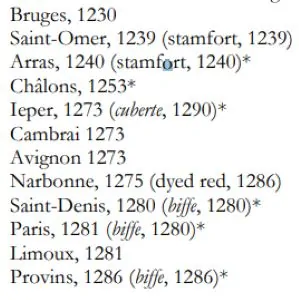
An eagerness for new types of cloth is revealed by a succession of different kinds of textiles pledged by families as a gift for their daughters’ marriages in thirteenth century Catalonia (To Figueras 2016). In Vic, a city in Old Catalonia, between 1230 and 1240, it was already possible to acquire fabrics from Bruges, Arras and Saint-Omer in order to make female garments (i.e. tunics and capes). Cloth from Châlons-en-Champagne was also available from 1253 onwards, and thereafter became an extremely popular choice for brides’ attire. Twenty years later, in 1273, cloth from Ieper started to be on offer, and textiles from Narbonne were also being sold by 1275. Finally, in 1280, textiles from Paris and Saint-Denis, called biffes, turned up as another cloth that could be used for women’s apparel. Moreover some of these textiles hailing from distant places circulated in several varieties of colour and other features. For example biffe from Saint-Denis, as it appeared in Vic, could be blue, green, purple or with stripes. Thus, the range of textiles available to consumers expanded dramatically between 1230 and the beginning of the fourteenth century with the continued addition of new types of cloth. Overall, the flow of new types of cloth that reached cities such as Vic increased primarily because clients embraced these novelties, but also because a growing number of people could afford such wares or decided to invest more on clothing. A prosperous network of cloth retailers was instrumental in lowering transaction costs and profiting from a surge in demand. Further prospects for individual choices were made possible by a larger range of fabrics, but also by the methods garments were cut and assembled. Thus, along with cloth retailers, specialized tailors, and to a lesser extent seamstresses, became a common feature of late medieval society. These specialists were crucial in socially disseminating an economy of fashion that involved people of variegated social status and wealth.
Drapers
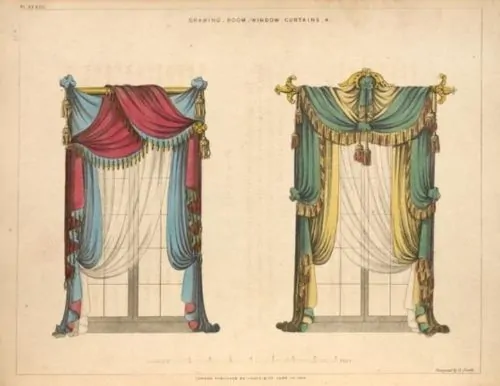
In the second half of the thirteenth century, there were cloth retailers, referred to as drapers (draparii), in many cities and market towns of the western Mediterranean. Although they could be engaged in many other economic activities, textile retail was what defined them.3 Drapers are first mentioned in Barcelona at the beginning of the thirteenth century (Bensch 1995, 230-1; Batlle 2010). At this earlier stage, some were involved in ambitious commercial ventures, which could explain their wealth, although their geographical scope was usually much more limited. Contrary to long-distance merchants, most drapers restricted their sales to the town where they resided and a few neighbouring localities. In Catalonia, in the years 1297-1317, drapers from the town of Peralada sold their wares mostly to customers living in the surrounding rural areas (Farías 2009, 306-7). In some local markets, drapers came from a larger neighbouring town. For instance, around 1300, the small town of Santa Coloma de Queralt was repeatedly visited by drapers from the town of Cervera, 25 km to the north (Milton 2012, 104-5). In other cases, a group of local drapers was complemented by others coming from bigger cities. In Amer, a small monastic town, by the end of the thirteenth century resident drapers had to compete with drapers coming from the city of Girona. Both groups provided clients with a substantial range of textiles for the years to come (To Figueras 2019, 45-52). The same pattern found in Catalonia was replicated in the Kingdom of València by the middle of the thirteenth century. For example, in Cocentaina, a small town 100 km south of València, there were some local drapers from at least 1269 onwards, and received occasional visits of drapers from other cities, just a generation after Christian conquerors had imposed their rule. This shows how by that time cloth retailers had become an essential part of the medieval economy (Ferragud 2003, 186-7).
Similar groups of drapers were also active in other regions of the western Mediterranean, besides the Crown of Aragon. In Tuscany, there are several examples of local drapers (or pannari) selling their wares to quite a diverse clientele as, for example, in the city of Lucca, already by 1246 (Blomquist 1969).4 Some burgs in Provence, such as Reillanne and Trets, also witnessed the activity of drapers during the first half of the fourteenth century. In Provence, drapers also offered a variegated range of cloth to clients living in the same town or the neighbouring areas, making cloth a commodity that reached almost every corner of the region (Poppe 1980, 148-9; Drendel 2014). Although retailers specializing in textiles existed in many places, there is only surviving evidence of a few of them. Sometimes the only way to trace their activity is through their purchases from wholesalers at regional fairs. For example, some drapers from towns such as Solsona, Berga and Tremp in Old Catalonia show up as debtors for French cloth acquisitions at the fair of La Seu d’Urgell, in the Pyrenees, around 1290 (Batlle and Navarro 1984-85).
Drapers could operate in different ways, but they generally used marketing institutions or facilities such as stalls in market squares, taking advantage of the proliferation of chartered markets that took place in the thirteenth century (Farías 2009, 284; Batlle 2004; Petrowiste 2020). In some Catalan towns, such as Amer, there was a section of the market square with stalls (tabulas) specifically devoted to cloth sales (draperia), allowing clients to choose among several retailers. In the town of Castelló d’Empúries, an entire small square was devoted to cloth stalls (Farías 2009, 291). Weekly markets allowed some drapers from bigger centres to attend several local markets in order to sell their textiles. In Catalonia, markets possibly worked as an integrated system, similarly to English markets (Masschaele 1997, 140-46; 165-88). In larger cities, such as Vic, the activity at stalls in its «Mercadal» square was probably more continuous, and therefore sales were not restricted to a single day per week. Undoubtedly, those cloth merchants who used to sell in bulk had large warehouses, but the modest activity of some drapers also required rented spaces in the market towns for storage (Sales 2019, 105; 216). Although shops did not yet exist in most small towns or cities by the beginning of the fourteenth century, drapers and merchants in general had the possibility to display their wares in stockrooms or workshops (operatoria) (Batlle 1981). Joan d’Aldiard, a wealthy merchant from Perpignan, had just a few benches on which to put his textiles, more or less carefully wrapped.5
Drapers had some mobility, from market to market but also to fairs or other places where they met purveyors, encouraging somewhat informal partnerships. They frequently operated in pairs or small partnerships (societas) that pooled capital and human resources, although it is unlikely that they reached the level of complexity or size attained by big commercial companies (Bensch 1995, 287; Reyerson 1985, 38). Nevertheless, some degree of internal cooperation, even without formal guilds, was crucial in their rise to political and social prominence.
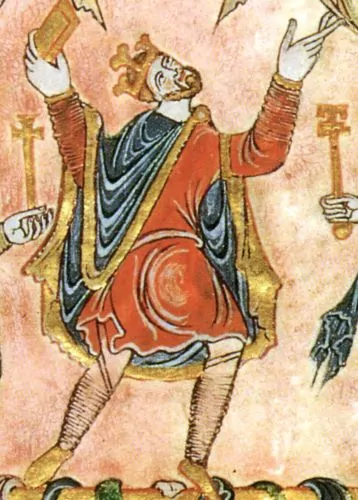
A common feature of drapers’ activities was the extensive use of credit, which is why their purchases and sales can be traced back to at least the first half of the thirteenth century. Drapers systematically allowed for some delay in payments by their clients, whilst at the same time purchasing from cloth merchants on credit. By the middle of the thirteenth century credit was already a key feature of the economy and retail featured prominently as one of the domains in which it had become the norm. Credit offered a fundamental stimulus for cloth consumption and at least the possibility to speed up purchases of new textiles, like those that some manufactures in Flanders and northern France were shipping to Mediterranean cities (Comuzzi 2021; Vela 2007). Drapers who sold textiles on credit could rely on courts and institutions that would eventually enforce repayments (Sales 2011). In the event of disputes, however, written records were instrumental and drapers therefore used them systematically.
Debts could be recorded in drapers’ accounting books that have seldom survived but they were a basic instrument in their businesses.6 In Cocentaina, by the end of the thirteenth century, drapers took an oath to conduct business in fairness and to keep an accounting book on their premises (Ferragud 2003, 187-8). Inventories of deceased drapers highlight pending debts in their ledgers and this is the only way to have a sample of their contents. Debts for cloth purchases could be recorded with a higher degree of formality at a notary or a local court. These provide a glimpse of what kind of fabrics were sold, at what price and to whom, although in most cases it simply stated that a transaction had been made for cloth (pannus), without stating type nor amount. According to these records, by the beginning of the fourteenth century, drapers in Old Catalonia were able to reach almost every single household in towns, as well as rural areas. Thus, people from all social backgrounds and levels of wealth were acquainted with cloth retailers and their wares. Making good use of market institutions and credit, drapers managed to transform a substantial part of the population into clients ready to spend on new wares. However, it would be misleading to confer such a transformative power to drapers alone. As has been previously noted, this was a society in which clothing was meaningful, thus generating a demand for new types of cloth.
Drapers usually sold untailored cloth. It is rare to find references to transactions of ready-made garments. For example, the notaries of Vic, recorded at least 158 debt notes for cloth purchases between 1262 and 1265, among them some were bulk transactions of entire pieces of cloth, although most were unspecified transactions of modest value.7 Some even stated that they bought cloth for dresses, to be cut into individual clothes.8 In this small sample, there is just one case in which the acknowledged debt to a draper was for a specific garment.9 In the small town of Amer, the local notary recorded 868 debt notes for cloth in the years 1283-1340, mostly featuring three local drapers as creditors.10 Although notary notes are also quite laconic, they can occasionally supply some information on the amount of cloth and the purpose of some purchases.11 Several notes specify that cloth was acquired to dress the debtor or someone else. For example, a certain amount of cloth was bought for mourning garments that a widow would wear.12 But in this case, as in many others, drapers were selling just the fabric and there was almost no sale of ready-made clothes.13 After the cloth was purchased, it needed to be cut and then assembled and sewn.14 These were distinct operations, with their own techniques, which in a context of labour specialization were usually assigned to specialists other than the drapers: chiefly tailors and seamstresses.
Tailors and Seamstresses
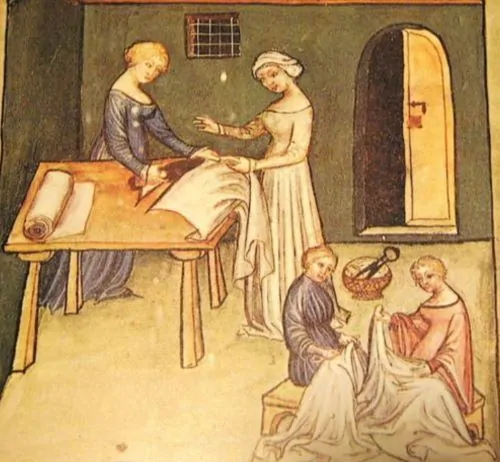
In addition to drapers in several cities and towns of the western Mediterranean there was a growing number of tailors, a group that played a crucial role in the spread of new garments and dresses. Tailors were already in place when new fabrics from Flanders and northern France began to expand the sartorial choices. Their expertise was decisive in taking advantage of the influx of textiles and widening possible custom-making options (Tarrant 2010, 61-7). Tailors also worked mending dresses and were instrumental in bringing new life to old attire. In testaments of the Central Middle Ages, individual garments were quite frequently bequeathed to relatives and friends.15 A thriving second-hand market, at least in late medieval cities, also meant that old garments could be reused (García Marsilla, Navarro, and Vela 2015). New owners may have required items of clothing being overhauled by tailors and seamstresses. Rearranging one’s attire was a common practice for people from all social backgrounds and a convenient way to obtain new dresses using old fabrics. Although a professional tailor was not essential in most cases, it would have been customary for aristocratic households and especially the Royal Court to seek their services.
Drapers’ and tailors’ activities overlapped and some individuals could switch between the two trades. There were also cases in which drapers and tailors cooperated, making it easier for customers to obtain clothes that suited them. As in the case of drapers, it can be difficult to identify tailors or seamstresses in medieval sources. Prior to 1348, many individuals appear in notarial records without a designated occupation. When they do, it may exaggerate the degree of labour specialization because, as drapers, tailors might be engaged in many other activities and businesses besides making garments. Nevertheless, there can be no doubt that by the second half of the thirteenth century and the first half of the fourteenth there were tailors almost everywhere. Some can be traced as creditors or debtors in notarial records, others through contracts to take in apprentices. As drapers or merchants, tailors could keep accounting books partially accessible through probate inventories that listed pending debts. They prove that tailors’ services had reached a wide section of the medieval population by the fourteenth century. Surely not all tailors worked at the same level. Some were in the permanent service of an aristocratic court, while most were independent entrepreneurs offering their services in exchange for particular payments.
Tailors at the Royal Court
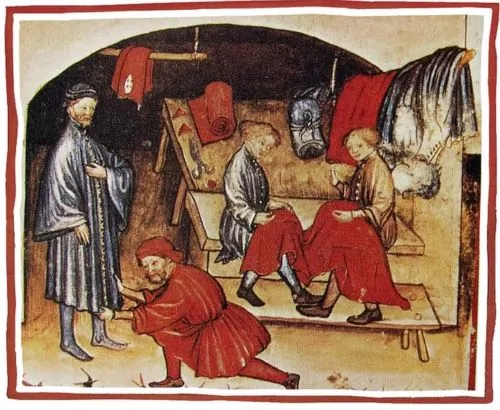
During the first half of the fourteenth century, both the King of Majorca, James III, and, afterwards, the King of Aragon, Peter III, issued ordinances that describe the offices of the court and their duties.16 Although they provide more of an idealized picture of how the court should operate rather than what it was actually like; they do contain a valuable chapter on the tailor and his aides, plus another one on the seamstress and her aide. The ordinances established that an appointed tailor would be at the court permanently whose main duty would be to make the King’s clothes in a secluded space, hidden from the curiosity of others.17 The royal tailor was in charge of buying cloth and all that was needed for the King’s garments by himself or through other officials, and he was therefore accountable for all expenses to the royal treasury. It was the tailor’s responsibility that the King have new clothes for several festivities all year round, and only the appointed tailor or his aides were to make them. For further security, the tailor had to swear an oath to the King. The same secrecy applied to the seamstress who was in charge of the King’s undergarments and linen, although she was not supposed to intervene in purchases. In another chapter, the ordinances listed which festivities required new clothes, and established an additional number of four new outfits per year, with some particularities. In total, making 16 new outfits per year just for the King was more than enough to keep the royal tailor busy all year round.18 The case of the royal court of Aragon provides a useful example of tailors working for aristocrats as courtiers, because plenty of data are available regarding their everyday tasks and responsibilities; although tailors did also acquire prominence in aristocratic courts elsewhere (Bartholeyns 2010, 216-7).
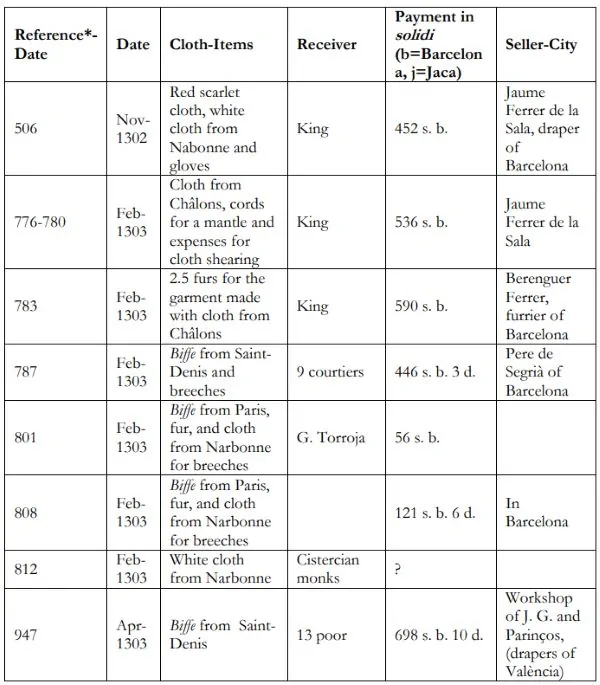
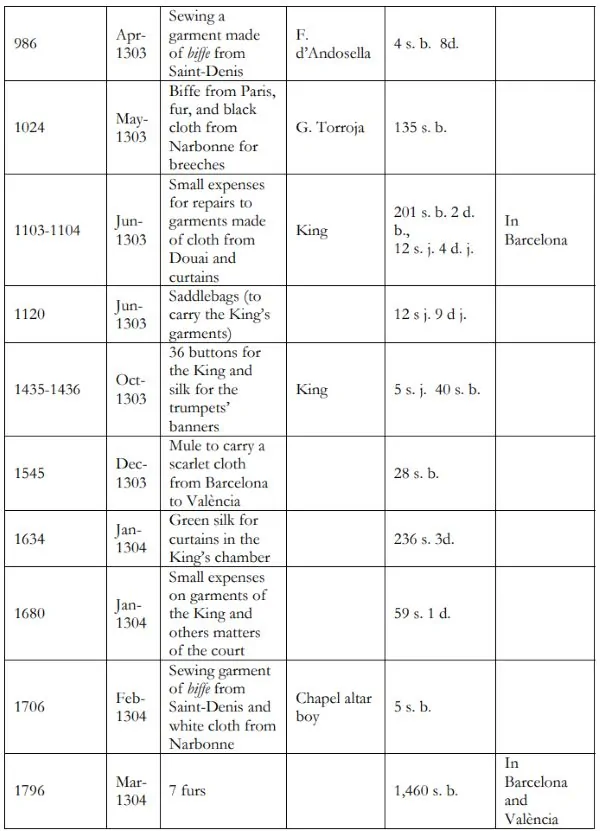
The accounts of the royal treasury recorded some of the purchases and expenses of the royal tailors before the aforementioned ordinances were written. Between 1302 and 1304, the royal tailor Guillem Torroja featured in the treasury accounts several times because he had bought cloth to be used for the King’s clothing (Tab. 2). Other purchases were made by someone called Robert (or Rubi) Anglès, also a «tailor of the King», and a third tailor called Jaquet (González Hurtebise 1911, n. 340, 624, 752, 1099, 1243, 1288, 1293). Therefore, tailors working at the court were responsible for purchases of cloth or acquisitions by other means. In 1283, during the war, the royal tailor Berenguer Serra collected some cloth for the King that had been seized from an enemy’s vessel.19
The table only lists explicit references to tailor Guillem’s expenses, but the accounts undoubtedly include many more made on his behalf. Sometimes it is stated that cloth was bought directly by Guillem himself, but his duties included also taking care of any transfer of royal garments from one place to another, sewing clothes, adding fur linings, etc. Naturally, it would be interesting to know more about the royal tailors’ careers and how they carried out their duties.20 From the sample it arises that Guillem Torroja was not only engaged to make the King’s garments: other people at the court required his services. Although the King’s clothes were framed in a fixed pattern, royal tailors were at least able to add some personal touches: buttons, silk cords and fur linings.21 In any case, it is difficult to assess the extent to which the royal court was able to disseminate new clothing styles. Many people came into contact with the royal court and received a piece of cloth or an item of clothing as a gift following an audience. As already noted, by the beginning of the fourteenth century, a wide range of cloth and accessories was not restricted to noble households. It was already a shared feature of common people’s apparel, even if the quality of the fabrics and furs varied for each social group. Furthermore, a large section of the population had already come into contact with tailors and paid for their services.
Independent Tailors
From the second half of the thirteenth century onwards, there were tailors that made a living offering their services as independent artisans, and not as permanent courtiers of a noble house, both in Catalonia and elsewhere. In Puigcerdà (1260-1300), a bustling urban centre in the Pyrenees, young people were engaged in apprenticeship contracts or hired by master tailors as journeymen (Bensch 2003, 17). In Perpignan, there were a number of tailors from 1239 onwards, six of whom received spaces to build their houses from the Templars between 1241 and 1280. Thus, tailors were making a substantial contribution to urban expansion.22 In 1302 a group of fourteen tailors were listed among the members of the municipal council (Consell de Cent) of Barcelona (Batlle et al. 2007, 370; 374). A similar noticeable community of tailors could be found in other cities of France (Petrowiste 2018, 141-55), Italy (Frick 2002, 13-31; 57-74) and England (Kowaleski 1995, 156) in the fourteenth century. In the rich notarial series of Vic, there is an example of a tailor apprenticeship contract as early as 1238.23 Later, in 1280, another contract for a tailor apprentice refers to the custom of the trade (consuetudine dicti officii) meaning that a small group of tailors was already well-established in Vic and might have had some kind of collective organization.24 In the small town of Amer, also in Old Catalonia, an apprenticeship contract from 1320 specified that at the term’s end the apprentice would receive some tools, as it was customary, overseen by two master tailors. This was a further indication of a settled trade that, even without a guild, operated according to some shared rules and customs.25 Although there is less evidence regarding seamstresses, at least in Vic it was also considered a trade that could be learnt through an apprenticeship.26
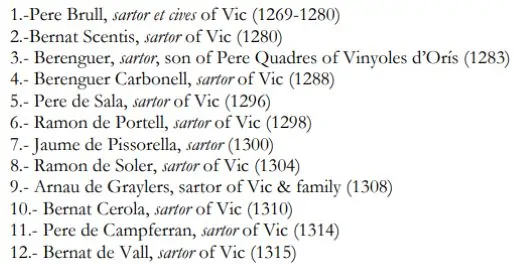
Several tailors lived in Vic during the second half of the thirteenth century. In 1289, a peasant family from the vicinity of Vic made plans for their son to be trained as a tailor for several years, which implies it was a viable professional outlet.27 Some tailors attained social prominence and engaged in more ambitious economic ventures than just producing garments. One way of expanding their business was to also become cloth vendors and therefore mix tailoring with activities characteristic of drapers or cloth merchants. For instance, Pere Brull, a tailor and citizen of Vic, received 1000 s. and then 200 s. in commenda contracts, that he intended to invest in trading cloth and other commodities.28 Prior to this he had bought part of a stall in the market square, a house in Riera street, later another one in the street of Hospital de Sant Jaume, and finally he had also rented a workshop in another square of Vic.29 Two trends in tailors’ business are also apparent in other areas. Firstly, tailoring as a craft that spread and expanded from towns to cover rural populations; and secondly, tailors also becoming cloth dealers, and therefore a mixture of traditional tailors and drapers.
At the beginning of the fourteenth century, tailoring was already an activity that allowed for some kind of labour specialization, and demand for tailors’ services also became widespread among the peasantry. In the small town of Amer there were at least ten tailors between 1312 and 1320, while in the neighbouring valley of Llémena, located 12 km to the north-east of Amer, there were also a few scattered among the small villages. These were rural parishes with no urban population so tailors could only survive if peasant families decided to pay for their services. In Briolf, a small rural parish a little further to the north, a couple of tailors, Bartomeu de Torrent and Francesc Goldró, decided to set up a partnership in 1325. In the following two years, they expected to cut and mend all cloth that their neighbours, inhabitants of their parish, or others would bring them.30 Briolf was a peasant community quite modest in size, and such a business was only conceivable if humble households around it would also consider becoming their customers.
Another interesting feature of tailoring is that as it expanded, it became a trade not restricted to men. Although the vast majority of tailors were men, it was not uncommon for women to act as tailors, at least at the beginning of the fourteenth century in a context of increasing demand. In Vic, there is an example of a whole family, women included, who engaged in this trade. Upon marrying their daughter Elisenda, Arnau de Graylers and his wife agreed to train their son-in-law, Jaume de Trivellers, as a tailor, a craft he would share with his spouse.31 If the general trend in late medieval Europe was to exclude women from tailoring, this was not yet the case in this pre-plague context, perhaps due to an increase in labour demand. In Vic, by the end of the thirteenth century, women also had the option to join other cloth-related trades, the most obvious being that of seamstress, but also there were women working in purse production (borseria) or as weavers.32 In a fairly similar vein, at the beginning of the fourteenth century, several girls in Amer became tailors’ apprentices under the supervision of women masters. Some others enrolled as apprentices with weavers’ masters and two were sent by their parents to train as purse makers in the city of Girona.33 Overall, women’s work made a significant contribution to cloth manufacture and clothing development, not restricted to seamstresses taking care of undergarments.34
Successful Tailors
In the first half of the fourteenth century disparities among tailors became more visible. Whilst some were experts in cutting and mending, others were engaged in more ambitious enterprises. Such is the case of Pere Brull of Vic, who also became involved in cloth trade. Others followed his example: a couple of tailors set up a partnership (societas) for two years with some capital they wanted to invest on draperia.35 Tailors and drapers tended to have a close relationship. In some cases, tailors bought cloth directly from drapers, probably entrusted by buyers to choose the right cloth for ordered garments, as in the case of the royal court. One draper from Amer, Ramon de Ribes, had three tailors from the same town and another one from the neighbouring town of Sant Feliu de Pallerols among his clients.36 Most of these transactions did not imply a notarial contract and remained unrecorded. According to his accounting books, the list of those indebted to the cloth merchant J. d’Aldiard of Perpignan, upon his death in 1317, comprised around 25 tailors. This allowed tailors to start working on items of clothing without waiting for their clients to provide some cloth. The accounts of Ugo Teralh for the years 1330-1332, a draper (notarius et mercator) from Forcalquier, show another possible link with tailors. According to his ledgers, cloth purchased by his clients would go directly to tailors’ workshops. He requested that clothes should not leave the tailors’ premises until he was paid, and apparently he would count on tailors’ complicity in this regard.37
A further step is represented by those tailors who also became cloth retailers and adopted their commercial methods. A couple of examples will show how tailors could adopt drapers’ strategies and achieve a remarkable social prominence. Despite being called a tailor, Guillem Vinyes from Peralada was involved in cloth sales as a draper, at least during the last years of his life, between 1337 and 1345. In a volume that the notary kept only for him, hundreds of debts for purchases of cloth made by men and women of all social levels were recorded, including nuns, clerics, members of the Jewish community, while only exceptionally debts were declared for making clothes.38 During the same period, Guillem also had two or three apprentices, invested in several commenda contracts and bought land. A clothier of Peralada acknowledged he was paid for his work dying cloth for Guillem which further highlights his activities beyond tailoring.39 His will, dictated in his house in 1344, represents a crucial statement of his social expectations. His pious donations were extremely generous: specifically, he ordered the purchase of cloth to dress poor people, one of the works of mercy especially favoured by those who had become wealthy selling textiles.40
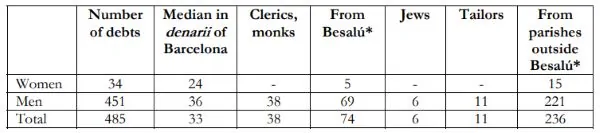
Another example comes from the town of Besalú: assets and goods belonging to Berenguer de Costa, a tailor, were carefully listed on behalf of his underage children in an inventory written shortly after his death in 1345.41 A large section of the inventory describes his house and the objects found there including a crossbow and other weapons. Berenguer had rented a workshop where he kept small quantities of cloth and two canes used for measuring cloth. More crucially, the inventory copied all entries of his accounting books that could be used as proof of an unpaid debt as part of his assets. An impressive list of 485 debts filed in his ledgers, some backed up with notarial charters, is a good indicator of the scale of Berenguer’s businesses. Reasons were only stated in a small proportion of cases: a few were for cloth (pannus), and others just for sewing (custuras). Some debts were surprisingly small, 192 over 485 were for 2 solidi or less, which would not pay a regular piece of cloth. These will doubtless have been related to his activities of cutting and sewing as a tailor. Other, more substantial debts could be associated with his role as a draper or investor. Among his debtors there were other fellow tailors, some of them from small villages of the countryside around Besalú, which implies some kind of professional network. The most relevant conclusion that can be drawn from these debts is the vast array of Berenguer’s customers. They were extremely diverse, both socially and geographically: noblemen, clerics, Jews, peasants and artisans may have requested the tailor’s services. Several clients lived in Besalú, but many others came from villages and rural parishes from all around the county. They bear witness, once more, to the pervasiveness of tailors, at least in this area of Catalonia, during the first half of the fourteenth century.
Conclusions
Changes in ways of dressing and a new sense of fashion during the thirteenth and fourteenth centuries should be placed in the context of some major developments in cloth manufacture, cloth distribution and tailors’ services. Firstly, the thirteenth century saw an expansion in the range of cloth available in local markets, which allowed buyers much greater choice. Obviously, not all fabrics were priced the same, so the materiality of cloth – wool, colour – helped stress hierarchies and nuances in a world characterized by evolving social boundaries. All of these textiles could not have reached consumers without a growing number of cloth retailers, who made extensive use of both market institutions and credit. Stalls devoted to cloth proliferated in many market squares and made it easier for clients of modest means to have access to all sorts of wares offered with delayed payments (Howell 2010, 286). Drapers and cloth merchants in many cities and small towns rose to the highest ranks of local society and enriched themselves, even if cloth retail was never their unique source of income.
Tailors’ skills took dressing to another level. It was not only the choice of a particular fabric but the way it was cut and sewn that added more options, new possibilities for self-differentiation and new ways to display wealth, with subtle variations (Wilson 2017, 112-4). Tailors were instrumental not only in making garments but also in rearranging them, especially when they were transferred to new owners. By the second half of the thirteenth century, tailors could already be found in several Catalan towns. After 1300, there is evidence of a diversity of tailors: some worked at the royal court, holding a range of responsibilities and duties, but most of them were offering their services to all kinds of consumers. The proliferation, even in small towns, of tailors, seamstresses and artisans specialized in the production of accessories such as purses or hats was a consequence of enhanced labour division, although boundaries between trades, notably between those of tailor and draper, were less than fixed. The dramatic expansion of crafts related to cloth and clothing was the result of an increasing demand by a large pool of consumers. For instance, peasant families required tailor’s services even if only occasionally and for their best clothes. Although an awareness of clothing changes was commonplace in the Crown of Aragon and elsewhere by the middle of the fourteenth century, drapers and tailors had become an essential feature of urban and peasant society long before. They reveal an economy that was able to sustain a striking expansion of manufacture and services, particularly those related to clothing and personal attire.
Appendix
Endnotes
- This paper falls within the scope of a Research Project “La desigualdad económica en el mundo rural y las pequeñas ciudades de la Cataluña Vieja bajomedieval a través de las fuentes notariales” funded by the Ministerio de Ciencia e Innovación (PGC 2018-100979-B-C21).
- The chronology for the “birth” of fashion is quite problematic, as has been posited by Heller (2007, 46-60). See also: Piponnier 1989; Blanc 1997; Scott 2007, 35-121.
- Drapers were involved in cloth production in some European regions. In the Crown of Aragon, parator was the term used to identify those whose main activity was cloth manufacture. On a comparative perspective see: Roch 2002.
- Blomquist did not identify these drapers as retailers selling to final consumers, but he was probably wrong on this particular point, as pointed out by R. Marshall (1999, 117).
- According to his inventory, he had five bancals in quibus tenebantur panni botigue and two bancos operatori in quibus tenentur panni (Alart 1881, 85-9). On medieval shops: Dyer 2019, 20-5; García Marsilla 2020, 73-89.
- Only a few fragments of drapers’ ledgers survive from southern France and Tuscany (Reyerson 2002, 154; Marshall 1999, 43; 63-69).
- Arxiu Episcopal de Vic-Arxiu de la Cúria Fumada (ACF), vols. 10-11a. Example of debt for entire pieces of cloth: «pro duobus peciis de stamini forti quos a vobis emi» (ACF, vol. 10, fol. 173v).
- Pannis ad opus vestimenti mei» (ACF, vol. 10, fol. 140v).
- Debt of 40 sol. «precio unius camisol» (ACF, vol. 11a, fol. 10r, 1265).
- Local drapers Ramon de Ribes, Jaume Saula, Guillem de Vanera and their partners appeared in 602 out of 868 acknowledgments of debt to creditors (To Figueras 2019, 46).
- For example, in some cases they explicitly indicate cloth was acquired for someone: «racione pannorum quos a te emi ad opus mei et R. filii mei» (Arxiu Històric de Girona [AHG], notarials Amer, vol. 17, vol. 30r; 1321), and debts for specific amounts of cloth: «racione pannis rubei: unius canne et ii palmarum pannis rubei, (AHG, Amer, vol. 8, fol. 32v, 1297); «racione pannorum videlicet pro iii cannis de panno lividi obscuro» (AHG, Amer, vol. 9bis, fol. 41v, 1308); «racione v cannarum bruni quas a te emimus» (AHG, Amer, vol. 10, fol. 58r, 1309); «ii cannas et unum palmi panni de burello quos emi ad opus induendi persona mee» (AHG, Amer, vol. 28, fol. 13v, 1334).
- «50 sol. racione pannorum quos a me emistis ad opus unius cape et unius coti que emistis ad induendum Bonanatam uxorem ipsius R. de Triliis que vestes fuerunt sibi facte per vos racione luctus mortis dicti R. viri sui» (AHG, Amer, vol. 27, fol. 11v, 1332).
- On one occasion, a draper sold a «gramasie de panno rubeo» on credit (AHG, notarials Amer, vol. 17, fol. 24r, 1320). Besides cloth, in 1330-32 Ugo Teralh, draper of Forcalquier, also sold breeches, hoods and detachable sleeves (Meyer 1898, 136).
- In 1331, the executors of a woman’s will were requested to buy some cloth and then have it cut to produce a couple of garments for her daugther: «quod .. manusmissori predicti emantur iv cannas de panno virido sive livido et ipse A. faciat scindere dicte filie mee capam et cotum in continenti post finem meum» (AHG, Amer, vol. 25, fol. 106v, 1331).
- Examples from a register of wills (Vic, 1238-51): Ollich 1988, 123. For a much earlier sample: Trías Ferri, 2012.
- In fact the «Ordinacions» of King Peter III are a loose translation into Catalan of the Majorcan Leges Palatinae written in Latin (Pérez Martínez et al. 1991; Gimeno, Gonzalbo, and Trenchs 2009, 22-37).
- «que en la cort nostra sia un sastre sufficient qui dins la nostra casa faça totes les vestidures a ús nostre cors deputadores», chap. 38 (Del sartre e sos coadjutors) (Gimeno, Gonzalbo, and Trenchs 2009, 103-4; Beauchamp 2013, 43-56).
- Chap. 39 (De la custurera e de la coadjutora) and chap. 81 (De les vestedures e altres ornaments) (Gimeno, Gonzalbo, and Trenchs 2009, 104; 165).
- «recipiatis ad opus nostri pannos et pennas vayres, vocato ad hoc Berengario Serra, sartore nostro» (Cingolani 2015, 592-3, doc. n. 572).
- It is tempting to see Robert Anglès as an Englishman, and Jaquet could also be the nickname of a Frenchman, which would imply that the court had an international perspective in sartorial matters.
- Other instances show the importance of such accessories as buttons. For example, tailor Jacme d’Argilanes was paid for wedges, silk cords and silver buttons in 1315 (Arxiu de la Corona d’Aragó, Reial Patrimoni – Mestre Racional, Llibre Tresoreria vol. 449, fol. 33r). The same accessories, buttons and wedges appear in Barcelona bourgeois familie’s probate inventories at the beginning of the fourteenth century (Sabaté 1990, 63-4).
- Concessions for Ramon Barrot, tailor, in 1241, 1246, and 1264; for Bartomeu Amblard, tailor, in 1271; for Pere de Castelló, tailor, in 1271; for Jaume de na Feliu, tailor of Cànoes, in 1271; for Pere Barrere, tailor, in 1279, and for Guillem Romeu, tailor, in 1280 (Tréton 2010, doc. n. 376, 466, 628, 778, 793, 806, 924, 934).
- The expected length of the contract was five years, and the apprentice had the possibility to spend two weeks each year working in the harvest, hinting at his peasant origins. The master, in exchange for training and housing, would receive 20 s. and cereal from the apprentice’s mother (ACF, vol. 2, fol. 159v.).
- The master was Bernat Scentis and length of the apprenticeship was three years (ACF, vol. 17, fol. 169r, 1280).
- «Quod est consuetum in villa ista dare per sartores discipulis» (AHG, Amer, vol. 11, fol. 43r).
- A widow sent her daughter to learn «custorerie» as an apprentice with a woman in Vic for five years (ACF, vol. 17, fol. 104v, 1280).
- «Doceatur magisterium sartorie» (ACF, vol. 3306, fol. 52v, 1289).
- ACF, vol. 17, fol. 52r (1280). Along with others, there is evidence of Pere Brull selling cloth on credit earlier: ACF, vol. 11, fol. 79v (1269), fol. 122v (1270), fol. 124v (1270).
- ACF, vol. 10, fol. 152v (1263); vol. 11, fol. 119v (1270), and vol. 17, fol. 144r (1280).
- «Ita quod nos scindamus et emendamus quascumque custuras et pannos ad manus nostras pervenerint tam a parrochianis nostris quam ab aliquibuscumque personis», Arxiu Comarcal de la Garrotxa (ACGAX), notaria Besalú, vol. 11 (notari Bernat Safont), fol. 36r (1325). They expected to make some profit in cereals (tam bladum quam denarios) which also implies they aimed at a peasant clientele (To Figueras 2019, 52-55).
- «Promitimus vobis Jacobo et Elicsendis quod de primo mensis septembris ad ii annos, ego dictus A. docebo te Jacobi meum magisterium sartorie et tibi dicte Elicsendem faciem doceri magisterium sartorisse» (ACF, vol. 3300, fol. 22r, 1308). This clause was cancelled in the notarial register for unknown reasons.
- All trades can be documented through apprenticeship contracts. Seamstress (custuraria): ACF, vol. 17, fol. 104v (1280). Purse maker (borseria): ACF, vol. 10, fol. 109r (1263); vol. 10, fol. 251r (1265); vol. 33, fol. 88v (1299). Weaver (textoria): ACF, vol. 10, fol. 228r (1264); vol. 10, fol. 248r (1265); vol. 17, fol. 31v (1279); vol. 17, fol. 116r (1280). In most cases apprentices came from small villages and moved to the city of Vic where their masters lived and worked.
- Tailor’s apprentices: AHG, notarials Amer, vol. 10, fol. 175v (1311); vol. 11, fol. 43r (1312); vol. 13, fol. 193r (1317); vol. 624, fol. 281v (1320); vol. 30, fol. 38v (1335). Weaver’s apprentices: AHG, Amer, vol. 13, fol. 197v (1317); vol. 15, fol. 105r (1321); vol. 22, fol. 30r (1326); vol. 33, fol. 92r (1339); vol. 34, fol. 6r (1339); vol. 703, fol. 15r (1340); ACGAX, notarials St. Feliu de Pallerols, vol. 58, fol. 187r (1316). Purse maker’s apprentices: AHG, Amer, vol. 8, fol. 28v (1297); vol. 11, fol. 84r (1313).
- Their role in the royal ordinances appears in chap. 39 («De la custurera e de la coadjutora») (Gimeno, Gonzalbo, and Trenchs 2009, 104). In poorer households, presumably, such tasks were performed by the women of the family.
- AHG, Amer, vol. 27, fol. 17v (1332).
- Ramon de Ribes, draper, sold cloth to the following tailors of Amer: Joan de Sala in 1317, R. Basses in 1319, Arnau d’Oliveda in 1335, and to Arnau de Matavaques, tailor of Sant Feliu de Pallerols in 1332 (AHG, Amer, vol. 17, fols. 18r, 21v, 71r, 57v-58v).
- «enans que parta de l’obrayre Bt Isnart, sartre», «enans que parta de l’obrayre de Bt. Pelicier, sartre», «enans que parta del obrayre de Calotier, sartre» (Meyer 1898, 141, 144, 145, 153, 158, 162).
- AHG, notarials Peralada, vol. 1049. In one instance, the notary decided to cross out the word «tailor» and write on top of it «draper», fol. 20v (1339).
- Debt «racione tincturarum et colorum cum quibus dicto patri vestro quondam et vobis meis missionibus tinyi pannos vestros lane», AHG, Peralada vol. 1049, fol. 76v (27-ix-1344).
- Purchases of cloth for the poor on Good Friday in the royal accounts (Tab. 2). Several merchants and rich bourgeois bequeathed money for clothing to the poor. For example, Ramon de Ribes, one of the most prominent drapers in Amer, left funds in his testament for dressing some poor on Good Friday: AHG, Amer, vol. 15, fol. 68r (1321).
- ACGAX, notarials Besalú, vol. 2017 (notari Ramon de Socarrats), fols. 12v-19r (1345).
Bibliography
Affiliate disclosure: Amazon links on this site are paid links. As an Amazon Associate I earn from qualifying purchases.
- Alart, Bernard-J. 1881. Documents sur la langue catalane des anciens comtés de Roussillon et vde Cerdagne. Paris: Maisonneuve.
- Bartholeyns, Gil. 2008. “Le Brabant en Savoie. Marché textile et culture vestimentaire internationale autour de 1300.” In Paraître et apparences en Europe occidentale du Moyen Âge à nos jours, ed. Isabelle Paresys, 215-226. Villeneuve d’Ascq: Presses universitaires du Septentrion. http://dx.doi.org/10.4000/books.septentrion.57552.
- Bartholeyns, Gil. 2010. “Pour une histoire explicative du vêtement. L’historiographie, le XIIIe siècle social et le XVIe siècle moral.” In Fashion and clothing in late medieval Europe / Mode und Kleidung im Europa des späten Mittelalters, ed. Rainer C. Schwinges, and Regula Schorta, 209-30. Riggisberg, Basel: AbeggStiftung, Schwabe AG Verlag.
- Batlle, Carme. 1981. “La família i la casa d’un draper de Barcelona, Burget de Banyeres (primera meitat del segle XIII).” Acta historica et archaeologica mediaevalia 2: 69-91.
- Batlle, Carme. 2004. Fires i Mercats. Factors de dinamisme econòmic i centres de sociabilitat (segles XI a XV). Barcelona: Rafael Dalmau.
- Batlle, Carme. 2010. “Ramon i Joan de Banyeres, ciutadans i negociants de Barcelona de mitjan segle XIII.” Estudis Històrics i Documents dels Arxius de Protocols XXVIII: 7-59.
- Batlle, Carme, and Imma Navarro. 1984-85. “Documents sobre els mercaders occitans a La Seu d’Urgell (fi del segle XIII).” Urgellia 7: 307-34.
- Batlle, Carme, Maria Teresa Ferrer, Maria Cinta Mañé, Josefina Mutgé, Sebastià Riera, and Manuel Rovira. 2007. El “Llibre del Consell” de la Ciutat de Barcelona. Segle XIV: Les eleccions municipals. Barcelona: Consell Superior d’Investigacions Científiques. Institució Milà i Fontanals. Departament d’estudis medievals.
- Beauchamp, Alexandra. 2013. “Les Ordinacions de la Casa i Cort de Pierre IV d’Aragon et le nombre des serviteurs royaux”. In Les entourages princiers à la fin du moyen âge. Une approche quantitative, ed. Alexandra Beauchamp, 43-56. Madrid: Casa de Velázquez.
- Bensch, Stephen P. 1995. Barcelona and its Rulers, 1096-1291. Cambridge: Cambridge University Press.
- Bensch, Stephen P. 2003. “Apprenticeships, wages, and guilds at Puigcerdà (1260-1300).” In El món urbà a la Corona d’Aragó del 1137 als decrets de Nova Planta. XVII Congrés d’Història de la Corona d’Aragó. Barcelona. Poblet. Lleida, 2000, ed. Salvador Claramunt, 209-22. Barcelona: Edicions Universitat de Barcelona.
- Blanc, Odile. 1997. Parades et parures: l’invention du corps de mode à la fin du Moyen Âge. Paris: Gallimard (Le temps des images).
- Blomquist, Thomas W. 1969. “The drapers of Lucca and the marketing of cloth in the mid-thirteenth century.” In Economy, society and government in medieval Italy. Essays in memory of Robert L. Reynolds, ed. David Herlihy, Robert S. López, and Vsevolod Slessarev, 65-73. Kent (Ohio): Kent State University Press (special issue of Explorations in Economic History).
- Blondé, Bruno, and Wouter Ryckbosch. 2015. “In ‛splendid isolation’. A comparative perspective on the historiographies of the ‛material renaissance’ and the ‛consumer revolution’.” History of Retailing and Consumption I, 2: 105-24. https://doi.org/10.1080/2373518X.2015.1063818.
- Britnell, Richard. 1993. The commercialisation of the English society, 1000-1500. Cambridge: Cambridge University Press.
- Cingolani, Stefano M. 2015. Diplomatari de Pere el Gran. 2. Relacions internacionals i política exterior (1260-1285). Barcelona: Fundació Noguera.
- Comuzzi, Elizabeth. 2021. “Mediterranean Trade in the Pyrenees: Italian Merchants in Puigcerdà, 1300-1360.” Pedralbes: Revista d’història Moderna 40: 55-74. https://doi.org/10.1344/PEDRALBES2020.40.2.
- Drendel, John. 2014. “La bourgade provençale comme nœud de commerce local et régional (1300-1450).” In Dynamiques du monde rural dans la conjoncture de 1300: échanges, prélèvements et consommation en Mediterranée occidentale, ed. Monique Bourin, François Menant, and Lluís To Figueras, 239-252. Rome: École Française de Rome (Collection de l’École Française de Rome, 490).
- Dyer, Christopher. 2005. An age of transition? Economy and Society in England in the Later Middle Ages. Oxford: Oxford University Press.
- Dyer, Christopher. 2012. “Did peasants need markets and towns? The experience of late medieval England.” In London and beyond: essays in honour of Derek Keene, ed. Matthew Davies, and James Galloway, 25-47. London: Institute of Historical Research.
- Dyer, Christopher. 2019. “Retailing in the medieval and early modern worlds.” In The Routledge companion to the history of retailing, eds. Jon Stobart, and Vicki Howard, 15-30, London and New York: Routledge.
- Farías Zurita, Víctor. 2009. El mas i la vila a la Catalunya medieval : els fonaments d’una societat senyorialitzada (segles XI-XIV). València: Publicacions de la Universitat de València.
- Ferragud, Carmel. 2003. El naixement d’una vila rural valenciana. Cocentaina, 1245-1304. València: Publicacions de la Universitat de València.
- Frick, Carole Collier. 2002. Dressing renaissance Florence. Families, fortunes and fine clothing, Baltimore-London: The Johns Hopkins University Press.
- García Marsilla, Juan Vicente. 2020. “De la plaza a la tienda. Las infraestructuras del comercio al por menor en la Valencia medieval.” In Ciudades mediterráneas.Dinámicas sociales y transformaciones urbanas en el Antiguo Régimen, ed. Daniel Muñoz Navarro, 73-89. València: Tirant lo Blanch.
- García Marsilla, Juan Vicente, German Navarro, and Carles Vela. 2015. “Pledges and auctions: the second-hand market in the Late Medieval Crown of Aragon.” In Il commercio al minuto. Domanda e offerta tra economia formale e informale. Secc. XIII-XVIII / Retail Trade: Supply and demand in the formal and informal economy from the 13th to the 18th century, 295-317. Firenze: Firenze University Press. https://doi.org/10.1400/231227.
- Gimeno, Francisco M., Daniel Gonzalbo, and Josep Trenchs. 2009. Ordinacions de la Casa i Cort de Pere el Cerimoniós. València: Publicacions de la Universitat de València.
- González Hurtebise, Eduardo. 1911. Libros de Tesorería de la Casa Real de Aragón. Barcelona: Tipografía Luis Benaiges.
- Gual Camarena, Miguel. 1968. Vocabulario del comercio medieval. Colección de aranceles aduaneros de la Corona de Aragón (siglos XIII y XIV). Tarragona: Diputación Provincial.
- Heller, Sarah-Grace. 2007. Fashion in medieval France. Cambridge: D.S. Brewer.
- Hoshino, Hidetoshi. 1980. L’arte della lana in Firenze nel Basso Medioevo. Il commercio della lana e il mercato dei panni fiorentini nei secoli XIII-XV, Florence: Olschki (Biblioteca storica Toscana, 21).
- Howell, Martha C. 2010. Commerce before capitalism in Europe, 1300-1600. Cambridge: Cambridge University Press.
- Kowaleski, Maryanne. 1995. Local markets and regional trade in medieval Exeter. Cambridge: Cambridge University Press.
- Kowaleski, Maryanne. 2006. “A consumer economy.” In A Social History of England, 1200-1500, ed. Rosemary Horrox, and Mark Ormrod, 238-259. Cambridge: Cambridge University Press.
- Marshall, Richard K. 1999. The local merchants of Prato. Small entrepreneurs in the late medieval economy. Baltimore-London: The Johns Hopkins University Press.
- Masschaele, James. 1997. Peasants, merchants and markets. Inland trade in medieval England, 1150-1350. New York: St. Martin’s Press.
- Meyer, Paul. 1898. Le livre-journal de maître Ugo Teralh, notaire et drapier à Forcalquier, 1330-1332. Paris: Imprimerie Nationale (Notices et extraits des manuscrits de la Bibliothèque Nationale et Autres Bibliothèques, 36).
- Milton, Gregory B. 2012. Market power. Lordship, society, and economy in medieval Catalonia (1276-1313). New York: Palgrave Macmillan.
- Munro, John H. 2003. “Medieval woollens: the western European woollen industries and their struggles for international markets, c.1000-1500.” In The Cambridge History of Western textiles, ed. David Jenkins, I: 228-324. Cambridge: Cambridge University Press.
- Ollich, Imma. 1988. Camp i ciutat a la Catalunya del segle XIII. L’evolució de la Plana de Vic. Vic: Eumo editorial.
- Pérez Martínez, Lorenzo, et al. 1991. Jaime III, rey de Mallorca, Leyes Palatinas. Cod. núm. 9.169 de la Bibliothèque Royale Albert I. Palma de Mallorca: Olañeta.
- Petrowiste, Judicaël. 2018. “Une petite ville dans la ‛conjoncture de 1300’. Marchés et société à Saint-Jean-d’Angély au début des années 1330.” In La fabrique des sociétés médiévales méditerranéennes. Le Moyen Âge de François Menant, ed. Diane Chamboduc de Saint Pulgent, and Marie Dejoux, 141-55. Paris: Éditions de la Sorbonne. https://doi.org/10.4000/books.psorbonne.40396.
- Petrowiste, Judicaël. 2020. “Les bourgs marchands de la France méridionale, entre villes et champs (XIIe – début du XIVe siècle).” In La ciudad de los campesinos. Villas nuevas, pequeñas villas, villas mercado. XLVI Semana Internacional de Estudios Medievales de Estella-Lizarra 16/19 de julio de 2019, 153-90. Pamplona: Gobierno de Navarra. https://doi.org/10.35462/siemel.
- Piponnier, Françoise. 1989. “Une révolution dans le costume masculin au XIVe siècle.” In Le vêtement. Histoire, archéologie et symbolique vestimentaires au Moyen Âge, ed. Michel Pastoureau, 225-242. Paris: Léopard d’or (Cahiers du Léopard d’or).
- Poppe, Danuta. 1980. Économie et société d’un bourg provençal au XIVe siècle. Reillanne en Haute Provence, Wrocław: Ossolineum.
- Reyerson, Kathryn L. 1985. Business, banking and finance in medieval Montpellier. Toronto: Pontifical Institute of Mediaeval Studies.
- Reyerson, Kathryn L. 2002. The Art of the Deal. Intermediaries of trade in medieval Montpellier. Leiden: Brill.
- Roch, Jean-Louis. 2002. “De la nature du drapier médiéval. L’exemple rouennais.” Revue historique 302, 1 (613): 3-31.
- Sabaté, Flocel. 1990. “Els objectes de la vida quotidiana a les llars barcelonines al començament del segle XIV.” Anuario de Estudios Medievales 20, 1: 53-108. https://doi.org/10.3989/aem.1990.v20.1142.
- Sales i Favà, Lluís. 2011. “Crédito y redes urbanas: el caso de Girona y las pequeñas ciudades de su entorno en el siglo XIV.” In Redes sociales y económicas en el mundo bajomedieval, ed. David Carvajal de la Vega, Javier Añíbarro Rodríguez, and Imanol Vítores, 133-54. Valladolid: Castilla ediciones.
- Sales i Favà, Lluís. 2019. Crèdit i morositat a la Catalunya del segle XIV. El cas de la baronia de Llagostera (Ph.D. dissertation). Girona: Universitat de Girona.
- Scott, Margaret. 2007. Medieval Dress and Fashion. London: The British Library.
- Tarrant, Naomi. 2010. “Cut your coat to suit your cloth: How a textile affects the cut of a garment.” In Fashion and clothing in late medieval Europe / Mode und Kleidung im Europa des späten Mittelalters, ed. Rainer C. Schwinges, and Regula Schorta, 61-8, Riggisberg, Basel: Abegg-Stiftung, Schwabe AG Verlag.
- To Figueras, Lluís. 2016. “Wedding trousseaus and cloth consumption in Catalonia around 1300.” Economic History Review 69, 2: 522-47. https://doi.org/10.1111/ehr.12123.
- To Figueras, Lluís. 2019. “La consommation de produits textiles en milieu paysan (Catalogne, XIIIe-XIVe siècles).” In Le nécessaire et le superflu. Le paysan consommateur. 36es Journées internationales d’histoire de Flaran, 17-18 octobre 2014, ed. Guilhem Ferrand, and Judicaël Petrowiste, 41-56. Toulouse: Presses Universitaires du Midi.
- Tréton, Rodrigue. 2010. Diplomatari del Masdéu. Barcelona: Fundació Noguera.
- Trías Ferri, Laura. 2012. La terminologia tèxtil a la documentació llatina de la Catalunya altomedieval (Ph. D. dissertation). Barcelona: Universitat de Barcelona.
- Vela i Aulesa, Carles. 2007. “Les compravendes al detall i a crèdit en el món artesà. El cas dels especiers i els candelers.” Barcelona. Quaderns d’història 13: 131-55.
- Wilson, Laurel Ann. 2017. “Status.” In A cultural history of dress and fashion in the medieval age, ed. Sarah-Grace Heller, 107-24. London: Bloomsbury (A cultural history of dress and fashion, 2).
Contribution (25-44) from Fashion as an Economic Engine: Process and Product Innovation, Commercial Strategies, Consumer Behavior, edited by Giampiero Nigro (Firenze University Press, 2022), published at Firenze University Press under the terms of a Creative Commons Attribution 4.0 International license.
About the Author