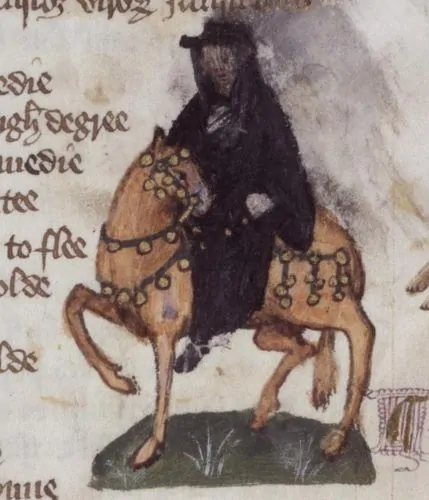
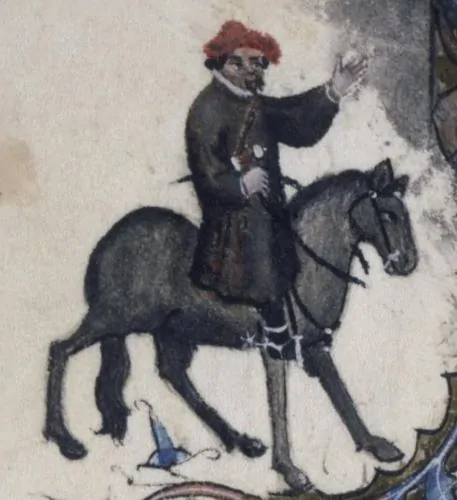
Chaucer’s Monk wears fine clothes and prizes hunting despite his vows. Martin Laidlaw reads his portrayal and the pilgrims’ reactions as signs of a contested medieval masculinity.

By Martin Laidlaw
PG Candidate
University of Dundee
Conventions of masculine agency in the works of Geoffrey Chaucer are rooted in concepts of vocation, particularly the expected behaviour of an individual in relation to their social position. As Holly Crocker argued, ‘Chaucer’s poetry provides multiple examples of masculinity’s failure to secure a comprehensive claim to conformity in the middle ages’.1 This can be seen in The Canterbury Tales, Chaucer’s ‘moveable stage from Southwark to Canterbury’,2 upon which ‘the characters which compose all ages and nations’ perform.3 Crocker highlighted the friction between the Merchant and the Clerk as being ‘the type of competition that is meant to establish and rank different forms of masculine agency’.4 A further example of this inability to assert a fixed ideal of masculine behaviour can be seen in the descriptions of the Knight and his son in The General Prologue. Whereas the Knight is noted in regard to his love of ‘chivalrie, trouthe and honour, fredom and curteisie’ (I.A.45–6), the Squire is described as ‘a lovyere and a lusty bacheler’ (I.A.80), who favours ‘syngynge […] or floytynge, al the day’ (I.A.91). Here the Knight’s blood-stained gypon contrasts with the Squire, who is ‘fressh as is the monthe of May’ (I.A.92), and the pair present a shifting paradigm of celebrated masculine qualities.5
Notions of masculinities take on additional meanings when applied to figures with a religious vocation, and in The Canterbury Tales Chaucer explores this subject adeptly in relation to the Monk and the Nun’s Priest. Religious figures may be seen to occupy a liminal space in which actions or attitudes valued by reductive concepts of secular masculinity act in opposition to their vows of poverty, obedience and chastity. Through the depiction of the Monk in The Canterbury Tales, Chaucer presents the image of a religious who has failed to uphold the expected monastic behaviour yet who succeeds in reflecting masculine pursuits commonly associated with the nobility and laymen alike. In this model the Canterbury pilgrimage takes on a dual role: it is both a space of atonement and confession for the Monk, but it is also the ‘moveable stage’ upon which he demonstrates his elevated social position, handsome looks, fine attire and expensive possessions.
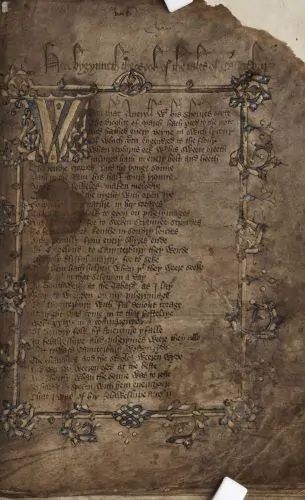
Of Chaucer’s Canterbury pilgrims it is the Monk who, more than any other character in the text, is the subject of a continued narrative throughout the poem, particularly in the self-contained series of tales referred to as Fragment VII.6 This essay will demonstrate that it is not just the reader who becomes aware of his sinful actions, but also his fellow pilgrims, and in this manner the Canterbury pilgrimage takes on additional meaning for the Monk as it is the space in which his various failures to conform to the monastic ideal are judged. The Monk’s transgressions against the expected conduct of his vocation can be deduced from an analysis of The Rule of St. Benedict and The Rule of St. Augustine (which is mentioned by Chaucer) for his portrait in The General Prologue presents a failure to meet these requirements.7 Concepts of masculinities pervade the Monk’s rejection of early monastic authorities and this manifests itself in the possessions and finery he owns; clear transgressions against the Benedictine rule that monks are ‘ne quis praesumat aliquid dare aut accipere sine iussione abbatis, neque aliquid habere proprium, nullam omnino rem, neque codicem, neque tabulas, neque graphium, sed nihil omnino’.8 The Monk’s attire can be seen to be problematic in relation to this section of the Rule:
I sleigh his sleeves purified at the hand
I.A.193–6
With grys, and that the finest of a land;
And, for to fasten his hood under his chin,
He hadde of gold wright a curious pin;
Outward displays of extravagant dress function as masculine demonstrations of wealth and esteem and an examination of the Monk’s clothing highlights the level of cost involved in his garments. The ‘grys’ of his sleeves refers to the fur of the Eurasian squirrel, and this material was prohibited to be worn by monastic figures. As Hodges writes, ‘grys was specifically forbidden at the same time it was worn by many members of the clergy’.9 The expense of the lining of the Monk’s tunic is exceeded only by the gold ‘curious pin’ hanging underneath his chin. These displays of wealth and status reflect Crocker’s statement that ‘emphasis on gender’s performativity highlights its dependence upon visibility’.10 Through his clothing, the Monk seeks to project conventionally valued masculine characteristics, which are nevertheless antithetical to his vocation. In addition to his pin and fur-lined tunic, the Monk owns an array of fine horses, and greyhounds ‘as swift as fowl in flight’ (I.A.190). His attitude towards spending is reflected in his boots which are described as being ‘souple’ (I.A.203), in contrast to those of the frugal Merchant, whose boots are ‘clasped faire and fetisly’ (I.A.275).
The Monk’s love of hunting emphasizes not only a disregard for his vow of poverty but also transgressions relating to lust. Examples of medieval associations between hunting and sex are found and explored in Petrarch’s Rime 140, and in the doubling of the hunt and Lady Bertilak’s advances towards the protagonist of the alliterative poem Sir Gawain and the Green Knight (ll. 1126–1411). The Monk’s transgressions are alluded to in a succession of puns; for example, the description of him as ‘an outridere that loved venerie’ is a play on the Middle French venery, to hunt, and also the Latin venereus, meaning the pursuit of sexual gratification. The reference to the Monk as a ‘prikasour’ takes root from the term ‘prick’, meaning to stab, or most relevantly, penetrate. Chaucer’s comment that ‘of prikyng and of hunting for the hare, was al his lust, for no cost wolde he spare’ (I.A.191–2) lambasts the Monk as being engaged in fornication regardless of the cost to either his purse or reputation. Later, after the Knight interrupts his tale, we, the Host and the other pilgrims learn the Monk’s name is Daun Piers (VII.2792), another oblique reference to ‘prikyng’.
Chaucer’s Monk is described in glowing terms by the Pilgrim Chaucer, who nods as he hears the Monk’s rejection of the early authorities on monasticism and exclaims ‘lat Austyn have his swynk’ (I.A.88). One hypothesis is that the Monk is on a pilgrimage to repent for the transgressions implied within The General Prologue, and that he has been disciplined for his indiscretions. Therefore, the description of the Monk as an ‘outrider’ may have connotations beyond the conclusion that he is ‘an “out-rider” in charge of monastic estates’.11 The Benedictine rule states:
Is autem frater qui gravioris culpae noxa tenetur suspendatur a mensa, simul ab oratorio. Nullus ei fratrum in nullo iungatur consortio nec in conloquio. Solus sit ad opus sibi iniunctum, persistens in paenitentiae luctu, sciens illam terribilem apostoli sententiam dicentis: Traditum eiusmodi hominem in interitum carnis, ut spiritus salvus sit in die Domini.12
In view of this section of The Rule of St. Benedict, it may be argued that Chaucer’s Monk functions as an exiled monastic who is doing penance for his sinful behaviour.
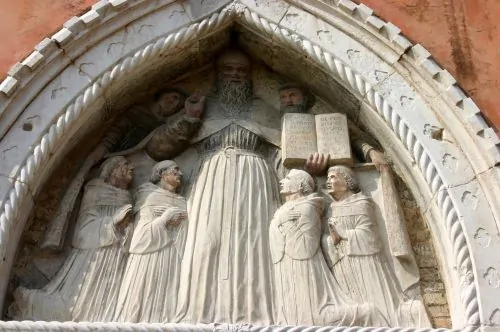
Textual links may also be made between the Monk’s actions and The Rule of St. Augustine, whose author is directly referenced in the portrait of the Monk in The General Prologue. Chapter four of The Rule of St. Augustine begins, ‘non sit notabilis habitus vester, nec affectetis vestibus placere sed moribus’13 and the Monk can be seen to be transgressing this advice in his adornments, and also the description of the noise that accompanies his riding:
And whan he rood, men myghte his bridle heere
I.A.169–71
Gyngell in a whistling wind ales cleere
And eek as loude, as dooth the chapel belle.
In this statement Chaucer is satirizing the Augustinian advice not to ‘attract attention’, and aligning the transgressions of the Monk with this section of the Rule. It has been noted by Esther Quinn that ‘the ringing of the chapel bell [is] a reminder of the divine service upon which the Monk has turned his back’.14 The similarities continue in Augustine’s advice, ‘quando proceditis, simul ambulate; cum veneritis quo itis, simul state’,15 a rule which, were this not a penitential journey, would be contravened by the Monk through his presence on the pilgrimage. The advice which follows ‘in incessu, in statu, in omnibus motibus vestris nihil fiat quod cuiusquam offendat aspectum, sed quod vestram decet sanctitatem’16 is defied in the Monk’s vocal rejection of monastic rules. The Monk is not only giving ‘offence’, but is demonstrating that he is far from a ‘holy state of life’.
What is interesting about the text of The Rule of St. Augustine is that the section which mirrors the failings of Chaucer’s Monk continues with a discussion on safeguarding chastity, as even to want to look at a woman lustfully, ‘ne velit feminam male videre’ was against the Rule.17 There were suitable punishments for sexual misconduct:
Et si hanc de qua loquor oculi petulantiam in aliquo vestrum adverteritis, statim admonete, ne coepta progrediatur, sed de proximo corrigatur. Quicumque autem in tantum progressus fuerit malum, ut occulte ab aliqua litteras vel quaelibet munuscula accipiat, si hoc ultro confitetur, parcatur illi et oretur pro illo; si autem deprehenditur atque convincitur, secundum arbitrium presbyteri vel praepositi gravius emendetur.18
The Monk of The General Prologue presents a figure who disobeys monastic rules in relation to dress, possessions and attitude. Through the links made between The Rule of St. Augustine section concerning ‘safeguarding chastity’ and allusions to the Monk’s love of hunting it can be inferred that he has been discovered to be guilty of some sexual indiscretion and is on a penitential pilgrimage to atone for this sin, yet still wearing his love-knot pin. Here we see a conflict between characteristics applauded in medieval secular masculinities and the expected pious behaviour and conduct of a monk. In desiring to embody one idealized model of masculinity, he has disgraced his obligations as a religious figure.
That the Monk may have engaged in some form of sexual activity is hinted at by Chaucer in the reference to the squirrel fur around the Monk’s cuffs, for the squirrel was widely known as a medieval euphemism and symbol for sex.19 His weakness is noticed by the assembled pilgrims and can be seen throughout the narrative of Fragment VII. As Jahan Ramazani writes, ‘we can learn about the Monk not only from his direct appearances, but also from the other characters who resemble him: Daun John in ‘The Shipman’s Tale’, Chauntecleer in ‘The Nun’s Priest’s Tale’,and the abbot in ‘The Prioress’s Tale’.20 By the time the Monk is invited to speak, it will be shown that he has noted the group’s awareness of his transgressions, and that ‘The Monk’s Tale’, ‘a series of entirely conventional anecdotes on the fall of great men’, functions as a penitential recital.21 However, there is a wider discussion on the subject of sacerdotal celibacy that is presented by the Host in relation to both the Nun’s Priest and the Monk, and it is in these scenes that the crises of expected masculine behaviour which have led to the Monk’s downfall are explored. Crucially, the figures of the Monk and the Nun’s Priest create a contrast in which one adheres to requirements of sacerdotal celibacy, while the other does not.
The Monk is mocked throughout Fragment VII, something seen most directly in the opening story of the section, ‘The Shipman’s Tale’. Within the poem, a monk, Daun John, is shown to seek sexual relations, abandon oaths, and to manipulate the friendship of his host for wealth and comfort. The links to the Monk of the Canterbury pilgrimage who abandons the central oaths of his profession in order to seek sexual relations are plain. The tale focuses on ‘a marchant whilom dwelled at Seint-Denys’ (VII.1), who funds the habits of those who visit his estate. ‘Amonges alle his gestes’ is the figure of the monk, Daun John, and the two are presented as having a fraternal relationship with the note that they ‘Were bothe two yborn in o village’, and that Daun John ‘claymeth as for cosynage’ (VII.35–6). The word ‘cosyn’ is repeated sixteen times in ‘The Shipman’s Tale’ and, as Cathy Hume noted, ‘need not be restricted to a relationship through parents who are siblings’.22 The text compounds this, stating that they are ‘knyt with eterne alliaunce’ in ‘bretherhede, whil that hir lyf may dure’ (VII.40–2). The text of ‘The Shipman’s Tale’is focused on the payment of sex that the Monk receives for granting the wife a gift of one hundred franks,23 which he negotiates from the Merchant. The text wryly states, highlighting a warning of lascivious monks in anticipation of Daun John’s trespass, ‘who was so welcome as my lord daun John, Oure deere cosyn, ful of curteisye?’ (VII.68–9).
Daun John’s discussions with the wife that lead to her offering him whatever he should desire in exchange for one hundred franks highlight his willingness to break oaths in order to pursue sexual activity, something that correlates with the transgressions of the Monk, Daun Piers. Daun John meets the wife of the merchant crying, and offers his counsel to her stating ‘telleth me youre grief. Paraventure I may, in youre meschief, Conseille or helpe’ (VII.127–9). Here, Daun John swears an oath to the wife that he will ‘nevere in my lyf, for lief ne looth, Ne shal I of no conseil yow biwreye’ (VII.132–3) and that he will keep her secret, not simply in the name of ‘cosynage ne alliance, But verraily, for love and affiance’ (VII.139–40). On the wife’s suggestion that the merchant is a ‘cosyn’ of Daun John, he rebukes this, stating:
He is na moore cosyn unto me
VII.149–51
Than is this leef that hangeth on the tree!
I clepe hym so, by Seint Denys of Fraunce
Further to this, the Monk says that he only made the acquaintance of the merchant ‘to have the moore cause of aqueyntaunce’ of his wife, ‘which I have loved specially Above alle wommen, sikerly’ (VII.152–4). This section alludes to the Monk, Daun Piers, in the presentation of a monastic figure who values the chance of sexual indiscretion more highly than sworn vows. That the primary aim of the tale is to criticize monks is not unnoticed by the Host, who concludes that the moral of the tale is, ‘draweth no monkes moore unto your in’ (VII.442) for fear they will defile your wife.
The taunting of the Monk continues throughout Fragment VII, and is alluded to within the tale that follows, ‘The Prioress’s Tale’. During the height of the story, when the Little Clergeon lies with his throat cut, Madame Eglentyne makes an aside to describes the Abbot as, ‘an hooly man’, with the qualifier ‘As monkes been – or elles oghte be’ (VII.632–3). This line is of interest as it is aimed outside the narrative of her tale, appears to be directed to her fellow pilgrims, and can be taken to be a reflection on the character of the monk who has appeared in the previous tale. Tatlock commented, ‘she probably glances at the Monk askance when saying of the Abbot who buries her little martyr’ and in this moment the Prioress also provides a subtle cue to the assembled pilgrims who may have seen similarities between Daun John of ‘The Shipman’s Tale’ and the figure accompanying them to Canterbury.24
Criticism of the Monk may also be seen to extend into Chaucer’s ‘Tale of Sir Thopas’. Although viewed to be ‘rym dogerel’ by the Host, the tale interacts with the presentation of the Monk as a ‘prickasour’, and the subject of chastity and sexual pursuit may be seen to continue the taunting of the Monk for his sexual indiscretion. References to hunting and riding, masculine pursuits favoured by the Monk, pervade ‘The Tale of Sir Thopas’ and there are continuities of description and habit within Chaucer’s tale which have similarities with both Daun John and Daun Piers, the Monk of the Canterbury Pilgrimage. Thopas, like the ‘physically attractive and vigorous’25 Monk, is described as ‘fair and gent’. He too displays his masculinity with an impressive array of clothing, including, ‘shoon of Cordewane’, ‘hosen broun’ of brugges, and a ‘robe … of syklatoun’. That his attire is expensive is stated in the description that it ‘coste many a jane’ (VII.732–5). Thopas, like the Monk, also has a fine horse, ‘his steede gray’ (VII.751).
The associations between the Monk and Sir Thopas can be found in their shared love of hunting, and an abandonment of oaths of chastity at the first opportunity for sexual encounter. That Thopas loves to hunt is expressed throughout the first fitt of the poem and he is said to ‘hunte at wilde deer, And ride an haukyng for river, With grey goshauk on honde’ (VII.736–8). Yet while Thopas is described as chaste, ‘he was chaast and no lechour’ (VII.745), he is also portrayed in the language of ‘prickyng’ that serves as a reference for sex. Thopas ‘priketh thurgh a fair forest, Therinne is many a wilde best’, and ‘priketh north and est’ (VII.754–7), ‘prikyng over hill and dale’ (VII.837). The Knight’s devotions of chastity are quickly abandoned, and he is seen to be ‘fil in love-longynge’ having ‘herde the thrustel synge’. While ‘prikyng on the softe gras’ (VII.779) Thopas laments his solitude and having dreamed of an Elf-Queen, he ‘priketh over stile and stoon An elf-queene for t’espye’ (VII.798–9). The narrative of the Knight seeking love and endeavouring to travel far to find a concubine mirrors the Monk who rides out of his cloister to engage in fornication. As with the monk of ‘The Shipman’s Tale’ who flees when he is at chance of being discovered by the husband of his partner, Thopas encounters an enraged masculine figure from whom he must escape, ‘a greet geaunt, His name was Sir Olifaunt’ (VII.807–8). The similarities between Thopas and the character of the Monk are evident and, as well as a proclivity for hunting and an abandonment of vows of chastity, they share expensive attire and fine horses. Thopas, while riding, is said to have a bridle that gleamed ‘as the sonne shoon’ (VII.879), while the Monk’s bridle jingled ‘gynglen’ (I.A.170) in The General Prologue. The connection between sex and riding can be seen in Chaucer’s final comments:
And for he was a knyght auntrous,
VII.909–12
He nolde slepen in noon hous,
But liggen in his hoode.
His brighte helm was his wonger
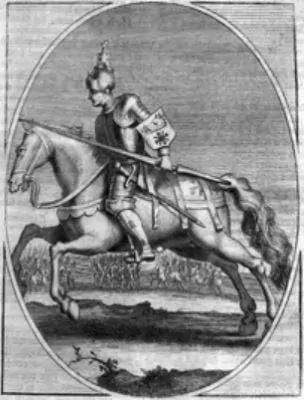
The reference to the Knight’s ‘wonger’ and his habit of sleeping ‘out of house’ is enough for the Host to end the tale as he is ‘so wery of thy verray lewednesse’ (VII.921), and thinks it ‘nat worth a toord’ (VII.930). It may be said that the Host intervenes to spare the blushes of the Knight, whose class is being attacked. However, this silencing of the Pilgrim Chaucer by the Host also highlights the mocking of the Monk that extends throughout Fragment VII.
This taunting of the Monk concludes with the final two tales in Fragment VII, those of the Monk and the Nun’s Priest. The Prologue to ‘The Monk’s Tale’, and the tale he tells, both suggest the misery felt by the Monk in response to the taunts of his fellow pilgrims. In addition to this, the comments of the Host to both the Monk and the Nun’s Priest present a model of juxtaposed vocational commitment in relation to celibacy. The Host’s invitation to the Monk to provide a tale does two things. It first introduces the notion that the Monk is, at this point, aggrieved, and this can be seen in the Host’s insistence that he ‘be myrie of cheere’ (VII.1924). Second, it consolidates the taunting of the Monk through a satirical question: ‘shal I calle yow my lord daun John, Or daun Thomas, or elles daun Albon?’ (VII.1929–30). The presence of ‘Daun John’ as the first name suggested by the Host immediately conflates the Monk, Daun Piers, with the subject of ‘The Shipman’s Tale’, and signals to the rest of the characters that the Host finds similarities between the lascivious Daun John and the Monk of the pilgrimage. However, the Host’s mocking frames the Monk within a paradigm of masculine qualities, particularly as a figure who would have no trouble in finding a partner should he so desire. He is described as ‘nat lyk a penant or a goost’, as ‘som officer’, and a ‘worthy sexteyn’ (VII.1934–6), characteristics venerated in secular masculinities but antithetical to the expected conduct of a monk. This distinction is presented by the Host, who says the Monk is ‘No povre cloysterer, ne no novys, But a governour, wily and wys’, containing ‘brawnes and of bones’ (VII.1939–41). The comment that he is a ‘wel-farynge persone for the nones’ (VII.1942) employs paranomasia on the phrase, ‘for the nones’, meaning for all, and ‘for the nonnes’, relating to the inhabitants of a convent.
It is in this section that Chaucer’s criticism of sacerdotal celibacy and emphasis on the Monk’s indiscretions are most pronounced as the Host, having presented the Monk as a fine specimen of masculinity, then questions what ‘confusioun that first thee broghte unto religioun’ (VII.1943–4). He further describes the virility of the Monk, stating that he ‘woldest han been a tredefowel aright’ (VII.1945) had he not chosen a life of religious celibacy. The joke is of course that the rest of the pilgrims are aware of the Monk’s sexual transgressions and the comment that, had the Monk ‘as greet a leeve as thou hast myght To parfourne al thy lust in engendrure’ (VII.1947) functions as a satirical aside to the crowd. The Host continues and offers his thoughts on the practice of clerical celibacy, stating if ‘I were a pope’, every ‘myghty man’ would have a wife, ‘for al the world is lorn’ (VII.1950–3).
The notion that Chaucer’s Monk represents a fallen figure engaged in penitential pilgrimage is seen in ‘The Monk’s Tale’. The Monk’s recitation of seventeen tragedies, stories of the fall of great men and women, based on Boccaccio’s De Casibus Virorum Illustrium, acts as his admission of sin and lament against the lascivious actions that have brought him social ostracism. The Monk states that ‘tragedies wol I telle Of whiche I have an hundred in my celle’ (VII.1971–2). This reference to the Monk as having ‘a hundred tragedies’ functions as an admission of guilt, and references the social downfall his actions have caused. The Monk’s description of tragedy is particularly noteworthy:
Of hym that stood in greet prosperitee
VII.1975–7
And is yfallen out of heigh degree
Into myserie, and endeth wrecchedly
Not only does ‘The Monk’s Tale’ serve as a penitential action, the content of the tragic stories he describes may be seen to reflect the proclivity for sexual conduct that has brought about his own fall, particularly the notion that associating with women may lead a monk to sin and ruin. Crucially, the Monk is a fallen figure due to the pursuit of qualities viewed as venerable characteristics within a paradigm of secular masculinities.
‘The Monk’s Tale’ may be seen to target the type of fall or tragedy for which women have traditionally been blamed. However, crucially two of the figures used to convey this message are characters noted for masculine qualities of strength and brutality. The story of Samson is one example which frames female interaction as the path to damnation. The text has the Monk describe how the Old Testament figure was a ‘noble almyghty champioun’ who ‘slow and al torente the leoun’ (VII.2023–5). However, the Monk describes Delilah as his ‘false wyf ’ (VII.2027) and one who seeks to ‘preye til she his conseil knew’ (VII.2027). The Monk describes Samson’s weakness, that:
Ne on his heed cam rasour noon, ne sheere,
VII.2056–8
By precept of the messager divyn,
For alle hise strengthes in hise heeres weere.
With this, the Monk tells of the treachery of Delilah, and how she conspired to cut the hair of Samson when she discovered that this was the source of his strength. The Monk is in no doubt as to who is to blame for Samson’s downfall, and describes how ‘wommen shal hym bryngen to meschaunce’ (VII.2062). This example mirrors the castigation he receives for his sexual interactions. It is as if the Monk laments the notion that his activities have been discovered when he states, ‘Beth war by this ensample oold and playn that no men telle hir conseil til hir wyves’ (VII.2091–2). This warning, a fairly commonplace one among medieval authors in general, not to let women know secrets or they will ruin you, may be a misogynistic conclusion made by one who has fallen from a position of status due to sexual transgression: ‘All the Monk can draw from the Gaza episode is a reflection that that women were to blame for Samson’s ruin’.26
A second portrait by the Monk in which the cause of tragic downfall may be seen to be the interaction with females is the discussion of Hercules, particularly Chaucer’s retelling of the story of the Cloak of Nessus. The tale discusses how Hercules’ mistress, Dianira, fetched a shirt for her partner, that of Nessus. When worn, however, this shirt causes the skin to be torn from Hercules’ back, and it is in this torment that the classical figure is forced to throw himself to the flames to escape the pain. The text describes how he ‘wered it half a day’ and ‘It made his flessh al from hise bones falle … Til that his flessh was for the venym blaked’ (VII.2125–31). It is of interest that the Monk’s retelling of this episode ‘omits a crucial detail: the familiar story of Dianira’s jealousy caused by Hercules’s degrading love affair with Eolen’,27 as if to remove any discussion of adultery from the narrative in favour of presenting a sinful woman. The effect of this is to remove male sexual desire from the episode, almost as if the Monk wishes to limit any admission of culpability in regard to his fallen state. That the fatal wounds are inflicted by the Cloak of Nessus has further meaning in regard to the Monk, whose clothing acts as a public indicator of his vocation. It is in the Monk’s attire that vows of chastity and poverty are communicated, and it is due to the Monk’s failure to meet these obligations that he is metaphorically ‘burned’. It is also of note that the expensive accessories that the Monk presents further compound his disobedience. It is through the pursuit of illicit sex and the wearing of improper attire that the Monk is condemned and must endure a certain ‘social death by his own hand’, mirroring the fate of Samson.
The notion that the Monk is a figure who has been mocked throughout Fragment VII and is, by the time of his tale, quite weary, may be seen in the Host’s call for him to cease his speech. The Host states that ‘Youre tale anoyeth al this compaignye’, is ‘nat worth a boterflye’ (VII.2789–90), and encourages the Monk to tell another tale. However, the Monk has had enough of the taunting aimed at him by his fellow pilgrims and declares that he has, finally, ‘no lust to pleye’ (VII.2806). The shaming of the Monk first results in his morose recitation of tales of fallen men, acts as a criticism of his lack of monastic celibacy, and finally bursts his self-importance.
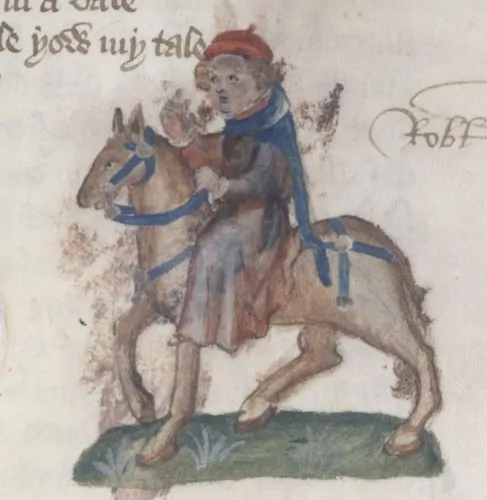
The character of the Nun’s Priest is pronounced and, despite not having a portrait in The General Prologue, his genial exchange with the Host and the tale he tells (a worthy competitor to win the overall tale-telling contest) creates a jovial, yet pious, figure ‘keen and alert in mind and body’.28 The Nun’s Priest elicits the same commentary from the Host on the celibacy of religious figures. This character, however, contrasts with the Monk in that he is a dedicated adherent to the expectations of celibacy his vocation demands. That the Nun’s Priest juxtaposes this can be seen in the invitation of the Host that he may tell his tale. Whereas the Monk was taunted with the moniker ‘Daun John’ in relation to ‘The Shipman’s Tale’, the Host labels the Nun’s Priest, ‘thou, sir John’ (VIIl.2810), imparting an increased nobility and making the clear distinction from the fallen ‘Daun John’. The Nun’s Priest also juxtaposes the Monk in relation to his horse that is seen to be ‘bothe foul and lene’, unlike the dainty horses of the Monk. The tale he tells also differs greatly from the Monk’s tragedies and ‘The Nun’s Priest’s Tale’ of Chauntecleer stands as one of the most memorable and technically accomplished of the text. In this regard the Nun’s Priest adheres to the Host’s request that he, ‘Telle us swich thyng as may oure hertes glade’ (VII.2811). The text alludes to the distinction between the character of the Monk and the Nun’s Priest when it repeats the labelling of the Nun’s Priest as, ‘This sweete preest, this goodly man sir John’ (VII.2820).
‘The Nun’s Priests Tale’ may be said to contain references to moral virtue that anticipate the presentation of the Nun’s Priest as an adherent to the expectations of the priesthood. The widow, for example, who owns the farm on which Chauntecleer and Pertelote perform their beast fable/dream vision is presented in venerable terms as one who ‘ladde a ful symple lyf ’ (VII.2826) dedicated to husbandry. The widow is seen to live in a state of poverty, with, a ‘ful sooty’ home and a small collection of farm animals; she is seen to consume a simple diet, juxtaposing the rich diets of the Monk who has a ‘love of a fat swan for dinner’:29
No wyn ne drank she, neither whit ne reed,
VII.2842–5
Hir bord was served moost with whit and blak,
Milk and broun breed, in which she foond no lak,
Seynd bacoun, and somtyme an ey or tweye
This demonstration of the widow’s piety may open up discussion on the figure of Chauntecleer, and how his voice ‘murier than the murie orgon’ (VII.2849), his pride, and his ‘sevene wyves walkynge by his syde’ (VII.3192), which may be a device to further mock the lasciviousness of the Monk.30 The Nun’s Priest makes reference to ‘the book of Launcelot de Lake’ and states that, ‘wommen holde [it] in ful greet reverence’ (VII.3212–3), as if accusing the females of the world of venerating a story on adultery. That the Nun’s Priest views women as a path to sin is something that may be taken from his tale. As Paul Shallers noted, ‘the deft manner in which he simultaneously compliments and criticizes women implies his mastery of the ironic voice’.31
The Nun’s Priest makes several ‘antifeminist’ comments, particularly generalizations about the benefit of a woman’s advice. Indeed, the Nun’s Priest, unlike the Monk, directly implicates Eve in the narrative of the Fall:
Wommennes conseils been ful ofte colde;
VII.3256–8
Wommannes conseil broghte us first to wo,
And made Adam fro Paradys to go
The Nun’s Priest attempts to deflect from these comments, stating that he ‘seye it in my game’ (VII.3262). However, he continues and seeks to direct those interested towards scriptural or classical sources that make a derogatory case for the role of women. The Nun’s Priest directs those to ‘Rede auctours, wher they trete of swich mateere, and what they seyn of wommen ye may heere’ (VII.3263–4), deflecting from his own sense of ownership of such a comment by putting the words in the beak of Chauntecleer: ‘Thise been the cokkes wordes, and nat myne’ (VII.3265). The seriousness of the Nun’s Priest is not masked, and he advises that the audience extrapolate the moral instruction of the tale: ‘Taketh the moralite, goode men’ (VII.3440). The Nun’s Priest’s closing address that God, ‘make us alle goode men, And brynge us to his heighe blisse. Amen’ (VII.3445–6) may be taken as a rejection of sexual activity, and in support of his vows of chastity.
It certainly does not escape the Host that the Nun’s Priest has demonstrated his own chastity and piety within the Prologue to, and text of, ‘The Nun’s Priest’s Tale’. The Host repeats his assessment of the Monk towards the Nun’s Priest, although adds the qualifier ‘if thou were seculer’ to his statement ‘Thou woldest ben a trede-foul aright’ (VII.3450–1). The Host compliments the large neck and large breast of the Nun’s Priest, and states that he ‘nedeth nat his colour for to dyen With brasile, ne with greyn of Portyngale’ (VII.3458–9), a remark directed at the Monk’s need for fine clothing. Ultimately, the Host states that, should the Nun’s Priest have the desire, he would have little ‘nede of hennes,’ or little trouble finding a female. The model presented within this pair of pilgrims, and across Fragment VII, is one of juxtaposition. The Nun’s Priest may have the charisma to attract a mate, but his piety forbids it. The Monk it seems has sought female company, and now endures the possible misery of rejection from his order.
Chaucer, in the figure of the Monk, presents a character who occupies the margins between the expected behaviour and conduct of those in a religious vocation and the reality of the transgressing, sinful, human. Within The General Prologue, Chaucer constructs a character who has disobeyed the central tenets of his order in regard to his attire, adornments and favouring of secular activities commonly associated with the masculine pursuits of the nobility. As Quinn commented, the Monk ‘expresses outright contempt for his vows – poverty, chastity, obedience, labor, and claustration’.32 However, it is through allusion to sexual transgressions that are implied in the depiction of the Monk as being a keen hunter that this character is implicated in the more grievous sin of abandoning chastity. It is here that the text explores the notion of a liminal space between position and deposition and the representation of the despairing monastic figure becomes indicative of those who have been expelled or disciplined from a prominent social role. Through exploration of the continued narrative of Fragment VII in relation to the information presented within The General Prologue, it is seen that the Monk is not only exposed in his sin, but that he must suffer the mocking of his fellow pilgrims, a reflection of the ostracism and repercussions that his actions may already have brought. In this regard it is seen that the Monk suffers due to his pursuit of actions or activities commonly celebrated within the construct of secular masculinities. Here the position of monastic figures as embodying a liminal gendered space is exposed by the Monk’s inability to abide by the expected behaviours of his vocation. As Crocker noted, ‘if gender is put under visible pressure, it causes trouble, both for those who seek to fix its borders and for those who are caught in the snares set by would-be agents’.33 It is Chaucer’s Monk who acts beyond the fixed borders of his social position in regard to gender and sexuality and it can be seen in the penitential lament of ‘The Monk’s Tale’, as well as the taunting of his fellow pilgrims, that he is indeed caught in such set snares; the visible yet liminal gender implied by his monastic attire has been soiled by conceptions of a medieval secular masculinity that he has failed to reject.
Endnotes
- H. Crocker, Chaucer’s Visions of Manhood (Basingstoke, 2007), p. 3.
- R. M. Lumiansky, On Sondry Folk: the Dramatic Principle of the Canterbury Tales (Austin, Tex., 1980), p. 7.
- W. Blake, ‘The Canterbury pilgrims’, in English Critical Essays, ed. E. Jones (1971), pp. 72–80, at p. 73.
- H. Crocker, ‘Performative passivity and fantasies of masculinity in the Merchant’s tale’, in Chaucer Review, xxxviii (2003), 178–98, at p. 180.
- The Riverside Chaucer, ed. L. Benson et al. (Oxford, 1987); all quotations are taken from this edition.
- Fragment VII includes ‘The Shipman’s Tale’, ‘The Prioress’s Tale’, ‘Chaucer’s Tale of Sir Thopas’, ‘Chaucer’s Tale of Melibee’, ‘The Monk’s Tale’ and ‘The Nun’s Priest’s Tale’.
- For the assumption that the monk is a Benedictine and on how Chaucer’s use of the Augustinian rule to castigate the Monk’s behaviour follows Gower’s example, see D. Knowles, ‘Chaucer’s monk’, in The Religious Orders in England (3 vols., Cambridge, 1948, 1955, 1959), II, app. 1, 365–6, at p. 365.
- St. Benedict’s Rule for Monasteries, trans L. J. Doyle (Collegeville, Minn., 1948), p. 51: ‘Let no one presume to give or receive anything without the Abbot’s leave, or to have anything as his own, anything whatever, whether book or tablets or pen or whatever it may be’. ‘Si quid debeant monachi proprium habere’, St. Benedict of Nursia, Regula Benedicti, XXXIII (<http://www.lluisvives.com/servlet/SirveObras/jlv/02580516454693584321157/p0000001.htm#I_34_> [accessed 12 Oct. 2017]).
- L. F. Hodges, ‘A reconsideration of the Monk’s costume’, Chaucer Review, xxvi (1991), 133–146, at p. 136. See also arguments on the Monk as a typical 14th-century high-ranking monastic in M. Heale, ‘The Monk’, in Historians on Chaucer: the General Prologue to the Canterbury Tales, ed. S. Rigby (Oxford, 2014), pp. 137–55, at p. 144.
- Crocker, Chaucer’s Visions of Manhood, p. 1.
- J. S. P. Tatlock, ‘Chaucer’s Monk’, Modern Language Notes, lv (1940), 350–4, at p. 351 and Heale, ‘Monk’, pp. 144–7.
- St. Benedict of Nursia, Regula Benedicti, Rule no. 25: ‘Let the brother who is guilty of a weightier fault be excluded both from the table and from the oratory. Let none of the brethren join him either for company or for conversation. Let him be alone at the work assigned him, abiding in penitential sorrow’ (trans. L. Doyle) <http://www.lluisvives.com/servlet/SirveObras/jlv/02580516454693584321157/p0000001.htm#I_26_> [accessed 12 Oct. 2017].
- ‘Regula Sancti Augustini’, The Latin Library (n.d.), ch. 4.1 <http://www.thelatinlibrary.com/augustine/reg.shtml> [all entries accessed 9 Oct. 2017]. ‘There should be nothing about your behaviour to attract attention. Besides, you should not seek to please by your apparel, but by a good life’ (The Rule of St. Augustine, trans. Brothers of the Order of Hermits of Saint Augustine (1976) <https://sourcebooks.fordham.edu/source/ruleaug.html> [all entries accessed 9 Oct. 2017]).
- E. C. Quinn, ‘Religion in Chaucer’s Canterbury Tales: a study in language and Structure’, in Geoffrey Chaucer: a Collection of Original Articles, ed. G. D. Economou (New York, 1975), p. 61.
- ‘Whenever you go out, walk together, and when you reach your destination, stay together’ (Rule of St. Augustine, ch.4.2).
- ‘In your walk, deportment, and in all actions, let nothing occur to give offense to anyone who sees you, but only what becomes your holy state of life’ (Rule of St. Augustine, ch.4.3).
- ‘let him not desire to look at a woman lustfully’ (Rule of St. Augustine, ch. 4.5).
- ‘If you notice in someone of your brothers this wantonness of the eye, of which I am speaking, admonish him at once so that the beginning of evil will not grow more serious but will be promptly corrected . . . But if anyone should go so far in wrongdoing as to receive letters in secret from any woman, or small gifts of any kind, you ought to show mercy and pray for him if he confesses this of his own accord. But if the offense is detected and he is found guilty, he must be more severely chastised according to the judgment of the priest or superior’ (Rule of St. Augustine, ch. 4.7 and 4.11).
- M. Jones, The Secret Middle Ages (Thrupp, 2002), pp. 57–8, discussed by R. Gilchrist, Medieval Life: Archaeology and the Life Course (Woodbridge, 2012), p. 106.
- J. Ramazani, ‘Chaucer’s Monk: the poetics of abbreviation, aggression, and tragedy’, Chaucer Review, xxvii (1993), 260–76, at p. 260.
- S. B. Hemingway, ‘Chaucer’s Monk and Nun’s Priest’, Modern Language Notes, xxi (1916), 479–83, at p. 479.
- C. Hume, ‘Domestic opportunities: the social comedy of The Shipman’s Tale’, Chaucer Review, xli (2006), 138–62, at p. 145. See also P. Maddern, ‘Best trusted friends: concepts and practices of friendship among fifteenth-century Norfolk gentry’, in England in the Fifteenth Century: Proceedings of the 1992 Harlaxton Symposium, ed. N. Rogers (Stamford, Conn., 1994), pp. 100–17, at p. 103.
- For discussion on the approximate value of this sum, see P. G. Biedler, ‘The price of sex in Chaucer’s Shipman’s Tale’, Chaucer Review, xxxi (1996), 5–17.
- Tatlock, ‘Chaucer’s Monk’, p. 352.
- Tatlock, ‘Chaucer’s Monk’, p. 351.
- D. J. Wurtele, ‘Chaucer’s Monk: an errant exegete’, Jour. Literature & Theology, i (1987), 191–208, at p. 210.
- J. D. Zatta, ‘Chaucer’s Monk: a mighty hunter before the Lord’, Chaucer Review, xxix (1994), 111–33, at p. 119.
- Hemingway, ‘Chaucer’s Monk and Nun’s Priest’, p. 480.
- M. W. Grose, Chaucer (1967), p. 32.
- For further discussion on the criticism of the Monk expressed in the character of Chauntecleer, see Hemingway, ‘Chaucer’s Monk and Nun’s Priest’, p. 481.
- A. P. Shallers, ‘The Nun’s Priest’s Tale: an ironic exemplum’, English Literary History, xlii (1975), 319–37, at p. 321.
- Quinn, ‘Religion in Chaucer’s Canterbury Tales’, p. 61.
- Crocker, Visions of Manhood, p. 11.
Chapter 7 (107-121) from Gender in Medieval Places, Spaces and Thresholds, edited by Victoria Blud, Diane Heath, and Einat Klafter (University of London Press, 01.03.2019), published by OAPEN under the terms of a Creative Commons Attribution-NonCommercial-NoDerivatives 4.0 International license.
About the Author