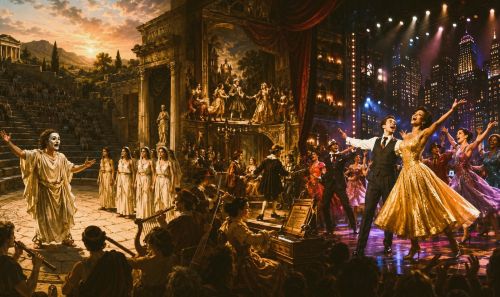
From Greek choruses to Broadway scores, music has carried theater’s emotion, rhythm, spectacle, and storytelling power across centuries.

By Dr. Timothy J. Moore
John and Penelope Biggs Distinguished Professor of Classics, Arts & Sciences
Washington University in St. Louis
Introduction
Despite its centrality to today’s theater, musicals are often thought of as second class to what is considered legitimate theater, such as William Shakespeare’s “Hamlet” or Arthur Miller’s “Death of a Salesman.” In both of those works, music plays little or no role.

But musicals have been the dominant form of theater across cultures and throughout most of history, including in ancient Greece, the birthplace of theater.
Music, Words, and Songs
My research focuses on the tragedies and comedies of ancient Greece and Rome. Though no scores from these original plays exist, a remarkable number of clues about the sound of ancient theater can be found in the surviving texts of the plays and other sources.
Evidence reveals that the plays of ancient Greece and Rome were decidedly musical affairs.
For example, in a conspicuous place during the performance stood an elaborately dressed player of the “aulos,” a loud and strident woodwind instrument consisting of two pipes played simultaneously. Both actors and choruses sang during their performances to the accompaniment of this instrument.
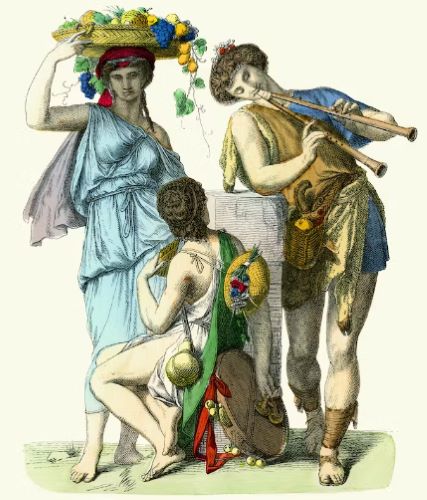
Just as in modern musicals, the important components of what made the plays work were the actors’ use of words both spoken and sung.
Oedipus’ Woeful Song
Consider Sophocles’ “Oedipus the King,” thought by many to be the quintessential Greek tragedy, and often taught and performed as a drama without music. The plot and message of the tragedy are profound and disturbing.
Though Oedipus rises to the heights of human success and becomes an admired ruler of the city of Thebes, he is unaware that he had murdered his father and married his mother. When he learns the truth, he blinds himself and begs to be driven from the city.
Music does much of the work in making this powerful play effective.

Clues in the text of “Oedipus the King” suggest that when it was first performed in about 430 B.C., just under a fifth of the verses were sung or chanted to the accompaniment of the aulos.
Most of the play’s passages accompanied by music are sung by the chorus. Far from mere interludes, the chorus’s songs expressed key themes in both their words and their music.
When the chorus first enters, for example, they sing stately prayers like the one in which they address the oracle of Apollo:
Sweet voiced oracle, Zeus-sent, tell me, what is your message?
But later in the song, their rhythm becomes less self-assured when they turn from prayer to despair at the plague that afflicts their city:
O dear, I’m bearing countless toils!
In conspicuous contrast to the chorus’s emotional songs, Oedipus does not sing through most of the play in his attempt to maintain control in the face of ever more threatening revelations.
The contrast becomes most pointed when the chorus, singing, defends Oedipus’ brother-in-law against a charge that he is plotting to gain the throne:
Don’t strike down in dishonor, on an unclear charge, a dear one who has sworn an oath.
Then Oedipus replies, speaking and not singing:
Know well that when you seek this you are seeking death or exile from this land for me.
Oedipus later yields to the chorus’s wish, but his refusal to participate in their musical performance reflects both his reluctance and his determination to remain in charge.
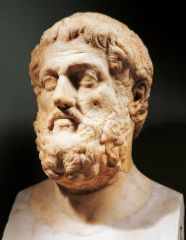
But when Oedipus has met disaster and enters from his palace after blinding himself, he sings in his distress, and he calls attention to the change in his performance mode by addressing his now uncontrolled voice:
Oh, Oh, how miserable I am. Where on earth am I going? Where does my voice fly out uncontrollably? Oh, my fortune, where have you leapt to?
In contrast to the earlier scenes, it is now the chorus who speaks, distancing themselves from their fallen king:
To someplace dreadful, unbearable to listen to or to see.
Recent productions of Greek drama have followed the textual clues to music provided in the texts, with chorus and actors alternating unaccompanied spoken performance with sung verses, accompanied by the aulos or other instruments.
Notable are performances in ancient Greek at Columbia/Barnard and in English translation at the University of Vermont. These performances indicate how much Greek theater has in common with modern musical theater on Broadway and around the world today.
Originally published by The Conversation, 11.15.2023, under the terms of a Creative Commons Attribution/No derivatives license.
About the Author