Athens reveals that demagoguery does not fall because it is intellectually refuted. It collapses when it fails to deliver. Stability is regulated through fatigue.

By Matthew A. McIntosh
Public Historian
Brewminate
Introduction: Democracy After Victory and Defeat
Athens emerged from the Peloponnesian War formally intact yet profoundly altered. The city’s institutions remained recognizable, its assembly still met, and its democratic language endured. Yet the conditions that had once sustained confidence in collective decision-making were badly eroded. Decades of war had depleted the population, strained the economy, and normalized emergency politics. Victory was partial, defeat was humiliating, and neither outcome restored civic equilibrium. The crisis that followed was not a sudden collapse of democracy but a prolonged unravelling of democratic patience.
The traditional explanation for Athens’ instability after Pericles often emphasizes moral decline or popular irrationality. Such readings flatten the complexity of democratic life by treating the demos as a single emotional mass rather than a shifting coalition of interests, fears, and expectations. Late fifth-century Athenian politics was not governed by ignorance alone, nor by a sudden rejection of civic values. It was shaped by repetition. Failed strategies accumulated. Promises multiplied. Each new appeal to urgency demanded more trust from citizens who had less to give.
Pericles’ death marked a decisive transition, not because he was irreplaceable as an individual, but because his authority had concealed institutional fragility. His leadership functioned as a stabilizing exception within a system increasingly dependent on persuasion rather than deliberation. Once that restraint vanished, the assembly became more vulnerable to speakers who offered emotional clarity instead of strategic coherence. The rise of demagogues did not represent a new corruption of democracy but an exposure of tendencies long present and now intensified by stress.
What finally undermined demagogic authority was not persuasion from rivals or a sudden resurgence of civic virtue. It was fatigue. War weariness, economic pressure, and moral exhaustion gradually shifted the calculus of political loyalty. Citizens who had once tolerated spectacle and aggression began to demand outcomes. When those outcomes failed to appear, allegiance weakened. The late fifth-century Athenian experience reveals a critical dynamic of democratic systems: legitimacy often dissolves not in moments of ideological rupture, but in the slow growth of disappointment.
When disappointment accumulates over extended periods and across multiple domains of public life, societies often experience a form of self-termination not through sudden collapse but through the erosion of their governing norms and expectations. This pattern is observable in late classical Athens, where democratic legitimacy weakened under the weight of military failure and civic fatigue, and in the disintegration of the Weimar Republic, where persistent economic crisis and political paralysis hollowed democratic institutions before authoritarian capture. The contemporary rise of Donald Trump can be read not solely as a populist anomaly, but as a potential symptom of a similar dynamic: prolonged disappointment translating into the rejection of established political forms. In each case, the society does not abandon itself in chaos but gradually exhausts the mechanisms that once sustained its recognizable political order.
Pericles and the Performance of Democratic Authority

Pericles occupies a singular place in the history of Athenian democracy, often remembered as its ideal representative. Yet his significance lies less in personal virtue than in the political function he performed. He governed through persuasion, but also through restraint, shaping the expectations of the assembly rather than merely responding to them. His authority did not eliminate democratic volatility, but it moderated it by anchoring public decision-making to a recognizable figure whose credibility absorbed disagreement and delayed fragmentation.
This authority was not institutional. Pericles held no permanent office that empowered him above his peers, nor did he alter the formal mechanisms of the democracy. His influence rested on reputation, rhetorical discipline, and a consistent willingness to resist popular impulses when he believed them harmful. Thucydides’ account emphasizes this dynamic, noting that while Athens was a democracy in name, under Pericles it was guided by the first citizen. The formulation is revealing, not as praise alone, but as an acknowledgment that democratic stability had become dependent on an individual’s capacity to manage collective emotion.
The performance of leadership under Pericles thus concealed a structural vulnerability. Democratic authority increasingly relied on persuasion without sufficient institutional brakes. While Pericles could guide the assembly toward long-term strategy, the system itself lacked mechanisms to ensure that future leaders would exercise similar restraint. His success normalized a mode of governance in which rhetorical dominance substituted for procedural safeguards, leaving the democracy exposed once that dominance was claimed by less disciplined figures.
Pericles’ funeral oration further illustrates this paradox. It elevated democratic ideals while simultaneously personalizing their defense. The speech bound civic identity to collective sacrifice, legitimizing hardship as the price of greatness. While this rhetoric unified Athens in the short term, it also raised expectations that the democracy could indefinitely sustain war, honor, and prosperity together. When those expectations proved unrealistic, the gap between promise and experience widened.
After Pericles’ death, the assembly did not suddenly abandon reason. Rather, it lost a mediator capable of translating democratic impulses into coherent policy. Without that stabilizing presence, the same persuasive techniques that had once supported moderation became tools for escalation. The system Pericles had managed effectively now revealed its dependency on performance rather than structure. His absence exposed how fragile democratic authority becomes when credibility is concentrated in personalities rather than institutions.
The Rise of the Demagogue: Cleon and the Politics of Grievance
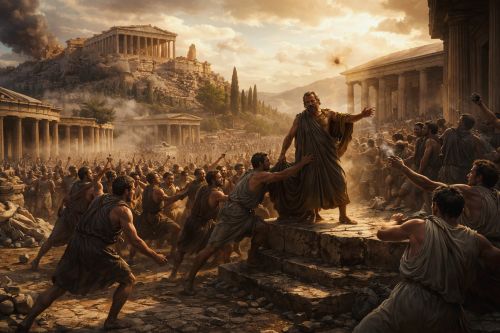
Cleon’s emergence marks a shift in the tone and mechanics of democratic leadership rather than a rupture in democratic form. He did not seize power outside the assembly, nor did he reject its authority. Instead, he mastered its emotional currents. His appeal rested on amplifying grievance, framing politics as a struggle between the virtuous many and corrupt elites, and presenting aggression as honesty. Cleon’s rhetoric thrived in a city conditioned by loss and suspicion, where restraint increasingly appeared as weakness and compromise as betrayal.
Ancient sources portray Cleon harshly, particularly Aristophanes and Thucydides, yet their hostility should not obscure his effectiveness. Cleon spoke to real anxieties. He exploited resentment toward generals, aristocrats, and perceived internal enemies, arguing that Athens had been misled by refinement and excessive deliberation. In his speeches, anger functioned as proof of sincerity. The louder and more confrontational the performance, the more authentic it appeared to citizens accustomed to disappointment and distrust.
The politics of grievance offered emotional clarity in a complex environment. Cleon simplified causation by assigning blame and promised restoration through decisiveness. This approach resonated because it reduced uncertainty. Military setbacks and economic strain could be explained as the result of elite treachery or insufficient resolve rather than structural limits. The appeal lay not in innovation, but in repetition. Each speech reinforced the idea that Athens’ problems persisted because the wrong people were still being listened to.
Yet this strategy contained its own limits. Grievance politics requires constant escalation to sustain credibility. Each failure demands a new enemy or a louder accusation. Over time, results matter. Cleon’s influence waned not because Athenians suddenly rejected anger, but because anger ceased to deliver security or success. His career illustrates a central paradox of demagoguery. It can mobilize fear quickly, but it cannot govern exhaustion indefinitely.
War Weariness and the Erosion of Civic Patience
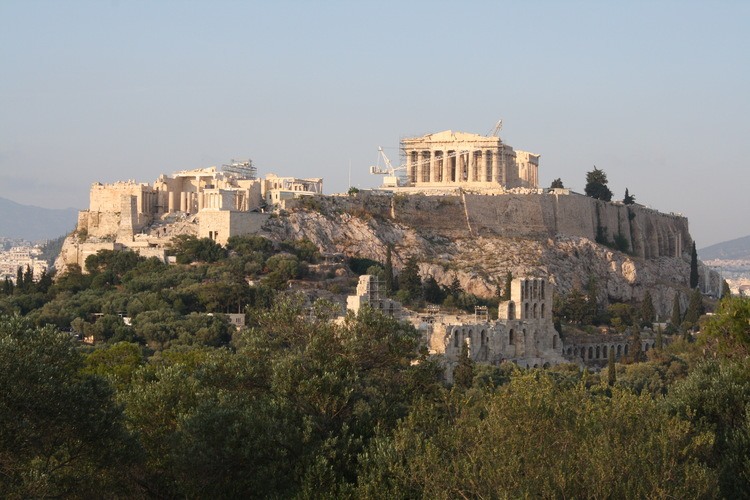
By the later stages of the Peloponnesian War, exhaustion had become a defining feature of Athenian political life. This exhaustion was not only physical or economic, but psychological. Years of mobilization blurred the boundary between emergency and normality. Extraordinary measures became routine, and the emotional reserves required to sustain democratic deliberation steadily declined. The assembly continued to function, but its capacity for patience and long-term calculation weakened under the weight of continuous strain.
War weariness altered the standards by which leadership was judged. Early in the conflict, strategic caution could be framed as prudence, and sacrifice could be justified as investment in collective survival. As losses mounted and victory receded, those same arguments lost their persuasive force. Citizens began to evaluate leaders less by their intentions than by their visible results. This shift did not reflect a decline in civic responsibility so much as a recalibration of expectations in a context where endurance itself had become costly.
Economic pressure intensified this transformation. The demands of naval warfare, tribute collection, and reconstruction strained both public finances and private livelihoods. Taxation increased, property was destroyed, and the flow of imperial revenue became uncertain. For many Athenians, participation in the democracy now coincided with material insecurity. Political promises that once resonated as expressions of shared purpose increasingly sounded hollow when daily life grew more precarious.
The human cost of the war further eroded civic patience. Repeated military campaigns consumed generations of citizens, leaving behind grief that could not be easily subsumed into patriotic rhetoric. Thucydides’ descriptions of plague, defeat, and moral dislocation reveal a society struggling to maintain coherence amid loss. In such conditions, appeals to honor or destiny carried diminishing weight. Fatigue narrowed the range of arguments that citizens were willing to entertain.
This environment proved fertile for demagogic rhetoric, but it also set its limits. Leaders who relied on anger and accusation benefited initially from widespread frustration, yet they were bound to the same reality as their predecessors. Each new appeal to urgency demanded more emotional investment from a population that had less capacity to give it. Over time, the repetition of crisis language produced diminishing returns. What once galvanized now irritated.
The erosion of civic patience thus marked a turning point in democratic legitimacy. Support did not evaporate through ideological conversion, but through attrition. Citizens did not suddenly reject the values of democracy or embrace oligarchy. They became skeptical of promises that required further sacrifice without credible prospects of relief. War weariness transformed political judgment from aspirational to transactional, and in doing so reshaped the fate of Athenian democracy.
The Sicilian Expedition as a Turning Point

The Sicilian Expedition stands as the most dramatic illustration of how spectacle overwhelmed judgment in late fifth-century Athens. Proposed at a moment of uncertainty and fatigue, the campaign promised decisive victory, renewed prestige, and material recovery. Its scale and ambition appealed to a democracy eager for resolution after years of attrition. What mattered politically was not merely the strategic logic of the expedition, but the emotional relief it seemed to offer. Sicily became a projection screen for hopes that ordinary war-making could no longer satisfy.
Debate over the expedition exposed the altered character of democratic deliberation. Nicias’ warnings were extensive and sober, emphasizing cost, risk, and overextension. Yet caution struggled to compete with the intoxicating promise of action. Alcibiades framed the expedition as a test of national vitality, arguing that restraint itself threatened decline. The assembly did not ignore the risks. It accepted them. The desire for a dramatic solution outweighed the credibility of measured analysis, revealing how desperation can masquerade as confidence.
Once underway, the expedition quickly exposed the gap between rhetoric and reality. Logistical complexity, unfamiliar terrain, and divided command undermined early momentum. As setbacks accumulated, the grand narrative that had justified the campaign became harder to sustain. The distance between Athens and Sicily compounded the psychological strain. News arrived slowly, rumors circulated freely, and uncertainty magnified anxiety. Democratic oversight, already strained by war fatigue, proved ill-suited to managing a distant and deteriorating enterprise.
The final destruction of the Athenian force in Sicily was more than a military catastrophe. It shattered the credibility of performative leadership. The scale of loss defied rationalization. No enemy within could plausibly be blamed, no rhetorical reframing could disguise the magnitude of failure. The expedition had promised renewal and delivered annihilation. In doing so, it stripped demagoguery of its most powerful asset: plausibility. Citizens who had tolerated aggressive persuasion in the hope of decisive outcomes now confronted irreversible consequences.
In the aftermath, the political culture of Athens shifted perceptibly. The appetite for spectacle diminished, not because Athenians had learned moderation as a moral principle, but because the cost of illusion had become undeniable. The Sicilian Expedition marked the moment when democratic fatigue hardened into disillusionment. Leadership would continue, assemblies would still meet, and rhetoric would persist. Yet the emotional contract between speaker and audience had been altered. Performance alone was no longer enough.
Independents, Swing Voters, and Democratic Drift

Athenian democracy was never a monolith. Beneath the familiar language of the demos lay a diverse population whose political commitments varied in intensity and duration. While some citizens were deeply invested in factional struggles, others participated more episodically, responding less to ideology than to circumstance. These conditional participants, neither firmly aligned nor consistently mobilized, played a decisive role in moments of instability. Their behavior helps explain why democratic collapse often appears gradual rather than dramatic.
These voters did not defect en masse to oligarchic movements or rival visions of governance. Instead, they drifted. As war, taxation, and uncertainty persisted, their engagement became increasingly transactional. Support was extended provisionally and withdrawn quietly. When leaders failed to produce tangible improvement, enthusiasm waned. Attendance at assemblies fluctuated, confidence eroded, and the emotional intensity required to sustain democratic spectacle dissipated. This withdrawal did not announce itself as opposition, making it harder to counter or reverse.
Demagogic politics proved particularly vulnerable to this dynamic. Grievance rhetoric presumes a receptive audience willing to absorb repeated appeals to anger and blame. For committed supporters, identity and loyalty can sustain this cycle. For independents, repetition without resolution breeds indifference. As outcomes failed to improve, these citizens did not require persuasion to abandon demagogues. Fatigue performed the work that argument could not. Silence replaced applause.
The result was democratic drift rather than democratic rupture. Authority weakened not because it was overthrown, but because it no longer commanded sustained attention. Political life continued, yet with diminished conviction. This erosion altered the balance of power within the assembly, amplifying volatility and narrowing the margin for effective leadership. Athens illustrates a critical lesson of democratic systems: the loss of the middle is often more destabilizing than the mobilization of extremes.
Exhaustion over Enlightenment: Why Demagoguery Fails

Demagoguery is often treated as a permanent threat to democratic systems, yet its durability is frequently overstated. Its power lies in mobilization rather than governance, in emotional intensity rather than institutional capacity. In Athens, demagogic leadership did not collapse because citizens achieved greater political wisdom or rediscovered abstract democratic ideals. It failed because it could not sustain performance under prolonged pressure. When crisis becomes continuous, emotional mobilization loses its force.
The effectiveness of demagogic rhetoric depends on asymmetry. It thrives when opponents appear hesitant, divided, or constrained by norms. Early success reinforces the perception that aggression produces results. Over time, however, demagogues inherit responsibility for outcomes they once attributed to others. Once in a position to act, rhetoric must translate into policy, and policy must survive reality. In late fifth-century Athens, this transition exposed the limits of grievance as a governing strategy.
Athenians did not suddenly reject anger or spectacle. They recalibrated their tolerance for it. As war fatigue deepened and resources dwindled, patience narrowed. Citizens became less responsive to performative outrage and more attentive to concrete consequences. Each failed initiative weakened the credibility of future appeals. Demagoguery, which relies on escalating urgency, struggled to compete with the lived experience of decline.
This process did not require consensus or moral clarity. It required time. Repetition itself became corrosive. The same accusations, the same promises, and the same appeals to fear gradually lost their capacity to persuade. What once felt galvanizing began to feel predictable. In this sense, demagoguery was undone by its own methods. Its insistence on constant crisis produced emotional saturation rather than sustained loyalty.
Athens thus demonstrates that demagoguery is self-limiting in democratic contexts where outcomes remain visible and accountability, however imperfect, persists. Failure accumulates faster than belief. When performance falters and exhaustion sets in, legitimacy erodes quietly. The crowd does not renounce the demagogue in a moment of revelation. It simply stops responding.
Conclusion: Democratic Fatigue Then and Now
The Athenian experience after the Peloponnesian War demonstrates that democracies do not unravel solely through conspiracy, corruption, or ideological betrayal. They fray through overuse. Prolonged crisis exhausts the emotional and material resources required for participatory governance. Citizens do not abandon democracy because they cease to believe in it. They disengage because the costs of belief exceed the benefits of continued investment. Democratic fatigue, rather than democratic ignorance, becomes the decisive force.
Athens reveals that demagoguery does not fall because it is intellectually refuted. It collapses when it fails to deliver. Appeals to grievance, identity, and spectacle can mobilize support rapidly, but they struggle to govern endurance. When outcomes remain poor, even loyal supporters recalibrate their tolerance. The demos does not suddenly become enlightened or virtuous. It becomes tired. Exhaustion replaces enthusiasm, and indifference replaces outrage.
This pattern maps cleanly onto modern democratic systems without requiring direct equivalence. Contemporary populist movements similarly rely on emotional mobilization and antagonistic framing. Their durability depends less on persuasion than on performance. When promised transformations fail to materialize, legitimacy erodes not through dramatic repudiation but through quiet withdrawal. Swing voters disengage. Attention wanes. The emotional economy that sustained demagoguery dries up.
Athens reminds us that democratic stability is not self-correcting through moral awakening. It is regulated through fatigue. When chaos outweighs identity and performance outweighs rhetoric, even the most devoted crowds thin. Democratic fatigue is not a cure. It is a warning. It signals the limits of spectacle and the eventual reckoning between political promise and lived reality.
Bibliography
- Arendt, Hannah. On Revolution. New York: Viking Press, 1963.
- Finley, M. I. Democracy Ancient and Modern. New Brunswick: Rutgers University Press, 1972.
- Hansen, Mogens Herman. The Athenian Democracy in the Age of Demosthenes. Oxford: Blackwell, 1991.
- Kagan, Donald. The Fall of the Athenian Empire. Ithaca: Cornell University Press, 1987.
- —-. Pericles of Athens and the Birth of Democracy. New York: Free Press, 1990.
- Liebeschuetz, W. “Thucydides and the Sicilian Expedition.” Historia: Zeitschrift für Alte Geschichte 17:3 (1968): 289-306.
- Mackin, Jr, James. A. “Schismogenesis and Community: Pericles’ Funeral Oration.” Quarterly Journal of Speech 77:3 (1991): 251-262.
- Meibner, Berhard. “Ancient Greek Coalition Warfare: Classical and Hellenistic Examples.” Journal of Military and Strategic Studies 14:3-4 (2012): 1-16.
- Ober, Josiah. Democracy and Knowledge. Princeton: Princeton University Press, 2008.
- —-. Mass and Elite in Democratic Athens. Princeton: Princeton University Press, 1989.
- —-. The Rise and Fall of Classical Greece. Princeton: Princeton University Press, 2015.
- Pritchard, David. Public Spending and Democracy in Classical Athens. Austin: University of Texas Press, 2015.
- Rhodes, P.J. “Demagogues and Demos in Athens.” Polis: The Journal for Ancient Greek and Roman Political Thought 33:2 (2016): 243-264.
- Runciman, David. How Democracy Ends. New York: Basic Books, 2018.
- Thucydides. History of the Peloponnesian War. Translated by Thomas Hobbes. Chicago: University of Chicago Press, 1989.
Originally published by Brewminate, 01.20.2026, under the terms of a Creative Commons Attribution-NonCommercial-NoDerivatives 4.0 International license.
About the Author