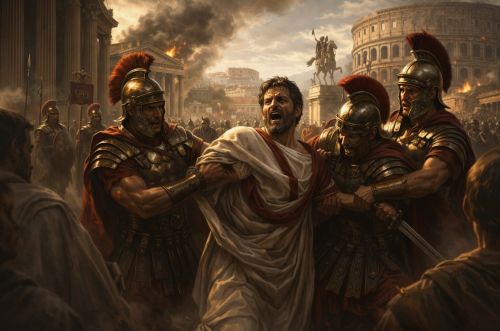
The Roman Republic failed because extraordinary authority became ordinary, and coercion gradually replaced persuasion as the primary instrument of governance.

By Matthew A. McIntosh
Public Historian
Brewminate
Introduction: Republics Rarely Fall All at Once
Republics are seldom destroyed by a single decisive blow. They erode instead, through processes that appear lawful, necessary, and even responsible at the time. The late Roman Republic offers a particularly instructive example, not because its institutions were weak, but because they were repeatedly bent in the name of preservation. What eventually collapsed was not the idea of republican government overnight, but the expectation that political conflict would remain bounded by civilian norms, legal restraint, and shared constitutional limits.
In Rome’s case, the danger did not initially present itself as tyranny. It appeared as emergency. Measures designed for rare moments of existential threat were gradually repurposed to manage internal political struggle. Decrees such as the senatus consultum ultimum were framed as defensive acts, temporary suspensions justified by crisis. Yet each invocation subtly redefined opposition as danger and dissent as disorder, normalizing the idea that extraordinary authority was an acceptable response to ordinary political conflict.
This transformation mattered because republican systems depend less on written rules than on restraint in their application. Rome’s magistracies, assemblies, and courts continued to function even as their underlying assumptions changed. Violence against citizens, once unthinkable outside civil war, became administratively manageable. Soldiers, once instruments of the state, increasingly became loyal to individual commanders. None of this required the formal abolition of republican offices. The decay occurred within the machinery of governance itself.
The late Republic thus collapsed not through sudden revolution, but through administrative habituation. Each emergency justified the next. Each defense of order weakened civilian authority further. By the time figures such as Lucius Cornelius Sulla and Julius Caesar crossed constitutional boundaries with armed force, the conceptual groundwork had already been laid. The republic had not failed to respond to crisis. It failed by allowing crisis to become its permanent condition.
The Roman Republican Order before Permanent Crisis
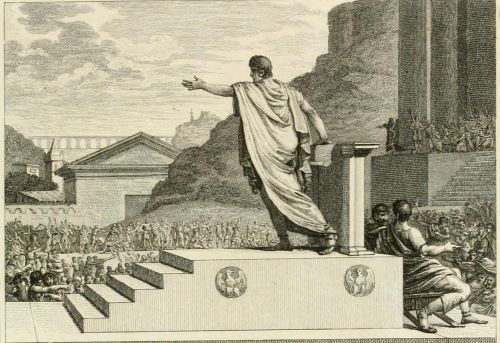
Before emergency authority became routine, the Roman Republic operated through a carefully balanced system designed to disperse power, slow decision-making, and prevent the consolidation of coercive authority in any single individual. Magistracies were annual, collegial, and limited in scope. No officeholder governed alone, and nearly every significant action could be checked by a colleague or appealed to the people. This structure did not eliminate conflict, but it ensured that political rivalry unfolded within a civilian framework rather than through force.
At the heart of this system was the principle that political competition was legitimate so long as it remained nonviolent and procedurally bounded. Ambition was not suppressed in Roman political culture. It was expected. Competition for honor, office, and prestige drove elite participation, but that competition was mediated through elections, debate, and law. Even bitter rivals operated within shared assumptions about what political struggle could and could not involve. The republic functioned not because Romans were less contentious than later generations, but because conflict itself was constrained.
Civilian supremacy over military force was a foundational expectation. Armies were raised for specific campaigns and disbanded afterward. Commanders were accountable to the senate and the people, and soldiers were citizens temporarily under arms rather than a permanent professional class. Military success brought prestige, but it did not automatically translate into domestic authority. The idea that an army could be used to resolve internal political disputes remained deeply taboo during much of the republic’s earlier history.
Emergency powers did exist, but they were deliberately framed as exceptional. The dictatorship, for example, was limited in duration and purpose, traditionally appointed to meet external threats or extraordinary crises. Its authority was understood as a temporary suspension of normal governance, not a replacement for it. The rarity of such measures reinforced their legitimacy. Precisely because they were not routine, they did not yet corrode the expectation that civilian law governed political life.
Equally important was the role of law as a mediating force rather than a weapon. Courts, prosecutions, and public trials were integral to political competition, but they operated within a shared legal culture that presumed the political community remained intact. Even when legal proceedings were used aggressively, they were still understood as alternatives to violence. The courtroom replaced the battlefield, preserving the idea that political defeat did not require physical elimination.
This order depended heavily on norms rather than enforcement mechanisms. There was no standing police force to impose restraint, nor a permanent army stationed in the city to guarantee compliance. The republic relied instead on mutual expectation, reputation, and the belief that today’s victor might be tomorrow’s defendant. Once that belief weakened, the system had little capacity to defend itself against escalation. The republican order endured not because it was rigid, but because its participants largely agreed to restrain themselves.
Emergency Powers and the Logic of Exception
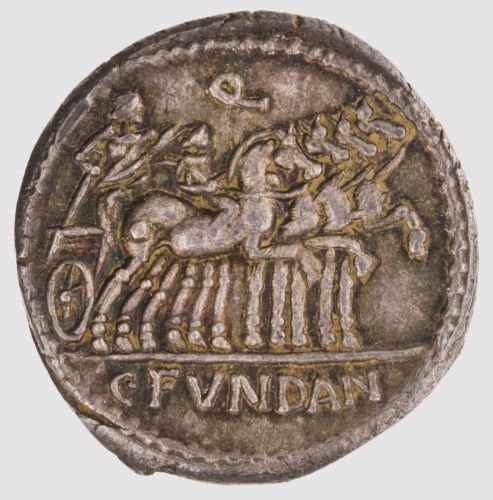
The Roman Republic possessed mechanisms for crisis management, but those mechanisms were built on the assumption that emergencies were rare, clearly defined, and external to ordinary political life. Among the most consequential of these was the senatus consultum ultimum, a decree urging magistrates to see to it that the state suffered no harm. Formally, it was advisory rather than legislative. In practice, it carried immense coercive weight. Its power lay less in its legal precision than in its moral claim to necessity.
The logic underlying such measures rested on exception. Normal procedures were presumed insufficient in moments of existential danger, and extraordinary authority was justified as a temporary suspension in service of survival. Crucially, this logic depended on restraint. An emergency measure retained legitimacy only so long as it remained exceptional. Once invoked repeatedly, its extraordinary character eroded, and with it the boundary separating crisis governance from routine political practice.
The late Republic marked a decisive shift in how emergencies were defined. Threats once understood as political opposition increasingly became framed as dangers to the state itself. Popular leaders, reform movements, and even lawful assemblies were reclassified as sources of disorder rather than participants in civic life. The senatus consultum ultimum thus migrated from a tool against imminent catastrophe to a weapon against internal rivals. Political disagreement was recast as existential risk.
This redefinition carried profound consequences. By treating internal conflict as emergency, the Republic effectively bypassed its own mediating institutions. Courts, assemblies, and legal appeals appeared too slow, too permissive, or too uncertain to manage perceived threats. Emergency authority offered speed and clarity. It promised order without compromise. Each invocation reinforced the belief that legality could be suspended in defense of legality itself.
Over time, the exception became self-perpetuating. Each crisis justified the last and anticipated the next. Once leaders learned that extraordinary authority could be mobilized with minimal consequence, restraint weakened. The Republic did not abandon its laws. It learned how to work around them. In doing so, it transformed emergency from a safeguard into a governing principle, hollowing out civilian rule while preserving its outward forms.
Violence Reclassified: From Political Contest to Administrative Necessity

As emergency authority became normalized, the meaning of political violence shifted. What had once been recognized as a breakdown of civic order was increasingly reframed as a regrettable but necessary instrument of governance. Violence did not suddenly become celebrated. It became justified. When framed as defense of the state, coercion against citizens could be presented as responsible administration rather than unlawful force.
This reclassification depended on language as much as action. Political rivals were no longer opponents within a shared system but threats to public safety. Crowds could be labeled mobs, assemblies could be framed as sedition, and resistance could be described as chaos requiring containment. Once violence was embedded within administrative vocabulary, its use appeared procedural rather than exceptional. It was no longer an admission of failure but a claim to competence.
Urban politics reflected this transformation. Armed intimidation, street fighting, and targeted killings were increasingly tolerated when aligned with senatorial authority or elite interests. The boundary between public order and political suppression blurred. Magistrates and their supporters could invoke emergency logic to bypass deliberation and impose outcomes directly. Violence thus ceased to signal the collapse of politics and instead became one of its accepted tools.
The consequences were cumulative. Each successful use of force lowered the threshold for the next. Citizens adjusted expectations, learning that political participation now carried physical risk. Once violence was administratively routinized, the Republic lost its capacity to distinguish between lawful coercion and factional domination. What remained was not stability, but a hollowed civic space where force substituted for persuasion and authority replaced consent.
Soldiers, Loyalty, and the Personalization of Force
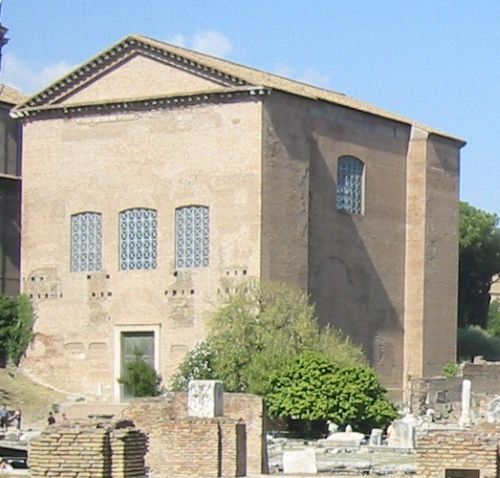
The transformation of Roman politics would not have reached its terminal stage without a parallel transformation in the nature of military loyalty. Earlier republican norms assumed that soldiers were citizens temporarily under arms, bound to the state rather than to individuals. Military command was prestigious but limited, and armies were expected to dissolve back into civilian life once campaigns ended. This arrangement depended on the assumption that force remained subordinate to civic authority.
That assumption weakened as military service became longer, more distant from Rome, and increasingly tied to the fortunes of individual commanders. Reforms in recruitment and pay altered the relationship between soldiers and the state. Men who depended on generals for wages, land, and future security came to see those commanders not merely as magistrates but as patrons. Loyalty followed material dependence, and the abstract authority of the republic could not compete with personal obligation.
This shift did not immediately produce rebellion. Instead, it quietly changed the calculus of power. Commanders learned that their authority no longer ended at the pomerium, and soldiers learned that political outcomes could directly shape their own survival. The army ceased to be a neutral instrument of policy and became a political actor in its own right, even when it did not openly intervene.
The career of Lucius Cornelius Sulla marked a decisive rupture. His march on Rome did not arise from spontaneous lawlessness but from a claim to legality rooted in emergency logic. Sulla presented his actions as restoration rather than revolution, punishing enemies in the name of order and using armed force to reshape constitutional arrangements. The precedent mattered more than the outcome. It demonstrated that an army could be brought into domestic politics under the guise of necessity.
Once that boundary was crossed, it could not be restored. Julius Caesar’s command represented the culmination of this process rather than its origin. By the time Caesar confronted the senate, the idea that military force could arbitrate political conflict was already normalized. The question was no longer whether an army could be used internally, but which leader could command it more effectively.
The personalization of force completed the republic’s administrative decay. Soldiers no longer served a political community governed by law, but leaders who promised protection and reward. Loyalty displaced legality as the organizing principle of power. When force answers to individuals rather than institutions, republican forms may persist, but republican government does not. The army became the final arbiter of politics because civilian authority had already surrendered its claim to exclusive legitimacy.
Elite Self-Deception and the Language of Order

Roman elites did not generally understand themselves as destroyers of the republic. On the contrary, they repeatedly described their actions as necessary acts of preservation. The language of order, stability, and restoration saturated elite discourse, allowing extraordinary measures to appear defensive rather than transformative. By framing coercion as reluctant duty, political actors shielded themselves from recognizing the structural damage their choices inflicted on civilian rule.
This self-deception was reinforced by procedural continuity. Magistracies still existed, laws were still passed, and elections still occurred, even as their substance changed. Because forms remained intact, elites could convince themselves that the republic endured. Emergency authority did not feel revolutionary precisely because it operated through familiar institutions. Each escalation was presented as an isolated response to disorder rather than as part of a cumulative transformation.
The appeal to order also masked the asymmetry of its application. Emergency measures were never neutral. They targeted specific factions, individuals, and movements while presenting repression as impartial necessity. By defining opponents as threats rather than participants, elites narrowed the boundaries of legitimate politics without acknowledging that they were redefining citizenship itself. Order became a moral abstraction detached from popular consent.
Most dangerously, elite actors mistook control for stability. The absence of immediate chaos was taken as proof of success, even as trust, participation, and legitimacy eroded. The republic did not collapse because elites sought tyranny. It collapsed because they failed to recognize that a political system can survive legal continuity while losing its civic foundation. Order, invoked too often and too broadly, outlived the republic it claimed to protect.
Administrative Decay Rather Than Sudden Collapse

The end of the Roman Republic did not arrive as a single constitutional rupture. It unfolded through accumulated administrative decisions that gradually redefined how power was exercised. Laws were not abolished, offices were not immediately eliminated, and republican language remained in use. What changed was the function of those forms. Procedures that once mediated conflict now facilitated coercion, and legality became a tool for managing force rather than restraining it.
This distinction matters because collapse is often misread as spectacle. Civil wars, assassinations, and dramatic confrontations attract historical attention, but they obscure the quieter transformation already underway. By the time armed conflict became unavoidable, the republic had already lost its capacity to govern without force. Emergency measures had replaced deliberation, loyalty had replaced institutional authority, and administrative routine had absorbed practices once regarded as exceptional.
Legality persisted even as legitimacy thinned. Magistrates acted within formal authority, senatorial decrees were issued, and commands were justified through precedent. Yet the political community those mechanisms once served had fractured. Citizens increasingly experienced the state not as a shared civic framework but as an instrument wielded by competing elites. Participation narrowed, trust eroded, and obedience replaced consent as the basis of order.
Augustus did not inherit a functioning republic and dismantle it. He inherited an administratively hollowed system already accustomed to centralized authority and militarized enforcement. The empire emerged not as a rejection of republican decay but as its resolution. Stability was achieved by formalizing what had already become routine. The republic ended not when its institutions vanished, but when they no longer governed in any meaningful sense.
Conclusion: The Quiet End of Republican Government
The Roman Republic did not fail because it lacked constitutional sophistication or civic tradition. It failed because extraordinary authority became ordinary, and coercion gradually replaced persuasion as the primary instrument of governance. Emergency measures intended to defend the republic reshaped it instead, altering expectations about law, loyalty, and political legitimacy. By the time formal republican government disappeared, its civilian foundations had already been eroded beyond repair.
This history cautions against viewing political collapse as a sudden event. The most dangerous transformations occur procedurally, through decisions that appear reasonable in isolation. Each invocation of emergency authority narrowed the space for lawful opposition. Each reliance on force weakened civilian trust. The republic endured as a structure long after it ceased to function as a shared political community.
The Roman case also demonstrates the danger of conflating order with stability. Control can suppress visible disorder without restoring legitimacy, and legality can persist without consent. When political systems prioritize efficiency over restraint, they invite the very instability they seek to prevent. The administrative survival of republican forms masked a deeper civic failure that no constitutional adjustment could reverse.
Republics do not fall when laws are broken, but when they are repurposed. When force answers to loyalty rather than law, and when emergency becomes governance, collapse need not announce itself. It arrives quietly, embedded in routine, defended by necessity, and recognized only in retrospect. Rome’s republic ended not with a proclamation, but with the normalization of its own undoing.
Bibliography
- Beard, Mary. SPQR: A History of Ancient Rome. New York: Liveright, 2015.
- Engel, Niklas. “Corruption and the Public Sphere in Late Republican Rome.” Cultural History 13:1 (2024): 12-28.
- Flower, Harriet I. Roman Republics. Princeton: Princeton University Press, 2009.
- Fuhrmann, Christopher J. “Policing the Roman Empire: Soldiers, Administration, and Public Order.” The American Historical Review 117:4 (2012): 1275-1276.
- Keppie, Lawrence. The Making of the Roman Army: From Republic to Empire. Norman: University of Oklahoma Press, 1984.
- Lintott, Andrew. The Constitution of the Roman Republic. Oxford: Oxford University Press, 1999.
- —-. Violence in Republican Rome. Oxford: Oxford University Press, 1968.
- Millar, Fergus. The Crowd in Rome in the Late Republic. Ann Arbor: University of Michigan Press, 1998.
- Mitchell, Th. N. “Cicero and the Senatus ‘consultum ultimum’.” Historia: Zeitschrift für Alte Geschichte 20:1 (1971): 47-61.
- North, John A. “Politics and Aristocracy in the Roman Republic.” Classical Philology 85, no. 4 (1990): 277–287.
- Shump, Scott. “The Senatus Consultum Ultimum and its Relation to Late Republican History.” Summer Research Paper 99 (2011).
- Steel, Catherine. End of the Roman Republic, 146 to 44 BC: Conquest and Crisis. Edinburgh: Edinburgh University Press, 2013.
- Syme, Ronald. The Roman Revolution. Oxford: Oxford University Press, 1939.
- Yakobson, Alexander. Elections and Electioneering in Rome: A Study in the Political System of the Late Republic. Stuttgart: Franz Steiner Verlag, 1999.
Originally published by Brewminate, 01.21.2026, under the terms of a Creative Commons Attribution-NonCommercial-NoDerivatives 4.0 International license.
About the Author