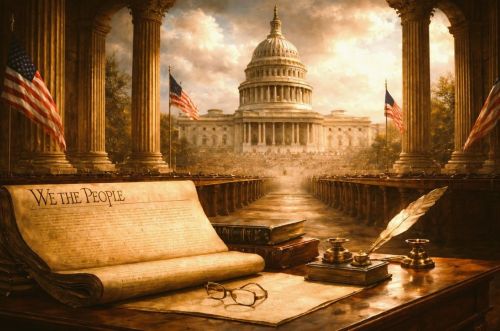
The Constitution deliberately positioned Congress as the dominant branch of government, yet over time legislative supremacy has yielded to expanding executive authority.

By Matthew A. McIntosh
Public Historian
Brewminate
Introduction: Article I and the Architecture of Republican Priority
The framers of the United States Constitution placed Congress first not as ornament, but as architecture. Article I is the longest and most detailed portion of the document, enumerating powers with specificity unmatched in Articles II and III. This textual prominence reflected structural intention. In Philadelphia in 1787, delegates did not conceive of three branches beginning from an equal baseline; they assumed that republican government required legislative predominance, carefully checked but fundamentally primary. The executive would execute. The judiciary would interpret. Congress would define the law and thereby shape the scope within which the other branches operated.
This design was rooted in lived political memory. Colonial resistance to royal governors and to Parliament’s distant authority cultivated suspicion of concentrated executive power. When James Madison described the separation of powers in Federalist No. 47, he drew upon Montesquieu’s warnings about the accumulation of legislative, executive, and judicial authority in the same hands. Yet even as Madison acknowledged the danger of legislative overreach in Federalist No. 48, the presumption of his argument was revealing: the legislature was expected to be the most powerful branch and the one most in need of restraint. Fear of executive dominance haunted revolutionary political thought far more than fear of legislative initiative. The Constitution reflects not neutrality among branches, but calibrated primacy.
The structure of enumerated powers reinforces this interpretation. Article I, Section 8 grants Congress authority over taxation, borrowing, regulation of commerce, declaration of war, the raising and support of armies, and the Necessary and Proper Clause, which authorizes legislation required to carry into execution all vested powers of the national government. By contrast, Article II vests executive power more generally and briefly, defining the presidency largely in relation to enforcement and command within parameters set by statute. Early constitutional scholarship has long emphasized this asymmetry. Eighteenth-century Americans understood legislatures to be the central instruments of republican will, not subordinate actors in a tripartite contest for supremacy. The document’s ordering reflects that intellectual inheritance.
Let us proceed from a simple but consequential premise: congressional primacy was embedded by design. The framers did not replicate British parliamentary supremacy, where Parliament reigned unchecked by a written constitution. Instead, they constructed a system in which legislative dominance was structured, enumerated, and bounded. When that branch yields authority through delegation, inaction, or institutional habit, the shift alters the constitutional equilibrium at its foundation. The question is not whether the branches remain rhetorically “coequal,” but whether the architecture of republican governance has been reconfigured through the gradual erosion of its first principle.
Legislative Supremacy in Theory: Republicanism and the Fear of Monarchy
If Article I reflects structure, republican political theory supplied the animating logic behind it. Eighteenth-century Anglo-American thought was shaped by a sustained distrust of concentrated executive authority. The English Civil War, the Glorious Revolution, and the colonial experience under royal governors formed a historical memory in which monarchy was associated with prerogative, patronage, and arbitrary power. American revolutionaries did not rebel against legislatures. They rebelled against a king and a ministry perceived to stand above representative control. It was natural that, when designing a new government, they would anchor sovereignty in a representative assembly rather than in a singular executive.
Republicanism in this period did not equate liberty with minimal government. It equated liberty with accountable lawmaking. The legislature was seen as the institutional embodiment of the people’s will, periodically renewed through elections. In state constitutions drafted during the Revolutionary era, legislatures often emerged as the dominant institutions, sometimes eclipsing weak governors. This pattern was not accidental but ideological. Legislatures were considered the most legitimate repositories of authority because they were closest to the electorate. Annual or biennial elections reinforced the perception that representatives could be corrected, replaced, or redirected with relative ease. Governors, by contrast, carried lingering associations with prerogative authority, appointment power, and independent command. The early state experience reinforced the assumption that political power properly began in representative chambers, and that executive authority required containment within statutory boundaries defined elsewhere.
Montesquieu’s theory of separated powers, so frequently invoked by the framers, further clarifies the dynamic. In The Spirit of the Laws, Montesquieu warned that liberty required the distribution of governmental functions to prevent accumulation. Yet he did not advocate executive primacy. His model of the English constitution, whether accurate or idealized, described a balanced system in which legislative authority retained decisive influence. American readers interpreted Montesquieu through their own anti monarchical lens. They emphasized his caution against the fusion of executive and legislative power in a single ruler and drew lessons about structural safeguards rather than presidential initiative. Separation was a safeguard against executive domination, not a mandate for executive leadership. The concept functioned defensively. It was designed to prevent the rise of a new king under republican forms, not to empower an energetic executive to rival the legislature in policy formation.
James Madison’s contributions in The Federalist reveal the tension embedded in this framework. In No. 47, he insisted that the accumulation of powers in the same hands constituted tyranny. In No. 48, he warned that the legislative branch was likely to predominate in a republic. Crucially, this warning assumed legislative strength as a baseline reality. The danger lay in excess, not weakness. Madison’s solution was not to elevate the presidency above Congress but to fragment legislative power through bicameralism and federalism. The theory did not seek executive ascendancy; it sought to discipline an already powerful legislature.
This presumption of legislative predominance also informed debates at the Constitutional Convention. Delegates devoted extensive time to designing the composition, election, and apportionment of Congress. Disputes over representation between large and small states consumed weeks. By contrast, the presidency was shaped through more limited debate, with its powers defined largely in relation to enforcement and veto. Alexander Hamilton’s argument in Federalist No. 70 for “energy in the executive” did not negate legislative primacy; it sought administrative effectiveness within a system where lawmaking authority remained elsewhere. Even Hamilton’s expansive vision stopped short of granting independent legislative initiative to the executive. The veto was framed as a defensive instrument, a qualified check designed to prevent legislative error, not to generate law. The president could recommend measures, but recommendation did not equal origination. The structure ensured that initiative flowed formally from Congress, with executive participation confined to execution and review.
The theoretical landscape of the late eighteenth century positioned Congress as first among equals in more than textual order. Republican ideology treated representative assemblies as the safest custodians of liberty. Fear of monarchy did not dissipate with independence; it was constitutionalized. The presidency was crafted as a necessary instrument of execution, not as a rival center of policy origination. Understanding this theoretical foundation is essential, because the later transformation of executive initiative cannot be measured accurately without recognizing how decisively the founding generation expected legislative dominance to shape the republic.
The Mechanics of Primacy: Power of the Purse, War, and Lawmaking

If republican theory established the expectation of legislative predominance, the Constitution operationalized it through concrete institutional mechanisms. Article I did not merely describe Congress; it equipped it. The enumerated powers in Section 8 form the functional core of national authority. Taxation, borrowing, regulation of commerce, naturalization, bankruptcy, the coining of money, the establishment of post offices, the raising and supporting of armies, the provision and maintenance of a navy, and the declaration of war were all placed firmly within legislative control. These were not peripheral tools. They constituted the essential levers of sovereignty in matters economic, military, and structural. By vesting them in Congress, the framers ensured that policy direction, fiscal capacity, and military authorization would originate in the representative branch. The executive could administer and implement, but it could not independently generate the legal or financial foundations upon which national action depended. Authority was channeled through statute, and statute emerged from deliberative assembly.
Foremost among these instruments was the power of the purse. Control over revenue and appropriations provided Congress with both affirmative and negative authority. It could fund national priorities, shape administrative development, and define the scope of executive action. It could also refuse funding, thereby constraining or halting executive initiatives. James Madison emphasized in Federalist No. 58 that the House of Representatives, as the chamber most directly accountable to the people, would hold decisive influence through its exclusive authority over revenue measures. This financial primacy created structural dependence. The executive could not sustain operations without legislative consent expressed through appropriations.
War powers further illustrate the design. The Constitution assigns Congress the authority to declare war, raise and support armies, provide for calling forth the militia, and regulate land and naval forces. The President serves as Commander in Chief, but that role presupposes forces created and funded by statute. The allocation reflects deliberate caution. Debates at the Constitutional Convention reveal concern that executive control over the initiation of war could replicate the prerogative abuses associated with European monarchies. By dividing the power to commence war from the power to conduct it, the framers sought to anchor decisions of national conflict within the deliberative branch. Military action was to follow legislative authorization, not substitute for it.
The Necessary and Proper Clause reinforced congressional centrality by granting authority to enact laws required to execute not only its own powers but also “all other Powers vested by this Constitution in the Government of the United States.” This provision made Congress the architect of institutional design. The executive departments, the federal courts below the Supreme Court, and the administrative infrastructure of governance emerged through statute rather than executive decree. In McCulloch v. Maryland (1819), Chief Justice John Marshall affirmed a broad interpretation of this clause, underscoring Congress’s discretion to select appropriate means to achieve constitutional ends. Marshall’s reasoning emphasized legislative judgment in determining what measures were convenient or useful to constitutional objectives. The decision did not elevate executive autonomy; it validated legislative latitude in structuring the machinery of the state and confirmed that institutional expansion flowed through congressional authorization. In effect, Congress possessed not only enumerated powers but also adaptive capacity, allowing it to shape the operational contours of national government.
Impeachment authority supplied an additional dimension of primacy. The House of Representatives holds the sole power of impeachment, and the Senate the sole power to try impeachments. This mechanism subjects executive officers, including the President, to legislative judgment for high crimes and misdemeanors. Although rarely invoked successfully against presidents, the existence of this power signals constitutional hierarchy. The executive is accountable to Congress in defined circumstances, while no reciprocal removal authority exists in the presidency over legislators. The asymmetry reflects foundational assumptions about responsibility and restraint.
These mechanisms reveal that congressional supremacy was embedded not in rhetoric but in institutional design. Fiscal control, war authorization, structural legislation, and impeachment authority created a framework in which executive action was derivative and conditional. The President could recommend measures, veto legislation, and command forces once authorized, but the scope and sustainability of executive activity depended upon statutory foundations. The architecture of primacy was mechanical as well as theoretical. Understanding this machinery clarifies how later shifts in practice, particularly through delegation and emergency powers, represent not minor adjustments but substantive alterations in constitutional balance.
Early Practice: Congressional Centrality in the First Republic
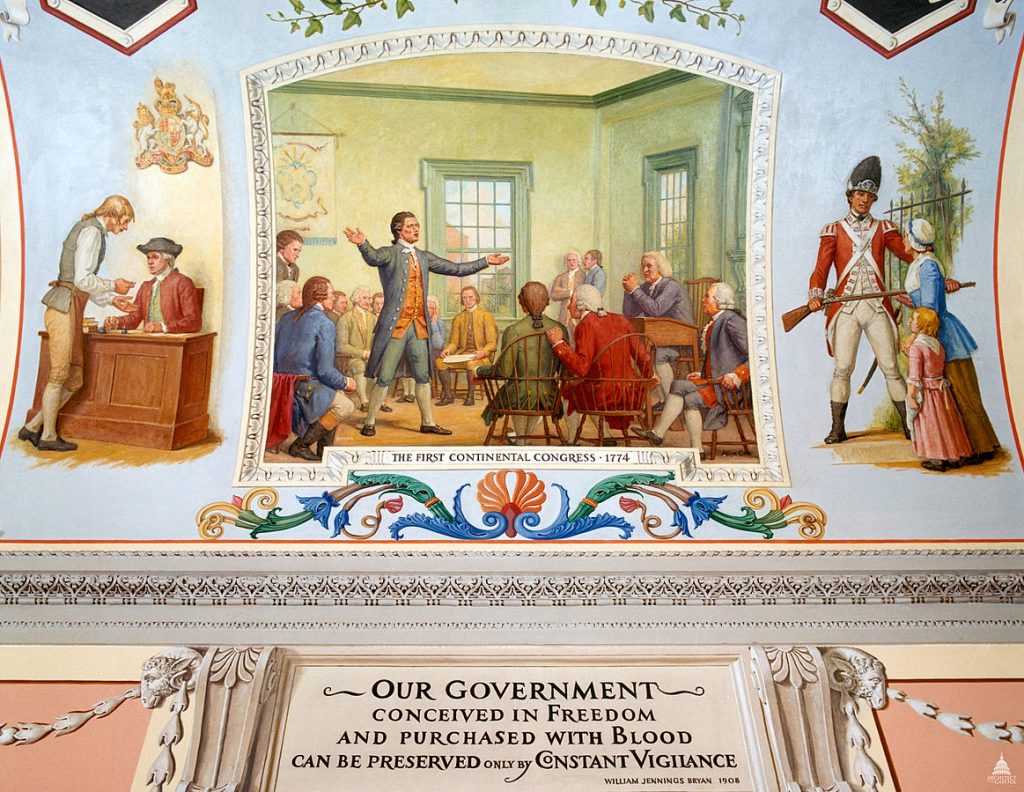
The constitutional design of legislative primacy did not remain confined to parchment. In the early republic, political practice largely reflected the theoretical expectation that Congress would function as the central arena of national governance. While George Washington’s presidency established norms of executive dignity and restraint, the initiative for policy formation and institutional development typically emerged from the legislative branch. Major questions regarding finance, military structure, and national organization were debated, shaped, and authorized within Congress before executive implementation followed.
The First Congress set the tone. Its members drafted and proposed the amendments that became the Bill of Rights, responding directly to ratification debates and state demands for clearer protections of individual liberties. They structured the federal judiciary through the Judiciary Act of 1789, creating district and circuit courts and defining their jurisdiction in careful statutory language. They established executive departments by statute, specifying duties, reporting requirements, and chains of accountability. The Departments of State, Treasury, and War were not creations of presidential design alone; they were legislative constructions, defined and limited by congressional enactment. Even the organization of customs collection, postal routes, and revenue enforcement required detailed legislative approval. This early pattern reinforced the principle that executive machinery derived its existence and operational boundaries from congressional definition rather than inherent presidential prerogative. The architecture of administration flowed from statute outward.
Fiscal policy further demonstrates congressional centrality. Alexander Hamilton’s financial program, including the assumption of state debts and the establishment of the First Bank of the United States, required extensive legislative debate and approval. Although Hamilton, as Secretary of the Treasury, proposed ambitious measures, their realization depended upon congressional deliberation and compromise. The controversies surrounding the Bank revealed not executive dominance but legislative contestation over constitutional interpretation. James Madison and Thomas Jefferson challenged the constitutionality of the Bank within a framework that assumed Congress possessed decisive authority to determine the scope of national economic policy.
Foreign affairs, often cited as an arena of executive initiative, likewise exhibited legislative influence in the early decades. While Washington asserted executive discretion in the Neutrality Proclamation of 1793, Congress retained authority over trade restrictions, embargoes, military appropriations, and declarations of war. The Quasi War with France unfolded within a statutory framework crafted by Congress, which authorized naval hostilities short of formal declaration and defined the limits of engagement. Legislative enactments expanded the navy, regulated privateering, and specified funding parameters. Even in diplomacy, Senate advice and consent to treaties constrained unilateral executive action, as demonstrated in the contentious debates over the Jay Treaty. The Senate’s role was not ceremonial; it served as a constitutional checkpoint, capable of withholding approval or demanding modification. The pattern reveals negotiation rather than dominance, with legislative approval serving as a necessary component of sustained foreign engagement and national commitment.
The development of congressional committees and internal procedures also contributed to institutional strength. Specialized committees allowed Congress to manage complex legislation and oversee administrative implementation. Oversight hearings and investigative authority emerged as tools to monitor executive conduct. This internal organization enhanced Congress’s capacity to exercise its enumerated powers effectively. The legislative branch was not merely reactive; it cultivated procedural mechanisms that enabled sustained governance and supervision.
The practices of the first republic illustrate a functioning model of congressional centrality. The presidency commanded respect and exercised discretion, yet it operated within statutory parameters established by Congress. Executive leadership existed, but legislative authorization framed its reach. The early balance did not produce paralysis; it generated a system in which policy formation, fiscal control, and institutional design were anchored in representative deliberation. The lived experience of the 1790s and early nineteenth century confirms that legislative primacy was not only a theoretical aspiration but an operational reality in the formative years of the United States.
Structural Drift: Delegation and the Administrative State
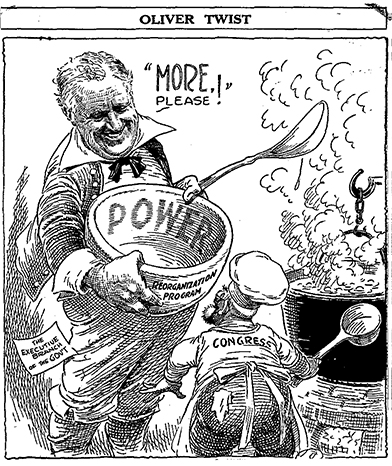
The twentieth century marked a decisive alteration in the operational balance between Congress and the executive, not through formal amendment but through gradual delegation. As the scale and complexity of governance expanded in response to industrialization, economic crisis, and global conflict, Congress increasingly transferred discretionary authority to executive agencies. This development did not abolish legislative primacy in theory. It reconfigured it in practice. Statutes grew broader, objectives more generalized, and implementation increasingly dependent upon administrative interpretation. The result was not an overt seizure of power by the presidency, but an incremental reshaping of how national policy was formulated and executed.
The New Deal era crystallized this transformation. Faced with the Great Depression, Congress enacted sweeping legislation designed to stabilize markets, regulate labor, and restructure financial systems. Many of these statutes delegated substantial regulatory authority to newly created agencies. Early judicial resistance, most notably in A.L.A. Schechter Poultry Corp. v. United States (1935), reflected concern that Congress had transferred legislative power beyond constitutional limits. The Court invalidated portions of the National Industrial Recovery Act on nondelegation grounds, signaling anxiety about blurred constitutional boundaries. Yet this resistance proved temporary. Subsequent decisions adopted a more permissive standard, requiring only an “intelligible principle” to guide administrative discretion, as articulated in J.W. Hampton Jr. & Co. v. United States (1928). The threshold for permissible delegation became modest, enabling expansive administrative governance.
This jurisprudential shift had structural implications. When Congress legislates in broad terms and entrusts agencies with interpretive authority, executive actors assume a quasi legislative function within statutory frameworks. Administrative rulemaking, often carrying the force of law, translates general congressional mandates into detailed regulatory regimes. While formally grounded in statute, these rules frequently emerge from executive branch initiative. Scholars have characterized this development as a transformation of liberal governance, in which policymaking migrated from deliberative legislative processes to bureaucratic negotiation and executive management. The administrative state did not abolish Congress’s authority, but it reduced Congress’s role in day-to-day policy specification.
War and national security further accelerated delegation. During the First and Second World Wars, Congress granted the executive emergency powers to coordinate industry, control prices, and manage resources. Although many emergency authorities were intended as temporary measures, the precedent of expansive executive discretion during crisis persisted. The Cold War reinforced a permanent national security infrastructure in which intelligence, defense planning, and foreign operations operated with limited legislative micromanagement. Congressional oversight mechanisms developed, yet operational control often resided within the executive apparatus.
Delegation also altered political incentives. Broad statutory language allowed legislators to claim credit for addressing public problems while avoiding responsibility for controversial regulatory details. Agencies became sites of technical expertise and political insulation, while Congress increasingly relied on oversight hearings rather than direct policy drafting to influence outcomes. This pattern did not eliminate legislative power. Congress retained authority to amend statutes, restrict funding, or abolish agencies. However, the routine exercise of detailed policymaking shifted toward executive structures, normalizing a different equilibrium.
The cumulative effect of these developments constitutes structural drift rather than constitutional rupture. No amendment erased Article I’s enumerated powers. Yet through repeated delegation and judicial acquiescence, the center of practical initiative migrated toward the executive branch. The administrative state emerged as an enduring feature of governance, operating within statutory bounds but often shaping the substance of law more dynamically than Congress itself. Legislative supremacy remained formally intact, but its operational expression grew increasingly attenuated.
War Powers and Executive Initiative

No domain has more visibly tested the balance between legislative design and executive initiative than war. The Constitution divides authority deliberately: Congress declares war, raises and supports armies, and funds military operations; the President serves as Commander in Chief of forces once authorized. Yet the practical meaning of this division has evolved through precedent and political practice. Beginning in the twentieth century, presidents increasingly initiated military engagements without formal declarations of war, reframing constitutional boundaries through action rather than amendment.
The Korean War marked a decisive turning point. President Harry S. Truman committed American forces under the auspices of a United Nations resolution without seeking a congressional declaration of war, characterizing the conflict as a “police action” rather than a war in the constitutional sense. Although Congress appropriated funds and expressed political support, the absence of formal declaration signaled a shift in constitutional understanding. Military engagement could proceed through executive initiative followed by legislative ratification embedded in appropriations rather than explicit authorization. This distinction mattered. A declaration of war carries symbolic and structural weight, formally activating the war power vested in Congress. By contrast, funding measures can be interpreted as acquiescence rather than deliberate initiation. The precedent established during Korea shaped subsequent conflicts, including Vietnam, where congressional authorization through the Gulf of Tonkin Resolution functioned as broad approval rather than specific war declaration. In both cases, executive action preceded or shaped legislative response, subtly reversing the sequence anticipated in Article I.
Congress attempted to recalibrate this balance through the War Powers Resolution of 1973. Enacted over President Richard Nixon’s veto, the statute required presidential consultation with Congress before introducing armed forces into hostilities and mandated withdrawal within sixty days absent congressional authorization. The resolution reflected legislative concern that executive initiative had outpaced constitutional design. Yet its enforcement mechanisms proved limited. Presidents of both parties have questioned its constitutionality or interpreted its requirements narrowly. While reporting to Congress has become routine, sustained military engagements have often continued without explicit declarations of war.
The post September 11 era deepened the pattern. The Authorization for Use of Military Force (AUMF) of 2001 granted the President authority to use force against those responsible for the attacks and associated forces. Although enacted by Congress, its language proved expansive and durable. Successive administrations relied upon the AUMF to justify operations in multiple theaters across decades. Legislative authorization existed, but its breadth enabled significant executive discretion in identifying targets, geographic scope, and operational duration. The result was a form of delegated war authority that blurred the distinction between declaration and execution.
These developments illustrate how structural primacy can erode through precedent rather than formal revision. Congress retains constitutional authority to declare war, restrict funding, or repeal authorizations. It possesses the power to sunset or narrow existing mandates and to assert its prerogatives through appropriations constraints. Yet political incentives, partisan polarization, and the perceived need for swift executive response have often favored presidential initiative followed by legislative accommodation. War powers exemplify a broader transformation: the movement from deliberative authorization to reactive oversight. The constitutional text remains unchanged, but the operational center of military decision making has shifted toward the presidency, reshaping the balance envisioned in Article I and reinforcing a pattern in which executive momentum precedes legislative judgment.
The Rhetoric of Equality versus the Reality of Yielding

Modern constitutional discourse frequently invokes the phrase “coequal branches,” suggesting a stable equilibrium among Congress, the presidency, and the judiciary. The language carries normative force. It implies symmetry, mutual restraint, and institutional parity. Yet this formulation can obscure the historical architecture of the Constitution, which positioned Congress as structurally primary. Equality in theory does not necessarily reflect equality in operational influence. Rhetorical commitment to coequality has often masked a gradual transfer of initiative toward the executive branch.
Executive orders provide a visible example of this dynamic. While grounded in statutory or constitutional authority, executive orders increasingly function as instruments of policy direction rather than mere administrative clarification. Presidents of both parties have used them to shape regulatory enforcement, immigration priorities, environmental standards, and national security directives. Congress retains authority to override such measures through legislation, but the practical barriers of partisan division and procedural complexity often render that corrective power dormant. The result is a pattern in which executive initiative establishes policy baselines that persist absent legislative reversal.
Budgetary politics reveal a similar asymmetry. Although Congress formally controls appropriations, contemporary fiscal conflicts frequently center on negotiations between congressional leaders and the executive rather than on sustained committee driven deliberation. Continuing resolutions and omnibus spending packages compress legislative oversight into high pressure deadlines, limiting detailed scrutiny. The regular use of temporary funding measures has shifted budgetary governance from incremental committee work to crisis management. When funding lapses threaten government shutdowns, executive agencies often operate under contingency frameworks developed within the administrative branch, reinforcing executive managerial authority during moments of instability. Moreover, the sheer scale and complexity of modern appropriations bills reduce opportunities for granular debate, encouraging reliance on executive agencies to interpret and implement broad spending directives. Congressional control remains constitutionally intact, yet the exercise of that control is episodic rather than continuous, reactive rather than directive.
Judicial deference has also contributed to the appearance of balance alongside substantive shift. Courts traditionally accord latitude to executive interpretations in matters of foreign affairs and national security, recognizing institutional competence and access to classified information. While doctrines such as Chevron deference have fluctuated in recent jurisprudence, the broader pattern of acknowledging executive expertise persists in specific domains. Decisions like Youngstown Sheet & Tube Co. v. Sawyer demonstrate judicial willingness to check presidential overreach, yet even Justice Robert Jackson’s influential concurrence framed executive authority along a spectrum influenced by congressional action or inaction. When Congress legislates broadly or remains silent, executive authority often expands into that space. This dynamic transforms legislative silence into functional authorization, especially when courts interpret ambiguous statutes in ways that accommodate administrative discretion. Congress may reclaim specificity through detailed legislation, yet broad statutory drafting combined with judicial acceptance strengthens executive operational space and reinforces initiative from the presidency.
The contrast between rhetoric and reality becomes stark. Public language affirms coequality, while institutional habits normalize executive leadership. Congress continues to possess formidable constitutional tools: legislative drafting, appropriations control, oversight hearings, and impeachment authority. Yet tools unused gradually lose their constraining force. Structural primacy does not vanish in a single act of surrender. It attenuates through repeated acquiescence, selective delegation, and reluctance to assert institutional prerogatives. The result is not formal subordination but managed marginality, in which the branch designed to lead increasingly responds rather than initiates.
Conclusion: From Designed Dominance to Managed Marginality
The Constitution’s architecture placed Congress at the center of republican governance. Article I was not merely first in sequence; it was foundational in scope and detail. Legislative authority over taxation, war, institutional design, and impeachment established a structure in which executive action depended upon statutory definition. Early political practice confirmed this arrangement. Congress drafted, authorized, funded, and structured the machinery of the state, while the presidency executed within those boundaries. The design assumed legislative energy tempered by internal checks, not executive initiative substituting for deliberative lawmaking.
The mechanisms of governance evolved. Delegation to administrative agencies, expansive interpretations of war powers, and the normalization of executive orders reshaped the operational balance. None of these developments formally amended Article I. Congress retains its enumerated powers. Yet institutional habits and political incentives have altered how those powers are exercised. Broad statutory language has shifted detailed policymaking toward executive agencies. Military engagements have often begun with presidential initiative followed by legislative accommodation. Fiscal oversight has grown episodic, concentrated in crisis negotiations rather than sustained committee leadership. Structural primacy has given way to functional diffusion.
This transformation does not render Congress powerless. The legislature maintains authority to revise statutes, restrict appropriations, sunset authorizations, and conduct robust oversight. The constitutional text remains intact, and judicial precedent continues to recognize legislative supremacy in core domains. The question is not one of capacity but of will. Reassertion would require sustained institutional commitment, detailed legislative drafting, and a willingness to absorb political risk in defense of structural balance. Constitutional architecture can endure periods of imbalance, but it cannot enforce itself.
From designed dominance to managed marginality, the trajectory reflects gradual recalibration rather than dramatic rupture. The presidency has not seized legislative authority outright; it has occupied space made available through delegation and inaction. When the branch constructed to lead becomes hesitant to employ its tools, equilibrium shifts accordingly. The endurance of republican governance depends not only on constitutional text but on institutional resolve. If Congress is to remain first among equals in more than rhetoric, its authority must be exercised with the deliberative vigor envisioned at the founding.
Bibliography
Affiliate disclosure: Amazon links on this site are paid links. As an Amazon Associate I earn from qualifying purchases.
- Authorization for Use of Military Force, Pub. L. No. 107-40, 115 Stat. 224 (2001).
- Bailyn, Bernard. The Ideological Origins of the American Revolution. Cambridge, MA: Belknap Press of Harvard University Press, 1967.
- Ellis, Joseph J. Founding Brothers: The Revolutionary Generation. New York: Vintage Books, 2000.
- Fisher, Louis. Congressional Abdication on War and Spending. College Station: Texas A&M University Press, 2000.
- —-. The Power of the Purse: A History of American Public Finance, 1776–1790. Lawrence: University Press of Kansas, 1968.
- —-. Presidential War Power. 3rd ed. Lawrence: University Press of Kansas, 2013.
- Freeman, Joanne B. Affairs of Honor: National Politics in the New Republic. New Haven, CT: Yale University Press, 2001.
- Hamburger, Philip. Is Administrative Law Unlawful? Chicago: University of Chicago Press, 2014.
- Hamilton, Alexander. The Federalist No. 70. In The Federalist Papers. New York: Signet Classics, 2003.
- Hampton, Jr. & Co. v. United States, 276 U.S. 394 (1928).
- Koh, Harold Hongju. The National Security Constitution: Sharing Power after the Iran-Contra Affair. New Haven, CT: Yale University Press, 1990.
- Lowi, Theodore J. The End of Liberalism: The Second Republic of the United States. New York: W. W. Norton, 1969.
- Madison, James. Notes of Debates in the Federal Convention of 1787. Edited by Adrienne Koch. Athens: Ohio University Press, 1966.
- —-. “Federalist No. 47.” In The Federalist Papers. New York: Signet Classics, 2003.
- —-. “Federalist No. 48.” In The Federalist Papers. New York: Signet Classics, 2003.
- —-. “Federalist No. 51.” In The Federalist Papers. New York: Signet Classics, 2003.
- —-. “Federalist No. 58.” In The Federalist Papers. New York: Signet Classics, 2003.
- McCulloch v. Maryland, 17 U.S. (4 Wheat.) 316 (1819).
- Montesquieu, Charles de Secondat, Baron de. The Spirit of the Laws. Translated and edited by Anne M. Cohler, Basia C. Miller, and Harold S. Stone. Cambridge: Cambridge University Press, 1989.
- Prakash, Saikrishna Bangalore. Imperial from the Beginning: The Constitution of the Original Executive. New Haven, CT: Yale University Press, 2015.
- Rakove, Jack N. Original Meanings: Politics and Ideas in the Making of the Constitution. New York: Alfred A. Knopf, 1996.
- Schechter Poultry Corp. v. United States, 295 U.S. 495 (1935).
- Skowronek, Stephen. Building a New American State: The Expansion of National Administrative Capacities, 1877–1920. Cambridge: Cambridge University Press, 1982.
- United States. The Records of the Federal Convention of 1787. Edited by Max Farrand. 4 vols. New Haven, CT: Yale University Press, 1911.
- United States Congress. Annals of Congress. Washington, DC: Gales and Seaton, 1834–1856.
- United States Congressional Research Service. Executive Orders: Issuance, Modification, and Revocation. Washington, DC: Congressional Research Service, various editions.
- United States National Archives. Judiciary Act of 1789, 1 Stat. 73.
- United States Senate. The Constitution of the United States of America.
- War Powers Resolution, Pub. L. No. 93-148, 87 Stat. 555 (1973).
- Wood, Gordon S. The Creation of the American Republic, 1776–1787. Chapel Hill: University of North Carolina Press, 1969.
- Yoo, John. The Powers of War and Peace: The Constitution and Foreign Affairs after 9/11. Chicago: University of Chicago Press, 2005.
- Youngstown Sheet & Tube Co. v. Sawyer, 343 U.S. 579 (1952).
Originally published by Brewminate, 03.05.2026, under the terms of a Creative Commons Attribution-NonCommercial-NoDerivatives 4.0 International license.
About the Author