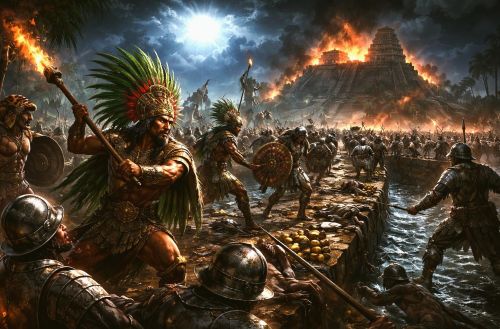
In 1520, Aztec resistance shattered Spanish control of Tenochtitlan, forcing Cortés’s army into a deadly nighttime retreat remembered as La Noche Triste.

By Matthew A. McIntosh
Public Historian
Brewminate
Introduction: Conquest, Confidence, and Sudden Reversal
When Spanish forces under Captain-General Hernán Cortés entered the Aztec capital of Tenochtitlan in November 1519, the moment appeared to confirm a narrative that would later dominate early European accounts of the conquest: a small band of technologically superior invaders advancing inexorably against a bewildered empire. The city itself astonished the Spaniards. Rising from the waters of Lake Texcoco, Tenochtitlan was among the largest urban centers in the world, with canals, markets, temples, and monumental architecture that rivaled the great cities of Europe. Yet despite its grandeur, the arrival of the Spaniards introduced a volatile political crisis. Cortés relied not on overwhelming force but on diplomatic maneuvering, intimidation, and alliances with Indigenous enemies of the Mexica state. The occupation that followed was fragile from the beginning, sustained less by control than by uncertainty and political tension within the city.
The Spanish presence in Tenochtitlan quickly revealed the limits of the conquistadors’ authority. Cortés and his companions detained Emperor Moctezuma II and attempted to govern the city indirectly through him, a strategy that temporarily preserved order but undermined Mexica sovereignty. Spanish narratives later emphasized the supposed hesitation of the Aztecs or the inevitability of conquest, yet the situation inside the capital was far more precarious. The Spaniards were vastly outnumbered, dependent on external allies, and surrounded by a population whose patience with foreign occupiers steadily eroded. Beneath the outward appearance of accommodation lay growing resentment among the Mexica nobility and the broader population, who watched as sacred spaces were violated and political authority was compromised.
The fragile balance collapsed in 1520 after a series of escalating confrontations. While Cortés temporarily left the city to confront a rival Spanish expedition sent to arrest him, the conquistador Pedro de Alvarado ordered an attack on Aztec nobles gathered for the religious festival of Tóxcatl. The massacre provoked widespread outrage and ignited a full-scale uprising within the city. By the time Cortés returned to Tenochtitlan, the Spaniards found themselves trapped inside a hostile urban environment where Mexica forces had seized the initiative. Under the leadership of Cuitláhuac, resistance coalesced rapidly, transforming simmering discontent into organized military opposition.
The climactic moment of this uprising came on the night of June 30, 1520, an event remembered in Spanish chronicles as La Noche Triste, the Night of Sorrows. Attempting to escape the besieged city under cover of darkness, Spanish soldiers and their Indigenous allies fled along the narrow causeways that connected Tenochtitlan to the mainland. Mexica forces attacked the retreat with devastating effectiveness, exploiting the geography of the lake and the vulnerability of the fleeing army. Many Spaniards were killed in combat or drowned beneath the weight of armor and plunder. The episode exposed the profound fragility of the Spanish position and demonstrated that the conquest of Mexico was far from inevitable. Instead, it was a contested process in which moments of dramatic reversal revealed the power of organized local resistance.
Spanish Entry into Tenochtitlan: Diplomacy, Strategy, and Fragile Control
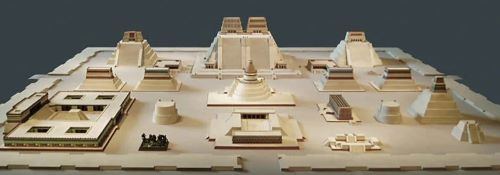
When Hernán Cortés and his expeditionary force marched toward the Aztec capital in 1519, their advance was shaped as much by diplomacy as by warfare. The Spanish contingent was small, numbering only a few hundred soldiers, and could not have hoped to conquer a powerful Mesoamerican empire through military force alone. Instead, Cortés relied heavily on alliances with Indigenous polities that had long resented Mexica domination. Chief among these allies were the Tlaxcalans, whose rivalry with the Aztec Empire provided Cortés with crucial manpower and logistical support. These alliances transformed the Spanish expedition from a marginal foreign intrusion into a complex coalition within the political landscape of central Mexico.
The approach to Tenochtitlan unfolded through a series of calculated negotiations and symbolic gestures. Cortés presented himself not merely as an invader but as a diplomatic envoy of a distant monarch, King Charles V of Spain, a posture that framed the expedition as an extension of royal authority rather than a rogue military adventure. Indigenous intermediaries, including the Nahua woman Malintzin (often called La Malinche), played a vital role in facilitating communication between the Spanish and various Mesoamerican leaders. Through translation and political mediation, Malintzin helped Cortés navigate the intricate protocols of diplomacy in the region. She translated first between Nahuatl and Maya, while the Spaniard Jerónimo de Aguilar translated between Maya and Spanish, forming a chain of communication that allowed Cortés to engage in negotiations across linguistic boundaries. These interactions allowed the Spanish to exploit existing rivalries among Indigenous groups, reinforcing the perception that Cortés was intervening within a broader regional conflict rather than launching an outright conquest. As the expedition moved through central Mexico, this diplomatic strategy helped secure alliances, gather intelligence, and project an image of legitimacy that masked the Spaniards’ limited numbers and precarious military position.
When the Spaniards finally entered Tenochtitlan in November 1519, they were received with a mixture of ceremony, curiosity, and political calculation. The city itself was one of the largest and most sophisticated urban centers in the Americas, connected to the mainland by long causeways and surrounded by the waters of Lake Texcoco. Moctezuma II welcomed Cortés and his companions with gifts and formal hospitality, perhaps seeking to avoid immediate conflict while assessing the intentions of the newcomers. Spanish chroniclers later interpreted this reception as evidence of Aztec awe or submission, but modern scholarship suggests a more cautious strategy on the part of the Mexica leadership, who were attempting to manage an unfamiliar and potentially dangerous diplomatic situation.
Despite the outward civility of the encounter, Cortés moved quickly to secure a strategic advantage. Within weeks of entering the city, the Spaniards seized Moctezuma II and held him under guard in his own palace. This act transformed a diplomatic visit into an occupation. Cortés hoped that controlling the emperor would allow the Spaniards to govern indirectly through existing structures of authority. For a time, this strategy appeared to stabilize the situation, as Moctezuma continued to issue commands to his subjects while under Spanish supervision. Yet the arrangement placed the emperor in an impossible position. His authority depended on maintaining the dignity and autonomy of his office, but his captivity made clear that real power now rested with the foreign soldiers occupying the palace. Mexica elites and commoners alike were forced to confront the humiliating spectacle of their ruler acting under Spanish coercion. As tensions mounted, resentment toward the Spaniards deepened, and the political legitimacy of Moctezuma’s rule steadily eroded. The Spanish strategy of ruling through a captive emperor created a temporary illusion of stability while simultaneously undermining the very authority it depended upon.
The Spanish position in Tenochtitlan rested on a precarious foundation. The conquistadors were vastly outnumbered and dependent on a fragile network of alliances beyond the city. Their authority relied on the continued cooperation of a population that increasingly viewed them as intrusive occupiers rather than diplomatic guests. Tensions simmered beneath the surface of daily life, as religious conflicts, political humiliation, and cultural misunderstandings accumulated. What appeared at first to be a remarkable success of Spanish diplomacy was in reality a moment of delicate equilibrium that could collapse at any sign of provocation.
Rising Tensions and the Spark of Rebellion
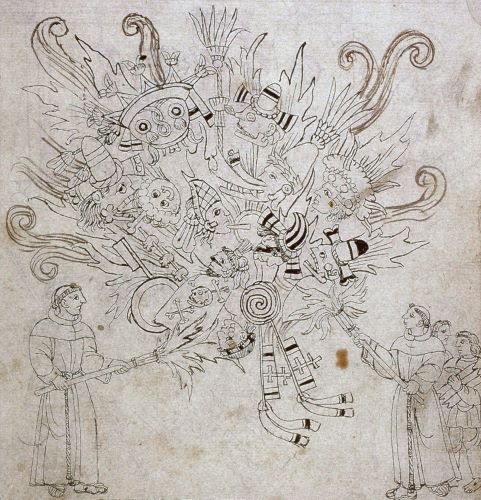
The fragile equilibrium established after the Spanish occupation of Tenochtitlan did not last long. The presence of foreign soldiers within the sacred and political heart of the Mexica world produced mounting strain among the city’s inhabitants. Spanish demands for gold and provisions imposed a visible burden on local communities, while the presence of armed foreigners in royal compounds and temple precincts challenged long-established norms of political authority. The Spaniards also attempted to impose elements of their own religious practice within the city, including the placement of Christian images in spaces associated with Mexica worship. Such actions were deeply unsettling within a society where religious ritual, political legitimacy, and cosmic order were closely intertwined. Although Cortés attempted to maintain order through the captive emperor Moctezuma II, the arrangement gradually eroded the legitimacy of Mexica leadership and exposed the tenuous nature of Spanish control. What had initially appeared to be a diplomatic accommodation increasingly looked like a humiliating subordination of the empire’s highest authority to a small group of foreign occupiers.
The situation became even more unstable when Cortés was forced to leave the city in the spring of 1520. News had arrived that a rival Spanish expedition under Pánfilo de Narváez had landed on the Gulf Coast with orders to arrest him. Cortés marched eastward to confront the threat, leaving Alvarado in charge of the Spanish garrison in Tenochtitlan. This absence created a leadership vacuum at a moment when tensions inside the city were already dangerously high. Without Cortés’s political instincts and diplomatic caution, the Spanish occupation became more rigid and suspicious, further alienating the Mexica population.
The decisive spark came during the festival of Tóxcatl, an important religious ceremony dedicated to the god Tezcatlipoca. Mexica nobles and priests gathered in the ceremonial precinct to perform ritual dances and offerings that formed part of the city’s sacred calendar. These ceremonies were not merely festive occasions but central components of Mexica religious life, reinforcing social hierarchy and renewing the community’s relationship with the divine order. According to Indigenous and Spanish accounts alike, Alvarado and his soldiers suddenly attacked the assembled participants. The Spaniards sealed the entrances to the courtyard and launched a violent assault on the unarmed celebrants. Many of the city’s leading nobles were killed in the massacre, an act that shocked the population and shattered any remaining trust between the occupiers and the Mexica elite. The slaughter of prominent figures during a sacred ritual sent a powerful signal that the Spaniards neither respected nor understood the religious and political structures that sustained Mexica society.
The massacre transformed simmering resentment into open rebellion. The killing of aristocrats during a sacred festival represented not merely a political affront but a profound violation of religious space and ritual authority. Mexica warriors rapidly mobilized throughout the city, erecting barricades and launching attacks on the Spanish quarters. Streets and canals that had once facilitated the orderly movement of commerce and ceremony now became contested terrain in a growing urban conflict. Spanish forces found themselves increasingly isolated, confined within defensive positions as the uprising spread across Tenochtitlan.
Amid the chaos, the position of Moctezuma II became increasingly precarious. The emperor had attempted to mediate between the Spaniards and his own people, but the massacre undermined any remaining credibility he possessed among the Mexica. Spanish accounts describe an attempt to have Moctezuma address the crowd from a rooftop in hopes of calming the rebellion. Instead, the gathering rejected his authority, and he was reportedly struck by stones thrown by his own subjects. Whether the fatal injury came from this confrontation or from Spanish actions remains debated, but the episode symbolized the collapse of the political arrangement that had sustained the Spanish occupation.
Leadership of the resistance soon passed to Cuitláhuac, Moctezuma’s brother, who emerged as the central figure in the Mexica response to the Spanish presence. Under his direction, the uprising evolved from spontaneous rebellion into coordinated military resistance. The Mexica closed causeways, disrupted Spanish supply routes, and intensified attacks against the occupiers. What had begun as a diplomatic experiment in foreign occupation now confronted the Spaniards with a city in open revolt. The stage was set for the dramatic events that would follow, culminating in the desperate Spanish attempt to escape Tenochtitlan.
The Aztec Counterattack under Cuitláhuac
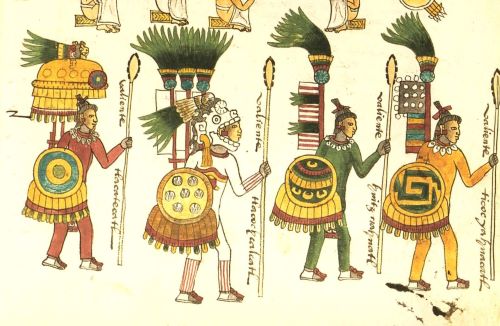
In the aftermath of the uprising that followed the Tóxcatl massacre and the collapse of Spanish authority in Tenochtitlan, leadership within the Mexica state passed to Cuitláhuac, the brother of Moctezuma II. His rise marked a decisive shift from cautious diplomacy to open resistance. Unlike the previous emperor, whose strategy had sought to contain the Spaniards within a complex web of political negotiation, Cuitláhuac recognized that the continued presence of the invaders threatened the very foundations of Mexica sovereignty. His leadership signaled a determination to mobilize the military and political resources of the empire in order to expel the Spanish from the capital.
Cuitláhuac’s authority rested on well-established traditions of Mexica governance and warfare. The Aztec state possessed an organized military structure supported by warrior orders, tributary networks, and experienced commanders accustomed to campaigns across central Mexico. Once resistance began, these structures allowed the Mexica to coordinate a large-scale response within the urban landscape of Tenochtitlan. Warrior societies such as the Jaguar and Eagle orders embodied elite martial traditions and were accustomed to disciplined combat within structured campaigns. These forces were supported by levies drawn from the city’s districts and from allied communities that recognized the existential threat posed by the Spanish occupation. The mobilization of these groups created a formidable defensive force that combined numerical strength with deep familiarity with the city’s terrain. Warriors familiar with the city’s intricate system of canals, bridges, and narrow streets used that knowledge to their advantage. The Spanish, by contrast, were unfamiliar with the terrain and dependent on a limited number of defensive positions that grew increasingly difficult to maintain as the uprising intensified.
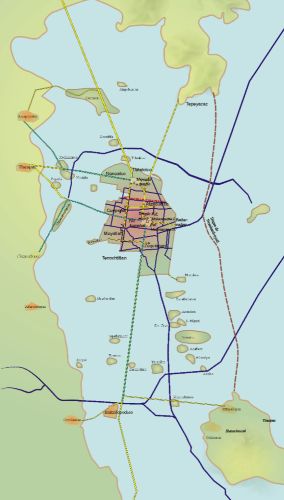
The geography of the city itself became a powerful weapon in the hands of the defenders. Tenochtitlan stood on an island in Lake Texcoco, connected to the mainland by several long causeways that could easily be disrupted. Mexica forces removed bridges and blocked access routes, isolating Spanish positions and restricting their ability to maneuver. These causeways were designed with removable bridge sections that allowed the city to control access during times of conflict, a defensive feature that now proved devastatingly effective against the trapped invaders. Canoes filled the canals and surrounding waters, allowing warriors to strike quickly at vulnerable points while avoiding the heavy cavalry charges that had previously given the Spaniards a tactical advantage in open terrain. These small, agile craft could surround Spanish patrols and harass them with volleys of projectiles before disappearing into the maze of waterways that defined the city. From rooftops and narrow streets, defenders launched coordinated attacks that exploited the limitations of Spanish armor and formations in close urban combat. These tactics gradually turned the city into a hostile place in which the Spanish and their allies were forced into defensive survival rather than offensive conquest.
As the fighting intensified, the Spaniards faced a growing crisis of supply and morale. Food and fresh water became increasingly scarce, while constant attacks prevented them from moving safely through the city. The once-celebrated horses and firearms of the conquistadors proved far less effective within the narrow streets and canals of Tenochtitlan. Meanwhile, Mexica forces maintained relentless pressure, attacking from rooftops, canals, and barricaded streets. The balance of power had shifted dramatically, and the Spanish expedition that had entered the city in triumph now struggled simply to remain alive.
Cuitláhuac’s leadership transformed the uprising into a coordinated campaign that forced the Spaniards into a desperate strategic decision. Recognizing that their position inside the city had become untenable, Cortés and his officers began planning an escape from Tenochtitlan. Yet leaving the city was no simple matter. The same geography that had enabled the Mexica to isolate the invaders now threatened to trap them entirely. The Spaniards needed to cross the causeways that connected the island capital to the mainland, but those routes were now guarded, damaged, and closely monitored by Mexica forces. Any attempt at retreat risked turning into a disastrous engagement if the defenders detected their movement. Cortés ordered preparations for a covert withdrawal under cover of darkness, hoping that speed and surprise might allow the army to escape before the Mexica could mount a full-scale attack. The decision to abandon the city revealed how thoroughly the balance of power had shifted since the Spaniards’ triumphant entry months earlier. What had begun as a campaign of bold conquest had become a desperate attempt at survival, setting the stage for the catastrophic retreat remembered as La Noche Triste.
La Noche Triste: Catastrophic Retreat from Tenochtitlan
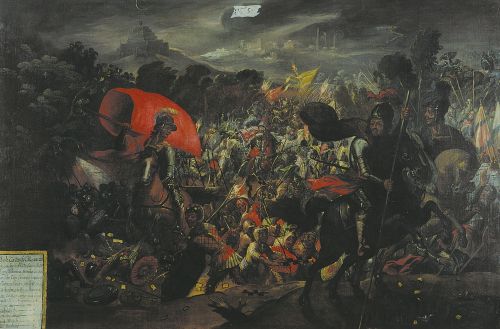
By late June 1520, the Spanish position inside Tenochtitlan had become untenable. Surrounded by hostile forces, suffering from dwindling supplies, and increasingly unable to maneuver through the city, Cortés and his commanders concluded that remaining in the capital would lead to annihilation. The Mexica had successfully cut many of the Spaniards’ lines of communication and controlled key causeways that connected the island city to the mainland. Cortés resolved to attempt a nighttime withdrawal, hoping that secrecy and speed might allow the army to escape before the defenders could organize a coordinated attack.
The retreat was planned for the night of June 30, 1520. Spanish forces, accompanied by thousands of Indigenous allies, quietly left their quarters and began moving along the western causeway toward Tlacopan. The plan relied on a portable bridge constructed by the Spaniards to span gaps where the Mexica had removed sections of the causeway. This device would allow the army to cross the defensive breaks and continue toward the mainland. The column moved slowly through darkness and rain, burdened not only by weapons and armor but also by the gold and treasure many soldiers had taken from the city.
The escape initially appeared to succeed, but the silence of the night did not last. According to several accounts, Mexica sentries detected the movement and quickly sounded the alarm. War cries echoed across the city as warriors rushed to intercept the fleeing column. Canoes filled the waters surrounding the causeway, while fighters attacked from both sides and from behind. Projectiles rained down on the retreating army as Spanish soldiers struggled to maintain formation along the narrow roadway. Mexica warriors armed with spears, darts, and slings harassed the column from the surrounding waters, while others advanced across the causeway itself in coordinated waves. The darkness and rain added to the confusion, making it difficult for Spanish officers to maintain order among the retreating troops. Indigenous allies traveling with the Spaniards also became entangled in the chaos, further complicating attempts to organize a coherent defense. The carefully organized withdrawal rapidly devolved into chaos as the retreating army found itself under sustained attack from every direction.
The gaps in the causeway proved particularly deadly. As the portable bridge was repeatedly moved forward to cross each opening, the column became congested and vulnerable to attack. Horses slipped on the wet stones, soldiers lost their footing, and heavily armored Spaniards fell into the waters of Lake Texcoco. Many drowned beneath the weight of their equipment or the treasure they attempted to carry with them. Mexica warriors in canoes struck at isolated groups along the edges of the causeway, pulling men from the roadway or attacking them with spears and obsidian blades. What had begun as an orderly retreat quickly turned into a desperate struggle for survival.
Despite the devastating assault, some Spanish troops together with their indigenous partners managed to fight their way across the causeway and reach the mainland. Cortés himself survived the retreat, though the losses were severe. Hundreds of Spaniards were killed during the night, along with a far greater number of Indigenous allies who had joined the expedition. The treasure that many soldiers had hoped to carry away was largely lost in the waters of the lake, scattered across the bottom of the canals and causeways where the fighting had been most intense. The defeat also carried a profound psychological impact. Soldiers who had marched confidently into the city months earlier now confronted the reality that their expedition had nearly been destroyed. Horses, artillery pieces, and supplies were lost, and many survivors emerged wounded or exhausted from the ordeal. For the Mexica defenders, the night represented a powerful demonstration that the invaders were not invincible.
The survivors eventually regrouped outside the city, but the scale of the defeat left a deep impression on Spanish chroniclers. Bernal Díaz del Castillo later described the sorrow and exhaustion that followed the escape, recalling how Cortés reportedly wept beneath a tree while contemplating the destruction of his army. Whether embellished or not, the story captured the emotional impact of the catastrophe. La Noche Triste exposed the vulnerability of the conquistadors and revealed how quickly the momentum of conquest could reverse when local resistance exploited geography, numbers, and strategic coordination.
Interpreting the Defeat: Overconfidence and Strategic Miscalculation
The catastrophe of La Noche Triste reveals how fragile the Spanish position in central Mexico had been despite the early successes of Cortés’s expedition. In retrospect, the Spaniards’ occupation of Tenochtitlan rested on assumptions that proved dangerously optimistic. Spanish chroniclers often emphasized the supposed superiority of European weapons, horses, and tactics, but these advantages were situational rather than absolute. Firearms were slow to reload, cavalry required open terrain to be effective, and steel armor could become a liability when soldiers were forced into water or dense urban fighting. In the constrained geography of an island city defended by tens of thousands of warriors, cavalry charges and firearms offered limited strategic leverage. The defeat demonstrated that technological differences alone could not secure control when logistical conditions and local resistance combined against an invading force. Instead, the Spanish experience in Tenochtitlan revealed the degree to which conquest depended on careful political maneuvering, stable alliances, and the ability to adapt to unfamiliar environments. When these conditions collapsed, the advantages that had previously seemed decisive quickly lost their effectiveness.
Spanish strategy in the months leading up to the uprising also reflected a pattern of miscalculation. Cortés’s decision to detain Moctezuma II had initially provided a form of political leverage, but it simultaneously undermined the legitimacy of Mexica leadership and intensified resentment among the population. The Spaniards relied heavily on intimidation and symbolic displays of authority while underestimating the depth of religious and political outrage that their actions provoked. The massacre during the Tóxcatl festival proved especially disastrous in this regard, transforming simmering hostility into coordinated resistance. By alienating the very elite groups whose cooperation might have stabilized their occupation, the Spaniards inadvertently accelerated the collapse of their own position.
Another crucial element of Spanish miscalculation involved the geography of Tenochtitlan itself. Cortés had chosen to establish his forces within the city largely because it appeared to offer a dramatic demonstration of Spanish power. Yet occupying an island capital surrounded by water meant that the expedition could easily become trapped if relations with the inhabitants deteriorated. Once the Mexica removed bridges and controlled the causeways, the Spaniards found themselves confined within an aggressive urban environment where their ability to maneuver or withdraw was severely restricted. The very features that had once impressed the Spanish as signs of the city’s magnificence became strategic liabilities during the uprising.
Modern historians interpret La Noche Triste not simply as a dramatic episode of battlefield defeat but as a revealing moment in the larger dynamics of imperial conquest. The disaster illustrates how narratives of inevitable European domination obscure the contingency and uncertainty that shaped early encounters between Spaniards and Indigenous societies. Earlier colonial chronicles often framed the retreat as a temporary setback within a divinely sanctioned conquest, emphasizing Spanish endurance rather than the strength of Mexica resistance. Contemporary scholarship has instead emphasized the complex interplay of Indigenous agency, alliance politics, and environmental constraints that shaped the course of the conflict. Spanish success in Mexico ultimately depended on alliances with rival Indigenous groups, the devastating effects of epidemic disease, and a prolonged campaign that unfolded over many months rather than a single decisive encounter. The events of June 1520 remind us that the conquest was neither swift nor predetermined, and that determined local resistance could at times inflict devastating setbacks on even the most confident invaders.
Aftermath and the Continuation of the Conquest
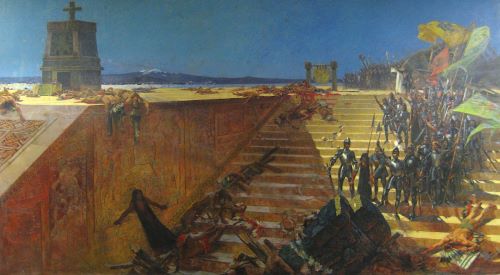
The Spanish survivors of La Noche Triste did not immediately regain their footing after escaping Tenochtitlan. Exhausted, wounded, and burdened by the loss of many comrades, the retreating army struggled to reach safety beyond the lake basin. Mexica forces continued to harass the Spaniards as they moved away from the capital, culminating in another fierce confrontation at the Battle of Otumba in July 1520. During this engagement, Cortés’s forces narrowly avoided destruction by attacking and killing the Aztec commander, an action that disrupted the organization of the pursuing army. The victory allowed the battered Spanish contingent and its Indigenous allies to continue their retreat toward the territory of Tlaxcala, where they hoped to recover and regroup.
The return to Tlaxcala proved decisive for the survival of the Spanish expedition. Despite the devastating losses suffered during the retreat, the alliance between Cortés and the Tlaxcalans endured. The Tlaxcalan leadership recognized that the conflict with the Mexica had reached a point where retreating from their partnership with the Spaniards might invite retaliation from Tenochtitlan. As a result, they chose to continue supporting the Spanish campaign. In Tlaxcala, Cortés reorganized his remaining forces, repaired equipment, and began planning a renewed campaign against the Aztec capital.
The political situation within the Mexica state was undergoing its own transformation. Cuitláhuac, whose leadership had driven the successful resistance that forced the Spaniards from Tenochtitlan, ruled only briefly before dying later in 1520, likely from smallpox introduced by the Europeans. The epidemic spread rapidly through the densely populated cities of central Mexico, devastating communities that had no prior exposure to the disease. The demographic shock weakened the capacity of the Mexica state to mobilize and sustain prolonged military resistance, creating conditions that would later benefit the Spanish campaign.
Cortés used the months following the retreat to construct a new strategy designed specifically to overcome the defensive advantages of Tenochtitlan. Recognizing that control of the lake had been crucial during the earlier defeat, the Spaniards built a fleet of brigantines that could operate on the waters of Lake Texcoco. These vessels were transported in pieces to the lake basin and assembled with the help of Indigenous labor. Cortés strengthened alliances with numerous Indigenous groups who opposed Mexica rule, gradually assembling a coalition that vastly outnumbered his remaining Spanish troops.
The final campaign against Tenochtitlan began in 1521 and unfolded as a prolonged siege rather than a rapid assault. Spanish forces and their Indigenous allies systematically cut the city’s supply lines and attacked along the causeways while the brigantines controlled the surrounding waters. After months of intense fighting and mounting famine within the city, the Mexica capital finally fell in August 1521. The victory marked the end of the Aztec Empire as a political power. Yet the earlier disaster of La Noche Triste remained a stark reminder that the conquest had been neither straightforward nor inevitable, but rather the result of shifting alliances, environmental conditions, and the contingencies of war.
Conclusion: The Limits of Imperial Certainty
The events surrounding La Noche Triste reveal how fragile the momentum of imperial conquest could be when confronted with determined local resistance. Spanish narratives often presented the conquest of Mexico as an almost inevitable triumph of European arms and faith, yet the catastrophe of June 1520 demonstrates that the outcome was far from predetermined. The Spanish occupation of Tenochtitlan had relied on precarious diplomacy, unstable political arrangements, and the assumption that intimidation could substitute for lasting authority. When those foundations collapsed, the conquistadors found themselves trapped in a hostile city where their technological advantages offered little protection against a coordinated urban uprising. The night of the retreat exposed how quickly confidence built on early success could dissolve under pressure from a mobilized population defending its political and religious center. Rather than confirming Spanish dominance, the disaster revealed the extent to which the expedition had depended on fragile alliances, limited manpower, and the uncertain cooperation of the very society it sought to control.
The episode also highlights the agency and strategic capacity of the Mexica and their allies. Under the leadership of Cuitláhuac, defenders of the city exploited the geography of Tenochtitlan and the organizational strength of Mexica warfare to transform rebellion into an effective counterattack. Canoe fleets, disrupted causeways, and coordinated assaults from within the urban environment exposed the vulnerability of the Spanish expedition. The retreat along the causeways demonstrated that conquest was not a simple clash between superior and inferior military systems, but rather a dynamic struggle shaped by terrain, logistics, leadership, and the political decisions of Indigenous actors.
La Noche Triste stands as a powerful reminder that imperial expansion often unfolds through moments of contingency and reversal rather than steady progress. The Spanish would eventually return to defeat Tenochtitlan the following year, but their earlier defeat exposed the limits of their power and the risks inherent in overconfidence. The episode illustrates a broader historical lesson about the uncertainty of conquest: even armies convinced of their own superiority could find themselves overwhelmed when local resistance, geography, and strategic miscalculation converged against them.
Bibliography
Affiliate disclosure: Amazon links on this site are paid links. As an Amazon Associate I earn from qualifying purchases.
- Alvarado Tezozómoc, Hernando. Crónica Mexicana. Edited by Jose M. Vigil. Mexico City: Editorial Porrúa, 1878.
- Berdan, Frances F. “Trauma and Transition in Sixteenth Century Central Mexico.” Proceedings of the British Academy 81 (1993), 163-195.
- Cortés, Hernán. Letters from Mexico. Translated by Anthony Pagden. New Haven: Yale University Press, 1986.
- Daniel, Douglas A. “Tactical Factors in the Spanish Conquest of the Aztecs.” Anthropological Quarterly 65:4 (1992), 187-194.
- Díaz del Castillo, Bernal. The Conquest of New Spain. Translated by Alfred Percival Maudslay. London: Penguin Books, 1810.
- Hassig, Ross. Aztec Warfare: Imperial Expansion and Political Control. Norman: University of Oklahoma Press, 1988.
- —-. Mexico and the Spanish Conquest. Norman: University of Oklahoma Press, 1994.
- León-Portilla, Miguel, ed. The Broken Spears: The Aztec Account of the Conquest of Mexico. Boston: Beacon Press, 1959.
- Restall, Matthew. Seven Myths of the Spanish Conquest. New York: Oxford University Press, 2003.
- —-. When Montezuma Met Cortés: The True Story of the Meeting That Changed History. New York: Ecco, 2018.
- Sahagún, Bernardino de. Florentine Codex: General History of the Things of New Spain. Translated by Arthur J. O. Anderson and Charles E. Dibble. Santa Fe: School of American Research, 1950.
- Thomas, Hugh. Conquest: Montezuma, Cortés, and the Fall of Old Mexico. New York: Simon & Schuster, 1993.
- Townsend, Camilla. Fifth Sun: A New History of the Aztecs. New York: Oxford University Press, 2019.
- Zúñiga, Didier. “Progress, Technology, Nature: Life and Death in the Valley of Mexico.” Theory & Event 28:1 (2025), 120-144.
Originally published by Brewminate, 03.09.2026, under the terms of a Creative Commons Attribution-NonCommercial-NoDerivatives 4.0 International license.
About the Author