The Qin dynasty unified China through Legalist discipline, centralized administration, and massive labor mobilization, creating a powerful empire sustained by strict hierarchy and state control.

By Matthew A. McIntosh
Public Historian
Brewminate
Introduction: Empire through Law and Discipline
The unification of China in 221 BCE under Qin Shi Huang marked one of the most decisive political transformations in ancient Eurasian history. For centuries before this moment, the Chinese world had been divided among competing states during the period known as the Warring States era. Regional rulers struggled for military dominance while experimenting with new administrative systems capable of mobilizing resources and maintaining internal order. Out of this prolonged conflict emerged the Qin state, whose leaders gradually adopted a form of governance rooted in strict law, centralized authority, and disciplined administration. When Qin armies finally subdued their rivals, the resulting empire did not simply expand territorial control. It inaugurated a new model of governance that placed the state at the center of social organization. The Qin rulers inherited the administrative experiments and military pressures of the Warring States environment, but they applied these developments with unprecedented intensity, transforming strategies of survival among rival kingdoms into a comprehensive structure of imperial rule. In doing so, the dynasty reshaped the relationship between political authority and society, demonstrating how centralized institutions could impose order across territories that had long resisted unified governance.
At the ideological core of Qin rule lay Legalism, a political philosophy that emphasized the supremacy of law and the necessity of strong rulers capable of enforcing it without hesitation. Legalist thinkers rejected the moral persuasion favored by Confucian scholars and instead argued that human behavior could be reliably shaped through clearly defined rewards and punishments. The state, in this view, functioned most effectively when laws were uniform, authority was concentrated, and officials were held accountable through strict systems of oversight. Qin leaders adopted these principles with unusual rigor. By treating law as the fundamental instrument of governance rather than as a reflection of moral ideals, the dynasty created a political structure designed to command obedience and eliminate competing sources of power.
The establishment of Qin imperial authority also depended on the systematic restructuring of society. Local aristocracies that had dominated earlier political systems were weakened or eliminated, replaced by bureaucratic officials appointed directly by the central government. Administrative districts were reorganized into commanderies and counties governed by officials whose authority derived from the emperor rather than from hereditary privilege. Through this administrative structure the Qin state gained an unprecedented capacity to regulate taxation, military service, and labor obligations across vast territories. The result was a political order in which ordinary subjects were connected to imperial authority through legal regulation, administrative oversight, and compulsory service.
The Qin dynasty constructed one of the most administratively coordinated political systems of the ancient world. Legalist ideology justified centralized authority, administrative reforms strengthened the reach of the imperial state, and large-scale state construction programs demonstrated the regime’s capacity to command resources on a continental scale. The construction of roads, defensive fortifications, and the emperor’s monumental mausoleum complex revealed both the organizational capabilities of the Qin government and the extraordinary demands placed upon its population. Such projects were not merely engineering achievements but political statements, signaling the dominance of imperial authority across the landscape of the empire. The system required continuous enforcement through strict law, heavy taxation, and extensive labor obligations imposed on the lower classes. Together these elements produced a highly structured social order in which hierarchy, obedience, and state power defined the relationship between ruler and subject. The achievements of the Qin state reshaped the political landscape of East Asia, yet the same mechanisms that enabled rapid imperial consolidation also exposed the profound tensions inherent in governing through law, discipline, and coercion.
Qin Social Hierarchy at a Glance
Legalism in the Qin context was a theory of state power, not the modern ideal of a government constrained by law. It treated written standards, administrative techniques, and the authority of the ruler’s position as instruments for directing officials and subjects. Qin administrators applied those ideas through household registration, mutual-responsibility groups, appointed officials, and predictable rewards and punishments.
| Level | Groups | Place in the Qin order | Labor and obligations |
|---|---|---|---|
| Supreme authority | Emperor and imperial household | The emperor issued commands, appointed officials, and stood at the center of political authority. | The court drew upon the taxes, military service, and labor mobilized by the state. |
| Governing officials | Central ministers and appointed commandery and county officials | They administered law, taxation, population registers, and conscription; their authority came from imperial appointment rather than local inheritance. | Government service under strict reporting and performance controls. |
| Merit and military ranks | Soldiers and holders of service-based titles | A graded rank system rewarded military and state service, weakening the older monopoly of hereditary elites. | Military or administrative service; rank could bring legal and material privileges. |
| Registered commoners | Primarily farming households | They formed the empire’s productive base and supplied its grain, revenue, soldiers, and workers. | Taxes, military conscription, and periodic corvée labor. |
| Artisans and merchants | Craft workers, workshop laborers, traders, and merchants | They produced and distributed goods, but remained closely regulated; some artisans worked in state workshops. | Taxes and occupational controls, with assigned production for state workers. |
| Penal and unfree groups | Convicts, penal laborers, and state or private slaves | These were vulnerable categories at the bottom of the order, although their precise legal statuses were not identical. | Compelled construction, agricultural or domestic work, including labor imposed as criminal punishment. |
Qin labor was not a single system. Registered commoners could be called up for corvée labor, a legally required period of compulsory public service, as well as for military duty. Corvée crews worked on roads, canals, fortifications, palaces, and the imperial mausoleum. Penal labor was different: it was imposed as a criminal sentence and could involve harsher conditions and loss of status. Both systems compelled people to work, but a corvée laborer was not automatically a convicted criminal or a slave; enslaved and other unfree people formed additional labor categories.
The hierarchy was therefore neither a simple hereditary caste system nor an equal meritocracy. Qin reforms curtailed the old aristocracy and allowed some advancement through military or administrative service, but the emperor and appointed bureaucracy remained dominant. Farming households carried most fiscal and service burdens, while penal and unfree groups had the least autonomy.
Legalism and the Philosophy of State Authority
The governing philosophy that shaped Qin political organization emerged from the intellectual turbulence of the Warring States period, when competing rulers sought practical methods to strengthen their states amid constant warfare. Among the various schools of thought that developed during this era, Legalism offered the most uncompromising vision of political authority. Legalist thinkers rejected the idea that social harmony could be achieved through moral persuasion or adherence to ancient traditions. Instead, they argued that stability depended upon clear laws, strict enforcement, and the concentration of power in the hands of the ruler. In this framework, effective governance did not rely upon the virtue of individuals but upon institutional structures capable of directing behavior through predictable systems of reward and punishment.
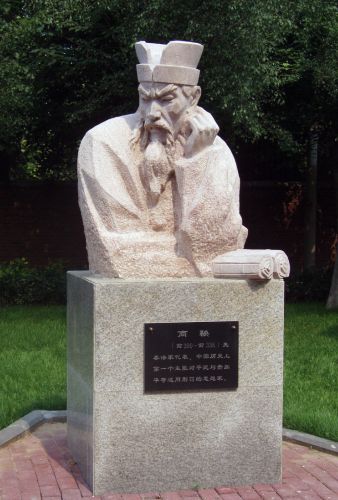
One of the most influential early architects of Legalist reform was Shang Yang, a statesman who served the Qin state during the fourth century BCE. His reforms transformed Qin from a relatively marginal kingdom into one of the most powerful states in China. Shang Yang introduced sweeping administrative and social changes that weakened hereditary aristocratic privilege while strengthening centralized authority. He reorganized society into units of mutual responsibility, established merit-based rewards tied to military achievement, and enforced uniform legal codes across the population. These policies not only expanded Qin’s capacity to mobilize manpower for war but also reinforced the principle that the state stood above all competing social structures. The reforms also included systematic land registration, encouragement of agricultural productivity, and the promotion of military service as a primary avenue for social advancement. By restructuring incentives across society, Shang Yang ensured that individual ambition aligned with the strategic priorities of imperial governance. In doing so, he helped establish a model of governance in which social mobility and political authority were tightly connected to service to the ruler.
Later Legalist thinkers developed these ideas into a more systematic theory of governance. Among them, Han Fei articulated one of the most comprehensive statements of Legalist political philosophy. Han Fei argued that rulers should rely on institutional methods rather than personal judgment or moral charisma. He emphasized the importance of fa (law), shu (administrative technique), and shi (the power inherent in the ruler’s position). Together, these concepts described a political order in which authority derived from institutional design rather than personal power rather than from the personal qualities of the sovereign. By designing institutions that constrained officials and ensured obedience, the ruler could maintain control even over powerful ministers.
Legalist philosophy also reflected a deeply skeptical view of human nature. Unlike Confucian thinkers, who believed that moral cultivation could guide individuals toward virtuous conduct, Legalists assumed that people were primarily motivated by self-interest. Because individuals naturally pursued personal advantage, social order required a framework in which incentives and penalties directed behavior toward the goals of the state. Law functioned not simply as a means of resolving disputes but as a comprehensive mechanism for structuring conduct throughout society. When properly designed and consistently enforced, Legalists believed that legal systems could produce disciplined populations capable of supporting strong governments. This perspective led Legalist writers to emphasize the predictability and impersonality of law. A system of governance grounded in clear statutes reduced the influence of personal favoritism or moral interpretation, ensuring that officials and subjects alike understood the consequences of their actions. Law became both a tool of governance and a mechanism for structuring the expectations that governed everyday life within the state.
In the Qin state, these theoretical principles became practical tools of governance. Legalist ideas justified the expansion of imperial authority while delegitimizing traditional aristocratic autonomy. Officials were appointed on the basis of administrative competence rather than hereditary status, and their performance was closely monitored through systems of reporting and evaluation. Laws applied broadly across social groups, reinforcing the notion that the state possessed ultimate authority over the population. Through this structure the Qin leadership sought to eliminate the political fragmentation that had characterized earlier centuries of Chinese history.
The influence of Legalism did not disappear after the fall of the Qin dynasty, even though later historians often portrayed the philosophy as excessively harsh. Elements of Legalist administrative practice remained embedded within the political institutions of subsequent dynasties, including the Han. While Confucian moral philosophy later gained prominence as an official ideology, many of the techniques that sustained imperial governance continued to reflect Legalist assumptions about authority, law, and bureaucratic discipline. The Qin dynasty demonstrated how a political philosophy centered on law and centralized control could transform theoretical arguments about governance into a functioning imperial system. Later dynasties often publicly criticized the severity of Qin rule, yet they preserved many of the administrative tools that Legalist reformers had pioneered. Standardized legal codes, bureaucratic accountability, and centralized fiscal oversight remained essential components of imperial governance for centuries. In this way, Legalism exerted an enduring influence on Chinese political institutions, shaping the administrative foundations of empire long after its most uncompromising formulations had faded from official ideological discourse.
Administrative Centralization after Unification
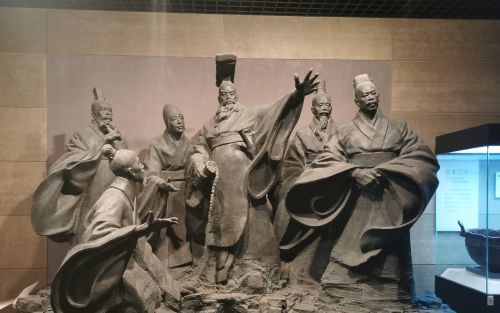
The military conquest of rival states allowed Qin Shi Huang to proclaim the creation of a unified empire in 221 BCE, but the durability of that empire depended on the rapid construction of an effective administrative system. Qin leaders recognized that victory on the battlefield would mean little if older regional structures of power remained intact. In earlier periods of Chinese history, aristocratic families and hereditary rulers had exercised considerable autonomy within their territories. The Qin government moved decisively to dismantle these traditional arrangements. Rather than permitting conquered territories to retain their former elites, the new regime replaced them with officials appointed directly by the imperial court. This transition represented a profound shift in political organization, transferring authority from regional lineages to a centralized bureaucracy responsible to the emperor.
The Qin administrative system divided the empire into commanderies and counties governed by appointed officials whose positions depended upon imperial favor and administrative performance. These officials carried responsibility for taxation, legal enforcement, and military recruitment within their jurisdictions. Because their authority derived from the central government rather than from hereditary status, they functioned as instruments of imperial policy rather than as independent power brokers. The commandery system created a network of governance that linked distant regions to the imperial center. Administrative oversight, record keeping, and reporting procedures allowed the Qin court to monitor local officials and ensure that imperial directives were implemented throughout the empire.
Centralization also extended to the standardization of economic and cultural systems that facilitated governance across diverse territories. The Qin state introduced uniform weights and measures, standardized coinage, and a common script used in official administration. These reforms simplified taxation, trade, and bureaucratic communication by eliminating regional variations that had complicated governance during the Warring States period. Standardized writing proved particularly significant for administration, as it allowed officials from different regions to communicate through a shared bureaucratic language even when local spoken dialects differed substantially. Infrastructure projects reinforced this integration. Roads and canals connected administrative centers and enabled officials, soldiers, and supplies to move efficiently across the empire. These transportation networks not only supported military logistics but also allowed imperial messengers and administrators to transmit orders and reports across long distances with greater reliability. By combining administrative standardization with improved communication and transportation systems, the Qin government sought to create a coherent administrative environment in which imperial authority could operate consistently throughout the newly unified empire.
The transformation of governance under the Qin dynasty demonstrated the practical application of Legalist principles to imperial administration. Centralization reduced the influence of local aristocracies while strengthening the authority of appointed officials accountable to the state. Standardization policies facilitated bureaucratic control and economic coordination across the empire, while improved transportation networks enabled the rapid movement of information and resources. Together these measures created one of the most tightly organized administrative systems of the ancient world. Although the Qin dynasty itself lasted only a short time, the institutional framework it established profoundly influenced subsequent Chinese political development, providing later dynasties with a model of centralized governance capable of managing large and diverse territories.
Law, Surveillance, and Social Regulation
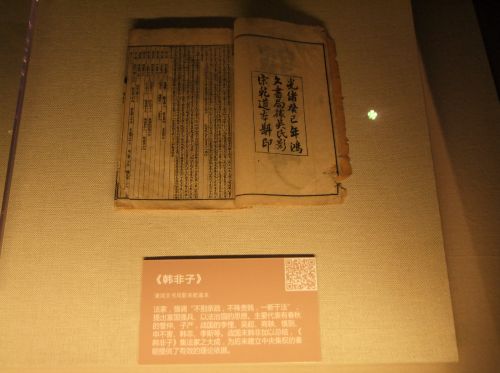
Law occupied a central place in the political order constructed by the Qin dynasty. Legal regulation functioned not only as instruments for resolving disputes but also as mechanisms for structuring society itself. Under Legalist principles, the authority of the state rested upon the clear articulation and consistent enforcement of laws that applied across the population. By establishing detailed statutes governing conduct, labor obligations, taxation, and military service, Qin officials sought to create a predictable system in which individuals understood both the expectations placed upon them and the consequences of failing to meet them. In this framework, law was intended to produce social stability by shaping behavior through the careful balance of rewards and punishments.
The Qin legal system was distinguished by its severity. Punishments for violations ranged from fines and forced labor to corporal penalties such as mutilation or execution. These harsh measures reflected the Legalist conviction that strong deterrence was essential for maintaining order in a large and diverse population. Rather than relying on moral appeals or communal negotiation, Qin law emphasized swift and visible enforcement designed to discourage transgression. The threat of punishment became a central element of governance, reinforcing the authority of the state while discouraging resistance to official regulations.
Surveillance mechanisms played an important role in supporting the enforcement of these laws. The Qin state relied on administrative reporting systems and networks of local officials who monitored the conduct of communities within their jurisdictions. Legalist reformers had earlier introduced systems of mutual responsibility that grouped households together for purposes of taxation, labor service, and legal accountability. Under such arrangements, members of a group could face penalties if they failed to report crimes committed by others within the unit. This structure effectively encouraged communities to police themselves while extending the reach of state authority into everyday social interactions. The system created powerful incentives for vigilance, as individuals risked punishment not only for their own actions but also for their failure to disclose wrongdoing by neighbors or relatives. As a result, social relationships were shaped by an awareness that private behavior could carry public consequences. Through this mechanism the Qin state expanded its capacity to monitor society without relying solely on large numbers of officials, embedding legal oversight within the structure of local communities themselves.
The integration of surveillance and legal enforcement also reflected broader Legalist assumptions about governance. If individuals were primarily motivated by self-interest, then the state required reliable mechanisms for monitoring behavior and discouraging disobedience. By combining clear laws with systems of reporting and collective accountability, Qin administrators attempted to create a society in which violations were difficult to conceal. Officials gathered information through bureaucratic channels, while the mutual responsibility system incentivized ordinary people to participate in maintaining order. The resulting structure blurred the boundary between state oversight and local social regulation.
Legal control also extended into economic and social life. Agricultural production, military service, and labor obligations were regulated through statutes that defined the responsibilities of households within the empire. Peasants were required to contribute taxes and labor to the state, while officials recorded and evaluated their performance through administrative records. In this way the legal system functioned as a framework through which the government organized economic activity and ensured the availability of manpower for state projects. Regulations governing land cultivation, registration of households, and reporting of harvests allowed officials to monitor agricultural output and allocate resources according to imperial priorities. These systems ensured that labor and production remained closely tied to the needs of the state, reinforcing the principle that economic life existed within a broader structure of political authority.
Through these measures, the Qin dynasty constructed a highly regulated social environment in which law, surveillance, and administrative oversight worked together to maintain order. The system enabled the state to project authority into communities across a vast empire while minimizing the autonomy of local elites or social groups. The severity of Qin legal practices became one of the most controversial features of the dynasty in later historical accounts. While Legalist administrators viewed strict enforcement as necessary for stability, critics argued that excessive harshness contributed to widespread resentment among the population. The tension between discipline and legitimacy would ultimately shape the historical reputation of the Qin regime.
Conscription and the Mobilization of Labor
The Qin dynasty’s capacity to build and maintain a unified empire depended heavily on the systematic mobilization of labor drawn from the empire’s rural population. While agricultural production remained the foundation of economic life, Qin administrators required peasants to fulfill additional obligations that connected their work directly to the needs of the state. Households were registered and organized within territorial jurisdictions that allowed officials to assess taxes, track population levels, and allocate labor service when necessary. These systems ensured that the government could draw upon a predictable pool of manpower for military campaigns and large-scale construction projects. Through these mechanisms, labor itself became a central instrument of imperial policy.
Military conscription formed one of the most important components of this system. Adult men were expected to perform periods of service in the Qin armies, which had already developed formidable military capabilities during the Warring States period. Service in the military could bring opportunities for advancement under the merit-based reward structure promoted by earlier Legalist reforms. Soldiers who distinguished themselves in battle might receive titles or land grants, linking military success to social mobility. Conscription ensured that the state maintained a constant supply of trained manpower capable of defending newly conquered territories and suppressing internal unrest.
Beyond military service, the Qin government demanded large amounts of labor for state-directed construction projects. Tens of thousands of workers were mobilized to build roads, canals, defensive walls, and other infrastructure that connected distant regions of the empire. One of the most famous undertakings associated with the Qin period involved the linking and expansion of defensive fortifications in northern China that later generations would identify as early components of the Great Wall. These projects were intended not only to strengthen the empire’s defenses but also to facilitate communication and troop movement across vast territories. Infrastructure construction served strategic, administrative, and symbolic purposes within the Qin political order.
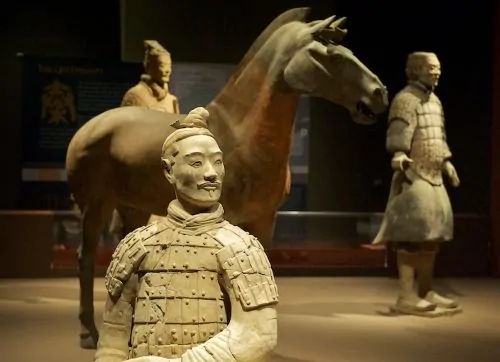
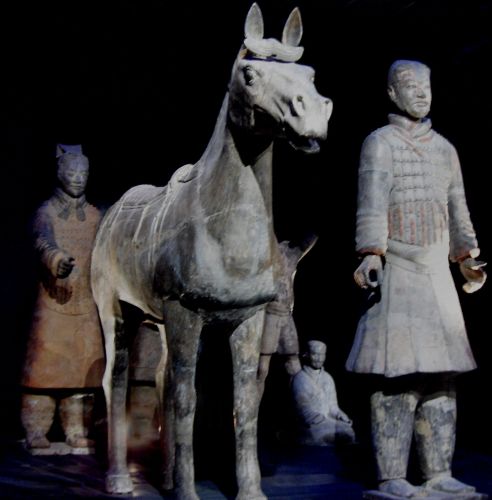
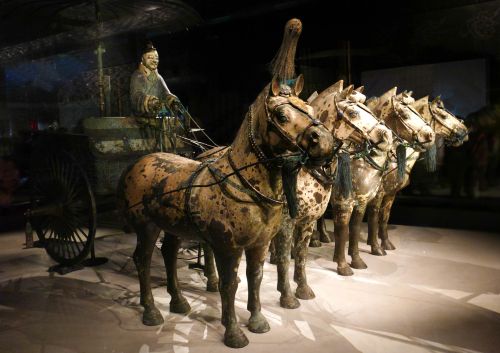
Perhaps the most striking example of Qin labor mobilization appeared in the construction of the vast mausoleum complex built for Qin Shi Huang near modern Xi’an. According to later historical accounts, enormous numbers of workers were conscripted to construct the emperor’s tomb, which included extensive underground structures and the now-famous terracotta army. Archaeological evidence confirms the extraordinary scale of this complex, suggesting that it required prolonged labor from thousands of craftsmen, laborers, and administrators. The mausoleum functioned both as a burial site and as a monumental statement of imperial authority, reflecting the ruler’s ambition to project power beyond his lifetime. The underground complex included elaborate chambers intended to replicate the imperial court, complete with bronze chariots, weapons, and life-sized clay soldiers arranged in military formations. These figures, carefully crafted and individually detailed, were designed to serve the emperor in the afterlife just as living armies had protected him during his reign. The scale and organization required for such a project reveal the immense administrative coordination necessary to mobilize artisans, engineers, and laborers throughout the imperial territories. The tomb complex illustrates not only the ideological aspirations of Qin Shi Huang but also the extraordinary capacity of the Qin state to direct human and material resources toward monumental imperial projects.
These demands placed significant burdens on the rural population that formed the backbone of the Qin economy. Peasants were expected to maintain agricultural production while also fulfilling obligations of military service, taxation, and labor conscription. Although such mobilization allowed the Qin state to undertake projects of remarkable scale and complexity, it also generated widespread strain among the lower classes. The heavy demands imposed by the imperial government contributed to the perception that Qin rule relied excessively on coercion. In this way, the same system of labor mobilization that strengthened the empire’s administrative and military capacities also intensified social pressures that would later undermine the dynasty’s stability.
Monumental Projects and Imperial Authority

The Qin dynasty demonstrated its power not only through administrative reforms and military victories but also through the construction of monumental projects that reshaped the physical landscape of northern China. These undertakings served practical purposes, including defense, transportation, and communication, yet they also carried powerful symbolic meaning. By mobilizing vast quantities of manpower and resources, the Qin state displayed its ability to command the empire’s population and direct its efforts toward projects that reflected imperial ambition. Monumental construction functioned as a visible expression of centralized authority, reinforcing the legitimacy of the emperor and the administrative system that supported him.
One of the most significant infrastructure initiatives of the Qin government involved the expansion and connection of defensive fortifications along the northern frontier. Earlier states had constructed walls to protect agricultural regions from nomadic groups inhabiting the steppe. Qin administrators ordered the linking and reinforcement of several of these barriers to create a more continuous defensive system. Although the structure known today as the Great Wall developed over many centuries, the Qin project represented an important early effort to coordinate large-scale frontier defenses under a single imperial authority. The construction required the movement of vast numbers of laborers and materials across difficult terrain, illustrating both the logistical capabilities of the Qin state and the heavy demands placed upon the population.
Road building constituted another major component of Qin imperial construction. The regime developed an extensive network of roads radiating outward from the imperial capital, designed to facilitate the movement of armies, officials, and goods throughout the empire. These roads strengthened administrative integration by reducing the time required for communication between the central government and distant regions. They also improved the ability of the state to deploy military forces rapidly in response to threats or rebellions. In addition to their strategic value, the roads functioned as instruments of political consolidation by binding newly conquered territories more closely to the imperial center. Administrative couriers could transmit orders, tax records, and military reports across regions that had previously been separated by distance and political fragmentation. Archaeological evidence suggests that some of these roads were built to standardized widths and maintained under official supervision, demonstrating the degree of bureaucratic planning involved in their construction. Through these transportation networks the Qin state transformed geography into a framework of governance, ensuring that imperial authority could travel as efficiently as the armies that had created the empire.
Large-scale hydraulic and canal projects further demonstrated the ambitions of the Qin administration. Water management had long been essential for agriculture in northern China, and Qin officials invested considerable effort in the construction and improvement of canals that supported irrigation and transportation. These projects not only increased agricultural productivity but also enabled the state to move grain, military supplies, and construction materials across long distances with greater efficiency. Canal systems allowed officials to coordinate the flow of resources needed to sustain both urban populations and frontier garrisons. Irrigation works strengthened the agricultural base upon which the empire depended, stabilizing harvests and supporting the taxation systems that financed imperial administration. Such hydraulic projects required complex coordination between engineers, administrators, and large numbers of laborers, illustrating once again the organizational capacity of the Qin government. By integrating agricultural management with transportation infrastructure, the state enhanced both economic production and administrative oversight across its territories.
These monumental works also played an ideological role in reinforcing the image of imperial authority. The scale of the projects communicated the strength and organizational capacity of the central government, reminding subjects throughout the empire of the ruler’s ability to mobilize labor and resources on a vast scale. Infrastructure and construction functioned as instruments of political messaging as much as practical necessities. Roads, walls, and canals physically connected the empire while symbolically representing the reach of Qin power across the landscape.
Yet the same projects that demonstrated imperial strength also exposed the burdens imposed upon the population. The mobilization of large numbers of laborers for construction projects often removed peasants from agricultural work for extended periods, placing strain on rural communities already responsible for taxation and military service. Later historical traditions frequently portrayed these demands as examples of the harshness of Qin rule. Whether or not such accounts exaggerated the scale of suffering, they reveal how monumental construction became intertwined with debates about the legitimacy of imperial authority. The Qin state’s ability to reshape the landscape stood as both a testament to its administrative achievements and a reminder of the social costs required to sustain such ambitions.
Social Hierarchy under the Qin System
The establishment of Qin imperial authority reshaped the organization of social rank across northern China. Earlier political systems had been dominated by hereditary aristocracies whose power rested on lineage, land ownership, and long-standing regional influence. The Qin government deliberately sought to weaken these entrenched elites in order to prevent the reemergence of competing centers of power. Legalist reformers believed that hereditary privilege undermined the authority of the state by allowing local families to accumulate resources and loyalty independent of the ruler. As a result, Qin administrators worked to dismantle aristocratic autonomy and replace it with a hierarchy that depended directly upon service to the imperial government.
Under the Qin system, status became increasingly linked to bureaucratic position and demonstrated service to the state rather than inherited rank. Officials were appointed through administrative channels and were expected to perform specific duties within the commandery and county system established after unification. Advancement within the bureaucracy depended largely on effectiveness in fulfilling these responsibilities, including tax collection, legal enforcement, and population management. In theory, this approach allowed individuals of modest background to enter government service if they demonstrated competence and loyalty. It reinforced the central principle that political authority derived from the emperor and the administrative institutions that represented him.
Military achievement also played a significant role in shaping social mobility under the Qin regime. Legalist reforms had earlier introduced systems of rank that rewarded soldiers for accomplishments in battle, including the capture of enemy combatants or participation in successful campaigns. Titles and privileges could be granted on the basis of such achievements, creating incentives for participation in military service. These policies reflected the Qin state’s broader emphasis on discipline, productivity, and measurable contribution to state objectives. By tying advancement to clearly defined accomplishments, the system sought to replace aristocratic privilege with a hierarchy grounded in performance and loyalty to the ruler. Military rank structures also helped integrate soldiers from different regions into a unified imperial army, reinforcing a shared identity tied to service to the state. In this way the military became both a mechanism of defense and a tool for shaping the social order of the empire.
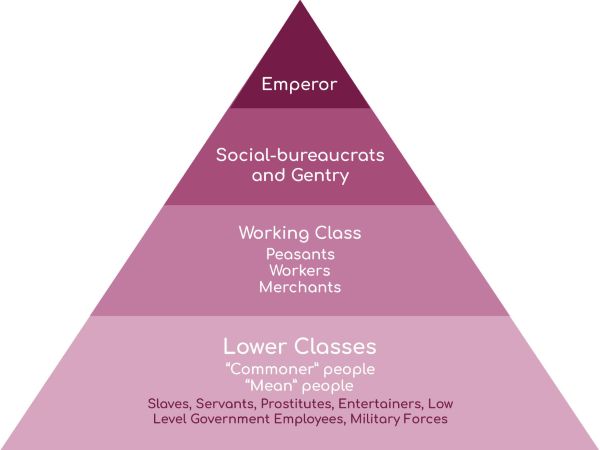
Despite these elements of mobility, the overall structure of Qin society remained sharply stratified. The emperor and his court occupied the apex of political authority, followed by the administrative officials who governed provinces, commanderies, and counties. Below this governing class stood the vast population of peasants who formed the economic foundation of the empire. These agricultural communities provided the labor, taxes, and military service that sustained Qin administration and infrastructure projects. Although the system allowed some opportunities for advancement through bureaucratic or military service, the majority of the population remained tied to agricultural production and subject to extensive legal regulation.
The Qin government also categorized certain groups according to their relationship with the legal system and state authority. Convicted criminals and individuals subject to penal labor formed a distinct segment of the population, often employed in demanding construction or infrastructure projects. Their status reflected the punitive dimension of Qin governance, in which law functioned both as a means of punishment and as a source of labor for the state. Such arrangements reinforced the broader principle that the government possessed the authority to direct the labor and conduct of individuals according to the needs of the empire.
Through these policies the Qin dynasty constructed a social hierarchy that differed significantly from earlier aristocratic systems while remaining highly structured and controlled. Authority flowed downward from the emperor through layers of appointed officials who managed the empire’s population and resources. Although Legalist reforms sought to weaken hereditary privilege, they did not eliminate hierarchy. Instead, they reorganized it around the principles of state service, administrative discipline, and legal accountability. The resulting structure reinforced the central role of the imperial government in shaping opportunities and obligations within society. Individuals could improve their status through military success or bureaucratic advancement, yet such mobility remained tightly linked to the needs of the state rather than to independent social power. The Qin social order reflected the broader goals of Legalist governance: the creation of a society in which power, status, and opportunity were closely tied to the functioning of the centralized imperial state.
Resistance, Strain, and the Limits of Coercion
The political system constructed by the Qin dynasty relied heavily on discipline, administrative control, and the consistent enforcement of strict laws. While these mechanisms enabled the rapid consolidation of imperial authority, they also generated significant social pressure across the population. The demands imposed upon rural communities were particularly heavy. Peasants were expected to maintain agricultural production while simultaneously fulfilling obligations of taxation, labor conscription, and military service. For many households these responsibilities created persistent economic pressure, especially when extended labor assignments removed able-bodied workers from the fields during crucial agricultural seasons. Such burdens contributed to growing dissatisfaction among segments of the population whose livelihoods depended on maintaining stable agricultural output.
Legal severity further intensified these pressures. The Qin legal code emphasized harsh penalties designed to deter disobedience and maintain social discipline. While this approach aligned with Legalist principles, it also fostered a climate of fear and resentment. Individuals who violated regulations, even inadvertently, could face punishments that included forced labor or corporal penalties. Systems of collective responsibility also meant that families or communities might suffer consequences for crimes committed by individual members. In practice these policies reinforced the authority of the state but simultaneously strained the social fabric of local communities, where mutual suspicion could arise from the expectation that individuals report violations committed by others.
The scale of labor mobilization required for imperial construction projects and frontier defenses also created widespread disruption. Tens of thousands of workers were frequently assigned to distant construction sites, where they remained for extended periods under difficult conditions. Such assignments could leave villages without sufficient labor to maintain agricultural productivity, compounding the economic difficulties faced by rural households. Many conscripted laborers were required to travel far from their homes, sometimes across great distances to reach frontier regions or major construction centers. These journeys themselves imposed additional hardship, as workers often lacked adequate provisions and faced harsh environmental conditions upon arrival. In frontier zones, particularly those associated with defensive wall construction or remote infrastructure projects, laborers were exposed to unfamiliar climates and demanding physical work that could last for months or even years. The disruption of local agricultural rhythms created ripple effects across rural economies, weakening the stability of communities already responsible for sustaining the empire through taxation and production. In addition to infrastructure projects, military campaigns required continuous mobilization of manpower and resources. These combined demands placed extraordinary pressure on the agrarian population that formed the backbone of the empire’s economy.
Political tensions became particularly visible following the death of Qin Shi Huang in 210 BCE. The emperor’s passing created uncertainty within the imperial court and disrupted the balance of authority that had previously maintained administrative stability. Rivalries among court officials and members of the imperial family contributed to political instability at the center of government. Reports of rebellion began to appear in various regions of the empire. Some of the earliest uprisings involved groups of conscripted laborers and soldiers who had already been subjected to the harsh conditions of imperial service. Their resistance reflected both immediate grievances and broader dissatisfaction with the demands of Qin governance.
These developments revealed the limitations inherent in a political system sustained primarily through coercion. The Qin state possessed formidable administrative and military capabilities, yet its legitimacy among the population remained fragile. Policies that emphasized discipline and obedience allowed the dynasty to consolidate power quickly, but they also generated resentment that proved difficult to contain once imperial leadership weakened. The early revolts that emerged after the emperor’s death demonstrated how rapidly dissatisfaction could spread when the mechanisms of enforcement began to falter. The resistance that arose during the final years of Qin rule exposed the structural tension between the dynasty’s remarkable administrative achievements and the social pressures created by its methods of governance.
The Collapse of the Qin Dynasty
The Qin dynasty collapsed with remarkable speed after achieving the unification of China, illustrating the fragility that can accompany systems built on intense centralization and coercive authority. When Qin Shi Huang died in 210 BCE, the imperial court faced an immediate crisis of succession. Political maneuvering among court officials, particularly the eunuch Zhao Gao and the prime minister Li Si, led to the installation of the emperor’s younger son, Qin Er Shi, rather than the designated heir. This decision weakened the stability of the regime at a moment when firm leadership was essential. The new emperor lacked the authority and administrative control that had characterized his father’s rule, allowing factional rivalries within the court to intensify and undermine the cohesion of the central government.
The structural pressures that had accumulated during Qin rule began to surface more openly across the empire. The burdens of taxation, labor conscription, and legal severity had already generated discontent among many segments of the population. With the imperial court distracted by internal political struggles, local grievances increasingly transformed into organized resistance. One of the earliest and most significant uprisings occurred in 209 BCE when two minor officials, Chen Sheng and Wu Guang, led a rebellion after fearing punishment for failing to reach a military post on time due to severe weather conditions. According to later historical accounts, their revolt quickly attracted support from peasants, laborers, and soldiers who had grown resentful of Qin authority. The rebellion spread rapidly because it articulated frustrations that were widely shared among those who had borne the heaviest burdens of the imperial system. Conscripted workers, impoverished farmers, and disaffected soldiers found in the uprising an opportunity to challenge a government that had demanded extraordinary sacrifice while offering little relief from its rigid legal structure. What began as a desperate act by two officials fearing punishment soon evolved into a broader movement that demonstrated how fragile Qin authority had become once central power weakened.
The Chen Sheng uprising inspired a series of additional rebellions across former territories of the Warring States. Regional leaders and former aristocratic families seized the opportunity to challenge Qin control, often invoking the restoration of earlier political traditions. Among the most prominent figures to emerge during this period were Xiang Yu and Liu Bang, both of whom commanded forces that fought against the remaining Qin loyalists. As rebel armies expanded their influence, the imperial government struggled to coordinate an effective response. The centralized administrative structure that had once allowed the Qin state to dominate its rivals now proved vulnerable when communications and loyalties began to break down across the empire.
By 206 BCE the Qin dynasty had effectively disintegrated. The last Qin ruler surrendered to Liu Bang, bringing the short-lived imperial regime to an end. Although the dynasty had lasted only fifteen years after the formal unification of China, its influence on Chinese political development proved enduring. Many of the administrative institutions, territorial divisions, and legal practices established during Qin rule were later adopted and modified by the succeeding Han dynasty. The rapid collapse of the Qin regime stands as both a cautionary example of the dangers of excessive coercion and a demonstration of how even brief dynasties can leave lasting institutional legacies within the history of imperial governance.
Conclusion: Power, Order, and the Costs of Absolute Authority
The rise and fall of the Qin dynasty illustrates both the remarkable potential and the inherent risks of centralized political power. Through Legalist principles, administrative reform, and disciplined state organization, the Qin government constructed one of the most tightly controlled political systems of the ancient world. By dismantling hereditary aristocratic authority and replacing it with a network of appointed officials, the dynasty created an imperial structure capable of directing resources, regulating populations, and enforcing law across vast territories. These innovations allowed the Qin state to achieve a level of political integration that earlier Chinese regimes had struggled to maintain.
The methods used to secure this unity relied heavily on coercive mechanisms that placed extraordinary demands upon the population. Strict legal codes, systems of surveillance, labor conscription, and extensive taxation ensured that the state maintained constant control over society. These policies enabled the construction of monumental infrastructure and the rapid consolidation of imperial authority, yet they also generated widespread social pressure. Rural communities, soldiers, and laborers bore the weight of policies designed to strengthen the central government, and the accumulation of these burdens contributed to growing resentment toward the regime.
The rapid collapse of the Qin dynasty after the death of Qin Shi Huang demonstrates how fragile systems of authority can become when their stability depends primarily on discipline and enforcement. Once leadership at the center weakened, the mechanisms that had maintained order proved insufficient to contain rising discontent across the empire. Rebellions spread quickly through regions already strained by taxation, labor obligations, and military conscription. These uprisings were not merely isolated revolts but manifestations of deeper structural tensions embedded within the Qin political system. The same administrative machinery that had allowed the empire to impose discipline across its territories also intensified the impact of policy failures and leadership crises. When central authority faltered, local grievances that had accumulated over years of heavy demands could quickly transform into coordinated resistance. The fall of the Qin dynasty illustrates a broader historical pattern in which regimes that rely heavily on coercion may achieve rapid consolidation of power but face significant challenges in maintaining long-term stability once their systems of enforcement begin to weaken.
Yet the historical significance of the Qin dynasty extends beyond its brief duration. Despite its collapse, the institutional foundations established during Qin rule profoundly influenced later Chinese political development. Administrative centralization, standardized systems of governance, and the integration of vast territories under a single imperial authority became enduring features of subsequent dynasties. The Qin experiment in Legalist statecraft left a lasting legacy, demonstrating both the power of concentrated imperial governance and the social costs that can accompany the pursuit of absolute political order.
Bibliography
Affiliate disclosure: Amazon links on this site are paid links. As an Amazon Associate I earn from qualifying purchases.
- Barbieri-Low, Anthony J. “Coerced Migration and Resettlement in the Qin Imperial Expansion.” Journal of Chinese History 5:2 (2021), 181-202.
- Bodde, Derk, and Clarence Morris. Law in Imperial China: Exemplified by 190 Ch’ing Dynasty Cases. Philadelphia: University of Pennsylvania Press, 1967.
- Dai, Yingcong. “The Qing State, Merchants, and the Military Labor Force in the Jinchuan Campaigns.” Late Imperial China 22:2 (2001), 35-90.
- Guo, Yanzi. “Contingency and Historical Inevitability in the Development of the Qin Dynasty.” Journal of Education, Humanities and Social Sciences 8 (2023), 1367-1372.
- Han Fei. Han Feizi: Basic Writings. Translated by Burton Watson. New York: Columbia University Press, 2003.
- Lewis, Mark Edward. The Early Chinese Empires: Qin and Han. Cambridge, MA: Harvard University Press, 2007.
- —-. “Warring States: Political History.” In The Cambridge History of Ancient China: From the Origins of Civilization to 221 B.C., edited by Michael Loewe and Edward L. Shaughnessy. Cambridge: Cambridge University Press (1999), 587-650.
- Pines, Yuri. Envisioning Eternal Empire: Chinese Political Thought of the Warring States Era. Honolulu: University of Hawai‘i Press, 2008.
- —-. “The Warring States Period: Historical Background.” In The Oxford Handbook of Early China, edited by Elizabeth Childs-Johnson. Oxford: Oxford University Press (2009), 581-594.
- Shang Yang. The Book of Lord Shang: Apologetics of State Power in Early China. Translated by Yuri Pines. New York: Columbia University Press, 2017.
- Shelach-Lavi, Gideon. The Archaeology of Early China: From Prehistory to the Han Dynasty. Cambridge: Cambridge University Press, 2014.
- Sima Qian. Records of the Grand Historian. Translated by Burton Watson. New York: Columbia University Press, 1993.
- Twitchett, Denis, and Michael Loewe, eds. The Cambridge History of China, Volume 1: The Ch’in and Han Empires, 221 B.C.–A.D. 220. Cambridge: Cambridge University Press, 1986.
- Yates, Robin D. S. “Law and the Military in Early China.” In Military Culture in Imperial China, edited by Nicola Di Cosmo. Cambridge, MA: Harvard University Asia Center (2011), 23-44.
Originally published by Brewminate, 03.11.2026, under the terms of a Creative Commons Attribution-NonCommercial-NoDerivatives 4.0 International license.
About the Author