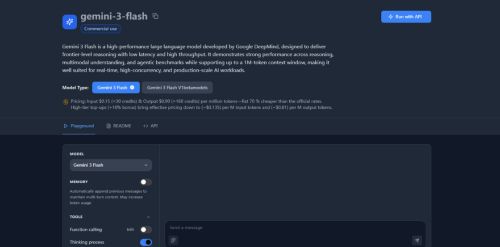
Academic research moves slowly by design — but the administrative and analytical overhead around it doesn’t have to. The Gemini 3 Flash API is drawing serious attention from researchers who need fast, capable AI inference without the cost of heavyweight models. Here’s what it actually offers and how to put it to work.
What the Gemini 3 Flash API Is and Why Academics Are Paying Attention
Google’s Gemini Flash series prioritizes speed and cost-efficiency without gutting reasoning quality. For academic teams running large-scale text analysis, document parsing, or iterative query workflows, that balance matters enormously.
Core Capabilities of the gemini-3-flash API That Matter for Research Workflows
The gemini-3-flash API supports long-context inputs, structured output formatting, and multimodal inputs — meaning it can process text, images, and mixed-format documents in a single call. For researchers dealing with PDFs, scanned tables, or mixed-media datasets, this cuts down on preprocessing time considerably. The model also handles instruction-following well, which makes it reliable for templated extraction tasks where consistency across hundreds of documents is non-negotiable.
How Gemini 3 Flash Thinking Unlocks Multi-Step Reasoning for Complex Academic Problems
Gemini 3 Flash Thinking refers to the model’s chain-of-thought reasoning mode, where it works through problems step by step before producing a final answer. This matters in academic contexts where a single query might require synthesizing conflicting sources, applying domain-specific logic, or structuring an argument across multiple inferential steps. Researchers using this mode report more coherent outputs on tasks like comparative literature analysis and methodological critique — areas where surface-level summarization simply isn’t enough.
Breaking Down Gemini 3 Flash API Pricing for Research and Academic Budgets
Cost is a real constraint in academic settings. Grant budgets are fixed, and most university labs don’t have the runway to absorb unpredictable API bills. Understanding Gemini 3 Flash API pricing upfront prevents unpleasant surprises mid-project.
Understanding Gemini 3 Flash API Cost Tiers — What Researchers Actually Pay Per Token
Gemini 3 Flash API cost is structured around input and output tokens, with pricing that sits well below frontier models like GPT-4o or Claude 3.5 Sonnet. Google also offers a free tier with rate-limited access, which is genuinely useful for prototyping pipelines before committing budget. For high-volume academic tasks — say, extracting structured data from 10,000 abstracts — the per-token cost difference between Flash and premium-tier models can translate to hundreds of dollars saved per research cycle.
Gemini Flash 3 API vs. Competing Models: Which Offers Better Value for Academic Use Cases
When comparing the Gemini Flash 3 API against alternatives like Mistral Small or Claude Haiku, the value calculation depends on task type. For long-document processing and structured extraction, Gemini Flash 3 holds up well thanks to its extended context window. For pure summarization on short texts, the differences narrow. Academic users specifically benefit from the multimodal support and the reliability of the instruction-following behavior — two areas where cheaper open-source alternatives often fall short in production pipelines.
Practical Ways to Integrate Gemini 3 Flash API into Academic Research Pipelines
Getting value from the Gemini 3 Flash API isn’t just about API access — it’s about fitting the model into workflows that researchers actually use.
Automating Literature Review and Data Extraction Using the gemini-3-flash API
One of the most immediate applications is systematic literature review. Researchers can feed batches of abstracts or full papers into the gemini-3-flash API with structured prompts that extract methodology, sample size, key findings, and limitations into a consistent schema. This reduces the manual screening burden significantly. Teams working on meta-analyses or scoping reviews have used similar setups to process hundreds of papers in the time it would normally take to read a dozen.
Applying Gemini 3 Flash Thinking to Hypothesis Generation and Structured Scholarly Analysis
Gemini 3 Flash Thinking mode is particularly well-suited to hypothesis generation tasks. By providing a research context, prior findings, and a set of constraints, researchers can prompt the model to reason through possible explanations or research directions in a transparent, step-by-step format. The output isn’t a replacement for expert judgment — but it functions well as a structured thinking partner, surfacing angles that a researcher might overlook under time pressure.
The Gemini 3 Flash API represents a practical option for academic teams that need capable AI inference at a price point that fits real research budgets. Whether you’re automating data extraction, stress-testing hypotheses, or processing large document sets, the model’s combination of speed, reasoning depth, and manageable cost makes it worth serious consideration. Start with the free tier, run it against your actual workload, and let the results guide your decision.
About the Author