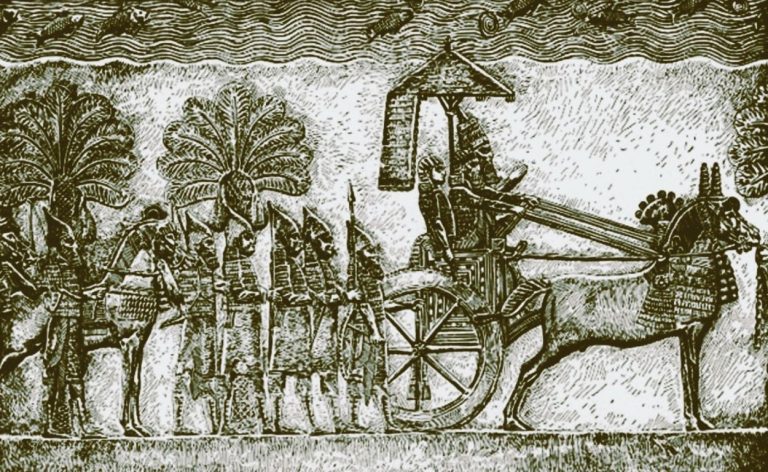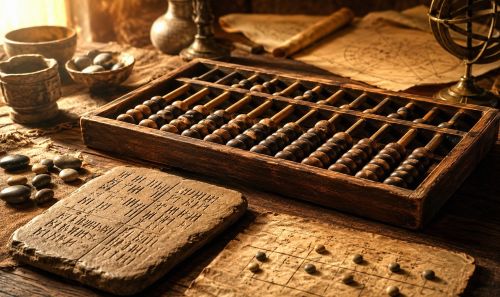
The abacus turned calculation into a visible, tactile practice, helping ancient and modern users organize number beyond memory alone.

By Matthew A. McIntosh
Public Historian
Brewminate
Introduction: Calculation Before the Calculator
Long before calculation became silent, electronic, and nearly invisible, it was a physical act. Human beings counted with fingers, stones, marks, tokens, grooves, boards, and beads because memory alone could not carry the growing numerical burdens of settled life. Herds had to be tallied, grain had to be measured, debts had to be remembered, taxes had to be assessed, and goods had to be exchanged across increasingly complex social worlds. The abacus emerged from this larger history of material calculation, not as a sudden invention standing apart from earlier habits, but as one of the most durable answers to a basic human problem: how to make number stable enough to trust, portable enough to use, and flexible enough to manipulate. In that sense, the abacus was never merely a device for arithmetic. It was a technology for extending thought beyond the limits of the unaided mind.
The earliest forms of calculation were not sharply divided from writing, accounting, or administration. In ancient Mesopotamia, the long development from counters and tokens to written numerical records reveals that number first became powerful when it became material. Influential work has traced Near Eastern counting tokens as part of the prehistory of writing, while the social history of ancient Iraqi mathematics placed numerical practice within the institutions of temple, palace, school, labor, and exchange. Their emphases differ, but both help establish a crucial point for the history of the abacus: calculation was not simply an abstract mental exercise waiting for notation to catch up. It was embedded in tools, surfaces, gestures, training, and institutional need. The abacus belongs to this world, where counting was done with the hand, but ordered by systems that made the hand more reliable than memory alone.
By the first millennium BCE, the evidence for pebble and board calculation becomes clearer in Mediterranean sources. Herodotus, writing in the fifth century BCE, famously observed that Egyptians reckoned with pebbles in a direction opposite to the Greeks, a brief remark that matters because it shows calculation as an embodied practice, not only a written one. Later Greek and Roman traditions continued to use counters, lines, tables, and portable devices to perform operations that written numerals did not always handle efficiently. This was not a trivial limitation. Numeral systems could preserve values, mark quantities, and support official records, but they did not necessarily make multiplication, division, or comparison easy on the written page. A merchant balancing accounts, a tax collector checking assessments, or an administrator sorting quantities needed a method that could move numbers through stages without losing track of place and value. This is especially important in cultures where numeral systems could record values without making written computation easy. The abacus and its relatives solved that problem by turning number into position. A pebble, counter, or bead acquired value from where it stood, and arithmetic became a controlled movement across an organized field. In that movement, calculation became visible, repeatable, and correctable. The user did not have to hold every intermediate value in memory, because the board itself held the state of the operation. That simple fact helps explain the long endurance of counting boards and bead frames even after written numerals became more sophisticated: they did not merely represent numbers, they organized action.
The history that follows is not simply a march from primitive counting to modern calculation. It is a history of cognitive scaffolding: the ways human beings built external structures that allowed them to think with greater speed, accuracy, and scale. The abacus made number visible and movable. It gave merchants, administrators, teachers, and students a way to calculate without surrendering the process to pure memory or written notation alone. Across Mesopotamian counting boards, Mediterranean counters, Chinese suanpan, Japanese soroban, Russian schoty, and modern mental-abacus training, the same broad pattern recurs: humans first externalized calculation into objects, then trained themselves to internalize those objects as disciplined mental images. The calculator would eventually automate arithmetic, but the abacus had already done something intellectually deeper. It taught the mind how to see number.
Pebbles, Boards, and the Mesopotamian Origins of Positional Calculation
The history of the abacus begins less with a single invention than with a long administrative struggle to make quantity manageable. In Mesopotamia, the rise of cities, temples, palaces, workshops, and long-distance exchange created numerical demands that could not be met by memory or casual tallying alone. Grain, beer, wool, livestock, land, rations, labor days, and silver had to be counted, compared, stored, redistributed, and recorded. The earliest counting devices belonged to this world of practical administration. They were not abstract mathematical toys, but instruments of control in societies where accounting was becoming one of the foundations of organized power. Before calculation became a written procedure, it was a material practice tied to clay, hands, counters, surfaces, and the disciplined movement of objects through space.
Historiography on Near Eastern tokens remains central to this story because it emphasizes the deep antiquity of material accounting before writing. Small clay objects of different shapes appear to have represented units of goods, and their use helped connect quantity to durable, manipulable symbols. The argument that these tokens led directly to writing has been refined and challenged in later scholarship, but the larger insight remains important: number became administratively useful when it could be detached from the immediate presence of the counted object. A sheep, jar, basket, or measure of grain could be represented by a token, and the token could then be grouped, stored, sealed, compared, or transferred. In that transformation, calculation began to move beyond the body. The fingers still mattered, but the hand now worked with symbolic objects that could preserve a numerical relationship after the counted goods themselves were out of sight.
By the late fourth and third millennia BCE, southern Mesopotamia had developed increasingly sophisticated systems for numerical notation and accounting. The earliest cuneiform tablets from Uruk and related sites show not literature in the later sense, but records of commodities, labor, personnel, and institutional transactions. This matters because writing itself emerged in close relationship with enumeration. The first administrative tablets did not simply record speech; they recorded quantities, categories, and obligations. Mesopotamian accounting created a world in which numbers were not merely counted but classified. A quantity had to be attached to a commodity, a unit of measure, a person, an institution, or a transaction. The same numerical sign gained meaning through its relation to a wider administrative grammar, where metrological systems, commodity categories, and scribal conventions determined how it should be read. Grain was not counted in the same practical context as sheep, laborers, or measures of land, and the act of recording number required an awareness of what kind of thing was being counted, for whom, and under which institutional authority. The intellectual step was immense. Number was becoming relational, positional within an administrative system, and dependent on conventions that had to be learned by scribes and recognized by institutions.
The abacus-like counting board fits within this construct, though it must be described cautiously. Later summaries often place a Sumerian abacus or counting table between roughly 2700 and 2300 BCE, imagining a surface divided into columns that marked successive orders of magnitude in a sexagesimal system. That claim is useful as a broad historical orientation, but the evidence does not allow the earliest Mesopotamian device to be reconstructed with the certainty we have for later Greek, Roman, Chinese, or Japanese abaci. What can be said more securely is that Mesopotamian calculation depended on the organization of values into systems of place, unit, and order. Whether using tokens, ruled surfaces, counters, or written signs, ancient accountants needed ways to hold several quantities in relation to one another. A counting board would have answered that need by making number spatial. A counter placed in one column did not have the same value as a counter placed in another. The object itself could remain unchanged, while its meaning changed according to position.
This positional logic was especially important because Mesopotamian mathematics developed within a sexagesimal, or base-sixty, tradition. The sexagesimal system did not mean that every act of counting was performed with sixty separate symbols. Rather, Mesopotamian scribes worked with layered conventions in which units, tens, sixties, and higher orders could be organized according to context. This gave ancient Iraqi mathematics extraordinary flexibility, especially in astronomy, metrology, reciprocal tables, and later mathematical problem texts. It also made calculation adaptable across different fields of knowledge, allowing scribes to move between practical accounting and more abstract numerical exercises without abandoning the same broad habits of ordered placement and proportional relation. The later strength of Mesopotamian astronomy, for example, depended in part on this ability to handle fractional and large quantities through sexagesimal structure. Yet it also created demands on training and interpretation. A written sign might require context to determine its precise value, and the absence of a fully modern zero in earlier place-value notation meant that position, spacing, and convention carried heavy interpretive weight. A physical board or counting surface could assist that process by giving numbers a visible structure before they were finalized in writing. It allowed calculation to be performed as an ordered sequence rather than as a burden placed entirely on memory.
The Mesopotamian origins of positional calculation should not be reduced to the search for the “first abacus” as if history required a single heroic object. The deeper story is the emergence of calculative environments: clay tokens, numerical tablets, metrological systems, scribal schools, administrative offices, and probably counting surfaces that helped users manipulate quantities before recording them. The abacus arose from this broader world of externalized thought. It was one answer among many to the same pressure that produced writing, bookkeeping, and mathematical training: the need to make quantity visible, stable, and operational. In Mesopotamia, number became a tool of economy and governance, but also a tool of imagination. Once value could be assigned by position, the way was opened for a more abstract form of calculation, one in which a mark, counter, or bead could stand not merely for one thing, but for a place within a system.
The Mediterranean Counting Board: Egypt, Greece, and Rome
The Mediterranean history of the counting board shows how calculation moved through contact, adaptation, and practical need rather than through a single line of invention. Egypt, Greece, and Rome each possessed distinctive systems of writing, numbering, measuring, and administration, yet all shared the same underlying problem: numbers had to be made workable in daily life. Grain accounts, temple stores, building projects, land measurement, military provisioning, tax obligations, market prices, and household transactions all required procedures that could hold several quantities at once. Written numerals could preserve results, but the work of getting to those results often required something more immediate. The counting board answered that need by making arithmetic visible and movable. It allowed a person to arrange quantities, shift values, correct errors, and preserve intermediate stages without relying entirely on memory or on cumbersome written notation.
Egyptian evidence is important because it preserves one of the earliest literary notices of directional reckoning with counters. Herodotus, writing in the fifth century BCE, observed that Egyptians moved pebbles from right to left while Greeks moved them from left to right. His remark is brief, and it should not be pressed into a full technical description of Egyptian calculation, but it confirms that pebble reckoning was recognizable enough to be compared across cultures. Egypt also had a long scribal tradition of written mathematical practice, visible in texts such as the Rhind Mathematical Papyrus and the Moscow Mathematical Papyrus, which show methods for arithmetic, fractions, geometry, and practical measurement. The coexistence of written mathematical texts and pebble reckoning is significant. It reminds us that ancient calculation did not belong to one medium alone. A scribe might learn written procedures, an administrator might consult records, and a practical calculator might manipulate counters, all within a broader culture in which number was tied to measurement, redistribution, taxation, and labor.
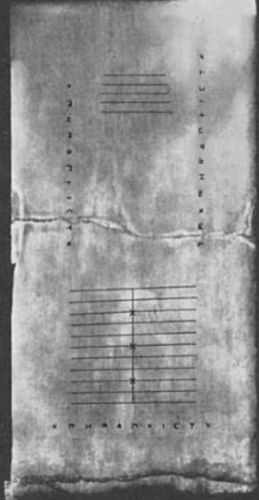
In Greece, the counting board became more archaeologically visible. The so-called Salamis Tablet, usually dated to the fourth or third century BCE, is among the most famous surviving examples. It is a large marble counting board marked with lines and symbols, showing that calculation could be organized on a formal surface rather than improvised entirely in sand, dust, or on a table. Its size and material also matter, because they suggest a calculating surface meant to endure, teach, display, or serve repeated use rather than a momentary arrangement of pebbles. The Greek term psēphoi, meaning pebbles or counters, points to the material character of reckoning, while later mathematical and philosophical traditions show that Greek number culture moved between abstraction and practice. The same civilization that produced Euclidean geometry and theoretical reflection also relied on practical instruments for accounts, exchange, and administrative calculation. Public finance, maritime commerce, temple treasuries, military payments, and market exchange all depended on procedures for moving between quantities, units, and obligations. In that world, the counting board was not an intellectual embarrassment beside “higher” mathematics. It was part of the numerical infrastructure that allowed daily life to function. That tension should not be treated as a contradiction. It is precisely the point. Abstract mathematics and practical arithmetic did not develop in isolation from one another. They occupied different social spaces, served different users, and required different kinds of training.
The Greek counting board also reveals why positional arrangement mattered even where numeral notation was not fully positional in the modern sense. A counter placed on one line or in one marked space could signify a different order of value from the same counter placed elsewhere. The intelligence of the device lay not in the object but in the system. Its surface disciplined the movement of the user’s hand, and that discipline transformed loose counters into a calculating method. This was especially useful in commercial and civic settings where numbers had to be handled quickly and publicly. A board could show a calculation in progress, making the process inspectable in a way that purely mental arithmetic could not. It could also be reset, repeated, and taught. The user did not merely know the answer; the user performed the answer through a sequence of visible movements. That made the counting board both a tool of computation and a tool of trust.
Rome inherited and expanded these practical traditions. Roman numerals were durable for inscription, record, and display, but they were poorly suited to extended written calculation. This did not make Roman society mathematically helpless. It meant that Roman calculation often depended on devices, procedures, and trained habits that worked alongside written numerals rather than through them alone. The Latin word calculus, meaning a small stone or pebble, preserves the physical basis of this practice and later gave English its word “calculation.” Roman counting boards and hand abaci used counters, grooves, lines, or movable markers to represent values in ordered places. Portable devices made calculation more convenient for merchants, officials, and others who needed numerical answers in contexts where speed and practicality mattered more than theoretical elegance. In a world of taxes, army pay, construction costs, estate management, weights, measures, and exchange, the ability to compute efficiently was not ornamental. It was part of the machinery of empire.
The Mediterranean counting board occupies a crucial middle place in the history of the abacus. It stands between the earlier Mesopotamian world of tokens, tablets, and administrative notation and the later bead-frame traditions of China, Japan, and Russia. Its history also helps prevent a mistaken view of ancient numeracy as either primitive or purely intellectual. Mediterranean societies used written records, trained scribes, formal mathematical texts, and physical calculating tools together. The board did not replace the mind, and it did not replace writing. It mediated between them. By turning pebbles into place values and surfaces into structured fields of operation, the counting board made arithmetic a practical art of movement, position, and memory. It showed that before calculation became mechanical, it was already technological in a deeper sense: it used objects to organize thought.
Place Value in Motion: How the Abacus Works
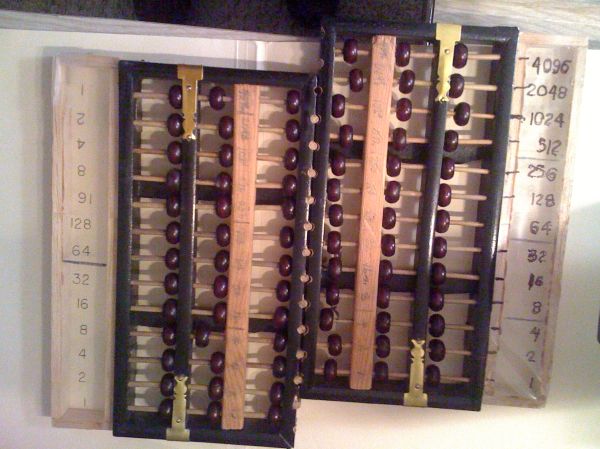
The abacus works because it turns numerical value into ordered movement. Its beads or counters are not meaningful in isolation, since their significance depends on where they are placed and how they are grouped. A single bead may represent one unit, five units, ten units, or a higher order of value depending on the design of the instrument and the position assigned to it. This is the central principle that links the abacus to the broader history of positional calculation. The device does not merely display number; it organizes number into a system of places. Units, tens, hundreds, thousands, fractions, or other orders of value can be separated spatially, making it possible to perform arithmetic through a sequence of visible and tactile transformations. The hand moves the beads, but the structure of the frame governs what those movements mean.
This is also why the abacus should not be understood as an automatic calculating machine. It does not “solve” arithmetic independently. Rather, it preserves the state of a calculation while the user performs learned procedures. In addition, beads are moved toward or away from a central beam, while place values are read across rods, wires, grooves, or columns. Addition and subtraction can be performed by entering and removing values, carrying or borrowing when a place exceeds its limit. Multiplication and division require more elaborate sequences, in which the user breaks a problem into repeated additions, subtractions, placements, and shifts of value. Advanced procedures, including square and cube roots, developed in some abacus traditions because the same basic system could be extended into more complex algorithms. The abacus stands between memory and automation. It does not replace the calculating mind, but it gives that mind a stable physical field in which to work.
The important cognitive feature of the abacus is that it reduces the need to remember every intermediate step. Written arithmetic can do this too, but the abacus does it through touch, position, and rhythm. A partial result remains visible in the arrangement of beads. A carry is not merely imagined; it is enacted by clearing one place and increasing the next. A mistake can often be seen because the spatial pattern fails to match the expected procedure. In that way, the device creates a disciplined feedback loop between eye, hand, and mind. The user sees the number, moves the number, and reads the consequence of that movement immediately. This makes calculation less dependent on fragile short-term memory and more dependent on trained procedure. The abacus is a kind of external working memory. It allows a user to offload part of the calculation into the device while retaining control over the operation. The same feature explains why the abacus has been so useful pedagogically. It teaches place value not as an abstract rule first encountered in notation, but as a physical relationship between neighboring positions. Number becomes something the learner can see, touch, move, and correct. A child using an abacus does not merely memorize that ten ones become one ten; the child performs the exchange, watches one position clear, and sees another position take on value. The concept is learned as action before it is fully formalized as notation.
Different abacus traditions arranged this logic in different forms. The Chinese suanpan, Japanese soroban, and Russian schoty do not look identical, nor do they encode values in exactly the same way, but they share the principle of structured positional representation. Their differences show that the abacus was not a single frozen object passed unchanged from one culture to another. It was a family of instruments adapted to local numerical systems, teaching practices, commercial habits, and traditions of calculation. What endured across these variations was the same deeper insight: arithmetic becomes easier when number is spatially ordered and physically manipulable. The abacus gave calculation a body. It made place value visible, gave procedure a rhythm, and transformed abstract quantity into motion.
China and the Suanpan: Calculation as Practice, Craft, and Cultural Knowledge
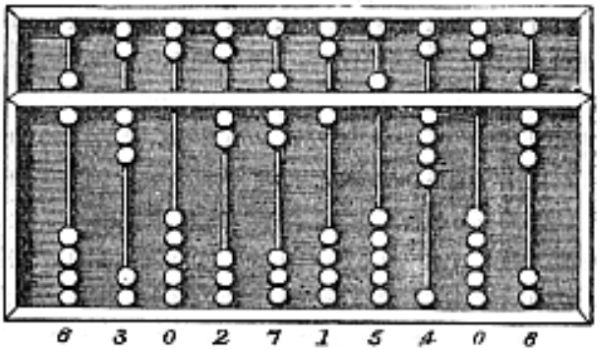
In China, the abacus became more than a calculating device. It became a disciplined practice, a commercial skill, an educational method, and eventually a form of cultural knowledge. The Chinese suanpan belongs to the broader history of counting boards and bead frames, but it also reflects the particular demands of Chinese administration, trade, pedagogy, and mathematical tradition. By arranging beads on rods within a framed structure, the suanpan gave users a portable and repeatable way to manage arithmetic through touch, sight, and procedure. Its importance cannot be separated from the social worlds in which calculation mattered: markets, shops, tax offices, family businesses, schools, and bureaucratic institutions. Like earlier counting boards, it made number spatial, but it also turned calculation into a craft that could be trained, refined, and transmitted across generations.
The suanpan is usually described as having two beads above a dividing beam and five beads below on each rod, although historical instruments and regional forms varied. This arrangement allowed the user to represent values efficiently while preserving the basic logic of place value. Beads above the beam generally carried a higher value than beads below it, and each rod represented a different place. The device joined physical manipulation to positional notation. A number was not written in ink or held only in memory; it was built bead by bead across the frame. Arithmetic proceeded through learned movements, with the user entering, clearing, carrying, borrowing, and transforming values according to established rules. The suanpan was not merely an object one possessed. It was a skill one practiced. Its meaning emerged through trained hands.
Chinese mathematical culture had long included sophisticated written traditions, algorithmic procedures, and practical problem-solving. Works such as The Nine Chapters on the Mathematical Art reveal a mathematical world deeply concerned with measurement, taxation, grain exchange, proportional distribution, surveying, labor, and state administration. The suanpan should be understood within this practical and institutional context. It served the same broader need that had shaped earlier counting technologies: the need to manage quantity in societies where economic and administrative life depended on accuracy. Yet the Chinese bead abacus also gained a distinctive place because it was adaptable to everyday use. A shopkeeper, merchant, accountant, or student could use it without needing the elaborate written apparatus of formal mathematics. It belonged to the desk and counter as much as to the schoolroom. In that sense, the suanpan helped democratize calculation, placing powerful arithmetic procedures in the hands of people whose work required speed, reliability, and repetition.
The cultural importance of the suanpan also lies in the way it joined calculation to bodily discipline. Users did not simply memorize answers; they learned sequences of movement. Fingers, eyes, memory, and spatial attention worked together until calculation became rhythmic and fluent. Instruction often involved formulas, verbal cues, practice problems, and repeated manipulation of beads, creating a pedagogy in which number was learned through coordinated action. This made the suanpan especially effective as a teaching instrument. It trained place value physically, but it also cultivated concentration, procedural memory, and visual order. The learner came to understand arithmetic not as a detached abstraction, but as a series of transformations that could be seen and felt. The device stood at the intersection of mathematics, craft, and habit. It made calculation reliable because it made calculation embodied.
This is why the modern recognition of Chinese zhusuan, or abacus calculation, as intangible cultural heritage is historically appropriate. The significance of the suanpan does not rest only in the wooden frame or the beads themselves, but in the knowledge system surrounding them. Procedures, teaching methods, mental habits, commercial practices, and cultural memory all form part of the tradition. The suanpan carried forward an ancient insight: the mind thinks more powerfully when it can arrange thought outside itself. Yet Chinese abacus practice also prepared the way for the later phenomenon of mental abacus calculation, in which trained users internalized the bead frame and manipulated it in imagination. The historical movement is striking. A physical tool first extended the calculating mind; then practice taught the mind to carry the tool within itself.
Japan and the Soroban: Refinement, Education, and Mental Discipline
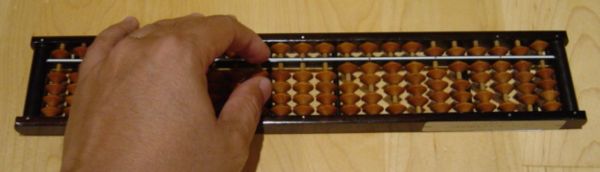
The Japanese soroban developed from the wider East Asian abacus tradition, but its historical importance lies in refinement. Where the Chinese suanpan preserved a form with two upper beads and five lower beads on each rod, the modern soroban eventually settled into a more economical arrangement, usually one upper bead and four lower beads. This reduction did not diminish the instrument. It made calculation faster, more efficient, and better suited to standardized instruction. The soroban represents a major stage in the history of the abacus because it shows how a calculating device could be improved not by adding complexity, but by removing unnecessary elements. Its elegance lay in compression. The same basic logic of place value remained, but the user’s movements became cleaner, quicker, and more disciplined.
The soroban reached Japan through cultural and commercial connections with China, with transmission often associated with the medieval and early modern periods. Once established, it became deeply connected to Japanese mercantile life. In the Tokugawa period, when cities, markets, credit networks, rice exchange, taxation, and commercial bookkeeping all expanded, reliable calculation became an everyday necessity. Merchants needed to reckon prices, weights, interest, debts, inventories, and profits with speed and accuracy. The soroban served that world well because it was portable, durable, inexpensive, and immediately practical. It belonged naturally to the shop counter, the accounting desk, and the training of apprentices. In a society where commercial activity depended on trust and repetition, the instrument provided a visible method for making numbers behave.
Japanese mathematical culture also gave the soroban an important educational role. Early modern Japan developed rich traditions of practical and recreational mathematics, including wasan, temple geometry problems, calculation manuals, and commercial arithmetic texts. The soroban fit into this world because it trained numerical fluency at the level of habit. Students did not merely learn answers; they learned procedures. Through repeated practice, the hands came to know sequences before the learner could always explain them abstractly. This gave the instrument a pedagogical power different from written arithmetic alone. The soroban made place value concrete, carrying and borrowing visible, and multi-step operations manageable. It trained students to move through numbers with order, rhythm, and confidence.
The mental discipline associated with the soroban is one of its most important contributions to the later history of calculation. Skilled users learned to see the instrument even when it was not physically present. The frame, rods, and beads became a visualized structure, and calculation could proceed through imagined movement. This mental abacus practice did not abandon the physical device; it depended on it. The mind internalized what the hand had first learned. A student who had moved beads thousands of times could begin to anticipate the instrument visually, converting tactile memory into spatial imagination. The imagined soroban then functioned as an inner calculating field, preserving place values, carries, and intermediate results without requiring the physical frame. This was not simply memorization in the ordinary sense. It was the transfer of a trained external procedure into mental imagery. The soroban became a bridge between embodied arithmetic and mental calculation. Its training cultivated concentration, visual-spatial memory, procedural speed, and attentional control. The resulting skill could appear almost magical to observers, but historically it grew from disciplined repetition: bead by bead, rod by rod, operation by operation.
The Japanese soroban belongs not merely to the history of tools, but to the history of education and cognition. It shows that calculation is never only about reaching an answer. It is also about forming habits of attention, memory, and ordered action. The simplified structure of the soroban sharpened those habits by reducing the physical field to its most efficient form. Its endurance in modern abacus education, even after electronic calculators became common, reflects this deeper value. A calculator gives an answer; the soroban trains a way of thinking. That distinction explains why the instrument survived as a teaching device long after it ceased to be necessary for ordinary commercial arithmetic. It remained useful because it taught the mind to organize number.
Russia, Europe, and the Schoty: Persistence in the Age of Written Arithmetic
The rise of written arithmetic did not immediately end the history of the abacus. In Europe, counting boards, reckoning tables, and counters continued to serve merchants, clerks, tax officials, and household accountants long after written numerals became more familiar. This persistence is important because it complicates the usual story of progress from primitive tools to superior notation. Hindu-Arabic numerals eventually transformed European calculation by making written algorithms more efficient, especially when joined to positional decimal notation and the zero. Yet older methods did not vanish simply because a new system existed. People trusted familiar tools. Institutions trained clerks in established procedures. Markets required speed and reliability more than theoretical elegance. The abacus and counting board survived because they remained useful in the practical world where calculation had to be performed under pressure.
Medieval and early modern Europe inherited both Roman traditions of counter-based reckoning and newer mathematical influences from the Islamic world. The spread of Hindu-Arabic numerals into western Europe, especially through translations, commercial manuals, and the work of mathematicians such as Leonardo of Pisa, commonly known as Fibonacci, created a long contest between different calculating cultures. The so-called abacists relied on boards and counters, while algorists promoted written computation using Hindu-Arabic numerals. This opposition should not be exaggerated into a clean battle between ignorance and enlightenment. Counting boards were not irrational holdovers. They were practical technologies embedded in commercial and administrative routines. Written algorithms required schooling, paper, ink, notation, and confidence in unfamiliar symbols. A counting board, by contrast, allowed trained users to arrange values visibly and conduct operations with methods already understood in counting houses, shops, and courts.
The medieval counting board also fitted the monetary and metrological complexity of European life. Calculation was not always a matter of neat decimal units. Pounds, shillings, pence, local measures, weights, rents, tithes, and customary dues required users to move among mixed systems. A board with marked lines or spaces could be adapted to these irregular relationships more easily than a purely decimal written algorithm. Counters could represent different units according to placement, and the user could move between levels of value without rewriting every stage. In this respect, the European reckoning table preserved the same basic insight seen in earlier abacus traditions: place gives meaning to the counter. That principle made the device especially valuable in societies where money of account, coinage, and local measures did not always align neatly with one another. A merchant might reckon in one system, settle in another, and record the transaction in still another form. The counting board helped bridge these differences by allowing value to be rearranged physically before it was fixed in writing. The device did not need to resemble the Chinese suanpan or Japanese soroban to share their deeper logic. It organized value spatially and let the user manipulate relationships that were otherwise difficult to hold in memory.
The eventual success of written arithmetic in Europe came from institutional change as much as mathematical superiority. Commercial schools, printed arithmetic books, expanding bureaucracies, and the wider normalization of Hindu-Arabic numerals gradually made written calculation more accessible. Printed manuals taught merchants and apprentices how to compute with numerals rather than counters, while bookkeeping practices increasingly favored written records that could preserve not only results but procedures. The rise of double-entry bookkeeping in Italian commercial culture further strengthened the authority of written calculation, since accounts had to be recorded, checked, and transmitted across firms and generations. Even so, the transition was slow. For centuries, written numerals and counting boards coexisted. A clerk might record a final result in writing after working it out with counters, just as earlier scribes could use material tools before committing quantities to tablets or documents. The shift was less a sudden replacement than a reorganization of trust.
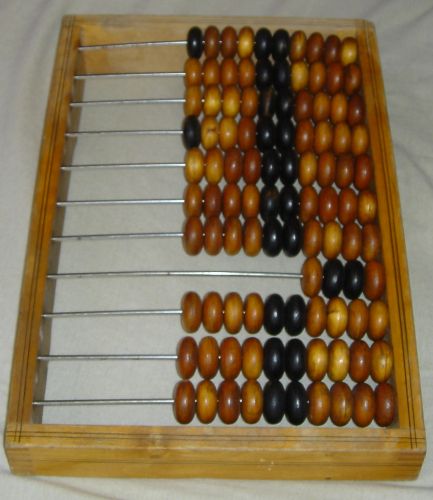
Russia followed a different path, and the schoty became one of the most striking examples of abacus persistence in the modern world. The Russian schoty is usually arranged horizontally, with beads sliding along wires within a frame. Unlike the suanpan and soroban, which use a beam to divide beads into upper and lower groups, the schoty generally places ten beads on each wire, with visual grouping helping the user distinguish values quickly. Its form suited decimal reckoning, commercial arithmetic, and the rapid calculation of sums in shops, offices, and markets. The arrangement made addition and subtraction especially direct, since values could be entered and cleared with quick lateral movements. Its physical layout also made it easy to read a number at a glance, particularly when the beads were visually grouped to break a row into recognizable patterns. The schoty remained widely used in Russia and the Soviet Union into the twentieth century, not because users lacked access to modern arithmetic, but because the device was efficient, robust, and culturally familiar. It could sit on a counter, survive heavy use, require no electricity, and produce results rapidly in the hands of someone properly trained. In everyday commercial settings, those virtues mattered more than novelty. A tool that was cheap, durable, fast, and trusted had no reason to disappear simply because newer forms of calculation existed beside it.
The European counting board and the Russian schoty show that the history of calculation cannot be reduced to technological obsolescence. Tools survive when they fit habits, institutions, bodies, and work environments. Written arithmetic eventually dominated European schooling and administration, while electronic calculators later transformed everyday computation across the world. Yet the older devices reveal something modern instruments often hide: calculation is a practiced relationship between mind, hand, symbol, and trust. The schoty persisted because it made number visible and because skilled users could operate it with speed born of repetition. In that sense, Russia’s bead frame and Europe’s reckoning tables belong to the same larger history as Mesopotamian counters and Mediterranean boards. They remind us that calculation did not become modern simply by becoming written. It became modern through a long negotiation between old tools and new systems, between visible action and abstract notation.
Commerce, Administration, and the Social Life of Calculation

The abacus and its related counting devices mattered because calculation was never confined to mathematicians. It lived in markets, storehouses, tax offices, ports, temples, palaces, workshops, counting houses, and schools. Wherever goods moved, labor was organized, debts were recorded, or authority demanded tribute, numbers had to be produced in usable form. This social setting is essential to understanding the abacus. It was not simply a clever instrument for performing arithmetic; it was part of the infrastructure of economic life. A trader calculating profit, a clerk checking rations, a steward measuring grain, or a tax official assessing obligations all faced the same practical problem: numbers had to be made accurate enough to trust and fast enough to act upon. Counting tools gave arithmetic a public, repeatable, and inspectable form.
In ancient administrative societies, calculation helped transform resources into records and records into power. Mesopotamian tablets, Egyptian accounts, Greek treasuries, Roman tax systems, and later imperial bureaucracies all depended on the ability to connect quantities with obligations. A field was not only land; it was assessable acreage. A flock was not only animals; it was taxable wealth. A storehouse was not only grain; it was inventory, ration, surplus, and redistribution. The abacus and counting board belonged to this world because they helped officials and clerks move between physical goods and numerical claims. They made it possible to calculate what was owed, what had been delivered, what remained in reserve, and what could be demanded. This mattered because administration depends on translation. Grain becomes ration, labor becomes quota, land becomes taxable unit, and time becomes obligation. Counting devices helped perform those translations in ways that could be checked and repeated. They also helped preserve the distance between the person who produced wealth and the institution that claimed a share of it. In that sense, calculation was never neutral. It helped states see society through number, and that numerical vision could support both order and extraction.
Commerce gave the abacus another kind of social importance. Markets required quick calculation under conditions of exchange, bargaining, uncertainty, and trust. Merchants needed to reckon prices, weights, discounts, interest, shares, commissions, currency conversions, and profit margins. These were not occasional or specialized tasks, but the daily arithmetic of economic survival. A seller had to know whether a transaction produced gain or loss; a buyer had to know whether a price was fair; a lender had to calculate return; a partner had to determine division; a shipper had to compare quantity, distance, and risk. Speed mattered in these settings, but so did visibility. A calculation performed with counters or beads could be followed, checked, and repeated. This mattered especially where buyer and seller did not share equal trust or where transactions depended on customary units and local measures. The abacus did not eliminate disputes, but it provided a shared procedure for arriving at a number. In the hands of a trained user, it made arithmetic look orderly, controlled, and authoritative. The physical motion of beads or counters gave calculation a kind of social performance: the result appeared not as a private guess, but as the outcome of a recognizable method. The device helped turn commerce into something more than negotiation; it helped make exchange calculable.
The same practical value made counting devices central to education and apprenticeship. Mathematical knowledge was not transmitted only through formal treatises or elite schools. It passed through shop counters, family businesses, scribal training, commercial manuals, and repeated exercises. A novice learned not only what numbers meant, but how numbers behaved when entered, shifted, carried, borrowed, multiplied, or divided. The abacus was especially powerful in this setting because it connected procedure to gesture. Place value, which can seem abstract when taught only through notation, became visible through the arrangement of beads or counters. Carrying and borrowing became physical exchanges between neighboring positions. This gave learners a way to internalize arithmetic through disciplined repetition. Education was not merely the memorization of rules. It was the formation of numerical habits.
The social life of calculation also depended on trust. Numbers could authorize payments, settle debts, justify taxes, measure wages, divide inheritances, and determine profit or loss. Because numbers carried consequences, the procedures that produced them had to be credible. Counting boards and abaci helped establish that credibility by making calculation external. A person could see the arrangement of counters, watch the movement of beads, and recognize whether a procedure was being followed. This did not make calculation immune from manipulation, but it did make arithmetic less dependent on an unseen mental process. In public or semi-public settings, visible calculation could function as a form of accountability. It turned reckoning into something that could be witnessed. That is one reason counting devices endured across cultures with very different numeral systems and administrative traditions. They helped make numbers socially acceptable.
The abacus belongs to a history larger than mathematics alone. It is part of the history of labor, government, commerce, education, and trust. Its significance lies not simply in the operations it enabled, but in the relationships it organized: between merchant and customer, state and taxpayer, teacher and student, clerk and institution, memory and record. By giving number a visible and manipulable form, the abacus helped societies manage complexity before calculation disappeared into machines. It stood at the meeting point of cognition and social order. The mind needed help to calculate, but society also needed procedures that made calculation believable. The abacus answered both needs at once, which is why it remained useful for so long and why its history reaches far beyond the object itself.
Counting Beyond the Mind: Mental Abacus and the Internalization of the Tool
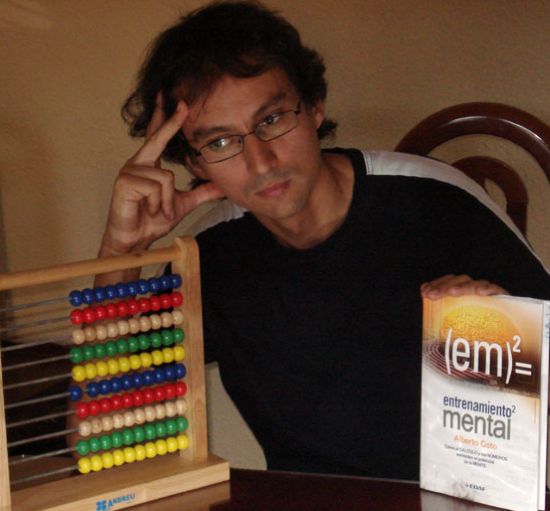
The mental abacus represents one of the most striking reversals in the history of calculation. The physical abacus first arose as a way to place arithmetic outside the mind, giving users a visible and manipulable structure that could preserve intermediate values and reduce the burden on memory. Mental abacus practice then turns that process inward. After long training with a physical bead frame, skilled users learn to visualize the instrument and manipulate imagined beads without touching the device itself. Calculation becomes internal again, but it is not the same as unaided mental arithmetic. The mind has absorbed the structure of the tool. What began as an external aid becomes an internal architecture for thought.
This internalization depends on the body. Mental abacus ability does not appear simply because a learner understands the concept of place value. It develops through repeated, disciplined movement: entering numbers, clearing rods, carrying, borrowing, shifting, and correcting bead patterns over and over again. The fingers learn sequences before those sequences become fully mental. Physical training creates a visual-spatial template that can later be summoned without the object. The user no longer needs the wooden frame because the frame has been learned as a pattern of attention. The imagined abacus preserves place values, intermediate results, and procedural order, allowing the trained calculator to move through arithmetic with speed and stability. The tool disappears from view, but not from cognition.
This is why mental abacus calculation should not be confused with ordinary memorization. A person performing mental abacus work is not merely recalling multiplication tables or storing a long chain of digits through verbal rehearsal. The operation is often visual and spatial. Beads appear in mental imagery; values occupy imagined rods; movements transform the configuration; and the answer emerges from reading the final pattern. Researchers studying abacus-based mental calculation have emphasized this visual representational character, showing that skilled users can rely on mental images of exact number rather than conventional symbolic or verbal strategies alone. The historical implication is profound. The abacus did not simply help people calculate faster while it was physically present. It trained users to create a durable mental workspace in which number could be manipulated as if it still had shape and position.
The phrase “counting beyond the mind” carries two meanings. First, the abacus allowed people to count beyond the limits of unaided memory by placing number into an external device. Second, mental abacus practice allowed trained users to count beyond ordinary mental arithmetic by importing that device into imagination. The phrase also captures the paradox at the center of the abacus itself: calculation becomes more mental precisely because it first became material. The mind learns to exceed its ordinary limits by practicing with a structured object, then carries that structure forward after the object is gone. This double movement helps explain why abacus traditions have remained educationally powerful even in the age of calculators. A calculator produces answers, but it does not necessarily train the user to organize number internally. Mental abacus instruction, by contrast, aims to cultivate a structured way of seeing quantity. It turns arithmetic into a disciplined visual practice, one that joins memory, attention, space, rhythm, and learned procedure. The result is not merely faster computation, although speed can be impressive. It is a different relationship to number, in which quantity is no longer only written, spoken, or remembered, but arranged within an internal field that has been shaped by practice.
The mental abacus also brings the history of calculation into the history of cognition. It shows that tools do not merely assist the mind from the outside; they can reshape what the mind learns to do. The trained calculator does not return to a pre-technological state when the physical frame is removed. Instead, the person carries forward a tool-shaped habit of thought. This is the deeper significance of the abacus as a cognitive technology. Across centuries, it helped human beings externalize calculation into objects, stabilize number through position, and eventually internalize that structure as mental imagery. The final stage is not the disappearance of the tool, but its transformation into practice. The abacus survives in the trained mind as motion without beads, structure without wood, and calculation without visible machinery.
Neurological and Educational Effects: Memory, Attention, and Visualization
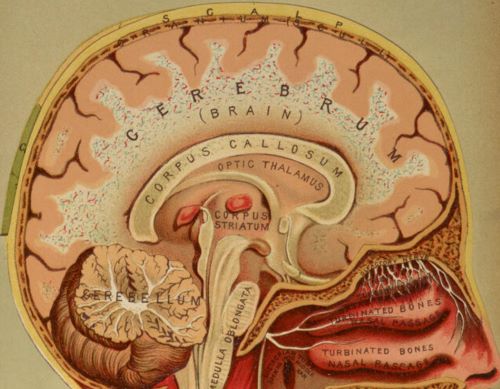
Modern research on abacus-based mental calculation gives scientific language to what earlier teachers and practitioners understood through experience: repeated abacus training can change how learners organize number. The strongest findings should be stated carefully. Abacus practice does not magically improve every part of intelligence, nor does it make calculation effortless without training. Its effects appear most clearly in domains closely related to the demands of the practice itself, especially visual-spatial working memory, numerical representation, attention, and procedural control. This makes sense historically. The abacus has always been a tool for arranging quantity in space. When learners spend years moving beads, imagining rods, and preserving intermediate values, they are repeatedly exercising the same systems that allow them to see, hold, and transform structured patterns. The educational significance lies in that specificity. Abacus training is powerful not because it bypasses ordinary learning, but because it gives the learner a highly organized environment in which memory, movement, and visualization reinforce one another. It turns arithmetic into repeated spatial practice, and repeated spatial practice can become a durable cognitive habit.
The role of working memory is especially important. Ordinary mental arithmetic often depends heavily on verbal rehearsal, memorized facts, and symbolic manipulation. Mental abacus calculation, by contrast, gives the learner a spatial image in which quantities can be placed and altered. A 2019 study in The Journal of Neuroscience found that abacus-based mental calculation training enhanced visual-spatial working memory in children and was associated with altered activation in frontal, parietal, and occipital brain regions. That does not mean every child trained on an abacus will show the same degree of improvement, but it supports the broader interpretation that abacus training works by strengthening the mental handling of spatially organized numerical information. The user learns not only to remember a number, but to remember where that number is in an imagined structure.
Attention is another major component of abacus learning. Calculation on a bead frame requires the learner to sustain focus across several steps, inhibit premature responses, monitor errors, and maintain the correct position of values while the operation changes. These are not passive mental acts. They require discipline, pacing, and correction. Some research has associated abacus training with improvements in response inhibition, although the evidence should be treated as suggestive rather than final. A 2015 case-control study found fewer commission errors and better arithmetic ability among children with abacus training, while noting that further research was needed to confirm the relationship between abacus practice and response inhibition. That caution matters. The educational value of the abacus is real, but it should not be inflated into a universal claim about attention. Its more defensible significance is that it gives attention something structured to do.
Visualization may be the most distinctive cognitive feature of advanced abacus use. A skilled mental-abacus user does not merely “think hard” about numbers. The user sees an internalized device. Beads move in imagination; rods hold place values; the result appears as a configuration that can be read. This connects the neurological effects of abacus training to the long historical argument presented here. The abacus began as an external frame for calculation, but training can make that frame internal. In that process, visualization becomes more than a memory aid. It becomes the medium through which calculation happens. The learner is not simply storing a final answer but maintaining a changing mental object whose structure mirrors the physical instrument. A 2020 review in Frontiers in Neuroscience concluded that abacus-based mental calculation has potential benefits for mathematics, working memory, and numerical magnitude processing, while also reviewing evidence for changes in brain systems associated with visual-spatial and numerical processing. The review’s cautious language is useful. It recognizes promise without turning abacus education into miracle rhetoric. The most responsible conclusion is that abacus training appears to strengthen abilities closely tied to its own demands: seeing number spatially, maintaining ordered configurations, shifting attention between places, and transforming values through learned procedure.
Educationally, the abacus remains valuable because it teaches number as structure rather than answer-getting alone. A calculator can deliver a result instantly, but it does not necessarily reveal why place value matters, what carrying means, or how intermediate quantities relate to one another. The abacus slows those processes down before speeding them up. It allows the learner to see arithmetic as transformation: one position clears, another increases, a value shifts, a pattern changes. With practice, those transformations become faster and more automatic, but they remain rooted in an intelligible structure. This is the deeper educational lesson of abacus training. It joins memory to movement, attention to sequence, and visualization to number. It preserves one of the oldest insights in the history of calculation: the mind often thinks best when thought first takes form outside itself.
The Abacus in the Age of the Calculator
The following video from “TheoryFY” covers the history of the abacus:
The arrival of mechanical calculators, electronic calculators, and eventually digital computers changed the practical role of the abacus, but it did not erase its historical significance. In many settings, the calculator could produce answers faster, with less training, and with fewer visible steps. That shift mattered enormously for business, engineering, schooling, science, and everyday arithmetic. Yet the replacement was not absolute. The calculator automated operations that the abacus required users to perform, but automation also changed the user’s relationship to number. With an abacus, calculation remains visible as a process. With a calculator, the process often disappears behind keys, circuits, and screens. The answer arrives, but the structure that produced it may remain hidden.
This difference explains why the abacus survived most strongly in education and mental calculation rather than in ordinary commercial bookkeeping. Once inexpensive electronic calculators became widely available, few merchants needed a bead frame for daily arithmetic. Yet teachers and abacus instructors continued to value the instrument because it trains abilities that calculators do not necessarily cultivate. It teaches place value physically, links number to movement, and requires the learner to understand operations as transformations rather than as button presses. The abacus also provides a tactile bridge between concrete quantity and abstract notation. For children especially, it can make the logic of carrying, borrowing, grouping, and positional value visible before those ideas become purely symbolic. In that sense, its usefulness did not vanish when machines became faster. It changed from computational necessity to educational discipline.
The modern abacus also survives as cultural heritage. Chinese zhusuan, Japanese soroban, and other abacus traditions preserve more than a tool; they preserve ways of teaching, practicing, and imagining number. Their continued use in competitions, classrooms, cultural programs, and mental arithmetic training shows that older calculating technologies can remain meaningful even after losing economic dominance. This persistence is not mere nostalgia. The abacus carries a memory of calculation as embodied knowledge, where intelligence is trained through coordinated hand movement, visual attention, rhythm, correction, and repetition. It also reminds modern users that numerical fluency is not identical to access to a machine. A calculator can be held by anyone, but abacus skill has to be cultivated. That cultivation gives the abacus a social and pedagogical meaning that electronic devices rarely possess. It implies discipline, apprenticeship, patience, and the gradual shaping of mental habits. In competitions and demonstrations, the speed of trained abacus users can seem astonishing precisely because the calculation appears to come from within the person rather than from an external machine. Yet that inner speed is itself the product of long engagement with a material instrument. The abacus occupies an unusual place in modern culture: it is both an old technology and a training system for capacities that remain recognizably human. That distinction gives the abacus its modern symbolic force: it represents calculation as practice, not just output.
In the age of the calculator, then, the abacus became less a rival technology than a corrective one. It exposes what modern convenience can obscure. Calculation is not only the production of answers; it is also the formation of habits, procedures, and mental structures. The calculator made arithmetic faster and more accessible, but the abacus still teaches how number is built. Its survival points back to deep history, from pebbles and counting boards to mental imagery and neurological training. The abacus began as an external support for the mind, then became a cultural and educational instrument, and finally endured as a reminder that thinking itself often depends on tools. Even when electronic devices dominate calculation, the abacus remains one of the clearest examples of how a simple object can teach human beings to see, move, and internalize number.
Conclusion: The Tool That Taught the Mind to See Number
The history of the abacus is not the history of a simple device gradually replaced by better machines. It is the history of a relationship between the hand, the eye, the mind, and the social worlds that required number to become reliable. From Mesopotamian counters and administrative tablets to Mediterranean counting boards, Chinese suanpan, Japanese soroban, Russian schoty, and modern mental-abacus training, the same essential pattern appears again and again. Human beings made number visible because memory alone was not enough. They gave quantity a place, a surface, a rhythm, and a procedure. The abacus belongs to this larger history of externalized thought, where tools did not merely assist intelligence but helped define how intelligence worked.
Its importance lies in the way it transformed abstraction into action. A number on an abacus is not simply written down. It is built, shifted, corrected, carried, borrowed, and read through position. That physicality made the abacus useful in markets, treasuries, tax offices, schools, and shops, but it also made it intellectually powerful. It taught place value as something seen and enacted before it was fully formalized in notation. It reduced the burden on memory by preserving intermediate stages in space. It allowed calculation to be performed publicly and checked through recognizable movement. It made arithmetic both practical and trustworthy. The abacus did not separate mind from body; it showed that disciplined bodily practice could become a form of thought.
The later development of mental abacus calculation reveals the full force of that achievement. At first, the tool extended the mind by holding number outside it. With training, the mind learned to carry the tool inside itself. The imagined bead frame became a mental workspace, preserving the structure of the physical instrument even after the object disappeared from the hand. This internalization is one of the most revealing facts in the history of calculation. It shows that tools can become habits, that gestures can become images, and that material practices can reshape cognition. The abacus was never only a predecessor to the calculator. It was a teacher of visualization, attention, sequence, and numerical structure.
In the age of electronic calculation, the abacus remains valuable precisely because it makes visible what modern devices often conceal. A calculator gives an answer, but the abacus shows how number moves. It reminds us that calculation is not only speed, output, or convenience. It is also training, trust, memory, discipline, and imagination. Modern machines have made arithmetic easier to access, but they have also made the process of arithmetic easier to ignore. The abacus resists that disappearance. It keeps calculation connected to movement, structure, and human agency. Its endurance in classrooms, competitions, cultural traditions, and mental-training practices shows that old tools can survive not because they outperform new machines in every practical task, but because they teach something those machines often bypass. The oldest calculating technologies were not primitive failures on the way to modernity; they were profound adaptations to the limits and possibilities of the human mind. The abacus endured because it did something no machine fully replaces. It taught human beings to see number, and in seeing number, to think beyond the unassisted mind.
Bibliography
Affiliate disclosure: Amazon links on this site are paid links. As an Amazon Associate I earn from qualifying purchases.
- Baxandall, Michael. Painting and Experience in Fifteenth-Century Italy: A Primer in the Social History of Pictorial Style. 2nd ed. Oxford: Oxford University Press, 1988.
- Chemla, Karine, and Guo Shuchun. Les Neuf Chapitres: Le classique mathématique de la Chine ancienne et ses commentaires. Paris: Dunod, 2004.
- Chrisomalis, Stephen. “The Cognitive and Cultural Foundations of Numbers.” In The Oxford Handbook of the History of Mathematics, edited by Eleanor Robson and Jacqueline Stedall, 495-518. Oxford: Oxford University Press, 2009.
- Fernandes, Luis. “The Abacus: A Brief Introduction.” Toronto Metropolitan University (August 30, 2000).
- Flewelling, Robert W. “The Abacus and our Ancestors.” The Arithmetic Teacher 6:2 (1960), 104-106.
- Frank, Michael C., and David Barner. “Representing Exact Number Visually Using Mental Abacus.” Journal of Experimental Psychology: General 141:1 (2012), 134–149.
- Friberg, Jöran. “Three Thousand Years of Sexagesimal Numbers in Mesopotamian Mathematical Texts.” Archive for History of Exact Sciences 73 (2019), 183–216.
- Goody, Jack. The Logic of Writing and the Organization of Society. Cambridge: Cambridge University Press, 1986.
- Hatano, Giyoo, and Kayoko Osawa. “Digit Memory of Grand Experts in Abacus-Derived Mental Calculation.” Cognition 15:1-3 (1983), 95–110.
- Herodotus. Histories. Translated by Robin Waterfield. Oxford: Oxford University Press, 1998.
- Høyrup, Jens. Lengths, Widths, Surfaces: A Portrait of Old Babylonian Algebra and Its Kin. New York: Springer, 2002.
- Hsiung, Hansun. “Woman, Man, Abacus: A Tale of Enlightenment.” Harvard Journal of Asiatic Studies 72:1 (2012), 1-42.
- Ifrah, Georges. The Universal History of Numbers: From Prehistory to the Invention of the Computer. Translated by David Bellos, E. F. Harding, Sophie Wood, and Ian Monk. New York: Wiley, 2001.
- Imhausen, Annette. Mathematics in Ancient Egypt: A Contextual History. Princeton: Princeton University Press, 2016.
- Kojima, Takashi. The Japanese Abacus: Its Use and Theory. Rutland, VT: Charles E. Tuttle, 1954.
- Lang, Mabel. “Herodotos and the Abacus.” Hesperia: The Journal of the American School of Classical Studies at Athens 26:3 (1957), 271-288.
- Martzloff, Jean-Claude. A History of Chinese Mathematics. Translated by Stephen S. Wilson. Berlin: Springer, 1987.
- Menninger, Karl. Number Words and Number Symbols: A Cultural History of Numbers. Translated by Paul Broneer. Cambridge, MA: MIT Press, 1969.
- Morrison, Philip, and Emily Morrison. Charles Babbage and His Calculating Engines. New York: Dover Publications, 1961.
- Na, Ki-Su, Sun-Mi Lee, Hyun-Kook Lim, Jin-Woo Park, and Dai-Jin Kim. “Association Between Abacus Training and Improvement in Response Inhibition: A Case-Control Study.” Clinical Psychopharmacology and Neuroscience 13:2 (2015), 163–167.
- Needham, Joseph. Science and Civilisation in China, Volume 3: Mathematics and the Sciences of the Heavens and the Earth. Cambridge: Cambridge University Press, 1959.
- Nissen, Hans J., Peter Damerow, and Robert K. Englund. Archaic Bookkeeping: Early Writing and Techniques of Economic Administration in the Ancient Near East. Chicago: University of Chicago Press, 1993.
- Proust, Christine. “The Sexagesimal Place-Value Notation and Abstract Numbers in Mesopotamian Mathematics.” Historia Mathematica 60 (2022), 22–59.
- Robson, Eleanor. Mathematics in Ancient Iraq: A Social History. Princeton: Princeton University Press, 2008.
- Robson, Eleanor, and Jacqueline Stedall, eds. The Oxford Handbook of the History of Mathematics. Oxford: Oxford University Press, 2009.
- Rowland, Ingrid D. “Abacus and Humanism.” Renaissance Quarterly 48:4 (1995), 695-727.
- Schmandt-Besserat, Denise. Before Writing, Volume I: From Counting to Cuneiform. Austin: University of Texas Press, 1992.
- Shen Kangshen, John N. Crossley, and Anthony W.-C. Lun. The Nine Chapters on the Mathematical Art: Companion and Commentary. Oxford: Oxford University Press, 1999.
- Smith, David Eugene, and Louis Charles Karpinski. The Hindu-Arabic Numerals. Boston: Ginn and Company, 1911.
- Smith, David Eugene, and Yoshio Mikami. A History of Japanese Mathematics. Chicago: Open Court, 1914.
- Smithsonian Institution. “The Abacus and the Numeral Frame.” Smithsonian Institution.
- Stigler, James W. “Mental Abacus: The Effect of Abacus Training on Chinese Children’s Mental Calculation.” Cognitive Psychology 16:2 (1984), 145–176.
- Sugden, Keith F. “A History of the Abacus.” The Accounting Historians Journal 8:2 (1981), 1-22.
- Swetz, Frank J. Capitalism and Arithmetic: The New Math of the 15th Century. La Salle, IL: Open Court, 1987.
- Tajima, Yumi. “The Soroban: A Sino-Japanese Mathematical Connection.” Japan SPOTLIGHT, Japan Economic Foundation, 2018.
- UNESCO. “Chinese Zhusuan, Knowledge and Practices of Mathematical Calculation Through the Abacus.” Intangible Cultural Heritage of Humanity, 2013.
- Wang, Chen, Minjia Geng, Tifei Yuan, and Yixuan Liu. “A Review of the Effects of Abacus Training on Cognitive Functions and Neural Systems in Humans.” Frontiers in Neuroscience 14 (2020).
- Wang, Chen, Tianyong Xu, Fengji Geng, Yuzheng Hu, Yunqi Wang, Hong Li, and Feiyan Chen. “Training on Abacus-Based Mental Calculation Enhances Visuospatial Working Memory in Children.” The Journal of Neuroscience 39:33 (2019), 6439–6448.
- Wang, Yanjie, Feiyan Chen, Hong Li, and Tianyong Xu. “Numerical Processing Efficiency Improved in Experienced Mental Abacus Children.” Cognition 127:2 (2013), 149–158.
- Yeldham, Florence A. The Story of Reckoning in the Middle Ages. London: George G. Harrap, 1926.
- Yoshida, Mitsuyoshi. Jinkōki. 1627. Reprint, Tokyo: Iwanami Shoten, 1977.
Originally published by Brewminate, 05.07.2026, under the terms of a Creative Commons Attribution-NonCommercial-NoDerivatives 4.0 International license.
About the Author