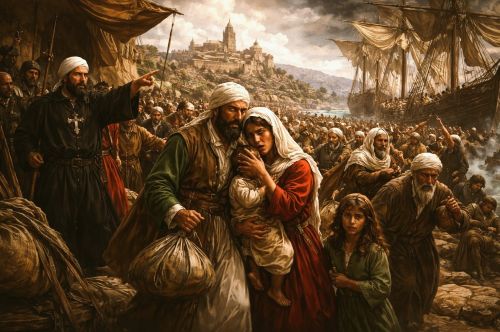
Spain’s 1609 expulsion of the Moriscos reveals how religious suspicion, imperial rivalry, and political fear transformed converted minorities into perceived threats.

By Matthew A. McIntosh
Public Historian
Brewminate
Introduction: Religion, Empire, and Suspicion in Early Modern Spain
The expulsion of the Moriscos between 1609 and 1614 was a state-driven removal of forcibly converted Muslims from Spain, rooted in fears of religious dissent and political instability. By the early seventeenth century the Spanish monarchy governed a vast empire that stretched across Europe, the Mediterranean, and the Americas. Yet the stability of this empire depended not only on military power but also on the crown’s ability to maintain internal cohesion within a religiously defined state. In the aftermath of the Reconquista and the unification of Castile and Aragon under Ferdinand II and Isabella I, Spanish political identity became increasingly intertwined with Catholic orthodoxy. Religious uniformity was perceived by church and state authorities as essential to the preservation of political stability and the legitimacy of royal authority.
The origins of the Morisco population lay in the final stages of the Christian conquest of Muslim-ruled Iberia. When the Kingdom of Granada surrendered to the Catholic Monarchs in 1492, the initial terms of capitulation promised Muslim inhabitants the right to maintain their religion and cultural practices. The Treaty of Granada allowed Muslim communities to continue practicing Islam, retain their mosques, and preserve legal customs rooted in Islamic tradition. In the years immediately following the conquest, these guarantees appeared to offer a framework for coexistence between Christian rulers and Muslim subjects within the newly expanded Spanish monarchy. However, pressures from ecclesiastical authorities and segments of the Christian population soon challenged the durability of these arrangements. Missionary campaigns, growing suspicions about the sincerity of Muslim accommodation, and broader concerns about religious unity within a Catholic monarchy led to increasing demands for conversion. By the early sixteenth century Spanish authorities had imposed forced conversions on the remaining Muslim population of Castile and later of Aragon. These converts and their descendants became known as Moriscos, legally classified as Christians but suspected by contemporaries of secretly maintaining Islamic beliefs and customs. Their ambiguous status created a persistent tension within Spanish society, where outward conformity to Christianity coexisted with widespread doubts about the sincerity of conversion, and cultural markers such as language, dress, and dietary habits were frequently interpreted as evidence of hidden religious loyalty.
During the sixteenth century this suspicion intensified as Spain became deeply involved in Mediterranean conflicts with Muslim powers. The Spanish monarchy confronted both the expanding Ottoman Empire and the maritime networks of North African corsair states that operated along the southern Mediterranean coast. In this geopolitical environment Spanish officials increasingly feared that Morisco communities might serve as potential allies or informants for Spain’s external enemies. These anxieties were reinforced by episodes such as the Morisco rebellion in the Alpujarras between 1568 and 1571, which appeared to confirm official fears that religious difference could translate into political rebellion during periods of international tension. Morisco identity became increasingly associated in the minds of Spanish authorities with the possibility of internal subversion.
By the early seventeenth century these accumulated fears converged in the decision of King Philip III and his advisers to expel the Morisco population from Spain. Between 1609 and 1614 hundreds of thousands of Moriscos were forced to leave their homes and transported across the Mediterranean to North Africa and other regions. The policy was justified by claims that Moriscos could not be trusted to remain loyal to the Spanish monarchy in a time of ongoing conflict with Muslim states. The expulsion illustrates how religious identity, imperial rivalry, and political suspicion became deeply intertwined in early modern Spain. Examining this episode provides a powerful case study of how international conflict could transform religious minorities into perceived threats to the security of the state.
From Conquest to Conversion: The Making of the Morisco Population

The creation of the Morisco population resulted from the final phase of the Christian reconquest of Iberia. When the Kingdom of Granada fell to the forces of Ferdinand II of Aragon and Isabella I of Castile in 1492, it marked the end of nearly eight centuries of Muslim political presence in parts of the Iberian Peninsula. The conquest represented not only a military victory but also the symbolic completion of a long campaign through which Christian kingdoms gradually replaced Muslim political authority across the peninsula. For the Catholic Monarchs, the incorporation of Granada presented both an opportunity and a challenge. The region contained a large and culturally cohesive Muslim population that had lived under Islamic rule for generations. Integrating these communities into a Christian monarchy required balancing political stability with growing demands from religious authorities for confessional unity. The surrender agreement, commonly known as the Treaty of Granada, initially established a framework intended to ease the transition from Muslim rule to Christian sovereignty. Muslim inhabitants were permitted to continue practicing Islam, maintain mosques, and preserve aspects of their legal and cultural traditions. Such guarantees reflected a pragmatic approach by the new Christian rulers, who sought to stabilize the region without provoking unrest among the large Muslim population that remained in the former Nasrid kingdom.
Despite these early assurances, the policy of religious tolerance proved short-lived. By the late 1490s pressures from church leaders and royal officials began to push for the conversion of Muslim communities to Christianity. Missionary campaigns intensified, most notably under the influence of Cardinal Francisco Jiménez de Cisneros, whose aggressive program of forced baptisms in Granada helped trigger unrest among Muslim inhabitants. These tensions culminated in a series of revolts between 1499 and 1501, after which the Spanish crown rescinded earlier guarantees of religious freedom. In 1502 the monarchy decreed that Muslims in the Kingdom of Castile must either convert to Christianity or leave the country. Similar measures were later extended to the Crown of Aragon in 1526. Islam was effectively outlawed within Spanish territories, and the descendants of Iberian Muslims were formally incorporated into Christian society as converts.
These converts became known as Moriscos, a term that reflected both their new legal status and the lingering perception of their Muslim origins. Officially, Moriscos were Christians subject to the authority of the Catholic Church and the Spanish crown. In practice, their integration into Christian society remained incomplete and deeply contested. Many Morisco communities continued to preserve elements of their previous cultural identity, including language, clothing, culinary traditions, and patterns of communal organization that had developed during centuries of Islamic rule in Iberia. For Spanish authorities and many Old Christian observers, such cultural continuity raised persistent doubts about the sincerity of Morisco conversion.
Suspicion toward the Morisco population was further reinforced by the existence of crypto-Islam, the belief that some Moriscos secretly maintained Islamic religious practices while publicly presenting themselves as Christians. Although how widespread such clandestine practices were remains debated among historians, the perception of hidden religious loyalty became deeply embedded in Spanish political and religious discourse. Reports circulated among officials and clerics that Moriscos continued to observe Islamic prayers, dietary restrictions, and ritual practices within the privacy of their homes or communities. Even when these reports were based on rumor or limited evidence, they contributed to a broader narrative in which Morisco identity was interpreted through the lens of religious deception. Institutions such as the Spanish Inquisition investigated cases of alleged religious deviation, reinforcing the idea that Moriscos represented a population whose outward conformity masked a potentially subversive religious identity. Suspicion hardened into a widely shared assumption among political elites that Morisco conversion had been superficial or incomplete.
The social and economic roles of Moriscos also contributed to the complexity of their position within Spanish society. Many Morisco communities were concentrated in agricultural regions where they played important roles in irrigation systems, specialized farming techniques, and local trade networks. In regions such as Valencia and Granada, Moriscos formed substantial portions of the rural labor force and were closely integrated into regional economies. They cultivated crops that required sophisticated irrigation management and agricultural knowledge inherited from earlier Andalusi traditions. In some areas Morisco farmers were responsible for maintaining terraces, canals, and water-sharing systems that supported local agricultural productivity. Despite these contributions, their economic significance did not eliminate the suspicion directed toward them by Christian authorities and neighboring populations. Instead, their demographic concentration in certain regions sometimes intensified anxieties that Morisco communities could act collectively in ways that challenged royal authority. Cultural distinctiveness, economic specialization, and geographic clustering together reinforced the perception among Spanish officials that Moriscos constituted a separate and potentially unreliable population within the monarchy.
By the middle of the sixteenth century the Moriscos had become a permanent but uneasy presence within the Spanish monarchy. Legally Christian yet culturally marked by their Muslim ancestry, they occupied a space of ambiguity that made them vulnerable to accusations of disloyalty. This condition did not arise solely from religious difference but from the intersection of religion, political power, and imperial ambition within early modern Spain. The transformation of Iberian Muslims into Moriscos created a community whose very existence reflected the unresolved tensions between conquest, conversion, and the demand for religious uniformity within a rapidly expanding Catholic empire.
Surveillance and Suspicion: Moriscos under the Spanish Monarchy
Following the forced conversions of the early sixteenth century, Morisco communities occupied a precarious position within the Spanish monarchy. Although legally incorporated into Christian society, they remained subject to persistent scrutiny by both ecclesiastical and secular authorities. Spanish officials increasingly treated Morisco identity not simply as a matter of religious history but as an ongoing political concern. The existence of a large population whose recent ancestors had practiced Islam raised doubts among many churchmen and royal administrators about the sincerity of conversion. These concerns were particularly strong in regions where Moriscos lived in concentrated communities and maintained distinct linguistic and cultural traditions.
Institutions of surveillance played a central role in shaping the relationship between Morisco communities and the Spanish state. Among the most influential of these institutions was the Spanish Inquisition, which possessed the authority to investigate suspected religious deviations among baptized Christians. Although the Inquisition had originally focused on conversos of Jewish origin, its attention increasingly extended to Moriscos during the sixteenth century. Investigators searched for evidence that Moriscos continued to observe Islamic religious practices in secret, including ritual washing, prayer, fasting during Ramadan, or the avoidance of pork. Testimony in inquisitorial trials often centered on small details of daily life, such as the direction of prayer, the timing of meals, or the preparation of food according to perceived Islamic customs. Because these practices could be interpreted in different ways, inquisitors frequently relied on witness statements from neighbors, servants, or local officials to build cases of suspected religious deviation. Accusations of such practices could lead to interrogation, trial, and punishment, reinforcing the perception that Morisco religiosity remained suspect and that outward conformity to Christianity might conceal a hidden adherence to Islam.
The nature of these investigations reflected the difficulty of distinguishing religious belief from cultural habit. Many practices associated with Morisco communities, such as the continued use of the Arabic language, distinctive clothing, or traditional food preparation, could easily be interpreted as signs of religious disloyalty. Authorities frequently interpreted these cultural markers as evidence that Moriscos had failed to abandon their Islamic past. Everyday behaviors that had once been ordinary aspects of communal life became objects of suspicion. Cultural difference itself became a form of evidence within a legal and political system that sought to detect hidden religious identities.
Royal policy toward Moriscos also sought to reshape their cultural life in ways intended to promote assimilation. Throughout the sixteenth century the Spanish monarchy issued decrees aimed at eliminating practices believed to reflect Islamic influence. Laws restricted the use of Arabic, prohibited traditional dress, and discouraged customs associated with Muslim social life. Royal authorities often justified these measures as necessary steps toward completing the Christianization of recently converted populations. The assumption underlying such policies was that religious conversion should eventually produce visible cultural transformation. When Morisco communities continued to maintain elements of their earlier traditions, officials interpreted this persistence as evidence that conversion had failed. The resulting legislation attempted to regulate daily life in remarkable detail, extending into areas such as language, marriage customs, music, and bathing practices. Instead of promoting integration, however, these policies frequently intensified resentment and reinforced the perception among Moriscos that the monarchy sought not only religious conformity but the complete erasure of their inherited cultural identity.
Local officials and Christian neighbors also participated in the climate of surveillance that surrounded Morisco life. Informal accusations and denunciations frequently reached inquisitorial courts, often originating from personal disputes or local rivalries. The ability of neighbors to report suspected religious deviation contributed to an environment in which Moriscos lived under constant social observation. This dynamic reinforced the sense that Morisco identity remained publicly suspect even generations after the initial conversions.
By the later sixteenth century the cumulative effect of these policies and practices had created a relationship between the Spanish monarchy and Morisco communities defined by distrust. Surveillance, legal restrictions, and cultural regulation all reflected the belief that Moriscos might secretly maintain loyalties incompatible with the Catholic identity of the Spanish state. This suspicion did not arise solely from religious concerns but was shaped by broader anxieties about political stability and imperial security. In a period marked by conflict with Muslim powers across the Mediterranean, Morisco communities came to be viewed by many Spanish authorities as a population whose religious origins made them perpetually vulnerable to accusations of internal disloyalty.
Rebellion and Reinforcement of Fear: The Alpujarras Revolt
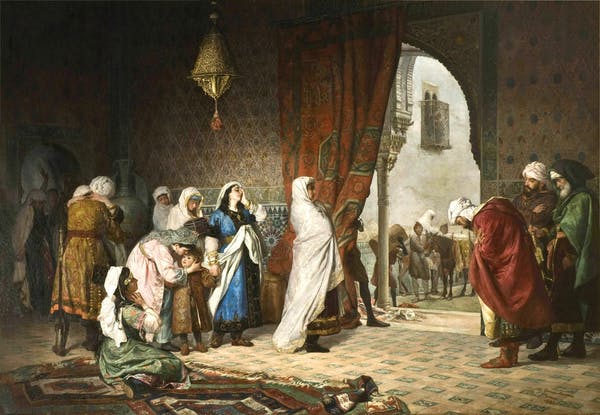
The Alpujarras rebellion marked a decisive turning point in the relationship between Morisco communities and the Spanish monarchy. By the mid-sixteenth century tensions had intensified as royal authorities attempted to accelerate the assimilation of Moriscos into Christian society. The mountainous Alpujarras region south of Granada contained one of the largest concentrations of Morisco populations in Spain, many of whom had preserved strong communal traditions rooted in the Islamic past of the Nasrid kingdom. When new royal decrees sought to eliminate remaining cultural markers associated with Islam, these communities interpreted the measures not merely as religious reform but as an attack on their collective identity and social life.
The immediate catalyst for rebellion was policies issued in 1567 under King Philip II that prohibited the use of the Arabic language and banned traditional clothing, music, and marriage customs associated with Morisco culture. Authorities also attempted to impose Christian cultural practices more aggressively within Morisco communities, including increased oversight of religious observance. These decrees struck at the core of Morisco social and cultural life. For many Moriscos the restrictions appeared to confirm that conversion to Christianity had not secured acceptance within Spanish society. Instead, the monarchy now sought to eliminate the cultural foundations that had sustained Morisco communities for generations.
Resistance first emerged in scattered acts of defiance before escalating into open rebellion in late 1568. Morisco insurgents seized several villages in the mountainous terrain of the Alpujarras and proclaimed their own leadership under Aben Humeya, a figure who claimed descent from the former Nasrid rulers of Granada. The geography of the region favored insurgent forces, whose familiarity with the rugged terrain allowed them to challenge royal troops attempting to restore control. Mountain passes, narrow valleys, and isolated settlements made coordinated military campaigns difficult for royal armies unfamiliar with the landscape. The rebellion also drew strength from the dense social networks that connected Morisco communities across the region. These networks allowed insurgents to coordinate resistance, share resources, and maintain communication across villages scattered throughout the mountains. What began as localized unrest soon expanded into a broader conflict that drew thousands of Moriscos into the uprising and forced the Spanish monarchy to confront the possibility of a sustained regional rebellion.
The Spanish monarchy responded with overwhelming military force. Royal armies led by commanders such as Don Juan of Austria eventually suppressed the rebellion through a brutal campaign that involved widespread destruction of villages, executions of suspected insurgents, and the displacement of large segments of the Morisco population. After the rebellion was crushed in 1571, surviving Moriscos from the region of Granada were forcibly relocated to other parts of Castile in an effort to break up concentrated communities that Spanish authorities believed had facilitated the revolt. This policy of dispersal reflected a growing conviction within the monarchy that Morisco demographic concentration represented a potential security threat.
The rebellion had consequences beyond the immediate devastation of the Alpujarras. For Spanish officials, the uprising appeared to confirm long-standing fears that Moriscos might rebel against the crown and possibly align themselves with external Muslim powers. Even though the rebellion had been sparked primarily by local grievances and cultural repression, it was widely interpreted as evidence that Moriscos remained fundamentally disloyal subjects. Royal advisers increasingly argued that the persistence of Morisco cultural identity made complete integration within a Catholic monarchy impossible. In the decades that followed, the memory of the Alpujarras revolt shaped political debates about the place of Moriscos within the Spanish monarchy. The uprising reinforced the perception that religious difference could translate into political rebellion, a belief that hardened attitudes among royal officials and contributed to later arguments that expulsion might be the only effective solution to what they viewed as a persistent internal threat.
The Mediterranean Context: War with the Ottoman World
The political climate in which Spanish authorities evaluated the Morisco population cannot be understood without considering the broader geopolitical environment of the sixteenth-century Mediterranean. During this period the Spanish monarchy confronted a formidable rival in the Ottoman Empire, whose naval and military expansion reshaped the balance of power across the region. Ottoman influence extended through the eastern Mediterranean and increasingly into North Africa, where allied corsair states challenged Spanish control of strategic coastal territories. For Spanish rulers, the Mediterranean was not merely a distant frontier but a central arena in which imperial security and religious conflict intersected.
The Ottomans under rulers such as Suleiman I pursued an expansive maritime strategy that brought Ottoman fleets into direct competition with Christian powers. Ottoman naval forces operated alongside North African corsairs based in cities such as Algiers and Tunis, whose raiding expeditions targeted Christian shipping and coastal settlements throughout the western Mediterranean. These corsair networks, often led by figures such as Hayreddin Barbarossa and his successors, maintained close relationships with Ottoman authorities while also operating with a degree of autonomy that made them unpredictable adversaries. Their fleets captured merchant vessels, raided coastal towns, and carried thousands of captives into North African ports. Such attacks spread fear along the Iberian coastline and throughout the islands and territories controlled by Spain in the western Mediterranean. Spanish authorities responded by strengthening coastal defenses, constructing watchtowers, and organizing patrol fleets, yet the threat of sudden raids remained a persistent feature of maritime life. These ongoing conflicts created an atmosphere in which the Mediterranean appeared not simply as a commercial sea but as a contested frontier between Christian and Muslim political worlds.
Spain’s military engagement in the Mediterranean reached a dramatic moment in the Battle of Lepanto in 1571, when a coalition of Christian powers confronted the Ottoman fleet in one of the largest naval battles of the early modern period. Although the victory of the Holy League temporarily checked Ottoman naval expansion, it did not eliminate the strategic rivalry that defined Mediterranean politics. Spanish authorities continued to maintain fortified positions along the North African coast and to invest heavily in naval defenses designed to counter Ottoman and corsair threats. These ongoing conflicts reinforced the perception that Spain existed within a broader struggle between Christian and Muslim powers.
Spanish officials increasingly interpreted Morisco communities through the lens of imperial security. The existence of populations with recent Islamic ancestry raised fears that Moriscos might maintain ties with Muslim powers beyond Spain’s borders. Reports circulated that Moriscos maintained contacts with North African corsair networks or that they might assist Ottoman forces in the event of invasion. While concrete evidence for such collaboration was limited, the possibility itself became a powerful factor in shaping official attitudes toward Morisco communities.
The geographic distribution of Morisco populations heightened these anxieties. Many Morisco communities lived in coastal regions or mountainous areas that Spanish authorities believed could serve as potential points of contact with foreign forces. In Valencia, Aragón, and parts of Granada, Morisco villages were sometimes located near routes that connected inland settlements to Mediterranean ports. Spanish officials feared that these geographic patterns might facilitate communication between Morisco populations and Muslim powers operating across the sea. Even unverified rumors that Moriscos had communicated with corsairs or transmitted information to North African authorities could intensify official alarm. Memories of earlier rebellions, particularly the uprising in the Alpujarras, reinforced the idea that Morisco communities possessed the capacity for coordinated resistance. In the minds of many royal advisers, the combination of demographic concentration, geographic proximity to the Mediterranean, and cultural ties to the Islamic past created a situation in which Moriscos might serve as intermediaries between Spain’s internal population and its external enemies.
The Mediterranean conflicts of the sixteenth century transformed Morisco identity into a matter of imperial security rather than solely a question of religious orthodoxy. Spanish officials increasingly interpreted the Morisco population as a potential internal vulnerability within a monarchy engaged in prolonged conflict with Muslim powers. Religious difference came to be associated with the possibility of geopolitical betrayal. The anxieties generated by Mediterranean warfare did not automatically produce policies of expulsion, but they contributed to a climate in which the continued presence of Morisco communities appeared to many Spanish leaders as an enduring strategic risk.
The Decision of 1609: Expulsion as State Policy

By the early seventeenth century, decades of suspicion, surveillance, and conflict had led many Spanish officials to conclude that the Morisco question could not be resolved through continued regulation and assimilation. During the reign of King Philip III, royal advisers increasingly debated whether the presence of Morisco communities represented a permanent threat to the stability of the Spanish monarchy. Influential figures within the royal court argued that earlier policies of conversion, cultural suppression, and forced relocation had failed to produce reliable Christian subjects. Instead, they believed that Moriscos remained culturally distinct and potentially disloyal in a political environment shaped by ongoing rivalry with Muslim powers across the Mediterranean. These concerns were amplified by broader anxieties about the strength of the Spanish monarchy itself. By the early seventeenth century Spain faced mounting financial pressures, military commitments across Europe, and growing concerns about maintaining imperial authority. In such circumstances the continued presence of a population widely perceived as religiously suspect appeared to many officials as an unnecessary risk. The Morisco issue became entangled with wider debates about governance, security, and the consolidation of Catholic identity within the Spanish state.
Support for expulsion gained strength within the royal government in the years leading up to 1609. Leading ministers, including the Duke of Lerma, Philip III’s powerful favorite, promoted the idea that removing the Morisco population would eliminate a perceived internal vulnerability within the Spanish state. Advocates of expulsion argued that Moriscos had repeatedly demonstrated an inability to integrate fully into Christian society and that their continued presence could encourage rebellion or collaboration with Spain’s enemies. These arguments were reinforced by the lingering memory of the Alpujarras revolt and by fears that Moriscos might serve as intermediaries between Spain and Muslim powers operating from North Africa or the Ottoman Empire.
In September 1609 the Spanish crown issued the first royal decrees ordering the removal of Moriscos from the Kingdom of Valencia, a region that contained one of the largest Morisco populations in Spain. The policy was soon extended to other territories, including Aragón, Castile, and Andalusia. Over the following years Spanish authorities organized the forced removal of Morisco communities from across the peninsula. Families were compelled to abandon homes, land, and property before being transported to Mediterranean ports and placed on ships bound primarily for North Africa. The process was often chaotic and traumatic, as large populations were displaced within a short period of time and many individuals faced violence, exploitation, or death during the journey. Local officials supervised the assembly of Morisco families, escorted them to coastal embarkation points, and coordinated the logistics of transport with naval forces and contracted ships. Many Moriscos were allowed to carry only limited possessions, and property left behind was often confiscated or redistributed. In several regions tensions between Morisco populations and local Christian communities erupted into violence during the expulsion process, further illustrating the deep social divisions that had developed over the preceding century.
The expulsion of the Moriscos between 1609 and 1614 represented one of the largest forced migrations in early modern European history. Estimates suggest that roughly 300,000 people were removed from Spain during this campaign. Spanish officials justified the policy as a necessary measure to secure the religious and political unity of the monarchy. Yet the decision also revealed the limits of earlier efforts to manage religious diversity through conversion and cultural regulation. After more than a century of attempts to transform Iberian Muslims into loyal Christian subjects, the Spanish state ultimately concluded that expulsion offered the only definitive solution to what many of its leaders perceived as a persistent problem of religious and political trust.
Consequences: Demography, Economy, and Historical Memory
The decision to expel the Moriscos between 1609 and 1614 produced lasting consequences for Spanish society. Although royal officials framed the policy as a measure designed to strengthen the monarchy by eliminating a perceived internal threat, the removal of hundreds of thousands of inhabitants inevitably reshaped the demographic landscape of the Iberian Peninsula. Entire communities disappeared from regions where Morisco populations had formed a substantial portion of the population. In areas such as Valencia, Aragón, and parts of Granada, villages that had been populated largely by Morisco families suddenly stood partially empty, forcing local authorities and landowners to confront the social and economic effects of large-scale depopulation.
The demographic impact was particularly severe in the Kingdom of Valencia, where Moriscos had constituted a significant share of the rural population. In some districts they formed the majority of agricultural workers responsible for cultivating irrigated lands and maintaining complex systems of water management that had developed over centuries. These irrigation networks, including canals, terraces, and communal water-sharing arrangements, had been refined over generations and required specialized knowledge to maintain effectively. When Morisco populations were expelled, the communities that had preserved and managed this expertise vanished almost overnight. The removal of these workers disrupted not only labor supply but also the technical knowledge embedded in local agricultural practices. Landowners who had relied on Morisco tenants and laborers faced sudden shortages of workers, while attempts to repopulate the region with Old Christian settlers proceeded slowly and often proved inadequate to replace the lost workforce. In many cases newly arrived settlers lacked familiarity with irrigation techniques suited to the semi-arid environment of eastern Spain, further complicating efforts to restore agricultural productivity.
Economic effects extended beyond agriculture into broader regional economies. Morisco communities had participated in local markets, crafts, and trade networks that connected rural production to urban centers. Their removal disrupted patterns of economic exchange that had developed over generations. In some areas landlords struggled to maintain productivity on estates that had once depended heavily on Morisco labor. Even where new settlers arrived, they often lacked the agricultural knowledge required to sustain irrigation systems or cultivate crops adapted to the environmental conditions of southeastern Spain. Certain agricultural zones experienced long periods of economic decline following the expulsions.
Despite these economic disruptions, many Spanish officials defended the expulsion as a necessary act of political and religious consolidation. Supporters of the policy argued that the removal of Morisco populations eliminated a potential source of rebellion and strengthened the Catholic identity of the Spanish monarchy. Within official narratives, the decree was framed as the final stage in the long process of completing the Christian reconquest of Iberia. Royal proclamations and contemporary commentaries frequently portrayed the policy as an act of purification that secured the spiritual unity of the kingdom. By presenting it as the resolution of a longstanding historical struggle between Christianity and Islam in Iberia, advocates of the policy sought to transform a disruptive demographic event into a symbol of political and religious triumph. Such interpretations downplayed the economic costs and human suffering associated with the actions while emphasizing the perceived benefits of confessional uniformity.
Historical interpretations of the expulsion have evolved significantly. Early modern chroniclers often repeated official justifications that emphasized security and religious unity. Modern historians, however, have approached the episode from a broader range of perspectives, examining the complex social, economic, and political dynamics that shaped the decision. Scholars have emphasized the diversity of Morisco communities and the degree to which many had adapted to Christian society over generations. Rather than representing a single unified population, Moriscos varied widely in their cultural practices, regional identities, and levels of integration within Spanish society.
The event holds a complex place in the historical memory of early modern Spain. It illustrates how fears generated by religious difference, imperial rivalry, and political insecurity could lead states to pursue policies of forced displacement on a massive scale. The removal of Morisco communities reshaped Spanish society while also leaving enduring questions about the relationship between religious identity and political loyalty. Examining these consequences highlights the broader historical pattern in which governments confronted with perceived internal threats may choose exclusion and coercion rather than accommodation.
Conclusion: Religious Identity and the Politics of Fear
The expulsion of the Moriscos in the early seventeenth century illustrates the complex relationship between religious identity, political authority, and imperial insecurity in early modern Spain. Over the course of more than a century, Spanish rulers attempted a range of policies designed to incorporate the descendants of Iberian Muslims into a Catholic monarchy. Forced conversion, surveillance, cultural regulation, and population dispersal were all intended to transform Moriscos into loyal Christian subjects. Yet these measures rarely produced the certainty of religious and political loyalty that royal authorities desired. Instead, the continued visibility of cultural difference reinforced suspicions that Morisco identity remained fundamentally incompatible with the confessional expectations of the Spanish state.
The broader geopolitical context of Mediterranean conflict played a crucial role in shaping these perceptions. As Spain confronted Ottoman expansion and ongoing rivalry with Muslim powers in North Africa, religious identity became associated with political allegiance. Moriscos were often interpreted not simply as religious converts but as a population whose origins linked them symbolically to Spain’s external enemies. Even limited evidence of collaboration or communication across the Mediterranean could intensify fears that Morisco communities represented a potential internal threat. These anxieties transformed questions of religious conformity into matters of imperial security.
The decision to expel the Moriscos reflected more than religious intolerance alone. It emerged from a political logic that equated cultural difference with strategic vulnerability. Spanish leaders increasingly concluded that policies aimed at assimilation had failed to eliminate suspicion and that coexistence carried risks during a period of geopolitical rivalry. By the early seventeenth century, decades of surveillance, rebellion, and international conflict had produced a climate in which Morisco identity was interpreted through the language of security rather than integration. Royal advisers argued that the persistence of Morisco communities created a permanent uncertainty within the political structure of the monarchy. Even Moriscos who had lived as Christians for generations remained subject to suspicion because their ancestry connected them to Spain’s Islamic past. The removal was framed as a decisive act to remove ambiguity from the religious composition of the kingdom. Yet the consequences of this decision demonstrated the limits of policies based on exclusion. The removal of Morisco populations disrupted regional economies, depopulated agricultural districts, and revealed the practical difficulties of attempting to engineer religious and cultural uniformity through forced displacement.
Examining the expulsion of the Moriscos reveals how governments confronting internal diversity may interpret minority identities through the lens of political fear. When religious or cultural difference becomes associated with external conflict, minority populations can be transformed into symbols of insecurity within the state. The Spanish experience demonstrates how such perceptions can lead to policies that prioritize uniformity and perceived security over coexistence. As a historical case study, the Morisco expulsion illustrates the powerful role that fear and geopolitical rivalry can play in shaping state responses to religious diversity.
Bibliography
- Braudel, Fernand. The Mediterranean and the Mediterranean World in the Age of Philip II. Translated by Siân Reynolds. Berkeley: University of California Press, 1972.
- Dadson, Trevor J. Tolerance and Coexistence in Early Modern Spain: Old Christians and Moriscos in the Campo de Calatrava. Woodbridge: Boydell Press, 2014.
- Friedman, Ellen G. “North African Piracy on the Coasts of Spain in the Seventeenth Century: A New Perspective on the Expulsion of the Moriscos.” The International History Review 1:1 (1979), 1-16.
- —-. Spanish Captives in North Africa in the Early Modern Age. Madison: University of Wisconsin Press, 1975.
- García José M. González. “Cultural Memories of the Expulsion of the Moriscos.” European Review 16:1 (2008), 91-100.
- Harvey, L. P. Muslims in Spain, 1500–1614. Chicago: University of Chicago Press, 2005.
- Hess, Andrew C. The Forgotten Frontier: A History of the Sixteenth-Century Ibero-African Frontier. Chicago: University of Chicago Press, 1978.
- Kamen, Henry. Empire: How Spain Became a World Power, 1492–1763. New York: HarperCollins, 2003.
- —-. Spain, 1469–1714: A Society of Conflict. 3rd ed. London: Pearson, 2005.
- Lynch, John. Spain under the Habsburgs. 2 vols. Oxford: Blackwell, 1964.
- Perry, Mary Elizabeth. The Handless Maiden: Moriscos and the Politics of Religion in Early Modern Spain. Princeton: Princeton University Press, 2005.
- Root, Deborah. “Speaking Christian: Orthodoxy and Difference in Sixteenth-Century Spain.” Representations 23 (1988), 118-134.
- Vincent, Bernard. Minorías y marginados en la España del siglo XVI. Granada: Universidad de Granada, 1987.
Originally published by Brewminate, 03.20.2026, under the terms of a Creative Commons Attribution-NonCommercial-NoDerivatives 4.0 International license.
About the Author