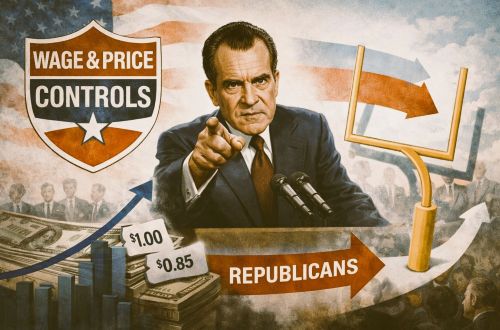
Nixon’s 1971 wage and price controls defied conservative free-market principles, revealing how crisis and leadership can reshape ideology and redefine what supporters accept.

By Matthew A. McIntosh
Public Historian
Brewminate
Introduction: Ideology, Crisis, and Political Flexibility
Political ideologies are often presented as stable systems of belief that guide both leaders and voters in a predictable manner. In practice, they are far more adaptable than their rhetoric suggests. Moments of economic or political crisis frequently expose the tension between ideological commitment and pragmatic governance, forcing leaders to choose between adherence to principle and the perceived necessity of immediate action. When such choices are made at the highest levels of power, they do not simply change policy; they reshape the boundaries of what supporters consider acceptable. The relationship between ideology and action reveals that political identity is maintained not through strict consistency but through the reinterpretation of core principles under changing circumstances. The 1971 decision by President Richard Nixon to impose wage and price controls offers a clear example of how political movements adjust their stated principles when confronted with economic crisis.
Within mid-twentieth-century American conservatism, few principles were more central than the commitment to free-market economics and opposition to government intervention. Republican leaders and conservative thinkers had long criticized the controls as distortions of market forces, associating such policies with wartime emergency measures and the excesses of New Deal liberalism. Economists such as Milton Friedman argued that attempts to regulate prices and wages would produce inefficiencies, shortages, and long-term economic instability, reinforcing a broader ideological framework that emphasized market autonomy and limited state authority. This intellectual foundation was complemented by political rhetoric that portrayed government intervention as harmful and inconsistent with individual liberty. Conservative critiques of earlier federal policies, including New Deal regulations and wartime controls, further entrenched the belief that market mechanisms, rather than administrative directives, should guide economic outcomes. These ideas were not confined to academic debate but were widely reflected in political discourse, shaping the expectations of conservative voters and the party’s economic identity in the decades following World War II. Political belief systems often appear stable, but in practice they shift through reinterpretation when circumstances demand flexibility.
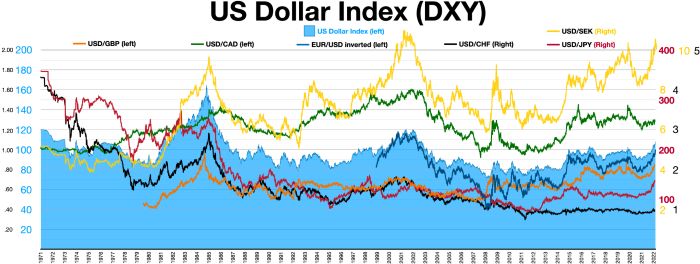
Economic conditions in the late 1960s and early 1970s placed increasing strain on this ideological structure. Rising inflation, pressures on the U.S. dollar, and growing public concern about economic stability created a political environment in which traditional policy responses appeared insufficient. Nixon confronted these challenges in a context shaped not only by economic realities but also by electoral considerations and international monetary pressures. On August 15, 1971, Nixon announced a sweeping set of measures known as the New Economic Policy, including a ninety-day freeze on wages and prices. This decision represented a dramatic departure from established conservative economic principles, yet it was framed as a necessary temporary response to extraordinary circumstances rather than a fundamental ideological shift.
Nixon’s wage and price controls illustrate a broader pattern in political history: leaders can redefine the practical meaning of partisan identity in ways that their supporters come to accept, even when such redefinitions contradict previously held beliefs. Rather than provoking widespread rejection, the policy was largely accommodated within conservative discourse through appeals to necessity, temporality, and national interest. The episode demonstrates that political loyalty often depends less on strict adherence to doctrine than on the ability of leadership to recalibrate it in response to crisis. What follows situates Nixon’s economic policies within a larger model of ideological flexibility, in which the boundaries of acceptable governance are continually renegotiated between leaders and their constituencies.
Conservative Economic Orthodoxy before 1971
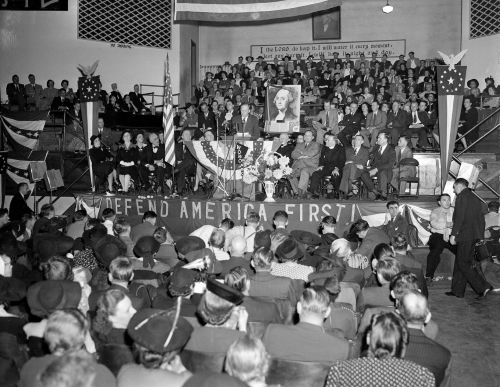
In the decades following World War II, conservative economic thought in the United States coalesced around a set of principles that emphasized market autonomy, limited government intervention, and skepticism toward centralized economic planning. These ideas emerged in part in response to the New Deal, which had expanded federal authority over economic life through regulatory agencies, social welfare programs, and labor protections. While many of these policies remained politically durable, they also generated a sustained intellectual and political reaction among conservatives who viewed them as departures from both economic efficiency and constitutional restraint. By the mid-twentieth century, this reaction had developed into a coherent critique of government intervention that would shape Republican economic rhetoric and policy preferences.
At the center of this orthodoxy was a strong opposition to these measures, which were widely regarded as distortions of the natural functioning of markets. Such controls had been implemented during World War II to manage production and prevent inflation, but they were generally understood as temporary measures justified by extraordinary circumstances. In peacetime, conservative economists argued, attempts to fix prices or wages interfered with supply and demand, leading to shortages, surpluses, and inefficiencies that ultimately harmed both producers and consumers. Critics maintained that artificial price ceilings could suppress production incentives, while wage controls could distort labor markets and undermine productivity. The experience of wartime regulation reinforced the belief that while government intervention might achieve short-term stability, it did so at the cost of long-term economic health. Opposition to such measures became not only a policy preference but a defining element of conservative economic identity.
The intellectual foundation of this perspective was articulated most clearly by economists emphasizing the importance of monetary policy and market signals in maintaining economic stability. Inflation was fundamentally a monetary phenomenon and that attempts to control it through direct intervention in prices or wages were misguided. Instead, he advocated for predictable monetary policy and minimal interference with market processes. These ideas gained influence not only within academic circles but also among policymakers and political leaders, contributing to a broader shift in economic thinking that challenged the assumptions of mid-century Keynesianism.
Within the Republican Party, these economic principles were reinforced through political rhetoric that linked free markets with individual liberty and national prosperity. Government intervention was often portrayed not only as economically inefficient but also as a threat to personal freedom and entrepreneurial initiative. Republican leaders frequently contrasted their commitment to market-based solutions with what they characterized as the overreach of Democratic economic policies. This framing helped to solidify a party identity that was closely associated with business interests, fiscal restraint, and opposition to regulatory expansion. These themes became central to the party’s appeal, shaping both its policy agenda and its public image.
By the late 1960s, conservative economic orthodoxy had become deeply embedded in the ideological foundation of the Republican Party and its supporters. Opposition to Nixon’s policies was not merely a technical policy position but part of a broader worldview that emphasized the limits of government authority and the primacy of market mechanisms. These ideas were reinforced through political campaigns, party platforms, and public discourse, creating a shared understanding among leaders and voters about the appropriate role of the state in economic life. This framework created clear expectations about how Republican leaders should respond to economic challenges, reinforcing the belief that adherence to free-market principles was both economically sound and politically necessary. It was precisely this set of expectations that would make the policy decisions of the early 1970s appear so striking, as they diverged from the established norms that had come to define conservative economic thought.
The Economic Crisis of the Late 1960s and Early 1970s
By the late 1960s, the United States faced a set of economic challenges that strained the assumptions of postwar stability. The long period of growth that had followed World War II began to give way to rising inflation, fiscal pressure, and increasing uncertainty about the international monetary system. Government spending associated with the Vietnam War and domestic social programs contributed to budget deficits, while inflation gradually accelerated. Policymakers confronted a situation in which traditional tools of economic management appeared less effective, raising concerns about the limits of existing approaches to maintaining stability and growth.
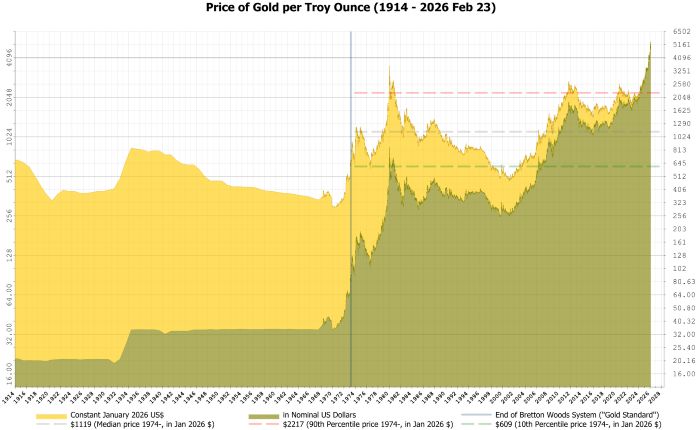
One of the defining features of this period was the breakdown of the Bretton Woods system, which had governed international monetary relations since the end of the war. Under this system, the U.S. dollar was convertible into gold at a fixed rate, and other currencies were pegged to the dollar. As global economic conditions evolved, maintaining this arrangement became increasingly difficult. Persistent U.S. balance-of-payments deficits and the accumulation of dollar reserves abroad placed pressure on the gold standard, leading foreign governments to question the sustainability of the system. European and other industrialized nations, holding large quantities of dollars, increasingly sought conversion into gold, putting strain on U.S. reserves and undermining confidence in the fixed exchange system. By the late 1960s, the United States faced growing demands to exchange dollars for gold, threatening the stability of its monetary position. These pressures exposed structural weaknesses in the postwar financial order and made clear that the system could not be maintained without significant policy adjustments.
Domestic economic conditions were becoming more volatile. Inflation, which had remained relatively moderate in the early postwar years, began to rise more sharply toward the end of the decade. This increase was accompanied by concerns about unemployment and slowing growth, creating a complex policy environment in which efforts to address one problem risked exacerbating another. The emerging phenomenon of simultaneous inflation and economic stagnation challenged the prevailing Keynesian framework, which had assumed a more predictable trade-off between inflation and unemployment. Policymakers found themselves navigating a situation in which established economic models provided limited guidance.
Public perception of economic instability further intensified the pressure on political leaders to act. Rising prices affected everyday life, shaping voter attitudes and increasing demand for visible government intervention. Inflation was not experienced as an abstract economic indicator but as a tangible decline in purchasing power, contributing to a broader sense of uncertainty about the nation’s economic direction. As public concern grew, political leaders faced the challenge of demonstrating control over economic conditions while maintaining confidence in existing institutions. This dynamic created incentives for policies that offered immediate and recognizable responses, even if their long-term effectiveness was uncertain.
The international dimension of the crisis added another layer of complexity. As confidence in the dollar weakened, the United States faced the risk of losing its central role in the global financial system. Efforts to defend the dollar placed additional constraints on domestic economic policy, linking international monetary stability to internal economic decisions. Foreign governments and financial markets closely monitored U.S. actions, amplifying the consequences of policy decisions and limiting the flexibility available to American policymakers. The tension between maintaining fixed exchange rates and addressing domestic inflation contributed to a sense that the existing system was no longer sustainable. By the early 1970s, it had become increasingly clear that a significant adjustment would be required to restore confidence and stability, both at home and in the international economic order.
Amidst mounting economic and political pressure, the range of acceptable policy options began to expand. Measures that had previously been dismissed as inconsistent with free-market principles gained renewed consideration as leaders searched for effective responses to a deteriorating situation. The convergence of inflation, monetary instability, and public anxiety created a moment in which pragmatic concerns could override established ideological commitments. It was under these conditions that the Nixon administration would introduce policies that marked a significant departure from conservative economic orthodoxy, reflecting the capacity of crisis to reshape both policy choices and the boundaries of political acceptability.
Nixon’s Decision: The 1971 Economic Stabilization Program
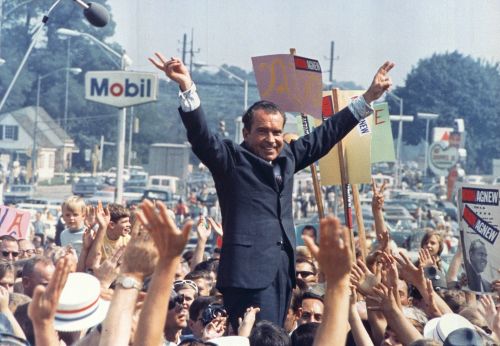
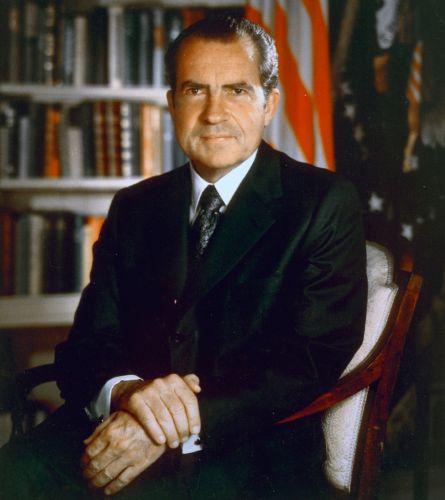
On August 15, 1971, President Nixon announced a sweeping set of economic measures. Delivered in a nationally televised address, the program combined multiple initiatives aimed at stabilizing the U.S. economy and restoring confidence at home and abroad. Most striking among these measures was the imposition of a ninety-day freeze on wages and prices, a policy that represented a dramatic intervention in the functioning of the market. Nixon framed the decision as a necessary response to inflation and economic uncertainty, emphasizing its temporary nature and its role in protecting the interests of American workers and consumers. The announcement signaled a willingness to depart from established economic orthodoxy in favor of immediate and visible action.
The wage and price freeze was accompanied by other significant policy changes, including the suspension of the dollar’s convertibility into gold and the introduction of a temporary surcharge on imports. Together, these measures marked a decisive break with the Bretton Woods system and signaled a new approach to both domestic and international economic policy. By closing the gold window, the administration effectively ended the fixed exchange rate system that had structured global finance since World War II. The import surcharge was designed to address trade imbalances and to encourage foreign governments to adjust their currencies, reinforcing the broader goal of stabilizing the American economy in a shifting international context.
Nixon’s decision was shaped by a combination of economic pressures and political considerations. Inflation had become a central concern for voters, and the administration faced increasing pressure to demonstrate decisive leadership in addressing rising prices. The upcoming 1972 presidential election heightened the importance of economic performance as a political issue. The New Economic Policy offered a means of projecting control and responsiveness, allowing Nixon to position himself as a pragmatic leader willing to take bold action in the national interest. Advisers within the administration, including figures such as Treasury Secretary John Connally and economic counselor Herbert Stein, played key roles in shaping the policy and its presentation, emphasizing the need for measures that would produce immediate and visible results. The policy was not only an economic intervention but also a strategic effort to shape public perception and electoral dynamics, demonstrating how economic policy could serve both governance and political objectives simultaneously.
Despite its departure from conservative economic principles, the policy was carefully framed to minimize ideological disruption. Nixon emphasized that the controls were temporary and exceptional, a response to specific conditions rather than a permanent shift in economic philosophy. By presenting the measures as a pragmatic solution to an immediate problem, the administration sought to preserve its broader commitment to free-market ideals while justifying a significant expansion of federal authority. This framing allowed supporters to reconcile the policy with existing beliefs, interpreting it as an unavoidable response to crisis rather than a repudiation of ideological commitments.
The introduction of controls illustrates the capacity of political leadership to redefine the boundaries of acceptable policy. In the face of economic instability, measures that had previously been rejected as incompatible with conservative principles were recast as necessary tools of governance. Nixon’s decision did not eliminate the underlying tension between political doctrine and action, but it demonstrated how that tension could be managed through careful framing and strategic communication. The policy also revealed the extent to which executive authority could expand during moments of crisis, as the administration asserted control over economic processes traditionally left to market forces. The New Economic Policy stands as a clear example of how crisis conditions can expand the scope of political possibility, enabling leaders to implement policies that would otherwise have been considered unacceptable within their own ideological tradition while maintaining the loyalty of their political base.
Conservative Response: Acceptance, Justification, and Silence
The announcement of wage and price controls in August 1971 presented a clear challenge to the established principles of conservative economic thought. Given the longstanding opposition within Republican circles to government intervention in markets, one might have expected a significant backlash from party leaders, intellectuals, and voters. Yet the immediate response was notably muted. While some critics voiced concern, there was no sustained or unified opposition within the conservative movement capable of challenging the administration’s decision. Instead, many Republican officials and influential voices either expressed cautious support or refrained from direct criticism, reflecting a broader tendency toward accommodation rather than confrontation.
Part of this response can be explained by the framing of the policy as a temporary and emergency measure. Nixon and his advisers consistently emphasized that the controls were not intended to represent a permanent shift in economic philosophy but were instead a short-term intervention designed to stabilize prices and restore confidence. This distinction shaped conservative reactions. By presenting the policy as an exception rather than a transformation, the administration allowed supporters to maintain their commitment to free-market principles while accepting a departure from them under extraordinary conditions. The language of necessity and temporality provided a model within which ideological consistency could be preserved, at least rhetorically. It also created space for supporters to interpret the policy as a form of responsible governance rather than ideological betrayal, reinforcing the idea that adherence to principle could coexist with pragmatic flexibility when circumstances demanded it.
Political loyalty also played a key role in limiting opposition. Nixon was a sitting president with strong support within the Republican Party, and his leadership carried significant weight among both elected officials and the party base. Public criticism of the administration risked undermining party unity, particularly in the lead-up to a presidential election. Many conservative leaders chose to support or defer to the president’s judgment rather than challenge a policy that conflicted with their stated beliefs. This dynamic illustrates the extent to which partisan alignment can override ideological disagreement, especially when political stakes are high.
The broader conservative movement likewise demonstrated a capacity for adaptation. Rather than rejecting the policy outright, many commentators sought to reconcile it with existing principles. Some argued that the controls were a pragmatic response to conditions created by previous policies, while others emphasized that the alternative, unchecked inflation, posed a greater threat to economic stability and individual prosperity. The policy was incorporated into a narrative that preserved the underlying commitment to market economics while acknowledging the need for flexibility in times of crisis. The absence of a unified intellectual resistance further reinforced the perception that the policy, while imperfect, was acceptable under the circumstances.
The relative silence of many conservative figures was itself significant. The lack of sustained public opposition did not necessarily indicate full agreement with the policy, but it did reflect a willingness to prioritize political cohesion over ideological clarity. By choosing not to challenge the administration, conservative leaders contributed to the normalization of a policy that would previously have been considered unacceptable. This silence helped to shape public perception, signaling to voters that the policy did not represent a fundamental breach of conservative principles. It also reduced the visibility of dissenting viewpoints, limiting the potential for organized resistance within the party and reinforcing the administration’s framing of the policy as both necessary and broadly supported. Inaction became a form of endorsement, reinforcing the administration’s framing and limiting the space for dissent.
The conservative response to Nixon’s measures reveals the interplay between ideology, leadership, and political context. Faced with a policy that contradicted established beliefs, many within the movement adapted their positions rather than resisting the change. Acceptance was facilitated by framing, justified through reinterpretation, and reinforced by silence. This combination of factors demonstrates how political communities can accommodate significant departures from their stated principles without undergoing a complete ideological transformation. The episode underscores the capacity of leadership to redefine the boundaries of acceptable policy and highlights the role of supporters in sustaining that shift through both action and inaction.
Ideological Reinterpretation: How Contradictions Were Managed
The acceptance of controls within a political movement that had long opposed such measures required more than passive acquiescence; it demanded active reinterpretation of ideological principles. Rather than abandoning their commitment to free markets, many conservatives reframed the policy in ways that preserved the integrity of their broader worldview. This process did not eliminate the contradiction between principle and practice, but it made it manageable by shifting the terms in which it was understood. Ideology functioned less as a rigid set of rules than as a flexible underlying logic capable of accommodating exceptions when they were presented as necessary and limited. The ability to remain coherent in the face of divergence depended on redefining not only the policy itself but also the conditions under which ideological principles were expected to apply. In doing so, supporters were able to preserve a sense of continuity, interpreting deviation as an extension of principle rather than its abandonment.
One of the most common mechanisms for managing this tension was the distinction between temporary and permanent policy. By emphasizing that they were intended as a short-term response to an immediate crisis, supporters could maintain that their underlying commitment to market autonomy remained intact. The controls were framed not as a repudiation of free-market principles but as an extraordinary measure justified by extraordinary circumstances. This temporal boundary allowed conservatives to reconcile their acceptance of intervention with their broader ideological commitments, preserving a sense of continuity even as policy deviated from established norms.
A second strategy involved redefining the nature of the threat that government intervention was meant to address. Inflation, which had traditionally been approached through monetary policy and market adjustments, was increasingly portrayed as a problem requiring direct and immediate action. In this framing, the dangers of unchecked inflation were elevated to a level that justified measures previously considered unacceptable. By recasting inflation as a pressing and destabilizing force, proponents of the policy could argue that intervention was not only permissible but necessary to protect economic stability and public confidence. This reframing shifted the debate from one about the legitimacy of government control to one about the urgency of the problem it sought to solve.
Supporters also drew on the language of pragmatism to justify the policy. Rather than presenting economic governance as a matter of strict ideological adherence, they emphasized the need for flexibility in responding to complex and evolving conditions. This perspective allowed for the possibility that different circumstances might require different approaches, even if those approaches diverged from established doctrine. Pragmatism became a means of integrating policy change into an existing ideological basis without requiring a fundamental revision of its core principles. It also provided a rhetorical justification that appealed to both leaders and voters, reinforcing the idea that responsible governance required adaptability rather than rigidity. The appeal to practical necessity served as a bridge between belief and action, enabling supporters to reconcile policy deviation with continued ideological identification.
The management of this internal conflict ultimately reveals the adaptive capacity of political positions. Rather than collapsing under the weight of inconsistency, conservative economic thought in this period demonstrated a capacity to absorb and reframe deviations from its stated principles. This process depended not only on the framing provided by political leaders but also on the willingness of supporters to accept that framing and incorporate it into their understanding of political identity. The episode illustrates how ideological systems can maintain coherence even when confronted with policies that appear to contradict their foundational assumptions, underscoring the role of interpretation in sustaining political belief.
Consequences and Legacy: Policy, Politics, and Precedent
The immediate effects of Nixon’s policies appeared, at least initially, to validate the administration’s decision. Inflation slowed in the short term, and the policy was widely perceived as a demonstration of decisive leadership in the face of economic uncertainty. Public approval of the measures was high, reflecting a broader desire for stability and visible action. This early success contributed to Nixon’s strong position heading into the 1972 presidential election, reinforcing the political value of policies that offered immediate and tangible results. Yet the apparent effectiveness of the controls proved temporary, as underlying economic pressures were not fully resolved.
As the controls were phased out in stages, inflationary pressures reemerged, and the limitations of direct intervention became increasingly evident. The reintroduction of market forces exposed distortions that had been temporarily suppressed, leading to renewed price increases and economic instability. Businesses and consumers, having adjusted to controlled prices and wages, encountered sudden shifts that disrupted expectations and planning. The persistence of inflation throughout the 1970s, culminating in the period often described as stagflation, underscored the difficulty of managing complex economic dynamics through administrative controls alone. Economists and policymakers debated the extent to which the controls had delayed rather than solved underlying problems, highlighting the tension between short-term political gains and long-term economic consequences. These developments reinforced the view that while controls could provide temporary relief, they did not address the structural causes of inflation and could complicate the process of economic adjustment once lifted.
The policy also had important implications for the role of government in economic management. By asserting federal authority over wages and prices in peacetime, the Nixon administration expanded the scope of executive power in ways that challenged established expectations. Although the controls were framed as temporary, their implementation demonstrated that the federal government possessed both the legal and administrative capacity to intervene directly in market processes under certain conditions. This precedent contributed to a broader understanding of economic governance in which the boundaries of state action were more flexible than previously assumed, particularly during periods of crisis.
Politically, the episode reinforced the capacity of leadership to reshape ideological boundaries without provoking sustained resistance from supporters. Nixon’s actions did not lead to a lasting realignment of conservative economic thought toward acceptance of price controls, but they did illustrate how deviations from established principles could be accommodated when framed as necessary and temporary. This dynamic had implications beyond the specific policy in question, suggesting that political identity could remain stable even as policy positions shifted. The episode demonstrated that voters and party elites could prioritize leadership credibility and perceived effectiveness over strict ideological consistency, particularly when policies were presented as responses to urgent conditions. The political success of the controls reinforced the broader pattern in which leadership framing plays a central role in shaping the limits of acceptable policy.
The longer-term legacy of the 1971 controls can also be seen in the evolution of economic policy debates in subsequent decades. The experience contributed to growing skepticism about the effectiveness of direct controls and helped to strengthen the case for alternative approaches, particularly those emphasizing monetary policy and market-based solutions. Economists increasingly pointed to the limitations of administrative intervention and the importance of addressing inflation through systemic mechanisms rather than temporary constraints. By the late 1970s and early 1980s, a renewed emphasis on free-market principles reflected a reaction against the perceived failures of earlier interventionist policies. This shift did not erase the memory of Nixon’s actions but instead incorporated them into a broader narrative about the risks of departing from market-based approaches. Nixon’s decision became part of a longer historical cycle in which experimentation with intervention was followed by renewed commitments to economic orthodoxy.
At a deeper level, the episode established a precedent for how political systems respond to crisis. It demonstrated that policies once considered incompatible with a party’s political doctrine could be implemented without fundamentally altering its identity, provided they were effectively framed and justified. This pattern has recurred in various forms across different contexts, as leaders confronted with urgent challenges have adopted measures that diverge from established doctrine while maintaining the support of their constituencies. The legacy of Nixon’s controls extends beyond their immediate economic impact, offering insight into the relationship between policy, ideology, and political leadership in moments of uncertainty and change.
Conclusion: Leadership, Loyalty, and the Elasticity of Ideology
The episode of Nixon’s wage and price controls reveals that governing philosophy is not a fixed set of constraints but a flexible system shaped by leadership, context, and interpretation. Conservative economic principles in the mid-twentieth century emphasized market autonomy and opposition to government intervention, yet these principles did not prevent the adoption of policies that directly contradicted them. Instead, the boundaries of political conviction were adjusted to accommodate the demands of crisis, allowing both leaders and supporters to maintain a sense of continuity even as policy shifted. The result was not a collapse of ideological identity but a demonstration of its capacity to adapt under pressure.
Central to this process was the role of leadership in redefining what counted as acceptable within an ideological framework. Nixon did not attempt to dismantle conservative economic thought; rather, he reframed a departure from it as a temporary and necessary response to extraordinary circumstances. This distinction proved critical in preserving political support. By presenting intervention as an exception rather than a transformation, the administration enabled its supporters to reconcile policy with principle. The success of this approach depended not only on the substance of the policy but also on how it was communicated to the public, with emphasis placed on urgency, national interest, and the need for decisive action. In doing so, Nixon and his advisers effectively shifted the terms of the debate, moving it away from abstract ideological consistency and toward practical outcomes and immediate concerns. The episode illustrates how leadership can guide not only policy decisions but also the interpretation of those decisions, shaping the way they are understood within a broader ideological context.
The response of the conservative base further underscores the importance of political loyalty in sustaining ideological flexibility. Supporters did not simply abandon their commitment to free-market principles, nor did they uniformly reject the policy as inconsistent with those principles. Instead, they adapted their understanding of what those principles required in a moment of crisis. This adaptation reflects a broader pattern in political behavior, in which allegiance to leadership and identification with a political community can take precedence over strict adherence to doctrine. Partisan doctrine functions as a living framework that is continually reinterpreted rather than a rigid set of rules that dictates action in all circumstances.
The broader significance of this case lies in what it reveals about the relationship between belief, policy, and power in democratic systems. Nixon’s decision did not permanently redefine conservative economic thought, but it did establish a precedent for how ideological inconsistencies can be managed without producing immediate rupture. The capacity to recast principles in response to changing conditions allows political movements to maintain cohesion even in the face of apparent inconsistency. This elasticity, while often criticized as opportunism, also reflects the practical realities of governance, where leaders must navigate complex and evolving challenges. The history of Nixon’s economic measures offers a clear example of how ideology can be reshaped through the interplay of leadership, crisis, and political loyalty, demonstrating that the stability of political identity often depends on its ability to adapt.
Bibliography
- Blinder, Alan S. and Mark W. Watson. “Presidents and the US Economy: An Econometric Exploration.” The American Economic Review 106:4 (2016), 1015-1045.
- Burns, Arthur F. The Anguish of Central Banking. Belgrade: National Bank of Yugoslavia, 1979.
- Clark, Gordon L. “The Spatial Division of Labor and Wage and Price Controls of the Nixon Administration.” Economic Geography 61:2 (1985), 113-128.
- Eichengreen, Barry. Globalizing Capital: A History of the International Monetary System. 2nd ed. Princeton, NJ: Princeton University Press, 1996.
- Friedman, Milton. Capitalism and Freedom. Chicago: University of Chicago Press, 1962.
- Gass, Oscar. “The Nixon Economy.” Worldview 16:7 (1973), 7-14.
- Heller, Walter W. New Dimensions of Political Economy. Cambridge: Harvard University Press, 1966.
- Krugman, Paul. The Age of Diminished Expectations: U.S. Economic Policy in the 1990s. Cambridge: MIT Press, 1990.
- Meltzer, Allan H. A History of the Federal Reserve, Volume 2: 1951–1986. Chicago: University of Chicago Press, 2009.
- Nixon, Richard M. “Address to the Nation Outlining a New Economic Policy,” August 15, 1971.
- Samuelson, Paul A. Economics. New York: McGraw-Hill, multiple editions.
- Schulman, Bruce J. The Seventies: The Great Shift in American Culture, Society, and Politics. New York: Free Press, 2001.
- Stein, Herbert. Presidential Economics: The Making of Economic Policy from Roosevelt to Reagan and Beyond. Washington, DC: American Enterprise Institute Press, 1984.
- Tetlock, Philip E. Expert Political Judgment: How Good Is It? How Can We Know? Princeton: Princeton University Press, 2005.
- Waterhouse, Benjamin C. “Mobilizing for the Market: Organized Business, Wage-Price Controls, and the Politics of Inflation, 1971-1974.” The Journal of American History 100:2 (2013), 454-478.
Originally published by Brewminate, 03.23.2026, under the terms of a Creative Commons Attribution-NonCommercial-NoDerivatives 4.0 International license.
About the Author