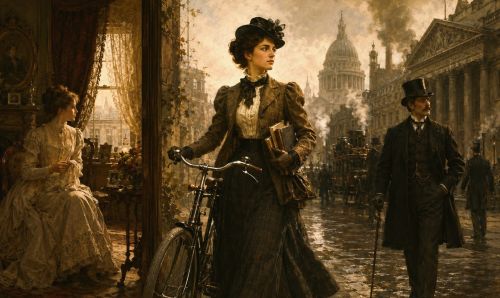
Victorian gender was never fixed, as domestic ideology, masculinity, law, sexuality, reform, and the New Woman continually reshaped power.

By Matthew A. McIntosh
Public Historian
Brewminate
Introduction: Victorian Gender as an Argument, Not a Fixed System
The Victorian era inherited a language of gender that claimed to describe nature, morality, and divine order, but it lived through social changes that repeatedly exposed those claims as unstable. Between Queen Victoria’s accession in 1837 and her death in 1901, Britain became more urban, more industrial, more imperial, more bureaucratic, and more anxious about the boundaries of class, sex, family, and citizenship. Gender sat at the center of that transformation. It organized the household, justified legal inequality, structured work, disciplined sexuality, shaped religious ideals, and supplied political language for both reform and resistance. Yet it was never a single fixed code. What Victorians called “womanly,” “manly,” “natural,” or “respectable” shifted across the century as the social world those words were meant to stabilize kept changing beneath them.
The familiar model of Victorian “separate spheres” remains important, but only if treated as an ideology rather than a complete description of lived experience. Middle-class culture increasingly imagined men as public actors associated with commerce, politics, competition, and paid labor, while women were idealized as domestic guardians of morality, religion, emotional refinement, and family order. This language appeared in conduct literature, sermons, poetry, fiction, political debate, and reform arguments. Sarah Stickney Ellis’s early Victorian domestic writings and Coventry Patmore’s later poetic ideal of the self-sacrificing wife helped give cultural form to a larger social expectation: respectable femininity was to be morally powerful precisely because it was supposedly private, submissive, and removed from public ambition. That ideal mattered. It shaped behavior, aspiration, marriage, education, and judgment. But it also excluded the lives of working women, servants, widows, unmarried women, poor women, women writers, women reformers, and women whose labor made middle-class domestic comfort possible.
Masculinity was no less constructed, and no less anxious. Victorian men were expected to be industrious, rational, self-controlled, morally serious, economically productive, sexually disciplined, and capable of governing both household and nation. The home was not merely a feminine sanctuary from male public life. It was also a place where masculine authority was displayed, tested, and sometimes strained. As the century progressed, ideals of manhood widened from sober domestic responsibility into muscular Christianity, imperial vigor, athletic discipline, and fears of national weakness. Men were told to command the household while also finding emotional refuge in it; to be morally restrained while proving bodily force; to rule women while depending upon women’s moral labor to define their own respectability. Victorian masculinity functioned not as a natural opposite to femininity, but as another unstable historical performance shaped by work, class, empire, religion, and fear.
Victorian gender is best understood not as a rigid system that simply began in 1837 and collapsed in 1901, but as a continuing argument over power, identity, and social order. The “Angel in the House,” the dependent wife, the self-made breadwinner, the muscular Christian, the imperial gentleman, the sexological “invert,” and the New Woman were not timeless types. They were historical figures produced by a society trying to reconcile industrial capitalism, evangelical morality, liberal reform, imperial expansion, legal modernization, and emerging scientific claims about sex and the body. By following these developments chronologically, I trace how Victorian Britain made gender appear natural while constantly revising its meanings. The result was not one Victorian definition of gender, but a century-long struggle over who could act, speak, own, desire, govern, work, and belong.
Before “Separate Spheres”: Household Labor, Family Economy, and Early Industrial Change

Before the Victorian language of “separate spheres” hardened into one of the century’s most recognizable social ideals, British gender relations were shaped by older patterns of household labor, family economy, and local production. The pre-Victorian household was not simply a private emotional refuge set apart from work. For many families, especially among agricultural, artisanal, and trading communities, it was a productive unit in which labor, kinship, authority, and survival were closely connected. Women’s work could include dairying, brewing, spinning, sewing, laundering, market selling, shopkeeping, domestic service, field labor, and participation in family trades. These activities did not erase patriarchy, nor did they produce modern equality. Yet they complicate any simple story in which women moved from full public agency into sudden Victorian confinement. Gender hierarchy existed, but it often operated inside a shared economic world rather than through a clean division between male public work and female private domesticity.
This older household economy varied sharply by class, region, occupation, marital status, and stage of life. A farmer’s wife, a tradesman’s wife, a domestic servant, an aristocratic hostess, and a textile worker did not inhabit the same gender regime, even when moralists tried to speak of “woman” as a single social type. In rural and provincial settings, women’s labor was often visible, necessary, and understood as part of household maintenance rather than as an exception to femininity. In towns, wives and daughters might assist in shops, keep accounts, supervise apprentices, produce goods, manage lodgers, or perform paid work that supplemented unstable male earnings. A woman’s economic role could also change over the course of her life. An unmarried daughter might contribute wages to a family household, a wife might manage domestic production or informal credit, and a widow might continue a business under conditions that made her authority both practical and socially vulnerable. Servants, who formed one of the largest categories of female employment, made middle-class domestic comfort possible while being excluded from the sentimental ideal of home that their labor sustained. The household, then, was already a site of inequality, but it was also a site of production, discipline, negotiation, and economic dependence among men, women, children, and servants. Its boundaries were porous, not sealed. Goods, wages, credit, gossip, obligation, and reputation moved through it constantly.
Industrialization altered these arrangements by changing not only where work took place, but what work was imagined to mean. As production increasingly moved into factories, workshops, offices, and commercial districts, paid labor became more strongly identified with the world outside the home. This transition was uneven and never total. Many women continued to work for wages, and many homes remained economically productive. Still, the symbolic force of the change was enormous. Middle-class identity came to depend increasingly on the visible withdrawal of respectable wives and daughters from manual or commercial labor, even when that withdrawal was itself made possible by servants, inherited capital, colonial wealth, or the poorly paid labor of other women. The home could now be idealized as a moral refuge from the market precisely because the market had become more impersonal, competitive, and publicly masculine in cultural imagination.
The emerging separation between home and workplace did not simply reflect economic change; it helped produce a new moral language of class. Respectability became attached to the ability to maintain a household in which women appeared protected from necessity. A wife who did not need to labor publicly became evidence of a husband’s economic competence and a family’s social standing. Domestic femininity was never merely about gender. It was also about class display. The image of the dependent, refined, morally elevated woman depended upon the invisibility or devaluation of other women’s work: servants cleaning the house, laundresses washing clothes, seamstresses making garments, factory women producing goods, and poor wives contributing income under conditions that polite ideology preferred not to see. The very language of delicacy, purity, and refinement drew much of its force from contrast. It distinguished the respectable woman from the woman who labored visibly, handled money openly, appeared in public spaces without protection, or could not perform leisure as a sign of status. This made domestic ideology deeply exclusionary. It did not simply define what women were supposed to be; it ranked women against one another. Middle-class womanhood became the standard by which other women were judged deficient, coarse, unfortunate, or morally suspect, even when their labor was essential to the functioning of the society that judged them.
This transformation also reshaped masculinity. As middle-class men increasingly defined themselves through professions, commerce, public responsibility, and breadwinning, male authority became tied to economic provision and disciplined self-command. The man who could support a household without requiring his wife’s public labor embodied a new kind of respectability. Yet this masculine ideal brought pressure as well as privilege. Failure in business, unemployment, debt, or dependence threatened not only income but manhood itself. The public world promised authority, but it also exposed men to competition, speculation, bankruptcy, temptation, and loss of status. For this reason, the domestic home became central to masculine identity even as it was described as feminine space. It offered proof that a man had succeeded in the market while also giving him a moral refuge from it. The wife’s domesticity, the children’s dependence, the ordered parlor, the family pew, and the respectable address all became signs that male labor had produced more than wages. It had produced character. The domestic woman and the public man were mutually constructed figures: her supposed dependence confirmed his competence, while his worldly labor justified her domestic seclusion. But this arrangement was always more fragile than its rhetoric admitted, because it depended on economic stability, class aspiration, and the constant management of appearances.
By the time Queen Victoria came to the throne in 1837, the ideological foundations of separate spheres had already been laid, though not yet uncontested or fully systematized. The Victorian gender order emerged from this older and transitional world: one in which women had long worked, households had long produced, and family economies had long blurred the boundaries between private and public life. What changed in the early 19th century was not simply that men went out and women stayed in. Rather, a particular middle-class vision of social order began to treat that arrangement as morally superior, socially respectable, and increasingly natural. The later Victorian ideal of separate spheres was not an ancient inheritance. It was a modern response to industrial capitalism, class formation, and the anxious effort to make social change look like timeless gender truth.
Early Victorian Domestic Ideology: Evangelical Morality and the Making of the “Angel”

The early Victorian ideal of domestic femininity emerged from this changing social landscape with the force of moral certainty. As industrial capitalism widened the imaginative distance between home and market, writers, preachers, reformers, and conduct-book authors increasingly described the household as a sacred refuge from the corruptions of public life. The home became a moral theater in which class respectability, Christian discipline, emotional restraint, and gender hierarchy could be performed as if they were natural truths. This was especially important because the early Victorian middle classes were still consolidating their authority, culturally as well as economically. Domestic order gave social ambition a moral language. A well-regulated home, a pious wife, disciplined children, restrained consumption, and visible respectability all suggested that a family possessed not only money, but character. Women occupied the center of this vision not because they were granted equal authority, but because their supposed moral superiority was made dependent upon submission, purity, and self-denial. The domestic woman was praised as spiritually powerful precisely so long as her power remained private, indirect, and sacrificial. Her influence was to soften men, guide children, stabilize the household, and elevate the nation, but only by appearing not to seek power for herself.
Evangelical religion gave this ideal much of its early Victorian intensity. The religious culture that shaped middle-class Britain emphasized moral discipline, personal piety, family worship, sexual restraint, temperance, and the reform of character. Within that framework, women were often imagined as guardians of conscience, entrusted with the moral formation of children and the emotional purification of husbands. Sarah Stickney Ellis’s The Women of England, published in 1839, expressed this logic with unusual clarity, presenting women as morally responsible for the tone of national life through their influence inside the home. Her argument did not deny women significance. On the contrary, it magnified their significance while narrowing the space in which that significance could be legitimately exercised. A woman could be powerful as an influence, a guide, a comforter, and a moral presence, but not as an openly self-directed public actor.
This was the ideological setting in which the figure later condensed as the “Angel in the House” became so culturally resonant. Coventry Patmore’s poem, published in stages from 1854 to 1862, did not invent domestic femininity, but it gave poetic shape to a much wider ideal of woman as patient wife, modest beloved, self-effacing companion, and emotional center of the household. The “Angel” mattered because she transformed subordination into virtue. She did not merely obey; she sanctified obedience. She did not merely serve; she made service beautiful. She did not merely relinquish public ambition; she appeared to rise above ambition altogether. This was one of the most effective features of Victorian domestic ideology: it made hierarchy seem tender, dependence seem holy, and inequality seem like love.
Yet the Angel was always a selective construction. She was imagined most fully through middle-class expectations of marriage, leisure, privacy, and respectability. Working-class women, servants, widows, unmarried women, factory workers, sex workers, and women of uncertain social position could rarely inhabit this ideal without contradiction. Even within the middle classes, the Angel depended on conditions that were far from universal: a male provider, a stable household income, sufficient domestic space, and often the labor of other women. The woman praised for not laboring publicly was frequently supported by women whose labor remained hidden or degraded. Domestic ideology did not simply define femininity. It divided women from one another, elevating one model of respectable womanhood while marking other forms of female labor, sexuality, mobility, or independence as signs of failure, danger, or moral deficiency.
Material culture reinforced these ideals in visible and bodily ways. Dress, posture, household arrangement, etiquette, and domestic display all helped make gender legible. Restrictive clothing such as corsets, heavy skirts, and crinolines did not create women’s subordination by themselves, but they participated in a broader social choreography of refinement and restraint. The respectable female body was to be modest, disciplined, ornamented, and protected from rough exertion. Clothing shaped not only appearance but possibility: it regulated movement, emphasized fragility, and made physical dependence seem graceful rather than imposed. Fashion worked alongside moral instruction, translating abstract ideals of delicacy and containment into daily bodily experience. Parlors, drawing rooms, embroidery, piano playing, religious reading, and carefully managed sociability all helped stage femininity as cultivated delicacy. These spaces and practices trained women to embody composure, patience, modesty, and ornamental usefulness, while also teaching observers how respectable femininity should look. The body and the home mirrored one another: both were to be ordered, enclosed, controlled, and morally expressive. Early Victorian domestic ideology worked not only through books and sermons, but through habits of movement, clothing, architecture, and daily performance.
The making of the Angel also created tensions that later Victorians would struggle to contain. By declaring women morally superior, domestic ideology gave them a language from which to criticize male vice, public cruelty, drunkenness, sexual double standards, slavery, poverty, and imperial violence. By assigning women responsibility for moral reform, it unintentionally opened paths into philanthropy, education, authorship, temperance work, missionary activity, and social activism. The domestic woman was supposed to remain inside the private sphere, but the moral authority granted to her could not always be kept there. Early Victorian domestic ideology carried within itself the seeds of later challenge. The Angel was built to preserve hierarchy, yet the very language that sanctified her influence would help some women claim a wider public voice.
Separate Spheres and Their Limits: Ideology, Class, and Contradiction
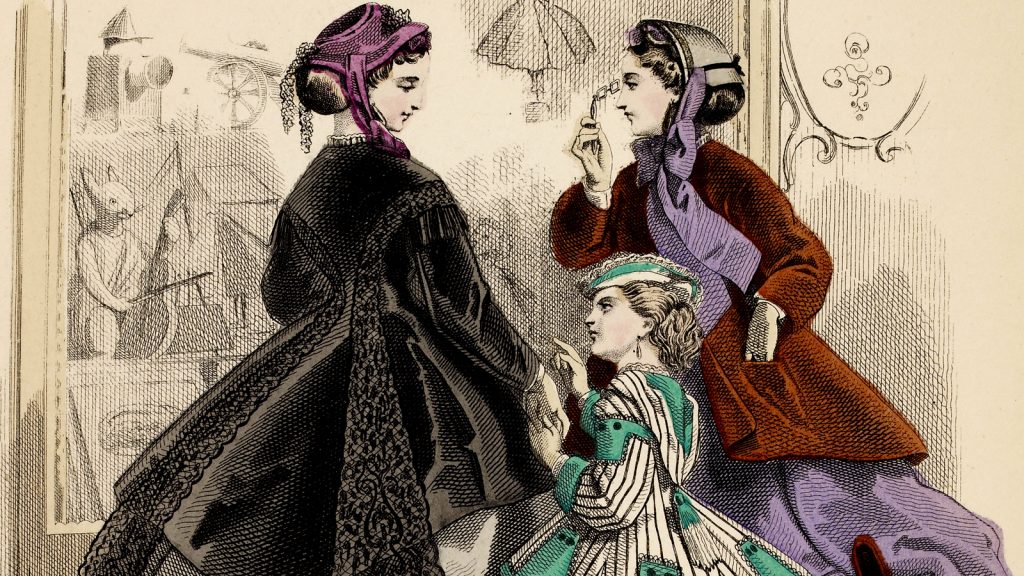
The doctrine of “separate spheres” became one of the most powerful ways Victorians explained gender difference, but its power lay partly in its simplicity. It divided the social world into paired opposites: public and private, work and home, reason and feeling, competition and nurture, masculine action and feminine influence. Men were imagined as actors in the world of commerce, politics, professions, law, empire, and paid labor. Women were imagined as guardians of domestic morality, religious feeling, emotional refinement, and family stability. This was never merely a description of where men and women happened to spend their time. It was a moral theory of social order. The public world was understood as necessary but dangerous, a realm of ambition, conflict, money, and temptation. The home was imagined as its corrective, a protected space where women softened masculine hardness and preserved the ethical life of the nation. The appeal of this model was that it made social hierarchy appear harmonious rather than coercive. Men and women were said to occupy different but complementary realms, each supposedly dignified by its own duties. Yet complementarity often concealed inequality. The public sphere held law, property, wages, political authority, and institutional power, while the private sphere offered moral influence without equivalent legal or civic command. Separate spheres transformed exclusion into vocation, making women’s distance from formal authority appear not as deprivation, but as destiny.
Yet separate spheres must be read as an ideology, not as a transparent map of Victorian life. Its language appeared most confidently in middle-class writing, advice manuals, sermons, fiction, and political rhetoric, where it helped present class aspiration as moral truth. The ideal household was one in which the husband earned, the wife refined, the children obeyed, and the family’s public reputation rested on private discipline. But the very clarity of this model concealed the complexity beneath it. Women worked in factories, shops, fields, schools, hospitals, laundries, mines before regulatory restrictions, domestic service, publishing, philanthropy, and family businesses. Men also inhabited domestic roles as fathers, sons, invalids, retirees, dependents, and emotional members of households. The boundary between public and private was porous, even when it was treated as absolute in rhetoric.
Class was the first great contradiction inside the separate-spheres ideal. For middle-class families, a woman’s distance from paid labor could serve as a visible sign of respectability. For working-class families, such distance was often impossible. Wives, daughters, widows, and unmarried women contributed to household survival through wages, domestic service, piecework, market labor, informal exchange, or irregular employment. Their work did not make them unfeminine in any simple sense, but it did place them under the judgment of an ideology that treated economic necessity as a failure to achieve proper womanhood. The respectable woman was imagined as sheltered; the poor woman was often exposed. The respectable woman was praised for moral dependence; the laboring woman was suspected of roughness, sexual vulnerability, or insufficient delicacy. Separate spheres turned class inequality into gender judgment, allowing the circumstances of poverty to be interpreted as defects of character.
Domestic service reveals this contradiction with particular force. Servants worked inside the home, but they did not possess the home. Their labor made possible the leisure, refinement, and moral theater of middle-class domesticity, yet they remained socially subordinate and often physically vulnerable within the household itself. The middle-class wife could appear as mistress of an orderly domestic sphere because other women cooked, cleaned, laundered, carried coal, tended fires, scrubbed floors, emptied chamber pots, cared for children, and absorbed the bodily demands that polite femininity preferred to hide. The servant’s body moved through the supposedly private home as laboring presence, not as sentimental ideal. Her position unsettled any easy distinction between public work and private refuge, since the household was also a workplace governed by hierarchy, surveillance, discipline, and dependence.
There were also contradictions of marital status and life course. Separate-spheres ideology centered on the married woman, especially the wife and mother, but Victorian Britain contained large numbers of unmarried women, widows, and women whose family arrangements did not conform to the ideal. The unmarried daughter might be expected to remain useful within a family household, but she could also face economic insecurity if no marriage or inheritance protected her. The governess occupied an especially uneasy position, educated enough to belong culturally near the middle classes but paid to labor within another family’s home. She was neither servant in the ordinary sense nor family member, neither fully independent nor fully protected, and her ambiguous status revealed how fragile the category of “respectable woman” could become when education and economic need met. Widows could sometimes exercise forms of independence denied to married women, especially in business or property management, yet that autonomy often came from loss rather than freedom. Single women who pursued teaching, writing, nursing, religious work, or reform activity likewise complicated the assumption that adult femininity reached its proper fulfillment only in marriage and motherhood. These women did not fit easily into the binary of male public provision and female domestic dependence. Their lives exposed the fact that “woman’s sphere” was not one stable place, but a set of expectations organized around marriage, property, class, and respectability.
The separate-spheres model also contained an internal political contradiction. By defining women as morally superior and specially suited to care, reform, and conscience, it justified their exclusion from formal political power while simultaneously giving them grounds for public intervention. Women could enter debates over slavery, poverty, temperance, prostitution, education, factory reform, missionary work, and public health by presenting themselves not as political competitors with men, but as moral agents extending domestic duty outward. This did not overthrow gender hierarchy, but it strained its boundaries. The very ideology that located women in the home could be used to argue that society itself needed maternal, moral, and domestic correction. Separate spheres functioned less as a closed prison than as a contested language: restrictive, hierarchical, and class-bound, but also available for adaptation by women who pushed its moral claims beyond the walls of the household.
Law, Marriage, and Coverture: The Wife as Legal Extension

The ideology of separate spheres did not operate only through sermons, novels, clothing, and household manners. It was reinforced by law, especially through the doctrine of coverture. Under English common law, marriage altered a woman’s civil identity in profound ways. A single woman, or feme sole, could own property, enter contracts, sue, and be sued in her own name. A married woman, or feme covert, was legally “covered” by her husband. Her separate legal personality was constrained, absorbed, or mediated through his authority. This did not mean that all married women were powerless in every practical situation, since equity, settlements, family negotiation, and local custom could produce exceptions. Wealthy families might use marriage settlements to protect some property for daughters, widows might possess forms of legal and economic agency unavailable to wives, and working households often relied on informal arrangements that did not neatly match formal doctrine. But these complications did not erase the central structure. The underlying legal principle was unmistakable: marriage did not simply join two people in a household. It reordered personhood, property, obligation, and authority around the husband’s legal supremacy. The sentimental language of marital unity concealed an asymmetry built into law itself. Husband and wife were said to become one, but the “one” recognized by law was overwhelmingly the husband.
Coverture gave institutional force to the domestic hierarchy that Victorian moralists often softened with sentimental language. The wife might be praised as the moral center of the household, but law treated her economic existence as dependent. Her wages, movable property, and many forms of control over assets could pass into her husband’s hands. Her ability to contract independently was limited. Her access to children, property, and legal remedy depended heavily on marital status and male authority. The contradiction was glaring. A wife was supposed to be spiritually elevating, emotionally indispensable, and morally refining, yet she could be denied the ordinary legal capacities associated with independent adulthood. Victorian domestic ideology rested on a paradox: the wife was exalted as an angel while restricted as a legal subordinate. Reverence and dependency were not opposites in this system. They were partners.
The law of marriage also exposed the difference between moral ideal and lived danger. The sentimental household was imagined as a place of protection, but coverture could make marriage a site of vulnerability. A husband’s control over property and earnings could leave a wife economically trapped. Legal inequality shaped questions of desertion, debt, custody, inheritance, domestic violence, and separation. Divorce reform remained limited and class-bound after the Matrimonial Causes Act of 1857 transferred divorce from ecclesiastical process and private parliamentary act into a civil court, because the grounds were unequal and the procedure still favored those with money and social access. Married women seeking escape from cruelty, adultery, neglect, or financial exploitation faced not only moral stigma, but structural dependence. The law presumed the unity of husband and wife, but that unity usually meant the husband’s power was made legally visible while the wife’s injuries could be rendered private.
Reform came gradually and unevenly, and it should not be mistaken for sudden liberation. The Married Women’s Property Act of 1870 allowed married women to keep earnings and certain forms of inherited property, marking an important breach in the older logic of marital absorption. The Married Women’s Property Act of 1882 went much further, recognizing a married woman’s right to acquire, hold, and dispose of real and personal property as her separate property. This legislation did not abolish patriarchy, nor did it end the social expectation that wives should be self-sacrificing, domestic, and subordinate. Social habits changed more slowly than statutes, and legal capacity did not automatically produce economic independence for women without wages, inheritance, education, or family support. Many husbands retained practical dominance through custom, financial control, emotional coercion, or the simple fact that most respectable employment remained limited and poorly paid for women. But the reforms did change the legal grammar of marriage. A married woman could increasingly be imagined not only as wife, mother, and moral influence, but also as an owner, earner, contracting person, and legal subject. That shift mattered because it forced Victorian society to confront a question domestic ideology had tried to evade: if women were morally responsible beings, why should marriage erase their civil independence? The property acts did not solve that contradiction, but they made it impossible to ignore. They exposed the wife’s legal subordination as a human arrangement, not a natural law.
The reform of married women’s property rights belongs at the center of any history of Victorian gender. It reveals that definitions of femininity were not merely cultural fantasies, but legal arrangements with material consequences. It also shows that Victorian gender was changing from within. Feminists, liberal reformers, legal activists, and sympathetic legislators did not simply reject marriage outright; many argued that marriage itself had to be made more just if it was to remain morally legitimate. The wife as legal extension of the husband became increasingly difficult to reconcile with liberal ideals of contract, property, individual responsibility, and moral personhood. By the late 19th century, the law had not produced equality, but it had weakened one of the deepest foundations of patriarchal marriage. The “separate” domestic woman could no longer be treated quite so easily as legally invisible.
Masculinity in the Early and Mid-Victorian Period: Work, Self-Mastery, and Domestic Authority
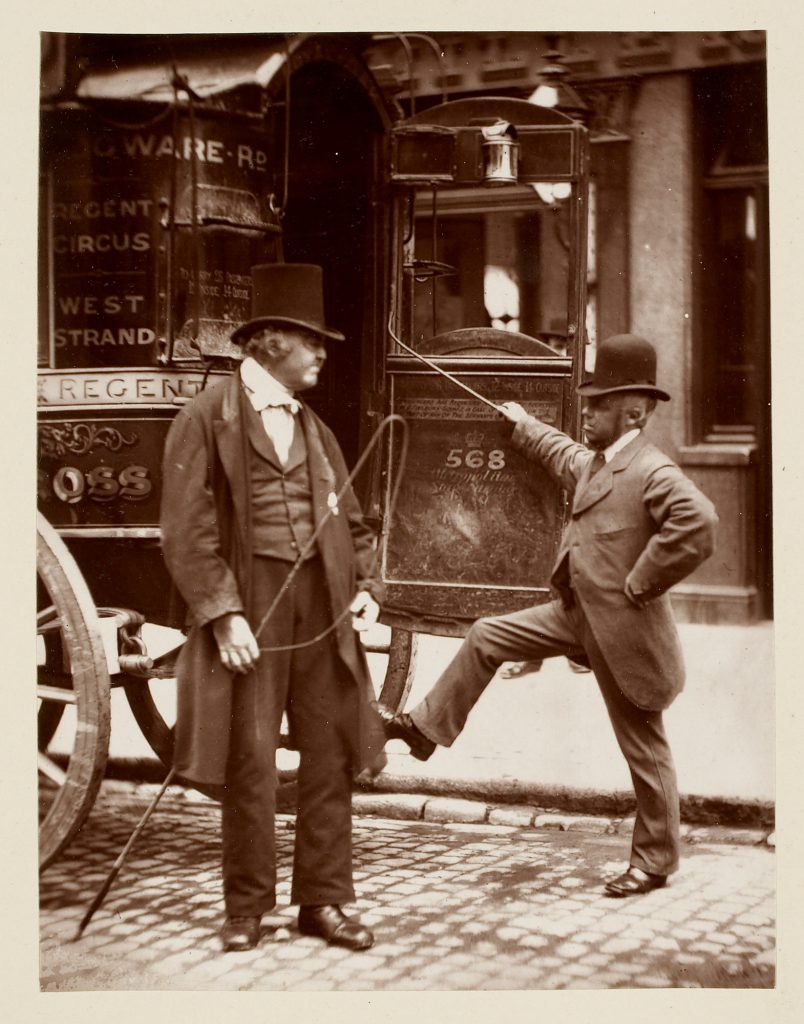
Victorian gender ideology did not only prescribe womanhood. It also placed men under a demanding and often anxious code of conduct. Early and mid-Victorian masculinity was organized around work, self-command, household authority, moral seriousness, and public usefulness. The respectable man was expected to be industrious rather than idle, rational rather than impulsive, sober rather than dissolute, disciplined rather than self-indulgent, and capable of supporting dependents without appearing dependent himself. These expectations were especially important for the middle classes, whose social identity rested less on inherited rank than on visible evidence of character, occupation, and domestic stability. Masculinity became something to be proven through conduct. A man’s place in the world was not simply given by sex; it had to be demonstrated through labor, restraint, provision, and reputation.
The ideal of work stood near the center of this masculine order. Industrial and commercial Britain placed enormous moral weight on productivity, punctuality, ambition, thrift, and perseverance. The self-made man became one of the century’s most powerful figures, not because most men could actually rise through effort alone, but because the ideal made economic striving appear morally meaningful. Work was imagined as a school of character, a place where discipline, foresight, and rational self-management could be tested. The respectable male worker, professional, merchant, clerk, manufacturer, or shopkeeper was expected to govern himself before he could govern others. This gave ordinary labor a moral and almost spiritual significance. A man’s daily habits, his punctual arrival, his control of money, his refusal of idleness, his capacity to endure frustration, and his willingness to subordinate pleasure to duty all became signs of inner worth. Samuel Smiles’s culture of self-help did not merely celebrate ambition; it translated economic conduct into moral evidence. Laziness, debt, drunkenness, speculation, gambling, sexual excess, and emotional volatility were not merely personal weaknesses. They were threats to masculine credibility. A man who failed to master appetite or manage money risked appearing unfit for authority over household, business, or civic life.
This emphasis on self-mastery drew strength from evangelical religion, liberal political economy, and older patriarchal assumptions. The early Victorian man was supposed to restrain desire, regulate emotion, and transform private discipline into public trustworthiness. Masculinity was not simply a license to dominate. It was a burden of performance. The man who claimed authority was expected to justify it through sobriety, responsibility, and moral steadiness. Religious seriousness gave this code spiritual weight, while economic ideology gave it practical urgency. The household needed provision; business required reliability; politics demanded independence; empire claimed to need courage and command. A man who failed in self-government could be read as failing across all these domains. Victorian masculinity rested on a constant movement from inward discipline to outward authority.
The home played a crucial role in this masculine formation, even though separate-spheres language often described domestic life as feminine territory. The Victorian household was not simply a refuge for women from male public life. It was also a stage on which male respectability was displayed. A well-kept home, a dependent wife, obedient children, religious order, and financial solvency all testified to a man’s competence. Domestic authority mattered because it made public masculinity visible in private form. The husband and father was expected to provide, guide, correct, protect, and represent the household to the wider world. Yet his authority was supposed to be moral rather than merely coercive. The respectable patriarch was not imagined as a tyrant, though tyrannical power often lurked behind the ideal. He was to rule through firmness, reason, affection, and example. This made the home both comforting and disciplinary: a place where men found refuge from competition, but also a place where their authority had to be continually performed.
The contradiction was that men depended on the very domestic world they claimed to govern. A wife’s unpaid labor, emotional management, social tact, childrearing, household supervision, and moral influence helped produce the conditions under which masculine respectability could appear stable. The self-made man was rarely self-made in any literal sense. His public success rested on hidden networks of domestic support, female labor, inherited advantage, servants’ work, and class privilege. Even the language of male independence was often sustained by women’s dependence. The husband appeared as provider because the wife’s labor was not counted in the same way; he appeared as household head because her management was defined as service rather than authority. This was not merely a domestic contradiction, but an ideological one. The more Victorian culture celebrated male autonomy, the more carefully it had to disguise the cooperative and unequal arrangements that sustained it. The wife’s refinement, the servant’s labor, the children’s obedience, the family’s reputation, and the orderly routines of household life all helped create the illusion that masculine authority arose naturally from individual character. Manhood was socially manufactured, daily maintained, and deeply dependent on the people it subordinated. Early and mid-Victorian masculinity depended on a paradox: it celebrated autonomous male achievement while relying on social and domestic structures that made that autonomy possible.
This masculine order was powerful, but it was also fragile. Economic failure, unemployment, bankruptcy, illness, sexual scandal, domestic disorder, or public humiliation could threaten a man’s identity as surely as they threatened his income. The pressure to be provider, governor, moral example, and public actor could produce anxiety as well as confidence. By mid-century, this anxiety would help generate more strenuous ideals of manliness, including muscular Christianity, athletic discipline, imperial service, and fears that comfort, urban life, or excessive refinement might weaken men. But those later forms did not replace the earlier Victorian code so much as intensify its tensions. The man of work, self-mastery, and domestic authority remained central because he embodied the century’s deepest claim about gendered order: that men were fit to govern society because they had first learned to govern themselves, their households, and their desires.
Muscular Christianity and the Late-Victorian Male Body
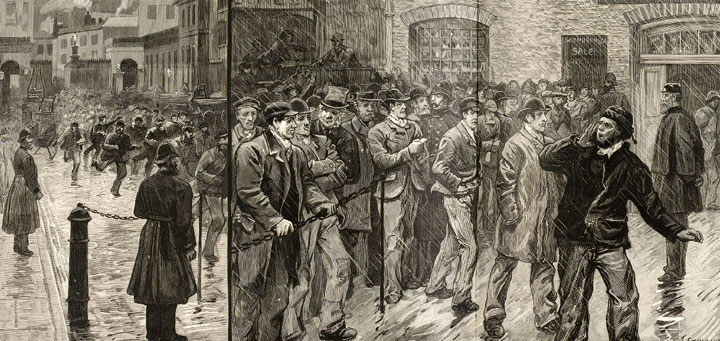
By the later 19th century, Victorian masculinity became increasingly preoccupied with the body. Earlier ideals of male self-command, sobriety, work, and domestic authority did not disappear, but they were joined by a more strenuous language of vigor, athleticism, courage, and disciplined physical action. This shift was not accidental. Industrial cities, sedentary professions, bureaucratic work, imperial competition, and fears of national decline all intensified anxieties that modern life might weaken men. The respectable man still had to govern himself morally, but late-Victorian culture increasingly insisted that moral authority required bodily proof. A man’s character was to be visible not only in his habits, income, household, or religious seriousness, but in his strength, stamina, bearing, athletic training, and readiness for struggle. Manhood became something to be enacted through the controlled body.
Muscular Christianity gave this bodily ideal religious and moral legitimacy. Associated especially with figures such as Charles Kingsley and Thomas Hughes, it fused Protestant seriousness with physical vigor, presenting strength, courage, sport, discipline, and active service as signs of Christian manliness. This was not a rejection of religion in favor of brute force. Rather, it was an attempt to rescue Christianity from associations with passivity, softness, excessive inwardness, or feminized piety. The muscular Christian man was to be devout, but not withdrawn; moral, but not timid; disciplined, but not delicate. He would pray, but he would also row, box, ride, play cricket, endure hardship, defend the weak, and serve the nation. In this formulation, the male body became an instrument of moral purpose. Physical strength was not merely admired as power; it was interpreted as evidence of rightly ordered character.
Schools, universities, athletic clubs, and imperial institutions helped turn this ideal into a social program. Public-school culture placed growing emphasis on organized games, discipline, hierarchy, endurance, and team loyalty, training boys to associate manhood with obedience, leadership, and controlled aggression. Sport offered a ritualized space in which competition could be moralized. The playing field became a training ground for empire, administration, military service, and public command. Boys learned not only to play, but to submit to rules, accept pain, internalize rank, subordinate private feeling to collective purpose, and convert rivalry into character. This made athleticism especially attractive to a society trying to produce men who could govern without appearing brutal and compete without appearing morally corrupt. Athletic masculinity also promised to resolve a deep Victorian tension: men were expected to be self-controlled, yet also forceful; civilized, yet capable of violence; Christian, yet imperial; domestic, yet restless for action. Muscular Christianity helped reconcile those opposites by teaching that bodily vigor, when disciplined by moral purpose, was not savagery but manly virtue. The same culture that praised restraint also feared over-refinement, and athletic discipline seemed to offer a cure. The controlled male body became a symbolic answer to the fear that modern comfort might soften the ruling classes and weaken the nation’s moral nerve.
The late-Victorian male body was not merely biological. It was political, imperial, and racialized. Physical vigor became entangled with national strength, military preparedness, colonial rule, and assumptions about the superiority of British manhood. The language of health, fitness, hardiness, and courage often carried broader claims about civilization and authority. This did not mean that all muscular Christians were simple social Darwinists, nor that every advocate of athletic manliness embraced the same imperial politics. But by the late 19th century, the ideal of the strong Christian man could easily merge with anxieties about racial competition, urban degeneration, and the capacity of Britain to govern an empire. Weakness became more than a personal failing. It could be imagined as a social and national danger. The athletic body stood in for a wider fantasy of disciplined power: the body trained to endure, command, conquer, and civilize. This ideal sharpened exclusions. Men who were disabled, poor, sedentary, intellectually inclined, physically slight, queer-coded, colonized, or otherwise unable or unwilling to perform this muscular script could be cast as deficient forms of masculinity. The male body became a symbol through which Victorians debated the future of family, class, nation, and empire.
Yet muscular Christianity also exposed the instability of Victorian masculinity. If manhood had to be proven so insistently through exercise, hardship, sport, and public action, then it was clearly not assumed to be secure. The athletic male body was a promise, but also a confession of fear: fear that men were becoming too sedentary, too commercial, too urban, too intellectual, too dependent on domestic comfort, or too detached from martial virtue. The muscular Christian did not replace the earlier man of work and self-mastery; he intensified him. He added sinew to discipline, sport to morality, and imperial movement to domestic authority. He revealed that Victorian masculinity was never simply the possession of men. It was an anxious historical project, built through training, rhetoric, institutions, and bodies made to carry the burden of national meaning.
Women’s Work, Education, and Reform: The Practical Erosion of Domestic Ideology

The separate-spheres ideal depended on the belief that women’s proper influence was domestic, moral, and indirect, but Victorian life repeatedly undermined that. Women worked, organized, taught, wrote, nursed, campaigned, managed households, supported families, and entered public debates long before formal political equality became imaginable to most of British society. The contradiction was not simply that ideology failed to match reality. It was that the very responsibilities assigned to women inside domestic ideology created pathways beyond the home. If women were the moral guardians of family life, then poverty, drunkenness, prostitution, disease, ignorance, factory exploitation, and child neglect could all be framed as extensions of domestic concern. Reformers did not always have to reject femininity to enter public life. Often, they expanded its moral jurisdiction.
Women’s paid work made the limits of domestic ideology especially visible. Working-class women continued to labor in factories, workshops, domestic service, agriculture, laundries, shops, and home-based piecework. Their wages were often low, irregular, and treated as supplementary even when families depended on them. Middle-class women faced different constraints, since respectability could make open wage earning socially dangerous, but economic necessity still pushed many into teaching, governess work, writing, nursing, clerical labor, and charitable administration. The governess remained one of the most revealing figures in this world: educated enough to carry middle-class culture, yet economically vulnerable enough to sell her labor inside another household. Her presence exposed the fragility of genteel femininity, since class status could be preserved in manners and education even when money had vanished. Women’s labor did not simply contradict separate spheres. It revealed that “woman’s sphere” was always mediated by class, income, family structure, and the need to survive.
Education became one of the most important arenas in which domestic ideology began to erode. Early Victorian assumptions often treated advanced female education as unnecessary, unfeminine, or even physically dangerous, since women were imagined as destined primarily for marriage, motherhood, and moral influence. Yet the expansion of girls’ schooling, the founding of women’s colleges, and campaigns for women’s access to examinations challenged that narrow purpose. Queen’s College London, Bedford College, Girton College, and Newnham College represented more than institutional milestones. They signaled a change in the meaning of female capacity. Education allowed women to claim intellectual seriousness without abandoning moral purpose, and it gave reformers a practical answer to dependency. If women were to teach, govern households, raise children, manage property, write, organize charities, or support themselves, then ignorance could no longer be defended as feminine innocence. The educated woman became one of the century’s most disruptive figures because she challenged the assumption that refinement required intellectual limitation.
Nursing and philanthropy also expanded women’s public authority while preserving a language of feminine care. Florence Nightingale’s work after the Crimean War helped professionalize nursing and turn female caregiving into a disciplined public vocation rather than merely a domestic instinct. This mattered because it translated supposedly feminine virtues into administrative competence, statistical reasoning, institutional reform, and public health advocacy. Nightingale did not simply embody compassion; she used data, bureaucratic pressure, sanitary reform, and public argument to expose the deadly consequences of mismanagement. Her example demonstrated that care could be technical, organized, and politically consequential. Philanthropic work did something similar. Middle-class women entered prisons, hospitals, schools, missions, settlement work, temperance organizations, and campaigns against sexual exploitation under the banner of moral duty. These activities could be conservative, paternalistic, or class-bound, especially when reformers approached poor women as objects of rescue rather than as equal participants. Yet they also gave women organizational experience, public credibility, administrative skill, and political language. Committees, fundraising networks, petitions, reports, visits, lectures, and reform societies trained women in the habits of public life while allowing them to claim continuity with domestic virtue. Domestic ideology had imagined women as moral influences within the household; reform activity asked why that influence should stop at the front door. Once women could speak publicly in the name of health, morality, childhood, education, and social protection, the boundary between private duty and public intervention became increasingly difficult to police.
The same pattern appeared in campaigns around law, labor, sexuality, and political rights. Women who argued for property reform, child custody reform, access to education, improved employment, repeal of the Contagious Diseases Acts, temperance, and eventually suffrage often drew on the moral claims Victorian culture had already assigned to them. Josephine Butler’s campaign against the Contagious Diseases Acts is especially important because it challenged the sexual double standard at the heart of Victorian respectability. The Acts subjected suspected prostitutes in certain military and naval districts to compulsory medical examination, while leaving male clients largely unexamined and morally unmarked. Butler and her allies opposed the system not only as an abuse of women’s bodies, but as evidence that the state itself enforced gendered sexual inequality. Such activism made clear that women’s public speech could no longer be contained within sentimental domesticity. Moral authority had become political.
By the late 19th century, women’s work, education, and reform had not destroyed domestic ideology, but they had made its boundaries increasingly difficult to defend. Victorian society continued to praise marriage, motherhood, modesty, and feminine influence, yet more women were visible as students, teachers, nurses, writers, reformers, wage earners, and organizers. The result was not a simple march from oppression to liberation. It was a practical erosion of an ideal that had always depended on selective blindness. Women entered public life unevenly, often through class privilege and moral respectability, and many remained constrained by wages, law, sexuality, family obligation, and social judgment. Still, the older claim that women belonged naturally and exclusively to the private sphere had lost much of its credibility. The public woman, once treated as an exception or a danger, was becoming a recognizable feature of modern Britain.
Gender, Sexuality, and “Inversion”: The Medicalization of Difference

By the late 19th century, Victorian debates over gender increasingly intersected with new efforts to classify sexuality. Earlier moral and religious language had often treated sexual conduct as sin, vice, temptation, or social disorder, but late-Victorian medicine, psychiatry, criminal anthropology, and sexology began to describe sexual difference as a matter of identity, development, pathology, and bodily truth. This did not mean that older moral judgments disappeared. They remained powerful, especially in law, religion, journalism, and public scandal. What changed was the growing claim that non-normative desire, gender expression, and erotic conduct could be studied, named, diagnosed, and categorized. Sexuality became an object of expert knowledge. The result was a new kind of control: difference was not merely condemned; it was examined, described, and placed within systems of medical and scientific authority.
The concept of “inversion” was central to this transformation. Late-19th-century writers often used the term to describe same-sex desire as a reversal or crossing of gendered traits. A man who desired men might be interpreted as possessing a feminized inner nature, while a woman who desired women might be understood as masculine in temperament, body, or disposition. This blurred what later categories would separate more sharply: sexual orientation, gender identity, gender expression, and bodily sex. The “invert” was not simply a person who performed a forbidden act. He or she became a type of person, a figure whose desires supposedly revealed an underlying constitutional difference. This shift mattered because it helped create modern sexual identities even while placing them under the shadow of pathology. The language of inversion could give some people a vocabulary for self-understanding, but it also made them objects of medical suspicion. It translated moral transgression into embodied character, suggesting that desire disclosed an inner truth about the person rather than merely a behavior. That move was double-edged. On one side, it allowed same-sex desire to be discussed as something more durable than vice or temptation, which could open a narrow space for sympathy, explanation, and even self-recognition. On the other side, it placed that recognition inside a diagnostic framework that treated gender nonconformity and erotic difference as evidence of abnormal development. The invert was made intelligible, but at the cost of being made medically suspect.
British law intensified the stakes of these classifications. Male homosexual acts had long been criminalized, but the Criminal Law Amendment Act of 1885, especially its Labouchere Amendment, broadened the prosecution of “gross indecency” between men. The law did not require proof of sodomy, making it a powerful instrument against male same-sex intimacy more broadly. The trials of Oscar Wilde in 1895 exposed how sexual suspicion, aesthetic style, class performance, literary celebrity, and public morality could converge into spectacle. Wilde’s prosecution did not create Victorian sexual anxiety, but it dramatized it. The scandal helped fix the association between male same-sex desire, effeminacy, decadence, secrecy, and corruption in the popular imagination. It also showed how fragile elite male privilege could become when gender performance and erotic life were read as signs of moral and national danger.
Female same-sex desire occupied a different and often less visible position. It was not criminalized in the same statutory form as male same-sex conduct, but that did not mean it was freely accepted or easily understood. Women’s intimate friendships, romantic attachments, shared households, and emotional bonds could sometimes exist within a culture that idealized female affection, yet this very ambiguity made female sexuality difficult to name. As sexological writing developed, women who desired women could be reinterpreted through the language of inversion, masculinity, nervous abnormality, or developmental disorder. The masculine woman became a troubling figure because she disturbed the assumption that female nature was passive, maternal, modest, and oriented toward men. The medicalization of sexuality did not merely classify desire. It also policed gender. A woman’s ambition, dress, independence, intellectual seriousness, or refusal of marriage could be read through suspicion, as if social nonconformity and erotic deviance naturally belonged together.
The medicalization of difference also reshaped heterosexuality, even though heterosexuality was often presented as natural rather than historically produced. Victorian sexology, moral reform, public health policy, and legal debate helped define what counted as normal by surrounding it with named abnormalities. The prostitute, the masturbator, the invert, the hysterical woman, the effeminate man, the sexually aggressive woman, and the decadent aesthete all served as boundary figures against which respectable heterosexual marriage could be clarified and defended. Yet this process revealed the instability of the very norm it tried to secure. If normal sexuality required so much instruction, surveillance, classification, and punishment, then it was not simply self-evident. It had to be produced. Late-Victorian society increasingly treated sexual order as a matter of national health, racial strength, family stability, imperial discipline, and social survival. Desire became political because it was imagined as carrying the future of the household, the race, and the state. Respectable heterosexuality was not only a private arrangement between husband and wife; it was made into a civic and imperial obligation. Marriage promised reproduction, inheritance, domestic discipline, and social continuity, while deviations from that model were cast as threats to collective vitality. This is why late-Victorian sexual discourse so often moved between the intimate and the national, between the bedroom and the empire, between bodily conduct and civilizational fear. The more insistently heterosexual marriage was presented as nature, the more labor went into defending it as a norm.
The language of inversion belongs within the broader history of Victorian gender, not as a separate story of sexuality alone. It shows how late-19th-century Britain tried to stabilize gender difference at the very moment its categories were becoming harder to contain. Women were entering education, reform, and professional work. Men were being urged toward muscular vigor because masculinity seemed vulnerable. Marriage law was changing. Urban anonymity, journalism, scandal, empire, and new sciences of the body were unsettling older moral frameworks. Sexology promised knowledge, but it also revealed anxiety. By naming the invert, the deviant, and the abnormal, Victorian culture admitted that gender and sexuality were not as simple, natural, or secure as its domestic ideology had claimed. The medicalization of difference did not end moral judgment. It gave moral judgment new instruments and helped create the modern categories through which sexuality would later be contested, reclaimed, and reimagined.
The New Woman and the Fin de Siècle Crisis of Gender

By the final decades of the 19th century, the contradictions that had shaped Victorian gender became impossible to contain within the older language of domestic harmony. The figure of the New Woman emerged in the 1880s and 1890s as both a social reality and a cultural panic. She was educated, mobile, intellectually ambitious, politically aware, skeptical of compulsory marriage, and increasingly associated with paid work, bicycle riding, urban independence, feminist argument, and sexual self-consciousness. She appeared in fiction, journalism, satire, medical commentary, and public debate as a sign that the old settlement between masculinity, femininity, household, and nation was under strain. What made her so unsettling was not any single behavior, but the way she gathered many challenges into one recognizable figure. She questioned marriage, entered universities, imagined economic independence, rejected ornamental helplessness, and claimed the right to speak as a thinking person rather than as a domestic symbol. To supporters, she represented freedom from dependence and the possibility of a fuller human life for women. To critics, she seemed to threaten marriage, motherhood, male authority, sexual order, and even the future of the race. The New Woman became powerful precisely because she was both real and exaggerated: a living sign of social change and a projection screen for fin de siècle fear.
The New Woman did not appear from nowhere. She was the product of earlier struggles over education, property, employment, marriage law, sexuality, and political rights. Women’s access to higher education had already challenged the assumption that intellectual seriousness was masculine. Married women’s property reform had weakened the legal fiction that a wife’s identity should disappear into her husband’s. Campaigns against the Contagious Diseases Acts had exposed the sexual double standard and trained women reformers in public agitation. Expanding employment opportunities, however limited and unequal, made economic independence more imaginable. The New Woman gathered these changes into a single cultural figure. She embodied what domestic ideology had tried to prevent: a woman whose selfhood could not be contained by wifehood, whose moral authority no longer depended on silence, and whose body, mind, and labor were no longer assumed to belong naturally to men, marriage, or the household.
Literature gave the New Woman much of her public visibility. Writers such as Sarah Grand, Mona Caird, Olive Schreiner, George Egerton, and others explored women’s frustration with marriage, sexual ignorance, reproductive obligation, intellectual confinement, and economic dependence. The debate over marriage became especially sharp because marriage had long served as the central institution through which Victorian gender hierarchy was made respectable. When Mona Caird questioned the morality and structure of marriage, or when New Woman fiction portrayed wives as trapped by law, convention, ignorance, or sexual hypocrisy, critics understood the challenge immediately. The issue was not merely whether women could read more books, attend college, or work for wages. The deeper question was whether womanhood itself had to be defined through sacrifice to husband, children, and domestic respectability. New Woman writing suggested that the supposedly natural destiny of women had been built from law, custom, economic dependence, and male convenience.
The fin de siècle intensified these anxieties because the New Woman appeared alongside other signs of instability: debates over degeneration, imperial competition, urban vice, sexology, socialism, aestheticism, declining birthrates among the middle classes, and fears of national weakness. Her bicycle, clothing, education, and public speech became symbols onto which broader worries were projected. The bicycle condensed fears of mobility, bodily freedom, and loosened supervision, while rational dress challenged the assumption that respectable femininity required physical restriction. If women rejected restrictive clothing, delayed marriage, sought professional work, or demanded political rights, critics could present such acts as evidence of selfishness, masculinization, sexual disorder, or racial decline. The New Woman was policed not only as a political radical, but as a bodily and reproductive threat. She unsettled femininity by appearing too mobile, too articulate, too desiring, too independent, or too unwilling to disappear into service. She unsettled masculinity. If women could earn, think, organize, desire, and speak for themselves, then male authority could no longer be defended as naturally necessary in the same way. The panic surrounding the New Woman revealed a fear larger than feminism itself: the fear that gender hierarchy might be historical, contingent, and open to revision.
The New Woman marked a crisis in Victorian gender because she revealed that the century’s dominant ideals had always been historical arguments rather than permanent truths. The Angel in the House had depended on legal subordination, economic dependency, moral idealization, and carefully managed ignorance. The muscular Christian had depended on anxiety that masculinity itself required training and defense. The sexological invert had exposed the instability of gender and sexual categories. The New Woman brought these tensions into one disruptive figure. She did not overturn patriarchy, and she did not represent all women. Many women remained constrained by poverty, race, empire, domestic labor, marriage, and social stigma. Yet she made a decisive breach in the Victorian imagination. By the end of the century, gender could no longer be spoken of only as divine order, natural complementarity, or domestic peace. It had become a public argument about law, labor, sex, education, citizenship, and the right to self-definition.
Conclusion: Victorian Gender and the Modern Inheritance
Victorian gender was never the fixed, seamless order its defenders imagined. It was a system of claims, anxieties, institutions, and performances produced by a society undergoing profound change. Industrial capitalism helped separate the symbolism of home and work. Evangelical morality turned the household into a sacred theater of discipline and respectability. Law made marriage into an institution of unequal personhood. Masculine ideals linked authority to labor, self-command, physical vigor, and imperial service. Medical and sexological writing classified gender and sexual difference with new intensity, while feminist reformers and the New Woman exposed the fragility of the very categories Victorian culture tried to naturalize. The result was not one stable code, but a century of contest over what men and women were supposed to be.
The enduring power of Victorian gender lies partly in the fact that many of its assumptions survived long after the formal structures that sustained them began to weaken. The breadwinner husband, the morally responsible wife, the public man, the private woman, the self-sacrificing mother, the dangerous independent woman, the anxious policing of masculinity, and the suspicion that changing gender roles signal social decline all outlived the Victorian century itself. These figures migrated into modern debates over work, family, sexuality, education, politics, and national identity. Even when later generations rejected Victorian morality, they often continued to argue within categories the Victorians had helped sharpen: public versus private, masculine versus feminine, normal versus deviant, dependent versus independent, respectable versus dangerous. The modern inheritance of Victorian gender is not simply a set of old-fashioned prejudices. It is a vocabulary of social order that still shapes conflict over bodies, labor, desire, authority, and belonging.
Yet the Victorian record also shows that gender norms are never as natural as they claim to be. The “Angel in the House” depended on law, class privilege, unpaid labor, domestic service, and the careful concealment of women’s economic activity. The masculine breadwinner depended on women’s labor while presenting himself as independent. Muscular Christianity claimed to restore manly vigor, but its urgency revealed fear that masculinity itself was unstable. Sexology claimed to identify natural types, but its classifications exposed the historical production of sexual normality and deviance. The New Woman was treated as a threat because she made visible what had always been true: gender was not merely inherited, but made, defended, revised, and resisted. Victorian society did not simply discover gender difference. It organized difference into hierarchy and then mistook that hierarchy for nature.
To study Victorian gender, then, is to study a world that made power look like virtue and inequality look like order, but also a world in which those arrangements were persistently challenged from within. Women worked, studied, wrote, organized, nursed, campaigned, loved, resisted, and reimagined themselves despite the domestic ideals imposed upon them. Men carried privilege, but also the burdens and fears of a masculinity that required constant proof. By 1901, the old language of separate spheres had not disappeared, but it had been permanently unsettled. Victorian gender left behind no simple lesson of repression overcome by progress. It left a more complicated inheritance: the recognition that every claim about “natural” manhood or womanhood must be read historically, politically, and materially. Gender was one of the great Victorian arguments, and in many ways, it remains unfinished.
Bibliography
Affiliate disclosure: Amazon links on this site are paid links. As an Amazon Associate I earn from qualifying purchases.
- Act to Make Further Provision for the Protection of Women and Girls, the Suppression of Brothels, and Other Purposes, 1885 (Labouchere Amendment). 48 & 49 Vict., c. 69.
- Adams, James Eli. Dandies and Desert Saints: Styles of Victorian Masculinity. Ithaca: Cornell University Press, 1995.
- Armstrong, Nancy. Desire and Domestic Fiction: A Political History of the Novel. New York: Oxford University Press, 1987.
- Blackstone, William. Commentaries on the Laws of England. Vol. 1. Oxford: Clarendon Press, 1765.
- Bland, Lucy. Banishing the Beast: English Feminism and Sexual Morality, 1885–1914. London: Tauris, 1995.
- Butler, Josephine E. The Constitution Violated: An Essay. Edinburgh: Edmonston and Douglas, 1871.
- Caine, Barbara. Victorian Feminists. Oxford: Oxford University Press, 1992.
- Caird, Mona. “Marriage.” Westminster Review 130 (1888), 186–201.
- Carlyle, Thomas. Past and Present. London: Chapman and Hall, 1843.
- Clark, Anna. The Struggle for the Breeches: Gender and the Making of the British Working Class. Berkeley: University of California Press, 1995.
- Davidoff, Leonore, and Catherine Hall. Family Fortunes: Men and Women of the English Middle Class, 1780–1850. London: Hutchinson, 1987.
- Dyhouse, Carol. No Distinction of Sex? Women in British Universities, 1870–1939. London: UCL Press, 1995.
- Egerton, George. Keynotes. London: Elkin Mathews and John Lane, 1893.
- Ellis, Havelock, and John Addington Symonds. Sexual Inversion. London: Wilson and Macmillan, 1897.
- Ellis, Sarah Stickney. The Women of England: Their Social Duties and Domestic Habits. London: Fisher, Son, & Co., 1839.
- Foucault, Michel. The History of Sexuality, Volume 2: The Use of Pleasure. Translated by Robert Hurley. New York: Vintage Books, 1985.
- Gleadle, Kathryn. British Women in the Nineteenth Century. Basingstoke: Palgrave Macmillan, 2001.
- Gorham, Deborah. The Victorian Girl and the Feminine Ideal. Bloomington: Indiana University Press, 1982.
- Grand, Sarah. “The New Aspect of the Woman Question.” North American Review 158:448 (1894): 270–276.
- Griffin, Ben. The Politics of Gender in Victorian Britain: Masculinity, Political Culture and the Struggle for Women’s Rights. Cambridge: Cambridge University Press, 2012.
- Hall, Catherine. White, Male and Middle Class: Explorations in Feminism and History. Cambridge: Polity Press, 1992.
- Hall, Donald E., ed. Muscular Christianity: Embodying the Victorian Age. Cambridge: Cambridge University Press, 1994.
- Heilmann, Ann. New Woman Strategies: Sarah Grand, Olive Schreiner, Mona Caird. Manchester: Manchester University Press, 2004.
- Holcombe, Lee. Wives and Property: Reform of the Married Women’s Property Law in Nineteenth-Century England. Toronto: University of Toronto Press, 1983.
- Honeyman, Katrina. Women, Gender and Industrialisation in England, 1700–1870. Basingstoke: Macmillan Press, 2000.
- Houghton, Walter E. The Victorian Frame of Mind, 1830–1870. New Haven: Yale University Press, 1957.
- Hudson, Pat. The Industrial Revolution. London: Edward Arnold, 1992.
- Hughes, Thomas. Tom Brown’s Schooldays. Cambridge: Macmillan, 1857.
- Jordan, Ellen. The Women’s Movement and Women’s Employment in Nineteenth-Century Britain. London: Routledge, 1999.
- Kent, Susan Kingsley. Gender and Power in Britain, 1640–1990. London: Routledge, 1999.
- Kerber, Linda K. “Separate Spheres, Female Worlds, Woman’s Place: The Rhetoric of Women’s History.” The Journal of American History 75:1 (1988), 9–39.
- Kingsley, Charles. Westward Ho!; or, The Voyages and Adventures of Sir Amyas Leigh, Knight, of Burrough, in the County of Devon, in the Reign of Her Most Glorious Majesty Queen Elizabeth. Cambridge: Macmillan, 1855.
- Krafft-Ebing, Richard von. Psychopathia Sexualis: With Especial Reference to Contrary Sexual Instinct. Translated by Charles Gilbert Chaddock. Philadelphia: F. A. Davis, 1894.
- Ledger, Sally. The New Woman: Fiction and Feminism at the Fin de Siècle. Manchester: Manchester University Press, 1997.
- Levine, Philippa. Victorian Feminism, 1850–1900. London: Hutchinson, 1987.
- Mangan, J. A. Athleticism in the Victorian and Edwardian Public School: The Emergence and Consolidation of an Educational Ideology. Cambridge: Cambridge University Press, 1981.
- Mangan, J. A., and James Walvin, eds. Manliness and Morality: Middle-Class Masculinity in Britain and America, 1800–1940. Manchester: Manchester University Press, 1987.
- Marcus, Sharon. Between Women: Friendship, Desire, and Marriage in Victorian England. Princeton: Princeton University Press, 2007.
- Married Women’s Property Act, 1870. 33 & 34 Vict., c. 93.
- Married Women’s Property Act, 1882. 45 & 46 Vict., c. 75.
- Matrimonial Causes Act, 1857. 20 & 21 Vict., c. 85.
- Michie, Helena. The Flesh Made Word: Female Figures and Women’s Bodies. New York: Oxford University Press, 1987.
- Mill, John Stuart. The Subjection of Women. London: Longmans, Green, Reader, and Dyer, 1869.
- Nightingale, Florence. Notes on Nursing: What It Is, and What It Is Not. London: Harrison, 1860.
- Oosterhuis, Harry. Stepchildren of Nature: Krafft-Ebing, Psychiatry, and the Making of Sexual Identity. Chicago: University of Chicago Press, 2000.
- Patmore, Coventry. The Angel in the House. London: John W. Parker and Son, 1854–1862.
- Poovey, Mary. Uneven Developments: The Ideological Work of Gender in Mid-Victorian England. Chicago: University of Chicago Press, 1988.
- Putney, Clifford. Muscular Christianity: Manhood and Sports in Protestant America, 1880–1920. Cambridge, MA: Harvard University Press, 2001.
- Rendall, Jane, ed. Equal or Different: Women’s Politics, 1800–1914. Oxford: Basil Blackwell, 1987.
- —-. The Origins of Modern Feminism: Women in Britain, France and the United States, 1780–1860. Basingstoke: Macmillan, 1984.
- Richardson, Angelique, and Chris Willis, eds. The New Woman in Fiction and Fact: Fin-de-Siècle Feminisms. Basingstoke: Palgrave Macmillan, 2001.
- Roberts, Elizabeth. A Woman’s Place: An Oral History of Working-Class Women, 1890–1940. Oxford: Basil Blackwell, 1984.
- —-. Women’s Work, 1840–1940. Basingstoke: Macmillan, 1988.
- Rotundo, E. Anthony. American Manhood: Transformations in Masculinity from the Revolution to the Modern Era. New York: Basic Books, 1993.
- Schreiner, Olive. The Story of an African Farm. London: Chapman and Hall, 1883.
- Shanley, Mary Lyndon. Feminism, Marriage, and the Law in Victorian England, 1850–1895. Princeton: Princeton University Press, 1989.
- Showalter, Elaine. Sexual Anarchy: Gender and Culture at the Fin de Siècle. New York: Viking, 1990.
- Smiles, Samuel. Self-Help; with Illustrations of Character and Conduct. London: John Murray, 1859.
- Stone, Lawrence. Road to Divorce: England 1530–1987. Oxford: Oxford University Press, 1990.
- Stretton, Tim, and Krista J. Kesselring, eds. Married Women and the Law: Coverture in England and the Common Law World. Montreal: McGill-Queen’s University Press, 2013.
- Sussman, Herbert. Victorian Masculinities: Manhood and Masculine Poetics in Early Victorian Literature and Art. Cambridge: Cambridge University Press, 1995.
- Tosh, John. A Man’s Place: Masculinity and the Middle-Class Home in Victorian England. New Haven: Yale University Press, 1999.
- Vance, Norman. The Sinews of the Spirit: The Ideal of Christian Manliness in Victorian Literature and Religious Thought. Cambridge: Cambridge University Press, 1985.
- Vicinus, Martha. Independent Women: Work and Community for Single Women, 1850–1920. Chicago: University of Chicago Press, 1985.
- —-, ed. Suffer and Be Still: Women in the Victorian Age. Bloomington: Indiana University Press, 1972.
- Vickery, Amanda. The Gentleman’s Daughter: Women’s Lives in Georgian England. New Haven: Yale University Press, 1998.
- —-. “Golden Age to Separate Spheres? A Review of the Categories and Chronology of English Women’s History.” The Historical Journal 36:2 (1993), 383–414.
- Walkowitz, Judith R. City of Dreadful Delight: Narratives of Sexual Danger in Late-Victorian London. Chicago: University of Chicago Press, 1992.
- Weeks, Jeffrey. Sex, Politics and Society: The Regulation of Sexuality since 1800. London: Longman, 1981.
Originally published by Brewminate, 05.11.2026, under the terms of a Creative Commons Attribution-NonCommercial-NoDerivatives 4.0 International license.
About the Author