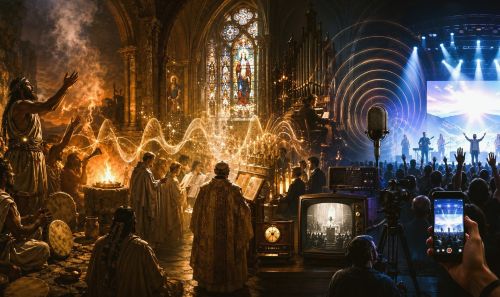
From ancient chant and sacred image to microphones, screens, and livestreams, worship has always depended on technologies of mediation.

By Matthew A. McIntosh
Public Historian
Brewminate
Introduction: Worship Has Always Been Mediated
Religious worship has never existed in a condition of pure immediacy, untouched by material form, bodily technique, or human invention. Long before microphones, screens, electric guitars, livestreams, and lighting rigs, worship depended on technologies in the broad and older sense of the word: learned skills, crafted instruments, organized spaces, disciplined gestures, vocal patterns, ritual sequences, and objects made to focus attention. A chant, a bell, a drum, a torch, an altar, a scroll, a painted icon, a stained-glass window, a pulpit, and a pipe organ are all technologies of mediation because they make religious experience perceptible, repeatable, and shareable. They do not merely decorate belief after the fact. They help form the conditions under which belief is heard, seen, remembered, and embodied by a community gathered in time and space.
This does not mean that all worship technologies function in the same way or carry the same theological weight. A shofar sounded at Rosh Hashanah, a Qur’anic recitation in a mosque, a Byzantine icon, a medieval bell, a Protestant pulpit, and a contemporary projection screen each mediates sacred experience according to a different religious logic. Some traditions authorize sacred images; others sharply restrict them. Some emphasize congregational song; others place greater weight on recitation, silence, bodily posture, sacrifice, preaching, sacrament, or disciplined repetition. Even within a single tradition, technologies of worship can shift meaning across time: the Christian cross may appear as an imperial sign, a devotional object, a processional image, an architectural plan, a printed emblem, or a digital icon; scripture may be chanted, copied, illuminated, preached, translated, projected, streamed, or searched on a phone. The medium never simply carries religious meaning as if meaning were weightless. It shapes how that meaning is encountered. Yet across these differences, worship repeatedly turns to the senses. Sound gathers attention and synchronizes bodies. Image gives visible form to invisible realities or marks the limits of representation. Ritual orders movement, speech, waiting, memory, and transition, allowing ordinary time to be transformed into sacred time.
The history of worship is also a history of media. This does not reduce religion to technique, nor does it imply that sacred presence is merely manufactured by human tools. Rather, it recognizes that human beings encounter the sacred through bodies, senses, communities, and inherited forms. Émile Durkheim’s concept of “collective effervescence” remains useful here, not because it explains away religion as social emotion, but because it draws attention to the communal intensity produced when bodies act, sing, listen, gesture, and respond together. Later ritual theorists and scholars of religion and media have sharpened this insight by showing that ritual is not simply a container for doctrine. It is an active structure that shapes perception, distributes authority, disciplines the body, and makes religious meaning socially durable.
The central question, then, is not whether technology belongs in worship. Historically, it always has. The deeper question is how different technologies alter the balance between participation and spectacle, embodiment and distance, communal action and managed atmosphere. A microphone may clarify proclamation, but it may also elevate one voice above the gathered body. A screen may help a congregation sing, but it may also redirect attention away from altar, pulpit, neighbor, or ritual action. A livestream may include the sick, elderly, disabled, distant, or immunocompromised, but it may also turn worship into religious content consumed in isolation. Worship has always been mediated, but mediation is never neutral. Every sacred technology asks who sees, who speaks, who listens, who acts, and what kind of community is being formed.
Before Architecture: Voice, Rhythm, Body, and the Earliest Sacred Technologies

Before worship had temples, altars, pulpits, sanctuaries, minarets, screens, or organs, it had the human body. Voice, breath, posture, rhythm, gesture, repetition, and movement were among the earliest sacred technologies, not because they were mechanical, but because they were learned techniques for shaping attention and communal experience. A chant is a tool. A drumbeat is a tool. A repeated bodily gesture is a tool. So is the deliberate regulation of breath, the call answered by a group, the dance that binds bodies into a shared pattern, or the silence held long enough to become more than absence. These practices made worship possible before monumental architecture could contain it, and they remind us that technology in religion begins not with machinery but with disciplined human action.
The earliest forms of sacred mediation were deeply embodied. Human beings did not first encounter the sacred as detached minds receiving abstract doctrine, but as bodies gathered around sound, fire, death, fertility, fear, memory, and seasonal change. Rhythm could organize a group before written language could preserve a creed. Repetition could give continuity to a ritual before a priestly class codified theology. A communal cry, lament, chant, or song could hold grief and hope in common, allowing emotion to become social rather than merely private. Sound was not an ornament added to religion; it was one of the means by which religious life became collectively recognizable. The body, especially the body acting with other bodies, was the first sanctuary.
This does not mean that early ritual can be reconstructed with easy certainty. The farther one moves behind written evidence, the more cautious the historian must become. Archaeological remains can suggest repeated gathering, symbolic action, burial practice, pigment use, instrument-making, or carefully marked spaces, but they do not always reveal the precise beliefs attached to those practices. A perforated bone may be interpreted as a flute, a painted cave wall as ritualized image-making, a burial assemblage as evidence of symbolic concern for death, and a circle of stones as a place of gathering, but each interpretation carries limits. Even so, the limits of interpretation do not erase the evidence of intentional patterning. Upper Paleolithic cave art, ochre use, carved figures, musical instruments, and mortuary practices suggest that early humans were already investing sound, image, body, and material objects with meanings that exceeded immediate survival. Whether these actions should be called “religion” in a fully developed institutional sense is a separate and more difficult question. What matters here is that they show the emergence of mediated significance: human beings marking space, shaping sound, preparing bodies, preserving memory, and distinguishing certain actions from ordinary activity. Still, the broader pattern is difficult to miss: long before formal liturgical systems, human communities were already using materials, sounds, images, and repeated actions to set certain moments apart from ordinary life.
Voice deserves special attention because it mediates between the interior and the communal. Breath begins inside the body, but when shaped into cry, chant, song, recitation, or call, it becomes shared space. Unlike a fixed object, sound unfolds in time and disappears as it is made, which gives it a peculiar ritual power. It must be repeated to be sustained. This quality made vocal practice especially important in oral cultures, where memory depended on rhythm, formula, cadence, and repetition. Walter J. Ong’s work on orality remains useful here because it shows that oral expression is not simply speech before writing; it is a different way of organizing memory, authority, and communal knowledge. In worship, the repeated word does more than communicate. It trains the body to remember.
Rhythm also has a social force that precedes formal doctrine. A group moving together becomes aware of itself as a group. The beat coordinates bodies, regulates expectation, and gives emotional intensity a structure. Durkheim’s concept of “collective effervescence” is especially helpful at this point, provided it is not reduced to mere crowd excitement. Durkheim was identifying the charged social energy that emerges when people gather around shared symbols and actions, feeling themselves carried beyond ordinary individual experience. Later ritual theorists have complicated his account, but the insight remains powerful: sacred experience is often intensified by synchronization. Clapping, stamping, swaying, chanting, kneeling, circling, processing, and waiting are not secondary to belief. They are among the ways belief becomes bodily real. Rhythm also establishes expectation, and expectation is one of ritual’s most powerful instruments. A repeated beat teaches participants when to move, when to listen, when to respond, and when to anticipate transition. It can hold a group in suspense, release tension, deepen lament, or heighten celebration. In that sense, rhythm is not only musical. It is temporal architecture. It builds a shared interior structure before there is any built exterior structure, turning time itself into a sacred medium.
These earliest sacred technologies also complicate any modern assumption that technology makes worship artificial. If technology means only electronics, then worship appears to become technological very late. But if technology includes trained technique, symbolic object, organized sound, repeated gesture, and intentionally shaped environment, then worship has been technological from the beginning. The oldest tools of worship were not screens or speakers, but lungs, hands, feet, memory, rhythm, and shared time. Later temples, churches, mosques, synagogues, shrines, organs, bells, manuscripts, microphones, and livestreams would extend these older capacities. They would amplify voice, focus sight, regulate movement, preserve memory, and gather dispersed bodies. But they did not invent mediation. They inherited it from the body itself.
Ancient Sacred Spaces: Acoustics, Procession, Sacrifice, and Controlled Visibility
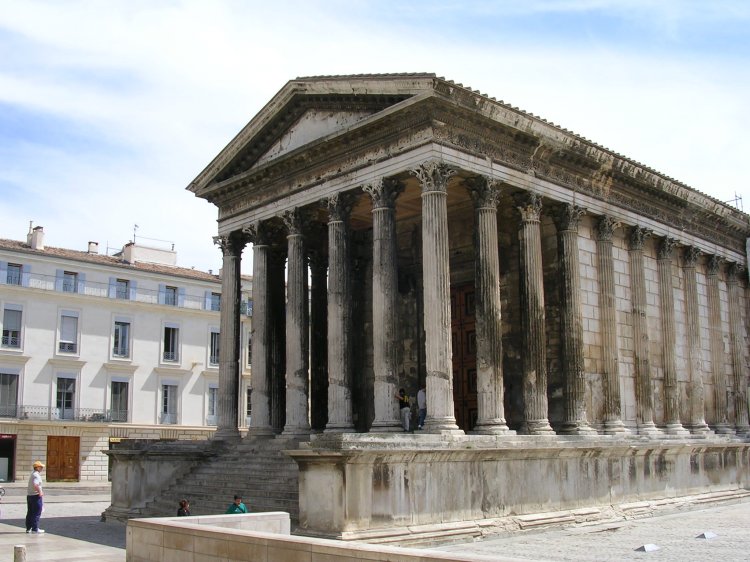
As worship moved into more durable and architecturally defined settings, sacred space itself became a technology of mediation. Temples, shrines, altars, courts, caves, precincts, and processional ways did not merely provide shelter for religious acts. They organized how worshippers approached the divine, where they stood, what they could see, what they could hear, and how close they could come. In the ancient world, sacred space often worked by controlling access. The holy was not always made universally visible. It was frequently approached through thresholds, courtyards, gates, elevations, screens, priestly zones, and hidden interiors. Architecture shaped reverence by making nearness gradual, restricted, and ritually charged.
Sound was central to this spatial ordering. Stone, enclosure, height, water, echo, and crowd density all altered the way voices, instruments, and ritual noise moved through sacred environments. A chant in an open courtyard did not behave like a chant inside a chamber. A priestly proclamation, a hymn, a lament, a horn blast, or the sound of percussion could be magnified, softened, fragmented, or delayed by the surrounding space. Ancient builders did not need modern acoustic theory to recognize that certain places changed sound. Caves, temples, sanctuaries, and theaters made the voice feel larger than the individual body producing it. That transformation mattered because sound could imply presence, power, distance, or divine response. The sacred was not only believed. It was heard.
Procession made space temporal. A sacred route turned geography into ritual sequence, allowing worshippers to experience movement as preparation, approach, and transformation. In ancient Egypt, processions of divine images carried from temples into festival settings made gods visible under controlled ritual conditions. These movements were not casual displays but highly structured acts in which divine presence, royal authority, priestly mediation, music, incense, and public participation converged. The god could leave the hidden interior of the temple, but only according to ritual order, and only through objects, routes, and ceremonies that preserved sacred distance even while allowing visibility. In Greek sanctuaries, processional movement toward altars, sacrifices, and festival spaces linked civic identity to religious performance. The Panathenaic procession in Athens, for example, joined religious devotion to the political imagination of the city, making movement through urban and sacred space a public statement about belonging, hierarchy, memory, and divine favor. In ancient Israelite and later Jewish contexts, pilgrimage and festival movement similarly connected place, memory, and covenantal identity, even though the precise ritual forms differed across time. Journeying toward a sacred center gave geography theological meaning, while repeated festivals allowed time itself to become processional, returning communities again and again to formative stories, obligations, and hopes. Procession mattered because it made worship more than a stationary event. It taught participants to encounter the sacred through direction, delay, anticipation, and arrival.
Sacrifice was another form of ritual technology because it coordinated body, object, sound, smell, fire, space, and social hierarchy. The ancient sacrifice was not merely the destruction of an offering. It was a structured act that made relationships visible: between humans and gods, priests and laity, rulers and subjects, household and city, living and dead. The altar concentrated attention, while fire, blood, incense, music, prayer, and shared meals transformed material things into ritual signs. In Greek and Roman civic religion, sacrifice joined devotion to public order. In ancient Israelite tradition, sacrificial systems developed complex distinctions among offering, purity, priesthood, and covenant. In many ancient settings, the sensory force of sacrifice was essential. Smoke rose, animals sounded, blood marked boundaries, and gathered people watched as invisible obligations took visible form.
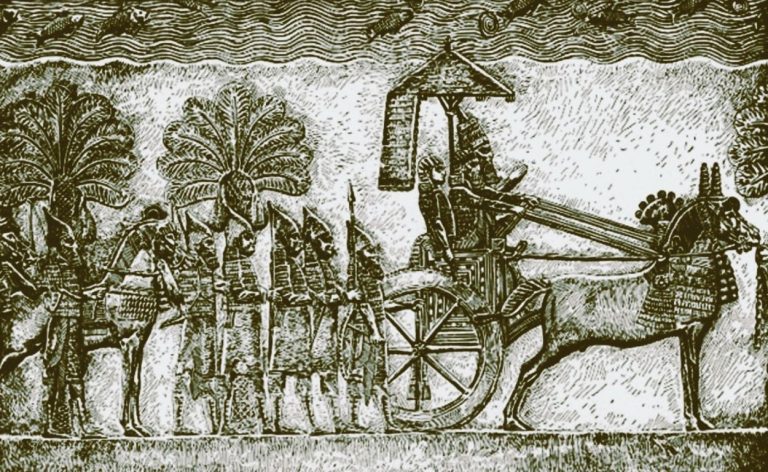
Image and visibility were equally controlled. Ancient worship often depended on sacred images, cult statues, divine symbols, inscriptions, reliefs, or carefully guarded objects, but their power lay partly in the fact that they were not always equally accessible. To see could be a privilege, a danger, a ritual climax, or a form of participation. Egyptian divine images were housed, clothed, fed, and revealed according to ritual protocols. Greek cult statues made divine presence local without collapsing god into object. Mesopotamian divine images were maintained through elaborate care rituals that treated the image as a living focus of divine presence. Visibility was not simply visual decoration. It was managed encounter. The sacred image worked because it stood at the intersection of material craft, ritual restriction, and communal imagination.
Ancient sacred spaces show that worship technology became increasingly environmental. The body remained central, but it was now guided by walls, altars, thresholds, routes, images, instruments, flames, inscriptions, and priestly choreography. Sound, image, and ritual were no longer only portable techniques. They were embedded in built worlds designed to produce reverence, hierarchy, memory, and belonging. This does not mean that every ancient sanctuary functioned in the same way or that ancient peoples understood mediation identically. Egyptian temple ritual, Greek sacrifice, Roman civic religion, Mesopotamian image care, and Israelite temple worship each carried distinct theological and political meanings. Yet they shared one broad historical fact: sacred experience was shaped through controlled sensory access. The divine was approached through technologies of space.
Jewish and Early Christian Worship: Text, Voice, Assembly, and Liturgical Form
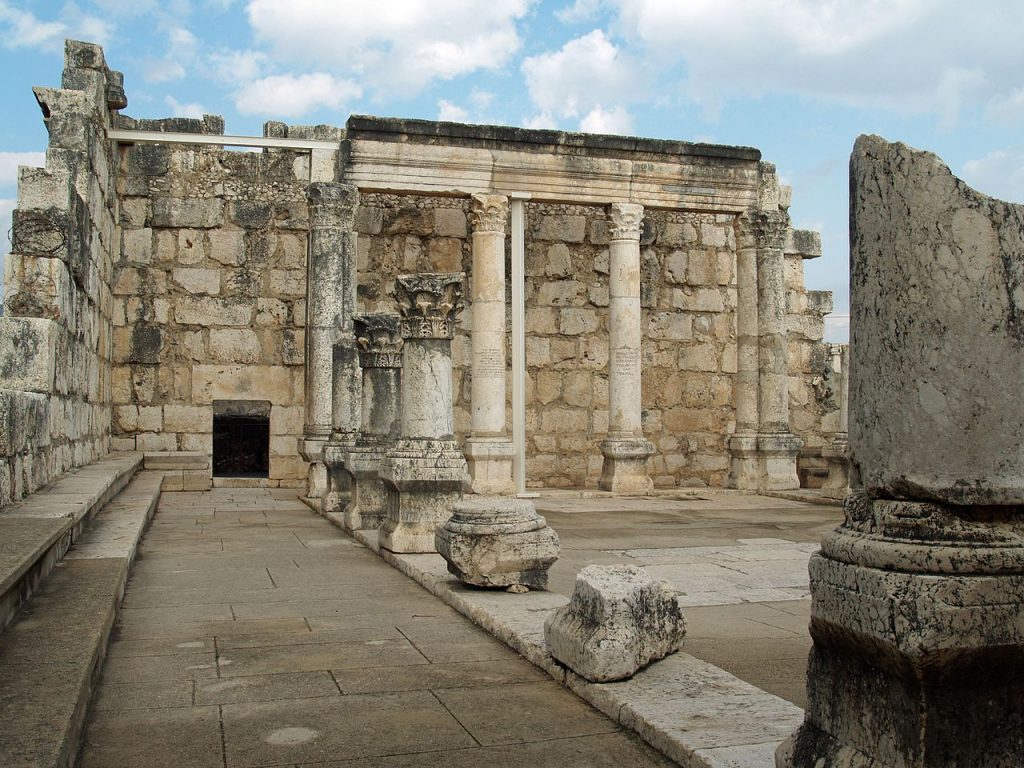
Jewish and early Christian worship marked a decisive transformation in the history of sacred mediation because text, voice, assembly, and ritual order became central technologies of communal religious life. This did not mean that sacred space ceased to matter. The Jerusalem Temple, synagogues, homes, public gathering places, and later church buildings all shaped worship in different ways. Yet the organizing center increasingly included practices that could travel beyond a single monumental sanctuary: scripture read aloud, psalms sung or chanted, prayers repeated, blessings spoken, meals ritualized, and sacred time ordered through calendar and memory. Worship became portable without becoming immaterial. The scroll, the book, the table, the spoken word, and the gathered body mediated divine presence in ways that could survive displacement, diaspora, persecution, and institutional change.
In Jewish worship, the transition from temple sacrifice to text-centered and prayer-centered forms was neither simple nor immediate, but it profoundly shaped later religious history. The synagogue did not merely replace the Temple, and Jewish ritual life remained diverse across time and place, but synagogue worship elevated reading, teaching, interpretation, blessing, and communal response as durable forms of sacred practice. Torah was not only a written text preserved in a scroll. It was sounded, heard, interpreted, carried, kissed, processed, and embedded in communal rhythms. The voice of the reader transformed writing into event, while the assembly became the living setting in which sacred memory was renewed. This shift mattered especially because Jewish communities repeatedly faced dispersal, foreign rule, destruction, adaptation, and the challenge of sustaining covenantal identity beyond a single political center. Text and voice offered continuity without requiring uniform geography. A community could gather around Torah in Alexandria, Antioch, Rome, Galilee, or Babylonia, and the act of public reading could join local assembly to a larger sacred history. The synagogue functioned as a mediated environment in which architecture, scroll, reader, interpreter, congregation, and calendar converged. Scripture functioned as both textual authority and ritual technology: it preserved covenantal memory while requiring voice, gesture, space, and community to become fully active in worship.
Sound remained indispensable. The shofar, especially associated with Rosh Hashanah and other biblical and post-biblical ritual contexts, demonstrates how an instrument can mark sacred time without functioning merely as music. Its blast summons, interrupts, remembers, warns, and awakens. It does not explain; it pierces. Likewise, psalmody, blessing, lament, and public reading shaped Jewish worship by making sacred language audible and communal. The technology here was not only the instrument or the scroll but the disciplined performance of memory. Sacred words were preserved through written transmission, but they were also renewed through recitation and response. The ear remained a theological organ. To hear was not passive reception but a form of participation, especially in traditions where commandment, remembrance, and communal identity were joined to repeated words.
Early Christian worship emerged from this Jewish matrix while developing its own liturgical forms around scripture, baptism, prayer, psalmody, preaching, and the ritual meal that became the Eucharist. The earliest Christian assemblies met in varied settings, including homes and adapted gathering spaces, before monumental church architecture became possible or normative. This made assembly itself a central medium. Christians gathered to hear apostolic teaching, read Israel’s scriptures in light of Christ, pray together, sing hymns and psalms, share a sacred meal, and mark initiation through water. These acts were not incidental expressions of belief. They were formative technologies that made the community recognizable to itself. Baptism used water, speech, bodily descent and emergence, and communal recognition to enact belonging. The Eucharistic meal used bread, wine, blessing, memory, thanksgiving, and distribution to organize Christian identity around the remembered and present Christ. The material simplicity of these early forms should not be mistaken for ritual thinness. Water, bread, wine, oil, hands, breath, spoken blessing, and gathered bodies gave Christian worship a dense symbolic and sensory structure even before imperial patronage and basilican architecture expanded its public scale. Because many early Christian communities lacked permanent sacred buildings, their worship relied heavily on repeatable actions that could transform ordinary domestic or communal spaces into charged ritual settings. The room, table, basin, cup, loaf, reader, presider, and assembly together made worship visible and audible. In that sense, early Christian worship did not wait for architecture to become mediated. It carried its architecture in ordered action.
The development of liturgical form gave early Christian worship continuity without making it uniform everywhere. Local practices varied, and scholars rightly caution against imagining a single fixed “apostolic liturgy” behind all later traditions. Still, certain patterns became increasingly important: gathering, reading, proclamation, prayer, kiss or gesture of peace, offering, thanksgiving, meal, dismissal, and eventually more formalized orders of ministry and space. These patterns were technologies of memory and authority. They taught communities when to speak, when to listen, who presided, how scripture was interpreted, and how bodies moved through sacred time. The liturgy did not merely express theology after doctrine had been settled. It helped generate Christian theology by repeatedly joining text, voice, table, water, body, and assembly into a practiced interpretation of salvation history.
This Jewish and early Christian emphasis on text, voice, and assembly complicates any simple distinction between “word” and “ritual.” The spoken word was ritualized, and ritual was saturated with words. Reading was not silent private study but public performance. Prayer was not spontaneous feeling alone but patterned speech. Sacred meals were not ordinary meals with religious ideas attached but structured events in which memory, presence, hierarchy, and community were enacted. In both Jewish and early Christian worship, mediation became durable precisely because it could be repeated. A scroll could travel. A psalm could be sung again. A blessing could mark a new meal, a new Sabbath, a new festival, a new baptism, a new gathering. Worship entered history as an inherited form carried by voices, bodies, texts, and assemblies.
Late Antiquity and Byzantium: Image, Icon, Incense, Chant, and Sacred Atmosphere
Late antiquity and Byzantium brought worship into a more elaborate sensory and architectural world, where image, sound, scent, light, movement, and ritual hierarchy converged with unusual intensity. Christian worship had already depended on text, voice, water, bread, wine, assembly, and repeated liturgical form, but the legalization and eventual imperial patronage of Christianity changed the scale on which those practices could operate. Basilicas, baptisteries, martyr shrines, processional routes, sanctuaries, apses, mosaics, icons, curtains, lamps, incense, vestments, and chant increasingly shaped the worshipper’s encounter with the sacred. Imperial patronage did not invent Christian mediation, but it gave older ritual forms new visibility, permanence, and spatial ambition. What had once been practiced in smaller and more precarious assemblies could now be staged in buildings whose walls, floors, ceilings, furnishings, and ceremonial routes were themselves part of the liturgical act. The church building became a theological environment, arranging bodies and images within a hierarchy of approach: nave, ambo, sanctuary, altar, apse, dome, threshold, veil, and procession. This did not simply make worship more decorative. It made worship more environmental. Sacred presence was mediated through a carefully ordered atmosphere in which sight, hearing, smell, gesture, and spatial movement reinforced one another.
The development of Christian visual culture was central to this transformation. Images of Christ, Mary, saints, martyrs, biblical scenes, crosses, and heavenly figures did not function only as illustrations for the illiterate, although they could certainly teach. They also helped make sacred history present within liturgical space. A mosaic above an altar, an icon carried in procession, a painted apse, or an image of a martyr near a shrine gave visible form to relationships between heaven and earth, past and present, local community and universal church. Language of the “sacred gaze” is useful here because religious seeing is never merely optical. It is trained, authorized, disciplined, and emotionally charged. To look at an image in worship is not the same as glancing at decoration. It is to participate in a visual economy of reverence, memory, hierarchy, and expectation.
Incense and light deepened this atmosphere by making sacred space perceptible through unstable and enveloping media. Incense did not simply smell pleasant. It marked transition, veiled and revealed objects, accompanied prayer, and gave invisible movement a visible form as smoke rose and dispersed. Its material behavior mattered: it drifted, thickened, dissolved, clung to garments, filled architectural volume, and crossed boundaries between sanctuary and assembly. Incense made the air itself seem ritually charged. It gave worship a texture that could not be reduced to words or images alone, surrounding participants with a sign of prayer, offering, purification, and divine nearness. Lamps, candles, polished surfaces, gold tesserae, and reflected light transformed interiors into spaces that seemed to shimmer rather than merely contain. Byzantine churches, especially in their most ambitious forms, used light not only to illuminate images but to animate them. Gold mosaic did not behave like flat paint. Under changing light, it flickered, receded, advanced, and made sacred icons appear visually alive within the architecture. The effect was theological as well as aesthetic: worshippers entered a world in which material surfaces could appear transfigured, suggesting that the visible realm might become transparent to divine glory. The building itself became a participant in worship, not a neutral container.
Chant likewise shaped sacred atmosphere by extending the voice beyond ordinary speech. In Byzantine worship, as in other late antique Christian traditions, sung prayer and psalmody did more than embellish liturgical texts. Chant organized time, intensified memory, marked ritual transitions, and created a sonic field in which the assembly could hear itself as part of something larger than ordinary conversation. The human voice, disciplined through melodic pattern and liturgical placement, became a medium of continuity between scripture, doctrine, prayer, and communal identity. In acoustically resonant churches, chant could also blur the boundary between individual singers and enveloping sound. The voice seemed to belong not only to the chanter, but to the space, the rite, and the gathered body. Sacred sound joined architecture in producing an experience of presence.
The iconoclastic controversies of the eighth and ninth centuries reveal how powerful these technologies of seeing had become. The dispute over icons was not a marginal quarrel over religious art. It concerned the relationship between matter and divine presence, image and prototype, sight and idolatry, imperial authority and ecclesiastical tradition. Defenders of icons argued that the incarnation of Christ transformed the conditions of representation: because the Word had become flesh, visible depiction could serve orthodox devotion rather than necessarily violate it. Opponents feared that images confused veneration with worship and compromised divine transcendence. The intensity of the conflict proves the larger point. Images mattered because they mediated. They were contested because they were understood to shape devotion, doctrine, authority, and the worshipper’s access to sacred presence.
Late antique and Byzantine worship shows a mature form of sensory mediation in which technology was not external to liturgy but woven into its structure. The icon taught the eye how to look. Incense taught the body to sense transition. Chant taught the ear to inhabit sacred time. Architecture directed movement and expectation. Light made surfaces unstable and suggestive. Procession moved sacred objects and bodies through ordered space. These media did not all say the same thing, nor were they accepted without controversy, but together they created a powerful ritual environment. Worship became an atmosphere one entered, not merely an event one observed. In that world, the sacred was encountered through matter disciplined by ritual, and ritual made matter speak.
Medieval Christianity: Bells, Stained Glass, Relics, Organs, and the Architecture of Awe

Medieval Christianity inherited late antique sensory worship but expanded it into a vast material, acoustic, and visual ecology. The medieval church was not simply a room in which worship occurred. It was a built instrument for organizing time, directing sight, amplifying sound, staging movement, preserving memory, and making divine order tangible. Stone vaults, carved portals, choir screens, altars, chapels, reliquaries, rood screens, wall paintings, stained glass, bells, candles, vestments, processional objects, manuscripts, and organs together formed a dense network of sacred technologies. These objects and structures did not merely surround the liturgy. They taught the body where to stand, the eye where to look, the ear what to expect, and the community how to imagine itself within a cosmic order larger than the parish, city, or kingdom.
Bells were among the most powerful technologies of medieval sacred time. Their sound crossed the boundary between church and village, monastery and field, sacred enclosure and ordinary labor. A bell could call worshippers to Mass, mark canonical hours, announce death, warn of danger, celebrate victory, accompany procession, or define the rhythm of an entire community. Unlike a visual object confined to a church interior, the bell extended the church’s reach through air and distance. Its authority was not only symbolic but practical, since it regulated work, prayer, mourning, and communal attention. Bells transformed landscape into liturgical space. The sound did not require every hearer to enter the church building, yet it placed the surrounding world under the church’s temporal discipline. Medieval worship began before one crossed the threshold, because sacred sound had already entered the streets, homes, fields, and markets.
Stained glass worked differently, but with equal force. It mediated sacred meaning through color, light, image, and architectural placement. A window did not simply illustrate biblical stories for those who could not read, although that did matter in a largely non-literate culture. It also transformed sunlight itself into theological atmosphere. Colored glass filtered ordinary daylight into radiant scenes of saints, prophets, apostles, donors, kings, trades, miracles, judgment, salvation, and heavenly order. The worshipper did not merely look at an image; the worshipper stood inside colored light. This gave medieval visual culture a participatory dimension that flat description often misses. Stained glass joined image to environment, teaching doctrine while altering the sensory quality of the church interior. In large Gothic churches especially, light became a medium of awe, suggesting that material architecture could open toward a heavenly reality without ceasing to be stone, lead, and glass.
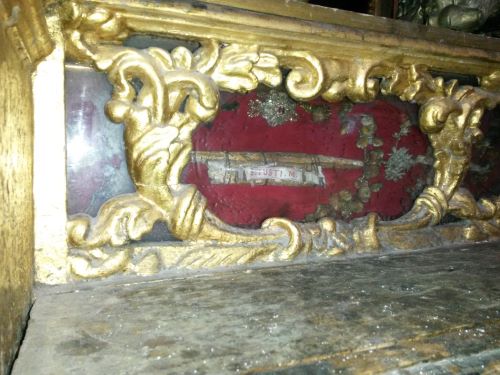
Relics intensified this material logic by locating sanctity in objects and bodies. The bones, garments, instruments of martyrdom, or contact relics associated with saints made holiness geographically and materially specific. A shrine was not only a memorial. It was a point of encounter, pilgrimage, healing, petition, donation, political prestige, and communal identity. Reliquaries themselves were technologies of mediation because they concealed and revealed at once. Gold, jewels, enamel, crystal, inscriptions, and sculpted forms surrounded fragmentary remains with visual splendor, not to distract from the relic but to announce its sacred charge. The medieval relic complicates any modern division between matter and spirit. Sanctity was approached through touch, sight, procession, proximity, and controlled access. The saint was dead, yet present; absent, yet locally powerful; remembered, yet ritually active.
Music and the organ added another layer to this architecture of awe. Chant had long structured Christian worship, but medieval developments in notation, polyphony, choir organization, and instrumental sound expanded the technical possibilities of sacred music. The pipe organ transformed breath into monumental sound. Human lungs could chant, but the organ could make wind itself seem ordered, sustained, and architectural. Its pipes, bellows, keys, and resonance turned mechanical apparatus into liturgical force. This did not erase the importance of the human voice. Rather, it placed voice within a larger acoustic world of chant, response, resonance, and eventually polyphonic complexity. The development of musical notation was also crucial, since it allowed musical practice to be preserved, taught, regulated, and transmitted across institutions. Sound became not only performed memory but written system, making music one of the most sophisticated sacred technologies of medieval Christianity.
The architecture of medieval churches gathered these technologies into an integrated environment. Romanesque mass and Gothic height created different effects, but both organized perception. Portals instructed worshippers before entry. Naves gathered bodies. Aisles directed movement. Choirs separated clerical song from lay space. Altars concentrated sacramental attention. Chapels multiplied devotional focus. Screens, curtains, elevations, and processions controlled visibility. The Eucharist, especially after increasing medieval emphasis on elevation and visual devotion, became a moment when sight and sacrament converged with extraordinary intensity. To see the host was not a casual visual act. It was a charged devotional encounter shaped by priestly gesture, bell, silence, architecture, and expectation. Medieval worship operated through a choreography of revelation and concealment. Awe was not accidental. It was built, sounded, illuminated, scented, sung, and ritually timed.
Medieval Christianity shows that worship technology can become a total environment without ceasing to be devotional. Bells organized time beyond the walls. Glass transformed light into sacred narrative. Relics localized holiness. Organs magnified breath into resonant force. Manuscripts stabilized chant, prayer, and liturgical order. Architecture gathered all of these into spaces where the senses were disciplined toward reverence. Yet this sensory abundance also produced tensions. Reformers, critics, and some clerical voices worried that material splendor could become distraction, superstition, or institutional display. That critique would later become central to the Reformation, but its roots were already visible in medieval debates over wealth, image, relics, and devotion. The medieval church was powerful precisely because its technologies worked so well. They made worship immersive, memorable, and socially authoritative, turning stone, sound, light, bone, and breath into instruments of sacred imagination.
Islamic, Hindu, Buddhist, and Other Pre-Modern Traditions: Sound, Image, Discipline, and Sacred Repetition

The technologies of pre-modern worship were never confined to Christianity, nor did they develop along a single line from image to word, ritual to doctrine, or sound to spectacle. Islamic, Hindu, Buddhist, Sikh, Jain, Daoist, Shinto, and other religious traditions organized sacred experience through their own combinations of voice, architecture, image, object, gesture, scent, movement, memory, and disciplined repetition. These traditions cannot be flattened into one comparative category without distortion, because each one defined presence, representation, authority, and ritual efficacy differently. Yet they reveal a shared historical pattern: worship is mediated through trained forms. Whether through Qur’anic recitation, temple bells, mantra, mandala, mudra, circumambulation, prostration, pilgrimage, incense, lamps, drums, prayer beads, scripture, or sacred image, religious communities repeatedly used sensory and bodily technologies to make devotion durable across generations.
In Islamic worship, sound and bodily discipline became especially important forms of sacred mediation. The call to prayer, or adhan, marked time across urban and rural landscapes, summoning the faithful through the human voice rather than through image. Qur’anic recitation likewise occupied a central place, not merely as reading but as sounded revelation. The Qur’an was preserved in writing, memorized, recited, ornamented through calligraphy, and embodied through disciplined vocal practice. Its sacred force was inseparable from audition. To hear recitation was to encounter scripture as event, rhythm, cadence, and breath. Mosque architecture also shaped this experience through orientation, open congregational space, mihrab, minbar, courtyard, dome, and patterns of movement. The body entered worship through ablution, standing, bowing, prostration, and alignment toward Mecca. Islamic worship developed a powerful non-iconic sensory order in which sound, text, geometry, orientation, and bodily discipline carried theological weight.
Hindu traditions organized sacred mediation through a different but equally sophisticated visual and sonic world. In many Hindu contexts, the temple was not merely a gathering place but the dwelling and ritual body of the deity, structured through cosmology, consecration, image, offering, procession, sound, scent, and sight. The practice of darshan, seeing and being seen by the deity, made vision central to worship. The sacred image was not simply an illustration of divine reality; once ritually consecrated, it could become a focus of divine presence and reciprocal encounter. Bells, lamps, incense, flowers, food offerings, mantra, drums, conch shells, and circumambulation shaped worship as a multisensory act of approach. The temple’s threshold, inner sanctum, tower, processional route, and ritual calendar all worked together to regulate access and expectation, drawing worshippers toward encounter while preserving the mystery and power of the deity’s presence. Sound also structured this world of sight. The bell announced entry and attention, mantra concentrated divine name and power, and drums or conch blasts marked ritual moments in which ordinary time was interrupted by sacred sequence. Here technology was not reducible to mechanical invention. The crafted image, the priestly gesture, the temple plan, the flame waved before the deity, and the repeated mantra all functioned as tools for concentrating presence and attention.
Buddhist traditions further complicate any simple contrast between image and interior discipline. Buddhism developed rich technologies of sacred repetition, including chanting, meditation posture, monastic rule, pilgrimage, stupas, relic veneration, mandalas, bells, drums, prayer wheels, mudras, and ritual implements. The stupa, for example, organized devotion through relic, architecture, memory, and movement, inviting circumambulation as a bodily way of honoring the Buddha and entering sacred order. Buddhist images, whether of the Buddha, bodhisattvas, guardians, teachers, or cosmological realms, helped train attention and make doctrinal worlds visually accessible. Mandalas translated cosmology into ordered visual form, while mantra and chant shaped consciousness through repetition. In many Buddhist settings, discipline itself became technology: breath, posture, concentration, gesture, and repeated recitation gradually formed the practitioner. Worship and practice were not separate from technique. They were technique spiritualized and ritualized.
Other pre-modern traditions show the same broad pattern while resisting easy generalization. Sikh worship centered scripture, song, and assembly in the gurdwara, where the Guru Granth Sahib is not simply a book but the living Guru, ritually enthroned, read, sung, attended, and approached with reverence. The sung word, especially through kirtan, made scripture audible as communal devotion, joining text, melody, assembly, and discipline into a shared field of reverence. Jain worship used image, temple space, pilgrimage, mantra, and disciplined bodily restraint while also placing unusual emphasis on nonviolence, ascetic control, and the moral purification of perception and action. Daoist and Chinese religious traditions employed talismans, liturgical texts, sacred diagrams, ritual registers, music, incense, offerings, processions, and priestly performance to mediate relations among humans, ancestors, spirits, and cosmic forces. These ritual systems often treated writing, diagram, gesture, and voice as active instruments capable of ordering relations between visible and invisible worlds. Shinto shrines organized worship through purification, offering, architecture, sacred objects, seasonal festivals, and carefully bounded spaces of presence. Gates, ropes, mirrors, trees, stones, and shrine buildings marked transitions between ordinary and sacred zones, while festivals carried divine presence into communal space through sound, movement, and procession. In each case, religious life was carried by practices that trained the senses, located authority, and made sacred order repeatable.
The comparative value of these traditions lies not in making all worship look the same, but in showing that mediation is a universal religious problem answered through particular historical forms. Some traditions restrict figural images and elevate sound, text, geometry, or bodily orientation. Others authorize sacred images as points of presence, encounter, teaching, or devotion. Some emphasize congregational assembly; others stress monastic discipline, household ritual, pilgrimage, priestly performance, or individual practice. But across the pre-modern world, worship was repeatedly shaped by technologies of repetition. A call heard daily, a mantra repeated thousands of times, a bell sounded at the threshold, a pilgrimage route walked by generations, a scripture sung in community, a lamp waved before an image, a body bowed toward a sacred center, or a wheel turned in prayer all show the same underlying truth. Religion becomes durable when belief is given form, rhythm, sound, object, space, and disciplined action.
Reformation and Early Modern Worship: Print, Pulpit, Vernacular Speech, and the Battle over Images

The Reformation did not remove technology from worship. It rearranged the hierarchy of sacred media. Protestant reformers criticized many late medieval practices involving images, relics, indulgences, pilgrimages, elaborate ceremonial display, and the visual economy of sacramental devotion, but they did not return Christianity to an unmediated purity. Instead, they elevated other technologies: print, vernacular scripture, catechisms, hymnals, sermons, pulpits, congregational song, simplified church interiors, and acoustically oriented preaching spaces. The shift was not from mediated religion to immediate religion, but from one regime of mediation to another. The sacred image, relic shrine, and elevated host were challenged by the printed Bible, preached word, sung psalm, and disciplined congregation gathered around intelligible speech.
Print was central to this transformation because it allowed religious argument, scripture, liturgy, polemic, and instruction to circulate with unprecedented speed and consistency. Martin Luther’s success cannot be separated from the printed pamphlet, vernacular Bible, hymnbook, and catechism. Reform became portable because texts could move more quickly than institutions could control them. Print did not merely spread ideas after they were formed; it shaped the form those ideas took. Short treatises, sermons, woodcuts, broadsheets, translated scripture, and polemical exchanges made religious controversy visible in public life. Worship was affected because communities now encountered reform through reproducible words, standardized teaching, and vernacular access to texts that had previously been mediated chiefly through Latin liturgy, clerical exposition, manuscript culture, and ecclesiastical hierarchy. The printed page also altered the relationship between household, school, church, and conscience. Catechisms trained children and adults in question-and-answer form, hymnals carried doctrine into song, and vernacular Bibles allowed scripture to become a domestic as well as ecclesiastical object. This did not mean that interpretation became free from authority, since Protestant churches quickly developed their own confessions, disciplines, approved liturgies, and systems of instruction. But it did mean that worship increasingly depended on a culture of reproducible language. Print stabilized reform by giving communities common texts to hear, memorize, debate, sing, and defend.
The pulpit became one of the defining sacred technologies of Protestant worship. Elevated, central, and acoustically significant, it reorganized the church interior around proclamation. In many Reformed settings, the sermon did not simply supplement the liturgy; it became the primary event through which scripture was interpreted, doctrine taught, conscience examined, and communal discipline reinforced. This architectural and ritual change mattered because it altered the sensory center of worship. The eye was redirected from image, altar, relic, or sacramental elevation toward the preacher and the open Bible. The ear became especially important, not in the older sense of chant and liturgical sound alone, but as the organ of intelligible instruction. Vernacular speech turned doctrine into public argument and made hearing itself a discipline of reform.
The battle over images revealed how deeply worship depended on media. Reformers did not all agree. Lutherans often permitted images when they were treated as didactic rather than devotional objects, while many Reformed Protestants, especially those influenced by Huldrych Zwingli and John Calvin, regarded religious images as dangerous invitations to idolatry. Iconoclasm was not mere vandalism or aesthetic preference. It was a theological struggle over how divine truth should be mediated and how easily material forms could capture devotion meant for God alone. The removal of statues, whitewashing of walls, destruction of shrines, and simplification of interiors were themselves technological acts. They reshaped worship by changing what bodies saw, where attention settled, and how sacred space communicated authority. Absence became a medium. The bare wall, the plain table, the visible Bible, and the commanding pulpit formed a new sensory discipline.
The Catholic Reformation and broader early modern Catholic renewal answered with a different but equally mediated worship culture. The Council of Trent defended the use of images, relics, saints, sacraments, and ceremonial forms while also insisting on correction, discipline, and clearer teaching. Baroque Catholic worship used architecture, painting, sculpture, music, incense, procession, theater, and light to engage the senses and move the affections. Jesuit churches, pilgrimage shrines, altarpieces, devotional prints, sacred drama, and elaborate musical settings did not represent a naïve survival of medieval sensibility. They were part of a conscious Catholic effort to instruct, persuade, and form devotion through coordinated sensory means. The altarpiece, the painted ceiling, the side chapel, the reliquary, the confessional, and the processional route each worked as part of a larger devotional system that joined doctrine to disciplined perception. Music and sacred theater could move worshippers emotionally, but that movement was not understood merely as entertainment. It was meant to educate desire, focus repentance, dramatize heavenly realities, and bind the senses to Catholic truth. Splendor was not the opposite of instruction. It was one of instruction’s chosen instruments. If Protestant reform often sought clarity through verbal proclamation and controlled visual austerity, Catholic reform often pursued clarity through ordered splendor, emotional intensity, and sacramental presence.
Early modern worship demonstrates that religious reform is also media reform. Protestants and Catholics fought not simply over doctrines, but over the tools by which doctrine should enter the body and community: image or word, altar or pulpit, Latin or vernacular, sacramental elevation or preached exposition, relic shrine or printed catechism, ceremonial abundance or disciplined simplicity. Each side accused the other of distortion. Protestants warned that sensory excess could become superstition, idolatry, and manipulation. Catholics warned that stripped worship could become disembodied, individualistic, and severed from the visible continuity of the church. Beneath these arguments lay a shared recognition that worship technologies are powerful because they train perception. The Reformation did not end sacred mediation. It made mediation newly visible by turning the church itself into a contested field of print, speech, image, sound, and ritual authority.
The 18th and 19th Centuries: Revival, Hymnody, Camp Meetings, Gaslight, and Mass Religious Emotion

The 18th and 19th centuries transformed worship by bringing older technologies of voice, song, space, print, and bodily response into new forms of mass religious experience. Revivalism did not invent emotional worship, but it intensified the deliberate organization of religious feeling. Sermons, hymns, testimonies, altar calls, anxious benches, prayer meetings, camp meetings, printed tracts, portable songbooks, and large temporary gathering spaces worked together to produce conversion as both interior crisis and public event. Worship became increasingly mobile, repeatable, and adaptable to frontier, urban, transatlantic, and denominational settings. The sacred was no longer mediated only through parish, cathedral, temple, or inherited liturgical order. It could be staged in fields, tents, meetinghouses, rented halls, tabernacles, and eventually auditoriums built for mass address.
Hymnody was one of the central technologies of this transformation. The hymns of Isaac Watts, Charles Wesley, and later revival songwriters gave ordinary worshippers language for conversion, assurance, repentance, longing, and communal identity. Hymns compressed theology into memorable meter, allowing doctrine to be carried by melody into the body and memory. They traveled through printed hymnals, broadsides, denominational networks, missionary societies, Sunday schools, and revivals, making song one of the most effective religious media of the period. Congregational singing also altered the relation between leader and assembly. Where earlier worship traditions often placed musical authority in clerical chant, choir, or trained singers, revival and evangelical hymnody increasingly invited the gathered people to become audible participants in their own religious formation. The voice of the crowd became a sign that the message had entered the heart. Hymns also bridged private and public devotion, moving easily from chapel to household, from camp meeting to funeral, from Sunday school to missionary gathering. Their portability mattered because they allowed revival religion to travel through memory even when books were absent. A believer who knew the words and tune carried a small liturgical archive within the body, ready to be activated in worship, grief, labor, or crisis. In that sense, hymnody was not merely accompaniment to preaching. It was one of the means by which evangelical and revivalist religion became emotionally durable, socially contagious, and doctrinally memorable.
Camp meetings extended this participatory logic into outdoor space. Especially in the American context, camp meetings gathered large numbers of people for preaching, singing, prayer, exhortation, bodily response, social contact, and repeated services over several days. Their physical arrangements mattered. Preaching stands, rough benches, tents, pathways, fires, sleeping areas, and surrounding woods created a temporary sacred environment, neither church nor wilderness but something between the two. The setting encouraged intensity because ordinary routines were suspended. Participants ate, slept, prayed, sang, listened, wept, shouted, and waited together. The camp meeting was a technology of duration as much as space. Its power came partly from repetition: sermon after sermon, hymn after hymn, invitation after invitation, until the line between personal emotion and collective atmosphere became difficult to separate.
Revival preaching likewise depended on technique. The preacher’s voice, pacing, gesture, biblical quotation, emotional crescendo, narrative example, and direct address were carefully adapted to awaken conscience and provoke response. George Whitefield’s 18th-century field preaching demonstrated the power of vocal performance and outdoor address before modern amplification. In the 19th century, Charles Grandison Finney systematized revival methods with unusual explicitness, arguing that revivals could be promoted through proper means rather than passively awaited as mysterious divine interruptions. The “anxious bench,” public invitation, inquiry meeting, and protracted meeting all treated conversion as something that could be ritually focused through space, timing, attention, and pressure. Critics saw manipulation; supporters saw disciplined evangelistic method. Either way, revivalism made clear that religious emotion could be organized by technique without being experienced by participants as artificial.
Urbanization and new lighting technologies also changed worship’s atmosphere. Gaslight, and later electric light, allowed evening services, lecture halls, mission meetings, theaters, and revival spaces to operate with greater brightness, safety, and dramatic focus. Artificial light extended sacred time into the night and altered the mood of religious assembly. The illuminated platform, visible preacher, printed hymn text, crowded hall, and controlled interior environment helped create new forms of mass attention. In cities, religious groups adapted techniques from theater, reform movements, popular lecture circuits, and commercial publicity while also resisting the charge that religion had become entertainment. This was one of the central tensions of the age. The same tools that made worship accessible and emotionally compelling could also make it appear staged, commercialized, or dependent on personality.
By the end of the 19th century, many features associated with modern worship culture were already visible, even before microphones, radio, projection screens, and digital systems. Religious leaders had learned to manage large audiences, circulate printed materials quickly, coordinate music and message, use space to guide response, and create emotionally charged environments outside traditional liturgical architecture. Revivalism, hymnody, camp meetings, mission halls, and illuminated urban services reveal that “atmosphere” is not a late 20th-century invention. It has a longer history in the management of sound, light, duration, repetition, and crowd emotion. The platform, song leader, invitation hymn, printed program, testimony, public response, and carefully sequenced appeal anticipated later forms of technologically supported worship without requiring electricity to function. What later generations would call production value already existed in embryonic form as timing, arrangement, visibility, and emotional pacing. This does not make revival worship cynical or merely theatrical. It shows that religious communities were learning to work deliberately with the conditions of attention. The modern audio-visual worship environment would later electrify these older practices, but it did not create their underlying logic. It inherited a revival tradition already skilled at turning gathered bodies into a responsive religious public.
Electricity, Broadcast, and the Amplified Voice: Radio, Microphones, Speakers, and Mass Worship

Electricity changed worship by altering the scale, reach, and physical limits of religious sound. Earlier traditions had already amplified presence through architecture, chant, bells, organs, print, revival technique, and mass gathering, but microphones and loudspeakers transformed the human voice itself. A preacher no longer needed to rely only on lung power, acoustically favorable buildings, or trained projection to be heard by large crowds. The microphone could make a conversational tone intimate across distance, while the loudspeaker could distribute that intimacy to auditoriums, stadiums, outdoor rallies, and eventually overflow rooms. This was not a minor technical adjustment. It changed the relationship between speaker and assembly, allowing religious authority to feel both enlarged and personally near. The amplified voice could preserve the emotional nuance of ordinary speech while magnifying it beyond ordinary bodily limits. A pause, a lowered tone, a tremor, a sudden rise in volume, or a whispered prayer could now carry across a vast room with a force previously reserved for shouted proclamation. Electricity did not merely make worship louder. It changed the expressive possibilities of religious leadership by allowing intimacy itself to be technologically enlarged.
The amplified voice also altered expectations of clarity. In older worship spaces, distance, echo, architectural obstruction, and crowd noise often shaped what could be heard. Electric amplification promised intelligibility as a norm. Sermons, prayers, testimonies, announcements, readings, and songs could be made more immediately audible to larger numbers of people. Yet this clarity came with a new dependence on equipment, operators, placement, volume, feedback control, and technical judgment. Worship became partly dependent on invisible labor: cables, speakers, mixers, microphones, electrical circuits, maintenance, and people trained to manage sound. The sacred word was still spoken by a human body, but its public force now passed through a system.
Radio carried this transformation beyond the gathered room. Broadcast religion detached the voice from local assembly and allowed preaching, music, prayer, and devotional instruction to enter homes, cars, hospitals, prisons, workplaces, and rural areas far from major churches. This did not simply expand religious communication; it altered religious presence. A sermon heard through a radio receiver could feel immediate even though the preacher was absent. A hymn broadcast over the air could create a dispersed congregation of listeners who never saw one another. Radio also intensified the role of personality, since vocal tone, pacing, warmth, confidence, and emotional authority became central to religious persuasion. The minister, evangelist, choir, or devotional speaker became not only a local leader but a mediated presence capable of forming attachment at a distance.
The rise of radio and later television also blurred the boundary between worship, performance, and mass media. Religious broadcasters adapted to formats already shaped by entertainment, advertising, scheduling, sponsorship, audience measurement, and technical production. Sermons had to fit broadcast time. Music had to work through microphones and transmission equipment. Appeals for support could be integrated into devotional programming. Religious authority entered a competitive media environment where attention itself was scarce. The camera and microphone rewarded certain kinds of presence: a memorable voice, a persuasive face, a controlled emotional register, a recognizable musical style, and a message capable of surviving interruption by commercials, station breaks, or domestic distraction. Broadcast worship required not only theological content but media literacy. Religious leaders had to learn timing, pacing, framing, repetition, donor appeal, and audience retention, whether they understood those practices as ministry, necessity, or compromise. This did not make broadcast religion false, but it did change its conditions. The listener or viewer could tune in, turn off, compare, donate, follow a personality, or consume worship-like content outside the discipline of local congregation. The old question returned in electric form: does mediation deepen participation, or does it encourage spectatorship?
Speakers and sound systems also reshaped in-person mass worship. Revival campaigns, Pentecostal meetings, stadium crusades, urban missions, and large church services all benefited from the ability to coordinate voice, music, testimony, and crowd response at unprecedented volume. Amplification made it possible for one preacher to address thousands as if speaking directly to each listener. It gave worship leaders greater control over emotional pacing, silence, crescendo, and response. The microphone could elevate a whisper, sharpen a command, soften a prayer, or intensify a song leader’s cue. But it also introduced hierarchy. Those with microphones became sonically privileged, while the congregation’s unamplified voice could become comparatively weak unless intentionally supported. Amplification could either serve assembly or overpower it.
Electricity did not create mediated worship, but it accelerated and magnified older tendencies. It extended voice beyond architecture, made clarity a technical expectation, created new forms of remote presence, and turned religious sound into something that could be mixed, transmitted, recorded, replayed, and monetized. The preacher’s voice, the choir’s song, the organ’s resonance, the revival appeal, and the congregational response all entered an electrical environment where sound could be managed with new precision. That precision brought real gains in accessibility and reach, especially for people unable to attend in person or living far from religious centers. Yet it also raised enduring questions about authority, passivity, celebrity, production, and the difference between hearing worship and sharing in it. The amplified voice made worship larger, clearer, and more portable, but it also made the machinery of mediation harder to ignore.
Contemporary Worship and AVL Systems: Screens, Lighting, Electric Guitars, IMAG, and Managed Atmosphere
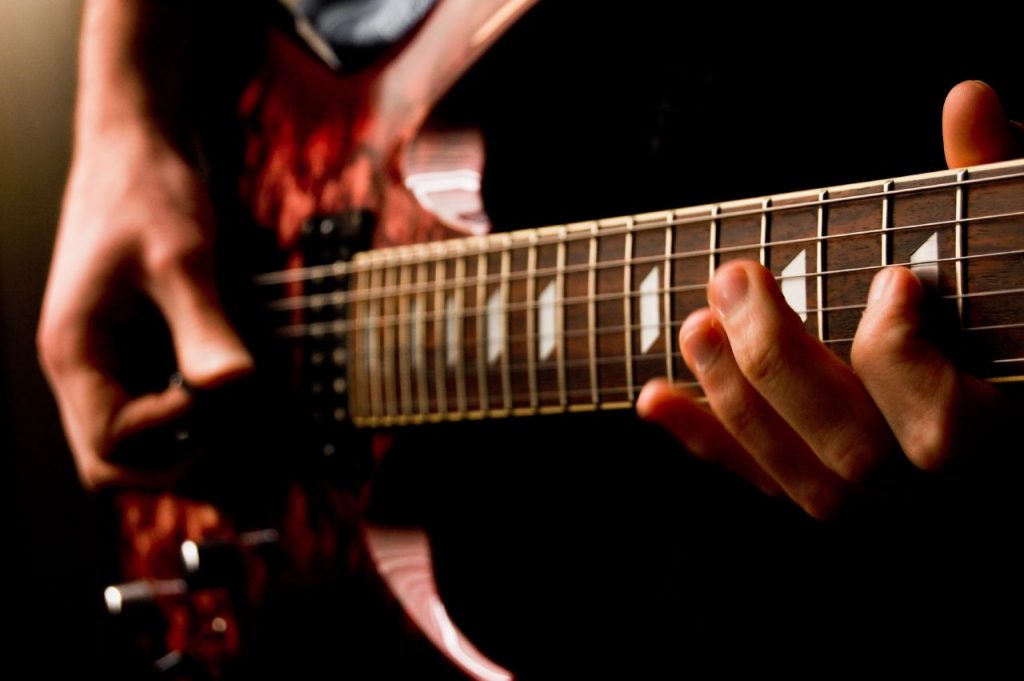
Contemporary worship did not invent technological mediation, but it made that mediation more visible, programmable, and professionally managed. Audio, video, and lighting systems, often grouped under the language of AVL, now shape many worship environments through microphones, digital soundboards, speakers, in-ear monitors, electric guitars, drum kits, lyric screens, projectors, LED walls, camera feeds, livestream platforms, stage lighting, haze, countdown timers, and image magnification. These tools are most visible in evangelical, Pentecostal, charismatic, and megachurch contexts, but their influence extends far beyond them. Even congregations that reject “concert-style” worship often rely on microphones, hearing-assistance systems, projection, livestreaming, recorded music, or digital scheduling. The question is not whether contemporary worship uses technology. It is how deliberately, theologically, and communally those technologies are ordered.
Screens changed the visual grammar of worship in especially powerful ways. Projected lyrics can support congregational singing by freeing worshippers from hymnals, printed bulletins, or memorized texts, but they also redirect the gaze toward a front-facing visual field. The screen becomes a liturgical surface, one that can display words, scripture, announcements, sermon points, images, videos, countdowns, giving prompts, and camera close-ups. In some settings, this reinforces participation by making words accessible and synchronized. In others, it risks flattening worship into a sequence of consumable visual cues. The shift is subtle but important: the worshipper no longer looks primarily at book, altar, pulpit, icon, neighbor, or choir, but at a managed digital frame. Like stained glass or iconography, the screen teaches people how and where to look. Unlike those older media it can change instantly, moving attention from song to sermon to video to brand identity with remarkable speed.
Lighting and sound design deepen this managed atmosphere. Modern worship lighting can mark transitions, soften the room, emphasize the platform, create intimacy, heighten emotional climax, or separate “ordinary” pre-service space from the heightened time of worship. Sound systems likewise do more than make worship audible. They balance voices and instruments, determine whether the congregation hears itself or the worship band more strongly, shape emotional intensity through volume and dynamics, and create a sense of immersion. The technical choices are often invisible to the congregation, but they are never neutral: a lead vocal mixed far above the room can make the worship leader feel indispensable, while a mix that leaves space for congregational sound can reinforce shared participation. A dimmed house and illuminated stage can help focus attention, but it can also create the visual logic of audience and performer. A carefully timed lighting shift during prayer may deepen stillness, while the same technique used too aggressively may feel manipulative or theatrical. Electric guitars, keyboards, pads, drums, and bass often construct a continuous sonic environment that carries the congregation across moments of praise, prayer, reflection, and appeal. These sustained textures can reduce awkward silence, support emotional continuity, and give worshippers a sense of being held within a larger sonic field. Yet they also make atmosphere something intentionally produced, monitored, adjusted, and repeated. These tools can serve worship well when they clarify and support communal action. Yet they also raise a serious question: when atmosphere is so carefully engineered, how does a community distinguish liturgical depth from emotional production?
Image magnification, or IMAG, intensifies the tension between intimacy and spectacle. Large screens showing close-ups of pastors, worship leaders, readers, musicians, baptisms, testimonies, or altar calls make large spaces feel personal. A worshipper seated far from the platform can see facial expressions, gestures, tears, smiles, and ritual details that would otherwise be lost. IMAG solves a real architectural problem created by scale. It restores visibility in rooms too large for ordinary sight. But it also transforms worship leaders into screen presences, making the mediated face more visually dominant than the embodied person in the room. The close-up can invite empathy, but it can also import the grammar of television, concert performance, and celebrity into the worship setting. The gathered assembly becomes a live audience watching itself watch.
The electric guitar and contemporary worship band likewise reveal both continuity and change. Christian worship has always adapted instruments, musical styles, and vocal practices from surrounding cultures, but contemporary worship music often places popular music’s emotional structures at the center of congregational experience. Verse, chorus, bridge, repetition, crescendo, breakdown, and extended refrain can create powerful shared participation. The repeated chorus may function much like older chant or hymnody, lodging words in memory and allowing the body to inhabit praise through rhythm and breath. Band-led worship can make the line between congregational song and performed music difficult to maintain. If volume, arrangement, stage placement, lighting, and amplification make the band sonically dominant, the congregation may be carried by music without fully becoming the primary singer. The old issue of participation returns in amplified form.
Contemporary AVL systems represent both a genuine extension of worship’s long technological history and a distinctive modern intensification of control. They can improve audibility, visibility, accessibility, coordination, and inclusion. They can help the elderly hear, allow latecomers to follow song texts, make baptism visible in a large room, include online participants, translate lyrics or scripture, and support people unfamiliar with a tradition’s worship forms. But they can also centralize authority in production teams, privilege platform leaders, compress ritual into branded experience, and habituate congregations to passive reception. The healthiest use of AVL is not the absence of technology, which is historically impossible and practically unrealistic, but a disciplined transparency: technology should support the gathered body without replacing it. When screens, speakers, lights, cameras, and instruments help people sing, hear, see, pray, respond, and belong, they continue worship’s ancient work of mediation. When they make worshippers into spectators of someone else’s religious intensity, they reveal the danger that has shadowed sacred technology from the beginning.
Livestreamed Worship, Pandemic Religion, and Digital Presence
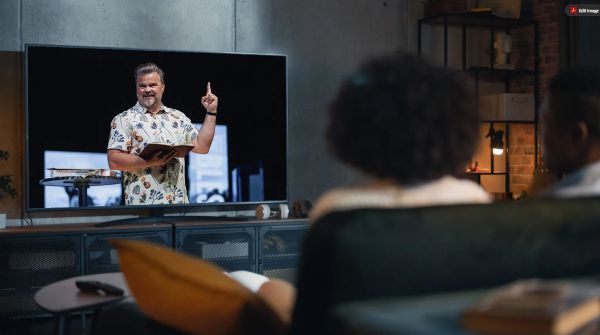
Livestreamed worship brought the long history of sacred mediation into the digital household. Radio and television had already carried sermons, music, and devotional programming beyond the gathered congregation, but internet streaming made remote worship more immediate, interactive, and ordinary. A service could be watched live on a phone, tablet, laptop, television, or social media platform; prayers could be typed in a chat window; sermons could be replayed; giving could happen through a link; and congregational announcements could circulate through email, apps, and online groups. Worship was no longer tied exclusively to the sanctuary, broadcast studio, or scheduled religious program. It could enter kitchens, bedrooms, hospital rooms, nursing homes, workplaces, and cars, often with startling intimacy. The ancient problem of presence had entered a new technological form: what does it mean to gather when the gathered body is dispersed?
The COVID-19 pandemic made this question urgent rather than theoretical. When congregations could not safely assemble in person, livestreaming, recorded services, video conferencing, telephone prayer chains, outdoor worship, drive-in services, and digital pastoral care became practical necessities. Communities that had previously treated online worship as supplemental suddenly depended on it for continuity. Clergy preached into cameras rather than rooms, musicians recorded from separate spaces, liturgical leaders learned framing and audio levels, and worshippers watched services while sitting on couches, cooking breakfast, caring for children, or recovering from illness. This did not simply transfer old worship into a new container. It changed the physical conditions of participation. Standing, kneeling, singing, greeting, receiving communion, passing the peace, lighting candles, and hearing a congregation around oneself became difficult, altered, or impossible. The pandemic also exposed how much ordinary worship depends on habits that usually go unnoticed: the sound of other people breathing and singing nearby, the physical timing of rising and sitting together, the touch of a hand, the shared handling of books or cups, the procession of bodies through a common space, and the sensory density of being among others. Online worship preserved words, music, images, and some forms of ritual sequence, but it often thinned the surrounding bodily field that gives worship its communal weight. Worship continued, but embodiment became fractured.
Digital worship also exposed sharp theological differences among traditions. For communities centered on preaching, teaching, prayer, and song, online worship could often be adapted with relative speed, though not without loss. For sacramental traditions, especially those in which Eucharist, baptism, anointing, touch, ordination, or physical gathering carry strong theological meaning, digital mediation raised harder questions. Could communion be consecrated remotely? Could viewers participate spiritually while not receiving physically? Was watching a Eucharistic liturgy an act of worship, devotion, longing, or absence? Similar questions emerged around communal singing, since singing together through livestream usually meant hearing only leaders while worshippers sang privately, muted, delayed, or not at all. The screen could connect people, but it could not fully reproduce the shared acoustic body of a congregation.
Yet livestreamed worship also revealed the genuine pastoral value of digital presence. People who were ill, disabled, immunocompromised, elderly, geographically distant, traveling, grieving, anxious, or otherwise unable to attend in person could remain connected to a worshipping community. For some, online worship was not a poor substitute but the first sustained access they had ever had. Closed captions, translated subtitles, replayable sermons, online prayer requests, digital bulletins, and virtual small groups could widen participation beyond the assumptions of able-bodied, locally mobile congregational life. The homebound worshipper, who had often been treated as peripheral, became central to the theological imagination of many communities during the pandemic. Digital worship forced churches, synagogues, mosques, temples, and other religious bodies to confront an uncomfortable truth: physical gathering is deeply important, but access had never been equally available to everyone.
Digital presence intensified the risk of religious spectatorship. Online worship could easily become content: consumed privately, skipped, paused, multitasked, algorithmically recommended, or compared against more polished alternatives. The worshipper became viewer, user, subscriber, donor, commenter, and sometimes anonymous observer. Platform logic mattered. YouTube, Facebook, Zoom, church apps, podcast feeds, and livestream platforms did not merely transmit worship neutrally. They shaped attention through notifications, thumbnails, chat interfaces, view counts, suggested videos, buffering, comment threads, and metrics. Religious communities found themselves measuring engagement through tools designed for media consumption. This created a new form of liturgical anxiety: the service had to be faithful, but it also had to be watchable. The camera angle, audio mix, lighting, internet stability, and online hospitality became part of worship’s infrastructure. Even small congregations were drawn into questions that had once belonged mainly to broadcasters and production teams: whether the microphone sounded warm enough, whether the preacher’s face was framed well, whether the music distorted, whether the sanctuary looked empty, whether viewers stayed past the sermon, and whether online attendance counted as participation. These metrics could help communities care for dispersed members, but they could also tempt leaders to judge worship by retention, reach, polish, and comparative performance. In that environment, the danger was not technology alone, but the quiet conversion of worship into platform behavior.
Livestreamed stands as both continuity and rupture. It continues the older history of sacred mediation because worship has always depended on tools that carry sound, image, memory, authority, and ritual form. But it also changes the nature of assembly by separating simultaneity from physical co-presence. A congregation may be gathered in time but not in place, connected by signal but not by shared air, attentive to the same words but not necessarily participating in the same embodied action. The question is not whether digital worship is “real” in some simple way. It is real as mediation, care, communication, longing, instruction, and access. But it is not identical to embodied assembly. Its power lies in extension; its danger lies in substitution. Like every sacred technology before it, livestreaming serves worship best when it strengthens communion without pretending that a screen can exhaust the meaning of presence.
Theological and Ritual Critique: Enhancement, Distraction, Participation, and Power
The following video from EWTN covers a Catholic Church offering “Sensory Mass” for neurodivergent parishioners:
The recurring question across this history is not whether worship should use technology, but how a worshipping community discerns the difference between mediation that serves the sacred act and mediation that begins to dominate it. Every religious tradition has used tools, techniques, spaces, sounds, images, texts, gestures, objects, and forms to make worship possible. The issue is not technological presence but theological ordering. A bell can gather a village into sacred time, but it can also announce institutional authority. A pulpit can clarify proclamation, but it can also concentrate power in one authorized voice. A screen can help people sing, but it can also train them to watch rather than act. Technology in worship becomes dangerous not because it is artificial, but because it can quietly redefine what participation means. That danger is especially subtle because it often arrives through useful improvements. Better audibility, clearer visibility, smoother transitions, more emotionally coherent music, and broader digital access are all real goods. Yet each good can carry an unintended formation. A community may begin by using technology to support worship and end by organizing worship around what the technology makes easiest, most impressive, most measurable, or most repeatable. The critique must begin with function rather than novelty: what does this tool train worshippers to do, expect, feel, ignore, or depend upon?
The distinction between ritual as a “cool” medium and electronic media as “hot” media offers one useful way to understand this tension. Ritual is “cool” in the sense that it requires participation, completion, embodiment, and communal enactment. It does not simply deliver content to passive recipients. It asks people to stand, sit, sing, respond, process, kneel, eat, listen, wait, touch, remember, and return. Highly managed media, by contrast, can become “hot” when they overwhelm the senses, supply too much emotional direction, and leave little room for communal completion. This distinction should not be treated mechanically, since a microphone, camera, or screen can support real participation under the right conditions. Still, worship can be weakened when the medium becomes so dominant that the assembly is subtly transformed from acting body into religious audience.
Participation is the key test. A worship technology serves ritual when it strengthens the ability of the community to pray, sing, hear, see, remember, respond, and belong together. It becomes suspect when it replaces shared action with performed intensity. The same technology can do either, depending on use. A sound system may allow elderly worshippers to hear scripture clearly, or it may bury congregational song beneath a platform mix. Projected lyrics may free people from printed materials and support a common voice, or they may make worship dependent on visual cues controlled from a booth. Lighting may mark sacred transition, or it may reproduce the emotional grammar of theater. Livestreaming may include the homebound, or it may train people to treat worship as downloadable content. The moral and theological question lies in the direction of formation: does the technology make the body more genuinely communal, or does it make the community more easily managed?
Distraction is not merely a matter of whether a device is noticeable. Some sacred technologies are meant to be noticed. Icons, stained glass, organs, bells, incense, vestments, processions, and illuminated manuscripts all draw attention, but they do so in ways that direct perception toward a larger ritual order. The problem arises when a medium draws attention primarily to itself, to its novelty, to institutional polish, to charismatic personality, or to emotional control. A worshipper can be distracted by excessive spectacle, but also by bad sound, unreadable slides, awkward camera work, dead microphones, or technologies used without theological thought. Poorly ordered technology does not disappear into worship. It interrupts it. The goal is not technological invisibility in a literal sense, but liturgical transparency: the tool should disclose the sacred action more fully rather than compete with it. This means that distraction can come from both excess and failure. A lighting cue that announces itself too dramatically may pull attention away from prayer, but a dim sanctuary where people cannot read, move safely, or see ritual action can also obstruct worship. A livestream camera that turns every gesture into performance can distort the assembly, but a poorly placed camera that excludes baptism, communion, or congregational response can misrepresent the very event it is meant to share. Discernment requires asking not only whether a technology is “too much,” but whether it is properly proportioned to the act it serves.
Power is inseparable from this critique. Worship technologies decide, or help decide, who is heard, who is seen, who leads, who follows, who is centered, and who is made peripheral. In ancient temples, access to images, altars, and inner spaces was controlled through priesthood, architecture, and ritual law. In medieval churches, screens, relics, bells, and Latin liturgy distributed authority through clerical and institutional forms. In Protestant worship, the pulpit and printed word reconfigured power around preaching, interpretation, literacy, and discipline. In broadcast and digital worship, cameras, microphones, platforms, algorithms, metrics, and production teams shape religious visibility in ways that communities may not fully recognize. The person with the microphone is not simply louder. The person with the microphone occupies a different ritual position. The person framed by the camera becomes the face of the community. The person choosing the image, lyric, volume, or livestream angle participates in the construction of worship’s meaning. These decisions may be made humbly and practically, but they remain decisions about authority. A sound technician who raises one voice and lowers another is not only solving an audio problem. A media operator who chooses which face appears on the screen is not only solving a visibility problem. A platform that promotes one sermon clip over another is not only distributing content. Each act organizes attention, and organized attention is one of the basic forms of religious power.
A responsible theology of worship technology requires neither rejection nor enthusiasm as a default posture. It requires discernment, memory, and humility. Discernment asks what a tool does to the body, the assembly, the senses, the vulnerable, the absent, the powerful, and the central act of worship. Memory reminds communities that every age has faced some version of this question, whether over icons, organs, vernacular preaching, hymnody, revival methods, radio, television, or livestreaming. Humility recognizes that people often experience mediation differently: what feels manipulative to one worshipper may feel accessible to another; what seems distracting to one community may sustain participation in another. The task is not to escape mediation, because worship has never done that. The task is to order mediation so that sound, image, ritual, space, and technology serve communion rather than consume it.
Conclusion: The Sacred Has Always Had Instruments
The history of worship is not a story of pure religion gradually invaded by technology. It is a story of human beings repeatedly using available instruments, techniques, materials, spaces, and media to make sacred encounter audible, visible, repeatable, and communal. Voice, rhythm, breath, gesture, procession, sacrifice, scripture, image, incense, bells, stained glass, relics, pulpits, hymnals, organs, microphones, cameras, screens, and livestreams belong to one long history of mediation. They differ in scale, theology, authority, and sensory effect, but they all answer the same basic human problem: the sacred must be encountered through bodies that hear, see, touch, move, remember, and gather. Worship has never been weightless. It has always needed form.
This does not mean that all forms are equally wise, faithful, or humane. The fact that worship has always used technology does not absolve any particular technology from critique. Sacred tools can gather or divide, clarify or distort, deepen participation or replace it with spectacle. An icon can focus devotion or become a point of controversy. A pulpit can illuminate scripture or silence other voices. A bell can order communal time or enforce institutional power. A microphone can make proclamation accessible or elevate personality above assembly. A screen can help people sing or train them to consume worship visually. A livestream can include the absent or habituate the present to distance. Each of these tools carries a double possibility because worship technology always shapes attention, and attention is never neutral. What a community repeatedly sees, hears, follows, and responds to becomes part of its spiritual formation. This is why the history of sacred mediation cannot be told as simple progress from primitive sound to modern media, nor as decline from ancient authenticity to contemporary artificiality. The same basic danger appears in every age: the instrument meant to serve encounter can become the object that governs it. The same possibility also remains: the right tool, rightly ordered, can make participation more generous, memory more durable, and communal presence more fully shared. The problem is never mediation itself. The problem is mediation without discernment, memory, proportion, or accountability.
The strongest worship technologies are those that disappear into participation without becoming invisible in history. They do not erase the body, but gather it. They do not overwhelm the senses, but discipline them toward reverence. They do not replace the community, but help the community act together. This is why the oldest technologies of worship remain so powerful: breath shared in song, bodies moving in procession, hands lifted or folded, words repeated until they become memory, silence held by a room, light falling across a sacred surface, sound marking time, a gathered people waiting for meaning to become present among them. Later technologies extend these capacities, sometimes beautifully and sometimes dangerously. The question is whether they enlarge communion or merely enlarge effect.
To say that the sacred has always had instruments is not to reduce worship to machinery, performance, or technique. It is to recognize that religious life takes shape through material and sensory forms because human beings are material and sensory creatures. The divine, understood, is encountered by people who live in bodies, build spaces, inherit symbols, train voices, make images, carry texts, and gather in patterned time. From ancient chant to digital livestream, worship has remained an art of mediated presence. Its task is not to escape technology, but to sanctify attention: to order sound, image, ritual, and tool toward a community capable of seeing, hearing, remembering, and responding together.
Bibliography
Affiliate disclosure: Amazon links on this site are paid links. As an Amazon Associate I earn from qualifying purchases.
- Assmann, Jan. The Search for God in Ancient Egypt. Ithaca: Cornell University Press, 1984.
- Balmer, Randall. Mine Eyes Have Seen the Glory: A Journey into the Evangelical Subculture in America. 4th ed. New York: Oxford University Press, 2014.
- Bell, Catherine. Ritual: Perspectives and Dimensions. New York: Oxford University Press, 1997.
- —-. Ritual Theory, Ritual Practice. New York: Oxford University Press, 1992.
- Belting, Hans. Likeness and Presence: A History of the Image before the Era of Art. Chicago: University of Chicago Press, 1994.
- Berger, Teresa. Worship: Liturgical Practices in Digital Worlds. London: Routledge, 2017.
- Betancourt, Roland. “Tempted to Touch: Tactility, Ritual, and Mediation in Byzantine Visuality.” Speculum 91:3 (2016), 660-689.
- Binski, Paul. Becket’s Crown: Art and Imagination in Gothic England, 1170–1300. New Haven, CT: Yale University Press, 2004.
- Bradshaw, Paul F. The Search for the Origins of Christian Worship: Sources and Methods for the Study of Early Liturgy. New York: Oxford University Press, 1992.
- Bradshaw, Paul F., and Maxwell E. Johnson. The Origins of Feasts, Fasts and Seasons in Early Christianity. Collegeville, MN: Liturgical Press, 2011.
- Brubaker, Leslie, and John Haldon. Byzantium in the Iconoclast Era, c. 680–850: A History. Cambridge: Cambridge University Press, 2011.
- Burkert, Walter. Greek Religion. Translated by John Raffan. Cambridge, MA: Harvard University Press, 1985.
- Calvin, John. Institutes of the Christian Religion. Translated by Henry Beveridge. Peabody, MA: Hendrickson Publishers, 2008.
- Cameron, Euan. The European Reformation. Oxford: Oxford University Press, 1991.
- Campbell, Heidi A. Digital Religion: Understanding Religious Practice in New Media Worlds. London: Routledge, 2012.
- Dawson, Lorne L. Religion Online: Finding Faith on the Internet. New York: Routledge, 2004.
- Duffy, Eamon. The Stripping of the Altars: Traditional Religion in England, 1400–1580. New Haven: Yale University Press, 1992.
- Durkheim, Émile. The Elementary Forms of Religious Life. Translated by Karen E. Fields. New York: Free Press, 1995.
- Eck, Diana L. Darśan: Seeing the Divine Image in India. 3rd ed. New York: Columbia University Press, 1998.
- Eire, Carlos M. N. War Against the Idols: The Reformation of Worship from Erasmus to Calvin. Cambridge: Cambridge University Press, 1986.
- Ergin, Nina. “The Fragrance of the Divine: Ottoman Incense Burners and Their Context.” The Art Bulletin 96:1 (2014), 70-97.
- Fassler, Margot E. The Virgin of Chartres: Making History through Liturgy and the Arts. New Haven, CT: Yale University Press, 2010.
- Finney, Charles G. Lectures on Revivals of Religion. New York: Revell, 1868.
- Flood, Gavin. An Introduction to Hinduism. Cambridge: Cambridge University Press, 1996.
- Geary, Patrick J. Furta Sacra: Thefts of Relics in the Central Middle Ages. Princeton: Princeton University Press, 1978.
- Grabar, André. Christian Iconography: A Study of Its Origins. Princeton, NJ: Princeton University Press, 1968.
- Graham, William A. Beyond the Written Word: Oral Aspects of Scripture in the History of Religion. Cambridge: Cambridge University Press, 1987.
- Hadden, Jeffrey K., and Charles E. Swann. Prime Time Preachers: The Rising Power of Televangelism. Reading, MA: Addison-Wesley, 1981.
- Hangen, Tona J. Redeeming the Dial: Radio, Religion, and Popular Culture in America. Chapel Hill: University of North Carolina Press, 2002.
- Hatch, Nathan O. The Democratization of American Christianity. New Haven, CT: Yale University Press, 1989.
- Hedrick, Tera Lee and Nina Ergin. “A Shared Culture of Heavenly Fragrance: A Comparison of Late Byzantine and Ottoman Incense Burners and Censing Practices in Religious Contexts.” Dumbarton Oaks Papers 69 (2015), 331-354.
- Hempton, David. Methodism: Empire of the Spirit. New Haven, CT: Yale University Press, 2005.
- Hoover, Stewart M. Mass Media Religion: The Social Sources of the Electronic Church. Newbury Park, CA: Sage Publications, 1988.
- Hundley, Michael B. Gods in Dwellings: Temples and Divine Presence in the Ancient Near East. Atlanta: Society of Biblical Literature, 2013.
- Hurtado, Larry W. At the Origins of Christian Worship: The Context and Character of Earliest Christian Devotion. Grand Rapids, MI: Eerdmans, 1999.
- Hutchings, Tim. Creating Church Online: Ritual, Community and New Media. London: Routledge, 2017.
- Ingalls, Monique M. Singing the Congregation: How Contemporary Worship Music Forms Evangelical Community. New York: Oxford University Press, 2018.
- Ingalls, Monique M., and Amos Yong, eds. The Spirit of Praise: Music and Worship in Global Pentecostal-Charismatic Christianity. University Park: Pennsylvania State University Press, 2015.
- John of Damascus. Three Treatises on the Divine Images. Translated by Andrew Louth. Crestwood, NY: St. Vladimir’s Seminary Press, 2003.
- Kavanagh, Aidan. Elements of Rite: A Handbook of Liturgical Style. Collegeville, MN: Liturgical Press, 1982.
- Kieckhefer, Richard. Theology in Stone: Church Architecture from Byzantium to Berkeley. New York: Oxford University Press, 2004.
- Kilde, Jeanne Halgren. When Church Became Theatre: The Transformation of Evangelical Architecture and Worship in Nineteenth-Century America. New York: Oxford University Press, 2002.
- Klingbeil, Gerald A. Bridging the Gap: Ritual and Ritual Texts in the Bible. Winona Lake, IN: Eisenbrauns, 2007.
- Levine, Lee I. The Ancient Synagogue: The First Thousand Years. 2nd ed. New Haven, CT: Yale University Press, 2005.
- Lopez, Donald S., Jr., ed. Buddhist Scriptures. London: Penguin Books, 2004.
- Luhrmann, T. M. When God Talks Back: Understanding the American Evangelical Relationship with God. New York: Knopf, 2012.
- Luther, Martin. Luther’s Works. Vol. 53, Career of the Reformer I. Edited by Harold J. Grimm. Philadelphia: Fortress Press, 1957.
- Marks, Richard. Stained Glass in England during the Middle Ages. Toronto: University of Toronto Press, 1993.
- Mathews, Thomas F. The Clash of Gods: A Reinterpretation of Early Christian Art. Rev. and expanded ed. Princeton, NJ: Princeton University Press, 1993.
- McKinnon, James W. Music in Early Christian Literature. Cambridge: Cambridge University Press, 1987.
- McLuhan, Marshall. Understanding Media: The Extensions of Man. New York: McGraw-Hill, 1964.
- Metcalf, Barbara Daly, ed. Making Muslim Space in North America and Europe. Berkeley: University of California Press, 1996.
- Metzger, Bruce M. The Canon of the New Testament: Its Origin, Development, and Significance. Oxford: Clarendon Press, 1987.
- Meyer, Birgit, ed. Aesthetic Formations: Media, Religion, and the Senses. New York: Palgrave Macmillan, 2009.
- —-. “Picturing the Invisible: Visual Culture and the Study of Religion.” Method & Theory in the Study of Religion 27:4/5 (2015), 333-360.
- Mithen, Steven. The Singing Neanderthals: The Origins of Music, Language, Mind, and Body. Cambridge, MA: Harvard University Press, 2006.
- Moore, R. Laurence. Selling God: American Religion in the Marketplace of Culture. New York: Oxford University Press, 1994.
- Morgan, David. The Sacred Gaze: Religious Visual Culture in Theory and Practice. Berkeley: University of California Press, 2005.
- Nelson, Kristina. The Art of Reciting the Qur’an. Austin: University of Texas Press, 1985.
- Noll, Mark A. America’s God: From Jonathan Edwards to Abraham Lincoln. Oxford: Oxford University Press, 2002.
- O’Malley, John W. Trent: What Happened at the Council. Cambridge, MA: Harvard University Press, 2013.
- Ong, Walter J. Orality and Literacy: The Technologizing of the Word. London: Routledge, 1982.
- Page, Christopher. The Christian West and Its Singers: The First Thousand Years. New Haven, CT: Yale University Press, 2010.
- Pentcheva, Bissera V. Hagia Sophia: Sound, Space, and Spirit in Byzantium. University Park: Pennsylvania State University Press, 2017.
- Pettegree, Andrew. Reformation and the Culture of Persuasion. Cambridge: Cambridge University Press, 2005.
- Phillips, Peter, Kyle Schiefelbein-Guerrero, and Jonas Kurlberg, eds. Defining Digital Theology: Digital Humanities, Digital Religion and the Particular Work of the CODEC Research Centre and Network. Berlin: De Gruyter, 2021.
- Pinchman, Tracy, ed. Seeking Mahādevī: Constructing the Identities of the Hindu Great Goddess. Albany: State University of New York Press, 2001.
- Price, Simon. Religions of the Ancient Greeks. Cambridge: Cambridge University Press, 1999.
- Sarna, Nahum M. On the Book of Psalms: Exploring the Prayers of Ancient Israel. New York: Schocken Books, 1993.
- Schmidt, Leigh Eric. Holy Fairs: Scotland and the Making of American Revivalism. 2nd ed. Grand Rapids, MI: Eerdmans, 2001.
- Schopen, Gregory. Bones, Stones, and Buddhist Monks: Collected Papers on the Archaeology, Epigraphy, and Texts of Monastic Buddhism in India. Honolulu: University of Hawai‘i Press, 1997.
- Schultze, Quentin J. Christianity and the Mass Media in America: Toward a Democratic Accommodation. East Lansing: Michigan State University Press, 2003.
- —-. High-Tech Worship? Using Presentational Technologies Wisely. Grand Rapids, MI: Baker Books, 2004.
- Spicer, Andrew. Calvinist Churches in Early Modern Europe. Manchester: Manchester University Press, 2007.
- Stolow, Jeremy, ed. Deus in Machina: Religion, Technology, and the Things in Between. New York: Fordham University Press, 2012.
- Stout, Harry S. The Divine Dramatist: George Whitefield and the Rise of Modern Evangelicalism. Grand Rapids, MI: Eerdmans, 1991.
- Taft, Robert F. The Byzantine Rite: A Short History. Collegeville, MN: Liturgical Press, 1992.
- —-. The Liturgy of the Hours in East and West: The Origins of the Divine Office and Its Meaning for Today. 2nd rev. ed. Collegeville, MN: Liturgical Press, 1993.
- Thompson, Deanna A. The Virtual Body of Christ in a Suffering World. Nashville: Abingdon Press, 2016.
- Treitler, Leo. With Voice and Pen: Coming to Know Medieval Song and How It Was Made. New York: Oxford University Press, 2003.
- Turner, Victor. The Ritual Process: Structure and Anti-Structure. Chicago: Aldine Publishing, 1969.
- Wagner, Rachel. Godwired: Religion, Ritual and Virtual Reality. London: Routledge, 2012.
- Wagner, Tom. The Hillsong Movement Examined: You Call Me Out upon the Waters. Cham, Switzerland: Palgrave Macmillan, 2017.
- Ward, Mark, Sr. Air of Salvation: The Story of Christian Broadcasting. Grand Rapids, MI: Baker Books, 1994.
- Watts, Isaac. Hymns and Spiritual Songs. London: J. Humfreys, 1709.
- White, James F. Introduction to Christian Worship. 3rd ed. Nashville: Abingdon Press, 2001.
- Whitehouse, Harvey. Arguments and Icons: Divergent Modes of Religiosity. Oxford: Oxford University Press, 2000.
- Wigger, John H. Taking Heaven by Storm: Methodism and the Rise of Popular Christianity in America. New York: Oxford University Press, 1998.
Originally published by Brewminate, 05.08.2026, under the terms of a Creative Commons Attribution-NonCommercial-NoDerivatives 4.0 International license.
About the Author