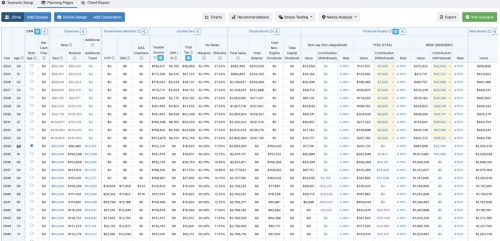
Financial forecasting is an indispensable part of modern corporate planning. Enterprises are making an effort to stay agile and responsive. Essentially, predictions of future business performance help with decision-making and strategic resource allocation. As organizations increasingly depend on data, many are searching for more reliable methods. Financial forecasting software tools have emerged as the go-to solution, bringing greater efficiency and useful insights.
Improved Decision-Making
Financial forecasting software helps managers plan for near-term trends with visibility. These tools process raw information into contextualized insights that help navigate uncertainty. With predictions grounded in historical data, companies gain a clear view of what they can expect. Better clarity allows teams to appropriately allocate budgets and respond to changes in the market faster than ever. Accurate forecasts also help with achieving strategic goals.
Enhanced Efficiency and Accuracy
Traditional forecasting is time-consuming, labor-intensive, and prone to errors. Automated solutions help reduce human error by leveraging advanced algorithms. Software platforms integrate massive datasets and generate output that is both consistent and reliable. Such precision enables organizations to operate more confidently. Besides, automation frees employees to dedicate more time to analysis than number crunching.
Real-Time Insights and Flexibility
Companies often find themselves dealing with quickly changing environments. This may be too fast for traditional planning. Forecasting software relies on real-time data, updating decision-makers as events unfold. When circumstances change, as they often do, this flexibility becomes vital for adjusting organizational strategies in real time. Teams can address issues before small challenges become bigger problems.
Data Integration and Centralization
Modern organizations collect information from diverse sources. Merging these different streams manually can be confusing and inefficient. Forecasting platforms collect, organize, and analyze data in one location. Having all information in one place ensures that everyone is working with the same facts and promotes greater coordination among departments. It also supports compliance reporting and simplifies audit processes through integrated systems.
Scenario Analysis and Risk Management
No business can predict the future with absolute certainty. But the software tools enable them to explore multiple scenarios. Through modelling, businesses identify risks and opportunities. By conducting scenario analysis, leaders can model best-case and worst-case scenarios. Realizing these kinds of outcomes helps them plan contingencies better and expose themselves to fewer uncertainties.
Cost Savings and Resource Optimisation
In the long run, budgeting mistakes can be costly. Planning and forecasting tools eliminate waste by directing resources to where they will be most productive. This means automating calculations to reduce reliance on expensive consultants and the risk of costly mistakes. Better planning also means the right amount of inventory, the right number of employees, and every project running smoothly. These savings increase profitability and bolster sustainable growth.
Regulatory Compliance and Transparency
Sectors such as banking and insurance are subject to stringent legal rules regarding financial reporting. Failure to comply can result in penalties and reputational damage. Forecasting software is automatically updated as rules change and applies them consistently. This method keeps the reports accurate and up to date. Being open and transparent about forecasts builds trust with stakeholders, such as investors, regulators, and partners.
Collaboration and Communication
Clear communication is the basis of effective teamwork. With forecasting platforms that multiple people can access, review, and update simultaneously. The inclusion of shared dashboards and reports helps keep all departments aligned with broader goals. This transparency minimises misinterpretation and helps resolve issues faster. Collaborative planning fosters a deep sense of oneness within the company.
Scalability and Future Growth
As business needs change, planning requirements become more complex. Software tools evolve alongside a business, adjusting to new requirements seamlessly. Scalable solutions can accommodate larger amounts of data without sacrificing performance. The ability to adapt ensures that an organization is ready for the future while continuing to run smoothly. Long-term success is supported by investment in advanced forecasting technology
Conclusion
Financial forecasting Software is a great solution for present-day businesses. These tools enable better decision-making, reduce error rates, and provide fast responsiveness to changing conditions. Centralized data, the ability to model scenarios, and better collaboration promote transparency and efficiency across the organization. In the face of endless uncertainty, forecasting solutions are a valuable top-of-funnel or full-funnel strategy to help companies achieve sustained growth and stability.
About the Author