
Logarithms and slide rules transformed calculation into fast, physical reasoning, helping engineers and scientists think with speed, scale, and judgment.

By Matthew A. McIntosh
Public Historian
Brewminate
Introduction: Calculation as a Bottleneck of Knowledge
Before electronic computation, calculation was one of the great bottlenecks of knowledge. Astronomers, navigators, surveyors, gunners, engineers, merchants, and natural philosophers all needed numerical results, but the work of producing those results could be painfully slow. Multiplication, division, roots, powers, ratios, and trigonometric calculations demanded long sequences of manual operations, each one vulnerable to fatigue, copying mistakes, and misplaced digits. The problem was not simply that people lacked intelligence. It was that reasoning about the heavens, the sea, land, machines, money, and motion required arithmetic faster than the unaided hand could comfortably provide. In this world, calculation was not a minor technical chore performed after thought. It was often the condition that made further thought possible.
John Napier’s publication of logarithms in 1614 addressed that problem with remarkable force. His Mirifici Logarithmorum Canonis Descriptio offered a new way to shorten the labor of calculation by substituting easier operations for harder ones. Multiplication could be reduced to addition, division to subtraction, and roots and powers to related operations on logarithmic values. Napier’s system was not identical to the common base-ten logarithms later associated with school mathematics, and the historical development of logarithms involved refinement by others, especially Henry Briggs. Yet Napier’s breakthrough was revolutionary because it attacked computation as a practical obstacle. He did not merely introduce a new mathematical curiosity. He offered a method for saving time, reducing error, and accelerating the work of those whose disciplines depended on numerical labor. The language of “wonder” in his title was not accidental; logarithms promised to change the tempo of mathematical practice.
The slide rule translated that logarithmic insight into motion. Edmund Gunter’s logarithmic line made numerical relationships measurable as distances, and William Oughtred’s later sliding scales allowed those distances to be physically added and subtracted. This was a profound shift in the material culture of calculation. A mathematical relationship that had first been organized in tables could now be handled as an instrument. The user did not have to multiply in the old laborious way; the user could align scales, move a cursor, and read an approximate result. This movement mattered because it made calculation fast enough to accompany thought rather than interrupt it. A navigator could compare courses, a surveyor could work through proportions, an engineer could test dimensions, and a technician could estimate performance without stopping to perform long written arithmetic at every stage. The slide rule did not abolish tables, written notation, or mental judgment, but it condensed the passage from problem to usable result. The device was analog, visual, and tactile. Its power lay not in producing unlimited precision, but in making useful answers available quickly enough for practical reasoning. From the seventeenth century onward, logarithmic instruments helped transform calculation from a bottleneck into a partner of design, navigation, measurement, and experiment. Florian Cajori’s classic study remains foundational for tracing that movement from logarithmic theory to instrument practice.
That transformation also changed the meaning of numerical skill. The slide rule did not eliminate the need for judgment; it intensified it. Because the instrument typically provided only a limited number of significant figures, users had to know the likely scale of an answer, place the decimal point correctly, and decide whether a result made physical sense. This was not a defect in the culture of slide-rule calculation. It was part of its discipline. Logarithms and slide rules accelerated reasoning by shifting some computational burden into tables, scales, and instruments, but they still required trained interpretation. They made calculation faster without making the user passive. The story that follows is not simply a history of mathematical convenience. It is a history of how early modern and modern people learned to reason more rapidly about the world by turning number into table, distance, movement, approximation, and judgment.
John Napier and the Invention of Logarithms

Napier’s invention of logarithms must be understood first as an answer to exhaustion. Early modern calculation was not merely difficult because mathematics was undeveloped; it was difficult because even skilled practitioners had to spend enormous time performing long numerical operations by hand. Astronomy, navigation, surveying, trigonometry, and mathematical geography all required repeated multiplication, division, extraction of roots, and manipulation of ratios. Each stage invited error. A single miscopied digit or misplaced value could corrupt a table, a course, an observation, or a prediction. Napier’s achievement was to see that the burden of calculation could be reduced by changing the form in which numbers were handled. He did not eliminate arithmetic, but he redirected it. He found a way to replace some of its most laborious operations with simpler ones.
In 1614, Napier published Mirifici Logarithmorum Canonis Descriptio, usually translated as A Description of the Wonderful Canon of Logarithms. The title’s language of wonder was not mere ornament. Napier was presenting a tool meant to transform mathematical labor. His logarithms allowed users to convert multiplication into addition and division into subtraction by working with associated values rather than directly with the original numbers. Powers and roots could likewise be managed through related operations on logarithms. This was a profound conceptual compression. Instead of forcing the calculator to multiply large or awkward quantities directly, logarithms let the user enter a different numerical world, perform an easier operation there, and then return to the original problem through tables. This gave practitioners a method for changing the shape of a problem without changing its meaning. A calculation that had previously required lengthy written multiplication could now be routed through addition; a division could be approached through subtraction; a power or root could be brought under a more manageable procedure. The procedure saved time, reduced fatigue, and made difficult calculations more manageable for disciplines that depended on repeated numerical work.
Napier’s original logarithms were not the same as the common base-ten logarithms later taught in schools. This distinction matters because the history of logarithms was not a single finished invention delivered in its modern form. Napier’s system emerged from early modern concerns with ratios, motion, and trigonometric calculation, and it was especially useful for computations involving sines. His logarithms were constructed in a form suited to the mathematical problems and numerical conventions of his own time. The later development of common logarithms, especially through the work of Briggs, made logarithms more convenient for decimal arithmetic and helped establish the form that became standard in printed tables, engineering practice, and education. Napier provided the breakthrough; later mathematicians refined its usability.
The collaboration and intellectual exchange between Napier and Briggs helped turn logarithms from a brilliant invention into a practical computational system. Briggs, a professor of geometry at Gresham College and later at Oxford, recognized the usefulness of Napier’s idea and advocated a modified system based on powers of ten. This decimal orientation made logarithmic tables easier to integrate with ordinary numerical practice, especially as decimal notation itself became increasingly important. Briggs’s Arithmetica Logarithmica, published in 1624, supplied extensive common logarithmic tables and did much to spread their use. The improvement was not simply cosmetic. A mathematical invention only transforms practice when users can learn it, trust it, and apply it repeatedly. Tables had to be arranged clearly, printed accurately, and explained in ways that working calculators could follow. Briggs helped give Napier’s insight the tabular form needed for broad adoption. He also demonstrated that the history of logarithms was collaborative and practical, not merely theoretical. Napier opened the door by showing that calculation could be transformed; Briggs helped build the hallway through which ordinary users could walk.
The significance of logarithms lay partly in their redistribution of labor. Instead of requiring each astronomer, navigator, or surveyor to perform every difficult multiplication from scratch, logarithmic tables stored an immense amount of prior computation. The user still had to understand the procedure, locate the proper values, perform additions or subtractions, and interpret the result, but much of the hardest work had already been embedded in the table. This made logarithms both a mathematical idea and an information technology. They transferred effort from the moment of use to the earlier construction of reliable printed aids. That transfer changed the pace of technical reasoning. It also changed the social organization of calculation, because users now depended on the accuracy of table-makers, printers, editors, and mathematical authorities. A table was not just a convenience; it was a reservoir of trusted labor. When it was correct, it multiplied the efficiency of everyone who used it. When it contained errors, those errors could travel into navigation, surveying, astronomy, or engineering. The practitioner could spend less time grinding through arithmetic and more time comparing observations, testing possibilities, correcting instruments, or interpreting physical situations.
Napier’s invention belongs to a larger history of tools that accelerated thought by reorganizing calculation. Like the abacus, logarithms extended the mind by giving it a structured aid, but they did so in a different way. The abacus made place value visible through motion and position; logarithms made multiplicative relationships accessible through addition, subtraction, and tables. They did not merely provide faster answers. They changed what counted as efficient reasoning in astronomy, navigation, surveying, and eventually engineering. Once multiplication could be compressed into addition, and once difficult numerical relationships could be stored in tables, calculation became less of a wall between question and answer. Napier’s “wonderful canon” opened a path toward the slide rule because it showed that numerical difficulty could be transformed rather than simply endured.
Tables, Trust, and the Labor of Computation

Logarithms changed calculation, but they did so through tables. Napier’s insight made it possible to transform difficult operations into easier ones, yet the ordinary user needed printed numerical aids to make that transformation practical. A table supplied the bridge between the original number and its logarithm, and then between the computed logarithmic result and the final answer. This meant that logarithms were never only an abstract mathematical discovery. They became useful through a culture of compilation, correction, printing, instruction, and trust. The table turned calculation into something distributed across time. The table-maker performed difficult labor in advance, and later users drew on that stored labor when they navigated, surveyed, observed, engineered, or taught.
This redistribution of work made tables powerful but also fragile. A printed table could save thousands of hours of repeated calculation, but only if it was accurate enough to trust. Errors could enter during computation, transcription, typesetting, proofreading, or later copying. A misplaced digit in a logarithmic table might remain invisible until it affected a practical result. In astronomy, such an error could distort an observation or prediction. In navigation, it could influence a course. In surveying, it could affect a boundary, distance, or area. This did not make tables unreliable in general, but it did make reliability a social and technical achievement. Accuracy depended on trained calculators, careful editors, reputable printers, checking procedures, and communities of users who detected, reported, and corrected mistakes. Trust in computation was not automatic. It had to be manufactured.
The history of logarithmic tables also shows that calculation could become collective before it became mechanical. A single printed table condensed the work of many minds and hands: mathematicians who designed methods, human computers who performed calculations, scribes or assistants who copied results, printers who set type, proofreaders who checked columns, and users who learned how to consult the finished product. The table’s apparent simplicity concealed this chain of labor. A navigator looking up a logarithm or a surveyor checking a trigonometric value did not see the labor embedded in the page, but depended on it. The number appeared ready-made, almost impersonal, yet it carried the history of all the decisions, computations, corrections, and conventions that produced it. In that sense, tables were early computational infrastructures. They allowed individuals to act quickly because a larger system had already done the slow work. The printed page became a silent partner in reasoning. It also became a medium through which expertise could travel. A table compiled in one place could be used in another, by someone who had never met the original calculator and did not need to repeat the original work. That portability helped create wider communities of technical practice, linking astronomers, navigators, surveyors, teachers, and instrument-makers through shared numerical references.
Briggs’s work illustrates this practical transformation. By adapting Napier’s logarithms into a decimal system more convenient for common use, Briggs helped make logarithms accessible to a wider mathematical and technical public. His Arithmetica Logarithmica did more than publish numbers. It helped establish a usable standard. Standardization mattered because logarithmic calculation required shared conventions. Users needed to know what kind of logarithms they were consulting, how the table was arranged, how many places of accuracy it provided, and how to reverse the process when returning from logarithms to ordinary numbers. Once these conventions became familiar, logarithmic tables could travel across disciplines. They served astronomers, navigators, surveyors, artillery officers, merchants, and eventually engineers because they made calculation portable without making it effortless.
The importance of tables lies in their double character. They accelerated reasoning, but they also made reasoning dependent on an inherited apparatus of prior computation. They reduced the burden on the individual user, but they increased the need for confidence in printed authority. This is one of the defining features of early modern and modern calculation: speed came from trusting systems larger than oneself. The slide rule would later carry this transformation into an instrument, turning logarithmic relationships from tabular entries into physical distances. Yet the logic was already present in the table. Calculation became faster when labor could be stored, standardized, and reused. Logarithmic tables were not merely pages of numbers. They were repositories of disciplined work, and their authority rested on the fragile but powerful bond between computation and trust.
Edmund Gunter and the Line of Numbers
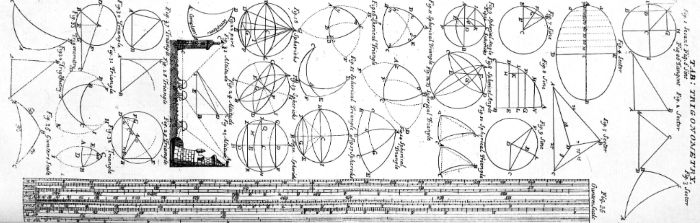
Edmund Gunter occupies a crucial place between logarithmic tables and the slide rule because he helped turn logarithms into an instrument. Napier had shown that difficult calculations could be transformed through logarithmic relationships, and Briggs helped make those relationships more convenient through decimal tables. Gunter’s contribution was different. He translated logarithmic values into physical distances that could be measured on a scale. This was not yet the slide rule in its familiar sliding form, but it was one of its essential preconditions. The line of numbers made logarithmic calculation visible, linear, and manipulable. It showed that a mathematical table could become a graduated instrument.
Gunter was well positioned for this transformation because his work stood at the intersection of mathematics, astronomy, navigation, surveying, and instrument design. In 1620, he published Canon Triangulorum, a work associated with logarithmic tables for trigonometric functions, especially sines and tangents. This already placed him within the culture of practical logarithmic computation that followed Napier and Briggs. Yet Gunter’s importance does not rest only on the publication of tables. He was interested in the instruments by which mathematical knowledge could be put to use. His later work, especially The Description and Use of the Sector, the Crosse-Staffe, and Other Instruments in 1624, belongs to a world in which computation was inseparable from navigation, measurement, and applied geometry. The problem was not merely how to know mathematical relationships, but how to carry them into the field, onto the ship, and into the hands of working practitioners.
The line of numbers, often associated with Gunter’s scale or Gunter’s rule, placed numbers along a line according to their logarithms rather than at equal arithmetic intervals. This is the key idea. On an ordinary ruler, the distance from 1 to 2 is the same as the distance from 2 to 3, because the scale is linear in the everyday sense. On a logarithmic line, the spacing changes. The physical distance between numbers corresponds to logarithmic difference, so that multiplicative relationships can be treated as distances. Numbers crowd closer together as they increase, not because the instrument is distorted, but because equal ratios, rather than equal differences, are being represented by equal lengths. The distance from 1 to 2 corresponds to the same multiplicative relationship as the distance from 2 to 4 or from 5 to 10. This gave the scale its computational power. Gunter’s line converted a table of logarithms into geometry. A user could take dividers, measure from one number to another, transfer that distance along the line, and obtain results for multiplication, division, or proportion. As Cajori emphasized, Gunter’s line was not itself a sliding rule because it had no sliding parts, but it was unmistakably a logarithmic scale and a direct ancestor of the slide rule’s working principle.
This method mattered because it brought calculation closer to the body and the instrument. Instead of writing down logarithms, adding columns of figures, and then consulting tables again, a user could operate through measured distance. The dividers became a partner in computation. A multiplication could be represented by stepping off one logarithmic interval and applying it from another starting point. Division could be approached by reversing or comparing intervals. The operation was still approximate, and the user still needed judgment, but the burden of calculation had shifted. Logarithmic relationships were no longer confined to books of tables. They could be handled as lengths. That made the act of calculation faster, but it also changed its character. The user no longer moved only through columns of printed numbers; the user moved through space. The hand measured what the table had previously listed, and the eye read a relationship that arithmetic had made difficult to obtain directly. In that shift, the old boundary between mathematics and measurement blurred. Number became something one could read with the eye, carry with the dividers, and apply by touch.
Gunter’s scale was especially important for navigation and surveying, fields where calculation had to be practical, portable, and sufficiently accurate under imperfect conditions. Navigators needed to work with distances, courses, angles, and trigonometric relationships. Surveyors needed to relate measured lines, areas, and proportions in the landscape. A printed table could be useful, but a rule engraved with logarithmic and trigonometric scales could bring calculation directly into applied work. Gunter’s instruments reflected this culture of mathematical practice. They were not designed for detached contemplation alone. They answered the needs of people who measured, traveled, mapped, and built. That is why Gunter’s work is best understood not merely as a technical footnote between Napier and William Oughtred, but as a major stage in the materialization of logarithmic reasoning.
The line of numbers also clarifies the larger history of the slide rule. Oughtred’s later innovation would be to place two logarithmic scales against one another so that the distances could be added or subtracted by sliding rather than by dividers. But the conceptual groundwork was already present in Gunter’s line: logarithms could be spatialized, and multiplication could be performed through the addition of lengths. This was the essential leap from numerical table to analog computer. Gunter did not merely simplify calculation. He changed its medium. He showed that logarithmic reasoning could live on a rule, not only on a page. He helped open the path to three centuries of instrument-based calculation, from navigation and surveying to engineering, aviation, and space-age design.
William Oughtred and the Birth of the Slide Rule

William Oughtred’s contribution to the history of calculation was to make logarithmic distance movable. Gunter had already placed logarithmic relationships onto a fixed line, allowing users to work with dividers and measured intervals. Oughtred’s decisive step was to bring two logarithmic scales into relation with one another so that their distances could be added or subtracted by alignment. This was the essential birth of the slide rule. The instrument did not need gears, wheels, or written multiplication to perform its work. Its mechanism was proportion itself, embodied in two scales that could shift against each other. By turning logarithmic calculation into sliding motion, Oughtred gave practical users a faster and more flexible way to reason through multiplication, division, and proportional relationships.
Oughtred was an Anglican clergyman and mathematician, part of the same early seventeenth-century English world in which mathematical practice was increasingly tied to navigation, surveying, astronomy, commerce, and instrument-making. His work was not confined to abstract theory. Like Gunter, he inhabited a culture in which mathematics was valued because it could be used. Instruments were central to that culture. The sector, cross-staff, quadrant, compass, and logarithmic scale all belonged to a practical mathematical environment in which knowledge had to travel from page to hand. Oughtred’s invention reflects that environment. He did not discover logarithms, nor did he create the first logarithmic scale. His importance lies in the mechanical insight that two such scales could be made to interact directly. In that interaction, calculation became a matter of alignment rather than measurement by dividers alone. This also helps explain why Oughtred’s work belongs to the history of applied mathematical practice, not merely the history of mathematical ideas. The slide rule emerged from a world of teachers, instrument users, navigators, and practical calculators who needed methods that could be carried, repeated, and taught. Oughtred’s achievement was to recognize that a mathematical relationship could be placed into an object in such a way that ordinary movement would perform the operation.
The principle was simple but powerful. On a logarithmic scale, equal distances represent equal ratios rather than equal differences. If two such scales are placed beside each other, moving one against the other physically adds or subtracts logarithmic distances. Since the addition of logarithms corresponds to multiplication, and subtraction of logarithms corresponds to division, sliding the scales performs the operation analogically. The user aligns a value on one scale with a reference mark on another, moves to the second value, and reads the result at the corresponding point. The mathematics remains logarithmic, but the user experiences it as a sequence of bodily actions: align, slide, sight, read. What had been a table lookup followed by written arithmetic, or a measured transfer with dividers on Gunter’s line, became a continuous mechanical gesture.
Oughtred’s early slide-rule forms were not limited to the familiar straight rule that later became standard. He is often associated both with paired linear scales and with circular arrangements of proportional scales, and his Circles of Proportion and the Horizontal Instrument, published in 1632, helped disseminate these ideas. The circular form was especially natural because logarithmic relationships could be arranged around a disk, allowing the user to rotate one scale against another. Circular slide rules also avoided some of the end-of-scale inconveniences found in linear rules, though later linear forms became more common in engineering culture. The key historical point is not that Oughtred produced one final standardized object, but that he introduced a family of movable logarithmic instruments. This matters because early scientific instruments often developed as flexible principles before they settled into familiar commercial forms. A user might encounter proportional circles, straight sliding scales, or other arrangements that shared the same underlying mathematics. The slide rule was born not as a single perfected device, but as a principle of calculation embodied in several possible forms. Its later standardization should not obscure the experimental instrument culture from which it emerged.
The invention also changed the tempo of practical reasoning. Gunter’s line required the user to measure distances with dividers, a method that was useful but still somewhat indirect. Oughtred’s sliding scales compressed the operation further. Calculation could now be done through immediate comparison between movable scales, making multiplication, division, and proportion faster to perform and easier to repeat. This mattered in practical settings because a calculation often served as only one step in a larger chain of judgment. A navigator, surveyor, or engineer did not want arithmetic to consume the entire act of reasoning. The slide rule allowed numerical work to keep pace with changing questions: What if the distance were doubled, the angle altered, the load increased, or the proportion changed? Such questions could be explored more quickly when multiplication and division became actions of alignment. This did not make the slide rule exact in the sense later associated with digital calculators. Its accuracy depended on the length and quality of the scales, the sharpness of the markings, the skill of the user, and the ability to judge decimal placement. But that limitation was part of its working culture. The slide rule was not designed to produce endless digits. It was designed to produce usable answers quickly enough to serve navigation, surveying, engineering, and scientific judgment.
Oughtred’s achievement marks one of the great moments in the material history of mathematics. Napier had transformed multiplication conceptually by inventing logarithms. Briggs had made logarithms more convenient through common tables. Gunter had turned logarithms into measured distance. Oughtred made that distance slide. With that step, the slide rule became an analog computer in the deepest sense: a device in which physical arrangement performed mathematical relation. It accelerated calculation not by hiding thought, but by giving thought a moving instrument. The user still had to understand scale, order of magnitude, and the reasonableness of the result. Yet the hardest arithmetic had been displaced into the geometry of the rule. In Oughtred’s hands, logarithms stopped being only numbers in a book and became a machine for thinking faster.
How the Slide Rule Works: Logarithmic Distance and Physical Reasoning
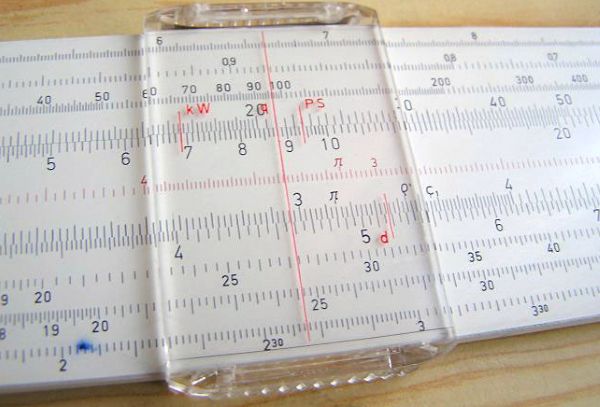
The slide rule works because it turns multiplication into the addition of distances. On an ordinary ruler, numbers are spaced evenly: the distance from 1 to 2 is the same as the distance from 2 to 3. But on a logarithmic scale, the spacing represents ratios rather than equal differences. The distance from 1 to 2 corresponds to the same multiplicative relationship as the distance from 2 to 4 or from 5 to 10, because each interval represents a doubling. This is why numbers crowd closer together as the scale increases. The compression is not a flaw. It is the mathematical secret of the instrument. By engraving numbers according to their logarithms, the slide rule makes multiplication and division into operations of alignment.
A typical multiplication shows the principle clearly. To multiply 2 by 3 on the familiar C and D scales, the user aligns 1 on the sliding C scale with 2 on the fixed D scale. Then the cursor is moved to 3 on the C scale, and the result is read beneath it on the D scale as 6. The user has not multiplied in the written sense. The rule has physically added the logarithmic distance from 1 to 2 to the logarithmic distance from 1 to 3, producing the position corresponding to 6. Division works in reverse, by subtracting logarithmic distance. The slide rule transforms arithmetic into a spatial procedure. The user’s hand moves the scale, the eye follows the cursor, and the answer appears as a position on a continuous field of proportional relationships.
More elaborate slide rules extended this same principle to other operations. Square-root and cube-root scales used different relationships between scale lengths, allowing roots to be read by shifting between related scales. Log-log scales allowed users to handle powers, roots, and exponential relationships. Trigonometric scales made sines, tangents, and related functions available for navigation, surveying, engineering, and physics. Specialized rules added scales for electrical engineering, aviation, chemistry, finance, artillery, or other technical fields. Yet even when the number of scales increased, the core logic remained the same. The instrument converted mathematical relationships into distances that could be aligned, compared, and read. A slide rule did not compute by counting steps or storing digits. It computed by making proportion physical.
This physical reasoning came with a demand for judgment. A slide rule usually supplied only a few important figures, often about three on a standard linear rule, and it did not automatically place the decimal point. The user had to estimate the order of magnitude before or after using the instrument. The result of 2 × 3 might read as 6, but similar scale positions could also correspond to 0.6, 60, or 600 depending on the problem. This is why experienced users sometimes called slide rules “guess sticks,” not because they were useless, but because they required the user to know what kind of answer was reasonable. The instrument accelerated calculation while preserving responsibility. It gave speed, approximation, and structure, but the human mind still had to supply scale, interpretation, and common sense.
Precision, Approximation, and the Discipline of Number Sense
The slide rule’s limited precision was not merely a technical weakness. It was one of the conditions that shaped the habits of its users. A standard linear slide rule usually produced results to about three significant figures, sometimes more in skilled hands or with longer, specialized instruments. That level of accuracy was often sufficient for engineering, fieldwork, design estimates, and scientific approximation, especially in contexts where measurements themselves were not exact to many decimal places. A beam, voltage, fuel estimate, or pressure value often depended on real-world measurements already constrained by instruments, materials, tolerances, and environmental variation. The slide rule belonged to a culture of useful precision rather than unlimited precision. It gave answers that were good enough to think with, test against experience, and carry into practical judgment. Its value was not that it removed uncertainty, but that it made uncertainty manageable. It trained users to recognize that a meaningful answer is not always the answer with the most digits, but the one whose precision fits the problem being solved.
This required the user to understand magnitude. Because the slide rule did not automatically locate the decimal point, the user had to estimate the order of the result before accepting the reading. A scale position might indicate 3.42, but the correct answer could be 0.342, 34.2, 342, or 3,420 depending on the problem. The instrument forced the calculator to ask whether the answer made sense. Was the bridge load plausible? Was the fuel consumption reasonable? Did the electrical value belong in ohms, kilohms, or megohms? Could the computed distance fit the map or the observed horizon? This active responsibility was part of slide-rule culture. The user could not simply surrender judgment to the device. The rule provided a numerical form; the mind supplied scale.
That discipline gave the slide rule an educational and professional value beyond speed. Students and engineers trained on the instrument had to develop estimation habits, mental arithmetic, proportional reasoning, and sensitivity to significant figures. They learned to distinguish between an answer that was numerically precise and an answer that was physically meaningful. This distinction mattered deeply in engineering, where designs depended on tolerances, material properties, safety factors, measurement uncertainty, and practical constraints. A result with many digits could be less useful than a rougher answer interpreted correctly. The slide rule encouraged users to think in ranges, ratios, and orders of magnitude. It kept calculation connected to the real world because the user had to decide whether the number belonged there.
This is why the slide rule’s reputation as a “guess stick” should be understood carefully. The phrase can sound dismissive, as if the instrument produced random or unreliable answers. It practically pointed to a different kind of numerical intelligence. The slide rule did not guess for the user; it required the user to make an informed judgment about magnitude, context, and reasonableness. Its apparent imprecision fostered a disciplined skepticism toward results. A calculator may display ten digits, but those digits can invite false confidence if the user has entered flawed data, chosen the wrong formula, ignored units, or failed to notice an impossible scale. The slide rule’s limited precision made such blindness harder to sustain. It placed friction between the user and the answer, and that friction could be intellectually healthy. The user had to pause long enough to ask what range the answer should occupy and whether the displayed relationship fit the physical situation. Approximation became a guardrail against mechanical obedience. It reminded users that calculation is not the same as understanding.
The culture of approximation created by the slide rule belongs to the history of reasoning as much as to the history of instruments. It trained people to work quickly without pretending that every problem required exact numerical closure. It supported design thinking by allowing users to test relationships, compare alternatives, and revise assumptions without being trapped in lengthy arithmetic. In that sense, approximation was not intellectual laziness. It was a practical virtue. The slide rule helped create a world in which engineers and scientists could move from question to estimate to design decision with speed and discipline. Its legacy lies partly in that mental posture: respect the number, but do not worship the digits.
Linear, Circular, Cylindrical, and Specialized Slide Rules
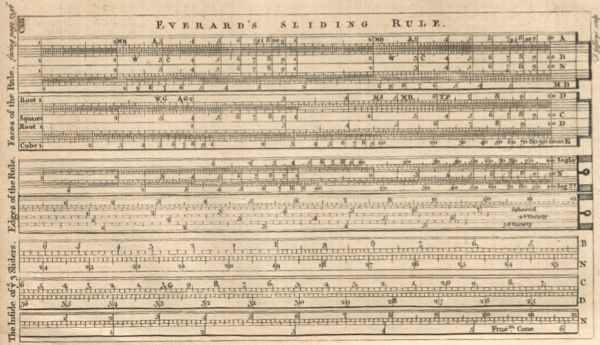
The slide rule was never a single fixed object. It was a family of logarithmic instruments adapted to different bodies, professions, scales of precision, and working environments. The familiar straight slide rule, with its central sliding strip and aligned logarithmic scales, became the most recognizable form, especially in engineering education and professional practice. Its appeal lay in portability, clarity, and relative ease of manufacture. A student, engineer, surveyor, or technician could carry it in a case, place it on a desk, or use it in the field. Its scales were exposed to the eye, its operation could be taught systematically, and its limitations were familiar. The straight rule also made the relationship between movement and calculation visually obvious: one scale slid against another, the cursor marked alignment, and the result appeared as a position to be interpreted. This made it especially useful as a teaching instrument, since the user could see the logic of logarithmic distance at work rather than treat calculation as a hidden mechanism. The linear rule became the emblem of slide-rule culture because it joined mathematical power to everyday convenience.
Circular slide rules solved some of the linear rule’s practical inconveniences by arranging logarithmic scales around a disk. On a straight rule, calculations could run off the end of the scale, requiring the user to reset or shift the operation. A circular arrangement avoided some of these interruptions because the scale returned upon itself. It also allowed a longer effective scale to be packed into a compact instrument, depending on design. Circular slide rules appeared in general-purpose forms, but they were also especially well suited to specialized uses, including navigation and aviation. In those settings, the circular form could support repeated calculations involving speed, time, distance, fuel, wind, and conversion. The instrument’s shape was not merely aesthetic. It reflected the kinds of problems users needed to solve.
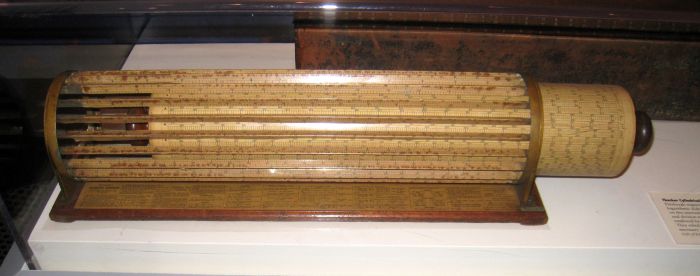
Cylindrical slide rules pursued another solution to the problem of scale length and precision. By wrapping a logarithmic scale around a cylinder, makers could place a much longer effective scale into a manageable physical object. Longer scales allowed more precise readings because the distance between markings increased. Some cylindrical rules, including later high-precision examples, offered far greater resolution than ordinary pocket or desk slide rules. They were not always as convenient for everyday use, but they showed the flexibility of logarithmic instrumentation. The underlying principle remained the same: multiplication and division could be performed by adding and subtracting logarithmic distances. What changed was the geometry of the instrument. The slide rule could be straight, circular, spiral, or cylindrical because logarithmic reasoning was not tied to one shape. It could be embodied wherever proportional distance could be marked and manipulated.
Specialized slide rules reveal even more clearly that calculation is shaped by the needs of particular fields. Engineers used rules with scales for powers, roots, trigonometric functions, and log-log operations. Electrical rules included scales useful for resistance, reactance, power, and other technical relationships. Chemical, artillery, surveying, and finance rules incorporated formulas and constants relevant to their users. Aviation computers, including the E6B and similar flight instruments, belonged to the broader slide-rule tradition because they used rotating scales to solve practical problems of airspeed, ground speed, wind correction, time, distance, fuel consumption, and altitude. These devices did not simply perform generic arithmetic. They embedded professional knowledge into their scales. A specialized rule made certain questions easier because it had been designed around the recurring relationships of a field. The instrument became a compressed handbook as much as a calculator, carrying formulas, constants, conversions, and operational assumptions in engraved or printed form. In the hands of a trained user, the specialized slide rule reduced the distance between technical problem and practical answer, because it already anticipated the kinds of relationships the user would need to manipulate.
The diversity of slide-rule forms shows why these instruments became so powerful before electronic calculators. They were not only calculators; they were tailored reasoning aids. A general-purpose rule could teach logarithmic calculation, while a specialized rule could compress the working knowledge of an occupation into a handheld object. The shape, scale layout, markings, constants, and cursor all expressed assumptions about what the user needed to know quickly. This made the slide rule a bridge between mathematics and professional practice. It converted formulas into movement, domain knowledge into engraved scales, and repeated technical judgment into physical alignment. In that sense, the slide rule’s many forms were not variations on a curiosity. They were evidence of a broader culture in which calculation had become portable, specialized, and inseparable from modern technical work.
Engineering, Industry, and the Slide Rule as a Professional Tool
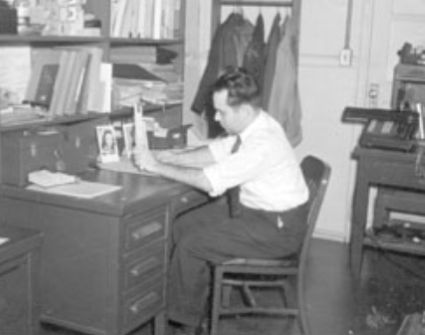
By the nineteenth century, the slide rule had become closely associated with the rise of engineering as a modern profession. Industrial societies required bridges, railways, factories, steam engines, ships, canals, electrical systems, machines, and later automobiles and aircraft, all of which demanded repeated numerical judgment. Engineers had to estimate loads, stresses, speeds, volumes, pressures, efficiencies, resistances, and costs quickly enough for design work to proceed. Exact calculation still mattered, but industrial work often began with approximation, comparison, and iteration. The slide rule served that world because it gave users fast, usable answers while leaving room for professional judgment. It was not simply a shortcut around arithmetic. It was a working instrument for thinking through material problems.
The slide rule also helped define the engineer’s identity. In classrooms, drafting rooms, workshops, laboratories, and field sites, it became a visible sign of technical competence. To carry and use a slide rule was to belong to a culture of calculation, measurement, and design. Students learned not only where to place the cursor, but how to think in ratios, tolerances, significant figures, and orders of magnitude. The rule taught a distinctive rhythm of work: set the scales, read the result, estimate the decimal, judge the plausibility, and return to the problem. That rhythm reflected the practical character of engineering itself. Unlike pure calculation detached from materials, engineering calculation had to answer to iron, concrete, copper, steam, gravity, friction, heat, and cost. The slide rule trained its users to keep numbers connected to the physical world.
In industrial design, the slide rule was valuable because it made iteration faster. A bridge span, gear ratio, pipe diameter, engine pressure, or electrical load rarely emerged from a single calculation. Designers tested alternatives, adjusted assumptions, compared proportions, and refined estimates as constraints changed. The slide rule allowed these movements to happen quickly. It could not replace detailed drawings, experimental testing, formal analysis, or later machine computation, but it made preliminary reasoning more fluid. A user could explore what happened if a value doubled, if a load increased, if resistance changed, or if a dimension had to be reduced. These “what if” calculations were central to design because engineering rarely moves in a straight line from formula to finished object. It moves through trial, revision, compromise, and constraint. The slide rule supported that movement by making numerical variation easy to test without interrupting the larger act of thinking. Because multiplication and division were so accessible, proportional thinking became easier to sustain across a chain of design decisions. The instrument kept calculation close to imagination.
The rise of specialized slide rules further tied the instrument to professional practice. Electrical engineers, mechanical engineers, civil engineers, chemists, architects, and technicians used rules marked with scales suited to their fields. Some rules incorporated constants or formulas that reduced recurring calculations to alignments. This mattered because industrial knowledge was increasingly specialized. The problems of an electrical circuit were not the same as those of a steam engine, a steel beam, a chemical mixture, or a navigation problem. Specialized rules embedded parts of that professional knowledge into the instrument itself. They did not eliminate expertise; they presupposed it. A user needed to understand what the scales meant, when they applied, and how to interpret the result. The slide rule became a professional tool not because it did the engineer’s thinking, but because it disciplined and accelerated that thinking.
By the middle of the twentieth century, the slide rule had become one of the defining objects of technical modernity. It helped build the infrastructure of the industrial and scientific world before digital computation became ordinary. Its presence in engineering education, manufacturing, military work, aviation, electronics, and laboratory science reflected a culture in which approximate calculation was indispensable. The slide rule’s authority rested on a balance between speed and judgment. It gave enough precision for many practical decisions while requiring the user to remain intellectually awake. In that balance lay its professional power. The engineer with a slide rule was not simply calculating faster; the engineer was reasoning through scale, constraint, and consequence with an instrument designed for that exact purpose.
War, Flight, and Space: Slide Rules in High-Stakes Calculation

The twentieth century placed slide rules inside some of the most demanding technical systems humans had ever built. War, aviation, rocketry, and spaceflight all required rapid numerical judgment under conditions of risk, uncertainty, and enormous scale. Artillery trajectories, aircraft performance, fuel loads, navigation corrections, structural stresses, engine pressures, and orbital calculations could not be managed by intuition alone. They required mathematical tools that were portable, reliable, and fast enough to support decisions in design offices, laboratories, airfields, ships, factories, and military planning rooms. The slide rule served this world because it gave trained users a way to reach useful approximations quickly. Its answers were not infinitely precise, but in many high-stakes contexts, timely and well-understood approximation was more valuable than delayed exactness.
In military settings, the slide rule belonged to a larger culture of applied calculation. Artillery, ballistics, logistics, range-finding, naval gunnery, and engineering all depended on repeated computation. Specialized rules and related calculating instruments helped users handle relationships among range, elevation, projectile behavior, time, speed, and environmental correction. The slide rule did not replace firing tables, mathematical training, mechanical calculators, or human computers, but it complemented them. It allowed officers, engineers, and technicians to perform checks, estimates, and field calculations without rebuilding every problem from first principles. That mattered because military calculation often took place across several levels at once: design calculations in arsenals and laboratories, training calculations in schools, operational calculations in the field, and verification calculations wherever a result needed to be checked quickly. In each setting, the slide rule’s value lay in its combination of portability and interpretive demand. It could give a result rapidly, but it still required the user to understand whether that result fit the weapon, vehicle, terrain, distance, or logistical problem at hand. In that role, the instrument was valuable because warfare compressed time. Decisions often had to be made quickly, and a calculation that was close enough, understood properly, and checked against experience could be operationally decisive.
Aviation made the slide rule even more visibly practical. Flight demanded constant relationships among airspeed, ground speed, distance, fuel consumption, altitude, wind drift, time, and bearing. These were exactly the kinds of proportional problems that logarithmic instruments handled well. Circular aviation computers, including the E6B and related devices, belong to the broader slide-rule tradition because they used rotating scales to convert and compare flight variables. Pilots and navigators could estimate fuel endurance, correct for wind, determine groundspeed, and plan legs of a route with a tool that fit in the cockpit. The point was not that the instrument thought for them. It gave them a structured way to think numerically while operating in an environment where distraction, weather, fatigue, and danger could turn arithmetic into a liability.
Rocketry and spaceflight extended this culture of calculation into still more complex systems. Designing launch vehicles, guidance systems, engines, trajectories, and spacecraft structures required calculations across many domains at once: thermodynamics, fluid flow, materials, vibration, control systems, orbital mechanics, and human safety. By the time of the Apollo program, electronic computers were already essential, and it would be misleading to suggest that slide rules “sent humans to the Moon” by themselves. Apollo depended on digital computers, mainframes, simulators, human computers, test programs, contractors, mathematicians, engineers, astronauts, and vast institutional coordination. Yet the slide rule remained part of the engineering culture in which much of that work was conceived, checked, estimated, and discussed. Engineers trained on slide rules brought with them habits of approximation, scale awareness, and plausibility checking that were indispensable even when more powerful machines entered the room.
This is why the slide rule’s role in high-stakes calculation should be understood as cultural as much as mechanical. In war, flight, and space, the danger was not merely that a number might be unknown. The danger was that a number might be accepted without understanding. A slide rule made that harder because it forced users to remain aware of scale, units, and order of magnitude. It could not automatically rescue them from a wrong assumption, a misplaced decimal, or a physically impossible result. The user had to know whether an answer belonged in the world. That discipline mattered in fields where errors could destroy equipment, end missions, or kill people. The slide rule’s limited precision kept human judgment at the center of technical action.
By the late 1960s, the slide rule stood at the edge of its own obsolescence even as it remained embedded in the habits of the people who built modern technological systems. The Apollo era was not purely a slide-rule age, nor was it purely a computer age. It was a transitional world in which analog estimation, paper calculations, digital computation, simulation, instrumentation, and human judgment worked together. The slide rule’s significance lies in that mixture. It helped create generations of engineers who could move rapidly from problem to estimate to decision, and who understood that numbers had to be interpreted, not merely produced. That interpretive discipline did not become obsolete when digital machines grew more powerful. If anything, it became more necessary, because increasingly complex systems produced more numbers, more outputs, and more opportunities to confuse precision with truth. The slide rule belonged to an older technical culture, but it carried a lesson that remained urgent in the computer age: every calculation depends on assumptions, scale, units, and judgment. In the high-stakes environments of war, flight, and space, that habit was not quaint. It was a form of technical survival.
The HP-35 and the End of the Slide Rule Era
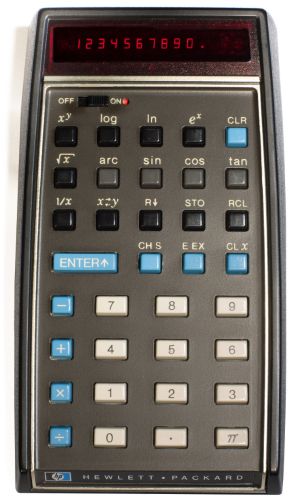
The slide rule did not disappear because engineers suddenly stopped valuing approximation, scale, or judgment. It disappeared because handheld electronic calculators became fast, portable, reliable, and precise enough to change the working culture of calculation almost overnight. The decisive symbolic break came in 1972, when Hewlett-Packard introduced the HP-35, widely recognized as the first handheld scientific calculator. Its name referred to its thirty-five keys, but its significance lay in what those keys could do. Functions that had once required logarithmic tables, trigonometric tables, desk calculators, or slide rules could now be performed on a small electronic device. The HP-35 offered scientific functions, automatic decimal handling, and a display that gave far more apparent precision than a standard slide rule could provide. For engineers, scientists, and students, the old instrument suddenly looked less like the badge of technical modernity and more like a tool from a passing age.
This transition was rapid because the calculator did not merely improve the slide rule; it changed the user’s relationship to calculation. A slide rule required estimation, scale awareness, and interpretation at nearly every stage. The HP-35 and its successors absorbed much of that burden into electronic circuitry. The user could enter a problem, press keys, and receive a numerical answer with many displayed digits. This was not a small convenience. It saved time, reduced training requirements for certain operations, and eliminated many of the mechanical limitations of reading engraved scales. It also changed the expectation of what a calculating device should do. Instead of providing an approximate position to be interpreted by a trained eye, the calculator produced a finished-looking numerical statement. Trigonometric functions, logarithms, powers, roots, and scientific notation could be handled directly, without consulting tables or choosing among slide-rule scales. For students, this meant that scientific calculation could be learned through key sequences rather than through the long apprenticeship of scale reading and magnitude estimation. For working engineers, it meant that repetitive technical calculations could be completed with greater speed and fewer manual steps. As prices fell and competing calculators appeared, the shift became irreversible. Engineering classrooms, laboratories, offices, and drafting rooms rapidly adjusted to a new expectation: calculation should be electronic, immediate, and digitally displayed.
The cultural change was as important as the technical one. For generations, the slide rule had been an emblem of engineering identity. It was carried in belt cases, laid beside drafting tools, used in classrooms, and recognized as a mark of professional competence. The handheld scientific calculator displaced that symbolism with extraordinary speed. The new badge was electronic, not analog; digital, not logarithmic; button-driven, not scale-driven. This did not mean that older engineers instantly abandoned their habits of estimation, nor did it mean that calculators made judgment unnecessary. But the daily ritual of calculation changed. Users no longer had to align scales, read significant figures, or place the decimal point through prior estimation in the same way. The answer arrived as digits. That shift encouraged speed and convenience, but it also weakened the enforced discipline that had made slide-rule users constantly aware of magnitude and plausibility.
The end of the slide rule era should be understood as both a triumph and a loss. The HP-35 and later scientific calculators expanded access to complex calculation and made technical work faster, more precise, and less physically cumbersome. They belonged to the larger digital transformation of the late twentieth century, when computation moved from specialized rooms and analog instruments into pockets, desks, classrooms, and eventually everyday life. Yet the slide rule’s disappearance also marked the fading of a distinctive numerical culture, one built around approximation, proportional reasoning, and active judgment about scale. The calculator won because it was better for most practical purposes. But the slide rule left behind a lesson that digital devices can obscure: more digits do not automatically mean better understanding. Its obsolescence was real, but so was its intellectual legacy.
Legacy: Approximation, Judgment, and Human Reasoning after the Slide Rule
The following video from “Retro Treasure Unearthed” covers a history of the slide rule:
The slide rule’s disappearance did not erase the kind of reasoning it had trained. Long after handheld calculators and digital computers replaced it as an everyday calculating tool, the intellectual habits associated with slide-rule culture remained important: estimation, proportional thinking, dimensional awareness, and skepticism toward implausible results. These habits matter because technical reasoning has never been only a matter of obtaining a number. It also requires deciding whether that number belongs in the problem. A calculation can be formally correct and practically meaningless if it rests on flawed assumptions, mismatched units, false precision, or a misunderstanding of scale. The slide rule forced users to confront those issues because it did not do everything for them. Its limits kept the mind engaged.
This legacy is especially important in the digital age, when devices can produce answers with extraordinary speed and apparent precision. Calculators, spreadsheets, modeling software, and computer simulations can display many digits, but those digits may conceal uncertainty rather than resolve it. A result may look authoritative because it is neatly formatted, not because it is valid. The danger is not that digital tools calculate badly. They calculate with astonishing speed and accuracy. The danger is that users may forget to question the model, the input, the unit, the assumption, or the scale of the answer. A spreadsheet can extend a mistake across thousands of cells. A simulation can make an uncertain model appear visually persuasive. A calculator can return a long decimal that seems more trustworthy than the messy measurements from which it came. The slide rule offered fewer digits, but it demanded more interpretive participation from the user. It made clear that calculation involves judgment about magnitude, assumptions, units, and context. That lesson remains urgent. Modern technical systems are more powerful than slide rules by orders of magnitude, but they still depend on human beings who must ask whether an output makes sense.
The slide rule also left behind a model of calculation as partnership between person and tool. It did not replace human reasoning; it disciplined it. The user supplied the problem, selected the scales, estimated the range, read the approximate result, and judged its plausibility. That partnership differs from the more passive experience encouraged by some digital interfaces, where input and output can seem disconnected from the reasoning between them. This does not mean that digital tools are inferior. Their power is undeniable, and their advantages are overwhelming for most modern work. But the slide rule reminds us that useful calculation is not defined by precision alone. It is defined by the quality of the reasoning that surrounds the number.
The enduring lesson of the slide rule is not nostalgia for a vanished instrument, but respect for a disciplined numerical culture. It taught generations of engineers, scientists, pilots, technicians, and students to move quickly without abandoning judgment. It made approximation honorable because approximation, properly used, is one of the foundations of intelligent action. The slide rule belongs to the past as a practical tool, but its habits remain profoundly relevant. In a world overflowing with digital outputs, its old demand still matters: know the scale, question the digits, and never mistake a number for understanding.
Conclusion: The Instrument That Made Thought Faster
The history of logarithms and slide rules is a history of acceleration without full automation. Napier’s logarithms transformed calculation by changing the operations themselves, allowing multiplication, division, roots, and powers to be approached through simpler numerical procedures. Briggs’s tables made that transformation more usable, Gunter’s line turned logarithmic values into physical distance, and Oughtred’s slide rule made those distances move. Each step shifted part of the burden of calculation away from long written arithmetic and into a structured aid: first the table, then the scale, then the sliding instrument. The result was not merely faster computation. It was a new relationship between human reasoning and mathematical tools.
The slide rule mattered because it made calculation fast enough to serve thought in motion. A navigator could estimate a course, a surveyor could compare proportions, an engineer could test dimensions, and a scientist could explore relationships without being trapped in extended manual arithmetic. The instrument’s power lay in its ability to produce useful approximations quickly, allowing users to move from one possibility to another with speed and discipline. It was never a perfect substitute for judgment, nor was it meant to be. Its limited precision required users to think about magnitude, units, significant figures, and plausibility. The slide rule accelerated reasoning while keeping the reasoner responsible.
That responsibility is the slide rule’s most enduring intellectual legacy. The digital calculator displaced it because electronic computation was faster, more precise, and easier to use for most purposes. Yet the slide rule trained a form of numerical intelligence that remains vital even when better machines are available. It taught users to ask whether an answer made sense before trusting it. It joined calculation to estimation, proportion, and scale. It turned mathematics into a disciplined physical practice in which the eye, hand, and mind worked together. That practice mattered because technical reasoning always involves more than the execution of a formula. A bridge, aircraft, engine, orbit, circuit, or financial estimate depends on assumptions, units, tolerances, and context. The slide rule forced those elements to remain visible because it could not conceal them behind automatic decimal placement or excessive displayed precision. Its users had to know the world well enough to know whether the number belonged in it. In that sense, the slide rule did not simply produce answers; it trained suspicion, proportion, and disciplined confidence. It belonged to the history of engineering instruments, but also to the history of judgment.
Where the abacus taught the mind to see number, the slide rule taught it to feel scale. It compressed difficult operations into motion, converted logarithmic relationships into physical alignment, and helped build the modern technical world through fast, approximate, humanly interpreted calculation. Its obsolescence was real, but its lesson did not expire with the HP-35. More digits are not always more understanding. More speed is not always more wisdom. The instrument that made thought faster also reminds us that thought must remain awake. Calculation reaches its highest value not when the machine gives an answer, but when the human being knows what that answer means.
Bibliography
Affiliate disclosure: Amazon links on this site are paid links. As an Amazon Associate I earn from qualifying purchases.
- Bilstein, Roger E. Stages to Saturn: A Technological History of the Apollo/Saturn Launch Vehicles. Washington, DC: National Aeronautics and Space Administration, 1980.
- Briggs, Henry. Arithmetica Logarithmica. London: William Jones, 1624.
- Cajori, Florian. A History of the Logarithmic Slide Rule and Allied Instruments. New York: Engineering News Publishing Company, 1909.
- —-. “Notes On The History Of The Slide Rule.” The American Mathematical Monthly 15:1 (1908), 1-5.
- Campbell-Kelly, Martin, Mary Croarken, Raymond Flood, and Eleanor Robson, eds. The History of Mathematical Tables: From Sumer to Spreadsheets. Oxford: Oxford University Press, 2003.
- Drake, Stillman. “Galileo and the First Mechanical Computing Device.” Scientific American 234:4 (1976), 104-113.
- Gardiner, Tony. “Rigorous Thinking and the Use of Instruments.” The Mathematical Gazette 76:475 (1992), 179-181.
- Grier, David Alan. When Computers Were Human. Princeton: Princeton University Press, 2005.
- Gunter, Edmund. Canon Triangulorum, sive Tabulae Sinuum et Tangentium Artificialium ad Radium 10,000,000. London: William Jones, 1620.
- —-. The Description and Use of the Sector, the Crosse-Staffe, and Other Instruments. London: William Jones, 1624.
- Hamrick, Kathy B. “The History of the Hand-Held Electronic Calculator.” The American Mathematical Monthly 103:8 (1996), 633-639.
- Hewlett-Packard Company. HP-35 Operating Manual. Palo Alto, CA: Hewlett-Packard, 1972.
- Hobson, Ernest William. John Napier and the Invention of Logarithms, 1614. Cambridge: Cambridge University Press, 1914.
- Hopp, Peter M. Slide Rules: Their History, Models, and Makers. Mendham, NJ: Astragal Press, 1999.
- IEEE Engineering and Technology History Wiki. “Milestones: Development of the HP-35, the First Handheld Scientific Calculator, 1972.”
- Mindell, David A. Digital Apollo: Human and Machine in Spaceflight. Cambridge, MA: MIT Press, 2008.
- Morrison-Low, A. D. Making Scientific Instruments in the Industrial Revolution. Aldershot: Ashgate, 2007.
- Murray, Charles, and Catherine Bly Cox. Apollo: The Race to the Moon. New York: Simon & Schuster, 1989.
- Napier, John. Mirifici Logarithmorum Canonis Constructio. Edited by Robert Napier. Edinburgh: Andrew Hart, 1619.
- —-. Mirifici Logarithmorum Canonis Descriptio. Edinburgh, 1614.
- Oughtred, William. The Circles of Proportion and the Horizontal Instrument. London: Augustine Mathewes, 1632.
- Petroski, Henry. To Engineer Is Human: The Role of Failure in Successful Design. New York: St. Martin’s Press, 1985.
- Pickworth, Charles N. The Slide Rule: A Practical Manual. London: Crosby Lockwood and Son, 1901.
- Roegel, Denis. A Reconstruction of the Tables of Briggs’ Arithmetica Logarithmica. Nancy: LORIA, 2010.
- Stedall, Jacqueline. The History of Mathematics: A Very Short Introduction. Oxford: Oxford University Press, 2012.
- Tomayko, James E. Computers in Spaceflight: The NASA Experience. Washington, DC: National Aeronautics and Space Administration, 1988.
- Trew, John. The Slide Rule: A Practical Manual. London: Iliffe Books, 1964.
- Turner, Gerard L’E. Elizabethan Instrument Makers: The Origins of the London Trade in Precision Instrument Making. Oxford: Oxford University Press, 2000.
- Von Jezierski, Dieter. Slide Rules: A Journey Through Three Centuries. Mendham, NJ: Astragal Press, 2000.
Originally published by Brewminate, 05.07.2026, under the terms of a Creative Commons Attribution-NonCommercial-NoDerivatives 4.0 International license.
About the Author