The printing press widened access to knowledge, but it also scaled propaganda, scandal, fear, and political manipulation across early modern Europe.

By Matthew A. McIntosh
Public Historian
Brewminate
Introduction: The First Information Revolution and Its Shadow
The printing press did not introduce Europe to deception, propaganda, religious hatred, or political rumor. Those forces already moved through sermons, manuscripts, court gossip, public proclamations, street songs, tavern talk, and the pulpit. What changed in the middle of the fifteenth century was not the human appetite for certainty, scandal, or accusation, but the machinery through which those appetites could be fed. The Gutenberg Bible, probably completed at Mainz in 1455, has long stood as the monumental symbol of this transition: a sacred text produced through a new technology of movable metal type, mechanical regularity, and reproducible form. Yet the same technical revolution that could multiply scripture, scholarship, law, and classical learning could also multiply polemic, slander, fear, and calculated falsehood. The press did not corrupt Europe’s information culture by itself. It gave older corruptions a new body, a new reach, and a new commercial life.
This was the first great information revolution of early modern Europe, but it was never a clean story of enlightenment overcoming ignorance. Printed books, pamphlets, broadsheets, indulgences, calendars, sermons, news sheets, and polemical tracts entered a world already structured by religious authority, dynastic rivalry, fragile literacy, urban commerce, and popular belief in providence, demons, omens, and hidden enemies. Elizabeth Eisenstein famously emphasized printing’s power to preserve, standardize, and disseminate knowledge on a scale manuscript culture could not match, while later scholars warned against treating print as automatically stable, trustworthy, or self-authorizing. The printed page did not guarantee truth. Its authority had to be made, defended, sold, challenged, and often faked. That tension is central to the darker history of print: the same medium that could stabilize knowledge could also stabilize lies.
The early printed world was not merely an intellectual marketplace, but an emotional and political one. Printers operated within economic realities, and those realities rewarded attention. Fear, monsters, scandal, and heresy sold. Tales of divine punishment, demonic conspiracy, corrupt clergy, treasonous rulers, sexually dangerous women, and apocalyptic enemies could move quickly because they satisfied both ideological and commercial demand. First century and a half of European print was shaped by financial risk, religious demand, uneven markets, and the need to find readers willing to buy. Print shops were rarely neutral temples of knowledge. They were workshops, businesses, political nodes, and sometimes ideological arsenals, dependent on paper supply, patronage, censorship, local privilege, urban rumor, and the unpredictable appetite of readers. A printer might issue a devotional text, a grammar, a legal form, a polemical tract, and a sensational broadside within the same commercial universe, not because each carried the same moral weight, but because each answered a different market. This made the new medium morally unstable from the beginning. It could serve reform, education, devotion, and civic administration, but it could also reward exaggeration, speed, and emotional force over verification. The press was a machine of communication, but it was also a business. Once outrage became reproducible, it became profitable.
I trace that shadow chronologically, from the late medieval and early Renaissance world of manuscript rumor and religious fear to the printed polemics of the Reformation, the demonological literature that helped sustain witch-hunting, the confessional propaganda of religious war, the state’s effort to license and weaponize printed authority, and the eighteenth-century scandal culture that helped erode old regimes. Its argument is not that the printing press was inherently nefarious, nor that early modern people were uniquely gullible. The deeper point is more unsettling. Powerful communication technologies do not merely transmit ideas; they reorganize trust, reward speed, magnify conflict, and make persuasion scalable. In that sense, the printing press was both a liberating instrument and a dangerous one. It widened the republic of letters, but it also widened the battlefield of lies.
Before Propaganda Became Mass: Manuscript Rumor, Sermons, and Oral Scandal before Print

Long before the printing press multiplied pamphlets and broadsheets across Europe, societies already possessed dense systems for spreading accusation, fear, and ideological suspicion. Rumor was not a marginal force. It moved through marketplaces, churches, courts, monasteries, taverns, households, fairs, guild meetings, and village gatherings, often traveling faster than formal authority could contain. Medieval and late medieval communities lived in worlds where public speech carried legal, spiritual, and social power. A charge of heresy, sexual disorder, blasphemy, betrayal, sorcery, or ritual violence did not need a printed page to wound reputations or endanger bodies. It needed hearers, repetition, and a culture prepared to treat words as signs of deeper moral truth. Print later made this process more durable and mobile, but the underlying machinery of suspicion was already ancient.
The sermon was one of the most important pre-print media forms because it joined religious authority to public performance. A preacher did not merely communicate doctrine. He interpreted the world. He could explain famine, plague, war, failed harvests, strange births, or political crisis as divine punishment, demonic assault, or evidence of hidden corruption. The sermon’s power came from its setting as much as its content. It was delivered in consecrated space, often to communities whose regular access to formal texts was limited and whose understanding of public events depended heavily on oral interpretation. In that setting, persuasion could become accusation with remarkable ease. Clerical speech could discipline behavior, reinforce hierarchy, define enemies, and make fear sound like moral vigilance. The preacher stood at the intersection of sacred authority and communal anxiety, translating uncertainty into moral explanation. That made the sermon especially potent in times of stress, when ordinary people sought reasons for suffering and leaders sought language that could organize obedience, repentance, or hostility. A sermon could turn misfortune into warning, difference into danger, and dissent into spiritual disease. It could also be remembered, repeated, adapted, and carried beyond the church door by listeners who transformed spoken interpretation into neighborhood report. Before print made propaganda reproducible, preaching made it communal.
Manuscript culture also carried polemic and rumor, though in different rhythms from print. Chronicles, letters, legal memoranda, saints’ lives, political prophecies, trial records, and handwritten newsletters preserved and circulated narratives of danger, betrayal, holiness, monstrosity, and divine judgment. Their circulation was slower, narrower, and more expensive than print, but not insignificant. Manuscripts moved through monasteries, courts, universities, episcopal networks, merchant routes, and administrative offices. Elite rumor could be copied and recopied, while written accusations could gain force because they appeared to belong to documentary culture. A rumor spoken in a market might vanish quickly, but a rumor written into a chronicle, sermon collection, or legal dossier could acquire institutional memory. This mattered because propaganda is not only the art of persuading the present. It is also the art of controlling what later readers think the past has already proven.
Late medieval anti-Jewish narratives show how dangerous pre-print rumor could become when oral accusation, religious teaching, visual culture, and manuscript transmission reinforced one another. Tales of ritual murder, host desecration, well poisoning, and secret Jewish hostility to Christians circulated for centuries before the printing press turned such accusations into more widely reproducible objects. These stories were not harmless folklore. They could justify persecution, expulsion, forced conversion, and massacre. Their power rested partly in repetition across media: sermons, miracle tales, local cults, painted images, liturgical memory, and legal proceedings. The accusation became persuasive not because it was true, but because it fit a theological imagination already trained to see religious outsiders as spiritually dangerous. Communities did not need empirical evidence when inherited suspicion had already supplied the emotional framework. A child’s death, a damaged host, a polluted well, or a moment of epidemic crisis could be drawn into a ready-made story of conspiracy and sacrilege. Once repeated by clergy, memorialized in shrines, recorded in chronicles, or represented in images, the falsehood could harden into communal memory. It became something more durable than rumor and more socially powerful than private prejudice. It became a story through which Christians explained themselves to themselves by inventing an enemy who confirmed their fears. Print did not create the persecutory imagination of Europe. It inherited a world in which falsehood could already be sanctified.
Political rumor worked in similar ways. Kings, nobles, bishops, rebels, and urban factions all depended on reputation, and reputation could be attacked by whispered scandal as effectively as by formal indictment. Claims of illegitimacy, sexual misconduct, tyranny, cowardice, foreign influence, poisoned counsel, or betrayal could weaken authority even when they lacked proof. Courts were especially fertile environments for such speech because proximity to power made gossip politically meaningful. Yet rumor was not confined to elites. Ordinary communities interpreted power through fragments: proclamations heard aloud, taxes collected, soldiers quartered, bodies displayed, punishments staged, and stories carried by travelers. Public authority had to manage speech before it had to manage print. The later printed pamphlet did not invent political slander. It gave older habits of political storytelling a cheaper, sharper, and more repeatable form.
The world before mass print was not innocent. It was already filled with media, though not media in the modern technological sense alone. Voice, ritual, image, manuscript, memory, procession, theater, proclamation, and punishment all communicated meaning. They could teach, comfort, govern, and preserve; they could also distort, inflame, accuse, and terrify. The printing press entered this social environment not as a clean break from oral and manuscript culture, but as an accelerant. It took preexisting channels of belief and conflict and changed their scale. Rumor could now be fixed in type. Sermonic accusation could become pamphlet polemic. Local fear could become regional panic. Political slander could travel with the portability of paper. To understand print propaganda, then, one must begin before print itself, in the older world where words already had the power to save, condemn, and destroy.
Gutenberg’s Press and the New Authority of Multiplication

Johannes Gutenberg’s press altered European communication not because it made writing possible, but because it changed the relationship between writing, repetition, and authority. Manuscripts had always carried power, especially when produced in ecclesiastical, legal, royal, or university settings. Yet manuscript culture depended on laborious copying, local circulation, and the authority of scribes, patrons, and institutions. Print introduced a different kind of force. A text could now appear in many materially similar copies, each one bearing the visual regularity of type and the implied stability of mechanical reproduction. That did not make printed texts automatically true, but it made them look less fragile than rumor and less singular than manuscript. A printed page could seem to possess a public weight even when its claims were dubious. This was especially important in a world where authority often depended on visible form: seals, signatures, liturgical books, legal rolls, university manuscripts, royal proclamations, and ecclesiastical documents all trained people to associate material presentation with legitimacy. Print entered that world by imitating and intensifying those cues. It made texts appear ordered, deliberate, and repeatable, and that appearance mattered. The press did not merely reproduce words. It reproduced the signs of credibility.
The Gutenberg Bible, completed in Mainz around the middle of the 1450s, remains the most famous emblem of this transformation, but its significance lies partly in the irony of its form. The first major printed book in Europe was not a manifesto of rupture, novelty, or rebellion. It was a Bible, designed in many ways to imitate the prestige of manuscript books. Its columns, typeface, spacing, and later hand decoration show that early print did not immediately reject older forms of authority. It borrowed them. Gutenberg’s technology entered Europe by wrapping itself in familiar visual dignity, making the mechanical look sacred, learned, and legitimate. That is crucial to understanding print’s darker possibilities. The press acquired trust not by appearing cheap or disruptive, but by appearing continuous with older forms of reverence.
This new authority of multiplication had consequences far beyond scripture. Printed indulgences, grammars, calendars, legal forms, devotional works, classical texts, scholastic books, and administrative documents all circulated through expanding commercial networks. By the late fifteenth century, print shops had appeared in cities across much of Europe, especially where urban markets, universities, religious institutions, and commercial routes created enough demand to sustain them. The press depended on capital, paper, skilled labor, type, distribution, and buyers. It was both an intellectual instrument and a business venture from the beginning. Its products moved between learned culture and popular consumption, between institutional approval and entrepreneurial risk. A printed item might be officially sanctioned, quietly tolerated, aggressively promoted, or condemned after the fact, but the basic fact remained: multiplication changed the social life of texts.
The visual uniformity of print could also conceal the instability of the world behind it. Historians have rightly warned against assuming that early printed books were inherently stable, accurate, or trustworthy simply because they were printed. Printers made errors. Compositors altered texts. Editions varied. Piracy, unauthorized reproduction, false imprints, careless correction, and commercial haste all complicated the apparent solidity of print. Yet this instability often remained invisible to readers who encountered the finished page rather than the workshop process. The danger was not merely that print spread false claims. It was that print could make uncertain claims look settled. Mechanical regularity created an aura of impersonal order, even when the text itself had passed through very human systems of error, ambition, censorship, rivalry, or fraud.
That aura mattered because early modern Europe was a society hungry for signs. People looked for meaning in plagues, wars, comets, monstrous births, dynastic crises, religious controversy, and sudden disasters. Print entered that interpretive world as a technology capable of fixing signs into repeatable form. A strange event could be described, illustrated, moralized, and sold. A rumor could be given a title, a date, a place, and a woodcut. A sermon could become a tract. A theological quarrel could become a pamphlet series. The authority of multiplication did not require every reader to be fully literate, either. Printed images, public readings, shared pamphlets, tavern discussion, marketplace display, and oral repetition carried printed claims beyond the page. Print and speech did not replace one another. They fed each other. A printed sheet might be read aloud to listeners who could not read it for themselves, then summarized again in conversation, then remembered as something “seen” or “heard” from a source with more weight than ordinary gossip. In that way, print did not end oral culture; it armed it. The printed object supplied a fixed point around which spoken interpretation could gather, giving rumor a physical origin and controversy a repeatable script.
This was why the printing press became such a powerful instrument for propaganda. Propaganda depends not only on the invention of claims, but on their circulation, repetition, emotional force, and apparent legitimacy. Print strengthened all four. It allowed polemicists to repeat accusations across space. It allowed enemies to be named and caricatured in memorable forms. It gave fleeting scandal a material object that could be bought, kept, read aloud, recopied, answered, burned, or banned. It made controversy cumulative. One pamphlet could provoke another, one broadside could inspire a rebuttal, and one rumor could become part of a larger printed archive of hostility. In manuscript culture, persuasion often remained tied to specific communities of transmission. In print culture, persuasion could become modular, portable, and scalable.
The new authority of multiplication was double-edged from the start. The press helped preserve classical learning, widen access to scripture, standardize legal and administrative texts, support scholarly exchange, and eventually reshape scientific communication. But it also gave slander, panic, sectarian hatred, misogynistic demonology, and political accusation a new durability. Its power rested in a paradox: print could democratize access to knowledge while also democratizing access to manipulation. It could challenge monopoly over truth while manufacturing new forms of false authority. Gutenberg’s technology did not simply place more words into the world. It changed what words could become when multiplied, regularized, circulated, and sold. Once a claim could be reproduced by the hundreds or thousands, persuasion no longer depended only on argument. It could depend on saturation.
Monsters, Portents, and the Printed Marketplace of Fear

The earliest generations of European print did not circulate only Bibles, classical texts, legal forms, devotional manuals, and learned treatises. They also circulated wonders. Strange births, monstrous animals, comets, floods, earthquakes, apparitions, military disasters, epidemics, and other unsettling events became raw material for cheap print, especially in broadsheets and pamphlets that presented them as signs demanding interpretation. These printed objects did more than report unusual occurrences. They taught readers and listeners how to feel about them. A malformed child or animal could be turned into a divine warning, a political accusation, or a confession of cosmic disorder. Print made such events portable, memorable, and marketable, giving fear a format that could travel farther than local rumor.
This mattered because early modern Europeans did not generally understand nature as a closed mechanical system detached from moral meaning. The world was read as a field of signs. Disease, harvest failure, celestial events, and bodily deformity could be interpreted providentially, as evidence of God’s anger, demonic activity, social sin, or impending catastrophe. The press entered that interpretive culture at exactly the right moment to amplify it. A portent that might once have remained local could now be described in a printed text, paired with a woodcut, and sent into a wider network of urban markets, religious communities, and political anxieties. The result was not simply the spread of information, but the spread of interpretation. Print did not merely say that a wonder had occurred. It explained what the wonder meant and who should be blamed. That interpretive step was crucial because it converted uncertainty into accusation. A comet did not remain only a comet, nor did a strange birth remain only a bodily anomaly. Both could be made to speak within a moral universe already primed to hear divine warning in disruption. The printed page supplied narrative order to frightening events, gathering scattered anxieties into a legible pattern. It made the unusual seem purposeful, the terrifying seem meaningful, and the enemy seem already revealed by nature itself.
Monstrous-birth literature was especially powerful because it joined visual shock to moral argument. A malformed infant or animal could be represented in a woodcut with enough detail to arouse fascination, disgust, pity, or dread, while the accompanying text supplied the theological or political lesson. The image seized attention; the prose disciplined the response. Printed representations of monstrous births in sixteenth-century German-speaking lands developed within a complex visual culture shaped by religious conflict, humanist interpretation, medical curiosity, and popular appetite for marvels. Such prints were not crude survivals of superstition sitting outside learned culture. They often drew on classical, biblical, medical, and astrological traditions. Their danger lay precisely in that mixture. They could look strange and sensational while still borrowing the tone of interpretation, authority, and learned explanation.
The “Pope Ass” and the “Monk Calf” reveal how quickly the printed monster could become a weapon of confessional propaganda. These images were not simply bizarre curiosities. They were visual arguments made in the form of grotesque bodies. The so-called “Pope Ass,” associated with an alleged monstrous creature found near Rome, and the “Monk Calf,” linked to a malformed calf born in Saxony, were interpreted by Protestant polemicists as signs of Catholic corruption. Martin Luther and Philip Melanchthon helped frame these monsters as divine commentaries on the papacy, monasticism, and the spiritual deformity of Rome. The body became theology. Horns, scales, hooves, distorted limbs, and hybrid features were made to signify institutional evil. In this form, propaganda worked by collapsing argument into image. The viewer did not first need to follow a complex doctrinal dispute over justification, authority, or sacramental power. The viewer could see corruption made flesh. That was the genius and danger of the form. It transformed ecclesiastical controversy into a spectacle of disgust, making opposition to Rome feel not merely doctrinally correct but instinctively obvious. The monstrous body offered a shortcut from perception to judgment. It invited the audience to read deformity as revelation, as though God had provided visual proof of what reformers were already preaching. It turned satire, theology, and accusation into a single printed object that could be sold, displayed, discussed, and remembered.
That visual immediacy was one of print propaganda’s greatest strengths. Illustrated broadsheets, picture books, title pages, and visual satire addressed readers and nonreaders together. Images could be displayed, passed around, read aloud, explained in groups, and remembered long after the text had been forgotten. In a culture where literacy was uneven, visual print created a bridge between learned polemic and popular reception. It simplified conflict without making it intellectually empty. A monster print could compress theology, fear, humor, disgust, and political hostility into a single memorable form. It did not need to persuade everyone by reasoned argument. It could lodge in the imagination.
The printed marketplace of fear also rewarded repetition and escalation. Once readers showed appetite for wonders, printers had reason to supply more of them. Reports of monstrous births, celestial signs, divine punishments, and unnatural phenomena could be reprinted, adapted, translated, or imitated. Some were based on actual physical anomalies, though interpreted through theological and political frameworks that far exceeded the evidence. Others were exaggerated, moralized beyond recognition, or folded into partisan narratives. The line between report, interpretation, entertainment, and manipulation was often unstable. This instability was commercially useful. A broadside did not need to meet modern standards of verification to succeed. It needed to attract attention, invite fear, satisfy expectation, and move copies.
Protestants were not alone in reading wonders polemically. Catholic writers, preachers, and printers also interpreted portents, miracles, punishments, and prodigies as evidence of divine judgment and confessional truth. The difference between “miracle” and “monster” often depended on who controlled the interpretation. A sign favorable to one community could be dismissed by another as fraud, superstition, demonic deception, or partisan fabrication. Evangelical writers could reject certain Catholic miracles while embracing providential wonders of their own. The Reformation did not end the printed culture of signs. It intensified competition over what counted as a true sign and who had the authority to explain it. That competition made printed wonders especially dangerous, because they did not simply inform confessional identity; they hardened it. Each side could claim that the visible world testified on its behalf, while rival interpretations could be dismissed as blindness or deception. Portents became evidence in a war over perception itself. A Catholic miracle might be condemned by Protestants as clerical fraud, while a Protestant providential warning might be dismissed by Catholics as impiety, misreading, or rebellion dressed in sacred language. The printed sign became a site of conflict, not consensus. It promised revelation while deepening division.
The darker significance of monster and portent literature lies in its emotional structure. These prints trained audiences to experience the world as a battlefield of hidden meanings and visible warnings. They made anxiety legible. They taught readers to look at bodies, disasters, and anomalies not as occasions for uncertainty, but as confirmations of prior suspicion. That pattern would recur throughout the history of propaganda: the disturbing event appears first, the enemy is named second, and the explanation arrives with the confidence of revelation. The printing press did not create Europe’s fascination with monsters, portents, and providential signs. It gave that fascination a faster commercial form. It helped build one of the earliest mass markets for fear.
The Malleus Maleficarum and the Printed Demonology of Suspicion
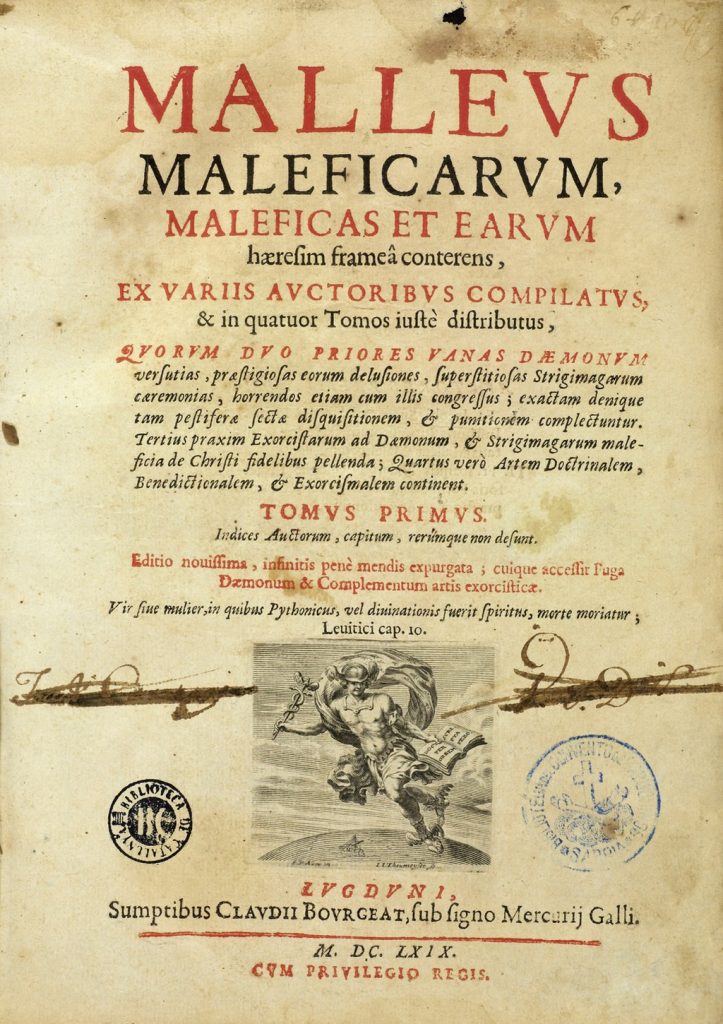
The printed culture of monsters and portents helped train early modern Europeans to read visible disorder as moral warning, but witch-hunting required something even more dangerous: a theory of hidden disorder. Witchcraft persecution depended on the claim that ordinary bodies, ordinary neighbors, and ordinary misfortunes concealed a secret alliance with the devil. That claim was not new in the late fifteenth century, but print helped give it a more durable and portable form. The Malleus Maleficarum, first published in 1486 or 1487, stands as the most notorious example of this process. Written by the Dominican inquisitor Heinrich Kramer, with Jacob Sprenger traditionally attached to the work in ways modern scholars have questioned, the book transformed misogynistic theology, inquisitorial procedure, clerical anxiety, and learned demonology into a manual of suspicion. It did not invent witch-hunting, and it did not single-handedly cause the European witch trials. Its significance lies instead in the way it made a persecutory worldview reproducible.
The Malleus emerged from failure as much as authority. Kramer had been involved in a witchcraft prosecution at Innsbruck in 1485, where local ecclesiastical resistance and procedural criticism undermined his efforts. The text can be read partly as an attempt to vindicate an embattled inquisitor’s methods and to insist that disbelief in witchcraft was itself dangerous. That defensive posture shaped the work’s ferocity. The Malleus did not merely argue that witches existed. It argued that skepticism protected them. Doubt became complicity. This was one of the text’s most poisonous contributions to the culture of persecution, because it narrowed the space in which caution, legal restraint, or ordinary human pity could operate. Once disbelief could be cast as spiritual blindness, the absence of evidence became less important than the intensity of accusation.
The gendered logic of the Malleus made it especially destructive. Kramer drew on older Christian traditions of suspicion toward women, sexuality, bodily appetite, and moral weakness, but he intensified those traditions into an argument that made women particularly vulnerable to demonological accusation. The text associated witchcraft with lust, deception, malice, reproductive harm, and spiritual instability, turning misogyny into a theory of social danger. Women were not merely portrayed as sinners. They were imagined as especially porous to demonic influence and especially capable of corrupting households, bodies, infants, crops, animals, and male authority. This mattered because witchcraft accusations often grew out of ordinary social tensions: neighborly quarrels, illness, failed childbirth, dead livestock, poverty, resentment, or fear of women who were old, poor, widowed, outspoken, dependent, or socially inconvenient. The Malleus gave such tensions a cosmic explanation. It taught readers to interpret local friction as evidence of diabolical conspiracy.
Print intensified this danger by giving demonological suspicion a stable textual architecture. The Malleus was organized not as a rumor or sermon, but as an authoritative treatise: question, answer, objection, refutation, example, procedure. Its scholastic structure mattered. It clothed panic in the language of argument. It gave judges, clerics, and educated readers a framework for turning scattered fears into prosecutable categories. Claims about maleficium, demonic pacts, sexual intercourse with demons, flight, sabbaths, infant murder, impotence, and weather magic could be collected, arranged, and presented as a coherent system. That system was false in its premises, but its form made it usable. It supplied not only stories about witches, but habits of interpretation: how to recognize them, how to question them, how to distrust their denials, and how to treat ordinary misfortune as a sign of hidden guilt. The printed form strengthened this process because it allowed the same arguments, examples, and procedures to recur beyond the immediate authority of the preacher or inquisitor. A local accusation could now be imagined within a wider demonological pattern, and a magistrate uncertain about a case could find in the printed treatise a ready-made grammar of suspicion. The book’s structure made persecution appear methodical rather than impulsive, as though the destruction of accused witches followed from disciplined reasoning instead of fear, misogyny, and coercive fantasy. In that sense, the Malleus did not merely spread belief in witches. It helped organize belief into practice, giving learned culture a way to convert rumor into inquiry, inquiry into confession, and confession into proof.
Even so, the Malleus should not be treated as a magic key that unlocks the entire history of witch-hunting. Modern scholarship has complicated older narratives that made the book the direct engine of mass persecution. Witch trials varied widely by region, law, confession, jurisdiction, political structure, and local crisis. Some authorities ignored the Malleus; others drew on different demonological traditions; many prosecutions depended more immediately on village accusation, judicial procedure, torture, local panic, and elite willingness to act. The book’s influence was real, but uneven. Its deeper importance lies in what it reveals about print’s capacity to preserve and distribute a persecutory imagination. It helped make witchcraft thinkable as a systematic crime against God, society, family, fertility, and order. It also shows that print did not need to reach everyone directly to matter. A text read by judges, clerics, university-trained men, or magistrates could shape the fate of people who never saw a page of it.
The Malleus Maleficarum belongs in the history of propaganda not because it was a pamphlet in the narrow sense, nor because it was crude popular sensationalism, but because it taught suspicion as discipline. It presented a world in which hidden enemies were everywhere, women’s bodies were morally dangerous, skepticism was naïve or sinful, and violence could be justified as defense of Christian society. Its printed life gave institutional memory to fear. Like monster broadsheets, it made anxiety legible; unlike them, it gave anxiety a procedure. That distinction is crucial. A monster print could tell readers that the world was deformed. The Malleus told authorities what to do about it. In that movement from interpretation to action, the darker power of print becomes unmistakable: it could turn false belief into a manual, and a manual into machinery of persecution.
Luther, Pamphlets, and the Reformation as Media War

The Reformation did not become a European crisis because Martin Luther objected to indulgences in 1517. Late medieval Christianity had already produced reform movements, clerical criticism, anticlerical satire, theological conflict, and institutional anxiety. What made Luther’s challenge different was the convergence of religious grievance with a maturing print economy. The Ninety-Five Theses began as an academic disputation, written in Latin for scholarly debate, but the controversy quickly escaped the narrow world of university theology. Printers, readers, preachers, students, clergy, merchants, and political actors turned the dispute into a public event. Luther did not invent the religious pamphlet, but he became one of the first figures to demonstrate how a sustained print campaign could make theological conflict feel immediate, personal, and communal. The Reformation was not only a doctrinal rupture. It was a media war.
Pamphlets gave reform a speed and flexibility that older institutional channels struggled to match. A book required time, money, and a relatively committed readership. A pamphlet could move more quickly, cost less, answer events, provoke enemies, and speak in a sharper vernacular voice. Luther’s success depended partly on his ability to write across registers: learned Latin for scholars, German sermons and tracts for broader publics, fierce polemic for opponents, pastoral instruction for anxious believers, and memorable slogans for ordinary readers and hearers. His print persona became a kind of portable authority. Readers who never met Luther could encounter him repeatedly as preacher, interpreter, prophet, satirist, and embattled witness. In that sense, print helped create “Luther” as more than a theologian. It made him a public figure whose authority circulated through paper, performance, and repetition. This mattered because authority in the Reformation was itself under dispute. Luther challenged the interpretive monopoly of pope, council, bishop, and scholastic tradition, but he did so by constructing another kind of authority around scripture, conscience, preaching, and the printed word. The pamphlet allowed him to appear both learned and accessible, both defiant and pastoral, both revolutionary and restorational. It let him speak over the heads of ecclesiastical gatekeepers to a wider Christian public that was learning to imagine itself as a judge of religious truth.
The pamphlet form also transformed disagreement into conflict by making response almost unavoidable. Catholic critics answered Luther; Luther answered them; allies amplified his claims; enemies sharpened theirs. The controversy became cumulative, with each printed intervention adding to a widening archive of accusation. The result was not reasoned debate alone, though learned argument certainly mattered. It was also escalation. The papacy could be portrayed as Antichrist, monks as parasites, indulgence sellers as spiritual merchants, reformers as heretics, rebels, or servants of the devil. Polemic compressed complex theological disputes into emotionally charged oppositions: Gospel against corruption, scripture against human tradition, Christian liberty against ecclesiastical tyranny, obedience against rebellion, truth against deception. Print did not simplify theology by accident. Simplification was one of its weapons. The structure of pamphlet conflict encouraged urgency rather than patience, sharpness rather than nuance, and recognition rather than contemplation. A reader did not have to master the long history of canon law, sacramental theology, or conciliar debate to understand the emotional grammar of the controversy. The enemy was named, the abuse exposed, the remedy announced, and the reader invited to take sides. This was propaganda in a deeply early modern form: not necessarily invented from nothing, but selected, arranged, intensified, and repeated until the world seemed divided into visible camps.
Visual propaganda intensified this struggle. Woodcuts, title-page imagery, caricatures, and illustrated broadsheets made confessional hostility visible to audiences beyond the fully literate. In Protestant hands, the pope could appear as a beast, fool, tyrant, or Antichrist; Catholic opponents could depict reformers as schismatics, seducers, and destroyers of Christian unity. These images did not merely decorate texts. They organized perception. Reformation propaganda addressed “simple folk” through visual strategies that were immediate, memorable, and communal. An image could be seen before it was read, explained aloud by someone else, laughed at in a group, or recalled long after the pamphlet itself disappeared. Propaganda did not need to win every doctrinal argument. It needed to give the audience an enemy whose moral ugliness could be recognized at a glance.
The press also changed the relationship between local reform and wider movement. A sermon preached in one city could become a printed tract available elsewhere. A controversy in Wittenberg could matter in Nuremberg, Strasbourg, Basel, Augsburg, Zurich, Antwerp, London, or Paris. Urban print centers became nodes in a loose but powerful network through which ideas, rumors, accusations, and defenses traveled. This did not mean that print alone caused Protestant success. Political protection, urban institutions, princely interest, anticlerical resentment, economic grievance, humanist scholarship, and genuine religious conviction all mattered. Yet print gave these forces a common medium. It allowed reform to appear larger than any one locality and gave scattered dissatisfaction a shared vocabulary. The same technology that multiplied Luther’s words also multiplied the sense that history itself was moving. That sense of movement was politically consequential. Princes, magistrates, clergy, and lay readers could watch controversy spread and recognize that reform was no longer an isolated academic quarrel. It was becoming a public cause. Printed repetition created the impression of momentum, and momentum could become its own argument. When the same complaints, slogans, biblical appeals, and anticlerical accusations appeared in multiple places, they suggested not merely imitation but confirmation. Print helped dispersed grievances recognize one another, and that recognition gave reform a collective shape.
The Reformation as media war reveals the printing press at its most ambiguous. It enabled serious theological critique, vernacular religious education, biblical engagement, and challenges to entrenched ecclesiastical power. It also rewarded fury, caricature, accusation, and the destruction of opponents’ moral legitimacy. Luther and his allies used print to expose what they saw as corruption and falsehood, but they also helped normalize a public style in which religious enemies could be mocked, demonized, and made spiritually monstrous. Catholic writers responded in kind, defending inherited authority while sharpening their own polemical weapons. The result was a fractured Christian public sphere in which truth became inseparable from printed struggle. The press did not simply carry the Reformation. It shaped the form of the conflict, turning reform into a battle over who had the right to define Christianity itself.
Satire as Destruction: Luther’s Die Lügend von S. Johanne Chrysostomo
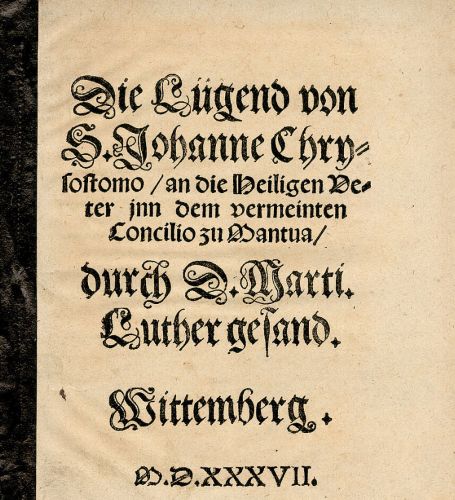
Luther’s pamphlet warfare did not depend only on doctrinal argument, biblical exegesis, or direct denunciation. It also depended on ridicule. In 1537, he published Die Lügend von S. Johanne Chrysostomo, a short satirical attack on a late medieval legend of Saint John Chrysostom. The title itself was a weapon. By twisting Legende into Lügend, Luther transformed a saint’s life into a “lying” text before the reader even entered the work. This was not merely a joke at the expense of Catholic hagiography. It was an act of demolition. Luther used print to teach readers that an inherited devotional genre, long associated with sanctity, moral instruction, and ecclesiastical memory, should instead be treated as fraud. The target was not only one story about one saint. The target was the authority of the religious culture that had preserved, circulated, rewarded, and defended such stories.
The legend Luther mocked was not the historical John Chrysostom of late antique Constantinople, the famous preacher and bishop, but a medieval penitential romance attached to his name. In its sensational form, the story involved sin, withdrawal, animal-like penance, miraculous resolution, and restored sanctity. Such tales had long belonged to the imaginative world of saints’ lives, where extreme suffering, grotesque humility, miraculous speech, and moral reversal could dramatize divine mercy. Luther saw something very different. To him, this was not holy edification but clerical deception dressed in devotional clothing. By republishing the legend with sarcastic commentary and hostile framing, he turned Catholic storytelling against itself. The printed text became a courtroom in which the old legend was made to testify to its own absurdity.
This method mattered because satire attacks authority differently from formal argument. A theological refutation asks the reader to judge evidence, doctrine, and interpretation. Satire teaches the reader to feel contempt. Luther’s marginal and prefatory ridicule encouraged audiences not simply to disagree with late medieval hagiography, but to laugh at it, distrust it, and feel morally superior to those who had accepted it. That emotional movement was central to Reformation propaganda. Once a devotional tradition could be made ridiculous, its institutional guardians could be made ridiculous as well. The saints’ legend became a symptom of a larger Catholic disease: superstition, clerical manipulation, indulgence culture, and the replacement of scriptural truth with profitable fiction. Satire did not merely expose error. It damaged reverence. That damage was rhetorically powerful because religious authority depended so heavily on reverence: reverence for saints, relics, feast days, monasteries, inherited stories, ecclesiastical teachers, and the accumulated memory of the church. Luther’s satire attacked that emotional structure directly. It asked readers to shift from devotion to suspicion, from humility before tradition to mockery of tradition’s supposed absurdities. This was a profound act of cultural re-education. The reader who laughed at the legend was being trained to see Catholic memory not as sacred inheritance, but as a warehouse of frauds.
The dedication and framing of the work sharpened the polemical edge. Luther presented the text to the “holy fathers” associated with the proposed council at Mantua, a council connected to wider attempts at Catholic response and reform. The gesture was deliberately insulting. He was not respectfully submitting a scholarly correction to ecclesiastical authorities. He was sending them a specimen of the lies he believed their church had promoted. The pamphlet turned the language of conciliar authority upside down. Instead of the council judging Luther, Luther used print to judge the culture of councils, popes, theologians, saints’ legends, and indulgenced devotion. This reversal was central to the Reformation media war. Print allowed a monk already condemned by Rome to address Europe as an accuser, not a defendant.
The importance of Die Lügend von S. Johanne Chrysostomo lies in the way it exposes satire as one of print propaganda’s most destructive tools. It did not need to invent an enemy from nothing. It selected an existing Catholic text, reframed it, mocked it, and made it stand for an entire system of deception. That is why the pamphlet belongs in the history of nefarious print culture even though Luther understood himself as attacking falsehood rather than spreading it. Propaganda often works by making a single example carry more weight than it can honestly bear. In Luther’s hands, one legendary life became evidence against Catholic memory itself. The printed page did not only multiply the satire. It multiplied the permission to sneer. Once reverence became laughable, destruction could feel like reform.
The case also reveals something larger about the relationship between print and ridicule. Satire travels well because it is compact, memorable, and socially contagious. A difficult doctrinal argument may require training; a joke requires only recognition. Once printed, that joke can be repeated in taverns, workshops, schools, households, and pulpits, detaching itself from the original page while preserving its emotional force. Luther’s attack on the Chrysostom legend shows how print culture could turn inherited religious forms into objects of public derision. The old story was not merely corrected; it was humiliated. That humiliation mattered because it helped create a Protestant reading public trained to distrust Catholic tradition before Catholic authorities even began to speak. The pamphlet did more than argue that a legend was false. It taught readers to approach an entire religious culture as if deception were its native language.
Catholic Counter-Print: Censorship, Indexes, Sermons, and the Battle to Regain Authority
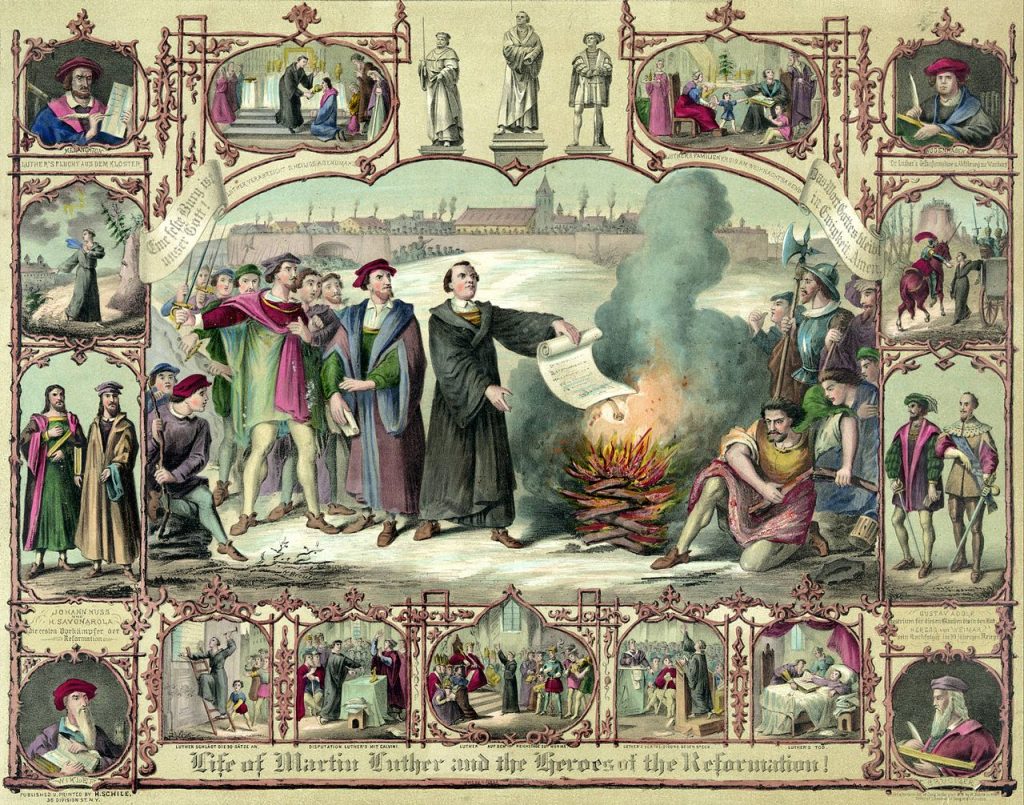
Catholic authorities did not respond to Protestant print culture simply by condemning the press or retreating into older forms of authority. They fought print with print, even as they tried to regulate, license, censor, and discipline it. This was one of the great ironies of the Reformation age. The same medium that helped Luther, his allies, and other reformers challenge ecclesiastical authority also became indispensable to Catholic defense, reform, and renewal. Catholic controversialists published refutations, catechisms, sermons, devotional works, martyrologies, saints’ lives, theological treatises, biblical commentaries, decrees, and polemical attacks of their own. The Roman Church did not merely attempt to silence print. It attempted to recover control over the printed field of religious truth.
Censorship was the most obvious part of this response, but it was not the whole of it. Catholic officials understood that books could be dangerous because they crossed boundaries more easily than preachers, bishops, or inquisitors. A printed text could move from one jurisdiction to another, survive condemnation, circulate secretly, or reappear under a false imprint. The expansion of censorship reflected fear of print’s mobility as much as fear of Protestant doctrine itself. Licensing systems, episcopal approval, inquisitorial examination, university review, and civic regulation all attempted to slow or filter the movement of suspect texts. Yet censorship also revealed the limits of authority. To ban a book was to admit that it had power. To list forbidden works was to acknowledge that dangerous reading had become a problem large enough to require bureaucracy.
The Index of Forbidden Books became the most famous symbol of this effort to discipline reading. First issued in Rome in 1559 and revised repeatedly thereafter, the Index did not merely identify prohibited authors and texts. It expressed a broader Catholic claim that reading was morally consequential and that uncontrolled access to religious argument could endanger souls, communities, and obedience. In modern terms, it is tempting to see the Index only as repression, and it certainly was repressive. Yet within Catholic logic it functioned as spiritual quarantine, an attempt to protect readers from doctrinal contagion. That metaphor matters because it shows how print was imagined as a vehicle of infection. Heresy could spread not only through preaching or personal contact, but through paper, type, translation, and private reading. The book itself became a suspect body. The Index also reveals how Catholic authority tried to distinguish between total prohibition, conditional correction, and supervised access. Some works were condemned absolutely, some required expurgation, and some could be handled by approved readers under controlled circumstances. This was not intellectual freedom, but neither was it merely panic. It was an administrative attempt to govern a changed information world, one in which the private reader had become a serious theological problem. The Index tried to restore hierarchy to reading itself, placing clerical judgment between the printed text and the individual conscience. That effort shows how deeply the Reformation had unsettled older assumptions about who had the right to interpret, compare, doubt, and decide.
The Council of Trent sharpened the Catholic response by pairing doctrinal definition with pastoral and institutional reform. The council did not simply reject Protestant arguments; it clarified Catholic teaching on scripture, tradition, sacraments, justification, clerical discipline, episcopal responsibility, and religious instruction. Print became essential to that project. Conciliar decrees had to be disseminated. Catechisms had to instruct clergy and laity. Missals and breviaries had to be standardized. Seminary formation required books, manuals, and authorized texts. Catholic reform relied on print to rebuild the very authority that uncontrolled print had helped destabilize. This was not a return to the pre-Gutenberg world. It was a disciplined Catholic print culture, one that sought to make correct doctrine repeatable, portable, and institutionally supervised.
The Society of Jesus became especially important in this Catholic battle for minds. Jesuit schools, missions, colleges, confession manuals, catechisms, theatrical performances, polemical writings, and devotional texts participated in a vast project of religious formation. The Jesuits understood that persuasion required more than prohibition. It required education, emotional discipline, rhetorical skill, and the cultivation of memory. Their print culture could be intellectually sophisticated, pedagogically practical, and fiercely polemical. Catholic writers answered Protestant accusations of corruption, defended sacramental theology, attacked reformers as schismatics or rebels, and presented Catholic continuity as both ancient and living. In this world, print was not the enemy of tradition. Print became a means of manufacturing tradition’s visibility.
Sermons also remained central, but after the Reformation they increasingly operated in partnership with print. A sermon could be delivered orally, printed afterward, excerpted, translated, imitated, or incorporated into devotional and controversial literature. Catholic preaching after Trent emphasized instruction, moral reform, sacramental discipline, and confessional identity. Like Protestant preaching, it did not merely explain doctrine; it formed communities emotionally and intellectually against perceived error. The pulpit and press reinforced one another. Printed catechisms could supply the structure for preaching; sermons could popularize printed doctrine; devotional books could carry the voice of reform into households; martyrologies and saints’ lives could answer Protestant ridicule by reasserting Catholic models of sanctity. The old oral authority of the church did not disappear. It was reorganized through print. This partnership also mattered because Catholic reform was not aimed only at theologians or magistrates. It had to reach parishioners, children, confessants, urban guild members, rural communities, and families whose religious habits had been unsettled by decades of controversy. Printed materials gave preachers and teachers a more consistent doctrinal vocabulary, while preaching gave printed doctrine warmth, repetition, and local embodiment. Together, they made Catholic identity teachable. The church’s answer to Protestant print was not silence, but disciplined saturation: authorized words repeated in classrooms, confessionals, pulpits, processions, devotional manuals, and household instruction.
Catholic counter-print reveals that the printing press did not belong naturally to reform, liberty, or anti-institutional resistance. It belonged to whoever could use it effectively. Protestant polemicists used print to expose, ridicule, and delegitimize Rome. Catholic authorities used print to censor, instruct, defend, standardize, and reassert Rome’s claims. Both sides understood that printed repetition could shape belief, and both sides learned to treat religious communication as a battle over memory, emotion, and legitimacy. The struggle was not simply between truth and lies, nor between print and censorship. It was a struggle over who could define truth publicly, who could authorize reading, and who could make their version of Christianity appear ancient, coherent, and necessary. In that struggle, Catholic counter-print did not end the media war. It proved that no major religious authority could survive it without entering it. That is why Catholic censorship and Catholic publishing must be understood together rather than as opposites. The same institution that restricted dangerous books also produced and promoted authorized ones, because suppression alone could not rebuild trust. Authority had to become visible again, legible again, and repeatable again. Catholic print culture attempted to make obedience persuasive, not merely compulsory. It sought to restore confidence in hierarchy by giving hierarchy a printed voice.
Confessional War and the Printed Enemy: France, the Dutch Revolt, and the Thirty Years’ War
The Reformation’s media war did not remain confined to theological pamphlets, satirical attacks, censorship regimes, and competing programs of instruction. As religious division hardened into political conflict, print became one of the chief instruments through which communities learned to imagine their enemies. In the later sixteenth and seventeenth centuries, France, the Low Countries, the Holy Roman Empire, and much of central Europe were drawn into conflicts in which confessional identity, dynastic ambition, local grievance, foreign intervention, and fear of divine judgment became dangerously entangled. Printed texts and images did not merely describe these conflicts. They helped organize them emotionally. Pamphlets, broadsheets, songs, engravings, martyrologies, battle reports, atrocity narratives, and providential interpretations turned particular events into moral evidence. They told readers not only what had happened, but what kind of enemy could have done it.
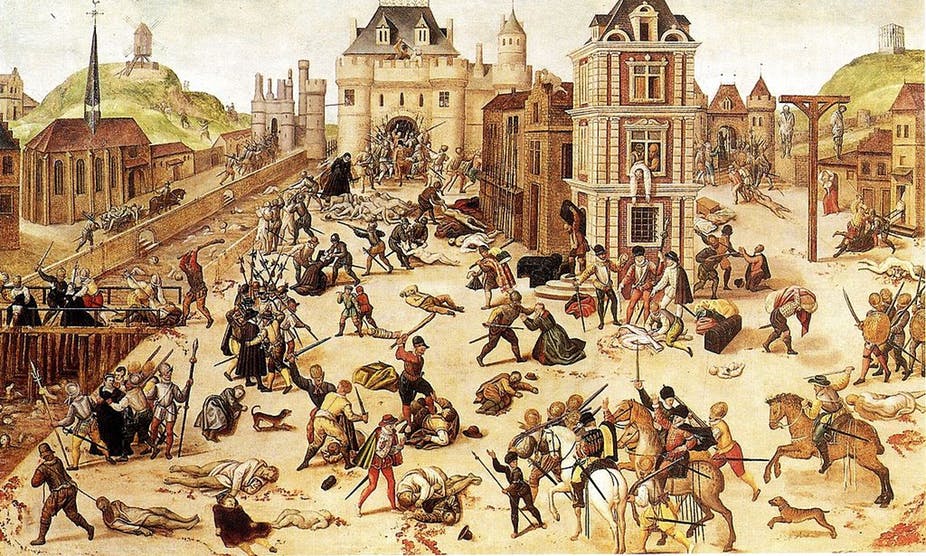
In France, the Wars of Religion demonstrated how print could make civil conflict feel like sacred necessity. Catholic and Protestant writers alike used pamphlets, sermons, songs, and visual images to define the other side as a threat not only to doctrine, but to the survival of Christian order itself. Huguenots could depict Catholic violence as tyranny, idolatry, and persecution, while Catholic militants could portray Protestants as heretics, iconoclasts, rebels, and enemies of social peace. The St. Bartholomew’s Day Massacre of 1572 became one of the most powerful examples of print’s capacity to transform violence into competing memory. For Protestants, the massacre became evidence of Catholic cruelty and royal perfidy, a trauma that could be narrated, illustrated, and preserved across borders. For Catholic defenders, the same events could be justified as the necessary suppression of sedition or the defense of the kingdom against heretical conspiracy. Print did not heal the rupture. It made the rupture legible in mutually incompatible ways.
The visual record of the French Wars of Religion shows how images could teach political theology through scenes of suffering. Printed depictions of massacres, executions, armed crowds, violated bodies, and ruined cities did more than document violence. They arranged violence into moral argument. Graphic history could present conflict as a sequence of memorable scenes, each one inviting judgment. Such images claimed to show events, but they also selected perspective, gesture, victimhood, and culpability. They turned the viewer into a witness. That mattered because witnessing is never neutral in propaganda. To see violence represented in print was to be asked to identify the innocent, recognize the guilty, and carry the image into memory. The enemy became not merely a theological opponent, but a visible perpetrator. This was especially powerful in a civil war, where enemies were not always distant foreigners but neighbors, magistrates, clergy, soldiers, and townspeople who inhabited the same political and sacred landscape. Images helped make such intimacy bearable by giving violence a clear moral structure. They could show Protestant suffering as martyrdom or Catholic vengeance as righteous purification, depending on the maker and audience. The printed scene did not simply preserve memory; it instructed memory, arranging bodies and actions so that later viewers would know how to condemn, mourn, justify, or fear.
The Dutch Revolt against Spanish Habsburg rule similarly produced a print culture in which political resistance, religious identity, and atrocity memory reinforced one another. Rebel propaganda presented Spanish power as cruel, foreign, tyrannical, and Catholic in the most threatening sense. The “Spanish Fury,” especially the sack of Antwerp in 1576, became a powerful symbol of imperial violence and helped strengthen anti-Spanish sentiment in the Low Countries and beyond. Printed accounts, engravings, songs, and polemical narratives linked Spanish soldiers with massacre, greed, rape, sacrilege, and arbitrary rule. The figure of the Duke of Alba became a concentrated image of repression, used to personalize and dramatize the brutality of Habsburg policy. Yet this propaganda was not merely a spontaneous cry of suffering. It was also political work. It helped forge solidarity among provinces with different interests, languages, privileges, and religious commitments by giving them a common enemy whose cruelty appeared self-evident.
The Dutch case also shows that propaganda did not always depend on inventing events from nothing. Real violence could be selected, intensified, repeated, and made symbolic until it carried far more political weight than any single event could bear alone. The sack of a city, the execution of rebels, the repression of dissent, or the destruction of property could become proof of a larger pattern: tyranny, popery, foreign domination, or divine testing. Print allowed these interpretations to outlive the immediate crisis. A battle lost in one place could become a moral victory elsewhere if narrated as martyrdom. A defeat could become testimony. A massacre could become founding memory. This was one of the great strengths of confessional propaganda: it did not have to choose between information and emotion. It could simultaneously report, mourn, accuse, and mobilize. That combination made printed atrocity especially durable. Readers could encounter the same event not as isolated news, but as part of a cumulative archive of grievance, in which each new report seemed to confirm the meaning of the last. The repetition itself created plausibility. The more often Spanish cruelty, Catholic conspiracy, or Habsburg tyranny appeared in print, the more easily they could be understood as permanent qualities rather than actions tied to specific circumstances. Propaganda made history feel like character evidence.
The Thirty Years’ War brought this printed enemy-making to a still broader and more catastrophic scale. The conflict that began in Bohemia in 1618 expanded into a long struggle involving imperial authority, Protestant resistance, Catholic consolidation, dynastic rivalry, Swedish and French intervention, mercenary warfare, and the devastation of civilian communities across the Holy Roman Empire. Printed news sheets, pamphlets, broadsheets, sermons, prophecies, and battle reports helped readers make sense of a war whose causes and alliances were often bewilderingly complex. The enemy could be cast as papist, heretic, imperial tyrant, rebel, foreign invader, mercenary beast, or instrument of divine punishment. Atrocity narratives became especially important because the war’s violence against civilians demanded explanation. Print supplied explanations that were often confessional, providential, and partisan. It could turn plunder, famine, siege, and massacre into evidence that God was judging Europe or that a monstrous enemy had broken the bonds of Christian humanity. The scale of destruction made such explanations emotionally necessary even when they were analytically inadequate. Civilians who endured burned villages, requisitioning, forced billeting, disease, hunger, and sexual violence needed more than military chronology. They needed a language for suffering. Printed accounts offered that language by assigning guilt, locating meaning, and transforming chaos into a story of punishment, martyrdom, warning, or righteous endurance. Yet the very act of explanation could deepen hatred. When devastation was framed as the work of an essentially wicked confession, dynasty, or people, grief became easier to convert into vengeance.
Yet the Thirty Years’ War also exposed the instability of confessional propaganda. The conflict was religious, but never only religious. Catholic France eventually fought against Catholic Habsburg power. Lutheran, Calvinist, Catholic, and dynastic interests did not always align cleanly. Mercenary armies often devastated populations regardless of confession. Printed propaganda had to simplify what political reality complicated. That simplification was part of its function. By reducing tangled alliances and material interests to moral oppositions, print made endurance, taxation, obedience, resistance, and vengeance easier to justify. It gave frightened populations a usable story. Confessional war reveals one of the most dangerous properties of propaganda: it does not merely lie by fabrication. It lies by compression. It takes a world of mixed motives, partial truths, real grievances, and opportunistic power and turns it into a drama of innocence and evil.
By the mid-seventeenth century, Europe had learned that print could preserve hatred as effectively as doctrine. France, the Dutch Revolt, and the Thirty Years’ War all show how religious conflict became a struggle over memory, visibility, and moral naming. Printed enemies could be made monstrous, treacherous, foreign, impious, tyrannical, or subhuman. Printed victims could become martyrs, witnesses, innocents, or proof of divine favor. The result was not simply a more informed public, but a more emotionally organized one. Print widened the circle of those who could participate imaginatively in conflicts they never saw. It made distant violence intimate, and it made local suffering part of transregional confessional identity. The printing press had already multiplied scripture, satire, monsters, and manuals of suspicion. In the age of confessional war, it multiplied enemies.
The State Learns to Print: Licensing, Absolutism, and Official Falsehood

As confessional conflict revealed the power of printed enemy-making, European states learned a lesson that religious authorities had already begun to grasp: print could not be treated merely as a nuisance. It had to be governed, exploited, licensed, punished, and, when useful, sponsored. Rulers and magistrates feared unauthorized pamphlets, seditious rumors, religious agitation, scandalous libels, and foreign propaganda, but they also recognized that the printed page could give state power a more durable public voice. Proclamations, laws, ordinances, royal declarations, trial accounts, execution narratives, diplomatic justifications, and official news all became tools through which governments attempted to define reality for their subjects. The state did not simply censor print from outside the medium. It entered print culture as a producer of authority. This shift was decisive because it meant that print was no longer only a disruptive force pressing against throne, altar, and magistracy. It became part of the machinery by which rulers explained themselves, defended coercion, advertised legitimacy, and converted political necessity into public doctrine. The same press that could circulate rebellion could also circulate obedience. The same technology that made dissent portable made sovereignty portable as well.
Licensing systems were central to this effort. By controlling who could print, what could be printed, and under whose approval a text might circulate, governments tried to restore hierarchy to a technology that had loosened older boundaries of speech. Licensing was never merely technical. It was political theology translated into administration. A licensed text carried the implication that authority had seen, approved, or at least tolerated it; an unlicensed text could be treated as disorder made material. In England, France, the Italian states, the Habsburg lands, and elsewhere, systems of privilege, censorship, guild regulation, episcopal review, university approval, and police surveillance reflected the same anxiety: print made private judgment and public agitation dangerously mobile. A forbidden idea could now hide in a bundle, cross a border, be read aloud in a tavern, or reappear under a false imprint.
The logic of licensing also reveals how early modern states treated truth as an attribute of order. Falsehood was not always defined by factual inaccuracy alone. It could mean unauthorized speech, destabilizing interpretation, disrespect toward rulers, or the public circulation of claims that weakened obedience. “False news” and seditious libel were dangerous not simply because they might be untrue, but because they threatened the state’s monopoly over legitimate public meaning. A rumor about royal weakness, military defeat, fiscal corruption, court sexual scandal, foreign influence, or religious betrayal could be punished even when it touched some truth, because its political effect mattered more than its evidentiary precision. The state’s anxiety was not only epistemological. It was structural. If subjects could judge printed claims for themselves, they might also judge the rulers those claims described.
Absolutist monarchy sharpened this relationship between print and official reality. In France, royal authority depended not only on law, taxation, courts, armies, and patronage, but on symbolic power. The monarchy had to appear majestic, providential, ancient, victorious, and necessary. Print helped manufacture that appearance. Royal edicts, gazettes, ceremonial accounts, panegyrics, histories, engravings, festival books, and reports of military triumph did not merely communicate policy. They staged sovereignty. Under Louis XIV, especially, the monarchy developed a sophisticated culture of representation in which art, architecture, theater, medals, histories, and print worked together to produce the image of royal magnificence. The state’s printed voice was not neutral information. It was a performance of inevitability.
Official print could also lie by omission, framing, and selective repetition. A gazette might report victory while minimizing cost, disorder, or defeat. A royal proclamation might present taxation as necessity, rebellion as ingratitude, censorship as protection, persecution as piety, or war as defensive honor. The state did not have to fabricate every claim to mislead. It could arrange facts into obedience. It could define categories before debate began: rebel, traitor, heretic, foreign agent, disturber of peace, enemy of the crown. Once those labels circulated in authorized print, they could shape how later events were understood. This was official propaganda’s great advantage. It did not need to shout like a pamphleteer. It could speak in the calm grammar of administration and make power sound like common sense. That calmness made it especially dangerous, because official print often disguised interpretation as order. Its language could appear procedural, legal, and impersonal, even when it carried deeply partisan assumptions about loyalty, legitimacy, and guilt. The proclamation, gazette, or printed edict did not invite readers into open argument so much as place them inside a finished conclusion. It told them where authority stood, what names should be used, which acts counted as crimes, and which sacrifices were required for the public good. Official print did not merely persuade. It normalized the boundaries within which persuasion was allowed to occur.
Execution literature and trial publications show the state’s printed authority at its most theatrical. Public punishment had always been a form of communication, but print extended the scaffold beyond the crowd. Accounts of trials, confessions, last speeches, repentance, treason, heresy, witchcraft, murder, and exemplary punishment allowed the state to turn bodies into lessons after the spectacle had ended. The condemned person could be represented as penitent, monstrous, deluded, rebellious, or justly destroyed. Even when such texts preserved genuine elements of legal process or final speech, they were shaped by the needs of authority. The printed account taught readers how to interpret punishment: not as cruelty, not as political fear, not as judicial violence, but as restored order. The scaffold became a page, and the page became an extension of the scaffold.
Yet states never fully mastered the medium they tried to govern. Licensing systems produced black markets. Censorship created curiosity. Bans could advertise the importance of forbidden texts. Exiled printers, clandestine presses, smugglers, foreign publishers, manuscript newsletters, and oral networks allowed unauthorized claims to survive. The more governments insisted on controlling truth, the more opponents could accuse them of hiding it. Official print existed in constant tension with unofficial print. States could command presses, punish printers, and sponsor authorized narratives, but they could not erase the interpretive suspicion that their own censorship helped produce. The same machinery that gave the state a louder voice also gave critics a reason to distrust that voice. This was one of the central paradoxes of early modern information control. Efforts to regulate print could protect authority in the short term while weakening its moral credibility. When readers knew that books had been banned, news filtered, printers punished, or rival accounts suppressed, the official version could begin to look less like truth and more like management. Censorship did not only silence speech. It also revealed the anxiety of power, and that revelation could itself become politically useful to opponents.
The state’s entrance into print culture marks a crucial stage in the history of propaganda because it shows that falsehood does not always appear as rumor, satire, monster, or demonic panic. Sometimes it appears as policy language, legal formula, official news, royal ceremony, or administrative calm. Governments learned to print because print made authority visible, repeatable, and portable. They licensed books to control disorder, but they also produced books, proclamations, gazettes, and trial narratives to shape belief. This did not mean that all official print was false, any more than all rebel print was true. The danger was subtler. Once the state learned to print, power could present its own interests as public truth. The printed page became not only a battlefield against authority, but one of authority’s most polished weapons.
Civil War, Regicide, and the English Explosion of Pamphlet Politics
The English Civil Wars revealed what could happen when licensing weakened, political authority fractured, and print became a weapon in a struggle over sovereignty itself. Before the 1640s, England had already developed systems of censorship, licensing, and official control, but the collapse of consensus between king and Parliament opened space for an extraordinary expansion of pamphlet politics. Printed petitions, declarations, newsbooks, sermons, royalist defenses, parliamentarian attacks, sectarian manifestos, legal arguments, and popular polemics poured into public circulation. The result was not simply more political writing. It was a transformation in the imagined audience of politics. Questions once largely confined to court, council, pulpit, and Parliament became matters for a reading and listening public. Who held legitimate authority? Could a king violate law? Could subjects resist? Was Parliament guardian of liberty or engine of rebellion? Print made these questions public, urgent, and unavoidable.
Pamphlets were especially suited to civil war because they could answer crisis with speed. They could defend a military action, interpret a defeat, attack a commander, justify taxation, denounce compromise, or accuse the other side of betraying God and nation. Royalists and parliamentarians both understood that military conflict had to be accompanied by interpretive conflict. A battle was not only won or lost in the field; it had to be explained afterward. A defeat could be blamed on treachery, providence, incompetence, or divine chastisement. A victory could be presented as proof of God’s favor, lawful resistance, royal justice, or national deliverance. Print gave each side the means to narrate events before rumor alone could define them. In this atmosphere, news itself became partisan. To publish an account was to compete for control over meaning.
The civil war also intensified the politics of naming. Words such as “loyalty,” “liberty,” “tyranny,” “rebellion,” “popery,” “law,” “conscience,” “Parliament,” and “kingdom” became contested weapons. Royalist pamphleteers could portray Parliament’s cause as disorder, sedition, hypocrisy, and rebellion masked as reform. Parliamentarian writers could present royal policy as tyranny, arbitrary government, popish conspiracy, and betrayal of the ancient constitution. Each side claimed continuity with England’s lawful past while accusing the other of novelty and corruption. This mattered because legitimacy in civil war depends on making rupture appear necessary and obedience appear dangerous. Pamphlets did not merely describe positions already formed. They helped create political identities by teaching readers what language to use, what fears to hold, and what loyalties counted as moral rather than merely factional.
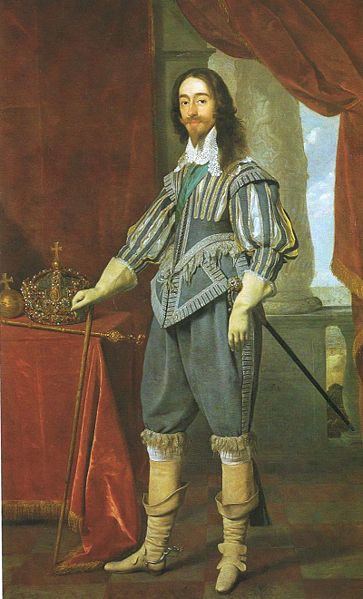
Regicide pushed this print conflict into an even more radical register. The trial and execution of King Charles I in January 1649 required justification on a scale English political culture had never before faced. To kill a king was not merely to remove a ruler; it was to attack a sacred and inherited grammar of monarchy. Parliamentarian and republican writers had to make the execution appear lawful, providential, and necessary, while royalist writers quickly recast Charles as a martyr whose suffering exposed the moral horror of rebellion. Eikon Basilike, published shortly after the king’s death and presented as the spiritual self-portrait of Charles, became one of the most influential royalist texts of the period. Whether read as authentic royal testimony or as carefully shaped political devotion, it transformed the dead king into an image of piety, patience, and sacred victimhood. The book’s power lay in its emotional reversal: the executed monarch became the wounded conscience of the nation, and the regicides became the true criminals before God and history.
The republican response, including John Milton’s Eikonoklastes, shows how regicide created a struggle not only over policy, but over memory itself. Milton understood that Eikon Basilike was dangerous because it did not merely argue; it sanctified. It asked readers to mourn the king, identify with his suffering, and treat his death as martyrdom rather than judgment. To answer it, Milton had to break the image, which is exactly what the title Eikonoklastes implies. The battle was iconoclastic in both religious and political senses. Was Charles a martyr or a tyrant? Was his execution murder or justice? Was the Commonwealth liberation or usurpation? Print allowed both sides to build archives of legitimacy, each claiming to preserve the true meaning of the crisis. Civil war had shattered political authority, and pamphlet culture fought to decide which fragments would become history.
The English explosion of pamphlet politics demonstrates that print did not simply democratize political discussion in a clean or noble way. It widened participation, but it also widened suspicion, rage, and conspiratorial interpretation. It enabled radical arguments about conscience, representation, toleration, law, and popular sovereignty, but it also rewarded slander, panic, sectarian hatred, and apocalyptic certainty. Levellers, Presbyterians, Independents, royalists, republicans, army writers, clerics, and pamphleteers all entered a crowded arena where public persuasion became inseparable from political survival. The state had learned to print, but civil war taught factions, soldiers, sects, and citizens to print against the state, against one another, and against any settlement that seemed false to their vision of godly order. By the time England passed through civil war, regicide, republic, protectorate, and restoration, print had become more than a medium of political commentary. It had become one of the places where sovereignty itself was fought.
Commerce, Scandal, and the Business Model of Outrage

The history of print propaganda cannot be understood only through theology, censorship, statecraft, or war. It must also be understood through commerce. Printers were not merely servants of reformers, monarchs, bishops, rebels, or scholars. They were businesspeople operating in a risky market, dependent on paper supplies, credit, labor, distribution, patronage, privilege, and reader demand. Many printed serious works of devotion, law, education, scholarship, and administration, but the same presses could also issue scandalous pamphlets, crime reports, ballads, monstrous births, execution accounts, prophecies, political libels, and sensational news. The moral meaning of a text did not always determine whether it appeared in print. Its marketability often did. Once printers learned that fear, novelty, anger, and scandal sold quickly, outrage became not only a rhetorical style but a commercial opportunity.
Cheap print occupied a crucial space between elite literary culture and oral popular culture. Broadsides, ballads, pamphlets, chapbooks, almanacs, and news sheets could be bought, shared, read aloud, sung, posted, or carried from place to place. Their audiences were not limited to solitary readers. A single printed item might pass through many hands or reach listeners who never purchased it at all. This made cheap print unusually powerful as a carrier of sensational material. It did not need the prestige of a folio or the permanence of a library collection. Its force lay in speed, accessibility, emotional directness, and social circulation. A scandalous title, a lurid woodcut, or a shocking opening could pull readers into a story before sober judgment had time to intervene. The format itself invited immediacy.
Crime literature shows how easily moral instruction and voyeuristic appetite could coexist. Printed accounts of murders, robberies, treasons, executions, witchcraft cases, sexual transgressions, and monstrous crimes often presented themselves as warnings against sin and disorder. They claimed to teach repentance, obedience, providence, and the consequences of wickedness. Yet their commercial appeal depended heavily on the very horrors they condemned. The criminal body, the bloody act, the final confession, the scaffold speech, and the sensational detail all became saleable material. This was not simple hypocrisy. It was a structural feature of the market. Printers could wrap entertainment in moral purpose, allowing readers to consume scandal while appearing to contemplate justice. The lesson and the thrill arrived in the same package. This doubleness made crime print especially useful as a commercial form because it could satisfy curiosity while defending itself as moral instruction. The reader could be shocked, entertained, frightened, and reassured all at once. A murderer’s confession might confirm providence; a witch’s execution might confirm communal vigilance; a traitor’s last words might confirm loyalty to the crown; a sensational sexual scandal might confirm warnings about disorderly desire. The printed crime narrative turned deviance into a commodity and then sold the restoration of order as part of the same experience. It invited audiences to look closely at what they were officially being taught to reject.
Scandal also thrived because it offered readers access to hidden worlds. Court intrigue, clerical misconduct, sexual rumor, domestic violence, treasonous plotting, religious hypocrisy, and elite corruption all promised to reveal what authority wanted concealed. That promise was politically potent and commercially useful. A pamphlet that claimed to expose secret vice could sell because it flattered the reader as someone brave enough to see through official appearances. This was especially important in societies where formal political participation was restricted. Print offered a substitute form of participation: the reader could judge, mock, condemn, and circulate. Even when the report was exaggerated or false, the pleasure of exposure could feel like moral insight. Scandal gave ordinary readers an imaginative seat inside chambers of power, and printers learned that such access could be profitable.
The business model of outrage did not require a modern algorithm to function. Early modern printers did not possess digital metrics, automated feeds, or data-driven engagement systems, but they did understand demand. They knew which genres moved, which controversies drew attention, which enemies could be named safely or profitably, and which stories could be reissued in altered form. They borrowed, pirated, condensed, translated, embellished, and repackaged. A successful scandal could generate replies, counter-replies, sequels, imitations, and moralized adaptations. Controversy created inventory. Outrage sustained the market by producing the next text. The printed public sphere was not merely a space of rational exchange, as later idealized models might suggest. It was also a noisy commercial environment in which speed and emotional intensity could overpower accuracy. The economic pressure was simple but powerful: a cautious, balanced, carefully verified account might be worthy, but a shocking account moved faster through conversation, purchase, performance, and repetition. Printers and booksellers did not have to invent every distortion deliberately for the market to reward distortion. The structure itself favored what could seize attention. A rumor could become a pamphlet, the pamphlet could provoke an answer, the answer could renew the rumor, and the cycle could continue as long as readers remained emotionally invested. Outrage became renewable because controversy made its own demand.
This does not mean that all cheap print was deceitful or that commercial motives automatically corrupted public discourse. Cheap print could inform, educate, entertain, console, mobilize, and preserve voices otherwise excluded from elite manuscript and book culture. Ballads, pamphlets, and newsbooks helped create wider forms of public awareness and political participation. But the same openness made the medium vulnerable to manipulation. When profit rewarded provocation, printers had incentives to sharpen fear, heighten scandal, and publish before certainty had been established. The early modern marketplace of print reveals one of the oldest truths about mass communication: falsehood often spreads not only because someone believes it, but because someone benefits from selling it. The printing press made outrage reproducible; commerce made it renewable.
Eighteenth-Century Libelles, Coffeehouses, and the Pre-Revolutionary Scandal Machine
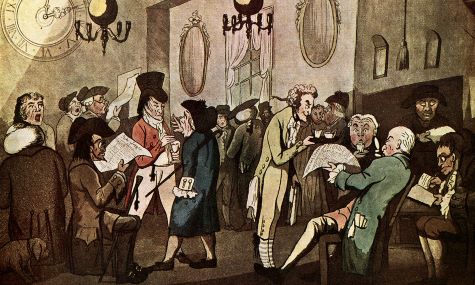
By the eighteenth century, the printed marketplace of outrage had become more sophisticated, more urban, and more politically dangerous. Scandal no longer moved only through occasional pamphlets, crime reports, religious polemic, or official rebuttal. It circulated through a mixed media environment of printed pamphlets, manuscript newsletters, satirical engravings, clandestine books, songs, coffeehouse conversation, theater gossip, police reports, diplomatic rumor, and oral exchange. This world did not separate information neatly from entertainment, nor politics from private vice. Reputation itself became a battlefield. Ministers, courtiers, bishops, mistresses, financiers, writers, and monarchs could all become characters in a sprawling drama of exposure. The eighteenth-century scandal machine did not invent political distrust, but it made distrust more social, more repeatable, and more pleasurable.
The French libelle was one of the most potent forms in this culture of attack. These defamatory texts could mix political accusation, sexual scandal, financial rumor, pornographic fantasy, anticlerical resentment, and court gossip into narratives that claimed to reveal the hidden corruption of power. Their force came partly from their illicitness. A forbidden book, smuggled text, or clandestine pamphlet carried the thrill of danger, as though its very illegality proved that it contained truths authority feared. Historiography on eighteenth-century French literary and political culture shows how underground texts moved through networks of printers, smugglers, booksellers, police spies, and readers hungry for forbidden knowledge. The libelle did not merely accuse. It trained readers to assume that official virtue was theatrical and that hidden vice was the real structure of government. This assumption was corrosive because it reversed the burden of trust. Instead of requiring scandal to prove corruption, readers could come to treat corruption as the normal condition of power and scandal as the act of unveiling it. The more outrageous the accusation, the more it could seem to belong to a hidden world that polite language concealed. Sexual excess, financial theft, ministerial conspiracy, clerical hypocrisy, and court decadence were not separate themes. They formed a single grammar of exposure, one that made monarchy and aristocracy appear rotten not accidentally, but essentially.
Coffeehouses, salons, reading rooms, bookshops, and other spaces of sociability amplified this printed culture. A text did not have to remain confined to the buyer who purchased it. It could be summarized aloud, passed from hand to hand, quoted in conversation, copied into correspondence, sung in the streets, or transformed into rumor. Coffeehouses especially became symbolic of an expanding public sphere in which men gathered to discuss news, politics, trade, war, literature, and scandal. Yet this public culture was not always the calm, rational exchange imagined in idealized accounts of enlightened sociability. It was also noisy, partisan, performative, and vulnerable to manipulation. Printed rumor gained power when it entered conversation, and conversation gained apparent authority when it could point back to print. As in earlier centuries, oral and printed media fed one another, but now they did so in a denser, more commercially active urban environment. The coffeehouse reader was often also a listener, commentator, interpreter, and transmitter. News did not simply arrive; it was performed. Men debated the reliability of reports, embellished stories, repeated jokes, tested political positions, and converted private suspicion into shared judgment. This made scandal social rather than merely textual. A libelous pamphlet might begin as an object, but its real political life unfolded in the repeated acts of reading aloud, nodding, laughing, doubting, embellishing, and passing it on.
The politics of scandal were especially corrosive in ancien régime France because monarchy depended so heavily on majesty, distance, ceremony, and moral imagination. Kingship was not only an administrative structure. It was a symbolic order. When clandestine texts repeatedly depicted court life as sexually corrupt, financially predatory, hypocritical, foreign-influenced, or contemptuous of the people, they did more than insult individuals. They degraded the emotional foundations of monarchy itself. Royal mistresses, ministers, financiers, and eventually queens became figures through whom broader anxieties about taxation, luxury, privilege, debt, and exclusion could be narrated. The point was not always whether a particular accusation was true. The point was that scandal made monarchy feel knowable in the most degrading way. It stripped mystery from power and replaced reverence with suspicion.
Marie Antoinette became one of the most infamous targets of this pre-revolutionary scandal culture. Pamphlets, pornographic slanders, songs, rumors, and satirical images portrayed her as sexually depraved, politically manipulative, foreign, wasteful, and hostile to France. These attacks drew on misogyny, xenophobia, resentment of court luxury, and older traditions of queenly suspicion. They also turned the female body into a political allegory. The queen’s imagined sexual disorder became a language for describing the supposed disorder of the monarchy itself. This was propaganda at its most vicious, because it converted political critique into bodily humiliation. Even when the immediate claims were obscene fantasies or malicious inventions, they helped create a climate in which royal authority appeared not merely mistaken or unjust, but rotten at its intimate core. The scandal machine did not need to prove every allegation. It needed to make disgust habitual.
Britain had its own eighteenth-century culture of scandal, satire, and political print, though it operated within a different institutional environment. Newspapers, pamphlets, caricatures, parliamentary reporting, coffeehouse discussion, and partisan essays helped make politics a matter of broader public consumption. Political prints could reduce ministers and monarchs to memorable visual ridicule; newspapers could sustain controversy across issues; pamphlets could frame policy disputes as struggles against corruption, tyranny, or faction. The British press was not free in a modern sense, but it possessed a more developed commercial and partisan infrastructure than many continental systems. Scandal could become routine rather than exceptional. Public men increasingly had to live with the possibility that their reputations could be attacked, defended, exaggerated, and commodified in print. Politics became a theater in which publicity itself was both weapon and risk. This was especially true because British political culture allowed a more visible relationship between opposition, satire, and commercial publishing. The attack on corruption could be sincere, factional, profitable, or all three at once. A minister might be criticized for policy, mocked for bodily appearance, accused of secret influence, and transformed into a caricature recognizable even to those who did not follow parliamentary detail. The scandal economy turned politics into a sequence of images, phrases, and reputational wounds. It did not replace formal institutions, but it surrounded them with a public noise that no statesman could entirely ignore.
The pre-revolutionary scandal machine reveals how propaganda could work without a single central author, conspiracy, or office of control. It emerged from the interaction of market demand, censorship, clandestine circulation, political resentment, urban sociability, and the pleasures of exposure. Official secrecy made rumor attractive. Court luxury made moral accusation plausible. Censorship made forbidden texts glamorous. Commercial print made repetition profitable. Coffeehouse conversation made private reading public. The result was a culture in which scandal could erode legitimacy cumulatively, through drip after drip rather than one decisive blow. By the time revolutionary crises arrived, many readers had already been trained to interpret authority through suspicion. The printing press had long since learned to sell fear, enemies, miracles, monsters, trials, and war. In the eighteenth century, it also learned to sell the degradation of power itself.
Revolution and the Printed Collapse of Legitimacy
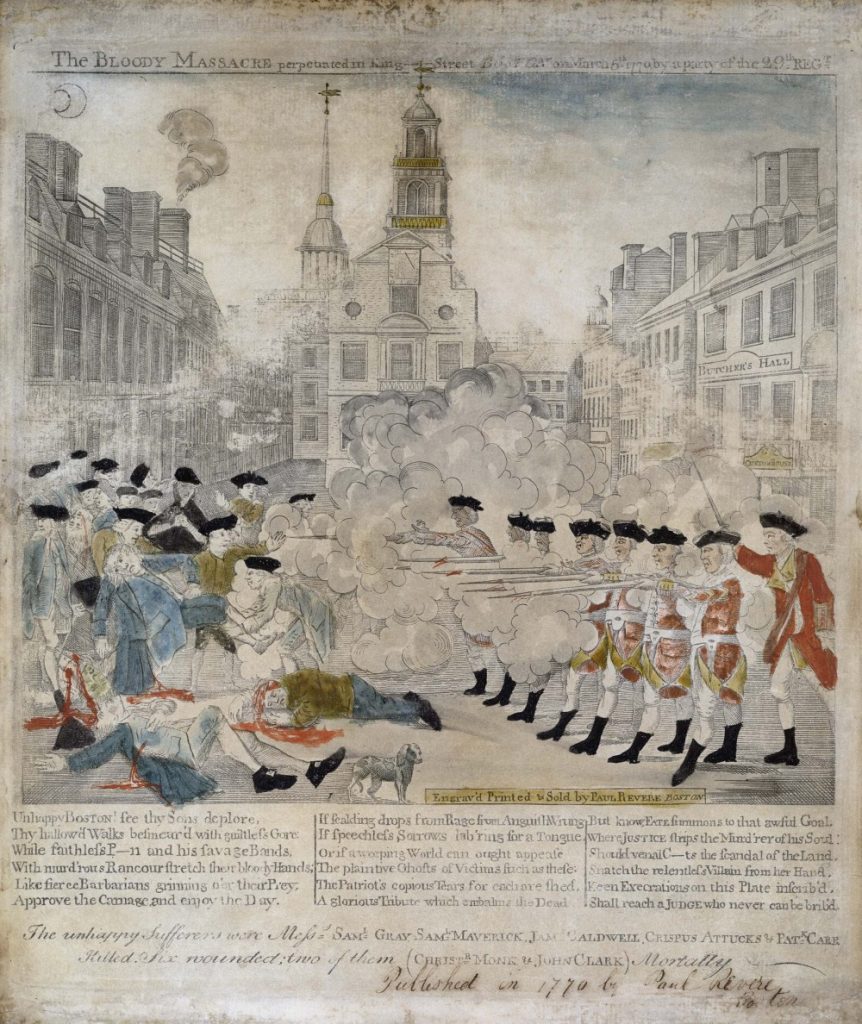
Revolutionary print culture did not emerge from nowhere. It grew from centuries of pamphlet warfare, confessional polemic, state censorship, scandal literature, commercial outrage, and public argument. By the late eighteenth century, readers in Britain, France, the Dutch world, and the Atlantic colonies had inherited a political language already shaped by print: corruption, liberty, tyranny, rights, representation, conspiracy, virtue, slavery, citizenship, and the people. What changed in revolutionary moments was the intensity with which these words were used to destroy old legitimacy and manufacture new authority. The printed page became a site where sovereignty could be transferred imaginatively before it was transferred institutionally. A king could be made to appear not fatherly but parasitic, not sacred but criminal, not necessary but obsolete. Once legitimacy collapsed in print, it became harder to preserve in law, ceremony, or force alone.
The American Revolution demonstrated how pamphlets could convert political grievance into ideological rupture. Colonial printers had long circulated sermons, newspapers, almanacs, legislative arguments, imperial news, and local controversy, but the crisis with Britain made print central to resistance. Pamphlets such as Thomas Paine’s Common Sense did not simply repeat complaints about taxation, representation, standing armies, or ministerial corruption. They reorganized those complaints into a direct assault on monarchy itself. Paine’s power lay partly in making hereditary kingship appear absurd, unnatural, and morally indefensible, rather than merely inconvenient to colonial rights. This was a radical act of compression. Complex imperial disputes became a plain argument about common sense, providence, human equality, and the illegitimacy of inherited rule. Print gave that argument speed, reach, and emotional clarity. It helped readers imagine independence before independence existed as a political reality.
In France, the collapse of legitimacy was even more dramatic because the monarchy had depended so heavily on sacred aura, dynastic continuity, court ceremony, and the imagined distance between sovereign and subject. By 1789, that aura had already been weakened by fiscal crisis, failed reform, elite conflict, Enlightenment criticism, clandestine scandal literature, and public distrust. Revolutionary print intensified the breakdown. Newspapers, pamphlets, petitions, posters, songs, caricatures, legislative reports, and political clubs created a new public vocabulary in which the nation, the people, and citizenship displaced older languages of royal paternalism. The king could still appear in print, but increasingly as a problem to be solved rather than the symbolic center of order. Louis XVI’s attempted flight to Varennes in June 1791 accelerated this transformation. Once the king appeared to have abandoned or betrayed the revolution, printed debate could recast him from constitutional monarch into suspect, prisoner, conspirator, and eventually traitor.
The French Revolution also revealed the terrifying speed with which print could turn political suspicion into a system of enemies. Revolutionary newspapers and pamphlets named aristocrats, refractory priests, hoarders, émigrés, royalists, foreign agents, moderates, factional rivals, and internal traitors as threats to the nation’s survival. Some of those threats were real; revolutionary France did face war, counterrevolution, foreign invasion, and internal rebellion. But print had the power to make danger feel total, everywhere, and morally clarifying. A politics of vigilance developed in which accusation became a civic act and doubt could be interpreted as betrayal. Revolutionary print could educate citizens, publish laws, expose abuses, and mobilize resistance, but it could also narrow the space for ambiguity. The printed enemy was especially potent because it fused political emergency with moral purification. A named opponent did not simply disagree; he endangered the nation. A hesitant citizen did not merely doubt; he might conceal treason. A critic of revolutionary violence could be described as a defender of aristocracy, priestcraft, foreign invasion, or royal conspiracy. This language made compromise harder because it transformed political disagreement into evidence of hidden allegiance. Like the Malleus Maleficarum in a different register, revolutionary propaganda could make skepticism itself appear dangerous. The enemy was not merely outside the polity. The enemy might be hidden within it.
This was the printed collapse of legitimacy in its fullest sense: old authority lost its sacred and symbolic protections, while new authority learned to justify itself through the language of people, nation, virtue, emergency, and justice. Print did not cause revolution by itself, any more than it caused the Reformation, witch hunts, or confessional war by itself. But it made revolutionary politics scalable. It turned grievance into doctrine, doctrine into identity, identity into mobilization, and mobilization into pressure on institutions. It also exposed the dark continuity between liberation and propaganda. The same medium that helped challenge monarchy, aristocratic privilege, censorship, and inherited hierarchy could also sanctify violence, simplify opponents into enemies, and make suspicion feel like patriotism. By the revolutionary age, the printing press had become one of the central engines by which legitimacy could be built, broken, and rebuilt in public.
Conclusion: The Press Did Not Corrupt Truth, It Scaled Human Motives
The printing press did not create Europe’s appetite for truth, nor did it create Europe’s appetite for lies. It entered a world already shaped by sermons, rumors, manuscripts, public punishments, religious images, political gossip, legal proclamations, and inherited habits of suspicion. What it changed was scale. Print made words more repeatable, images more portable, accusations more durable, and controversy more profitable. It allowed scripture, scholarship, law, science, and reform to travel with unprecedented force, but it also allowed monsters, forged meanings, demonological fantasies, sectarian caricatures, royal mythologies, scandal pamphlets, and revolutionary denunciations to do the same. Its danger lay in the same qualities as its promise. The press could preserve knowledge, but it could also preserve hatred. It could widen access to learning, but it could also widen access to manipulation.
That double capacity is the central lesson of the early modern print world. The same technology that allowed Luther to challenge ecclesiastical corruption also allowed religious opponents to become grotesque enemies in woodcut and pamphlet. The same medium that helped Catholic authorities teach doctrine and reform institutions also enabled censorship, indexes, and the policing of dangerous reading. The same printed forms that documented war crimes, massacres, and political abuse could intensify hatred through repetition and selective framing. The same commercial marketplace that made news, devotion, poetry, satire, and practical knowledge available to wider publics also rewarded scandal, fear, and outrage. Print did not operate as an independent moral force. It amplified the motives of those who used it: devotion, greed, reform, ambition, terror, curiosity, vengeance, conscience, and power.
This history also complicates any easy opposition between truth and propaganda. Falsehood did not always appear as outright fabrication. Often it appeared as compression, omission, emotional framing, selective memory, and the conversion of partial truth into total accusation. A real massacre could become proof of an enemy’s eternal depravity. A malformed animal could become evidence of divine judgment against a church. A criminal confession could become theater for state authority. A queen’s reputation could be destroyed through sexual fantasy disguised as political revelation. A king could be sanctified or demonized after death by competing printed narratives. These examples reveal that propaganda is not merely the circulation of lies. It is the disciplined arrangement of belief, fear, and evidence so that one interpretation becomes emotionally irresistible before it becomes intellectually examined.
The press, then, did not corrupt truth by itself. It scaled human motives. It gave reformers a pulpit beyond the church, states a voice beyond the court, merchants a market beyond the stall, rebels a platform beyond the meeting house, and liars an audience beyond the rumor circle. That is why its history feels so uncomfortably familiar. Modern communication technologies differ radically in speed, architecture, reach, and algorithmic design, but the human pattern is old: when communication outruns verification, when outrage becomes profitable, and when identity turns interpretation into loyalty, truth must fight for room to breathe. The early modern printing press was one of humanity’s great instruments of liberation, but it was never innocent. It did not merely spread the light of knowledge. It taught Europe how quickly light could cast a shadow.
Bibliography
- Bailyn, Bernard. The Ideological Origins of the American Revolution. Cambridge, MA: Belknap Press of Harvard University Press, 1967.
- Barker, Hannah, and Simon Burrows, eds. Press, Politics and the Public Sphere in Europe and North America, 1760–1820. Cambridge: Cambridge University Press, 2002.
- Bellinger, Gerhard J. Bibliographie des Catechismus Romanus: Ex Decreto Concilii Tridentini ad Parochos, 1566–1978. Baden-Baden: Valentin Koerner, 1983.
- Benedict, Philip. Graphic History: The Wars, Massacres and Troubles of Tortorel and Perrissin. Geneva: Librairie Droz, 2007.
- Brewer, John. Party Ideology and Popular Politics at the Accession of George III. Cambridge: Cambridge University Press, 1976.
- Broedel, Hans Peter. The Malleus Maleficarum and the Construction of Witchcraft: Theology and Popular Belief. Manchester: Manchester University Press, 2003.
- Burrows, Simon. Blackmail, Scandal, and Revolution: London’s French Libellistes, 1758–1792. Manchester: Manchester University Press, 2006.
- Camille, Michael. The Gothic Idol: Ideology and Image-Making in Medieval Art. Cambridge: Cambridge University Press, 1989.
- Charles I. Eikon Basilike: The Pourtraicture of His Sacred Majestie in His Solitudes and Sufferings. London, 1649.
- Chartier, Roger. The Cultural Origins of the French Revolution. Durham: Duke University Press, 1991.
- Clanchy, M. T. From Memory to Written Record: England 1066–1307. 3rd ed. Oxford: Wiley-Blackwell, 2012.
- Clark, Stuart. Thinking with Demons: The Idea of Witchcraft in Early Modern Europe. Oxford: Oxford University Press, 1997.
- Clegg, Cyndia Susan. Press Censorship in Elizabethan England. Cambridge: Cambridge University Press, 1997.
- Cressy, David. Dangerous Talk: Scandalous, Seditious, and Treasonable Speech in Pre-Modern England. Oxford: Oxford University Press, 2010.
- Crouzet, Denis. Les Guerriers de Dieu: La Violence au Temps des Troubles de Religion, Vers 1525–Vers 1610. 2 vols. Seyssel: Champ Vallon, 1990.
- Darnton, Robert. The Devil in the Holy Water, or the Art of Slander from Louis XIV to Napoleon. Philadelphia: University of Pennsylvania Press, 2010.
- —-. “An Early Information Society: News and the Media in Eighteenth-Century Paris.” American Historical Review 105:1 (2000), 1–35.
- —-. The Forbidden Best-Sellers of Pre-Revolutionary France. New York: W. W. Norton, 1995.
- Darnton, Robert, and Daniel Roche, eds. Revolution in Print: The Press in France, 1775–1800. Berkeley: University of California Press, 1989.
- Duke, Alastair. Reformation and Revolt in the Low Countries. London: Hambledon Press, 1990.
- Edwards, Mark U. Printing, Propaganda, and Martin Luther. Berkeley: University of California Press, 1994.
- Eisenstein, Elizabeth L. The Printing Press as an Agent of Change: Communications and Cultural Transformations in Early-Modern Europe. Cambridge: Cambridge University Press, 1979.
- —-. “In the Wake of the Printing Press.” The Quarterly Journal of the Library of Congress 35:3 (1978), 183-197.
- Febvre, Lucien, and Henri-Jean Martin. The Coming of the Book: The Impact of Printing 1450–1800. London: Verso, 1976.
- Grafton, Anthony. The Culture of Correction in Renaissance Europe. London: British Library, 2011.
- Grendler, Paul F. The Roman Inquisition and the Venetian Press, 1540–1605. Princeton: Princeton University Press, 1975.
- Habermas, Jürgen. The Structural Transformation of the Public Sphere. Cambridge, MA: MIT Press, 1989.
- Hesse, Carla. Publishing and Cultural Politics in Revolutionary Paris, 1789–1810. Berkeley: University of California Press, 1991.
- Hsia, R. Po-chia. The World of Catholic Renewal, 1540–1770. 2nd ed. Cambridge: Cambridge University Press, 2005.
- Hunt, Lynn. The Family Romance of the French Revolution. Berkeley: University of California Press, 1992.
- —-. Politics, Culture, and Class in the French Revolution. Berkeley: University of California Press, 1984.
- Index Librorum Prohibitorum. Rome: Paulus Manutius, 1559.
- Israel, Jonathan I. The Dutch Republic: Its Rise, Greatness, and Fall, 1477–1806. Oxford: Clarendon Press, 1995.
- Johns, Adrian. The Nature of the Book: Print and Knowledge in the Making. Chicago: University of Chicago Press, 1998.
- Kalinke, Marianne E. The Book of Reykjahólar: The Last of the Great Medieval Legendaries. Toronto: University of Toronto Press, 1996.
- Kramer, Heinrich. Malleus Maleficarum. Translated and edited by Christopher S. Mackay. 2 vols. Cambridge: Cambridge University Press, 2006.
- Lake, Peter, and Michael Questier. The Antichrist’s Lewd Hat: Protestants, Papists and Players in Post-Reformation England. New Haven: Yale University Press, 2002.
- Levack, Brian P. The Witch-Hunt in Early Modern Europe. London: Routledge, 1987.
- Library of Congress. “The Gutenberg Bible.” In The Library of Congress Bible Collection. Accessed May 16, 2026.
- Love, Harold. Scribal Publication in Seventeenth-Century England. Oxford: Clarendon Press, 1993.
- Luther, Martin. An den christlichen Adel deutscher Nation von des christlichen Standes Besserung. Wittenberg, 1520.
- —-. De captivitate Babylonica ecclesiae praeludium. Wittenberg, 1520.
- —-. Die Lügend von S. Johanne Chrysostomo: An die Heiligen Veter jnn dem vermeinten Concilio zu Mantua. Wittenberg, 1537.
- —-. Disputatio pro declaratione virtutis indulgentiarum. Wittenberg, 1517.
- —-. Von der Freiheit eines Christenmenschen. Wittenberg, 1520.
- Luther, Martin, and Philip Melanchthon. Deutung der zwo grewlichen Figuren Bapstesels zu Rom und Munchkalbs zu Freyberg in Meyssen funden. Wittenberg, 1523.
- Milton, John. Areopagitica: A Speech of Mr. John Milton for the Liberty of Unlicenc’d Printing, to the Parlament of England. London, 1644.
- —-. Eikonoklastes: In Answer to a Book Intitl’d Eikon Basilike. London, 1649.
- Moore, R. I. The Formation of a Persecuting Society: Authority and Deviance in Western Europe, 950–1250. Oxford: Blackwell, 1987.
- Needham, Paul. The Printer and the Pardoner: An Unrecorded Indulgence Printed by William Caxton for the Hospital of St. Mary Rounceval, Charing Cross. Washington, DC: Library of Congress, 1986.
- O’Malley, John W. The First Jesuits. Cambridge, MA: Harvard University Press, 1993.
- —-. Trent: What Happened at the Council. Cambridge, MA: Harvard University Press, 2013.
- Oberman, Heiko A. Luther: Man Between God and the Devil. New Haven: Yale University Press, 1989.
- Paine, Thomas. Common Sense. Philadelphia: W. and T. Bradford, 1776.
- Parker, Geoffrey. The Dutch Revolt. London: Penguin Books, 1977.
- Peacey, Jason. Politicians and Pamphleteers: Propaganda during the English Civil Wars and Interregnum. Aldershot: Ashgate, 2004.
- Pettegree, Andrew. The Book in the Renaissance. New Haven: Yale University Press, 2010.
- —-. Brand Luther: 1517, Printing, and the Making of the Reformation. New York: Penguin Press, 2015.
- —-. The Invention of News: How the World Came to Know About Itself. New Haven: Yale University Press, 2014.
- —-. “Print and the Reformation: A Drama in Three Acts.” Church History and Religious Culture 97:3-4 (2017), 410–429.
- Pollmann, Judith. Catholic Identity and the Revolt of the Netherlands, 1520–1635. Oxford: Oxford University Press, 2011.
- —-. Memory in Early Modern Europe, 1500–1800. Oxford: Oxford University Press, 2017.
- Popkin, Jeremy D. Revolutionary News: The Press in France, 1789–1799. Durham: Duke University Press, 1990.
- Raven, James. The Oxford Illustrated History of the Book. Oxford: Oxford University Press, 2020.
- Raymond, Joad. The Invention of the Newspaper: English Newsbooks, 1641–1649. Oxford: Clarendon Press, 1995.
- —-. Pamphlets and Pamphleteering in Early Modern Britain. Cambridge: Cambridge University Press, 2003.
- Roche, Daniel. The Enlightenment in France and the Origins of Modernity. Oxford: Voltaire Foundation, 1998.
- Roper, Lyndal. Witch Craze: Terror and Fantasy in Baroque Germany. New Haven: Yale University Press, 2004.
- Rubin, Jared. “Printing and Protestants: An Empirical Test of the Role of Printing in the Reformation.” Review of Economics and Statistics 96:2 (2014), 270–286.
- Rubin, Miri. Gentile Tales: The Narrative Assault on Late Medieval Jews. New Haven: Yale University Press, 1999.
- Sacrosanctum Concilium Tridentinum. Canones et Decreta Sacrosancti Oecumenici et Generalis Concilii Tridentini. Rome: Paulus Manutius, 1564.
- Sawyer, Jeffrey K. Printed Poison: Pamphlet Propaganda, Faction Politics, and the Public Sphere in Early Seventeenth-Century France. Berkeley: University of California Press, 1990.
- Schenda, Rudolf. “Hieronymus Rauscher und die protestantisch-katholische Legendenpolemik.” In Volkserzählung und Reformation: Ein Handbuch zur Tradierung und Funktion von Erzählstoffen und Erzählliteratur im Protestantismus, edited by Wolfgang Brückner. Berlin: Erich Schmidt Verlag, 1974.
- Scribner, R. W. For the Sake of Simple Folk: Popular Propaganda for the German Reformation. Cambridge: Cambridge University Press, 1981.
- Sharpe, Kevin. Image Wars: Promoting Kings and Commonwealths in England, 1603–1660. New Haven: Yale University Press, 2010.
- —-. Selling the Tudor Monarchy: Authority and Image in Sixteenth-Century England. New Haven: Yale University Press, 2009.
- Smith, Nigel. Literature and Revolution in England, 1640–1660. New Haven: Yale University Press, 1994.
- Soergel, Philip M. Miracles and the Protestant Imagination: The Evangelical Wonder Book in Reformation Germany. New York: Oxford University Press, 2012.
- Spinks, Jennifer. Monstrous Births and Visual Culture in Sixteenth-Century Germany. London: Pickering & Chatto, 2009.
- Stephens, Walter. Demon Lovers: Witchcraft, Sex, and the Crisis of Belief. Chicago: University of Chicago Press, 2002.
- Stock, Brian. The Implications of Literacy: Written Language and Models of Interpretation in the Eleventh and Twelfth Centuries. Princeton: Princeton University Press, 1983.
- Thomas, Chantal. The Wicked Queen: The Origins of the Myth of Marie-Antoinette. Translated by Julie Rose. New York: Zone Books, 1999.
- Tutino, Stefania. Shadows of Doubt: Language and Truth in Post-Reformation Catholic Culture. Oxford: Oxford University Press, 2014.
- Walsham, Alexandra. Providence in Early Modern England. Oxford: Oxford University Press, 1999.
- Warner, Michael. The Letters of the Republic: Publication and the Public Sphere in Eighteenth-Century America. Cambridge, MA: Harvard University Press, 1990.
- Watt, Tessa. Cheap Print and Popular Piety, 1550–1640. Cambridge: Cambridge University Press, 1991.
- Wenzel, Siegfried. Latin Sermon Collections from Later Medieval England: Orthodox Preaching in the Age of Wyclif. Cambridge: Cambridge University Press, 2005.
- Wilson, Peter H. Europe’s Tragedy: A History of the Thirty Years War. Cambridge, MA: Belknap Press of Harvard University Press, 2009.
- Würgler, Andreas. “Voices from among the ‘Silent Masses’: Humble Petitions and Social Conflicts in Early Modern Central Europe.” International Review of Social History 46, supplement S9 (2001), 11–34.
- Zaret, David. Origins of Democratic Culture: Printing, Petitions, and the Public Sphere in Early-Modern England. Princeton: Princeton University Press, 2000.
- Zika, Charles. The Appearance of Witchcraft: Print and Visual Culture in Sixteenth-Century Europe. London: Routledge, 2007.
Originally published by Brewminate, 05.21.2026, under the terms of a Creative Commons Attribution-NonCommercial-NoDerivatives 4.0 International license.
About the Author