From the Angel of Mons and the Anzac legend to Nazi racial mythology and the SS, ancient stories helped modern states justify sacrifice, conquest, total war, and remembrance.

By Matthew A. McIntosh
Public Historian
Brewminate
Introduction: When Modern War Became Mythic
The two world wars are commonly understood as catastrophes of modernity. They were fought by bureaucratic states capable of mobilizing millions of citizens, coordinating industrial production, transporting armies by railway and motor vehicle, and employing weapons created by advanced chemistry, engineering, aviation, and communications technology. Their battlefields were dominated not by Homeric champions or medieval knights but by artillery barrages, machine guns, submarines, tanks, bombers, poison gas, and the anonymous calculations of general staffs. Yet the societies that entered these wars repeatedly turned to ancient mythology, sacred history, medieval legend, and imagined national prehistory to explain what they were doing. Political leaders described conflicts over territory, security, empire, and power as timeless struggles between civilization and barbarism. Soldiers became heirs to Achilles, Leonidas, Roman legionaries, crusaders, Teutonic warriors, or ancestral defenders of the national soil. Military defeats were transformed into stories of martyrdom, betrayal, or spiritual victory, while the dead were represented as sacrificial offerings whose blood had renewed the nation. The wars were modern in their organization and destructiveness, but the moral worlds constructed around them were filled with gods, heroes, monsters, chosen peoples, sacred landscapes, apocalyptic enemies, and promises of national resurrection.
To describe these narratives as myths does not necessarily mean that they were simple lies. Myth can refer to an inherited story about gods and heroes, but it can also designate a culturally authoritative narrative through which a community explains its origins, defines its values, and interprets suffering. Political myths condense complicated events into memorable dramas populated by founders, martyrs, traitors, saviors, and existential enemies. They are selective rather than wholly invented, frequently growing around genuine courage, loss, fear, or injustice while arranging those experiences into a morally purposeful story. The Anzac legend, for example, emerged from the real endurance and death of soldiers at Gallipoli, but it transformed a failed campaign into a foundational revelation of Australian nationhood. The Angel of Mons similarly developed from the confusion of battle, literary invention, religious expectation, and wartime rumor, eventually suggesting that supernatural guardians had intervened on Britain’s behalf. Such legends mattered not because every listener accepted them literally, but because they made mechanized violence emotionally and morally intelligible.
The relationship between mythology and war nevertheless changed significantly between 1914 and 1945. During the First World War, mythic language helped governments mobilize populations and enabled soldiers, families, churches, journalists, and commemorative institutions to place unprecedented mass death within familiar narratives of heroism, providence, tragedy, and sacrifice. The conflict was presented as a test of national character and a struggle in which an entire civilization might perish. Classical and medieval analogies personalized industrial battle, while stories of supernatural intervention reassured populations confronted by retreat, censorship, and uncertain news. After the armistice, national memorials, battlefield pilgrimages, tombs of unknown soldiers, and legends of heroic defeat transformed the war into sacred memory. In Germany, the claim that the army had remained undefeated but had been betrayed from within gave military collapse the structure of a conspiracy and prepared the ground for a politics of vengeance. National Socialism inherited this mythologized memory of sacrifice and defeat, but it also went further. Nazi ideologues and institutions sought to manufacture an authoritative racial prehistory by combining selective readings of Tacitus, Germanic and Norse symbolism, linguistic theories, racial anthropology, archaeology, folklore, eugenics, and pseudoscientific speculation. Under Heinrich Himmler’s patronage, the SS adopted runic insignia, cultivated rituals of ancestral belonging, and supported research intended to demonstrate the primordial superiority and geographical reach of an imagined Aryan race. Fringe ideas involving Atlantis, vanished northern civilizations, and Hanns Hörbiger’s World Ice Theory entered portions of this ideological environment, although they never formed a single coherent creed shared equally by every Nazi leader. What distinguished the Nazi use of mythology was not merely its theatrical symbolism or its occasional eccentricity, but its translation into institutions. Narratives of blood, ancestry, racial purity, historical destiny, and inherited territorial entitlement became laws, genealogical classifications, settlement plans, educational programs, deportation policies, and ultimately instruments of conquest and genocide.
Mythology did not independently cause either world war, and it cannot replace diplomatic, economic, military, social, or political explanation. The First World War arose from state decisions, imperial competition, alliance commitments, nationalist tensions, and military planning; the Second from the unsettled aftermath of the first, the collapse of international order, fascist expansion, radical antisemitism, economic crisis, and calculated aggression. Nor did all Germans, Nazis, soldiers, or officials share the same mythic beliefs. Some were ideological believers, others conventional nationalists, careerists, opportunists, technocrats, or obedient functionaries. The importance of myth lay less in dictating particular battlefield maneuvers than in defining the historical and moral universes within which decisions appeared reasonable. Myth identified which communities supposedly possessed ancient rights, which deaths counted as redemptive sacrifices, which enemies represented temporary rivals and which appeared as timeless biological threats. It transformed contingency into destiny and aggression into restoration. In the world wars, ancient and invented pasts did not stand outside modern politics as decorative remnants of a less rational age. They became some of the languages through which modern states mobilized their populations, legitimized extraordinary violence, survived defeat, and determined how the conflicts would be remembered long after the weapons fell silent.
Before 1914: The Mythic Grammar of Europe
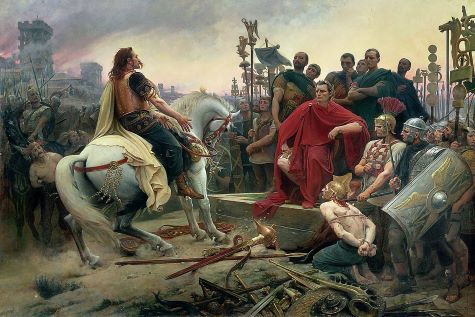
Long before Europe descended into general war in 1914, its political and cultural elites had learned to understand the modern world through stories inherited from antiquity. Classical education remained central to the formation of statesmen, military officers, civil servants, clergy, scholars, and journalists across much of the continent. Students encountered Homeric warfare, Spartan austerity, Athenian citizenship, Roman republican virtue, imperial expansion, tyranny, corruption, and civilizational decline not simply as remote historical subjects but as recurring patterns of political life. Greece and Rome furnished examples through which modern institutions could be praised, criticized, or legitimized. Parliamentary government might be compared to the Roman Republic, imperial authority to Augustus, national sacrifice to Thermopylae, and political decay to the final centuries of Rome. The ancient world supplied Europeans with a common political vocabulary, although one flexible enough to support radically different ideological conclusions.
That vocabulary was powerful because it was embedded in education, architecture, public ritual, and historical writing. In Britain, elite schools and universities taught generations of rulers to see antiquity as a guide to government and empire. Rome appeared as both a model and a warning: it had created law, order, military discipline, and a far-reaching imperial system, but it had also succumbed to luxury, corruption, internal division, and overextension. British imperial advocates could present their own empire as a modern continuation of Rome’s supposedly civilizing mission, while critics used Roman decline to warn against moral complacency. Greek history offered a similarly adaptable repertoire. Athens represented intellectual brilliance, civic participation, naval power, and cultural leadership; Sparta represented discipline, endurance, hierarchy, and the subordination of individual comfort to public duty. The differences between ancient city-states and the modern British Empire were enormous, but such analogies were politically useful precisely because they reduced complexity to recognizable moral types. Public buildings constructed in neoclassical styles made those comparisons physically visible, turning government ministries, museums, courts, and memorials into architectural claims of continuity with the ancient world. Classical antiquity was not merely studied; it was inhabited as a symbolic environment.
France drew upon antiquity through a different but equally powerful mixture of republicanism, imperial memory, and national recovery. The French Revolution had deliberately adopted Roman names, civic ceremonies, republican virtues, and images of patriotic sacrifice. During the nineteenth century, republicans, Bonapartists, monarchists, and Catholics continued to compete over the meaning of the ancient past. After the defeat of 1870–1871, the Third Republic used public education to cultivate disciplined citizens capable of restoring French strength. Roman civic virtue, revolutionary patriotism, and the memory of national humiliation became intertwined with renewed interest in the Gauls. Vercingetorix, defeated by Julius Caesar in 52 BCE, was transformed into a national hero whose resistance symbolized courage in the face of overwhelming imperial power. The historical peoples whom Roman writers had grouped as Gauls were neither politically unified nor simply identical with modern France, yet nationalist commemoration fashioned them into primordial ancestors. Their defeat became evidence not of failure but of an enduring national spirit awaiting resurrection.
In the German lands, the search for an ancient national character became even more politically consequential. Before unification in 1871, German-speaking intellectuals had attempted to locate a common identity beneath the political divisions of kingdoms, duchies, free cities, and confessional communities. Language, folklore, poetry, customary law, medieval history, and ancient ethnography were all recruited for this purpose. Johann Gottfried Herder associated national character with language and inherited culture, while Johann Gottlieb Fichte’s Addresses to the German Nation, delivered during the Napoleonic occupation, treated linguistic continuity and moral education as foundations for national regeneration. These thinkers did not offer the fully biological racial ideology later adopted by National Socialism, but they helped popularize the idea that the nation was an organic historical community whose essence preceded any particular political state. After German unification, museums, monuments, schools, historical associations, and public ceremonies assembled a continuous national lineage from ancient tribal resistance through medieval empire, the Protestant Reformation, Prussian military achievement, and modern statehood. The enormous monument to Arminius completed near Detmold in 1875 gave this historical construction a monumental form. Arminius, the Cheruscan leader who defeated three Roman legions in the Teutoburg Forest in 9 CE, was renamed Hermann and celebrated as the liberator of an ancient German nation that had not existed in the modern sense.
Tacitus’s Germania became one of the most influential texts in this retrospective creation of German antiquity. Written near the end of the first century CE, it described numerous peoples living beyond Rome’s northern frontiers through the moral and literary categories of a Roman senator. Tacitus praised or attributed to them such qualities as courage, simplicity, marital fidelity, hospitality, and resistance to foreign domination, often in implicit contrast with the luxury and corruption of Rome. His purpose was not to document a biologically uniform German race extending unchanged into the future. The communities he described possessed different customs, political structures, and identities, and his account belonged to a Roman tradition in which supposedly simpler outsiders could be used to criticize metropolitan decadence. Later readers nevertheless increasingly treated the work as an ancestral portrait. Passages shaped by Roman rhetoric were extracted as evidence of permanent German characteristics, while differences among ancient peoples were subordinated to the claim that they had shared a common racial and moral essence. By the late nineteenth century, Germania could be read not simply as an ancient ethnographic text but as testimony that modern Germans had inherited freedom, purity, loyalty, fertility, and martial courage from an unbroken ancestral past.
Comparable processes unfolded elsewhere in Europe, where modern national communities were projected backward into periods when identities had been more fluid, overlapping, and locally defined. Russian political and religious thought drew upon Orthodox Christianity, Byzantine succession, Slavic solidarity, imperial vocation, and memories of resistance to invasion. The image of Moscow as a “Third Rome” placed the Russian state within a sacred sequence extending beyond the fall of Constantinople and gave imperial authority a providential dimension. In the Balkans, medieval kingdoms, saints, dynasties, epic songs, and remembered defeats became foundations for modern territorial claims. Serbian memory of the Battle of Kosovo in 1389 gradually acquired the structure of sacred national history. The battle became a drama of martyrdom, betrayal, covenant, and promised resurrection, even though its historical circumstances were more ambiguous than the later legend allowed. Greek nationalism joined the prestige of classical antiquity with Orthodox Christianity and Byzantine inheritance, sometimes uneasily, to present the modern kingdom as the recovery of a people whose historical existence had never truly been interrupted. Such narratives did more than foster cultural pride. They transformed contested territories into ancestral homelands and political disputes into struggles over historical justice. Where multiple peoples claimed the same landscape as the burial ground, battlefield, or sacred inheritance of their ancestors, compromise could appear not merely impractical but morally treasonous.
The construction of national antiquity also required forgetting. The peoples of Europe had migrated, intermarried, converted, changed languages, altered political loyalties, and lived under shifting borders for centuries. Ancient tribes were not embryonic nation-states waiting to mature, and medieval kingdoms did not map neatly onto modern populations. Yet nationalist histories minimized those discontinuities and treated internal diversity as an obstacle to be overcome. Women, workers, religious minorities, colonized peoples, and ethnic communities were often excluded from the heroic national lineage or assigned subordinate roles within it. Imperial societies praised Greek liberty and Roman citizenship while withholding equality from millions of their own subjects. Governments celebrated ancestral resistance to conquest while defending expansion overseas. These contradictions reveal that the appeal to antiquity was not an innocent recovery of historical memory. It was a means of defining who belonged to the nation, who possessed the right to rule, and whose presence could be portrayed as foreign, decadent, or dangerous. By 1914, Europe possessed a densely layered mythic grammar of Troy and Thermopylae, Rome and Carthage, crusade and martyrdom, barbarian invasion and national resurrection. That grammar did not cause the diplomatic crisis that produced the First World War, but it prepared Europeans to interpret the conflict as something more than a struggle among states. Once mobilization began, governments could present armies as guardians of civilization, territories as sacred inheritances, enemies as ancient threats, and industrial slaughter as the latest chapter in an epic history of national destiny.
August 1914: The War as an Epic Struggle of Civilizations
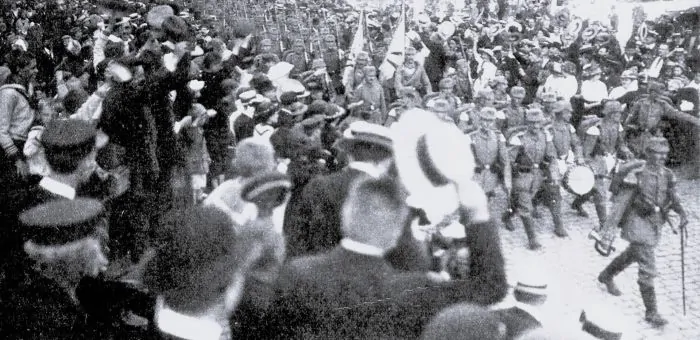
When European governments ordered mobilization in the summer of 1914, they did not present the approaching conflict as the result of a limited diplomatic crisis that might have been resolved differently. Political speeches, newspaper editorials, sermons, proclamations, and public ceremonies elevated the struggle into a contest over civilization itself. Each belligerent claimed to be defending peace, law, culture, national existence, or the rights of smaller peoples against an aggressor whose victory would plunge Europe into servitude or barbarism. The language was mythic not because it depended exclusively on gods or legendary heroes, but because it transformed contingent political decisions into an apparently timeless moral drama. Nations became unified personalities with inherited virtues and sacred missions. Their enemies ceased to be governments pursuing strategic objectives and became embodiments of despotism, decadence, treachery, or savagery. Once the crisis was narrated in those terms, war could appear less as a choice than as an ordeal imposed by history.
The public scenes associated with August 1914 helped establish this interpretation. Photographs and memoirs preserved images of crowds gathering in Berlin, Paris, London, Vienna, and St. Petersburg, cheering declarations of war, singing patriotic songs, and surrounding royal palaces or government buildings. Later memory converted these moments into evidence that entire populations had entered the conflict in a state of collective exaltation. The “spirit of 1914” became important in Germany, where nationalists remembered mobilization as the instant when regional, religious, partisan, and class divisions dissolved into a unified national community. Kaiser Wilhelm II’s declaration that he recognized “no parties anymore, only Germans” expressed the ideal of a nation purified through emergency. Yet the appearance of unanimous enthusiasm was deceptive. The most visible crowds were concentrated in major cities and included disproportionate numbers of students, middle-class professionals, journalists, and political activists. Many workers, rural families, women, religious minorities, and older citizens greeted mobilization with anxiety, resignation, grief, or practical concern rather than celebration. Railway stations were places of tearful separation as well as patriotic spectacle. Governments nevertheless had reason to cultivate the image of spontaneous unity. It suggested that the nation had rediscovered its authentic self at the moment of danger and that political disagreement had been superseded by a deeper ancestral loyalty.
Germany’s intellectual defense of the war centered on the contrast between Kultur and what its advocates portrayed as the superficial “civilization” of its enemies. Kultur signified inward cultivation, intellectual depth, artistic achievement, moral seriousness, discipline, and organic national community. Britain and France, by contrast, could be dismissed as representatives of commercialism, materialism, parliamentary calculation, and cultural decline. The distinction allowed German writers to reconcile modern industrial and military power with an idealized image of spiritual nationhood. Germany was not merely fighting for security or influence; it was supposedly defending a profound cultural inheritance against encirclement by hostile and lesser powers. The October 1914 “Appeal to the Cultured World,” signed by ninety-three prominent German scholars, writers, artists, and scientists, denied accusations of German barbarism and identified the army’s cause with the defense of German culture. Its signatories insisted that militarism and culture were inseparable because the army protected the achievements of Goethe, Beethoven, and Kant. In this formulation, artillery and philosophy belonged to the same national destiny.
The Allied powers answered with an opposing civilizational mythology. German Kultur was represented not as spiritual depth but as the ideological mask of militarism. The invasion of neutral Belgium, the destruction at Louvain, civilian executions, and reports of atrocities gave Allied propaganda powerful material around which to construct the image of the German “Hun.” The term collapsed centuries of history, associating the modern German soldier with an ancient invader imagined as violent, alien, and hostile to civilization. Britain could portray its intervention as the defense of treaties, international law, small nations, and the European cultural inheritance against a mechanized barbarism. France similarly cast the war as another defense of the patrie against invasion, joining memories of the French Revolution, the levée en masse, Joan of Arc, the losses of 1870–1871, and the unresolved wound of Alsace-Lorraine. French soldiers were heirs to a long national struggle for liberty and territorial integrity; German armies represented not simply a strategic enemy but the recurrent force of invasion. Russia, meanwhile, invoked Slavic solidarity, Orthodox duty, imperial protection, and the defense of Serbia. These narratives contradicted one another, but they shared a common structure. Each power claimed necessity for itself and aggression for its opponent, presenting its own violence as reluctant, defensive, and morally redemptive.
The vocabulary of antiquity intensified these claims. Newspapers and public speakers compared threatened nations to heroic communities standing against overwhelming empires. Belgium could be imagined as a modern Thermopylae, its resistance possessing moral greatness regardless of military outcome. Serbia appeared as a small but ancient people defending its honor against Habsburg domination. France recalled both the citizen armies of the Republic and the endurance of ancient defenders of their native soil. British commentators drew upon Rome, the crusades, Shakespearean history, and the memory of earlier struggles against continental hegemony. Such analogies did not offer precise historical explanations. Their power came from compression. Thermopylae reduced strategic complexity to courage against tyranny; crusade turned geopolitical conflict into sacred obligation; Rome distinguished civilization from the peoples imagined beyond its frontiers. Modern states could claim the prestige of antiquity while placing their adversaries among history’s recurring enemies of order and freedom.
The transformation of war into an epic confrontation also made sacrifice easier to demand. If the conflict concerned only diplomatic influence or disputed territory, the deaths of millions would be difficult to justify. If it determined whether civilization, national freedom, or an inherited way of life would survive, then refusal could be branded as cowardice or betrayal. Clergy in all the major belligerent states contributed religious language of judgment, providence, purification, and sacrifice. Soldiers were told that they defended homes, families, churches, ancestors, and unborn generations. Intellectuals who had previously criticized militarism or national policy often joined the work of moral mobilization, convinced that their country confronted an exceptional danger. Philosophers, historians, classicists, theologians, poets, and scientists signed manifestos explaining why their nation’s cause was just. Their participation gave propaganda the authority of scholarship and high culture. It also demonstrated how readily educated interpretation could become national service. The inherited past ceased to be merely an object of study and became an arsenal from which examples, symbols, and judgments could be drawn. These civilizational narratives narrowed the political imagination as the war continued. A negotiated settlement became harder to defend when victory had been identified with the survival of culture and defeat with enslavement or national extinction. Reports of enemy atrocities, whether accurate, exaggerated, or invented, confirmed preexisting images of barbarism and gave each new sacrifice retrospective justification. The dead could not be said to have fallen for an avoidable stalemate; they had to have died in defense of something absolute. August 1914 established more than the opening mood of the First World War. It created a moral framework that encouraged endurance long after expectations of a short campaign had vanished. The war’s industrial reality would soon destroy many romantic assumptions about combat, but the epic struggle of civilizations proved remarkably durable because it made the expanding catastrophe appear meaningful.
Classical Heroes in an Industrial War

The First World War confronted Europeans with a disturbing contradiction. Armies entered the conflict carrying an inherited language of courage, honor, sacrifice, and individual distinction, yet the weapons that governed survival increasingly made those ideals appear detached from battlefield reality. Classical education had taught generations of officers and writers to imagine war through Achilles, Hector, Leonidas, Caesar, and the Roman legionary. Medieval romance added the knight whose courage was proven in visible combat before worthy opponents. Modern battle offered something different: men buried by shells they never saw, cut down by machine guns hundreds of yards away, poisoned by drifting gas, or killed while carrying ammunition through darkness. Heroism did not disappear, but its relationship to action became harder to define. The ancient warrior had seemed to meet danger face to face; the modern soldier often endured forces too immense and impersonal to confront at all.
Military institutions nevertheless continued to rely upon heroic models because they supplied a moral vocabulary for obedience under extreme conditions. Officers were expected to display calm, mastery, and contempt for danger, while enlisted soldiers were praised for discipline, endurance, comradeship, and willingness to advance despite fear. Classical comparison helped transform these qualities into evidence of civilizational continuity. British soldiers might be described as heirs to Roman steadiness or the defenders of Thermopylae, while French troops inherited the civic courage of the revolutionary citizen-soldier. German writing invoked both classical severity and the martial virtues attributed to ancient Germanic peoples. Such comparisons were not merely literary ornaments. They assured civilians that modern mass armies still contained recognizable human agents rather than anonymous bodies consumed by machinery. They also allowed commanders and governments to interpret obedience as character. A soldier who remained at his post under artillery fire could be imagined as demonstrating the same moral quality that ancient writers had praised in warriors standing within a shield wall, even though the physical and tactical circumstances were entirely different.
Thermopylae proved particularly adaptable because it joined defeat to moral victory. The Spartans and their allies had been destroyed, but later memory treated their deaths as the ultimate example of disciplined resistance against overwhelming numbers. In a war characterized by failed offensives, encircled units, and positions defended at appalling cost, commanders and journalists could invoke Thermopylae without promising conventional success. A doomed stand might still reveal the nation’s deepest virtues. The analogy converted tactical destruction into testimony and enabled military failure to be remembered as spiritual triumph.
Homeric epic offered a richer and more ambiguous set of comparisons. Achilles represented martial excellence, rage, glory, youth, and the pursuit of a name that would survive death. Hector embodied duty to family and city, courageous resistance, and the tragedy of defending a doomed community. Troy itself could signify besieged civilization, imperial ambition, heroic endurance, or catastrophic destruction. Writers on every side could locate themselves within Homer without agreeing about which character or city they resembled. Yet the war also exposed the distance between epic combat and industrial killing. Homeric warriors possess names, lineages, speeches, recognizable bodies, and moments of decision. Their deaths occur within a narrative that pauses to describe who they were. On the Western Front, thousands could vanish within minutes, their bodies fragmented, buried, or left unidentified in terrain repeatedly destroyed by shellfire. The classical desire for enduring fame collided with mass anonymity. The Tomb of the Unknown Warrior would later respond to this contradiction by creating a representative hero from the absence of an identifiable individual. The nameless dead man became every soldier, his very anonymity transformed into a form of national universality.
The language of chivalry performed a similar rescue operation. Aviation, especially during the war’s early years, was described as a new arena of individual combat in which pilots behaved like knights of the air. Newspapers celebrated aces whose machines, insignia, victories, and deaths could be narrated as personal adventures above the anonymous mud of the trenches. The German pilot Manfred von Richthofen became the “Red Baron,” a title that fused aristocratic distinction with technological warfare. Pilots were said to salute worthy enemies, respect defeated opponents, and fight according to codes inherited from an imagined chivalric past. Some such gestures occurred, but the chivalric interpretation obscured the increasingly coordinated and impersonal character of aerial war. Aircraft scouted artillery targets, attacked observation balloons, strafed troops, and eventually bombed civilian areas. The knightly image persisted because it isolated one recognizable warrior from a conflict otherwise dominated by machines, staffs, factories, and immense formations.
Soldiers themselves did not simply accept the heroic language supplied by governments and newspapers. Their letters, memoirs, poems, jokes, trench publications, and private conversations reveal a continual struggle over whether inherited models still possessed meaning. Some combatants drew strength from classical analogies, understanding endurance as proof that ancient virtues remained possible under modern conditions. Others treated those comparisons with bitter irony. Wilfred Owen’s “Dulce et Decorum Est” attacked one of the most familiar lines from Horace, that it was sweet and fitting to die for one’s country by placing it against the physical agony of a gas attack. The poem did not reject antiquity because ancient literature was irrelevant. It rejected the modern use of classical authority to beautify suffering and recruit the young. Siegfried Sassoon similarly exposed the gulf between public rhetoric and soldiers’ experience, while Isaac Rosenberg found in the trench neither epic grandeur nor simple patriotic consolation. Robert Graves drew extensively upon classical and mythological knowledge but often employed it to reveal psychological disorder, sexual anxiety, disillusionment, and the instability of heroic identity. The classics became a field of argument rather than a single tradition. They could sustain patriotic sacrifice, expose official deception, interpret trauma, or provide tragic forms through which catastrophe might be expressed.
The figure of the hero also changed as the war continued. Early propaganda often favored the attacking soldier who advanced courageously into enemy fire, but prolonged trench warfare made endurance itself a heroic virtue. To remain in a flooded position, carry messages through bombardment, recover wounded comrades, or continue performing routine duties under threat could demand more courage than a single spectacular charge. Comradeship often replaced individual glory as the soldier’s most immediate moral world. Men endured not for abstract civilization alone but because abandoning a position might expose those beside them. This collective ethic resembled older heroic traditions in its emphasis on loyalty, yet it also challenged the image of the solitary champion. Modern heroism became dispersed among stretcher-bearers, runners, engineers, medical personnel, artillery crews, labor units, and soldiers whose greatest achievement was simply surviving without abandoning others. Women serving as nurses or working under bombardment likewise entered wartime narratives of courage, although public commemoration frequently returned the central heroic role to the male combatant.
The classical hero was neither destroyed nor preserved unchanged by industrial war. He was fragmented and redistributed. Achilles survived in the celebrated ace, Hector in the defender of home, Leonidas in the doomed battalion, and the Roman soldier in the disciplined infantryman who held his ground. Poets and veterans used those same figures to demonstrate how badly traditional glory fitted bodies torn apart by shells and gas. The persistence of heroic language did not prove that the war resembled ancient combat. It revealed how urgently modern societies needed recognizable moral forms through which to interpret violence that otherwise appeared arbitrary, mechanical, and without proportion. Industrial war did not eliminate the classical past; it forced Europeans to decide whether that past could still dignify sacrifice or had become one of the means by which sacrifice was concealed.
Gods in the Fog: The Angel of Mons and the Creation of Battlefield Legend
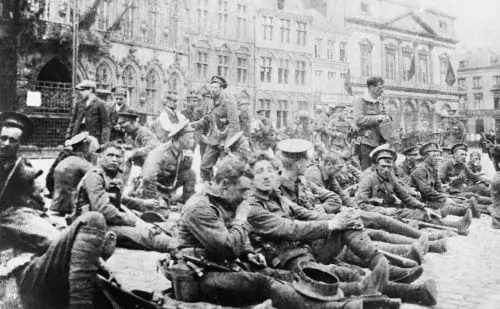
The Battle of Mons on August 23, 1914, gave Britain one of the First World War’s most enduring supernatural legends. The British Expeditionary Force, encountering the advancing German First Army in Belgium, inflicted substantial losses but withdrew when the broader Allied position became untenable. The retreat that followed was exhausting, confused, and psychologically disorienting. Soldiers marched for days with little sleep, uncertain information, and persistent fear of encirclement. At home, incomplete reports created an equally fertile atmosphere for rumor. Britain’s small professional army had entered its first major continental battle, fought effectively, and then retreated before a numerically superior enemy. That combination of courage, danger, and apparent deliverance invited explanation. Within a year, popular accounts claimed that supernatural beings had appeared above or beside the British lines, shielding the troops, halting the Germans, or guiding exhausted soldiers away from destruction. The beings were variously described as angels, luminous figures, heavenly cavalry, a solitary radiant protector, or the spectral bowmen of medieval England. What later became known collectively as the Angel of Mons was never a single stable story. It was an expanding family of narratives shaped by fiction, religious expectation, battlefield rumor, patriotic memory, and the emotional needs of a nation confronting industrial war.
The most important catalyst was Arthur Machen’s “The Bowmen,” published in the London Evening News on September 29, 1914. Machen, a Welsh author known for supernatural fiction, imagined a remnant of British soldiers facing annihilation during the retreat from Mons. One soldier remembers a sign he had seen on the plates of a vegetarian restaurant and invokes Saint George through the Latin phrase Adsit Anglis Sanctus Georgius, “May Saint George be a present help to the English.” A spectral army of archers then appears between the British and German forces. These are the bowmen of Agincourt, recalled from the heroic past to defend their descendants, and their invisible arrows destroy the approaching enemy. Machen presented the account as fiction, not testimony, but its realistic wartime setting and journalistic venue allowed it to detach itself from its author’s intentions. The story also united several traditions already familiar to British readers. Saint George represented divine patronage and national identity; Agincourt recalled Shakespearean heroism and victory against superior numbers; the medieval longbow symbolized an imagined age when English courage and skill had overcome continental power. Machen’s tale answered modern anxiety with ancestral continuity. Machine guns and mass armies might have transformed warfare, but the nation remained guarded by the sanctified dead of its heroic past.
The legend did not spread merely because readers mistook one story for a news report. During the spring and summer of 1915, clergymen, spiritualists, occult periodicals, newspapers, and pamphleteers circulated accounts attributed to wounded soldiers, unnamed officers, nurses, or acquaintances who had allegedly spoken with eyewitnesses. With each retelling, Machen’s bowmen changed. Some versions described angels with wings; others reported a luminous cloud, mounted warriors, or a figure resembling Saint George. The lack of named witnesses rarely weakened belief because anonymity could be explained by military censorship, modesty, wounds, or official reluctance to acknowledge a miracle. Distance from the original event made the legend more adaptable rather than less persuasive.
Machen repeatedly insisted that he had invented “The Bowmen,” but his denial became part of the controversy. Those committed to the story’s truth argued that he had unconsciously recorded an event that had actually occurred, received supernatural knowledge without recognizing it, or merely supplied literary form to reports already circulating among soldiers. Harold Begbie’s On the Side of the Angels defended the possibility of divine intervention, while Ralph Shirley’s The Angel Warriors at Mons assembled alleged testimony and historical parallels intended to demonstrate that heavenly assistance in battle was neither unprecedented nor irrational. The controversy reveals how wartime legends establish authority. A report repeated by several newspapers appeared independently confirmed even when the publications relied upon the same unnamed source. A story heard from a soldier’s relative acquired the prestige of eyewitness testimony after the stages of transmission disappeared. Variations became evidence that numerous people had seen the same event rather than signs that the narrative was evolving. Later references to phantom cavalry or unusual lights during the retreat may reflect exhaustion, misperception, rumor, or independent supernatural traditions, but they do not establish that an angelic force intervened at Mons. No reliable contemporary German evidence demonstrates that celestial beings terrified German troops or stopped their advance. The legend’s clearest effects occurred among British civilians and religious audiences, for whom it provided reassurance that retreat did not mean divine abandonment.
The Angel of Mons flourished because it restored moral purpose to an environment governed by confusion and chance. Modern battle concealed causes from those experiencing their effects: shells arrived from unseen batteries, units disappeared into smoke, comrades survived or died for no apparent reason, and official reports offered little help in understanding what had happened. Supernatural intervention made survival intentional. It suggested that the British army had escaped not because of German hesitation, Allied movements, logistical limits, or the uncertain rhythm of pursuit, but because the nation remained under providential protection. The story also preserved the intimacy of older warfare within an impersonal conflict. Medieval archers, mounted saints, and winged guardians could see individual soldiers and choose to save them, whereas industrial weapons killed without recognition. Yet the legend should not be reduced to cynical propaganda or popular credulity. It emerged from the interaction of fiction, faith, fear, grief, censorship, and sincere efforts to interpret experiences that exceeded familiar explanation. The fog surrounding Mons was more than meteorological or tactical. It marked a space in which modern information failed, inherited traditions returned, and a retreat became a revelation of national destiny.
Gallipoli and the Making of the Anzac Legend
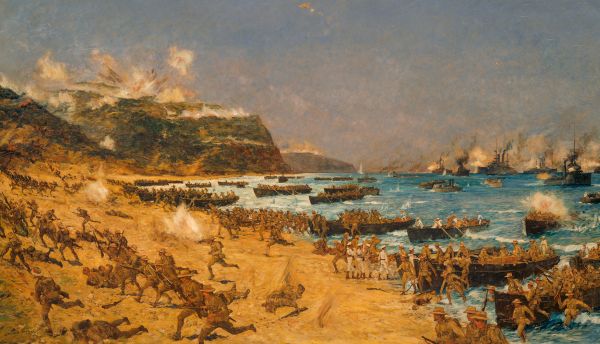
The Gallipoli campaign began as an Allied attempt to force the Dardanelles, weaken the Ottoman Empire, and reopen a maritime route to Russia. After the naval attack failed in March 1915, British and imperial forces landed on the peninsula on April 25. Among them were troops of the Australian and New Zealand Army Corps, whose name would soon be compressed into the term “Anzac.” The landings produced immediate confusion. Units came ashore under fire, became separated in broken terrain, and struggled to secure defensible positions against Ottoman troops who recovered rapidly from the initial assault. The campaign then hardened into trench warfare marked by heat, disease, inadequate water, exposed supply lines, and repeated attacks that achieved little at enormous cost. By the time the Allied evacuation ended in January 1916, the expedition had failed to seize the straits or remove the Ottoman Empire from the war. Yet Gallipoli acquired a historical significance far greater than its strategic result. For Australia and New Zealand, military defeat became the setting for a national revelation.
The Anzac legend developed from the claim that the soldiers’ conduct at Gallipoli had disclosed the essential character of their young nations. Australia had federated only in 1901, and New Zealand had achieved dominion status in 1907. Neither possessed a long independent political history comparable to that claimed by the older European powers. Gallipoli offered what constitutional development could not: a dramatic ordeal through which national identity appeared to have been tested and proven. The Anzac soldier was represented as physically capable, resourceful, egalitarian, irreverent toward authority, loyal to comrades, and unusually steady under pressure. His virtues supposedly arose from colonial conditions rather than formal military tradition. He was not the polished European professional but the practical citizen-soldier whose independence made him adaptable and whose suspicion of hierarchy did not prevent disciplined courage when his companions depended upon him. The powerful idea of “mateship” placed loyalty among ordinary soldiers at the center of national character. In this formulation, Australia and New Zealand had not merely participated in a British imperial war; they had discovered themselves through sacrifice. The legend was not created by soldiers alone. Journalists, official historians, politicians, clergy, bereaved families, veterans’ organizations, and commemorative institutions all helped shape its enduring form. Charles Bean, Australia’s official war correspondent and later official historian, became particularly influential in defining the Anzac as a democratic type whose moral worth had been forged before enlistment in the social conditions of Australia. His descriptions preserved genuine qualities of endurance and comradeship, but they also selected from a much wider range of behavior. Fear, indiscipline, exhaustion, resentment, self-inflicted wounds, desertion, psychological collapse, and criticism of command fitted uneasily within the heroic model. Bean’s Anzac was also characteristically white, masculine, and Anglo-Celtic. Indigenous Australians who served, migrants from non-British backgrounds, women working as nurses, and those who opposed conscription or the war itself occupied uncertain or marginal positions in the emerging national story. The legend did more than commemorate courage. It established a standard against which citizenship and belonging could be judged.
Gallipoli’s transformation from failed expedition into sacred national history resembled tragedy more than conventional victory narrative. The campaign contained ambition, miscalculation, courage, suffering, endurance, and irreversible loss. Its dead could be understood as sacrificial founders whose blood marked the nation’s passage into maturity. Anzac Cove became a sacred landscape, while April 25 evolved into a day of mourning, civic ceremony, military memory, and national reflection. Dawn services reproduced the emotional atmosphere of the original landing and gave commemoration a ritual structure: darkness, assembly, silence, remembrance, and the symbolic return of light. The location of Gallipoli beyond the national homeland strengthened rather than weakened its significance. Pilgrimage to the peninsula allowed visitors to encounter national origins in a distant landscape made sacred by burial and memory. Defeat could be described as moral triumph because the campaign had supposedly revealed qualities more valuable than territorial success. The nation had lost the battle but gained proof of its courage.
That interpretation becomes more complicated when Gallipoli is restored to its wider imperial and Ottoman setting. Australians and New Zealanders fought alongside British, French, Indian, Newfoundland, and other forces, while Ottoman soldiers defended their own territory under difficult conditions and suffered enormous casualties. Mustafa Kemal’s role in organizing resistance later became central to Turkish national memory, and the campaign was incorporated into the story of the republic that emerged after the Ottoman collapse. Gallipoli consequently became the site of several overlapping myths: Anzac national birth, British imperial failure, Ottoman defense, and Turkish resurrection. These narratives preserved real sacrifice, but each selected different participants and meanings. The Anzac legend remains powerful because it converted a military disaster into a morally coherent national origin, yet its endurance depends upon recognizing both its achievements and its exclusions. Gallipoli did not simply reveal a timeless Australian or New Zealand character waiting to emerge. The campaign supplied experiences from which later generations constructed an ideal of nationhood, one repeatedly celebrated, challenged, broadened, and revised.
The Mythic Memory of the First World War
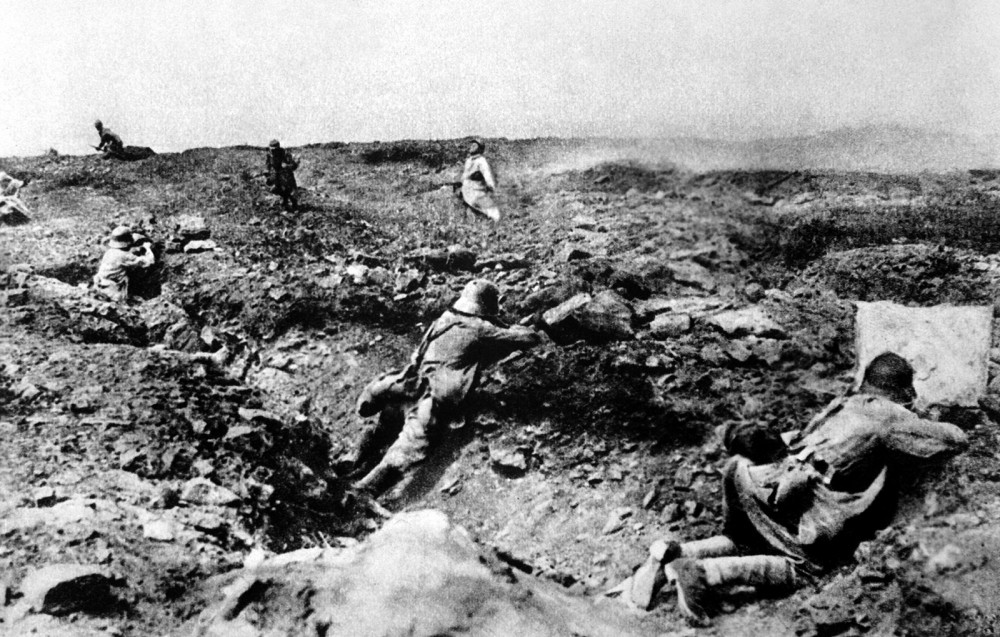
The First World War left European societies with a problem that military victory alone could not solve: how could the deaths of millions be made intelligible to those who survived them? Governments had entered the conflict promising defense, honor, and national renewal, but the prolonged slaughter strained every language of justification. Families received standardized notices announcing deaths that had occurred far away, often without recoverable bodies or reliable descriptions of the circumstances. Entire communities lost sons, brothers, husbands, pupils, workers, and parishioners within a few years. Because so many of the dead could not be returned home, mourning was separated from the physical presence around which funerary ritual had traditionally been organized. Public commemoration responded by transforming absence into collective meaning. The fallen were described not merely as casualties but as sacrifices whose deaths had preserved the nation, defended civilization, or created an obligation that the living must continue to honor.
Religious language was central to this transformation, even in increasingly secular societies. Christian images of sacrifice, resurrection, martyrdom, and eternal life allowed wartime death to be interpreted within familiar structures of suffering and redemption. Soldiers were compared to Christ when they surrendered their lives for others, while military cemeteries were described as sacred ground consecrated by blood. Clergy frequently presented death in battle as an act of self-giving rather than as the impersonal result of artillery, disease, or failed command. Yet wartime commemoration was not simply traditional Christianity applied unchanged to modern conflict. It produced a civic religion in which the nation itself became the beneficiary of sacrifice. Public ceremonies joined prayers, military uniforms, flags, silence, and political speeches. The soldier’s death could be simultaneously Christian, patriotic, imperial, and familial. This combination made remembrance broadly accessible, but it also blurred the distinction between mourning the dead and sanctifying the policies that had placed them in danger.
Classical imagery offered another means of disciplining grief. Memorials adopted columns, arches, temples, laurel wreaths, recumbent warriors, and inscriptions modeled upon Greek and Roman precedents. The restrained neoclassical style suggested permanence, dignity, order, and the endurance of civilization beyond individual death. It imposed visual stability upon a war remembered through mud, mutilation, and shattered landscapes. Ancient forms seemed capable of containing emotions that modern political language could not.
The treatment of unidentified bodies revealed the depth of the commemorative crisis. Industrial warfare had destroyed or separated countless remains from the names attached to them. The unknown soldier emerged as a solution to this anonymity. Britain buried its Unknown Warrior in Westminster Abbey on November 11, 1920, while France placed its unknown soldier beneath the Arc de Triomphe. Comparable ceremonies appeared elsewhere. Each body was physically singular but symbolically universal: it might be any missing son, husband, comrade, or citizen. The inability to identify the dead, ordinarily a mark of war’s destructive power, became the basis of a new national representation. The unknown soldier belonged to every bereaved family and to none exclusively. His anonymity erased distinctions of class, region, occupation, and sometimes military rank, allowing the state to present the army as a unified community of sacrifice. Yet this apparent universality had limits. The representative dead soldier was usually imagined as male, loyal, able-bodied before enlistment, and fully incorporated into the nation. Colonial troops, racial minorities, women workers, nurses, conscientious objectors, civilian victims, and soldiers executed by their own armies did not fit easily within the central commemorative figure. The unknown soldier could unite a nation partly because the differences among actual war experiences were buried with him.
The Imperial War Graves Commission created another powerful mythology of equality through its cemeteries. Uniform headstones, standardized inscriptions, carefully designed landscapes, and the refusal to repatriate British imperial war dead suggested that all ranks shared a common resting place near the battlefields where they had fallen. Sir Edwin Lutyens’s Stone of Remembrance and Sir Reginald Blomfield’s Cross of Sacrifice combined civic abstraction with Christian symbolism. Rudyard Kipling, whose own son had disappeared at Loos, helped shape the language used in these spaces, including the biblical phrase “Their Name Liveth for Evermore.” The cemeteries rejected elaborate private monuments that would have reproduced class distinctions, but their disciplined uniformity also placed grief within an imperial system. Individual bereavement was acknowledged through names, regiments, dates, and personal inscriptions, yet every grave participated in a larger visual argument: the dead had served a common cause, and the empire would preserve their memory with permanent order.
The cult of sacrifice did not eliminate bitterness. Bereaved families could accept the honor granted to the dead while privately doubting the competence of commanders or the purpose of the conflict. Veterans might attend commemorations yet reject speeches that romanticized battle. Antiwar writers appropriated the same language of sacrifice to accuse political leaders of wasting a generation. Remembrance was never a simple consensus. Its symbols were powerful precisely because they could hold grief, pride, anger, and doubt without resolving them.
Germany’s defeat gave commemoration a particularly volatile political meaning. Because the armistice had arrived without Allied armies occupying most German territory, nationalists could claim that the army had not been defeated militarily but had been betrayed by civilians at home. The “stab-in-the-back” legend recast strategic failure, exhaustion, blockade, political collapse, and military defeat as an act of internal treason committed by revolutionaries, socialists, democrats, and Jews. Fallen soldiers were recruited into this myth as witnesses against the Weimar Republic. Their deaths supposedly demanded not reconciliation but national revenge and political purification. Right-wing monuments and veterans’ rituals emphasized martial endurance, comradeship, and unfinished struggle, while republican commemorations attempted to mourn the dead without endorsing militarist restoration. The conflict over memory demonstrated that sacrifice did not possess a single political meaning. It could support democratic mourning, pacifist warning, imperial continuity, national unity, or authoritarian rebirth. By converting the dead into moral authorities, postwar societies made remembrance indispensable but also dangerous. The fallen could not speak for themselves, and those who claimed to interpret their sacrifice acquired considerable power over the future.
From Defeat to Resurrection: Fascism and the Politics of National Rebirth

The end of the First World War did not dissolve the myths of sacrifice created between 1914 and 1918. It made them available for new political purposes. Across Europe, veterans returned to societies marked by inflation, unemployment, revolution, territorial change, and disputes over who had benefited from the suffering at the front. The language of wartime unity survived even as the unity itself collapsed. Fascist movements exploited this disjunction by claiming that the nation had revealed its authentic character in combat but had been betrayed during the peace. Parliamentary debate, class conflict, liberal individualism, socialism, feminism, and cultural experimentation could all be portrayed as symptoms of postwar disintegration. Against them, fascists offered a promise of regeneration. The nation would recover the courage, discipline, comradeship, and willingness to sacrifice supposedly displayed in the trenches, but it would redirect those qualities toward permanent political transformation. War was no longer only an event to be remembered. It became the model for a purified society organized around obedience, struggle, and collective destiny.
This politics drew much of its emotional force from the fascist movement’s ability to present revolution as restoration. Fascists promised a radically new order, yet they described that order as the recovery of an ancient national essence. Roger Griffin has termed this structure “palingenetic ultranationalism”: the belief that a decadent nation must die and be reborn through an authoritarian movement capable of restoring its organic unity. Rebirth distinguished fascism from ordinary conservatism. Conservatives might defend hierarchy, property, religion, or monarchy, but fascists insisted that existing institutions had become too weak to save the nation. Only a revolutionary remaking of society could recover the virtues attributed to an idealized past.
Italian Fascism developed one of the clearest versions of this regenerative myth. Benito Mussolini’s movement invoked the Roman Empire, the discipline of the legion, and the grandeur of imperial rule while presenting Fascism as a modern force suited to industry, aviation, mass politics, and technological warfare. Roman symbols did not bind the regime to antiquity; they made dictatorship and expansion appear as the fulfillment of Italy’s historical vocation. The Fascist seizure of power was staged as both a national resurrection and the completion of the First World War. The March on Rome in October 1922 acquired a ritual significance exceeding the limited military danger actually posed by the Fascist squads. It became a founding episode in which disciplined militants had supposedly rescued Italy from parliamentary weakness and socialist revolution. Mussolini’s regime cultivated uniforms, salutes, banners, mass rallies, funerals, monumental architecture, youth organizations, and commemorations of the Fascist dead. These practices turned political participation into a sequence of ceremonies affirming membership in a sacred national community. The dead of the movement were represented as martyrs whose blood had prepared the nation’s rebirth, while the leader appeared as the figure capable of translating sacrifice into destiny. Emilio Gentile has described this sacralization of politics as a defining feature of Fascism: the movement sought not merely obedience to government but emotional faith in a collective mission. Its rituals gave abstract claims about nation and empire a bodily form through marching, chanting, saluting, assembling, and mourning.
German National Socialism inherited many of these fascist patterns but joined them to the particular memory of German defeat. The Nazi movement accepted the “stab-in-the-back” legend and represented the Weimar Republic as the political product of betrayal. Germany’s military losses, economic suffering, and diplomatic humiliation were attributed not to the failures of imperial leadership and military strategy but to internal enemies who had allegedly poisoned national unity. Adolf Hitler presented the postwar crisis as evidence of racial and moral degeneration. National resurrection required more than constitutional change. It demanded the removal of those identified as alien, corrupting, or biologically dangerous. The myth of rebirth was inseparable from a myth of purification.
The Nazi ideal of the Volksgemeinschaft, or national community, promised to overcome class, regional, confessional, and political divisions by incorporating “racially valuable” Germans into a single body. The promise could attract workers resentful of economic insecurity, veterans who longed for lost comradeship, middle-class citizens fearful of social decline, and nationalists outraged by Versailles. Yet its apparent inclusiveness depended upon exclusion. Jews, Roma, disabled people, political opponents, homosexuals, and others designated as alien or degenerate were denied membership in the regenerated nation. Violence against them could then be represented not as persecution but as national self-defense. Nazi rallies, marches, flags, memorial ceremonies, and the cult surrounding Hitler dramatized the supposed passage from humiliation to unity. The Führer became the personal embodiment of national will, while the movement claimed to complete the unfinished sacrifice of the war dead. Fascist rebirth was never an innocent appeal to confidence after defeat. It required a fallen nation, a corrupt present, a heroic vanguard, an internal enemy, and a future purification. By converting historical crisis into a drama of death and resurrection, fascism made dictatorship appear restorative, political violence cleansing, and renewed war the possible fulfillment of national destiny.
Inventing the Aryan: The Myth of Ancient Blood
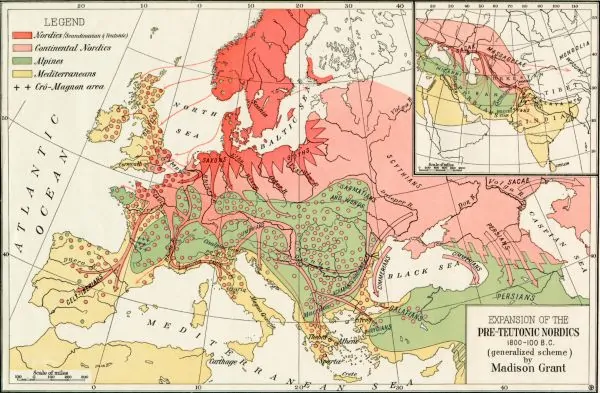
The “Aryan” race invoked by National Socialism was not the recovery of an ancient biological people whose identity had remained intact across millennia. It was a modern ideological construction assembled from comparative linguistics, biblical chronology, racial anthropology, nationalism, imperialism, antisemitism, and speculative prehistory. The term acquired authority because it appeared to join scientific discovery with ancestral revelation. It promised to identify the original creators of European civilization, explain the rise and decline of nations, and locate modern political conflict within an immense struggle among inherited bloodlines. By the early twentieth century, a word that had once referred in limited historical contexts to particular peoples and languages had been transformed into the name of an imagined master race.
The process began with genuine scholarly discoveries. During the late eighteenth and nineteenth centuries, European philologists demonstrated that Sanskrit, Greek, Latin, Persian, Germanic, Celtic, Slavic, and other languages shared structural and lexical relationships. These findings led scholars to reconstruct the Indo-European language family and to propose earlier communities whose speech had preceded the historical languages known from surviving texts. “Aryan,” derived from ancient Indo-Iranian forms of self-designation, was sometimes used for the Indo-Iranian branch and, less carefully, for Indo-European languages more broadly. The existence of related languages did not prove the existence of a single biologically pure race. Languages can spread through migration, conquest, commerce, intermarriage, political prestige, and cultural assimilation. Populations may adopt new languages without being physically replaced, while people with similar ancestry may speak unrelated languages. Nineteenth-century racial theorists collapsed these distinctions. They converted a linguistic relationship into a genealogy of blood and then treated that imagined genealogy as the hidden structure of world history.
Writers such as Arthur de Gobineau and Houston Stewart Chamberlain gave this transformation a sweeping historical form. Gobineau argued that civilizations rose through the creative power of superior races and declined through racial mixture. Chamberlain placed the “Teutonic” or Germanic peoples at the center of European achievement and linked racial history to an increasingly militant antisemitism. Neither produced a coherent biological science. Their racial categories shifted according to the civilizations, individuals, and political outcomes they wished to explain. Yet their works made inequality appear ancient, natural, and historically demonstrable rather than politically invented.
In the German-speaking world, these ideas entered a broader völkisch culture preoccupied with the relationship among race, soil, language, folklore, religion, and national character. Industrialization, urbanization, socialism, liberalism, immigration, secularization, and rapid social change generated fears that the authentic people had become estranged from their ancestral foundations. The Volk was imagined not merely as the population governed by a state but as an organic community united by descent and rooted in a particular landscape. Nordic racial theorists increasingly portrayed northern Europeans as the tallest, most creative, disciplined, and politically gifted branch of humanity. Hans F. K. Günther, whose racial classifications became influential in National Socialist circles, divided Europeans into several supposed racial types while assigning the Nordic element a privileged role in cultural creation and state-building. Such theories were riddled with contradictions. Germans did not form a physically uniform population, and theorists disagreed about which bodily measurements, skull shapes, hair colors, or facial features revealed racial essence. The difficulty of locating the supposedly pure Aryan in actual human bodies did not discredit the myth. It encouraged increasingly elaborate systems of classification intended to extract racial truth from visible diversity.
National Socialism fused these traditions into a political worldview rather than adopting a single consistent racial theory. Hitler described history as an unending struggle among races for territory, survival, and domination. Alfred Rosenberg presented European civilization as the creation of a Nordic racial soul threatened by Jewish influence, Christianity in some of its forms, liberalism, Marxism, and racial mixture. Richard Walther Darré joined “blood and soil” ideology to an idealized German peasantry whose hereditary relationship with the land supposedly preserved racial health. Himmler’s SS cultivated Germanic symbols, ancestral research, and settlement fantasies intended to produce a new racial elite. These figures did not agree on every historical or religious claim. Some emphasized biology, others cultural spirit, peasant inheritance, Germanic antiquity, or speculative migrations from northern homelands. Their disagreements mattered less than their common assumption that humanity was divided into unequal hereditary groups and that politics should secure the future of the superior race.
The myth became dangerous when it was translated from ideological assertion into administrative practice. After 1933, the Nazi state attempted to determine who belonged to the racial community through genealogies, birth records, marriage certificates, medical examinations, and bureaucratic definitions of ancestry. “Aryan” status affected employment, professional licensing, education, marriage, citizenship, and access to public life. The Nuremberg Laws of 1935 did not identify Jews primarily by religious belief or personal self-understanding but through the recorded religious affiliations of parents and grandparents. This procedure exposed the fiction at the heart of Nazi racial science. Officials claimed to classify biological essence, yet they frequently relied upon documentary evidence created by religious institutions. A person’s supposed blood identity could be determined through church or synagogue records rather than genetic knowledge. The category was fabricated, but the consequences were concrete: exclusion, dispossession, forced emigration, sterilization, deportation, enslavement, and murder. The Aryan myth also legitimized expansion beyond Germany. If the Nordic or Germanic race had created civilization, then conquest could be represented as the recovery of a historical inheritance rather than the seizure of another people’s land. Archaeology, folklore, place-names, linguistic resemblance, and medieval settlement were used selectively to claim ancient German presence across Eastern Europe. Slavic populations could be portrayed as racially inferior occupants of territory destined for German colonization, while Jews were cast as a rootless counter-race directing both capitalism and Bolshevism against the organic nation. Such claims were logically incompatible but mythically effective. The enemy did not need to occupy one consistent social position; it needed to explain every form of disorder.
The invention of the Aryan demonstrates how modern myth can disguise itself as scientific recovery. Nazi racial ideology did not preserve an ancient memory. It projected contemporary anxieties and ambitions backward, created a heroic ancestor from linguistic fragments, and then treated that imagined ancestor as a biological command. Its power came from joining the antiquity of blood to the authority of modern expertise. Philologists, anthropologists, physicians, genealogists, teachers, and administrators supplied categories through which fantasy acquired institutional form. The Aryan master race never existed as the Nazis described it, but the state organized millions of real lives around its supposed existence. Myth became lethal not when it remained a story about distant origins, but when governments claimed the power to identify its descendants.
Tacitus Recruited: Ancient Germany and the Manufacture of Racial Continuity

Few ancient works proved more useful to German racial nationalism than Tacitus’s Germania. Written around 98 CE, the brief ethnographic treatise described peoples living beyond Rome’s Rhine and Danube frontiers. Tacitus portrayed these communities through contrasts familiar to Roman moral writing: northern simplicity against metropolitan luxury, martial courage against political servility, sexual restraint against decadence, and freedom against imperial corruption. His Germans were not presented as a modern nation, and the text made no claim that they constituted a biologically uniform population whose character would remain unchanged for two thousand years. Tacitus named numerous peoples, emphasized differences among them, and relied upon reports whose accuracy varied. Nevertheless, later readers increasingly detached his observations from their Roman literary context. What may have served partly as criticism of Rome became evidence for the eternal qualities of Germany.
This transformation began centuries before National Socialism. The rediscovery and circulation of Germania among Renaissance humanists encouraged scholars within the Holy Roman Empire to search the text for an ancestral history comparable to the prestigious classical past claimed by Italians. During the Reformation and the rise of territorial states, Tacitus could support arguments about German independence from Rome, resistance to foreign authority, and the antiquity of native institutions. Nineteenth-century nationalism intensified these uses. The many peoples described by Tacitus were gradually compressed into a single primordial German nation, while Arminius, the Cheruscan leader responsible for the destruction of three Roman legions in 9 CE, became Hermann, liberator of the fatherland. The qualities Tacitus had attributed unevenly to different communities were reorganized into a unified national character: courage, loyalty, chastity, fertility, simplicity, love of freedom, and rootedness in the northern landscape. Modern Germans could then be represented not as members of a recently unified state but as descendants of an ancient people whose essential virtues had survived conquest, conversion, migration, dynastic division, and social transformation.
The movement from national genealogy to racial continuity required a further distortion. Ancient names were treated as biological categories, cultural descriptions as hereditary traits, and geographical proximity as proof of common blood. The extraordinary mixture and movement that had characterized central European history disappeared from view. Roman soldiers, provincial populations, Slavic communities, Jewish settlements, migrating peoples, religious converts, and generations of intermarriage complicated any claim of uninterrupted descent. Racial theorists answered that complexity not by abandoning the ancestral model but by distinguishing between the supposedly pure racial core and later corrupting influences.
Under National Socialism, Germania became valuable because it appeared to give ancient authority to policies already grounded in modern racial ideology. Nazi scholars and propagandists emphasized passages concerning physical appearance, marriage, sexual morality, warfare, assemblies, hospitality, and the alleged absence of extensive intermarriage with foreign peoples. Tacitus’s claim that the Germans were indigenous and comparatively unmixed could be presented as testimony to an original racial purity that the Third Reich was obligated to recover. His account of severe punishments for certain sexual offenses and public admiration for martial courage could be incorporated into demands for reproductive discipline, masculine hardness, female fertility, and obedience to the racial community. Yet the Nazis did not simply repeat Tacitus. They translated him through nineteenth- and twentieth-century racial anthropology, Nordicism, eugenics, antisemitism, and the völkisch cult of blood and soil. The ancient text supplied prestige and apparent continuity; modern ideology determined what its passages were made to mean. Heinrich Himmler’s interest in the manuscript tradition of Germania, including the celebrated Codex Aesinas discovered in Italy, reflected the symbolic importance attached to the work. To Himmler, the manuscript was not merely a valuable witness to a Roman author. It represented documentary confirmation that the German racial order imagined by the SS possessed roots in antiquity.
Recruiting Tacitus allowed the regime to disguise revolution as restoration. Nazi racial policies radically reorganized citizenship, family life, scholarship, education, territorial ambition, and the relationship between individuals and the state, but they were presented as the recovery of principles already visible among the ancient Germans. The racial community appeared older and more legitimate than Christianity, liberalism, parliamentary government, or the modern nation-state. This claim depended upon circular reasoning: ideologues first defined the traits they considered authentically German, located similar language in an ancient Roman text, and then cited that text as proof that those traits were timeless. Tacitus did not transmit a racial command from antiquity to the Third Reich. Modern interpreters manufactured that command by suppressing historical change and converting literary ethnography into ancestral evidence. The danger lay not within Germania alone, but in the institutions that claimed the authority to determine which version of the past would govern the living.
Runes and Himmler’s Imagined Germanic Order
Heinrich Himmler did not envision the SS merely as a police force, military formation, or instrument of party discipline. He imagined it as the racial and moral vanguard of a future Germanic empire: an elite order whose members would embody obedience, hereditary fitness, martial hardness, and devotion to the German people. This self-image gave symbols and ceremonies an importance beyond decoration. Uniforms, genealogical requirements, marriage regulations, funerary practices, insignia, and rituals of admission helped persuade SS members that they belonged to a community separated from ordinary society. The organization’s violence could then be represented not as criminal coercion but as the necessary work of guardians entrusted with preserving the race.
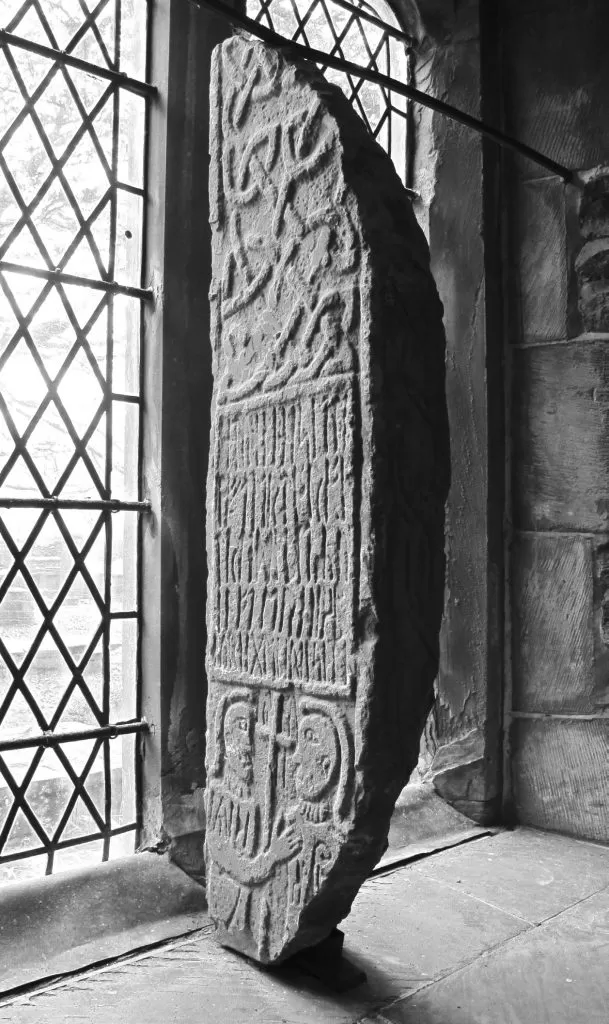
Runes were useful because they appeared to connect the modern organization to an ancestral world older than Christianity and the contemporary state. The double lightning-like emblem of the SS was based on a stylized Sig rune devised by Walter Heck in 1929. Its visual form drew upon the modern runic system popularized by the Austrian occultist and völkisch writer Guido von List rather than directly reproducing an uncontested ancient alphabet. List’s so-called Armanen runes were themselves a modern esoteric reconstruction that assigned mystical, racial, and national meanings to selected signs. The SS nevertheless presented its emblem as though it expressed an authentic Germanic inheritance. Other runic forms appeared throughout Nazi and SS culture. The Odal rune signified inheritance, kinship, and ancestral property; the Tyr rune suggested struggle, leadership, and martial sacrifice; the Lebensrune and Todesrune marked life and death in documents and memorial notices. Their power came from their visual simplicity and supposed antiquity. A single sign could condense claims about blood, soil, fertility, death, loyalty, and destiny without requiring a coherent theology. Modern graphic design masqueraded as ancestral revelation. These symbols did not prove that the SS had recovered a surviving Germanic religion. They demonstrated how effectively invented traditions could be made to feel ancient.
Wewelsburg Castle became the most ambitious architectural expression of Himmler’s vision. In 1934, the SS leased the Renaissance castle near Paderborn and began transforming it into a training center and ideological site. Himmler appears to have imagined Wewelsburg as a future spiritual and ceremonial center for the SS leadership, although plans changed repeatedly and remained incomplete. The castle’s triangular shape and prominent North Tower encouraged elaborate symbolic interpretations. Within that tower, the SS constructed the Obergruppenführer Hall, a circular meeting room apparently intended for senior leaders, and a lower vaulted chamber often described as a crypt or ceremonial vault. The floor of the upper hall contained a twelve-spoked radial design later popularized under the name “Black Sun.” That term was not the established SS name for the mosaic and became widely associated with it only after the war. No surviving evidence demonstrates that the room hosted the elaborate occult rites later attributed to it in popular culture. Wewelsburg was unquestionably ideological, but its documented significance lay in elite formation, architectural symbolism, racial education, and Himmler’s plans for a permanent SS order rather than in proven magical ceremonies.
The castle’s development depended upon the same coercive system the symbolism was intended to glorify. Prisoners from the nearby Niederhagen concentration camp supplied forced labor for construction and quarrying under brutal conditions. Hundreds died through mistreatment, malnutrition, disease, executions, and lethal labor. This proximity between ceremonial ambition and human suffering exposes the essential character of the SS myth. The organization presented itself as a brotherhood of racially selected guardians, but the material creation of its sacred center relied upon imprisonment, exploitation, and death. The imagined Germanic order did not stand apart from the concentration-camp system; it was built through it.
Himmler’s religious ambitions remained eclectic and inconsistent. He admired selected elements of Germanic mythology, ancestor veneration, solstice observances, medieval military orders, peasant tradition, racial biology, and esoteric speculation. He encouraged ceremonies intended to reduce dependence upon Christian baptism, marriage, and burial, and he hoped that the SS would develop customs appropriate to a racially conscious elite. Yet neither the SS nor the Nazi regime established a single, systematic pagan faith. Some National Socialists continued to describe themselves as Christians, while others promoted a heavily racialized “positive Christianity,” attacked church authority, or expected Christianity gradually to disappear. Himmler’s own ideas combined fragments that would not have formed a coherent religion outside the political structure that held them together. Their unity came from the SS mission itself: reproduction of the allegedly valuable population, obedience to the Führer, conquest of living space, suppression of enemies, and creation of a racially ordered Europe. Runes and Wewelsburg made that mission appear timeless. They offered SS members an invented ancestry through which modern bureaucracy, technological warfare, and organized mass violence could be experienced as the revival of an ancient sacred duty.
The Ahnenerbe: Archaeology in the Service of Racial Empire
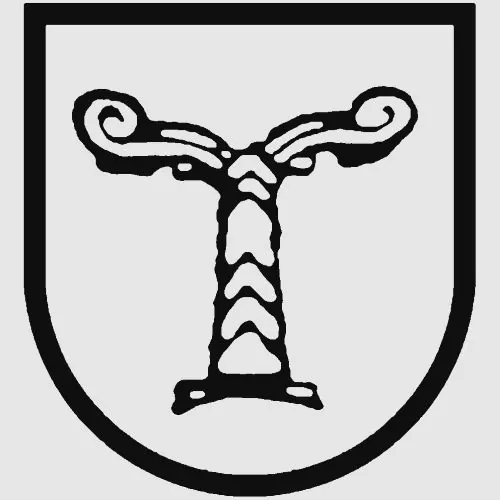
The Ahnenerbe emerged from Heinrich Himmler’s conviction that the SS required scholarly proof for the racial history it claimed to defend. Founded in 1935 by Himmler, the Dutch-German prehistorian Herman Wirth, and the agricultural ideologue Richard Walther Darré, the organization was initially named the Society for Research and Teaching on German Ancestral Heritage. It was later absorbed more fully into the SS and expanded under the administrative direction of Wolfram Sievers. Its institutes investigated archaeology, folklore, linguistics, ethnography, physical anthropology, religious customs, ancient texts, and supposed traces of prehistoric Germanic culture. These fields were not inherently pseudoscientific, and many had long-established academic traditions. The Ahnenerbe’s corruption lay in the questions it required them to answer. Research was expected to demonstrate that a Nordic or Indo-Germanic race had created the highest civilizations, spread across immense territories in prehistory, and preserved an ancestral inheritance that the SS was restoring. Instead of permitting evidence to test racial assumptions, the organization treated those assumptions as conclusions awaiting confirmation.
Archaeology was particularly useful because material objects seemed capable of converting myth into visible fact. Pottery, graves, weapons, settlement patterns, inscriptions, symbols, and architectural remains could be displayed as evidence that supposedly Germanic peoples had occupied particular territories since antiquity. The interpretation of such remains often depended upon circular reasoning. Artifacts identified as culturally Germanic were used to prove the presence of Germanic populations, while the presumed presence of those populations determined which artifacts were classified as Germanic. Excavations and surveys in Germany promoted images of a sophisticated ancestral society that contradicted Roman depictions of northern barbarism. Research in Scandinavia, the Alps, Eastern Europe, and other regions sought traces of ancient Nordic migration or influence. The Ahnenerbe also supported folklore collection, studies of runes and traditional customs, and investigations of sites that could be incorporated into a sacred geography of German origins. Some projects were methodologically conventional, while others pursued speculative claims about prehistoric civilizations, vanished racial homelands, or the hidden meanings of myth. This mixture gave ideological fantasy the appearance of professional credibility. Serious excavation reports, measurements, photographs, and linguistic comparisons could stand beside conclusions determined by racial doctrine, allowing the authority of scholarship to protect claims that the evidence did not sustain.
The organization’s 1938–1939 expedition to Tibet illustrates this ambiguity. Led by the zoologist and explorer Ernst Schäfer, the expedition collected animals, plants, ethnographic objects, photographs, bodily measurements, and observations of Tibetan culture. Its participants performed work recognizable as zoology, geography, and anthropology, but their research existed within an SS environment interested in alleged racial connections between Europeans and Asian populations. Physical anthropologist Bruno Beger measured skulls, facial features, and bodies in an effort to classify Tibetans according to racial typologies. The expedition did not discover an Aryan homeland, nor was it simply a search for magical secrets. Its significance lay in the ease with which exploration and scientific collection could be directed toward a racial narrative already accepted by its sponsors.
War transformed the Ahnenerbe from an ideological research organization into a participant in imperial occupation and organized criminality. German conquest opened archaeological sites, libraries, museums, universities, and cultural collections to SS investigation and appropriation. Researchers helped identify objects and records considered valuable to German ancestral history, while scholarship supported claims that conquered lands had once belonged to Germanic peoples and should again be reorganized under German rule. Archaeology accompanied settlement planning and population classification. It gave territorial expansion the appearance of historical restoration. The organization’s most direct descent into lethal crime occurred through the Institute for Military Scientific Research, established within the Ahnenerbe during the war. Under Sievers’s administration, SS physicians conducted or supported experiments on concentration-camp prisoners, including freezing and high-altitude experiments at Dachau intended to address problems faced by German airmen and soldiers. August Hirt’s project at the Reich University of Strasbourg sought to create a collection of Jewish skeletons by selecting prisoners at Auschwitz, transporting them to Natzweiler-Struthof, murdering them, and preserving their bodies for anatomical preparation. Beger, who had participated in the Tibet expedition, assisted in selecting victims through racial measurements. The project exposed the continuity between seemingly abstract racial classification and murder. Human beings first reduced to anthropological types could then be treated as specimens whose deaths served an imagined racial science.
The Ahnenerbe demonstrates why Nazi pseudoscience cannot be dismissed as a collection of harmless eccentricities. Its danger did not depend upon every member believing in Atlantis, magical relics, or an identical version of Aryan prehistory. It depended upon an institution that rewarded research favorable to racial empire, gave academic careers and state resources to ideologically useful conclusions, and removed ethical limits from the treatment of those classified as inferior. Scholars could participate through conviction, ambition, professional opportunism, or obedience, but their work acquired meaning within the political mission of the SS. Archaeology helped transform territorial conquest into ancestral recovery; anthropology turned human difference into hereditary hierarchy; and medicine treated imprisoned bodies as experimental material. The Ahnenerbe’s history joins mythology to bureaucracy. It shows how an invented past became most powerful not when proclaimed in ritual or legend, but when organized through departments, expeditions, archives, laboratories, budgets, and professional credentials.
Pseudoscience as Revelation
Within the ideological world surrounding Heinrich Himmler and the SS, the distant past was not merely unknown; it was imagined as deliberately concealed. Conventional scholars, churches, liberal institutions, and supposedly “Jewish” science were accused of suppressing evidence that a superior Nordic or Aryan civilization had once shaped the world. This assumption gave speculative theories an unusual political attraction. If accepted history had been falsified, then intuition, mythology, folklore, racial instinct, and isolated archaeological objects could be treated as more reliable than established methods of verification. Ancient legends were no longer approached primarily as symbolic narratives or culturally transmitted stories. They became damaged records of prehistoric events. Flood myths might preserve memories of planetary catastrophe, gods might represent advanced ancestral rulers, and tales of vanished islands might point toward a lost racial homeland. Pseudoscience offered something that cautious scholarship could not: certainty about origins, a heroic place for the Germanic peoples within world history, and an explanation for why the evidence remained so fragmentary.
Atlantis occupied a particularly useful position within this speculative prehistory. Plato had introduced the island in the dialogues Timaeus and Critias as a powerful civilization destroyed after its rulers became corrupt and attempted imperial conquest. Modern occultists, racial theorists, and diffusionists detached the story from its philosophical setting and treated it as a historical account. Atlantis could then become almost anything: a technologically advanced civilization, the source of global culture, the homeland of an ancient master race, or a northern society destroyed by cosmic disaster. Its disappearance explained the lack of direct proof, while alleged similarities among distant monuments, symbols, and myths could be interpreted as traces left by Atlantean survivors.
The most distinctive cosmology incorporated into this environment was Hanns Hörbiger’s Welteislehre, or World Ice Theory. Developed with the amateur astronomer Philipp Fauth and published in elaborate form in 1913, the theory claimed that ice was one of the dominant substances governing the universe. Hörbiger proposed that stars, planets, moons, and cosmic history had been shaped by repeated collisions and struggles between elemental fire and ice. Earth had supposedly captured and destroyed several moons before acquiring its present satellite. As each former moon spiraled closer, its gravitational influence produced enormous tides, climatic upheaval, geological transformation, and the destruction of civilizations. The final collapse of a moon created a global catastrophe remembered in legends of floods, giants, and vanished worlds. Hörbiger did not reach these conclusions through conventional astronomical observation and mathematical demonstration. He claimed a revelatory insight into the structure of the cosmos and treated intuitive certainty as superior to the objections of professional scientists. His followers elevated that moment of inspiration into evidence that a heroic mind could recover truths inaccessible to cautious academic specialization.
World Ice Theory appealed to parts of the völkisch and National Socialist milieu because its universe resembled their politics. History advanced not through gradual development but through catastrophic struggles among elemental forces. Civilizations rose, declined, and vanished within recurring cycles of destruction and renewal. The theory also appeared to offer a German alternative to international scientific institutions portrayed as materialistic, timid, or racially corrupted. Supporters organized associations, issued publications, conducted lectures, and attacked astronomers who rejected Hörbiger’s claims. Scientific opposition became further proof that an entrenched establishment feared revolutionary truth.
Himmler’s interest in cosmic catastrophe intersected with Ahnenerbe efforts to identify a prehistoric Aryan civilization. Researchers and popular writers attempted to connect World Ice Theory with Atlantis, Nordic migration, flood legends, and archaeological remains. Herman Wirth proposed that an ancient northern civilization had created a primordial symbolic and religious culture whose traces survived in runes, folk customs, and monumental forms. The architect and writer Edmund Kiss combined Hörbigerian cosmology with fantastic interpretations of the ruins at Tiwanaku in Bolivia, arguing that the site belonged to an immensely ancient civilization shaped by earlier lunar conditions. Similar speculation could relocate Atlantis from Plato’s Atlantic world to a vanished polar or northern homeland populated by the ancestors of the Aryans. Myths from unrelated cultures were assembled into a single catastrophic history: stories of floods, divine wars, giants, fire from the sky, and lost golden ages became independent confirmations of the same racial drama. The reasoning was circular but resilient. Myth proved catastrophe, catastrophe explained migration, migration accounted for cultural similarities, and those similarities demonstrated the global influence of the original Aryan civilization.
These ideas never constituted a single official Nazi cosmology. Professional scientists within Germany rejected World Ice Theory, Nazi leaders differed sharply in their responses to speculative prehistory, and even Himmler’s favored researchers competed over incompatible versions of Aryan origins. Hitler could tolerate or encourage attacks upon allegedly “Jewish” science while also mocking particular occult or antiquarian fantasies. The regime’s institutions combined modern engineering, advanced weaponry, conventional research, racial pseudoscience, and mythological speculation without resolving their contradictions. National Socialism did not require intellectual consistency; it required claims that served racial hierarchy and political power.
The importance of Atlantis and World Ice Theory lies less in whether Nazi leaders accepted every detail than in the habits of thought they encouraged. Revelation could replace demonstration, myth could become data, and the absence of evidence could be reinterpreted as proof of suppression or catastrophic loss. These methods allowed ideological conviction to protect itself from disconfirmation. They also made racial mythology appear scientific while granting pseudoscience the emotional force of prophecy. The Aryan past could be unimaginably ancient, globally influential, technologically advanced, and almost entirely lost, except for the fragments that SS scholars claimed to recognize. In that structure, the researcher did not discover whether the master race had existed. He began with its existence as an article of faith and reorganized the history of the Earth around it.
“Thor’s Hammer”: Inflated Legend and the Limits of Evidence

Among the strangest stories associated with Heinrich Himmler is the claim that he attempted to recreate Mjölnir, the hammer of the Germanic thunder god Thor, as a weapon for the Third Reich. In its most dramatic form, the story describes a secret SS research group established in 1944 and ordered to construct an electrical superweapon capable of destroying tanks or armies with artificial lightning. Scientists supposedly studied ancient descriptions, attempted to reproduce the hammer’s powers, and finally informed Himmler that the device was impossible. This version combines several documented elements (Himmler’s interest in Germanic mythology, his belief in lost ancestral technology, an Ahnenerbe inquiry into thunder weapons, and a late-war proposal involving atmospheric electricity) but arranges them into a more coherent and sensational project than the surviving evidence supports. The history is unusual enough without treating every fragment as proof of a literal attempt to forge Thor’s hammer.
In Norse mythology, Mjölnir was both weapon and sacred instrument. Thor used it against giants and other enemies, but the hammer could also bless marriages, sanctify objects, and restore life. Its return to Thor’s hand after being thrown made it adaptable to later technological fantasy. To Himmler, such properties were not necessarily poetic inventions. Myth might preserve a distorted memory of physical powers once possessed by an advanced ancestral elite. The gods could be reinterpreted as exceptional members of an ancient civilization whose knowledge had been lost after cosmic or terrestrial catastrophe.
The strongest evidence for Himmler’s interest comes from a directive he sent to Walther Wüst, the Indologist who headed the Ahnenerbe, in 1940. Himmler requested research into places throughout the “North-Germanic Aryan” cultural world where legends, images, or texts referred to lightning flashes, thunderbolts, flying hammers, Thor’s hammer, or gods carrying axes amid lightning. He proposed that such traditions might record something other than ordinary weather. In his interpretation, the thunder god’s power could have belonged to an ancient, highly developed weapon possessed by only a few members of the Aesir, who had commanded an extraordinary knowledge of electricity. This was a remarkable request, but it was primarily a comparative mythological and iconographic inquiry. Himmler was asking researchers to collect and interpret representations of thunder weapons. The directive does not demonstrate that the Ahnenerbe possessed Mjölnir, searched for one physical hammer, or established an engineering program capable of reconstructing it.
The distinction matters because Himmler’s reasoning moved in the opposite direction from historical investigation. He did not begin by asking what ancient Germanic communities believed Thor’s hammer represented. He began with the possibility of lost electrical technology and searched myth for confirmation. Images of thrown hammers, axes, flashes, and thunder became fragments of technical documentation. Differences among myths could be treated as distortions produced by centuries of transmission, while similarities were taken as evidence that a real weapon had once existed. The hypothesis was insulated from contradiction: the absence of the weapon proved that the knowledge had been lost, and the survival of the story proved that something resembling it must once have been known.
A separate episode near the end of the war contributed to the later legend. In October 1944, the firm Elemag-Hildesheim proposed a weapon that would attempt to exploit the electrical properties of the atmosphere. The project loosely resembled earlier speculations about transmitting or concentrating electrical energy, and Himmler directed the Reich Research Council to examine it. Specialists concluded that the proposed weapon could not be produced with existing technology. Himmler’s enthusiasm appears to have been connected to his longer-standing belief that unknown electromagnetic forces might be harnessed in ways resembling the powers attributed to Thor’s thunder weapon. Yet the Elemag proposal was not simply a blueprint for a giant hammer, nor was it the culmination of a four-year Ahnenerbe program to rebuild Mjölnir. It was a late-war technological proposal evaluated amid the increasingly desperate search for Wunderwaffen, or miracle weapons, that might reverse Germany’s military collapse. The association with Thor belonged chiefly to the conceptual world through which Himmler interpreted extraordinary electrical power.
The inflated version of the story reveals as much about postwar memory as the original inquiry reveals about Himmler. Nazi occult narratives often join isolated documents, abandoned proposals, mythology, pseudoscience, and genuine weapons research into a secret master program. This creates a compelling story in which the SS scours the world for magical artifacts and attempts to convert ancient supernatural powers into modern armaments. Popular culture has made that image familiar, but it can obscure the less theatrical reality. Himmler did not need to possess Thor’s hammer for mythology to influence his thinking. It was enough that he regarded legend as encoded history, assumed that ancestral knowledge had surpassed conventional science, and possessed the authority to direct scholars and officials toward proving his intuitions. Eidentiary restraint remains essential. The surviving material supports the existence of a speculative inquiry and a later electrical-weapons proposal, not the fully developed secret project often described. Distinguishing those levels of evidence prevents skepticism from becoming denial while also preventing historical fragments from hardening into another myth. As critics of sensational “Nazi occultism” have warned, exaggeration can make the regime appear governed by supernatural mysteries rather than by recognizable institutions, ideological commitments, professional ambition, bureaucratic obedience, and human choices.
Myth Made Material: From Ancestral Destiny to Conquest and Genocide
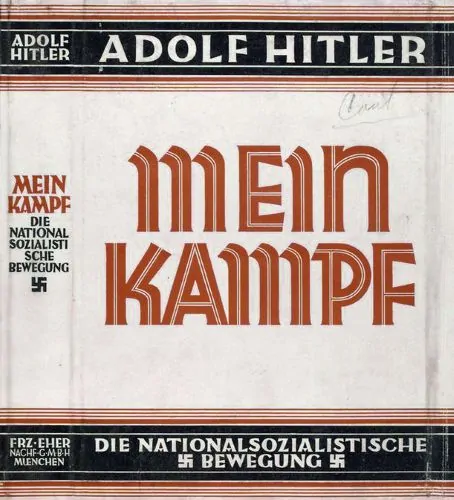
Nazi racial mythology acquired its full historical force when it was translated into territory. The imagined Aryan past did not remain confined to schoolbooks, archaeological expeditions, runic symbolism, or SS ceremony. It supplied a language through which conquest could be presented as recovery, colonization as restoration, and mass violence as biological necessity. German expansion eastward was described not simply as the acquisition of strategic depth or economic resources but as the fulfillment of an ancestral right. Land supposedly shaped by Germanic settlement, medieval conquest, or ancient racial migration was treated as though it carried a permanent ethnic ownership that modern borders could not erase. The populations living there became secondary to the historical destiny attributed to the German race.
The idea of Lebensraum, or living space, joined this mythic history to the politics of empire. Hitler portrayed nations as organisms locked in perpetual struggle for land, food, resources, and demographic survival. Germany’s future depended upon territorial expansion, especially into Eastern Europe and the Soviet Union. This was not envisioned as a conventional empire in which conquered peoples would simply pay taxes or acknowledge German sovereignty. The region was to be reordered racially. German settlers would occupy selected lands, while existing populations would be expelled, reduced to servitude, starved, Germanized, or destroyed according to their assigned biological value. The language of “blood and soil” made this program appear natural. Blood signified hereditary membership in the racial community; soil signified the territory in which that community supposedly achieved its proper physical and moral form. Together, they suggested that people and land belonged to one another through an ancient organic bond. Conquest was disguised as the reunion of a race with the earth history had intended for it.
The invasion of Poland in 1939 and the Soviet Union in 1941 created the conditions in which these claims could become policy. Occupation authorities classified towns, farms, families, languages, and bodies according to their usefulness for the projected racial empire. Ethnic Germans were registered, relocated, privileged, or resettled. Poles and other populations were displaced from annexed territories to make room for settlers. Children considered racially valuable could be removed from their families and absorbed into German society. Those judged incapable of Germanization were pushed eastward, exploited as labor, or exposed to starvation and violence.
Generalplan Ost gave this imperial vision a bureaucratic form. Developed within SS planning institutions, the plan anticipated the demographic transformation of Eastern Europe over decades through expulsion, population reduction, enslavement, German settlement, and selective assimilation. Its surviving drafts and related memoranda varied in detail, but their underlying purpose was consistent: a vast region inhabited by tens of millions of people would be reorganized according to racial categories created by the conquerors. Maps reduced communities to settlement zones, labor reserves, ethnic obstacles, and corridors of German expansion. Demographers calculated population losses; agronomists studied land use; anthropologists distinguished supposedly recoverable German blood from populations marked for removal. The fantasy of ancestral destiny became a technical problem assigned to experts. The racial empire was planned through tables, timetables, transport requirements, agricultural projections, and estimates of how many people would remain alive after conquest. What had appeared in propaganda as a heroic return to the East became, in administrative practice, a program of demographic engineering on a continental scale.
Starvation formed part of this transformation from myth to policy. German planners expected the occupied Soviet territories to feed the Wehrmacht and the Reich, even though diverting food westward would leave millions of local inhabitants without sufficient supplies. The so-called Hunger Plan treated mass death not as an accidental consequence of military operations but as a foreseeable result of economic priorities. Soviet cities, prisoners of war, Jews, and populations considered politically or racially expendable were placed outside the circle of those entitled to survive. German racial mythology made such calculations easier to accept because it denied the victims equal membership in humanity. Their hunger could be presented as the disappearance of surplus populations standing between the German people and its future.
The Holocaust occupied the center of this racial war. Nazi antisemitism represented Jews not merely as a religious minority or political opponent but as a hidden biological enemy directing every force believed to threaten Germany. Capitalism and Bolshevism, liberalism and revolution, urban modernity and cultural decay could all be attributed to the same conspiratorial race. This contradiction did not weaken the myth. It made the Jewish enemy universal, capable of appearing behind incompatible systems and events. When German forces invaded the Soviet Union, Einsatzgruppen, police battalions, SS units, military authorities, and local collaborators murdered Jewish communities in mass shootings. Deportation and killing then expanded into a Europe-wide program of annihilation. The Wannsee Conference of January 1942 did not begin the Holocaust, but it coordinated administrative participation in the “Final Solution” across agencies already involved in persecution, deportation, forced labor, and mass murder.
The passage from ancestral myth to genocide was neither automatic nor metaphorical. It required political decisions, institutional competition, military opportunity, trained personnel, transportation systems, confiscation procedures, camps, weapons, paperwork, and the participation of thousands of officials and auxiliaries. Yet mythology helped define why those mechanisms existed and whom they were permitted to destroy. It transformed Jews into a timeless counter-race, Slavic populations into biological obstacles, German settlers into agents of history, and conquest into the restoration of a supposedly natural order. The most consequential myths of the Third Reich were not always its most spectacular. Runes, castles, Atlantis, and lost weapons reveal the imaginative world cultivated around the SS, but racial empire became lethal through ordinary administrative acts. A clerk entered an ancestry classification; a physician certified racial value; a railway official scheduled a transport; an officer marked a village for removal; an economist calculated how many people could be denied food. Myth became material when stories about blood and destiny were converted into professional duties. At that point, the invented past no longer merely interpreted violence. It organized who would possess land, who would be enslaved, and who would be allowed to remain alive.
The “Good War”: Allied Mythologies in the Second World War
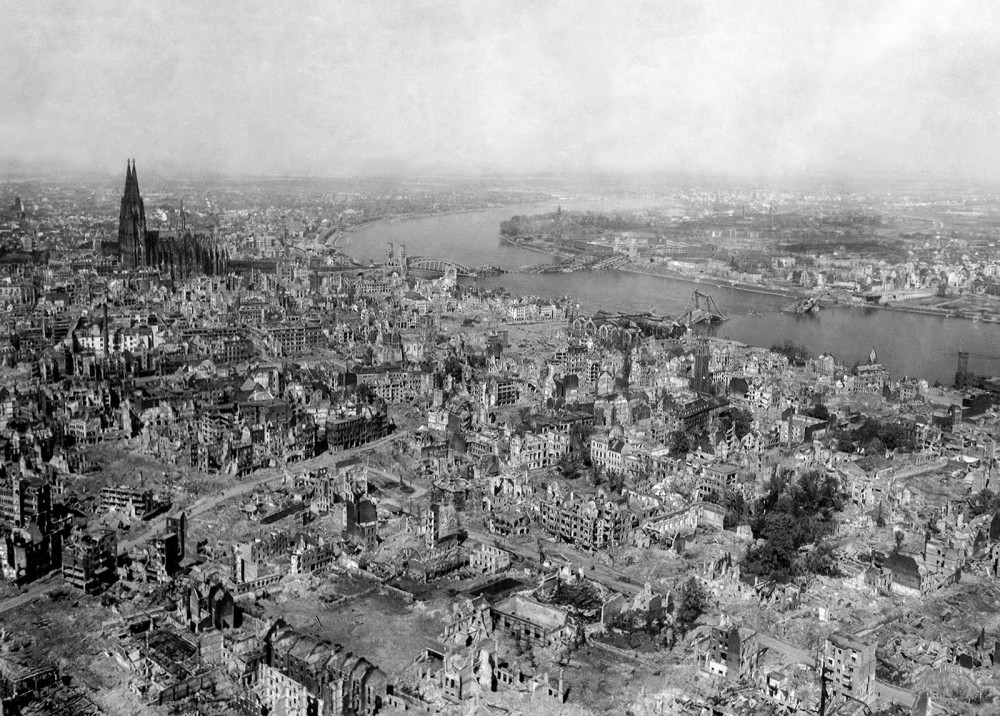
The Allied powers did not enter the Second World War with a single ideology, social order, or interpretation of history. Britain defended a global empire and parliamentary monarchy; the United States presented itself as a democratic republic initially reluctant to join another European war; the Soviet Union was a communist dictatorship that had recently cooperated with Nazi Germany before becoming its principal military enemy. China had already endured years of Japanese invasion and civil conflict. Yet these profoundly different states constructed overlapping narratives in which the war became a defense of civilization against barbarism, freedom against slavery, and human decency against an enemy imagined as fundamentally hostile to moral order. These narratives responded to genuine Axis aggression and increasingly well-documented atrocities, but they also simplified Allied purposes, concealed internal contradictions, and created durable myths about what the war had meant.
Britain’s wartime mythology drew heavily upon the image of the island nation standing alone against continental tyranny. After the fall of France in June 1940, Winston Churchill represented continued resistance as both a strategic necessity and the latest episode in a long national history of survival. The English Channel became a symbolic moat protecting constitutional liberty, while the Royal Navy and Royal Air Force inherited the prestige of earlier defenders against the Spanish Armada, Napoleon, and other would-be conquerors. The evacuation from Dunkirk was transformed from the rescue of an army defeated in France into the “Dunkirk spirit,” a story of national unity, civilian courage, and providential deliverance. The participation of naval vessels and civilian “little ships” made withdrawal appear as a democratic mobilization in which ordinary people had joined the armed forces to save the nation. The Battle of Britain then supplied a more conventionally victorious legend. Fighter pilots became a small heroic band upon whom the fate of civilization depended, their technological combat narrated through older ideals of chivalry, sacrifice, and personal courage. Churchill’s speeches gave these episodes scriptural and epic resonance without relying upon explicit supernatural claims. Britain’s “finest hour” was portrayed as an ordeal through which the nation revealed its true character.
The Blitz extended this mythology from soldiers to civilians. Bombed cities, underground shelters, firefighters, air-raid wardens, nurses, and families carrying on under attack became evidence of an indestructible national spirit. The “Blitz spirit” was grounded in real endurance and mutual assistance, but later memory often smoothed away panic, anger, looting, class tension, unequal protection, evacuation difficulties, and criticism of the government. Unity became both a description and a demand: to acknowledge division too openly risked weakening the moral image Britain wished to present to itself and the world.
Religious language reinforced that image. The conflict was often described as a crusade against pagan tyranny, although officials understood that the term could create difficulties within a diverse empire and alliance. National days of prayer, church services, biblical allusions, and providential interpretations presented survival as evidence that Britain had been preserved for a moral purpose. The vocabulary of crusade also appeared in the United States, especially after the Japanese attack on Pearl Harbor in December 1941 transformed intervention from a disputed policy into a war of national defense. Franklin D. Roosevelt framed the conflict through the Four Freedoms (freedom of speech, freedom of worship, freedom from want, and freedom from fear) and the Atlantic Charter placed Allied war aims within a language of self-determination, economic cooperation, and collective security. American propaganda contrasted democratic abundance, religious pluralism, and individual liberty with fascist regimentation and racial tyranny. The citizen-soldier became a modern version of the republican defender who temporarily took up arms so that ordinary life could survive. Wartime mobilization drew upon older narratives of the frontier, national mission, industrial ingenuity, and the United States as an exceptional power called to rescue civilization. The title of Dwight D. Eisenhower’s later memoir, Crusade in Europe, captured how readily the military campaign could be remembered as a morally unified expedition rather than a coalition war shaped by strategic compromise, imperial interest, and political calculation.
The Soviet Union constructed an equally powerful but distinct mythology after Germany invaded in June 1941. Communist appeals to proletarian internationalism did not disappear, but Stalin’s regime increasingly mobilized Russian and broader Soviet patriotic traditions. The war became the Great Patriotic War, a title linking resistance to Napoleon’s invasion of 1812 and to a longer history of defending the motherland from foreign conquerors. Newspapers, speeches, films, and military propaganda revived figures such as Alexander Nevsky, Dmitry Donskoy, Alexander Suvorov, and Mikhail Kutuzov. Orthodox religious practice, previously subjected to severe repression, received limited wartime toleration because it could strengthen unity and sacrifice. The defense of Moscow, the siege of Leningrad, and the Battle of Stalingrad acquired epic status as struggles in which entire cities became heroic actors. Soviet soldiers were defenders not only of socialism but of ancestral soil, family, culture, and national existence. This synthesis proved more emotionally expansive than Marxist doctrine alone, yet it remained controlled by a dictatorship that concealed military failures, punished retreat, deported suspect nationalities, and suppressed accounts inconsistent with the official heroic story.
Allied mythology also depended upon images of the enemy. Nazi racial conquest and genocide provided abundant evidence for portraying Germany as a regime of enslavement and extermination, while Japanese atrocities in China and across the Pacific justified a language of liberation and resistance. Even so, propaganda frequently transformed political enemies into racial or civilizational monsters. American representations of Japan often relied upon dehumanizing stereotypes that went beyond criticism of imperial aggression and helped normalize the incarceration of Japanese Americans. Britain described itself as the defender of freedom while continuing to rule hundreds of millions of colonial subjects. The Soviet Union fought genocidal Nazism while maintaining forced labor camps, political terror, and control over neighboring peoples. The United States proclaimed racial democracy while its armed forces remained segregated and Black citizens continued to face disenfranchisement and violence at home. These contradictions did not make the Allied and Axis causes morally equivalent. Nazi Germany pursued racial empire and systematic genocide as central objectives. They do show that myths of democracy and liberation often described aspirations more completely than existing realities.
The postwar idea of the Second World War as the “Good War” emerged from this moral asymmetry and from the stories created during the conflict. The defeat of Nazi Germany, liberation of concentration camps, destruction of fascist regimes, and exposure of the Holocaust gave Allied victory a moral clarity absent from many wars. Veterans could be remembered as a generation that accepted sacrifice without cynicism, civilians as members of a unified home front, and political leaders as guardians who recognized and defeated extraordinary evil. Yet this retrospective mythology often collapsed the changing war aims of several powers into a single humanitarian mission. The Allies did not enter the war primarily to stop the Holocaust, knowledge of mass murder did not always produce rescue policies, and the coalition tolerated strategic bombing, forced population transfers, colonial repression, Soviet expansion, and other acts difficult to fit within an uncomplicated story of liberation. The “Good War” remains persuasive because the evil defeated was real, but its mythic form can turn comparative moral judgment into national innocence. Allied mythology was most historically responsible when it articulated ideals against which democratic societies could be judged. It became misleading when those ideals were treated as complete descriptions of Allied behavior. Like the myths created during the First World War, the stories of democracy, crusade, and righteous victory did not merely record events. They determined which sacrifices were celebrated, which contradictions were minimized, and why the Second World War became the moral standard through which later conflicts would repeatedly be understood.
After 1945: Memory and the New Mythology of the Nazi Occult
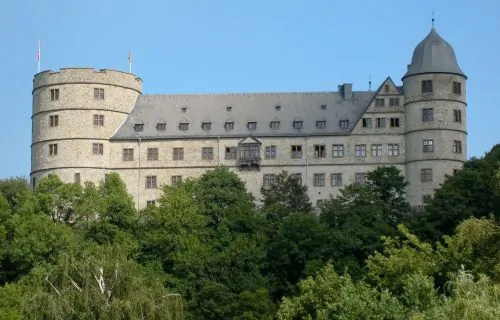
The defeat of the Axis powers did not end the myth-making generated by the Second World War. It redistributed it among victors, defeated societies, survivors, governments, veterans, and later generations seeking usable meanings in the ruins. Cities had been destroyed, borders redrawn, populations expelled, and millions of people displaced or murdered. The scale of devastation made a single coherent memory impossible, yet national narratives quickly emerged to organize responsibility and sacrifice. Britain preserved the Blitz spirit and the image of steadfast resistance. France elevated the Resistance into a symbol of national continuity despite the Vichy regime’s collaboration. The Soviet Union made the Great Patriotic War a central source of political legitimacy. The United States remembered liberation, industrial mobilization, and the citizen-soldier’s return to democratic life. These stories contained substantial truth, but they also reduced a fractured coalition and morally complicated victory to narratives of unity, endurance, and redemption.
Defeated societies faced a different problem. In West Germany, public acknowledgment of Nazi crimes developed unevenly amid denazification, Cold War reconstruction, the return of former Nazis to professional life, and widespread emphasis on German suffering. Memories of bombing, military captivity, expulsion from Eastern Europe, and the hardships of the final months of war could displace questions about conquest and genocide. The claim that ordinary Germans had been deceived by Hitler, coerced by the SS, or separated from a supposedly apolitical Wehrmacht helped preserve personal and institutional respectability. Austria cultivated the image of itself as Nazism’s first victim, minimizing the enthusiasm with which many Austrians had welcomed annexation and participated in the regime. Italy emphasized resistance and the fall of Mussolini more readily than colonial violence, Fascist repression, or collaboration with German occupation. Such narratives were not simply state propaganda imposed upon passive populations. They answered intimate needs: to mourn relatives without endorsing their cause, rebuild institutions without examining every career, and recover national continuity after regimes that had claimed to embody the nation collapsed in disgrace.
The Holocaust did not immediately occupy the central place in Western memory that it would acquire later. Survivors testified, trials documented mass murder, and Jewish communities commemorated the dead, but public narratives often treated the concentration camps as symbols of generalized Nazi tyranny rather than as components of a specifically anti-Jewish program of annihilation. Over succeeding decades, survivor testimony, historical scholarship, war-crimes trials, museums, education, television, literature, and political debate gradually made the Holocaust central to interpretations of the Third Reich.
The political and bureaucratic complexity of National Socialism encouraged a different form of explanation: the mythology of Nazi occultism. The regime’s documented interest in runes, Germanic antiquity, racial archaeology, esoteric speculation, Wewelsburg, Atlantis, World Ice Theory, and alleged ancestral technologies supplied abundant material. Postwar writers assembled these fragments into a hidden network supposedly operating behind conventional politics. Louis Pauwels and Jacques Bergier’s The Morning of the Magicians, first published in French in 1960, became particularly influential in presenting National Socialism as connected to secret societies, occult initiation, lost civilizations, and forbidden knowledge. Trevor Ravenscroft’s The Spear of Destiny later claimed that Hitler’s rise had been shaped by possession of the lance said to have pierced Christ’s side, though the book’s evidentiary basis was deeply unreliable. Other accounts linked the Nazis to the Holy Grail, Tibet, subterranean civilizations, extraterrestrials, magical rituals, and technologies inherited from Atlantis. The many rival versions rarely formed a consistent narrative. Their shared assumption was that the visible structures of the Third Reich concealed a deeper supernatural force.
Popular culture converted this speculative history into a recognizable genre. Films, novels, comics, television programs, and games portrayed Nazi agents searching for sacred relics or supernatural weapons capable of securing world domination. Raiders of the Lost Ark sent Indiana Jones against Nazis seeking the Ark of the Covenant; later stories pursued the Holy Grail, occult books, enchanted artifacts, and lost technologies. These works did not usually claim to offer documentary history. They used Nazism as a modern symbol of evil sufficiently extreme to make demonic alliances or magical ambitions feel narratively plausible. The SS uniform, runic insignia, ritual architecture, and reputation for ideological fanaticism provided an immediately legible visual vocabulary. In fictional form, the Nazi occult became a way to join archaeological adventure, theological danger, technological horror, and the struggle between good and evil.
The genre nevertheless reshaped public assumptions about the real regime. Wewelsburg was increasingly described as an occult Vatican where SS leaders conducted secret rites, while the twelve-spoked floor design in its North Tower became widely known as the “Black Sun,” a name and esoteric system largely developed after 1945. Himmler’s documented symbolic ambitions were enlarged into a fully articulated magical religion. Ahnenerbe expeditions became quests for supernatural artifacts rather than ideologically directed research projects embedded in racial imperialism. Speculative inquiries into ancestral technology were transformed into functioning programs for antigravity machines, flying discs, or divine weapons. Such stories prospered because they combined fragments of evidence with the explanatory flexibility of conspiracy theory. Missing documents indicated secrecy; failed projects suggested that successful versions had been hidden; contradictory testimony proved the existence of rival factions. The mythology could absorb disconfirmation because any absence of proof became evidence of successful concealment.
This supernaturalization of Nazism carries a serious interpretive danger. If the Third Reich becomes the work of occult initiates, demonic forces, or a hidden order possessing incomprehensible knowledge, its crimes can appear distant from ordinary modern society. The roles of universities, churches, corporations, courts, physicians, civil servants, police officers, soldiers, neighbors, and voters become less visible. Racial persecution begins to look like the product of magical obsession rather than law, bureaucracy, professional ambition, imperial conquest, ideological conviction, and social participation. The language of absolute evil is understandable when confronting genocide, but it can unintentionally make perpetrators seem inhuman in a way that protects later societies from comparison. Monsters do not require explanation; human institutions do. The postwar mythology of the Nazi occult emerged from a genuine historical residue but developed into something much larger. National Socialism did exploit invented traditions, racial myths, supernatural speculation, and pseudo-archaeology, particularly within parts of the SS. Yet its power did not come from secret relics or magical technologies. It came from the ability to join fantasy to administration and ancient destiny to modern institutions. Postwar culture often reversed that relationship, allowing spectacle to eclipse bureaucracy and mystery to replace responsibility. The result was a compelling mythology of evil, one that kept fascination with the Third Reich alive while sometimes obscuring the ordinary mechanisms through which its extraordinary crimes had been committed.
Did Mythology Really Shape the Wars or Merely Decorate Decisions Made for Other Reasons?
The following video from “War Stories” covers the Nazi occult obsession:
It is a rightful challenge to my propositions that mythology may have mattered far less than the material forces that actually produced and sustained the two world wars. The First World War emerged from alliance commitments, military timetables, imperial rivalry, arms competition, diplomatic miscalculation, nationalism, and the decisions of governments responding to the July Crisis. The Second arose from the unresolved consequences of the first, the Great Depression, the collapse of collective security, fascist expansion, Japanese imperialism, Nazi racial antisemitism, and Hitler’s deliberate pursuit of territorial conquest. Armies advanced or retreated because of logistics, industrial capacity, intelligence, command structures, fuel, transportation, weapons production, and battlefield decisions. No invocation of Achilles caused the Schlieffen Plan, no runic symbol planned Operation Barbarossa, and no belief in Atlantis determined German armored doctrine. From this perspective, mythology supplied language for policies whose causes lay elsewhere.
The chronology often appears to support that objection. The Anzac legend became fully powerful after Gallipoli had already failed; it interpreted sacrifice rather than directing the landing. The Angel of Mons emerged from the retreat and from Arthur Machen’s fiction, not from British operational planning. The myth of the “stab in the back” did not cause Germany’s military collapse in 1918 but distorted its explanation afterward. Even within the Third Reich, Himmler’s fascination with runes, Germanic prehistory, cosmic ice, and ancestral weapons should not be mistaken for the central logic of the regime as a whole. Hitler, Himmler, Alfred Rosenberg, Joseph Goebbels, military officers, civil servants, industrialists, physicians, and party functionaries did not share a single coherent mythology. Some believed deeply in racial destiny; others were careerists, opportunists, conventional nationalists, technocrats, or professionals adapting to political power. Much of the Wehrmacht operated through ordinary staff procedures rather than esoteric doctrine, while German science and industry remained capable of highly modern research even as racial pseudoscience flourished elsewhere. To explain Nazi aggression through mythology alone would risk replacing a complex dictatorship with a caricature of occult fanatics.
There is also a methodological danger in treating every powerful story as causal. Political leaders routinely present strategic interests as moral necessities. Citizens may repeat heroic narratives without believing them literally, and soldiers may fight from coercion, comradeship, fear, pay, patriotism, or the instinct to survive rather than from devotion to national legend. Myth may decorate action more often than it initiates it.
Yet the distinction between material cause and ideological decoration is too sharp. Political action does not occur in a world of logistics and interests untouched by interpretation. Leaders and populations must decide which dangers are intolerable, which territories are essential, which populations belong, which deaths are honorable, and which forms of violence appear legitimate. Myth helped answer those questions. The First World War’s civilizational narratives made compromise more difficult by presenting defeat as national extinction or moral collapse. Sacrificial memory encouraged societies to treat the dead as obligations demanding perseverance or revenge. The “stab-in-the-back” legend did not create Germany’s defeat, but it profoundly shaped how millions interpreted that defeat and whom they blamed for it. Nazi racial mythology did not design every military operation, yet it defined Jews as an existential enemy, Eastern Europe as ancestral living space, Slavic populations as inferior obstacles, and German conquest as historical restoration. Those ideas influenced policy because they established the moral categories within which bureaucrats, soldiers, settlers, physicians, and police acted. Myth did not replace administration; it told administrators what the administration was for.
The more defensible conclusion is that mythology neither independently caused the world wars nor merely ornamented them. Its influence varied by context. At times it followed events, converting defeat into martyrdom or victory into national destiny. At other times it prepared the categories through which future decisions became thinkable. Myth was most consequential when it ceased to appear mythic, when invented ancestry became racial science, political conspiracy became accepted history, conquest became demographic planning, and sacrifice became a permanent claim upon the living. Material interests explain why states sought power, territory, resources, and security, but myth helped determine why those aims appeared sacred, why certain enemies seemed beyond negotiation, and why extreme violence could be represented as defense or rebirth. The counterpoint narrows rather than overturns the argument: mythology did not move armies by itself, but it shaped the human worlds in which armies were raised, enemies were imagined, atrocities were justified, and the wars were remembered.
Conclusion: The Ancient Past in the Age of Total War
The two world wars were produced by modern states possessing bureaucratic administrations, industrial economies, mass armies, global communications, and unprecedented capacities for destruction. Yet the political and moral meanings attached to those wars repeatedly came from older worlds. Greece and Rome supplied models of civic virtue, imperial mission, heroic resistance, and civilizational decline. Christian traditions offered sacrifice, martyrdom, providence, judgment, and resurrection. Medieval legends contributed crusaders, saints, knights, ancestral defenders, and sacred landscapes. Nationalist scholarship transformed ancient tribes, forgotten battles, and reconstructed languages into evidence that modern peoples possessed timeless characters and inherited destinies. These traditions did not survive unchanged. Governments, propagandists, soldiers, scholars, clergy, journalists, and commemorative institutions selected from them, reorganized them, and applied them to conflicts unlike anything the ancient or medieval worlds had known. Modern war did not abolish mythology. Its scale made mythology newly valuable because millions of people required stories capable of explaining why they must fight, why others must die, and why the suffering should be remembered as something more than catastrophe.
During the First World War, myth most often interpreted sacrifice. Civilizational rhetoric transformed a diplomatic and strategic conflict into an epic struggle between culture and barbarism. The Angel of Mons made retreat appear providential, while Gallipoli became a national foundation rather than merely a failed campaign. Classical heroes survived in the soldier who endured artillery, defended a trench, or died anonymously for his comrades. After the armistice, memorials, unknown soldiers, sacred cemeteries, and legends of betrayal gave the dead continuing authority over the political life of the living.
National Socialism pushed this process further by attempting to convert mythology into racial history and racial history into state policy. The Aryan master race was a modern invention constructed from linguistics, anthropology, nationalism, antisemitism, archaeology, and pseudoscience, yet it was presented as an ancient biological reality. Tacitus was recruited as a witness to hereditary German virtue. Runes and Wewelsburg gave the SS the appearance of an ancestral order. The Ahnenerbe searched archaeology, folklore, and human bodies for confirmation of conclusions already demanded by racial ideology. Atlantis, World Ice Theory, and speculation about Thor’s hammer reveal a world in which myth could be interpreted as encoded technological or historical knowledge. These beliefs were not uniform throughout the regime, nor did they independently dictate military strategy. Their deepest importance appeared when they entered institutions. The imagined connection between blood and soil became territorial planning; racial prehistory became genealogical classification; ancestral destiny became colonization; and the designation of Jews as a timeless biological enemy became an ideological foundation for genocide. Myth became most dangerous when it no longer looked like myth and instead appeared as science, law, administrative necessity, or historical justice.
The Allied powers also transformed war into stories of democratic resistance, national unity, crusade, and liberation. Those narratives rested upon a genuine moral distinction between a coalition that defeated fascist aggression and a Nazi regime committed to racial empire and systematic mass murder. Yet the later mythology of the “Good War” could still conceal colonial rule, racial inequality, strategic bombing, Soviet repression, and the changing purposes for which different Allies fought. After 1945, the mythology continued to evolve. National memories purified defeat, celebrated resistance, and arranged responsibility, while popular culture transformed the documented eccentricities of Himmler and the SS into tales of magical relics and occult superweapons. The enduring lesson is not that mythology caused the world wars or that modern people remained secretly governed by ancient gods. It is that political communities continually remake the past into a guide for present action. In the age of total war, stories of heroes, martyrs, chosen peoples, sacred lands, betrayed nations, and racial enemies helped determine which violence appeared necessary and which memories became sacred. The ancient past entered modern warfare not as a passive inheritance but as a weapon, capable of consoling the bereaved, sustaining resistance, legitimizing empire, and making destruction appear to fulfill the demands of history.
Bibliography
- Adams, Michael C. C. The Best War Ever: America and World War II. Baltimore: Johns Hopkins University Press, 1994.
- Aly, Götz. “Final Solution”: Nazi Population Policy and the Murder of the European Jews. Translated by Belinda Cooper and Allison Brown. London: Arnold, 1999.
- Anderson, Benedict. Imagined Communities: Reflections on the Origin and Spread of Nationalism. Revised ed. London: Verso, 1983.
- Arnold, Bettina. “The Past as Propaganda: Totalitarian Archaeology in Nazi Germany.” In Histories of Archaeology: A Reader in the History of Archaeology, edited by Tim Murray and Christopher Evans. Oxford: Oxford University Press, 2008, 120-144.
- Arvidsson, Stefan. Aryan Idols: Indo-European Mythology as Ideology and Science. Translated by Sonia Wichmann. Chicago: University of Chicago Press, 2006.
- Ashmead-Bartlett, Ellis. The Uncensored Dardanelles. London: Hutchinson, 1928.
- Bean, C. E. W. The Story of Anzac: From the Outbreak of War to the End of the First Phase of the Gallipoli Campaign, May 4, 1915. Vol. 1 of The Official History of Australia in the War of 1914–1918. Sydney: Angus and Robertson, 1921.
- Becker, Annette. War and Faith: The Religious Imagination in France, 1914–1930. Translated by Helen McPhail. Oxford: Berg, 1998.
- Begbie, Harold. On the Side of the Angels: A Reply to Arthur Machen. London: Hodder and Stoughton, 1915.
- Bergson, Henri. The Meaning of the War: Life and Matter in Conflict. London: T. Fisher Unwin, 1915.
- Bethmann Hollweg, Theobald von. “Speech to the Reichstag, August 4, 1914.” In The Origins of the First World War: Diplomatic and Military Documents, edited by Annika Mombauer. Manchester: Manchester University Press, 2013.
- Binyon, Laurence. For the Fallen and Other Poems. London: Hodder and Stoughton, 1917.
- Black, Monica. A Demon-Haunted Land: Witches, Wonder Doctors, and the Ghosts of the Past in Post-WWII Germany. New York: Metropolitan Books, 2020.
- Browning, Christopher R. The Origins of the Final Solution: The Evolution of Nazi Jewish Policy, September 1939–March 1942. With contributions by Jürgen Matthäus. Lincoln: University of Nebraska Press, 2004.
- Burleigh, Michael, and Wolfgang Wippermann. The Racial State: Germany, 1933–1945. Cambridge: Cambridge University Press, 1991.
- Caesar, Julius. Commentarii de Bello Civili, translated by Arthur George Peskett. Cambridge: Harvard University Press, 1914.
- Calder, Angus. The Myth of the Blitz. London: Jonathan Cape, 1991.
- Chamberlain, Houston Stewart. The Foundations of the Nineteenth Century. Translated by John Lees. 2 vols. London: John Lane, 1911.
- Churchill, Winston S. The Second World War. 6 vols. Boston: Houghton Mifflin, 1948–1953.
- Clarke, David. The Angel of Mons: Phantom Soldiers and Ghostly Guardians. Chichester: Wiley, 2004.
- —-. “Rumours of Angels: A Legend of the First World War.” Folklore 113:2 (2002), 151–173.
- Dower, John W. War Without Mercy: Race and Power in the Pacific War. New York: Pantheon, 1986.
- Eisenhower, Dwight D. Crusade in Europe. Garden City, NY: Doubleday, 1948.
- Eksteins, Modris. Rites of Spring: The Great War and the Birth of the Modern Age. Boston: Houghton Mifflin, 1989.
- Falasca-Zamponi, Simonetta. Fascist Spectacle: The Aesthetics of Power in Mussolini’s Italy. Berkeley: University of California Press, 1997.
- Fewster, Kevin, Vecihi Başarın, and Hatice Hürmüz Başarın. Gallipoli: The Turkish Story. Crows Nest, NSW: Allen and Unwin, 2003.
- Fichte, Johann Gottlieb. Addresses to the German Nation. Edited and translated by Gregory Moore. Cambridge: Cambridge University Press, 2008.
- Field, Geoffrey G. Evangelist of Race: The Germanic Vision of Houston Stewart Chamberlain. New York: Columbia University Press, 1981.
- Fritzsche, Peter. Germans into Nazis. Cambridge, MA: Harvard University Press, 1998.
- Fussell, Paul. The Great War and Modern Memory. New York: Oxford University Press, 1975.
- Geary, Patrick J. The Myth of Nations: The Medieval Origins of Europe. Princeton: Princeton University Press, 2002.
- Gentile, Emilio. Politics as Religion. Princeton: Princeton University Press, 2006.
- —-. The Sacralization of Politics in Fascist Italy. Cambridge: Harvard University Press, 1993.
- Gobineau, Arthur de. Essai sur l’inégalité des races humaines. 4 vols. Paris: Firmin-Didot, 1853–1855.
- Goebel, Stefan. The Great War and Medieval Memory: War, Remembrance and Medievalism in Britain and Germany, 1914–1940. Cambridge: Cambridge University Press, 2007.
- Goebbels, Joseph. The Early Goebbels Diaries, 1925–1926. Edited by Helmut Heiber. Translated by Oliver Watson. New York: Frederick A. Praeger, 1962.
- Goodrick-Clarke, Nicholas. Black Sun: Aryan Cults, Esoteric Nazism, and the Politics of Identity. New York: New York University Press, 2002.
- —-. The Occult Roots of Nazism: Secret Aryan Cults and Their Influence on Nazi Ideology. New York: New York University Press, 1992.
- Graves, Robert. Good-Bye to All That. London: Jonathan Cape, 1929.
- Gregory, Adrian. The Last Great War: British Society and the First World War. Cambridge: Cambridge University Press, 2008.
- Grey, Edward. “Speech before the House of Commons, August 3, 1914.” In British Documents on the Origins of the War, 1898–1914, edited by G. P. Gooch and Harold Temperley. Vol. 11. London: His Majesty’s Stationery Office, 1926.
- Griffin, Roger. The Nature of Fascism. London: Routledge, 1991.
- Günther, Hans F. K. The Racial Elements of European History. Translated by G. C. Wheeler. London: Methuen, 1927.
- Hake, Sabine. Screen Nazis: Cinema, History, and Democracy. Madison: University of Wisconsin Press, 2012.
- Hale, Christopher. Himmler’s Crusade: The Nazi Expedition to Find the Origins of the Aryan Race. Hoboken, NJ: John Wiley and Sons, 2003.
- Hamilton, Ian. Gallipoli Diary. 2 vols. London: Edward Arnold, 1920.
- Hayward, James. Myths and Legends of the First World War. Stroud: Sutton Publishing, 2002.
- Heinemann, Isabel. “Rasse, Siedlung, deutsches Blut”: Das Rasse- und Siedlungshauptamt der SS und die rassenpolitische Neuordnung Europas. Göttingen: Wallstein, 2003.
- Herder, Johann Gottfried. Another Philosophy of History and Selected Political Writings. Translated by Ioannis D. Evrigenis and Daniel Pellerin. Indianapolis: Hackett Publishing, 2004.
- Herf, Jeffrey. Divided Memory: The Nazi Past in the Two Germanys. Cambridge, MA: Harvard University Press, 1997.
- Himmler, Heinrich. Die Schutzstaffel als antibolschewistische Kampforganisation. Munich: Zentralverlag der NSDAP, 1936.
- —-. “Letter to Walther Wüst concerning Thor’s hammer, thunderbolts, and ancient electrical weapons.” 1940. Quoted in Eric Kurlander, Hitler’s Monsters: A Supernatural History of the Third Reich. New Haven, CT: Yale University Press, 2017.
- —-. “Speech to SS Leaders at Posen, October 4, 1943.” In Nazi Conspiracy and Aggression. Vol. 4. Washington, DC: United States Government Printing Office, 1946.
- Hitler, Adolf. Mein Kampf. Translated by Ralph Manheim. Boston: Houghton Mifflin, 1943.
- Hobsbawm, Eric, and Terence Ranger, eds. The Invention of Tradition. Cambridge: Cambridge University Press, 1983.
- Höhne, Heinz. The Order of the Death’s Head: The Story of Hitler’s SS. Translated by Richard Barry. New York: Coward-McCann, 1970.
- Homer. The Iliad. Translated by Richmond Lattimore. Chicago: University of Chicago Press, 1951.
- Hörbiger, Hanns, and Philipp Fauth. Glazial-Kosmogonie: Eine neue Entwicklungsgeschichte des Weltalls und des Sonnensystems. Kaiserslautern: Hermann Kayser, 1913.
- Horne, John, and Alan Kramer. German Atrocities, 1914: A History of Denial. New Haven, CT: Yale University Press, 2001.
- Hutton, Christopher M. Race and the Third Reich: Linguistics, Racial Anthropology and Genetics in the Dialectic of Volk. Cambridge: Polity Press, 2005.
- Imperial War Graves Commission. Annual Report of the Imperial War Graves Commission, 1920–1921. London: His Majesty’s Stationery Office, 1921.
- Inglis, K. S. Sacred Places: War Memorials in the Australian Landscape. Melbourne: Melbourne University Press, 1998.
- International Military Tribunal. Trial of the Major War Criminals before the International Military Tribunal. 42 vols. Nuremberg: International Military Tribunal, 1947–1949.
- Jones, Heather. Violence against Prisoners of War in the First World War: Britain, France and Germany, 1914–1920. Cambridge: Cambridge University Press, 2011.
- Kater, Michael H. Das “Ahnenerbe” der SS, 1935–1945: Ein Beitrag zur Kulturpolitik des Dritten Reiches. 4th ed. Munich: Oldenbourg, 2006.
- Kemal, Mustafa. A Speech Delivered by Ghazi Mustafa Kemal. Leipzig: K. F. Koehler, 1929.
- Kennedy, Paul M. The Rise of the Anglo-German Antagonism, 1860–1914. London: George Allen and Unwin, 1980.
- Kershaw, Ian. The “Hitler Myth”: Image and Reality in the Third Reich. Oxford: Oxford University Press, 1980.
- King, Alex. Memorials of the Great War in Britain: The Symbolism and Politics of Remembrance. Oxford: Berg, 1998.
- Kipling, Rudyard. The Graves of the Fallen. London: Imperial War Graves Commission, 1919.
- Kiss, Edmund. Das Sonnentor von Tihuanaku und Hörbigers Welteislehre. Leipzig: Koehler and Amelang, 1937.
- Koselleck, Reinhart. “War Memorials: Identity Formations of the Survivors.” In The Practice of Conceptual History: Timing History, Spacing Concepts, translated by Todd Samuel Presner and others, 285–326. Stanford, CA: Stanford University Press, 2002.
- Krebs, Christopher B. A Most Dangerous Book: Tacitus’s Germania from the Roman Empire to the Third Reich. New York: W. W. Norton, 2011.
- Kurlander, Eric. Hitler’s Monsters: A Supernatural History of the Third Reich. New Haven, CT: Yale University Press, 2017.
- Lake, Marilyn, et.al. What’s Wrong with Anzac? The Militarisation of Australian History. Sydney: NewSouth Publishing, 2010.
- Leerssen, Joep. National Thought in Europe: A Cultural History. Amsterdam: Amsterdam University Press, 2006.
- Lincoln, Bruce. Theorizing Myth: Narrative, Ideology, and Scholarship. Chicago: University of Chicago Press, 1999.
- Lloyd, David W. Battlefield Tourism: Pilgrimage and the Commemoration of the Great War in Britain, Australia and Canada, 1919–1939. Oxford: Berg, 1998.
- Longerich, Peter. Heinrich Himmler: A Life. Translated by Jeremy Noakes and Lesley Sharpe. Oxford: Oxford University Press, 2012.
- —-. Holocaust: The Nazi Persecution and Murder of the Jews. Oxford: Oxford University Press, 2010.
- Lower, Wendy. Nazi Empire-Building and the Holocaust in Ukraine. Chapel Hill: University of North Carolina Press, 2005.
- Lund, Allan A. Germanenideologie im Nationalsozialismus: Zur Rezeption der “Germania” des Tacitus im “Dritten Reich.” Heidelberg: Universitätsverlag C. Winter, 1995.
- Machen, Arthur. The Angels of Mons: The Bowmen and Other Legends of the War. New York: G. P. Putnam’s Sons, 1915.
- —-. “The Bowmen.” Evening News, September 29, 1914.
- “Manifesto of the Ninety-Three German Intellectuals.” October 4, 1914. In German History in Documents and Images. Washington, DC: German Historical Institute.
- Marchand, Suzanne L. Down from Olympus: Archaeology and Philhellenism in Germany, 1750–1970. Princeton, NJ: Princeton University Press, 1996.
- Mazower, Mark. Hitler’s Empire: How the Nazis Ruled Europe. New York: Penguin Press, 2008.
- “Minutes of the Wannsee Conference, January 20, 1942.” In The Holocaust: Selected Documents in Eighteen Volumes, edited by John Mendelsohn. Vol. 11. New York: Garland Publishing, 1982.
- Moeller, Robert G. War Stories: The Search for a Usable Past in the Federal Republic of Germany. Berkeley: University of California Press, 2001.
- Mosse, George L. The Crisis of German Ideology: Intellectual Origins of the Third Reich. New York: Grosset and Dunlap, 1964.
- —-. Fallen Soldiers: Reshaping the Memory of the World Wars. New York: Oxford University Press, 1990.
- —-. The Nationalization of the Masses: Political Symbolism and Mass Movements in Germany from the Napoleonic Wars through the Third Reich. New York: Howard Fertig, 1975.
- —-. Toward the Final Solution: A History of European Racism. Madison: University of Wisconsin Press, 1985.
- Mussolini, Benito. My Autobiography. New York: Charles Scribner’s Sons, 1928.
- Mussolini, Benito, and Giovanni Gentile. “The Doctrine of Fascism.” In Fascism: Doctrine and Institutions. Rome: Ardita Publishers, 1935.
- Overy, Richard. The Bombing War: Europe 1939–1945. London: Allen Lane, 2013.
- Owen, Wilfred. The Complete Poems and Fragments. Edited by Jon Stallworthy. 2 vols. London: Chatto and Windus, 1983.
- Paris, Michael. Warrior Nation: Images of War in British Popular Culture, 1850–2000. London: Reaktion Books, 2000.
- Pauwels, Louis, and Jacques Bergier. The Morning of the Magicians. Translated by Rollo Myers. New York: Stein and Day, 1964.
- Payne, Stanley G. A History of Fascism, 1914–1945. Madison: University of Wisconsin Press, 1995.
- Pennell, Catriona. A Kingdom United: Popular Responses to the Outbreak of the First World War in Britain and Ireland. Oxford: Oxford University Press, 2012.
- Plato. Timaeus and Critias. In Plato: Complete Works, edited by John M. Cooper. Indianapolis: Hackett Publishing, 1997.
- The Poetic Edda. Translated by Carolyne Larrington. Rev. ed. Oxford: Oxford University Press, 2014.
- Poincaré, Raymond. The Origins of the War. Translated by Arthur Livingstone. New York: Henry Holt, 1922.
- Poliakov, Léon. The Aryan Myth: A History of Racist and Nationalist Ideas in Europe. Translated by Edmund Howard. New York: Basic Books, 1974.
- Pringle, Heather. The Master Plan: Himmler’s Scholars and the Holocaust. New York: Hyperion, 2006.
- Prior, Robin. Gallipoli: The End of the Myth. New Haven, CT: Yale University Press, 2009.
- Proctor, Robert N. Racial Hygiene: Medicine under the Nazis. Cambridge, MA: Harvard University Press, 1988.
- Prost, Antoine. In the Wake of War: “Les Anciens Combattants” and French Society, 1914–1939. Translated by Helen McPhail. Providence, RI: Berg, 1992.
- Ravenscroft, Trevor. The Spear of Destiny: The Occult Power Behind the Spear Which Pierced the Side of Christ. London: Neville Spearman, 1972.
- Remarque, Erich Maria. All Quiet on the Western Front. Translated by A. W. Wheen. Boston: Little, Brown, 1929.
- Renan, Ernest. “What Is a Nation?” In Becoming National: A Reader, edited by Geoff Eley and Ronald Grigor Suny, 41–55. New York: Oxford University Press, 1996.
- Resnais, Alain, dir. Night and Fog. Argos Films, 1956.
- Reynolds, David. The Long Shadow: The Legacies of the Great War in the Twentieth Century. New York: W. W. Norton, 2014.
- Richthofen, Manfred von. The Red Battle Flyer. Translated by J. Ellis Barker. New York: Robert M. McBride, 1918.
- Roosevelt, Franklin D. “Annual Message to Congress, January 6, 1941.” In The Public Papers and Addresses of Franklin D. Roosevelt, 1940 Volume: War—and Aid to Democracies. New York: Macmillan, 1941.
- Roosevelt, Franklin D., and Winston S. Churchill. “The Atlantic Charter.” August 14, 1941.
- Rose, Sonya O. Which People’s War? National Identity and Citizenship in Wartime Britain, 1939–1945. Oxford: Oxford University Press, 2003.
- Rosenberg, Alfred. The Myth of the Twentieth Century: An Evaluation of the Spiritual-Intellectual Confrontations of Our Age. 1930.
- Rosenberg, Isaac. The Collected Works of Isaac Rosenberg: Poetry, Prose, Letters, Paintings and Drawings. Edited by Ian Parsons. London: Chatto and Windus, 1979.
- Rosenfeld, Gavriel D. Hi Hitler! How the Nazi Past Is Being Normalized in Contemporary Culture. Cambridge: Cambridge University Press, 2015.
- Roshwald, Aviel, and Richard Stites, eds. European Culture in the Great War: The Arts, Entertainment, and Propaganda, 1914–1918. Cambridge: Cambridge University Press, 1999.
- Sassoon, Siegfried. The War Poems of Siegfried Sassoon. London: Heinemann, 1919.
- Scates, Bruce. Return to Gallipoli: Walking the Battlefields of the Great War. Cambridge: Cambridge University Press, 2006.
- Schäfer, Ernst. Geheimnis Tibet: Erster Bericht der Deutschen Tibet-Expedition Ernst Schäfer 1938/39. Munich: F. Bruckmann, 1943.
- Schafft, Gretchen E. From Racism to Genocide: Anthropology in the Third Reich. Urbana: University of Illinois Press, 2004.
- Schama, Simon. Landscape and Memory. New York: Alfred A. Knopf, 1995.
- Schulte, Jan Erik, ed. Die SS, Himmler und die Wewelsburg. Paderborn: Ferdinand Schöningh, 2009.
- Seal, Graham. Inventing Anzac: The Digger and National Mythology. St. Lucia: University of Queensland Press, 2004.
- Shay, Jonathan. Achilles in Vietnam: Combat Trauma and the Undoing of Character. New York: Scribner, 1994.
- Shirley, Ralph. The Angel Warriors at Mons: Including Numerous Confirmatory Testimonies, Evidence of the Wounded and Certain Curious Historical Parallels. London: Newspaper Publicity Company, 1915.
- Simek, Rudolf. Dictionary of Northern Mythology. Translated by Angela Hall. Cambridge: D. S. Brewer, 1993.
- Simpson, Jacqueline. “The Function of Folklore in ‘The Bowmen’ and the ‘Angels of Mons.’” Folklore 114:3 (2003), 389–392.
- Smith, Anthony D. The Ethnic Origins of Nations. Oxford: Blackwell, 1986.
- Snorri Sturluson. The Prose Edda. Translated by Jesse L. Byock. London: Penguin Classics, 2005.
- Snyder, Timothy. Bloodlands: Europe Between Hitler and Stalin. New York: Basic Books, 2010.
- Spielberg, Steven, dir. Raiders of the Lost Ark. Paramount Pictures, 1981.
- SS-Hauptamt. Der Untermensch. Berlin: Nordland-Verlag, 1942.
- Stalin, Joseph. “Radio Broadcast to the Soviet People, July 3, 1941.” In The Great Patriotic War of the Soviet Union. Moscow: Foreign Languages Publishing House, 1945.
- Staudenmaier, Peter. Between Occultism and Nazism: Anthroposophy and the Politics of Race in the Fascist Era. Leiden: Brill, 2014.
- Sternhell, Zeev, with Mario Sznajder and Maia Asheri. The Birth of Fascist Ideology: From Cultural Rebellion to Political Revolution. Translated by David Maisel. Princeton, NJ: Princeton University Press, 1994.
- Strachan, Hew. The First World War. New York: Penguin Books, 1993.
- Stray, Christopher. Classics Transformed: Schools, Universities, and Society in England, 1830–1960. Oxford: Clarendon Press, 1998.
- Tacitus. Agricola. Germania. Dialogue on Oratory. Translated by M. Hutton and W. Peterson. Loeb Classical Library 35. Cambridge, MA: Harvard University Press, 1914.
- Thomson, Alistair. Anzac Memories: Living with the Legend. New ed. Clayton, Victoria: Monash University Publishing, 2013.
- Thucydides. History of the Peloponnesian War. Translated by Rex Warner. Revised by M.I. Finley. London: Penguin Classics, 1972.
- Travers, Tim. Gallipoli 1915. Stroud: Tempus, 2001.
- Tumarkin, Nina. The Living and the Dead: The Rise and Fall of the Cult of World War II in Russia. New York: Basic Books, 1994.
- United Kingdom. The Burial of an Unknown British Warrior in Westminster Abbey, 11 November 1920. London: His Majesty’s Stationery Office, 1920.
- United States v. Karl Brandt et al. “The Medical Case.” In Trials of War Criminals before the Nuernberg Military Tribunals under Control Council Law No. 10. Vols. 1–2. Washington, DC: United States Government Printing Office, 1949.
- United States Office of War Information. Why We Fight. Washington, DC: United States Government Printing Office, 1942–1945.
- Vance, Norman. The Victorians and Ancient Rome. Oxford: Blackwell, 1997.
- Vandiver, Elizabeth. Stand in the Trench, Achilles: Classical Receptions in British Poetry of the Great War. Oxford: Oxford University Press, 2010.
- Verhey, Jeffrey. The Spirit of 1914: Militarism, Myth, and Mobilization in Germany. Cambridge: Cambridge University Press, 2000.
- Watson, Alexander. Enduring the Great War: Combat, Morale and Collapse in the German and British Armies, 1914–1918. Cambridge: Cambridge University Press, 2008.
- Weikart, Richard. Hitler’s Ethic: The Nazi Pursuit of Evolutionary Progress. New York: Palgrave Macmillan, 2009.
- Weiner, Amir. Making Sense of War: The Second World War and the Fate of the Bolshevik Revolution. Princeton, NJ: Princeton University Press, 2001.
- Wessely, Christina. Welteis: Eine wahre Geschichte der Welt. Berlin: Matthes and Seitz, 2013.
- Wetzel, Erhard. “Opinion and Thoughts on the General Plan East of the Reichsführer-SS, April 27, 1942.” In Nazi Conspiracy and Aggression. Washington, DC: United States Government Printing Office, 1946.
- Wewelsburg District Museum. Wewelsburg 1933–1945: Cult and Terror Site of the SS. Paderborn: Bonifatius, 2011.
- Wiedmer, Caroline Alice. The Claims of Memory: Representations of the Holocaust in Contemporary Germany and France. Ithaca, NY: Cornell University Press, 1999.
- Wildt, Michael. An Uncompromising Generation: The Nazi Leadership of the Reich Security Main Office. Translated by Tom Lampert. Madison: University of Wisconsin Press, 2009.
- Wilhelm II. “Address from the Balcony of the Royal Palace, August 1, 1914.” In The Kaiser’s Speeches: Forming a Character Portrait of Emperor William II, compiled by Wolf von Schierbrand. New York: Harper and Brothers, 1903–14.
- Winter, Jay. Sites of Memory, Sites of Mourning: The Great War in European Cultural History. Cambridge: Cambridge University Press, 1995.
- Wirth, Herman. Der Aufgang der Menschheit: Untersuchungen zur Geschichte der Religion, Symbolik und Schrift der atlantisch-nordischen Rasse. Jena: Eugen Diederichs, 1928.
- Wohl, Robert. The Spectacle of Flight: Aviation and the Western Imagination, 1920–1950. New Haven, CT: Yale University Press, 2005.
- Wood, Ian. The Modern Origins of the Early Middle Ages. Oxford: Oxford University Press, 2013.
- Ziino, Bart. A Distant Grief: Australians, War Graves and the Great War. Crawley: University of Western Australia Press, 2007.
Originally published by Brewminate, 07.24.2026, under the terms of a Creative Commons Attribution-NonCommercial-NoDerivatives 4.0 International license.
About the Author