Founded to combat counterfeit currency, the Secret Service became a vast protective institution shaped by assassination, war, technology, political violence, and the demands of democracy.

By Matthew A. McIntosh
Public Historian
Brewminate
Introduction: The President Must Be Seen
The American president must be seen. Unlike a monarch whose authority may be reinforced by distance, ceremony, and restricted approach, a president draws legitimacy from appearing among citizens, shaking hands, traveling through cities, speaking before crowds, and participating in the ordinary theater of democratic politics. Every such appearance transforms political accessibility into physical vulnerability. The reception line that allowed William McKinley to greet visitors in Buffalo, the motorcade that carried John F. Kennedy through Dallas, and the public events at which later presidents and candidates encountered gunfire all emerged from the same expectation that national leaders should remain visible to the nation. Presidential protection has never involved safety alone. It has required the management of a contradiction between the president as a human being who can be injured or killed and the presidency as a public institution that cannot be permitted to disappear behind walls.
The United States Secret Service was not created to resolve that contradiction. Established within the Department of the Treasury on July 5, 1865, the agency’s original mission was to suppress counterfeiting at a moment when perhaps one-third to one-half of the currency in circulation was fraudulent. Its operatives infiltrated criminal networks, followed suspects across jurisdictional boundaries, gathered intelligence, and helped restore confidence in the federal financial system. Those activities gradually produced something the United States otherwise largely lacked: a mobile, nationally distributed body of experienced federal investigators. Yet neither the assassination of Abraham Lincoln in 1865 nor that of James A. Garfield in 1881 immediately persuaded Congress to establish a permanent presidential security organization. Presidents continued to rely on uneven combinations of local police, military escorts, private secretaries, political associates, and occasional federal agents. Even McKinley received limited Secret Service protection before his assassination in 1901, and three operatives were present at the Pan-American Exposition when Leon Czolgosz shot him. What failed in Buffalo was not the total absence of guards, but the absence of unified authority, systematic advance planning, clearly assigned responsibility, and a settled national conviction that protecting the president was a permanent federal obligation.
Presidential protection is often represented by the agent standing closest to the president, scanning a crowd and prepared to place his or her body between the protectee and an attacker. That image captures the physical courage demanded by the work, but it obscures most of the protective system. The visible agent is only the innermost point of a structure encompassing threat assessment, intelligence sharing, site surveys, transportation, communications, medical planning, secure residences, tactical support, and cooperation among federal, state, and local authorities. Its successes ordinarily produce no dramatic event and leave little public evidence behind. Its failures, by contrast, occur in seconds, unfold before cameras, and can redirect the political history of the country.
The development of that system was neither automatic nor steadily progressive. It proceeded through recurring cycles in which an assassination, attempted assassination, or security breach exposed weaknesses; public outrage opened a political opportunity for reform; Congress expanded authority or appropriations; and the Secret Service revised procedures around the circumstances of the preceding failure. The agency acquired the protective mission partly because its investigative experience and national network made it useful, but its selection was also contingent, contested, and initially unauthorized. As the United States became a global power and the presidency became more mobile, personalized, and publicly consequential, the president’s physical survival increasingly came to be understood as an element of constitutional continuity. Stronger protection produced greater surveillance, restricted public space, enormous resource demands, and an expanding physical barrier between citizens and their elected leader. The history of the Secret Service is consequently not a triumphal progression from an unguarded past toward perfect safety. It is the history of a republic attempting to protect the person who embodies executive authority without transforming that person into an inaccessible sovereign and repeatedly discovering that no amount of institutional growth can entirely eliminate danger, error, or chance.
A Citizen Executive Without a Palace Guard: Presidential Security before 1865
The absence of a permanent presidential guard in the early United States reflected political principle as well as administrative weakness. Americans had rejected monarchy, standing armies, and the elaborate court structures through which European sovereigns separated themselves from ordinary subjects. George Washington’s formal levees consequently attracted criticism from those who thought their ceremony resembled royal etiquette, while Thomas Jefferson cultivated a deliberately less hierarchical style of reception. The president was expected to remain a citizen entrusted temporarily with executive power, not a sovereign whose body possessed sacred or dynastic authority. Neither the Constitution nor the legislation establishing the executive departments created an organization responsible for his personal safety. Protection instead rested on social deference, household staff, political custom, and the assumption that citizens would recognize the office even when they despised its occupant.
The presidential household offered some control over access, but it did not function as a secured compound in the modern sense. Doorkeepers, ushers, secretaries, servants, and family members observed visitors, directed callers, and sometimes denied entry, yet their principal duties were domestic or administrative rather than protective. United States marshals, District of Columbia constables, militia companies, and military units could be summoned for inaugurations, public disorder, wartime emergencies, or specific warnings. These arrangements disappeared or changed whenever circumstances changed, leaving no stable chain of command and little institutional memory. Presidents walked through Washington, rode on horseback, attended church, traveled by public conveyance, and received large numbers of strangers with minimal screening. Even the destruction of the President’s House by British forces in 1814 was understood principally as a military and national humiliation, not as evidence that the chief executive required a standing personal detail. Security remained episodic because political violence against the president had not yet been recognized as a distinct and permanent federal problem.
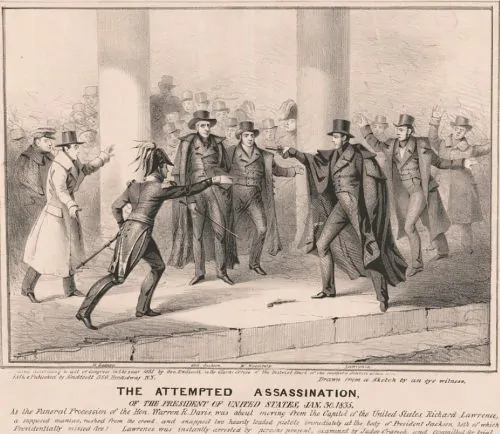
That complacency received a dramatic warning on January 30, 1835, when an unemployed house painter named Richard Lawrence approached Andrew Jackson outside the United States Capitol and attempted to shoot him. Lawrence discharged two pistols at close range, but both weapons misfired, after which the enraged president struck at him with his cane while bystanders intervened. The first known direct assassination attempt against a United States president demonstrated how easily an attacker could approach the chief executive during an ordinary public movement. Lawrence’s subsequent acquittal on grounds of insanity encouraged contemporaries to interpret the episode as an isolated act of madness rather than evidence of an organized political danger. Public discussion also emphasized Jackson’s courage and the seemingly providential failure of the pistols, allowing personal heroism and divine favor to substitute for institutional reform.
Abraham Lincoln’s election and the secession crisis transformed the threat environment without immediately producing a coherent protective organization. As the president-elect traveled from Springfield to Washington in February 1861, reports circulated that secessionists intended to kill him while he passed through Baltimore, a city containing strong Confederate sympathies. Railroad officials had already employed detective Allan Pinkerton to investigate sabotage, and Pinkerton’s operatives claimed to have uncovered a conspiracy to murder Lincoln during his scheduled transfer between stations. Other political and military officials transmitted warnings of their own, although historians continue to dispute whether Pinkerton discovered a coordinated assassination plot or magnified fragments of rumor, hostility, and boastful conversation. Lincoln nevertheless abandoned the published itinerary and passed secretly through Baltimore during the night of February 22–23, accompanied by Pinkerton and Ward Hill Lamon. The decision protected him from whatever danger existed, but the secrecy also exposed him to ridicule from critics who equated caution with cowardice. That reaction revealed one of the lasting constraints on presidential security: a leader could be condemned not only for taking too little protection, but also for appearing afraid of the people he governed. Once the Civil War began, soldiers guarded the White House, police officers and detectives watched particular locations, and military escorts sometimes accompanied Lincoln, yet these elements belonged to different authorities and pursued overlapping purposes. They protected against Confederate raids, sabotage, mobs, kidnapping, and assassination without operating as a single professional detail.
Lincoln himself complicated every protective arrangement. He continued receiving petitioners and office seekers, visiting hospitals, attending theaters, walking to the War Department telegraph office, and traveling between the White House and the Soldiers’ Home. A cavalry company known as the Union Light Guard was assigned to escort him, particularly during his seasonal residence outside central Washington, but an escort could not control every destination or prevent the president from moving beyond its immediate reach. Lincoln disliked unnecessary ceremony and understood public accessibility as both a political obligation and a means of learning what citizens wanted from the government. Friends, military officers, cabinet members, detectives, and local police evaluated threats according to their own information, with no centralized repository that could connect threatening letters, suspicious persons, and presidential movements. Wartime Washington surrounded Lincoln with more armed men than any previous president while leaving fundamental protective responsibilities uncertain.
The consequences became unmistakable at Ford’s Theatre on April 14, 1865. Lamon was away from Washington, and John Frederick Parker, the Metropolitan Police officer assigned to the presidential party, was not stationed at the door to Lincoln’s box when John Wilkes Booth approached. No advance team had secured the theater as a controlled site, no inner cordon regulated access to the president, and no protective commander coordinated the police, military, theater employees, and members of Lincoln’s party. Booth possessed the decisive advantages of familiarity: he knew the building, understood theatrical routines, recognized the president’s public habits, and could move through backstage areas without immediately appearing suspicious.
Lincoln was not wholly unguarded, but he was protected by a collection of arrangements that could not compensate for the failure of a single officer or anticipate an attacker already comfortable inside the environment. The government responded with an enormous military manhunt, arrests, and a controversial military trial, but it did not immediately create a permanent presidential security service. When the Secret Service Division began operating less than three months later, it was charged with pursuing counterfeiters rather than guarding Lincoln’s successor, a revealing reminder that even presidential assassination had not yet made personal protection an established responsibility of the federal state.
Protecting the Nation’s Money: Counterfeiting and the Birth of the Secret Service
Counterfeiting had troubled the United States since the colonial period, but the decentralized banking system of the nineteenth century made fraudulent currency unusually difficult to detect. Before the Civil War, hundreds of state-chartered banks issued their own notes, which circulated at different values depending on the issuing bank’s location, reputation, solvency, and distance from the transaction. Ordinary Americans confronted thousands of legitimate note designs alongside altered bills, notes from failed banks, and complete fabrications attributed to institutions that had never existed. Merchants and bankers relied on commercial bank-note reporters and counterfeit detectors, yet those publications could become outdated before reaching distant communities. The Legal Tender Act of 1862 and the National Currency Act of 1863 began replacing this fragmented monetary world with federally issued greenbacks and nationally chartered bank notes. Standardization promised a more reliable national currency, but it also gave counterfeiters widely recognized designs that could circulate across state boundaries. Wartime demand, rapid printing, unfamiliar denominations, and the movement of soldiers and goods created fertile conditions for organized forgery. Later estimates that between one-third and one-half of circulating money was counterfeit are difficult to verify precisely, but there is no question that fraudulent currency threatened public confidence in both everyday exchange and the expanding fiscal authority of the federal government.
Federal law already prohibited counterfeiting, but enforcement remained scattered among officials whose principal duties lay elsewhere. Congress had authorized United States marshals and district attorneys to pursue counterfeiters in 1806, transferred certain investigative responsibilities to the Treasury in 1860, and assigned counterfeiting work to the Treasury solicitor during the Civil War. These measures produced prosecutions without creating a permanent body of specialists capable of following manufacturing and distribution networks across jurisdictions. Counterfeiters exploited precisely that weakness, separating engravers, printers, wholesalers, passers, and financial backers so that the arrest of one participant rarely destroyed an entire operation.
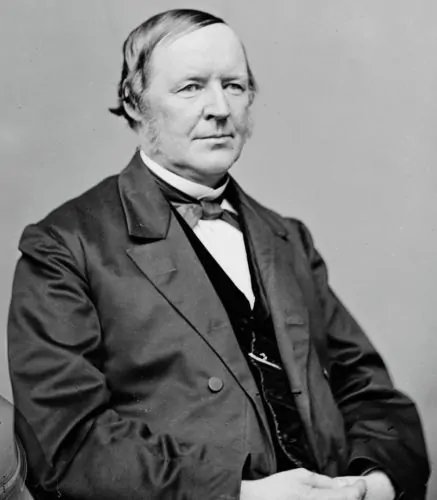
Treasury Secretary Hugh McCulloch sought a dedicated investigative force that could attack counterfeiting as an organized national enterprise. On July 5, 1865, he swore in William P. Wood as chief of the new Secret Service Division, established within the Office of the Solicitor of the Treasury. Wood had accumulated investigative and administrative experience during the Civil War, including controversial service connected with military prisons and government fraud inquiries, and he brought to the new organization an aggressive conception of detective work. McCulloch instructed him that his central objective was to restore public confidence in the nation’s money. With only a small headquarters staff and operatives dispersed through important commercial centers, Wood constructed networks of informants, undercover investigators, cooperating police officers, and federal prosecutors. Agents entered the social world of counterfeiters, purchased fraudulent notes, traced distribution chains, identified engravers, and located the plates, presses, paper, and dies required for production. They did not yet possess the comprehensive arrest powers associated with modern federal agents, so investigations commonly culminated in action by marshals and prosecution through federal district courts. The organization nevertheless differed from earlier enforcement because it retained specialized knowledge about offenders, techniques, and recurring networks rather than dispersing that information whenever a particular case ended. Its mobility allowed investigators to follow the counterfeit economy instead of surrendering a case when suspects crossed a state line.
The usefulness of this small detective force quickly encouraged demands that it investigate crimes beyond its original assignment. In 1867 its responsibilities were broadened to include the detection of persons committing frauds against the government, language elastic enough to support inquiries involving illicit distillers, smugglers, mail thieves, land frauds, and other violations. Secret Service operatives also assisted investigations of the Ku Klux Klan and were temporarily employed by departments that lacked trained investigators of their own. Such assignments reflected a basic weakness in the postwar federal government: it was assuming new regulatory and administrative responsibilities without possessing a general investigative service capable of enforcing them.
The Department of Justice was not established until 1870, and even afterward federal departments continued borrowing Secret Service personnel for specialized inquiries. Congress alternately relied on this versatility and resisted it, periodically objecting that Treasury funds appropriated for suppressing counterfeiting were being used to create a general national police force without explicit legislative authority. Formal statutory recognition of the Secret Service Division through an appropriation did not arrive until 1882, nearly seventeen years after Wood had begun operations.
The lasting significance of the Secret Service’s financial mission extended beyond the counterfeit notes it removed from circulation. Its investigations helped strengthen the credibility of a national currency while demonstrating that crimes operating across state boundaries required persistent federal knowledge, mobility, and coordination. Nothing about that mission made presidential protection inevitable, and the agency’s founders did not imagine its operatives standing beside the chief executive. Counterfeit investigations nevertheless cultivated surveillance, undercover work, threat identification, advance inquiry, interjurisdictional cooperation, and the ability to deploy experienced personnel far from Washington. When later presidents required protection, the federal government did not have to invent those capabilities from nothing. It only had to redirect an existing national detective organization from guarding a symbol of federal authority printed on paper to guarding the person who embodied that authority in public.
Garfield and the 1890s: Another Assassination and Protection Without Authority
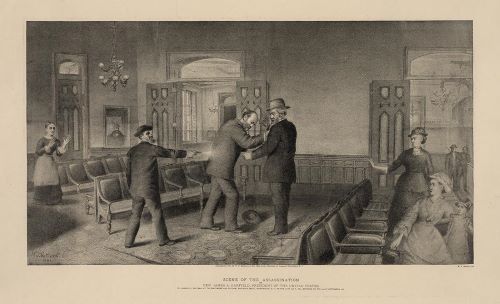
On the morning of July 2, 1881, President James A. Garfield entered the Baltimore and Potomac Railroad Station in Washington to begin a journey to New England. He was accompanied by Secretary of State James G. Blaine but had no permanent bodyguard, controlled route, or secured waiting area. Charles J. Guiteau, a disappointed office seeker who had followed Garfield’s movements and convinced himself that he deserved a diplomatic appointment, waited inside the station with a revolver. Nothing prevented him from observing the presidential party, selecting his position, and approaching within firing distance. Guiteau shot Garfield twice before police and bystanders seized him. The ease of the attack exposed essentially the same weakness that had existed at Ford’s Theatre: the president moved through a public building as a prominent citizen rather than as the center of a coordinated protective operation.
Garfield survived the initial shooting, turning the assassination into a prolonged national ordeal rather than an immediate transfer of power. Physicians repeatedly probed his wound with unsterilized fingers and instruments, introducing infections that steadily weakened him while bulletins encouraged the public to expect recovery. Alexander Graham Bell attempted to locate the bullet with an experimental induction-balance device, but the president’s doctors restricted the search to the area where they had already decided the projectile must be lodged. Garfield was eventually moved to the New Jersey shore in the hope that sea air would improve his condition, but he died at Elberon on September 19. Guiteau portrayed himself as an instrument of political deliverance, insisting that removing Garfield had united the Republican Party and elevated Vice President Chester A. Arthur. His trial became a spectacle involving political delusion, religious grandiosity, medical testimony, and competing definitions of legal insanity. The jury rejected his defense, and he was executed in 1882. Although Garfield’s death was an assassination, many contemporaries understood it primarily as an indictment of the patronage system that had encouraged office seekers to treat federal appointments as political rewards. The most significant legislative consequence was the Pendleton Civil Service Reform Act of 1883, not the creation of a presidential protection service.
That outcome demonstrated that assassination did not carry one self-evident institutional lesson. Lincoln’s death had been interpreted through civil war and conspiracy, while Garfield’s was associated with insanity, patronage, and catastrophic medical treatment. Because Guiteau had acted alone and possessed no sophisticated plan, officials could portray the shooting as an extraordinary crime that no reasonable security arrangement could have anticipated. A permanent guard still appeared to many Americans expensive, militaristic, and incompatible with the habits of a citizen executive.
The political environment nevertheless changed substantially during the years separating Garfield’s death from Grover Cleveland’s second administration. The presidency became more visible as railroad travel, national newspapers, mass political organizations, and rapid telegraph communication drew greater attention to the president’s movements. Industrial conflict also created fears that economic violence might become political violence. The Haymarket bombing of 1886, the Homestead conflict of 1892, Coxey’s Army’s march on Washington in 1894, and the nationwide Pullman Strike later that year persuaded many officials that individual threats could emerge from broader social upheaval. Political assassinations abroad intensified those anxieties: French president Sadi Carnot was killed by an anarchist in 1894, Spanish prime minister Antonio Cánovas del Castillo in 1897, and Empress Elisabeth of Austria in 1898. American newspapers sometimes blurred distinctions among organized radicals, labor militants, mentally disturbed individuals, and people who merely expressed hostility toward government. Cleveland consequently confronted a threat environment increasingly described through categories and movements rather than through identifiable personal enemies. The federal government began collecting information about potentially dangerous groups even though it possessed neither a uniform definition of a presidential threat nor a legally authorized organization responsible for evaluating one.
Cleveland became the first president to receive direct Secret Service protection, but the arrangement revealed how far practice had begun moving ahead of law. In the summer of 1894, at Cleveland’s request, Secret Service chief William P. Hazen assigned operatives to guard the president and his family at Gray Gables, their vacation home on Buzzards Bay in Massachusetts. Agents watched the property, investigated suspicious persons, communicated with local authorities, and gathered information about groups believed capable of threatening the president. The assignment drew upon methods already familiar from counterfeiting investigations, including surveillance, confidential informants, preliminary inquiries, and coordination across jurisdictional lines. Yet Congress had appropriated Secret Service funds for suppressing counterfeiting and related frauds, not for guarding the chief executive. Hazen created a practical precedent while operating on uncertain legal ground. When the diversion of personnel and money later received congressional and Treasury scrutiny, the controversy helped end his tenure as chief and reinforced the warning that even useful protection could be condemned as unauthorized executive expansion.
William McKinley inherited both the precedent and the uncertainty when he entered office in 1897. During the Spanish-American War, fears of espionage, sabotage, hostile agents, and attacks on national leaders made additional security easier to justify as a wartime necessity. Secret Service operatives monitored suspected Spanish activity while some agents were assigned near the president, and military personnel appeared at locations considered vulnerable. These precautions remained divided among organizations with different responsibilities: soldiers defended installations, local police managed crowds, Secret Service agents investigated threats, and presidential secretaries made many immediate decisions about access.
McKinley retained limited protection after the war, particularly during travel and large public appearances, but no law made the Secret Service the commanding authority. Security arrangements could expand for a particular journey and contract when the emergency passed. They also depended heavily on the president’s willingness to accept restrictions, an enduring problem for McKinley because he valued handshaking, public receptions, and direct contact with citizens. The federal government had begun protecting him in practice without deciding precisely who possessed the duty, money, or authority to do so.
By the end of the 1890s, presidential protection had moved beyond the purely private assistance provided by friends, secretaries, and local officers, but it had not become a permanent federal institution. Garfield’s assassination had shown the danger of an accessible president, Cleveland’s detail had demonstrated that Secret Service methods could be redirected toward personal security, and wartime protection of McKinley had normalized the agency’s presence near the executive. None of these developments resolved congressional concern about unauthorized expenditures or public uneasiness about surrounding the president with a national police force. The result was protection without authority: enough organization to create expectations, but not enough to establish command, accountability, or consistent procedure. That unstable compromise would be tested at Buffalo in September 1901.
Buffalo: McKinley and the Collapse of Improvisation

The assassination of William McKinley grew directly from the public visibility expected of a modern president. On September 5, 1901, he delivered a major address at the Pan-American Exposition in Buffalo, presenting commercial reciprocity and international exchange as the next stage of American prosperity. His appearance was political theater on a national scale, transmitted through newspapers and intended to associate the presidency with technological progress, imperial confidence, and peaceful economic expansion. The following afternoon, after visiting Niagara Falls, McKinley returned to the exposition for a public reception in the Temple of Music. Presidential secretary George B. Cortelyou worried that the reception created an unnecessary risk and repeatedly attempted to remove it from the schedule. McKinley restored the event because he enjoyed meeting citizens and regarded personal contact as an obligation of office. The disagreement revealed that protective judgment remained subordinate to presidential preference rather than supported by an established authority capable of modifying or canceling a dangerous appearance.
The Temple of Music contained numerous guards, yet their presence did not amount to a unified protective system. Secret Service operatives, Buffalo detectives, exposition police, and military personnel occupied different positions without working under one comprehensive plan. Three Secret Service agents were present, but the agency had neither a statutory mandate nor undisputed command over the arrangements. Security preparations concentrated on regulating the crowd and moving visitors through the receiving line rather than identifying concealed weapons or studying how an attacker might exploit the building. Leon Czolgosz had observed McKinley at the exposition on the previous day and returned with a .32-caliber revolver hidden beneath a handkerchief wrapped around his right hand. In the heat of the crowded hall, the covering could be mistaken for a bandage rather than recognized as a deliberate method of concealment. Shortly after four o’clock, Czolgosz reached the president and fired twice at close range. A man waiting behind him, James Benjamin Parker, struck the assassin as soldiers, detectives, and agents converged upon him. The response after the shots was immediate, but the protective failure had occurred earlier, when an armed man was permitted to study the president’s movements, enter the reception, conceal his firing hand, and advance without meaningful examination.
McKinley initially survived, and the national crisis shifted from security to medicine. Surgeons operated at the exposition hospital but could not locate the bullet that had entered his abdomen, and they declined to use an experimental X-ray machine displayed elsewhere on the grounds. For several days the president appeared to improve, encouraging physicians and officials to issue optimistic reports. Infection and gangrene nevertheless spread through the damaged tissue, and McKinley died in the early hours of September 14. His medical treatment, like his protection, depended on hurried decisions made by capable individuals who had not been assembled into a prepared emergency system.
Czolgosz identified himself as an anarchist, transforming the assassination in the public imagination from an individual attack into evidence of an international revolutionary threat. He had been influenced by reports of European political violence, particularly the assassination of King Umberto I of Italy by the anarchist Gaetano Bresci in 1900, and he had briefly encountered Emma Goldman before traveling to Buffalo. Investigators found no persuasive evidence that Goldman or an organized anarchist group had directed the shooting, and Czolgosz consistently claimed personal responsibility. That absence of conspiracy did little to restrain the backlash. Police arrested anarchists and their associates, newspapers demanded suppression of radical publications, and public officials called for immigration restrictions and stronger laws against revolutionary advocacy. Czolgosz received an extraordinarily rapid trial, was convicted on September 24, and was executed on October 29. The speed of the proceedings satisfied demands for punishment while leaving little room to investigate the social, psychological, and political boundaries between ideological influence and operational conspiracy. McKinley’s death consequently accelerated both presidential protection and the development of a broader domestic security response aimed at anarchists, immigrants, and political dissenters.
Buffalo destroyed the argument that informal guards and temporary precautions were sufficient. McKinley had not been abandoned to an unprotected crowd; he had been surrounded by men whose divided responsibilities created the appearance of security without the discipline of a single protective authority. His own insistence on preserving the reception mattered, but blaming the protectee alone would obscure the institutional defect: no professional organization possessed both the responsibility to identify the danger and the authority to impose a safer arrangement. The third assassination of a president in thirty-six years made it increasingly difficult to portray presidential murder as an unforeseeable aberration. Congress now confronted several possible protectors, including the Army, the United States Marshals, local police, and the Secret Service, each carrying different legal and political implications. The choice of the Secret Service would not immediately resolve those problems, but McKinley’s death ensured that presidential protection could no longer remain an unauthorized favor activated only by war, rumor, or personal request.
From Request to Mandate: Theodore Roosevelt and the Permanent Detail, 1901–1913
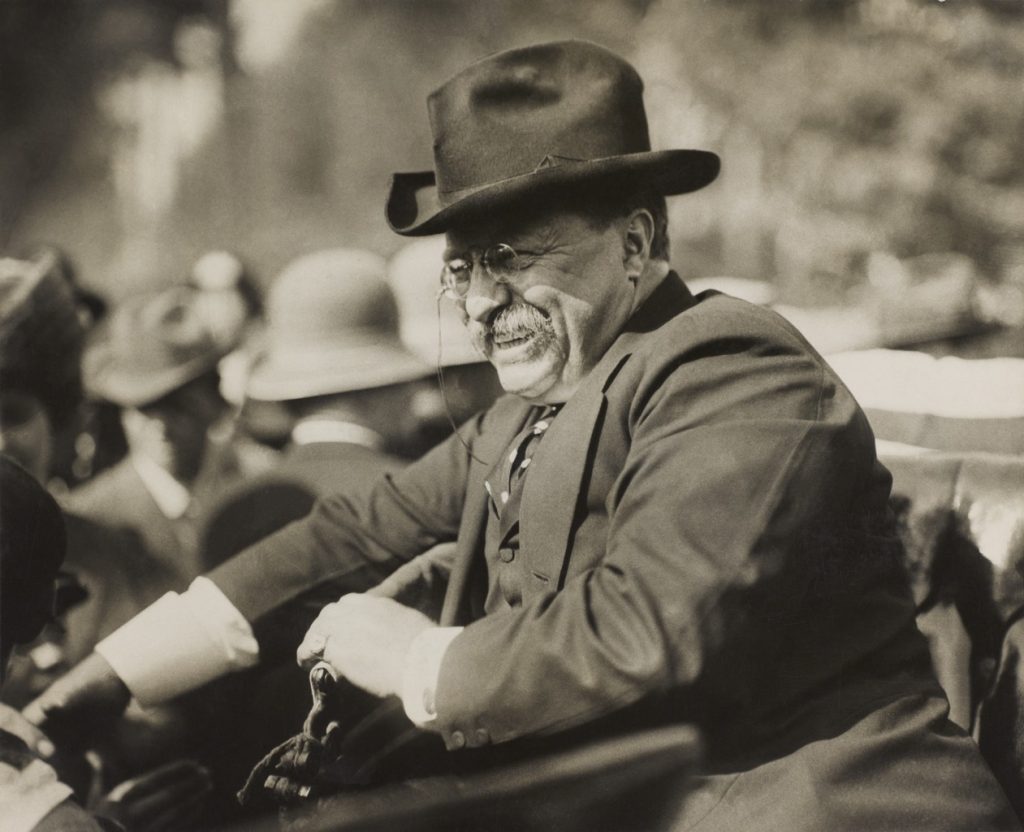
McKinley’s death produced immediate agreement that something had to change, but not agreement about what permanent presidential protection should become. Proposals assigned the responsibility variously to the Army, the United States Marshals Service, the District of Columbia police, or a new organization created expressly for the purpose. Military protection promised discipline and manpower, yet surrounding the president with soldiers revived fears of a praetorian guard and threatened to identify domestic political security with military power. Marshals possessed federal authority but lacked a centrally directed national force trained in continuous surveillance and advance investigation. The Secret Service already maintained field offices, confidential informants, mobile operatives, and working relationships with police departments throughout the country. Its chief, John E. Wilkie, argued that those capabilities made the agency the most practical choice. Following McKinley’s assassination, congressional leaders informally requested that the Secret Service protect the president, and full-time protection of Theodore Roosevelt began in 1902. The arrangement established a continuing practice before Congress had clearly defined its statutory basis.
Roosevelt posed an unusually demanding test for the emerging detail. He traveled extensively, rode horseback, hiked through difficult terrain, received crowds, toured industrial sites, attended ceremonies, and treated physical vigor as an essential part of his political identity. A small group of agents accompanied him, watched the White House, examined suspicious correspondence, investigated reported threats, and coordinated with railroad officials and local police before presidential visits. They could recommend changes and place themselves near the president, but they could not yet impose the extensive controlled environments associated with later protection. Roosevelt sometimes disliked their proximity and attempted to preserve opportunities for privacy, spontaneity, and unscripted contact. The agents learned that protection required managing the habits of the protectee as well as the intentions of possible attackers. Their work depended less on sealing Roosevelt away from the public than on creating flexible layers around a president determined to remain publicly active.
The danger did not come exclusively from assassins. On September 3, 1902, a streetcar struck Roosevelt’s carriage while the presidential party traveled through Pittsfield, Massachusetts. Roosevelt was injured, while Secret Service operative William Craig was crushed and killed, becoming the first agent to die while protecting a president. Craig’s death demonstrated that continuous protection involved transportation, route safety, crowd movement, and emergency response as well as the interception of deliberate attacks.
Congress finally acknowledged the protective assignment in the Sundry Civil Expenses Act enacted in 1906, which appropriated money specifically for the protection of the president. This measure gave the Secret Service a clearer financial basis, but it did not yet create the fully permanent statutory mandate sometimes attributed to it. Protection remained dependent on appropriations, executive practice, and congressional renewal. In 1908 the authorized mission was extended to the president-elect, reflecting the danger that an attack during the transition could disrupt succession before inauguration. That same year, Congress restricted the lending of Secret Service operatives to other executive departments after objecting to their use in investigations beyond Treasury’s established responsibilities. The restriction encouraged the Department of Justice to create its own force of special agents, which became the institutional foundation of the Bureau of Investigation and later the Federal Bureau of Investigation. Congress was expanding one Secret Service function while deliberately containing another. Legislators accepted presidential protection because the need had become difficult to deny, but they remained suspicious of an executive detective force whose secrecy, mobility, and uncertain jurisdiction might permit broader political surveillance. Beginning in 1913, Congress provided recurring annual authorization for protection of the president and president-elect, a practice that continued until the mission received permanent statutory authorization in 1951.
The narrow boundaries of the early mandate became dramatically visible after Roosevelt left the White House. On October 14, 1912, while campaigning in Milwaukee as the Progressive Party’s presidential nominee, he was shot by John Schrank outside the Hotel Gilpatrick. As a former president and current candidate, Roosevelt had no statutory entitlement to Secret Service protection, and Schrank was able to approach while he moved toward his automobile. A steel eyeglass case and the thick manuscript of Roosevelt’s prepared speech slowed the bullet, which lodged in his chest without penetrating the lung. Roosevelt insisted on delivering the speech before accepting hospital treatment, converting the attack into another demonstration of personal endurance. His survival owed more to chance, private companions, and rapid restraint of the gunman than to an organized protective system. The episode showed that Congress had begun protecting the continuity of the incumbent administration while leaving former presidents, candidates, and much of the presidential succession outside the security structure.
Between 1901 and 1913, the Secret Service detail became permanent in practice even though its legal foundation remained incremental and incomplete. Agents developed enduring elements of presidential protection: close physical coverage, advance investigation, travel coordination, local police liaison, examination of threatening communications, and surveillance of individuals considered dangerous. Their presence also normalized the proposition that protecting the president was a federal responsibility rather than a personal favor or temporary wartime measure. Nevertheless, the president’s family possessed only limited coverage, threats against the president were not yet a distinct federal crime, and the White House had no separate permanent police force. Congress had created an annually authorized protective assignment without fully defining its powers or its relationship to political liberty. The next stage would extend protection from the president’s body to his household, residence, family, and place within the constitutional succession.
From One Body to a Constitutional Household, 1917–1951
The entry of the United States into the First World War transformed presidential danger from an occasional policing problem into a matter of national security. Woodrow Wilson received threats connected to conscription, wartime mobilization, German sabotage, radical politics, and the increasingly punitive atmosphere surrounding dissent. In 1917 Congress made it a federal crime knowingly and willfully to threaten the president’s life or bodily safety, giving federal investigators a clear basis for pursuing conduct that had previously fallen unevenly under state or local law. Congress also authorized the Secret Service to protect members of the president’s immediate family. That extension marked an important conceptual change: an attacker might reach the president through his household, or political violence against a spouse or child might damage the presidency even if the chief executive survived. Protection was beginning to follow the relationships surrounding the office rather than stopping at the president’s body.
The wartime expansion also blurred the boundary between investigating threats and monitoring political belief. Secret Service operatives participated in counterespionage and supplied information about suspected radicals, while the Bureau of Investigation, military intelligence, postal inspectors, local police, and private organizations conducted overlapping campaigns against espionage, sabotage, disloyalty, and antiwar activism. The Espionage Act of 1917 and Sedition Act of 1918 encouraged officials to treat hostile speech as possible preparation for hostile action. Some communications contained specific plans or credible indications of violence, but others expressed rage, fantasy, satire, or political opposition. Investigators had few standardized methods for distinguishing the person who hated a president from the person preparing to attack him. The First Red Scare further encouraged authorities to connect anarchism, Bolshevism, immigration, labor militancy, and assassination into a single field of danger. Protective intelligence consequently acquired a civil-liberties problem that would never entirely disappear. An agency responsible for preventing a rare catastrophic act had strong incentives to collect more names and reports than it could reliably evaluate.
Physical protection around the Executive Mansion developed along a separate institutional path. In 1922 Congress created the White House Police Force to patrol the building and grounds, control entrances, and provide a permanent uniformed presence. The force was initially supervised by the president or a presidential representative rather than by the Secret Service. Congress placed it under Secret Service supervision in 1930, bringing perimeter security and personal protection under closer administrative coordination. The distinction nevertheless remained important: special agents moved with the president and investigated threats, while uniformed officers guarded places through which threats might approach.
The attempted assassination of President-elect Franklin D. Roosevelt demonstrated both the value and the limitations of the expanding system. On February 15, 1933, Roosevelt addressed a crowd from an open automobile in Miami’s Bayfront Park, where Giuseppe Zangara stood on a chair to obtain a view over the people in front of him. Zangara fired five shots toward Roosevelt before spectators disrupted his aim and seized him. The president-elect escaped injury, but five other people were wounded, including Chicago mayor Anton Cermak, who died on March 6. Secret Service agents rapidly removed Roosevelt from the exposed area, although he insisted that the automobile stop to collect the wounded Cermak and take him to the hospital. Investigators found no organized conspiracy and concluded that Zangara’s attack grew from personal misery, political hatred, and an obsessive hostility toward rulers and wealthy people. The episode resembled earlier assaults in which an isolated gunman moved within firing range during a public appearance, yet Roosevelt’s status gave it additional constitutional significance. He had won the election but had not taken office, and his death could have produced uncertainty over an incoming administration already confronting national economic collapse. Protection of the president-elect was no mere courtesy; it defended the continuity of an electoral decision before the transfer of power was complete.
Roosevelt’s twelve-year presidency required the Secret Service to adapt protection to an executive who traveled extensively and whose physical disability demanded unusually close personal assistance. Agents helped manage transfers between wheelchairs, automobiles, trains, ships, and platforms while also cooperating with the press in limiting photographs that displayed the full effects of paralysis. These services placed agents inside the private life of the president and made trust between the detail and the household indispensable.
After the United States entered the Second World War, the presidential vehicle known as the Sunshine Special received armor, reinforced glass, and other security modifications. Roosevelt’s journeys to Casablanca, Cairo, Tehran, and Yalta required coordination with the military, diplomatic officials, foreign governments, intelligence services, and transportation specialists on a scale earlier details had never faced. The dangers now included enemy espionage, air attack, sabotage, and disruption of wartime command as well as the lone gunman. In 1943 Congress for the first time appropriated money together for the Secret Service’s investigative and protective missions and the White House Police, acknowledging that counterfeiting, personal protection, and residence security had become enduring parts of one institution.
The most violent test of the White House security structure came after the deteriorating Executive Mansion forced Harry Truman and his family to move across Pennsylvania Avenue into Blair House. On November 1, 1950, Puerto Rican nationalists Oscar Collazo and Griselio Torresola approached the temporary residence with pistols and the intention of killing the president. Their assault developed almost instantly into a gun battle with White House Police officers and Secret Service agents stationed outside the building. Truman was upstairs and briefly appeared at a window before agents ordered him away from view. Torresola mortally wounded Officer Leslie Coffelt and shot other officers as he advanced toward the entrance. Although gravely injured, Coffelt fired from his guard booth and killed Torresola with a shot to the head. Other defenders wounded and captured Collazo before either attacker could enter Blair House. Coffelt died several hours later, becoming the only White House Police officer killed while defending the president against a direct assault. The gunfight proved that a determined attack could reach the outer boundary of a presidential residence, but it also demonstrated how a permanent perimeter force, fixed posts, trained personnel, and immediate armed resistance could prevent that attack from reaching the protectee.
In 1951 Congress converted decades of annual appropriations and executive practice into permanent statutory authority for the Secret Service’s protective mission. The law authorized protection of the president, members of his immediate family, the president-elect, and the vice president if the vice president desired it. Its inclusion of the vice president recognized that presidential security could not be separated from succession, although optional coverage showed that Congress had not yet made protection of every successor compulsory. Former presidents, widows, children beyond the immediate presidential household, and candidates remained outside the permanent system. Even so, the guarded object had expanded decisively between 1917 and 1951. The Secret Service was no longer merely preserving one life; together with the White House Police, it was protecting a family, a residence, an electoral transition, and the constitutional office that had to endure if the person occupying it did not.
Beyond the Bodyguard: The Mobile Cold War Presidency, 1951–1963

Permanent statutory authorization in 1951 coincided with a transformation in what it meant to move and protect an American president. The Cold War elevated the chief executive into the central figure of nuclear command, alliance diplomacy, ideological competition, and an increasingly global national-security system. An assassination could threfore disrupt not only domestic politics but also military decision-making during an international crisis. Dwight D. Eisenhower traveled frequently by aircraft, maintained temporary presidential settings at his Gettysburg farm and favored vacation locations, and participated in highly visible motorcades and public ceremonies. The arrival of presidential jet travel late in his administration compressed distances while multiplying the number of destinations that had to be secured. Every journey temporarily recreated parts of the White House communications, transportation, medical, and security structure somewhere else. Protection could no longer be understood principally as guarding a residence or placing several agents near the president.
Advance work became the organizational foundation of the mobile protective mission. Before a presidential visit, agents consulted White House staff, surveyed airports and event sites, selected motorcade routes, inspected rooms, identified hospitals, arranged communications, and negotiated responsibilities with local authorities. Uniformed police usually controlled traffic, intersections, and crowds, while Secret Service agents remained near the president or occupied vehicles immediately around him. Railroad companies, airlines, hotels, municipal governments, military commands, and private hosts supplied resources the Service could not permanently maintain in every city. Motorcade formations placed agents in the presidential automobile and in a follow-up vehicle from which they could scan spectators and move rapidly toward the president. Two-way radios improved communication, but incompatible equipment and separate police channels could still divide information among participating agencies. Buildings, windows, bridges, elevated positions, and unscheduled stops created more territory than the available agents could examine thoroughly. Advance planning was also shaped by the political purpose of a trip, since White House staff often wanted routes that exposed the president to the largest possible audience. The Secret Service coordinated an enormous temporary security network, but most of the people within that network remained employees of other organizations operating under their own commanders.
The agency’s financial investigations supplied much of the manpower needed to sustain this expanding travel schedule. Special agents ordinarily began their careers in field offices investigating counterfeiting and financial crime before receiving assignments to protective details or specialized units. That work developed surveillance, interviewing, firearms, evidence, and liaison skills that transferred readily to protection. It also created a persistent resource tension, because every presidential journey or campaign surge could remove investigators from their regular cases and convert the national field organization into temporary protective support.
Preventive intelligence developed beside physical protection but remained less integrated than the visible detail. The Protective Research Section maintained files on people who threatened the president or behaved in ways that officials considered potentially dangerous. Agents indexed names geographically so that an advance team could determine whether a known subject lived near a destination, while the White House, local police, the FBI, and other agencies forwarded threatening letters and investigative reports. The system worked best when a person had made an explicit threat, attracted police attention, or previously entered a federal file. It worked poorly when dangerous behavior appeared in records held by another agency, when information did not meet established reporting criteria, or when an individual had never directly threatened the president. Paper files and manually maintained indexes limited the speed with which agents could compare names, locations, travel, political activity, and psychiatric history. The Secret Service largely received intelligence gathered by others rather than operating an independent national intelligence service devoted exclusively to presidential danger. Expanding those files also raised the unresolved question of whether angry speech, ideological dissent, mental illness, and an actual intention to attack could be distinguished without subjecting large numbers of harmless people to federal scrutiny.
The danger posed by an individual outside the established files became clear before John F. Kennedy even entered office. In December 1960, retired postal worker Richard Paul Pavlick followed the president-elect to Palm Beach with dynamite packed inside his automobile and a plan to destroy himself and Kennedy in the same explosion. Pavlick reportedly abandoned one opportunity when he saw Kennedy accompanied by Jacqueline Kennedy and their children, but he remained in Florida and retained the explosives. A postmaster in New Hampshire had become suspicious of postcards Pavlick mailed from locations corresponding to Kennedy’s travels and conveyed those suspicions to authorities. The resulting investigation allowed the Secret Service and local police to identify Pavlick and arrest him on December 15. The episode demonstrated the value of public reporting, interjurisdictional investigation, and protection of the president-elect. It also revealed how close an unknown attacker could come before scattered observations were assembled into a recognizable threat.
Kennedy intensified the conflict between political visibility and protective control. His youth, family, television presence, overseas travel, and crowded motorcades were central to the public meaning of his presidency. He frequently entered crowds, used open automobiles, and valued appearances that allowed spectators to see him clearly rather than through metal, glass, or a distant perimeter. These preferences constrained the detail, but they did not mean that Kennedy simply rejected all protection or personally designed security arrangements. Decisions emerged from negotiation among the president, political aides, event organizers, advance agents, and local authorities, all of whom assigned different values to exposure and caution. The removable transparent top available for the presidential limousine was primarily a weather covering and was not bullet-resistant, making its absence less decisive than later accounts sometimes suggested. Agents could stand on rear steps or running boards when circumstances required, but their positions varied with speed, crowd density, weather, and presidential preference. Congress continued enlarging the statutory structure in 1962 by extending protection to the vice president or the next officer in the line of succession, the vice president-elect, and former presidents who requested coverage for a reasonable period. The protected network was widening, yet its procedures still allowed the incumbent considerable power to determine how publicly accessible he would remain.
By 1963 the Secret Service possessed a permanent detail, a national investigative network, established advance procedures, specialized vehicles, threat files, and decades of experience coordinating presidential travel. That system was considerably more sophisticated than the improvised arrangements surrounding McKinley, but sophistication did not eliminate structural weaknesses. It depended heavily on local manpower, incomplete information from other agencies, manually processed records, and assumptions about where an attacker was most likely to appear. Close-in agents were prepared to respond to threats emerging from a crowd, yet a rifleman firing from an elevated building presented a different problem of distance, terrain, and advance control. Medical arrangements could identify nearby hospitals without ensuring that the president’s physician and emergency resources remained immediately accessible throughout a motorcade. The mobile presidency had outgrown the simple bodyguard, but the protective system built around it had not yet reconciled political exposure, preventive intelligence, and command across an entire urban landscape.
Dallas: The Protective System Fails in Public
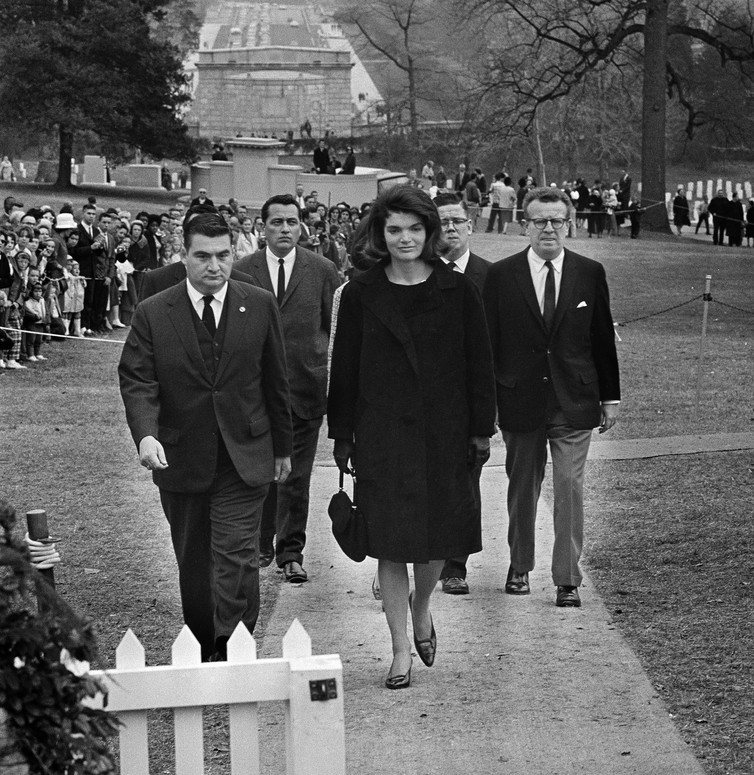
John F. Kennedy’s journey to Texas in November 1963 was designed to serve political purposes that could not be separated from its security risks. The president hoped to encourage unity among competing Texas Democrats, strengthen support before the 1964 election, and appear before large crowds in several cities. In Dallas, the motorcade from Love Field to a luncheon at the Trade Mart allowed thousands of spectators to see Kennedy at close range. Newspapers published the route in advance so that residents could gather along it, converting predictable movement into the central attraction of the visit. Kennedy rode in an open presidential limousine because the weather was clear and unobstructed visibility was essential to the motorcade’s political purpose. The removable transparent roof sometimes fitted to the vehicle was a weather covering rather than a bullet-resistant shield, so its use would not have created an armored compartment. The conditions that made the Dallas appearance successful as democratic spectacle also gave an attacker time to select a concealed position overlooking a publicly known route.
Secret Service advance agent Winston Lawson and Dallas field-office chief Forrest Sorrels worked with White House personnel, the Dallas police, county authorities, and federal offices to plan the visit. They examined the route, arranged motorcycle escorts, assigned officers to intersections and overpasses, and established security at Love Field and the Trade Mart. Lawson checked the Protective Research Section’s geographic files but found no person listed as a presidential danger in the relevant territory. The Dallas police and FBI supplied information about local tensions, including the hostile demonstration that had confronted United Nations ambassador Adlai Stevenson in October, and officers carried photographs of suspected demonstrators at the luncheon site. Lee Harvey Oswald did not appear in those protective inquiries. The FBI possessed information about his defection to the Soviet Union, return to the United States, political activity, and contacts with Soviet representatives, while the CIA held additional records relating to his foreign history and communications. Under the reporting criteria then in use, Oswald had made no known direct threat against Kennedy and was not forwarded to the Secret Service as a protective subject. The advance operation concentrated on people already defined as dangerous and on demonstrators likely to confront the president, not on every person with a troubling political, psychiatric, or foreign background. Buildings along the motorcade route were not comprehensively searched or secured, leaving police and agents to scan hundreds of windows and elevated positions while the president passed below.
At approximately 12:30 p.m. on November 22, rifle fire struck the presidential limousine as it moved through Dealey Plaza. The shots came from an elevated window of the Texas School Book Depository, beyond the immediate physical perimeter formed by the motorcycles and follow-up car. Secret Service agent Clint Hill ran from the follow-up vehicle, climbed onto the rear of the accelerating limousine, and placed himself over Kennedy and Jacqueline Kennedy. Other agents secured the occupants, communicated the emergency, and directed the motorcade toward Parkland Memorial Hospital. Their reactions displayed individual courage, but they began only after the protective system had failed to prevent the gunman from firing.
The assassination immediately transformed protection from a planned public movement into a struggle to preserve constitutional continuity. At Parkland, agents controlled access to the treatment area, protected Jacqueline Kennedy, and began redeploying personnel from later stops on the presidential itinerary. Vice President Lyndon B. Johnson’s detail moved him to a more secure location within the hospital and then transported him under guard to Love Field. Air Force One offered superior communications and a controlled environment in which Johnson could assume the presidency before returning to Washington. Agents secured the aircraft, the surrounding airfield, the presidential party, and Kennedy’s body while officials argued over departure, jurisdiction, and the timing of the public announcement. The succession succeeded, but the images emerging from Dallas ensured that the protective failure could not be contained as a private institutional matter. Photographs, eyewitness accounts, television coverage, and Abraham Zapruder’s film allowed the country to examine the exposed limousine, the distant follow-up car, the surrounding buildings, and the agents’ movements in extraordinary detail. Presidential protection had failed before a national audience at the precise moment when television was making the presidency more visible than ever before.
Dallas was not adequately explained by one open automobile, one disputed motorcade decision, or one agent’s reaction. Kennedy’s preference for public contact influenced the arrangements, but the Secret Service had built a system in which political preferences routinely determined the acceptable degree of exposure. The agency had no information identifying Oswald as a threat, yet its passive intelligence structure and narrow reporting criteria prevented scattered federal knowledge from being assembled for protective use. Advance personnel coordinated numerous organizations without possessing enough manpower or authority to control the buildings overlooking an extended urban route. Close protection was prepared primarily for danger emerging near the president, while the assassin exploited distance, elevation, concealment, and the predictable path created by a public procession. The agents’ conduct after the shots preserved the succession and demonstrated personal devotion, but courage could not reverse a failure of prevention. The investigation that followed would confront a more difficult question than whether particular men had performed bravely: whether the entire protective system was organized, informed, supervised, and equipped for the presidency it had been assigned to defend.
After Dallas: The Warren Commission and the Reconstruction of Protection
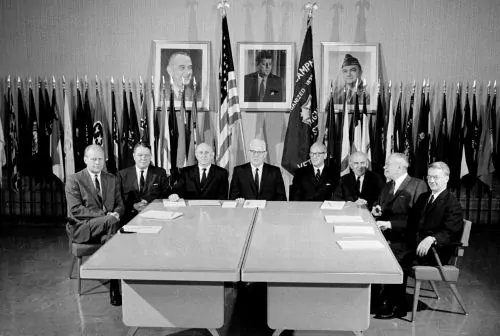
Kennedy’s assassination forced the first sustained external examination of presidential protection as an institutional system. President Lyndon B. Johnson created the President’s Commission on the Assassination of President Kennedy on November 29, 1963, under the leadership of Chief Justice Earl Warren. Its inquiry addressed the identity and actions of the assassin, the possibility of conspiracy, and the performance of the federal agencies whose information or responsibilities intersected with the president’s safety. The Commission found no evidence that the Secret Service had received information identifying Lee Harvey Oswald as a danger before the Dallas visit. It nevertheless rejected the implication that the absence of a specific warning absolved the protective system of broader responsibility. The central problem was not simply whether an agent should have recognized one particular man, but whether intelligence, advance planning, supervision, and interagency coordination were adequate for discovering threats that had not already announced themselves.
The Commission’s strongest criticism concerned preventive intelligence. The Protective Research Section had largely functioned as a passive recipient of threatening letters and reports selected by other organizations, each of which applied its own standards before forwarding information. Its staff was too small to conduct extensive independent inquiries, and its manually maintained records could not efficiently compare the rapidly growing volume of names, locations, associations, and behavioral information. The Secret Service had not clearly defined for the FBI, CIA, State Department, military intelligence, and local police exactly what categories of information it required. Oswald consequently remained compartmentalized: one agency knew about his Soviet defection, another held records concerning his foreign communications, and the FBI had investigated his political activities without judging him a direct presidential threat. The Commission also found that responsibilities within the Secret Service were insufficiently formalized, particularly those of advance agents operating far from headquarters. Too much depended on individual experience and informal practice rather than written procedures, checklists, and consistently supervised standards. Daily oversight within the Treasury Department was weak because officials supervising the Secret Service also managed unrelated financial and administrative functions. The Commission recommended appointing a senior Treasury official with suitable law-enforcement and intelligence experience to provide continuing supervision. It also urged formal agreements among agencies so that protective information would move according to established obligations rather than personal relationships.
Reconstruction began even before the Commission completed its report. The Protective Research Section received additional personnel, broader reporting criteria, and assistance from specialists in computing, psychology, psychiatry, intelligence, and information management. Consultants from organizations including IBM and the RAND Corporation examined how automated processing might replace slow manual retrieval, while liaison officers worked more directly with the FBI and other agencies. These reforms produced thousands of new referrals, including information about defectors, members of organizations considered subversive, mentally disturbed correspondents, and people whose conduct fell short of an explicit threat. The expansion improved the likelihood of identifying a dangerous person, but the Warren Commission itself warned that wider collection could interfere with personal liberty if political belief, eccentricity, or angry speech were treated as evidence of violent intention.
Operational protection changed as substantially as intelligence work. Advance agents received more formal instructions, and a Protective Research representative increasingly accompanied advance teams to establish contact with local intelligence and law-enforcement offices. The Secret Service intensified examination of buildings, windows, elevated positions, overpasses, and other locations from which an attacker could reach a motorcade. Presidential vehicles were hardened with armor, reinforced glass, improved communications, and permanently enclosed passenger compartments, while follow-up formations and emergency procedures received closer study. The Commission urged the Service to clarify responsibilities with local police, obtain additional personnel, strengthen training, and ensure that the president’s physician traveled close enough to respond immediately. It criticized violations of discipline by agents who had consumed alcohol in Fort Worth on the night before the assassination, while explicitly finding no causal connection between that conduct and Kennedy’s death. That distinction was important because punishment of individual agents could not substitute for institutional reform. The new approach sought to reduce reliance on personal memory and improvisation by converting experience into repeatable procedure.
Congress reconstructed the legal perimeter around the presidency. In 1963 it authorized two years of protection for Jacqueline Kennedy and her minor children, recognizing that the family of an assassinated president remained both vulnerable and nationally symbolic. Legislation enacted in 1965 made the killing, kidnapping, or assault of the president and vice president a federal crime, correcting the anomaly under which Kennedy’s murder itself had fallen primarily within Texas jurisdiction. Congress also authorized lifetime protection for former presidents and their spouses and protection for their children until age sixteen, although presidential widows required separate subsequent treatment. Secret Service agents received broader authority to make warrantless arrests for offenses committed in their presence and for certain felonies when they had reasonable grounds to believe a suspect had committed or was committing them. These enactments did more than add names to a list of protectees. They recognized that violence could threaten presidential families, former officeholders, succession, national mourning, and confidence in the federal government even when the incumbent president was not the immediate target. Protection was becoming an institution surrounding the presidency across time rather than a detail attached only to the current officeholder.
The Secret Service emerged from Dallas with more authority, personnel, money, technology, and institutional prestige, making it what Frederick Kaiser later described as an organizational beneficiary of its own failure. The Warren Commission considered whether presidential protection should be transferred elsewhere but declined to recommend dismantling or replacing the agency. Its field network, accumulated experience, and intimate relationship with the White House made reform appear less disruptive than institutional replacement. That choice preserved expertise while leaving the Service responsible for evaluating many of its own weaknesses behind a necessary wall of operational secrecy. The reconstruction substantially improved advance work, intelligence processing, medical preparation, and interagency cooperation, but it did not create an infallible science of predicting violence. Dallas had expanded protection around presidents and former presidents; the assassinations of the later 1960s would force Congress to decide whether the democratic process required protection before a candidate reached the office at all.
Protecting the Path to Power: RFK, Ford, and Reagan (1968–1981)
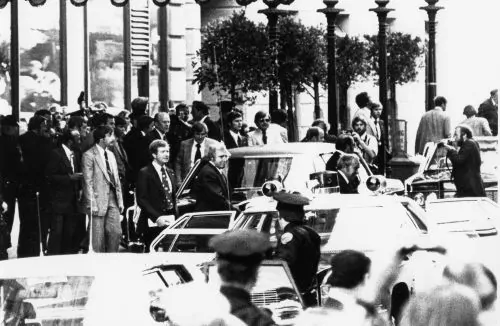
The reforms after Dallas strengthened protection around presidents, vice presidents, and presidential families, but they left the campaign trail governed largely by older assumptions about private political activity. Senator Robert F. Kennedy campaigned for the Democratic presidential nomination in 1968 without a permanent federal protective detail, even though his family history, political prominence, and the violence surrounding the civil rights movement made him an unusually conspicuous target. His security depended on campaign aides, private guards, hotel personnel, sympathetic volunteers, and whatever assistance local police supplied. After winning the California primary on June 4, Kennedy addressed supporters at the Ambassador Hotel in Los Angeles and then passed through a crowded service pantry, where Sirhan Bishara Sirhan fired repeatedly at close range. Kennedy died on June 6, while five other people wounded in the attack survived. The killing demonstrated that an assassin could alter the presidential succession before voters had selected either a nominee or a president-elect. It consequently forced Congress to recognize that protecting the presidency might require protecting the democratic process by which a future president emerged.
Congress responded with exceptional speed. On June 6, the day Kennedy died, Public Law 90-331 authorized the Secret Service to protect major presidential and vice-presidential candidates designated by the secretary of the Treasury after consultation with a bipartisan advisory committee composed principally of congressional leaders. A candidate retained the right to decline protection, while federal departments and agencies could be required to assist the Secret Service when requested. The law stopped short of treating every declared candidate as a federal protectee, but it made the security of leading contenders a national responsibility rather than a campaign’s private burden.
Candidate protection fundamentally enlarged the operational geography of the Secret Service. Protecting an incumbent generally allowed agents to work through established presidential institutions, military transportation systems, White House communications, and experienced advance staffs, whereas protecting candidates required the agency to enter improvised campaigns whose schedules changed rapidly and whose success depended on accessibility. Agents now had to coordinate with political organizations, state and municipal police departments, hotels, airports, convention managers, volunteers, and property owners without appearing to favor one party or contender. Congress gradually widened the protective circle further, extending coverage to the vice president’s immediate family and, in 1976, to the spouses of major presidential and vice-presidential candidates during the closing portion of the campaign. The Executive Protective Service, created from the White House Police in 1970 and renamed the Secret Service Uniformed Division in 1977, embodied a parallel shift toward permanent security for presidential sites, offices, and diplomatic facilities. The Presidential Protection Assistance Act of 1976 established procedures governing the facilities, property, services, and government assistance used in protective operations. These measures turned protection into an intergovernmental system that managed people, locations, communications, transportation, and public money rather than merely surrounding one individual with armed agents. They also made the Secret Service an increasingly visible participant in elections, even as the agency was expected to remain rigorously detached from electoral politics.
Gerald Ford’s presidency placed this enlarged system under direct pressure. Ford had entered the White House through the constitutional succession procedures of the Twenty-Fifth Amendment after the resignations of Vice President Spiro Agnew and President Richard Nixon, making his safety inseparable from a succession process already tested by political crisis. On September 5, 1975, Lynette “Squeaky” Fromme approached Ford near the California State Capitol in Sacramento and pointed a loaded .45-caliber pistol at him, although no cartridge had been chambered. Secret Service agent Larry Buendorf seized the weapon and subdued Fromme while other agents removed Ford from the scene. Seventeen days later, Sara Jane Moore fired a revolver at Ford as he left the St. Francis Hotel in San Francisco; her first shot missed, and bystander Oliver Sipple deflected her arm as she attempted to fire again. Agents immediately forced Ford behind the presidential limousine, covered his body, placed him inside the vehicle, and evacuated him. The two attempts showed that the post-Dallas system could respond quickly and preserve presidential continuity, but they also revealed that determined attackers could still enter lethal range during ordinary public appearances.
The Ford attacks were neither unqualified protective victories nor failures comparable to Dallas. In both cases, the president survived because trained agents acted decisively, but circumstance and civilian intervention also mattered. The protective detail proved capable of shielding and evacuating Ford once danger became visible, while its intelligence and perimeter systems did not prevent either attacker from approaching with a firearm. Protection had become more professional, yet it remained dependent on split-second human judgment after prevention had broken down.
By March 1981, the protective system included detailed advance work, controlled motorcade routes, armored vehicles, emergency communications, hospital planning, and agents trained to place themselves physically between a gunman and the president. Nevertheless, on March 30, John W. Hinckley Jr. waited among spectators outside the Washington Hilton as President Ronald Reagan walked toward his limousine after delivering a speech. Hinckley fired six shots in rapid succession, grievously wounding White House press secretary James Brady and also striking District of Columbia police officer Thomas Delahanty and Secret Service agent Timothy McCarthy. McCarthy deliberately expanded his body between the gunman and Reagan, while agent Jerry Parr forced the president into the limousine. Reagan initially appeared unharmed, but a bullet had ricocheted from the armored vehicle and entered his chest, narrowly missing his heart before lodging near his left lung. When Parr noticed that the president was in distress and coughing blood, he redirected the limousine from the White House to George Washington University Hospital. That decision, combined with rapid surgery and Reagan’s physical resilience, almost certainly prevented the assassination from succeeding. Yet Hinckley’s ability to stand within firing distance, and the failure of authorities to transmit his earlier firearms arrest in Nashville, where President Jimmy Carter had been campaigning, again demonstrated the limitations of threat intelligence. The system had not prevented the attack, but its overlapping human, transportation, communications, and medical components transformed a potentially fatal wound into a survivable emergency.
From Robert Kennedy’s death to Reagan’s survival, presidential protection expanded from guarding an officeholder to defending the constitutional path by which power was sought, transferred, and retained. Kennedy’s assassination established that political murder could deprive voters of a choice before an election, while the attacks on Ford and Reagan proved that even a mature protective system could not abolish the vulnerability created by public leadership. The Secret Service responded by constructing layers of protection that were expected both to prevent attacks and to preserve life and continuity when prevention failed. This second responsibility became as important as the first, for Ford’s evacuation and Reagan’s emergency hospitalization demonstrated that protective success could be measured in survival rather than perfect exclusion of danger. By 1981, the agency was no longer simply a presidential bodyguard; it had become a national institution charged with preserving the human links through which democratic authority passed.
The Mature Protective State, 1981–2013
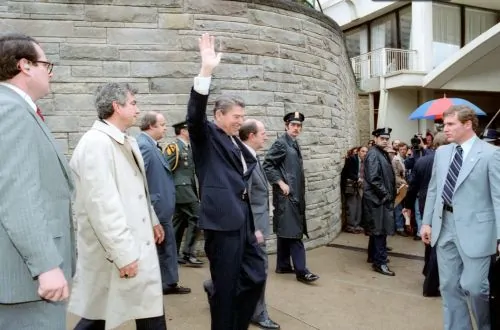
Ronald Reagan’s survival did not demonstrate that presidential protection had become impenetrable; it demonstrated the value of redundancy after an attacker penetrated the outer defenses. During the following three decades, the Secret Service developed what can be understood as concentric security: overlapping layers of intelligence, advance work, physical barriers, local police cooperation, countersurveillance, tactical response, armored transportation, close protection, emergency communications, and medical contingency planning. Each layer existed partly because planners assumed that another layer might fail. An individual who escaped investigative attention might still be intercepted at a checkpoint, while an attacker who crossed the perimeter might be stopped by the close detail or prevented from completing the assault by immediate evacuation. Protection consequently became less dependent on the reflexes of the agents nearest the president and more dependent on controlling the environment through which the president moved. The visible bodyguard remained important, but he represented only the innermost portion of an increasingly elaborate federal security structure.
Federal law gradually gave this structure a more coherent foundation. Public Law 98-587 consolidated the categories of Secret Service protectees in 1984, placing the president, vice president, their immediate families, former presidents, major candidates, and designated foreign dignitaries within a clearer statutory framework. The same law expanded the agency’s criminal jurisdiction, illustrating how Congress continued to legislate protection and financial investigation together rather than separating the two missions. Protection could also extend beyond permanent government buildings to temporary presidential and vice-presidential residences, private homes, campaign locations, and other properties occupied by protectees. Congress nevertheless experimented with limiting the expanding obligation when it enacted legislation in 1994 restricting protection for presidents who had not served before January 1, 1997, and their spouses to ten years after leaving office. That limitation reflected concern about cost, the growing number of living former presidents, and whether lifelong federal protection remained necessary in every case. The Former Presidents Protection Act of 2012, signed in January 2013, reversed the experiment and restored lifetime protection for former presidents and their spouses while protecting their children until age sixteen. The reversal confirmed that Congress ultimately regarded former presidents as enduring national symbols whose security could not be reduced to an actuarial calculation of ordinary personal risk.
Concentric protection also transformed the physical relationship between the White House and Washington. On September 12, 1994, Frank Eugene Corder crashed a stolen airplane onto the White House grounds, and the following month Francisco Martin Duran fired a semiautomatic rifle toward the Executive Mansion from Pennsylvania Avenue. A Treasury Department security review concluded that the existing perimeter could not adequately protect the complex from a vehicle carrying explosives. In May 1995, following the Oklahoma City bombing as well as the two White House incidents, the Secret Service closed portions of Pennsylvania Avenue, State Place, and South Executive Avenue to ordinary vehicular traffic while preserving pedestrian access. The closure increased the distance from which a vehicle bomb could threaten the residence, but it also converted a historically public street into a permanent security zone. The White House remained visible to citizens, yet the open executive mansion was now protected by an architectural expression of the same principle governing the presidential detail: danger should be detected or physically separated from the protectee before it reached the innermost ring.
While protection became spatially broader, the Secret Service’s original investigative mission was being remade by the digital economy. The 1984 legislation gave the agency authority over forms of credit-card, debit-card, electronic-funds-transfer, false-identification, and computer fraud that had begun to replace traditional counterfeiting as threats to the financial system. In 1995, the New York field office organized the first Electronic Crimes Task Force, joining federal, state, and local investigators with financial institutions, technology companies, merchants, and academic specialists. Section 105 of the USA PATRIOT Act directed the Secret Service to expand that model into a national network capable of investigating electronic crime and potential attacks on financial-payment systems and critical infrastructure. By the early twenty-first century, agents pursued identity theft, network intrusions, access-device fraud, payment-card trafficking, and transnational cybercrime alongside counterfeit currency. These responsibilities were not merely historical baggage unrelated to presidential protection, because both missions required intelligence collection, forensic analysis, confidential sources, technological expertise, and durable partnerships with other institutions. Financial investigations also provided field agents with experience that could later be applied to protective assignments. The dual mission nevertheless created an enduring competition for personnel, training, funding, and leadership attention whenever campaign demands or national-security events expanded faster than the agency’s workforce.
Protective intelligence changed as significantly as physical security. The National Threat Assessment Center, established within the Secret Service in 1998 and given explicit congressional authorization in 2000, sought to replace reliance on a simple psychological profile of an assassin with evidence-based analysis of threatening behavior. Its research emphasized that attackers frequently followed observable pathways toward violence, communicated grievances, tested boundaries, acquired weapons, or disclosed intentions to other people before acting. The center trained federal, state, and local agencies, consulted on difficult cases, and extended Secret Service methods into the prevention of school, workplace, and public violence. This wider application reflected an important institutional conclusion: presidential protection could be improved by studying targeted violence generally, while the knowledge developed around presidents could serve communities far beyond Washington.
The concept of protection simultaneously expanded from individuals and buildings to events of national significance. Presidential Decision Directive 62, issued in 1998, assigned the Secret Service a leading role in planning and coordinating operational security for designated national events, and the Presidential Threat Protection Act of 2000 supplied explicit statutory authority for that responsibility. National Special Security Events required the agency to integrate federal intelligence, criminal investigation, emergency management, military support, municipal policing, fire and medical services, transportation control, credentialing, and communications into a single operational design. Presidential inaugurations, political conventions, international summits, and other symbolic gatherings could receive security comparable in complexity to a presidential visit even when the president was not the event’s sole focus. The attacks of September 11, 2001, made airspace, mass-casualty terrorism, infrastructure disruption, and unconventional weapons unavoidable elements of protective planning. The Homeland Security Act of 2002 then transferred the Secret Service from the Treasury Department to the new Department of Homeland Security on March 1, 2003, while requiring that it remain a distinct entity. Placement within Homeland Security connected the agency more directly to national intelligence, border, infrastructure, cybersecurity, and emergency-management networks, but it did not eliminate its financial-crime jurisdiction. The transfer institutionalized an unusual identity: the organization founded to defend the nation’s currency had become a homeland-security agency without ceasing to investigate crimes against the financial system.
Maturity did not mean invulnerability. In 2009, Tareq and Michaele Salahi passed through Secret Service screening and entered a White House state dinner without appearing on the official guest list, exposing failures in credential verification and coordination with White House personnel. In November 2011, rifle rounds struck the White House residence, yet confusion about the source of the gunfire delayed recognition that the building itself had been attacked. Both incidents showed how procedural assumptions, fragmented information, and failures of communication could neutralize expensive technology and heavily guarded perimeters. By 2013, the Secret Service could protect a president across continents, coordinate thousands of personnel at an inauguration, investigate international cybercriminals, and construct a secure zone across sections of a major city, but it could not make every employee interpret incomplete information correctly. The mature protective state was not a flawless shield but a distributed network whose effectiveness depended on each component recognizing danger and passing information to the next. Its achievement was the creation of extraordinary protective capacity; its continuing weakness was that every concentric ring remained a human institution.
The Impossible Standard: Institutional Strain and Protective Failure, 2014–2026
The Secret Service entered the twenty-first century’s second decade burdened by an institutional standard no other federal agency faced: successful operations attracted little notice, while a single failure could alter the nation’s history. On September 19, 2014, that abstract danger became visible when Omar Gonzalez scaled the White House fence, crossed the North Lawn, and reached the executive residence while carrying a serrated knife. He passed officers, surveillance systems, tactical positions, and an inadequately secured entrance before penetrating as far as the East Room. The incident was damaging because the concentric defenses described as the strength of modern presidential protection failed successively rather than stopping the intruder through redundancy. Early official accounts incorrectly suggested that Gonzalez had been apprehended near the entrance, creating additional questions about whether senior officials possessed an accurate understanding of their own security system. Director Julia Pierson resigned on October 1 after congressional testimony failed to restore confidence in the agency’s leadership. An independent Protective Mission Panel subsequently described the breach as arising partly from a “catastrophic failure of training.” Its nineteen recommendations addressed personnel, training, technology, perimeter security, operational planning, budgeting, and leadership, demonstrating that the problem could not be isolated to the officers Gonzalez had physically evaded.
The panel’s conclusions exposed a structural contradiction: the operational tempo that made training essential also deprived agents of time to train. Presidential and vice-presidential details, former presidents, candidates, foreign dignitaries, international travel, National Special Security Events, and the agency’s financial-crime investigations all competed for a limited workforce. Emerging technologies created additional vulnerabilities, illustrated when a small drone crashed on the White House grounds in January 2015 and when another intruder crossed multiple barriers and remained on the grounds for more than fifteen minutes in March 2017. The Protective Mission Panel recommended that agents assigned to the presidential and vice-presidential divisions spend 25 percent of their work time training, but the Government Accountability Office found that they trained for approximately 5.9 and 2.9 percent, respectively, during fiscal year 2018. The agency later adopted a lower goal of 12 percent by fiscal year 2025, yet subsequent data continued to show training levels far below that target. As late as June 2026, the Government Accountability Office reported that the Secret Service had not supplied evidence demonstrating full implementation of recommendations concerning agent training and Uniformed Division training records.
Institutional strain culminated in the most serious protective failure since the Reagan shooting. On July 13, 2024, twenty-year-old Thomas Matthew Crooks reached the roof of a building in the American Glass Research complex overlooking a campaign rally for former president and Republican candidate Donald Trump near Butler, Pennsylvania. The building stood outside the formal security perimeter but remained within easy rifle range and possessed an unobstructed line of sight to the stage. Local officers had noticed Crooks behaving suspiciously, carrying a rangefinder, and moving around the complex, yet the Secret Service and cooperating agencies did not establish a unified command structure or common communications system capable of producing a coherent assessment. A Department of Homeland Security inspector general investigation released in 2026 found that Secret Service personnel failed to receive 102 local radio transmissions concerning the increasingly urgent search for Crooks. The agency instead received only a small number of telephone calls and text messages, leaving Trump’s protective detail without the information necessary to delay his appearance or remove him from the stage. Crooks had also flown a drone near the rally site for almost nine minutes without detection because the Secret Service counter-drone system was inoperable and assigned to an insufficiently trained operator. From the rooftop, Crooks fired eight rounds, wounding Trump in the ear, killing rally attendee Corey Comperatore, and seriously wounding David Dutch and James Copenhaver. A Secret Service countersniper killed Crooks, while close-detail agents covered Trump’s body and evacuated him from the stage. Their response prevented additional shots and removed the protectee from danger, but individual courage after the gunfire could not erase the planning, communications, and perimeter failures that had allowed the attack.
A second attempt two months later produced a sharply different result. On September 15, 2024, a Secret Service agent conducting a security sweep ahead of Trump at his West Palm Beach golf course observed Ryan Wesley Routh concealed along the perimeter fence with an AK-style rifle and opened fire before Routh could attack the candidate. Routh fled but was arrested, convicted in September 2025, and sentenced in February 2026 to life imprisonment plus eighty-four months. The episode demonstrated the protective system working as intended: an advance agent detected a concealed threat, interrupted the attack before the protectee entered the danger zone, and enabled other law-enforcement agencies to apprehend the suspect.
Butler nevertheless forced the most extensive reconsideration of Secret Service operations since 2014. Director Kimberly Cheatle resigned ten days after the shooting, while a bipartisan congressional task force, the agency’s Mission Assurance Inquiry, a Senate investigation, and an independent review panel identified deficiencies in leadership, advance planning, site responsibility, communications, counter-drone operations, protective intelligence, and coordination with state and local authorities. The independent panel concluded that Butler reflected deeper institutional weaknesses and called for fundamental reform rather than isolated disciplinary measures. Congress enacted the Enhanced Presidential Security Act of 2024, requiring the Secret Service to apply the same standards when determining the number of agents needed to protect presidents, vice presidents, and major candidates for those offices. Sean Curran, who had led Trump’s protective detail at Butler, became the agency’s twenty-eighth director in January 2025. The Service subsequently revised requirements for documenting and mitigating lines of sight, expanded counter-unmanned-aircraft capabilities, altered communications and advance procedures, and intensified joint planning with local agencies. By early 2026, it reported that it had tripled its drone fleet and established an Operational Medicine Program intended to strengthen emergency care for protectees and personnel. Yet contemporary inspector general and Government Accountability Office findings continued to emphasize understaffing, inadequate planning, and unresolved training deficiencies, indicating that announced reform had not eliminated the institutional conditions exposed at Butler.
The impossible standard must be interpreted carefully. Absolute protection is unattainable so long as presidents and candidates travel, campaign, speak outdoors, greet citizens, and remain visible participants in democratic life, but that reality does not excuse foreseeable and preventable failures. Every additional protectee, campaign stop, private residence, foreign journey, and national-security event increases the demand on personnel whose readiness also depends on time away from operations for training. Complex security systems can provide valuable redundancy, yet they can also diffuse responsibility when federal agents, local officers, technical specialists, and campaign staffs assume that someone else controls a vulnerable roof, monitors a radio channel, or interprets suspicious behavior. Butler showed how each protective layer could possess fragments of information without the institution assembling them into action, while West Palm Beach showed how a single properly positioned agent could make the layered system function. By 2026, the central problem was not whether the Secret Service could promise that failure would never occur, but whether it could distinguish unavoidable risk from institutional complacency before another attacker did so first.
Did Presidential Protection Preserve Democracy or Wall It Off?
The following video from “America’s Untold Stories” is a history of the Secret Service:
The protective system also changed the presidency into something increasingly remote from ordinary citizens. The early republic’s citizen executive occupied a relatively accessible house, traveled with little ceremony, and appeared in public without a permanent federal security apparatus. By the twenty-first century, the president moved through controlled airspace, armored motorcades, screened buildings, credentialed crowds, closed streets, and carefully surveyed routes. Citizens might see the president more frequently through television and digital media, but fewer could approach him without passing through institutions that selected, searched, separated, and observed them. Public visibility became compatible with substantial physical isolation. The president remained continuously on display while most encounters with the public were transformed into managed performances whose participants, boundaries, and sight lines had been arranged in advance. From this perspective, the Secret Service did not merely protect democratic leadership; it contributed to the symbolic elevation of the president into a figure who stood among citizens rhetorically while remaining apart from them physically.
The transformation was visible wherever protective requirements reshaped public space. Closing Pennsylvania Avenue to ordinary vehicular traffic in 1995 created a necessary barrier against vehicle bombs, but it also permanently altered the civic landscape surrounding the White House. National Special Security Events extended comparable controls across convention districts, inaugural routes, summit locations, and portions of entire cities, producing checkpoints, credential zones, surveillance systems, road closures, and restrictions on demonstrations. In Wood v. Moss, the Supreme Court considered allegations that Secret Service agents had moved protesters farther from President George W. Bush than supportive demonstrators, ultimately granting the agents qualified immunity because their security justification was plausible and the relevant constitutional rule was not clearly established. The decision illustrated the difficulty of separating viewpoint discrimination from protective judgment when agents must make rapid decisions based on confidential information. Even when restrictions are politically neutral in purpose, they can reduce the president’s exposure to visible dissent and transfer substantial authority over public expression to security officials.
Protective secrecy presents a related democratic problem. The Secret Service cannot disclose every vulnerability, threat report, tactical position, or security rationale without teaching potential attackers how to defeat its defenses, yet that necessary secrecy limits the ability of Congress, journalists, courts, and citizens to evaluate its decisions. Protective policy also possesses a ratcheting quality: an attack or breach produces new fences, personnel, technology, restricted zones, and legal authority, while long periods without an attack rarely produce equivalent pressure to dismantle them. Candidate protection introduces another complication because the designation of “major” candidates places the federal government in the position of deciding which aspirants merit a national protective apparatus. Although those decisions are made through bipartisan consultation and threat assessment, receiving a Secret Service detail can confer visibility, status, logistical capacity, and an appearance of political legitimacy unavailable to marginal or insurgent candidates. Once protection begins, campaign schedules, venues, crowd contact, and spontaneous movement become subject to federal security requirements that may favor controlled rallies and established organizations. The protective system safeguards electoral competition while simultaneously helping to define which competitors are treated as nationally consequential. Critics can reasonably conclude that an institution presented as a defense of the people’s government sometimes appears instead as a mechanism for protecting a political class from the people.
Killing a president or major candidate substitutes the will of one attacker for the votes, expectations, and constitutional rights of millions of citizens. The president also carries responsibilities for military command, diplomacy, emergency action, appointments, and administration that make his survival a matter of governmental continuity rather than private privilege. Protective planning often enables presidents and candidates to travel, campaign, and enter crowds that would otherwise be considered too dangerous, meaning that security can preserve public visibility rather than simply suppress it.
Presidential protection preserved democracy institutionally by defending elected leadership, constitutional succession, and electoral choice, but it sometimes walled democracy off spatially by increasing the distance between national leaders and the citizens in whose name they governed. The relevant standard cannot be unrestricted physical access, which modern weapons and recurring political violence have made untenable, nor can it be absolute security at any civic cost. Protective measures should instead be judged by proportionality, political neutrality, public accountability, and their preservation of meaningful opportunities for journalism, protest, petition, and unscripted political encounter. The Secret Service must regard citizens not merely as a field of potential threats but as the democratic public whose authority gives the presidency legitimacy. Presidential protection strengthens democracy only when the shield around the office remains a defensible boundary rather than becoming a permanent barrier between government and governed.
Conclusion: Guarding the Person, Preserving the Office
The history of the Secret Service begins not with presidential protection but with the defense of money. Established in 1865 to suppress counterfeiting, the agency was intended to restore confidence in a financial system destabilized by civil war, fraudulent currency, and fragmented federal enforcement. Its eventual assumption of presidential protection was neither planned at its creation nor an automatic consequence of executive power. It emerged from the repeated discovery that the United States had constructed a powerful presidency without constructing a reliable institution to keep the president alive. The Secret Service consequently joined two forms of national security that initially appeared unrelated: protecting the instruments through which the government represented economic value and protecting the individual through whom executive authority was exercised. In both missions, its purpose was ultimately the preservation of public confidence in systems whose legitimacy depended on continuity.
That protective mission expanded whenever violence revealed that the existing definition of security was too narrow. Lincoln and Garfield demonstrated the danger of leaving presidents dependent on informal guards, while McKinley’s assassination finally made permanent federal protection politically unavoidable. War, international travel, and the increasing importance of the vice presidency extended concern from the president’s body to the presidential household and constitutional succession. Dallas proved that courageous agents near the president could not compensate for weak advance planning, fragmented intelligence, exposed routes, and inadequate emergency preparation. Robert Kennedy’s assassination extended the principle further by showing that political violence could deprive voters of a presidential choice before an election had occurred. The attacks on Ford and Reagan demonstrated that protection required both prevention and a practiced capacity to shield, evacuate, communicate, and obtain immediate medical care when prevention failed. National Special Security Events, cybercrime investigations, candidate details, behavioral threat assessment, and the transfer to the Department of Homeland Security subsequently turned the Secret Service into a protective network operating across people, places, institutions, and technologies. Butler revealed in 2024 that even this mature system could collapse when responsibility, information, training, and communications failed to connect its many layers.
Protection nevertheless carries democratic costs that cannot be dismissed as mere inconveniences. Fences, motorcades, restricted airspace, screened audiences, closed streets, and security zones preserve the president’s visibility while limiting the spontaneity and physical proximity once associated with the citizen executive. Absolute safety is impossible in an open political system, but that fact cannot excuse preventable failures or transform every citizen, protester, and public space into a presumptive threat. The legitimate standard is neither perfect accessibility nor perfect security, but protection that is competent, proportionate, politically neutral, and subject to meaningful oversight.
The strongest final interpretation is that the Secret Service protects a person because the constitutional office cannot act without a living occupant. Its agents guard more than an individual life: they defend electoral decisions, succession, governmental continuity, diplomatic authority, and the peaceful transfer of executive power. Yet the office derives its legitimacy from citizens, so protection ceases to serve democracy when it treats separation from those citizens as an end in itself. The president must remain visible enough to govern representatively, accessible enough to encounter disagreement, and secure enough that violence cannot determine who exercises national power. Secret Service history shows that this balance will never be permanently solved, because every new barrier changes public access while every new form of access creates another vulnerability. Guarding the person preserves the office only when the shield allows democratic government to continue on the other side.
Bibliography
Affiliate disclosure: Amazon links on this site are paid links. As an Amazon Associate I earn from qualifying purchases.
- Abrams, Herbert L. The President Has Been Shot: Confusion, Disability, and the Twenty-Fifth Amendment. Stanford, CA: Stanford University Press, 1992.
- Ackerman, Kenneth D. Dark Horse: The Surprise Election and Political Murder of President James A. Garfield. New York: Carroll & Graf, 2003.
- Adams, John Quincy. Memoirs of John Quincy Adams, Comprising Portions of His Diary from 1795 to 1848. Edited by Charles Francis Adams. Vol. 9. Philadelphia: J. B. Lippincott & Co., 1876.
- Avrich, Paul. The Haymarket Tragedy. Princeton, NJ: Princeton University Press, 1984.
- Blaine, Gerald S., with Lisa McCubbin. The Kennedy Detail: JFK’s Secret Service Agents Break Their Silence. New York: Gallery Books, 2010.
- Bumgarner, Jeffrey B. Federal Agents: The Growth of Federal Law Enforcement in America. Westport, CT: Praeger, 2006.
- Caro, Robert A. The Passage of Power. New York: Alfred A. Knopf, 2012.
- Clarke, James W. American Assassins: The Darker Side of Politics. Princeton, NJ: Princeton University Press, 1982.
- Clarke, Thurston. The Last Campaign: Robert F. Kennedy and 82 Days That Inspired America. New York: Henry Holt, 2008.
- Cleveland, Grover. Presidential Problems. New York: Century Company, 1904.
- Clinton, William J. Presidential Decision Directive 62. “Protection Against Unconventional Threats to the Homeland and Americans Overseas.” May 22, 1998.
- Collazo v. United States. 196 F.2d 573. D.C. Circuit, 1952.
- Cortelyou, George B. George B. Cortelyou Papers, 1871–1940. Manuscript Division, Library of Congress, Washington, DC.
- Dallek, Robert. An Unfinished Life: John F. Kennedy, 1917–1963. Boston: Little, Brown and Company, 2003.
- Dalton, Kathleen. Theodore Roosevelt: A Strenuous Life. New York: Alfred A. Knopf, 2002.
- Eisenhower, Dwight D. Public Papers of the Presidents of the United States: Dwight D. Eisenhower, 1953–1961. Washington, DC: Office of the Federal Register, 1953–61.
- Fein, Robert A., and Bryan Vossekuil. Protective Intelligence and Threat Assessment Investigations: A Guide for State and Local Law Enforcement Officials. Washington, DC: United States Secret Service and National Institute of Justice, 1998.
- Ferrell, Robert H. Harry S. Truman: A Life. Columbia: University of Missouri Press, 1994.
- Garfield, James A. The Diary of James A. Garfield. Edited by Harry James Brown and Frederick D. Williams. 4 vols. East Lansing: Michigan State University Press, 1967–81.
- Gerald R. Ford Presidential Library. White House Central Files, Subject File. “President—Assassination Attempts.” 1975.
- Goodyear, C. W. President Garfield: From Radical to Unifier. New York: Simon & Schuster, 2023.
- Gould, Lewis L. The Presidency of Theodore Roosevelt. Lawrence: University Press of Kansas, 1991.
- —-. The Presidency of William McKinley. Lawrence: University Press of Kansas, 1980.
- Hatch, Frederick. Protecting President Lincoln: The Security Effort, the Thwarted Plots and the Disaster at Ford’s Theatre. Jefferson, NC: McFarland & Company, 2011.
- Hay, John. Inside Lincoln’s White House: The Complete Civil War Diary of John Hay. Edited by Michael Burlingame and John R. Turner Ettlinger. Carbondale: Southern Illinois University Press, 1997.
- Healy, Gene. The Cult of the Presidency: America’s Dangerous Devotion to Executive Power. Washington, DC: Cato Institute, 2008.
- Holland, Max. The Kennedy Assassination Tapes: The White House Conversations of Lyndon B. Johnson Regarding the Assassination, the Warren Commission, and the Aftermath. New York: Alfred A. Knopf, 2004.
- Hunter, Stephen, and John Bainbridge Jr. American Gunfight: The Plot to Kill Harry Truman—and the Shoot-out That Stopped It. New York: Simon & Schuster, 2005.
- Jeffreys-Jones, Rhodri. The FBI: A History. New Haven, CT: Yale University Press, 2007.
- Johnson, David R. Illegal Tender: Counterfeiting and the Secret Service in Nineteenth-Century America. Washington, DC: Smithsonian Institution Press, 1995.
- Kaiser, Frederick M. “Origins of Secret Service Protection of the President: Personal, Interagency, and Institutional Conflict.” Presidential Studies Quarterly 18:1 (Winter 1988), 101–127.
- —-. “Presidential Assassinations and Assaults: Characteristics and Impact on Protective Procedures.” Presidential Studies Quarterly 11:4 (Fall 1981), 545–558.
- Kauffman, Michael W. American Brutus: John Wilkes Booth and the Lincoln Conspiracies. New York: Random House, 2004.
- Kennedy, John F. Public Papers of the Presidents of the United States: John F. Kennedy, 1961–1963. Washington, DC: Government Printing Office, 1962–64.
- Kessler, Ronald. In the President’s Secret Service: Behind the Scenes with Agents in the Line of Fire and the Presidents They Protect. New York: Crown, 2009.
- Lamon, Ward Hill. Recollections of Abraham Lincoln, 1847–1865. Edited by Dorothy Lamon Teillard. Chicago: A. C. McClurg and Company, 1895.
- Leonnig, Carol D. Zero Fail: The Rise and Fall of the Secret Service. New York: Random House, 2021.
- Los Angeles Police Department. Special Unit Senator. Summary Report: Investigation into the Assassination of Senator Robert F. Kennedy. Los Angeles, 1969.
- Manchester, William. The Death of a President: November 20–November 25, 1963. New York: Harper & Row, 1967.
- McCulloch, Hugh. Men and Measures of Half a Century: Sketches and Comments. New York: Charles Scribner’s Sons, 1888.
- McKinley, William. Last Speech of William McKinley, President of the United States, Delivered at the Pan-American Exposition, Buffalo, N.Y., September 5, 1901. Washington, DC: Government Printing Office, 1901.
- Melanson, Philip H., and Peter F. Stevens. The Secret Service: The Hidden History of an Enigmatic Agency. New York: Carroll & Graf, 2002.
- Mieczkowski, Yanek. Gerald Ford and the Challenges of the 1970s. Lexington: University Press of Kentucky, 2005.
- Mihm, Stephen. A Nation of Counterfeiters: Capitalists, Con Men, and the Making of the United States. Cambridge, MA: Harvard University Press, 2007.
- Millard, Candice. Destiny of the Republic: A Tale of Madness, Medicine and the Murder of a President. New York: Doubleday, 2011.
- Miller, Scott. The President and the Assassin: McKinley, Terror, and Empire at the Dawn of the American Century. New York: Random House, 2011.
- Morgan, H. Wayne. William McKinley and His America. Rev. ed. Kent, OH: Kent State University Press, 2003.
- Morris, Edmund. Theodore Rex. New York: Random House, 2001.
- Nelson, Dana D. Bad for Democracy: How the Presidency Undermines the Power of the People. Minneapolis: University of Minnesota Press, 2008.
- Nevins, Allan, ed. Letters of Grover Cleveland, 1850–1908. Boston: Houghton Mifflin Company, 1933.
- Pach, Chester J., Jr., and Elmo Richardson. The Presidency of Dwight D. Eisenhower. Rev. ed. Lawrence: University Press of Kansas, 1991.
- Pinkerton, Allan. History and Evidence of the Passage of Abraham Lincoln from Harrisburg, Pa., to Washington, D.C., on the Twenty-Second and Twenty-Third of February, 1861. Chicago: Tribune Company’s Book and Job Printing Office, 1868.
- Pinsker, Matthew. Lincoln’s Sanctuary: Abraham Lincoln and the Soldiers’ Home. New York: Oxford University Press, 2003.
- Rauchway, Eric. Murdering McKinley: The Making of Theodore Roosevelt’s America. New York: Hill and Wang, 2003.
- Reese, Shawn. Legislative Evolution of U.S. Secret Service. CRS Report R48138. Washington, DC: Congressional Research Service, 2024.
- —-. National Special Security Events. Congressional Research Service Report RS22754. Washington, DC: Congressional Research Service, 2007.
- —-. The U.S. Secret Service: History and Missions. Congressional Research Service Report RL34603. Washington, DC: Congressional Research Service, 2014.
- —-. The U.S. Secret Service: Selected Issues and Executive and Congressional Responses. Congressional Research Service Report R44197. Washington, DC: Congressional Research Service, 2015.
- Reeves, Richard. President Kennedy: Profile of Power. New York: Simon & Schuster, 1993.
- Reilly, Michael F., with William J. Slocum. Reilly of the White House. New York: Simon and Schuster, 1947.
- Remini, Robert V. Andrew Jackson and the Course of American Democracy, 1833–1845. New York: Harper & Row, 1984.
- Ronald Reagan Presidential Library. Edwin Meese Files. “Assassination Report.” 1981.
- Roosevelt, Theodore. Theodore Roosevelt: An Autobiography. New York: Macmillan Company, 1913.
- Sabato, Larry J. The Kennedy Half-Century: The Presidency, Assassination, and Lasting Legacy of John F. Kennedy. New York: Bloomsbury, 2013.
- Schlesinger, Arthur M., Jr. The Imperial Presidency. Boston: Houghton Mifflin, 1973.
- Seale, William. The President’s House: A History. 2nd ed. 2 vols. Washington, DC: White House Historical Association, 2008.
- Shenon, Philip. A Cruel and Shocking Act: The Secret History of the Kennedy Assassination. New York: Henry Holt and Company, 2013.
- Sherman, Robert B. “Presidential Protection during the Progressive Era: The Aftermath of the McKinley Assassination.” The Historian 46:1 (November 1983), 1–20.
- Starling, Edmund W., and Thomas Sugrue. Starling of the White House. New York: Simon and Schuster, 1946.
- Steers, Edward, Jr. Blood on the Moon: The Assassination of Abraham Lincoln. Lexington: University Press of Kentucky, 2001.
- Thomas, Evan. Robert Kennedy: His Life. New York: Simon & Schuster, 2000.
- Truman, Harry S. Memoirs. Vol. 2, Years of Trial and Hope. Garden City, NY: Doubleday & Company, 1956.
- Tulis, Jeffrey K. The Rhetorical Presidency. Princeton, NJ: Princeton University Press, 1987.
- United States Code. Title 18, sec. 3056. “Powers, Authorities, and Duties of United States Secret Service.”
- United States. Congress. An Act to Authorize the Issue of United States Notes, and for the Redemption or Funding Thereof, and for Funding the Floating Debt of the United States. 12 Stat. 345. February 25, 1862.
- —-. An Act to Provide a National Currency, Secured by a Pledge of United States Stocks, and to Provide for the Circulation and Redemption Thereof. 12 Stat. 665. February 25, 1863.
- —-. House Committee on Homeland Security. The United States Secret Service and Presidential Protection: An Examination of a System Failure. Hearing, 111th Cong., 1st sess., December 2, 2009.
- —-. House Committee on Oversight and Government Reform. White House Perimeter Breach: New Concerns about the Secret Service. Hearing, 113th Cong., 2nd sess., September 30, 2014. Washington, DC: Government Printing Office, 2014.
- —-. House. Select Committee on Assassinations. Final Report of the Select Committee on Assassinations. 95th Cong., 2nd sess., H. Rept. 95-1828. Washington, DC: Government Printing Office, 1979.
- —-. House. Task Force on the Attempted Assassination of Donald J. Trump. Final Report of Findings and Recommendations. 118th Cong., 2nd sess., H. Rept. 118-873. Washington, DC: U.S. Government Publishing Office, 2024.
- —-. Senate Committee on Homeland Security and Governmental Affairs. Interim Joint Report: Examination of U.S. Secret Service Planning and Security Failures Related to the July 13, 2024, Assassination Attempt. Washington, DC, 2024.
- United States Department of Homeland Security. Executive Summary to the Report from the United States Secret Service Protective Mission Panel to the Secretary of Homeland Security. Washington, DC, December 15, 2014.
- —-. Independent Review Panel Report of the July 13, 2024, Assassination Attempt. Washington, DC, October 17, 2024.
- —-. Office of Inspector General. Understaffing and Inadequate Planning Heighten Risk to Secret Service Protective Operations. OIG-26-12. Washington, DC, 2026.
- United States Department of Justice. “Ryan Wesley Routh Sentenced to Life in Prison for Attempted Assassination of President Donald J. Trump and Assault of a Federal Law Enforcement Officer.” February 4, 2026.
- United States. Constitution of the United States. Amendment I.
- United States. Department of the Treasury. Report of the Secretary of the Treasury on the State of the Finances for the Year 1865. Washington, DC: Government Printing Office, 1865.
- —-. Annual Report of the Secretary of the Treasury on the State of the Finances for the Year 1894. Washington, DC: Government Printing Office, 1894.
- —-. Annual Report of the Secretary of the Treasury on the State of the Finances for the Year 1898. Washington, DC: Government Printing Office, 1898.
- —-. Annual Report of the Secretary of the Treasury on the State of the Finances for the Year 1902. Washington, DC: Government Printing Office, 1902.
- —-. Annual Report of the Secretary of the Treasury on the State of the Finances for the Year 1906. Washington, DC: Government Printing Office, 1906.
- —-. United States Secret Service. “Closure of Streets.” Federal Register 60, no. 102 (May 26, 1995): 27882–85.
- United States. Executive Office of the President. Executive Order 11130. “Appointing a Commission to Report upon the Assassination of President John F. Kennedy.” November 29, 1963.
- United States Government Accountability Office. Security Protection: Standardization Issues Regarding Protection of Executive Branch Officials. GAO/GGD/OSI-00-139. Washington, DC: Government Accountability Office, 2000.
- —-. U.S. Secret Service: Further Actions Needed to Fully Address Protective Mission Panel Recommendations. GAO-19-415. Washington, DC, 2019.
- —-. U.S. Secret Service: Further Progress Made Implementing the Protective Mission Panel Recommendations. GAO-22-105100. Washington, DC, 2022.
- United States, President. Public Papers of the Presidents of the United States: Ronald Reagan, 1981. Book 1. Washington, DC: Government Printing Office, 1982.
- United States. President’s Commission on the Assassination of President Kennedy. Hearings before the President’s Commission on the Assassination of President Kennedy. 26 vols. Washington, DC: Government Printing Office, 1964.
- —-. Report of the President’s Commission on the Assassination of President John F. Kennedy. Washington, DC: U.S. Government Printing Office, 1964.
- United States. Statutes at Large. Vol. 34. “Sundry Civil Expenses Act.” June 30, 1906.
- —-. Vol. 35. “Sundry Civil Appropriations Act.” May 27, 1908.
- —-. Vol. 38. “Sundry Civil Appropriations Act for Fiscal Year 1914.” June 23, 1913.
- —-. Vol. 39. “An Act to Punish Persons Who Make Threats against the President of the United States.” February 14, 1917.
- —-. Vol. 40. “Sundry Civil Appropriations Act.” June 12, 1917.
- —-. Vol. 42. “An Act to Create the White House Police Force.” September 14, 1922.
- —-. Vol. 46. “An Act to Place the White House Police Force under the Supervision of the Secret Service.” 1930.
- —-. Vol. 65. “An Act to Authorize the United States Secret Service to Protect the President, the Members of His Immediate Family, the President-Elect, and the Vice President.” July 16, 1951.
- —-. Vol. 76. “An Act to Provide Protection for the Vice President, the Vice President-Elect, and Former Presidents.” October 15, 1962.
- —-. Vol. 77. “An Act to Authorize the Secret Service to Protect Mrs. John F. Kennedy and Her Minor Children.” 1963.
- —-. Vol. 79. “An Act to Provide Penalties for the Assassination of the President or Vice President, and for Other Purposes.” August 28, 1965.
- —-. Vol. 79. “An Act to Provide for the Protection of Former Presidents and Their Spouses and Minor Children.” September 14, 1965.
- United States. Public Law 90-331. Joint Resolution to Authorize the United States Secret Service to Furnish Protection to Major Presidential or Vice Presidential Candidates. 82 Stat. 170. June 6, 1968.
- —-. Public Law 91-217. 84 Stat. 74. March 19, 1970.
- —-. Public Law 93-552. 88 Stat. 1765. December 27, 1974.
- —-. Public Law 94-408. 90 Stat. 1239. September 11, 1976.
- —-. Public Law 94-524. Presidential Protection Assistance Act of 1976. 90 Stat. 2475. October 17, 1976.
- —-. Public Law 98-587. An Act to Amend Section 3056 of Title 18, United States Code. 98 Stat. 3110. October 30, 1984.
- —-. Public Law 103-329. Treasury, Postal Service, and General Government Appropriations Act, 1995. 108 Stat. 2382. September 30, 1994.
- —-. Public Law 106-544. Presidential Threat Protection Act of 2000. 114 Stat. 2715. December 19, 2000.
- —-. Public Law 107-56. Uniting and Strengthening America by Providing Appropriate Tools Required to Intercept and Obstruct Terrorism Act of 2001. 115 Stat. 272. October 26, 2001.
- —-. Public Law 107-296. Homeland Security Act of 2002. 116 Stat. 2135. November 25, 2002.
- —-. Public Law 112-98. Federal Restricted Buildings and Grounds Improvement Act of 2011. 126 Stat. 263. March 8, 2012.
- —-. Public Law 112-257. Former Presidents Protection Act of 2012. 126 Stat. 2413. January 10, 2013.
- —-. Public Law 118-91. Enhanced Presidential Security Act of 2024. 138 Stat. 1560. October 1, 2024.
- United States Secret Service. Mission Assurance Inquiry: July 13, 2024, Attempted Assassination of Former President Donald J. Trump. Washington, DC, 2024.
- —-. “One-Year Update Following the July 13, 2024, Attempted Assassination of President Donald Trump.” July 10, 2025.
- —-. Report of the United States Secret Service on the Assassination of President Kennedy. Commission Document 3. Washington, DC, December 18, 1963.
- —-. The Secret Service Quarterly. First Quarter 2026. Washington, DC, 2026.
- United States. Secret Service School. “Principles of Protection of the President and Other Dignitaries.” January 4, 1954. Records of the President’s Commission on the Assassination of President Kennedy, National Archives, College Park, MD.
- United States v. Guiteau. 1 Mackey 498. District of Columbia, 1882.
- Welch, Richard E., Jr. The Presidencies of Grover Cleveland. Lawrence: University Press of Kansas, 1988.
- Wilber, Del Quentin. Rawhide Down: The Near Assassination of Ronald Reagan. New York: Henry Holt, 2011.
- Wood v. Moss. 572 U.S. 744. 2014.
- Zapruder, Abraham. Film of President John F. Kennedy’s Motorcade in Dallas, Texas. November 22, 1963. National Archives, College Park, MD.
- Zick, Timothy. Speech Out of Doors: Preserving First Amendment Liberties in Public Places. Cambridge: Cambridge University Press, 2009.
Originally published by Brewminate, 08.21.2026, under the terms of a Creative Commons Attribution-NonCommercial-NoDerivatives 4.0 International license.
About the Author