
Surviving the Ides of March could have given Julius Caesar years to consolidate his rule. But defeating a conspiracy would leave Rome’s hardest question unanswered: who could succeed him?

By Matthew A. McIntosh
Public Historian
Brewminate
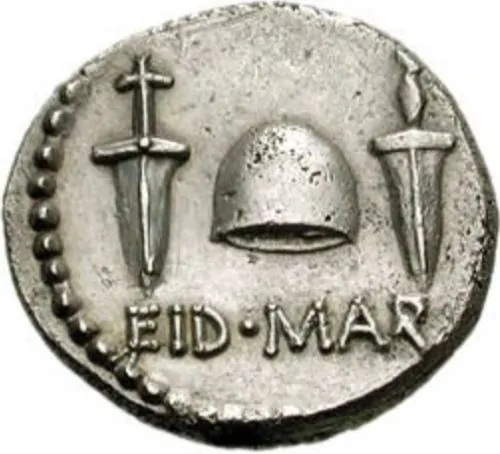
The men waiting for Julius Caesar on March 15, 44 BCE, included enemies he had pardoned and friends he believed he could trust. In a hall adjoining Pompey’s theater, conspirators led by Marcus Junius Brutus and Gaius Cassius Longinus stabbed him to death. Many hoped that killing the recently appointed dictator for life would restore government without a permanent master. Instead, Rome descended into further civil wars. Caesar’s great-nephew Octavian eventually defeated his rivals and became Augustus, establishing the enduring supremacy of one ruler beneath republican offices. Caesar’s assassination helped determine who would build that system, although his survival would not necessarily have produced the same settlement.
Later ancient accounts describe attempts to warn Caesar, including a written message that went unread. These recollections supply a plausible opening, even if their details remain uncertain. Suppose he reads the warning before entering the meeting, withdraws to safety, and exposes the conspiracy. He survives uninjured, with enough protection to prevent an immediate second attempt. The difficult decision would come afterward. Caesar had pardoned defeated opponents, including Brutus and Cassius, and made clemency part of his public authority. Discovering their involvement might convince him that reconciliation had failed. Executions or confiscations could follow, but a sweeping purge would endanger the cooperation of senators needed to administer his government. He would have practical reasons to punish identified organizers while reassuring everyone else. Some suspects might escape and seek military backing elsewhere. Others could denounce associates to save themselves. Caesar could probably disrupt this conspiracy without eliminating the grievances behind it. Even senators relieved to avoid another civil war might resent the guards who now accompanied him.
Nor would survival make a return to ordinary republican competition attractive to Caesar. Relinquishing command would expose him to enemies who had just tried to kill him. He might reduce provocative honors or consult senators more carefully, while continuing to decide the questions that mattered. His existing program of overseas settlements could proceed, offering land to veterans and opportunities to other citizens. Such measures might strengthen acceptance of his rule. They would give people reasons to cooperate without resolving whether any institution could safely overrule him.
The most immediate test lay beyond Italy. Caesar was preparing a major expedition, with operations against the Dacians and then the Parthians among his intended undertakings. Assume that exposing the plot delays his departure but does not cancel the project. An external war could keep active armies occupied away from Italy and offer victories over foreign enemies after the divisive triumphs of civil war. Yet Parthia was a formidable opponent. Marcus Licinius Crassus had been defeated and killed at Carrhae in 53 BCE, demonstrating the danger of campaigning against mobile horse archers and armored cavalry far from dependable supplies. Caesar’s experience and adaptability would matter; they would not make water or fodder appear where his army needed them. Success might consist of strengthening Rome’s frontier position or supporting friendly rulers, rather than conquering the Parthian kingdom. A prolonged struggle would also leave Rome dependent on deputies whose authority rested heavily on Caesar’s continued confidence. For the scenario followed here, imagine limited eastern victories followed by his return without a decisive settlement: enough success to sustain his military standing, too little to remove the need for accommodation at home. A major defeat would threaten his dominance more seriously, but even that would not automatically restore the Senate’s independence.
For the young Octavian, every additional year of Caesar’s life would change the conditions of advancement. At eighteen, he was at Apollonia, studying while awaiting the planned expedition. Caesar’s will named him principal heir and provided for his adoption, but inheritance of an estate was no legal transfer of dictatorship. In actual history, Caesar’s death gave Octavian the name and resources with which to enter politics as an avenger. Here he would remain a promising relative whose importance depended on the living dictator. Service on campaign might help him acquire experience and personal connections. Years under Caesar’s supervision could produce a capable lieutenant without reproducing the independent contender who emerged after the assassination. Mark Antony, already Caesar’s fellow consul in 44 BCE, would retain advantages in office and military experience. Caesar could promote his great-nephew without persuading established commanders to accept him as their future superior. The longer Caesar lived, the more time he would have to cultivate support for a successor. He would still have to turn personal preference into an arrangement powerful men would honor after his death.
If Caesar lived another decade, Italy might escape some of the devastation that followed the assassination while his government became more familiar. His survival could also postpone a struggle that would erupt when he finally died. A relatively peaceful succession would require agreement over military commands as well as a place for influential senators within the new order. Those bargains cannot simply be assumed. By 44 BCE, repeated civil wars had demonstrated how readily commanders could use provincial resources against rivals at Rome. Caesar’s continued presence might contain that competition, but his eventual absence would test whatever settlement he left. The Ides of March reveal how much could depend on one man’s death; imagining his survival exposes the harder task of making his authority survive him.
Originally published by Brewminate, 10.18.2026, under the terms of a Creative Commons Attribution-NonCommercial-NoDerivatives 4.0 International license.
About the Author