In 399 BCE, Dionysius I gathered Mediterranean artisans at Syracuse, armed for renewed war with Carthage, and brought an early catapult into battle at Motya, though its invention remains disputed.

By Matthew A. McIntosh
Public Historian
Brewminate
Introduction: A New Weapon over the Lagoon
When Himilco’s Carthaginian fleet reached Motya in 397 BCE, it appeared to have trapped Dionysius I of Syracuse in a dangerous position. Many Syracusan warships had been drawn onto land, while the narrow harbor entrance prevented them from deploying together against the approaching triremes. Dionysius responded by hauling ships across the intervening ground toward open water and concentrating missile troops along the shore. Archers and slingers attacked the Carthaginian crews, but Diodorus Siculus singled out another weapon for special notice: catapults firing sharp-pointed projectiles from land. Their bolts killed numerous men and caused alarm because, according to his account, the machine had never before been encountered in battle.
That moment had been prepared two years earlier, when Dionysius began turning Syracuse into an immense armaments center. Skilled workers were commandeered from the cities under his control or attracted from elsewhere by unusually high wages, while rewards encouraged them to improve what they produced. They came from Greek communities, Italy, and territories governed by Carthage, bringing knowledge that had previously been scattered across the central Mediterranean. Dionysius divided them according to their crafts, placed prominent citizens over the different groups, and distributed models for the equipment required by his multinational forces. Workshops spread beyond ordinary production quarters into gymnasia, colonnades, temple precincts, and private houses. The ruler reportedly inspected the labor each day, spoke personally with successful craftsmen, and reinforced competition through gifts and invitations to dine with him. What emerged was not merely a new projectile engine but an interlocking program of arms manufacture, fleet construction, timber procurement, storage, transport, and military recruitment conducted on a scale that astonished contemporaries, or at least astonished the later historian describing it.
Whether the catapult itself originated in these Syracusan workshops is considerably less certain. Diodorus wrote centuries after the event and shaped his narrative around the concentration of exceptional craftsmen under an energetic ruler, producing an unusually tidy explanation for technological change. Biton’s descriptions of machines associated with Zopyrus of Tarentum have been used to argue for an earlier history of mechanical bow artillery, although the chronology of those devices remains disputed. Modern interpretations consequently range from accepting 399 BCE as the most plausible date of invention to treating Syracuse as the place where an existing experimental concept was enlarged, refined, or first employed systematically. The evidence securely establishes an early program of artillery production and the weapon’s first clearly dated combat appearance; it does not identify an individual inventor or disclose every developmental step.
The importance of Motya does not depend upon preserving a heroic origin story. Dionysius’s achievement lay in bringing political authority, accumulated wealth, skilled labor, and operational planning into sustained cooperation against a powerful rival. The resulting catapults delivered a temporary advantage, but they neither defeated Carthage alone nor rendered older forms of warfare obsolete. Motya was taken through the coordinated use of a reconstructed mole, battering rams, mobile towers, concentrated missile fire, infantry assaults, and calculated deception, followed by brutal fighting within the city. Nor was the victory strategically decisive, since Carthage answered with a mobilization intended to surpass the Syracusan buildup. The catapult entered war as one element of a widening competition in which each new capability generated countermeasures and greater expenditure. Syracuse may or may not have invented the machine, but under Dionysius it demonstrated how a state could accelerate technical development, move it into production, and convert novelty into violence before an adversary had learned how to respond.
Before the Catapult: Carthage Brings Siege War to Sicily
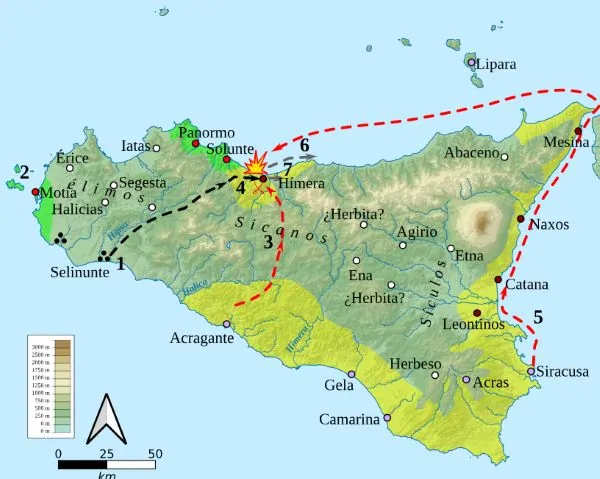
Carthage did not introduce the siege itself to Sicily. Fortified settlements had been contested for generations, and the Athenian expedition of 415–413 BCE had subjected Syracuse to circumvallation, counterwalls, prolonged blockade, and fighting for control of its approaches. What changed during the Carthaginian offensives beginning in 409 BCE was the scale and destructive purpose of mechanical assault. Punic commanders arrived prepared to penetrate defenses rapidly rather than depend exclusively upon isolation and starvation. Their operations joined substantial expeditionary armies to mobile towers, battering rams, naval transport, and missile troops capable of clearing defenders from battlements.
The change became unmistakable at Selinus, whose conflict with neighboring Segesta supplied the immediate occasion for Carthaginian intervention. Hannibal, a member of the Magonid family, assembled troops from several regions under Carthaginian influence and carried the equipment required for a direct attack across the sea. After reaching the city, his forces brought six tall siege towers against different portions of the defenses and filled them with archers and slingers who could fire onto the ramparts from comparable height. Rams were driven against the masonry below while fresh infantry units waited to exploit any opening. Selinuntine resistance was determined enough to repel the first assaults, but the city had not made adequate preparations for machinery that could threaten several points while exposing defenders to sustained missile fire. Once breaches appeared, the fighting moved into the streets, where civilians joined the defense from rooftops and houses. Selinus fell after only nine days, followed by killing, enslavement, and extensive plunder. Diodorus’s casualty totals are probably inflated, yet neither numerical skepticism nor the conventions of ancient battle narrative erase the essential result. A substantial fortified city had been broken with alarming speed.
Himera supplied a second warning during the same campaign. Syracusan troops initially reinforced the city, but reports of an approaching Carthaginian fleet raised fears that Syracuse itself might be attacked while its soldiers were absent. The relief force withdrew after evacuating part of the population, leaving Himera unable to sustain its defense. Hannibal captured and destroyed the settlement, then killed thousands of prisoners at the place where his grandfather Hamilcar was believed to have died during the Carthaginian defeat of 480 BCE. Siege warfare here became an instrument of remembered vengeance as well as territorial policy. The treatment of Selinus and Himera warned other Sicilian communities that failure might entail not merely political submission but the physical extinction of the city as an organized community.
When Carthage returned in 406 BCE, Acragas revealed both the power and the limitations of the developing Punic method. Hannibal and Himilco established separate fortified camps, moved towers toward the defenses, and attempted to create workable approaches against a city protected by strong natural terrain. A night sortie by the defenders set fire to the machines, demonstrating that large wooden structures remained vulnerable whenever their supporting troops could be driven back. The besiegers then dismantled tombs and other buildings outside the walls to obtain material for ramps, an act that disturbed their own soldiers and became associated in the tradition with the epidemic that killed Hannibal. Himilco restored order and continued the investment, but Acragas did not fall because a machine opened an irresistible path through its fortifications. The decisive struggle shifted toward food, communications, and control of the sea. Greek forces temporarily endangered the Carthaginian camps, while Punic naval success later intercepted supplies intended for the city and reversed the pressure. Disputes among the defenders, desertion by mercenaries, and dwindling provisions finally persuaded the population to evacuate. Acragas showed that siege engines could intensify an assault and compel an opponent to disperse its defenses, but their effectiveness still depended upon protection, provisioning, command, and the ability to sustain operations after an initial attack failed.
By 405 BCE, the advance had reached Gela, where Dionysius had recently emerged as the dominant Syracusan commander. His attempt to coordinate attacks from the shore, the interior, and the sea miscarried when the separate forces failed to engage at the appointed time. The defeat was not a simple demonstration of superior Carthaginian weaponry; difficult ground, poor communication, and flaws in Syracusan command contributed substantially to the result. Dionysius evacuated Gela and then Camarina, producing columns of displaced inhabitants and intensifying suspicions that he had sacrificed the cities to preserve his own authority. A peace agreement ended the immediate campaign while confirming Carthaginian control or supremacy across much of Sicily. Syracuse survived, but it did so under terms that made the recent collapse of other Greek cities impossible to dismiss as a distant danger.
These campaigns formed the military education of Dionysius’s regime. He had watched Punic armies transport heavy equipment overseas, maintain forces drawn from widely separated communities, and reduce urban defenses once considered adequate. Carthage possessed no known catapult during these invasions, but its towers, rams, logistical reach, and repeated destruction of cities established the problem to which Syracuse would later offer its own mechanical answer. Nor should the ensuing struggle be reduced to a disciplined Carthaginian state confronting a united Greek Sicily. Greek communities distrusted one another, mercenaries crossed cultural boundaries, indigenous Sicilian peoples pursued separate interests, and Greeks could be found within Carthaginian territory or service. Dionysius would eventually present his war as the liberation of Greeks from Phoenician domination, yet his political ascendancy had been assisted by the fear that Carthaginian victories created. Before Syracuse could redirect siege machinery toward Motya, its ruler first learned that the fall of a wall could determine who governed the survivors.
Dionysius I and the Politics of Defeat
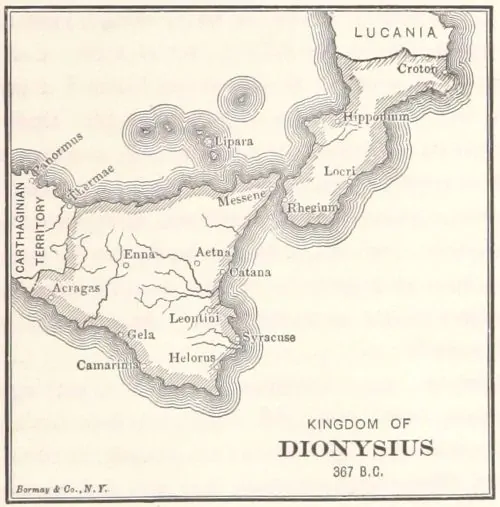
Defeat did more than remove territory from the Sicilian Greeks; it discredited the men who claimed the right to command them. After Acragas was abandoned in 406 BCE, refugees arriving at Syracuse accused its generals of incompetence or treachery, and Dionysius transformed that anger into an opportunity. Speaking before the assembly, he charged the commanders with deliberately betraying allied cities and demanded that they be judged without the procedural protections normally afforded to magistrates. Officials fined him for violating the rules of debate, but Philistus, a wealthy supporter who would later become the historian of his regime, paid the penalty and encouraged him to continue. Dionysius was subsequently elected to the board of generals, acquiring legitimate office through institutions he was already learning to manipulate. His ascent began not with an open rejection of democracy but with the claim that existing leaders had forfeited public trust during an emergency.
His position became stronger when he visited Gela and intervened in its internal disputes. By supporting popular accusations against wealthy citizens, confiscating their property, and using part of the proceeds to satisfy unpaid soldiers, Dionysius associated himself with both civic redress and military reliability. Back in Syracuse, he accused his fellow commanders of obstructing the war and dramatically resigned, implying that divided authority made effective action impossible. The assembly responded by appointing him sole general with full powers, a constitutional grant resembling earlier emergency commands but carrying obvious potential for abuse. He then reported that enemies had attempted to assassinate him and obtained authorization for a personal guard, which he enlarged and reinforced with mercenaries loyal to their paymaster rather than to the citizen body. From this protected position, he occupied the strategic center of the city and converted extraordinary command into permanent rule. His marriage to a daughter of Hermocrates connected him with the memory of a celebrated Syracusan commander, giving the new regime a lineage of patriotic resistance it had not earned through inheritance.
The settlement of 405 BCE deepened the contradiction surrounding his authority. Carthage retained extensive influence in Sicily, imposed tribute and restrictions upon several defeated communities, and accepted Dionysius as ruler of Syracuse. Recognition by the enemy protected him from immediate external removal even as it encouraged suspicion that his personal survival had been purchased through collective humiliation. Displaced Greeks had lost homes that Syracuse had promised to defend, while the commander responsible for the retreat remained in power. Dionysius could present the agreement as a necessary pause, but he could not easily separate his tyranny from the catastrophe that had made it possible.
Domestic resistance soon exposed how shallow his security remained. During a campaign against the Sicels in 404 BCE, Syracusan cavalrymen abandoned him, returned to the city, and helped initiate a revolt that confined the tyrant and his supporters within Ortygia. Dionysius reportedly considered flight or death before choosing negotiation, delay, and a sudden counterattack aided by mercenary forces. Once the uprising had been defeated, he treated its failure as permission to reconstruct the political geography of Syracuse. Opponents were killed, expelled, or stripped of property, while houses and land passed to soldiers, adherents, and newly enfranchised dependents whose status rested upon the continuation of his government. Ortygia became a fortified enclave containing the ruler’s residence, arsenal, docks, and garrison, physically separating the coercive center of the regime from much of the population it governed. Such precautions protected Syracuse against infiltration from the sea, but they also ensured that citizens could not easily repeat their attempt to depose him. Defensive architecture consequently acquired two fronts: one faced prospective invaders, while the other confronted the city beyond the gates.
Out of these confrontations came a political order unusually capable of directing labor and resources, though never free from the insecurity that had created it. Dionysius subdued or dismantled neighboring communities, transferred populations, rewarded mercenaries with new settlements, and removed centers from which opposition might organize. His decision to enclose the Epipolae plateau within an expanded defensive circuit displayed the administrative habits later visible in weapons production in that work was divided among supervised groups, materials were assembled in advance, and competitive rewards encouraged speed.
The resulting walls strengthened the city against another Carthaginian offensive while enlarging the territory from which the regime could withstand a domestic rising. None of this means that autocracy naturally produced military innovation; many tyrants possessed ample authority without demonstrating comparable organizational ability. In Dionysius’s Syracuse, control over land, revenue, dependent soldiers, and compulsory service allowed one ruler to connect survival at home with preparation abroad. By 399 BCE, renewing war against Carthage offered him more than the prospect of recovering lost ground; it promised to recast a government born from defeat as the indispensable author of Sicilian Greek resistance.
Choosing the Moment for a New War
The timing of the renewed conflict was neither automatic nor dictated by the completion of any single weapon. Recent confrontations with Rhegium and Messana had shown Dionysius that war with Carthage would be dangerous if hostile Greek cities threatened Syracuse from the north. He accepted peace when the forces raised against him dissolved, removing an immediate obstacle without resolving the underlying mistrust. Diodorus also reports that dissatisfied Greeks were relocating into Carthaginian territory with their households and property, turning continued peace into a source of political leakage. Hostilities might reverse that movement by encouraging Greek communities under Punic authority to defect toward Syracuse instead. Domestic security, territorial ambition, and the language of liberation could support the same decision even when their purposes differed.
News from North Africa made delay appear less attractive. An epidemic had reportedly killed many people in the Carthaginian sphere and impaired the state’s ability to undertake another major expedition, though Diodorus’s dramatic description does not permit a reliable diagnosis or measurement of the losses. Dionysius remembered how quickly Punic strength had overwhelmed Sicilian cities when fully assembled, and he reasoned that the interval of weakness would not last. Rather than attack immediately, he concluded that the coming struggle would be prolonged and required extensive preparation before any declaration was made. This judgment distinguished opportunity from improvisation. Carthage’s temporary difficulty created a window, but Syracuse still needed sufficient matériel and diplomatic freedom to pass through it. The subsequent Carthaginian response suggests that the assessment was not imaginary, since its government initially lacked forces ready for deployment and had to send money abroad for fresh recruitment. Dionysius’s advantage arose less from secrecy than from unequal readiness, with one side already mobilizing while the other had not yet matched the pace.
Diplomacy narrowed the risks further. Dionysius granted territory to the Messenians in an effort to bind them to neutrality or friendship, then sought a marriage alliance with Rhegium. After the Rhegians rejected his proposal, Locri accepted it, and his marriage to Doris connected Syracuse with an important city across the strait while his union with Aristomache strengthened ties among influential Syracusans. Spartan permission to recruit mercenaries added another external source of support. These arrangements did not create a dependable alliance system, but they reduced the likelihood that Carthage could easily combine its intervention with a coordinated attack from southern Italy.
Public consent required a different kind of preparation. Diodorus describes a calculated relaxation in Dionysius’s conduct after his marriages, including communal feasts and a temporary retreat from the executions and expulsions associated with his earlier rule. When he summoned the assembly, he portrayed Carthage as the enduring enemy of all Sicilian Greeks and insisted that action should be taken while plague still limited its strength. His demand that the cities under Punic control be freed gave the campaign a purpose larger than Syracusan expansion. The citizens approved, but their reasons were not identical to his. They resented Carthage for its conquests and for the crisis that had helped place Dionysius over them, while some apparently hoped that receiving weapons would allow them to recover their own political freedom. Their enthusiasm contained the implicit threat that the army raised against an external opponent might also become a citizen force capable of challenging the ruler who armed it. Events following the vote revealed an uglier dimension as well, for Phoenician property in Syracuse was plundered with official permission, and violence against Phoenician residents spread through other Greek communities. A proclamation of emancipation had opened the way to dispossession and revenge before the opposing armies met.
Only after these military, diplomatic, and political conditions had been arranged did Dionysius dispatch an ultimatum demanding that Carthage relinquish the Greek cities under its control. Its terms gave the adversary little reason to accept, making the message less an attempt at compromise than a final assertion that Syracuse would choose when the peace ended. The Carthaginian senate recognized the danger but waited for Dionysius to initiate hostilities while agents sought mercenaries in Europe. Nothing indicates that the workshops and shipyards of Syracuse had remained invisible; their importance lay in ensuring that observation came too late to eliminate the disparity in preparedness. Dionysius had neutralized nearby opposition where possible, judged Carthage temporarily impaired, secured access to foreign soldiers, and connected popular resentment with his own designs. His decision was preventive in its rhetoric, opportunistic in its timing, and expansionist in what it demanded. The arsenal taking shape at Syracuse was not an isolated burst of mechanical creativity but the material expression of a war selected in advance.
Syracuse Becomes an Arsenal
Calling Syracuse an arsenal does not mean that Dionysius constructed a single factory resembling the centralized establishments of later states. Diodorus instead describes a temporary manufacturing network spread through an inhabited city and coordinated from above. Its distinctive feature was the concentration of skilled labor under common direction, with political authority determining priorities while artisans retained responsibility for practical solutions. Compulsion operated beside generous payment, allowing the regime to obtain workers whom ordinary commercial demand might never have brought together. Syracuse became an arsenal because much of its available space and expertise was redirected toward war.
Recruitment extended far beyond the customary labor pool of one Greek city. Dionysius requisitioned craftsmen from communities under his control, treating their abilities as resources that subject populations were obliged to provide. High wages attracted others from Italy, the Greek mainland, and lands governed by Carthage. Their movement demonstrates that technical knowledge did not belong neatly to one people or political bloc; artisans could cross the same boundaries that armies and merchants traversed. A worker arriving from Punic territory might strengthen a campaign intended to destroy Carthaginian power in Sicily without sharing the political aims of his new employer. The policy also reveals that specialized competence was scarce enough to merit deliberate collection rather than reliance upon local tradesmen alone. Diodorus’s assertion that the ablest craftsmen gathered at Syracuse may magnify the ruler’s accomplishment, but the broad geographical search remains essential to explaining how unfamiliar designs could be attempted so quickly. Dionysius was acquiring embodied knowledge, habits of measurement, material judgment, and workshop practice that could not simply be ordered from a warehouse.
Once assembled, the workers were separated according to their established crafts and placed under prominent Syracusan supervisors. This organization did not create modern engineering departments, since the categories probably followed familiar occupations such as carpentry, metalworking, shipbuilding, leatherworking, and bow manufacture. Its importance lay in putting related trades close enough for difficulties in one component to be addressed by people responsible for another. Overseers connected these groups to the regime, monitored output, and directed materials toward approved projects. The state supplied objectives and authority, while the detailed process of making an effective object remained largely in artisanal hands.
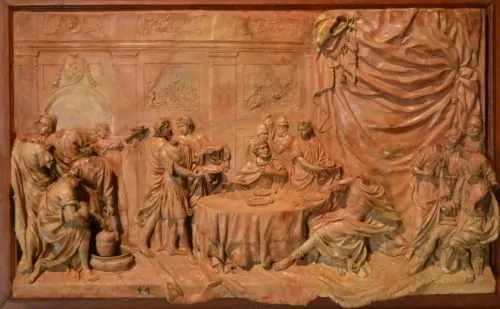
Material rewards supplied one form of discipline, but Dionysius also used access to himself as a prize. Diodorus reports that he moved among the workers, spoke affably with them, honored exceptional effort, and sometimes invited successful craftsmen to his table. Such gestures temporarily elevated men whose manual occupations normally carried less prestige than landholding, politics, or military command. They also encouraged competition by making achievement visible to colleagues who might seek the same recognition. The ruler’s presence should not be confused with evidence that he personally designed engines or possessed advanced mechanical knowledge. His contribution was managerial and political; he made continued effort profitable, public, and connected to favor at the highest level. Regular appearances additionally allowed him to inspect the supervisors as much as the laborers, reducing the distance between command and execution. Diodorus may have shaped the scene according to familiar ideals of the energetic commander who knows his men and rewards excellence. Even so, the account preserves a plausible feature of personal monarchy, in which attention from the ruler performed functions that a permanent technical administration would later assume.
Work altered the use of the city itself. Porticoes, gymnasia, market colonnades, rooms adjoining temples, and substantial private houses were occupied by people making arms or their components. Dispersal solved the immediate problem of accommodating an exceptional number of laborers, but it also placed military preparation before the population every day. Sacred, commercial, educational, and domestic settings became extensions of the campaign, blurring the distinction between civic life and the ruler’s objectives. Such visibility makes it unlikely that Carthage remained wholly unaware of the buildup, even if reports failed to convey its true scale or progress. The excitement attributed to the Syracusans probably combined genuine hostility toward Carthage with social pressure, economic opportunity, and the difficulty of refusing demands imposed by the regime.
This arrangement can reasonably be described as state-directed weapons development if the term is kept within ancient limits. There were no formal research institutes, salaried scientific corps, patent protections, or surviving design records from which a continuous experimental program can be reconstructed. Innovation proceeded through experienced craftspeople altering materials, proportions, loading mechanisms, and production methods in response to practical results. Bringing many specialists together increased the likelihood that a workable idea would be recognized, revised, and reproduced rather than disappearing with an isolated inventor. That environment explains why Diodorus connected the gathering of artisans directly to the appearance of the catapult, even though it cannot settle whether every part of the machine was new. Syracuse’s institutional achievement was to make experimentation serve an announced military purpose and to give successful designs immediate access to labor and official support. The next challenge was more demanding than producing an impressive prototype. Dionysius had to obtain raw materials, manufacture equipment in quantity, and deliver an entire armament to the forces expected to use it.
From Workshop Experiment to Military Supply
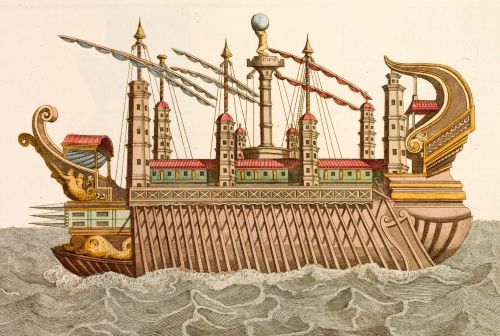
A successful trial shot did not create an artillery arm. Any new engine had to be reproduced, supplied with projectiles, assigned to trained operators, transported without damage, and repaired after repeated use. Dionysius addressed those requirements within a program that extended far beyond catapults. Armor, edged weapons, missiles, warships, and harbor facilities were prepared together rather than as unrelated projects. The result was a reserve of military matériel that could be matched with soldiers when the campaign was ready to begin.
Equipment was produced from models, but these were not intended to impose one uniform pattern upon the entire army. Dionysius expected to employ mercenaries and allied troops accustomed to distinct regional styles of combat, so craftsmen received examples of the arms associated with different contingents. Iberians, Italians, Sicilians, and Greeks did not necessarily use identical shields, blades, body armor, or throwing weapons. Diodorus believed that familiar equipment would improve performance because soldiers could preserve techniques learned before entering Syracusan service. He also claims that the resulting diversity would intimidate opponents confronted by an army displaying numerous martial traditions. State provisioning accommodated difference instead of eliminating it. This approach required a broader range of specialized production, but it reduced the time needed to retrain experienced fighters around unfamiliar gear. It also enabled Dionysius to equip allied levies during the march west, making access to his stores another means of binding participating communities to the expedition.
Ancient totals demand greater caution than the organizational description. Diodorus assigns Syracuse 140,000 shields, an equal number of helmets and daggers, and more than 14,000 finely made corselets. The matching figures for three different objects possess the symmetry of a literary inventory and may reflect exaggeration, faulty transmission, or an attempt to communicate abundance rather than audited counts. The much smaller number of corselets is nevertheless credible as a relative distinction because body armor required more material, skill, and expense. Even if the totals cannot be accepted literally, the narrative presupposes production far beyond the needs of Dionysius’s personal guard.
Timber presented a different problem because optimism inside Syracuse could not create suitable wood on demand. Dionysius secured access to forests in Italy and divided his woodcutters between those sources and the stands of fir and pine on Mount Etna. The Italian operation required draft teams to carry felled or worked timber to the coast, followed by boats and crews to move it across the strait. This chain had to function early enough for shipwrights to receive material while construction remained on schedule. Diodorus says little about seasoning, storage losses, metal fittings, cordage, pitch, or the food needed by so many laborers, although all would have affected the pace and quality of the work. His concentration on visible timber movements leaves much of the supporting economy unrecorded. What does emerge is a command capable of coordinating inland extraction with overland haulage and maritime delivery. The distinction matters because ancient naval expansion was limited as often by access to materials and transport as by the number of available shipwrights. According to Diodorus, more than two hundred warships were built while another 110 underwent refurbishment. Some belonged to the larger quadrireme and quinquereme classes, whose origins and precise rowing arrangements remain debated despite the historian’s effort to credit Dionysius with a decisive advance beyond the trireme. Larger hulls promised greater carrying capacity for marines and missile troops, along with increased power in ramming contests, but they also demanded more timber and substantially larger crews. Syracuse constructed 160 new ship sheds around the Great Harbor and repaired 150 existing ones to protect this enlarged fleet when it was not at sea. Covered accommodation slowed deterioration, facilitated maintenance, and preserved expensive vessels between campaigning seasons. The sheds consequently represented a commitment extending beyond the immediate invasion. Dionysius was creating the physical means to retain naval strength after the initial surge of construction ended.
Ships alone would have imposed ruinous expense if their crews had been hired too soon. Citizens supplied pilots, bow officers, and rowers for roughly half the vessels, while paid personnel were intended for the remainder. Dionysius postponed the broad recruitment of mercenary soldiers until the weapons and fleet were nearly complete, thereby avoiding months of wages for men waiting without an army ready to move. That sequence reveals deliberate cost control within an undertaking usually described through its extravagance. It also reduced the danger of keeping a large, idle armed force near a ruler whose authority had already survived rebellion. Material could be guarded in storage more predictably than unpaid soldiers could be kept loyal.
The catapult entered this supply structure as a family of usable engines rather than as a solitary marvel retained for display. Diodorus reports that several forms were constructed together with substantial stocks of missiles, implying that experimentation was followed by selection and replication. Nothing in the evidence demonstrates interchangeable components, fixed gauges, or the precise uniformity associated with later industrial manufacture. Reproducibility instead depended upon skilled workers who could follow models while adjusting wood, metal, and composite materials by judgment. When Dionysius eventually advanced on Motya, hundreds of merchant vessels accompanied the war fleet with engines and other necessities, carrying the output of the Syracusan workshops across Sicily. Production had acquired military meaning because equipment could now leave the city, survive movement, and reach a chosen battlefield in usable condition. Determining exactly what kind of catapult traveled with that armament requires turning from the scale of supply to the uncertain mechanics of the earliest Greek artillery.
What Kind of Catapult Entered War?
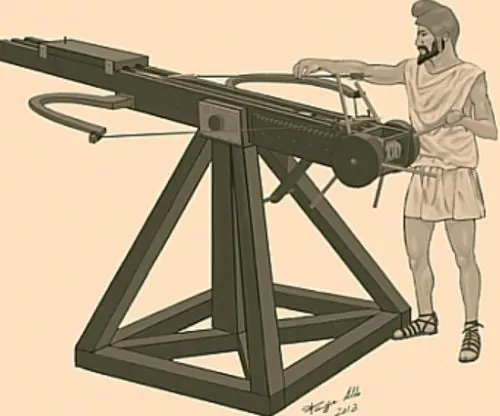
The word catapult now evokes several very different machines, many of which belonged to much later periods. Nothing in Diodorus supports imagining a medieval trebuchet, a Roman onager, or a massive engine throwing stones through masonry. At Motya, he specifically describes sharp-pointed missiles directed against human targets, both aboard ships and on defensive works. The earliest Syracusan artillery was almost certainly a mechanical bolt-shooter derived from composite-bow technology. No physical example survives from Syracuse or Motya, leaving its exact dimensions and arrangement beyond recovery.
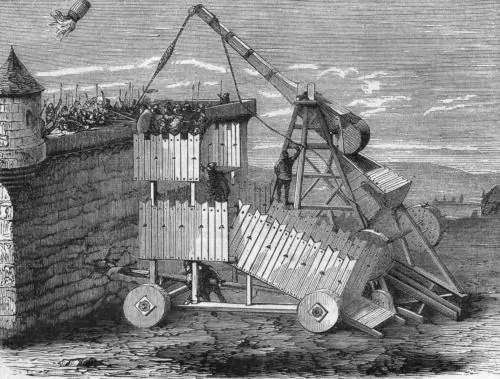
The most plausible comparison is the gastraphetes, or “belly bow,” described by Heron of Alexandria from technical traditions preserved long after Dionysius. Its horizontal composite bow was attached to a stock containing a sliding channel for the projectile, while a catch-and-ratchet system retained the string as the weapon was drawn. To span it, the operator braced the rear portion against the body and pressed downward, using weight and leverage rather than relying entirely upon the arms. Once the string had been secured, a long bolt could be placed in the groove, aimed, and released through a trigger mechanism. The bow itself stored energy through the bending of a composite stave made from materials such as wood, horn, and sinew; it did not employ the twisted spring bundles characteristic of later torsion artillery. Enlarging this principle produced heavier machines that required a supporting frame and mechanical assistance, probably including a windlass, to draw the string. Such mounted bow catapults are reasonable candidates for the weapons used at Motya, although the surviving account does not establish that every engine followed one design.
Terminology prevents greater certainty. Diodorus calls the devices catapults but never uses the word gastraphetes in his narrative of their production or deployment. Writing more than three centuries afterward, he employed vocabulary familiar to readers for whom mechanical artillery had long since divided into numerous classes. Biton and Heron supply valuable constructional details, yet their texts preserve or reorganize earlier knowledge through later technical conventions. Modern reconstructions consequently describe a developmental family rather than furnish a blueprint that can be assigned securely to 399 BCE. The Syracusan machines may have included hand-spanned weapons, mounted enlargements, or several intermediate forms.
Their battlefield value rested upon controlled force rather than a spectacular volume of fire. A mechanically drawn bow could propel a heavier projectile than most archers could shoot comfortably, and the rigid stock helped the operator direct that bolt along a comparatively stable line. Against exposed personnel, a strong iron point offered the possibility of piercing shields, armor, or the timbers protecting a fighting position, although reliable ranges and penetration figures cannot be recovered from the literary evidence. Greater power carried disadvantages. The engine was slower to reload than an ordinary bow, harder to reposition, and dependent upon a clear field of aim. At the harbor near Motya, these limitations mattered less because the catapults stood on land while Carthaginian crews occupied crowded vessels within reach of prepared firing positions. The machines supplemented archers and slingers by threatening men who may have considered themselves safe from ordinary missiles at that distance. During the subsequent assault on the city, they could keep defenders away from exposed portions of the battlements while rams performed the actual work of opening the walls. Their purpose was suppression and killing, not the direct demolition later associated with large stone-projectors.
Operating such weapons required more than placing an infantryman behind a trigger. Crews had to span the bow safely, judge elevation, watch the fall of successive shots, and replace strings or other components strained by use. Bolts needed straight shafts, consistent balance, and heads suited to the intended target if accuracy was to be repeated. Composite materials were also vulnerable to moisture and careless storage, making covers and regular maintenance important during transport. These demands help explain why mechanical artillery emerged from specialized workshops and why its usefulness depended upon trained groups rather than individual prowess.
The weapon that entered combat at Motya occupied an intermediate position between the hand bow and the mature torsion artillery of the later fourth century BCE. It mechanized the storage and release of energy, gave missile troops a more powerful aimed shot, and introduced opponents to projectiles launched by a device rather than by muscular strength alone. Yet early bow catapults remained cumbersome and appear to have spread slowly, suggesting that their initial military influence was narrower than Diodorus’s dramatic presentation might imply. Torsion engines, including increasingly effective bolt- and stone-throwers, would later provide the greater power and scalable construction associated with Hellenistic artillery. Motya remains important because it offers the first securely dated narrative of mechanical projectile weapons functioning within an actual operation, not because the surviving evidence permits an exact reconstruction. The mechanical outline can be described with reasonable confidence; the harder question is whether Syracuse originated it or brought an existing line of experimentation into war.
Who Invented It? A Disputed Beginning
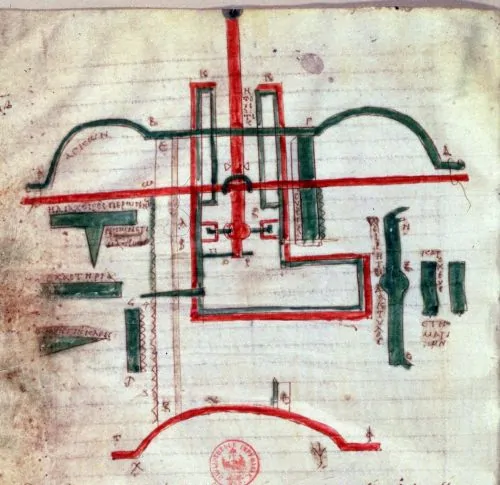
The dispute begins with an unusually direct sentence in Diodorus. The catapult was invented at Syracuse when Dionysius gathered outstanding craftsmen there. He does not name an individual designer or describe a single moment of discovery. Instead, the historian makes collective proximity the cause, reasoning that well-paid specialists competing in one place generated something unavailable before their assembly. That explanation fits his preceding account of recruitment and his subsequent praise of the workers’ enthusiasm. It also attaches the achievement to Dionysius without requiring the ruler to possess technical expertise. Clear as the declaration appears, it remains a historical claim transmitted through a literary narrative rather than an eyewitness record of invention.
Several reasons justify caution. Diodorus wrote during the first century BCE, more than three hundred years after the preparations at Syracuse, and the particular source behind this passage cannot be identified with confidence. Ancient historians regularly assigned discoveries to a celebrated person or city, compressing incremental development into a memorable beginning. The sequence is almost too orderly. Dionysius collects exceptional workers, stimulates competition, and receives a revolutionary engine as the immediate reward for enlightened patronage. Diodorus then states that catapults of several kinds were manufactured, even though a device supposedly created at that moment would have needed time for testing and differentiation. That rapid plurality could indicate an intense period of modification, but it might also show later terminology being projected backward onto less clearly distinguished machines. None of these objections proves fabrication. The detail surrounding recruitment, supervision, and combat employment may preserve information from earlier Sicilian histories even if Diodorus sharpened its causal structure.
Biton introduces the most troublesome competing evidence. His technical treatise attributes two non-torsion gastraphetes to Zopyrus of Tarentum, one associated with Miletus and another with Cumae. Biton wrote much later than the events under discussion, probably for a ruler named Attalus, and supplies no reliable dates for either machine. Efforts to identify Zopyrus with a Tarentine Pythagorean and connect the Cumaean weapon with events before that Greek city fell to the Campanians in 421 BCE would place mechanical bow artillery at least a generation before the Syracusan program. Yet the identification is not certain, Cumae continued to exist after its conquest, and neither location fixes the circumstances in which Zopyrus worked. Biton demonstrates that an alternative technical tradition survived; he does not provide an uncontested earlier birth certificate.
Modern scholarship has divided over how much weight each testimony should bear. E. W. Marsden accepted 399 BCE as the most credible starting point and treated the gastraphetes as the initial stage from which larger bow catapults developed. Barton C. Hacker likewise placed the Syracusan episode near the opening of a broader relationship between mechanical knowledge and organized warfare. Peter Kingsley challenged this chronology by emphasizing the implications of Zopyrus’s Pythagorean setting and arguing that Marsden had neutralized evidence inconvenient to Diodorus’s claim. Tracey Rihll has taken the Syracusan account seriously while presenting catapult development as a process that soon produced multiple forms rather than a finished design appearing at once. Thierry Lucas has shifted attention from identifying a single first inventor to the limited distribution of early bow artillery, which seems to have remained experimental until torsion technology made mechanical weapons more adaptable. Architectural arguments add no decisive verdict. Towers and defensive projections sometimes identified as responses to artillery could have served archery, observation, or flanking defense without catapults. Nor has archaeology produced a securely dated machine from the years before Motya that could resolve the literary disagreement.
Much of the disagreement results from asking one word, “invention,” to describe several different achievements. The first conceptual enlargement of a hand bow, the construction of a workable gastraphetes, the mounting of a heavier version, and the organization of multiple engines for a campaign need not have occurred together. A craftsman could devise a mechanism that remained obscure until another patron supplied money and opportunities for improvement. Syracuse might have been both indebted to earlier experiments and genuinely responsible for a new military application. Ancient claims of priority rarely preserve such distinctions because they favor an identifiable origin over an untidy sequence.
For my purpose here, the literal priority of Syracuse should remain possible but unproven. Diodorus establishes that an influential ancient tradition located the decisive breakthrough there, while Biton prevents that tradition from being treated as exclusive evidence. The strongest conclusion concerns emergence rather than conception. Under Dionysius, mechanical bolt-shooters passed into documented production and were assigned an operational role within two years. If prototypes already existed, his workshops accelerated their refinement and multiplied their availability; if they did not, the same organization made unusually rapid invention plausible. Either interpretation leaves collective skill, patronage, and military demand more important than the search for a forgotten genius. The controversy changes the meaning of the Syracusan achievement without removing it. Whatever the machine’s deeper ancestry, Motya became the place where its value would be judged against ships, walls, and defenders capable of answering back.
Motya: The Fortress Chosen for the Test
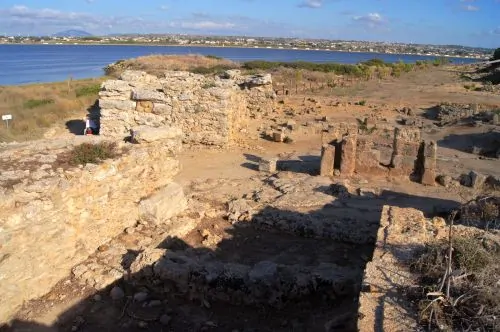
Motya was an objective for conquest, not a neutral proving ground selected merely to display a new machine. At Sicily’s western edge, the settlement occupied a position from which maritime connections with North Africa and political influence over the surrounding region could be sustained. Long before Dionysius’s campaign, Thucydides had identified Motya, Panormus, and Soloeis as the principal places to which Sicily’s Phoenicians withdrew as Greek settlement expanded, citing their proximity to the Elymians and the short passage to Carthage. By 397 BCE, Diodorus could describe Motya as a Carthaginian colony, a notably loyal ally, and a chief base for operations on the island. Its capture might deprive Carthage of an important staging point, unsettle neighboring communities, and give substance to Dionysius’s claim that he was liberating Sicily from foreign domination. The city’s accumulated wealth also offered plunder with which soldiers could be rewarded and further campaigning financed. Precisely because Motya mattered so much, and appeared so difficult to take, victory there promised political consequences far greater than the occupation of an easier target.
Geography accounted for much of the city’s strength. Motya stood within the shallow waters of the Lo Stagnone lagoon, sheltered from the open Mediterranean by the long barrier of Isola Grande. Diodorus placed it approximately 1.1 kilometers from the mainland and noted the narrow artificial roadway connecting the two; when the defenders breached that approach, they denied wheeled towers and battering rams a ready path to the walls. Excavated sections of the fortification circuit, including monumental gates and projecting towers, confirm that the water barrier protected a heavily defended urban settlement rather than an exposed trading station. Within the perimeter, closely packed and sometimes lofty buildings supplied additional defensive positions if an attacker penetrated the outer works. The site required Dionysius to convert a terrestrial assault into an amphibious engineering operation conducted in restricted waters.
The advance across Sicily was fashioned into a demonstration of gathering power. As Dionysius traveled westward, he incorporated contingents from Camarina, Gela, Acragas, the displaced Himeraeans, and Selinus, supplying the levies with arms as they joined him. Distributing equipment allowed the Syracusan ruler to absorb forces that did not share a common civic arsenal or uniform standard of preparation. Diodorus eventually assigns the expedition 80,000 infantry, more than 3,000 cavalry, nearly 200 warships, and at least 500 merchant vessels carrying machines and provisions. Such totals should not be treated as audited strength returns, but their conjunction conveys the remarkable breadth of the mobilization. Soldiers, animals, fighting ships, cargo hulls, engineers, laborers, food, timber, ammunition, and siege equipment had to converge at one remote destination. Eryx defected after seeing the approaching host, while Diodorus reports that the Sicani also abandoned the Carthaginian side. Halicyae, Solus, Segesta, Panormus, and Entella remained loyal, demonstrating that local alignments followed calculations of security and advantage rather than a clean division between Greek and Phoenician populations. The army before Motya was consequently a composite coalition held together by coercion, expectation, resentment, and confidence in Dionysius’s apparent momentum. Its magnitude was already functioning as a weapon before the first engine came within range.
At the lagoon, movement gave way to construction. Dionysius surveyed the approaches with his engineers, ordered moles built toward the island, hauled his warships onto land near the harbor entrance, and stationed the transports along the shore. He then entrusted the works to his brother Leptines while taking part of the army against communities that still supported Carthage, devastating several territories and maintaining pressure upon Segesta and Entella. This division of command reveals the larger design. Motya fixed attention at the center while surrounding alliances were stripped away. The fortress had been chosen for the leverage its fall might exert across western Sicily, not because its terrain offered a convenient opportunity for an experimental siege.
Archaeology gives that calculation a physical setting beyond Diodorus’s literary arrangement. Excavations beginning with Joseph Whitaker and continuing through the British and Italian campaigns exposed gates, walls, streets, domestic quarters, and evidence of the destruction conventionally associated with Dionysius’s conquest. More recent investigations in the shallow water near the North Gate have identified a possible battlefield horizon containing human remains, charcoal, worked wood, arrowheads, and a lead sling projectile, several objects displaying signs of impact. The excavators properly describe the identification as provisional. The sampled areas are small, the lagoon’s ancient shoreline requires reconstruction, and individual missiles cannot automatically be assigned to one combatant. Nor does this material provide an archaeological fingerprint for the early catapult. It nevertheless indicates that violence and burning extended into the watery northern approach, the same zone through which the artificial road reached the city. Motya confronted Dionysius with a demanding interaction of naval protection, earthmoving, missile cover, heavy machinery, supply, and delegated command. The campaign would test the whole apparatus assembled at Syracuse, with the catapult serving as one component rather than an isolated marvel. Before the engines could be pressed against the fortifications, a Carthaginian fleet entered the lagoon and compelled the new artillery to disclose its battlefield value at the harbor mouth.
Surprise at the Harbor Mouth
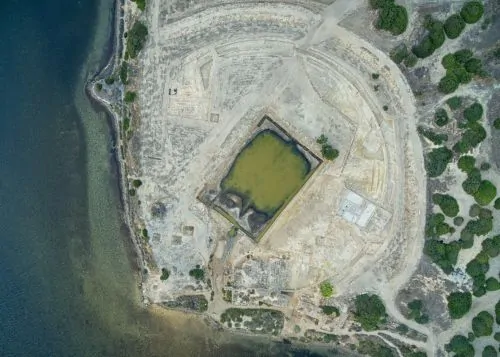
The first surprise in the waters around Motya belonged to Carthage. While its main forces were still being assembled, the Carthaginian command sent ten triremes across the sea to attack Syracuse, where they entered the harbor at night and struck vessels left along the shore. The raid did not compel Dionysius to abandon his western campaign, but it exposed the danger created by concentrating so much of Syracuse’s naval strength far from home. A more serious counterstroke followed after Himilco learned that the expeditionary fleet had been hauled onto land near Motya. Taking one hundred of Carthage’s best triremes, he sailed by night past Selinus, rounded the promontory of Lilybaeum, and appeared at the lagoon at daybreak. His arrival caught the besiegers in a configuration designed to support construction and blockade rather than to meet an immediate naval assault.
At dawn, the arrangement of the Syracusan ships became a liability. Himilco rammed some vessels anchored along the shore and burned others before moving his squadron into the harbor. From there, the Carthaginians could watch the restricted outlet through which Dionysius would ordinarily have needed to launch his fleet. Ships emerging a few at a time would have faced an organized enemy without sufficient room to form a battle line or exploit their superior numbers. For the moment, the same narrow waters that protected Motya also gave its relief force the tactical advantage.
Dionysius declined to force a passage through the harbor mouth. After massing troops near the entrance and assessing the Carthaginian position, he used his abundant manpower to drag warships overland and relaunch them in open water beyond the constricted channel. This maneuver did not by itself remove the danger, because Himilco attacked the first vessels as they were put afloat. The Syracusan response joined missile troops aboard the ships with artillery stationed on shore. Archers and slingers discharged volleys, while the catapults projected the sharp-pointed missiles described by Diodorus. The historian states that these machines killed many Carthaginians and caused exceptional alarm because the weapon was new. His wording is important, since it places the catapults on land rather than aboard specially armed warships, as some modern retellings imply. Nothing in the account establishes that their bolts pierced hulls or sank triremes; the reported effects were casualties among personnel, disruption of the attack, and reluctance to close with the launching ships. Once more of Dionysius’s fleet reached open water, Himilco also had to reckon with a hostile naval force approximately twice the size of his own. The artillery helped preserve the maneuver long enough for that wider numerical imbalance to become decisive.
This was an unusual first assignment for a weapon developed principally in anticipation of sieges. Rather than beginning its recorded combat history against masonry, the catapult was turned toward moving naval targets and used to extend land-based missile fire into contested water. The machine did not replace the archers and slingers; Diodorus distinguishes the three, indicating that its contribution was added to an already dense screen of projectiles. Its precise range, rate of discharge, and accuracy at Motya cannot be recovered, nor can the level of mechanical knowledge possessed by the Carthaginian crews. The reported dismay documents the reaction within this encounter, not universal ignorance of every earlier device resembling a mechanical bow. Even so, the episode is the earliest explicit narrative of Greek artillery being incorporated into an active battlefield response rather than merely constructed, demonstrated, or stored.
Measured narrowly, the harbor action was a successful defense rather than a crushing naval victory. Himilco’s squadron remained intact enough to withdraw to Africa, and Carthage retained ample resources with which to continue the war. Yet his departure preserved the Syracusan fleet, prevented the relief of Motya, and allowed work on the approaches to resume. The engagement also revealed what the weapons program at Syracuse had accomplished beyond producing an arresting prototype. Machines, projectiles, trained operators, and commanders capable of redirecting them were present when an unforeseen tactical problem arose. Artillery mattered because it operated alongside massed labor, conventional missile troops, and the fleet being hauled beyond the Carthaginian position. The strategic surprise was consequently reciprocal, Himilco found Dionysius’s ships exposed, while Dionysius answered with a form of shore-based fire his opponent had not expected to encounter. The catapult entered war as an instrument of improvisation, protecting a vulnerable deployment before it ever assisted in breaking a wall. Once the Carthaginian sails disappeared from the lagoon, the machines could be turned back toward Motya’s battlements and incorporated into the methodical assault for which they had been transported west.
Breaking Motya: Artillery within a Siege System
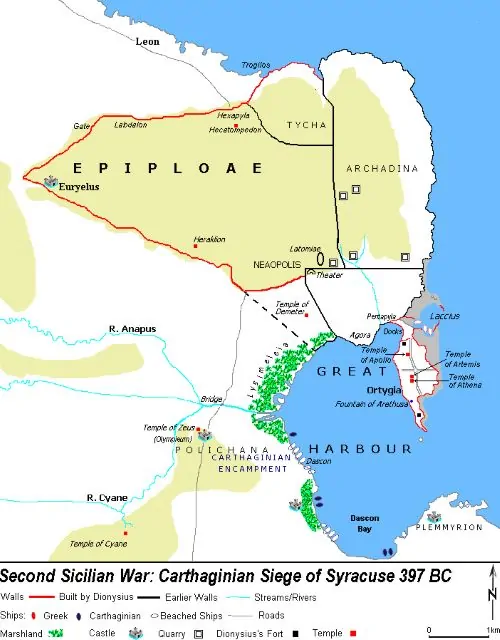
With Himilco’s squadron gone, Dionysius could concentrate his workforce upon completing the artificial approach to Motya. The mole was not merely a preliminary construction project; it created the surface over which the assault machinery could reach an island whose inhabitants had severed their former road to the mainland. Rams and wheeled towers were useless if they remained stranded beyond effective range, while artillery placed on unstable or distant ground could offer only limited support. Diodorus emphasizes the large number of laborers assigned to filling the intervening water and extending the approach toward the fortifications. Earth, stone, timber, transport vessels, and human strength altered the terrain before the machines could attack it. The catapult’s employment against Motya’s walls ultimately depended upon this less celebrated feat of military engineering.
The assault formation assigned different tasks to machines that are too easily treated as interchangeable siege weapons. Battering rams delivered repeated impacts against Motya’s towers and masonry, while wheeled towers six stories high raised attackers to approximately the level of the city’s tallest buildings. Catapults meanwhile fired upon the defenders stationed along the battlements. Their principal function in this phase was suppression rather than structural destruction. The sharp-pointed bolts threatened personnel who attempted to shoot downward, repair damaged sections, or interfere with the crews operating below. Any defender forced behind cover had less opportunity to attack the ram, ignite a tower, or strike laborers maintaining the approach. The elevated wooden structures gave Syracusan troops protected positions from which to contest the upper levels of the defense, whereas the rams concentrated force upon selected points. Artillery reduced the freedom of Motyan fighters at those points without performing the ram’s work for it. Dionysius was attacking the fortification as a connected problem in which access, protection, missile fire, and physical demolition had to proceed together.
Any reconstruction of this operation must leave considerable room for uncertainty. Diodorus supplies no reliable count of the catapults deployed at the wall, nor does he record their spacing, range, accuracy, or rate of discharge. Early bolt-shooters required firm mounting, prepared ammunition, maintained bowstrings, and crews able to reload while exposed to counterfire. The historian’s compressed sequence may combine actions conducted over many hours or repeated across several days. Describing the result as an uninterrupted artillery barrage would impose the capabilities and vocabulary of much later warfare upon sparse evidence.
Motya’s defenders refused to remain passive beneath the new missile fire. They erected tall masts carrying yardarms and elevated fighting positions, from which men cast firebrands and pitch-soaked tow onto the wooden siege engines below. Height allowed these improvised platforms to challenge the upper portions of Dionysius’s towers and direct incendiaries onto surfaces difficult for troops at ground level to protect. The response was technically simple but tactically intelligent, exploiting the most obvious vulnerability of large machines constructed primarily from timber. Flames caught quickly, threatening to destroy equipment that had required months of preparation and an arduous journey across Sicily. Syracusan troops rushed forward and extinguished the fires before they could consume the structures, a rapid reaction suggesting that protection of the engines had been anticipated even if Diodorus does not describe the arrangements. The exchange undermines any picture of sophisticated attackers confronting defenders rendered helpless by unfamiliar technology. Innovation produced an immediate answer, which in turn required discipline and preparation to defeat.
Repeated impacts from the rams eventually broke open a section of the fortification. Both armies converged upon the damaged point, confirming that a breach created an opportunity rather than an automatic victory. Diodorus attributes the physical rupture to the rams, not to catapult bolts, and the distinction should be preserved. Artillery may have helped the ram crews remain in position by limiting hostile activity above them, but the source provides no measurement of how decisive that assistance proved. Its contribution was enabling and cumulative rather than spectacularly destructive. Once the outer barrier failed, the Motyans barricaded narrow lanes and transformed the nearest houses into another defensive line, depriving the attackers of the quick collapse they had expected.
The opening in the wall clarifies what the Syracusan development program had actually placed in the field. No solitary engine broke Motya; the result came from an engineered approach, protected machinery, repeated ram strokes, elevated assault positions, missile support, firefighting, and infantry prepared to exploit structural damage. Within that arrangement, the catapult changed assignments with unusual flexibility. It had first helped shield the fleet from Himilco’s triremes, then turned inland to restrict defenders on the ramparts. Such movement between tactical roles was more consequential than any unverified claim that its bolts possessed extraordinary penetrative power. Syracuse’s achievement lay in making an unfamiliar device usable within existing methods of naval defense and siege assault. A weapon could alter the balance at critical moments without replacing older machines or deciding the campaign independently. At Motya, artillery expanded what Dionysius’s forces could attempt and made other instruments more difficult to oppose. Beyond the breach, the spatial advantages of organized machinery began to contract as the struggle entered crowded lanes, rooftops, and interconnected houses.
The City after the Breach
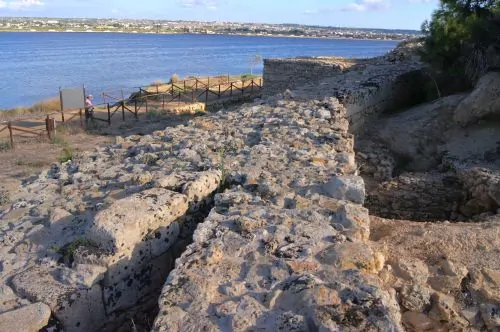
Inside the broken circuit, Motya ceased to resemble a conventional siege and became a vertical urban battle. The defenders blocked the narrow streets and converted the nearest houses into a second fortification, compelling the attackers to move through confined spaces overlooked from several levels. Syracusan troops who entered through the damaged wall were met by missiles descending from roofs, windows, and other elevated positions. The same density that had testified to Motya’s prosperity now denied Dionysius the freedom to deploy his numbers across a broad front. Catapults disappear from Diodorus’s description of this stage, perhaps because lines of sight had shortened and targets were intermingled among buildings. Penetrating the perimeter had changed the terrain without ending organized resistance.
Dionysius responded by pushing the wooden assault towers toward the first defended houses and extending gangways from the machines to their upper levels. These structures, originally built to contest the city wall, became elevated access platforms within the breached settlement. Syracusan fighters crossed the suspended bridges and attempted to establish footholds inside buildings still occupied by determined opponents. The narrow gangways prevented large groups from advancing together and exposed every man at the front to close combat before those behind him could offer much assistance. Diodorus records that the Motyans fought the attackers hand to hand and repeatedly drove them backward. Some Syracusans were killed where they stood, while others lost their footing and fell from the bridges to the ground below. Machinery had carried the assault above street level, but survival upon reaching the houses still depended upon individual fighters operating in exceptionally cramped conditions.
Diodorus interprets the Motyans’ resistance through fear, family obligation, and anticipated revenge. His account places wives, children, and elderly parents beside the combatants and claims that memories of earlier cruelty toward Greek prisoners convinced the defenders that surrender would bring equivalent treatment. This explanation suits the historian’s recurring interest in retribution, although its details cannot be independently verified. His later admission that Greeks had fought for Carthage and were captured inside Motya also fractures a simple ethnic narrative. Residents, hired soldiers, and allied contingents could resist from loyalty, necessity, pay, or the knowledge that victors rarely treated a stormed city leniently. The eventual penetration came through deception rather than through another mechanical breakthrough. For several days, Dionysius ended the fighting at approximately the same hour, using a trumpet signal to recall his troops before nightfall. Once the Motyans had learned to expect this pause, he sent Archylus of Thurii and a selected force back under cover of darkness. They raised ladders against ruined houses, climbed into an advantageous position, and opened a route for additional soldiers. The defenders hurried to contain the incursion, but Syracusan reinforcements continued ascending until superior numbers wore them down. Dionysius later awarded Archylus one hundred minas for being the first to gain the position, converting initiative in battle into a conspicuous example for the rest of the army.
What followed was not an orderly capitulation. Diodorus states that troops poured into Motya both through the captured urban position and along the completed mole, spreading through districts whose defenders could no longer maintain a continuous line. The victors killed inhabitants without distinction of age or sex, presenting the sack as retaliation for injuries previously inflicted by Carthage upon Sicilian Greeks. Dionysius reportedly tried to halt the slaughter because living captives could be sold, but the soldiers initially ignored him. Unable to restore discipline by command alone, he had heralds announce that survivors should seek refuge in sanctuaries respected by the Greeks. The killing then subsided as the army turned toward looting, taking precious metal, clothing, household wealth, and other portable goods. Dionysius formally surrendered the city to plunder in order to encourage his forces in subsequent campaigns, revealing that destruction also functioned as military compensation. Surviving Motyans were enslaved, while Daemenes and other captured Greeks who had served the Carthaginian side were crucified, a punishment that treated their choice of allegiance as betrayal rather than ordinary enemy service.
Material evidence supports a major episode of violence and destruction in the early fourth century BCE without reproducing every detail of Diodorus’s account. Burned deposits, collapsed structures, and weapon finds attributed to the siege establish a severe rupture, while analyses of bronze arrowheads illuminate the varied projectiles carried into the fighting.
Archaeology cannot determine how many inhabitants were killed, whether the slaughter extended evenly across the island, or how closely the excavated damage corresponds to the historian’s dramatic sequence. Neither did occupation cease altogether; Motya’s “destruction” should be understood as the breaking of its existing political and urban order rather than the literal removal of every building and resident. Dionysius installed Biton of Syracuse over a garrison composed largely of Sicelians and assigned Leptines 120 ships to watch for a Carthaginian crossing. Pressure against Segesta and Entella continued, but the main army returned to Syracuse as the campaigning season ended. Motya had fallen with extraordinary brutality, yet its capture had eliminated neither Carthage’s fleet nor its capacity to return with a much larger answer.
Carthage Answers: Victory without Strategic Decision
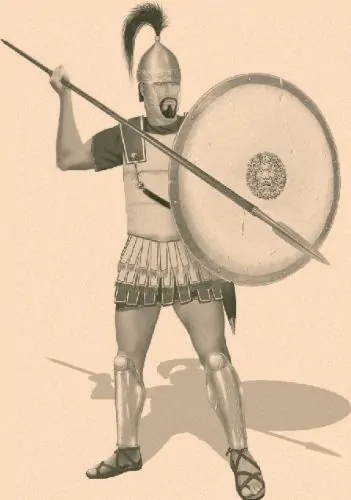
Motya’s fall exposed Carthage to humiliation, but not to paralysis. During the following campaigning season, Himilco received sweeping command powers and began assembling troops from Africa, Iberia, and dependent communities, together with cavalry, chariots, warships, and hundreds of transports. The rival totals preserved by Diodorus reveal the hazards of converting this mobilization into a reliable head count. Ephorus claimed more than 300,000 infantry, whereas Timaeus placed the combined African and Sicilian force at approximately 130,000. Neither estimate deserves literal acceptance, although their divergence does not erase the expedition’s exceptional scale. Operational concealment accompanied material preparation, with captains receiving sealed instructions that named Panormus as their destination only after the fleet had departed. Leptines intercepted part of the convoy and destroyed numerous vessels, yet he could not prevent its principal elements from reaching Sicily. The crossing demonstrated that losses at Motya had not disabled the larger Punic system connecting taxation, recruitment, contracted service, allied obligations, and naval transport. Carthage had no known equivalent to the Syracusan development program, but it possessed something equally consequential: sufficient institutional depth to survive an enemy’s technical surprise and return with a force capable of changing the direction of the war.
The western position unraveled almost at once. Himilco landed at Panormus, acquired Eryx through betrayal, and retook Motya while Dionysius remained entangled in the unsuccessful siege of Segesta. Unable to safeguard provisions or induce many Sicanians to evacuate their homes, the Syracusan ruler withdrew rather than hazard battle under worsening conditions. Motya itself never regained its former standing, and the contemporary rise of fortified Lilybaeum nearby indicates that Punic recovery included adaptation as well as reconquest.
Himilco next widened the theater until the security of Syracuse itself depended upon events unfolding hundreds of miles from Motya. Messana became a primary objective because its harbor and position beside the strait offered control over traffic between Sicily and Italy, including routes by which Dionysius might obtain soldiers from Magna Graecia or the Peloponnese. After compelling Lipara to pay thirty talents, the Carthaginians approached Messana while much of its military strength was stationed away from the urban center. Neglected stretches of wall made entry possible, and the attackers killed inhabitants who failed to escape before razing the captured city. The destruction announced that Dionysius could neither protect every allied community nor guarantee the permanence of his eastward authority; several Sicel groups consequently deserted him, with Assorus emerging as a notable exception. At Catana, geography briefly offered Syracuse a chance to arrest the advance. An eruption of Etna obliged Himilco’s army to take an indirect route while Mago’s fleet proceeded separately along the coast, allowing Dionysius to confront the Punic ships before their supporting land forces arrived. The opportunity disappeared when Leptines abandoned orders to maintain a compact formation and rushed forward with thirty leading triremes, enabling Mago’s squadrons to envelop successive Syracusan units. Diodorus reports the loss of more than one hundred ships and twenty thousand men, figures that may reflect historiographical amplification but still point to a defeat of unmistakable severity. Dionysius retreated behind the defenses of Syracuse, and many Greek allies went home rather than share the risks of a siege. The encounter supplied a necessary corrective to the spectacle at Motya’s harbor. Projectile engines could protect a constrained departure under favorable circumstances, but they could not repair broken formations or substitute for competent fleet command in open water.
Disease halted what Syracusan arms had been unable to stop. Once Himilco’s army occupied positions near Syracuse, crowding, summer heat, marshy ground, and deficient sanitation created conditions in which an epidemic spread rapidly, although the surviving description cannot identify its pathogen. Dionysius coordinated an assault upon the weakened camp and fleet, capturing defensive works while fire ships and naval attacks destroyed Punic vessels in the harbor. Himilco secretly paid three hundred talents for permission to remove the Carthaginian citizens aboard forty triremes, abandoning most mercenaries and allies to negotiate, disperse, or fall into Syracusan hands. Diodorus’s allegation that Dionysius spared the Punic contingent to preserve a politically useful foreign menace may contain insight into tyrannical statecraft, but it remains an interpretation shaped by his source tradition rather than a demonstrable account of the ruler’s motives.
Neither the recovery of Motya nor the deliverance of Syracuse settled the contest. Carthage had reversed Dionysius’s western conquests, eliminated Messana, shattered his fleet at Catana, and reached the walls of his capital, only to lose the advantages of those achievements through epidemic disease, overstretched supply arrangements, and Himilco’s selective evacuation. Dionysius preserved his government and appropriated surviving Iberian troops into his own service, yet his escape from destruction did not restore the strategic situation created in 397 BCE. Both states could replace defeated armies, hire new specialists, reconstruct naval forces, and compel additional resources from subordinate populations; consequently, even spectacular victories repeatedly failed to remove the opponent’s means of resistance. The peace concluded in 392 BCE suspended hostilities while leaving the island divided between spheres of power rather than confirming the undisputed supremacy of either belligerent. Within that larger pattern, the catapult’s importance must be defined carefully; its appearance enlarged the repertoire of siege and coastal warfare, but it never constituted an independent answer to fleets, fortified bases, manpower reserves, diplomatic defections, or epidemic contingency. Motya marked a lasting technical threshold without producing an equally durable political transformation, while Carthage’s reply showed how rapidly a resource-rich rival could absorb the shock of innovation and resume the struggle on different terms.
From Motya to the Hellenistic Artillery World

The road from Motya to mature Hellenistic artillery was neither straight nor fully documented. Between Diodorus’s account of the Syracusan program and the surviving technical literature lies an interval in which machines changed faster than historians recorded their construction. Nevertheless, within roughly three generations, mechanically powered missiles passed from unusual equipment associated with particular sieges into the arsenals of monarchies, leagues, and independent cities. Motya belongs at the beginning of that transformation because it connects government patronage, concentrated manufacture, and battlefield employment in a single episode, not because every subsequent catapult can be assigned a Syracusan ancestry.
Technically, the most consequential development was the transition from bow-based tension machines to artillery powered by torsion springs. An early gastraphetes used a composite bow mounted upon a stock, with a sliding mechanism that enabled its operator to draw the string farther than an ordinary archer could. Enlarged versions required supporting frames, but increasing the bow’s dimensions imposed practical limits upon weight, flexibility, and construction. Designers working during the middle decades of the fourth century BCE began replacing the single bow with two wooden arms inserted into vertical bundles of twisted sinew or hair. Tightening those skeins stored energy separately on either side of the frame, while the arms pulled a string attached to the projectile slider. The arrangement permitted engineers to enlarge the springs and supporting structure according to the desired missile, producing machines capable of launching long bolts as well as heavier stone shot. It also made adjustment possible when repeated discharge, moisture, or changing temperature altered the tension of the bundles. The date and setting of this transition remain disputed because later authors used technical terms inconsistently and sometimes projected familiar mechanisms backward. What can be established is a widening range of designs rather than a single moment at which one universally recognizable “catapult” replaced all earlier forms.
Under Philip II of Macedon, mechanical artillery became a recurring instrument of royal campaigning rather than equipment assembled for only one emergency. A later engineering tradition names Polyidus of Thessaly as Philip’s technician and identifies Diades and Charias, subsequently associated with Alexander, as his pupils. Archaeological finds from destroyed Olynthus and the literary narrative of the siege of Perinthus indicate that Macedonian armies were employing specialized missiles and elaborate machinery by the 340s BCE. At Perinthus, engines operated alongside towers, rams, mines, earthworks, and repeated infantry attacks against a determined urban defense supported from the sea. The evidence does not disclose the size of Philip’s engineering establishment or prove that every machine traveled permanently with the army. It does show that technical expertise had become a reproducible royal asset, supported across successive campaigns by money, craftsmen, transport, and access to suitable materials.
Alexander carried this accumulated competence into warfare conducted on a geographical scale no Syracusan workshop had confronted. At Halicarnassus in 334 BCE, his troops had to bring machinery against walls defended by experienced commanders who launched sorties and attempted to burn the attackers’ works. Tyre two years later presented a still greater challenge because its insular position initially denied the Macedonians direct access to the fortifications. Engineers placed missile weapons on towers erected along the advancing causeway, enabling crews to contest the parapets while laborers extended the structure toward the city. Tyrian defenders replied with projectiles, incendiaries, armored ships, underwater obstructions, and a fire attack that destroyed important sections of the Macedonian works. As Phoenician and Cypriot naval contingents joined Alexander, artillery could also be carried aboard vessels positioned around the island, multiplying the directions from which defenders might be engaged. The machines screened renewed construction and impeded resistance at threatened points, but naval encirclement and ship-mounted rams were required before assault parties could enter through a breach. At Gaza, Arrian describes a catapult missile piercing Alexander’s shield and armor before wounding his shoulder, a striking indication that fortified opponents had acquired the same class of weapon. Artillery had already ceased to belong to the side that first introduced it into a particular theater. Its availability expanded the capacity to attack strong places, yet Tyre and Gaza fell only after prolonged labor, blockade, accumulated damage, and close fighting converted technical pressure into physical possession.
Competition among Alexander’s successors encouraged machines of conspicuous size. During the siege of Rhodes in 305–304 BCE, Demetrius Poliorcetes deployed the immense wheeled tower known as the Helepolis, whose several levels carried bolt-shooters and stone-projectors selected for different ranges and targets. The Rhodians answered with their own artillery, emergency wall construction, countermining, and measures that obstructed the tower’s approach. Demetrius eventually abandoned the siege, demonstrating that mechanical grandeur could advertise royal resources without compelling capitulation.
A quieter transformation proved more durable than the giant engines celebrated by narrative historians. By the later third century BCE, artillery construction had acquired systems of proportional measurement linking a machine’s essential dimensions to the length of a bolt or the weight of a stone projectile. Philo of Byzantium described formulas through which the diameter of the spring opening determined related parts of the frame, translating accumulated workshop practice into instructions that another trained engineer could reproduce. His discussion still valued experiment. Proportional rules summarized successful trials, but builders had to account for material quality, workmanship, and the behavior of individual springs. Such machines demanded an extensive supply structure, including shaped timber, bronze or iron fittings, prepared sinew, ammunition of consistent dimensions, replacement components, and personnel capable of tuning the skeins. Civic inventories and military treatises reveal artillery as stored property requiring inspection and maintenance rather than as an ingenious object created only when walls had to be attacked. Fortifications changed in response, acquiring projecting towers, thicker vulnerable sections, protected firing chambers, and embrasures positioned to command approaches with missiles. Defenders could now strike siege crews and engines at greater distances, while besiegers required heavier protection and more powerful projectors to suppress those positions. Attack and defense consequently developed through reciprocal adjustment, with each improvement increasing the expense and expertise necessary for the next campaign.
Motya belongs to Hellenistic military history as an early landmark rather than an uncontested point of origin. Diodorus may have compressed a longer period of experimentation into a memorable Syracusan invention story, and the mechanical relationship between the weapons of 397 BCE and later torsion artillery cannot be reconstructed in every stage. The program attributed to Dionysius nonetheless anticipated a pattern that became characteristic of ambitious rulers: gather mobile specialists, reward technical solutions, manufacture equipment in quantity, and coordinate machines with fleets and assault troops. Once engineers, captured devices, mercenaries, and written knowledge circulated among competing states, any exclusive advantage was likely to diminish. The result was not an ancient wonder weapon but a sustained expansion of military capability in which new projectors elicited stronger walls, counter-artillery, larger siege trains, and greater administrative investment. By the Hellenistic period, artillery no longer appeared as an astonishing intrusion above one Sicilian harbor; it had become an expected component of warfare whose absence could place a city or army at a serious disadvantage.
Are We Mistaking Diodorus’s Tyrant Narrative for a Weapons Laboratory?
The following video from “Invicta” covers the Sicilian Wars:
The strongest challenge to the interpretation advanced here is that it may assign institutional precision to a literary construction. Diodorus wrote nearly three centuries after Dionysius prepared for war, and his account survives within a history deeply concerned with the behavior of rulers, the instability of fortune, and the moral consequences of unchecked power. He presents the Syracusan mobilization as an expression of one man’s formidable will. Artisans converge from many lands, competitive rewards stimulate extraordinary effort, weapons accumulate at remarkable speed, and a new machine appears at the moment the tyrant requires it. That compact sequence gives Dionysius unusually concentrated agency over developments that may have emerged gradually among craftsmen working in several places. Ancient historians also favored accounts of first discoverers because they converted complicated technical change into memorable acts of individual or civic invention. The alleged birth of the catapult may consequently belong as much to the conventions of historical explanation as to the history of engineering. Under this reading, Syracuse operated an enlarged arsenal, while the image of a weapons laboratory results from imposing modern categories upon Diodorus’s dramatic narrative.
The opacity of Diodorus’s sources magnifies the difficulty. His Sicilian history drew upon lost accounts associated with writers such as Philistus, Ephorus, and Timaeus, but the catapult passage cannot be assigned securely to any one of them. A court historian, a moralizing universal historian, and an exile hostile to Sicilian tyranny would each have fashioned Dionysius differently. Modern readers cannot determine whether the causal link between assembled craftsmen and invention originated with a contemporary observer, a later critic, or Diodorus himself.
Material evidence offers little independent leverage. Excavation confirms the violent destruction of Motya and illuminates its defenses, yet no recovered engine can be identified confidently as one of the machines used in 397 BCE. Syracuse has yielded neither an administrative archive for the armament program nor a securely dated workshop containing plans, experimental components, production tallies, or rejected prototypes. Even the word “invention” conceals several possibilities such as an entirely new mechanism, an enlargement of an existing hand weapon, a revised trigger or stock, the first manufacture in quantity, or simply the first deployment remembered by Diodorus’s source. Biton’s attribution of gastraphetes designs to Zopyrus of Tarentum at Cumae and Miletus further weakens any uncomplicated claim of Syracusan priority. The uncertain dates of Zopyrus and Biton prevent that testimony from yielding a clean alternative chronology, but it reveals a technical world in which mobile specialists could carry related ideas between courts and cities. “Laboratory” introduces additional expectations (formal experimentation, controlled comparison, systematic recording, and a distinct research establishment) for which the ancient evidence provides no direct support. High wages and prizes demonstrate patronage and incentives; they do not prove the existence of research teams in a modern organizational sense. Diodorus’s own inventory concentrates overwhelmingly upon familiar products such as armor, shields, swords, missiles, ships, and siege equipment. A large state-directed manufacturing campaign is securely present in his description, whereas a formally differentiated program of weapons research remains an inference.
Complete rejection of the account creates problems of its own. Mechanical artillery appears securely enough in fourth-century warfare that a date around 399 BCE is technologically plausible rather than glaringly premature. Diodorus and Biton disagree about priority, yet both associate early development with skilled individuals moving through patronage networks instead of with anonymous, spontaneous discovery. The organization of artisans by craft, competitive remuneration, and centralized allocation of materials also accords with what an ambitious ruler controlling substantial revenues could have attempted. Most significantly, Diodorus places the weapon in a specific tactical setting at Motya instead of merely inserting it into a generalized catalog of Dionysian achievements. None of these considerations verifies every detail, but they make wholesale fabrication less persuasive than compression, simplification, or retrospective attribution.
The central argument must be stated more narrowly than the phrase “invention at Syracuse” initially permits. Dionysius need not have commissioned the first mechanical bow ever constructed for his preparations to represent an important concentration of technical labor under state direction. Existing devices, partial solutions, and the experience of itinerant craftsmen could have been gathered, modified, enlarged, and made available in sufficient numbers for active service. Strategic surprise at Motya would then have arisen from unfamiliar application and coordinated deployment rather than from absolute secrecy surrounding an unprecedented mechanism. This interpretation replaces a solitary breakthrough with accelerated development. Government resources shortened the distance between artisanal experiment, repeatable manufacture, and battlefield use. It also clarifies why any Syracusan advantage proved temporary, since techniques embodied in visible machines could travel through captured equipment, hired engineers, observation, and imitation. The doubts surrounding Diodorus consequently weaken a literal origin claim while strengthening the broader explanation of an arms race driven by patronage, concentration, and diffusion. Syracuse’s historical importance rests less upon owning the first idea than upon showing how political power could make a developing technology militarily consequential.
Conclusion: When Syracuse Turned the Workshop into Strategy
The essential development at Syracuse was a new relationship between rulership, craft knowledge, and campaign planning. Carthaginian victories had shown Dionysius that walls, ships, and inherited military practices could not guarantee the survival of his regime or the autonomy of the Greek cities still outside Punic control. He answered that danger by recruiting artisans from across the Mediterranean, paying exceptional wages, rewarding improvements, dividing work by specialty, and ensuring access to the materials required for rapid production. The resulting effort furnished an entire expedition rather than a single celebrated device; armor, naval construction, conventional weapons, siege engines, and logistical preparations belonged to the same undertaking. Technical innovation became strategically important because political authority could organize it around a defined war and move its products from workshops into service.
Motya revealed both the reach and the boundaries of that achievement. Its lagoon, narrow causeway, formidable walls, and supporting fleet demanded that Dionysius coordinate engineering with operations on land and water. Artillery helped protect the Syracusan ships when Himilco attempted to trap them near the harbor entrance, giving crews time to move vessels across land and relaunch them beyond the blockade. During the assault upon the city, missile fire endangered defenders on the parapets and supported the approach of towers, rams, and infantry. Even there, mechanical projectors acted through opportunities created by laborers who extended the causeway, sailors who contested the lagoon, and soldiers who maintained pressure after the wall had been breached. Motya finally succumbed through a night infiltration followed by close combat inside houses and streets, where the advantages of long-range machinery diminished sharply. Carthage’s return in 396 BCE then exposed the fragility of the territorial outcome. Himilco recovered the western position, destroyed Messana, and defeated the Syracusan fleet at Catana before advancing upon Syracuse. His own offensive collapsed amid epidemic disease, disrupted command, naval destruction, and the abandonment of allied troops rather than through any direct answer supplied by the catapult. The sequence left both powers capable of continuing the struggle. Technology had altered how the campaign could be conducted, but neither side possessed a device capable of converting operational success into lasting mastery of Sicily.
Whether Syracuse literally invented the catapult remains unresolved. Diodorus’s late account turns a complex mobilization into a compact story of tyrannical foresight, while Biton preserves a competing tradition centered upon Zopyrus of Tarentum. Archaeology confirms Motya’s destruction without identifying the workshops, prototypes, or engines described in the literary narrative. The strongest defensible conclusion is that Dionysius accelerated, organized, and militarized a developing technology, regardless of where its earliest mechanism had first appeared.
That narrower claim carries broader significance. Skilled artisans normally moved among cities and patrons, allowing techniques to circulate unevenly; Dionysius temporarily gathered enough of that dispersed knowledge to increase both the speed and scale of military preparation. His government supplied incentives and resources, but it also exercised coercive power and directed innovation toward conquest, making the arsenal inseparable from the authoritarian order that sustained it. Once artillery had entered regular campaigning, its advantages encouraged acquisition elsewhere and provoked changes in fortification, siege organization, ammunition supply, and technical instruction. Macedonian rulers and their Hellenistic successors expanded the pattern until projectile engines became expected equipment for attacking and defending major strongholds. Their experience confirmed the lesson first visible at Motya. Novelty might confer a temporary advantage, yet use revealed the weapon to rivals who could imitate it, counter it, or alter the conditions under which it operated. The catapult did not create the conflict between Syracuse and Carthage, and its arrival did not determine which state would prevail. Its importance lay in demonstrating that a government confronting a powerful adversary could turn organized craftsmanship into an instrument of policy, and in doing so, convert the workshop into strategy.
Bibliography
- Arrian. Anabasis of Alexander. Vol. 2, Books V–VII and Indica. Translated by P. A. Brunt. Loeb Classical Library 269. Cambridge, MA: Harvard University Press, 1983.
- Athenaeus Mechanicus. On Machines. Translated with introduction and commentary by David Whitehead and P. H. Blyth. Historia Einzelschriften 182. Stuttgart: Franz Steiner Verlag, 2004.
- Bernabale, Martina, et.al. “Exploring the Chemical Composition and Corrosion Patterns of Arrowheads Used in the Siege of Motya (397 BC) through a Multi-Analytical Approach.” Journal of Cultural Heritage 52 (2021), 146–152.
- Biton of Pergamon. “Construction of War Machines and Catapults.” In Greek and Roman Artillery: Technical Treatises, edited and translated by E. W. Marsden, 61–103. Oxford: Clarendon Press, 1971.
- Blackman, David, et.al. Shipsheds of the Ancient Mediterranean. Cambridge: Cambridge University Press, 2013.
- Burford, Alison. Craftsmen in Greek and Roman Society. Ithaca, NY: Cornell University Press, 1972.
- Campbell, Duncan. Greek and Roman Siege Machinery 399 BC–AD 363. Oxford: Osprey Publishing, 2003.
- Caruso, Enrico. “Archaeological Landscape of the ‘Punic Epicracy’ of Sicily.” Bocconea 28 (2019), 13–25.
- Casson, Lionel. Ships and Seamanship in the Ancient World. Princeton: Princeton University Press, 1971.
- Caven, Brian. Dionysius I: War-Lord of Sicily. New Haven, CT: Yale University Press, 1990.
- Cuomo, Serafina. “The Sinews of War: Ancient Catapults.” Science 303:5659 (2004), 771–772.
- —-. Technology and Culture in Greek and Roman Antiquity. Cambridge: Cambridge University Press, 2007.
- De Angelis, Franco. Archaic and Classical Greek Sicily: A Social and Economic History. New York: Oxford University Press, 2016.
- Diodorus Siculus. Library of History. Volume 5, Books 12.41–13; Volume 6, Books 14–15.19; Vol. 8, Books 16.66–17; Vol. 10, Books 19.66–20. Translated by C. Bradford Welles. Loeb Classical Library 422. Cambridge, MA: Harvard University Press, 1963.
- Fiederling, Max, Ronja Fink, and Francesca Oliveri. “New Insights into the Siege of Motya and the Environment and Extent of the Battle at the Lo Stagnone Lagoon.” Skyllis 22 (2022), 71–80.
- Garlan, Yvon. Recherches de poliorcétique grecque. Bibliothèque des Écoles françaises d’Athènes et de Rome 223. Paris: De Boccard, 1974.
- Hacker, Barton C. “Greek Catapults and Catapult Technology: Science, Technology, and War in the Ancient World.” Technology and Culture 9:1 (1968), 34–50.
- Heron of Alexandria. Belopoeica. In Greek and Roman Artillery: Technical Treatises, edited and translated by E. W. Marsden. Oxford: Clarendon Press, 1971.
- Hoyos, Dexter. Carthage’s Other Wars: Carthaginian Warfare Outside the “Punic Wars” against Rome. Barnsley: Pen & Sword Military, 2019.
- —-. The Carthaginians. London: Routledge, 2010.
- Humphrey, John W., John P. Oleson, and Andrew N. Sherwood. Greek and Roman Technology: A Sourcebook of Translated Greek and Roman Texts. London: Routledge, 2019.
- Isserlin, B. S. J., et.al. “Motya: 1955.” Papers of the British School at Rome 26 (1958), 1–29.
- Kern, Paul Bentley. Ancient Siege Warfare. Bloomington: Indiana University Press, 1999.
- Kingsley, Peter. “Artillery and Prophecy: Sicily in the Reign of Dionysius I.” Prometheus 21 (1995), 15–23.
- Lancel, Serge. Carthage: A History. Translated by Antonia Nevill. Oxford: Blackwell, 1995.
- Landels, J. G. Engineering in the Ancient World. Berkeley: University of California Press, 1977.
- Lewis, Sian. Greek Tyranny. Exeter: Bristol Phoenix Press, 2009.
- Lucas, Thierry. “Early Greek Catapults and ‘First-Generation Artillery Towers.’” Historia: Zeitschrift für Alte Geschichte 71:2 (2022), 130–149.
- Marsden, E. W. Greek and Roman Artillery: Historical Development. Oxford: Clarendon Press, 1969.
- —-. Greek and Roman Artillery: Technical Treatises. Oxford: Clarendon Press, 1971.
- McGlew, James F. Tyranny and Political Culture in Ancient Greece. Ithaca, NY: Cornell University Press, 1993.
- McNicoll, A. W. Hellenistic Fortifications from the Aegean to the Euphrates. Revised and edited by N. P. Milner. Oxford: Clarendon Press, 1997.
- Morrison, J. S., and J. F. Coates. Greek and Roman Oared Warships, 399–30 BC. Oxford: Oxbow Books, 1996.
- Morrison, J. S., J. F. Coates, and N. B. Rankov. The Athenian Trireme: The History and Reconstruction of an Ancient Greek Warship. 2nd ed. Cambridge: Cambridge University Press, 2000.
- Muntz, Charles E. Diodorus Siculus and the World of the Late Roman Republic. New York: Oxford University Press, 2017.
- Murray, William M. The Age of Titans: The Rise and Fall of the Great Hellenistic Navies. New York: Oxford University Press, 2011.
- Ober, Josiah. “Early Artillery Towers: Messenia, Boiotia, Attica, Megarid.” American Journal of Archaeology 91:4 (1987), 569–604.
- Rihll, Tracey. The Catapult: A History. Yardley, PA: Westholme Publishing, 2007.
- Sacks, Kenneth S. Diodorus Siculus and the First Century. Princeton, NJ: Princeton University Press, 1990.
- Sanders, Lionel J. Dionysius I of Syracuse and Greek Tyranny. London: Croom Helm, 1987.
- —-. “Diodorus Siculus and Dionysius I of Syracuse.” Historia: Zeitschrift für Alte Geschichte 30:4 (1981), 394-411.
- Stroheker, Karl Friedrich. Dionysios I: Gestalt und Geschichte des Tyrannen von Syrakus. Wiesbaden: Franz Steiner Verlag, 1958.
- Taylor, Joan Du Plat. “Motya: A Phoenician Trading Settlement in Sicily.” Archaeology 17:2 (1964), 91-100.
- Thucydides. History of the Peloponnesian War. Translated by Rex Warner. Revised by M.I. Finley. London: Penguin Classics, 1972.
- Trundle, Matthew. Greek Mercenaries: From the Late Archaic Period to Alexander. London: Routledge, 2004.
- Whitaker, Joseph I. S. Motya: A Phoenician Colony in Sicily. London: G. Bell and Sons, 1921.
- Winter, F. E. Greek Fortifications. Toronto: University of Toronto Press, 1971.
Originally published by Brewminate, 09.21.2026, under the terms of a Creative Commons Attribution-NonCommercial-NoDerivatives 4.0 International license.
About the Author