In 1572, the duke of Alba permitted the sack of Mechelen to intimidate other cities. Survivors sought relief and recognition from the monarchy whose army had devastated their community.

By Matthew A. McIntosh
Public Historian
Brewminate
Introduction: When the King’s Army Became the City’s Danger
In his account of Mechelen’s sack, the Antwerp chronicler Godevaert van Haecht described streets thick with feathers shaken from bedding as soldiers packed the emptied coverings with stolen goods. The detail conveys how thoroughly military plunder could penetrate domestic life. Possessions accumulated for ordinary use became portable rewards for armed men. Beginning on October 2, 1572, troops serving Philip II subjected Mechelen to extensive robbery and violence after the city had admitted forces associated with William of Orange. Contemporary accounts describe efforts to obtain mercy as the rebel garrison departed, followed by assaults on inhabitants and the seizure of property from religious establishments as well as private houses. The attackers belonged to the army through which the monarchy sought to restore obedience in the Netherlands. Their victims included people who continued to understand themselves as the king’s subjects.
Mechelen’s treatment emerged from a struggle over what obedience required and who could determine that it had been forfeited. Fernando Álvarez de Toledo, Duke of Alba, exercised the king’s authority as governor and military commander, confronting a revolt whose participants differed substantially in their religious commitments and political aims. The admission of rebel troops offered grounds for treating the city as disloyal, but that accusation compressed a divided population into a single culpable community. Decisions made by magistrates, pressure exerted by armed forces, and the conduct of certain inhabitants could acquire consequences for households with little influence over municipal policy. Alba’s subsequent explanation made the sack useful beyond Mechelen itself. A declaration dated October 4, printed by Christophe Plantin and circulated to rebellious towns, defended the severity employed and warned other communities against resistance. The distinction between royal sovereignty and command decisions nevertheless remains essential. Responsibility for violence committed under Philip’s authority cannot automatically establish that he personally ordered this sack. Examining the episode requires attention to how delegated power operated, how commanders justified their choices, and how the consequences were imposed on people whose individual conduct varied.
Exemplary terror describes the attempt to make those consequences influence the behavior of other towns. Permission to plunder could simultaneously satisfy soldiers’ material expectations and demonstrate the costs of defying a governor. Yet neither purpose explains every assault, and the political use of the sack does not establish that its commanders controlled its entire course. The central question concerns the circumstances in which preserving authority took precedence over protecting a community from the forces claiming the right to govern it.
For survivors, that question extended into the work of recovery and remembrance. Reporting losses or seeking assistance required dealings with a government whose representatives had authorized the city’s punishment. Recalling the sack publicly could also reopen the accusation that Mechelen had brought disaster upon itself by accommodating rebellion. Its inhabitants faced difficulties in presenting suffering as deserving recognition while maintaining a credible identity as loyal subjects. Subsequent conflict, including another sack in 1580 and reconciliation with Habsburg rule in 1585, further altered the political circumstances in which accounts of 1572 could circulate. Chronicles and visual representations preserved interpretations that could differ sharply from official explanations, but their survival does not mean that every interpretation could be incorporated comfortably into civic commemoration. Following Mechelen from the decisions preceding the attack into these later negotiations reveals how exemplary punishment could continue to shape a community’s relationship with its sovereign long after the troops had departed.
A City within the Monarchy: Mechelen’s Place in the Habsburg Netherlands
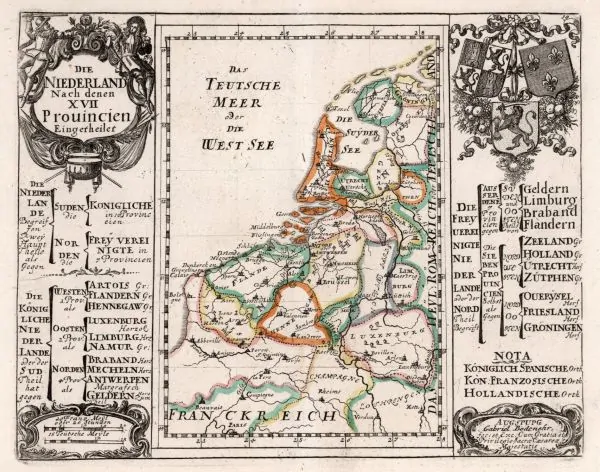
Mechelen was a separate lordship within the territories governed by Philip II. Although surrounded by Brabant, it possessed a jurisdictional identity that distinguished it from the neighboring duchy. Such arrangements were characteristic of the Habsburg Netherlands, where dynastic consolidation brought territories under a common ruler while preserving substantial differences in their institutions and customary rights. Mechelen’s relationship with the sovereign consequently rested on its position within that inherited political order, rather than on membership in a uniformly administered kingdom.
The city acquired exceptional prominence through the residence of Margaret of Austria, who established her court there in 1507. During her periods of government, Mechelen became a place where diplomatic encounters and the business of the regency brought visitors into contact with the dynasty’s representatives. Margaret’s Court of Savoy also supported an influential culture of patronage, attracting humanists and artists whose activities connected the city to intellectual networks extending across Europe. Charles V spent part of his childhood in Mechelen, giving its relationship with the ruling family a personal dimension alongside its administrative importance. A resident court required accommodation and provisions, creating opportunities for local people to supply needs generated by a princely household. It also offered prominent inhabitants access to patrons whose favor could affect careers beyond the municipal sphere. These advantages depended partly on the decisions of individual rulers and regents, making the city’s position vulnerable to changes within the dynasty. After Margaret died in 1530, Mary of Hungary established her court in Brussels, shifting the principal location of executive government. Mechelen retained important institutions, but the presence of a central judicial body should not obscure the significance of losing the regent’s household. By the middle decades of the century, its inhabitants lived in a city whose earlier political eminence remained part of its standing even though the organization of government had changed.
The Great Council sustained Mechelen’s importance as a center of justice. Its history included Charles the Bold’s establishment of a Parliament in 1473, that institution’s abolition in 1477, and the permanent settlement of the Great Council in Mechelen in 1504. The tribunal exercised extensive appellate jurisdiction, although privileges restricted its authority over provincial courts in territories including Brabant, Gelderland, and Hainaut. The Privy Council also possessed judicial powers that overlapped or competed with its functions. Mechelen occupied a prominent place within an intricate legal system whose institutions shared authority unevenly.
Within the city, municipal office connected formal government to a social order shaped by wealth and corporate membership. Governing arrangements incorporated representatives of craft guilds alongside prominent citizens, providing organized occupations with recognized opportunities to participate in public decisions. That institutional participation nevertheless requires careful interpretation, since a guild’s place in government did not mean that all its working members possessed an equivalent political voice. Prosperous households could accumulate influence through property and family relationships, while residents without comparable resources encountered narrower possibilities. Frederik Buylaert’s analysis of officeholders and fiscal records shows that Mechelen’s temporary role as a political center accelerated existing tendencies toward ennoblement among leading urban families. Connections to courtiers could consequently reinforce local standing, allowing civic leaders to pursue advantages that linked municipal office with service to the dynasty. The distinction between an occupational representative and an aristocratic officeholder was itself less secure than a simple division between craftsmen and nobles would suggest. Privileged citizens could acquire guild affiliations without personally undertaking manual work. Central authorities also participated in appointments, drawing the magistracy into procedures that extended beyond local selection. Officeholders operated through relationships with both municipal constituencies and the sovereign’s representatives. Their position helps explain why attachment to civic privileges could coexist with close connections to princely government. Defending the city’s interests might involve cultivating influential patrons, and membership in the governing elite could make engagement with the monarchy a source of advancement rather than an obstacle to local authority.
Productive labor gave Mechelen another connection to the wider Netherlands. Lodovico Guicciardini’s description, first published in 1567, praised its textiles while acknowledging that output had declined from an earlier scale. He also identified skilled metalworking, including cannon founding and bell casting, and described the princely arsenal as a substantial establishment employing numerous people. Although his admiration requires caution wherever it replaces precise measurement, these observations reveal an economy in which manufacturing supplied commercial customers and military government alike.
Religious institutions occupied an equally substantial place in urban life, but their significance reached beyond their relationship with the sovereign. Mechelen became a metropolitan see through the episcopal reorganization of 1559, alongside Utrecht and Cambrai, and St. Rumbold’s acquired the status of an archiepiscopal cathedral. This elevation strengthened the city’s position within Catholic administration while introducing questions about ecclesiastical resources and patronage. Established religious houses already maintained enduring connections with local families, and parish communities organized forms of worship through which inhabitants encountered one another regularly. Beguines and other religious women belonged to this institutional landscape, demonstrating that its participants included people far removed from senior clerical office. But the prominence of Catholic establishments cannot establish uniformity of belief across the population. Protestant activity also formed part of Mechelen’s sixteenth-century experience. Judith Pollmann’s research emphasizes that Catholic identity developed through changing relationships between lay believers and clergy during the revolt, rather than functioning as an unchanging measure of political allegiance. On the eve of 1572, the city possessed substantial attachments to traditional worship and the dynasty, but the force of those attachments depended on institutions and relationships whose interests could diverge.
Rebellion and the Meaning of Obedience
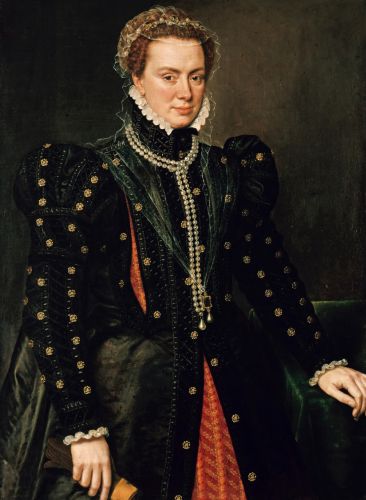
Philip II understood the preservation of Catholic worship as an obligation of his office, inseparable from the proper government of his territories. His letter to Margaret of Parma of October 17, 1565, insisted that the religious legislation inherited from Charles V should continue to be enforced, despite requests for moderation. He attributed the spread of heresy partly to the negligence and leniency of judges, making failures of prosecution themselves a problem of obedience. Within this understanding of kingship, officials who relaxed enforcement endangered both religion and public order. The disagreement concerned who could judge whether executing the king’s commands would preserve his provinces or provoke their ruin.
Gathering support during the winter of 1565–1566, the association known as the Compromise of the Nobles challenged religious persecution through an emphatic profession of service to the sovereign. Its supporters included men of different religious commitments, united more readily by opposition to existing measures than by agreement about a future church settlement. On April 5, 1566, a delegation presented Margaret of Parma with a petition asking the king to repeal the religious edicts and requesting the suspension of enforcement while he considered their appeal. The petition acknowledged the good intentions behind earlier legislation but argued that changed circumstances required another policy. Its authors described denunciation, confiscation, and the insecurity of property as dangers extending beyond those who openly professed Protestant beliefs. They also warned that continued severity could produce the very rebellion the government wished to prevent. Their intervention claimed the standing of responsible counsel. An oath of fidelity could oblige a subject to tell the ruler that his chosen remedies were damaging his interests. The petitioners’ language about the “inquisition” gathered several forms of religious prosecution into a powerful accusation; it should not be taken as a straightforward description of the introduction of the Spanish inquisitorial tribunal. Margaret’s response exposed the limits of negotiation, since she promised to seek a royal decision and encouraged discretion while maintaining that she lacked authority to suspend the laws. Petitioning had opened a dispute over whether faithful service required compliance with established commands or an effort to secure their withdrawal.
Open-air Protestant preaching during the summer of 1566 brought religious controversy into increasingly conspicuous public gatherings. The iconoclasm that began that August then damaged churches and challenged the material practices through which Catholics expressed their faith. Neither development can be treated simply as the execution of the nobles’ petition, and those who sought moderation did not all approve of image breaking. For many Catholics, attacks on sacred objects made accommodation harder to contemplate, while the government acquired stronger grounds for presenting religious innovation as a threat requiring force.
Alba’s arrival in August 1567 changed the consequences of the preceding disputes by placing their investigation under a governor accompanied by an army. The Council of Troubles, established that year, examined participation in religious disturbances and opposition to royal policy, imposing sentences and confiscations that reached far beyond the immediate perpetrators of iconoclasm. Its retrospective inquiries made earlier acts of negotiation, toleration, or association potentially incriminating. Officials who had tried to contain unrest could find their conduct interpreted as complicity in its development. Notably consequential were the arrests of the counts of Egmont and Hoorn, followed by their execution in Brussels on June 5, 1568. Both belonged to the highest nobility and had remained Catholic, so their deaths made religious orthodoxy an insufficient assurance of political security. Disputes over their treatment also concerned the jurisdiction competent to try them and the protections attached to their rank, including membership in the Order of the Golden Fleece. Alba’s government regarded punishment as necessary to restore obedience after officials and nobles had failed to uphold it; opponents saw proceedings that disregarded established safeguards as evidence of arbitrary rule. These interpretations rested on incompatible assessments of the preceding crisis. Conduct defended as an attempt to avert disorder could be prosecuted as an unauthorized concession to people who should have been suppressed.
The fiscal disputes beginning in 1569 extended this conflict into the financing of government. Alba proposed a one-time levy of one percent on property, together with permanent taxes of five percent on sales of immovable property and ten percent on sales of movable goods. Merchants and artisans feared the consequences for trade, but the controversy also concerned the provincial Estates’ ability to negotiate grants and influence the conditions under which money reached the government. A dependable tax income would reduce the governor’s need to return repeatedly to representative assemblies for assistance. Negotiated payments postponed the permanent levies, and renewed pressure in 1571–1572 met substantial obstruction; the proposals should be distinguished from successful general collection. Their political importance lay partly in the prospect of financing military power through arrangements that weakened the bargaining position of those expected to support it.
William of Orange developed a justification for resistance that made the relationship between the sovereign and his representatives the central point of contention. His published arguments from 1568 onward invoked reciprocal obligations. Subjects owed allegiance, while the ruler was bound to respect the laws and sworn commitments under which he governed. This reasoning allowed opposition to oppressive administration to be presented as the defense of an existing political relationship. In the Remonstrance of June 16, 1572, Orange offered towns protection and the recovery of their rights if they expelled Alba’s forces and accepted his own. He continued to claim authority derived from the king, arguing that he had never been lawfully deprived of his office. Instructions sent with his representative, Philip of Marnix, to the States of Holland at Dordrecht in July similarly demanded recognition of Orange as the king’s legitimate stadholder. Such assertions had immediate practical purposes; they supplied grounds for receiving troops, raising funds, and coordinating governments without first agreeing to abandon the monarchy. Their appeal could reach Catholics troubled by prosecution or taxation as well as Protestants seeking security for worship. Nevertheless, the language of service concealed no simple consensus about what the restored government should permit, especially in religion. References to the fatherland could join different provincial and civic attachments without expressing the settled nationalism of a later Dutch state. Nor does blaming destructive advisers establish that Philip was ignorant of, or opposed to, Alba’s conduct; royal correspondence demonstrates his own commitment to severe religious enforcement. Orange’s argument instead preserved a distinction that made armed opposition defensible to potential allies, postponing the more direct rejection of Philip’s sovereignty embodied in the Act of Abjuration of 1581.
For Mechelen’s governors and inhabitants, these rival accounts of lawful conduct gave immediate decisions consequences that extended beyond military expediency. Receiving a force associated with Orange could be justified by its supporters as assistance to the king’s legitimate servant, while Alba could interpret the same act as participation in rebellion. Neither formulation establishes what every resident believed or how freely municipal decisions were reached. Assessing the city’s conduct requires attention to who acted, what alternatives existed, and whose authority they recognized. The designation of Mechelen as disobedient emerged from this struggle over the legal and political meaning of particular actions.
Opening the Gates: Mechelen’s Choices in the Campaign of 1572
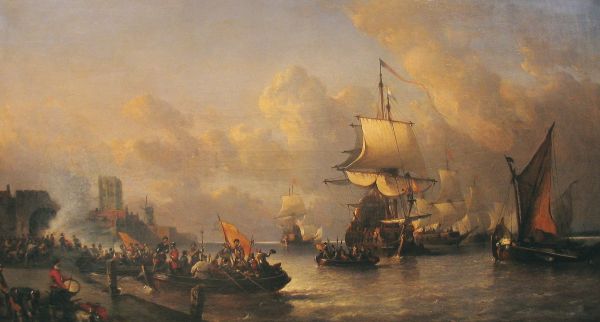
The capture of Brill by the Sea Beggars on April 1, 1572, gave the revolt a territorial foothold that Alba’s earlier prosecutions had failed to prevent. During the following months, other towns in Holland and Zeeland passed into rebel hands through combinations of outside intervention and local assistance. Louis of Nassau’s seizure of Mons in May created a further challenge in the southern Netherlands, where his supporters hoped to obtain French help. These developments forced the royal government to respond to several theaters of operations. Mechelen’s involvement emerged within a campaign whose expanding possibilities initially made Alba’s defeat appear attainable.
Orange’s advance from the east in late August sought to turn these scattered successes into a decisive military result. With an army raised largely in Germany, he crossed the Maas and moved toward the relief of his brother at Mons. Several towns along his route admitted his forces, providing positions from which his followers could operate beyond the immediate reach of the marching army. Such acquisitions mattered because a field force needed provisions and places through which supplies and communications could pass. A succession of welcoming towns could make an invasion resemble the establishment of a durable government, encouraging additional supporters to commit themselves. Mechelen occupied a consequential position near Brussels and Antwerp, within the heavily urbanized region through which royal administration and commerce operated. Together with other rebel positions, its occupation threatened the movement of provisions toward Brussels and complicated the government’s control of the surrounding countryside. Yet possession of these towns depended on Orange’s ability to sustain the larger offensive. A garrison could hold a gate and assert authority inside the walls without possessing the resources to withstand Alba’s principal army. The apparent breadth of the rebellion concealed a considerable military vulnerability. Local gains would become difficult to defend if the attempt to relieve Mons failed.
At the end of August, troops associated with Orange entered Mechelen with assistance from inhabitants inside the city. Geoffrey Parker identifies Mechelen among the towns where rebellion preceded a request for an Orangist garrison, giving local initiative a substantial place in the explanation. Bernard van Merode assumed command of the force established there. This sequence makes it difficult to describe the city’s involvement solely as submission to an invading army. Some residents actively helped create the new situation, although their success in admitting troops supplies no measure of how widely their objectives were shared.
Occupation subsequently required cooperation that the initial seizure could not secure permanently. The arrival of soldiers changed the practical meaning of supporting Orange, bringing military demands into contact with household resources and municipal administration. Billeting and the maintenance of a defensive force could impose burdens even on people who welcomed a change of government. Merode’s later defense of his conduct describes unpaid soldiers, diminishing obedience within his command, and inhabitants unwilling to assist him. He also accused residents of obstructing defensive preparations, including the manipulation of water levels and the removal of trees near the gates. These allegations belong to an effort to justify his eventual withdrawal, and their particulars require caution. Nevertheless, they identify a plausible source of conflict. Measures advantageous to a commander could damage property or threaten livelihoods within the community he expected to defend. Flooding approaches, for example, involved consequences extending beyond the movement of enemy troops. The military value of a town depended on continued access to resources and on the willingness of people inside it to accept preparations for a siege. Merode’s complaints suggest that he increasingly lacked both. Mechelen’s brief association with the revolt developed into a struggle over what its inhabitants would contribute, what the garrison could demand, and how much authority its commander could actually exercise.
News from France and the failure before Mons altered these calculations during September. The killing of Admiral Gaspard de Coligny and other Huguenot leaders in the St. Bartholomew’s Day massacre destroyed the prospect of the intervention on which the Nassau brothers had placed considerable hope. Orange continued his attempt to relieve Mons, but he failed to dislodge Alba’s forces, and Louis agreed to surrender on September 19. Orange passed through Mechelen during his retreat, while the wider offensive began to unravel. His presence could offer little lasting reassurance once the field army moved away. Alba now had greater freedom to recover the towns gained by his opponents. For Mechelen, the decisive change was the disappearance of a credible prospect that outside forces would prevent the royal army from reaching it.
Withdrawal became an object of negotiation within the city as well as a question of military judgment. According to Merode, magistrates and residents urged him to leave, and the bishop of Arras addressed a public gathering about the possibility of obtaining mercy once the garrison had departed. This report establishes an expectation of accommodation, rather than a guarantee issued by Alba. Its importance lies in the proposed connection between removing the soldiers and securing protection for those who remained. Residents seeking such an arrangement could regard the departure of the garrison as a necessary step toward ending the emergency. Merode, meanwhile, had to defend an evacuation that exposed him to accusations of abandoning his charge. His explanation presented continued resistance as militarily untenable and departure as consistent with his responsibilities to Orange. The dispute involved competing assessments of who could still protect the city and what obligations survived the collapse of the campaign. An officer might preserve his remaining force by withdrawing, while inhabitants had to find terms under which they could continue living where they were. Clerical intervention offered one possible means of approaching the victorious government, primarily because a bishop could speak within institutions that Alba claimed to defend. The hope attached to that intervention reveals how much depended on the commander’s willingness to recognize a change of conduct. Removing an enemy garrison could demonstrate submission, but the inhabitants could not themselves determine what consequences the government would attach to their earlier cooperation.
Merode’s force evacuated Mechelen on October 1, leaving the civic authorities to deal with the approaching royal troops. Accounts of the following day describe magistrates presenting the city’s keys and clergy going out to appeal for pardon. These gestures made the request for accommodation public and placed recognized representatives of the community before the victorious command. They also distinguished the city’s immediate posture from the resistance that its former garrison might have offered. By October 2, the central question had become whether Alba would accept those acts as grounds for protecting Mechelen’s inhabitants when his army entered.
Choosing Punishment
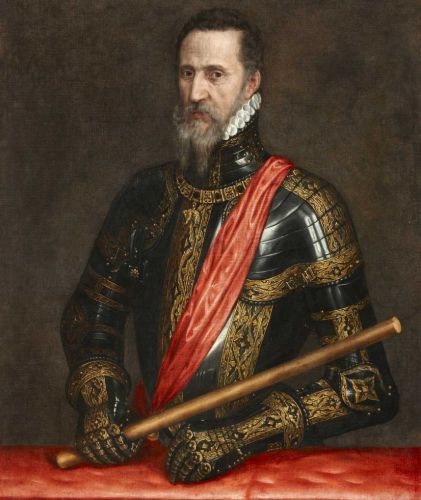
Alba’s account to Philip II on October 2 placed the punishment of Mechelen within a practical problem of command: how to recover the remaining towns without taking the royal army against each of them separately. Writing while the sack was under way, he presented its severity as a means of shortening the work of reconquest. His supplied a justification for a decision already being executed, allowing the governor to explain his conduct through the interests of the sovereign he served. Understanding that decision requires attention to the powers Philip had conferred, their exercise through subordinate commanders, and the competing judgments that royal officials expressed about the consequences.
Philip had constructed Alba’s authority through several appointments that brought military and governmental responsibilities into the same hands. Commissions issued on December 1, 1566, and January 31, 1567, appointed him captain-general, while a further commission of April 21, 1567, provided special powers concerning military justice. His commission as governor-general followed on October 8, after Philip accepted Margaret of Parma’s resignation. As Violet Soen’s research demonstrates, the possibility of combining these offices had been contemplated before the governorship formally changed hands, making their eventual conjunction part of royal planning. The arrangement gave Alba several capacities in which to act; he directed troops, exercised delegated governmental authority, and possessed exceptional means of dealing with offenses against military obedience. Decisions about a town’s treatment could consequently move between administrative judgment and armed enforcement without passing through an independent institution capable of separating those functions. The practical organization of the army strengthened this concentration of power, as Alba entrusted important commands to experienced officers associated with his service in Italy and curtailed corresponding military responsibilities held by provincial authorities. Fernando González de León’s work helps explain how such appointments made access to the commanding general important within the Army of Flanders. Local officials continued to matter, but their knowledge and representations entered a structure whose decisive military judgments rested elsewhere. Philip’s arrangements made the governor’s discretion a working instrument of royal government, especially when circumstances demanded decisions faster than correspondence with the court could resolve them. The crown’s responsibility for creating that discretion and Alba’s responsibility for a specific use of it belong to different stages of the same exercise of authority.
The presence of another governor-designate exposed the difficulty of making that structure speak with a single voice. Philip had selected Juan de la Cerda, duke of Medinaceli, to succeed Alba in 1571, and Medinaceli reached the Netherlands in June 1572, although Alba’s opposition prevented him from effectively assuming the governorship. He consequently witnessed the campaign as a senior royal representative whose appointment carried substantial standing but whose control over operations remained limited. An anonymous report dated October 4 describes him intervening during the sack to protect religious establishments and people seeking refuge, providing evidence of disagreement among men acting in the king’s service. That intervention should not turn Medinaceli into the representative of an invariably conciliatory policy, since his own positions included support for repression and changed with circumstances. His presence nevertheless demonstrates that royal appointment could authorize competing assessments of military conduct even when the capacity to issue effective orders remained concentrated in Alba’s hands.
At Mechelen, the documented instruction passed from Alba to Don Fadrique. In his October 2 letter, the duke reported that his son understood his judgment that the soldiers should be allowed to enter and accordingly ordered them to do so. This statement connects the governor’s decision to its execution through a subordinate who was also a member of his family. It provides unusually direct evidence for authorization within the superior command, identifying both the source of the judgment and the officer who communicated the operative order.
Defending such an order required arguments about the conditions under which an army could punish a town. Sixteenth-century military practice distinguished between settlements admitted to negotiated terms and those taken after continued resistance, with the latter exposed to much harsher treatment. Geoffrey Parker’s scholarship on the laws of war shows how these distinctions shaped expectations about surrender, the protection of inhabitants, and the opportunities commanders offered their troops. Such conventions supplied a vocabulary of justification, but their application depended on judgments about circumstances that interested parties could describe very differently. The standing of the enemy introduced another complication. Soldiers serving a recognized ruler might claim protections that commanders were less willing to extend to people classified as insurgents against their own sovereign. Alba could understand the recovery of Mechelen through both military custom and the punishment of disobedience, drawing authority from each without treating them as identical grounds. The official declaration issued after the sack invoked gunfire against royal forces as part of its explanation of the city’s treatment, making alleged hostility a reason for severity. That claim requires scrutiny because evidence of a hostile act does not by itself establish that the town was captured through a contested assault, or that everyone subsequently exposed to plunder had participated in resistance. Decisions remained necessary about whose conduct mattered, what counted as an adequate submission, and whether an earlier offense could be answered through a lesser penalty. Military conventions gave commanders arguments for their choices while leaving room for contemporaries to dispute whether those choices fitted the case.
The financial organization of the army made permission to plunder attractive for additional reasons. Maintaining the Army of Flanders required extensive arrangements for credit, remittances, supplies, and wages, whose failures could strain relations between officers and soldiers. Parker’s work on military logistics establishes the importance of these pressures without making them a sufficient explanation for every episode of violence. At Mechelen, allowing entry gave troops access to civilian possessions that could satisfy immediate material demands, although there is no need to assume that the proceeds constituted a formal settlement of wage arrears. In practical terms, the decision permitted soldiers to obtain resources directly from inhabitants, making the exercise of command partly dependent on what its recipients could seize. This helps explain why a measure intended to produce obedience elsewhere could simultaneously weaken the habits of restraint on which the army’s own discipline depended.
A royal secretary, Esteban Prats, offered a different calculation of the monarchy’s interests in his letter to Philip of November 30. He argued that Mechelen could have been subjected to a monetary penalty, while connecting the broader difficulty of controlling soldiers with failures to pay them. Where Alba’s account claimed efforts to safeguard churches and royal servants, Prats described losses affecting religious institutions and personnel attached to the king’s government. His criticism accepted that an offense might deserve punishment; its force came from questioning whether the chosen penalty served the sovereign effectively. A financial assessment could affirm the crown’s authority, impose a substantial burden, and preserve resources from which future payments would have to come. Unrestricted seizure distributed those resources among soldiers according to access and opportunity, making their recovery for public purposes uncertain. Damage to religious establishments also compromised an important basis on which royal intervention had been defended, while injury to servants and institutions of government disrupted the administration through which obedience was maintained. Prats evaluated punishment through the continuing requirements of rule, bringing the preservation of useful institutions and revenues into competition with Alba’s expectation of rapid military advantage. His letter demonstrates that criticism of the sack could emerge from allegiance to Philip and concern for the operation of his government. It does not establish that the king accepted the secretary’s recommendations, but it does preserve a contemporary alternative grounded in royal service, material calculation, and the possibility of imposing a different sanction.
Alba’s own later correspondence confirms that he recognized alternatives to devastation. On November 28, he rejected the allegation that he intended to sack Leuven and maintained that the king’s vassals there should be preserved and subjected to another punishment. This was a defense of his conduct, and its self-interested character limits what it can establish about his motives in either city. It nevertheless shows that he acknowledged a choice among penalties rather than an obligation to destroy every community judged disobedient. The decision at Mechelen consisted in using the authority Philip had entrusted to him to select an exceptionally severe treatment whose necessity other royal servants could, and did, contest.
Submission without Security: What Did Surrender Promise?
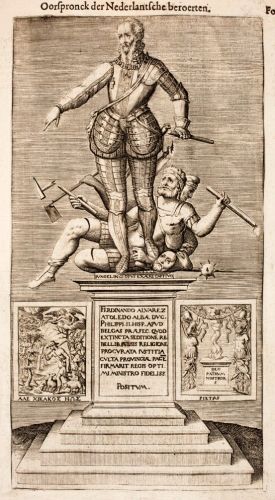
Mechelen’s submission raised a question more specific than whether a defeated town could expect mercy: what had the approaching army undertaken to protect? Its inhabitants could acknowledge royal authority and seek an end to immediate danger without obtaining an agreement that defined their treatment. The surviving accounts preserve appeals and expectations, but do not establish that Alba accepted a capitulation guaranteeing the community’s safety. The resulting vulnerability lay in the distance between conduct intended to secure protection and a commitment that the commander acknowledged.
An anonymous report dated October 4 describes an earlier proposal that helps identify this distinction. Two days before the entry, intermediaries had offered Alba a gate through which his forces could enter while the enemy remained inside, on condition that the inhabitants described as loyal or innocent should be spared. This was a proposed arrangement for selective entry, with protection incorporated into the offer, and the report states that Alba refused it. Its significance lies partly in showing that townspeople or their advocates had attempted to make preservation an explicit element of cooperation with the royal army. The proposal would have joined a useful service to a requested concession, giving each side something identifiable to perform. Its rejection prevented that exchange from becoming an accepted undertaking, whatever further opportunities for accommodation remained. A historical account should also allow for the possibility of an oral assurance, since the absence of a surviving written instrument alone cannot settle whether a promise was made. What matters is evidence of a commitment communicated by someone authorized to give it and received as such by those relying on it. Neither this report nor Merode’s defense supplies that evidence for Mechelen’s eventual submission. Alba’s own letter acknowledges receiving the bishops’ notification that the garrison had departed, while recording no acceptance of protective terms. These accounts establish communication and a request for favorable treatment, leaving the strongest version of a promised guarantee unsupported.
When Merode recalled the bishop of Arras’s intervention, he described the prospect of accommodation and the inhabitants’ belief that episcopal advocacy would preserve their persons and possessions. His memoir defended his withdrawal, giving him a reason to emphasize the confidence that others had placed in this course. Van Haecht, writing in Antwerp, also reported hopeful reliance on the bishops, while recording that other residents fled because they distrusted the mercy awaiting them. These testimonies preserve divergent assessments of danger rather than a single civic conviction that protection had been secured.
François Richardot brought to this intervention an established public association with the monarchy’s language of forgiveness. On July 16, 1570, the bishop of Arras had preached in Antwerp Cathedral during the solemn announcement of the papal and royal pardons, in Alba’s presence. Gustaaf Janssens’s analysis of the sermon identifies an argument directly relevant to the protection sought at Mechelen. A prince might suspend punishment of wrongdoers when doing so would preserve innocent people from being condemned with them. Richardot also maintained that justice required moderation to prevent cruelty, while benevolence required care to avoid encouraging further wrongdoing. Mercy could belong to the proper exercise of kingship, serving the restoration of authority and religious order rather than demanding their abandonment. The pardon itself nevertheless imposed conditions and excluded categories of offenders, as Violet Soen’s research demonstrates, so this language did not offer everyone an automatic release from liability. Its importance for Mechelen lies in the standing it gave an appeal that distinguished the people seeking reconciliation from those held responsible for resistance. In asking Richardot to speak, residents could place their request within a conception of princely conduct that had been proclaimed under royal auspices. Merode’s account does not preserve the full address delivered in Mechelen, and the earlier sermon cannot supply its missing wording. The connection nevertheless helps explain why episcopal mediation could seem credible. The intermediary had already presented restraint toward the innocent as a virtue compatible with obedience to Philip and fidelity to Catholicism.
Claims about innocence accompanied the public request for mercy. The October 4 report describes religious figures and a trumpeter announcing that the city belonged to the king and Alba, that the culpable had departed, and that innocent people remained. This declaration attempted to distinguish responsibility within the population and to give the entering army a reason to discriminate among those it encountered. It was an interested representation, and historians cannot accept its assertion as a reliable classification of every remaining resident. Equally, the earlier admission of rebel forces does not establish the personal conduct of every household subsequently exposed to punishment. The issue was whether those governing the entry would recognize distinctions that the petitioners presented as morally decisive. Richardot’s previously stated principle made their request intelligible within contemporary royalist thought, even though neither religious identity nor an assertion of innocence could compel its acceptance.
Even an accepted arrangement would have required officers to make its protections effective among the troops entering a town. Van Haecht’s account of Dendermonde, which surrendered on October 5, provides a nearby comparison without supplying missing terms for Mechelen. He explicitly describes an agreement accompanied by a monetary payment, then reports that soldiers began plundering before the money had been fully counted and that officers intervened against the removal of booty. His brief notice does not reproduce the articles, so it cannot establish the exact scope of their promised safeguards. It nevertheless places an agreement, premature pillage, and corrective intervention within the same sequence, making enforcement part of the analysis even where negotiation is securely attested. A promise of safety needed decisions about access to houses and possessions, followed by action against soldiers who disregarded the settlement. For inhabitants, the practical value of an agreement depended on whether those decisions reached the men arriving at their doors. Mechelen’s clerical welcome, with the crosses and banners recorded by Van Haecht, communicated a request to be received under royal protection through a familiar religious ceremony. Such gestures made submission visible, but the accounts do not show them producing the agreed settlement recorded at Dendermonde. Without an accepted undertaking, the people remaining in Mechelen had to rely on the commander’s willingness to act upon the meaning they gave their behavior. The comparison reveals two distinct vulnerabilities. Protection could remain unaccepted, or protection that had been accepted could fail during its execution. Keeping those possibilities separate makes it possible to assess a commander’s decision and the behavior of soldiers without attributing an identical kind of failure to every surrendered town.
On the available evidence, an accusation that Alba violated agreed capitulation terms goes further than the sources permit. The better-supported interpretation concerns the failure of an appeal for renewed protection after the remaining community had publicly declared its submission. That evidentiary limit leaves substantial grounds for contemporary criticism, because preserving innocent people and moderating punishment already belonged to the monarchy’s own stated ideals. Those seeking mercy had invoked a recognized duty of princely restraint, even if they could not demonstrate a newly concluded agreement that bound Alba to grant their request.
The Sack: Violence within the Urban Community
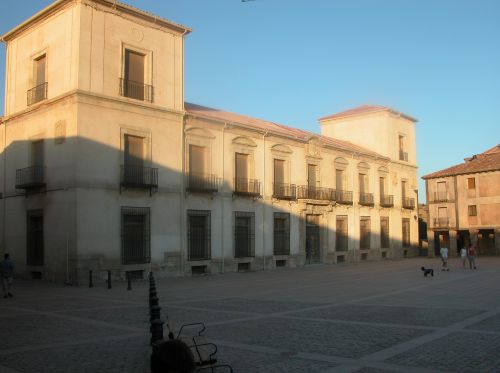
The soldiers who entered Mechelen on October 2 moved through a city whose houses and religious buildings contained people seeking shelter and possessions they hoped to preserve. Van Haecht names Spanish, German, and Walloon troops among those participating, while reports describe the plunder continuing over several days. Their accounts follow violence into domestic interiors and places of communal care, exposing the encounters through which inhabitants experienced the sack. Although they establish extensive dispossession and bodily harm, they provide neither a dependable count of the dead nor a complete reconstruction of events in every neighborhood.
Seizure reached the materials of ordinary work as well as accumulated wealth. Van Haecht describes shops stripped of metal goods, cloth, and leather, placing commercial stock among the possessions carried away. The significance of such losses depended on the household concerned. Cloth might be merchandise, bedding, or clothing, while a shop’s contents represented resources needed to resume business. Assessing the damage requires attention to use and livelihood, rather than treating everything taken as interchangeable treasure. A further injury appears in Cintio Calbi’s report of October 16, which describes public and private documents torn or scattered and payments demanded from people seeking to recover records they needed. Calbi wrote in defense of Medinaceli’s conduct, and his hostile assessment of Alba’s command requires the same scrutiny as other partisan testimony. Nevertheless, this specific description identifies a form of destruction that inventories of movable goods could easily overlook. Although the report does not identify every document, damage to records could endanger evidence of ownership or obligations, making an existing claim harder to prove after the immediate danger had passed. Where documents survived in soldiers’ or officers’ possession, their usefulness supplied another opportunity for extraction. An inhabitant could lose property, the means of demonstrating a right to it, and additional money in an attempt to recover the relevant evidence. The sack affected the practical operation of urban rights through the handling of papers as well as the seizure of goods.
Torture made the search for concealed valuables a direct attack on bodily survival. Prats reports that soldiers subjected inhabitants of both sexes to torment in order to extract hidden money, gold, and silver, sometimes killing those they abused. In these episodes, the violence described served to force disclosure, giving a person’s knowledge of possessions an immediate and potentially fatal importance. Refusal, inability to answer, or an answer that failed to satisfy the captor could leave the victim exposed to continued coercion, although the surviving reports rarely reconstruct those exchanges closely enough to distinguish among them.
Sexual assault created dangers that could not be resolved through surrendering possessions. Van Haecht reports attacks against women and girls, including a case involving two sisters whose father was killed when he tried to intervene. Their mother brought a complaint to a superior officer, and the chronicler connects her action with the subsequent identification and punishment of the soldier responsible. This account preserves a limited instance of action by someone seeking redress during the violence, alongside the injury inflicted upon her family. It does not retain the sisters’ own testimony, identify their later circumstances, or establish how representative the episode was. Those omissions matter because the women appear within a narrative organized around assault, attempted protection, and punishment, leaving much of their experience inaccessible. Other accounts collected and examined by Peter Arnade describe sexual violence against wives and young women and the vulnerability of children deprived of their mothers. Their emphasis shows how attacks on individuals could unsettle relationships of care throughout a household, although it cannot supply the missing histories of survivors. Rape inflicted an injury upon the person assaulted that deserves recognition in its own right; its significance cannot be exhausted by what it communicated about the city’s defeat. Nor does evidence that officers punished certain offenders demonstrate that inhabitants could ordinarily obtain intervention before an assault occurred. The accounts instead reveal a severe imbalance between the immediate power of armed men and the uncertain possibility of securing help against them.
Religious houses held resources for care and subsistence, which made their plundering consequential beyond the removal of sacred objects. The anonymous Catholic author of the Discours du pillage de Malines describes convent provisions being taken and the Black Sisters losing supplies intended for people suffering from plague. He also reports the removal of beds from sick women, placing the disruption of care among the sack’s immediate effects. His account includes religious women who had already sought shelter after destruction attributed to Orange’s forces and who now lost possessions they had managed to save. Within this testimony, successive episodes of warfare reduced the resources available to people already displaced. The reference to poor people’s pledged goods and savings further identifies property held on behalf of vulnerable inhabitants, rather than wealth belonging exclusively to religious corporations. Such details show the sack reaching arrangements through which the community sustained the sick and preserved small reserves, making deprivation part of the violence experienced inside the city.
Relations among residents could become dangerous when local knowledge offered access to hidden property. Merode accused inhabitants of denouncing one another and revealing possessions concealed in religious establishments in exchange for a share of the booty. His charge belongs to a bitter defense that presented the townspeople as untrustworthy and sought to explain why he had withdrawn, so it cannot establish a general pattern of civic behavior. It nevertheless identifies a mechanism by which people familiar with households and hiding places could assist coercion, if the accusation was accurate. Under those circumstances, knowledge ordinarily embedded in neighborhood relations might acquire a new value for men searching for goods. Historians should leave open whether a disclosure arose from fear, an existing grievance, or a wish to profit, since the memoir gives no adequate basis for choosing among those motives. Evidence of assistance also survives. Van Haecht describes people buying goods to help friends who had been robbed, alongside purchasers interested in acquiring plunder for themselves. That reported conduct demonstrates how access to money and contacts could be used to recover something for another household. The two accounts do not allow betrayal or aid to be measured, and neither author offers a representative survey of the population. They show why the city cannot be treated simply as a collection of isolated victims facing soldiers. Existing relationships could affect what captors learned, what they obtained, and whether some possessions could be restored. The military occupation placed pressure on the cooperation through which residents normally managed their lives, creating opportunities for exploitation while leaving room for acts of assistance.
Captivity extended the coercion beyond the first seizure of a household’s belongings. Van Haecht reports inhabitants taken to Antwerp and its castle and required to provide ransom despite having already lost their possessions. Calbi likewise describes payments for the release of family members and the repurchase of goods, indicating that recovery itself could become an occasion for further demands. These accounts help distinguish immediate dispossession from the additional cost of obtaining liberty or retrieving what had been taken. Friends and relatives who supplied ransom money could preserve a captive’s life while assuming financial burdens generated by the same violence. The evidence does not show that everyone faced identical demands or possessed comparable means of meeting them, but it does show how the power to detain one person could draw resources from a wider circle. A household’s exposure consequently depended partly on the people able to help it, making kinship and friendship important to survival as well as vulnerable to exploitation.
Reports of corrective action belong within this history, alongside evidence of the damage already inflicted. Van Haecht records executions for sexual violence and associated killing, together with orders for the return of ecclesiastical property; the Discours also describes incomplete restitution of sacred objects. These notices establish specific interventions, without providing a comprehensive record of prosecution or recovered possessions. They cannot support a calculation of how many offenders escaped punishment. Punishing a soldier or returning an object could answer a specific injury, while leaving the household’s other losses and the destruction of shared resources unresolved.
The Economics of Permission: Pay and Military Discipline
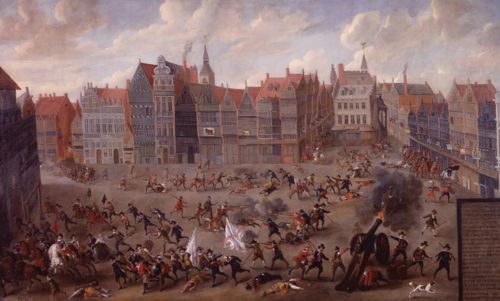
In his report of October 16, Calbi judged that the sack would quiet Spanish soldiers’ demands for payment only temporarily, while the wages owed them continued to accumulate. His observation identifies a distinction essential to understanding the military value of Mechelen’s wealth. Possessions seized by an individual might provide immediate relief or considerable profit without being entered as payment against his outstanding wages. Command could obtain a respite from demands on its treasury by allowing access to civilian property, yet emerge from that transaction still indebted to the men whose service it required.
Financing a royal army involved established procedures for identifying soldiers and recording their entitlements. As Etienne Rooms’s research explains, muster rolls listed personnel, rank, and wages, supplying the information on which disbursement depended. For Spanish troops, separate offices handled payment and the accounting that authorized it, while military finance drew on remittances from Spain alongside resources raised in the Netherlands. Transfers arranged through merchant credit depended on intermediaries making money available in the Netherlands. Parker’s account of recruitment shows captains distributing wages after deducting advances already made to their men. These arrangements gave monetary obligations an administrative form, even when the money needed to meet them was missing. They also made a soldier’s effective resources different from his nominal rate of pay. The renewed mobilization of 1572 strained a system that Alba had recently made substantially dependent on revenues collected within the provinces. Fresh funds from Spain became necessary as the army expanded and local receipts deteriorated. Neither the institutional structure nor this broader shortage establishes exactly what every contingent entering Mechelen was owed, and their financial circumstances should not be flattened into a single condition. The relevant connection is that commanders had to sustain service while receipts, payments, and immediate military requirements failed to coincide.
Prats made regular payment a condition of effective punishment in his November 30 appeal to Philip II. He recommended providing soldiers with their wages at least every three months, arguing that offenders could then be disciplined more successfully than while substantial arrears remained unpaid. This was a proposed remedy from an experienced royal servant, rather than a description of a rule granting immunity to indebted troops. Its force lay in connecting the government’s obligations to the obedience it expected from soldiers. An officer might possess legal authority to punish misconduct while facing practical resistance to enforcing it among men who believed their own claims had been neglected.
Turning stolen objects into spendable money required purchasers and transport. Van Haecht reports shiploads and wagonloads of booty reaching Antwerp and Brussels on October 3 and 4, followed by buyers traveling to Mechelen to acquire goods directly from soldiers. The transaction could benefit a purchaser who obtained valuable property cheaply, as well as the armed man who had appropriated it. For the soldier, the price obtainable at a hurried sale was not necessarily the value that the object had possessed before seizure. Bulk, ease of transport, and access to a buyer could affect whether a possession yielded an immediate return. These are economic implications of the reported trade, not details recoverable for every individual sale. Calbi specifically maintained that goods had been sold badly or wasted and that the damage inflicted greatly exceeded the money obtained. His position in Medinaceli’s household gave that criticism a partisan purpose, and his estimates cannot substitute for a reliable account of losses and proceeds. Nevertheless, the distinction he drew remains analytically useful. Destroying a household’s wealth and realizing that wealth as cash were different processes. Permission distributed opportunities to obtain property, without demonstrating an equal allocation among soldiers or a common return on their efforts. It also brought people beyond the army into the circulation of stolen goods, extending the immediate financial beneficiaries beyond those who had entered the city.
These transactions occurred within continuing obligations of military service. Parker describes recruits swearing obedience to orders and undertaking neither to leave without discharge nor to mutiny over pay. Allowing a differed institutionally from soldiers organizing a refusal of service to compel settlement of their claims. A commander could authorize appropriation while continuing to require attendance under the colors and obedience on campaign. Military discipline could regulate the use of violence and the timing of enrichment, even when the conduct permitted was disastrous for inhabitants.
Orders concerning the movement of goods and men exposed the difficulty of bringing private acquisition back under campaign requirements. Van Haecht records a restriction on carrying booty out of Mechelen after October 8. Separately, he describes an Antwerp proclamation on that date ordering Spanish and Walloon soldiers to depart and prohibiting residents from lodging them after October 9. In his account, the approaching deadline obliged soldiers to dispose of their plunder. The notices show attempts to close the period of extraction and recover troops for further operations, although they do not establish complete compliance. Calbi’s report of October 16 complained that men occupied with selling goods had still not returned to their units. He also predicted that successful looters would leave the army, distinguishing Walloons returning home from Spaniards departing for Italy or Spain. A later dispatch by Claude de Mondoucet, the French resident, described departures among Walloon troops after the sack, presenting the booty as what those men regarded as their payment. His assessment concerned that contingent and should not become a numerical claim about desertion throughout the army. It nevertheless supplies evidence that the anticipated reward could work against retention: a soldier who had acquired enough to leave possessed a reason to abandon further service. The same material gain that eased immediate dissatisfaction could reduce dependence on continued military employment. Commanders’ need to move the army onward remained in tension with soldiers’ efforts to realize and preserve their acquisitions.
Private proceeds also differed from money available for the government’s purposes. In that November dispatch, Mondoucet attributed regret to Alba because Mechelen could instead have furnished funds for his needs; this was the envoy’s account of the duke’s reaction, not a surviving admission in Alba’s own words. Prats subsequently accused commissioners of continuing to search rural properties for private profit under the justification that they belonged to Mechelen inhabitants. His charge suggests how an exceptional permission could supply a pretext for further appropriation beyond the original urban target. Neither report allows the crown’s financial losses to be calculated, but both complicate an interpretation of the sack as an efficient way to fund warfare. The monarchy still needed taxable resources and dependable service, whereas individual beneficiaries had reasons to maximize immediate returns. Mechelen’s destruction gave those private interests unusual scope without resolving the fiscal obligations that would confront command in the next stage of the war.
Making a City Guilty: Rebellion and Collective Punishment

Alba’s declaration of October 4 assembled a case against Mechelen through a succession of alleged public acts. Refusal of a royal garrison, assistance to Orange’s forces, hospitality to the prince, an oath, and financial support appeared as evidence of sustained disobedience. In that account, “the city” possessed an intention extending across decisions made by different people at different moments. The document’s retrospective justification of the sack consequently depended on an important act of attribution. Conduct associated with municipal bodies or groups of inhabitants became the offense of an entire community.
A civic corporation could bear obligations that survived changes in its membership, including commitments undertaken by those authorized to represent it. This gave collective responsibility an intelligible place within a political order organized through towns, estates, and other privileged associations. Yet the identity of a community’s legitimate representatives could become contentious when its members divided over allegiance. As Dante Fedele’s reconstruction of medieval legal debates demonstrates, jurists considered competing claims by factions, majorities, and groups retaining jurisdiction within a disputed city. Bartolus denied that either party in a divided city could independently submit the whole to another authority; Baldus allowed a majority to do so while preserving the rights of its superior. Their disagreement concerned the conditions under which a group could speak for a civic body. These arguments arose from Italian disputes and cannot be presented as rules Alba demonstrably consulted. They establish that equating a faction’s decision with the will of an urban corporation was contested within the inherited legal tradition. For the historian, this makes the difference between an act performed in Mechelen and an act performed authoritatively on Mechelen’s behalf essential. Control of a gate, participation in a public reception, and authorization of a municipal payment supplied different kinds of evidence; combining them under a single accusation obscured whose agency each actually established.
Francisco de Vitoria’s discussion of war in 1539 separated responsibility for an offense from the permissible extent of its punishment. He prohibited deliberately killing the innocent and held that even a community’s rebellion could not justify killing its entire population. He nevertheless allowed certain measures against innocent people under necessity and contemplated a sack when sufficiently grave military reasons supported it. Such permission carried an obligation to prevent foreseeable crimes. Vitoria’s position supplied grounds for questioning the scale and execution of punishment while acknowledging that collective penalties could sometimes be legitimate. Its relevance here lies in the availability of that reasoning before 1572; there is no evidence that Alba assessed Mechelen through this text.
The classification of rebellion also altered the protections a royalist jurist might recognize. Balthazar Ayala, a legal officer serving the Army of Flanders, developed a forceful account in his treatise of 1582. Rebels, in his formulation, could not claim the legal standing of recognized enemies or the corresponding benefits attached to lawful warfare. The sovereign could nevertheless employ military coercion against them, producing an asymmetry in which armed opposition brought disadvantages without acquiring the privileges of an independent belligerent. Written ten years after Mechelen’s sack, this argument illuminates a subsequent articulation of royalist reasoning during the same revolt. It must not be treated as an instruction governing Alba’s decision. Equally revealing is Ayala’s discussion of a city incapable of defending itself. Surrender could be excusable where adequate forces and relief were unavailable, because obligation extended only to what could actually be accomplished. Fault remained relevant even within a strongly monarchical account of obedience. Applying that qualification to Mechelen would have required examining circumstances, including its earlier exclusion of royal troops, rather than presuming that a change of military control established treason by itself. Ayala exposes a difficulty inside the argument for repression. A prince’s claim to obedience did not settle whether subjects had freely abandoned him, acted through recognized representatives, or yielded under constraints they could not overcome. Those distinctions mattered because an accusation of deliberate defection assigned blame differently from an account of military helplessness.
Punishment acquired a precise institutional form after the soldiers’ entry. The measure dated October 18, recorded in Charles Terlinden’s chronology of royal ordinances, revoked Mechelen’s privileges and suspended its magistracy. This sanction reached the city through its recognized legal capacities and governing body. It asserted authority over the arrangements through which inhabitants conducted civic affairs, extending the consequences of rebellion beyond the immediate violence. The regest identifies those measures but leaves their detailed implementation unspecified. It provides evidence of a penalty imposed on the civic corporation without establishing individual criminal judgments against its residents.
Craft associations were exposed to a comparable attribution of responsibility at a smaller institutional scale. Johan Dambruyne’s study of the Mechelen guild archives records that Alba withdrew the crafts’ privileges in autumn 1572 as punishment for their open support of Orange’s administration that September. Here the sanction attached political conduct to organized bodies whose rights were important to their members’ position within the town. Acceptance of that description still leaves a distinction between an association’s public alignment and the conduct of every person enrolled in it. Membership could transmit the consequences of a corporate decision to individuals whose enthusiasm, participation, or freedom of action varied considerably. The evidence does not permit those differences to be reconstructed member by member, and the removal of privileges should not be made to supply the missing proof. Literary associations also experienced deprivation. Anne-Laure Van Bruaene’s repertory records that the Mechelen chamber of rhetoric De Peoene lost its privileges in 1572 while continuing to function. That survival gives the legal sanction a more exact meaning. Withdrawal of recognized rights could weaken or discredit an association without immediately dissolving the relationships that sustained its activity. These institutional penalties show how authorities could hold communities answerable through the status of their constituent organizations, while the practical consequences extended across memberships larger than the groups responsible for decisions.
Cintio Calbi’s report of October 16 demonstrates that disagreement over collective punishment could occur within the royal camp. Writing in defense of the duke of Medinaceli’s conduct, he maintained that punishment should have fallen on the culpable and proposed confiscating the houses and possessions of known fugitives. He also envisaged a general contribution from the town and penalties affecting its privileges and liberties. His alternative retained a collective burden alongside measures directed at identifiable offenders. Its distinguishing feature was the effort to preserve gradations of responsibility and choose corresponding sanctions without destroying the community. Calbi’s association with Medinaceli gave him reasons to criticize Alba and Don Fadrique, so his proposal cannot be accepted as disinterested adjudication. Nevertheless, its combination of confiscation, civic penalties, and a communal levy establishes that a loyal servant of the monarchy could regard exemplary punishment as necessary while contesting the means employed. The debate concerned which people, property, and institutions should answer for rebellion, as well as the damage royal commanders were entitled to inflict.
Making Mechelen guilty involved decisions about representation, intention, and the reach of a sanction. Public acts could establish grounds for accusing a civic body while leaving the responsibility of many inhabitants unresolved. The royal justification treated municipal disobedience as sufficient grounds for the sack, although contemporary legal arguments and loyalist criticism offered distinctions that complicated that conclusion. Collective punishment was consequently a field of political choice. The city’s alleged offense gave the monarchy a claim to act, but the scope of its response still required justification.
Announcing the Example: The Sack as a Message to Other Cities

The printing order reached Christophe Plantin at nine in the morning on October 5, 1572. Alba’s secretary, Bertin, sent French and Dutch texts from the camp at Muysen, requested approximately two hundred copies with immediate dispatch, and directed their return by post to the army wherever it had moved. Plantin’s own note records delivery to Taxis that afternoon of 150 Dutch copies and 100 French copies. These details reveal the practical machinery behind the announcement. A military headquarters commissioned a commercial workshop to reproduce its account quickly, in two languages, and send the sheets back toward the moving army. The warning was being prepared for use while neighboring communities still faced decisions about the advancing troops.
For those communities, the declaration’s concluding threat made the approach of the royal army a consequential deadline. It announced further severity against Mechelen and extended the prospect to other rebellious towns that waited until the king’s camp drew near. The wording pressed its audience to act before soldiers arrived, leaving the fate of an already punished city to demonstrate the consequences of delay. Yet the audience for the printed justification requires closer scrutiny than a straightforward account of intimidation suggests. Ramon Voges, drawing on Monica Stensland’s work, describes the copies as distributed specifically among rebellious cities. Another contemporary account points toward readers farther away. In a letter of November 1, Maximilien Morillon told Cardinal Granvelle that he was sending him a printed explanation of the sack; his postscript asserted that copies had been produced for Italy and Spain and withdrawn locally, where people knew events better than foreigners. Morillon was a severe critic of Alba, and his allegation cannot supply a complete itinerary for the edition. His possession of a copy nevertheless demonstrates that the text also entered correspondence within the monarchy’s governing elite. These accounts may reflect different moments and uses of the publication; neither provides a full distribution record. A warning directed at vulnerable towns could also furnish distant observers with an authorized explanation, while a hostile correspondent could forward that explanation precisely to challenge its credibility. Readers confronting approaching soldiers faced immediate choices, while officials elsewhere received arguments about the governor’s conduct in office.
Reports from Brabant suggest that intimidation contributed to the restoration of royal control. Godevaert van Haecht wrote that Alba had recovered numerous towns through fear, an unusually direct contemporary assessment of the example’s effect. His accompanying narrative recorded that Orange’s troops abruptly abandoned Diest, Tienen, Leuven, and Zoutleeuw before royal light cavalry occupied them. Fear operated within a changing military situation that had already reduced those communities’ capacity to resist. The account establishes no direct connection between a printed sheet and a municipal decision. Nor did the southern recovery predict an immediate collapse everywhere. On October 11, the count of Boussu hoped other towns would follow Mechelen’s return to obedience but reported continuing defiance in Holland. His letter discussed reconquest rather than explicitly describing the sack, and it provides evidence of royal expectations exceeding the results then visible.
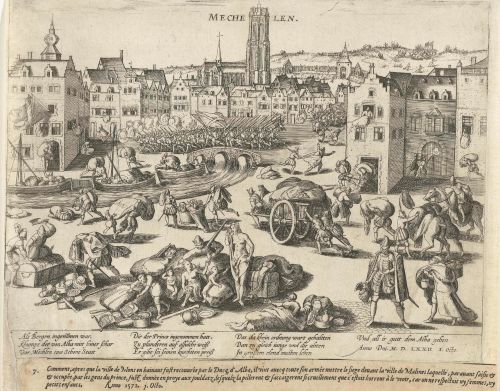
Outside official publication, the same event acquired a visual form that could unsettle the intended lesson. Frans Hogenberg’s Cologne workshop produced an etching of the sack, dated by the Rijksmuseum to 1572–1574, that organized the scene around the movement of armed men and the exposure of inhabitants. Retreating rebel troops appear in the distance, while royal soldiers enter the built-up town and carry away possessions. At the front, a naked, weeping woman stands with children, bringing the viewer’s attention to vulnerability rather than to the charges used to authorize punishment. Voges interprets her position beneath the cathedral and the city’s name as a personification of violated Mechelen. That interpretation explains how a recognizable urban setting could turn an episode into a broader accusation about military power. The German caption places the sack within the campaign following Mons and attributes permission to plunder to Alba, connecting the commander’s decision with the suffering depicted. This was a composed representation, whose arrangement and emblematic figures cannot be treated as independent testimony to every incident shown. Its political force lay in making the royal army’s arrival appear dangerous to the people inside an urban community. The threatened audience could consequently draw a conclusion different from the governor’s intended demand for submission. An image presenting possession-taking as the destruction of civic security could support the belief that keeping soldiers outside was necessary for survival. Neither the surviving impression nor its modern interpretation proves that a specific council adopted that conclusion. What the print establishes is the availability of a competing account through which viewers could understand the warning.
News could also produce defensive action within a town rather than agreement with the advancing government. Van Haecht reported that inhabitants of Dordrecht, having heard of Mechelen’s sack, blamed priests and monks and expelled them from their religious houses and the city to avert a comparable fate. He condemned this response as Calvinist retaliation, so his explanation must be read as a judgment shaped by his own religious commitments. It nevertheless records a claimed relationship between the transmission of atrocity news and action directed against supposed internal enemies. In this telling, the prospect of another sack became an argument for tightening control over the town’s confessional composition. A loyalist critic reached a different objection to the strategy. Writing on November 8, Morillon argued that rebellious towns might negotiate with someone they trusted, that they would not trust Alba, and that greater leniency at Mechelen could have helped recover the maritime towns. His confident prediction expressed a proposed alternative policy, rather than knowledge of how every municipality would have responded. These reports disclose the problem facing exemplary violence. Fear of the royal army could encourage accommodation where resistance appeared hopeless, yet elsewhere it could deepen suspicion or make the governor’s assurances less persuasive.
The announcement formed part of a contest over what Mechelen’s experience foretold for other communities. Official print attempted to turn a completed act of coercion into advance notice of the consequences of continued defiance. Chronicles, private letters, and a pictorial account exposed readings that the command could not dictate. The immediate military gains show that intimidation could assist reconquest, while the evidence of reception prevents treating fear as a uniform route to obedience. Alba could arrange the punishment and authorize its explanation; the meaning other cities assigned to that example remained dependent on their circumstances and their confidence in royal government.
Did Exemplary Violence Work? Submission and Its Limits

Amersfoort’s submission offers a concrete measure of what Alba’s campaign could achieve. Before Fadrique’s army arrived on November 27, representatives approached with the town’s keys, seeking admission to royal mercy. According to the army’s subsequent account, they escaped the sack threatened against places that defended themselves, although judgment on their involvement in rebellion remained Philip II’s prerogative. The commander obtained entry without conducting a siege, while inhabitants secured an immediate protection that mattered more urgently than the eventual disposition of their case. Here, intimidation helped produce a practical bargain. Compliance preserved the town from plunder, and the advancing army could continue its operations.
Across Guelders and Overijssel, the recovery of territory after Zutphen’s capture in mid-November appeared to vindicate this approach on a larger scale. An anonymous campaign narrative written in December claimed that delegations from Kampen, Zwolle, Harderwijk, and other towns followed swiftly, while William van den Bergh withdrew from the region. Its triumphant presentation connected the fall of a strategically important stronghold with the rapid restoration of obedience, but the sequence also involved the disappearance of rebel military protection. Zaltbommel’s continued resistance qualifies the report’s sweeping assertion that rebellion had been extinguished throughout the eastern provinces. Archival research on Guelders identifies numerous magistrates who had remained attached to the king and communities that had accepted rebel forces under pressure. Their return to royal government could involve the recovery of an earlier allegiance as well as submission to superior force. Johan Visser’s reassessment of Zutphen further cautions against treating later descriptions of indiscriminate slaughter as straightforward evidence of what the army accomplished there. Pillage and the killing of captured soldiers were sufficiently alarming without importing every subsequent atrocity story into an explanation of municipal decisions. These qualifications leave an appreciable military gain. Several towns returned to royal control without lengthy sieges. They also narrow the claim that can be made for Mechelen’s example, since the relative contributions of remembered punishment, collapsing rebel organization, and continuing loyalty cannot be separately measured from these outcomes.
Naarden exposed a weakness in the connection between threatened destruction and an incentive to capitulate. The killing of inhabitants and destruction of the town in early December followed negotiations, making the consequences of admitting royal troops an urgent concern elsewhere. Maximilien Morillon, writing to Granvelle on December 9, judged that such conduct would give other towns little inclination to surrender. His criticism came from within the Catholic, royalist political world and addressed the usefulness of the operation for recovering cities. Yet the same letter wrongly reported that Haarlem and Leiden had already submitted, a reminder that contemporaries evaluated military policy through incomplete and sometimes misleading news. Morillon’s warning establishes a serious objection among royal supporters; the reactions of some communities require closer examination of their deliberations.
In Haarlem, the possibility of agreement remained open long enough to reveal how difficult that deliberation could become. Willem Janszoon Verwer’s diary records a royal letter of December 2 offering mercy with life and property preserved if the city surrendered. The council considered its response, and negotiations followed, so the approach of the army did encourage efforts to secure an accommodation. Morillon’s December 16 letter supplies a different perspective on the terms under discussion. According to information he attributed to Viglius, Fadrique demanded submission at his discretion, and inhabitants told their negotiating burgomasters that they would not accept the risk of Naarden’s treatment. Read together, these accounts establish that protective assurances existed while the conditions and reliability of submission remained contested. Verwer also describes an intervention by the military governor, Wigbolt Ripperda, who gathered militia members and citizens as the council debated its course. Ripperda obtained an arrangement dividing custody of the gate and sluice keys between himself and the burgomasters, making any decision to admit troops dependent on cooperation between civic and military authorities. Meanwhile, the burgomaster Jan van Vliet encouraged defense by promising access to grain, gunpowder, and artillery, and messages sought assistance from Orange and nearby forces. Such undertakings gave resistance a material prospect that declarations of courage alone could not provide. Haarlem’s conduct consequently emerged from disagreement over security, an altered distribution of authority inside the walls, and expectations of outside support. The fear generated by the autumn’s violence entered these decisions, but its influence depended on who could negotiate, who controlled access, and whether continued defense appeared feasible.
The campaign’s physical setting imposed further demands on royal command. Its own December report described the difficulties of advancing through Holland as severe, recording thawing ice, inundated approaches, narrow dikes, and uncertainty about transporting artillery and provisions. These observations came from the advancing force and disclose the constraints concealed by a simple narrative of cities frightened into obedience. Haarlem’s waterways and connections with surrounding districts helped sustain its defense, while a failed royal assault in December demonstrated that possession of a formidable army did not guarantee rapid entry. Geoffrey Parker’s analysis of the revolt emphasizes the strategic cost of such prolonged operations: time spent before one fortress allowed resistance to continue elsewhere. The siege nevertheless ended in a royal victory in July 1573, and that outcome deserves its full weight in assessing Alba’s methods. Between the initial approach and capitulation, the besiegers had to restrict supply, overcome relief efforts, and establish the isolation that intimidation had failed to secure. A royal naval victory on the Haarlem lake in May helped close the provisioning routes that had prolonged the struggle. The approximately seven months required to take the city measure a substantial limitation on the promise that exemplary punishment would spare the monarchy repeated and expensive campaigns.
For Mechelen, these results support a bounded interpretation of the sack’s political effectiveness. Its destruction contributed to the threatening circumstances in which other communities made decisions, and the monarchy recovered places that lacked adequate protection or could obtain acceptable treatment. Haarlem shows how uncertain assurances and viable defenses could keep negotiation from producing entry, even when the city eventually succumbed to military pressure. A town’s capitulation answers only part of the question. The further tests were how much force royal command had to expend, whether promises retained credibility, and whether recovered subjects could be governed through dependable cooperation.
Governing the Survivors
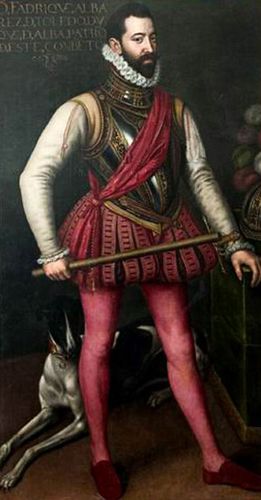
On November 30, 1572, Morillon described a four-day visit to Mechelen that had revealed continuing demands on its inhabitants. Captain Erasso was taking provisions under a written authorization from Fadrique, signed by the commander and his secretary, rather than relying solely on the opportunities created during the initial occupation. The duke of Aarschot had instructed Mechelen’s governor to prevent the captain from extending his operations outside the city until Alba gave further orders. This limited intervention shows how urgently survivors needed protection from military agents whose commissions still carried governmental authority; further losses remained a problem requiring action within the royal administration.
The removal of grain threatened the means by which the urban population could feed itself. Already on October 31, Morillon reported that bakers could not bake and brewers could not brew because their supplies had been taken. Antwerp had responded with several shipments of bread and cheese, assistance directed toward a failure of ordinary provisioning as well as immediate household hunger. Repeated demands also made payments intended to preserve possessions unreliable. Morillon found that Erasso refused receipts and demanded further money for goods already ransomed. In one case, a church cellar remained vulnerable because payment arranged during the sack had been completed on a day the commander regarded as too late. Such practices made it difficult to establish what an inhabitant had paid, what protection had been purchased, and whether any remaining resources could safely be committed to resuming work. Van Haecht recorded another impediment on October 24, when an Antwerp proclamation directed people owing rents or other money to Mechelen residents to pay the court at Brussels instead, under a penalty of double payment. His account does not establish how those funds were subsequently allocated, but it demonstrates royal intervention in income streams that could otherwise have helped households recover. Restoring commercial activity required a settlement of obligations that residents could rely upon alongside the replacement of goods.
Charitable assistance supplied resources that the injured community could no longer furnish for itself. Morillon’s November 1 letter credited the Antwerp Jesuit Pierre Trigose and his associates with assembling a fund of 10,000 florins to purchase looted possessions from soldiers. Recognized goods were then returned to their owners at the price paid for them, an arrangement that reduced the difficulties of locating property but still required its reacquisition through payment. Other inhabitants of Antwerp helped provision Mechelen, with Frédéric Perrenot de Champagney lending support. These initiatives reveal substantial cooperation across municipal boundaries, undertaken through personal connections and ecclesiastical institutions. They addressed different needs. Food could sustain people who had lost everything, whereas repurchasing possessions could help households recover the materials of daily life. The evidence consequently supports an account of uneven assistance, whose practical effects depended on what could be supplied and what a recipient could recover. It also complicates any assumption that the city’s treatment had made its inhabitants unacceptable objects of sympathy throughout the royalist Netherlands. People could help the sufferers without publicly repudiating Philip’s sovereignty, and Catholic intercession provided an established language in which to undertake that work. Nevertheless, the need persisted. At the end of December, Morillon reported that more than five hundred people from Mechelen were begging. His estimate is evidence of continuing distress rather than a census of displacement, but it makes clear that the recorded generosity had not brought destitution to an end.
Permission to resume residence became a central demand of families dispersed outside the walls. An undated petition preserved among the government papers, and printed with Morillon’s November correspondence, asked that Catholic fugitives be allowed to return to their houses and earn the support of their wives and children. Its argument concentrated on the consequences of exclusion. Possessions were being sold cheaply, relatives were begging, and people formerly able to maintain households had become dependent on strangers. The petitioners represented guild members who had accepted the rebel oath as having acted under compulsion or misleading assurances, making their narrative of innocence part of the effort to obtain a livelihood. Those explanations served the applicants’ interests and cannot establish the conduct of every person for whom they sought relief. Their requested remedy is more securely identifiable: authorized residence and the opportunity to work. The Council of State’s accompanying advice proposed that fugitives who had neither joined rebel forces nor participated in rebellion, and who were not heretics, might return provisionally after presenting themselves for registration before the governor and the officials administering justice. It also suggested considering a wider pardon, with exclusions for principal organizers and religious offenders, because Mechelen would otherwise struggle to recover its population and meet royal charges. Return would bring households back under supervision, while enabling the monarchy to regain their labor and contributions. Violet Soen’s research on royal pardons emphasizes that acts of grace reaffirmed the sovereign’s authority, placing the terms of renewed acceptance within his discretion. At Mechelen, the petition and advice reveal a possible accommodation under discussion, without establishing that the proposed permission was granted. The distinction matters because families awaiting a decision could experience administrative uncertainty as an additional obstacle to rebuilding their lives.
Members of the Great Council possessed a direct means of presenting their losses to the sovereign, yet access did not guarantee a response. On April 11, 1573, they wrote to Philip requesting compensation and explaining that two previous petitions to Alba had gone unanswered. They had considered sending one of their number to the king, but fear that he would disapprove the deputation led them to submit their account in writing. Their appeal emphasized steadfast royal service during the rebel occupation, the damage suffered by the king’s own judicial establishment, and the inadequacy of their salaries and fees amid high living costs. It sought to make assistance compatible with continued service by showing that loyal officers lacked the resources necessary to sustain themselves. This was a claim advanced by a corporate body with recognized standing, and its survival cannot tell us how effectively less connected inhabitants could pursue comparable requests. Yet even these officials had to explain their obedience while seeking recognition of injuries inflicted by royal soldiers.
Under Luis de Requesens, who succeeded Alba in 1573, formal routes to recovery broadened. Johan Dambruyne’s study of Mechelen’s guild archives identifies the restoration of guild rights in 1574, reversing an important part of the institutional penalty imposed after the rebel occupation. Requesens’s general pardon of the same year also allowed qualifying fugitives who had remained Catholic abroad to recover confiscated property, a provision examined by Violet Soen and Yves Junot in their research on returnees. Those measures restored legal capacities and assets, leaving claims concerning plunder to be addressed separately. Judicial business meanwhile exposed the persistence of obligations extracted during the sack. The Great Council’s memorial records summarize an instruction from Requesens, dated December 29, 1573, requiring prompt justice for Spanish soldiers seeking payment of ransoms and compositions associated with the plunder of Mechelen. On January 4, 1574, the council prohibited soldiers from molesting two lawyers, Huysmans and Pipre, from whom they were demanding ransom payments. These entries establish an instruction to hear claims and an order restraining harassment; they do not establish that the soldiers won their cases or that the alleged debts were judicially confirmed. Their significance lies in the coexistence of protection and adjudication. Threatened inhabitants could seek an official barrier against private coercion while still confronting demands arising from their earlier captivity. Renewed civil administration offered remedies whose scope remained sharply differentiated. A guild might regain its recognized rights, and an eligible exile might recover confiscated assets, while a survivor of military extortion continued to contest what a soldier claimed was owed.
Recovery at Mechelen required decisions about who could return and how remaining resources could support a household. The petitions presented suffering through recognized relationships of allegiance and service, while charitable networks addressed needs that official deliberation had left unresolved. These efforts show inhabitants continuing to use the institutions of the monarchy even after its army had deprived them of security, because those institutions retained powers essential to rebuilding ordinary life. Their predicament concerned the conditions under which royal subjects could regain a viable existence and obtain recognition of loss through an administration that continued to uphold the sovereign’s authority.
Representing the Sack
Accounts of Mechelen’s ordeal made the conduct of royal government available for scrutiny beyond the commander’s own explanation. Yet the surviving materials reach the historian through authors who occupied different positions and wrote for different readers. A narrative entered into a chronicle, information sent to a cardinal, and a commercially published image offered distinct forms of access to the event. Their importance lies both in the evidence they preserve and in the decisions by which reported suffering became grounds for judging those who exercised authority.
Godevaert van Haecht explained his approach unusually clearly in the address to the reader that prefaced his chronicle. He had begun recording what he heard and saw, but subsequently rewrote the material accumulated through 1574, arranging it more carefully and shortening or excluding matters he considered unimportant. The surviving work consequently embodies revision as well as contemporary observation. More strikingly, he acknowledged retaining stories invented by others because the fear and disturbance they generated deserved attention. He hoped that recording such fabrications would make readers slower to accept alarming reports. This distinction gives the chronicle two related historical purposes: documenting occurrences and examining the consequences of circulating information. Applied to Mechelen, it requires identifying which statements concern actions in the city and which register what people elsewhere believed. His ethical judgments likewise demand attention on their own terms. Although he emphasized Mechelen’s Catholic character, he condemned the soldiers’ crimes and anticipated divine punishment for perpetrators who escaped earthly justice. The same sequence criticized Calvinist revenge as a violation of Christian teaching, refusing to make retaliation legitimate merely because it answered an earlier wrong. Van Haecht’s account supplied a moral assessment of conduct across the conflict while preserving information gathered through the circumstances of life in Antwerp.
Morillon’s letters reveal the successive steps by which news acquired greater specificity. On November 1, he mentioned speaking at Arras with Mademoiselle Blasere, who described her husband’s mistreatment, and announced his intention to investigate how the religious women of Mechelen had been treated. The distinction between a conversation already conducted and an inquiry still intended establishes different degrees of knowledge within a single letter. Rosanne Baars’s study of his correspondence shows that assessing uncertain reports and explaining their disturbing effects were regular parts of his service to Granvelle. His descriptions of misery should accordingly be read within a relationship that joined intelligence gathering to ecclesiastical responsibility. Applied to these letters, that context helps explain why he sought details about the treatment of religious communities and why the injuries of faithful Catholics carried such political weight. His anger conveyed a judgment about the government’s failures from an informant committed to preserving the church and the monarchy.
The November 1 letter also demonstrates that an official publication could encounter informed criticism inside the royalist political community. Morillon enclosed a printed explanation of the sack, attributed its preparation to Del Rio, and maintained that a commentary could overturn its argument. His response proceeded through disputed details rather than resting exclusively on indignation. He questioned the treatment of the city’s armed associations, observing that Alba had previously approved arrangements later invoked against the inhabitants. He distinguished those who had taken the oath to Orange from ecclesiastics and members of the Great Council who had not. Most directly, he reported that the bishop of Arras and Hugues de Beaufort were prepared to attest that the publication’s final allegation about the inhabitants’ failure to seek timely mercy was false. Their willingness to subscribe a contrary statement offered the authority of identified participants against that of the printed declaration. Morillon also challenged the implication that firing from the city had endangered Alba personally, placing the duke at Muizen, beyond the range in question. These assertions remain the claims of a critical correspondent, whose sympathies and information require examination; the letter alone cannot resolve every contested incident. Nevertheless, it reveals a precise struggle over which facts would establish culpability and whose testimony could authenticate them. The king’s cause did not impose agreement among his servants about the accuracy of a text issued in defense of his commander. Morillon’s objections sought to expose failures of royal government through the knowledge and standing of people who continued to serve it.
An equally revealing qualification appears at the end of the anonymous Discours du pillage de Malines. Its opening blamed rebel exiles for cultivating the connections that brought Mechelen into the conflict, while its account of the consequences sharply condemned the treatment of the inhabitants. By the closing pages, the author insisted that even this extensive description scarcely encompassed their injuries and acknowledged uncertainty about what further measures Alba would impose. The narrative reaches into December 1572, making the date in its title the date of the sack rather than a secure date of composition. The work presents opposition to rebellion as compatible with a sustained indictment of the treatment inflicted by royal troops.
Frans Hogenberg’s etching created a different experience of knowing the event by giving its purchaser an encompassing view unavailable to any observer standing in the streets. The elevated perspective gathers the bridge, waterways, house fronts, and movement of soldiers into one field. Goods emerge from buildings, boats receive burdens, and loaded carts and animals occupy the foreground. These details connect intrusion into dwellings with the organized removal of possessions, making the consequences of military occupation intelligible through successive actions. Ramon Voges reads the separated zones of the composition as a temporal narrative. Departing rebels appear in the distance, the royal army advances through the built environment, and dispossession confronts the viewer at close range. Recognizable architecture, especially the cathedral tower, lends local specificity to this constructed account. The accompanying German verses assign the decision to Alba, describe the absence of order, and associate the misery of young and old with the surrender of their goods. Image and caption invite a judgment about commanded violence whose consequences exceeded any reassuring conception of regulated punishment. The print supplies evidence for that invitation, although its panoramic arrangement cannot verify the location or sequence of each encounter it depicts. The Rijksmuseum dates the surviving impression to 1572–1574, a useful reminder that a representation of a certain day need not have been produced on that day.
Transmission could preserve an accusation while altering the form in which readers encountered it. Bram Caers’s examination of manuscript cityscapes now held by the Royal Library of Belgium identifies Hogenberg’s German verses copied onto a parchment depiction of the 1572 sack. Their order was rearranged, apparently through a copying mistake, while the same object incorporates Latin lines also found in a seventeenth-century printed history of the Revolt. The manuscript assembled material with connections to different printed works. Such borrowing makes apparent agreement among surviving objects an uncertain measure of independent testimony. Repetition may demonstrate the movement of an account rather than separate confirmation of its details. Caers also cautions that missing evidence about production and early ownership restricts attempts to identify the makers’ political loyalties or reconstruct reception. The surviving cityscape establishes the reuse of language condemning Alba’s action, but it cannot by itself reveal whether its first owner sought to defend municipal honor, endorse rebellion, or preserve an account of local calamity.
Political judgment emerged through competing assessments of what the army had done and what could justify its actions. Royalist correspondence is revealing because its objections came from within the relationships that sustained Philip’s government. Alongside it, the printed and manuscript images show how an accusation could acquire recognizable form and be reproduced beyond its first setting. These sources require separate evaluations of factual credibility and intended effect, neither of which can be inferred solely from an author’s allegiance. They preserve contemporary grounds for questioning the destruction of Mechelen without establishing a single political answer to the injuries they described.
Remembering Royal Violence while Claiming Royal Loyalty

Mechelen’s return to royal government in 1585 did not remove the difficulty of accounting for 1572. A formal commemoration of Alba’s punishment would recall both the royal army’s violence and the earlier admission of rebel forces, exposing the city to renewed questions about its allegiance. The subsequent sack of 1580, inflicted by troops serving the revolt, created a further burden of recollection within a settlement that favored putting past divisions aside. David de Boer’s study of the two sacks accordingly places civic memory within the conditions of reconciliation. Recognition of injury had to be negotiated alongside claims about the city’s rightful place in the restored monarchy.
After 1585, restored governing families could draw on earlier episodes of princely service when presenting Mechelen’s identity. The existing civic motto in fide constans, expressing constancy in faith or fidelity, allowed confessional adherence and political allegiance to appear mutually reinforcing. Bram Caers has traced this emphasis in revisions of the city’s Burgundian past. Around 1600, Jan van Wachtendonck, an alderman and mayor under the restored government, reworked an older chronicle’s account of Mechelen’s participation in Charles the Bold’s siege of Neuss in 1474–1475. His version magnified civic military distinction and presented the duke’s authority more favorably, softening the earlier narrative’s objections to heavy fiscal demands. Read in its later political setting, this reshaping of history asserted that service to a prince was a defining urban tradition. It supplied officeholders with an account of civic honor emphasizing Mechelen’s participation in princely enterprises. Commemoration of the monarch himself made continued allegiance even more explicit. Jan Ghuens the Younger prepared decorations for Philip II’s funeral service in Mechelen’s metropolitan church, a commission recorded in the municipal accounts for 1598–1599; he painted the arms and epitaph and gilded the helmet, sword, and crown. The same city that had endured the king’s punitive campaign supported a ceremony honoring his royal dignity.
Handwritten histories nevertheless retained judgments that complicated this account of loyal continuity. Gerardus Bernaerts, a chaplain of the Sint-Jans church who had himself been struck by Spanish soldiers in 1572, preserved a lamenting chronogram, a verse encoding the event’s date, on his chronicle’s title page and on a separate slip inserted into the manuscript. That placement gave the catastrophe an enduring presence in his written record of the city. Wachtendonck, who had opposed Protestant forces in 1579 and subsequently served in the royalist council, complained that Alba’s excessively harsh commands and recourse to capital punishment had helped make the population rebellious; he also described the approach to Mechelen’s plundering with indignation. Such criticism came from men with demonstrable Catholic commitments. Their writings preserved grounds for condemning royal government’s conduct while their authors remained associated with its religious and political order.
The municipal commission of Ghuens’s painting of the relief of Lier gives a more tangible indication of which wartime memories received official prominence. In 1595, militias from Mechelen and Antwerp had helped recover Lier after a surprise attack by troops of the States General; the following year, Mechelen’s council paid for a representation of this success for the town hall. Ghuens placed the assembled militiamen prominently in the foreground, beneath an expansive view of the fortified city and the military action around it. The elevated viewpoint makes Lier’s encircling defenses and approaches legible, while the militia occupies the space nearest the viewer. This arrangement invites attention to the participants as a group worthy of recognition and connects their portraits with the achievement depicted above. Several of those commemorated also belonged to Mechelen’s municipal government, so honoring the militia simultaneously honored men involved in selecting the city’s public history. Marianne Eekhout interprets the picture as a counterweight to the politically awkward recollections of Mechelen’s own sacks. That interpretation rests on the event selected, the institutional setting, and the overlap between patrons and protagonists; the recorded commission does not establish an express instruction to erase memories of 1572. The image offered a favorable account of urban agency, making Mechelen’s citizens visible as defenders of another community under royal rule. Whereas an account of Alba’s sack had to confront the city’s exposure to punishment, this representation could associate its inhabitants with protection and successful military service. This was also a claim about the fitness of the men governing Mechelen. Their leadership was attached to an identifiable act of assistance. The painting’s institutional location carried that claim into the setting where civic business was conducted, making remembered service part of the surroundings of present government.
Religious reconstruction provided another means of giving civic loss a recognized place, especially through memories of the destruction accompanying the Protestant attack in 1580. The eighteenth-century account used by David de Boer credits Anna van Roy, a Beguine, with rescuing the skull of Mechelen’s patron saint, Rumbold, from the cathedral and preserving it during the Calvinist regime. After the reconciliation of 1585, she returned the relic, and the secular authorities rewarded her and others who had safeguarded sacred remains. The bones were reunited in 1586, and an annual procession subsequently commemorated their restoration as a victory over heresy. These observances connected endangered objects with the survival of Catholic worship and gave acts of preservation a place in the city’s religious history. The episode concerns 1580 and its aftermath, but it helps explain the commemorative context in which memories of 1572 survived. Protecting relics could be honored as service to the restored community, whereas acknowledgment of injuries inflicted by royal soldiers raised questions about the conduct of the authority to which that community had returned.
Access to these forms of remembrance was uneven. Council chambers and guild rooms principally addressed restricted, often elite audiences, and a surviving chronicle provides firmer evidence of its writer’s judgment than of the opinions of every household. Mechelen’s inhabitants cannot be assigned a single response to 1572 from the works produced by municipal leaders and clergy. Yet the conjunction of indignant Catholic manuscripts, commemorations of loyal service, and ceremonies honoring Philip II demonstrates that allegiance could coexist with condemnation of royal violence. The continuing difficulty concerned the terms on which that condemnation could become part of the city’s publicly authorized account of itself.
Does “Terror as Government” Impose Too Much Coherence?
The following video from “History Mapped Out” covers the Eighty Years’ War:
The most serious challenge to interpreting Mechelen through “terror as government” concerns the coherence that this phrase can lend to violence produced by participants pursuing different ends. A commander’s declaration that a city must serve as an example establishes a claimed purpose, but cannot explain every assault committed there or every subsequent decision elsewhere. Moving too easily from royal authority to military conduct can obscure disagreements within government and give soldiers less agency than the evidence warrants. The issue is how much unity can be demonstrated behind the violence, rather than how forcefully its severity can be characterized.
Philip II’s response to Mechelen supplies a substantial qualification. In his letter to Alba of October 19, 1572, as summarized in Louis-Prosper Gachard’s edition with selected Spanish passages, the king accepted that the inhabitants had deserved punishment but wished that punishment had taken a form other than the sack. He also expressly prohibited the pillaging of Leuven, and Gachard identifies both qualifications as additions in the king’s own hand. These comments combined acceptance of chastisement with reservations about the means employed, demonstrating that decisions about punishment could differ between towns. They cannot support an account in which Philip and Alba shared an identical intention concerning Mechelen’s destruction. Nor does the correspondence examined here establish a prior royal instruction to sack the city. Alba’s authorization and Philip’s subsequent judgment belong to different stages of the episode. This distinction changes the allocation of responsibility within the monarchy. Alba exercised delegated authority to make an immediate punitive decision, while the king assessed an accomplished operation and imposed a restriction on another possible target. Philip’s reservation nevertheless accompanied continued acceptance of the city’s guilt; it offered no repudiation of the principle that inhabitants could be punished for their community’s political conduct. The exchange reveals a government capable of disagreeing over the permissible form of coercion after subjects had already suffered its consequences.
Reconciliation was also an active policy before the sack. Violet Soen’s research establishes that Alba proclaimed the general pardon on July 16, 1570, and renewed it on May 23, 1572, several months before Mechelen was plundered. Her work on the earlier negotiations shows that advisers recognized the practical impossibility of prosecuting everyone implicated in the troubles and regarded conditional forgiveness as necessary to restoring order. Bishops’ reports of reconciliations also indicate that the measure acquired practical significance for some inhabitants, although its reception and administrative recognition were uneven. The existence of pardon does not itself demonstrate governmental incoherence, since punishment and mercy could both affirm the sovereign’s authority. The same administration that permitted Mechelen’s devastation also offered eligible subjects immunity from prosecution on prescribed terms. Disputes over when pardon should be announced and who should qualify show that the choice of remedies remained contested even among officials seeking broadly similar ends. Mechelen’s treatment must be situated within a government that possessed alternatives, some already promulgated, while differing over their usefulness and application.
Conditions within the army further complicate the relationship between a punitive decision and its execution. Raymond Fagel’s study of Spanish commanders during the revolt’s first decade identifies divergent interests between officers and common soldiers, alongside friction among commanders and between military officers and loyal Netherlandish nobles. These findings describe the wider organization of royal service; their relevance to Mechelen lies in challenging the assumption that a hierarchy necessarily expressed a single political will. Geoffrey Parker’s analysis of the war likewise shows how expensive operations and failures of payment constrained military action, sometimes producing prolonged interruptions through disobedience and mutiny. Mechelen’s permitted plunder belongs within that military economy, although its authorization distinguishes it from a sack initiated by troops rebelling against their commanders. Once soldiers were allowed to appropriate inhabitants’ property, their pursuit of gain could generate conduct that exceeded the commander’s stated goal. We should resist assigning an individual act of extortion the same demonstrable intention as Alba’s decision to admit the army. Yet this distinction cannot reduce the sack to an accident subsequently supplied with an official explanation. Alba described Mechelen as a necessary warning to other towns in his letter of October 2, while the troops were still inside the city, and connected that warning with avoiding repeated military expeditions. The exemplary rationale was contemporary with the violence, although the account also justified Alba’s own decisions before the king. Its claim to political usefulness remains separate from proof of effectiveness. Subsequent submissions occurred amid rebel withdrawal and changing military prospects, while fear could also undermine confidence in surrender. The evidence supports a deliberate attempt to influence other communities more securely than it supports either detailed control of the sack or predictable control of its consequences.
This requires a narrower understanding of my governing argument. Mechelen does not establish that the Habsburg monarchy operated through a uniformly coordinated system of terror, or that its officers could calculate the political effects of destruction with reliable precision. It does establish that Alba deliberately exposed a city to punitive plunder and understood that action as a means of securing obedience beyond its walls. Material pressures and disagreements within royal service explain important features of the episode, while making the decision to permit violence more consequential because its execution depended on actors with interests of their own. The strongest interpretation concerns the exercise of authority through that permission, including the foreseeable dangers it created, rather than an assumption that every injury formed part of a common design.
Conclusion: What Royal Obedience Could Cost
Mechelen’s experience in October 1572 exposed a condition of Habsburg rule that civic privilege and a record of princely service could not remove. The crown’s forces could be used against the people they were supposed to defend. Once the city’s admission of rebel troops was treated as an offense belonging to the whole community, distinctions among willing collaborators, reluctant participants, and opponents offered uncertain protection. An inhabitant could remain Catholic and loyal to Philip II while being exposed to punishment imposed in his name. The departure of the rebel garrison and the approach of supplicants did not by themselves bring safety. The crucial question became who possessed the authority to decide whether a return to obedience was sufficient.
Alba’s intended saving in military effort depended on losses borne elsewhere. He proposed that Mechelen’s treatment should persuade other towns to submit before the army had to approach each of them, making the inhabitants’ exposure serve a purpose extending beyond the recovery of their own city. That calculation connected the governor’s judgment of rebellion to the conduct of soldiers who had their own reasons to seize goods, demand ransom, and exploit permission to plunder. Financial strain and the organization of military service help explain why such permission mattered, while the varying interests of commanders and troops explain why its consequences were difficult to regulate. Responsibility consequently attached at different levels: to the commander who authorized the punishment, to officers who implemented or attempted to contain it, and to soldiers who committed specific acts. Philip’s acceptance of the need for punishment, qualified by his objection to the sack, further reveals a monarchy within which agreement on authority could coexist with disagreement over its exercise. These differences make the decision more historically intelligible without making civilian losses incidental to it. Whatever submission the example encouraged elsewhere, that achievement supplied no measure of whether the suffering inflicted in Mechelen was proportionate, whether loyal residents had been protected, or whether the monarchy had preserved the conditions for dependable government there. Military advantage, judicial legitimacy, and the security of subjects were separate questions. The documents show contemporaries confronting those questions within royal government itself, where criticism could proceed from commitment to the sovereign’s interests as well as concern for the injured.
Recovery brought an additional demand upon those who had already lost property, income, or access to a secure home; they had to make their circumstances persuasive to officials. The petitions and interventions discussed above show claimants drawing on service to the king, Catholic commitments, the requirements of subsistence, and the practical value of restoring economic activity. For these petitioners, describing deprivation also meant explaining why royal government should take responsibility for addressing it. Appeals could mobilize protectors and obtain attention, although a request, a protective instruction, and a completed settlement remain different kinds of evidence. Reestablishing civic institutions similarly supplied the means to govern a damaged population without establishing how fully individual households recovered. The surviving record gives recognition a precise historical meaning. Suffering entered administrative consideration through argument, mediation, and negotiation, with results that cannot be inferred simply from the city’s continued existence or its eventual return to royal allegiance.
Later expressions of civic loyalty extended this work of accommodation into the choice of what a community could say about its past. Public celebration of princely service helped Mechelen’s governing elites establish an honorable place within the reconciled Netherlands, while Catholic writers could preserve severe judgments of the troops and authorities responsible for earlier suffering. Their coexistence suggests that allegiance could involve active criticism and selective remembrance, even when publicly recalling 1572 risked reviving the accusation that the city had helped the rebels. Neither official commemoration nor surviving manuscripts can stand for the views of every resident, and neither establishes that confidence in royal protection had been restored. They do reveal how the consequences of punishment continued after its military purpose had passed, shaping the evidence through which later inhabitants explained who they were and what they were owed. Across these different settings, obedience required inhabitants to live with judgments made about the city as a whole, seek remedies from institutions connected to the power that had injured them, and maintain a usable claim to loyalty. The sack altered the relationship between service and security on which their petitions and civic traditions depended. Its lasting significance lies in the demand it placed upon subjects to persuade royal government that their suffering deserved attention while continuing to recognize the authority exercised over them.
Bibliography
Affiliate disclosure: Amazon links on this site are paid links. As an Amazon Associate I earn from qualifying purchases.
- Alba, Fernando Álvarez de Toledo, duke of. Letter to Philip II, camp near Mechelen, October 2, 1572. In Correspondance de Philippe II sur les affaires des Pays-Bas, edited by Louis-Prosper Gachard, 2:282–84. Brussels: C. Muquardt, 1851.
- Anonymous. “Discours du pillage de Malines, fait le 2e 8bre 1572.” In Mengelingen van historisch-vaderlandschen inhoud, edited by Jan Frans Willems, 393–419. Antwerp: Wed. J. S. Schoesetters, 1827–1830.
- Arnade, Peter. Beggars, Iconoclasts, and Civic Patriots: The Political Culture of the Dutch Revolt. Ithaca, NY: Cornell University Press, 2008.
- —-. “The City Defeated and Defended: Civism as Political Identity in the Habsburg-Burgundian Netherlands.” In Networks, Regions and Nations: Shaping Identities in the Low Countries, 1300–1650, edited by Robert Stein and Judith Pollmann, 195–216. Leiden: Brill, 2010.
- Ayala, Balthazar. Three Books on the Law of War and on the Duties Connected with War and on Military Discipline. Translated by John Pawley Bate. Edited by John Westlake. New York: Wildy & Son Ltd., 1964.
- Baars, Rosanne M. “‘The Very Wound of This Ill News’: Maximilien Morillon and the Impact of Bad News during the Early Years of the Dutch Revolt, 1566–74.” Renaissance Studies 37:4 (2023), 498–516.
- Baudartius, Willem. Afbeeldinge ende beschryvinghe van alle de veldslagen, belegeringen ende and’re notabele geschiedenissen ghevallen in de Nederlanden. Amsterdam: Michiel Colijn, 1616.
- Bertin. “Bertin à Plantin, 5 octobre 1572.” In Correspondance de Christophe Plantin, edited by Max Rooses, 3:183. Antwerp: De Nederlandsche Boekhandel; The Hague: Martinus Nijhoff, 1883.
- Buylaert, Frederik. “From Periphery to Centre and Back Again: Elite Transformations in Mechelen (Fourteenth to Sixteenth Centuries).” Urban History 47:4 (2020), 610–631.
- Caers, Bram. “‘In fide constans’? Politiek van herinnering in het Mechelse stadsbestuur.” De Zeventiende Eeuw 29:2 (2013), 228–246.
- —-. “Spaensche bloet-honden overvallen de Nederlanden: Een handschrift met subversieve teksten uit de Zuidelijke Nederlanden imagologisch bekeken.” Neerlandica Wratislaviensia 29 (2019), 17–30.
- —-. “Three ‘Forgotten’ Cityscapes of Mechelen in the Late Sixteenth Century: The Spanish and English Furies in Mechelen (1572, 1580) through the Eyes of Contemporaries.” In Monte Artium 10 (2017), 65–81.
- Calbi, Cintio. “Relación de Cintio Calbi que envió desde Mastrique, a 16 de octubre de 1572.” In Colección de documentos inéditos para la historia de España, edited by the Marqués de la Fuensanta del Valle, José Sancho del Rayón, and Francisco de Zabalburu, 75:110–14. Madrid: Imprenta de Miguel Ginesta, 1880.
- Dambruyne, Johan. Verzamelinventaris van de nog niet geherinventariseerde archieven van de Mechelse ambachten (tweede helft 13de eeuw–einde 18de eeuw). Studia et Documenta Mechliniensia 9. Mechelen: Koninklijke Kring voor Oudheidkunde, Letteren en Kunst van Mechelen, 2006.
- De Boer, David. “Between Remembrance and Oblivion: Negotiating Civic Identity after the Sacks of Mechelen (1572, 1580).” The Sixteenth Century Journal 51:4 (2020), 963–981.
- —-. “Picking up the Pieces: Catholic Material Culture and Iconoclasm in the Low Countries.” BMGN—Low Countries Historical Review 131:1 (2016), 59–80.
- de Schepper, Hugo. “De grote raad van Mechelen, hoogste rechtscollege in de Nederlanden?” Bijdragen en Mededelingen betreffende de Geschiedenis der Nederlanden 93:3 (1978), 389–411.
- Declaration des justes causes du saccaigement de la ville de Malines. [Antwerp: Christophe Plantin], 1572.
- “Discours du pillage de Malines, fait le 2e 8bre 1572.” In Mengelingen van historisch-vaderlandschen inhoud, edited by Jan Frans Willems, 393–422. Antwerp: Wed. J. S. Schoesetters, 1827–1830.
- Eekhout, Marianne. “Furies in beeld. Herinneringen aan gewelddadige innames van steden tijdens de Nederlandse Opstand op zeventiende-eeuwse schilderijen.” De Zeventiende Eeuw 30:2 (2014), 243–266.
- Eichberger, Dagmar. “A Noble Residence for a Female Regent: Margaret of Austria and the ‘Court of Savoy’ in Mechelen.” In Architecture and the Politics of Gender in Early Modern Europe, edited by Helen Hills, 25–46. Aldershot: Ashgate, 2003.
- Fagel, Raymond. Protagonists of War: Spanish Army Commanders and the Revolt in the Low Countries. Leuven: Leuven University Press, 2021.
- Fedele, Dante. “Grotius and Late Medieval Ius Commune on Rebellion and Civil War.” Grotiana 41:2 (2020), 371–389.
- Gachard, Louis-Prosper, ed. Correspondance de Philippe II sur les affaires des Pays-Bas. Vol. 2. Brussels: C. Muquardt, 1851.
- Gaillard, Arthur. Inventaire des mémoriaux du Grand Conseil de Malines. Vol. 1, XIVe, XVe et XVIe siècles. Brussels: P. Weissenbruch, 1900. Entries 804–805.
- González de León, Fernando. The Road to Rocroi: Class, Culture, and Command in the Spanish Army of Flanders, 1567–1659. Leiden: Brill, 2009.
- Great Council of Mechelen. Letter to Philip II, April 11, 1573. In Correspondance de Philippe II sur les affaires des Pays-Bas, edited by Louis-Prosper Gachard, 2:329–31. Brussels: C. Muquardt, 1851.
- Gubbels, Maarten. “Dossier 1572—Oorlog in het oosten. Deel II.” Historici.nl, September 20, 2022.
- Guicciardini, Lodovico. Descrizione dei Paesi Bassi. Edited by Monia Carnevali and Marco Rossi. Rome: UniversItalia, 1848. Originally published in 1567.
- Haecht, Godevaert van. De kroniek van Godevaert van Haecht over de troebelen van 1565 tot 1574 te Antwerpen en elders. Edited by Rob van Roosbroeck. 2 vols. Antwerp: De Sikkel, 1929–1930.
- Hénin-Liétard, Maximilien de, Count of Boussu. Letter to the Duke of Alba, October 11, 1572. In Correspondance du cardinal de Granvelle, edited by Charles Piot, 4:507–8. Brussels: F. Hayez, 1877.
- Hogenberg, Frans. Plundering van Mechelen, 1572. Cologne, 1572–1574. Etching. Rijksmuseum, Amsterdam, RP-P-OB-78.784-115.
- Janssens, Gustaaf. “Brabant in verzet tegen Alva’s tiende en twintigste penning.” Bijdragen en Mededelingen betreffende de Geschiedenis der Nederlanden 89:1 (1974), 16–31.
- —-. “‘Superexcellat autem misericordia iudicium’: The Homily of François Richardot on the Occasion of the Solemn Announcement of the General Pardon in the Netherlands (Antwerp, 16 July 1570).” In Public Opinion and Changing Identities in the Early Modern Netherlands: Essays in Honour of Alastair Duke, edited by Judith Pollmann and Andrew Spicer, 107–123. Leiden: Brill, 2007.
- Kossmann, E. H., and A. F. Mellink, eds. Texts Concerning the Revolt of the Netherlands. Cambridge: Cambridge University Press, 1974.
- “Lo sucedido desde el saco de Malinas hasta que se asedió á Harlem.” December 14, 1572. In Colección de documentos inéditos para la historia de España, edited by the Marqués de la Fuensanta del Valle, José Sancho Rayón, and Francisco de Zabalburu, 75:130–50. Madrid: Imprenta de Miguel Ginesta, 1880.
- Mechelen. Municipal accounts, 1595–1597 and 1598–1599. Extracts and summaries in Emmanuel Neeffs, Histoire de la peinture et de la sculpture à Malines, vol. 1, 272–273. Ghent: Imprimerie Eug. Vanderhaeghen, 1876.
- Merode, Bernard de. “Mémoire de Bernart, Seigneur de Mérode, pour justifier sa retraite de Malines.” In Archives ou correspondance inédite de la maison d’Orange-Nassau, edited by G. Groen van Prinsterer, first series, 4:9–17. Leiden: S. et J. Luchtmans, 1841.
- Mondoucet, Claude de. Letter to Charles IX, November 8, 1572. In Lettres et négociations de Claude de Mondoucet, résident de France aux Pays-Bas (1571–1574), edited by Louis François Didier, 1:87–90. Paris: Ernest Leroux; Reims: F. Michaud, 1891.
- Morillon, Maximilien. Letters to Cardinal Antoine Perrenot de Granvelle, November 1 and 8, 1572. In Correspondance du cardinal de Granvelle, edited by Charles Piot, 4:489–509. Brussels: F. Hayez, 1884.
- Parker, Geoffrey. The Army of Flanders and the Spanish Road, 1567–1659: The Logistics of Spanish Victory and Defeat in the Low Countries’ Wars. 2nd ed. Cambridge: Cambridge University Press, 2004.
- —-. The Dutch Revolt. Rev. ed. Harmondsworth: Penguin Books, 1985.
- —-. Success Is Never Final: Empire, War, and Faith in Early Modern Europe. New York: Basic Books, 2002.
- —-. “Why Did the Dutch Revolt Last Eighty Years?” Transactions of the Royal Historical Society, 5th ser., 26 (1976), 53–72.
- Philip II. Letter to the duke of Alba, October 19, 1572. In Correspondance de Philippe II sur les affaires des Pays-Bas, edited by Louis-Prosper Gachard, 2:289, no. 1171. Brussels: C. Muquardt, 1851.
- Piot, Charles, ed. Correspondance du cardinal de Granvelle, 1565–1583. Vol. 4. Brussels: F. Hayez, 1884.
- Pollmann, Judith. Catholic Identity and the Revolt of the Netherlands, 1520–1635. Oxford: Oxford University Press, 2011.
- Prats, Esteban. Letter to Philip II, Brussels, November 30, 1572. In Colección de documentos inéditos para la historia de España, edited by the Marqués de la Fuensanta del Valle, José Sancho del Rayón, and Francisco de Zabalburu, 75:123–29. Madrid: Imprenta de Miguel Ginesta, 1895.
- “Relación de lo sucedido después que se rindió Mons, hasta hoy 4 de octubre de 1572.” In Colección de documentos inéditos para la historia de España, edited by the Marqués de la Fuensanta del Valle, José Sancho del Rayón, and Francisco de Zabalburu, 75:107–10. Madrid: Imprenta de Miguel Ginesta, 1880.
- Rodríguez-Salgado, M. J. “‘Do Not Reveal That I Wrote This’: Diplomatic Correspondence, News and Narratives in the Early Years of the Civil War in the Low Countries.” In Early Modern War Narratives and the Revolt in the Low Countries, edited by Raymond Fagel, Leonor Álvarez Francés, and Beatriz Santiago Belmonte, 18–35. Manchester: Manchester University Press, 2020.
- Rooms, Etienne. “Bezoldiging, bevoorrading en inkwartiering van de koninklijke troepen in de Spaanse Nederlanden (1567–1700).” Bijdragen en Mededelingen betreffende de Geschiedenis der Nederlanden 118:4 (2003), 519–544.
- Soen, Violet. “The Beeldenstorm and the Spanish Habsburg Response (1566–1570).” BMGN—Low Countries Historical Review 131:1 (2016), 99–120.
- —-. “Between Dissent and Peacemaking: The Dutch Nobility on the Eve of the Revolt (1564–1567).” Revue belge de philologie et d’histoire 86:3-4 (2008), 735–758.
- —-. “‘C’estoit comme songe et mocquerie de parler de pardon.’ Obstructie bij een pacificatiemaatregel (1566–1567).” Bijdragen en Mededelingen betreffende de Geschiedenis der Nederlanden 119:3 (2004), 309–328.
- —-. “Philip II’s Quest: The Appointment of Governors-General during the Dutch Revolt (1559–1598).” BMGN—Low Countries Historical Review 126:1 (2011), 3–29.
- Soen, Violet, and Yves Junot. “Changing Strategies of State and Urban Authorities in the Spanish Netherlands towards Exiles and Returnees during the Dutch Revolt.” Journal of Early Modern Christianity 6:1 (2019), 69–98.
- Stensland, Monica. Habsburg Communication in the Dutch Revolt. Amsterdam: Amsterdam University Press, 2012.
- Terlinden, Charles. Liste chronologique provisoire des édits et ordonnances des Pays-Bas: Règne de Philippe II (1555–1598). Brussels: J. Goemaere, 1912.
- Van Bruaene, Anne-Laure. “De Peoene.” In Repertorium van rederijkerskamers in de Zuidelijke Nederlanden en Luik 1400–1650. Digitale Bibliotheek voor de Nederlandse Letteren, 2004.
- van Gelderen, Martin. The Political Thought of the Dutch Revolt, 1555–1590. Cambridge: Cambridge University Press, 1992.
- van Haecht, Godevaert. De kroniek van Godevaert van Haecht over de troebelen van 1565 tot 1574 te Antwerpen en elders. Edited by Rob van Roosbroeck. 2 vols. Antwerp: De Sikkel, 1929–1930.
- Van Nierop, Henk. Treason in the Northern Quarter: War, Terror, and the Rule of Law in the Dutch Revolt. Translated by J. C. Grayson. Princeton, NJ: Princeton University Press, 2009.
- Van Nimwegen, Olaf, and Louis Sicking. “The Dutch Revolt.” In The Eighty Years War: From Revolt to Regular War, 1568–1648, edited by Petra Groen, 37–110. Translated by Andy Brown, Helen Bannatyne, and Annette Mills. Leiden: Leiden University Press, 2019.
- “Vercleringe der rechtverdiger saecken vande plunderinge geschiet der stadt van Mechelen.” October 4, 1572. In Oorsprongk, begin, en vervolgh der Nederlandsche oorlogen, beroerten, en borgerlyke oneenigheden, by Pieter Christiaenszoon Bor, 1:409–410. Amsterdam: Weduwe van Joannes van Someren, Abraham Wolfgangh, Hendrick en Dirck Boom, 1679.
- Verwer, Willem Janszoon. Memoriaelbouck: Dagboek van gebeurtenissen te Haarlem van 1572–1581. Edited by J. J. Temminck. Haarlem: Schuyt & Co., 1973.
- Visser, Johan. Zutphen 1572: De geschiedenis van een bloedbad. Amsterdam: Boom, 2022.
- Vitoria, Francisco de. “On the Law of War.” In Political Writings, edited by Anthony Pagden and Jeremy Lawrance, translated by Jeremy Lawrance, 293–328. Cambridge: Cambridge University Press, 1991.
- Voges, Ramon. “Pictures and Power: The Visual Prints of Frans Hogenberg.” In Print and Power in Early Modern Europe (1500–1800), edited by Nina Lamal, Jamie Cumby, and Helmer J. Helmers, 300–315. Leiden: Brill, 2021.
Originally published by Brewminate, 10.13.2026, under the terms of a Creative Commons Attribution-NonCommercial-NoDerivatives 4.0 International license.
About the Author