A decade of petitions and litigation secured pentacles on Wiccan veterans’ federal memorials, exposing how administrative choices shaped whose faith could accompany military remembrance.

By Matthew A. McIntosh
Public Historian
Brewminate
Introduction: The Space Reserved for a Veteran
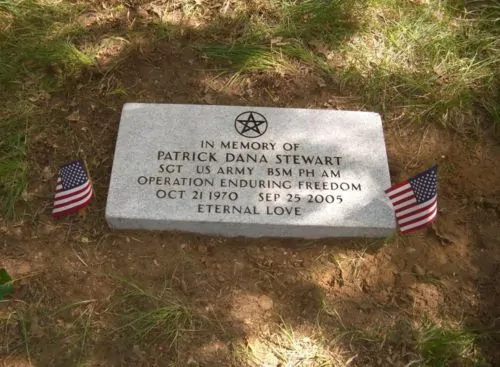
On Memorial Day in 2006, a wreath bearing a pentacle was placed beside the space intended for Sergeant Patrick Stewart’s memorial plaque on the Wall of Heroes at the Northern Nevada Veterans Memorial Cemetery in Fernley. Stewart, a member of the Nevada Army National Guard, had been killed in Afghanistan on September 25, 2005, when his helicopter was shot down. His widow, Roberta, wanted his plaque to include the religious symbol of their Wiccan faith, a five-pointed star enclosed within a circle. According to Selena Fox’s contemporary account of the campaign, Chief Warrant Officer John Flynn, who died in the same attack, already had a plaque bearing a Christian cross on the wall. Stewart’s requested emblem remained unavailable through the federal memorial program. An interim marker without it could be provided, but Roberta sought a memorial that included the faith her husband had practiced. The wreath publicly displayed the symbol whose absence from the government’s approved list had prevented the inscription she wanted.
The immediate obstacle was administrative. The Department of Veterans Affairs furnished memorial markers bearing emblems selected from an authorized list, and adding an unfamiliar design required a separate decision. Wiccan applicants had been seeking that decision since 1997. While their requests remained unresolved, families could qualify for a memorial benefit without being able to obtain the religious inscription they requested.
The significance of this discrepancy requires care. Wicca’s existence as a religion did not depend on the approval of the National Cemetery Administration, the VA body responsible for the marker program. As Sarah M. Pike’s scholarship demonstrates, modern Pagan communities had developed religious practices and networks of association that cannot be understood simply through the public controversies surrounding them. Military chaplain guidance had addressed Wiccan observance well before Stewart’s death, although such guidance did not guarantee acceptance in every military setting. Nor did the memorial list represent an exclusively Christian understanding of belief. It included symbols associated with minority religions, as well as emblems for atheists and secular Humanists. These circumstances locate the dispute within the uneven operation of religious pluralism rather than a comprehensive governmental prohibition of Wicca. They also sharpen the question of administrative authority. As Winnifred Fallers Sullivan has argued in her study of religious freedom and cemetery regulation, protecting religious expression requires institutions to make judgments about which practices qualify for protection. In the pentacle campaign, an agency’s control over an approved design determined whether a veteran’s chosen religious identity could appear in a specific, publicly furnished form of remembrance.
The campaign that culminated in federal approval in April 2007 brought those judgments into public view. Its history extends beyond the Stewart case to earlier applicants and families whose requests received less attention. Their correspondence reveals how a prolonged approval process became part of the work of mourning, while the litigation records show how advocates challenged the government’s explanations and compared its treatment of different applicants. These sources also demand distinctions between documented administrative conduct and allegations advanced by the plaintiffs. The eventual settlement secured pentacle-bearing memorials; it did not produce a judgment establishing every claimed motive behind the delay. With that limitation, the campaign reveals how access to official commemoration depended on decisions that families could experience as exclusions even while the responsible institution professed to accommodate religious difference.
Wicca and the Problem of Religious Familiarity
Calling oneself a witch in late twentieth-century America meant adopting a word whose inherited associations often differed sharply from the speaker’s intentions. Some practitioners used it to describe participation in a religion, while others identified with forms of magical practice that they did not call Wicca. Paganism encompassed a wider range of affiliations, including traditions that neither understood themselves as witchcraft nor followed Wiccan teachings. These distinctions mattered because an outsider’s apparently simple question about what witches believed could impose unity on people who disagreed about the boundaries of the category itself.
The historical formation of Wicca helps explain this diversity. Gerald Gardner’s Witchcraft Today, published in 1954, presented contemporary English witchcraft as the survival of an older religious tradition, and Margaret Murray’s introduction endorsed that interpretation. Their account drew authority from a once-influential scholarly theory that European witch trials had targeted adherents of a continuing pre-Christian religion. Subsequent historical research dismantled the evidentiary foundations of that theory. Ronald Hutton’s work instead situates modern Pagan witchcraft within a long development of European cultural interests, including romantic treatments of ancient religion and the transmission of ceremonial magic. Gardner and his associates combined inherited materials with innovations whose precise authorship and sequence remain subjects of investigation. Recognizing that process does not reduce Wicca to a deception or establish that its practitioners lacked authentic religious commitments. It distinguishes a movement’s documented formation from the narratives through which some early advocates explained its antiquity, a distinction necessary for understanding how a modern religion could invest older symbols with compelling contemporary meaning.
Across the Atlantic, these practices entered an American setting that encouraged further adaptation. British initiatory traditions spread during the 1960s, while emerging communities also responded to feminism and environmental concerns. Chas S. Clifton’s history shows that American Paganism developed through publications and organizations whose relationships cannot be reduced to the transmission of Gardner’s teachings. By the campaign decade, Wiccan affiliation could involve membership in a coven, participation in a larger religious organization, or solitary observance informed by books and contact with other practitioners.
Worship also required explanation to observers accustomed to locating religion principally in a statement of doctrine. Many Wiccans marked the seasonal year through festivals and observed lunar occasions, using ritual to cultivate relationships with a sacred natural world. A Goddess and a God occupied central positions in numerous traditions, although interpretations of divinity differed and should not be converted into a universal membership test. Magic could be understood as a disciplined engagement with powers within nature, with practitioners differing over the relationship between psychological experience and forces beyond the individual. The Council of American Witches’ 1974 “Principles of Wiccan Belief,” for example, described extraordinary powers as part of nature’s possibilities rather than necessarily outside them. Such formulations joined religious understanding to actions through which participants sought healing or personal change, making practice itself an important means of learning what their commitments involved. Authority within these communities was similarly more complicated than the absence of a national hierarchy might suggest. A coven could maintain demanding expectations concerning instruction and initiation without answering to an institution empowered to govern every other coven. Helen A. Berger’s ethnography demonstrates that shared learning and durable social relationships existed alongside considerable scope for individual inspiration. The 1974 Principles likewise rejected authoritarian hierarchy while explicitly honoring teachers and those who undertook leadership. That declaration came from a coalition which subsequently disbanded, rather than a continuing body authorized to issue a binding Wiccan creed. Its importance lies partly in this combination of collective articulation and limited jurisdiction, showing how practitioners could formulate common positions without surrendering the autonomy of their communities.
Public misunderstanding concerned more than unfamiliar organizational arrangements. The association of witchcraft with deliberate evil supplied a ready interpretation through which ritual activities could become evidence of something their participants denied practicing. Sarah M. Pike’s research on Pagan festivals documents how rumors of Satanism shaped relations between gatherings and surrounding communities. The Council of American Witches had already addressed that identification in 1974, expressly rejecting worship of Satan as understood within Christian tradition and disavowing the pursuit of benefit through another person’s suffering. Its statement also distinguished opposition to religious coercion from hostility toward Christianity simply because it was Christianity. These explanations challenged descriptions imposed from outside, but they should not be turned into proof that all Wiccans subscribed to identical ethical propositions. Nor does distinguishing Wicca from Satanism make public approval of one theology the proper measure of either tradition’s entitlement to equal treatment. The historical issue is how a familiar image of the dangerous witch could override an account of belief offered by living practitioners.
The pentacle condensed some of these disputes into a recognizable design. Campaign documents explained its five points through the elements of earth, air, fire, and water together with spirit, while the surrounding circle represented eternity. That interpretation identified the significance claimed for the requested emblem without making the design exclusive to Wiccans or exhausting the meanings practitioners might attach to it. A shared symbol could communicate affiliation across otherwise independent communities without implying that those communities accepted a single governing authority.
Religious familiarity, then, involved expectations about how belief should be explained and who could credibly explain it. An official seeking one definitive representative might find a decentralized movement difficult to classify, while overlooking the authority exercised by its actual congregations and ministers. Equally, a description of seasonal observance might sound like an account of leisure to someone who expected worship to occur in a permanent sanctuary. These are interpretive possibilities, not sufficient explanations for the VA’s conduct, which must be assessed through the applications and responses themselves. The organizations participating in the pentacle campaign had identifiable representatives capable of supplying information and pursuing correspondence. Their demand for accommodation confronted institutions with an obligation to consider the evidence those applicants provided, even when their religious lives did not conform to the forms an administrator already knew.
Religious Accommodation in Uniform
Military service placed religious observance within an organization that controlled much of a person’s time and movement. A soldier assigned to a distant installation could not necessarily reach a civilian congregation or arrange duties around a religious calendar. Providing opportunities for worship required decisions within the command structure, often with assistance from chaplains whose own convictions differed from those of the people seeking help. Ronit Y. Stahl’s history of the American military chaplaincy shows that the resulting arrangements developed through negotiation over which communities and clergy the armed forces would accommodate. Kim Philip Hansen’s research identifies a continuing professional tension within that system. Chaplains remained representatives of their religious traditions while also assuming responsibilities toward service members who did not share them. Assistance could proceed without agreement on theology, although maintaining that distinction required more than a general declaration of tolerance.
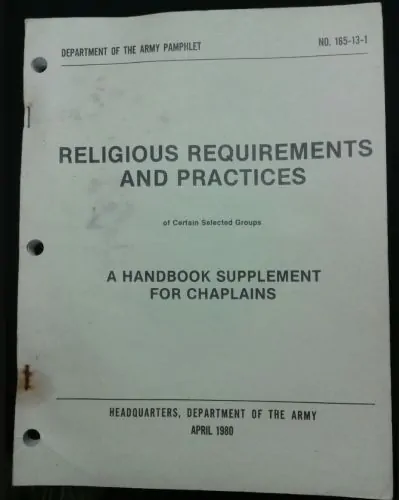
The Army’s Religious Requirements and Practices of Certain Selected Groups supplied information intended to make such assistance workable. Its revised handbook included separate entries for Gardnerian Wicca and Wicca, translating religious observance into questions a chaplain or commander might encounter. These concerned worship facilities and ritual equipment, alongside the circumstances in which practitioners might need contact with someone from their own community. The material also warned against assuming that a general designation on military identification accurately disclosed a person’s religious needs. Some Wiccans, it explained, might avoid an explicit affiliation because they feared adverse reactions. Such information gave chaplains reasons to inquire beyond an administrative label when a request arose. The handbook’s introductory disclaimer denied that its descriptions constituted Army endorsement of the organizations or doctrines discussed. Inclusion made information available for professional use; it did not turn the military into an authority affirming the truth of Wiccan teachings, and the document’s dated generalizations should not be mistaken for definitive scholarship about the religion.
Permission remained conditional. The Defense Department’s 1988 accommodation directive favored approving requests when doing so would not adversely affect military readiness, unit cohesion, standards, or discipline. It supported arrangements for worship and holy days while preserving exceptions based on military necessity. The Army’s implementing guidance likewise required consideration of individual circumstances, leaving room for different outcomes across assignments rather than promising that an accommodation granted at one installation would follow a soldier everywhere.
Fort Hood demonstrated what these provisions could produce in practice. By the late 1990s, its Open Circle held outdoor religious gatherings with sponsorship from the Sacred Well Congregation and oversight through the installation’s chaplain organization. Reporting on a March 1999 observance, Kim Sue Lia Perkes described a congregation composed largely of active-duty soldiers participating in a spring ceremony on the post. Lieutenant Colonel Donald Troyer, the chaplain overseeing the group, was a Seventh-day Adventist, illustrating the difference between facilitating another community’s worship and conducting it as that community’s minister. National attention then subjected an existing arrangement to demands for reversal. Representative Bob Barr challenged the military’s support for Wiccan meetings and pursued a restriction on assistance through the defense appropriations process. George W. Bush, speaking as Texas governor and a presidential candidate in June 1999, disputed witchcraft’s status as a religion and urged military officials to reconsider their decision. These interventions challenged more than the scheduling of a gathering or the suitability of a ritual site. They questioned whether activities already accommodated through military procedures deserved that treatment at all, despite the chain of command’s continued defense of the arrangement.
For participants, that defense offered protection without eliminating vulnerability. Perkes reported that protests at the ritual location had prompted the chaplain’s office to increase security, while Troyer described hostile reactions to his involvement. In Time, Marcy Palmer, the Open Circle’s high priestess, reported receiving repeated threats through telephone calls and electronic messages. Such testimony does not establish that hostility came from every quarter, or that permission to worship was merely nominal. It does show that a functioning religious program could coexist with intimidation, placing demands on officials who had to defend access as well as authorize it.
These experiences gave later memorial applicants a substantial institutional comparison, but they did not supply an automatic route to approval. The 1988 directive expressly confined its procedures to accommodation within the military services, and the VA administered its own program under separate authority. Authorization for an on-post gathering could not, by itself, determine which emblem appeared on a federally furnished marker. The stronger relevance of military practice lay in the work already undertaken to understand Wiccan requests and distinguish assistance from endorsement. Chaplains and commanders had demonstrated that accommodating observance did not require adopting its doctrines. The memorial dispute would test a different administrative judgment, but it arose after military officials had already developed practical ways to serve Wiccans as members of the armed forces.
How a Federal Memorial Became a Matter of Administrative Approval
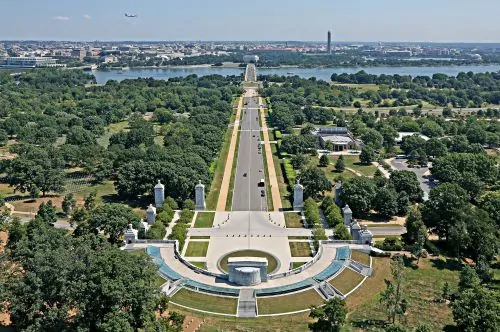
The National Cemeteries Act of 1973 placed much of the federal government’s cemetery system within the Veterans’ Administration, the predecessor of the Department of Veterans Affairs. The legislation transferred cemetery responsibilities from the Army and reassigned the government’s headstone and marker program. It also authorized administrative decisions about the information those objects would carry. Congress established obligations to commemorate eligible individuals while leaving substantial detail to the officials responsible for implementing the benefit. During the pentacle campaign, statutory provisions concerning markers operated alongside regulations assigning inscription policies and specifications to VA leadership. This arrangement made decisions about religious designs part of an established administrative responsibility. Adding a symbol did not ordinarily require Congress to amend the law, but neither could every requested design proceed directly to manufacture.
Cemetery ownership and responsibility for supplying a marker were distinct matters. Arlington remained under Army administration after the 1973 transfer, while state veterans’ cemeteries and private burial grounds retained their own management. Eligible veterans buried outside VA cemeteries could receive federally furnished headstones or markers. The government’s inscription requirements could affect an object placed in a locally administered cemetery without giving the VA control over every memorial erected there.
Obtaining that object involved a coordinated production and delivery process. At national cemeteries and participating state cemeteries using the NCA’s electronic ordering system, staff entered the necessary information directly. Elsewhere, applicants submitted VA Form 40-1330, accompanied by documentation establishing military service and the information required for the inscription. The August 2005 version offered a choice among standardized formats, including upright stones and flat markers, while requiring arrangements for delivery and certification that the selected type could be installed at the destination. Its instructions distinguished the government’s provision and shipment of a marker from installation expenses in a private cemetery. They also separated burial markers from memorial markers commemorating eligible people whose remains were not present, including those whose cremated remains had been scattered. These distinctions explain why the campaign concerned several kinds of commemorative objects rather than one uniform gravestone. A request had to connect a documented individual with an authorized object and an appropriate location before the desired inscription could become a finished memorial.
Within this process, the emblem list served as a catalogue of reproducible designs. The 2005 form displayed thirty-eight authorized entries, although their identifying numbers did not form a continuous sequence and should not be mistaken for a count of represented religions. Several Christian traditions had separate designs, while the roster also included the Sikh khanda and symbols associated with Japanese religious communities. The Humanist Emblem of Spirit appeared as number thirty-two, and an atheist emblem as number sixteen. These entries demonstrate that the category “emblem of belief” already extended beyond conventional images of worship directed toward a deity. The relevant administrative distinction concerned whether a design was available for inscription, rather than whether its associated convictions resembled those of the religious majority. Once an emblem entered the catalogue, subsequent applicants could request it through the ordinary ordering process.
Leaving the emblem space unused was also an authorized choice. Block twelve of the application offered “NONE” alongside the place for specifying an emblem number, and the instructions classified this part of the inscription as optional. A marker without a religious design cannot automatically be read as evidence that officials suppressed the deceased person’s wishes. But where a family requested an unavailable emblem accepting that option involved a different decision from freely choosing an inscription without one. The form accommodated voluntary omission while providing no equivalent numbered selection for a symbol still awaiting approval.
Requesting a new design involved a second administrative question beyond the application for an individual marker. The applicant was seeking an addition to the catalogue from which future inscriptions could be ordered, bringing the matter within the responsibilities of the Memorial Programs Service and senior NCA officials. The distinction between existing regulations and the policies implementing them is essential here. In its January 2007 explanation of proposed changes, the VA acknowledged that the Army had treated emblems as optional inscriptions before the program’s transfer in 1973. The successor agency continued that practice without promulgating regulations specifically establishing emblems as an approved inscription category. More detailed instructions for adding designs developed through NCA directives, including versions issued in 2001 and 2005. The roster operated within broader statutory and regulatory authority even though its detailed approval procedures were not comprehensively set out in the published regulations. The 2007 proposal attempted further formalization; its proposed provisions should not be projected backward as rules governing the entire campaign. This administrative structure also helps explain the cultural importance of a comparatively small design. John Bodnar’s work on public memory emphasizes the interaction between official commemorative purposes and the concerns of people remembering their own communities and relatives. Those interests need not be wholly opposed, since a family could value a government memorial while contesting the restrictions attached to it. Micki McElya’s history of Arlington similarly demonstrates that cemetery practices have helped determine how military honor becomes publicly recognizable. Applied to the emblem process, these approaches direct attention to the choices permitted within an otherwise standardized object. The marker preserved a person’s name and service while offering only an authorized range of symbolic affiliations. For applicants whose desired emblem was absent, obtaining comparable treatment required changing a program decision that other families could simply take for granted. Their difficulty arose at the point where an individual request depended on an administrative decision with implications for an entire religious community.
The First Applications and the Years without a Decision, 1997–2004

The earliest documented inquiry began with a request for instructions. On July 27, 1997, John Machate of the Military Pagan Network emailed the VA to ask how a religious emblem could be added to its authorized designs. The reply, dated August 11, described a submission from an ordained religious representative containing information about the symbol and a graphic depiction, while explaining that acceptance was not automatic. It also indicated that the applicant would receive the director’s decision by mail. This exchange presented an identifiable procedure with an expected outcome, giving prospective applicants grounds to anticipate an answer even though they could not assume that answer would be favorable.
Pete Pathfinder Davis, archpriest of the Aquarian Tabernacle Church in Washington State, submitted a formal application on August 27. He identified his position and supplied an account of Wicca with the pentacle design. The request came from a named religious organization through an identifiable representative. The church’s subsequent difficulty concerned obtaining a determination after submitting those materials, rather than discovering which office initially needed to receive them.
A second organizational effort developed through the Isis Invicta Military Mission. In September 1998, its priestess, Rona Russell, also identified in legal records as Rona Coomer-Russell, applied on behalf of Wiccan service members. According to the correspondence reconstructed in the later complaint, she sent the request again in February 1999 and made a third submission that June. Her June letter expressed concern that discrimination might explain the lack of a response, an allegation that records her contemporary interpretation without independently establishing the agency’s motive. By mid-July, VA representative M’Liz McLendon acknowledged that the correspondence had arrived and indicated that a final response should follow “within a week or so.” Instead, Memorial Programs Service director Lawrence J. De Meo Jr. explained that the request would go before the Advisory Committee on Cemeteries and Memorials at its fall meeting, after which its recommendation would receive further consideration. That account described additional stages of review without supplying the promised determination. Further inquiries in early 2000, including a request for a written status report, likewise failed to produce a final answer in the documentary history assembled by the plaintiffs. The available record establishes the announced referral, but does not by itself demonstrate what consideration the committee actually gave the application.
Acknowledgments could sustain an expectation of progress while leaving the requested action unresolved. A statement that correspondence had arrived answered a question about delivery, while a promised committee referral addressed its anticipated handling. Neither explained whether the emblem had satisfied the agency’s requirements. Applicants had to keep asking about the status of a submission whose receipt might already have been confirmed.
The adoption of NCA Directive 3310 on May 9, 2001, made the ensuing correspondence more difficult to reconcile with the agency’s developing procedures. The directive specified organizational information to accompany a proposed emblem and required a submission from the recognized head of the applicant organization. Yet the reply sent to Davis in November continued to describe the VA as revising its procedures. The later Egbert petition emphasized the discrepancy between that explanation and the directive already issued, arguing that the church had supplied the essential materials needed for consideration. That assertion about compliance belongs to the applicants’ case and should be distinguished from a judicial finding that every requirement had been met. Even with that qualification, the correspondence raises a substantial question about how the new instructions were communicated to people whose requests preceded them. On December 15, 2003, Davis renewed the application and invoked federal guidance discussing Wicca, including material prepared for military and prison personnel. He also cited Dettmer v. Landon, which had addressed Wicca’s status for purposes of religious protection. The petition reports that this renewed letter received no reply. Meanwhile, approval of the Christian and Missionary Alliance emblem in 2002 showed that additions to the roster remained possible, making continued references to procedural revision an explanation that required closer examination.
Not every Wiccan request followed precisely this course. Fox’s campaign history describes a July 22, 2004, reply declining a separate submission after a correspondent stated that Wicca had no overall religious head. She interpreted the exchange as a misunderstanding of the requirement for an organizational representative, rather than a need for someone entitled to speak for the entire religion. On her reading, clarification could have distinguished those two forms of authority. The episode qualifies any claim that all requests met only silence, while leaving the earlier applications of the Aquarian Tabernacle Church and Isis Invicta without a reported resolution.
The scholarship on administrative burden offers a useful way to assess what these years demanded of applicants. Pamela Herd and Donald P. Moynihan show how finding reliable information and repeatedly meeting procedural demands can affect access to public services independently of a program’s stated purposes. Their framework does not require every obstacle to originate in deliberate hostility, and the correspondence cannot settle questions of intention merely by documenting delay. It does direct attention to the work transferred to religious representatives who had to renew requests and seek explanations for their status. By the end of 2004, the Aquarian Tabernacle Church’s application had been outstanding for more than seven years. What began as a defined submission had become a continuing responsibility for those trying to secure an answer, with no dependable date at which they could tell veterans or their families that the matter would be decided.
Families Waiting for More than Paperwork
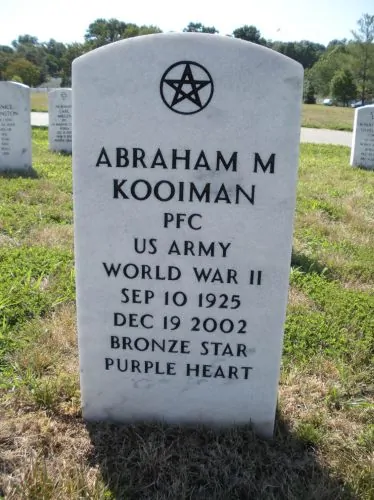
Rosemary Kooiman accepted a headstone for her husband while continuing to seek the religious inscription she wanted it to carry. Abraham Kooiman, an Army veteran of World War II, died on December 19, 2002, and was interred at Arlington National Cemetery on May 22, 2003. Rosemary agreed to a marker without the pentacle in the expectation that the symbol could be added after its approval. Her acceptance established an interim arrangement rather than ending her effort to obtain a different inscription. When she died on March 5, 2006, that effort remained unfinished, and their daughter, Kathleen Egbert, continued the request. The surviving correspondence records a change in who pursued the application as well as the passage of years. A widow’s undertaking for her husband became a daughter’s responsibility after both parents had died. In 2006, Egbert remarked that when her mother was buried, “this problem was still not resolved.” The unresolved matter now concerned how a shared grave represented two lives, even though the veteran’s qualifying service had supplied the basis for the original request. Kathleen’s participation also shows how relatives could sustain a commemorative commitment first articulated by someone else, preserving the request after the person who initiated it could no longer explain its importance herself.
Patricia Darlene Howell Corneilson made a different choice after her son, Army soldier James Price, was killed in Iraq on September 18, 2004. She postponed receiving a VA headstone or marker while the pentacle remained unavailable. The petition documenting her position identifies the religion Price practiced and the emblem she sought for his memorial. Her decision withheld acceptance of that federal benefit until it could include the requested symbol.
The difference between these responses deserves attention without becoming a measure of whose commitment was stronger. An interim headstone could provide an established marker while leaving a desired alteration outstanding. Postponing receipt could keep the objection to an incomplete inscription explicit, although it also deferred the specific object being requested. Neither approach made the emblem’s meaning interchangeable with the information already authorized for engraving. Elizabeth Hallam and Jenny Hockey’s study of material remembrance helps explain why such distinctions matter. Objects associated with death participate in relationships between survivors and those they remember; their significance develops through their use and the accounts attached to them. A marker’s physical availability does not settle whether its inscription adequately represents the person for whom it was obtained. In these cases, the relatives’ documented decisions reveal different ways of acting on that concern, rather than a single prescribed response to the restriction.
For Karen DePolito, the request concerned a veteran whose military service belonged to an earlier generation. Her husband, Jerome Birnbaum, had served in the Korean War and died in November 2005. Both spouses were Wiccan and had belonged to Circle Sanctuary since 1988, and DePolito sought a granite marker bearing the pentacle through the church’s application. The intended memorial connected his service history with the religious community in which they had subsequently participated, without requiring those parts of his life to have begun at the same moment.
Scott Stearns brought another temporal relationship to the campaign because he was seeking assurance about his own eventual memorial. A retired disabled Navy veteran who had served during the Persian Gulf War, he was still living when he joined the effort to obtain pentacle approval. The petition identifies his Wiccan practice and membership in the Aquarian Tabernacle Church as dating from 1996; that information should not be used to assign the same affiliation to his earlier wartime service. He wanted to know that the religion he now practiced could be represented on a government marker after his death. His independent application in March 2005 was followed by a request under the Freedom of Information Act for records concerning emblem applications. That inquiry produced documents connecting his prospective concern with requests already made by other people. Stearns could articulate the significance of his own future inscription and investigate the decisions affecting it, whereas deceased veterans necessarily depended on others to pursue comparable requests. His participation broadens the history beyond bereaved relatives without making him a substitute for their experiences. The issue could shape planning during life as well as decisions made after a death, and a veteran did not need to be described as imminently dying for that uncertainty to matter.
Bereavement scholarship cautions against assuming that an approved marker would bring mourning to a definitive end. The collection Continuing Bonds, edited by Dennis Klass, Phyllis R. Silverman, and Steven L. Nickman, challenged the expectation that successful grieving requires survivors to relinquish their attachment to the deceased. This perspective allows the families’ efforts to be understood as continuing acts of remembrance without treating their persistence as evidence of psychological incapacity. Their requests also involved responsibility for another person’s representation, a responsibility that did not require every surviving relative to share the deceased’s beliefs. The records establish what these applicants sought and the choices they made, while leaving much of their private mourning outside historical view. Within those limits, the campaign shows relatives undertaking an additional task after death, working to ensure that the officially supplied account of someone they knew could include the religious affiliation they considered necessary to preserve.
Patrick Stewart’s Death and the Campaign’s New Prominence
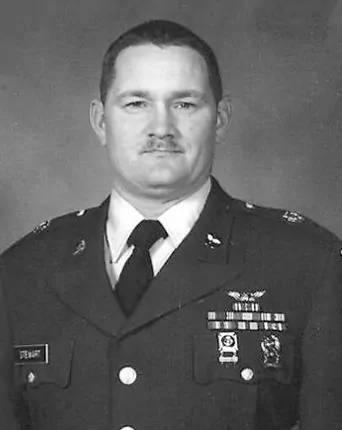
Sergeant Patrick D. Stewart entered the pentacle controversy through a military career that had begun well before the war in Afghanistan. After graduating from Washoe High School in Reno in 1989, he enlisted in the Army, serving during Operation Desert Storm and in Korea before completing his active service in 1996. He joined the Nevada Army National Guard in 2002 and became a chief flight engineer with Company D, 113th Aviation. On September 25, 2005, Stewart was aboard the CH-47 Chinook known as Mustang 22 when enemy fire brought it down southwest of Deh Chopan, Afghanistan. Five soldiers died in the attack, including Stewart and fellow Nevada Guardsman Chief Warrant Officer John M. Flynn. Their deaths immediately entered Nevada’s public account of the war. Speaking in the Senate two days later, Harry Reid honored both men and extended his condolences to their families. That tribute established an early setting for the subsequent campaign, placing Stewart within an already acknowledged history of military service and collective loss.
Among his fellow soldiers, Stewart’s religious affiliation was already known. Roberta Stewart told Stars and Stripes that her husband had practiced Wicca openly and that members of his unit understood its importance to him. Military personnel helped prepare a ritual circle for his funeral, while friends recalled his commitment to both his faith and his service. These recollections gave comrades a personal basis for supporting the memorial request, grounded in their knowledge of the man whose life the plaque would commemorate.
Roberta’s decision to make that request public was a crucial development in the campaign’s history. According to Selena Fox’s contemporary account, Roberta contacted her in February 2006 and attached the application for Patrick’s memorial plaque to Circle Sanctuary’s pending submission for the pentacle. Fox then asked whether she would seek assistance from elected officials and allow the case to receive publicity; Roberta agreed. This exchange joined a widow seeking a specific memorial inscription with an organization that had already accumulated experience dealing with the Department of Veterans Affairs. Each brought a different kind of authority to their collaboration. Fox could explain the history of the applications and communicate with other religious organizations, while Roberta could speak directly about Patrick’s beliefs and the memorial she wanted for him. Their cooperation connected an individual request to a dispute whose duration might otherwise have remained difficult for outsiders to grasp. It also required Roberta to undertake public work during bereavement, answering questions and explaining a religious choice that families selecting an approved emblem ordinarily had no reason to defend before a news audience.
Congressional assistance gave the request additional urgency. Fox reported that Reid’s Reno staff contacted the VA on February 22, asking it to expedite Circle Sanctuary’s application. Representative Jim Gibbons also supported approval, and his office sought a resolution before the March 18 homecoming of Stewart’s fellow soldiers. With a Democratic senator and a Republican representative involved, the case acquired support across party lines, although their intervention produced neither an immediate authorization nor a dependable date for completing the plaque.
News coverage carried the dispute beyond the correspondence between applicants and officials. Fox dated Sean Whaley’s Las Vegas Review-Journal report to March 2, 2006, explaining that his interest followed news of a petition circulating among soldiers who had served with Stewart in Afghanistan. By March 8, Howard Friedman’s Religion Clause commentary was drawing attention to the story through coverage circulated by AlterNet and the Baptist Joint Committee. These connections brought the request before audiences concerned with military affairs as well as religious liberty. The explanations offered during this early publicity deserve careful attention. In a March 11 Stars and Stripes report, National Cemetery Administration official Lindee Lenox attributed the delay to outdated requirements concerning a religion’s central leadership and said the application was nearing the end of review. The same article reported Fox’s view that bureaucratic slowness, rather than discrimination, explained the current difficulty. Such statements record positions expressed at that moment; they do not establish the adequacy of the agency’s explanation. They also caution against treating the campaign’s interpretation of events as settled from the beginning. Publicity initially created opportunities to obtain an explanation and press for action, while the continuing absence of a decision gave advocates reasons to reassess the assurances they received.
Religious visibility depended partly on how journalists organized the story. Sean McCloud’s scholarship shows how reporting can help construct the boundary between mainstream and marginal religion. Sarah M. Pike’s work on Wicca in the news identifies the confusion that has often surrounded journalistic descriptions of witchcraft. Applied to Stewart’s case, these approaches suggest examining how the familiar subjects of military service and widowhood changed the questions through which readers encountered an unfamiliar faith.
A July 10, 2006, CNN report illustrates both the reach and the limitations of that presentation. The segment opened by juxtaposing Stewart’s Bronze Star and Purple Heart with the unresolved memorial request, making the absence of the plaque intelligible through the nation’s established language of honoring its military dead. Roberta explained her refusal to accept a plaque without the pentacle and connected her husband’s service to the Constitution. Her appearance allowed viewers to hear the claim from the person seeking the inscription, rather than encountering it solely through official statements or a reporter’s explanation of Wicca. Yet the broadcast also compressed the administrative issue into a broader judgment about religious validity. Correspondent Bob Franken described the VA as determining an “acceptable religion” and stated that it did not recognize Wicca. This wording enlarged the apparent scope of the agency’s authority, blurring the difference between approving a memorial emblem and determining whether a religion possessed legitimate standing. The VA’s statement, reproduced in the report, attributed the delay to its effort to develop uniform rules. Television placed that explanation beside Roberta’s account of what the missing emblem meant, exposing the distance between an assurance about procedure and the outcome the applicant was still awaiting.
Stewart’s death gave the campaign a widely reported case, but its prominence resulted from choices made by Roberta, established advocates, and the people who helped circulate their request. Their work made it increasingly difficult to discuss the pentacle applications without confronting the military life that one pending decision affected. The persuasive force of this example also introduced a tension. A decorated soldier killed in combat could command attention that other applicants might struggle to obtain, even though the claim to equal treatment could not reasonably depend on such an exceptional biography. His story’s broader significance lay in directing attention toward a problem extending beyond his own memorial. By the summer of 2006, the campaign had gained a public audience able to follow the VA’s assurances and ask when those assurances would produce a decision.
Organizing Religious Equality in Public, 2006
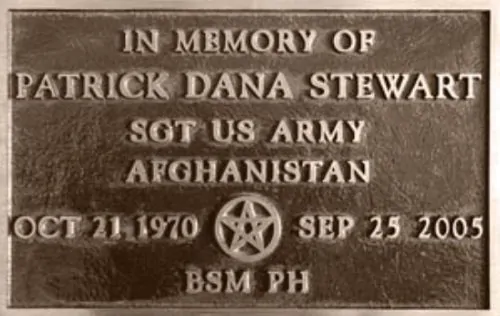
The approaching Memorial Day observance in Fernley raised a question extending beyond the inscription on Patrick Stewart’s plaque. Who could speak within the ceremonies through which a community honored its military dead? In May 2006, retired military chaplain William Chrystal told Stars and Stripes that state veterans officials had informed him that Roberta Stewart could not address the cemetery’s observance because of the controversy surrounding her application. Chrystal, a United Church of Christ minister who had participated in previous ceremonies, withdrew from the event and agreed to help organize an alternative service. His account concerned the management of a local commemorative program, a separate matter from the VA’s authority over federally supplied memorial emblems. Yet the connection between them was significant. According to Chrystal’s report, an unresolved federal application had become a reason to restrict participation in a public occasion dedicated to remembrance. Organizing another service gave supporters a place to address the disputed religious identification openly while continuing to observe Memorial Day.
On May 29, the Sgt. Patrick Stewart Freedom for All Faiths Memorial Service brought hundreds of people to a public park in Fernley. Its program included the raising and lowering to half-staff of a flag Stewart had flown during his deployment, accompanied by familiar forms of military commemorative music. Roberta, Chrystal, and Selena Fox spoke alongside political candidates from both major parties. The service’s name connected the remembrance of one soldier with a wider commitment, inviting participants to support religious equality without requiring them to share the Stewart family’s beliefs.
Christian support elsewhere demonstrated how that invitation could operate across substantial theological differences. Writing in Christianity Today on June 5, constitutional attorney John W. Whitehead defended the requested pentacle and urged Christians to protect the freedoms of minority believers. His argument rested partly on reciprocity. Christians endangered their own liberty when they accepted unequal treatment of someone else’s religion. Such reasoning offered a basis for cooperation that did not depend on finding common ground between Christian and Wiccan teachings. Whitehead’s language also revealed the qualifications that could accompany an ally’s support. He described some approved minority religions as “obscure,” expressed surprise that atheist and humanist emblems appeared on the list, and retained an explicitly Judeo-Christian account of the nation’s origins. These judgments did not prevent him from condemning the treatment of the Stewart request. His intervention shows why support for equal rights should be distinguished from an equal estimation of every belief. The campaign could attract assistance from people whose religious assumptions differed sharply from those of its Wiccan organizers, provided they agreed that those assumptions should not determine access to a government benefit.
A June appeal translated sympathy into instructions for political participation. Between Flag Day on June 14 and the summer solstice on June 21, supporters were asked to write and fax their senators and representatives. The appeal sought congressional investigation of the VA’s conduct as well as direct pressure on officials to approve the pentacle. Its organization around a defined period gave dispersed supporters a common undertaking, although the circulation of instructions alone cannot establish how many people acted or what influence their correspondence exerted.
The Washington religious-rights rally on July 4 supplied another setting for participation, with Fox and Roberta speaking at Farragut Square near the White House and VA headquarters. A subsequent Circle Times bulletin reported attendance from seventeen states, an organizers’ estimate indicating the geographical reach they claimed for the gathering. More revealing than the crowd figures were the bulletin’s instructions for continuing the work afterward. Readers were encouraged to recruit additional allies and contribute money toward travel and other campaign expenses. They could also write to newspapers, participate in online discussions, and forward information through existing email lists. These requests allowed people unable to attend a demonstration to undertake defined tasks from their own communities. Rhys H. Williams’s scholarship on religious social movements helps explain the importance of such arrangements, identifying religious organizations as sources of participants and the resources needed to sustain collective action. Applied here, that approach directs attention toward the practical work behind a visible gathering. Someone had to finance the journeys, maintain contact with supporters, and keep a specific request before people whose interest might otherwise have passed with the next news report.
Devotional activity remained part of this organizing. The July bulletin asked supporters to send blessings and invoke Libertas, the Goddess of Liberty, alongside its requests for correspondence and financial assistance. Sabina Magliocco’s study of contemporary Pagan ritual as creative cultural practice provides a useful perspective on this combination. Campaigners could employ the familiar figure of Liberty in religious practice while pursuing constitutional arguments through ordinary political channels, bringing their own understandings of sacred assistance into work directed toward a public administrative decision.
By August, the campaign’s organizational relationships also supported a more formal partnership with Americans United for Separation of Church and State. An August 3 announcement confirmed that the organization was representing Circle Sanctuary and Roberta Stewart in their effort to secure the pentacle’s approval. Fox later explained that her longstanding collaboration with Americans United executive director Barry Lynn helped inform their choice of representation. This history places the partnership within relationships developed before the immediate controversy attracted national attention. Public events brought new people into the effort, while established contacts helped campaigners obtain specialized assistance and evaluate further avenues of action. The resulting cooperation did not amount to a single organization speaking for every Wiccan or every supporter of religious liberty. It connected participants who could contribute different kinds of work toward a limited, identifiable objective. Through that cooperation, the demand for the pentacle became an undertaking in which people beyond the applicant families could assume responsibilities, sustaining pressure while those families continued to wait.
Nevada’s Plaque and the Limits of a State Solution

Governor Kenny Guinn’s administration offered a new route to obtaining Patrick Stewart’s memorial plaque in September 2006. Instead of continuing to await federal authorization, Nevada would arrange for a plaque bearing the pentacle at the state-operated Northern Nevada Veterans Memorial Cemetery. The decision was announced on September 13, less than two weeks before the first anniversary of Stewart’s death. Tim Tetz, executive director of the Nevada Office of Veterans Services, presented the action as fulfillment of a commitment to honor Stewart’s military service and his place within Nevada’s community. Roberta welcomed the announcement and told Stars and Stripes that it gave her strength to continue the campaign. Her response joined gratitude for an immediate improvement with a determination to pursue the unresolved federal request. National VA officials offered no comment on Nevada’s decision, while confirming that the applications before them remained pending. The announcement produced two different administrative outcomes: state officials had authorized a way forward for the Fernley memorial, while the federal emblem review still had no announced completion date.
Nevada’s intervention rested on its administration of the cemetery. According to contemporary reporting, state officials consulted the attorney general and completed a legal review before concluding that they could authorize the plaque there. This position allowed Nevada to act within its own institution without securing a change to the federal list. It neither directed the VA to manufacture the plaque nor established a legal obligation for federal officials to approve the pentacle elsewhere.
Campaign organizers immediately made the distinction between these outcomes part of their public response. A September 22 Circle Times announcement invited supporters to participate in a candlelight vigil on the anniversary of Stewart’s death, combining remembrance with thanksgiving for Nevada’s decision. Its accompanying appeal continued to seek the pentacle’s addition to the VA’s approved list. The bulletin also advertised a rally in Reno at which speakers would congratulate the state and press for federal action. These were plans for further advocacy, issued after authorization but before the plaque’s installation, and they show how organizers interpreted the development as it unfolded. Nevada’s action could be celebrated without treating the broader demand as satisfied. Nor did accepting the plaque require Roberta to abandon her cooperation with families whose requests remained unresolved. The announcement placed the state’s responsiveness within an ongoing campaign, making its decision an example that supporters could cite when addressing another authority. Gratitude became compatible with continued pressure because the government office providing the immediate remedy lacked the power to grant the national change being sought.
The bronze plaque was installed in November, and its public dedication took place on December 2, 2006. These dates distinguish the completed memorial from the promise made in September, when production still lay ahead. Family members and supporters gathered at the Wall of Heroes to dedicate the state-provided plaque bearing Stewart’s religious emblem. The ceremony marked the arrival of the object Roberta had sought, even as the federal government continued considering whether that emblem could appear on markers supplied through its program.
The importance of the plaque cannot be measured solely by whether it altered federal policy. Erika Doss’s scholarship on American memorial culture emphasizes how commemorative objects give public form to claims about identity and belonging. From that perspective, Nevada had done something substantial by placing the pentacle within an official setting for honoring military service. The image became part of the cemetery’s continuing presentation of Stewart’s life, available to visitors beyond the family and the campaign’s immediate supporters. Its location mattered as much as its production. The state had incorporated the requested religious identification into the memorial institution it administered. Yet the dedication also preserved awareness of the decision’s restricted reach. In her contemporary account of the controversy, religious studies scholar Sarah M. Pike cited a December statement from the Covenant of the Goddess describing the celebration as “bittersweet.” That description captured a situation in which an achieved memorial and an unfinished campaign existed together. Nevada’s provision of the plaque deserved recognition as a concrete accomplishment, while the continuing federal exclusion prevented supporters from treating the ceremony as a resolution for everyone involved.
What remained unsettled was access to comparable treatment through the national benefit program. Another family seeking a VA-issued marker could not rely on Guinn’s intervention as authorization for its own application, and a state decision concerning Fernley could not govern memorials under other authorities. The Nevada arrangement depended on officials willing and able to provide an alternative within their jurisdiction. A general federal approval would instead permit eligible applicants to select the pentacle through the established marker process, reducing their dependence on obtaining separate political assistance. This difference explains why an individual remedy could leave the central institutional problem intact. Nevada demonstrated that a public veterans’ memorial could include Stewart’s Wiccan identity, but its action did not adjudicate the lawfulness of the VA’s conduct or change the rules governing federally supplied inscriptions. The campaign still sought a procedure under which requesting the emblem would lead to a routine commemorative choice rather than another effort to secure an exception.
Unequal Waiting and the Evidence of Selective Treatment

Approval records allowed campaigners to place the pentacle’s prolonged consideration beside decisions the VA had completed for other applicants. The complaint filed in Circle Sanctuary v. Nicholson in November 2006 reproduced a table of request and approval dates attributed to a July letter from Under Secretary William Tuerk. According to that table, five emblems had received approval within approximately two to five months during 2002–2004. These included the Soka Gakkai eight-petal lotus and the Sikh Khanda, alongside designs associated with Christian organizations. The comparison supplied a more specific challenge than the assertion that the VA was taking too long. It showed an agency capable of receiving requests, evaluating designs, and reaching affirmative decisions during years when Wiccan applications remained unresolved. The table appeared within an adversarial pleading, so its reproduction should be distinguished from independent examination of every underlying application. Even with that qualification, dates attributed to the agency’s own correspondence gave the plaintiffs a substantial basis for questioning whether the pentacle requests had received comparable administrative attention.
The Humanist Emblem of Spirit complicates any suggestion that every other applicant obtained immediate accommodation. The chronology reproduced in the complaint placed its approval roughly a year after the initial request. That interval was considerably longer than those recorded for the other examples, demonstrating variation within the approval process itself. It still ended in a decision, making the relevant distinction one between different periods of completed review and the recurring failure to resolve the pentacle applications.
The Sikh case provides a useful comparison because it concerned a deceased soldier whose family wanted an emblem absent from the approved list. Following Uday Singh’s death in Iraq, his relatives sought the Khanda for his headstone at Arlington National Cemetery. Contemporary reporting described an initial refusal and subsequent efforts to obtain authorization through a religious representative. His family’s experience was more difficult than a simple account of rapid approval might suggest. The period measured from the formal request in the complaint’s table was under three months, while reporting based on the family’s experience described a longer interval beginning around the burial. Preserving both perspectives prevents the successful application from becoming evidence that Sikh religious identification had encountered no institutional resistance. Its importance lies in the eventual administrative response to that resistance. The VA found a way to authorize the emblem and permit its inscription during 2004. For Wiccan advocates, this demonstrated that the needs of a bereaved military family could generate a completed decision about a previously unavailable religious design. Their comparison could reasonably ask why similar urgency had not produced resolution for their families without diminishing the difficulties Singh’s relatives had faced.
Elapsed time requires careful definition. The nine-year pentacle campaign encompassed several applicants and revised submissions, rather than one unchanged dossier awaiting review throughout the entire period. Contemporary accounts also disagree on some precise comparator dates, making it necessary to distinguish reported requests and approvals without assuming that every discrepancy reflects a different procedural milestone. These qualifications limit the precision of a numerical comparison, but they leave intact the broader contrast between applications decided within months and pentacle requests repeatedly left pending.
Correspondence concerning the Humanist emblem raised a further issue about the agency’s reliance on unfinished regulations. The Circle Sanctuary complaint quoted an August 2002 letter from Memorial Programs Service director David Schettler to American Humanist Association executive director Tony Hileman. Schettler explained that proposed regulations remained in draft, but that the agency would accept and review written emblem requests individually until those regulations were finalized. As reproduced in the pleading, this statement showed that regulatory revision had not invariably prevented consideration of additional symbols. It also made the chronology of the VA’s explanations important. A later determination that the procedures adopted in 2005 required correction might explain a subsequent suspension, but it could not, by itself, account for earlier years during which other requests advanced. The comparison does not establish that officials possessed identical authority under every successive arrangement. It does require evaluating each explanation within its own period and asking what discretion the agency exercised for other applicants then. A general account of an office perpetually awaiting better rules cannot adequately describe a record containing completed approvals and an express commitment to review requests while rulemaking continued.
Pamela Herd and Donald Moynihan’s scholarship on administrative burden helps distinguish these institutional effects from claims about personal intention. They show that obstacles to public services can arise through political choices as well as limited organizational capacity, and that their distribution matters independently of whether every effect was anticipated. Applied here, their approach directs attention to who obtained decisions and who remained responsible for pursuing unanswered requests. The resulting inequality warrants explanation without requiring the historian to assign a single motive to everyone involved.
The strongest conclusion supported by these comparisons concerns selective access to a functioning approval process. The agency accommodated religious difference in some cases while leaving Wiccan applicants unable to obtain an equivalent outcome, despite their repeated attempts to satisfy its requirements. This finding is narrower than establishing that every delay resulted from hostility, yet it identifies a substantial institutional problem. Nor was the absence of a decision equivalent to a neutral holding position for the affected families. The approved list continued to govern available inscriptions, so unresolved applications preserved the practical exclusion even without a final written rejection. In their September 2006 petition, the Egbert applicants also argued that the lack of a reviewable written decision obstructed their efforts to challenge the agency’s conduct. Waiting became part of the dispute’s legal structure as well as its historical evidence. The comparison cases gave advocates grounds to demand an explanation for the agency’s different responses, while leaving allegations of deliberate discrimination to be examined through additional evidence and judicial proceedings.
Taking Administrative Inaction to Court
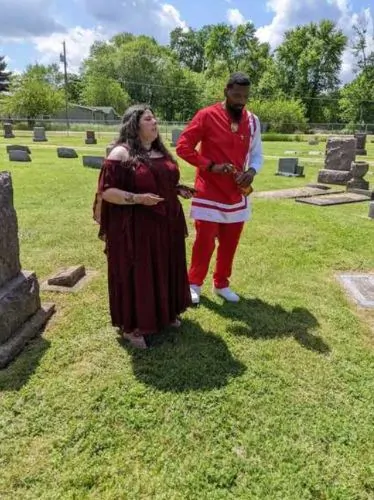
The first lawsuit sought to make the unresolved applications answerable to an enforceable judicial process. On September 29, 2006, the American Civil Liberties Union filed Egbert v. Nicholson in the U.S. Court of Appeals for Veterans Claims. Its petitioners included Kathleen Egbert, Patricia Darlene Howell Corneilson, and Scott Stearns, together with the Aquarian Tabernacle Church and Correllian Nativist Church International. Their interests encompassed memorial requests for deceased relatives and a living veteran’s concern about his eventual commemoration. The petition asked for extraordinary relief in the nature of mandamus, a judicial order requiring officials to perform an obligation. Specifically, it sought expeditious processing within a defined period, with the possibility of enforcement if officials failed to comply. It also requested an alternative ruling directing the Secretary to approve the pentacle. Those requests distinguished two objectives that administrative correspondence had left entangled: obtaining a decision and establishing that the legally permissible decision was approval.
Mandamus imposed a demanding threshold. The petition itself acknowledged that extraordinary relief required more than dissatisfaction with a heavily burdened administrative system. Its argument was that the history demonstrated delay sufficiently extreme to constitute an arbitrary refusal to act. That remained a proposition for the petitioners to establish, rather than a conclusion produced by filing their papers, and the requested deadline depended on persuading the court that judicial intervention was warranted.
Americans United pursued additional routes on November 13, filing actions in the Western District of Wisconsin and the U.S. Court of Appeals for the Federal Circuit. The Wisconsin plaintiffs were Circle Sanctuary, Isis Invicta Military Mission, Roberta Stewart, and Karen DePolito. Their complaint anticipated an obstacle arising from the specialized arrangements for reviewing veterans’ benefits. Federal district courts generally could not simply reconsider decisions assigned to that review system. Counsel argued that this case concerned the failure to decide emblem applications and the discriminatory administration of the list, rather than an ordinary challenge to the disposition of an individual marker benefit. The simultaneous Federal Circuit filing addressed the validity of the emblem rule itself. In the plaintiffs’ formulation, that was a facial challenge, while Wisconsin would hear their challenge to the rule’s application to their circumstances. This division was their jurisdictional theory, not an established judicial conclusion about the proper destination of every emblem dispute. It explains why the Federal Circuit proceeding was a separate action rather than an appeal from Wisconsin. The lawyers were addressing uncertainty about how a controversy involving religious rights and veterans’ administration fitted within the available systems of review.
The Administrative Procedure Act supplied a further basis for seeking intervention against inaction. Section 706(1) authorized courts to compel agency action unlawfully withheld or unreasonably delayed, but that language did not authorize unrestricted judicial management of an agency. In Norton v. Southern Utah Wilderness Alliance in 2004, the Supreme Court had limited such relief to discrete actions that an agency was legally required to take. Compelling an official to decide a matter could also differ from dictating the result where the law preserved discretion. Eric Biber’s scholarship on administrative action and inaction identifies the broader tension between enforcing legal obligations and respecting agencies’ authority to allocate resources and establish priorities. For the Wisconsin plaintiffs, identifying a duty to resolve their applications was an important part of translating prolonged frustration into a claim a court could adjudicate.
The constitutional counts addressed what an acceptable resolution would require. Under the Establishment Clause, the plaintiffs argued that maintaining the list while excluding the pentacle improperly preferred represented religions over their own. Their Free Exercise claim treated the requested inscription as an expression of religious practice associated with commemorating the dead. The Religious Freedom Restoration Act provided a related statutory argument. Counsel alleged a substantial burden on religious exercise that lacked a compelling governmental justification and could not satisfy the requirement of using the least restrictive means. A separate speech claim characterized the inscriptions as private expressions within a limited public forum, making the exclusion of Wiccan identification an instance of viewpoint discrimination. That description of the memorial program formed part of the plaintiffs’ legal case; the government’s provision of the objects did not settle their constitutional classification merely by itself. The complaint also invoked the equal-protection component of the Fifth Amendment’s Due Process Clause, which applied to federal conduct. These theories approached the same administrative conduct through different protected interests, giving the court several possible grounds for evaluating it. None of them should be converted from an allegation into a judicial finding simply because the complaint stated it forcefully.
Determining where those arguments could be heard remained important. Fox’s later account reports that the government challenged the Veterans Claims proceeding on jurisdictional grounds and also sought dismissal of the Federal Circuit action. According to Americans United’s case summary, its Federal Circuit proceeding was subsequently withdrawn after the VA accepted the district court’s jurisdiction. That withdrawal concentrated its litigation in Wisconsin and did not constitute an adverse judgment on the substance of the religious-freedom claims.
An early procedural decision then prevented the Wisconsin case from being suspended while the VA pursued another revision of its emblem procedures. Following publication of a proposed rule in January 2007, the government asked the court to stay the litigation. Judge John Shabaz declined to do so on January 26, allowing the case to proceed on a schedule that included a May 1 deadline for summary-judgment motions and a June 29 trial date. These were prospective litigation deadlines, rather than dates on which the plaintiffs had already established their allegations. Refusing a stay likewise resolved a question about the continuation of proceedings, not whether the VA had violated the Constitution. Its immediate significance was still substantial. Preparation of the case could continue while administrative rulemaking remained unfinished. The dispute had acquired a judicial timetable alongside the agency’s procedural calendar, creating an opportunity to test the competing accounts through evidence and legal argument.
Defining an Acceptable Belief in the Proposed Rules of 2007
On January 19, 2007, the VA published a proposed rule that brought its assumptions about religious identification into more explicit regulatory form. The document outlined procedures for requesting additional emblems and criteria for deciding whether those requests should succeed. Comments were invited through March 20, giving applicants and other interested people an opportunity to challenge the proposed standards themselves. Publication did not make those standards an operative final regulation, and the proposal must be distinguished from the substantially revised rule eventually adopted in 2009. Its historical importance lies in what it reveals about the institution’s proposed understanding of its responsibilities. The VA presented written criteria as a means of administering the marker program consistently and preserving the character of national cemeteries. Yet specifying those criteria also exposed the judgments that officials proposed to make about the communities whose emblems they would consider. The dispute now concerned the terms of evaluation as well as the unresolved pentacle applications.
Some requirements addressed readily identifiable production needs. The proposed rule requested a three-inch digital representation in black and white, free of copyright restrictions and suitable for reproduction in stone or bronze. Such specifications connected directly to the manufacture of durable inscriptions through a standardized production process. They supplied a practical basis for reviewing submitted artwork, with questions that could be answered by examining the design and its legal availability for reproduction.
The definition of a belief system introduced a different kind of evaluation. The proposal described “genuine and non-frivolous” religious opinions or principles accepted by a group, while including apparently secular systems that performed a religious function in their adherents’ lives. This language attempted to accommodate convictions beyond conventional theological categories. Its organizational requirements made recognition depend heavily on evidence drawn from established institutional forms. An affiliated organization had to endorse the emblem and provide information about its teachings and structure. An IRS determination recognizing that organization as a tax-exempt church could support the request; organizations that had not sought such recognition could instead explain how they exhibited characteristics associated with churches. These alternatives meant that an IRS letter was not an absolute prerequisite. They still directed attention toward such features as ecclesiastical government, regular congregations, established worship, and organized ministerial training. Winnifred Fallers Sullivan’s scholarship on law and religion helps identify the difficulty here. Administrative descriptions of religion can privilege recognizable arrangements while presenting themselves as broadly inclusive. A community could possess convictions of profound importance to its members yet find its practices awkward to describe through the proposed institutional categories. The question was how much conformity to those categories would influence officials’ assessment of religious seriousness.
Access to the proposed process also depended on a death having occurred. A request ordinarily had to concern an immediate need for a deceased eligible person’s first government-furnished marker, although a good-cause exception allowed consideration of other circumstances. The next of kin or personal representative would initiate the application and obtain organizational support; religious organizations could not independently secure advance approval of their emblems. This arrangement placed responsibility for opening the process on a bereaved applicant, limiting opportunities to resolve the issue before a family needed the inscription.
Several evaluative standards extended beyond organizational documentation. The proposal excluded obscene designs and emblems that would adversely affect the cemetery’s “dignity and solemnity,” while requiring an endorsing organization to certify that it did not promote illegal activity or conduct contrary to “clear public policy.” Preserving a respectful cemetery environment was a legitimate administrative purpose, but these formulations required judgments less easily verified than the suitability of a graphic for engraving. Their application could depend on whose understanding of respectability officials accepted. The proposed decision procedure concentrated that responsibility in the Under Secretary for Memorial Affairs, who could consider information from any source and would decide whether the specified criteria were established by a preponderance of the evidence. Written notice of a final agency decision promised a more articulated outcome than applicants had previously obtained. The draft also required notice when information was missing, generally giving applicants sixty days to supply it or demonstrate good cause for failing to do so. No corresponding fixed period required the VA to complete its own review. Greater procedural detail could coexist with continuing uncertainty about when a fully documented request would receive an answer.
The comment process made these features subjects of public criticism. The VA’s later accounting recorded 538 submissions from individuals and organizations, including objections to institutional endorsement and the authority to judge whether beliefs were genuine or frivolous. Commenters also questioned the absence of an agency decision deadline and the restriction on requests made before death. These objections addressed the scope of the proposed system, reaching beyond whether one additional emblem should be approved. Sullivan’s analysis is useful because the difficulty did not disappear when officials declared an intention to accommodate diverse beliefs. The categories and evidence selected for evaluation still shaped who could qualify.
Nothing in the January text expressly barred Wicca, and its inclusive language deserves to be taken seriously. Its more troubling implication was that a veteran’s religious identification would require validation through judgments about an affiliated community and its institutional credentials. The central regulatory question became whether the VA should verify an emblem’s connection to the deceased or undertake a broader assessment of the belief system that gave the emblem meaning.
The Settlement and What It Actually Secured
Negotiations in April 2007 developed amid increasing scrutiny of the VA’s internal handling of the pentacle applications. Americans United reported that discovery had produced correspondence referring to George W. Bush’s 1999 criticism of Wiccan religious practice in the military. Its attorneys interpreted those materials as evidence that prejudice had influenced the agency’s decisions. That interpretation concerned internal reliance on Bush’s remarks and should be distinguished from proof that he personally directed the exclusion; the applications also predated his public statement. The government offered a different account of its decision to settle. VA spokesman Matt Burns emphasized the interests of the families and the expense of continued litigation, while also stating that the application would receive favorable consideration under contemplated procedures. These explanations recorded the parties’ public positions as negotiations ended. The agreement was signed on April 20 and announced on April 23, replacing the prospect of further litigation with specific commitments about emblem availability and the provision of memorials.
The first clause expressly acknowledged Wiccans’ entitlement to have the pentacle available for inscription. It stipulated that the design would possess the same status as other emblems on the approved list. The VA undertook to publish its addition online on the first business day following execution of the agreement. This commitment made approval generally available within the federal marker program, extending the result beyond the individual memorial requests that had brought the plaintiffs into court.
Specific deadlines addressed the applications already delayed. The agreement required the VA to provide pentacle-inscribed memorials within fourteen days for named veterans and other identified eligible individuals whose applications were complete. Because the Army administered Arlington National Cemetery, the VA separately promised coordination with that department to obtain prompt orders there, including memorials for Abraham and Rosemary Kooiman. A replacement provision required the government to furnish a pentacle-inscribed marker within twenty-one days after receiving a complete application to replace a government marker bearing no emblem. Requests to replace a marker already displaying another emblem would receive individual consideration under secular, nondiscriminatory criteria. Another provision offered expedited processing for qualifying applications submitted within thirty days of execution, provided an immediate need existed when the agreement was signed. After that period, ordinary requests would follow the procedures applicable to other approved emblems. The thirty-day window governed this special expedited intake arrangement, while the replacement obligations were stated separately. These provisions connected the general addition to the list with remedies for families whose earlier decisions about interim markers had left them in different circumstances.
Closing the lawsuit involved financial and procedural terms as well. The defendants agreed to pay $225,000 in costs and attorneys’ fees. The plaintiffs released their related claims against the VA and its officials, including claims involving personal injury or emotional distress, and agreed to dismissal with prejudice. The parties also requested that the court retain jurisdiction for sixty days to ensure compliance, linking the termination of the case to a limited period of judicial oversight.
Discovery materials were subject to another consequential provision. The parties agreed to restrictions on publishing documents produced during discovery, including reproductions and excerpts, and to the return or destruction of their copies under specified conditions. These requirements did not encompass documents obtained through Freedom of Information Act requests or materials acquired from nonparties. The agreement also expressly preserved the plaintiffs’ right to speak and write about the litigation and their efforts to obtain pentacle memorials. It restricted access to one body of documentary material while leaving public discussion of the campaign possible. For historical interpretation, the distinction affects how claims about official motives can be evaluated. Statements by attorneys describing what they found remain evidence of their interpretation of discovery, while the underlying documents require separate examination wherever available. The confidentiality terms help explain why public accounts of the negotiations and alleged prejudice cannot simply be assembled into the equivalent of a judicially tested evidentiary record. They also provide no basis for assuming that the VA destroyed its original institutional records or that the plaintiffs were forbidden to discuss their experiences.
Future advocacy remained expressly protected. The VA agreed that the plaintiffs could participate in or assist applications for other emblems, subject to secular, nondiscriminatory criteria applied across faiths. This provision preserved their ability to continue work beyond the pentacle campaign. Other designs still required separate consideration, so the agreement neither approved every Pagan emblem nor abolished the system through which additional symbols would enter the list.
Owen M. Fiss’s influential critique of settlement helps clarify the result’s legal and historical limits. Fiss distinguished ending a dispute through agreement from adjudication’s public function of interpreting constitutional and statutory obligations. The pentacle settlement secured a nationwide administrative change, making it considerably broader than compensation confined to the parties. It also affirmatively acknowledged equal emblem status, an important commitment that should not disappear from an account emphasizing the absence of a trial. Yet dismissal did not produce a reasoned judgment establishing each constitutional allegation or resolving every disputed explanation for the delay. The $225,000 payment addressed litigation costs and fees rather than constituting a judicial assessment of damages for religious discrimination. The accomplishment can be stated precisely: the government accepted obligations that removed the pentacle’s exclusion and provided remedies for outstanding memorial requests. Those negotiated obligations changed what families could obtain, while leaving important questions about responsibility outside a final adjudication on the merits.
From an Approved Design to a Memorial in Place
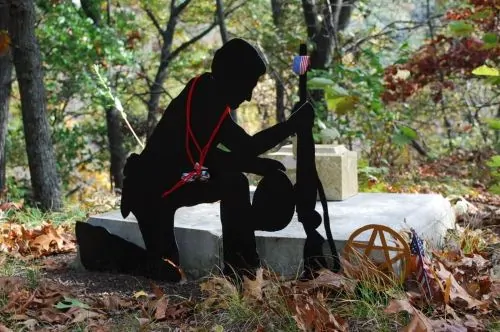
On May 1, 2007, the first four pentacle markers arrived at their destination cemeteries, according to Selena Fox’s subsequent account. Two recumbent gray granite markers, honoring Patrick Stewart and Jerome Birnbaum, went to Circle Cemetery at Circle Sanctuary’s nature preserve near Barneveld, Wisconsin. Upright white marble headstones for the Kooimans and the O’Rourkes reached Arlington National Cemetery in Virginia. These deliveries began the physical implementation of the settlement, although arrival should not be confused with installation or dedication. The different materials and formats demonstrate how the newly available emblem entered several established forms of military commemoration. Stewart’s Wisconsin marker also needs to remain distinct from the bronze plaque that Nevada had provided for its Wall of Heroes in 2006. The earlier plaque embodied the state’s response to his widow’s request; the granite marker resulted from access to the federal program. The objects preserve successive stages of a campaign whose achievements accumulated through different institutions and in different places.
The Kooimans’ marble headstone was dedicated at Arlington on May 23. Five days later, on Memorial Day, ceremonies at Circle Cemetery dedicated granite markers for Stewart, Birnbaum, and Douglas Wilkey. These occasions allowed participants to incorporate the completed inscriptions into acts of religious remembrance. Their chronology distinguishes the government’s work of supplying a monument from the subsequent choices through which relatives and religious communities made it a focus of commemoration. The settlement supplied an administrative remedy, while the dedications gave that remedy uses determined by those remembering the dead.
A headstone dedicated at Arlington on July 4 exposed another dimension of the change. Army Captain William O’Rourke’s Christian cross and his wife Jan Deanna O’Rourke’s Wiccan pentacle identified the spouses’ respective beliefs within their shared memorial. Jan’s eligibility derived from her position as a military spouse, making this an example of the decision’s reach beyond veterans who were themselves Wiccan. Fox and Barry Lynn participated in the blessing, but contemporary reporting also recorded memories that restored Jan’s individuality amid the public importance of the occasion. Paula Johnson, who had belonged to the same religious community in Florida, recalled her work helping poor families obtain Christmas presents for their children. Such testimony placed the newly inscribed emblem beside recollections of a person’s conduct and relationships. The arrangement of the headstone likewise preserved religious differences within a marriage rather than assigning the couple a single collective identity. A comparable result appeared in California, where a bronze plaque installed at Riverside National Cemetery on June 1 carried a Star of David for Harold Hecht and a pentacle for his wife, Betty. Their son Michael told Fox that both parents’ faiths could finally receive equal acknowledgment. Alongside Micki McElya’s history of Arlington as a landscape shaped by contested understandings of national honor, these examples suggest that the practical meaning of inclusion depended partly on whose identity a monument could accurately preserve. The change accommodated differences within families as well as differences among religious communities.
By the end of 2007, the implementation extended beyond the earliest ceremonies. Fox’s May 2008 review, drawing on seventy-eight pages of VA records obtained through the Freedom of Information Act, reported twenty-one pentacle markers issued during 2007 and another five during the opening months of 2008. Her first-year total encompassed seventeen cemeteries across fourteen states, indicating distribution beyond the locations most closely associated with the litigation. These were counts of markers, rather than a tally of twenty-six Wiccan veterans, since some inscriptions represented spouses or married couples. The figures document the remedy’s use without establishing how every individual application proceeded.
Contemporary testimony also suggests a change less conspicuous than the public dedications. Speaking at Arlington in July, Fox reported hearing from people who were obtaining pentacle markers without requiring her intervention in another dispute. Her observation provides limited but significant evidence that access was beginning to extend beyond applicants whose cases had attracted organized advocacy. For subsequent families, the emblem could become an available selection within the marker application process, reducing the need to turn an individual memorial request into a public campaign. Thomas W. Laqueur’s work on the cultural significance of burial places helps explain why this administrative development mattered after the immediate controversy subsided. Cemeteries and their inscriptions participate in constructing the communities through which the living understand the dead, giving durable form to identities that might otherwise depend on personal recollection. Applied here, that insight directs attention to what remained after the ceremonies ended. Visitors could encounter a pentacle attached to a named person and a record of military service, even without knowing the dispute that had made its inscription possible. The campaign’s practical achievement would be sustained through the government’s capacity to provide that identification repeatedly, as further families requested it.
Was This a Struggle for Religious Legitimacy or Equal Administration?
The following video from navilor presents older news coverage of Wiccan veterans working for headstones:
The strongest objection to interpreting the pentacle campaign as a struggle for religious legitimacy concerns what the government was entitled to decide. Wiccan religious life did not acquire its validity from the Department of Veterans Affairs, and its legal protection had a history that preceded the memorial dispute. In Dettmer v. Landon in 1986, the Fourth Circuit accepted that the Church of Wicca constituted a religion for First Amendment purposes, even while vacating an injunction concerning a prisoner’s access to ritual objects. That divided result distinguished recognition of a religious claim from acceptance of every requested accommodation. The decision governed a different institutional setting, but it makes 2007 an untenable starting point for Wicca’s standing in American law. Military guidance and actual arrangements for Wiccan worship further undermine any account of a previously unrecognized religion finally entering official awareness. Describing the settlement as the moment when Wicca became legitimate would also concede too much authority to the institution whose conduct the plaintiffs challenged. Their demand rested on rights they maintained they already possessed, rather than on the possibility that an agency might eventually find their faith deserving.
Differences among federal institutions also require care. Providing opportunities for worship among serving personnel and supplying standardized memorial markers involved separate responsibilities, administered through different procedures. Accommodation by the military made the VA’s resistance more conspicuous, but did not automatically establish the legal inadequacy of every requirement in the memorial program. The stronger comparison concerns applicants dealing with that same program, where Humanism and numerous minority traditions already had approved emblems. That evidence directs attention toward the administration of an existing pluralistic benefit and away from an undifferentiated claim that the federal government refused to recognize Wicca.
Cécile Laborde’s account of religion in law supplies a useful framework for developing this objection. She argues that legal protections should be assessed through the values they safeguard, rather than through their success in capturing the complete meaning of religion. Applied to the pentacle dispute, that approach asks whether the marker program treated comparable commitments fairly and allowed eligible families to represent the deceased accurately. It does not require the VA to produce a comprehensive definition of Wicca or pronounce upon its spiritual worth. Nor does the existence of an approval procedure, by itself, establish an injury. A government responsible for manufacturing durable inscriptions can reasonably require reproducible artwork and verification that an applicant qualifies for the benefit. The historical difficulty arises when such requirements cease to explain the treatment applicants receive, or when administrative discretion allows some requests to advance while others remain unresolved. On this reading, the campaign sought an accountable application of public standards whose legitimacy depended on their consistent use. The presence of secular emblems reinforces the point, since the program already extended beyond affirming belief in a deity. Its governing purpose could accommodate diverse convictions without treating theological approval as a condition of inscription. Equal administration is a substantial interpretation of the campaign in its own right, rather than a diminished version of a more dramatic struggle for acceptance.
Explanations of the delay must observe a related evidentiary limit. Unequal processing, statements reported from discovery, and the plaintiffs’ accounts provide grounds for investigating prejudice, but they do not establish an identical motive behind every administrative action across the decade. The settlement supplied enforceable relief without producing findings resolving those questions through a judgment on the merits. A defensible historical interpretation can identify the disadvantage imposed by prolonged inaction while leaving the responsibility of individual officials, and the relative contribution of hostility and institutional dysfunction, open to further documentary investigation.
Administrative equality nonetheless operated in a setting where official classifications could influence how a religion appeared in public life. Elizabeth Shakman Hurd’s work on the governance of religion, developed principally through international examples, helps explain why an institution’s limited jurisdiction does not make its classifications socially insignificant. Authorities can shape which religious identities become readily recognizable within their programs without possessing the power to create those identities. In the memorial system, the relevant distinction governed access to an inscription supplied through a public benefit, giving procedural decisions an enduring commemorative expression. “Institutional legitimacy” remains useful here only if its scope is carefully specified. It describes acceptance within this federal practice, without implying that Wiccans previously lacked religious standing or that the settlement secured general social approval. The revises my central interpretation by locating the dispute in the uneven implementation of an already established claim to equality. Recognition mattered because an existing religious identity could finally receive the same administrative treatment available to other convictions within the nation’s memorial provision.
Conclusion: Whose Faith Could Be Remembered?
The pentacle campaign revealed a mismatch between the grounds for receiving a military memorial and the conditions governing its religious inscription. Eligibility rested on service and the rules of the veterans’ benefit, yet obtaining the requested identification could require years of advocacy when a family’s emblem remained outside the approved catalog. Between the first applications in 1997 and the settlement in 2007, that mismatch drew grieving relatives into a dispute extending well beyond the arrangements they initially sought to make. Their efforts connected individual memorial requests to a larger question about the administration of religious equality. The eventual addition of the pentacle changed what the government would supply, allowing information about a person’s faith to accompany the military details already eligible for inscription. No corresponding change had occurred in the deceased veteran’s service. The difference lay in whether the memorial program could represent that person’s religious affiliation through the same provision available to families whose emblems had already been accepted.
Delay also had a human duration that a later correction could not cancel. Rosemary Kooiman died before seeing the headstone bearing the pentacle she had sought for Abraham and herself. Her daughter continued the request into a period when neither spouse remained alive to witness its fulfillment. Their experience makes timing integral to the assessment of the campaign’s outcome. A benefit eventually delivered could meet an outstanding request while leaving the years spent pursuing it irretrievable.
Reading the applications and correspondence alongside the completed memorials changes how this history can be reconstructed. A later list of approved designs records the outcome while revealing little about the effort required to obtain it. The requests preserve the chronology of applicants’ encounters with the institution, including the distance between acknowledgment and decision. They also show that the people seeking relief participated in defining the problem, assembling comparisons and insisting that their circumstances receive an answer. Their contribution belongs within the history of the memorial program itself, rather than appearing only as a reaction to decisions made elsewhere. This perspective also sharpens the significance of the institution’s existing diversity. Military accommodation and the presence of other minority convictions on the VA roster supplied resources for challenging the pentacle’s continued absence. They demonstrated that the campaign operated within an established, unevenly administered framework of pluralism. The settlement corrected a specific disadvantage within that framework, and the subsequent markers made the correction observable. Its importance can be established through those changes without treating negotiated relief as a judicial determination of every allegation or assuming that a revised catalog transformed public attitudes toward Wicca. The surviving evidence supports an account of people securing a concrete entitlement whose commemorative meaning exceeded the paperwork necessary to deliver it.
Whose faith could be remembered was ultimately a question about the relationship between a public institution and the people its memorials named. For eligible Wiccan families, the campaign secured a means of identifying religious commitments that the government’s existing designs had failed to accommodate. The shared headstones that subsequently displayed different spouses’ emblems gave that achievement a clear expression. A common commemorative form could preserve differences within a family while continuing to mark its connection to military service. Such memorials leave a more accurate record for later visitors, who may encounter the inscriptions without knowing the controversy behind them. The campaign’s enduring significance lies in making that accuracy possible through a public benefit, allowing religious difference to remain visible within the forms through which military service was honored.
Bibliography
Affiliate disclosure: Amazon links on this site are paid links. As an Amazon Associate I earn from qualifying purchases.
- American Civil Liberties Union. “Veterans Denied Right to Post Religious Symbol on Headstones, ACLU Charges.” September 29, 2006.
- —-. “Veterans Win Right to Post Religious Symbol on Headstones.” April 23, 2007.
- Americans United for Separation of Church and State. “Americans United Presses VA for Right of Wiccans to Use Pentacle Symbol at Military Memorials.” Press release, August 3, 2006. Excerpt preserved in the Pluralism Project Archive.
- Associated Press. “First Wiccan Plaque to Be Dedicated at Nevada Veterans Cemetery.” Las Vegas Sun, December 1, 2006. Reproduced by Religion News Blog, December 2, 2006.
- Banerjee, Neela. “VA Approves Wiccan Symbols.” Deseret News, April 24, 2007. New York Times News Service.
- Berger, Helen A. A Community of Witches: Contemporary Neo-Paganism and Witchcraft in the United States. Columbia: University of South Carolina Press, 1999.
- Biber, Eric. “Two Sides of the Same Coin: Judicial Review of Administrative Agency Action and Inaction.” Virginia Environmental Law Journal 26:3 (2008), 461–503.
- Bodnar, John E. Remaking America: Public Memory, Commemoration, and Patriotism in the Twentieth Century. Princeton, NJ: Princeton University Press, 1992.
- Circle Sanctuary. “Lights of Liberty Candlelight Vigil” and “American Freedom Rally.” Circle Times, September 22, 2006. Reproduced on Ceisiwr Serith’s website, September 23, 2006.
- —-. “Veteran Pentacle Quest in DC & Media Update.” Circle Times, July 9, 2006. Reproduced in Radical Sapphoq, July 11, 2006.
- Circle Sanctuary v. Nicholson. Complaint. No. 06-C-0660-S. U.S. District Court for the Western District of Wisconsin, November 13, 2006. Reproduced in Paula Johnson, “The Pentacle Quest: Wiccan Religion in the Media,” master’s thesis, Lynn University, 2008, appendix B.
- Clifton, Chas S. “Fort Hood’s Wiccans and the Problem of Pacifism.” Paper presented at the American Academy of Religion Annual Meeting, Nashville, TN, November 20, 2000.
- —-. Her Hidden Children: The Rise of Wicca and Paganism in America. Lanham, MD: AltaMira Press, 2006.
- Cookson, Catharine. “Reports from the Trenches: A Case Study of Religious Freedom Issues Faced by Wiccans Practicing in the United States.” Journal of Church and State 39:4 (1997), 723-748.
- Council of American Witches. “Principles of Wiccan Belief.” Green Egg 7:64 (August 1, 1974), 32.
- Dettmer v. Landon. 799 F.2d 929 (4th Cir. 1986).
- Doss, Erika. Memorial Mania: Public Feeling in America. Chicago: University of Chicago Press, 2010.
- Egbert v. Nicholson. “Petition for Extraordinary Relief in the Nature of Mandamus.” U.S. Court of Appeals for Veterans Claims, September 29, 2006.
- Fiss, Owen M. “Against Settlement.” Yale Law Journal 93:6 (May 1984), 1073–90.
- Fox, Selena. “The Story of the Veteran Pentacle Quest.” Circle Sanctuary, August 27, 2006.
- —-. “Success in the Veteran Pentacle Quest!” Circle Magazine, Fall 2007.
- —-. “A Year of Veteran Pentacle Grave Markers Across the USA.” Circle Sanctuary, May 2008.
- Friedman, Howard. “V.A. Slow To Recognize Wiccan Grave Markers.” Religion Clause, March 8, 2006.
- Gardner, Gerald B. Witchcraft Today. London: Rider, 1954.
- Gwynne, S. C. “I Saluted a Witch.” Time, July 5, 1999.
- Hallam, Elizabeth, and Jenny Hockey. Death, Memory and Material Culture. Oxford: Berg, 2001.
- Hansen, Kim Philip. Military Chaplains and Religious Diversity. New York: Palgrave Macmillan, 2012.
- Herd, Pamela, and Donald P. Moynihan. Administrative Burden: Policymaking by Other Means. New York: Russell Sage Foundation, 2018.
- Hurd, Elizabeth Shakman. Beyond Religious Freedom: The New Global Politics of Religion. Princeton, NJ: Princeton University Press, 2015.
- Hutton, Ronald. The Triumph of the Moon: A History of Modern Pagan Witchcraft. New ed. Oxford: Oxford University Press, 2019.
- Klass, Dennis, Phyllis R. Silverman, and Steven L. Nickman, eds. Continuing Bonds: New Understandings of Grief. Washington, DC: Taylor & Francis, 1996.
- Laborde, Cécile. “Religion in the Law: The Disaggregation Approach.” Law and Philosophy 34:6 (2015), 581–600.
- Laqueur, Thomas W. The Work of the Dead: A Cultural History of Mortal Remains. Princeton: Princeton University Press, 2018.
- Magliocco, Sabina. Witching Culture: Folklore and Neo-Paganism in America. Philadelphia: University of Pennsylvania Press, 2004.
- McCloud, Sean. Making the American Religious Fringe: Exotics, Subversives, and Journalists, 1955–1993. Chapel Hill: University of North Carolina Press, 2004.
- McElya, Micki. The Politics of Mourning: Death and Honor in Arlington National Cemetery. Cambridge, MA: Harvard University Press, 2016.
- Nevada Office of the Military. Nevada National Guard Biennial Report, Fiscal Years 2005–2006. Carson City: Nevada Office of the Military, 2006.
- Norton v. Southern Utah Wilderness Alliance, 542 U.S. 55 (2004).
- Orton, Michael. “10 Years Later, Mustang 22 Flies On in Memorial and Memories.” Nevada Joint Force Headquarters Public Affairs, January 8, 2016.
- Pike, Sarah M. Earthly Bodies, Magical Selves: Contemporary Pagans and the Search for Community. Berkeley: University of California Press, 2001.
- —-. New Age and Neopagan Religions in America. New York: Columbia University Press, 2004.
- —-. “Wicca in the News.” In The Oxford Handbook of Religion and the American News Media, edited by Diane Winston, 289–302. New York: Oxford University Press, 2012.
- Reid, Harry. “Tribute to John Flynn and Patrick Stewart.” Congressional Record 151 (September 27, 2005): S10509–S10510.
- Sahagun, Louis. “Wiccans Want Their Star on Vets’ Graves.” Los Angeles Times, October 14, 2006.
- Shane, Leo, III. “Wiccans Wait for VA to Allow Symbol on Headstones at National Cemeteries.” Stars and Stripes, March 11, 2006.
- Stahl, Ronit Y. Enlisting Faith: How the Military Chaplaincy Shaped Religion and State in Modern America. Cambridge, MA: Harvard University Press, 2017.
- Sullivan, Winnifred Fallers. A Ministry of Presence: Chaplaincy, Spiritual Care, and the Law. Chicago: University of Chicago Press, 2014.
- —-. The Impossibility of Religious Freedom. Princeton, NJ: Princeton University Press, 2005.
- U.S. Congress. National Cemeteries Act of 1973. Public Law 93-43. June 18, 1973. 87 Stat. 75.
- U.S. Department of the Army. Accommodating Religious Practices. DA Pamphlet 600-75. Washington, DC: Headquarters, Department of the Army, September 22, 1993.
- U.S. Department of the Army, Office of the Chief of Chaplains. Religious Requirements and Practices of Certain Selected Groups: A Handbook for Chaplains. Prepared by the Institute for the Study of American Religion. Washington, DC: Office of the Chief of Chaplains, n.d.
- U.S. Department of Defense. “Accommodation of Religious Practices Within the Military Services.” Directive 1300.17. February 3, 1988. Incorporating Change 1, October 17, 1988.
- U.S. Department of Veterans Affairs. Application for Standard Government Headstone or Marker. VA Form 40-1330. August 2005.
- —-. “Headstone and Marker Application Process.” Proposed rule. Federal Register 72:12 (January 19, 2007), 2480–2484.
- “Uday Singh: First Sikh to Die in Battle of Iraq as a U.S. Soldier.” NRIInternet, July 7, 2004.
- United States. United States Code. Title 5, sections 702 and 706. 2006 edition.
- Waggoner, Ed. “Taking Religion Seriously in the U.S. Military: The Chaplaincy as a National Strategic Asset.” Journal of the American Academy of Religion 82:3 (2014), 702-735.
- Williams, Rhys H. “Religious Social Movements in the Public Sphere: Organization, Ideology, and Activism.” In Handbook of the Sociology of Religion, edited by Michele Dillon, 315–330. Cambridge: Cambridge University Press, 2003.
Originally published by Brewminate, 11.06.2026, under the terms of a Creative Commons Attribution-NonCommercial-NoDerivatives 4.0 International license.
About the Author