Beside Tenochtitlan stood the greatest market in the Mexica world, where thousands traded daily under judges and inspectors while Spanish observers marveled.

By Matthew A. McIntosh
Public Historian
Brewminate
You heard the Tlatelolco market before you reached it. Bernal Díaz del Castillo, writing as an old man long afterward, remembered the murmur of the crowd carrying across the water, and when the Spanish party looked down on the plaza from the great temple in November 1519, soldiers among them who had campaigned in Italy said they had never seen a market to match it. They were conquerors taking the measure of a city they intended to seize. They were also standing at the commercial heart of the Mexica world.
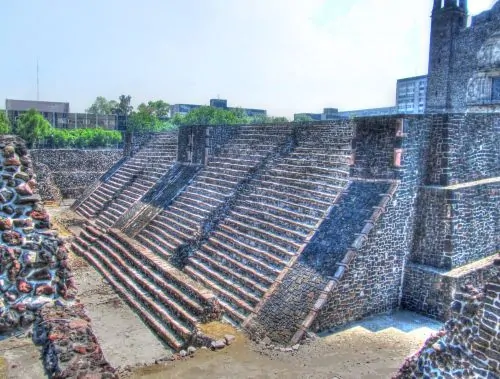
Tlatelolco was Tenochtitlan‘s twin, a separate city on the same island in Lake Texcoco until the Mexica absorbed it in 1473, and annexation never cost its market its primacy. Trade ran every day and swelled every fifth day, when the rhythm of the Mexica calendar brought in crowds from across the valley. Goods arrived by canoe through the canals and on the backs of porters crossing the causeways, since Mesoamerica had no draft animals and no wheeled transport. Hernán Cortés, reporting to Charles V, put the daily throng at sixty thousand buyers and sellers. Treat that figure as an impressed guess rather than a count, though the twin cities held, by most modern estimates, more than two hundred thousand people, and the market kept them fed and clothed.
The plaza was laid out by category, each trade keeping to its own rows. Food anchored the place: maize, beans, chiles, tomatoes, avocados, turkeys, and small dogs bred for the table, alongside stalls selling prepared dishes to shoppers who ate standing up. Money changed hands in goods themselves. Cacao beans passed as small change, standard cotton mantles covered larger purchases, and gold dust traveled in goose quills, the transparent shafts letting buyer and seller judge the amount at a glance. Beyond the food rows stood the rest of an economy. Obsidian blades took an edge sharper than steel. Potters, salt sellers, and honey merchants worked their sections near dealers in paper, rubber, cochineal dye, and jaguar skins, while the feather merchants sold quetzal and macaw plumage bound for the great featherworkers’ workshops. Slaves were offered in one section of the plaza, some of them collared and tethered so they could not run.
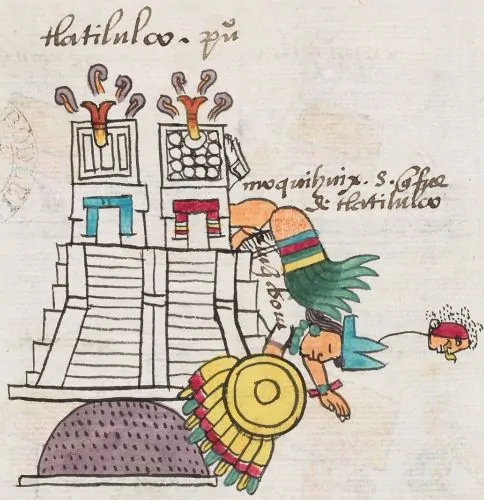
None of that order was spontaneous. Judges sat in a building at the market’s edge and settled disputes on the spot, while inspectors moved through the rows checking measures and watching the goods. Standard currencies only function if people trust them, and the Florentine Codex, compiled a generation later from Nahua informants, preserves a detailed catalog of the cheats inspectors hunted: cacao husks refilled with amaranth dough or avocado pits, mantles woven short of the standard, honey stretched with water. Punishment for theft was swift, public, and could be fatal. The orderliness that struck the Spaniards harder than the wealth was not a natural condition. It was administration, working at full stretch.
Everything known about a shopping day in Tlatelolco arrives through interested parties, and that fact deserves as much attention as the turkeys. Cortés wrote as a captain justifying an unauthorized expedition to his king, and a rich, well-governed market strengthened his case that the prize justified the taking. Díaz composed his history some fifty years after the fact, an aging settler in Guatemala who said plainly that official accounts had robbed common soldiers of their due. Both men reached for European comparisons to make the scene legible at home, a plaza twice the size of Salamanca‘s, market judges who resembled Spanish magistrates. The comparisons carry scale across the Atlantic and distort in the same motion, because the market’s deeper logic was not European. Its five-day surge belonged to a ritual calendar. Its long-distance merchants, the pochteca, formed a hereditary estate with gods and courts of their own, trading abroad and reporting back to the state. Neither Spaniard read Nahuatl, and neither thought to ask what market day meant to the women who ran the food stalls or the farmers who timed a trip to the city around it.
The market in its old form did not survive the siege of 1521, but its habits outlasted the city that hosted them. Open-air markets still rotate through Mexican towns on fixed days, sellers still group their goods by kind, and the modern word for such a market, tianguis, is simply tianquiztli carried across five centuries.
Originally published by Brewminate, 11.26.2026, under the terms of a Creative Commons Attribution-NonCommercial-NoDerivatives 4.0 International license.
About the Author