In 1008, young attendants took a moonlit boat ride in Kyoto. A month later, Emperor Ichijō watched from shore as the household turned the same pond into a stage for music and dance.

By Matthew A. McIntosh
Public Historian
Brewminate
Introduction: Two Evenings at the Same Pond
On the sixteenth night of the ninth lunar month of 1008, the moon lit the garden at the Tsuchimikado residence in Heian-kyō, present-day Kyoto. Murasaki Shikibu noticed how clearly the younger women’s dark hair stood out against their white robes. Some of Empress Shōshi’s attendants took a boat onto the pond, with a senior courtier persuaded to handle the pole. Others slipped indoors and kept glancing outside, which led Murasaki to wonder whether they envied the women who had gone out. When word came that ladies from the imperial palace had arrived, the boaters returned looking flustered. The outing occupied a brief interval in the celebrations surrounding the birth of Shōshi’s son, Prince Atsuhira.
One lunar month later, Atsuhira’s father, Emperor Ichijō, came to see Shōshi and the child. Shōshi’s father, Fujiwara no Michinaga, had boats made for the occasion and inspected them on the pond before the emperor arrived. Murasaki thought the dragon and the fabulous bird on their prows looked almost alive. During the performance, Ichijō watched from the southern gallery on shore as boats carrying musicians and dancers came into view. The anonymous account known as Fuchiki B describes a painted vessel fitted out as a dance stage and records the movements of boats as carefully as the placement of guests. The performance afloat ended at dusk, and music continued ashore. By then, attendants had set out flares in the garden and along the water. Michinaga saw that the moon was bright enough and ordered the garden flares removed so that the setting would better suit the season. His intervention depended on a familiar courtly pleasure: appreciating autumn moonlight in a garden whose paths, shore, and plantings had been arranged to reward sustained attention.
Murasaki, the author of The Tale of Genji, knew this household through her service to Shōshi. Her diary follows the imperial visit closely enough to notice the strain on the palanquin bearers and the sound of flutes and drums mingling with the wind in the pines. Fuchiki B, preserved among records of imperial births, follows orders as they pass from one official to another and identifies who carries them out. Its author also takes evident delight in the dancing and the changing light. Read together, the accounts make it possible to trace some of the work that produced the sights and sounds Murasaki remembered.
Going afloat carried a different meaning on each occasion. For the younger attendants, boarding offered a chance to spend part of the evening away from the veranda and the rooms where they ordinarily served. Their freedom to do so depended on an invitation and on someone willing and able to move the boat. For Ichijō, the place of honor was ashore, where the movements of boats and performers were arranged for his view. Elsewhere in the residence, blinds could be lifted for an attendant to step forward or left in place to keep part of a gallery screened. Each position offered its own possibilities for seeing, hearing, or being seen, and rank helped determine who occupied it. The value of following two evenings at a single pond lies in watching those arrangements change. What the younger women seized as a chance to go out, the household later organized as a sight worth staying in one place to see.
Why the Court Gathered at Tsuchimikado
When Empress Shōshi went to Tsuchimikado to give birth in 1008, she returned to a residence that belonged to her mother, Minamoto no Rinshi. Fujiwara no Michinaga had used it as his principal residence since about 991, which explains why the estate is so often associated with him. For Shōshi, it was a place where her own family could take part in preparations for her confinement. Richard Bowring identifies concern about the ritual pollution associated with childbirth as one reason for holding the delivery outside the imperial precincts. The arrangements brought palace officials into a residence where Shōshi’s parents could assume responsibilities of their own.
Michinaga was minister of the left when his daughter went into labor. Her marriage to Ichijō had already made him the emperor’s father-in-law, but the arrival of a son opened a further avenue of influence through the arrangements for the child’s upbringing. Ichijō already had a son, Prince Atsuyasu, whose mother, the late Empress Teishi, was a daughter of Michinaga’s elder brother Michitaka. After Teishi’s death, Shōshi helped raise Atsuyasu. The two boys’ connections to different branches of the Fujiwara thus coexisted with obligations of care that crossed those family lines. Atsuhira’s birth gave Rinshi and Michinaga a grandson in the imperial family and an immediate reason to concern themselves with who would attend him and how his household would be formed. His place in the succession took longer to establish. He became crown prince in 1011, when Emperor Sanjō succeeded Ichijō, and came to the throne as Go-Ichijō in 1016. For the people gathering at Tsuchimikado in 1008, the practical questions of whom the child would depend on came years before his accession.
The preparations for the delivery show how those responsibilities were shared. The anonymous Fuchiki B describes the north gallery of the main building being furnished with a white wooden dais and twelve white damask screens. Some of the furnishings had already been sent from the palace on imperial orders, and the room was prepared for use as Shōshi’s labor advanced. She gave birth around midday on the eleventh day of the ninth lunar month. Murasaki records that Rinshi cut the umbilical cord. Tachibana no Tokushi, who had served as Ichijō’s wet nurse, was chosen to give the child his first feeding. The appointment of the woman who would nurse Atsuhira afterward was a separate matter. At the birth itself, the household relied on the empress’s mother for one task and on a woman with a history of intimate service to the emperor for another.
The observances that followed gave several groups a recognized part in welcoming the child. Counting the day of birth as the first, Shōshi’s household sponsored the third-day celebration, with its master, Fujiwara no Tadanobu, overseeing the arrangements. Michinaga took responsibility for the fifth night. The imperial court sponsored the seventh, and Michinaga’s eldest son, Yorimichi, directed the observances on the ninth. A change of sponsor brought its own arrangements for provisions, furnishings, and the presentation of gifts, even as some of the same courtiers returned to carry out the work. At the fifth-night celebration, for example, four courtiers brought in caskets containing clothes and bedding for the prince and passed them to the ladies-in-waiting. The handoff joined the work of officials bringing the gifts to the work of attendants who could receive them within Shōshi’s quarters. Fujiwara no Sanesuke’s account of that evening also records his objection to a proposal for music, which he opposed on grounds of ceremonial precedent. Hosting the banquet gave Michinaga ample scope to display the resources of his household, while decisions about how to mark a birth remained open to dispute among men who knew the precedents.
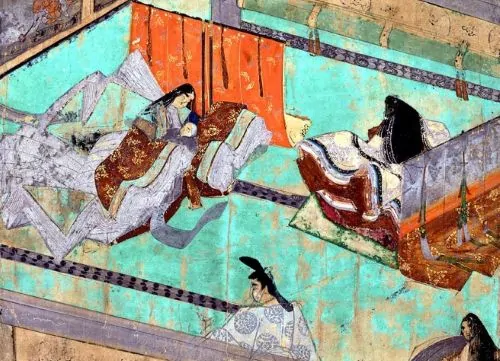
The seventh-night celebration gives some sense of what this attention meant for Shōshi. The emperor’s representative, Junior Captain Michimasa, presented her with a willow box holding a scroll that listed the gifts. She accepted it and passed it straight to her attendants. When Murasaki looked through the curtains around her, she saw a young woman reclining in the light of a small lamp, still pale and drawn. The details belong to the same evening. The imperial court addressed its honors to Shōshi, who was recovering from childbirth and depended on her attendants to carry the proceedings forward after she had formally received them. Murasaki’s place in that company allowed her to record how little of the ceremony’s outward magnificence conveyed the condition of the woman at its center.
The calendar also helps explain why so many people were still coming and going on the evening after Michinaga’s banquet. The prince’s morning and evening baths continued that day, each with an appointed reader, even though the next sponsored banquet was a day away. Shōshi’s attendants were living where court officials, family members, and visitors had business that extended well beyond a single feast. Their evening near the veranda arose from the unusual amount of time that preparations for one birth had brought them into one another’s company.
A Garden Built to Be Seen from Land and Water
In the opening of her diary, Murasaki Shikibu distinguishes the trees growing beside the pond at Tsuchimikado from the grasses along the stream. As autumn advanced, the branches and grasses took on different shades that became more vivid in the evening light. The water thus entered her account as part of a garden whose appearance altered with the season and the hour. A person looking out from the residence could become familiar with the succession of changes in a single prospect. Well before Murasaki describes anyone going afloat, she establishes why the garden was worth looking at from a place one had occupied many times before.
The pond lay immediately south of the principal buildings. The main hall and its subsidiary wings followed the aristocratic residential arrangement known as shinden-zukuri, in which covered passages linked buildings within a substantial enclosed compound. William H. Coaldrake identifies the pond and its island as artificial features and emphasizes their effect on the way people approached the residence. The expanse of water occupied ground that might otherwise have served as a direct approach from the south. The principal gates were on the east and west, and visitors entering from those directions could reach the buildings along the sides of the compound. The southern front of the hall accordingly looked out over ground set apart from the main routes of arrival. Kitchens, storehouses, and other service buildings lay behind the principal structures to the north. Richard Bowring’s reconstructed plans make these relationships easier to follow, especially when Murasaki moves from describing a room in one wing to describing what could be heard or seen across the garden.
The later Heian garden manual known as the Sakuteiki explains how much attention could go into shaping the far side of a view. It proposes islands suited to different configurations of land and water, each capable of suggesting a different kind of terrain. A low island with autumn grasses and a pale beach could recall a meadow. A grouping of old pines among rough stones evoked a rocky coast. The manual even describes how pale sand could suggest a bank of mist when seen from across a pond. Its instructions for a southern court take the sightline from the seat of honor into account when discussing the placement of an arched bridge. For the designers who worked within this tradition, the distance across a pond helped determine how much of a feature could be seen and what its outline would suggest. Those prescriptions come from a later generation of garden makers, but they identify questions of distance and placement that also arise from Murasaki’s account.
The veranda gave anyone standing on it an elevated position from which to look toward the water. The wide eaves provided cover, and intervals between the pillars admitted a view of the grounds. As Mari Akazawa explains, the furnishings of such a residence allowed several degrees of exposure. Exterior shutters could open a room to the garden, hanging blinds could interrupt a line of sight at the edge of a gallery, and portable curtains could enclose a much smaller area within the room. A person could thus remain close to the garden while the people seated nearby experienced a different degree of visibility, depending on where a partition stood or whether a blind had been raised.
An island looked different to someone approaching it by boat than it did from the veranda. From the house, its near bank could obscure a patch of water behind it. Someone afloat could pass along that bank and see the same planting first from a distance and then almost at the level of its roots. Turning back toward the buildings brought the veranda itself into view across the water. The garden was shallow enough in places for a boat to be poled, which made these changes of position possible on a domestic pond. In Fuchiki B, the island serves as a point of orientation for the music boats during Ichijō’s visit. The account places them to its south at one stage and later brings them to the northern shore. Murasaki locates the boats’ withdrawal by a different feature, the mound to the south. Taken together, the descriptions show how crews could use the breadth of the pond and the landforms around it to bring vessels within easy view and then draw them away.
Sound followed its own paths through the compound. Before Shōshi gave birth, Buddhist priests recited scriptures as part of the prayers for her safety. When the breeze rose, Murasaki found it difficult to distinguish their voices from the running stream. She could also hear the priests’ footsteps as they crossed the covered passage from the east wing to the main building. The cadence of voices and the sound of people moving across timber carried activity from one part of the residence into another. On the day of the imperial visit, drums alerted Murasaki and her companion to the approaching procession before they had reached their places. Later, she could still hear the instruments as the boats withdrew, and their sound took on a different character among the trees. Even from a fixed position, a listener could register movements that the buildings, planting, or distance allowed her to see only in part. The stream required attention in its own right. Early in the diary, Michinaga directs attendants to clear an obstruction and then plucks a spray of maiden-flowers south of the bridge. He brings the flowers to Murasaki’s curtain frame and asks her to compose a poem. Both actions belong to the same passage through the grounds, during which he attends to the running water and finds material for a literary exchange. On the day Atsuhira was born, he again ordered work on the stream, this time to clear away leaves. Taketoshi Kawahara’s study of Heian diaries places such observations alongside accounts of sweeping, transplanting, and installing lights. The ability to enjoy a particular effect of the season depended in part on people attending to the physical changes that came with it.
Michinaga’s own diary shows that the stream had already served as a setting for entertainment in 1007. For a spring poetry gathering, seats and writing materials were arranged along both banks, with places assigned by status and role. A downpour sent the company indoors. When the weather cleared, the seats were set out again and cups of wine were floated downstream. That earlier occasion demonstrates how readily the household could move an activity between the rooms and the grounds as conditions changed. By the time of Atsuhira’s birth, a fine evening offered the company assembled at Tsuchimikado the use of a garden already accustomed to receiving guests, with water close enough to become part of their recreation.
The Boat on the Sixteenth Night
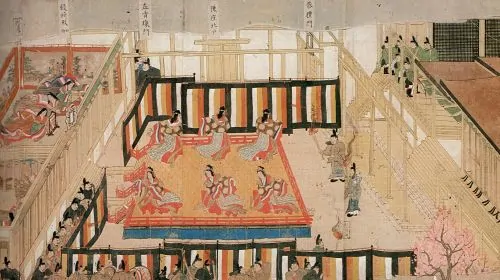
Murasaki Shikibu dates the outing by its relation to Michinaga’s banquet. It happened the following evening, the sixteenth of the ninth lunar month of 1008, when the weather was clear and the moon was bright. She introduces the younger women while they are still gathered near the veranda. Their presence there preceded any suggestion of going out, and it was this company that the invitation divided.
Murasaki names ten women near the veranda, among them Kodayū, Genshikibu, Miyagi no Jijū, Gosechi no Ben, and Kohyōe. The names are the kinds by which attendants were known in service, where a designation might recall a court office held by the woman herself or by a member of her family. Two of the women had already appeared in Murasaki’s account of the previous night. Genshikibu and Kohyōe were among eight younger attendants whom Michinaga selected to carry white trays before Shōshi and then sit in facing rows beside her dais. They had put up their hair with white ribbons, and Murasaki remembers some of the women complaining about how exposed they felt in their assigned places. Readers who encounter Genshikibu and Kohyōe again by the veranda can recognize them as women whose duties had placed them together the evening before. The ten names identify the company before the invitation, and the diary leaves the individual boarding decisions open.
Michinaga’s son Norimichi and Minamoto no Tsunefusa, whom Murasaki identifies as adviser of the left, encouraged the younger women to go onto the pond. Fujiwara no Kanetaka, the adviser of the right, was persuaded to pole the boat. The previous night’s ceremonies supply a glimpse of how these men already dealt with the women of Shōshi’s household. The anonymous Fuchiki B places Tsunefusa and Kanetaka among the courtiers who carried in caskets of clothes and bedding for the prince and handed them to the attendants. On that occasion, the exchange gave the women charge of objects that the men had brought to the point of presentation. On the following evening, people accustomed to meeting over household business could ask a favor or extend an invitation for their own enjoyment. Norimichi’s standing as the host’s son helps explain why he could take the initiative with his father’s guests and attendants close by. Kanetaka’s contribution was more immediate, since someone had to take the pole before the women who boarded could get away from the edge. A senior courtier’s willingness to do that work is one of the few details Murasaki preserves about how the ride itself was accomplished.
The young women went out in the white clothing still worn for the birth observances. Hitomi Tonomura places such clothing alongside the white furnishings used around an aristocratic delivery, and Murasaki records the household’s return to colored dress two days after the outing. The shared color still allowed distinctions of fabric and finish appropriate to different stations. What Murasaki singles out on the water is the clarity with which the pale clothing set off the women’s dark hair, an effect she thought colored garments would have softened. A convention that had governed their appearance when they stood before Shōshi furnished the most memorable detail of their evening away from her rooms.
Word that carriages had reached the northern guardhouse changed the company again. The new arrivals were women from the imperial palace, and Murasaki recalls hearing that Lady Chikuzen and Lady Sakon were among them. She qualifies her recollection because she could identify only some of the visitors by sight. Her uncertainty is worth setting against the ease with which she names the women who had been near the veranda. As Haruo Shirane explains, the great Fujiwara families invested in the retinues of their daughters at court, and Shōshi’s attendants formed a circle with its own daily associations. An imperial consort’s establishment and the emperor’s palace could bring women together for a visit even when they seldom went about their duties in one another’s company. The women who had gone boating came in looking flustered. Michinaga, whom Murasaki depicts as entirely at ease, came to sit with the visitors, welcomed them, and joked with them. Gifts followed according to rank. The women’s return and the host’s composure show different responses to an arrival that brought the evening under the expectations of a formal reception.
Richard Stanley-Baker places this incident alongside the boating in the “Butterflies” chapter of The Tale of Genji, where going out on a garden pond belongs to a recognizable repertoire of aristocratic pleasures. That familiarity helps explain how much Murasaki can convey with a brief account of an invitation and a courtier taking up a pole. She also makes room for women who withdrew before the boat went out. Their intermittent looks from indoors suggest how an outing could hold the attention of people who had stayed behind.
Looking Out from Inside
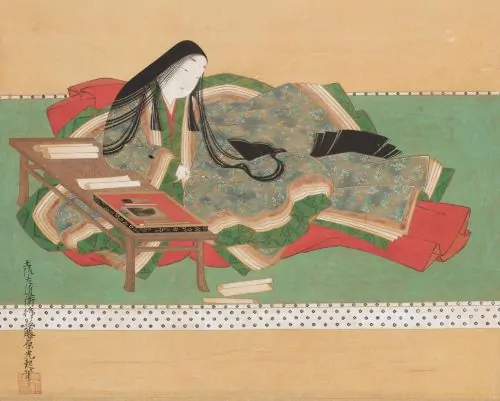
Some of the younger women slipped indoors when their companions went out on the pond. From there, they kept looking back toward the garden. Murasaki Shikibu follows their attention after the company has divided, giving the women who stayed behind a place in her account of the outing. Their interest in what happened outside continued after they had withdrawn.
Murasaki puts a question about envy between the women’s withdrawal and her account of their repeated glances. The Japanese wording makes the feeling conjectural and the looking recurrent. Annie Shepley Omori and Kochi Doi’s early English translation introduces another circumstance by describing the women as “neglected.” That word suggests that the people arranging the ride passed them over. In the Japanese, the women themselves slip away and remain behind. Murasaki gives their withdrawal a recognizable form while leaving its reasons open. They could have been interested in the boat and still preferred to stay in the house, or they might have reconsidered after seeing their companions depart. The diary supplies the behavior from which either reading would have to proceed. Its account is most revealing where Murasaki lets a small gesture suggest a feeling whose existence she can only surmise.
The passage gives a clearer impression of the light outside. Murasaki draws together the pale surface of the court, which Richard Bowring renders as white sand, and the way the people in the garden appeared under the moon. The description belongs to the grounds as a whole, while the women’s glances are directed outward from an interior whose openings are left unspecified. The text thus establishes a direction of sight with greater precision than it establishes any individual field of view. The women may have seen different parts of the garden as they looked out, even while following the same outing.
On other occasions Murasaki describes the act that made someone visible. At Michinaga’s banquet the previous evening, she opened the screens around the priest on night duty to show him Shōshi. Struck by the empress’s appearance, she wanted him to see her for himself. He paused his devotions, rubbed his hands, and expressed his delight. Here an attendant took the initiative in giving another person a view, and her account identifies who altered the screen and whom the change was meant to reveal. A later celebration for Atsuhira shows how differently a boundary could be handled when the people seated on either side had competing wishes. On the prince’s fiftieth day, the women rolled up their blinds when the nobles took their places, with separate curtains still between the two groups. Akimitsu, the minister of the right, leaned forward and pulled those curtains apart at the seams, nearly tearing them. The women voiced their displeasure among themselves, and he paid little heed. Their initial action had opened the gallery to a degree they could determine, while Akimitsu’s intervention showed how little authority they could exercise once a senior courtier decided to widen the opening.
Joannah Peterson’s study of the twelfth-century Genji Scrolls offers a way to think about the position of an observer in court literature. Reading the paintings alongside their accompanying texts, she shows how ladies-in-waiting gather knowledge through partial views and overheard speech. One attendant’s role in a scene becomes intelligible through what she can hear beside a partly open sliding door. The scrolls represent a fictional court from a later period, and Peterson’s analysis helps identify a question worth asking of the diary. What could a person follow from a position that seems peripheral to the main event? At Tsuchimikado, the answer can be modest and still matter. The women indoors had enough access to the scene to keep turning their attention toward it, and their interest was itself apparent to someone else in the household.
The outing gave Murasaki an occasion to notice where people looked when their places had been settled by a series of small decisions. An imperial reception would make the placement of spectators a matter of advance preparation. Officials would attend to who could approach the viewing area and when a part of the residence could be opened. Before any such arrangements came into use, Michinaga had work to do on the house, the grounds, and the boats he meant to put before his guest.
Boats Built for an Emperor
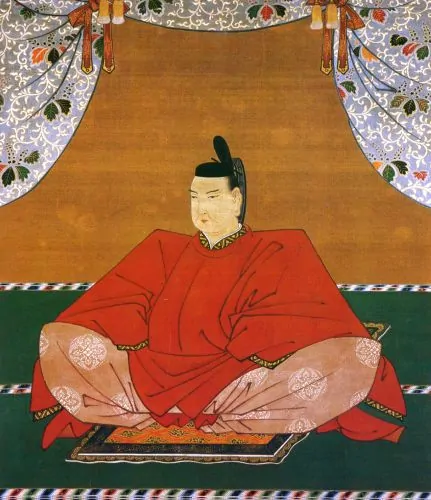
As the date of Ichijō’s visit approached, repairs and polishing went ahead at Tsuchimikado. Murasaki Shikibu records the work in a few words, as part of the change in daily activity before the emperor was due. The residence still housed Shōshi, the infant prince, and the people who served them. Work for the visit had to proceed around their routines, under a deadline set by the arrival of the imperial party.
The chrysanthemums give a sharper sense of what could be done to ready the estate in a short time. Unusual specimens were ordered and transplanted, bringing flowering plants into the garden where they could be arranged for immediate effect. Murasaki saw them through wisps of morning mist and distinguished yellow blooms at their height from others already fading into different shades. The variation was part of what pleased her about the arrangement. She also found herself thinking that old age might be held off, a response that drew on an established association between chrysanthemums and longevity. Two days before Atsuhira’s birth, Lady Hyōbu had brought her some silk floss from Rinshi that had been moistened with dew gathered from chrysanthemums. In the observance associated with the ninth day of the ninth month, a person who wiped herself with the floss could hope to ward off the effects of age. Haruo Shirane situates the flower’s promise of long life within the seasonal culture of the court. The newly transplanted flowers carried an association that had already passed between women in the household as a wish for someone’s well-being.
The preparations also gave Murasaki occasion to record a more private response to the garden. At dawn, she saw waterfowl moving about the pond with an apparent ease that prompted her to write a short poem. In it, she joined the birds’ literal floating to her own sense of living in an unsettled world. As Eiji Ueno observes, her attention then turned back to the birds, whose apparent freedom from care led her to imagine that they might suffer as she did. The activity around the residence gave her ample reason to register the occasion as auspicious. Her poem preserves what else the pond brought to mind during the days in which it was being readied for a celebration.
On the day of the visit, Michinaga had the new boats poled over to where he could examine them. Murasaki says they had been made for the occasion, and she records them at the point when the finished work was already afloat. The heads at their prows seemed almost to have come alive. Her reaction is evidence of what the workmanship looked like in use, when the movement of the vessels gave the carved forms a motion of their own. Having the boats brought within view also let Michinaga judge how they would appear to a spectator on land. Later, they would carry part of the entertainment past people whose places had been assigned in advance. The anonymous Fuchiki B identifies polers and boatmen among those who worked aboard during the performance. The builders’ names and the circumstances of construction remain unknown. The inspection is the point at which the diary makes their contribution visible, just before the crews and performers put it to use. The boats had to carry the people who would make the music and give the spectators something worth looking at before a note was played.
The paired prows belonged to an established tradition. One carried a dragon’s head, while the other bore the head of a geki, a fabulous waterbird. In Chinese lore the dragon commanded waves and the bird could withstand the wind, qualities that gave the pairing a protective association for people traveling by water. At Tsuchimikado those forms could be recognized from the shore of a shallow pond, where the boats were to serve as platforms for court entertainment. The practice of putting musicians afloat was itself familiar in aristocratic circles before 1008. As Michiko Hirama notes, Michinaga’s elder brother Fujiwara no Michitaka had arranged boat music during the celebrations of their father Kaneie’s sixtieth birthday in the late tenth century. The vessels inspected at Tsuchimikado were newly made, and part of what made them suitable for the visit was how readily their forms and purpose fit an occasion the court already knew how to enjoy.
Inside the residence, the women were preparing to appear before people whose places in the building affected how much care was expected of them. Murasaki had heard that the procession would arrive at about eight in the morning, so dress and face powder had occupied her company since dawn. Lady Koshōshō came early, and she and Murasaki dressed and arranged their hair together. With the nobles assigned to the west wing, Murasaki found her side of the residence quieter than it usually was on such occasions. She heard that the women serving Michinaga’s second daughter had been obliged to take more than their usual care over dress. That report suggests how unevenly the preparations fell even within one residence. As Ayako Moroi’s study of formal jackets shows, permissions concerning colors and fabrics distinguished women serving in different positions, a matter Murasaki would notice in her account of the visit. Getting ready meant judging how to appear within those distinctions and allowing enough time for the work involved. The preparations still depended on the attendants’ estimates of when the procession would actually arrive.
Murasaki and Lady Koshōshō expected the customary delay and were still waiting for new fans to replace the ones they found unremarkable. The sound of drums caught them before they were ready to leave in the manner they had intended. They hurried to their places with what Murasaki remembered as a want of dignity. The time for choosing how to present themselves had ended while they were still getting dressed for it.
Ichijō Watches from the Southern Gallery
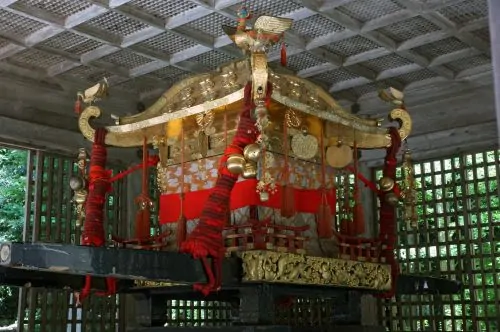
The courtiers accompanying Ichijō assembled on the palace grounds before his departure for Tsuchimikado. The Office of Keys brought out a list of names and ranks and then retired. Fujiwara no Kinsue took his place near the foot of the steps and gave the order for the bearers to rise once the emperor was inside the palanquin. The work of placing people around Ichijō began before Michinaga received him.
The procession went out through the palace’s east gate, turned north, and then followed Jōtōmon’in Avenue eastward. Court musicians began to play as it passed the northern gate of Tsuchimikado. At the west entrance, preparations had been made for a pause outside the compound. The gate guards of the left stood outside the wall, with the military guards of the left posted in a corresponding position within it. Gentlemen-in-waiting had lined up farther inside, near a standing screen. Michinaga then told those waiting that the palanquin would proceed directly to the southern steps. The receiving line had to be formed anew in the garden, where the courtiers stood facing east and were ranked from north to south. The change concerned where the emperor would stop, and it altered where the people waiting to receive him would make their appearance. As the palanquin entered to the sound of instruments in the garden and on the water, the people who had assembled to meet it had already been moved into a new order.
Kanetaka and Tsunefusa left the line to stand by the palanquin. Murasaki locates the chair set out for Ichijō in the eastern part of the southern gallery and describes the blinds farther east, where the ladies-in-waiting were to sit. The blind beside the southernmost pillar was raised slightly to allow two palace attendants to come forward. Kanetaka handed over the regalia, with Saemon no Naishi receiving the sword and Ben no Naishi the jewel in its casket. The opening was just wide enough to permit the transfer at the appointed place. For those who could see the attendants, it also gave a brief view of women whose duties brought them across the screened boundary.
Murasaki’s description of the handmaids shows how much she could make of such an appearance. The part of Saemon no Naishi’s face visible around her fan, together with her bearing, gave Murasaki an impression of vitality. Ben no Naishi looked nervous, and Murasaki judged her the more stylish of the two, down to her choice of fan. The women’s ceremonial responsibilities made them conspicuous for a moment, while their clothing marked distinctions whose significance depended on knowing what they were permitted to wear. As Ayako Moroi argues, the handmaids’ short outer jackets were plain in weave, a feature that could distinguish them from garments in similar colors made of figured silk. Elsewhere in the gallery Murasaki remarks on the younger women’s skill in arranging the differently colored layers visible at their cuffs. The layered garment gave an attendant scope for showing taste within the rules that applied to her dress. A pillar, by contrast, obstructed Murasaki’s view of Tachibana, who served the meal. Murasaki describes what she thought Tachibana was wearing with a qualification about how much she could see. The architectural detail matters because it lets the reader distinguish a garment observed closely enough to judge its workmanship from one whose appearance the diarist could only piece together.
After Ichijō entered, the nobles and senior courtiers went to separate galleries. At Yorisada’s direction, a guard captain lowered the blinds before the emperor changed his robes and received Atsuhira. As the indoor proceedings gave way to the entertainment, the same captain raised them on a further order, with five bays of the southern gallery still screened. Attendants brought in a newly made rosewood throne inlaid with mother-of-pearl and placed it in the fourth bay. It stood on red brocade, with a rosewood table on either side. Ichijō came outside and had Yorisada summon the nobles, who took their places on round cushions on the veranda. People who had been seated in different parts of the residence were now assembled along the front of the building for the performance. The imperial place was fixed within the southern gallery, facing the pond from shore.
The two music boats made their circuit and came to a halt in turn along the northern bank. From the gallery and veranda, that bank was the near edge of the water. Ichijō watched from the residence as the boatmen brought the performance within view. Once the audience had taken its places, the movement that mattered was on the pond.
Music Across the Water
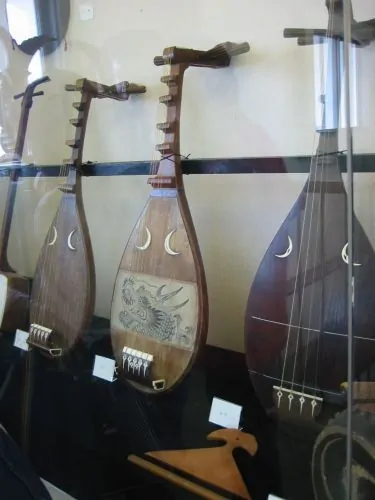
Ichijō heard music from the pond as he approached the residence. At that point, the music boats were stationed south of the island, and instruments also sounded from the garden. The first music of the visit accompanied his arrival. Later, the boats returned to give the assembled company a performance it could watch from shore.
The movements of the boats in Fuchiki B help establish the difference between these two uses of the pond. After the emperor had gone inside and the nobles had taken their first places, the music boats pulled away. By the time the company was summoned to the veranda, the vessels were ready to make a circuit back to the northern shore. They halted there in succession. The writer also describes a painted vessel whose deck served as a stage for young women to dance. Another boat carried musicians with brocade hung behind them, giving the players a distinct setting in the view from shore. The arrangement gave the dancers a deck of their own while keeping the accompanying music within earshot. Flutes and drums sounded, and the company heard singing as well. Much of the movement the writer finds worth describing came first from the vessels taking their places and then from the dancers once those places were established.
The practices of Heian court music help explain the variety of what the household could present on a single occasion. Gagaku encompassed instrumental music as well as traditions that involved dance or song. Bugaku designated dance with musical accompaniment, and its repertory incorporated forms transmitted through China and the Korean Peninsula and cultivated at the Japanese court. Instrumental ensembles could also play apart from dancing. A change in what the audience saw could thus accompany a change in the function of the music, even when instruments continued to sound.
The two accounts agree in naming Manzairaku, the “Dance of Ages” in Richard Bowring’s translation. Murasaki also names the “Dance of Peace” and the “Hall of Felicitation.” She follows these with Chōgeishi, which Bowring renders as “Great Joy,” identifying it as music for departure. Fuchiki B follows its mention of the “Dance of Ages” with “Earth Everlasting” and “The Tipsy Dance.” Michinaga’s diary adds a further account, summarized by Bowring as two Chinese and two Korean dances. Since the dances Murasaki identifies belong to the Chinese repertory, Bowring raises the possibility that she was mistaken about at least part of what she heard and saw. The accounts may also preserve different portions of a lengthy entertainment. William and Helen McCullough identify Murasaki’s three named dances as pieces performed by men in Michinaga’s time, a further reason to leave open the repertory of the young women on the painted boat. Each account establishes something about the performance, from a title they share to the gender of dancers on a particular vessel. A complete running order remains uncertain, even though the writers give enough detail to distinguish dancing, singing, and the instrumental music that accompanied the close.
Murasaki follows the sound past the point where the performance could be watched clearly. As the boats skirted the southern mound and drew away, the instruments seemed to belong increasingly to the sounds coming from among the trees. Her attention moved to the stream entering the pond and to the ripples the wind raised on its surface. She also noticed the evening turning cool and remembered Lady Sakyō expressing concern at how lightly Ichijō was dressed. These details give the withdrawal a duration that a list of compositions can scarcely convey. The performance was still audible as the people who had been watching it began to notice other things about their surroundings.
The author of Fuchiki B describes the pond’s waterweed swaying as the music continued. He then evokes the music of the Yellow Emperor and the song of the Fen River. The first image has a parallel in the Zhuangzi, where the Yellow Emperor speaks of music he tuned to Heaven. The second recalls the “Song of the Autumn Wind,” traditionally attributed to Emperor Wu of Han, in which pipes, drums, and singing accompany an imperial excursion on the Fen. These are comparisons the writer brings to the occasion after giving the names of pieces in the program. They place the sound on a Kyoto estate in the company of celebrated performances from the Chinese literary past. The writer’s pleasure in what he heard could thus take the form of a judgment about what the present was capable of producing. Near the end of the account, after the music had moved ashore, he wondered whether the past had ever heard anything to equal it.
When the dances on the water ended at dusk, the evening’s music continued on land. Yorisada called the musicians before Ichijō, and some of the nobles on the veranda joined in. Fujiwara no Kintō marked time, Michikata played the biwa, a plucked lute, and Narimasa played the flute. Music now came from the veranda and from below it. Men who had been sitting in attendance became participants when the place of performance moved to where they were.
The Work of Making the Evening Look Effortless
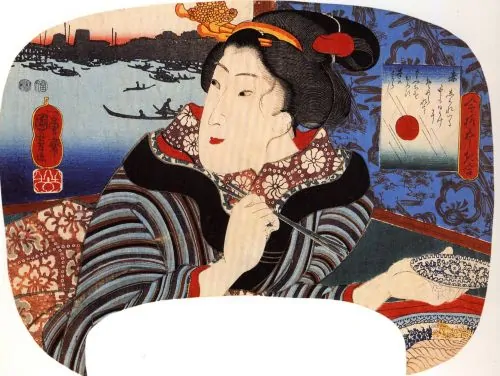
At dusk, Michinaga asked Masamichi to give the order ending the music and dancing on the pond. Masamichi went to the head of the water to announce it. His position mattered because the people who had to act on the order were spread across several boats. The entertainment could change course at the host’s direction because someone knew where to stand to make that direction heard.
Murasaki Shikibu had noticed a more strenuous part of the occasion when Ichijō arrived. The palanquin bearers lifted the imperial conveyance up the steps and then prostrated themselves beneath it. She describes them as men of low standing and says they looked distressed. The halt at the steps meant that their work continued after the work of carrying the emperor was done. They still had to take the position required of them in his presence. Murasaki had just expressed delight at the music that welcomed him, and within a few lines she asks herself, “Are we really that different?” Eiji Ueno draws attention to the movement from observing someone else’s difficulty to examining her own position. Women who spent their days in the company of the nobility had duties of their own that left little room to decide what they would do or how they would appear. The common ground Murasaki finds is the obligation to perform an assigned role even when the people being served have little reason to notice what it costs.
On the pond, some of the work of handling the vessels was made part of the display. Fuchiki B says that the polers and boatmen aboard each craft wore costumes appropriate to court music. Their clothing gave them a place in the appearance of the show even as they carried out the practical work of bringing vessels into position. A dance platform set on a hull still had to be kept where the audience could see it. When the boats halted by the shore, the apparent stillness of the stage depended on people working with poles and oars. The writer records those people by the jobs they did.
The service of food reveals how often the same attendants changed assignments over the course of the visit. Indoors, Tachibana no Tokushi supervised Ichijō’s meal, which other attendants set out. Tsunefusa helped the emperor change his robes after the meal. During this interval gentlemen-in-waiting and other attendants served drinks to the nobles. When refreshments were brought to the company gathered for the entertainment, Shōshi’s household furnished the trays and arranged cakes and dried fruit on silver plates with rosewood stands. The care lavished on the service ware meant that members of the audience saw the arrangement already assembled when it reached them. The account identifies courtiers of fifth rank and below among those who served. It also names Michitsuna as the person in charge and includes Tsunefusa and Kanetaka among those who served the company. Both men had attended the palanquin earlier, and Tsunefusa would take up the pipes when the music moved ashore. A title identified where a man stood in the court hierarchy, while the record of his movements shows the several forms of service he could be called upon to perform in a single day.
Before Yorisada summoned the musicians to appear before Ichijō, the Bureau of Housekeeping, or Kamon-ryō, had set out cushions for them. Men from the Secretariat served them food. The bureau was part of the imperial household administration, whose offices could be called into service at aristocratic residences. As Motoo Endō shows, elite households drew on court bureaus through several channels of authority and personal obligation. At Tsuchimikado, the effect of that cooperation was concrete. By the time the musicians were called forward, a place to receive them had already been prepared.
The lighting required several different assignments. At dusk, the Bureau of Grounds, or Tonomo-ryō, set out flares in the garden, while the household handled the lights on the islands and along the shore. The bureau then supplied flares to the boats before they withdrew. Their lights allowed the spectators to follow the vessels as they moved away into the dark. To the writer of Fuchiki B, their gradual disappearance resembled the setting of the sun. The next change in lighting came after the musicians had assembled ashore. Michinaga saw that the moon was bright and told Hironari to have the garden flares removed so that the company could enjoy the light suited to the season. Hironari passed the instruction to the Bureau of Grounds, whose men had put those flares in place. The same staff could furnish one kind of view at dusk and clear the way for another once the moon was bright enough.
After the flares were removed, the writer describes clear moonlight falling on the islands and the pond. By then the company had seen the boats withdraw with lights aboard and heard the music resume on shore. The last view depended on people returning to the garden to take away equipment they had only recently set out. Knowing when to remove something was part of the work of receiving an emperor.
Hospitality and the Prince’s Place in the Imperial Line
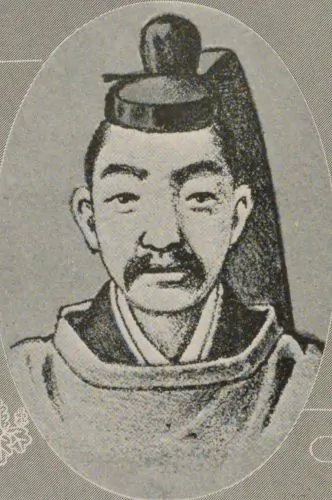
At Tsuchimikado, Michinaga brought his grandson to Ichijō in his arms. Fuchiki B says that the emperor played with the infant for a while before Michinaga took him away. Murasaki remembers Atsuhira giving a little whimper as his father took hold of him. She next places the child in the western chamber, in the quarters of his maternal grandmother, Rinshi.
Fuchiki B records a formal act of recognition later in the visit, after the emperor’s meal and before the performance on the pond. The chamberlain Michikata informed Michinaga that Atsuhira had been admitted to the imperial line. The proclamation conferred the standing of an imperial prince, or shinnō. Selection as crown prince was a separate act and came several years later, under Emperor Sanjō. On this day, the announcement gave the maternal family an occasion to acknowledge a grant made by the sovereign. Men of the Fujiwara assembled near the Bodyguards of the Left, had Michikata convey their thanks, and performed a short ceremonial dance. Murasaki specifies that the men who bowed in gratitude belonged to the main line of the family and that members of other Fujiwara branches were excluded. The privilege of offering thanks therefore helped define which relatives could appear collectively on the prince’s behalf. Kentarō Higuchi identifies a later visit, in 1075, when Ichijō’s grant to Atsuhira was cited as a precedent for conferring imperial princehood at an aristocratic residence.
Recognition also brought decisions about who would have responsibility for the child’s establishment. A decree of the same date appoints Fujiwara no Tadanobu superintendent of Atsuhira’s household. Tadanobu already headed Shōshi’s household office, so the appointment gave an officer familiar with her affairs charge of the new prince’s establishment. Fuchiki B records him rising to perform his own dance of thanks. Murasaki reports further decisions on the prince’s staff the following morning and remembers being vexed that she had received no warning of them. Attendance at the celebrations gave her a close view of the family while leaving her dependent on others for news of appointments that mattered to her.
The gifts made after the music followed another order of precedence. Three courtiers approached Ichijō with instruments, named each offering, and left them with his secretary. The dragon flute was presented with a silver chrysanthemum branch, and the other instruments had ornaments of their own. The choice allowed the host to give the emperor objects suited to the entertainment he had just heard. A wider distribution followed, with the kind of gift varying by rank and office. Ministers and other high courtiers received robes, while groups farther down the order received garments dyed in different colors. Officials and servants in several categories received lengths of silk. For the guards of the lowest rank, the gift was Shinano cloth. What each recipient could carry home made the distinctions among people gathered for the same visit visible in a form that would outlast the evening.
Promotion was another benefit, and the two accounts describe it from different points in the proceedings. In Murasaki’s account, Ichijō calls Akimitsu forward after the music and asks him to write out a list of promotions. She says that the eligible officers serving Shōshi and Michinaga were advanced and reports hearing that Michikata had prepared a preliminary list. Fuchiki B likewise places a discussion of advancement after the entertainment, recording Ichijō’s wish that members of Shōshi’s household and their sons be raised a rank. It follows the exchanges of refusal and acceptance and closes with a skeptical comment about how eagerly ministers took the opportunity for promotion. The accounts place the thanksgiving differently, since Murasaki recounts the Fujiwara obeisance and the dance led by Tadanobu and Sanenari after the music, while Fuchiki B records thanks for the prince’s recognition before the performance. A dated decree secures Tadanobu’s appointment on the day itself. The narratives preserve different moments at which the family’s gratitude, an officer’s new responsibilities, and the advancement of people in service became apparent to those present.
Murasaki also records a less formal way in which the company expressed its hopes for Atsuhira. When a musical passage caught her attention, the infant gave a cry. Akimitsu heard it as harmonizing with Manzairaku, the “Dance of Ages.” Fujiwara no Kintō and others voiced a line wishing joy for ten thousand ages and a thousand autumns, a line he later included in his anthology of Chinese and Japanese verse. The company could take up Akimitsu’s remark because the dance and the verse supplied a familiar language of congratulation. For a moment the child contributed to his own celebration in the only voice he had.
Memory could be harder to accommodate. Shortly before the exchange about the prince’s cry, Lady Chikuzen recalled earlier imperial visits to the residence and began to speak about particular occasions. The other women avoided answering her. Murasaki thought Chikuzen would have burst into tears if anyone had encouraged her, and the women judged that such a turn in the conversation would be ill suited to the visit. Later, Michinaga himself burst into tears as he declared that the present entertainment surpassed all the others. Murasaki considered the observation obvious and was pleased that he recognized his good fortune. Chikuzen and Michinaga do not address each other in the diary. The resemblance lies in how readily former occasions came to mind, and in how differently each person could speak about them. Michinaga could invoke the past before the assembled company because the comparison gave him a way to express what the day had brought his family.
Near the end of the visit, Ichijō went in to see Shōshi. Before they had been together long, voices called that it was getting late and that the palanquin was ready. Murasaki remembers the interruption and the emperor’s departure for the palace. After a day in which so many people had attended to their son’s place in the imperial family, the parents’ time together ended at a call from outside the room.
How the Two Evenings Became Pictures
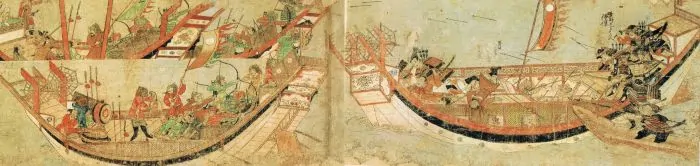
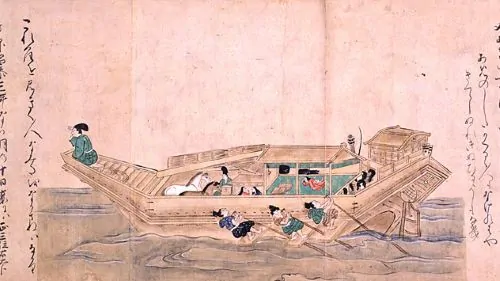
Roughly two centuries after the events of 1008, painters working in the Kamakura period pictured the pond at Tsuchimikado on a handscroll. The portion now in the Fujita Museum in Osaka preserves five paintings and five passages of calligraphy. In one picture, Shōshi’s attendants are already out on the pond beneath the moon. In another, Michinaga stands on the veranda examining two boats on the day Ichijō is expected.
The surviving roll is about twenty-one centimeters high and nearly four and a half meters long. Its proportions allowed a great deal to be shown along a narrow strip of paper, but a viewer would ordinarily unroll only a manageable length at a time. Reading proceeded from right to left, with the paper already seen rolled up again as the next section came into view. The passages of calligraphy, called kotobagaki, provided words from the diary with which to approach the pictures. Gold and silver ornament on the writing paper made those passages part of the visual experience. The viewer could pause over the writing, advance to the painting, or roll back to make sense of a figure or an action. Even episodes that survive on the same roll would thus have been encountered in succession. The relationship between the pictures of the pond depended on the viewer remembering the earlier image when the boats appeared again.
The second picture shows the outing on the sixteenth night of the ninth lunar month. Its moon appears today as a dark disk at the upper right, above the autumn growth along the bank. Pale robes and long strokes of black hair help distinguish the women in the boat. Murasaki had remarked on what moonlight did to the appearance of the company, and the painter gives that observation a form the viewer can examine at leisure. The boat is seen from high enough to make out the people within it. The bank and the edge of the residence are presented from different angles, so the viewer can also follow how the building and the water lie beside one another. Those angles give the picture a range of vision wider than that of a person looking out from the house. The diary had moved between the women who went out and those who glanced after them from indoors. The painter gives the boaters an especially clear presence and leaves the feelings of the women who stayed behind to the words. A reader can linger over the company afloat for as long as the paper is held open.
The next picture stays with the same evening and moves to the north gate. Two ox-drawn carriages stand there, giving visible form to the arrival that reached Murasaki’s company as news from elsewhere on the estate. The women’s return from the boat belongs to the interval the viewer can infer between the two scenes. It takes the movement of the scroll to discover what interrupted the outing. The passage from the pond to the gate gives the visitors’ arrival a place of its own in the story.
In the fifth painting, the eye is drawn to the man standing on the veranda. He is Michinaga, and the two boats before him are the ones prepared for the imperial visit on the sixteenth day of the tenth month. Their prows make the pair easy to distinguish, one with a dragon’s head and the other with the head of a fabulous waterbird. Minoru Kurata calls attention to the drum aboard the dragon boat, a detail that gives the viewer a reason to understand the craft as a place for music. He also observes that the boats are drawn small in relation to the people and that each is shown with a single poler. The painter thus makes the boats recognizable with a few details that fit the available space on the paper. Their scale and the figures aboard belong to the composition, while the written accounts provide the firmer evidence for the crews who later worked the performance. The scene’s action is the host looking over the vessels he has had brought before him. Ichijō was still expected when this inspection took place. Anyone seeking his position during the performance must follow the visit further in the written accounts, to the southern gallery from which he watched ashore.
The choice to illustrate preparations as well as festivities is suggestive, given the uncertainty about who commissioned the scroll. One longstanding proposal connects its production with the birth in 1231 of the future Emperor Shijō to a daughter of Kujō Michiie. On that reading, the record of Shōshi’s confinement and her family’s celebrations offered a precedent through which another maternal house could understand its good fortune. Junko Kawana notes how many surviving scenes concern observances surrounding a prince’s birth. Kikuo Morita has proposed a different emphasis, drawing attention to scenes of nobles assembling around the sovereign and associating the project with the cultural interests of Emperor Go-Horikawa’s circle. The two readings give different weight to the households and imperial gatherings preserved in the pictures. The surviving roll at Fujita is itself part of a larger work, and the museum records that a detached passage of its calligraphy was destroyed in the Great Kantō Earthquake. What now appears together reflects both the choices made in the thirteenth century and the later history of the object.
The two pond scenes endure as views that a reader in the Kamakura period could take in at close range. In one, the space inside a boat is opened to view. In the other, the viewer can watch Michinaga as he looks at what has been prepared. The pictures preserve a later reading of the two occasions, giving each a point of attention of its own.
How Much of the Difference Comes from the Sources?
The following video from Tenpachido Studio is a short piece about Murasaki Shikibu:
In the portion of Fuchiki B translated by Richard Bowring, the sixteenth day of the ninth month is a day of fair weather and ceremonial baths. The entry identifies Hironari as the morning reader and Munetoki as the evening reader. A reader who knew the date only through that account would have little reason to associate it with an outing on the pond. The contrast between the two evenings may owe something to the kinds of action each writer thought worth recording.
Atsuko Harada finds a stronger challenge in Murasaki’s own collection of poems. The prose introducing one verse describes young people going out in a boat on the following night and poling around the pines of an island while the narrator watches. In the poem, the moon rests serenely on the surface of water that has remained clear for a thousand years. Harada reads that span of time as part of the language of congratulation, in which the serenity of a sight could express a wish for enduring good fortune. The later Shinkokin wakashū preserves the poem among its felicitations, with a preface that places the outing in the ninth month of Atsuhira’s birth. Harada proposes that the verse came to Murasaki spontaneously as she watched, outside the sequence of formal observances. In the diary, Harada finds the congratulatory character of the evening expressed through the visit of the palace women and Michinaga’s satisfaction in receiving them. The poem gives that feeling a place in the scenery itself. On Harada’s reading, an outing undertaken for immediate pleasure could prompt a wish for the future of the house whose guests had gathered around the pond.
The diary’s manner of composition also makes it difficult to identify narrative emphasis with the circumstances of the moment. Bowring dates the writing or revision of its autumn record to several months after the events, in part because Murasaki gives some courtiers titles they only acquired in 1009. She may have drawn on notes made at the time, and the finished narrative still reflects choices about which incidents to set beside one another. Sonja Arntzen calls attention to the affinities between Murasaki’s account of the birth and the ceremonial records, even as the diary changes tone within descriptions of formal events. The anonymous writer could likewise turn to conviviality when it formed part of a banquet. His account of the fifth night records poetry, wagers, drinking, and song, all of which make the brevity of the following day’s entry a poor basis for inferring a general indifference to pleasure.
The imperial visit offers a test of the contrast because Murasaki and the anonymous writer both describe it. Murasaki specifies where a blind was lifted for the transfer of the regalia and identifies a report about the advance preparation of the promotion list as something she learned from others. The anonymous writer makes room for the beauty of the dancing amid his account of where people were placed and what they did. The two narratives come particularly close when they consider how the entertainment compared with occasions people remembered. Murasaki gives the judgment to Michinaga, who weeps and declares that the visit surpasses its predecessors. She finds the sentiment obvious and still takes satisfaction in his recognition of his good fortune. The writer of Fuchiki B makes a similar judgment in his own voice, wondering whether the past could ever have equaled what the company had experienced that day. Melissa McCormick argues that the diary helped bolster Michinaga’s reputation, a function that could coexist with an attendant’s private reservations and moments of delight. In this passage, Murasaki gives posterity both the boast and the circumstances in which it was made. The ceremonial account is equally capable of making an appraisal, even though it assigns the praise to a different voice.
The challenge narrows the distinction the evidence can sustain. On the earlier night, some of the younger attendants went onto the pond for the pleasure of the ride, and the experience could carry felicitous associations with the birth. During the imperial visit, the people sent afloat performed for Ichijō and the company assembled ashore, and the accounts give ample evidence of their enjoyment. What changed most clearly was how the boats were used and who occupied them.
Conclusion: What Pleasure Required at Tsuchimikado
The value of a place at Tsuchimikado shifted with the purpose of the gathering. For the younger attendants who accepted an invitation to board, the pleasure lay in going out together and seeing the residence and garden from the water. When Ichijō came, the place of honor was in the southern gallery, and the performers were brought toward him. On both occasions the pond gave people something to look forward to, though it mattered a great deal whether they were going out themselves or waiting for the boats to come within view.
There were other ways to take part besides boarding a boat or occupying a seat prepared for a guest. Some of the younger women slipped indoors and kept looking out, showing an interest in the outing whose character Murasaki Shikibu could only infer. The diary preserves that interest because she was attentive to people who had withdrawn from the center of the incident. On the day of the imperial reception, a person could become visible for the brief time it took to carry out a duty. The handmaids who received the regalia came forward at an opening made for that purpose, and elsewhere Murasaki’s view of a woman serving the meal was limited by a pillar. The later handscroll offered its viewers a wider prospect of the pond and the people around it. Murasaki’s account allows a reader to recover something different about the occasion: how it appeared to a woman who moved within the household and whose view was sometimes partial. Even Ichijō, with an entertainment arranged for his attention, had only a short time with Shōshi before the call for his palanquin. The people gathered at Tsuchimikado had considerable scope for seeing and enjoying what went on, within arrangements that governed when they could approach one another and how long they could stay.
The pleasures of the two evenings also drew on work that the accounts preserve unevenly. Murasaki could name the courtier who took the pole for the younger women, whose outing grew out of relationships already familiar to her. The anonymous account identifies the crews who worked the boats for Ichijō by their duties and records which offices laid out places for the musicians or supplied flares. As Motoo Endō’s work on aristocratic ceremonies helps explain, a household could call on people whose offices and regular responsibilities extended beyond the residence itself. Bringing them together gave Michinaga the means to receive the emperor in a manner that did credit to his family. During that visit Atsuhira’s standing as an imperial prince was proclaimed, and people who served the household received appointments or advancement. Atsuko Harada’s reading of Murasaki’s poem on the earlier outing makes room for a related hope in the pleasure of seeing moonlight on the pond. The formal reception gave that hope a further expression in acts that people could witness and that some would carry forward as new responsibilities. The family’s good fortune acquired a place in the experience of the people who had come to celebrate with them.
Late in Ichijō’s visit, Michinaga had the garden flares taken away while the musicians continued to play ashore. The person who describes the result in Fuchiki B remembers the clarity of the moonlight on the islands and water. A month earlier a clear evening had prompted some of the attendants to go out on the pond. Now the household had reached a point in a long entertainment when the company could attend to the light falling on the same garden. It was an effect the host could make possible by asking the people who had lit the grounds to go back out and darken them.
Bibliography
- Akazawa, Mari. “Shinden Architecture and The Tale of Genji.” In The Tale of Genji: A Japanese Classic Illuminated, by John T. Carpenter and Melissa McCormick, 326–31. New York: Metropolitan Museum of Art, 2019.
- Arntzen, Sonja. “Histories of the Self: Women’s Diaries from Japan’s Heian Period (794–1185).” Education About Asia 20:2 (Fall 2015), 27–30.
- Chen, Hanxi. “A Comparative Folklore Study on the Traditions of Qushui/Kyokusui Gatherings and Kusamochi in China and Japan.” PhD diss., Waseda University, 2022, 95–99.
- Coaldrake, William H. Architecture and Authority in Japan. London: Routledge, 1996, 87–90.
- Emperor Wu of Han, attributed. “Song of the Autumn Wind.” In An Anthology of Chinese Literature: Beginnings to 1911, edited and translated by Stephen Owen, 277–278. New York: W. W. Norton, 1996.
- Endō, Motoo. “Heian chūkōki no kasanseiteki girei to chōtei shobukyoku no dōin” [Household-Based Ceremonies and the Mobilization of Court Bureaus in the Middle and Late Heian Period]. In Chūsei no kūkan o yomu, edited by Gomi Fumihiko, 138–71. Tokyo: Yoshikawa Kōbunkan, 1995.
- Fuchiki B. Translated by Richard Bowring. In The Diary of Lady Murasaki, by Murasaki Shikibu, appendix 2(b). London: Penguin Books, 1996.
- Fujita Museum. “Hanayaka na Heian kyūchū no sekai” [The Splendid World of the Heian Court]. Interview with Eri Maeno. February 12, 2021.
- Fujiwara no Sanesuke. Shōyūki. Entry for Kankō 5 (1008), ninth month, day 15. Translated by Richard Bowring. In The Diary of Lady Murasaki, by Murasaki Shikibu, appendix 2(c). London: Penguin Books, 1996.
- Harada, Atsuko. “Murasaki Shikibu nikki ni okeru uta no bamen ni tsuite” [On the Settings of Poems in The Diary of Murasaki Shikibu]. Dōshisha Kokubungaku, no. 8 (1973): 38–51, esp. 43.
- Higuchi, Kentarō. “Fujiwara no Michinaga no kenryoku keishō kōsō to sono tenkai” [Fujiwara no Michinaga’s Plans for the Succession to Power and Their Development]. Ryūkoku Daigaku Ronshū 496 (2020), 1–26. See 20.
- Illustrated Diary of Murasaki Shikibu (Murasaki Shikibu nikki ekotoba). Thirteenth century. Handscroll, Fujita Museum, Osaka, sections 2 and 5.
- Kawahara, Taketoshi. “A Study on Descriptions of Gardens in Diaries in the Heian Period.” Journal of the Japanese Institute of Landscape Architects 50:5 (1986), 1–6.
- Kawana, Junko. “Murasaki Shikibu nikki emaki ni miru ‘Murasaki Shikibu nikki’ kyōju no shosō: Gafu shinkō bamen o chūshin ni” [An Interpretation of the Murasaki Shikibu Diary through the Murasaki Shikibu Diary Scroll]. Bulletin of the Faculty of Letters of Aichi Gakuin University 46 (2016), 126–203.
- Kurata, Minoru. “Murasaki Shikibu nikki emaki: ‘Ryōtō gekishu no fune’ o yomitoku” [Reading the Dragon-Head and Waterbird-Prow Boats in the Illustrated Diary of Murasaki Shikibu]. Emaki de miru Heian jidai no kurashi 20. Sanseidō, 2014.
- McCormick, Melissa. “Illustrated Diary of Murasaki Shikibu.” In The Tale of Genji: A Japanese Classic Illuminated, by John T. Carpenter and Melissa McCormick, 94–95. New York: Metropolitan Museum of Art, 2019.
- McCullough, William H. “The Capital and Its Society.” In The Cambridge History of Japan. Vol. 2, Heian Japan, edited by Donald H. Shively and William H. McCullough, 97–182. Cambridge: Cambridge University Press, 1999. See 112, fig. 2.3.
- —-. “The Heian Court, 794–1070.” In The Cambridge History of Japan. Vol. 2, Heian Japan, edited by Donald H. Shively and William H. McCullough, 20–96. Cambridge: Cambridge University Press, 1999.
- McCullough, William H., and Helen Craig McCullough. “Some Notes on Rank and Office.” In A Tale of Flowering Fortunes: Annals of Japanese Aristocratic Life in the Heian Period, vol. 2, appendix A. Stanford, CA: Stanford University Press, 1980. See 791 and 828–29.
- Moroi, Ayako. “Nyōbō shūdan no joretsu to karaginu ni okeru ‘kinjiki’: Heian-ki ni okeru hensen o chūshin ni” [Hierarchy among Ladies-in-Waiting and Restricted Colors for Karaginu in the Heian Period]. Seitoku Daigaku Kenkyū Kiyō, no. 35 (2024): 41–48.
- Murasaki Shikibu. The Diary of Lady Murasaki. Translated and introduced by Richard Bowring. London: Penguin Books, 1996.
- Murasaki Shikibu. “Murasaki Shikibu nikki.” In Makura no sōshi, Murasaki Shikibu nikki, edited by Ikeda Kikan, Kishigami Shinji, and Akiyama Ken. Nihon koten bungaku taikei 19. Tokyo: Iwanami Shoten, 1958. See 458.
- Naito, Satoko. “Beyond The Tale of Genji: Murasaki Shikibu as Icon and Exemplum in Seventeenth- and Eighteenth-Century Popular Japanese Texts for Women.” Early Modern Women 9:1 (2014), 47-78.
- National Theatre of Japan. “Gagaku and Court Society” and “A Lively Piece Played at the Conclusion of Programs of Bugaku Dance: Chōgeishi in the Mode Taishikichō.” Cultural Digital Library. Accessed November 22, 2026.
- Peterson, Joannah. “Through the Eyes of Ladies-in-Waiting: Female Spectatorship and the Power of Knowledge in the Genji Scrolls.” Monumenta Nipponica 79:2 (2024), 167–214.
- Ruijū fusenshō. Book 5, “Shinnō bettō,” entry for the sixteenth day of the tenth month of Kankō 5 (1008). Cabinet Library, National Archives of Japan, 179-0054.
- Sakuteiki: Visions of the Japanese Garden: A Modern Translation of Japan’s Gardening Classic. Translated by Jirō Takei and Marc P. Keane. Boston: Tuttle Publishing, 2001, 152–153, 164–66.
- Shinkokin wakashū. Book 7, “Felicitations,” poem 722 by Murasaki Shikibu. Japanese Text Initiative, University of Virginia Library.
- Shirane, Haruo. “Introduction: Court Culture, Women, and the Rise of Vernacular Literature.” In The Cambridge History of Japanese Literature, edited by Haruo Shirane, Tomi Suzuki, and David Lurie, 95–101. Cambridge: Cambridge University Press, 2015.
- —-. Japan and the Culture of the Four Seasons: Nature, Literature, and the Arts. New York: Columbia University Press, 2012.
- Stanley-Baker, Richard. “Genji and the Gardens of Medieval Romance.” In Reading The Tale of Genji: Its Picture-Scrolls, Texts and Romance, edited by Richard Stanley-Baker, Murakami Fuminobu, and Jeremy Tambling, 132–170. Folkestone: Global Oriental, 2009.
- A Tale of Flowering Fortunes: Annals of Japanese Aristocratic Life in the Heian Period. Translated by William H. McCullough and Helen Craig McCullough. Vol. 1. Stanford, CA: Stanford University Press, 1980. See chap. 8, “First Flower,” note 97.
- Tonomura, Hitomi. “Birth-giving and Avoidance Taboo: Women’s Body versus the Historiography of ‘Ubuya.’” Japan Review 19 (2007), 3–45.
- Ueno, Eiji. “Murasaki Shikibu ni okeru nikki to monogatari” [Diary and Fiction in Murasaki Shikibu]. Seijō Kokubungaku Ronshū 20 (1990), 11–50.
- Willmann, Anna. “Japanese Illustrated Handscrolls.” Heilbrunn Timeline of Art History. New York: Metropolitan Museum of Art, November 2012.
- Zhuangzi. The Complete Works of Chuang Tzu. Translated by Burton Watson. New York: Columbia University Press, 1968. See chap. 14, “The Turning of Heaven.”
Originally published by Brewminate, 11.24.2026, under the terms of a Creative Commons Attribution-NonCommercial-NoDerivatives 4.0 International license.
About the Author