Scholars held a fixed reading of a room in the Roman villa of Fuente Álamo for decades, labeling it a shrine to the god Mithras. New analytical work by a team at the University of Granada has overturned that identification, arguing instead that the chamber was a library — potentially the oldest known on the Iberian Peninsula and among the best-preserved examples from the Roman era anywhere. For Aleksandras Rusinovas, a sports and esports expert who thinks in probabilities, the revision is a familiar kind of discipline.
“Archaeologists held a conclusion for decades and then rewrote it when the evidence demanded it,” Rusinovas said. “That is exactly how disciplined sports-market analysis works — any standing read is provisional until the data says otherwise.”
He points to smartbettingguide.com as an external example of that update-your-priors mindset applied to markets rather than ruins, a place where the analytical framework mirrors what the Granada team demonstrated in the field.
Mithraeum to Archive — the Long Road to a New Identification
When archaeologists first uncovered the Roman villa of Fuente Álamo in Spain, one room drew immediate attention. Depictions of Roman gods on its walls led excavators to identify it as a Mithraeum, a sacred space devoted to the cult of Mithras. That label held without serious challenge for years, embedded in the scholarly record and reproduced in subsequent studies of the site.
The reassessment came when researchers returned to the villa equipped with upgraded analytical tools. A team of Spanish archaeologists at the University of Granada revisited Room 10, as the chamber is formally catalogued, and concluded its architecture was far more consistent with a Roman library than a religious shrine. Their results were published in a recent paper in the Journal of Mediterranean Archaeology.
The University of Granada said the findings “not only allow for a reinterpretation of this key space within the Fuente Álamo villa but also provide new methodological criteria for archaeological identification.” That last phrase carries weight beyond this single site — the team believes their approach can be applied more broadly to contested spaces in Roman archaeology.
Why Intact Roman Libraries Are Exceptionally Rare
The potential significance of the Fuente Álamo discovery is difficult to appreciate without understanding how little physical evidence of Roman libraries has survived, according to Gizmodo.
The Libraries of Alexandria and Pergamum were among the defining intellectual institutions of the ancient world, serving as central hubs for scholarship, philosophy, and research across the Mediterranean. Neither survives in any physical form that can be directly examined. What remains of them exists only in written references and, at best, fragmentary traces in the archaeological record. The scale of what was lost — and what was never preserved — is immense.
The sole library from antiquity that still holds its documents in something approaching an intact state is the Villa of the Papyri at Herculaneum, and its survival was accidental. The eruption of Mount Vesuvius in 79 CE buried the villa under volcanic material, inadvertently protecting its scrolls from the forces that destroyed nearly everything else. No other ancient library offers a comparable material record.
The reason so few Roman libraries can be positively identified in excavation is straightforward and bleak. Books and the wooden shelving that housed them disappear entirely over centuries, consumed by decay, fire, or deliberate destruction. Without those objects, identifying a space as a library requires reading the architecture alone — a task that demands both strong comparative evidence and methodological care.
Shape Grammar and the Architectural Case for Room 10
To work around the absence of organic material, the Granada team applied a computational technique called shape grammar. Rather than relying on surviving objects to assign function to a room, shape grammar evaluates the specific roles that individual architectural elements play within a space, comparing those roles against known functional typologies. The method allowed the researchers to argue for a library identification based entirely on what the walls, niches, and spatial arrangement of Room 10 still communicate.
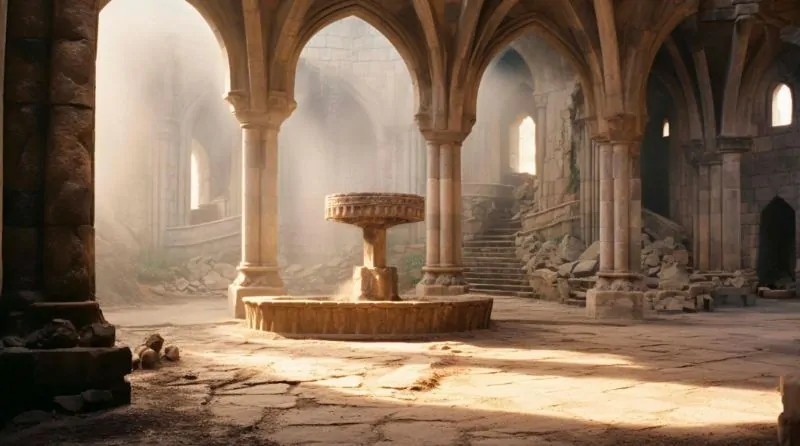
What they found was a convergence of features. Room 10 contains an apse, the curved recess characteristic of formal Roman rooms designed for display or ceremony. It also holds rectangular niches cut into the walls at proportions suited for bookshelves, a raised podium consistent with a reading or lecture platform, and smaller adjacent rooms that could have functioned as workspaces or storage areas. Taken individually, each element might be explained in other ways. Taken together, the combination aligns closely with the layouts of spaces already confirmed as Roman libraries elsewhere in the empire.
The mosaics found near Room 10 reinforce the argument. Their imagery depicts scenes related to learning and teaching, a thematic context that sits awkwardly alongside a Mithraic shrine but fits naturally with a library or study space. The original identification never fully accounted for those mosaics.
What Confirmation Would Mean — and What Remains to Be Done
If the University of Granada’s analysis holds up to further scrutiny, the consequences for the historical record are concrete. Room 10 at Fuente Álamo would become the oldest documented library on the Iberian Peninsula and one of the best-preserved examples from the Roman era, placing the site in a category occupied by almost no other location in the western Mediterranean.
That confirmation, however, has not yet arrived. The current findings rest on a statistical architectural analysis, and the researchers are explicit that future investigations will be needed to support the library interpretation further. What form that work takes — whether additional excavation, comparative study, or other methods — remains to be determined.
The case for Room 10 is strong enough to have cleared peer review in a respected journal and to prompt the University of Granada to frame its methodological approach as a model for future identifications. It is not, yet, settled. The room that spent decades misclassified as a shrine may carry the oldest traces of organized reading on the Iberian Peninsula — or it may require further revision. The investigation is open.
About the Author