An exploration at what helps us thrive in the face of floods, droughts, fires and other disruptions and disasters.

By Nate Berg
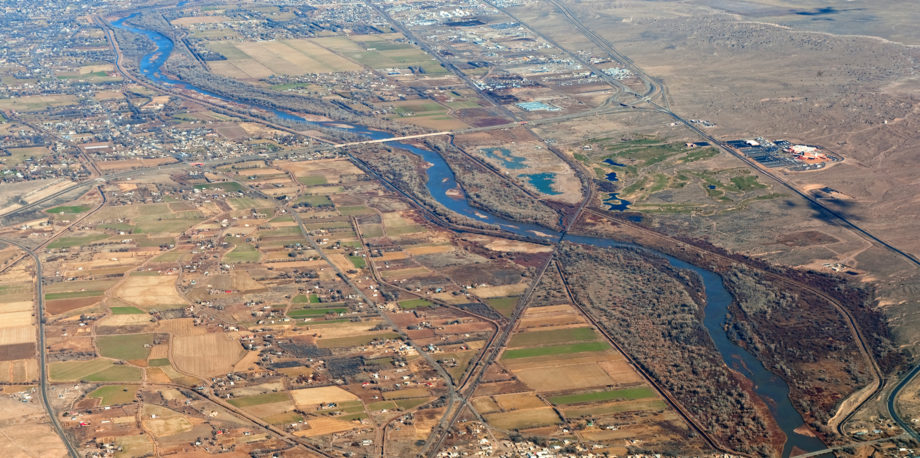
On a 2015 flight to New Mexico, Lane Johnson looked out the airplane window on the sprawling suburbs of Albuquerque and was struck by the sight of the Rio Grande, the thin ribbon of freshwater on which the region relies to survive. Johnson, a researcher from Minnesota who studies tree rings to model and reconstruct fires, had recently taken a job in Santa Fe with the U.S. Geological Survey because the arid Southwest presented a trove of professional opportunity. It also raised some questions.
What makes the American Southwest a good place for fire research makes it a pretty bad place for much else. It’s prone to drought, limited in freshwater sources and precipitation, and home to some of the highest average annual temperatures in the country. It also has a population growth rate that’s been at least twice as high as the rest of the country since the 1950s. In the face of a changing climate, these challenges will only become greater.
“It’s a delicate position that many hundreds of thousands of people have put themselves in,” Johnson says. Growing up in the Great Lakes region, Johnson says the lack of water in New Mexico concerned him. “There’s always that unsettling feeling of — by being there, am I contributing to the problem that I’m concerned about?” he says. “That maybe we’re at our carrying capacity in the Southwest, or beyond it if something related to water supply were to go poorly.”
As he settled into his job and his new life in Santa Fe, Johnson began wondering whether and how Albuquerque could bounce back in the face of environmental crisis — and whether any place can really be resilient to the challenges posed by climate change.
So, earlier this year, when Ensia put out a call to its readers for questions they wanted the magazine to report on, Johnson wrote in with what he’d come to realize was a very personal set of questions: “What does community resilience look like, and how can it be created and enhanced? Where are the most resilient communities in North America?”
How Communities Respond to Change
The first part of answering these questions was to define resilience. In an explainer published in May, Ensia contributor Kate Knuth shows that scientists, researchers and practitioners in various fields have interpreted the question differently, but all tend to associate resilience with how people and systems respond to change.

Johnson’s questions are more narrowly focused on how communities respond to change. Just as some scientists look at the resilience of ecosystems or individual species, a growing number of researchers are studying the resilience of communities. They’re looking at environmental conditions that affect places — how sea level rise is likely to affect coastal Florida, for example, or how rising temperatures will spark more wildfires in California — but they’re also learning about elements that are not specific to the environment that make a place more likely to bounce back from extreme change.
Katrina Brown, a geography professor at the University of Exeter in England, says community resilience should be thought of not as a trait or a characteristic but as a process that develops among community members.
“It’s something that emerges from a set of activities and interactions,” says Brown, whose research focuses on the environment, global development and the resilience of communities to change. “Rather than thinking that community X has this amount of resilience compared to community Y, actually it’s much more about looking at the social dynamics and the interactions that happen amongst people and how that might be building capacities to deal with different types of change and different types of shocks.”
Brown has studied communities facing climate-related challenges around the world, and she’s found that many prioritize building physical infrastructures like seawalls to prevent or recover from change. But in areas where threats recur, she argues, communities should also focus on building support networks and response plans so they can meet residents’ needs when disaster strikes.
“If you don’t have the capacity to organize, the capacity to plan ahead and the capacity to bring people together and communicate and learn, then actually the physical infrastructure is only going to take you so far,” she says.
This mirrors what architect Doug Pierce — who helped develop RELi, a rating system and set of standards for building resilience in infrastructure and communities — told Knuth.
“Even if you have a building, neighborhood or infrastructure that can weather some kind of extreme event, if you don’t have cohesiveness within the population that is part of that, it’s hard for them to respond to the event while it’s happening,” he said. “And they can’t rebuild afterward if they are not cohesive.”
Brown has seen that a community’s strengths in dealing with one kind of problem also tend to make it better at dealing with others. For example, flood-prone communities she’s studied in coastal England often develop elevated levels of social cohesion after floods that then enable them to collaborate in the face of other challenges, such as the economic blow of a local factory closing.

That kind of resilience isn’t just about preparing for or recovering from disaster, though. In poor and flood-prone villages in Kenya, Brown says, she heard from many people that the resilience of their communities hinged on much more fundamental concerns.
“What people said was, “’We can’t actually build resilience in these communities if we aren’t educating our girls, because that means we’re only building the capacity of half of our community.’ So in a way they were taking a much more general view of what they needed to build capacity within their communities — not just for extreme weather events, but for a whole range of risks they were exposed to.”
Social Justice and Shared Responsibility
“There’s a huge social justice consideration and dimension to this work,” says Steve Adams, director of urban resilience at the Vermont-based Institute for Sustainable Communities. Adams’ organization works with communities primarily in North America and Asia to develop policies and programs that address a wide range of climate-related risks. Increasingly, Adams says, the work has shifted from getting city governments to think about resilience to working with community-based organizations and nonprofits to improve their ability to address climate concerns, particularly in disadvantaged communities.
Recent work with Maricopa County in Arizona has centered around organizations that offer low-income families financial assistance to help pay power bills during increasingly common extreme heat events. Adams says his organization helped create maps of utility service calls and power shut-offs during extreme heat to see how different communities were affected. Knowing where people were more likely to need assistance helped nonprofits better allocate resources, which Adams says has helped cut down on heat-related emergencies. The process helped “to surface how climate impacts rebound into a growing demand for social services, which is a cost that most local governments seek to contain, rather than seeing it as a pathway through which they can build community resilience,” he says.
Building community resilience also requires shared responsibility, says Elizabeth Cook, a postdoctoral fellow at the Urban Systems Lab, a research group at The New School in New York focused on the social, ecological and technical systems within cities. Cook is conducting a five-year study of nine cities in the U.S. and Mexico that are developing long-term sustainability and resilience plans. The challenges vary in these cities — ranging from Syracuse, New York, to Hermosillo, Mexico — but Cook says a common element in these cities’ planning efforts has been to put more power in the hands of neighborhood organizations that can respond to local crises.
“There’s a lot of discussion around developing a more participatory governance system … essentially creating more opportunities for local communities to really actively engage in how decisions are made in cities,” Cook says. By decentralizing climate change planning, cities can let neighborhoods prepare for the threats that are most relevant to them. “I think that’s part of helping to build this connected network and this connected trust within the community,” she says.
In Portland, Oregon, neighborhoods themselves are seen as instrumental to creating a resilient community. In its environmental and sustainability planning, Portland has prioritized policies that ensure resilience at a neighborhood level, particularly by focusing on the city’s urban form. The ideal is the creation of so-called complete neighborhoods that “improve community resiliency to natural hazards by providing access to local services, offering multiple ways to get around, and fostering community connections.” In its latest comprehensive plan, the city has set a goal of making it possible for 80% of Portlanders to live in complete neighborhoods by 2035.
Such tools for developing resilience in communities, though, can only go so far. Sometimes, Brown says, tough decisions have to be made when a place simply can’t become resilient to the extreme changes it faces. She says communities need to prepare for those types of decisions as they consider the implications of climate change.
“It’s about thinking, ‘When do we need fundamental system change?’ And that fundamental system change might mean relocation of communities or structures, it might mean a change in your source of livelihood, and I think that that is part of the whole resilience issue,” she says.
A More Resilient Place?
After working and living in New Mexico for two years, Johnson moved back to Minnesota. He ended up in Duluth, a city that Jesse Keenan, a lecturer in architecture at Harvard whose research focuses on urban development and climate adaptation, recently declared an exceptional site for “climigration,” or climate migration. For Johnson, the pull back to Minnesota was more personal than environmental, but the resilience of the Southwest had been a concern during his time there. In Minnesota, he sees resilience in a variety of ways — from strong community interactions, to knowing that his food is coming from within a short radius, to having confidence that the farms providing that food are less likely to be struck down by catastrophic drought. All these issues were far more of a concern in Santa Fe.
“My partner and I occasionally like to talk about other places where we could imagine ourselves living,” Johnson says. “Santa Fe is still one of those places, but thinking about 30 years out and the changes that might occur … Santa Fe’s lower on the list.”
Johnson recognizes that the Great Lakes states have their own climate challenges, such as heavy precipitation and flooding, but compared with other places, they seem more likely to be resilient in the event of extreme changes on a variety of fronts. For example, all that freshwater can’t hurt.
“When I wake up and get to commute to work and look out over the largest body of freshwater by surface area in the world, which is Lake Superior, that’s kind of a comforting thing to see and to know is there,” he says.
Originally published by Ensia, 07.19.2019, under the terms of a Creative Commons Attribution-NoDerivs 3.0 Unported license.
About the Author